54.1 F
Davis

Davis, California

Tuesday, December 23, 2025
Home Blog Page 481

The plight of the student gamer

ALLYSON KO / AGGIE

Homework and video games are unlikely duo, but not at UC Davis

“Call of Duty: Black Ops 4” and “Red Dead Redemption 2” were both released in October and more video games, such as “Fallout 76” and “Battlefield V” are scheduled to release later this year. As the big game titles keep flowing in, 2018 proceeds to be one of the best and brightest years for video games. Which poses the question: How does the full-time student balance school and video games?

UC Davis houses a large community of video game enthusiasts. A few student gamers, who requested to remain nameless and go by their gamertag, gave compelling insight on how to balance the two worlds. Some find it harder than others, having to dial back school work to ensure they have enough time to game, while others use video games as a reward for having completed their studies.

Nevertheless, all of the students had great knowledge on how to balance leisure and learning, which is applicable to more than just gaming.

A student who goes by the gamertag G3L0 prioritizes student life during the week and gaming on the weekends.

“Of course, I have to play at least an hour or two of video games some nights, but I try to limit it at that,” G3L0 said. “Either I set an in-game deadline like ‘finish this quest’ or ‘play 4 rounds’ or I set a timer — once that’s up then I need to get back to studying. Same with studying, I tell myself to do it for a decent amount of time and then I let myself game. It’s important to try and give studying more time than gaming, though.”

Another student-gamer, PinkPikachu finds the greatest difficulty to be time and how to fit gaming into her schedule.

“During low-unit quarters, I can easily overdo it, but during high-unit quarters I sometimes go two weeks without playing,” PinkPikachu said. “When I sit down to play a game, I want to play it for at least two and a half or three hours, minimum. That doesn’t seem like a long time until you start thinking of other obligations like classes [and] homework and that three hours is a minimum, which can easily turn into five or six.”

Balancing video games and school also depends on what game PinkPikachu is playing. More competitive games require more attention, but leisure games are easier to put a time limit on.

“Last year, I was so invested in ‘Overwatch’ that every Thursday I’d come home from section at 6:30 p.m., me and four to five friends would queue up, and then we’d play until midnight,” PinkPikachu said. “I was so intent on ranking up that I’d sit there for hours with a break or two in-between. By nature, ‘Overwatch’ is a volatile game, and you don’t really know how many games it’ll take to get to the rank you want, so you can be sitting there for hours.”

Another student gamer who goes by the gamertag MantisToboggan is so dedicated to gaming that he has altered his schedule, so game time can be a priority. MantisToboggan dropped one class and changed another to pass/fail, so that he could log more hours on “Red Dead Redemption 2.”

“I have been waiting for this game for about eight years, so I had planned to take a lighter workload this semester,” MantisToboggan said. “But I regret it now because my new schedule could possibly postpone my graduation date.”

The greatest difficulty gamers like G3L0 have faced is staying disciplined in the time they dedicate to video games and homework.

“I love video games, especially this game,” MantisToboggan said. “So the greatest difficulty for me is taking my homework seriously when all I really care about right now is the game. [My] second greatest difficulty is tossing relationships into the mix and trying to find a good time for friends [while] also getting your gaming fix. It’s even harder if your friends aren’t really gamers because then you can’t even talk about video games!”

Gamer PinkPikachu advises practicing self-control, which G3L0 agrees with.

“If I’m playing something single-player like ‘Final Fantasy XV,’ or not as competitive like ‘Dead By Daylight,’ I have pretty good self-control and can cut myself off after playing for a certain amount of time,” PinkPikachu said. “Games can be pretty addictive, so it’s important for people who like to game to practice self-control.”

Unlike his peers, MantisToboggan felt otherwise.

“Listen, I have a whole camp of people at Horseshoe Overlook who are relying on me to supply provisions for the camp so we can head back east,” MantisToboggan said. “I can’t be thinking about homework.”

The struggle of gaming and being a student may be a difficult one, but at UC Davis, the two worlds have a means to be combined.

In an upper-division course taught by Stephanie Boluk, an associate professor of both English and cinema and digital media, and Patrick LeMieux, an assistant professor of cinema and digital media, these student gamers thrive in a class called Video Games and Culture (CTS 172) which covers everything from making a video game to making a living playing video games.

According to these students, the homework in this class revolves around beating, building and understanding video games. So rather than attempting to balance homework and video games, why not take a course where video games are the homework?

Written by: Clay Allen Rogers – arts@theaggie.org

Review: Can You Ever Forgive Me?

CAITLYN SAMPLEY / AGGIE

Melissa McCarthy’s movie portrayal brings a criminal to life

“Can You Ever Forgive Me?” is a honest look into real-life writer Lee Israel’s criminal career in the 1990s. The film, directed by Marielle Heller, opens with a disheartened Israel, whose celebrity biographies were no longer turning a profit. Behind on rent and swamped with her sick cat’s veterinary bills, Israel turns to a life of crime. She comes across a letter from a well-known author and discovers it’s worth a small sum to New York City’s many used bookstores.

More interesting content, however, could bring in more money, which is what Israel soon learns as she dives into the world of literary forgery. Purchasing various typewriters to match the typefaces and age of the letters, Israel begins embellishing letters and passing her own writing off as the work of Dorothy Parker, Ernest Hemingway and other deceased authors. Israel graduates to replacing archived letters with her own fakes and sells the originals to collectors.

As Israel’s crime spree takes off, the film similarly picks up speed. Israel, who was often described as having a difficult personality, is portrayed brilliantly by veteran comedic actor Melissa McCarthy. In “Can You Ever Forgive Me?” McCarthy transforms into a reclusive alcoholic and does so in a way that avoids stereotypes and an overly villainized portrayal, emphasizing how Israel is still human despite her transgressions.

Israel soon finds an accomplice in the dashing hedonist Jack Hock, who becomes Israel’s only friend (besides her cat, Jersey). Israel’s intensive research and writing dexterity combined with Hock’s street-smarts and relaxed morals produce and sell over 400 letters in a two year period.

“I’m a better Dorothy Parker than Dorothy Parker,” McCarthy, as Israel, brags in the film.

In real life, Israel identified as lesbian and Hock was openly gay, which the film deals with in a respectful, matter-of-fact way.

“[Sexuality is] a part of who you are, and it’s integrated into your being from the beginning,” McCarthy told Curtis M. Wong, during an interview with the Huffington Post. “It shouldn’t be like this separate entity that’s added on, like you picked it up along the way.”

A major theme in “Can You Ever Forgive Me?” is Israel’s reclusive nature. Her fear of intimacy becomes apparent through an encounter with an ex-partner and by the harsh criticism of her literary agent, who berates Israel for hiding behind others’ lives in her biographical writing. Even Israel’s letter forgeries, although masterfully written, contain nothing of their writer.

“Can You Ever Forgive Me?” is an adaptation of Israel’s 2008 memoir of the same name, which is her most intimate work and details her years as a literary forger. In this memoir, she considers the forgeries to be her best work.

The film adaptation captures Israel’s sassiness and caustic wit. Despite the depressing tone of the film there are many humorous moments, placing it in the genre of dark humor. The film does not attempt to judge its characters or imbue their stories with a positive message. The Lee Israel on screen is the same cat-loving, cranky Lee Israel many came to know, but perhaps not love. “Can You Ever Forgive Me?” is an authentic portrait that’s worth a view. It is currently showing at the Davis Varsity Theatre.


Written by: Cheyenne Wiseman — arts@theaggie.org


Humor: Man who smells good confused as to whether he himself smells good or his ability to smell is good

DAVIS WHALEN / AGGIE

It’s a classic conundrum

Holding his arm up to his face, Tyler S. Mell, or “Nose Goes,” as he is more affectionately known by his drinking buddies, takes a good whiff. His eyes roll back in his head as a slight moan escapes his lips. They open again, concerned and searching.

“I thought I used to know the difference,” Mell said longingly. “But maybe I just don’t nose anymore.”

Mell recently suffered a nervous breakdown following an existential crisis anyone can empathize with — not knowing whether his sense of smell allows him to smell good or that he smells good.

“It’s like, on one hand, there’s the grammar issue,” Mell said. He breathed through his nose, and every sniff is followed by a shudder and then a strange popping noise from somewhere inside his nose. Each time it occured, I grew increasingly close to vomiting in rage.

“From what I understood before, it’s just smelling well, not good,” Mell said. “But then recently, an English professor buddy of mine patted me on the back after I told him I smelled cyanide dissolving in his drink and told me, ‘Damn, you smell real good!’ So now what am I supposed to think? Especially when that same night he kept breathing over my shoulder and giving me a thumbs up.”

Mell also said his dating life has suffered as a result of his confusion. On several occasions, he recalled using his signature scent, “Le Nez Mignon,” before meeting a lady friend. Before leaving his apartment, however, he would often “get a sudden urge” to smell himself in order to settle his internal struggle.

Of course, this ended as expected at this point in our story — a missed date, hours of smelling himself and then spending the rest of the night applying combinations of food onto his skin in hopes of finally solving this confusion, only to find that the paradox deepens with each added layer.

Mell looked up at me toward the end of our interview. He requested that I allow him one question of his own, which I granted. After a silent moment, he sniffed.

“What about you, Shaw? How do you smell?” Mell narrowed his eyes at me as he sniffed my fear.

“Tell your readers to really think deeply about it, too. I want to know if I’m the only one who smells good.”


Written by: Conner Shaw — cjshaw@ucdavis.edu

(This article is humor and/or satire, and its content is purely fictional. The story and the names of “sources” are fictionalized.)

Brixmor Properties proposes new plans for University Mall

0
CAITLYN SAMPLEY / AGGIE

Plan calls for complete remodeling of most stores

University Mall, a 1966 establishment, is soon to be remodeled. Brixmor Property Group, Inc., the landowners of University Mall, have made plans for a redevelopment of the mall in order to better suit the needs of the Davis community. Andrew Gracey, the vice president of Brixmor, explained the fundamentals of the redesign.

“Originally, we went in there, to the city, to look at either [demolishing] it or the redevelopment of that center,” Gracey said. “Some of the space and the way it’s laid isn’t the most functional, so we were going to address that. The feedback we’ve been getting has been welcoming, and the center could use some redevelopment.”

The proposal is currently under review by the city of Davis. George Phillip, a land use and zoning attorney, outlined the public process.

“The scoping meeting that will be held in the next 30 days will be the first opportunity where there is a notice that will go out to the public,” Phillip said. “People can attend that scope meeting and provide feedback for the project in terms of what they think [and also] environmental issues that they want analyzed. Then, that will be taken into consideration. It will take about five months to prepare. Once that is released, there is another one that is released and a 45-day comment period. Then there will be public hearings.”

The redevelopment has called for the complete demolition of 90,653 square feet of the existing mall to create a new mixed-use development. Brixmor plans to refurbish not only the current stores but also add new shops and residential buildings. Approximately 150,000 square feet are being set aside for retail, restaurants and other uses.

“We’re looking for a retail mix,” Gracey said. “Our goal is to then heavily seek the tenants that we would like to come over here and be able to be successful [in order] to provide those services. [The mall] would work well and be something that would be special, with not only the students but with the community as well.”

In order to accommodate the increasing demand for housing, Brixmor has also proposed 264 multi-family residential units spanning 1,124 square feet of the property. These new houses will consist of one, two, four or five bedroom units and a total of 894 beds.

In addition to the many new buildings and parking structures, the proposal includes outdoor lounges, benches and other outdoor accommodations for residents. It will also include a pool and a workout room.

The proposal also calls for the addition of a multi-level parking structure and ground level parking. The structure will have 693 total parking spaces, with 264 being reserved for residents and the rest for retail use. Currently, there are 427 parking spaces. Along with parking availability, electronic charging stations may also be added, but are not built into the formal plan as of now.

Bike parking is planned for the first level of the parking garage, as well as 124 additional spaces outside any retail stores. One bike slot will be provided per bed.

University Mall has been a part of the Davis Community since its opening in 1966. In 1970, the mall added Lawrence’s, a department store. That space is now occupied by Cost Plus World Market. In 1999, the mall went under a large renovation, relocating many long-standing businesses. In 2004, the mall was acquired by Brixmor, which is now the current owner.

Eui Hyung Lee, a first-year economics major, expressed his appreciation for the renovation.

“My first impression [of the mall] wasn’t positive,” Lee said. “When I went there, I didn’t really like it. There were no features that grabbed my attention. It looked empty and mundane. [The renovation] would definitely attract more people. It looks modern. It really resembles current outlets that I usually go to. It [is surprising] how it can accommodate more people and provide more parking.”


Written by: John Regidor — city@theaggie.org


Davis Community cleans up E Street Plaza in “Make Downtown Davis Sparkle” event

1
MICHELLE BYARS / COURTESY

Davis Chamber of Commerce hosts first of many quarterly downtown clean-up events

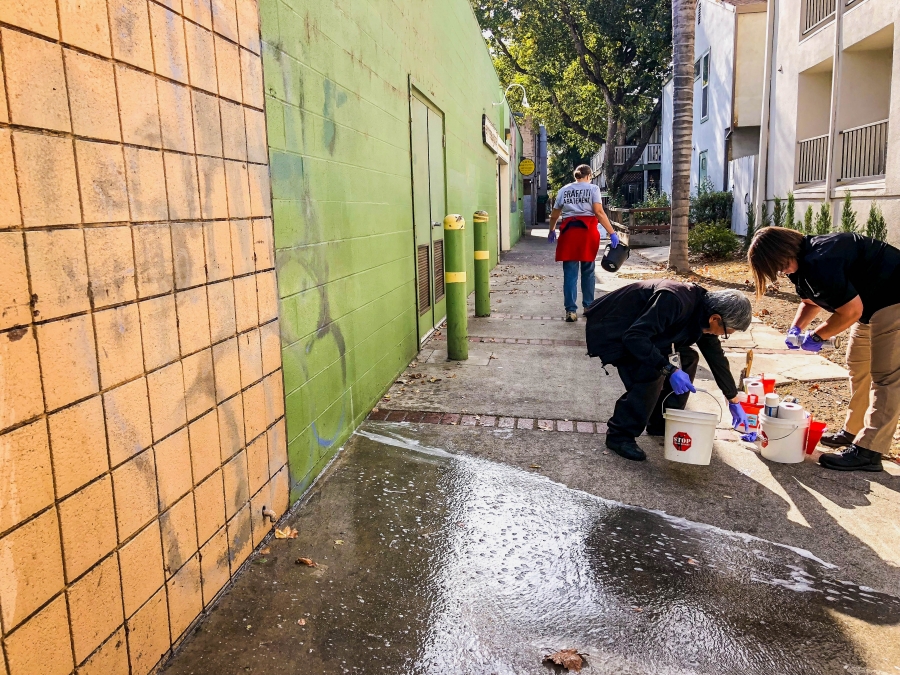
E Street Plaza was scrubbed clean by Davis community members on the morning of Sunday, Nov. 3. With sponges, rakes and power washers in hand, the volunteers left the plaza spotless.

The Davis Chamber of Commerce and the Davis Police Department hosted its first “Make Downtown Davis Sparkle” event, a downtown cleanup that the DCOC hopes will be held monthly or quarterly. The area that the volunteers cleaned on E Street stretched from the Chamber of Commerce building to E Street Plaza.

The E Street Plaza was identified by the police department as the area that would benefit most from being cleaned. For Sarah Worley, the city of Davis business engagement manager, the E Street Plaza is a central hub for activity downtown, with many community events occuring at the plaza. One such event that would benefit from a clean plaza is the upcoming annual tree lighting ceremony.

“As the first time out, the decision was to focus the energies and the volunteers on the E Street Plaza, which is really the heart of the downtown,” Worley said. “Also, part of the concept is to clean up our downtown in anticipation of a lot of holiday shoppers coming and enjoying our downtown. So this will be one of what we hope will be many, many, many events.”

Darren Pytel, the Davis chief of police, had considered the idea of cleaning downtown for quite some time.  He introduced it during a Chamber of Commerce “Professionals Helping to Re-Envision Davis” subcommittee meeting three weeks before the event.

“[PHRED tries] to find actionable items and take action, and this is one of the items that the police brought up to take action [for],” said Carolyn Stiver, the vice chair of the Board of Directors for the DCOC. “One of the biggest reasons [to take action] is civic pride. When people put in a little bit of elbow grease and a little bit of sweat equity, then they have more pride in the community at large and they’re more likely to keep it clean.”

According to Stiver, around 30 to 40 participants showed up to volunteer. Although the event was scheduled to be held until 11 a.m., the volunteers cleaning up started wrapping up early at 9:30 a.m.

Among the volunteers were city employees, DCOC ambassadors, private citizens and representatives from many private downtown businesses. According to Stiver, some businesses that made an appearance included the owner of Pinkadot and the general manager for Woodstocks.

“We had a great turnout this morning,” Stiver said. “Nobody wants to be the only person showing up to an event like this — and just to let people know that yes, we had a great turnout this time, we expect to have more.”

Ted Parks, the general manager of Woodstocks, helped clean the utility boxes near the plaza on E Street. He expressed how volunteering is infectious and hopes that passerbyers who were curious about the event would participate during the next Downtown Davis event.

“I think downtown needs to get a little facelift, get a little cleaned up a little bit,” Parks said. “We’ve been trying to keep downtown as clean as we can in front of the shops. We’ve been talking about this for a while so, you know, you gotta keep your money where your mouth is.”

In the future, Pytel and Stiver hope that there will be more downtown clean-up events. According to Pytel, while it’s normally the job of the parks department to do limited maintenance on downtown, it has been difficult for them due to the downsizing of a number of employees.

“Parks departments picks up the trash and does limited maintenance but in 2006, the city had about 100 more employees than it does now,” Pytel said. “We’ve actually ended up eliminating a lot of those positions, and some of those positions were park staff that would come down here and keep everything clean. So the reality is that since that time, it’s been one of those jobs that hasn’t really gotten done.”

Another downtown cleanup event is scheduled for Nov. 18. The site of cleanup will be the G Street Plaza and its surrounding areas. Since the E Street cleanup was planned very quickly, Stiver hopes that more people will show up to the next cleanup event.

“Downtown is really the commercial heart of the community, and I think that having a cleaner environment shows that you’ll have a better experience,” Worley said. “But it also shows pride in our community, and when people show pride in our community and take care of it, [it] can stimulate and be a catalyst for other kinds of volunteer opportunities and investments.”

Written by: Hannan Waliullah — city@theaggie.org

Dry campus no more?

LUIS LOPEZ / AGGIE

The Gunrock plans to serve alcohol on campus once again

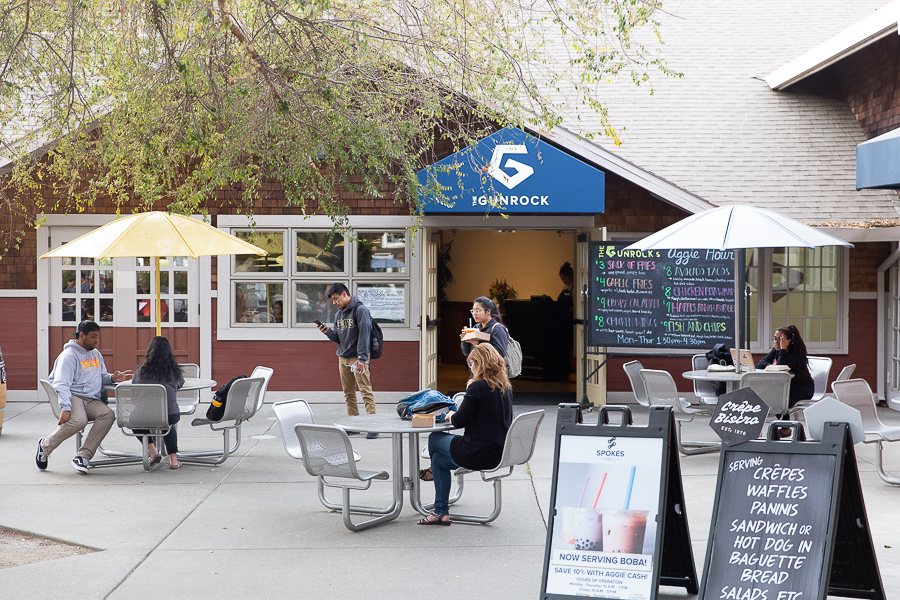
A look at the Yelp page for the Gunrock Pub shows that the on-campus bar and grill has closed. In its place now sits The Gunrock, a revamped version of the former pub. What’s different? Besides the new flooring and outdoor patio, The Gunrock is a completely dry establishment — for now.

In June of 2016, UC Davis made the decision not to renew its 46-year contract with vendor Sodexo and instead opted to internalize its dining services.

Sodexo held the alcohol license for the Gunrock Pub, which permitted the restaurant to serve alcohol for decades. The termination of the contract with the university’s primary food vendor also took away its alcohol license, giving the Gunrock Pub no choice but to change its name and rewrite its menu.

The Gunrock Pub closed for the entire summer of 2017 and opened back up that fall as The Gunrock. The name change was the university’s idea, said Keith Luke, manager of The Gunrock.

“The name [The Gunrock Pub] was coined and phrased by Sodexo,” Luke said. “That was kind of their thing, and campus didn’t really want us to be associated with the pub aspect.”

Management of the former bar has been working out a way to bring the pub-like spirit back, however, with a new contract with an outside vendor. Popular Sacramento eatery Capitol Garage is planning on taking over all alcohol sales at The Gunrock.

This transition to dual-vendorship has not been a quick and easy process for The Gunrock because of the licensing logistics to sort through.

“It’s just a different process because we will be running the food operations and doing the food sales, and they [Capitol Garage] would be doing solely the alcohol sales,” Luke said. “Two people can occupy the same space, but the person who holds the alcohol license is responsible for all the food sales. They can subcontract that to another company, but the liability is held under the alcohol license.”

This type of permit is difficult for an establishment in The Gunrock’s situation because a sole proprietor or private company, in this case Capitol Garage, is not legally allowed to sublease or sublet business to a state-run facility. Because food and dining services are now managed exclusively by the university, they are now classified as state-run.

However, this did not stop the partnership between Capitol Garage and The Gunrock from moving forward. Gia Hellwig, the director of operations for Capitol Garage, said that the extra hoops to jump through would be worth it in the long run.

“We’re used to working with the ABC [Alcoholic Beverage Control],” Hellwig said. “There are definitely some unique requirements because it’s a college campus establishment, but we basically are just dealing with that extra paperwork and waiting for their approval in the meantime.”

Hellwig said the biggest challenge thus far has been brainstorming how to market effectively to a wide audience.

“Hopefully we will be able to generate interest once we get the word out there,” Hellwig said. “Any kind of market would be great — we’re looking forward to welcoming undergraduates, faculty and alumni to The Gunrock.”

Third-year history major Alexandra Wildman commented on the reintroduction of alcohol sales at The Gunrock, expressing her hopefulness for the restaurant.

“I’ve always wanted to try The Gunrock, but have yet to make it over there” Wildman said. “I feel like selling beer and wine will be a huge incentive for students to opt to have lunch or dinner on campus, as opposed to going somewhere downtown.”

Both Luke and Hellwig reported that they are anticipating opening The Gunrock for alcohol sales in January, although the contracts should be finished before then.

“Given the time frame of holidays with Thanksgiving and then December break, we may just choose to hold off and start fresh in January,” Luke said.

Opening at the very beginning of Winter Quarter would provide a clean slate for the rollout of The Gunrock’s new alcoholic menu, which will feature eight different taps of local beer and cider as well as wine made by UC Davis alumni. Hellwig commented on the January opening, saying “we want to do it and we want to do it right, and we’re really looking to working with local breweries.”


Written by: Claire Dodd — campus@theaggie.org


Additional blue emergency lights to be installed by UCDPD

DIANNA LI / AGGIE

Four new blue lights will shine at central campus locations

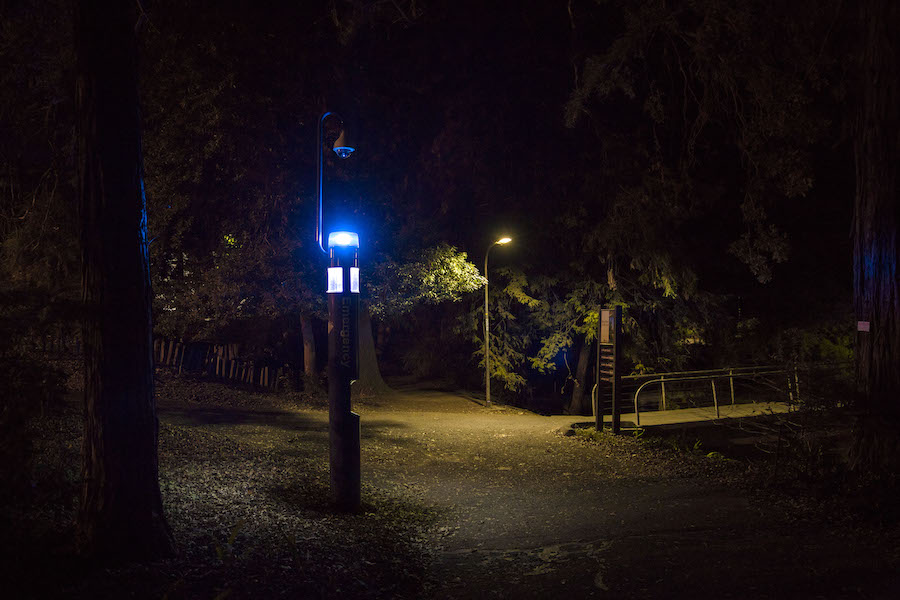
On Nov. 7, the UC Davis Police Department (UCDPD) began installing a second series of blue emergency lights at central campus locations. Four new blue emergency lights will be installed on either end of the Quad and Shields Library and near the north side of the Memorial Union.

The lights are an addition to seven existing lights on campus which were installed two years ago and placed along the Arboretum paths and around West Village, according to an article released by the university.

Blue emergency lights are emergency call boxes designed so that those in emergencies or accidents can contact the police, said UC Davis Police Chief Joseph Farrow.

“They’re designed in a way if there’s an emergency, […they are in] convenient locations where people just pick up the phone,” Farrow said. “They automatically dial into our dispatch center, and we can dispatch police, fire, EMR, whatever we have to [because] we already know where the location is because they are all coded.”

In addition to serving as call boxes to contact emergency services, the new blue emergency lights are outfitted with recording equipment which helps ensure that incidents receive efficient and direct responses. This way any event that is going on at that location will be captured on film, Farrow said.

He also explained that as technology for these emergency call boxes began improving in the early 2000s, the boxes started appearing as a safety precaution in airports, shopping malls, concert venues and college campuses. UC Davis’ blue emergency lights have seen technological improvements since the launch of the first, now discontinued, generation.

“The early version was technology that didn’t work as well as we wanted to because it relied on cellular — they weren’t hardwired to the ground, so when you picked up the phone you had to wait for the phone to engage … causing a delay,” Farrow said. “Some of the people who tried to use the phone thought it didn’t work and hung up prematurely.”

The seven active blue emergency lights currently near and on campus are part of the second generation of blue emergency lights that include numerous improvements, like being hardwired instead of relying on cellular.

Even if it isn’t a “9-1-1 emergency,” this technology allows UCDPD to be “immediately accessible to the public to try and help them,” Farrow said.

ASUCD, the UCDPD and Chancellor Gary May worked collaboratively on this project after concerns about safety were voiced by students.

“ASUCD ultimately came up with a resolution specifically asking the university to explore the use of more of this technology,” Farrow said. “They […] helped us identify some of the areas where they thought it would be beneficial through walks around campus with students.”

Senate Resolution #11, which voiced support for “the installation of ten new Blue Emergency Lights on the UC Davis Campus,” was passed unanimously by the ASUCD Senate in April of 2018. The resolution acts “in solidarity with marginalized communities on campus and recognizes their need for these Blue Lights.”

This resolution was in response to demands made by the #blackunderattack movement, which initiated a conversation that led to the installation of the initial seven Blue Emergency Lights. In February of 2016, the movement reacted “after an African American student reported that she had been assaulted” while walking near her residence in West Village, a UC Davis News report stated.

Each light costs up to $25,000 because of the need to hardwire into the ground, trench the lights, place pillars and cover the cost of maintenance, Farrow said.

“Through the UC system’s Violent Acts Mitigation Program, UC Davis police, Risk Management and Emergency Services secured $100,000 for four new call stations,” a UC Davis News article stated, adding that further funding from grants may be available over the coming years.

According to an email from Farrow, the emergency blue light project is part of a security initiative currently underway on campus to increase the security and safety of UC Davis community members.

After the new emergency call boxes are installed “at locations in the core campus,” the 2019 Lighting Safety Walk, aimed at identifying poorly-lit areas of campus and attended by students and staff, will take place in January.

“Finally, the campus Security Management System project continues to progress  … this will unify campus electronic access control and video recording systems onto a single system, allowing Police to view campus-wide electronic security systems,” Farrow said via email.

Farrow elaborated on the police department’s perspective of this security initiative and the Blue Light project, saying he sees the department’s role on campus as being there for students.

We truly are here for the students, that’s our job, that’s the only job we have and we try to do the best that we possibly can,” Farrow said. “Traditional law enforcement defines safety as your physical well-being, but on this campus it goes beyond that — it’s about your emotional, psychological security, too. […] When we work together on projects like this, people will see that [support for students] is truly what we’re working to do and that it’s an honor for us to be here and serve.”


Written by: Priyanka Shreedar — campus@theaggie.org


Aggies win first Big Sky title, advance to FCS playoffs

Football team earns No. 6 seed, will host playoff game on Dec. 1

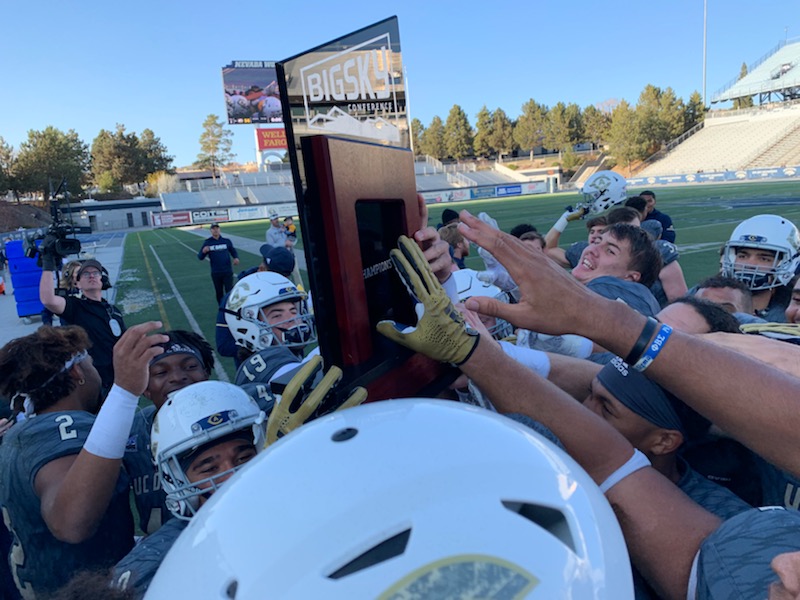
The UC Davis football team captured its first ever Big Sky conference title with a 56-13 victory over rival Sacramento State on Saturday afternoon’s 65th annual Causeway Classic. Then, on Sunday morning, the FCS Selection Committee announced that the Aggies were given the No. 6 seed in the upcoming FCS playoffs and a first-round bye.

UC Davis will host a second-round game at Aggie Stadium on Saturday Dec. 1 at 4 p.m., facing either Northern Iowa or Lamar.

“We are ready to go and it’s been a long time coming,” said senior wide receiver Keelan Doss. “These opportunities don’t come around too often so we’re ready to take advantage of that.”

Due to the unsafe air quality from the Camp Fire in Butte County, this year’s edition of the Causeway Classic was relocated to the Mackay Stadium at the University of Nevada, Reno campus. At the time of kickoff, the air quality index (AQI) back in Davis was at an unhealthy level of 206.

Despite the last-minute change of plans, almost 2,500 fans made the 150-mile trek up north and collectively raised $5,407 for the victims of the Camp Fire.

Overall, it was a glorious afternoon for the Aggies who truly overpowered their rivals in every possible manner. The team’s offensive superstars, Doss and junior quarterback Jake Maier, set new personal records, while the defense allowed its fewest number of yards in any game this season. The special teams unit also did its part, executing a fake punt that resulted in more points for the offense.

UC Davis jumped out to a 35-10 halftime lead and got the celebration started early as Head Coach Dan Hawkins received the honorary ice bath on the sideline as the final seconds ticked off the clock.

“I haven’t had one in a while, so it felt good,” Hawkins said.

The second-year head coach was quite emotional after the game as he reflected on the significance of this victory for the program. After seven years of playing in the Big Sky, the Aggies finally have a share of the conference title.

“It’s just all the sacrifice, all these guys have been through and everything that everybody puts into it,” Hawkins said. “To see them sacrifice and buy in and have a transcendent experience, this is what an Aggie is.”

Saturday’s victory was the pinnacle of a remarkable turnaround that Hawkins has led since the day he returned to his alma mater in late November of 2016.

“I don’t think you put a lid or timetable on it,” Hawkins said. “You get in here, work hard and try to get guys to buy into this vision of excellence with class and raising their standards. We’ve had so many guys sacrifice and do things above and beyond for our program. That’s why it happens.”

In the midst of celebration, Maier conceded his never-ending quest to play a flawless game and keep improving every week, something that he has referenced after every victory this season.

“Still to this day, we feel like we haven’t actually played a complete, perfect game of football and that’s always been our standard,” Maier said. “If I know this team well enough, these next few weeks of preparation coming into the playoffs are going to be the hardest this team has ever worked.”

Maier set a career-high with 478 passing yards on the afternoon and also scored two rushing touchdowns, which matches his career high.

Doss, last year’s Walter Payton Award finalist and the owner of the all-time records for catches and receiving yards in program history, expressed his satisfaction for staying at UC Davis for his senior season, instead of declaring for the NFL draft last winter.

“This definitely elevated my decision to come back,” Doss said. “I’m happy, and I can’t even put it into words right now.”

Hawkins agreed that Doss “started the whole thing when he stayed” and credited “his love for the University and football program, and finishing something he started.”

UC Davis received the opening kickoff and swiftly started the scoring after just four plays. Sophomore wide receiver Jared Harrell, running a deep post route over the middle, caught the ball in stride and streaked all the way down the sideline for a career-long 77-yard touchdown.

On the next Aggie drive, redshirt freshman running back Ulonzo Gilliam juked a couple defenders and carried the ball 34 yards into enemy territory. After a play-action fake and 19-yard completion to junior tight end Wesley Preece, Maier dashed into the endzone for a one-yard touchdown to make it 14-0.

Sacramento State started to find a rhythm on offense on its third possession, with two long completions through the air and a run of 11 yards. Nonetheless, the UC Davis defense held strong, with junior defensive lineman Jordan Franklin batting down a pass at the line of scrimmage on a key third down play.

After a lengthy drive of over four minutes, the Hornets settled for a 34-yard field goal to cut their deficit to 11 points.

On the next drive, Gilliam continued to exhibit his shiftiness in open space, slipping multiple tackles en route to a 23-yard run. Faced with a fourth-and-four play from the Hornet 44-yard line, the Aggies ran a fake punt with senior running back Ethan Hicks, the upback, taking the direct snap and sprinting 25 yards up the middle for the first down. Two plays later, Maier maneuvered around the pocket and decided to tuck the ball and scamper nine yards for the touchdown.

After a punt by Sacramento State, the UC Davis offense picked up right where it left off on the previous possession. The drive began with three straight pass completions, including two in the direction of Doss, to bring Maier’s completion streak to 13 straight throws to begin the game. Then, Doss came down with a spectacular 23-yard reception, turning his hips in the middle of the air and high-pointing the ball. Three plays later, Hicks cruised into the endzone from three yards out to push the lead to 28-3 with under ten minutes left in the half.

Sacramento State quickly answered with back-to-back completions of 34 and 14 yards to get into the red zone, before scoring on an 18-yard pass play.

The Aggies executed a two-minute drill at the end of the first half, on the strength of a 23-yard run by Gilliam and a tremendous effort by Doss, to stretch forward for a first down. With 10 seconds left, Doss took a short screen 13 yards to the house, extending the lead to 35-10.

The Hornets began the third quarter with a tedious 17-play drive of over seven minutes, but came away with just three points.

Toward the end of the quarter, the Aggie offense got rolling again with three completions to Doss, including a five-yard touchdown on a short crossing route over the middle.

It was the same story in the fourth quarter, as Doss hauled in a 43-yard fade and then made a tremendous running catch toward the sideline with a defender draped over him. Those plays set up a jump-ball catch by junior tight end Wesley Preece in the endzone to push the score to 49-13.  

On the last UC Davis possession, Doss set a new personal record with his 16th catch of the afternoon. He fell just three yards shy of breaking his single-game record for receiving yards. A late four-yard run by senior running back Namane Modise capped the score at 56-13.

With two weeks to prepare for the FCS playoff battle, Hawkins expressed some satisfaction with the fact that the Aggies will be able to “get some wind underneath the sails” during the Thanksgiving bye week. Not one to look too far ahead, Hawkins did note that, if the Aggies do take care of business on Dec. 1, the looming possibility of a rematch against Big Sky rivals Eastern Washington in the following round is “interesting.”


Written by: Brendan Ogburn — sports@theaggie.org

Addressing population factors contributing to liver, colon cancers

MONIQUE VASQUEZ AND EBONY IRICK HADNOT / COURTESY

The UC Davis Department of Internal Medicine dedicates day to liver, colon cancer awareness

The Fourth Annual Liver Research Day opened with thoughtful liver and colon cancer surveillance discussions between undergraduates, graduate students, medical professionals and researchers. Attention to the liver signaled the arrival of the final organ-focused research day hosted by the UC Davis Department of Internal Medicine.

Before the Liver Research Day were Heart, Lung and Kidney Research Days. This year’s Liver Research Day was organized by Dr. Valentina Medici, an associate professor in the UC Davis Division of Gastroenterology and Hepatology and Dr. Christopher Bowlus, a professor and the chief of the Division of Gastroenterology and Hepatology.

The morning sessions focused on liver cancer, offering population perspectives and strategies to improve patient outcomes with hepatitis. Lunch was accompanied by a competitive poster session, in which researchers displayed the progress of their projects. The afternoon sessions highlighted colon cancer prevalence and clinical perspectives to improve colon cancer screenings.

The knowledge gained from Liver Research Day could be beneficial for members across all generations.

“At the event, we discussed that Hepatitis C incidence is high in 50-70-year old’s,” Medici said. “Now, it is also increasing in incidence in people from 20-30 years of age because of the opioid crisis.”

Hepatitis C exposure presents a major risk for developing liver cancer. Additionally, fatty liver disease and chronic illnesses, such as diabetes, hypertension and obesity, are becoming associated with a higher risk for liver cancer. This is a shift from assumptions that liver cancer is always associated with Hepatitis C exposure and alcohol use.

“Liver cancer incidence and prevalence are also increasing in the general population,” Medici said. “This calls for a multi-disciplinary approach to care coordination and how patients can navigate healthcare.”

UC Davis researchers and invited speakers shared the progress of their work to understand liver and colon cancers within specific populations.

Bradley Pollock, professor and chair of UC Davis Public Health Sciences, shared his research highlighting the likelihood of developing hepatocellular carcinoma, a common form of liver cancer, in the presence of risk factors such as socioeconomic status and social and medical histories. Another risk factor that was identified was exposure to aflatoxin, a potent carcinogen appearing in drought stressed crops like corn in south Texas counties.

“Hepatocellular carcinoma rates vary across ethnic groups, but Asian/ Pacific Islanders and Hispanics are disproportionately affected by the chronic condition,” Pollock said.

Pollock’s review found an association between lower socioeconomic status, including lower education and income levels, and an increased likelihood of developing hepatocellular carcinoma, in addition to Hepatitis C exposure, alcohol use and smoking. Traces of aflatoxin in the body were found to have increased odds of hepatocellular carcinoma.

“Surprisingly, aspirin and omega-3 consumption seemed to offer some protection against the effects of aflatoxin exposure,” Pollock said.

Sooraj Tejaswi, associate clinical professor at the UC Davis Division of Gastroenterology and Hepatology and program director of the gastroenterology and hepatology fellowship, shared his work investigating colon cancer rates in South Asians.

“South Asians have not been historically studied,” Tejaswi said. “Our people think rates of colon cancer are low. It reported to be very low, but not every case is tracked in South Asia like it is in California due to resources. Californians with South Asian origin tend to have higher rates of colon cancer than reported.”

According to Tejaswi, South Asians face 13.7 cases of colon cancer per 100,000 individuals in California, while non-hispanic whites encounter 26.1 cases of colon cancer per 100,000 individuals in California. In California, South Asians over the age of 50 experience 66.2 cases of colon cancer per 100,000 individuals. Non-Hispanic whites over the age of 50 face 114 cases of colon cancer per 100,000 individuals.

After looking at colonoscopy patients from the UC Davis Medical Center, Tejaswi found that South Asians have a similar number of tubular adenomas, polyps or growths that may become cancerous, in their colons as other ethnic groups. From 2006 to 2015, South Asian colonoscopy patients were found to have 22.7 tubular adenomas per 100 colonoscopy screenings, while non-hispanic whites were found to have 28.1 tubular adenomas per 100 colonoscopy screenings.

“This is alarming as South Asians take up the same lifestyle as Americans, they may catch up to the colon cancer rates of other ethnicities,” Tejaswi said. “This is an alarm call for people living in the United States and countries in South Asia.”

South Asians represent a fast-growing population in California and the United States. Effective cancer prevention strategies must account for their needs as a population instead of as isolated individuals to reduce the growing risks of colon cancer.

As colon and liver cancer rates escalate, ethnic populations cannot be treated the same. Preventative healthcare calls for a specialized approach to research and to understanding cancer.


Written by: Foxy Robinson — science@theaggie.org


Men’s tennis ends fall season with a bang

MARK HONBO / UC DAVIS ATHLETICS

Thamma, Goulak, Scemanenco win titles as men’s tennis wraps up fall season

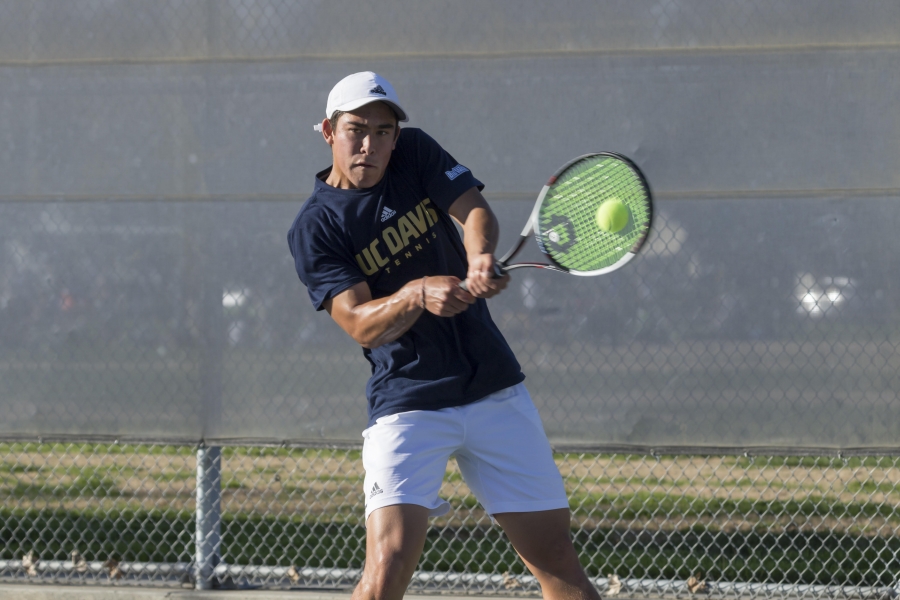
The last few weeks of the fall season have been quite eventful for the UC Davis men’s tennis team. Multiple players won tournament titles and advanced to final rounds. These performances have led to new successes to celebrate practically every weekend.

The junior-sophomore duo of David Goulak and Ivan Thamma and freshman Alex Scemanco both achieved victories at the St. Mary’s Fall Invite the last weekend of October. Goulak and Thamma won their doubles title after they took down Cal Poly’s Dominic Bechard and Karapet Vardanyan with a score of 8-6. This victory occurred in the tournament’s final top doubles competition, and the win extended the duo’s record to 6-1.

Thamma, the team’s captain, commented on the goals he worked on throughout the fall season.

“I specifically worked on my mental game this fall by trying to keep a positive attitude and finding ways to win even though I’m not playing my best,” Thamma said. “I’ve seen myself bring a better attitude as the season went on, and, by the end, I think I performed my best mentally.”

Scemanco joined his teammates in success by winning a battle in the Men’s B singles matches’ main draw; he took the win in his semi final match versus Louis Chabut of Sacramento State. Though he ended up falling short in the final singles round, he was able to end the day with some victories under his belt.

Sophomore Chethan Swanson and freshman Daniel Landa defeated the reigning 2018 All-Big West Honorable Mention doubles team Roman Shenkiryk and Andrew Whitehouse, and Landa claimed a singles victory.

During the weekend of Nov. 1st, Goulak and Thamma took home the Men’s Open Doubles crown at the Kramer Classic in Rolling Hill Estates. In the third game of the match, the pair broke serve to start out with a 2-1 lead, and they kept hold of the break with an additional hold of serve and second break. This gave the duo a 4-1 lead over the competitors, Igor Karpovets and Herkko Pollanen.

Thamma was able to hold the serve in their final game to seal the opposition’s fate at 8-4. Goulak and Thamma defeated the Arizona team to claim their second title. Their record moved to 9-1 for the fall season, with their only loss recorded at the ITA Northwest Regional in Seattle.

Goulak commented on why the Kramer Classic especially stood out to him as one of the top moments of his season so far.

“[My] favorite moment of the fall would probably have to be winning Jack Kramer because it’s a really big college tournament, and we’ve never played it before, so a lot of top teams around the country come and play it,” Goulak said. “Winning that and representing UC Davis was really nice.”

The team wrapped up its season at the Fresno State Bulldog Classic during the first weekend of November 3-4. Following the tournament’s first day, Scemanenco and Swanson earned their place in the Flight A doubles semifinal against a pair from San Francisco, despite the Aggies’ close loss of 8-7. Sophomore Arjith Jayaraman joined Scemanenco in the consolation semifinal round after coming out victorious in his first consolation match in Flight B in three sets. Scemanenco was granted a walkover in his first consolation match, but neither of the Aggies were able to reach the final rounds.

During the tournament’s extra matches on Nov. 4, both Swanson and Scemanenco went undefeated. Together, the pair enjoyed a 8-3 victory over a Nevada duo. In singles, Swanson won two sets over St. Mary’s Boris Reckow, and Scemanceno brought home the crown in three sets against Patrick Pech of Fresno State.

The men’s tennis team will be back in action in January and hopes to carry its successes into the new year.


Written by: Kennedy Walker — sports@theaggie.org


Living room tour stops in Davis

RAUL MORALES / AGGIE

An evening with Julia Nunes

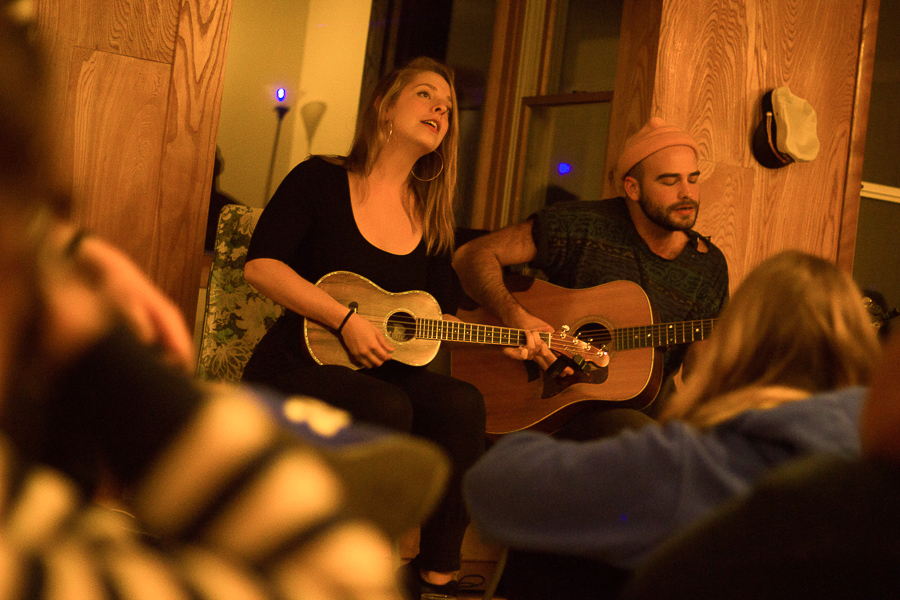
On Nov. 7 at 7 p.m., my housemates and I hosted a living room concert for Julia Nunes, a musician with over 230,000 Youtube subscribers who is known for her heartfelt covers, incredible voice and talented songwriting. As the house bustled with excitement for Julia’s upcoming arrival and performance, the intimate nature of the “living room show” was reflected in the friendship and connection that everyone in the house had established.

By 8 p.m., when the show began, everyone had met each other, shared stories about how they had found the concert and bonded over their connection to Nunes’ music. The various degrees of familiarity with Nunes’ music didn’t matter. Some people had never heard her music before, some had attended previous shows and some had never seen her but had been following her music since her start.

The varied makeup of the group created a special atmosphere of diverse relationships to the music that was about be performed. Everyone understood that they were about to share an experience that could only be shared in that living room, embracing the vulnerability and irreplicable nature of the present.

When Nunes arrived with her bandmate Chase Burnett, the energy of the house rocketed. As she walked in with the same humble demeanor of someone attending the show, set up her merch on our kitchen table and sat on one of our rickety chairs, she introduced herself and Burnett in the same friendly manner that everyone in the audience had done with one another for the last hour.

This concert marked Nunes’ third stop on her living room tour.

“I love living room shows because I actually get an answer to my questions that I ask instead of just the ‘woo’ that you get at bigger shows,”  Nunes said. “It’s my favorite way to play music and see music.”

Between each song, Nunes explained what inspired her to write the song she was performing, connecting each audience member to her music in personal ways as she described honest feelings of happiness, heartbreak and self-reflection. With each introduction the audience laughed, nodded in agreement or looked around at one another, affirming that Nunes had just sung or said something that related with an experience that everyone could understand.

Austin Carroll, a fourth-year human development major who had never been to a living room show before, enjoyed Nunes’ song explanations.

“I think this was one of the most real performances that I have been at because I really knew what the songs were about and what they meant to her because she got to talk more,” Carroll said. “I think when you go to a bigger show they still perform vulnerable and real songs and even sometimes explain them, but it’s always in a much bigger setting. Here, I felt like she was having an open conversation with us when she explained everything behind each song.”

Before the show ended, Nunes hosted a question and answer portion, engaging the audience, urging them to ask her anything they wanted.

“We can talk about any number of things, it doesn’t just have to be about music,” Nunes said, further encouraging openness and honesty.

When an audience member asked Nunes if she still felt nervous before releasing songs, Nunes answered, “Yup,” taking a pause before expanding on her answer in a comical and authentic manner that mirrored her incredible personability.

“The songs that are about about my heart being, you know, pulverized, those are scarier to release, and I honestly think that a big portion of why this next record is taking me so long is because I’m just not ready yet,” Nunes said, testifying to the raw vulnerability and emotion behind her music.

J.J. Flax, a fourth-year design major who had only started listening to Julia Nunes after she bought her tickets, reflected on Nunes’ honesty.

“I liked when she was talking about her current headspace and how she can’t put up a preformative front right now,” Flax said.“I could tell she didn’t seem like she had put up any wall or mask at any point of the show, which I think set the tone for the rest of the concert because we all settled into this chill realness.”

This “chill realness” continued throughout the night, as she ended her show and welcomed everyone who wanted to take pictures and chat with her. As everyone stood up and looked around, it was apparent that they had all been emotionally moved by Nunes’ music, and moreso her ability to connect with those sitting in the living room.

After everyone left, only my housemates, Nunes and myself remained. We turned up the music as Nunes led an impromptu dance party. For Nunes to stay and hang out with us, even for a few minutes, was a testimony to the type of person she is. As Nunes laughed and danced with us, she became our friend, leaving us and everybody who attended her show with a role model who embodies comfort, creativity and honesty.


Written by: Rosie Schawrz – arts@theaggie.org


Makeover for Tower Bridge in Sacramento

0
TESSA KOGA / AGGIE

Tower Bridge replacements in progress in Sacramento

Tower Bridge in Sacramento is under repairs and will receive new suspenders as a safety precaution. California did not want to wait any longer on taking precaution against possible accidents so the maintenance projects have been in effect. Caltrans confirmed, however, that the bridge itself is not sagging.

Mike White, a Caltrans engineer, said that the bridge’s two-inch thick cables will be replaced because of the potential for future deterioration.

“They’ve never been replaced before, as far as we can tell,” White said to The Sacramento Bee. “They’re actually in pretty good shape. But it’s good to be prudent. Nothing lasts forever.”

Dennis Keaton, a Caltrans public information officer, emphasized that the bridge was not sagging, and that the state was simply taking care of the bridge.

“What happened is that those were the original supports, [and] the bridge is 85 years old,” Keaton said. “What they have are these suspension supports that need to be replaced.”

Caltrans had specific measurements in mind and went ahead with starting the project.

“They had to do testing, and they wanted to make sure that everything that is in place still conforms to the measurements or they had to be replaced,” Keaton said. “At some point, they made a decision to go ahead and replace that.”

The project served as maintenance for the bridge, which is expected to be complete in December. Not only will Caltrans consider the suspensions, but other forms of maintenance will be done as well.

In the project’s description, Caltrans noted that “the work will upgrade the existing security/communications system, replace 48 incandescent lights with energy efficient LED lighting, replace the traveling cable system, conduct NDT testing and maintenance of the counterbalance chains, and replace the 96 counterweight wire ropes, required to operate the bridge opening.”

Even though the maintenance project has been ongoing, traffic has not been significantly affected.

“The traffic has been reduced to one lane in both directions,” Keaton said. “In doing so, it typically backs traffic up specifically in the morning and afternoon. But regular times are normal — no major disruptions.”

The estimated repair costs for Tower Bridge total $5.8 million.

“The project started late September and has been ongoing,” Keaton said. “They had to do some nighttime closures — complete closures — but during the day times, they kept it to one lane opened in both directions.”

Caltrans also warned that motorists will have to be on the lookout for the closures.

According to Caltrans’ press release, they are “alerting motorists to expect continuous lane closures on the Tower Bridge.”

In addition to motorists having to watch out for the closures, bridge access is more limited than before. The press release also stated that “waterway traffic must contact the U.S. Coast Guard for clearance approval and bridge access.”

There are multiple changes being made on the bridge in terms of maintenance like upgrading the electrical and mechanical systems. While the expected deadline will be in December, there is some leeway due to other variables — such as weather — that may affect the work.


Written by: Stella Tran — city@theaggie.org


Organization of formerly incarcerated students holds panel discussion

BEYOND THE STATS / COURTESY

Beyond the Stats discusses Education As Freedom course

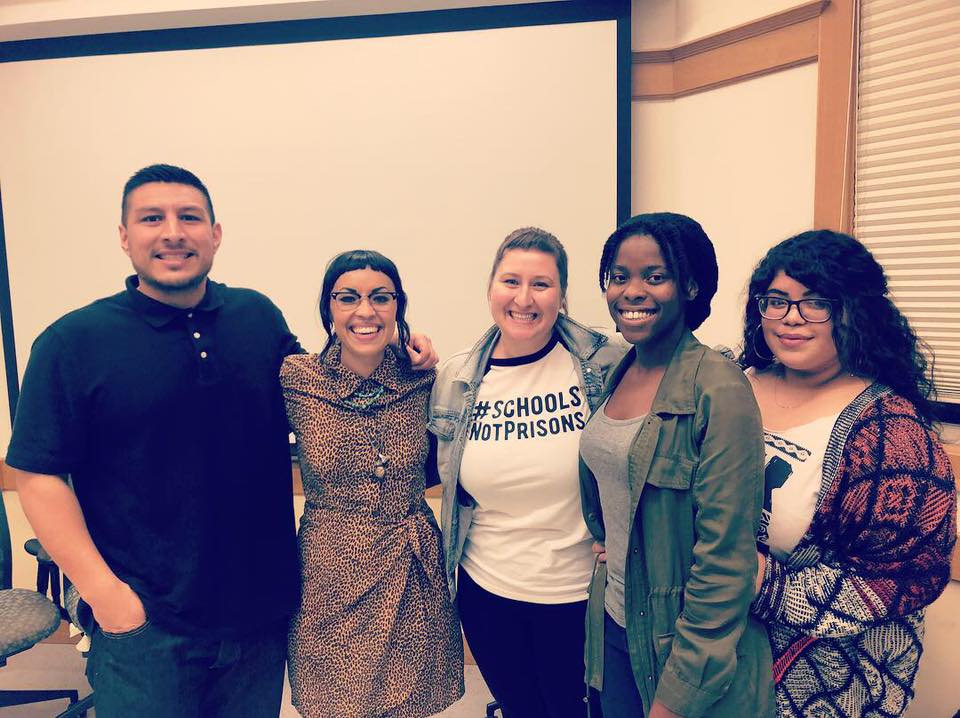
Beyond the Stats, an organization created nearly two years ago to provide support for formerly incarcerated students and those impacted by the prison system, held a Q&A style panel on Oct. 30 that featured several of the organization’s members.

Assistant Professor Ofelia Cuevas of the Chicanx Studies Department moderated the panel, and began by letting attendees know a bit about herself and why she feels such a strong connection with this organization. Her work focuses partly on race and prisons.

“I myself have studied the connection between race and prisons for 25 years,” Cuevas said. “I’m impacted by the system.”

Cuevas continued, providing important background information about the prison system to show why an organization like Beyond the Stats is needed, explaining that over the course of about two decades, starting in 1983, 28 prisons were built while only one UC was.

“These prisons never made an impact on public or private safety,” Cuevas said. “There are 1.6 million people in California with a criminal record. They all have someone, a relative or family that’s affected. I think we’re out there, everywhere.”

After Cueva’s introduction, the panelists first let the audience know about Beyond the Stats before taking turns to discuss how they found a home through the organization.

Tina Curiel-Allen, a co-founder of the organization, described Beyond the Stats as a “support system” which is important for formerly incarcerated students because their “trajectory is different than a third generation college student with wealth and privilege passed down to them. And that’s okay.”

Curiel-Allen said that she simply “wanted to know how other formerly incarcerated students were handling higher education.” She had the opportunity to ask that exact question in a sociology class which led her to other formerly incarcerated students in the class, including Daniel Mendoza, who would later co-found the organization alongside her.

Curiel-Allen no longer takes sociology classes, as she felt uncomfortable the way she became a subject and was studied as a statistic in those courses. Instead, she switched her major to Chicana/o Studies, where she feels that her peers are more willing to discuss incarceration and the prison system critically. Scharleth Guadamuz, a sociology and history double major and panelist, said she felt the same way about sociology and decided to balance the sociological issues with a historical perspective.

Another panelist was Briana Sue Zweifler, alumna of the UC Davis School of Law. Zweifler currently works as a legal fellow, focusing on the California Youth Justice Initiative at the National Center for Youth Law.

Mendoza, a sociology and ethnic studies double major and co-founder to the organization, was also a panelist. He and Curiel-Allen met two years ago in their sociology class and discovered they were dealing with similar experiences.

Mendoza recalled how he felt unsettled with what he saw reflected in other students in his first year at Davis. “When I first came here, everyone seemed to be just surviving.” Instead of falling into that same trap, Mendoza was determined to set a different standard.

“We [BTS] offer a sense of identity and community. Let’s go from surviving mode to thriving mode,” Mendoza said.

A popular topic among the panelists was the seminar taught under the Chicana/o Studies Department titled, “Education as Freedom: AKA Amerika This Is How You Made Me.” The syllabus was written by Curiel-Allen and another member not present at the panel, which consists of readings from Angela Davis, James Baldwin, Malcolm X and the Black Panther 10 point plan. Speaking to the course outline, Curiel Allen said that the department wanted to include scholars of color that have just as much to say as white scholars.

“These writers understand their position in relation to social power,” she said. “We are hoping students can do it too. We want to empower them and give them the language to tell their own stories like this.”

Unlike a typical class, this seminar has no lectures and is completely discussion-based and is meant to be a consciousness raising class. The class is set up in a circle, and before instruction begins, Mendoza said they ask students how they are — “just telling someone ‘I see you.’”

The goal of the seminar is to look at multiple systems and isn’t simply “to tell the saddest thing that’s happened to [us]. Our stories are part of a larger narrative,” Curiel-Allen said.

A long day on campus almost deterred third-year sociology and African/Afro-American Studies double major J’son Jones from attending the event, which he heard about from a friend from the Pan Afro Student Organization where Jones serves as historical counselor. But as he passed Hart Hall, he decided to stop by to support his friend.

The audience members had a chance to ask the panelists questions, prompting Jones to inquire about how to deal with the anger resulting from being discussed as a statistic and subject in sociology classes. Multiple panelists told him to speak up or else it will continue to happen. For Jones, their shared experiences and advice was exactly what he needed to hear.

“I was so mad, so I was wondering if you guys had a perspective on it and you did — so now the next time I’m in that class, I’m gonna say something,” Jones said.

Throughout the panel, Cuevas stated multiple times how proud she was of Beyond the Stats and what they’ve been able to accomplish.

“I’ve never worked with a group of students like this,” Cuevas said. “They came together on their own, they do their work on their own. A very true support system for each other.”

It definitely was a moment to remember for members of Beyond the Stats, as it was literally a dream come true.

“We created a wishlist when we were first starting and having a panel was on it,” Curiel-Allen said. “We’re very happy.”


Written by: Deana Medina — campus@theaggie.org

UC Davis-based online textbook library receives $4.9 million federal grant

REBECCA CAMPBELL / AGGIE

Online textbook library aims to expand its content, cut costs for students, tailor course-specific material

The U.S. Department of Education has awarded a $4.9 million dollar grant to the LibreText Project, an online textbook library founded at UC Davis.

According to the Department of Education website, the grant awarded under the Open Textbooks Pilot Program “emphasizes the development of projects that demonstrate the greatest potential to achieve the highest level of savings for students through sustainable, expanded use of open textbooks in high-enrollment courses or in programs that prepare individuals for in-demand fields.”

The LibreText Project, previously under the name ChemWiki, was developed 11 years ago by Delmar Larsen, an associate professor in the chemistry department. Larsen provided a supplemental text for Chem 107B: Physical Chemistry for Life Scientists, and the project grew to encompass all chemistry classes and further fields of study. The LibreText Project has amassed 12 libraries worth of content to date.

While developed at UC Davis, the online library is in use across universities and community colleges throughout the country. In addition to providing existing texts, it also provides the option for instructors to contribute their own texts tailored to their classes. The intent is to offer classrooms the ability to read content more directly related to the vocabulary used by a professor in their classes.

Marc Facciotti, an associate professor in the biomedical engineering department, contributed to the textbook library by providing reading modules he had written specifically for BIS 2A: Introductory Biology: Cell Functions.

“I think the students have appreciated that we’ve gone from having a lot of complaints at the end of the quarter about why people were reading the book when it wasn’t as related as to what was going on in the course to basically zero complaints,” Facciotti said.

According to Larsen, the LibreText project, which falls under classification as an Open Education Resource (OER), is the largest, highest ranked of its kind and has the greatest amount of online traffic for an OER.

“We have 70,000 pages of content that spans from sciences to social sciences to humanities,” Larsen said. “We’re going to be expanding to the trades which is a vocational based library which is probably more applicable to community colleges.”

Anne Britt, a professor in the plant biology department, has incorporated LibreText’s customizable tool to tailor a textbook for her BIS 2A class. She has found it a useful resource in communicating content to her students.

“Students really appreciate knowing what you want them to know,” Britt said. “If you’re using a regular textbook there’s going to be stuff inevitably in there that’s not really important to you, and the students have a hard time discerning which are your favorite topics. So having a custom textbook is super helpful in terms of getting the most important points to me across to the students.”

The Department of Education set up a 30-day window between July 30 and Aug. 29 in which applicants could submit their proposals for the Open Textbooks Pilot Program. A consortium of volunteer faculty across campuses involved with the project edited and drafted pre-existing language to submit as their proposal. Within a month of review, LibreText received the funds from the grant.

“The resources that we are getting from this award is ten times greater than all the resources we’ve had before, combined,” Larsen said. “So you can argue we’d be ten times bigger and ten times better and that is certainly our goal.”

The LibreText Project plans to use the funds for expansion through the development of five independently-operating teams responsible for construction, harvesting, dissemination, technology and an assessment and evaluation team. Larsen is in the process of hiring 50 to 100 undergraduate students to assist in the curation of additional content.

“The textbook of the future is definitely going to be different from the textbook of the past,” Larsen said. “And that’s why we want to be able to use current and emerging technologies and embed those into the textbook library.”

Among those emerging technologies are efforts to integrate interactive, illustrated figures and simulations, programming for three dimensional calculus and coding and an annotative infrastructure for students and faculty.

“What we’re doing is delivering content in a different way that replaces the textbook but that is, in some ways, richer than the textbook,” Facciotti said. “Or at least maybe richer in the future that’s more modern and adaptable.”


Written by: Elizabeth Mercado — campus@theaggie.org


UC Davis will become Hispanic Serving Institution, Chicana/o Studies professors raise concerns

RAUL MORALES / AGGIE

Professors think focus should be on currently-enrolled Chicana/o students who feel isolated

UC Davis’ efforts to meet the requirements to become a Hispanic Serving Institution came to a close in May of 2018, and now the university is researching how to best use funds granted through the designation it is expecting to receive in Spring 2019. While some believe UC Davis is well equipped to properly serve its Hispanic students, others, including certain staff members, feel unsure and hesitant about how much success the HSI designation will actually bring to students.

Assistant Professor Clarissa Rojas of the Chicano/a Studies Department is one of those staff members, as her past experiences at different campuses has her hoping UC Davis will make the right decisions.

“At CSU Long Beach, early rounds of HSI fund distribution were not duly informed by the Chicanx students, staff and faculty leadership on campus,” Rojas said. “As a result, decisions like a significant amount of funds being used to fund a new Starbucks on campus were made, among others. These decisions misdirected funds away from the services and vital academic support that Chicanx/Latinx students needed to access for their success.”

Recently, Rojas brought up the topic of the HSI title into her classroom, connecting it to the Young Lords — an organization active during the 1960s and 1970s that strove for self-determination for the Puerto Rican community of New York. Turning to her students, Rojas asked them a question to put into perspective what exactly it was the Young Lords were working towards: “What if you could decide what happened with the HSI funds?” At first, there were just some giggles and smiles, and then multiple hands shot up: “Free books!” “Affordable housing!” “Free parking!”

What if? The answer to that question will have to wait until next spring.

Rojas is not alone in these sentiments. Department Natalia Deeb-Sossa, an associate professor or Chicano/a Studies, is critical of the designation, specifically citing how there are plenty of students right now who need help and not just those that help the university reach their quota for the HSI requirement.

For me, it is really important that the university reflects or takes time to understand that they are not adequately serving the CHI/LAT students that they currently have,” Deeb-Sossa said. “So, it’s a disservice to accept more CHI/LAT students if the students they currently have feel marginalized, alienated, somehow that this institution does not reflect them, doesn’t respect them. They’re not doing well in classes. They don’t graduate. They’re not performing well.”

Deeb-Sossa’s assessment of the university’s current help for Chicanx students made her decision quite easy when she was asked by Carlos Jackson, head of the Chicanx Department, to be the the department’s representative on the task force.

I wanted to be at the table and have input on this important committee,” Deeb-Sossa said.

Having a seat at the table should allow Deeb-Sossa to address her concerns and make a difference, although she said that even the task force itself is a problem.

“This task force and the co-chairs in particular are not being supported,” Deeb-Sossa said. “They do not have the funding and the staff necessary to do this important work. Again, we see how the CHI/LAT community, and in particular the CHI/LAT students are not a priority to this chancellor.”

To better engage public discussion on the matter, a town hall meeting was held on Nov. 1 at the UC Davis Conference Center, open to faculty, staff, students and alumni as well as members of the public.

Held by the Office of Diversity, Equity and Inclusion on behalf of the HSI task force, the topic of the discussion was “What Does It Mean for UC Davis to Be Hispanic-Serving?”

The forum was comprised of a brief program followed by small group discussions designed to identify opportunities for UC Davis as one of only nine universities with the highest level of research activities for undergraduate and graduate students that also have the HSI designation.

Written by: Deana Medina — dlmedina@ucdavis.edu