54.1 F
Davis

Davis, California

Tuesday, December 23, 2025
Home Blog Page 482

Classes at UC Davis cancelled through Thanksgiving break

SHEREEN LEE / AGGIE

Campus to reopen, classes to resume Monday, Nov. 26

After a four days of cancelled classes, an initial attempt to resume classes that faced widespread backlash, air quality index levels above 300 and the change of location of the Causeway Classic to Reno, UC Davis has cancelled classes until after the Thanksgiving holiday.

In a WarnMe sent to students at 9:15 a.m. on Sunday, Nov. 18, students were notified of the cancellation. According to a previous statement, students were to be notified of such a cancellation by 5:00 p.m. on Nov. 18.

As was previously done, an updated statement was posted to the UC Davis News and Media Relations website.

“While we had hoped to reopen our Davis and Sacramento campuses on Monday, Nov. 19, the air quality forecasts are not showing enough improvement toward the healthy categories,” the statement said. “In addition, the Academic Senate leadership has recommended that classes be cancelled Monday through Wednesday. Based on this and other input, we have decided to close both campuses through the Thanksgiving break.”

According to the statement, classes are set to resume Monday, Nov. 26. Campus leadership is still determining what to do about the seven days of cancelled classes.

“In consultation with the [University of California] Office of the President, our provost, the Academic Senate and American Federation are working on details about how the remaining days of the quarter will be handled,” the statement said. “We’ll communicate about that as soon as possible.”


Written by: Kenton Goldsby — campus@theaggie.org
Humor: UC Davis administration says class cancellations still “up in the air”

QUINN SPOONER / AGGIE

Get it?

When questioned by The California Aggie about the status of class cancellations and the continuation of the quarter after this week’s series of missed days, Davis administrators replied by saying it’s all still “up in the air.”

“Get it?” an administrator asked The Aggie, smiling and slapping his knee. “Because, it’s like, there’s the smoke up in the air? And then the scheduling is still up in the air. It’s like… it’s a play on words, you know? A pun… kinda? Am I making sense? You’re looking at me like I’m not making sense. It was just… a joke, you know? I was trying to make light of the situation. Does that… ok, I guess it really wasn’t that funny. It’s fine, I understand, I just thought I could break the old serious administrator stereotype, but I guess I’ll just stick to my lane like my wife said I should. She told me, ‘Harold, if you keep trying to make jokes about serious stuff, it’s gonna bite you in the butt,’ and I guess she was right, so thank you Sharon. Thanks a bunch.”

The administrator paused briefly before continuing.

“But yeah, to answer your original question, I have absolutely no idea. I probably shouldn’t have even answered your question like that. It was just confusing and now it’s this whole thing with the joke and all that.”

Written by: Conner Shaw — cjshaw@ucdavis.edu

Causeway classic relocated due to air quality concerns

UC Davis and Sacramento State will play in Reno, Nev.

Editor’s note: This story is developing. We will update as we learn more.

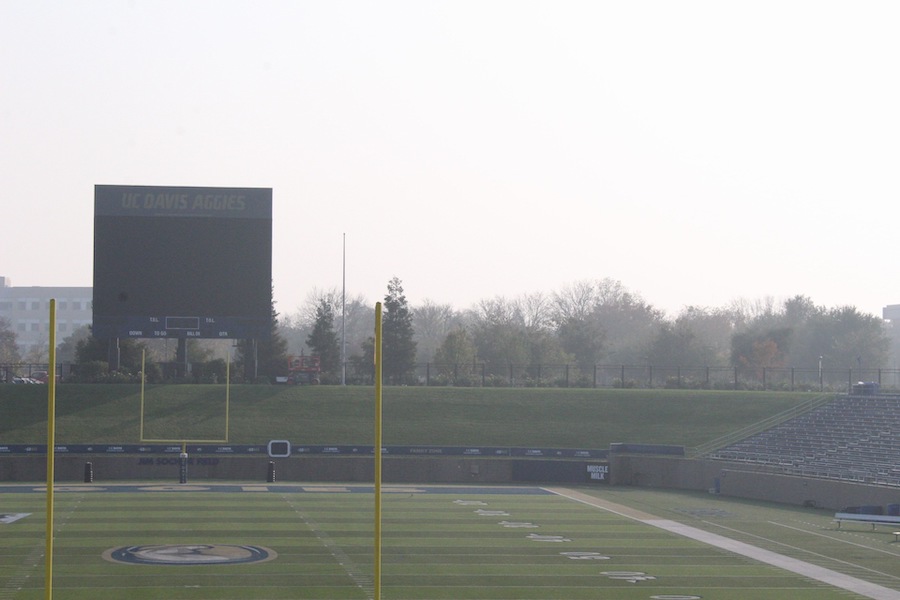
Following a week in which all UC Davis classes were cancelled due to poor air quality, the UC Davis Athletics department announced Friday morning that this Saturday’s Causeway Classic football game will be moved to Mackay Stadium in Reno, Nev. “due to uncertainty regarding air quality in Davis.”

UC Davis Athletics had made it clear in the days leading up to Saturday’s contest that it planned to monitor the air conditions in Davis. The department issued a statement on Thursday saying that it is “closely watching” the air quality index, and that an update regarding the plans for the game will be given by 10 a.m. Friday morning.

Athletics noted that its decision was made in accordance with NCAA guidelines that govern what actions should be taken in the presence of unsafe air conditions. These guidelines state that outdoor activities should be shortened or modified when the AQI reaches 150, and “serious consideration should be given to rescheduling the activity or moving it indoors” at AQIs of 200 or above.

The decision to move the game to Reno was done “to prioritize the health and safety of student-athletes from both schools,” according to Friday’s announcement. As of 11:30 a.m. on Friday, Davis’ AQI is projected to be around 174 on Saturday while Reno’s is projected to be well under 100, according to airnow.gov.

Anyone with tickets to tomorrow’s game will be allowed to attend and any UC Davis student with a valid Aggie ID will still be able to get in for free. Parking at Mackay Stadium will also be free. For those who have purchased tickets and can no longer attend the game, Athletics announced that it will be able to address ticket refunds early next week, since the Athletics ticket office is currently closed.

For those who did not purchase tickets in advance, a $5 donation is suggested upon entry to the stadium. All donations will be given to the American Red Cross to support its Camp Fire recovery efforts, according to Friday’s announcement.

Located on the campus of the University of Nevada, Reno, the Mackay Stadium is 150 miles from Davis and is more than a two hour drive away.

Regardless of the unfortunate and peculiar circumstances, the Aggies are still looking to take back the Causeway trophy and finish their regular season with a win on Saturday. A win over Sac State would earn UC Davis its first ever Big Sky title and give the team a likely shot at hosting a football championship subdivision playoff game.


Written by: Dominic Faria — sports@theaggie.org


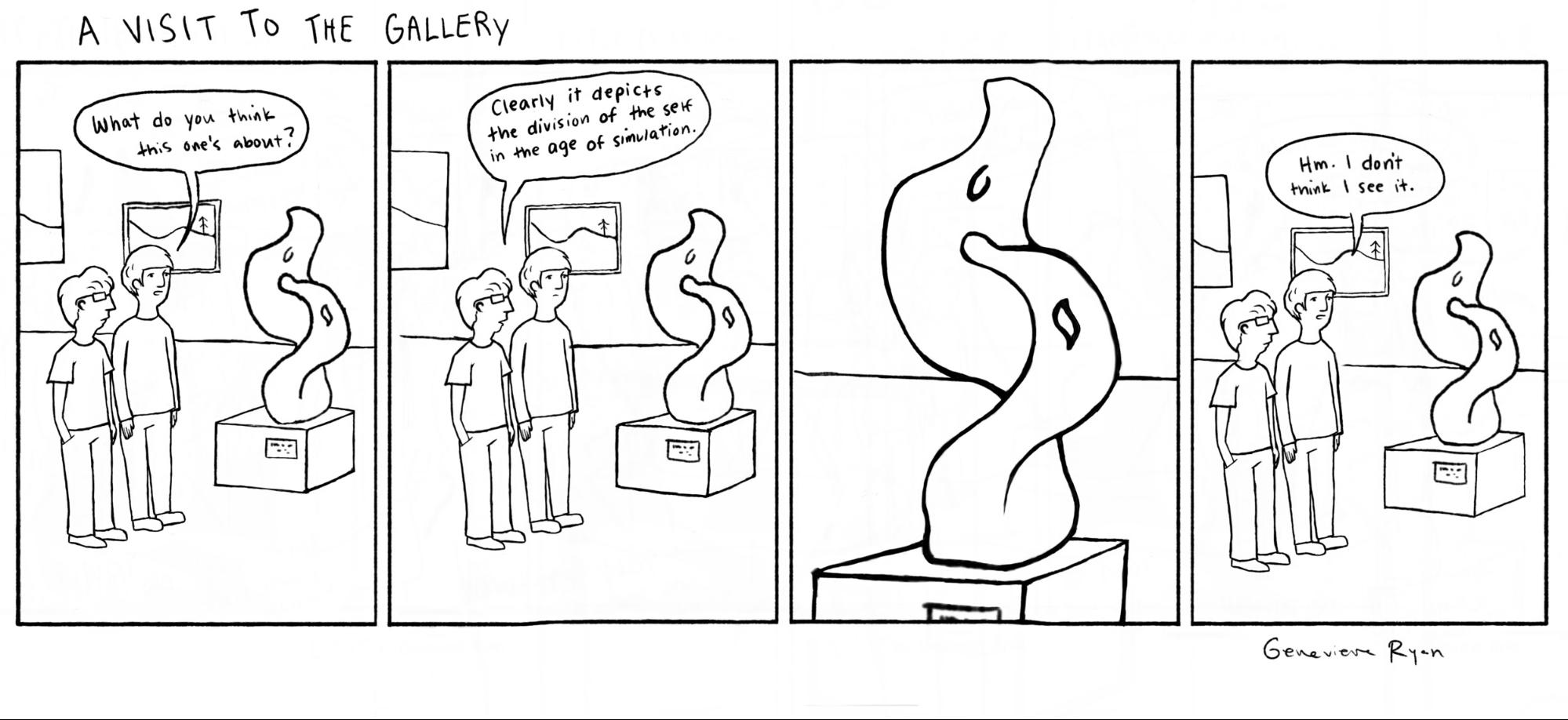
Cartoon: A Visit to the Gallery

GENEVIEVE RYAN / AGGIE

Written by: GENEVIEVE RYAN — geryan@ucdavis.edu


Student-parent relationships in college

0
ANDREA GONZALEZ / AGGIE

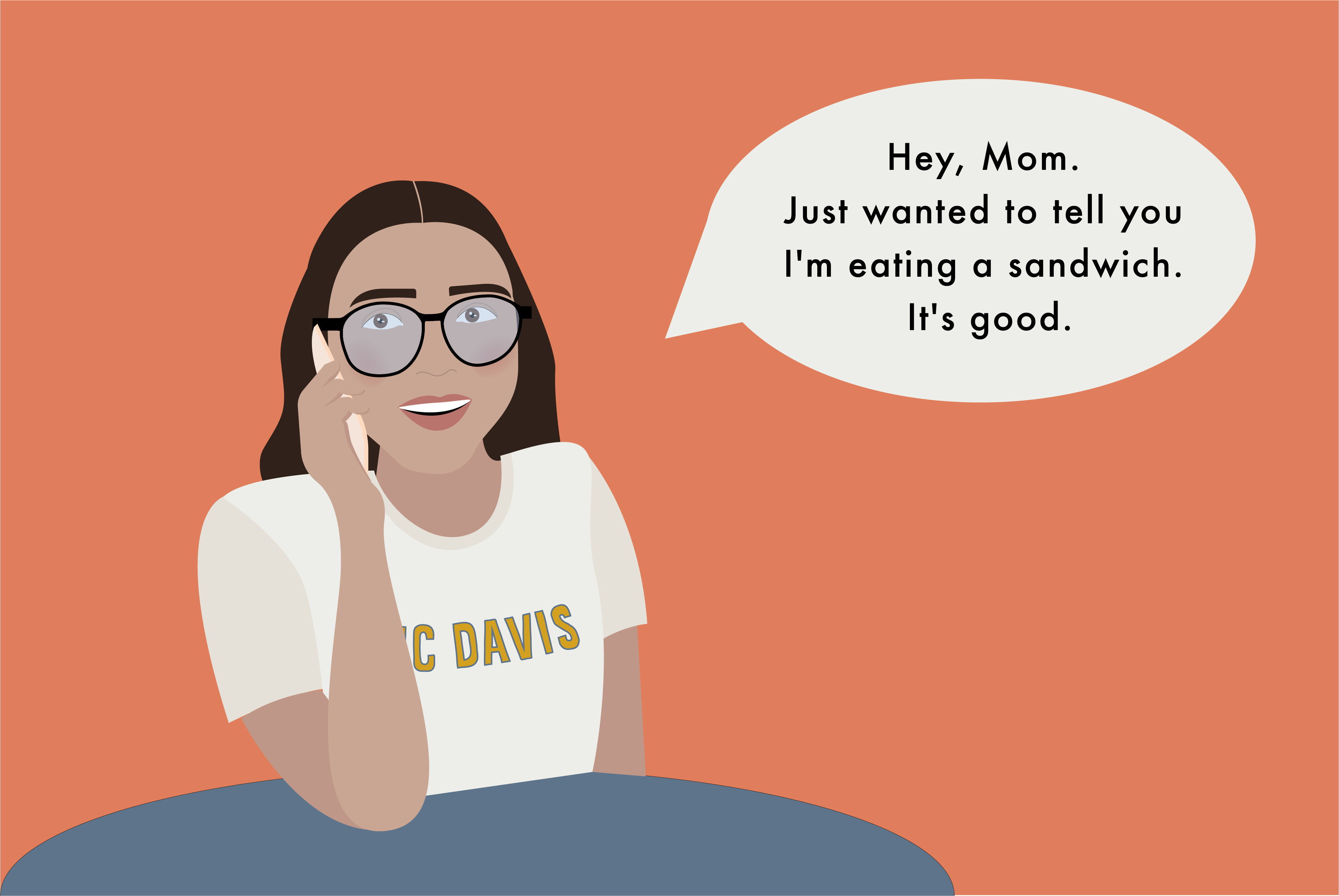
Students discuss their relationships with their parents

While moving away from college means meeting new people and cultivating new friendships and relationships, it may also mean an increasing drift in student’s lives and relationships back from home — particularly relationships with their parents.

We’re less of an everyday type family, so I don’t end up sharing a lot of the minutiae with him from my day-to-day,” said Alyssa Buchthal, a third-year computer science and communication double major. “I share big news or events with my dad. Whenever I get a big grade back or we’re planning holidays or there’s big family news, that’s when we talk.”

There are also some students who are more closely in touch with their parents.

“I talk to my mom around two to three times a day via call and talk to my dad via text/phone one to three times a week,” said Isabella Sanchez, a second-year materials science engineering major.

There are times when, like in any other relationship, students and parents have disagreements. Different people approach conflict in different ways.

“My dad and I are really good at being logic-minded, even in personal conflict,” Buchthal said. ”If we ever are in a tough spot, we can pretty reliably talk about it and work it out without raised voices or actual fighting.”

Third-year economics major Sarah Ramadhania spoke about avoiding confrontation with her parents to avoid any further complications.

“I’d pretend to agree with them just so that we don’t get into an argument,” Ramadhania said.

Sanchez approaches conflict much like Buchthal — by clearly talking it out with her parents.

“When my parents and I argue, we usually call each other and talk it out instead of holding it in,” Sanchez said. “It’s better to get over things faster than to let it drag out or else it just hangs over us like a cloud.”

Students voiced their opinions on what areas they tend to disagree with their parents about and how they come to a resolution.

“My parents like to push me to pursue a ‘wall-street’ career like working at McKinsey or Goldman but that’s just not what I want,” Ramadhania said. “I want to work in something that blends my passion for economic development and travel. I can’t do the corporate 9-to-5 life.”

Buchthal talked about the differences in political beliefs between her and her father.

“We tend to disagree on some politics,” Buchthal said. “My dad and his fiancé are pretty liberal, but they have a couple extremely conservative political views that don’t mesh well with me and my brother. Thankfully, they’re open-minded people with the right intent, so when we do get into political discussions, they are good at listening to my side and explaining their own. Usually, my brother and I teamed together have enough information on our side to sway them, and thankfully they’re not so close-minded or prideful that they’re unwilling to change their view in the face of facts.”

Romance, a huge part of many college students lives, can be quite a controversial topic when it comes to discussions with parents. Some students are more open when talking about their dating life than others.

“ Definitely not,” Ramadhania said. “It’s not a taboo, but in our family we just don’t talk about it. Mostly because I feel uncomfortable opening up about what’s going on in my love life in fear of judgment and they don’t really bother to ask either.”

In contrast, Buchthal seems to have a more communicative bond with her dad and his fiance.

“My dad and his fiancé are definitely more eager to talk about my love life with me than I am to talk about it with them,” Buchthal said. “They think I’m boring and definitely pressure me to get out there more.”

Students in college may not have the time anymore to spend a significant amount of time with their parents, but they do still have some memories that they fondly reminisce on.

“My dad never missed a single one of my basketball games in high school, no matter what,” Buchthal said. “He works full time, and some of my games were very far away, but he was always there. My team also low-key sucked, so he had to sit through a lot to support me like that, and I’m insanely grateful for it.”

For Ramadhania, it was a memorable birthday celebration.

“Celebrating my 16th birthday at the Sydney Opera House on New Year’s Eve,” Ramadhania said. “Though, I’d like to visit them as often as I can. Maybe take them out to a nice holiday or something as simple as going for a walk in the park.”

Ramadhania talked about what she would do differently to maintain her relationship with her parents if she could go back in time.

“I’d like to be more respectful towards them,” Ramadhania said. “I remember always feeling like they were against me, even though that probably wasn’t the case.”

Finally, even though a parent-child (especially as a college student) relationship is surely complex and challenging for students to maintain in a healthy manner, they highlight the dilemma that a lot of students go through: at the end of the day, they understand that parents are also humans, and hence, make mistakes.

“Over the years I’ve learned that my parents aren’t perfect,” Ramadhania said. “They’re human. They make mistakes. And a part of growing up is learning to understand and accept them for who they are.”

Buchthal talked about the complexity of familial relationships.

“Things aren’t always easy with family, but I think it’s important to remember that — almost always people are just trying to do their best, and being patient and kind with people is the best way to weather any storm,” Buchthal said. “Even parents aren’t perfect.”


Written by: Rabiya Oberoi — features@theaggie.org


Concert Review: Rüfüs Du Sol

INFAMOUS PR / COURTESY

Australian trio leaves memorable performance at Bill Graham

On Nov. 6, San Francisco welcomed alternative electro-dance group Rüfüs Du Sol at the Bill Graham Civic Auditorium. The performance was the eleventh stop on Rüfüs Du Sol’s Solace Tour. The city was the perfect backdrop for the minimalist sultry sound that established the group’s presence in the broader Electronic Dance Music genre. This time I remembered that San Francisco venues have coat checks.

Jon George, the keyboard player, shouted, “San Francisco, this is the biggest show of the tour!” This statement instantly washed over the crowd, and everyone in attendance knew at that moment they were going to witness a spectacular show.

The stage was simple and not over-the-top-rave cliche. I thought the clear keyboard stand and band equipment was a smart aesthetic choice. The band has a great way of creating a look and feel with their albums from the artwork to their live performances that creates a consistent micro-universe.

Rüfüs Du Sol opened the show with “Eyes,” and it was the quintessential submerging experience that drew in the attention of the crowd. The lyric “‘Cause I see myself in your eyes,” flowed into the bass drop and sent crowd into bliss.

“Innerbloom” and “You Were Right” from their album titled “Bloom” were revived at the show and it created a sense of nostalgia. The two songs are the most famous from the group so far. “You Were Right” has over 50 million listens and “Innerbloom” has 24 million listens on Spotify — a significant leap from the rest of their discography. “You Were Right” is my personal favorite because it’s clean, light and it makes me want to do a wave-like motion with my whole body.

The show was like a wavelength going up and down. There were songs like “Treat You Better” that was slow and made the crowd sway from side to side, and then they were hit with a pulsating beat and the power of songs like “Lost in my Mind” — a song with dramatic vocalizations that echo Gregorian chants.

There are several songs with vocalizations that allowed for a more intimate connection between the group and the crowd. Much like the “Ay-oh” that Queen was famous for, many of the songs on the “Solace” album have a harmonious vocalization that give the songs a tasteful, gaudy appeal.

The vulnerable lyrics of Rüfüs Du Sol combined with the deep bass and flashing lights were something to appreciate. It isn’t enough to say the show created a sense of euphoria because the performance transported the audience somewhere else — possibly the majestic outback of Australia.

EDM culture from the outside looking in has an expected attire that features accessories like exaggerated candy bracelets, fishnets and bandanas. However, there was a notable portion of the crowd that chose a different style, deterring from said stereotypes. This divide between button-ups with wing-tipped shoes and tank tops with bandanas is an example of how Rüfüs Du Sol caters to many that enjoy EDM.

The show finished with the lead single from their “Solace” album — “No Place.” The raw and vulnerable conclusion that sings, “There’s no place I’d rather be. I feel myself with you” was a profound example of their ability to move a crowd.

Rüfüs Du Sol gracefully executes a happy middle between head-banging EDM and soft-indie. Their eclectic sound is distinguishable, and they have stayed true to it since their start. Their music is available to stream on Spotify and Apple Music.

Written by: Josh Madrid – arts@theaggie.org

Food for Fines food drive hosted by Yolo County Library

0
JEREMY DANG / AGGIE

Community members can clear overdue fines with food donations

As the holiday season approaches, the Yolo County Library is kicking off its annual Food for Fines program. The event allows library cardholders to use food donations to clear overdue fines.

Each food item donated to any Yolo County Library between Nov. 13 and Dec. 31 will clear $1 of fines. There will be no limit of reduction in fines, and the food will be given to the Yolo Food Bank. The library also accepts donations from people who do not have fines but still want to give to the community.

This program is part of the library’s December Kindness Month, wherein the library is encouraging visitors to participate in small acts of kindness.

Food for Fines is still relatively new, and has continued to grow since it started in November of 2015. Last year, Yolo County residents donated 4,681 pounds of food through Food for Fines, making it Yolo Food Bank’s second largest food drive of the year.

Dana Christy, the East Yolo Library regional manager, is looking forward to this year’s drive.

“Hopefully [it will go] equally as well,” Christy said. “We collect donations in all of our branches, and we’re hoping to collect 6,000 pounds, which would be a record for us.”  

Suggested items for donation include canned food, meats, fruits, vegetables, beans and soup. Canned or boxed meals, cereal, rice, pasta, fruit juice, shelf-stable milk and peanut butter will also be accepted.

According to a county press release, “The Yolo Food Bank recommends nutritional options such as 100 [percent] fruit juices, low-sodium soups and whole grains. They will not accept rusty or unlabeled cans, non-commercial items, alcoholic beverages or mixes, food packaged in glass, or perishable, expired, open, used or homemade items.”

Through drives like Food for Fines and coordination with a network of organizations and businesses, the Yolo Food Bank provides more than four million pounds of food annually to Yolo County residents who struggle with food insecurity. As stated by the Yolo Food Bank’s website, as many as 17 percent of Yolo County residents are affected by food insecurity, despite Yolo’s status as a vibrant agricultural economy.

Some students at UC Davis are well aware of these food issues throughout the region. Evan Dumas, a fourth-year biotechnology major at UC Davis, is the president of Food Recovery Network. The organization coordinates food donations from UC Davis markets and dining commons, as well as from city farmers markets.

“[Food insecurity is] an unfortunate, real problem that I think based on what I’ve seen doesn’t need to exist, just because there’s so much all around that’s wasted and not used appropriately,” Dumas said.

Dumas appreciates what the library is doing through Food for Fines.

“Food for fines — I think that’s a really cool name and a cool program … [and] I think applying an incentive to [donation] is a really smart way to go about it,” Dumas said. “It’s the most harmless and kind way of encouraging people to donate food.”

Maura Rorbaugh, a Davis resident, is considering participating in the program because it may allow her to donate without adding another errand to her day.

“Probably it would most depend on if I’m going to the library,” Rorbaugh said.

Rorbaugh, who said she visits the Mary L. Stephens Davis Library about once every two months, commented on Food for Fines.

“It seems like in some ways, [the library will] get money that they wouldn’t have gotten otherwise [to] go to a worthy cause, if people are going to want their fines off their record,” Rorbaugh said. “So I think it sounds like it’s a really good idea.”


Written by: Anne Fey — city@theaggie.org


New leadership, GASC members, Refrigerator Services

CAITLYN SAMPLEY / AGGIE

President discusses targeted attacks within association

The Nov. 1 ASUCD Senate meeting was held in the Mee Room of the Memorial Union and was called to order at 6:10 p.m. Absent on the roll call were Senators Devo Leichter, Daniella Aloni and Brandon Clemons. Senator Alisha Hacker had to leave early, and Senator Simran Kaur sat in as senator pro tempore in her place.

The meeting opened with a moment of silence for the victims of the Tree of Life synagogue shooting in Pittsburgh, Pennsylvania.

After the moment of silence, the Senate meeting began. The meeting consisted of quarterly reports by ASUCD units, held association member confirmations, voted on existing legislation and introduced new legislation.
Emily Stack, the editor-in-chief of The California Aggie, delivered the newspaper’s quarterly report. Stack highlighted the completion of fall hiring for the newspaper and confirmed that the the staff is at full capacity. She also mentioned that the newspaper was now being printed at The Sacramento Bee as a logistical and cost-saving measure.

Stack also said that the digitization project to scan past editions of the newspaper online received full funding and the effort should be completed by the spring of 2019. Stack also announced the inclusion of video features to further foster the publication’s online presence.

Regarding Stack’s report, Rina Singh, the Ethnic and Cultural Affairs Commission chair, asked about the process in which the newspaper’s editorial board opinions are written and approved. Singh then inquired whether the minutes are read beforehand when an opinion piece is written about the Senate.

Stack responded and said that the editorial staff meets four times a week where editors each give two ideas, and then the board decides on the most important topic to write about. She then said that the editors generally read minutes before writing a Senate-based editorial.  

Senator Ko Ser Lu Htoo asked if the video service will have any overlap with Aggie Studios. Stack said that she is working closely with the Aggie Studios director, and hopefully the work will generate “discrete enough content so we won’t step on their toes.”  

Up next was the Bike Barn’s quarterly report. The Bike Barn is an ASUCD unit that repairs, rents and sells used bicycles on campus. Co-directors Jacob Wagner and Oscar McBain delivered the report and said that the Bike Barn’s move-in weekend event was a record-breaker for the shop. They also highlighted that in October 483 flat tire repairs were made as compared to 293 during the same period in 2017.

Senator Alisha Hacker asked the two co-directors if the cost of wages affected their pricing. They replied, saying the increased minimum wage has affected their labor costs. They hope that the increases haven’t affected students, however, and they are trying to make processes more efficient to maximize the budget.

Up next was the Refrigerator Services’ quarterly report. The director of the unit, Mohammed Qayum, gave the financial and rental results, outlining that 326 microfridges and 83 mini refrigerators were loaned out. Microfridge deposit refunds totaled $12,780 and mini refrigerator deposit refunds totaled $830, with total sales at $48,420. Qayum, who is leaving the position, expressed a concern for warehouse safety as refrigerators are stacked three-high, and said that the next unit director will need to issue a plan to get a forklift.

Next came the quarterly report for the Mental Health Initiative Committee. Co-directors Milly Judd, a third-year animal science major, and Katrina Manrique, a fourth-year English and history double major, delivered the report. They expressed concern about health providers not accepting students covered under the UC Student Health Insurance Program, as well as the providers receiving SHIP decreasing.

They said that in Student Health and Counseling Services (SHCS) there were long lines and wait times for counseling appointments. Judd and Manrique announced that the Health Awareness Week held earlier in the fall was successful.

They also promoted the upcoming Mental Health Conference which will be held from Jan. 12 to 13 at the UC Davis Conference Center. Conference registration will be free and the event will feature 12 workshops. The workshops will feature a range of speakers and topics — representatives from Saint James Infirmary will focus on the health and safety of sex workers in the U.S., there will be presentations by the Gender Health Center on how to ally with the transgender communities and The Happiness Project will focus on personal self-care.

Senator Jumoke Maraiyesa asked about efforts to create a buddy system to check how people are doing. Judd said that during a meeting this fall, a Google form was posted seeking individuals who may need help and support, and they matched people up as a result. Singh asked about their current outreach efforts. Judd said that though they do not counsel people because they are not health care professionals, they distribute handouts listing resources where people can find help. Judd also mentioned that during the conference there will be panels and professional workers on hand to provide information.

The Senate then moved to unit director and unit member interviews and confirmations. Jose Benito Martinez, a third-year political science major, applied for the Refrigeration Services director position that was to be vacated by Qayum. Martinez was endorsed by Gofman who said Martinez “stood out for his good work ethic” and mentioned his previous experience with refrigerator services. Martinez was confirmed without objections.

The Gender and Sexuality Commission (GASC) member confirmations came next. Deirdra Bradley, a fourth-year international relations major, Rebecca Canfield, a third-year biology major and Daniel Tillman, a fourth-year political science and history double major, were interviewed for the position. The GASC commission chair Joelle Barnard offered her support for the candidates, saying “they were all knowledgeable about the issues and really cared.”

Htoo asked the candidates about what leadership and outreach meant to them. Canfield said that a leader needs to be a good listener. Bradley said that a leader needs to know when to be a follower and “know when to step back and also know when your idea is valid and stand by it.” Tillman added that GASC must be representative of the communities they serve, so therefore “listening is important.” All members were confirmed without objection.

Consideration of new legislation came up next.

Senate Bill #18 to create the Transfer, Reentry and Veterans Committee was sent to the Internal Affairs Commission for review. And Senate Bill #17, which would allocate $7,313 for The Pantry to purchase solid steel shelves, was sent to the Business and Finance Commission.

Up next was the discussion and approval of old legislation.

Senate Bill #7 looked to make grammatical edits to the description of the Ethnic and Cultural Affairs Commission and Gender and Sexuality Commission in the Bylaws. The measure was passed with amendments.

Senate Bill #15 aimed to define and structure the meaning and intent of “urgent legislation” language. After a protracted discussion, the bill was passed with amendments.

Senate Bill #16 aimed to reduce paper waste by eliminating paper copies of Senate meeting minutes. After discussion, the bill was passed with amendments.

Status of Previously Passed Legislation was approved and signed.

Also during public discussion, Gofman addressed concerns within the association.

“The same people that accuse others of being divisive do the same thing they’re accusing others of doing,” Gofman said. “It’s completely inappropriate to go around the table asking my friends to join their ludicrous attempt to slander my reputation. What good does it go to go behind my back?  … Trying to target members of this association and saying they’re corrupt or colluding secretly behind backs for the sake of your own personal political gain doesn’t help students in this university. Do your job. Don’t engage in petty politics.”

Ex-officio Reports and Elected Officer Reports were given. The past meeting’s minutes were approved and the meeting adjourned at 9:30 p.m.

Written by: George Liao — campus@theaggie.org

How students get organized

0
TESSA KOGA / AGGIE

Students talk about how they stay organized during their college life

College students have a number of obligations to keep track of, and students have various ways of staying on schedule. Keeping track of academic and personal responsibilities takes many forms — meal planning, scheduling around work and using a planner are just a few of these.

As a Resident Advisor (RA), third-year animal science major Isis Vasquez has multiple responsibilities, including conducting facility checks and occupancy reports, being on call at least once a week and scheduling events for her floor and building. For her, there are multiple parts of her day-to-day life that she likes to keep track of, and she has a three-pronged system. She uses a wall calendar for her RA duties, midterms and long term assignments. She combines this with a Google calendar that contains important dates for all the RAs and a planner that she describes as her most important organizational tool.

Vasquez says that organization is all about choosing to stay on top of things, but she understands that some students may have difficulty with it when in college. She credits the AVID program she was part of in her high school for her organizational skills. She learned note-taking skills and the importance of using a planner properly, which she cites as a critical part of succeeding in college.

“You can’t tell anyone how to [organize], it has to come from [themselves],” Vasquez said. “You can give them all the resources, it’s whether or not they’re going to apply them.”

Meal-planning is another critical part of a weekly routine for third-year computer science major Abhay Sawhney and many other students who do not have a meal plan with the Dining Commons. Sawhney bases his diet almost exclusively on his workouts.

“Earlier, I would work out and head to the DC and eat until I couldn’t eat anymore,” Sawhney said. “Now, I kind of do the same thing. I’ll go to the gym and then I’ll take a box of chicken from the fridge and zap it in the microwave.”

On Sundays, Sawhney purchases chicken or beef, which he then cooks, three pounds at a time with different spices for different batches. He stores half in the fridge for the first three days of the week and stores the other half in the freezer for the rest of the week. With internships and school obligations, he stays on track with his Google calendar.

“I let the Google calendar take care of everything,” Sawhney said. “Whenever something important comes up, I’ll just put it on my calendar. Generally when my calendar is filled up, I don’t have to think about what I’m doing because it’s telling me what to do at any hour of the day.”

Second-year biopsychology major Lillian Wu also has to meal plan, she shops for groceries on Sundays. She tries to cook meals that are relatively simple — this is the first year she is cooking for herself, and she tries to create well-rounded meals with sufficient carbs, protein and vegetables.

“It was kind of hard to learn cooking at first,” Wu said. “A lot of it I’m still learning. There’s a lot of easy recipes online, and cooking is a lot easier than people say it is — and a lot cheaper than eating out.”

Wu had a seven-day meal plan during the fall of her first year, but then a five-day meal plan in the winter and spring. With that, she ended up eating out, and therefore spending, a lot more. With the meal planning that she has started this year, she feels that she’s more organized.

“It’s given me structure to my life,” Wu said. “I plan my day very thoroughly as opposed to last year where I kind of went, ‘I’ll just come back and eat at the dining hall whenever I’m free.’”

Another obligation that many students have to plan around is having a job. While some jobs have strict hours, first-year sustainable agriculture and food systems major Christian Morgan’s job as a student lab assistant allows her flexibility, which she sees as a benefit, especially in terms of scheduling classes. This quarter, Morgan tends to work in the morning when she’d otherwise be sleeping in, as she says it’s the best use of time that would otherwise not be spent doing anything useful.

“I schedule my classes first and then I look for the gaps in that space and then I’ll do the job,” Morgan said. “It’s an internship with the school. They’re very flexible, so I come in when I can and whatever free time I have, I go to work.”

As an RA, Vasquez has had some of her residents ask her for help with time management and organization; when they come to her, she shows them her system.

“I’ll show them my stuff and then they’re like, ‘Oh wow that’s so nice, I can’t do that,’” Vasquez said. “I’m like, you can, but [organization]’s a choice if you want to  … It’s hard, but it feels good.”

Written by:  ANJINI VENUGOPAL — features@theaggie.org


We must prioritize healthcare funding

ANDREA GONZALEZ / AGGIE

State budgets should be reevaluated if Americans want affordable healthcare

Despite efforts on behalf of Republicans to do away with the Affordable Care Act, 37 states have voted to expand Medicaid. These include Idaho, Nebraska and Utah, which voted in the midterm elections to adopt Medicaid expansion. While Medicaid expansion has afforded  benefits in multiple areas, the program runs the risk of exceeding state budgets as they search for the funds to pay their part of the bill — this is best exemplified by Montana, which voted on Tuesday to allow Medicaid expansion to expire in July 2019.

Montana has enjoyed the benefits of Medicaid expansion ever since it adopted the program in 2015. Since then, some 120,000 low-income Montanans have gained healthcare coverage, but it has come at a cost to the state’s budget. According to the Foundation for Government Accountability, Montana’s expansion has exceeded the budget by 70 percent. To account for this, legislators proposed a tobacco tax that appeared on the midterm ballot, which would have added $2 to the cost of cigarettes. Had Medicaid expansion been allowed to continue, the tobacco tax likely wouldn’t have alleviated the state’s problem in the long term, due to the national decline of cigarette use as well as a likely decline in Montanans’ cigarette use post-tobacco tax.

Slapping on taxes to account for healthcare budgets could also dampen economic activity and hurt the wallets of those the tax is intended to assist. Relying on taxes won’t be enough and may simply prove altogether ineffective. Time will only tell for states like Utah, which recently passed a proposal to raise the sales tax from 4.7 percent to 4.85 percent to fund part of its Medicaid expansion costs.

The primary issue emerging from expansion is cost overruns that are a result of enrollment and payment rates that go beyond initial projections. While many states have blown their budget, they haven’t yet felt the weight of debt since the federal government covers 90 percent of the cost for new beneficiaries.

That being said, the federal government will gradually reduce its subsidy over time, and states will be expected to cover a larger portion of the cost. If Republicans get their way, each state’s portion of the burden to fund Medicaid expansion will increase quickly. The GOP has repeatedly asserted its intent to equalize the funding formula, planning to make states cover 30 to 50 percent of the expansion budget.   

Improper payments are also prevalent: in 2016, independent audits of Medicaid in Arizona, Florida, Michigan and New Jersey unearthed 50 dead people who recouped at least $9 million in benefits after they died; 47 providers who registered foreign addresses as their service location; and $448 million apportioned to 199,000 beneficiaries with fake Social Security numbers.  

Because the federal government has given states a cushion to exceed their budgets by paying 90 percent of the tab, states have exceeded enrollment and created high payment rates. Funding Medicaid isn’t cheap, and states won’t be able to rely on the federal government forever — which, over time, will transform the likelihood of fiscal crises into a reality.

The fatal flaw of Medicaid expansion under this context comes down to a lack of funding. Currently, President Donald Trump is set to run an annual budget deficit that will reach, and very likely exceed, $1 trillion. Combined with pouring $716 billion into the U.S. military for the 2019 fiscal year, this leaves little room to fund things like education, infrastructure, and healthcare. And while proper maintenance of national security is in the best interest of all Americans, we cannot justify the amount currently being spent.

In spite of Republican efforts to eradicate the Affordable Care Act, it remains the law of the land. The adoption of Medicaid expansion by 37 states proves that American support for affordable healthcare is tangible.

Medicaid expansion isn’t a bad idea, but it’s been executed poorly. To ensure healthcare coverage for all, our budget priorities must be seriously reevaluated.


Written by: Hanadi Jordan — hajordan@ucdavis.edu

Disclaimer: The views and opinions expressed by individual columnists belong to the columnists alone and do not necessarily indicate the views and opinions held by The California Aggie.


Aggies end season with a win

QUINN SPOONER / AGGIE

Men’s water polo defeats Pacific 12-7 as six seniors are honored

In front of a large crowd, the No. 10 nationally ranked UC Davis Aggies defeated the No. 7 ranked Pacific Tigers 12-7 in a non-conference match on Sunday, Nov. 11. This marked the conclusion of the Aggies 2018-19 regular season, as UC Davis took down a high level opponent before the start of the Western Water Polo Association (WWPA) tournament on Nov. 16.

“I just think that the level of energy they brought today was so fun to watch,” Child and Meisel Families Director of Men’s Water Polo Daniel Leyson said. “We have been talking a lot, and it’s just awesome to see how hard they played and how well they played together especially for the seniors in their last home game.”

This game not only served as a test before the WWPA tournament, but was where six graduating UC Davis seniors were honored, playing their last home regular season match. Among those seniors are attackers Marcus Anderson and Colter Knight, utility players Nick Coufal, Ido Goldschmidt and Riley Venne, as well as goalkeeper R.J. Quigley.

“For the first time ever we have six seniors on one of my teams and these guys all have their own individual stories that are special,” Leyson said. “Overall, what they have represented is the ascension of our program. They have been with us when we haven’t won conference and when we have and they have helped our program to come along in ways that are just really special. They are just quality people.”

After they won the sprint to begin the first period, it took the Aggies a few minutes to speed up their play. Both teams drew six shots a piece ending the first, but it was UC Davis that capitalized on two late goals. The first came with 2:20 left in the period by sophomore attacker Jack Stafford and the second was scored by Knight with 1:00 remaining, giving the Aggies an early two goal lead to end the first.

Continuing their momentum and winning the second period sprint, an early penalty shot from freshman center Nir Gross increased the Aggie’s lead. The Tigers then began slow down their play enough for junior center Eric Martel to throw another one in the back of the net for UC Davis’ fourth unanswered goal.

With 2:10 remaining in the half, Pacific converted its own penalty shot on an Aggie exclusion, decreasing the lead to three. Just over a minute later, a save by Quigley allowed for junior attacker Yurii Hanley to deliver a pass from the two meter line across the pool to a waiting Anderson, who easily slid the ball past the keeper, ending the half with a 5-1 Aggie lead.

Going three-for-three on sprints, the Aggies continued to prove why they are consistently a nationally ranked team. Junior attacker Holden Tamblyn drove a bullet from five meters out into the top right corner of the net to open the third period. Soon after, though, the Tigers responded with two of their own even strength goals, which cut the UC Davis lead to 6-3. The remainder of the period delivered an even three goals by each team, so the score going into the final frame stood at 9-6.

The final period proved similar to the first three, with goals from Goldschmidt, Venne and junior attacker Max Somple and only one Pacific goal to end the game in a 12-7 Aggie win.

In total, the Aggies and the Tigers both finished with 28 shots, and Quigley ended the game with an impressive 13 saves for UC Davis.

“This team is more than a team for me, it’s a family,” Goldschmidt said as he reflected on his last regular season home game. “We are here for each other in the good moments and the bad moments and have been there for each other every team. For me, coming from Israel half across the world to come play here, I am very emotional about it but very satisfying and I will definitely remember those moments for the rest of my life.”

Finishing the season with a 16-7 overall record and a 6-1 conference record, the Aggies are set to face Concordia University in the first round of the WWPA tournament in Fullerton, Calif. at 1 p.m.

“I am hopeful that the feeling they had [today] will continue,” Leyson said. “You don’t know until you know and with the level of energy that we brought across the board it’s encouraging and we are just going to try to keep doing this and see what happens.”

Written by: Ryan Bugsch — sports@theaggie.org

Studio 301’s Upcoming Review: Movie Musicals!

JETT ALTENHOFEN / AGGIE

Fall production to feature compilation of musical staples

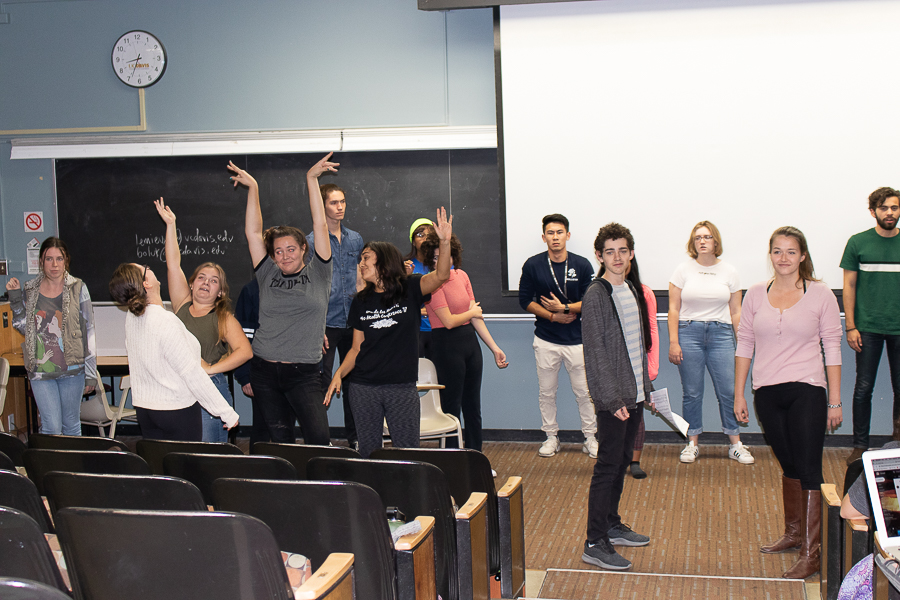
In the basement of Wellman Hall there’s a cluster of undergrads singing their hearts out in preparation for the upcoming fall review: “Movie Musicals!” The small classroom does not stop them from running lines and practicing their choreography.

With directions being shouted from the entrance of the hall as the students run their numbers, the group takes the instructions as they go, which goes on for two hours. Studio 301’s fall production will be a review, directed by Myah Daniels, a fourth-year communication major. Stage manager Jillian Yong, a second-year international relations and theatre and dance double major, explains what a review is.

“It’s basically like a concert of sorts,” Yong said. “It’s cabaret style, meaning they’re just going to be performing a bunch of different songs not necessarily in conjunction with each other. It’s a lot of fun, it’s just a feel-good show. It’s not going to make you question life afterwards, which is great for midterm season.”

The review will feature numbers from “Hairspray,” “Little Shop of Horrors,” “West Side Story” and many other popular musicals. The list of songs was chosen by Daniels, but there was a bit of flexibility to the selection process. Julie Torres, a third-year managerial economics major and actor in the show, discussed the process of how the review’s songs were chosen.

“There were some [songs] that people auditioned with, and [Daniels] was like, ‘Oh that person is good for that song, maybe I’ll consider adding that song in,’” Torres said. “So, typically for reviews, the director chooses the songs.”

This year’s review is guaranteed to be one for the books. There will be songs from old musicals and new dance moves to go along with it.

A member of the Studio 301 Board Gracie Unger, a second-year psychology major and one of the show’s choreographers, talked about her castmates, along with having to deal with the responsibility of choreographing nine of the 13 numbers in the review.

“I think that this cast is just spectacular,” Unger said. “There’s actual choreography, which is really something that we haven’t done for a review before, like having choreographers and actual movements, so I think that this is a step up of where it’s normally been in the past.”

As the students rehearse, Unger can be found showing the steps to the number in the middle of the classroom.

“I think it always helped me having someone visually there,” Unger said. “Especially when you haven’t run something for a while, having someone guide you through it for that first time is super helpful.”

“Movie Musicals!” marks the first time Unger has been a choreographer for Studio 301.

“It’s one of the great things about Studio 301 — you can try out anything that you haven’t tried out [before],” Unger said. “Like if I wanted to do tech for the first time ever, they’d be like, ‘Sure!’”

Nicole Richer, a first-year animal science major, is excited to be part of the production.

“Right now, I’m in two numbers,” Richer said. “My solo number is called ‘Still Hurting’ from ‘The Last Five Years’ and it’s such an emotional, in-depth number. I love the show ‘The Last Five Years,’ so I was really excited for that, and then I’m singing as part of The Dynamites in ‘Hairspray.’”

Studio 301 was founded in 2007 and is currently run by undergraduate students from a variety of majors. This club targets students who enjoy theatre but don’t necessarily want to pursue it as their major. Studio 301 performs many different types of shows, from reviews to musicals to plays.

“I did theatre a lot growing up,” Unger said. “And there’s nothing like a group of theatre kids that accept you for whatever you are and whoever you want to be and are just such an inclusive environment.”

Studio 301 gives students the opportunity to be either in the production, in the club or in both.

“It’s kind of fun to be part of the group that brings everybody together,” Yong said. “I personally am not much of a performer, but I enjoy the arts, so it’s fun to still be a part of that whole process, but in my comfort zone.”

For some, “Movie Musicals!” will be their last production with Studio 301.

“This show means a lot to me because there’s a lot of people that I know in this show that will be leaving next year,” Torres said.

This review is a light-hearted one, mixing different genres of music into one night for people to enjoy.

“Movie musicals just make people so happy and it brings non-theatre people into the theatre world and then they want to learn more,” Richer said.

“Movie Musicals!” has exciting musical numbers that are fun to watch and the kind of entertainment that would make for a perfect night. In rehearsal, the students laughed at themselves when they got the lyrics wrong and this friendly environment is sure to be exemplified during the review itself.

“Movie Musicals!” will be playing Nov. 16 to 18 at Lab A in Wright Hall. Tickets are $8 for students and $10 for general admission. More information can be found on the production’s Facebook event page.


Written by: Itzelth Gamboa — arts@theaggie.org


UC Davis loses to No. 7 Stanford

Rael Hanus / Aggie

Aggies outplayed in season opener

The UC Davis women’s basketball team couldn’t seem to find its groove last Wednesday. The Aggies lost their first regular season game, 71-43, on the road against No. 7 Stanford.

It was a tough matchup against the perennial Pac-12 power. The Cardinal has made it to the sweet 16 of the NCAA tournament each year since 2008 under 31-year Head Coach Tara VanDerveer.

“[Stanford is] really long and tough to score on, they have great length at every single position,” said UC Davis Head Coach Jennifer Gross.

The Aggie offense struggled to generate scoring opportunities, only hitting 22.6 percent of their shots from the court. The Cardinal shot at a higher and more consistent clip, at 42.6 percent.

Senior forward Morgan Bertsch put the game’s first points on the board with a three-pointer. The first quarter was the only one where the Aggies seemed to be on even footing with the Cardinal. UC Davis shot 29.4 percent from the field, and the Cardinal shot 35.3 percent.

Stanford’s interior defense closed off lanes for UC Davis to drive to the basket. Facing limited space and aggressive guarding in the key, the Aggies only scored four points in the paint compared to the Cardinal’s 12.

The Cardinal picked up the pace in the second quarter. Stanford sophomore guard Kiana Williams racked up 14 points, three assists and shot 62.5 percent from the field in the first half. As a team, Stanford raised its output to 42.9 percent-shooting and logged nine steals to finish out the half.

The Cardinal defense forced the Aggies to take more difficult shots. UC Davis dipped to 15.4 percent shooting, only converting two of its 13 shot attempts. The Cardinal didn’t hesitate to double team Bertsch, all but shutting down the Aggies’ top producer on offense.

“I think it’s no secret that we like to play through Morgan,” Gross said. “And they were just surrounding her, there’s lots of long arms to pass over, when we did get shots we just didn’t knock them down.”

Gross and the Aggies were aware that teams would try to shut down Bertsch.

“We worked on that quite a bit, we’re anticipating that’s going to happen,” Gross said. “When people throw a double we’re going to be able to find shooters and find cutters.”

The Aggies finished the second quarter without scoring any points in the paint and trailed 36-24.

In the second half, the Cardinal continued to shoot well while the Aggies struggled.  

Stanford senior forward Alanna Smith, considered the 23rd-best player in women’s college basketball by ESPN’s preseason rankings, led the way for the Cardinal. She averaged 13.5 points per game, seven rebounds per game and 1.8 blocks per game in the 2017-18 season.

The versatile preseason All-Pac-12 team pick didn’t leave one category on the stat sheet blank. In 15 minutes of playing time, Smith shot 57 percent from the field, logged 16 points, an assist, block, steal and rebound.

The Cardinal also dominated the Aggies on the boards as well, as Stanford collected 36 defensive and 18 offensive rebounds.

Despite the subpar shooting performance, Gross saw the positive side of competing against one of the top teams in the country.

Gross noted she was pleased with the recent Walla Walla Community College transfer, junior guard Cierra McKeown and her ability to shoot from beyond the arc. McKeown drained both of her three-point attempts in the first half when Gross decided the team needed an offensive surge.

Losing three starters to graduation last season meant that Gross had to change the lineup this season.

“We’re still trying to figure out with our chemistry, what lineups work well together,” Gross said.

Senior guard Kourtney Eaton played 35 minutes and, according to Gross, added pressure to lead the team.

“Kourtney had a lot on her shoulders tonight, just playing the amount of minutes that she did and trying to keep us together.”

A new season means new players are brought into the fold and returning players inherit increased responsibility. As the team works out the kinks, Gross will be searching for a lineup with good chemistry.

The Aggies will travel up the pacific northwest to play Portland State, a team the Aggies beat last year, 79-67, on Friday and Washington State on Sunday. The Aggies will return to Davis for a home game against Southern Utah on Nov 23.

Written by: Bobby John — sports@theaggie.org

Davis City Council discusses bringing e-scooters to the community

0
MICHAEL LEAHY / AGGIE

Regulations, policies being established to monitor e-scooters’ impact on city

Electric scooters have been popping up in numerous parts of California, and the Davis City Council is discussing bringing them to town.

E-scooters, like the rentable bikes around campus and the city, can be rented and dropped off anywhere. Simply downloading an app allows users to gain access to the electric-powered scooters. The whole rental process is almost identical to the bike-share programs. There have been several concerns, however, regarding the potential issues these e-scooters may cause. In addition, rules are still being discussed in order to manage e-scooter programs.

An urgency ordinance was implemented to alleviate concerns that starting these programs in the Davis community could result in abandoned scooters around town. It also was aimed to protect residents from getting hurt or hurting someone and to regulate the number of scooters allowed in the area. The Davis City Council came together on Oct. 30 to discuss the best way to determine expected rules and authorization standards so that the safety of the community will remain intact. The public’s peace, safety and health is the council’s number one priority in the case of enabling electric scooters in Davis. Popular companies that offer these rentals include Lime, Bird, Spin, Skip and Scoot.

“Many cities have experienced problems with scooter use,” said Floria Partida, a Davis city council member. “We want this venture to be as successful as possible if it begins operating in Davis. We believe this is a good option for alternate transportation, and it would be more difficult to bring a program back that has ended badly due to poor management. Already, we have received multiple people reaching out to us with concerns. Any program would need to have well thought out regulations to keep everyone safe.”

The city council decided to allow e-scooters to come to Davis as long as they are authorized and permitted. This would allow the council to exert legislative control over the increasingly popular business. The council’s goal is to ban scooter share companies until they create a policy that can take the city of Davis’ well-being into account.

“The last time we passed such a temporary measure ‘banning’ an activity was for commercial cannabis,” said Will Arnold, a Davis city council member. “In that case, we then immediately began the process of forming a comprehensive policy, which we completed earlier this year. We have now licensed five dispensaries, which are either already open or opening soon, along with a number of manufacturing and other cannabis-related businesses. I expect the scooter-share industry will follow a similar path.”

Although the Davis City Council is concerned with the safety aspects of these e-scooters, it is also excited to have these local rentals for students who are looking for means of transportation to classes.

“They are super accessible, and are much more efficient than jump bikes, in my opinion,” said Will Khouri, a second-year managerial economics major. “The only downside is that people sometimes trash them cause they are easier to throw around — at least that is how it is with the scooters placed around my hometown. Still, the pros outweigh the cons, and I do miss having the availability of them.”


Written by: Lauren Tropio — city@theaggie.org


Air quality index reaches 305 in Davis

QUINN SPOONER / AGGIE

City, residents, homeless affected by smoke

Update (15 Nov. 2018, 7:33 p.m.): AQI in Davis has risen to 323.

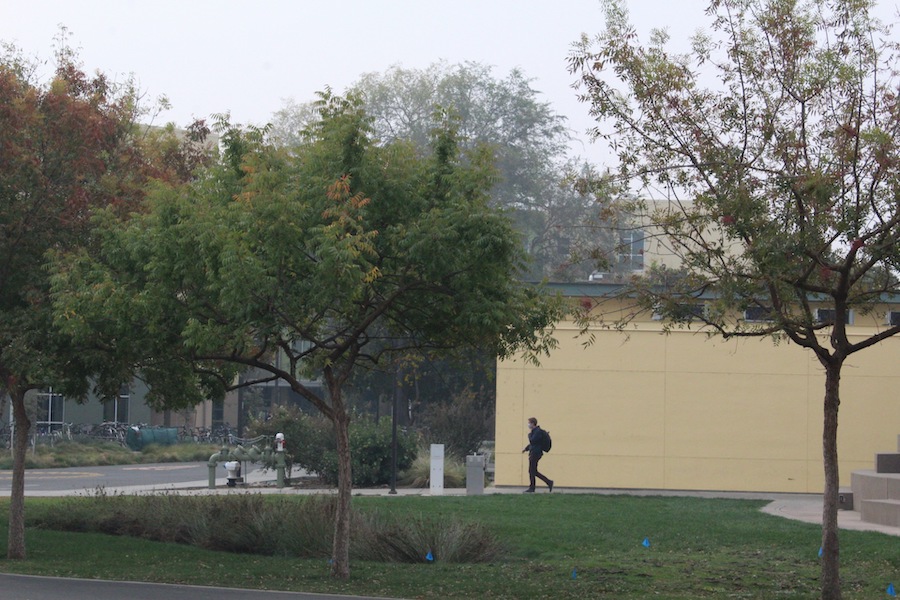
The Butte County fire has affected students and residents alike, as the air quality index in Davis has reached up to 305 as of 6 p.m. on Thursday. Sacramento’s AQI has reached up to 311. Both Davis and Sacramento’s air qualities are categorized as “hazardous.”

Several college campuses, including UC Davis; California State University, Sacramento and San Francisco State University closed the past few days and will close again Friday, Nov. 16 due to the health concerns associated with the poor air quality. Davis Joint Unified School District, along with other school districts in Yolo County, have closed schools and all offices for Friday as well.

“We anticipate the conditions to improve significantly over the next week and look forward to a return to normal school routines, outdoor activities and athletics after Thanksgiving Break,” according to the DJUSD website.

Josh Buren, a Sacramento resident who sells laboratory equipment to UC Davis, explained that he has to work from home all week since campus is closed.

“I actually ended up having to tell several coworkers to cancel their flights for different events on campus this week,” Buren said. “Although I have barely left the house, I have noticed that [there are] plenty of people who still think it’s safe to bring their dogs to the dog park across the street. Thoughts and prayers go out to all of those affected across the state.”

Several other events were canceled, including the annual Davis Turkey Trot. Sacramento Metropolitan, El Dorado, Feather River, Placer and Yolo-Solano Air Districts advised to “stay indoors and avoid outdoor activities.

UC Davis and the City of Davis are offering a limited amount of N95 masks at the Memorial Union and the fire department. Boxes of free masks were stationed outside of the Davis Fire Department downtown on Fifth St. Local stores that usually sell the masks were completely sold out as a result of residents stocking up.

Not all people, however, have the means to purchase the masks. Many homeless people around the city are without masks, breathing in the hazardous air. The California Aggie called several homeless shelters to see if the homeless were being provided masks, but did not receive any response. It is unknown if they are currently open. Family Promise of Sacramento, a nonprofit organization in Sacramento, said that it was not providing masks.

It is recommended that residents remain indoors as much as possible and take precautionary measures when stepping outside, such as wearing masks. Conditions are expected to improve over the weekend.

Written by: Kaelyn Tuermer-Lee — city@theaggie.org