58.6 F
Davis

Davis, California

Monday, December 22, 2025
Home Blog Page 53

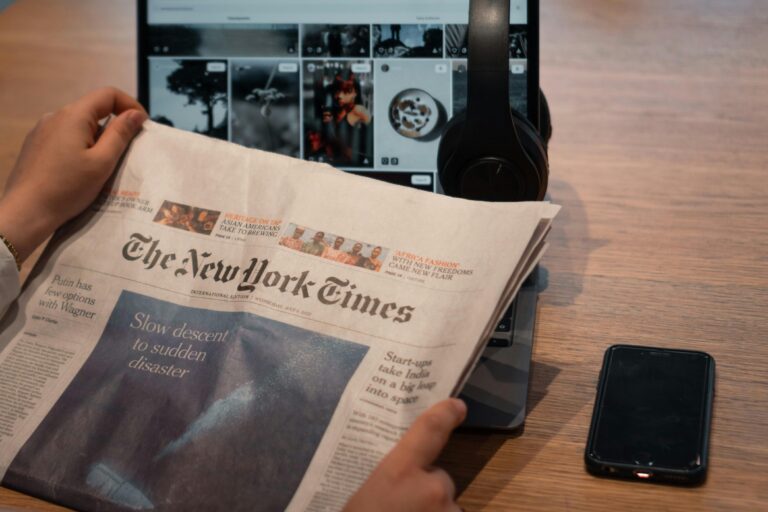
Paywalled articles can make research difficult for college students

0

While subscription fees provide income for news outlets, they also create barriers to reliable journalism 


By LAILA AZHAR — features@theaggie.org


For college students, research sessions are often interrupted by a barrage of pop-ups. The Atlantic, for example, does not permit non-subscribers to read its articles. The website flashes a screen that reads: “To read this story, sign in or start a free trial.”

The New Yorker, on the other hand, allows access to a few articles before obstructing access. When the user is reaching their limit, the pop-up instructs them: “Your window is closing. Get full access for $2.50, $1 a week for one year, plus a free tote.” 

A 2019 study by Reuters Institute found that while hard paywalls, which completely prohibit access to non-subscribers, are rare, more than two-thirds of leading newspapers across the United States and European Union operate behind some form of paywall. The study also found that in the United States alone, this has seen an increase from 60% to 76% since 2017.

Jeanine Mora, a second-year international relations major, explained the frustration from attempting to complete class assignments when there is a paywall. 

“Trying to find good, reputable sources when you’re writing a paper can be hard when a lot of the newspapers and sources that are known for being reliable and recognizable by their name make you pay to read them,” Mora said. “Sometimes you see a title that seems like it would perfectly talk about what you need, but you can’t read anything past that.” 

Additionally, Layla Abedini, a second-year biological sciences major, pointed out that  placing journalism behind paywalls may encourage people to rely on social media for news. 

“These days, most people get their news from social media,” Abedini said. “Social media is free and it’s easy to access, but that means that people usually don’t read beyond a headline or a post by someone who might not be really informed. Things you post online aren’t fact-checked the way things printed in a newspaper are.” 

On the other hand, subscription fees provide publications with the steady funding they need to produce the stories they want to tell. A reliable stream of income is essential for a newspaper to operate and compensate their writers and workers. 

The alternative to a subscription system often results in a webpage covered with advertisements. This model can lead to an overuse of clickbait headlines, as outlets prioritize increasing web traffic to generate ad revenue over producing meaningful journalism. 

However, Ivan Lai, a fourth-year human biology major, said subscription models create a disparity between the types of information people are able to access.

“Putting information behind a paywall means that people with more money are able to access more information and potentially higher-quality sources or reporting,” Lai said. 

While paywalls are an important source of funding for many publications, they create barriers for students who rely on accessible, credible information. Subscription models, while they may help keep publications afloat, may exacerbate inequalities in access to reliable journalism. 

Balancing financial interests and accessibility remains a critical challenge for outlets. In the meantime, UC Davis students have resources available through UC Davis’ Office of Educational Opportunity and Enrichment Services to help them access more outlets. 

For example, students have free online access to The New York Times and The Economist websites. The UC Davis Library also hosts newspaper collections, both historic and contemporary, and provides access to a collection of academic journals, books and documentaries


Written by: Laila Azhar — features@theaggie.org
Commentary: There’s more to the cannibalism metaphor than all-consuming romance

Media and literature seem increasingly obsessed with the idea of people eating other people…but what is it really all about? 


By SAVANNAH ANNO — arts@theaggie.org

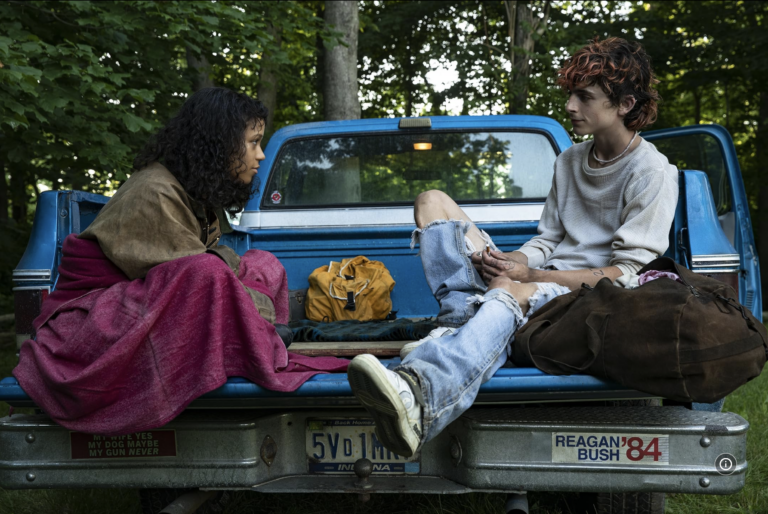
With the week of Valentine’s Day upon us, it is only natural to gravitate toward the usual roses and romantic comedies. And, if you’re anything like the average all-media-consuming 20-year-old girl, chances are your tastes also tend to lean toward the creepier side of love. Recent films like “Nosferatu” (2024), “Bones and All” (2022) and “Saltburn” (2023) tie desire, complex relationships and horror elements neatly together with a bloody red bow. 

What is it about that sort of package that makes it so much more appealing than a regular box of chocolates? More and more, cannibalism in pop culture is gaining a cult-like following as fans move back and forth between hit shows like “Hannibal” (2013) and “Yellowjackets” (2022). Most often, these extreme acts are interpreted by fans as the ultimate metaphor for love.

But is that all there is to it? As Chelsea G. Summers — author of “A Certain Hunger” (2019), which follows a female food writer and cannibal — writes for British Vogue, “cannibalism speaks our language.” While the thought of it may revolt or shock you, there’s something about a never-ending hunger that’s universal no matter your romantic status. Themes of class conflict, bodily autonomy, revenge and even queerness can all be represented through the singular, seemingly damning act. 


Insatiable grief:

Beyond pop culture, cannibalism’s inclusion within literature can be traced all the way back to works like Shakespeare’s “Titus Andronicus” (1588), which follows the title character, a Roman general, as he comes to blows with Tamora, Queen of the Goths. At the end of the play — spoiler alert — Andronicus kills Tamora’s sons, bakes them into a pie, feeds it to her, reveals what’s in the pie and then kills Tamora as well just moments later. 

In an insightful deep dive into “Titus Andronicus,” and various other dramatic works that utilize cannibalism, Ph.D. scholar and YouTuber, who uses the name GlutenbergBible, explains an interesting interpretation of the horrifying plot line. In many performances of the play, directors push the act of cannibalism further by having Tamora actually continue to eat the pie after learning it is her children. 

“In order to try to protect them, she eats them to return them to the safety of her body,” GlutenbergBible said via a video essay. 

It’s not only “Titus Andronicus.” For centuries, cannibalism has been used in stories, and in real life, as a funerary ritual to honor life and represent its never-ending cycle. Of course, it’s not an act to be defended, but it makes sense that one of the most inexplicable crimes is often paired with grief, one of the most ineffable emotions. 


Girls have to eat, too:

Moving away from Early Modern literature and into the exciting works of today, it is easy to see that mentions and acts of cannibalism in media are becoming increasingly female. In her own novel and in cult classics like “Jennifer’s Body” (2009) or “Yellowjackets,” Summers explained that the act of consumption isn’t simply about sexual desire or desperation. 

“So much about femininity centers on consumption,” Summers’ British Vogue piece reads. “What we can eat, how much we can eat, how to present yourself as appealing, and how those questions are inextricably intertwined.” 

In these newer iterations, cannibalism is used to show women reclaiming the body and leaning into the monstrous as a way to challenge what we see in our everyday world — bodily autonomy constantly at stake and women’s appearances being picked apart daily. Moving even further away from the male gaze and straight into the grotesque, female writers and filmmakers are proudly subverting any and all expectations. 

“Horror belongs to women because we understand, on a gut-punch level, how it feels to be viewed as a monster,” Summers said. “As well as how it feels to be reduced to body parts.” 


Control, violation and the other:

While it is maybe more interesting and entertaining to think of cannibalism in these metaphors of reclaiming power or coping with grief, it is also important to remember that cannibalism can also be just that — cannibalism, a method of murder. As much as media can attempt (and oftentimes succeed) at poeticizing the act or romanticizing its intensity, works like Ethel Cain’s “Preacher’s Daughter” (2016) remind us of cannibalism as a complete violation of boundaries. A universally understood subversive act, it can also be used to signify “the other” in today’s stories. 

In her two-hour video essay, “Hunger Hurts: Cannibals and Why We’re Obsessed with Them,” YouTuber Lola Sebastian examined the many layers of interpretation of the act, one of them focusing on how new media can be used to highlight the political and colonial roots of cannibalism in the real world. 

Beginning with Christopher Columbus’ false accusations of the Indigenous people of Latin America eating one another, cannibalism has been used for centuries as a justification for colonialism and a way to dehumanize Indigenous people of color. In reality, it was Europeans and white Americans who were doing the eating, as explained in Vincent Woodward’s “The Delectable Negro: Human Consumption and Homoeroticism within U.S. Slave Culture” (2014). 

“‘Bones and All’ is specifically the story of a Black girl navigating a landscape intrinsically hostile to her,” Sebastian said. “It was extremely deliberate who the author [Camille DeAngelis] chose to otherize. All of the monsters in the novel are white.” 


As the cannibalism plot device climbs the ranks to join vampires and zombies, it’s important to not just brush each iteration of it off as a symbol for love. Exploring the metaphor through various lenses honors the intricate thinking of each writer and artist trying to push the boundaries of their audience’s comfortability. 

Written by: Savannah Anno — arts@theaggie.org

Pence Gallery to host new Seconds Sale

0

First-ever Seconds Sale to be held at downtown gallery to promote unique works of art, experimental pieces and overstock


By GIA LOOMIS — city@theaggie.org


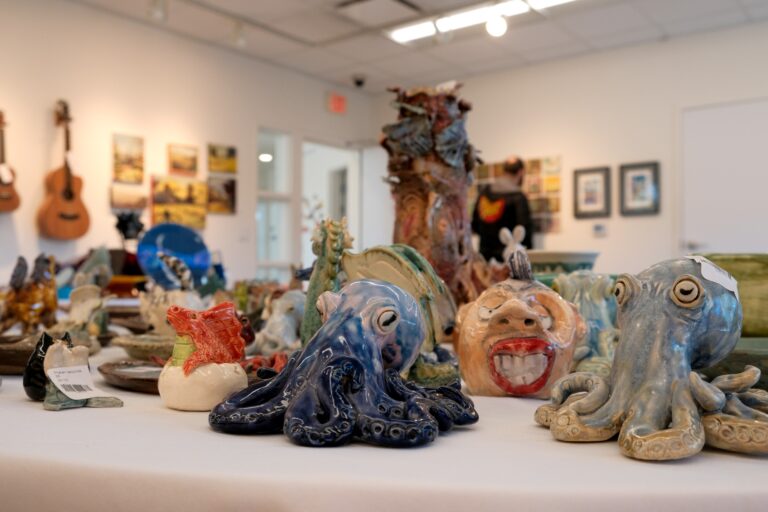
Since its beginnings in 1976, Pence Gallery has hosted many annual art exhibits, sales and markets. Yet this February, the gallery is expanding its usual events to feature the Seconds Sale. Opening on Feb. 7, this sale presents a unique selection of works including items of artistic experiment, art pieces with small flaws and overstock. 

In order to pull off a unique sale like this one, a lot of work goes into the brainstorming and planning process. Pence Gallery’s director and curator, Natalie Nelson, explained where the idea for the Seconds Sale came from. 

“This is the first Seconds Sale that we’ve ever had at the Pence Gallery,” Nelson said. “We were inspired by the Artery’s Second Sale, which they have annually in the summer.” 

The sale will be open until Feb. 28 in the second-level Learning Center at the gallery, but on Feb. 14, an open reception featuring the sale will be held. Admission to the sale and reception will be free and open to the public.

While Pence Gallery has held many sales in the past, as a non-profit gallery it is not its main focus. The gallery instead utilizes sales to fundraise when necessary — for that reason, the Seconds Sale was planned in the past few months to help the gallery cover some unexpected expenses that have arisen, according to Nelson. 

“Typically, the Pence as a non-profit doesn’t do a lot of sales,” Nelson said. “We mainly organize exhibits of work by local and regional artists in order to bring interesting and beautiful original works of art to the community. To support all of our education programs and to host 20 changing exhibits annually, we plan a few fundraising activities, such as this sale.”

The sale will not only host unique, limited works of art but also a wide variety of media and forms, as over 25 professional artists will be presented at the sale. Some of the varying mediums that can be found at the sale will include glass, ceramics, acrylic painting, prints and more. With so many artists featured, both Pence Gallery and the presented artists will benefit from this experimental sale. 

Nelson continued by explaining how the unique nature of the Seconds Sale allows artists to refresh their stock. 

“It’s such a great concept to offer things that might be slightly older or more experimental, or have a flaw in them, for sale to the public,” Nelson said. “Artists get to clean out their studios to make space for new work and to sell things that might not represent their interests or style anymore.” 

Additionally, by supporting the Seconds Sale, patrons are also supporting numerous local artists that Pence Gallery commonly features. Davis-based artist Jennifer Nachmonoff will present many pieces at the sale ranging from her one-of-a-kind pottery to functional ceramics.

Nachmonoff explained the type of products she will present at the sale and how it differs from her usual selection. 

I’m offering a variety of functional ceramics at the Seconds Sale — cups, bowls, plates and a variety of servingware,” Nachmonoff said. “These are pieces that may be the extra leftover piece from a set or something that didn’t come out exactly how I hoped or have a small defect of some sort. The Seconds Sale is a terrific opportunity for artists like myself to clean out our storage a little to make way for new work — and for shoppers to get a really good deal on some very nice work!”

The Seconds Sale aids artists in cleaning out works that may have been sitting around for a while or funding more exploratory projects, making it unique from other sales Pence Gallery has done in the past. 

Oil painter Marlene Lee, whose work will be featured at the sale, explained the importance of unique sales like this from an artist’s perspective. 

“I love the idea of the Seconds Sales,” Lee said. “The Seconds Sales allows my older paintings to find a home. Also, it provides more exposure.”

The Seconds Sale will be open until Feb. 28, Tuesday through Sunday, from 11:30 a.m. to 5 pm. Due to the experimental nature of the sale, items come in limited or single quantities, making each piece unique. Check out the Pence Gallery’s website for upcoming events and more information.  


Written By: Gia Loomis — city@theaggie.org


There are no longer ‘untouchables’ in the NBA

0

Reviewing the biggest trades in the 2025 NBA trade deadline


By DIEGO CERNA — sports@theaggie.org


The National Basketball Association (NBA) trade deadline has officially come and gone after a very hectic period. The growing rumors of players wanting out and teams needing change brought some of the most shocking and exciting news to NBA teams and fans.

On Jan. 31, NBA news reporter Shams Charania reported that the Dallas Mavericks and Los Angeles Lakers combined in a three-way trade. The trade sent superstar point guard Luka Dončić, forward Maxi Kleber and forward Marcus Morris Sr. to the Lakers in exchange for star power-forward Anthony Davis, guard Max Christie and a first-round pick to the Mavericks. 

This came as a shock to everyone in the sports world, and for good reason. 

Dončić is a generational talent — drafted in 2018, Dončić has been transformative to the Mavericks organization. He’s led them to their first playoffs since 2016, their first conference finals since 2013 and their first NBA Finals since Dirk Nowitzki — who led them to a championship in 2011, falling to the Boston Celtics in five games this past 2024 season. 

“We think defense wins championships,” Mavericks General Manager Nico Harrison said in a press conference with Head Coach Jason Kidd. “We feel like we’re built to win now as well in the future”.

Fans, however, might say otherwise. Crowds showed up at the Mavericks’ American Airlines Arena the day after the trade to cope with the departure of their beloved fan favorite. Viral videos on social media have shown fans placing memorabilia such as jerseys and other merchandise of Dončić outside of the arena. 

Many speculate that the Mavericks traded Dončić because they did not want to extend his eligibility for a super-max contract, which would have been $346.3 million over the next five years. Another reason may have been Dončić’s workout conditioning, as he currently has an injured calf

“When we win, I feel like the frustration will go away,” Harrison said

Still, many label this trade as one of the most unexpected trades in NBA history. 

For the Lakers, they have shifted the dynamic of their team completely. By pairing Dončić with forward Lebron James and also acquiring center Mark Williams from the Charlotte Hornets in exchange for rookie forward Dalton Knecht and a first-round pick to replace Davis, they have not only a strong team for the season but also young players to build around in the future. 

Lakers General Manager Rob Pelinka has received criticism for his inability to make moves in the past, but this trade deadline has shown major progression throughout his time with the Lakers

Shams reported another major trade that occurred on Feb. 5. In a massive five-team trade, the Golden State Warriors acquired Miami Heat forward Jimmy Butler in exchange for Warriors forward Andrew Wiggins, forward Kyle Anderson, guard Dennis Schröder and a first-round pick. 

Currently the 10th seed in the Western Conference, Warriors General Manager Mike Dunleavy has made it clear that they are “all in” to maximizing 36-year-old superstar point guard Stephen Curry’s time left in the league. One other concern experts have is the price the Warriors signed Butler for, as they signed the 35-year-old to a $121 million contract over the next two years, making him one of the highest-paid players in the league. 

After two finals appearances in four years, things seemed to end in a stalemate between Butler and Heat General Manager Pat Riley after Butler publicly requested a trade. Suspended for seven games because of his protest of participating in team activities, Riley decided to deal Butler away and end his saga with the Heat.

On Feb. 2, the San Antonio Spurs made headlines with their blockbuster trade to acquire Sacramento Kings point guard De’Aaron Fox to pair alongside global phenom center Victor Wembanyama. In a three-team trade, the Spurs acquired Fox, the Kings acquired Chicago Bulls’ star guard Zach LaVine and Spurs guard Sidy Cissoko, three first-round picks and three second-round picks. The Bulls received Kings guard Kevin Heurter, Spurs center Zach Collins and Spurs guard Tre Jones. 

After the Kings fired former Head Coach Mike Brown earlier this year due to the team’s early struggles, rumors were speculating that Fox would be traded after being with the team since 2018. In return, the Kings will pair LaVine with his former Bulls teammate DeMar DeRozan, who both made a playoff appearance together in 2022. 

There’s no doubt that this has been one of the most interesting NBA trade deadlines in recent league history. With multiple all-stars being dealt, rumors manifesting to be true and surprising trades, the NBA landscape has dramatically shifted for years to come. 


By (Diego Cerna) — sports@theaggie.org


The A and the Z bus lines finally get together

They will live happily ever after


By ALLISON KELEHER — adkeleher@ucdavis.edu


Once upon a time, in a land far, far away called Davis, California, two bright and shiny red buses were born. Little bus squeaks filled the air as they took their first breaths. On this day, in adjacent bus hospital rooms, two new buses joined the fleet of Unitrans bus lines. They were later known as the A and the Z. 

But don’t let me get ahead of myself. It would be a long time before these buses would mature into the bus lines that they are today. In the meantime, these baby buses grew up together, since their moms were best friends. This meant frequent play dates and shared birthday parties throughout the years. They saw each other through all of life’s struggles: from playground drama to puberty to their first loves in high school. Needless to say, the A and the Z have always been best friends. 

It wasn’t long before these little buses grew up into young adult buses and were off in search of higher education. Following in their parents’ footsteps, they both decided to attend UC Davis as legacy Unitrans lines. They were welcomed with open windshield wipers to start their roles as the A and the Z bus lines. 

When they were first-years, the A and the Z spent a lot of their time together. However, as they both found their niches on campus, the two buses drifted apart. The A invested herself in political activism and worked hard toward her political science degree. On the other hand, the Z was across campus studying to become an electrical engineer. Despite the distance, they were determined to maintain their lifelong friendship. Every week on Fridays, they met at the Silo and ate at the Crepe Bistro together. They would share details about their weeks and occasionally reminisce about their childhoods. 

One Friday, the Z was getting ready to go to the Silo, when his roommate suddenly began a conversation with the Z. After a polite amount of time, the Z told his roommate that he needed to go see the A. 

“Oh, that’s right now? Yeah man, go see your girl.”

“She’s not my girlfriend,” the Z corrected him. 

“Really? Oh, my bad,” his roommate replied. 

This really short and uneventful conversation wormed its way into the Z’s brain and plagued his mind as he went to meet with the A. He wondered how many buses thought that he was with the A and what made them think that. He tried to shake these thoughts as he met up with the A. It was a very uninteresting conversation about their respective professors and their experiences driving people around Davis. 

At least it was until the A looked up from her crepe in excitement. 

“I forgot to tell you! I’m going to Washington D.C. during spring quarter for an internship!” 

This was very exciting for the A, because she had always dreamt of a career in politics, so this would set her up for success. The Z congratulated her, and they finished off their crepes talking about the internship. This conversation relieved the Z because he felt that some space would be good to clear up any rumors about them being together. 

Many months later, the A was off to Washington D.C., and the Z was ready to spend his spring quarter without her. The quarter started out swimmingly, as the Z dedicated the majority of his time to his senior design project for engineering. However, as he worked on it, he soon realized that he missed updating the A on his project. In the quarter prior, the A would always ask a bunch of questions about his project, because she always thought it was so cool that he was interested in engineering. 

One day, the Z couldn’t help it — he called the A on his phone to try to have a conversation with her. She was happy to talk as always, but she quickly got pulled away from the phone by her friends she had met during her internship. This left the Z to come to the harsh realization that he was sad she was gone. 

The Z threw himself into his work, working as many hours as Unitrans would let him. Something about carting around smelly students made him feel important. However, after every route, he would return to the Silo and look over at the Crepe Bistro and think of her. 

After many weeks of enduring this pain, the Z was a wreck. He would only go to work and class, and then go sit in the bus garage and be sad. Then, one day, his phone started buzzing — it was the A. He waited a moment so as to not seem too eager, and then he picked up the phone. She started the conversation by apologizing for their last phone call and filled in the Z on her exciting internship. They ended up chatting for hours and by the time they hung up, the Z was an even brighter shade of red than anyone thought possible. 

After that, the A and the Z began finding reasons to call and update each other about their daily lives. After a while, it became clear to both of them that they missed each other greatly (although neither of them would admit it to themselves).

It wasn’t until the A was set to return to Davis that the Z was filled with anxiety about how to greet the A. Things felt different for him, so he was afraid to speak with the bus that he grew up with. However, he didn’t need to worry, because everything fell into place when she returned. The Z picked up the A from the airport and gave her a great, big hug with his windshield wipers. They both turned a brighter shade of Unitrans red, returning to Davis together. 

They spent the majority of their time together upon their return, and it wasn’t long before they admitted their feelings for each other. It was a match destined to happen, so it wasn’t a surprise that they lived happily ever after. 


Written by: Allison Keleher — adkeleher@ucdavis.edu


Disclaimer: (This article is humor and/or satire, and its content is purely fictional. The story and the names of “sources” are fictionalized.)

Human Rights Studies hosts University of California scholars to discuss memory, culture and justice

0

The first of four UC conferences brought together students and faculty to engage in meaningful dialogue 


By MEGAN PUSL — campus@theaggie.org


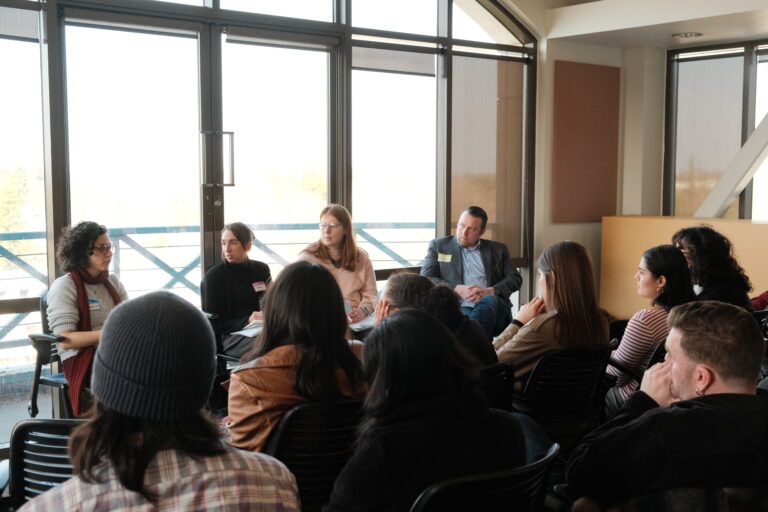
The UC Davis Human Rights Studies Program hosted a conference on Jan. 30 and 31, inviting students and faculty from across the University of California system to hold conversations about human rights. This first conference was titled “The Role of Memory and Historical Consciousness in Understanding Regional Violence, Conflict and Peacemaking.” 

The conference consisted of three parts including a graduate student symposium, a Human Rights Film Festival and conversations among UC faculty, according to their website. The three events each provided unique opportunities for attendees to learn about human rights through the lens of memory and historical consciousness. 

The conversations on human rights, humanity and peacemaking were made possible through the efforts of Keith David Watenpaugh, the professor and director of Human Rights Studies at UC Davis, along with Undergraduate Student Conference Leads Angelina Cicchini and Gabriella Violett. 

Cicchini, a fourth-year sociology major and human rights minor, shared the most rewarding part of planning the conference series. 

“Witnessing the debate and conversation between scholars was so interesting because every single person there was from such a different walk of life,” Cicchini said. “All of these people coming with their own specific, niche, personal [and] intimate human rights-based topics that coincide somehow with their lives, their family history [and] their background.”

The graduate student symposium took place on Jan. 30 from 12 to 4 p.m. in Sproul Hall. Four Ph.D. students from across the UCs were given the opportunity to share their experience and research, focusing on how memory contributes to human rights and resistance. 

Hannah Bacchus, a fourth-year UC Irvine Ph.D. student in English, shared her paper on black consciousness that highlights the novel “Native Son” by Richard Wright. 

Camellia Haghverdian, a UC Merced Ph.D. student in sociology, shared her research and personal experience of how memory influences women’s resistance in the Middle East. 

“Women’s resistance, in whatever shape it comes, forms the way [that] a huge portion of social memory or collective memories are created,” Haghverdian said. “The way we remember things is going to inform the way we are going to resist in the future. It’s a constant loop that happens.” 

During the second panel, Eliana Fonsah, a UC Merced Ph.D. student in sociology, spoke about the role of historical consciousness and memory in the Cameroon Anglophone Movement. 

Sekou Jabateh, a UC Berkeley Ph.D. student in comparative politics, shared his research about the memory of the civil war in Liberia and Sierra Leone.

The conversation among the graduate students was guided by UC Davis Spanish and Portuguese graduate students Emily Nelsen and Chandler Thompson, along with UC Davis History Professor Adam Zientek. 

The Human Rights Film Festival was hosted in Cruess Hall on the evening of Jan. 30 from 7 to 9:30 p.m. The 2024 film “So Surreal: Behind the Masks” was presented to the many students and faculty in attendance. The documentary highlighted the history of Indigenous ceremonial masks belonging to the Yup’ik and Kwakwa̱ka̱ʼwakw nations of North America. The documentary follows the quest to locate the Raven Transformation Mask, bringing together different people to join the search in many locations across the world. 

After the film screening, special guest Chuna McIntyre, a prominent figure in the highlighted film, as well as a Yup’ik artist and master storyteller, presented to the audience. McIntyre performed a traditional Yup’ik song to the audience, shared pieces of his culture and answered questions from the audience. 

“Our masks were created to appease the spirits of the sky, the land and everything in between,” McIntyre said. “We still have our language. Within our language is locked in the secrets of our masks.” 

The last event, the University of California Faculty in Conversation, took place on Jan. 31 from 12 to 5 p.m. in the International Center. The first panel of the day featured four professors from across the UC System.

The faculty in this panel included UC Davis Professor of Human Rights Studies Lucia Luna Victoria, UC Santa Cruz Professor of Critical Race and Ethnic Studies Alice Yang, UC Merced Professor of Anthropology and Heritage Studies Robin DeLugan and UC Irvine Assistant Professor of History Kevin Antonio Aguilar.

The conversation and audience questionnaire was guided by UC Davis Professor Marian Schlotterbeck of the History Department.

Three UC professors participated in the second panel, engaging in conversation about the preservation of culture, the role of memory and the act of resistance. 

Mark Levine, UC Irvine professor of modern Middle Eastern history, talked about the importance of protecting culture, specifically in the examples of Palestine and Chiapas. 

“The production of culture is crucial to keeping communities whole and allowing them to survive,” Levine said. “Culture is like a weed. It always survives. It always finds a new way. So how is culture going to be expressed within the devastation that Palestinians, at least for now, are returning to?” 

Watenpaugh exemplified the role of memory with a story from his time spent as a graduate student at the University of Damascus in Syria. When visiting a mosque in the city of Hama, he explained the horror of seeing bullet holes covering the walls. 

“When the people in the city of Hama, the survivors of this terrible massacre, went to pray in that mosque, they knelt in prayer not just in the direction of Mecca,” Watenpaugh said. “But they knelt in the direction of the public memory […] that they had resisted, and that the price of resistance was being executed. As you prayed you were forced to remember that act of violence.”

Jennifer Mogannam, UC Santa Cruz professor of critical race and ethnic studies, spoke about her piece on the act of resistance and the reframing of violence through people-centered research. 

“For colonized peoples, the act of resistance is the act of resisting disappearance,” Mogannam said. “It’s the act of becoming human in the face of dehumanizing machines.” 

The conversation and audience questionnaire in this panel were guided by UC Davis Professor Michael Lazzara of the Department of Spanish and Portuguese. 

This conference is the first of four in the human rights conference series on the UC Davis campus. The second conference is set for Feb. 27 to 28 focusing on “Artistic and Literary Freedom and the Destruction of Culture, Education and Heritage in Times of Mass Atrocity.” The third conference will take place from March 6 to 7 focusing on “Reparative Responsibility in the Face of Discrimination and Hate.” The fourth conference will be from April 24 to 25 and will highlight “The Human Rights Framework and Global Solidarities.” 


Written by: Megan Pusl— campus@theaggie.org


Prytanean Women’s Honor Society brings together high-achieving UC Davis women

0

The society aims to promote core values of scholarship, leadership and service


By EMME DUNNING — features@theaggie.org


There is a certain stereotype associated with honors societies. Historically, they have followed in the footsteps of many societal biases, overrepresenting men and often perpetuating elitist and exclusionary views. Despite this history, the reality of modern honors societies is quite different. UC Davis Prytanean Women’s Honors Society has been at the forefront of this change on the UC Davis campus.

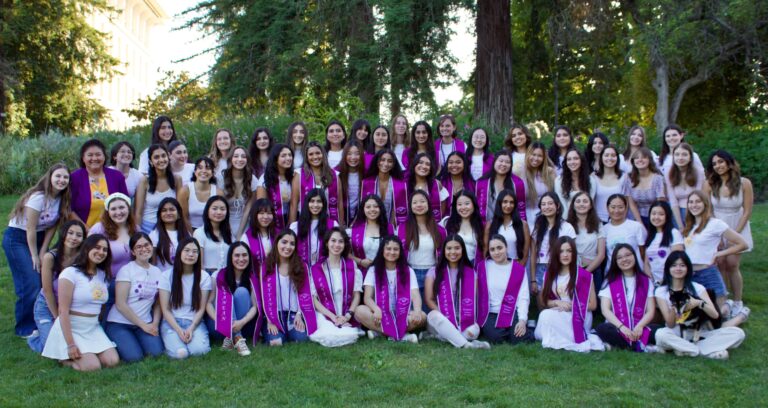
Prytanean Women’s Honor Society was founded at UC Davis in 1952 and is recognized as the only women’s honors society at UC Davis. The name Prytanean is said to originate from the Greek word “Prytanes,” which loosely translates to “a representative.” 

The society consists of nearly 100 women at UC Davis, who meet regularly for general meetings, networking, socials and service events. Together, these meetings hope to fulfill Prytanean’s three core values — scholarship, leadership and service. 

Sophia Strohmeyer, a third-year animal science and management major, serves as the current president of Prytanean. She joined the society during her first year and asserts that it has been transformative in her undergraduate experience.

“Prior to coming to college, I didn’t have any service experience,” Strohmeyer said. “Being a part of this community has allowed me to realize how big service is in the community and how helpful it can be.”

In addition to gaining a sense of the importance of service, Strohmeyer has enjoyed connecting with like-minded women in Prytanean. 

“What I’ve gained the most is a community,” Strohmeyer said. “I think the type of community Prytanean offers is something that is pretty rare.”

Chloe Even, a fourth-year sociology major, has also found some of her closest friends through Prytanean. 

“I felt like I had community at Davis, but I wanted a broader group of people who really understood what I was going through,” Even said. “Prytanean was really able to do that. It’s really just a close-knit community where we can all come together and share our experiences and foster really great friendships.”

As the current historian of Prytanean, Even’s main role is to document the events of the society, as well as to ensure that current activities are in line with the historical roots of Prytanean. Even has also played a major role in coordinating their main winter quarter event — Dinner for Ten. 

The event encourages current members of Prytanean to invite professors, faculty and other mentors for a night of food and networking. The dinner is part of a larger goal of Prytanean to aid their members in creating strong relationships with faculty and more broadly preparing them for professional success after graduation. 

“The professional development I learned in Prytanean I will be using every day in my future,” Even said. “It’s really just a great opportunity to develop skills in a low-stress and low-stakes environment.” 

Joshlyn Aguirre, a fourth-year communications major, joined Prytanean this past fall. Although she is fairly new to the organization, she expressed that she has already reaped the benefits through her involvement.

“I think that what I’ve gained for sure is a better understanding of how to have relationships with staff and faculty,” Aguirre said. “They do a really good job of connecting us with mentors, as well as shaping us into being mentors.” 

Aguirre also noted that Prytanean being a women-specific honor society brings members together in ways that might not otherwise be possible. 

“There’s a certain sense of responsibility, especially in affinity groups,” Aguirre said. “You have the responsibility to be there for each other in ways that a non-affinity group wouldn’t. We’ve been through certain things in life that make us see things differently than others, and I think that it’s really important to have these spaces as ambitious women who want to succeed and do very well in life.” 

For Aguirre, this unique nature of Prytanean has been encouraging in a society where the voices of women are not always heard. 

“There aren’t a lot of women in the room sometimes,” Aguirre said. “To have a room full of a hundred women, as someone who went to an all-girls school, is pretty comforting.”


Written by: Emme Dunning — features@theaggie.org

What goes on inside the UC Davis Crocker Nuclear Lab?

Let’s dive into the processes going on inside one the most unique labs at UC Davis and in the U.S.


By EKATERINA MEDVEDEVA — science@theaggie.org


In the southeast part of the UC Davis campus, amid numerous complexes dedicated to sciences, there stands an inconspicuous yellowish building named the Jungerman Hall. Despite its plain appearance, the Crocker Nuclear Lab (CNL) concealed beyond its doors is truly exceptional. 

At the center of all the processes happening in CNL is the 76-inch isochronous cyclotron that accelerates particles. It is “one of the few of its kind still in use,” according to the CNL webpage. Unlike most modern cyclotrons, the CNL cyclotron can be tuned at relatively low energy levels within the range of four MeV to 67.5 MeV, enabling it to operate without energy degraders and produce a “high quality, stable beam [of particles] with lower energy spread and emittance.”

So how does it accelerate the particles? At the very core, a cyclotron can be pictured as a hollow vacuum disk with an electric voltage applied across its two insulated halves (called the Ds). When a charged particle (usually a proton, deuteron, helion or alpha) is placed inside, it is attracted to the half with the opposite charge, meaning that the force of the electric field accelerates that particle in its direction. At the same time, a magnetic field that is applied through the plane of the disk causes the particle to experience centrifugal force, turning it around on an arc and returning it back to the center axis. 

At this point, the polarity of the Ds switches so that the particle always finds itself in the half with the opposite charge. However, now that it has some velocity, it goes around on an even bigger arc due to the force of the magnetic field. As this process goes on, the particle gains velocity and spirals further out of the center until it reaches the edge of the disk and is allowed to escape. 

One particle, of course, would not be able to do much, so numerous particles are accelerated and allowed to escape in beams. When they leave the cyclotron, but still remain in a vacuum chamber, these beams are “steered and focused by magnetic elements” manipulated from the control room and are transported to the beam line. There, they are collimated (parallelized) and directed toward their final target, as described by the 2001 Institute of Electrical and Electronics Engineers (IEEE) Radiation Effects Data Workshop record

The applications of this technology at CNL are broad, ranging from treatment of ocular melanoma (a rare type of eye cancer that forms behind the retina) to testing the effects of cosmic radiation on the electric equipment used in space missions. 

One of the most notable examples of the latter is the testing of Focal Plane Arrays (FPAs) for the James Webb Space Telescope (JWST), which are critical light sensors used for imaging. The research team conducting these tests simulated conditions of cosmic radiation using the CNL cyclotron, irradiating the devices at varying angles of incidence and then evaluating their sensitivity to make sure that they pass the set benchmarks to be used for JWST.

The CNL cyclotron is also used for other projects including the production of Astatine-211 (a cancer treating isotope), development of detectors to look for dark matter and many more applications. 

Recently, the UC Davis Physics Club teamed up with CNL and other initiatives to conduct tours of the laboratory. They were led by the Director of the CNL and Professor in the Department of Physics and Astronomy, Dr. Eric Prebys, as well as graduate students Logan Knudson and Lena Korkeila. 

To learn more about the UC Davis Physics Club, check out their website and Instagram page. If you haven’t had a chance to visit the Crocker Nuclear Lab, you can find a short tour posted on Dr. Eric Prebys’ YouTube channel and more information on the CNL webpage. 


Written by: Ekaterina Medvedeva — science@theaggie.org

Inauguration No. 47

Starting gun for the race to the bottom


By SIMON LEWIS — simlewis@ucdavis.edu  


On a flight to Washington, DC, I was turning over in my mind part of a prayer the Reverend Robert A. Fisher, Rector of St. John’s Church at Lafayette Square, planned to deliver at Donald Trump’s pre-inaugural prayer service on Jan. 20, 2025. 

“Open our eyes to simple beauty all around us, and our hearts to the loveliness men hide from us because we do not try to understand them.” 

The prayer was written by St. John’s former Rector Oliver J. Hart for FDR, the President who attended the first of what has now been 14 pre-inaugural prayer services at the church. Reverend Fisher told me, “it’s a prayer inviting us to see one another better, to honor the dignity and worth of every human being, and that’s a timeless call.” 

For the Reverend’s first pre-inaugural prayer service, he returned the service to its older form, removing guest speakers and sermons. The Reverend told me, “It made a lot of sense to me to bring it back in, simplify, make it not a time about celebrity, but about prayer.” 

At Trump’s first pre-inaugural service at the church in 2017, one guest pastor compared him to Nehemiah, a prophet chosen by God to build a wall. On June 1, 2020, Trump ordered peaceful Black Lives Matter protesters tear-gassed and pepper-sprayed to make way for his photo-op in front of the church. In the time of the Once and Future President’s great rubdown by billionaires, Village People and Snoop Dogg, it lightened my chafing heart to know that for half an hour, God wouldn’t join in, too — everyone else seemed to have, though.

In a conversation with Daniel Lippman, a Politico reporter covering the White House, he told me, “With the first inauguration, there was so much resistance around his taking office… this time, all these CEOs that were anti-Trump before are flocking to Trump’s side to celebrate him.” 

In the press, he said, “A number of media outlets are not as resistance-focused as they were eight years ago because the American people voted for Trump twice, and this time he won the popular vote. They want to appeal to his voters to get more viewers or readers, so you’re seeing media organizations act accordingly. There’s still going to be tough journalism and he’ll still attack the press, but you’re not going to have something like the Russia scandal that was a cloud over his first administration.” 

It seemed Trump’s “Revolution of Common Sense” had stupefied all levels of America with his sweeping victory. On inauguration morning, a mile-long river of red caps stretched to the Capital One Arena. In there, on jumbotrons bigger than gods, the Great One had a laurel wreath placed on His head and was sicced on all His foes. The outdoor inauguration was cancelled due to cold, and now those with outdoor tickets either held out hope for a seat in the Arena or went to overpriced brunch buffets at bars all around the city. 

Meanwhile, Amazon CEO Jeff Bezos, Meta CEO Mark Zuckerberg, Reichsführer-X Elon Musk and Google CEO Sundar Pichai got an up-close look at their prize horse at the indoor ceremony in the Capitol Rotunda. But they weren’t the only ones hustling that day. I met Terry K. Wilson, an artist selling prints of his painting depicting Donald Trump on an elephant. 

He told me, “Even though I’m not all the way with [Trump], I still paint him because it’s history and he is our President… When he came into office right after Obama, I had an Obama piece right next to this one, so I was selling to both crowds, because I have to make a living at art… I do major events around the country. The next show I’m doing is in March in Selma, Alabama for voter’s rights, so I’m doing a painting on that right now.”

The clock struck noon, Donald Trump was President, and in front of all these women in furs from head-to-toe and their equally murderous husbands, I drank a Fireball shooter I found behind a porta-potty and shouted, “Trump Über Alles! Und Tausendjähriges Reich!” I staggered through the Killing Fields of Chinchilla, mad as an improperly-gored bull, reeling each time I heard another rickshaw playing “YMCA.” I saw Joe Rogan and shouted, “You’re a bald piglet suckling on Trump’s sow teat!” 

I left the city unheard. In Las Vegas on a layover, I saw an ad which read “Rule The World” and just inches away, I could see the Trump International Hotel in the Strip skyline. I pointed and told a couple in “Make America Great Again” hats, “Go be with your God!” but they just smiled. Well, at least I got to see what a real winner looks like.


Written by: Simon Lewis — simlewis@ucdavis.edu 


Disclaimer: The views and opinions expressed by guest writers belong to the writers alone and do not necessarily indicate the views and opinions held by The California Aggie 

Sun, surf and spring break: how UC Davis students are spending their week off

0

UC Davis students share their spring break plans, from classic Florida parties to local getaways


By JALAN TEHRANIFAR — features@theaggie.org


Spring break as we know it today traces its roots back to the 1960s, when movies like “Where the Boys Are romanticized the idea of students flocking south for sun, surf and socializing. Over the decades, the tradition has evolved, shifting locations and growing in scale. By the 1980s and ’90s, MTV’s “Spring Break turned it into a national spectacle, with live concerts, celebrity appearances and, of course, non-stop partying.

For some students, spring break is all about embracing that classic college experience. Nicole Whitacker, a third-year linguistics and anthropology double-major, is planning for the typical “college spring break” in Florida.

“My friends and I have always wanted to go to Florida for spring break because that’s what was always in the movies growing up,” Whitacker said. “We haven’t picked exactly where yet, probably Miami or Fort Lauderdale, but you best believe we are going to party on the beach one way or another.”

While many students jet off to beach destinations, not everyone is packing their bags for spring break. For those staying in Davis or heading home, the week off can still be a chance to unwind and make the most of local adventures. 

Neeka Raie, a third-year political science major, is skipping the Florida party scene and heading home to the Bay Area instead.

“All these crazy spring break trips are expensive,” Raie said. “I could plan something in my budget, but I just know once I get there I would just spend all my money. I have no self-control when it comes to money.”

Instead of a tropical getaway, Raie plans to take day trips around Northern California with her hometown friends. This may include destinations like San Francisco for nightlife, Lake Tahoe for jet skiing or Santa Cruz for beach-side fun.

“A lot of my friends aren’t going anywhere for spring break either, so we’ll probably just plan something fun during the week and drive,” Raie said. “Honestly, what makes spring break fun isn’t where you go — it’s more so who you’re with.”

While Florida remains a top choice for many spring breakers, some students are looking beyond U.S. borders for their getaway. Destinations like Cancun and Cabo San Lucas have become increasingly popular, especially for students under the age of 21 who want to take advantage of more relaxed drinking laws and all-inclusive resort packages. 

A second-year data science major, who wished to remain anonymous, is among those opting for an international spring break experience.

“A big group of my friends and I are going to a resort in Cabo for five days,” the student said. “I think we’re like 15 or 16 people. Most of us aren’t 21 yet, so we chose Cabo because we can legally drink there, and I know a lot of college students go there for spring break, so we’ll probably meet new people our age from different schools.”

Spring break is full of unforgettable moments — but not all of them are Instagram-worthy. While most students enjoy a fun and carefree trip, the chaos can sometimes lead to trouble, from excessive drinking to reckless behavior. 44% of female college students and 75% of male college students drink heavily daily during spring break, according to Psychology Today

Although spring break is all about having fun and making memories, it is just as important to stay safe, whether that means looking out for friends, drinking responsibly or being aware of your surroundings.

For some, spring break is a once-in-a-lifetime experience, a chance to let loose and a time to make memories with friends before adulthood takes over. For others, it’s an overhyped tradition filled with overpriced hotels and sunburns. Love it or hate it, there’s no denying that college spring break is a uniquely American tradition — one that keeps drawing students at UC Davis and beyond back year after year.


Written by: Jalan Tehranifar — features@theaggie.org

Editor’s Note: An earlier version of this article included a sources name. The source later requested to be made anonymous for reasons The Aggie approved. For questions about our policy and The Aggie Code of Ethics please email editor@theaggie.org


Culture Corner

The Arts Desk’s weekly picks for music, movies and more


By AALIYAH ESPAÑOL-RIVAS — arts@theaggie.org 


If it’s complicated — Book: “Normal People” by Sally Rooney (2018)


“Normal People” sets the precedent for “situationships.” The book tells the story of Connell Waldron and Marriane Sheridan over the course of four years as they navigate their complicated feelings for one another. With heavy ties into class divide and social standing, the book explores a difficult emotional relationship between the two as they struggle to effectively communicate their feelings with one another. Encapsulating the “right person, wrong time” trope, the book goes from chapter to chapter displaying both the intimacy and distance between Connell and Marianne, with their dynamic changing nearly every page. Rooney’s writing demonstrates the intricate emotional relationships one can have both romantically and platonically, leaving you with the desire to ask your situationship: “What are we?”


If they’re the love of your life — Movie: “The Notebook” dir. Nick Cassavetes (2004)


“The Notebook” is the quintessential romance movie. Based on the Nicolas Sparks novel, the film follows the story of Noah Calhoun and Allie Hamilton’s enemies-to-lovers relationship. Following the trope of “he fell first, but she fell harder,” the film shows the ups and downs of their relationship in the 1940s, including the class difference between the two and Noah’s departure to fight in World War II. However, after calling it quits when they were merely teens, the film takes a turn years later: After thinking Noah didn’t write to her during his time in the army, Allie meets someone new. When their paths cross again years later and Allie sees all of the promises Noah kept start to come into fruition, along with 365 love letters she never received, Allie soon realizes that she might not be over Noah after all. After watching “The Notebook,” it may be a good idea to keep your phone far, far, away just in case you get any ideas. 


If you’re crushing — Album: “Yours Truly” by Ariana Grande (2013) 


One would argue “Yours Truly” is Ariana Grande’s best album — and that person would be me. “Yours Truly” takes inspiration from doo-wop music from ‘50s and ‘90s R&B, being an eclectic mix for Grande’s debut album. The opening song, “Honeymoon Avenue,” sounds nothing like songs released at that time, with an entire orchestra in the background setting forth the uniqueness of the album. Following this, the 12-track album covers multiple interpretations of a relationship, with “Daydreamin’” describing what it’s like to crush on someone, “Tattooed Heart” for when you’re fully enthralled and “Almost Is Never Enough” if it doesn’t work out. While Grande now leans into one specific sound for each album, “Yours Truly” shows her versatility and is a standout in her discography. Regardless of where you stand this Valentine’s Day, there is a song on the album for any situation.


If there’s someone new — Song: “Begin Again” by Taylor Swift (2012)


One of Taylor Swift’s more subtle love songs, “Begin Again” describes the thought process behind the first date with someone new following the end of a previous relationship. Throughout the song, Swift describes her grievances and doubts stemming from her last relationship while juxtaposing these thoughts with all of the new, positive and opposite qualities her date has — with lyrics such as: “I think it’s strange that you think I’m funny, ‘cause he never did.” With a light guitar strum in the background, Swift not only explores the differences between the two relationships but also the back-and-forth thinking that all love does is hurt and burn. Despite these conflicting thoughts, she realizes that while all things may come to an end, they can always begin again. 


Written by: Aaliyah Español-Rivas — arts@theaggie.org 


They will love you: flaws and all

Being the perfect person isn’t a prerequisite for finding love and connection


By JHANA RHODES—jsrho@ucdavis.edu


          Valentine’s Day comes around yearly, reminding me that I am still single. And, recently, I’ve been the only single person among my friends. Don’t get me wrong: I am ecstatic that they have all found people who can appreciate them as the fantastic human beings they are. 

Not too long ago, I cried tears of joy after my friend told me her boyfriend told her he loved her (three times in a row). In the past, she has been through tumultuous relationships that have left her traumatized. It took years of reflection, therapy and self-care before she was finally ready to move forward. Although she’s stronger now, some wounds still need tending. 

As a part of her journey and a key witness to her ups and downs, I realized that if she can work through her trauma, then so could I. For the past few years, I’ve been telling myself that the day I’m fully healed is the day I’ll be ready for a relationship. I’ve spent hours writing imaginary checklists of all the things I believed I had to do before I could even consider a relationship:


  1. Lose a few more pounds
  2. Make more money
  3. Go to therapy


          The conditions were endless. But, if I’m being honest, the more I added to my list, the more I felt like I needed to become someone else entirely.

          Recently, after one of my infamous cry sessions with my friend over the phone and a little self-reflection, I realized something important. I don’t need to be fully recovered to deserve love and connection — and neither do you. 

          Being completely healed is a myth. We would all like to think that life can be perfect, but that isn’t the case. Life is complicated, insecurities exist and bad things happen. Unfortunately, we have to deal with those insecurities and experience trauma. However, it’s important to remember that real healing is an uphill, continuous journey you must go through for yourself. It’s not a mirage, and it’s not easy.

          Don’t get me wrong — it’s perfectly fine to recognize that you need personal time for growth before dating. If anything, I encourage it. It shows that you are independently taking the time to work on becoming the best version of yourself. However, keep in mind that you don’t have to reach perfection just to find love.  

          I used to make the mistake of assuming the relationships I saw online and in the media were what relationships should be like. Everything I saw online was perfect. Perfect clothes, perfect bodies, perfect lives. Everyone appeared to be healed and have found their inner peace. However, I failed to realize that what I saw in the media was only a fraction of the relationship. The relationships I see in real life are, in fact, not perfect, and neither are the people in them. Individually, they all have insecurities and trauma that they are dealing with, just like me and just like everyone else. Nonetheless, they are learning, growing and healing as individuals and as couples.

          In fact, an imperfect relationship can have many benefits. Finding someone you can learn and grow with is a mutually beneficial experience. As you become the best version of yourself, it’s nice to know that you have a partner with whom you can practice vulnerable communication. Mutual trust and vulnerability, when shared consensually and respectfully, create a space for you to share your experiences and support each other’s healing processes.

          That being said, here’s a disclaimer: I’m not a therapist, psychiatrist or expert on love and relationships. I’m not promoting or condoning unhealthy relationships. I’m not saying that you shouldn’t take personal time to work on yourself, neither am I implying that being single is bad. Whether you’re looking for a partner or not — you know yourself best, you know what you need to work on and you know what you’re looking for. However, do what makes you the happiest and the healthiest. Please remember to be gentle with yourself, set realistic expectations and continuously practice self-awareness. 

          It’s okay to have insecurities while in a relationship. However, we must recognize and avoid unhealthy and dysfunctional behaviors. These behaviors include (but are not limited to) neglecting your personal needs and manipulating, controlling or being violent. Instead, we must seek out and practice healthy behaviors like effective communication, patience, trust, honesty — the list is endless. Remember, it takes two to tango. This applies to both partners, as healthy relationships require mutual commitment and effort. You should never tolerate or remain in a relationship where you or your partner feel abused, unsafe, unhappy or neglected. 

          If you find yourself needing more support, you’re not alone. Speak to a professional, a friend, a family member or someone you trust. UC Davis has an amazing team of counselors and counseling services, such as the Student Health and Counseling Services, that can hopefully aid your healing process. They offer psychiatric services, individual and group therapy and 24/7 crisis support. You can find more information about these services at https://shcs.ucdavis.edu.

          We all should learn to love ourselves first instead of trying to become the perfect person for someone else. No matter who you are, you are worthy, loved and accepted. One day (if you haven’t already), you will find someone who treats you with respect and sees all the extraordinary qualities you have. And, of course, they will love you unconditionally — flaws and all. 


Written by: Jhana Rhodes— jsrho@ucdavis.edu


Disclaimer: The views and opinions expressed by individual columnists belong to the columnists alone and do not necessarily indicate the views and opinions held by The California Aggie.


Threat level: same

The time has come again to oppose racist political persecution


BY PROFESSORS JOSHUA CLOVER and SEETA CHAGANTI — jclover@ucdavis.ede

schaganti@ucdavis.edu


If Donald Trump’s Jan. 29, 2025 executive order (EO) targeting non-citizen — and largely non-white — students with expedited deportation alarms us, it does not catch us unawares. It is not the first time Trump has leveled such a threat. In 2017, the White House issued orders interfering with higher education for non-citizens in various ways, including attempting to revoke Deferred Action for Childhood Arrivals (DACA) status and banning specific people from re-entering the country. Of particular concern in the previous round of orders was the fate of “dreamers,” undocumented childhood arrivals pursuing higher education.

During that first administration, UC Davis responded rapidly and assertively, for example by highlighting the AB540 Center and UnDocuAlly training. These provided not only support to students targeted by the presidential administration but also an opportunity for all people of conscience to think hard about the very meaning of terms like “documented” and “deserving.” 

The UnDocuAlly trainers in that period urged attendees to challenge the distinctions cached within the category of documentlessness. Are the non-student siblings of college-enrolled “dreamers,” for example, less worthy of protection? These useful prods fell within an institutional defense that, if inevitably clanky, was in good faith, serious, spectrumatic, and in most practical senses, successful. Campus struggles aligned with popular mobilizations. The promised wave of deportations and exclusions was, for the most part, averted. 

At this moment, we have yet to see such a contest. One thus has to look back and wonder: Did the more remote layer of university administration in 2017 honor those granular moments of political education, or, as seems more likely, were they happy to ride the wave of a liberal consensus about the need to protect the deserving, the striving, the productive? This possibility would explain why the university’s response to Trump’s most recent EO does not carry the urgency, vehemence and indignation that the previous iteration inspired. 

The university no doubt considers it a riskier sell to propose that students presented as beyond the embrace of liberal priorities deserve protection. The available language of allyship and opportunity last time appealed to a liberal political subject, meant to line up behind the idea — an idea surely insufficient to the breadth and depth of their actual politics — that the dream in question was purely one of class mobility. This served to flatter the university while, among other things, separating these students from the subjects of the racist Muslim ban.

 The political terrain of the most recent EO, however, is much rougher for being more explicit. This reality becomes clear in the EO’s accompanying “Fact Sheet,” which clarifies the aim to “[d]eport Hamas Sympathizers and Revoke Student Visas: ‘To all the resident aliens who joined in the pro-jihadist protests, we put you on notice: come 2025, we will find you, and we will deport you. I will also quickly cancel the student visas of all Hamas sympathizers on college campuses, which have been infested with radicalism like never before.’”

If we accepted that the current EO’s goal was truly to root out those international students explicitly sympathetic to Hamas, we would have to note that the United Nations enshrines the right of all occupied peoples to struggle for self-determination. If we suspected that this EO’s goal was more disingenuous to target the broader swath of people who believe that Palestine should be free, well, that is a basic premise of ethical life. 

In understanding this order and our obligation to oppose it unhesitatingly, however, we would insist — against false distinctions that both the right-wing administration and the adherents to liberal democratic tenets might find useful — on the many and critical continuities of 2017. If that moment helped open many people’s minds to the idea that no one is illegal, then 2025 is the moment when we remind ourselves that the language of “infestation” used to describe a political ideology is a familiar racist dog whistle, and that this recent ban is no more and no less than the racism of the previous Muslim ban. A politicized racism? Yes, but all racism is political. 

Moreover, the continuity of this racial-political animus belies the idea that anything started on Oct. 7, 2023, either in the politics of the Middle East or its policing in the United States. We also know, however, that the animus against pro-Palestinian students is a wedge. If UC Davis declines to oppose this EO, they assent to racialized persecution that is certain to expand. Every single indication on the record tells us this. 

But if there are continuities with 2017 and an ongoing project of racialized political persecution, so are continuities of hope. Recalling the victories, the successful defenses, the campus solidarity and the airport actions, we know that we can win this one if we fight together. We can together push back against the capacity for the state to exclude students according to certain political beliefs along with their origins and the color of their skin — for freedom, for all.


Written by: Professors Joshua Clover and Seeta Chaganti  — jclover@ucdavis.ede

schaganti@ucdavis.edu


Disclaimer: The views and opinions expressed by individual guest contributors belong to the contributors alone and do not necessarily indicate the views and opinions held by The California Aggie.


Women’s water polo comes in sixth place at Triton Invitational

Two victories helped Aggies move up in conference rankings


By LUCIENNE BROOKER — sports@theaggie.org

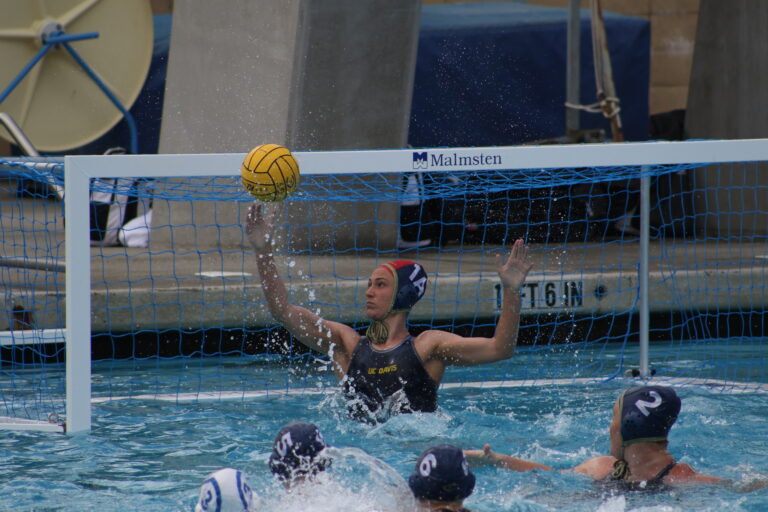
Women’s water polo finished sixth out of 16 teams at the Triton Invitational in San Diego over the Jan. 31 weekend. With two wins and two losses, the Aggies’ strong performance improved their record to five wins this season so far. After falling to the top two teams in the country, UC Los Angeles and Stanford University, in consecutive games, the Aggies needed some motivation to turn their performances around, delivering in their games in San Diego. 

Their first matchup against the Loyola Marymount University (LMU) Lions on Jan. 31 proved that UC Davis was there to win. The Aggies took an early lead only 30 seconds into the game but were unable to hold this advantage for long. The two teams scored back-to-back goals in the first quarter, establishing a fast pace. This back-and-forth pace continued for half of the first quarter until the Aggies scored four unanswered goals in three minutes. Although the Lions cut their deficit to one point, a last-second goal by Ally Smith, a third-year economics major and attacker, gave UC Davis a two-point cushion at the end of the quarter.

Subsequent quarters were equally frantic, as each team continued to score at least three goals per quarter. Tied 16-16 in the final quarter, both teams tried to find an edge but a final-minute goal by Bridget Miller, a second-year undeclared major and center, helped the Aggies retie the score at 19-19 and send the game into overtime periods. A last-second goal by Sam Yoo, a fourth-year human development major and utility, gave the Aggies a hard-fought victory in their first game of the invitational.

It was a short recovery period as the Aggies faced the University of Southern California Trojans early the next morning. Although the final score 9-17 appears lopsided, UC Davis performed better than expected against the Trojans, who went on to win the Triton Invitational. Sadie Henry, a second-year neurobiology, physiology and behavior major and utility, continued her scoring streak, putting up a hat trick against the Trojan defense. 

They carried this momentum into the second match of the day, facing off against the California State University, Fresno Bulldogs as the sun began to set in San Diego. The Aggies hadn’t defeated the Bulldogs in over five years, but they dug deep and ultimately beat them 12-9. Henry was again a scoring powerhouse, netting four goals. These points helped the team claw their way back into the match after a tight first quarter saw them trailing. The combination of offensive prowess and stellar goalkeeping from Lucy Holland, a third-year molecular and medical microbiology major, propelled the Aggies to victory and into the final match to determine fifth place. 

The final match of a long tournament weekend took place on the morning of Feb. 2. The Aggies took on California State University, Long Beach but suffered a narrow defeat in overtime, with a score of 11-12. UC Davis trailed in every quarter until the fourth, where they fought their way back to force a draw and head into overtime. Henry scored a hat trick, marking her fourth game in a row with multiple goals. Despite strong play from the entire team, Long Beach State scored a goal with 2:30 minutes to go in the overtime period, and the Aggies were unable to net a response, finishing the tournament in sixth place.

“I am really excited with how we competed all weekend,” Head Coach Kandace Waldthaler said. “We have some work to do defensively, but I am really pleased with how we played this weekend against some very tough opponents.” 

Next up, the Aggies are able to play host for the Aggie Invite, where they will play matches against the University of the Pacific, UC Merced, Santa Clara University and a special game against UC Davis women’s water polo alumni. All four games will take place at the Schaal Aquatics Center starting on Feb. 8.

Written by: Lucienne Brooker — sports@theaggie.org

Davis City Council recognizes February as Black History Month and Black Futures Month at a recent meeting

The meeting focused on the declaration, public comments and economic development


By YUENJO FAN — city@theaggie.org


The Davis City Council met on Feb. 7 and discussed various topics, ranging from economic development to Black History Month.

The meeting kicked off with a ceremonial presentation recognizing February as Black History and Black Futures Month. Amy Higgins-Boyd, a behavioral specialist from Marguerite Montgomery Elementary, addressed the council to discuss the importance of this proclamation. 

“As we reflect on the history of our nation, we honor the legacies of those who fought with courage and resilience for change,” Higgins-Boyd said. “However, this is not merely a time to look back but a moment to celebrate the powerful Bblack voices who are shaping our world today: those who are challenging injustice, those who are advocating for equality and creating pathways for future generations. We must recognize that we are walking in the footprints of all who came before us, and now it is our turn to advance the work they started.”

Furthermore, Higgins-Boyd explained the meaning of the commemorative month’s new component: Black Futures Month. 

“This year, we also honor Black Futures Month, a vision of what is possible where Black individuals can thrive despite the weight of historical oppression,” Higgins-Boyd said.

Following the ceremonial presentation, the city council turned to public comments, where attendees could take to the podium for up to two minutes and address council members with comments or concerns. 

The topics brought up ranged from the recent rise in traffic accidents to Davis’ lack of music venues to the city’s recent ordinance to add a framework to the down payment assistance program. Davis resident Elaine Roberts-Musser was one of the speakers who voiced her concern about the recent down payment assistance program.

“The ordinance is premature,” Roberts-Musser said. “One, what are the costs to administer this program? Two, where is the money coming from to take care of the down payment assistance? Three, why should we put the city at financial risk when the city is in dire financial straits? We can’t manage to pay for pothole repairs in the roads, but somehow we can afford to help people pay for houses?”

Passed in January 2025 as Davis’ newest piece of legislation, the ordinance to the down payment assistance program plans to provide loans and grants to new homeowners. However, the fiscal requirement of upholding such a framework has not yet been made clear and has left unanswered questions for Davis community members.

To wrap up the meeting, the city council addressed the issue of economic development. Intended to provide both vision and direction to stimulate growth, Davis’ strategic plan for economic development was presented to the council by Katie Yancey, the economic development director for the city of Davis. She explained to the city council how the plan intends to initiate strategies to help launch new opportunities in Davis that can create economic benefits. 

“The city council adopted goals in 2024-25 that contained direction to develop an economic development strategy,” Yancey said. “It would demonstrate economic opportunities for the city and provide an action plan that will enhance the jobs to housing balance in this city, encourage growth in areas consistent with the city’s vision and planning documents and result in stronger ties to the business community while all increasing fiscal stability.”

The economic development strategy also included proposals for living wage standards, targeting specific industry sectors and business retention and expansion programs. After the presentation, Davis Vice Mayor Donna Neville gave her view on the development plan.

“I think we all know there are some things we’d love to get started on right now, and I think we all feel that there are certain things that we can right away get moving forward on,” Neville said. “But, in terms of our overall strategy, I do think there is somewhat more analysis that’s needed to really help us better understand which specific strategies or approaches are really going to work. I do want to know what is the actual deliverable we’re going to get from that strategy. What’s the timeline, what’s the cost, who are the players? That is really going to inform our decision-making.”

With the economic development strategy plan still in its early stages, many of the details will still be in discussion. 

The next Davis City Council meeting will be on Feb. 18 at 6:30 p.m. in the Community Chambers in the City Hall. Agendas will be posted prior to the meeting’s commencement on the city of Davis’ website.


Written By Yuenjo Fan — city@theaggie.org