
55.4 F
Davis

Davis, California

Sunday, December 21, 2025
Home Blog Page 581

Humor: What this year’s dose of global warming will bring to November

The really inconvenient truth

Unfortunately this week’s humor article veers a little too close to the actual truth, so I’ll try to keep that distinction through making light of a serious matter. If you’re offended by the idiocy behind my logic, I assure you that I do believe in global warming. But at the same time, I just happen to be an idiot.

Global warming exists and, because of that, a lot of things are going to happen. As someone who understands everything, I’m not going to take the time to explain the nitty-gritty details of our self-destruction. However, I will tell you what to look out for in this lovely month of November.

Confused turkey migratory patterns: Yes, this exists. And if you think it doesn’t have anything to do with our wonky jet stream, then you should open up Google and educate yourself. Things are happening in front of our very eyes — and by that I mean turkeys are everywhere. I tried to take a shower the other day and was met with a turkey knocking on the door asking how much longer I was going to be. That’s not normal. While I felt angry that there was a turkey who let itself into my house, I thought about how they must feel landing in an expensive Northern California town when they had prepared for something a little more affordable. This never used to happen, and now because the weather is changing, the turkeys are taking over. I’d recommend staying home and letting the turkeys do their thing for a little bit as they start to find their place in this cute little overeducated town.

Increased CO2 output from bikes: I don’t really know how to explain this, and riding bikes is usually good for the environment. But the buses we take to school so that we can ride our bikes that we left on campus are not so good. Now that it’s raining, many people opt for the gas-guzzling busses (or they could run on potatoes, I’m not sure) so they can avoid biking to school. However, I urge you to consider that the more you do this, the more CO2 (?) you will put into the atmosphere, which will lead to increased rainfall, meaning you’ll have to keep participating in this toxic system until Davis becomes a hub of rain (not that it isn’t already). I urge you to do the noble thing and just not go to classes when it rains. It will save the environment.

Four different climates in a day: We seem to already be desensitized to this very scary symptom of global warming. But the bigger problem exists when the confusing weather forces students to start their day in Uggs and 40 layers — and end it barefoot in class and practically naked. Our classrooms are crowded as it is. All this discarded gear and sweat will lead to increased humidity in the air, which will probably just lead to more rain and will melt some ice caps somewhere. So honestly, I think a way to avoid contributing to this tragedy would be to go make some tea, put on your pajamas and just stay home, where you can regulate the temperature to be whatever you want it to be.

Since nobody likes to change their lifestyle and global warming is happening anyway, I think it’s best to just take it in stride and stay home and not touch anything  and maybe all other major countries and companies will follow our lead.


Written by: Rosie Schwarz — rschwarz@ucdavis.edu

(This article is humor and/or satire, and its content is purely fictional. The story and the names of “sources” are fictionalized.)


Humor: Existentialist A-frame laments: “I get blown down, I get put back up, ad infinitum”

SHEREEN LEE / AGGIE

Finding meaning in advertising for a fraternity

I was blown down today. Or, maybe, yesterday; I can’t be sure. The wind took up a great gust, and the people on campus charged with maintaining my condition had left me a telegram: “SORRY, DON’T FEEL LIKE PUTTING YOU BACK UP. HAVE TO WAIT THE WEEKEND OUT.” Which told me something: I’m pretty sure I got blown over on a Friday.
UC Davis is a campus full of life. Yet so many times I found myself simply being passed by or being outright ignored. The signs around me are much more interesting: the ski or snowboard club has a beautiful sign with a mountainous landscape painted on it. The equestrian club of course has a majestic horse featured on it. And what do I have? “RUSH ZETA.”

Now, there are moments when these simple, bold letters give me pleasure. They are elegant and striking. However, like all pleasure in this temporary world, it is only fleeting. Finding comfort in my appearance has been a thankless task, and it’s so much more difficult to be happy if you are constantly being blown over.

Nearly every week the wind will gust and I will again find myself flat. These repetitions of being flattened have become a routine I’ve accepted. Not with peace, but with passivity.

I have been, for the length of my short existence, searching for a meaning to imprint upon my meaningless life. What more can a poorly built A-frame wish for than just the comfort of standing upright and the attention of curious students?

However bleak, I will push through this pressing anxiety. I will search for meaning among an absurd, windy world. And I will not be a stranger to my authentic self.


Written by: Aaron Levins  — adlevins@ucdavis.edu

(This article is humor and/or satire, and its content is purely fictional. The story and the names of “sources” are fictionalized.)

UC Davis awarded grant to study parents, children of Mexican origin

CAITLYN SAMPLEY / AGGIE

California Babies Project to study stress in Mexican-origin children, families

Leah Hibel, an associate professor in the Department of Human Ecology, and her team have been awarded a $2.7 million grant by the National Institutes of Health in order to study stress and health of Latino families of Mexican origin. By creating a basic understanding of how difficult circumstances affect these families, Hibel hopes to utilize the findings from this research to help address their specific needs.

“We hope to make sure this project is not taking the mindset of our knowledge of our White families when approaching this research,” Hibel said. “Some of the main stressors we will be looking at are fear of deportation, marital issues, discrimination, and socioeconomic status because they are at a higher risk of poverty.”

Hibel explained that the purpose of this research is to understand the unique experiences of Latino families.

Hibel and her research team, consisting of professors, graduate and undergraduate students, will work with about 250 families in Sacramento and Woodland.

Andrea Buhler, a Ph.D. candidate in human development at UC Davis, is part of Hibel’s research team.

“My goal is to support people in achieving greater levels of wellbeing, and effective strategies require scientific research to understand the specific risk and success factors impacting human development in different contexts,” Buhler said. “I identify as Latina, speak Spanish and feel a great sense of purpose and enjoyment in doing this work.”

The research is going to focus primarily on quantitative research aided by qualitative open-ended questions. Biology is also an important component that will be studied.

Cynthia Alvarado-Martinez is an undergraduate lab research assistant in Hibel’s research team. She was also an undergraduate summer research fellow in 2017.

“Research has shown that sleep is an important determinant in mental health,” Alvarado said. “Sleep deprivation can be detrimental to not only adults, but to the wellbeing and health of infants and children. Yet, considering the importance of sleep and the rapidly growing Latino population in California, there is little information on the infant and child development in Latino children.”

While studying these areas of struggle, Hibel hopes to also understand the strengths of these families.

“An exciting component of this research is that we have families collect samples of their saliva so we can measure the hormone cortisol, which is a biological marker of how the body deals with stress,” Buhler said. “Hopefully, we will elucidate the processes of how stress gets under the skin and how it manifests in behavior, social relationships, the development of self-regulation and sleep.”


Written By: David Soltero — science@theaggie.org

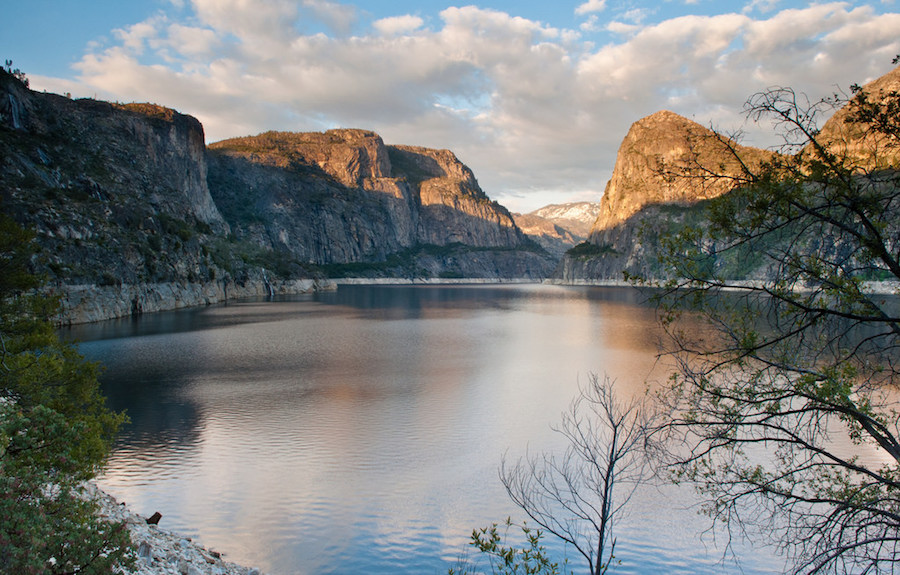
It’s time to restore Hetch Hetchy

JUSTIN GAERLAN [(CC BY 2.0)] / FLICKR
The Bay Area must invest in alternative sources of drinking water

Have you ever looked out over the Yosemite Valley and thought, “Somebody should cut down all these trees and fill this puppy with water — because I’m thirsty”? No.

So why do we allow Yosemite’s lost Hetch Hetchy Valley to remain underwater?

John Muir, who fought hard against the O’Shaughnessy Dam that flooded Hetch Hetchy, referred to the valley as the “Tuolumne Yosemite.”

“[A]t a depth of more than 4,000 feet, you see a beautiful ribbon of level ground, with a silver thread in the middle of it, and green or yellow according to the time of year,” Muir wrote. “The opposite wall of the cañon rises in precipices, steep and angular, or with rounded brows like those of Yosemite.”

The “silver thread” Muir referred to is the Tuolumne River, which has supplied drinking water to San Francisco since 1934, and the valley Muir described lies under 300 feet of Sierra water.

The huge environmental loss has done nothing to quell the 100-year controversy sparked by the damming of Hetch Hetchy Valley. Every time conservationists propose a reevaluation of the reservoir, Bay Area voters oppose that reevaluation.

In 2012, San Francisco voted against a study that would evaluate “how to drain the Hetch Hetchy Reservoir so that it can be restored by the National Park Service and identify replacement water and power sources.”

Judge Kevin Seibert in Tuolumne Superior Court rejected a claim made by the Restore Hetch Hetchy group that the reservoir violated a state mandate that water diversions be “reasonable” in 2016.

Yet both of these oppositions occurred during the historic five-year drought in California, before the drought’s state of emergency was lifted in April 2017. Californians are making water conservation a way of life now, and when thinking about sustainability practices and water conservation, Yosemite’s lost Hetch Hetchy Valley comes to mind.

It’s time that Californians reassess our less-than-intelligent drinking water solutions.

Researchers and conservationists say that San Francisco may have options it is refusing to invest in.

“We understand that San Francisco’s water system will need certain improvements and some hydropower will need to be replaced with renewable power,” the Restore Hetch Hetchy group said. “We have done substantial research on these water and power alternatives, but San Francisco appears to need a political or legal imperative to consider these water and power alternatives.”

San Francisco has six water reservoirs. Hetch Hetchy only stores 25 percent of San Francisco’s drinking water, and that water could be diverted outside of the National Park, allowing the valley to be restored.

San Francisco will begin supplementing its drinking water this year with six new wells that will provide the city with an additional 4 million gallons of groundwater per day, proving that the city can be innovative when it needs to be. San Francisco can make changes if it is willing to invest in alternative sources of drinking water.

“This is the first new potable water supply we’ve added to our system since the 1960s. […] This is a significant milestone,” said Paula Kehoe, the director of water resources for the Public Utilities Commission.

San Francisco could research available surface water, following the examples set by Davis and Woodland, which partnered to complete the regional surface water supply project last year. The project diverts surface water from the Sacramento River to provide 85 to 95 percent of the drinking water in Davis and Woodland.

If San Francisco invested in a study to reevaluate the Hetch Hetchy reservoir, it would likely find an answer that conservationists and Bay Area voters could agree on.

Yosemite has 4 million visitors a year. A study from 2011 showed that Yosemite visitors spent $379 million in local communities, and visitor spending impacted the U.S. economy by $30 billion. Another Yosemite valley would only produce even greater revenue for the park. Maybe some of that revenue could help San Francisco find the answer to its water needs.

We have to be smarter and think more progressively about our country’s natural resources. Step one: Realize that Hetch Hetchy reservoir isn’t our best option for drinking water.


Written by: Jessica Driver — jmdriver@ucdavis.edu

Disclaimer: The views and opinions expressed by individual columnists belong to the columnists alone and do not necessarily indicate the views and opinions held by The California Aggie.

NaNoWriMo Returns

CHALRES MIIN / AGGIE FILE

Yolo County bands together for annual month-long writing challenge

Laughter, coffee and creativity were flowing at Crepeville on a Wednesday night as residents of the Davis community furiously typed away on their laptops. It was the eighth day of NaNoWriMo — formally known as National Novel Writing Month — and just the beginning for many aspiring writers.

Founded in 1999, National Novel Writing Month is a nonprofit organization dedicated to inspiring creativity and motivation among writers everywhere. Each year on Nov. 1, thousands of participants all over the world pledge to write 50,000 words in 30 days, a feat that does not come easily. While some may win the challenge and others may not, the overall intention of NaNoWriMo is simply to get words on the page.

“You don’t really have a choice once you decide to write 50,000 in one month,” said Davis resident Kelsey Ha. “You can’t second-guess yourself, and sometimes you may even surprise yourself.”

In the past, students at UC Davis have participated in NaNoWriMo as part of a seminar course taught by molecular and cellular biology professor Ian Korf. Although the course was not offered this year, there is still a strong presence of active NaNoWriMo participants in the Davis area.

“There’s always a core group of people that I know are going to do it every year,” said Elizabeth Kauffman, the co-municipal liaison of the Yolo County NaNoWriMo region. “I feel like there’s definitely more student participation if there’s an incentive, like a course on campus to get them involved.”

Within Yolo County, many writers say that the supportive community that comes along with participating in NaNoWriMo is what pushes them to succeed in completing 50,000 words. Led by Kauffman, local NaNoWriMo participants often gather together for “Write-In” events throughout the month to share ideas and motivate one another to achieve their goals. On any given night, some writers complete up to 3,000 words.

“I love the community,” said first-time NaNoWriMo participant Jennifer Gerhart. “The support is incredible, especially if you’re feeling defeated one day. Everybody has your back and you can provide that support back to other people.”

With two weeks left until the final day of NaNoWriMo, participants continue to write each day in the hopes of hitting 50,000 words. While some, like Ha, are already well past the halfway mark, many are hoping simply to stay on track until they reach the finish line.


Written by: Sydney Odman — arts@theaggie.org

Airbnb now collecting occupancy taxes

0
JEREMY DANG / AGGIE

City of Davis and Airbnb agree on new tax

The City of Davis recently announced a tax agreement with Airbnb. On Nov. 1, Airbnb began collecting and remitting the Transient Occupancy Tax to the city. A 12 percent TOT already exists and is collected from all hotels, motels and bed and breakfast setups in the city. Given that Airbnbs are not traditional brick-and-mortar businesses like hotels, the city did not have a way to collect the TOT.

“Fundamentally, it’s about fairness, considering that Airbnbs essentially provide the same services as any hotel in the city,” said Davis Mayor Robb Davis. “Since hotels are required to pay the TOT, we believe that Airbnb should be subject to the same tax. The problem was, we didn’t want the burden of collection and recording to fall on the hosts.”

In June 2016, the public approved a 2-percent hike to the TOT, increasing it from 10 to 12 percent. The new tax agreement with Airbnb means more revenue from visitors, especially during graduation and move-in weekend at UC Davis.

“We worked with Airbnb to be able to collect the TOT and disperse it to the City,” said Assistant City Manager Kelly Stachowicz. “It helps us make sure that they are paying their fair share of the TOT into the city coffers, which can go to the fund we put toward general public services like firefighters, police officers, parks, any of our basic city services.”

The tax agreement benefits many on a surface level, but digging deeper, it may affect hosts’ businesses. Nightly charges for every listing will increase by 12 percent, making every listing slightly more expensive.

“We were the first Airbnb in Davis in 2011,” said Neil Michel, whose Airbnb is in downtown Davis. “Being able to have this extra form of income has made all the difference for us […] From a host experience point of view, [the tax agreement] is as good as it could be, but it doesn’t change the fact that the cost of staying in our unit is going to go up by 12 percent. It’s making us less competitive in the local accommodations market. What it really does is it delays the time until the next increase in our nightly rate. I would have loved to increase my nightly rate this year, but I don’t get to do that because the extra 12 percent goes towards the city for now, which is unfortunate.”

Automating tax collection makes the process easier for Airbnb, the City of Davis and hosts. With this tax policy, Davis joins more than 300 jurisdictions globally, where Airbnb collects and remits taxes, including more than 30 jurisdictions in California.

“We’re not trying to drive Airbnb out of Davis and make it impossible for people to host people in their homes, but we do believe that it’s equitable that people should all pay the TOT,” Davis said. “That tax is going to be used to fund essential city services. There is even an agreement on part of the current council that the TOT collected specifically from Airbnb [that] could go toward services to increase affordable housing. It will be invisible to the host and to the guest — it will just be collected and remitted to us based on the agreement.”


Written by: Prachita Chawla — city@theaggie.org

UC Davis first to breed Daddy Long Leg cows

JULIE TORRES / AGGIE


By: Julie Torres — opinion@theaggie.org

Disclaimer: The views and opinions expressed by individual cartoonists belong to the cartoonists alone and do not necessarily indicate the views and opinions held by The California Aggie.


A Plug for Used Bookstores: How used bookstores offer a more intimate reading experience

ANH-TRAM BUI / AGGIE

The digital age has shifted the reading discourse

At the corner of Speedway Boulevard and Wilmot Road, a certain store awaits shoppers as they brave the stifling heat to browse its wares. After entering through the sliding doors, these shoppers will eye rows and rows of red-orange shelves, stacked high with an assortment of goodies. Is it a Martian rendition of Walmart? A marijuana dispensary? No, it’s a used bookstore — something that deserves to be recognized for its steadfast commitment to the art of traditional reading.

This particular used bookstore is called Bookmans, and it’s somewhat of a cultural icon in Tucson, where I’m from. Its bookshelves beckon readers of all ages, from the teeniest toddler flipping through picture books to Don DeLillo fans and everyone in between. Bookmans atmosphere lives and breaths dog-eared pages and crinkled covers, quintessential components of used books.

Yet Bookmans is not unique in this regard — every used bookstore I’ve visited has invoked this classic image, one that places page-turning above profits, providing access to cheap books and an environment conducive to reading.

Logos Books, right here in downtown Davis, is no exception. Its soft lighting, classical music and tight shelving can tickle a reader’s heart and turn a novice into a bibliophile in no time. That’s the power of used bookstores. They allow a special sort of bond to form between books and their readers, a living connection with pages that have been turned and prodded and marked up by the pens of previous owners.

There’s satisfaction in a worn page or a smudge in the ink — the book’s been used, picked apart, read in bed or at the beach, perhaps thrown at a wall because of a sucky ending. It’s been read, even if only theoretically. Someone took the time to buy or donate or pass the book around. There’s been interaction, and books are designed for interaction.

New bookstores maintain an atmosphere of sterility that contrasts with their used-book cousins. While the selection at new bookstores may be more extensive (though not always), outrageous prices diminish any good feelings created by stepping into the bookstore in the first place. When a paperback copy of George R.R. Martin’s “A Feast for Crows” costs more than two Chipotle burritos, who can be blamed for turning to other sources for cheaper books — with more interaction to boot?

Used bookstores may be part of the reason why new books are so expensive — but that’s chump material when we realize that used bookstores offer a classic reading experience that exceeds that of their new-book counterparts.

Everyone always talks about technology’s effects on reading. Debates rage over gadgets like e-readers, which have been the target of scorn from more traditional book readers. Conflicts have emerged over the issue of printed reading versus reading on screens.

These arguments fail to notice the physical void technology has created when it comes to new bookstores. Led by online giants like Amazon, it’s now easier than ever to browse, digest good reviews and order a book without leaving your futon. This increasingly modern trend has caused a ripple effect, in which brick-and-mortar book retailers for new books are forced to add online ordering to their business model or risk losing a share of the reading market.

Barnes & Noble adapted well to this blend of online and physical bookselling retail. On the other hand, Borders, which used to be the country’s second largest-bookstore chain, filed for bankruptcy and eventual liquidation in 2011, in part because it failed to jump on the online bandwagon while it still could.

Used bookstores are largely immune to this digital shift. In many ways, the internet age has rendered reading a more technological enterprise — and used bookstores offer an excellent antidote.

So the next time you spot a used bookstore, don’t be afraid to step inside and get lost in the ambiance. There are worse places to spend your money.


Written by: Nick Irvin — ntirvin@ucdavis.edu

Disclaimer: The views and opinions expressed by individual columnists belong to the columnists alone and do not necessarily indicate the views and opinions held by The California Aggie.

Fall 2017 Fashion Trends

JAMIE CHEN / AGGIE

Nostalgia is back

Just because it’s time for layering your outfits doesn’t mean your sense of style has to take a back seat. With Thanksgiving around the corner, it’s time to get ready for Black Friday shopping — the day after Thanksgiving that has instead become the beginning of Christmas shopping season. Retailers often open early in the morning, and some are even opening late Thursday night.

Here are some trends to keep in mind:

One of the most noticeable trends of this season has been nostalgia. From graphic tees to retro plaid — the past is back.

The retro plaid look can be found at Urban Outfitters and on coats, pants, skirts and dresses. Plaid is always a trend in fall, but now it’s gone a step further and become a statement piece. On Black Friday, Urban Outfitters will be having 60% off selected women’s fashion.

Embroidery is in — embroidery on sheer shirts, jackets and pants. Patches are also a big thing this year. And that’s an easy DIY project: just go to the store, order patches online from Amazon and then iron them onto whatever shirt, jacket or pants you want. This can give a look a throwback feel.

Ruffles and velvet are two things normally associated with older women, but not anymore. Ruffled sleeves can be seen all over magazines and found at almost all retail stores. Same goes for velvet. It’s everywhere and is perfect for the cold seasons. Velvet also makes for a great holiday outfit while still staying cozy.

Long layers are perfect for the cold weather that accompanies fall. They can make it look like you put in some effort while still staying comfortable at home. Long layers can mean a long overcoat or long sweaters with jackets on top — all are helpful for the transition between the cold outside and overheated classrooms.

Midi skirts are a phenomenal invention; you can still wear a skirt and won’t freeze. Midi-length skirts also work well with all types of shoes, and you can wear them with chunky sweaters for a more high-fashion look.

High-neck shirts are the best shirts for the fall. When it’s cold out, having your neck covered is incredibly warm, especially when biking. Many stores are carrying turtlenecks with interesting patterns and textures. These can also be found at stores such as Urban Outfitters, Nordstrom and Target.

Tights are your best friend in the winter. You can still wear a dress or a skirt outdoors (and not freeze to death) or cover your legs if you forget to shave. A lot of designers put fishnets on the runway to spice up an outfit — and they certainly do. They are a great statement piece.

Fall is the season for experimenting with fashion. Have fun with layering, mixing and matching designs or even stepping outside of your comfort zone to buy some kind of statement piece.


Written By: CaraJoy Kleinrock — arts@theaggie.org

A World Unchanged

0
CAITLYN SAMPLEY / AGGIE

Peering back through 40 years of Davis history, similarities and differences

In 1909, what was known as The University Farm School opened its doors to 18 eager students. More than 100 years later, the campus now known as UC Davis boasts more than 35,000 students. Although the campus has shifted and grown over the years, UC Davis alumni remember their time as students being not so different from what students experience today.

“Well, I mean, there’s the whole youth and phones and how electronics have come in, but […] students are students,” said Sean Davis, who graduated in 1978 with a Bachelor of Arts in psychology. “For example […]  they procrastinate just as much as they always have.”

Davis has been working at UC Davis for about 20 years now as a lecturer in computer science. Even though he’s an expert in computers now, Davis didn’t have the luxury of laptops and conveniently located computer labs around campus when he attended school here in the 1970s.

“From the standpoint of computers, the basement of Hutchison was where the [only] computer was,” Davis said. “You went down there and you gave them your computer cards and you ran them through the computer and you’d pick them up the next morning with your output. It was just a big old computer which was raised up on special floorings.”

The computer labs in places like the library and Wellman Hall didn’t exist either, but instead were lounges for the students. Wellman itself was a completely fresh design at the time and offered a funky, colorful atmosphere.

“Wellman in the ‘70s was an amazing design,” Davis said. “The interior was all one big […] trip. You’d go in and there’d be a band of blue on a wall coming down at an angle […] and the tiles were blue. Then they had a picture of an electro-micrograph of a head of an ant on one of the walls.”

When Davis was a freshman, he got to experience a whole different kind of Tercero as well. At the time, there were two clusters of six buildings titled the letters of the alphabet, and Davis decided he wanted to join the 64-person Pierce Co-op that occupied the G building.

“They cooked for themselves down where Trudy’s of Tercero was [which] was called Trudy’s Fox Hole [during that time],” Davis said. “The co-op was more responsible, you-do-the-work-for-yourselves-type stuff; we cooked and cleaned for ourselves. That was a terrific experience.”

Another student who happened to live in the Tercero Co-op at the same time as Davis is David Dodd, who graduated in 1979 with a Bachelor of Arts in German. Dodd recalls some of his favorite pastimes as a student — activities a little less popular with today’s student population.  

“We did stuff like going to the barns and jumping from the loft into the hay, believe it or not,” Dodd said. “We climbed the water tower. There was this place called ‘the Trestle’ […] over the railroad tracks, and we would climb on the ladder and walk across. You could go across and go down through a trap door and watch the trains go by. It was quite a thrill.”

One piece of campus culture that has remained through the years is none other than The California Aggie itself, a student-run organization then and now and something Dodd is proud to have been a part of.

“[The Aggie] was the most fun,” Dodd said. “We were a daily [paper], so there was a lot of pressure. I don’t know how many hours I spent writing, but I was just a reporter then to staff writer in my freshman year. The next year I was campus editor, and that was really fun because I got to write anything I assigned myself.”

Dodd enjoyed writing book reviews, album reviews and record releases, but was most stoked for concert reviews. According to Dodd, UC Davis experienced a booming entertainment scene, hosting breakout music groups at the time like The Talking Heads and The Police.

“This was 1977, which was a historic year for rock and roll,” Dodd said. “The big wave happened, all these bands broke that year. And we had this guy booking the Coffee House at the time, and he booked all these acts before they broke and they were at Davis as they were breaking. They would play in stadiums, and they would play in the UC Davis coffee house.”

Room-sized computers, dorm-coop hybrids, a daily print newspaper and CoHo rock concerts are all aspects of Davis culture that have clearly changed through time, but something that stands out the most is the growth in the connection between campus and community.

“When I settled on Davis and moved in, at first I wasn’t sure because it’s such a small town and it seemed like there wasn’t a lot to do or there wasn’t much to it,” said Thara Randawa, a 2009 graduate with a degree in biology. “My wife and I stopped in [Davis] within a few years after we graduated, and the town seemed very different. Downtown seemed […] more active, like [UC Davis] had crept out into the city a little bit; more of that campus vibe had pushed its way out, which is cool.”  

Randawa and his wife went to Davis together a little less than a decade ago, and grew to enjoy their educational experience in a small college town — the most intrinsic characteristic of Davis that will hopefully never change.

“We both really miss it,” Randawa said. “We love where we live now, but there’s something about the town. We both loved it a lot. California is a great place to travel, so anywhere we can work it in [our travels], we like to stop in Davis at the very least.”

A lot has changed over the years, each decade characterized by its own unique contributions. Despite any changes to the campus or the culture, UC Davis students have always retained an affection and pride for their Aggie home.

“A certain tradition at Davis [is] about being serious about school and at the same time being aware of the world, and to know that not everybody thinks the same way,” Dodd said. “You can’t really stereotype a Davis student the way you might a Berkeley student or a USC student, […] and I think that’s part of the big strength of Davis. Anywhere you go out in the world you’re going to meet people who went to Davis. These people will show up throughout your whole life and you will have that instant connection of that [shared] place, and that’s what’s really cool.”


Written by: Marlys Jeane — features@theaggie.org

Fire in Sharps & Flats Apartments damages homes

0
KYLA ROUNDS / AGGIE

10 Davis residents displaced by small fire

On Saturday, Oct. 28, firefighters were alerted to a small fire in South Davis. Responders arrived at the Sharps & Flats Apartment Complex at 1660 Drew Circle and found smoke floating out of a window that had been broken by the fire.

“We got the call at 10:31, and the team arrived shortly after,” said Fire Division Chief Joseph Tenney. “It was in the morning, Oct. 28, a Saturday. The first engine company got there, checked the water flow, alarm and sprinklers, and made sure everything was under control […] about three rooms were damaged by the sprinklers […] 10 people were displaced.”

While the fire was hazardous, it was a flood from the sprinklers that damaged the rooms in the upper floors of the complex, making it uninhabitable for 10 residents, who were assisted by the Davis Fire Department and American Red Cross. Their identities and stories, however, are not available to the public for privacy reasons.

“The cause of the fire was a candle,” said Fire Captain Richard Moore, the lead investigator on the case. “It had been left burning for a while and ended up starting a fire that made the sprinklers kick in. We haven’t found anything else.”

A single candle caused a small desk fire. Management at the Sharps & Flats Apartment complex, along with J Street Apartments and The Grove, is owned by the FPI Management corporation, which declined to comment on the situation.

Although the fire didn’t occur on UC Davis’ campus property or dormitories, the majority of residents at Sharps & Flats Apartments are UC Davis students. There are over 80 apartment complexes in Davis, most of which are used to house the thousands of students that attend the university.


Written by: Ahash Francis — city@theaggie.org

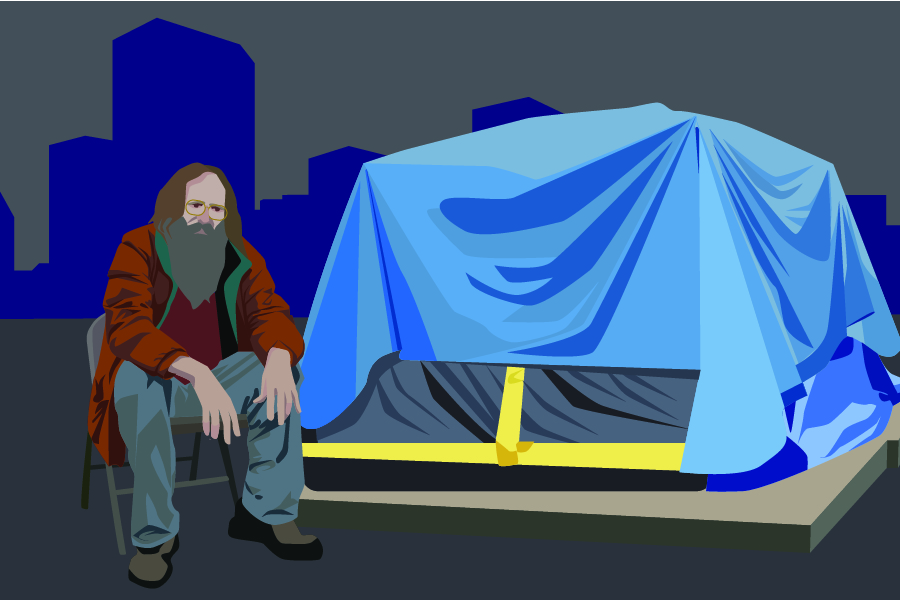
Anti-camping ordinance lawsuit denied by jury

0
ALLYSON KO / AGGIE

Sacramento homeless population continues to have no right to rest

On Nov. 2, a Superior Court jury denied homeless plaintiffs’ claim that the city of Sacramento selectively enforced its longstanding ordinance banning prolonged camping in public and private spaces within the city.

“Homeless plaintiffs hoped to prove that the city violated their constitutional right to equal protection under the law by selectively enforcing the ordinance against people forced to live outdoors,” Cynthia Hubert wrote in an article in The Sacramento Bee.

The lawsuit originated in September 2009 when Sacramento civil rights attorney Mark Merin, who filed the lawsuit on behalf of the homeless, allowed over 20 homeless individuals to camp on his private property within the city limits of Sacramento.

Merin and homeless plaintiffs contended that the city of Sacramento looked the other way when Black Friday shoppers and Boy Scouts illegally camped within the city limits. Shoppers, individuals with the Sacramento Valley Conservancy and attendants of Fairytale Town’s overnight campouts all testified that they camped in Sacramento without prior permission or receiving a summons.

Senior deputy city attorney Chance Trimm and the jury thought otherwise. The jury voted 9-3 in favor of the city’s right to cite and arrest homeless campers who did not otherwise have a permit to camp.

“It’s going to be interesting how the trial turns out,” said Jon Adler, who works for Harm Reduction Services in Sacramento, before the trial. “If they are going for the constitutionality of the camping ordinance, I don’t think they’re gonna get it.”

The verdict maintains the state of affairs, which leaves Sacramento’s growing homeless population without a right to rest.

Homelessness rose 38 percent from 2015 to 2017 in Sacramento County, according to the county’s point-in-time count. The Sacramento Regional Coalition to End Homelessness reported 71 homeless deaths occurred in 2016 and 776 from 2002 to 2016.

“We need to look at communities around the nation that have had varying levels of success with innovative programs that use tent cities and tiny houses among others,” said Sheryle Stafford, a social work professor at CSU Sacramento.

“There are no alternatives [other] than the camps on the river and downtown streets,” Stafford said. “For those that want to stay unhoused, we need to make sure there is a place for them to go instead of constantly running them off the river and downtown sidewalks.”

In 2016 alone, the Sacramento Police Department and Sacramento County Park Rangers issued 1382 anti-camping ordinances.

“Arresting or citing the homeless isn’t going to end homelessness,” said Michelle Aguiar, a social work student at CSU Sacramento. “Punishing the homeless for being unhoused is akin to punishing a drug addict for being hooked on a substance. Just like citing a drug addict isn’t going to help them get clean, citing an unhoused individual isn’t going to get them off the streets.”

On Nov. 7, the Sacramento County Board of Supervisors approved a three-year, $44 million homelessness prevention plan. All of the money will go toward California’s Mental Health Services Act.

On Sept. 20, Sacramento Mayor Darrell Steinberg announced plans to build two new homeless shelters in North Sacramento. Steinberg was the only City Council member to vote against the anti-camping ordinance when it was implemented in 1995.

Despite the verdict, Merin stills sees an opportunity to get the anti-camping ordinance repealed by taking the case to federal court, according to The Sacramento News and Review.


Written by: Dylan Svoboda — city@theaggie.org

Campus Prepares for Rainy Season

0
ALEXA FONTANILLA / AGGIE

Staff plans ahead, prepares infrastructure for storms

In Davis, November usually brings the first significant rains of the season. Residents will have to adjust by digging out their raincoats and umbrellas, by crowding the Unitrans buses and by buying bike fenders to avoid the “freshman stripe.” But when rain turns into intense storms, everyone on campus relies on infrastructure to prevent damage and disruption to their campus routines.

While much of this infrastructure might be invisible to students, there are dedicated teams of staff who work hard to plan ahead in anticipation of this year’s storms. When the forecast calls for heavy rains, many of these staff members will meet to coordinate the best course of action.

“Normally, when we know the storm is coming, we have a big meeting involving all the different folks,” said Michael Fan, the director of UC Davis Utilities. “There’s the facilities people that deal with flooding inside buildings and utilities […] and we also meet with the campus Emergency Operations Center. We all sit in the same room to plan, so we know that if something happens, if a really big one comes, we are ready.”

Fan knows the importance of planning ahead, and he and the other groups of staff who prepare for storms are well-equipped to allocate resources effectively.

“I think the key is before the storm, in the planning stages […] I’ve been here on campus for 20 years, so I know where the vulnerabilities and the flooding situations are,” Fan said.  “Campus is designed for certain stormwater levels.”

The utilities unit works with several other campus groups and systems. For example, the Arboretum waterway serves an important purpose during storms, functioning as the ultimate destination for runoff water from around campus.

“When the storms come, we’ll keep the water level lower at the Arboretum waterway, because all the runoff is coming to the waterway,” Fan said. “If that level is too high, the water is gonna back up to whatever the drainage system is.”

Because of its importance during storms, the Arboretum itself needs to be prepared for the rainy season, both in terms of the current construction and routine maintenance.

“All the work inside the channel is completed for this phase, so the rains won’t impact us,” said Andrew Fulks, the assistant director of the Arboretum. “[The waterway] is designed and managed to handle any of the storms we get here […] We prune dead limbs off of trees, make sure storm drains are clear of leaves and pick them up as they come down, cover bare dirt with mulch to prevent erosion. For the waterway, we install absorbent ‘socks’ at each storm drain, to catch any oils that run off the road after the first rains.”

Utilities also coordinates with Grounds and Landscape Services. The grounds crew is often some of the first people on campus in the morning, and they are often some of the first people to respond to damage from a storm.

“In terms of big storms, the first thing we do is come in and check the campus to make sure that it’s safe,” said Cary Avery, the associate director of Grounds and Landscape Services. “We make sure that there’s nothing blocking streets or sidewalks or anything, make sure no limbs have fallen down, we make sure the drains are all clear, and then we basically go through the campus and make sure all walks, roads and building entries are safe and clear.”
Last winter, UC Davis experienced some particularly intense wind and sustained rainfall. The La Rue bike underpass flooded and several trees fell.

“Well, last year was certainly challenging,” Avery said. “What happens is the more rain we get, some of the evergreen trees, they tend to hold a lot of water, and those trees are more susceptible to breaking out with heavy rain. Those are some of the things I’m talking about where we know that we have issues, and we kind of keep an eye on that stuff.”

Despite the challenges presented by storms like those last winter, Fan says that the campus was still prepared.

“Last year the amount of rainfall was huge […] but actually last year, there was actually the least amount of flooding damage,” Fan said. “Part of it is that we’re really used to these planning efforts, to get all the people from different expertises sitting in the same room, to prepare us ahead of time […] the amount of rain actually increased, but I was surprised to see that the amount of flooding was way less.”

For Fan, it’s important for people to know that UC Davis is well prepared for storms, and that groups like the utilities unit are there to help.

“I’d highly encourage people to call us, anytime they see anything stormwater related,” Fan said. “Over the years I’ve been here, I’ve gotten calls from students about dropping skateboards into the water intake, or their lunch or their iPhone […] we have good systems here.”


Written by: Gabriel Mulcaire — features@theaggie.org


And the band plays on

TAYLOR LAPOINT / AGGIE FILE

A look into the Cal Aggie Marching Band-uh! student musicians, traditions

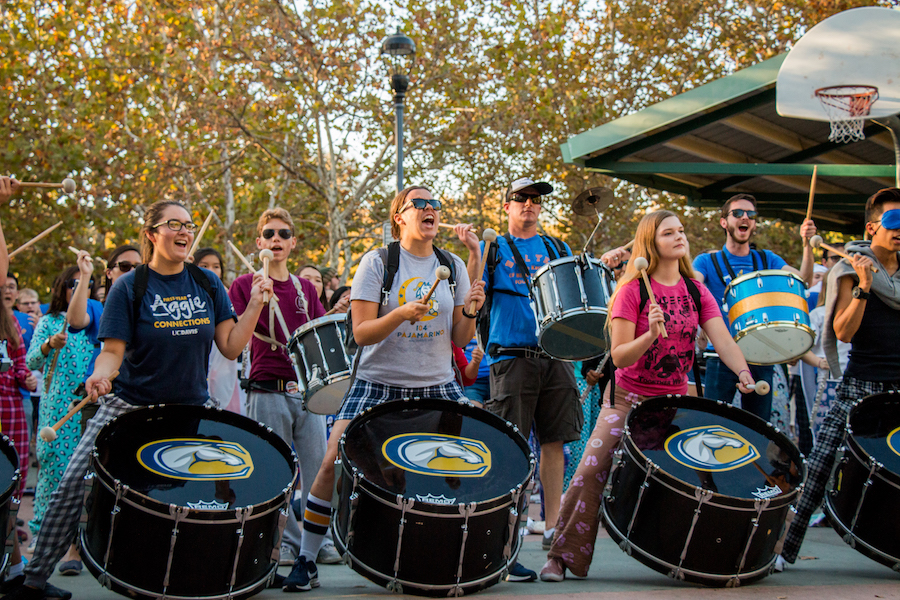
The Cal Aggie Marching Band-uh! is UC Davis’ official marching band. The Cal Aggie Marching Band-uh! was formed in 1929 as a small pep band for the football team. Now, the band has upwards of 200 members and is open to students of all majors and levels of experience. The Band-uh! is mostly student-run and operates completely on a volunteer basis.

The arrangements the band performs and the choreography are created by students themselves. This year, arrangements included breakup songs, “Guardians of the Galaxy,” Led Zeppelin, high school songs and the Foo Fighters.

The majority of Band-uh! members are not music majors, but simply have a passion for music. Jan Hong, a fourth-year psychology and human development major and bass drum player, joined the band their first year at UC Davis.

“I have done music all my life in public school,” Hong said. “I am someone who has trouble making friends, so band has always been a really welcoming place for me, and when I came to college here, I didn’t really know where to go, and the band anywhere is a good place to be, in my opinion, so that’s why I joined. It’s just like automatic friends [and] I love music.”

The band performs at every home football game and basketball game as well as at

other community events throughout the year including birthday parties, commencement ceremonies, the Save the Music Festival in Belmont, Calif. and Snow Fest in Tahoe. This year, the band even had the opportunity to perform at an Oakland Raiders game during halftime. The biggest events for the band are Homecoming’s Pajamarino and Picnic Day. At Picnic Day, the Band-uh! hosts a Battle of the Bands, inviting schools like Stanford, Humboldt State University, UC Irvine and UC Berkeley. The bands keep playing until they run out of music to perform and the last band standing is the winner. This past Picnic Day, the Battle of the Bands lasted eight hours.

“It’s a whole day for us,” Hong said about Picnic Day. “We’re literally getting ready at 4 a.m. and then [we] don’t leave campus until past midnight. We do two parades, a rally, and then battle, so we’re literally playing all day.”

The band is rich with traditions, and every band member has their favorite traditions and gigs. A favorite tradition held by a lot of members is the seasonal caroling. During the Christmas season, trumpet players carol through Davis and on Valentine’s Day, the low brass section performs love songs downtown and around campus. For snare drum player Chelsea Coppock, a fourth-year animal biology and entomology major, it’s the freshman rally on Picnic Day.

“One of my favorites is at the start of Picnic Day and we all wake up really early,” Coppock said. “The freshmen put on a rally for their uppers, which is everyone past their freshman year. They arrange their own songs and they practice it. There’s breakfast and stuff, so it’s really fun.”

For clarinetist Chris Rivas, a third-year evolution, ecology, and biodiversity major, his favorite events are the ESPN basketball games.

“For me, it’s anytime we do an ESPN game,” Rivas said. “The band is just super energetic at basketball games, but at ESPN games, the energy is even more noticeable.”

The Cal Aggie Marching Band-uh! is part of UC Davis athletics, so there’s always a debate on whether to consider marching band a sport, even within the band itself.

“In our band, there are a lot of people who probably don’t consider marching band a sport and a lot of people that do consider marching band a sport,” Hong said. “I do very much feel like marching band is a sport. It’s like a sport of the arts, in the same way you would consider dance and gymnastics. I think it’s very precision-based, like archery or golf. The thing about sports, too, is that you’ll have your higher level teams and you’re not as serious teams, and the way that I look at the Cal Aggie Marching Band, is if you compare us to basketball, we’re like the neighborhood pickup team. And other [college] bands, they’re more like the actual team, they take it very seriously.”

Coppock echoed her bandmate’s sentiment.

“We do take music seriously,” she said. “Sometimes people think because we don’t have auditions and don’t make cuts, that we don’t take ourselves seriously. We do, but we do have fun.”


Written by: Liz Jacobson — sports@theaggie.org


UC Davis researchers turn to unusual source of protein

RAY LUCAS / UC DAVIS

Larvae supplement chicken feed as synthetic methionine phased out of organic use

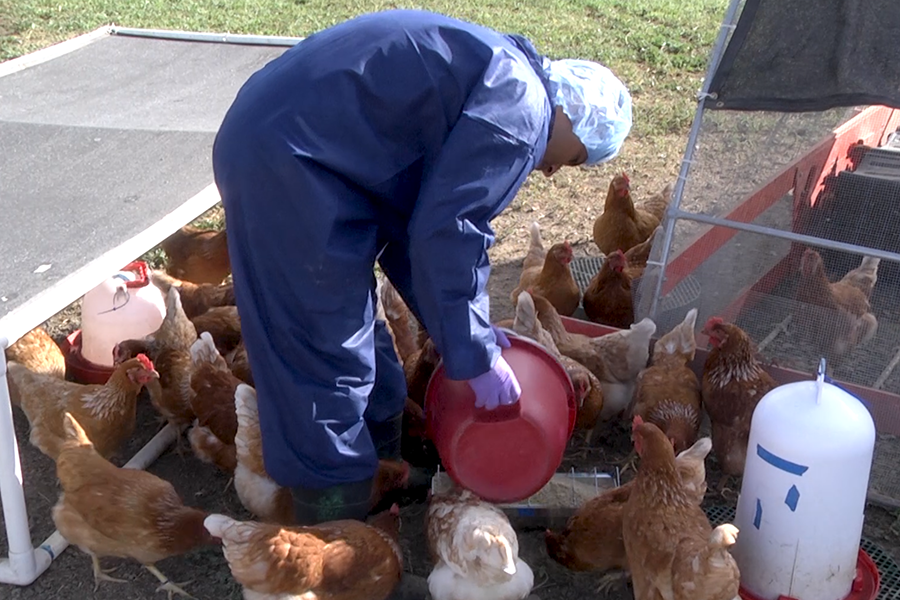
In a collaborative effort, researchers from the Departments of Civil and Environmental Engineering and Biological Agricultural Engineering and the UC Davis School of Veterinary Medicine have developed a process of growing black soldier fly larvae and introducing them as a dietary supplement for chickens.

Normally, methionine is supplemented via synthetic means — that is, introduced into chicken feed. But in the case of organically raised chicken, the amount of synthetic methionine is limited to two pounds per ton of feed. However, the National Organic Program, the branch of the United States Department of Agriculture that certifies organic products, aims to decrease or even eliminate synthetic methionine for use on organic chickens and eggs.

So why flies?

Researchers have considered Brazil nuts and fish meal to fill the gap of supplemental methionine, but aside from being less cost prohibitive than the former, there is a simplicity in using larvae.

“Remember that birds have a natural inclination to eat insects,” said Maurice Pitesky, a professor in the UC Davis School of Veterinary Medicine. “So we’re just trying to take advantage of that natural inclination.”

“The chickens like it more,” said Lydia Palma, a graduate student in the lab of Jean VanderGheynst, a professor in the Department of Biological Agricultural Engineering. “And the impact of growing insects on the environment is less than that of growing crops like soy and corn.”

VanderGheynst’s lab designed the larval breeding system. Initially a senior design project, the black soldier fly larvae was not originally a focus of VanderGheynst’s. However, once it showed feasibility, the idea took off.

“The project was shown at the [Engineering Design] Showcase and had a lot of interest,” said Matthew Paddock, another graduate student in VanderGheynst’s lab. “She took the senior design project as a proof of concept and used it to raise additional funds [for the current project].”

Black soldier fly larvae are distinct from common house and blow flies for two main reasons. They have a longer pupal phase than the latter, typically 20-30 days compared to 3 days. This means that BSFL can grow larger than other types of larvae. In addition, adult black soldier flies have no mouths and therefore cannot transmit disease, allowing for safe, large-scale breeding.

While the eggs are not laid in lab, the entire larval stage, from hatching to harvesting, takes place within carefully designed plastic bags. The bags contain their food, almond shell hulls, fertilizer for nitrogen content and hoses for air intake and outflow. The bags can sustain hundreds of larvae at a time and grow within a climate controlled environment that governs humidity, temperature and oxygen flow. Almond shells, most commonly used for animal bedding, are a byproduct of almond harvesting and can be a cheap source of food for the

larvae. The tailings from the larvae are also reusable compost, a bonus to the larvae themselves being high in protein.

After two or three weeks, the larvae will begin to pupate, or transition to their adult phase, and in turn “self-harvest themselves”.

“The black soldier flies will actually crawl into a dark area when it is pre-pupating,” Palma said. “In a scaled-up facility, you would probably want to utilize that part of their life cycle to collect them.”

This method of harvesting is more efficient than the alternative: sifting manually through the tailings and collecting the larvae individually. Once collected, the larvae are killed via freezing, dried out, and ground up to be mixed in the chicken feed.

For the experiment to be considered successful, Pitesky and his team must make sure that there is no significant difference between the hens that have eaten the BSFL enriched meal and those that have not. One indicator is in the taste and quality of eggs.

“We’re making sure the shells are still of the same quality as those from hens that are not fed the soldier fly larvae,” Pitesky said. “We’re checking to see if the fatty acid profile in the yolk are the same or equivalent… and finally, we’re trying to make sure that there are no flavor differences.”

The team have carried out a number of taste tests around campus, using a control egg and an egg from a BSFL-fed chicken. Pitesky’s group plans to announce preliminary results next spring at the Western Poultry Disease Conference in Salt Lake City, with a peer reviewed article to be published the following fall.


Written By: Dylan Hendrickson — science@theaggie.org