55.4 F
Davis

Davis, California

Monday, December 22, 2025
Home Blog Page 585

Justice League Advanced Screening

CAITLYN SAMPLEY / AGGIE

Free blockbuster movie screening for UC Davis community

On Tuesday, Nov. 14, ASUCD Entertainment Council will host an advanced screening of the much-anticipated film “Justice League.” The advanced screening will take place in downtown Davis at the Varsity Theatre.

The film, which has generated interest with a star-studded cast that includes Ben Affleck as Batman and Gal Gadot as Wonder Woman, is sure to please. Packing action, comic book superheroes and romance, Justice League will give its audiences an exhilarating ride.

As Entertainment Council’s first advanced screening event of the school year, the event has been met with great excitement.

“[Entertainment Council] is basically meant for the students to have fun,” said Entertainment Council director Liz O’Neill, a third-year economics and psychology major. “We create events to have fun, so if this is what students want then we try to bring it.”

Despite that sentiment, O’Neill’s ability to create these advanced screening events has been greatly reduced by the removal of Entertainment Council’s cinema budget two years ago.

“We don’t have a cinema budget anymore,” O’Neill said. “That’s why [screenings] aren’t a consistent thing […] someone reached out to us versus us going out to a studio.”

While the timing of the events may be out of their control, O’Neill and her staff remain hopeful that many more screenings will occur this school year. In order to improve that chance, Entertainment Council is working to make sure this event is a sold out success.

“Our first step was blasting it out on social media: Facebook, Instagram, Twitter,” said Entertainment Council promotions director Maddy Means, a third-year forensic chemistry major. “We are also going to be promoting it in our newsletter; we have fliers that the movie company sent us, so we post those around campus. We might even be giving away some posters in some sort of raffle or contest.”

The venue, the Varsity Theatre, hopes for similar success, seeing the screening as an opportunity to give back to the community.

“It’s something we really like to do. We like to keep that connection with UCD,” said head manager Whitney Martinez. “We really enjoy working alongside campus and bringing exciting things to Davis for the students.”

And since the pre-screening is free, the event is expected to be sold out, creating a lively viewing atmosphere.

“I wouldn’t be surprised if we filled up the entire auditorium,” Martinez said. “We seat about 260, so I’m expecting to have about 260 people show up on Tuesday.”

The advanced screening of Justice League will take place at 9 p.m. on Nov. 14. Arrive with an appetite for delicious movie theater snacks and DC Comics superhero movie action.


Written by: Rowan O’Connell-Gates — arts@theaggie.org

California Environmental Policy and Law Center screens Al Gore’s “An Inconvenient Sequel”

PARAMOUNT PICTURES / COURTESY

Hope and determination necessary for smart energy transformation

“An Inconvenient Sequel: Truth to Power” was screened to a full auditorium at King Hall on Oct. 26. The event was hosted by both the California Environmental Law and Policy Center and the UC Davis School of Law. The film, a sequel to 2006’s “An Inconvenient Truth,” features environmentalist and former Vice President Al Gore diving deep into the evidence of climate change and environmental destruction caused by fossil fuel energy sources.

“The impacts of climate change are all around us — as was identified in the film — in terms of more extreme storm events, wildfires, sea level rise, storm surges, Superstorm Sandy,” said Rick Frank, a professor of environmental practice and the director of the California Environmental Law and Policy Center at UC Davis. “This is just a harbinger of the new normal, and the new normal is pretty alarming.”

One of the first scenes of the film takes place in a 2007 U.S. Senate Hearing. Gore openly muses of possible methods of reaching out to people like Oklahoma Senator James Inhofe, who seem to ignore accumulated scientific evidence.

“There are very few elected leaders in our national government who have any kind of science background,” Frank said. “What they get, they have to get by osmosis, or from journalists, or other sources.”

Gore lamented how fossil fuel industries blocked the creation and adoption of solar and wind energy systems which could revolutionize transportation systems and energy consumption methods around the world. New York Attorney General Eric Schneiderman discussed an ongoing lawsuit against petroleum companies accused of lying to their stockholders and the general public about the harmful effects of oil and gas pollution.

MEENA RUGH / AGGIE

“Exxon Mobil, for many years, it’s been documented they had internal science that was informing of the reality of climate change at the same time they were buying expensive, full-page ads in the New York Times, the Washington Post and other major newspapers casting doubt on it and attempting to discredit the whole idea of climate change and climate science,” Frank said.

Many devastating weather systems were featured in the film. Hurricanes and typhoons derive their strength from water vapor in the air and warm ocean waters, both of which have increased in the industrial era. Typhoon Haiyan devastated the Philippines in November 2013 partly because ocean waters were about 10 degrees Fahrenheit warmer than usual at that time of year.

“There was a point where he talked about how the poorest people are affected the most by these events,” said Madison Farricker, a fifth-year environmental policy major. “That’s so true, and they have the fewest resources to get through those times, as well. Definitely motivates me to continue on my [career] path.”

Challenges lie in both adjusting the energy and transportation infrastructure already in place and shoring up defenses against extreme weather events.

“I think the State of California has pioneered a lot of important policies, in terms of both mitigating greenhouse gas emissions and adapting to the unavoidable consequences of climate change,” Frank said.

Davis has been trending in a positive direction. Most homes and apartment complexes are equipped with small containers for composting food materials. The CoHo uses composted materials for utensils, plates, and take-out bags. Recycling stations around the university campus help dispose of electronic waste. Many residents utilize methods of transportation, such as bicycling or walking, which eliminate emissions from vehicles. The UC system has launched the #MyLastTrash campaign, which is an initiative to have zero waste going to landfills by 2020, with 69 percent of the waste already diverted from landfills.

Gore helped create the Climate Reality Leadership Corps to train hundreds of hopeful activists around the world to contribute innovative solutions to solve the energy crisis. One tactic is to convince friends and family of the reality and gravity of the climate crisis.

“I definitely think [the film will] make me more conscious of the little things that I do in my daily life,” said Alisha Hacker, a first-year political science major. “Like making sure I recycle everything that I can, making sure that if I can carpool, I’m trying to, or trying to bike as much as I can.”

Cities around the United States have been adopting plans to use 100 percent of their energy from renewable sources such as wind and solar energy. One featured city is Georgetown, Texas, which the town’s mayor calls “the reddest city in the reddest county in Texas.” Georgetown is located on the outskirts of Austin, less than 200 miles from Houston, a huge oil refinery hub. Gore spent some time with the Georgetown mayor, a conservative Republican, who explained his rationale for spearheading the city’s renewable energy project: “The less stuff you put in the air, the better it is.”

Gore insisted that people around the world continue to advocate for an energy system which takes advantage of wind and solar energies instead of oil and gasoline. Nations such as Germany, Chile and Costa Rica have been pursuing solar, wind and geothermal energy technologies to support their infrastructure.

“One thing I’m comforted by is that, in a federal administration that is, at best, disinterested in climate change, and at worst, overtly hostile to climate change reform, that the state of California has stepped up and has made clear they are at full speed ahead in terms of state policy in this area,” Frank said. “I find that very encouraging. “


Written By: George Ugartemendia — science@theaggie.org

Nick’s Meditations on Love: My quest to understand love, Greeks and hotdogs

JAMIE CHEN / AGGIE

One of life’s universal feelings is surprisingly tricky to define

I’m no expert on love. Only one person has ever received the love of this guy, your columnist. Yeah, just one. But taking that love-mobile for a spin revealed something intriguing. I began wondering about the word “love” and all its puzzling connotations. And that’s not an easy thing to solve.



Everyone will experience that crazy, stupid little thing called love at some point (unless you’re James Franco; that guy is incapable of loving). Love is one of life’s concepts that’s pretty much universal, like death and taxes. It’s also nearly impossible to express through language. If there was one word tossed around the most but understood the least, it’s “love.”

Attempting to define love is like training for a hot dog-eating contest. It’s both frustrating and nauseating, and it leaves you feeling slightly bloated.

Some definitions hit the mark better than others. Over at dictionary.com, love is defined as “a profoundly tender, passionate affection for another person.” But this would be inadequate for the ancient Greeks, who split love into four different categories — distinguishing between romantic or sexual desire and the love between friends and family, for example.

Writers and romantics have been trying to nail down the essence of love for millennia, from Homer to E. L. James. A catchall definition of love is tricky to pinpoint, but perhaps it doesn’t matter in the long run what love means. What seems to matter most is how love feels.

Not all feelings are created equally, of course. That crazy, stupid thing called heartbreak is certainly real — just ask your favorite singers. It’s also an inevitable part of our collective romantic journey. Over 85 percent of unmarried couples will break up, and even half of all married couples will end up cutting the knot eventually.

The people we love — a spouse, a sweetheart, a Tinder bondage buddy — are at the mercy of probability. What’s the point if realism dictates it might end?

There is a point, though. Love requires sacrifice, a lot of effort and a state of vulnerability that molds our character — and who doesn’t need a bit of character molding these days? In a life full of tidal waves, ups and downs and side-to-sides, love can be the cage that keeps the sharks away.

Okay, that concludes my semi-poetic rejoinder to love’s appeal. The point is that love is raw. It harkens back to a primitive state of being, a most basic form of connection to another person. And it’s those raw emotions that make us live irrationally sometimes, yes, but with a heightened sense of fulfillment that is tough to replicate.

True, it will most likely end. But so what? Those memories of the past will sting, at first, and then slowly dissipate as the months pass. Those tears will dry, and the heart will grow stronger and more knowledgeable of the things that make us happy. It takes time, as friends and experts will tell us, but eventually we emerge with renewed vitality. Besides, the line of attractive suitors is surely awaiting.

Imagine the multi-headed Hydra, a ferocious monster from Greek mythology. Every time it loses a head, new ones take its place. Love is this monster, and broken hearts feel like one of its lost heads. But in time, wounds heal, giving us much-needed strength after a period of doom and gloom.

If you know the myth, some guy named Hercules kills the Hydra. Well hey, maybe love doesn’t belong in this metaphor after all. Maybe love’s meaning is better left to the abyss, content to leave people struggling with their bloat as I have. Yeah, this love thing kind of sucks.

It’s all Greek to me.


Written by: Nick Irvin — ntirvin@ucdavis.edu

Disclaimer: The views and opinions expressed by individual columnists belong to the columnists alone and do not necessarily indicate the views and opinions held by The California Aggie.

Humor: I claimed my soul back from the UC system, and you should too

JEREMY DANG / AGGIE

Devil’s advocate

At the risk of accidentally infuriating a population of California taxpayers — or some other group of people that would be offended by a half-college-educated person’s opinion — I’ll try my best to stick to my biased agenda and veer away from the facts.

There’s a lot of controversy these days about what counts as a “real job,” and since I’m not being paid to drink four cups of coffee a day and go to half of my classes, I’ve tried to find other sources of income. While Davis offers many job opportunities, I’ve had a hard time figuring out how to save money when there are always fun things to spend it on, like textbooks and rent.

As this vicious cycle has continued for the past three years, I’ve realized there’s no real way to save your money from the greedy, clammy hands of the system we all got tricked into joining. The way I’ve combatted this is slightly unorthodox, but I promise it works: I claimed my soul back from the UC system, and you can, too.

The day I refused to conform to the UC system was the day the narrative switched. Freeing myself from the evil hands of Linda Katehi (if that reference even works), I weaseled my way out of this system and actually turned the tables.

What happened next is something that you guys probably couldn’t guess, so I’ll just tell you. Nothing changed, but at the same time, everything changed.

I’m still begrudgingly forced to buy overpriced textbooks and pay for rent that is only increasing because the UC system decided they wanted it to increase. But now I look at my situation positively.

What I realized is that I’m not doing any actual selling — I’m actually doing the buying. If I learned anything from my semester of high school economics and The Big Short, there’s such a thing as a buyer’s market, and we’re living in it. Consumers control the industry, or something like that, and that has gone straight to my ego. I control the UC system, and I will be respected as such.

So I urge you to keep doing what you’re doing because that’s never going to change. But do it with the mindset that you’re in control, and you’ll feel good about all the debt you’ve acquired because, in a way, you own the UC system.


Written by: Rosie Schwarz — rschwarz@ucdavis.edu

(This article is humor and/or satire, and its content is purely fictional. The story and the names of “sources” are fictionalized.)

The Green Initiative Fund

0
SARAH RISHER / COURTESY

New ASUCD unit offers grant opportunity for sustainability projects

Sustainability, making an impact, leadership experience, funding: these are the keys that The Green Initiative Fund (TGIF) offers to the UC Davis community to unlock sustainability projects of its own creation.

“Are you worried that funding is holding you back from seeing a really cool project through?” said fourth-year environmental policy analysis and planning major Chase McFadden. “Then ASUCD’s TGIF is here to bridge that gap between [an] idea and actually turning your project into reality and making it happen.”

TGIF, born of an ASUCD fee initiative, is a “green bank” that offers grants to all UC Davis community members interested in improving campus sustainability from many different vantage points. According to McFadden, funded projects will promote environmental awareness, improve educational opportunities, engage in sustainable research, advocate for environmental justice and address other waste-reduction and restoration efforts.

Sarah Risher, a fourth-year environmental policy analysis and planning major and chair of the TGIF Committee, insisted upon the importance of community participation in sustainability efforts on campus.

“To me, it’s all about student empowerment and student voices and students making decisions about what affects them,” Risher said. “I feel like in the institutions that we are raised in, there’s a lot of communities that don’t have voices and are underrepresented and a lot of discrimination against young people […] To me, the mission of TGIF is to give students voices and to give students the tools to turn their ideas into reality.”

This multilateral mission provides funding — $2,000 during the fall application season and $20,000 in winter — for students, faculty and staff to address issues of sustainability that may or may not fall under the two major UC-wide goals: become zero-waste by 2020 and become carbon-neutral by 2025. The last day to apply for the fall mini-grant is Nov. 13.

In-committee alliances attach TGIF to the resources of the Office of Sustainability, Campus Planning and Environmental Stewardship and, of course, ASUCD.

“It’s kind of a unique ASUCD program in that it’s not directly tied to ASUCD operations,” McFadden said.

TGIF operations fall under the ASUCD budget and it is of interest to ASUCD because it uses student fees and is intended to serve undergraduate students first and foremost. Thus, grant proposals to TGIF should improve campus sustainability and especially affect the sustainability of undergraduate experiences.

Representing Campus Planning and Environmental Stewardship is Robert Segar, a staff member on the TGIF committee.

“We are responsible for long-range planning for the UC Davis campus environment,” Segar said. “Creating a sustainable future is at the core of what we do. It will be a great help to us to have students advancing the cause, and we think we can cue up some great opportunities for students to participate. I think the biggest opportunity going forward is to more fully integrate student engagement and student learning into our sustainability efforts.”

Annaliese Franz, a TGIF faculty committee member, researcher and associate professor of chemistry, studies catalysts and the ways in which they make chemical reactions more efficient, among other innovations focused on efficiency. Franz’s position as the director of the Undergraduate Research Center is notable, as she provides a liaison between the campus center and potential grant applicants for research projects.

“We generally try to empower and help inspire students from all over campus, and so basically anytime there’s an opportunity to have a partnership to help students get involved in research, we’re excited to do that,” Franz said. “Everyone has these unique opportunities where they contribute to the community, and each person is going to have a different idea, and that’s why instead of having one committee coming up with ideas, by having the opportunity to basically give the financial resources to small amounts to different groups, different people will come up with more ideas.”

While faculty members often apply for grants and funding, the rest of the UC Davis community may be foreign to the endeavor. This doesn’t disqualify anyone from earning the grant, though, as it is the knowledge that comes from working in different capacities across campus that qualify an applicant to speak on gaps in sustainability.

“Faculty or professors have more access to grants, obviously they do research all the time, and so we do want to reach out to janitorial staff, or the career staff [who are] not professors because they are on the ground everyday, they know this campus inside and out, it’s their community as well, and they have great ideas too,” Risher said. “I know different […] students, groups or just individual students see different needs and I think that’s the great thing about TGIF is that it allows people to bring those [ideas] forward where admin can’t see them, or ASUCD can’t see them.”


Written by: Stella Sappington — features@theaggie.org

Article 26 Backpack uses cloud drive to help reboot lives

CAITLYN SAMPLEY / AGGIE

Article 26 Backpack initiative will give displaced students secure access to textbooks, transcripts, college registrars

Cloud storage has integrated itself within the technological mainstream the same way that smartphones, contactless payment and on-demand media streaming have. Arguably, it has been the technological innovation that has made these services and products possible. The work of the Article 26 Backpack initiative now aims to use cloud storage technology to store essential documents for students who lack reliable access to their own educational files.

Named after Article 26 of the United Nations’ “Universal Declaration of Human Rights,” which guarantees the right to an education for all people, the Article 26 Backpack is centered around students in war-torn countries with underfunded education systems. This initiative helps these students regain access to their educational documents.

With physical records potentially lost due to natural disasters, wars or mismanagement, the ability to have these documents safe on a third-party server is one less thing to worry about.

“We [students] have the benefit of already having all of our SAT and ACT scores in the system,” said Liz McAllister, a fourth-year design major at UC Davis and documentarian for the project.  “They’ve already been evaluated and are readily transferable [to universities]. These people don’t have access to that.”

The project is the brainchild of Dr. Keith Watenpaugh, the director of the Human Rights Studies program at UC Davis. After being in the works for several years, the project received $500,000 from the Ford Foundation in October to fund the development of the program.

While the idea for the Backpack was novel within itself, the actual software was adapted from an existing framework created by IQ4, a New Jersey-based software developer.

“It was like an internal LinkedIn for companies like JP Morgan Chase, where you as an employee could list your skills and any specialized training you took while working there,” said Mona Finucane, the deputy director of the Article 26 Backpack.

The trial run for the Backpack will take place next spring in Beirut, Lebanon, a city with a high concentration of refugees and displaced students from the Middle East. 600 students will have their documents scanned and be given access to the Backpack.

“They’d come to this backpack event and the accreditors [from the American Association of Collegiate Registrars and Admissions Officers (AACRAO) and similar organizations from other countries] will evaluate them and say, ‘you’re eligible to go to this university and do this,’” McAllister said.

The accreditors would then issue a report for the student to take to their university of choice. The students will also be able to upload a personal statement to their backpacks, like those in college applications.

The Backpack is based on software developed by IQ4 called Passport, a software that acts, in the words of IQ4 CEO Frank Cecio, “as a digital resume.” But it is not only a place where employees can post their educational and work history — it is also a place where employers can create virtual classrooms to teach specific skills that employees may not have learned previously. Transferring this technology to the educational and humanitarian field was a pivot from skill verification to educational credit verification.

The aforementioned AACRAO creates a system in the US that determines how credits and units transfer between colleges so that a registrar for a university can easily figure out if incoming students have the education that they claim to have. Along with these standards, registrars have access to the National Student Clearinghouse, a nonprofit database containing millions of individual student files and transcripts, which allows admissions officers verifiable proof of a student’s academic record. However, there aren’t systems like this in place in many countries.

“We could validate [student data] from the Clearinghouse [if the students were from the U.S.], so we don’t deal with all that,” Cecio said. “In this case, we can’t. We don’t have this kind of function in Syria.”

The software, therefore, is more than just a place to store textbooks and transcripts remotely; rather, it is a peer-to-peer network directly linking students to universities’ registrars and vice versa.

The cloud storage, hosted via Amazon S3 service, will additionally be secured via block chains. Block chains are an integral part of cryptocurrencies such as Bitcoin, where each transaction is recorded on a virtual ledger, along with who the sender and recipient was. Once completed, the record of the transaction is permanently linked with the one before it, giving rise to the “chain” aspect of its name. This verifies the identities of both parties involved.

The team plans on training some college students in Beirut on how to use the Backpack and on how to enroll other students.

Finucane hopes to gradually create a self-sustaining structure wherein knowledge is passed from the top grades to the bottom. As knowledge passes from peer to peer, it instills self-sufficiency and trust in the Backpack.

Those involved with the project expressed that the Article 26 backpack would not only be a new dawn for those receiving the Backpack, but would conceptualize humanitarian projects in a more interdisciplinary way.

“It can’t just be the lawyers who are advocating; it can’t be the tech people, who have a product but no one to match the needs of the users to the actual capabilities of the software. McAllister said. “This day and age, where all this technology is available to us, the answer really has to come from many different teams working together.”


Written By: Dylan Hendrickson — science@theaggie.org

Perspective in Politics: The appeal of violent and nonviolent social movements

SHEREEN LEE / AGGIE

In an era seeking to fight injustice and inequality, nonviolence seems weak

Worldwide social movements have struggled with the dilemma of whether to employ violence to get results. Most historical movements have come with some mixture of nonviolent and violent means. This doesn’t affect their success. However, in the context of recent violence in Charlottesville and elsewhere, it seems as if violent measures are perceived as bringing the best possible results.

Nonviolent movements are challenging, especially when fighting against institutions that enact both physical and psychological violence. As for the social movements that Gandhi and Martin Luther King, Jr. engaged in, their impact is still debated heavily. Nonviolent resistance has been heavily criticized by people who doubt its effectiveness. To these people, there is a higher possibility that peaceful movements are more willing to compromise if violence isn’t even considered a viable option. For these campaigns to work, they require mass participation, time and patience despite pushback from those that want to see them fail.

But the argument for using physical violence is very much connected to the clamor for fighting inequality in the modern era. It’s not just equal rights that these activists are demanding. They want widespread changes, often including ending institutions and government policies that perpetuate inequality and injustice. When it seems that the nonviolent attempts at solving these issues haven’t done enough to create a more equal and just society, alternative means will grow in popularity.

This disillusionment with peaceful protest leaves a vacuum open to the argument for change “by any means necessary,” as Malcolm X phrased it in 1964. Violent disturbances force society to see how injustice is perpetuated by the government responding to violence with violence. Demonstrating oppression makes others understand that violence is the only available option against a strong, unyielding oppressor. This will, in turn, compel general society to interpret these violent disturbances as cries of desperation.

Current peaceful movements lack the strength and vitality of MLK or Gandhi in creating such an effective movement, with many activists just paying lip service to them for their peaceful activism. These activists are composed of either people who are against change or those who want change without violence. This can be summed up by something that moderate liberals and conservatives stereotypically say — that everyone has the right to protest, as long as property isn’t destroyed and people aren’t attacked and that working within the system is productive. This offers no pressure to force change, since people just stand as allies on the sidelines.

These people are often weak and lack any backbone. There is no strong belief in their argument anymore because others assume that their proposals will not bring widespread change. It is only a limited, compromised change that does little to shake the established order that these people vehemently oppose.

The only way to strengthen the success of nonviolence is to do research and understand how it has worked in the past. People must understand the underlying principles of social movements and how it only takes a strong movement to let the oppressing power destroy its own credibility with its cruel violence. The British empire’s repressive strength became no match for the Gandhi inspired mass movements that made India intentionally ungovernable.

In the United States, it took a strong, mostly peaceful civil rights movement in the 1960s to convince lawmakers and the general public that civil rights legislation was desperately needed. Violence remained in the periphery for both cases, hardening the resolve of the state to concede to change. If activists really want change through nonviolent means, then their movements must garner the patience, charisma, confidence, and popularity of MLK and Gandhi. In the end, they will not hurt their own communities but will help them without using any forms of physical violence.


Written by: Justin Chau — jtchau@ucdavis.edu

Disclaimer: The views and opinions expressed by individual columnists belong to the columnists alone and do not necessarily indicate the views and opinions held by The California Aggie.

Humor: Yikes! Student drunkenly sends carrier pigeon to crush

JAMIE CHEN / AGGIE

Drunk texting is a thing of the past

We’ve all known the terror of drunk texting. Perhaps you texted your ex, your best friend or your dad. One UC Davis student, third-year Sylvia Ono, rejected this standard for embarrassment and instead drunkenly sent a carrier pigeon to her beloved.

Ono’s friend group went on a jaunt to the bars this last weekend, like the cool-cat college kids they are, but wound up walking back to their apartment. After prying the iPhone out of Ono’s hands, her friends thought they had saved her. This, of course, proved false when Ono grabbed a pigeon with the vigor of Donald Trump, or myself when given a box of McNuggets, and began her message.

“Honestly, we thought she killed the pigeon when she grabbed it,” said Patty Pollo, one of Ono’s friends. “Then she started writing on a used napkin with a tube of lipstick. It was kind of impressive but then deeply concerning all at once.”

The pigeon, who called himself Kanye Nest, was shook, to say the least. After years of being told that his dream of being a carrier pigeon was “foolish” and “dated,” it was finally his time to prove himself.

“Suck it, DAD!” Nest exclaimed. “Screw law school, screw med school and SCREW THE CHILI’S THAT FIRED ME LAST WEEK!”

Nest’s entire future was riding in the hands of this drunken woman, and tensions were high. With the intensity of Floyd Mayweather, Ono finished her big message.

“It was just two words,” said Beth Foreman, another friend of Ono’s. “She wrote, ‘You up?’ We hoped it was an attempt to be cool, but it took her like 45 minutes to write this.”

With the message in his grasp, Kanye Nest flew all the way to the home of Timmy Winks and tapped vigorously on his window. He needed only to tap once, though, as Winks had been awake since the beginning of midterm season and was brewing his 10th cup of coffee for the night.

“You up?!?” Winks shouted. “Of course I’m up! I haven’t seen a bed since the third grade. I haven’t closed my eyes since I was in the womb!”

Just when we thought the scene was ending, another pigeon, Jimmy Talon, came with a second message from Ono. This one read, “Heyyyy.”

“I wrote back the only message I could think of,” Winks said. “And that was ‘New pigeon, who dis?’”


Written by: Olivia Luchini — ocluchini@ucdavis.edu

(This article is humor and/or satire, and its content is purely fictional. The story and the names of “sources” are fictionalized.)

Letter to the Editor

CAITLYN SAMPLEY / AGGIE

UC Davis did not ignore anti-Semitic sermon


To the Editor:

Re “UC Davis remains silent in wake of anti-Semitic sermon” (Op-Ed, Nov. 2):


I first want to express my concern for the intolerant and hate-filled aggressions Charline Delkhah described experiencing on campus. They are personally disturbing to me, and they do not represent the values of our university.

Secondly, to clarify Delkhah’s account of the administration’s response to Imam Shahim’s July sermons at the Davis Islamic Center: UC Davis was not silent. On July 26, Chancellor Gary May and Interim Chancellor Ralph Hexter (current executive vice chancellor and provost) issued a public statement condemning the hateful remarks. It remains available online. Here is an excerpt:

“Like others in the Davis community, we are deeply disturbed by reports of comments delivered last Friday at the Islamic Center of Davis concerning Jewish people. These reports have understandably caused great pain and alarm. We harshly condemn hateful remarks and have extended to those members of our community our immediate and ongoing support. We want to emphasize that we do not condone any type of discrimination.”

On Aug. 7, our chancellor and provost also sent a letter to Davis Muslim Hands in response to the organization’s public statement. In part, May and Hexter wrote:

“On behalf of the entire UC Davis community, we the chancellor and provost, write to express our deep admiration and appreciation for your letter […] We find both heartening and encouraging the depth of compassion that your message shows for members of the Jewish community in Davis and on our campus, as well as the sensitivity to the way that Jewish historical experience makes anti-Semitic utterances all the more painful and frightening […] We must all work together to defend the inherent value, dignity, and rights of all people.”

Finally, I want to thank Delkhah for addressing this important issue. In our diverse intellectual community, our voices and positive actions are the most powerful tools we have. Campus leaders were not silent in July, and we will continue to speak loudly against hate and discrimination on behalf of our entire community.


ADELA DE LA TORRE, DAVIS

The writer is the vice chancellor of Student Affairs and a distinguished professor in the Department of Chicana/o Studies at UC Davis.  


Disclaimer: The views and opinions expressed by individual columnists belong to the columnists alone and do not necessarily indicate the views and opinions held by The California Aggie.

Guest: Come as you are

JORDAN KNOWLES / AGGIE FILE

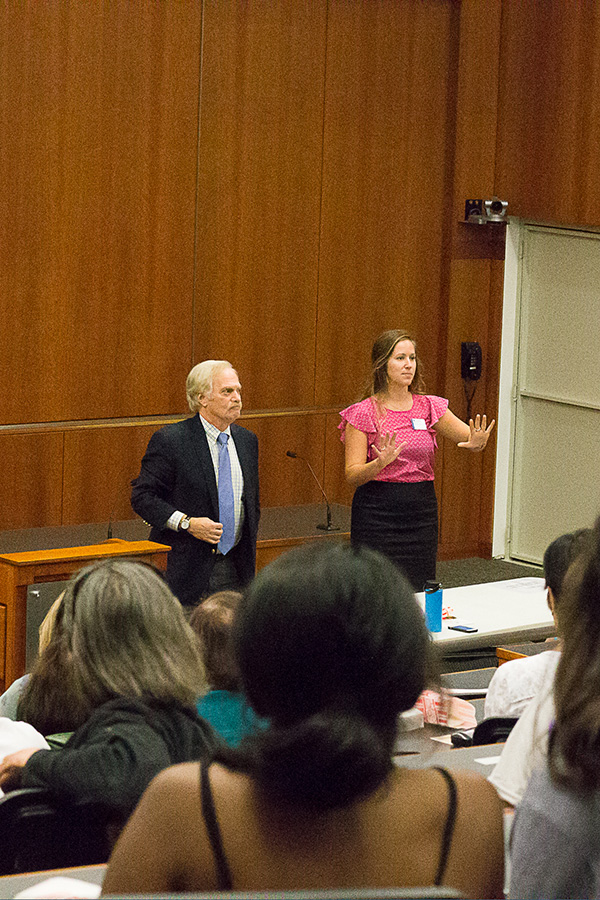
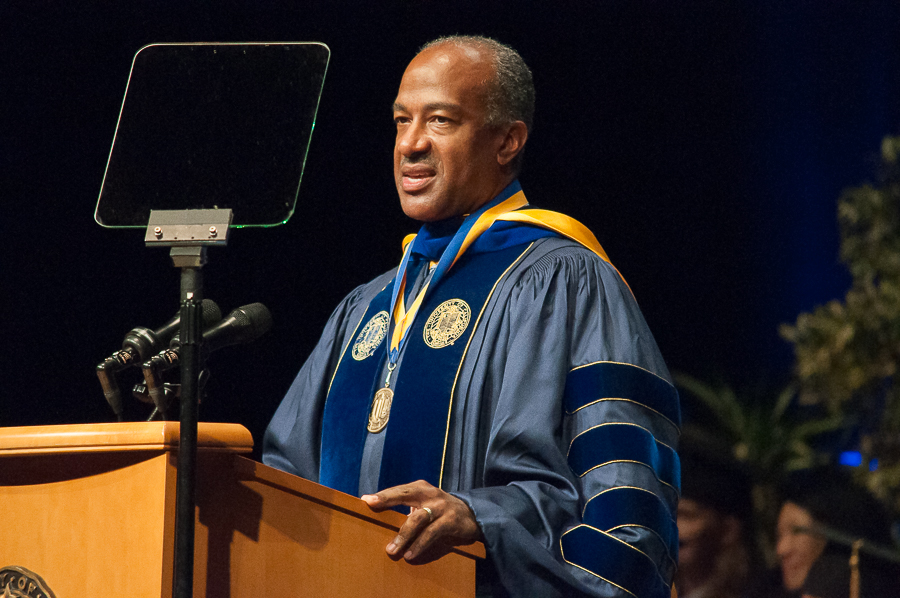
UC Davis Chancellor Gary May responds to provocative fliers posted around campus

A seemingly benign flier that appeared around UC Davis over the weekend serves as a reminder that our campus, for all its charm, is hardly insulated from the issues facing our society at large.

The anonymous single-sentence message read: “It’s okay to be white.”

Multiple postings, made under cover of darkness Saturday night, were duplicated at many other college campuses across the country. They were spotted in Harvard Yard, Tulane University in New Orleans, Concordia College in Moorhead, Minn., the University of Alberta in Canada and a high school in Silver Spring, Md. The flyers attempted to subtly convey a message that white people are under attack in the United States.

Well, of course it’s okay to be white, or brown, or black, or gay, or straight, or rich, or poor, or Muslim, or Jewish, or Catholic, or Protestant or disabled. All are welcome at UC Davis.

But why UC Davis? If you were looking to persuade people to accept the concept of “white victimhood,” would you hit a jackpot here, at one of the nation’s Top Ten public research universities that prides itself on diversity, inclusion and civil discourse?

Of course not. The midnight vandals who posted these flyers are only seeking to goad us. Several of the signs were taped to a banner advertising the annual Empowerment Conference hosted by the UC Davis Women’s Resources & Research Center. Others appeared on sandwich boards outside the Student Community Center, home of our Cross Cultural Center, which seeks to empower students from underrepresented ethnic groups.

The posters were part of a national campaign of provocations intended to divide our country. Their aim was to provoke a reaction and portray it as evidence of growing anti-white discrimination on college campuses.

We removed the signs on Sunday wherever we found them. All were in violation of our campus posting policy, which generally prohibits postings on buildings, walls, windows and trees — whether it’s for a political cause or a blood drive.

UC Davis has been and should continue to be a forum for wide-open dialogue on an unlimited range of ideas, including those that many find disturbing. Anonymous fliers, however, are not dialogue. Support for social diversity and equity is not a put-down. This is not a zero sum game. All can be valued. All can be supported. All can be successful.

Yes, it’s okay to be white — or anything else at UC Davis. But it’s not okay to vandalize or intimidate. Like the signs at the ARC say: “Come as you are.” Just come to learn and contribute constructively to the UC Davis community.

Gary S. May is the chancellor of the University of California at Davis.


Written by: Gary S. May

Disclaimer: The views and opinions expressed by individual columnists belong to the columnists alone and do not necessarily indicate the views and opinions held by The California Aggie.

Uncontested election worrisome

HANNAH LEE / AGGIE

ASUCD needs to address student apathy

Of the 35,415 undergraduate students who attend UC Davis, a mere six felt inspired enough to run for the six open Senate positions in the Fall Election.

This news raised concerns within the Editorial Board regarding the apathy that many students feel toward getting involved in student government and whether ASUCD is doing enough to promote itself and its agenda. We believe it’s important to reignite the conversation about student government in academics and campus life.

Though the dismal candidate turnout has removed the incentive to vote and rendered the ballot futile, the student body can still take an active stance to get to know tomorrow’s leaders and hold them accountable to their platforms. For instance, consider attending the Candidate Debate on Monday, Nov. 13 from 11:30 a.m. to 1:30 p.m. at the CoHo to challenge the candidates’ viewpoints on issues that matter.

Despite the apparent lack of enthusiasm shown by the student body in getting involved with student government, ASUCD influences the daily life of every student and therefore deserves attention. Some of the indifference toward the Senate can be attributed to a lack of knowledge about the critical role it plays in the maintenance of common ASUCD units on campus. The Senate oversees a $13 million budget that funds popular units such as the CoHo, the Bike Barn and Unitrans.

Many students find these units integral to their success and notice areas that need improvement and yet, candidate and voter turnouts continue to suffer because very few seek out student government as the solution.

ASUCD shoulders much of the blame for student apathy. But getting things done is a two-way street. To fund new and beneficial units and develop policies that create true change, senators require the input of their constituents. Students must be vigilant about issues on campus and areas where they want to see change as well as be proactive in bringing those issues to the attention of their senators. Attending weekly ASUCD Senate meetings is one way to place items on the political agenda. Students can also voice their concerns during senators’ office hours, which go largely unattended, or simply send an email to the Senate Listserv at senate@ucdavis.edu. Senators, for their part, should be actively promoting their office hours and maintaining an engaging presence beyond campaigning. Students and senators can work together to formulate spending or policy bills, which make an impact on the quality of student life.

When students are given a platform and are allowed to exercise power, we should make sure that they represent the student population and its needs in the best way possible. While the student body may not have willingly elected these candidates, it still falls to us apply public pressure to ensure that the senators feel an obligation to stand by their campaign promises.

In other words, let’s hold them to higher standards and settle for nothing less.


Written By: The Editorial Board

Chamber of Commerce’s homelessness meeting sparks debate

MICHELLE GORE / AGGIE

Search continues for solution to end homelessness

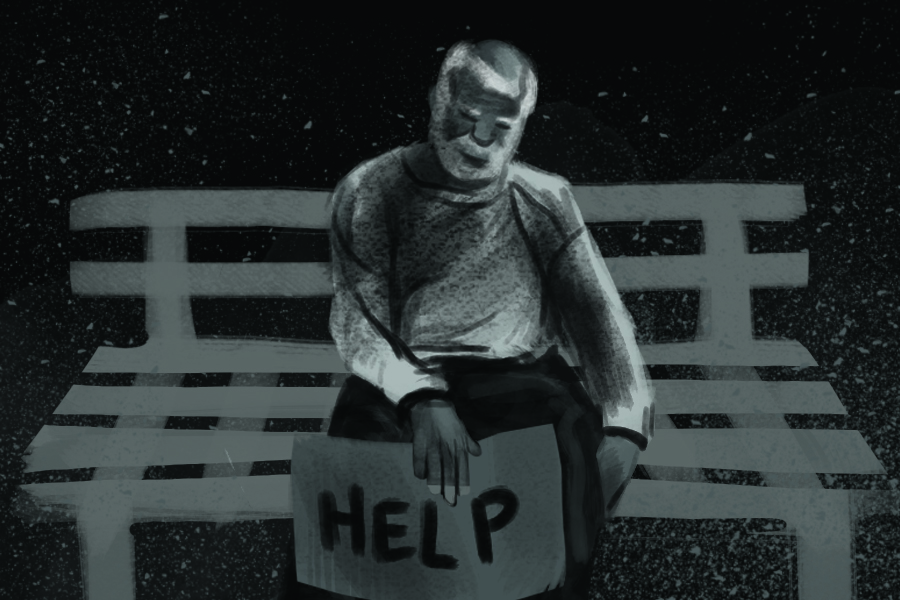
On Oct. 24, the Davis Chamber of Commerce held a panel discussion at the Veterans Memorial Theater to address the growing homelessness issue in Davis.

The discussion was free and open to the public. The panel was made up of 10 local leaders, including a number of social workers, downtown Davis business owners and government officials. Guests were encouraged to share their input on the issue.

Darren Pytel, the City of Davis’ chief of police, opened the discussion by touching on the challenges of panhandling.

“From a constitutional standpoint, panhandling in a nonaggressive way is protected speech,” Pytel said.

Pytel also indicated that the City of Davis’ police department recently hired a social worker whose sole purpose is to reach out to the homeless community.

Davis resident Jack Armstrong, the co-host of the Armstrong & Getty radio show, told a chilling story about an expletive-filled interaction he, his wife and two young children had with a disheveled man at Dos Coyotes in Davis.

“I would like [Davis] to stop being a magnet for those people,” Armstrong said.

Pytel commented on the severe drug and mental health issues these individuals are dealing with and how low drug prices are leading to more rampant drug use. Pytel also attributed the rise in car burglaries to drug use.

Many guests, most of them residents of Davis, expressed their concerns over such actions and the number of homeless people in town.

Jon Adler from Harm Reduction Services in Sacramento attended the meeting as a guest and shared his thoughts from his unique perspective as a former “unhoused” individual.

“Living on the street is a traumatic experience,” Adler said. “Until there is compassion, there won’t be any progress. There are people who go to Davis High School who commit crimes.”

Davis Mayor Pro Tempore Brett Lee stressed the importance of behavior when describing the homeless. He pointed out the parallels between his fraternity-row neighbors with their “non-neighborly” actions and the homeless population.

Lee also noted the necessity of cooperation between Yolo County and the City of Davis in solving the crisis.

Adler, who lived on the streets of Davis for five years and has 20 years of experience working with the homeless in the Sacramento area, stressed the importance of compassion and understanding.

“People don’t want to live outside,” Adler said. “That is a myth in itself. It’s not something you choose. When you hear the term ‘homeless,’ you hear ‘drug addict,’ ‘criminal,’ ‘mentally ill.’ The fact is there are more drug addicts, criminals and mentally ill that live in houses.”

Adler also touched on why Davis is an attractive place for the unhoused.

“This is a f–king great town,” Adler said. “Community Gardens. I can eat like a king. Everybody recycles. I can make $20 an hour recycling here. I can go to sleep and not worry about getting my head kicked in. That’s going to be attractive to everyone.”

Bill Pride, the director of the Community Meals program in Davis, believes the cause of the issue is a lack of affordable housing in the region. He noted the increase in students living in his hometown of Woodland, which is 15 minutes north of Davis.

According to the Yolo County Homeless and Poverty Action Coalition, homelessness is slowly on the rise in Davis. Homelessness is up 11.4 percent from 2015 and 28 percent since 2009.

In 2016, the State of California’s homeless rate was 30.1 people for every 10,000 people, according to the most recent study on homelessness conducted by the U.S. Interagency Council. In Yolo County’s most recent homeless count in 2017, Davis’ homeless rate was 21.4 people for every 10,000.


Written by: Dylan Svoboda — city@theaggie.org

2017 ASUCD Fall Election — Meet the Candidates

Fall Quarter ASUCD Senate Candidates (BRIAN LANDRY, MEENA RUGH, NICHOLAS CHAN, DIANA LI / AGGIE)

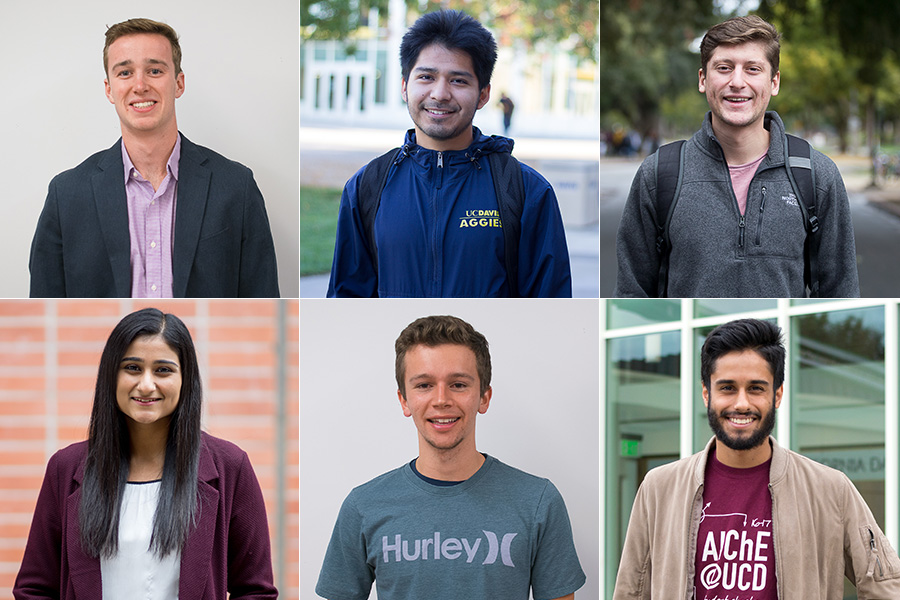
Six candidates running for six open senate positions

The six candidates running for senatorial positions in the Fall Election have been announced. There are six open senate positions, which means this election is uncontested. Voting will start at 8 a.m. on Tuesday, Nov. 14 and end at 8 a.m. on Friday, Nov. 17.


Andreas Godderis

Second-year economics major Andreas Godderis is one of the four independent candidates. Godderis has had no previous involvement with ASUCD; he said “that’s part of the reason why” he’s decided to run for senate.

“Last year, I didn’t feel like there [were] a whole lot of opportunities to interact with ASUCD unless you explicitly searched them out,” Godderis said. “I think every student should have an easy road to go down if they want to get involved with campus and the way it’s run. I want my function […] in ASUCD [to be] more of a voice for students rather than someone who interprets the bylaws.”

One of the main components of Godderis’ platform is increasing voter turnout. Godderis said that “even the amount of candidates” running this year is “problematic” and “disappointing.” According to Godderis, fostering more connections between students and senators will result in greater turnout.

As a former competitive cyclist, Godderis said he would be interested in adopting the Bike Barn if he were elected. He has plans to increase floor space by utilizing the building’s upper level for storage.

Godderis, who works at the South CoHo, said he would also be interested in finding ways to improve retention rates at the CoHo and South CoHo.

“When you work for ASUCD — for the CoHo, for the South CoHo — your contract states that you have a minimum work requirement of 15 hours per week,” Godderis said. “I think for a lot of students, myself included, that’s too much. [That requirement] creates this culture where you have a lot of employees who start and quit halfway through the quarter. [I want to] decrease work hours to whatever the sweet spot is — I initially had in mind 7 to 10 hours.”

Godderis hopes to complete more than one term on senate, as he has a few “fairly ambitious” goals.


Gaven Kaur

Gaven Kaur, a second-year psychology and communications double major, is also running as an independent candidate.

“I decided to run for senate because I really want to be an active voice on campus and make sure that I can make positive changes through my platforms, which I’m super, super passionate about,” Kaur said. “I’m really looking forward to campaigning and […] getting myself out there and more involved with the campus.”

Kaur has previous involvement with ASUCD: she formerly served as a staff member for Senator Simran Grewal. In regards to her platform, Kaur is most interested in promoting mental health resources on campus.

“I […] want to collaborate with the Student Health and Wellness Center,” Kaur said. “My freshman year, I got to know a lot of students who suffer from mental health issues. A lot of the kids would tell me all the time […] ‘If someone had reached out to me, maybe it would be different.’ I feel like through this platform […] I could help promote it. I’d definitely want to table [and] hold discussions. It goes hand-in-hand with my second platform [issue].”

The other component of Kaur’s platform is increasing resources for freshmen to encourage their involvement in activities around campus.

Kaur is the only woman running in this election.
“I think it’s definitely surprising because we do have a very large female population,” Kaur said. “I am super involved with women[‘s] organizations on campus: I do HerCampus [and] Davis Women in Business, so I’m definitely all for women empowerment. I definitely want to be that role model for women.”


Danny Halawi

Second-year Danny Halawi is currently an applied mathematics major, though he plans to switch to computer science. He is running on the UC Davis Unite slate.

“I’m partnering with [the slate] because they have a lot of experience,” Halawi said. “A lot of their platforms and their ideas and policies I agree with, so it happened to just be a good mix.”

Halawi said he wants to bring his perspective as a STEM major to the Senate.

“There’s a big lack of STEM representation,” Halawi said. “Because there’s not a lot of [senators] majoring in [those fields], they’re not able to make decisions related to those fields and topics because no one has the expertise. In order to help my community and help the students on campus majoring in STEM, I need to run and represent them.”

A member of UC Davis Greek life, Halawi said he wants to “be the bridge between ASUCD and Greek Life.”

“Greek does a lot of great things for the campus with their philanthropy, their charity and bringing people together,” Halawi said. “I want to make sure they have representation on ASUCD as well. The two entities have very [similar] values — they both want to help their communities, essentially. They have these same values; however, they work separately, which doesn’t make sense to me.”

Halawi has had no previous experience with ASUCD. He said he would like to encourage student involvement with ASUCD.

“A lot of students don’t know about ASUCD, and one of the reasons why I want to become senator is to make us more well known,” Halawi said. “One thing I could immediately fix, or at least take a step towards fixing, is making sure that students know [ASUCD] exists and that they can help out through various efforts. I think that’s really important to do right away. If people don’t know about us, then they’re not going to come to us for help.”


Jesse Kullar

Jesse Kullar is also running as a candidate on the UC Davis Unite slate alongside Halawi. Kullar is a second-year chemical engineering major who was born in Toronto, Canada and raised in San Jose.

“Last year I did attend a senate meeting, and they were actually talking about lobbying the [engineering] department to normalize fifth- and sixth-year programs for STEM and engineering backgrounds, and that didn’t really sit right with me,” Kullar said. “Everyone except for one person there was a political science major at that time, and I felt that if they are going to be speaking on behalf of STEM and engineering, they should have someone at the table who is already in that background so they can voice the opinions and concerns of their classmates.”

This experience inspired Kullar to run for senate and make one of his platforms better STEM representation in ASUCD. From his experience playing pickup and intramural soccer on campus, Kullar has also prioritized bettering athletic facilities on his platform.

“I want to focus more on student athletics because what I’ve noticed from talking to a lot of students who play at our facilities, like the soccer fields, tennis courts and basketball courts is that a lot of our facilities are not at the standard that they should be for a college campus,” Kullar said. “The lighting does not even work at night for their tennis courts so [students] can’t even play past sundown, and the basketball courts overall are pretty run-down.”

Kullar is interested in adopting the Unitrans unit of ASUCD in order to increase frequent stopping in areas such as East Davis, where buses only stop every 30 minutes. Overall, Kullar feels strongly about bettering student involvement on campus, especially when it comes to voter turnout.

“When students are involved in the campus, when they enjoy the company of the campus, you have such more positive experiences,” Kullar said. “If we can find a way to get people more involved and love the community that they go to, I think overall that would make Davis an even better campus than it already is.”


Bryan Perez

Bryan Perez is a second-year political science and managerial economics double major running as an independent candidate.

During his freshman year, Perez worked as a tour guide and realized that there are a lot of resources on campus students don’t know about. This was one of the reasons he decided to run for senate.

“I came from a small city, and it was really overwhelming to come to a university with a bunch of different communities. I want to break that and help other people represent other communities whose voices are not heard yet,” Perez said. “I want to add a structure by the MU that has flyers for what is going on posted on there because I know some people don’t have Facebook or social media [and] I want to make sure that they are all involved because the MU is a pivotal place of our campus.”

Perez is interested in adding more lighting around campus in order to ensure safety as well as making the first floor of Shields Library open 24 hours to make studying more accessible. Overall, he is very passionate about making student resources widely known.

“People find out late in the end [about] resources they could have utilized, but they were not notified early and didn’t know where to look in the first place,” Perez said. “I am a tour guide, and I know all this information, but there are still more resources that I don’t know about. This is not a major change, but it’s something that can actually impact our students because it’s a way for students to be notified, and hopefully I can make that happen.”

Perez is excited for the senate campaign and the opportunity to make a difference.

“I’m a first-generation [college student] for my family. I’m setting an example for my family and other people as well from back home because no one from that area has considered going to NorCal,” Perez said. “I found this university has a great environment to grow, and I feel like it can be better for our students so they won’t be scared to go out and explore for themselves and express themselves.”


Jake Sedgley

Jake Sedgley is a third-year economics and environmental policy analysis and planning double major. Sedgley, a Davis local, is running as an independent candidate to improve the transfer student experience on campus.

“Coming to a big campus like this is a really big deal for a lot of transfer students. I personally worked my butt off to get here, and I came here and it just didn’t feel like it was supposed to, quite honestly,” Sedgley said. “Being a sophomore transfer gives me a unique opportunity to actually represent transfer students.”

Sedgley is also interested in improving ASUCD outreach to students.

“Generally, the candidates don’t represent the student body, like there’s only one woman running,” Sedgley said. “Voter participation is a big problem. When you only have 10 percent at most of the students voting, there’s no way that’s going to represent the student interests. It’s almost impossible.”

Sedgley has been following ASUCD almost his entire life through the local news and has attended about four or five senate meetings since he decided to run for senate. He is also interested in adopting Unitrans or the Aggie Reuse Store because of his interest in environmental policy.

Sedgley’s priority is to address the lack of student participation in ASUCD.

“Voter participation is just something that needs to be fixed as soon as possible,” Sedgley said. “There are other UC campuses that have like 30 or 40 percent voter participation. Things like social media outreach and just generally talking to transfer and freshman students at orientation, I’m trying to get them more interested in what ASUCD does and more awareness of how big they actually are on campus.”


Written by: Gillian Allen & Hannah Holzer —  campus@theaggie.org

Aggies advance to Big West tournament finals

0
BRIAN LANDRY / AGGIE

Men’s soccer outlasts CSUN 4-2 in game for the ages

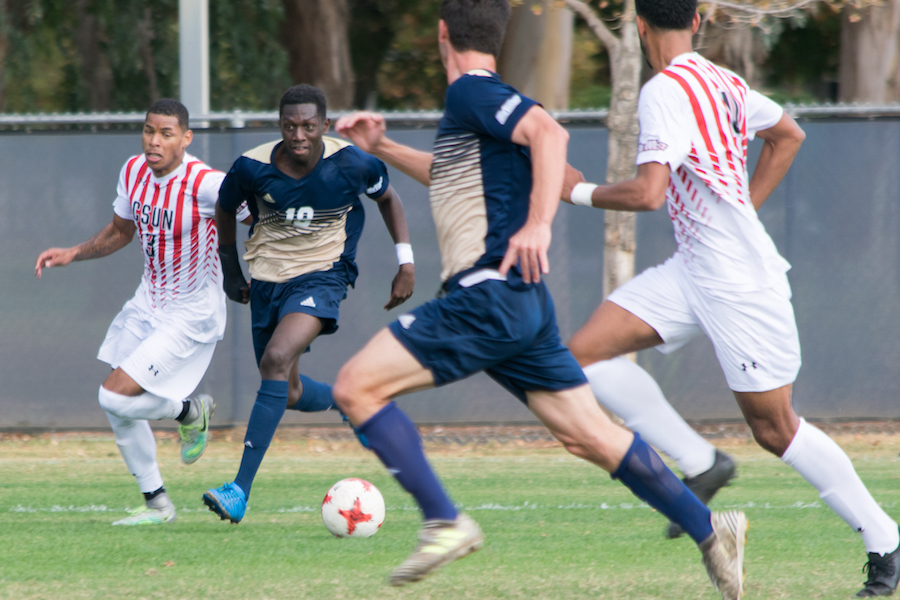
UC Davis men’s soccer advanced to the finals of the 2017 Big West tournament with a riveting 4-2 win over visiting CSU Northridge in the most drama-filled match of the season. Senior forward Noah Wilson tapped in the game-winning goal for the Aggies with 22 seconds remaining in regulation to save the season and give UC Davis a shot at capturing its first Big West conference title in program history.

In the final minute, UC Davis senior defender Kyle Higgins handled a long deflection from the UC Davis box that ended up at midfield and dribbled all the way down to the CSU Northridge box, getting through two Matador defenders with a series of impressive ball moves. Dribbling in front of the right goalpost, Higgins chipped the ball past the diving Matador goalkeeper to a wide-open Wilson, who was waiting in the middle of the box to tap the ball in for the game-winning score.

“I was kind of cherry-picking at the end there,” Higgins said. “We were down a guy, so I knew I’d be the only one up top and have to make play if the time came. I found myself with the ball at half and they were kind of lazy getting back on defense and I had a one-on-one with the defender. Coach always says be aggressive so I took him on and ended up getting to the endline, picked my head up and Noah made probably a 120-yard sprint, good position and I found him.”

Wilson deflected all the credit to Higgins, whom he trusted to give him a good pass and an opportunity to fire off a quality shot.

“I’ve watched Kyle [Higgins] for the past four years just shred guys going at them and I knew if I could just get to a spot in the box he’s going to beat him,” Wilson said. “And he played the perfect pass. I just stayed focused and slotted it in. He did all the hard work. The weight of the pass was absolutely perfect. All I had to do was swing my foot through it.”

Higgins scored a breakaway goal with two seconds left to cap things off, as the Matadors desperately tried to tie the game and left only one player on their own side of the field.

Emotions were at a fever pitch in the second half, as the physicality between the two sides started to heat up and the referees were forced to try and restore order to the game. It was one thing after another for the Aggies, with seemingly every call going against them. When it was all said and done, a grand total of eight yellow cards and two red cards were issued by the referees — six yellow cards and both red cards belonged to UC Davis.

After building an early 2-0 lead on first half goals by junior midfielder Justin Wright and redshirt freshman Nabi Kibunguchy, the Aggies were on their heels for the majority of the second half, as CSU Northridge battled back to tie the game with goals in the 58th and 81st minutes.

With the Aggies clinging to a 2-1 lead late in the match, Kibunguchy received a red card in the 80th minute, sending the home crowd into a frenzy and ultimately causing the home team to play out the remainder of the game with only ten players. On the play, Kibunguchy outstretched his leg in an effort to block a kick from a CSU Northridge midfielder, inadvertently flipping the player into the air as the ball left the ground.

A mere 60 seconds later, the Matadors netted the equalizer when senior defender Darion Mealing dribbled down the left side of the box and, from a very awkward angle, fired a missile into the top right corner of the net for the goal.

Immediately following the score, UC Davis senior defender Chase Rhode brought all nine of his teammates into a huddle, in an effort to reunite the squad and help everyone regain their composure.

“Excellent move by Chase Rhode after they scored their second to just bring us in and be like, ‘Hey guys, we’re all seniors here and this is a big moment, so we’re going to give everything we have on this field’ and that’s exactly what we did,” Wilson said. “Just to kind of re-zone in after that second goal, and not just put our heads down but fight through it, was really helpful.”

This small display of unity ultimately reinvigorated the Aggies and inspired them to fight as hard as they could for the last eight minutes.

“It shows the fact that we have eight seniors on the team and we’re an experienced group,” said UC Davis head coach Dwayne Shaffer. “I thought they held their composure and played really well. At no point did I ever feel like that game wasn’t ours.”

Considering the fact that this was a conference semifinal game, the Aggies knew they had no time to stand around and feel sorry for themselves.

“Maybe on any other day you’d just try to take your time, pack it in, and get out with the result, but not in the Big West tournament — you’ve gotta go for the win at all times,” Higgins said.

UC Davis will host the finals on Saturday Nov. 11 at 12 p.m. against Cal State Fullerton.

“It’s a great atmosphere,” Wilson said. “It’s always encouraging to put on a show for them and when they get going it definitely gets us fired up.”


Written by: Brendan Ogburn — sports@theaggie.org

UC Davis responds to big data

KARIN HIGGINS / COURTESY

Growing landscape of data science leads UC Davis to implement Data Science Initiative

The rapid onset of the digital era has revolutionized the world, but without the proper tools for analyzing data, future technological advancements are fruitless. The Data Science Initiative (DSI) at UC Davis was founded in response to big data with a mission to bolster current research with a rigorous application of data science.

“We are dealing with vast amounts of data that don’t scale to single computers,” said Duncan Temple Lang, a UC Davis statistics professor and the director of the DSI.

Most online retailers see what their consumers purchase and how they navigate through the site. It is only with data analytics, however, that these retailers can develop algorithms to predict additional items that their customers might like.

Without the necessary data applications, consumer-based data is likened to that of puzzle pieces without a final image to show how they are meant to come together.

“We are able to take qualitative questions and make them quantitative,” said Carl Stahmer, the DSI’s associate director for humanities.  

Stahmer recounted a study that analyzed copious amounts of feedback to decide whether the FDA should regulate the word “natural.” After downloading all responses, Stahmer modeled the comments into categories based on their stance and diction.

Many UC Davis researchers realize the potential of applying data science to their work, but lack the know-how. The DSI remedies this by offering seminars for undergraduates, graduates and faculty members for skill levels ranging from beginner to advanced. Internship opportunities are also offered for undergraduates to gain problem-solving experience.

“The world is so much more heterogeneous, and it makes life complicated. We are in the Wild West, at the moment, of big data where there are so many solutions, but none dominate,” Temple Lang said.

Data science is a field which spans across all discipline. For this reason, the DSI fosters pioneering and groundbreaking research by pulling departments and communities together.

“We are able to build the interdisciplinary team that is needed to answer a particular scholarly question,” Stahmer said.

Simultaneously, the initiative recognizes the ethical ramifications caused by a surge in accessibility to data.

“We are defining data science very broadly as being kind of the whole picture from social to legal to technical and analytical,” said MacKenzie Smith, a university librarian.

She added that the interdisciplinary nature of the DSI is again exhibited when lawyers collaborate with mathematicians to decide how to approach legal issues.

“Another aspect of data science is the data governance, to make sure data is kept confidential and used appropriately so that you, as the subject of the data, understand what people are doing with it,” Smith said.

The DSI acknowledges these ethical standards and tackles them exhaustively.

“We are trying to exploit and leverage new opportunities to do things better, faster, and new things, but this breadth goes beyond data technologies and analytics to what are the social implications and privacy implications,” Temple Lang said.

This initiative will work to grow into a permanent department. For now, the DSI remains in the library, open to all Aggies.

“It allows us to ask scholarly questions that we never would have been able to answer before,” Stahmer said.


Written by: Natalie Cowan — science@theaggie.org