58.6 F
Davis

Davis, California

Monday, December 22, 2025
Home Blog Page 586

Aggies dominate Titans in 3-0 blowout

0
MEENA RUGH / AGGIE

UC Davis volleyball keeps winning streak alive, now 7-6 in league play

Coming off of two conference wins against Cal State Long Beach and CSU Northridge, the UC Davis Aggies defeated the Cal State Fullerton Titans 3-0 in record time on Nov. 2 at the Pavilion. The one hour and 12 minutes it took the Aggies to sweep the Titans was the fastest game head coach Dan Conners has seen since joining the team in 2014.

The Aggies kept the lead for the duration of the game. With high energy, the Aggies won each set by double digits, with final scores of 25-10, 25-13, and 25-12.

“We played well,” Conners said. “Offensively, we were sharp and then defensively, we didn’t let them do much. We definitely had a lot to improve [on] from last weekend and I thought we sharpened up some things and that we looked good tonight.”

With a lack of communication on the defensive coupled with a weak offense, the Titans only managed 11 kills for the whole match. In the first set, 9 of the 10 points earned by the Titans were side-outs.

Junior outside hitter Brianna Karsseboom was on top of her game and had a match-high 15 kills with an accuracy of .481. With only two errors for her total 27 attempts, Karsseboom lead her team to victory.

“I think our team played really well and really aggressively,” Karsseboom said. “We went after it all three sets. We definitely don’t want to let up in those moments [when we’re ahead] and something that really helped us tonight was the bench. They were really energetic and cheering really loud, so that was a big help.”

Being aggressive was definitely on the forefront of each player’s mind, with freshman outside hitter Mahalia White right behind Karsseboom with 13 kills of her own.

“I thought as far as the team in general, and myself, we all just went out there and played really aggressive and it shows in the fast win [we had] today,” White said. “We were really focusing on just keeping our momentum.”

Freshman setter Paloma Bowman had the unique opportunity to play against her older sister, sophomore setter Nastassja Bowman of the Titans. Bowman proved that age doesn’t always have the advantage, managing 33 assists throughout the game compared to her sister’s four.

In the second game of the two-game homestand, the Aggies faced UC Riverside in the Gary Colberg Tribute Match on Nov. 4.

“Riverside is a tough defensive team,” Conners said. “They hit the ball hard, too, so we’re going to have to be ready for that.”

The Aggies were ready for Riverside’s defense. They defeated the Highlanders in five sets with scores of 17-25, 25-19, 25-27, 25-18, and 15-4. The Aggies are now 7-6 in conference play and are ranked 4th in the Big West.

The tribute match is played in memory of Gary Colberg, who passed away in 2016. Colberg was the director of sports clubs and intramural sports for UC Davis. Having officiated at the Olympic level, Colberg is considered an officiating legend in the volleyball community.


Written by: Liz Jacobson — sports@theaggie.org
Internal wage audits reveal inconsistency in UC system

ROSA FURNEAUX / AGGIE FILE

Inspections across UC campuses show little compliance with UCOP’s pledge to increase minimum wage

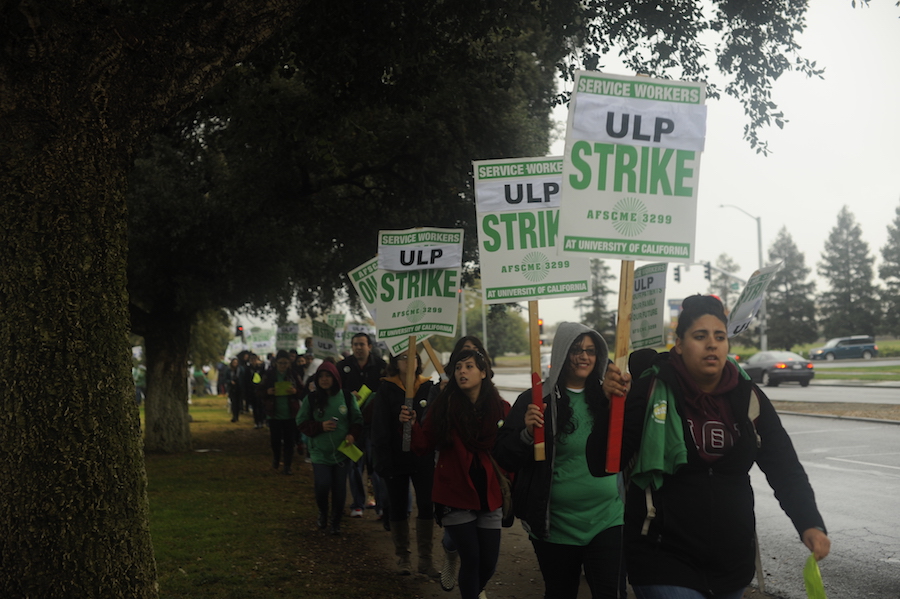
A recent review of audits conducted across UC campuses and medical centers has revealed that the UC system has shown inconsistent compliance with the Fair Wage/Fair Work Plan announced in 2015 by UC President Janet Napolitano. The plan was announced to the Board of Regents through the UC Office of the President in July of 2015 and pledged “that the minimum wage for its workers — both direct and service contract employees — will be raised to $15 an hour over the next three years.”

Part of the criteria to successfully implement this policy is mandatory audits independently performed on UC contractors employed for services exceeding $100,000. Contracts are required to contain language of the policy stated within and audits must be paid for and conducted by an independent auditor the supplier hires. Afterward, the contractor provides a certificate signed by the independent auditor to their respective campus proving their annual audit was performed.

Each UC campus’ Audit and Management Advisory Services reviewed its university’s processes, contracts and compliance with the Fair Wage/Fair Work Plan. The audits revealed that the systems in place to monitor universtiy agreements related to independent contracting were lacking. The purpose of a monitoring system is to ensure that contracts fall under the criteria relating to the Fair Wage/Fair Work Plan; however, the review showed that parts of the system were flawed. The review also found a recurring failure to conduct audits among service contractors and vendors who were plainly violating the Fair Wage/Fair Work policy with no repercussions.

“What these audits expose is [that the] UC has not been enforcing this Wage/Work plan,”  said John de los Angeles, the communications director of the American Federation of State, County and Municipal Employees (AFSCME), the largest UC employee labor union. “Contractors are skating under the radar and they themselves are not even sure which contractors need to be following this policy.”

UC Davis’ review showed that since the plan’s announcement two years ago, the campus and UC Davis Health are still trying to create effective systems to track independent contracting agreements. UC Davis is also trying to become stricter when it comes to certifying the authenticity of audits. Similar observations were recorded in audits at UC Merced, UC Santa Barbara, UC Santa Cruz, UC Irvine, UC Riverside, UC San Diego and UC Berkeley.

“If UC prides itself in being an agent for social mobility for students, they might also think to serve that same function for low wage workers,” de los Angeles said.

Claire Doan, a UC spokesperson, responded to current issues with the Fair Wage/Fair Work Plan via email.

“As with any relatively new and expansive policy, implementation and compliance can take some time,” Doan said.

Doan also said that the UC is continuing to develop the plan by training occupational leadership to enforce policy, tracking contracts to make sure guidelines were followed and updating reference documents and online content for clarification. These developments are projected to be completed by Dec. 31, 2017.


Written by: Elizabeth Mercado — campus@theaggie.org

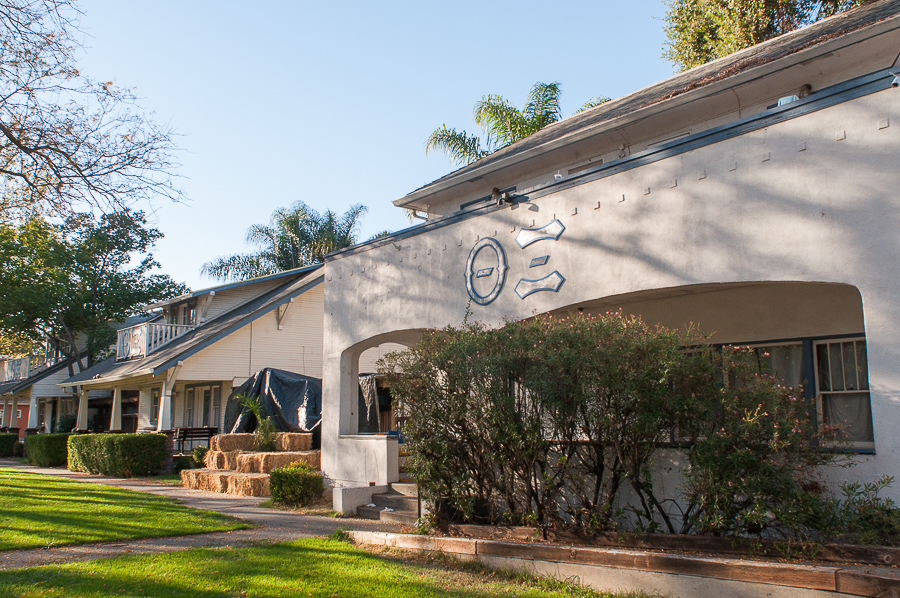
Theta Xi placed on conditional registration for two years after disturbance of peace over summer

IAN JONES / AGGIE

Probationary period for fraternity follows appeal of revocation of registration

Over the summer, the Theta Xi fraternity was cited for a disturbance of the peace complaint regarding fireworks being set off from its lawn.

Initially, Theta Xi faced revocation of its UC Davis chapter’s registration, however, the members decided to undertake a judicial and student housing appeals process. As a result of the successful appeal, there will be two years of conditional registration — essentially a probationary period.

Donald Dudley, the director of Student Judicial Affairs (SJA), spoke about how the appeals trial of Theta Xi was handled, explaining how conditional registration restricts the fraternity.

“The appeal process has been completed,” Dudley said. “The appeals committee reduced the revocation to two years of conditional registration. The conditional registration means if they violate campus policy, or local codes [and] state laws during that period, then registration would likely be revoked.”

With regard to what initially sparked the revocation, Dudley confirmed that it was based on an “incident related to disturbance of the peace conduct that raised concerns for health and safety.”

Jonathan Montes, a fourth-year psychology major and the president of Theta Xi as well as their Interfraternity Council representative, stated that the incident in question involved three individuals setting off “illegal fireworks” in the backyard of Theta Xi’s Chapter House. One of the individuals was a former member of the Theta Xi chapter. Montes said he was “disappointed at the outcome” of the appeal.

The real perpetrators of the incident involving fireworks escaped without being charged while the chapter as a whole was punished for something it had nothing to do with,” Montes said. “The appropriate action for the University would have been to dismiss the original decision in its entirety.”

Courtney O’Connor, the assistant director of policy and conduct at the Student Housing Office, confirmed another incident involving a Theta Xi president reportedly trespassing onto the fraternity house’s neighboring funeral home in the fall of 2016. O’Connor said that this event was unrelated to this conditional registration enforcement.

“From what I heard, it was that noise complaints violate university policies,” said Megan Bull, the president of the Davis Collegiate Panhellenic Association. “If they break rules, then it goes to university trials. Why it was so strict, I don’t know, because I feel like two years is a long time.”

Bull said that she heard firsthand from Theta Xi members attending Panhellenic meetings that no members were living in the house over the summer when the firework incident is said to have occurred.

“Theta Xi came into one of our meetings for Panhellenic,” Bull said. “They said that it was an alumni, that no one in Theta Xi lives in the chapter house over summer. It was an alumni that came in and caused the noise complaint. [Afterward], they were essentially getting kicked off of campus, they were on bad registration, and they appealed it. They [were able] to have a trial and go and talk to the university, explain their side of things, and the university said, ‘That’s OK, we get it, but now you’re on conditional registration for two years.’”

Montes confirmed that no current member of the fraternity living in the chapter house had “a right to enter the property during the summer.” However, three current members were living in the house.

 “The owner of the property hired [three] members of the chapter to do maintenance work at the property during the summer and those individuals lived on the property pursuant to an extension of their lease agreements,” Montes said. “However, none of those employees were present or involved in the incident.”

Besides the prohibition of Theta Xi-related misconduct for two years, the fraternity has also been barred from sorority events. Bull explained the logistics of having good standing in the eyes of the Interfraternity Council (IFC) and the university.

“One of our rules is that we can only do events with sororities or fraternities in good standing,” Bull said. “They’re not in good standing because they’re conditional — anything that isn’t good standing, technically, is in bad standing.”

In the spring of 2017, a Theta Xi member faced sexual assault allegations. Bull confirmed that the probationary ruling had nothing to do with last spring’s assault allegations. Speaking for herself, however, Bull speculated that “there could be some correlation” between the past sexual assault allegation and the severity of the response to the noise complaint.

When asked how the fraternity is being punished, Bull said that the only tangible change other than higher scrutiny is that they must follow the enforced sorority ban.

“There are no holds on them,” Bull said. “They’re allowed to have alcohol, they’re allowed to have events, they just are restricted from associating with sororities, because of our national policies.”

Additionally, Bull said Theta Xi “came into Panhellenic meetings and we gave them a list of things they need to fix if they ever want a chance to do things with sororities again.”

Specifically, the Panhellenic Society laid out a contingency plan composed of sexual assault training, bystander intervention and TIPS certification.


Written by: Aaron Liss — campus@theaggie.org

I Am Your Neighbor: A Tale of Two Cities Homeless Film Festival

BRIAN LANDRY / AGGIE

Film festival aims to humanize, destigmatize homelessness

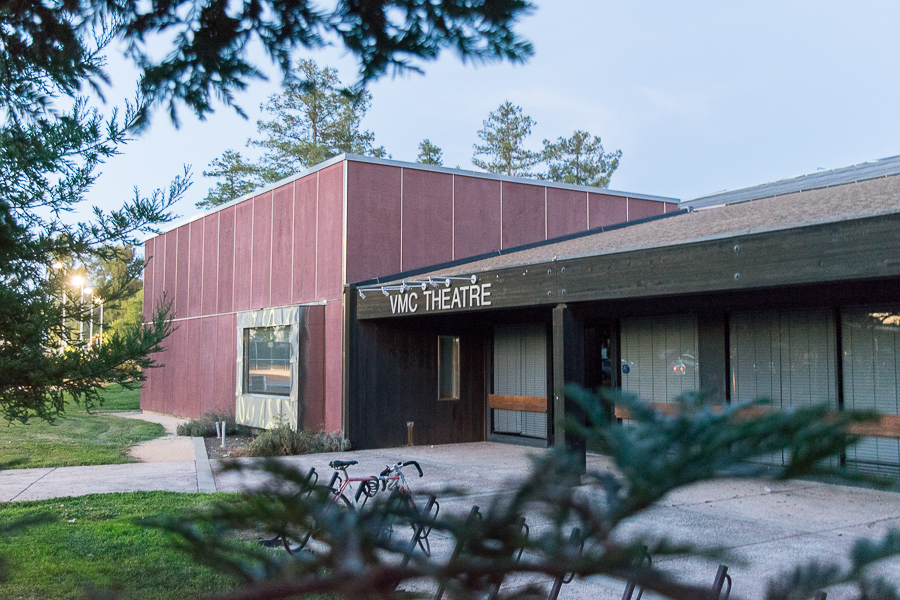
Yolo County Library, YoloArts, California Humanities and the City of Davis presented documentaries to shed light onto the problem of homelessness. The events, which screened four documentary films (two at the first event in Sacramento on Oct. 12 and the other two at the Davis Veterans Memorial Theatre on Nov. 4) focused on humanizing homelessness. Lisa Baker, the CEO of Yolo County Housing, was inspired to create the film festival for exactly that purpose.

Meredith Beales, the event’s organizer, and Baker are leaders at the Yolo County Library and Yolo County Housing. They wanted to create a film series with panel discussions pertaining to homelessness. After being awarded a grant through the California Humanities’ “Humanities for All” program, staff members began planning the event.

Two films were presented at the event: “Inocente” and “When I Came Home. “Inocente” is a film about a young student whose family is homeless, and “While I Came Home” is about a veteran who returns from combat to no home. Both films provide real, honest illustrations of homeless experiences and strives to end the stigma attached to homelessness.

“Often, in talking about homelessness, we tend to focus on short-term community impacts but not on the lives of those experiencing homelessness or on the circumstances that led them there,” Baker said. “The film series is meant to allow us to engage with the topic from a different perspective. It’s also about understanding the complexity of the issue and to experience the humanity of those who are suffering. I hope we get to experience, even if only for a moment, what it would be like to be homeless. As someone who was once homeless myself for a short while, I’m hoping we learn how to resolve these issues locally and nationally. To do that, we must have an understanding of the issue, and we must have empathy.”

Interim library administrator Chris Crist, surprised by the statistics of homelessness, anticipated change in audience viewpoints regarding the problem.  

“[We hoped to see people’s perceptions] change as they see the documentaries of people from various walks of life experiencing homelessness and the paths that led them there,” Crist said. “For example, one statistic that really stuck in my mind was that 70 percent of the people who are homeless have jobs; they just can’t make enough on minimum wage to find a place to rent — housing costs are too high. [We want] to help the community understand how it just takes one slip in circumstances (health, loss of job, accident) to shift from having housing to not being able to afford housing.”

This film series was designed to show others that being homeless does not define an individual. Being homeless means someone requires efforts beyond the short-term community impacts described by Baker. The films aimed to highlight the lives of people affected by this issue and how lives can be altered drastically with small yet impactful measures.

“At one of our planning meetings, we were discussing myths and truths about homelessness, and someone said, ‘The reason a person is homeless is because they don’t have a home,’ meaning it’s not ‘because of’ any other (often stereotypical) reason that people might say,” Beales said. “It’s as simple as that. When it’s boiled down that clearly, it’s hard to turn away from the problem.”


Written by: Becky Lee — arts@theaggie.org

Senate endorsements: consider the following

HANNAH LEE / AGGIE

The Editorial Board was most disappointed to learn that the upcoming Fall Election will be uncontested — with six candidates running for six open senatorial positions. An uncontested election discourages voter turnout, an issue with which ASUCD already struggles. This election also virtually guarantees all six candidates a spot in the Senate, representing a student body which had little to no say in their selection. Additionally, the majority of the student population at UC Davis is composed of women. It was therefore disheartening and frustrating to see only one woman in the group of six candidates.

After the Editorial Board sat down with all six candidates, we found them to be enthusiastic and professional about the job they will be elected to by default. Many of the platforms brought forth by the candidates however, were unoriginal — unsuccessful ideas we have heard copied and pasted into countless ASUCD campaigns. Several platforms contained admirable ideas, but were vague and had no clearly thought-out approaches to ensure successful achievement. Some candidates seemingly lacked a basic understanding of what an ASUCD unit is or failed to correctly name even one of the 23 units.

Nevertheless, the Editorial Board has decided to endorse three candidates running for Senate.


Andreas Godderis

Second-year economics major Andreas Godderis inspired us with his creative vision and diverse selection of concrete, feasible plans and is our top choice for Senate. One plausible and strong idea Godderis brought forth was reducing the minimum work hours for employees of the CoHo, the South CoHo and BioBrew from 15 hours a week to around eight to 10 hours. As an employee at the South CoHo, Godderis said he sees a culture of quick turnover and low retention rates because full-time students cannot keep up with a 15-hour workweek. Another simple yet effective idea Godderis spoke about was creating a sign inviting students to talk to him when he holds office hours at the CoHo in order to increase accessibility to ASUCD. Godderis’ innovative ideas and strong work ethic were apparent and we were impressed by his thorough answers and the research he had clearly undertaken for his campaign.


        We also wish to endorse Jake Sedgley and Jesse Kullar, who would be beneficial additions to the Senate table.


Jake Sedgley

Sedgley is a third-year economics and environmental policy analysis and planning double major. As a transfer student, Sedgley said he did not feel immediately comfortable on campus and talked about ways to inform transfer students about welcome events. The Editorial Board admired Sedgley’s honesty, specifically when he spoke of his own unhappiness with the uncontested nature of the election. We also liked his ideas about increased funding for the Office of Advocacy and Student Representation as well as his plan to promote the university’s achievements during the Whole Earth Festival.

Jesse Kullar

After noting a lack of STEM voices at a Senate meeting he attended, Kullar, a second-year chemical engineering major, brings a much-needed STEM perspective to a Senate that has historically lacked such representation. Kullar appears determined to fulfill the terms of his position as a representative of the student body. In office, Kullar plans to be a voice for his fellow engineering students, and we admire Kullar’s passionate spirit. Kullar is a member of the UCD Unite slate and we encourage him to take advantage of the collaborative opportunities available with more experienced members.


        Fall Elections will take place Nov. 14-17 at elections.ucdavis.edu.


Written By: The Editorial Board


Editor’s Note: An earlier version of this story incorrectly stated that Andreas Godderis is an economics and computer science double major. Godderis is only an economics major. The story has been updated to reflect these changes. 

New bioethics club brings interdisciplinary approach to scientific issues

0
CAITLYN SAMPLEY / AGGIE

Upcoming event on gene editing to connect students with professors

In this age of rapid scientific advancement, complex ethical questions continue to arise from the possible applications of new discoveries. Two fourth-year students, Alex Robertson and Ben Mallory, decided to start the Bioethics Club at UC Davis to give students a new outlet for discussing these questions.

“We wanted to have networking and to have real resources available to people, but we also wanted to have a place where people can have discussions and have [something] tangible, to leave being more informed about an issue in some way,” said Robertson, a fourth-year global disease biology major and the club’s president and founder.

On Nov. 9 at 8 p.m. in 1003 Giedt Hall, the Bioethics Club will host an event on human gene editing. The event will feature professors spanning many disciplines, including Tina Rulli of the Philosophy Department, Kyle Fink of the Neurology Department and the Stem Cell Program, Mark Yarborough, a dean’s professor of bioethics, Lisa Ikemoto, a Martin Luther King Jr. Professor of Law and Meaghan O’Keefe of the Religious Studies Department.

“At first, our idea was to have a debate, but then we realized that was against the whole concept of our club,” Robertson said. “A debate makes it two-sided. So instead, when we started developing the event, we made it into a round table discussion, more of an open forum […] with the professors.”

Robertson also emphasized that the professors are eager to talk with the students and to help them explore their interests.

“We hope that after the event is over, to have some time for people to come up and talk to both the board members if they’re interestested in getting involved, and also with the professors themselves if they’re interested in what they had to say,” Robertson said.

The event’s open format reflects the club’s goal of creating a place for rich discussions that bring many possible approaches to complex problems. The featured professors are excited about the club’s potential to bring together students from a wide variety of disciplines.

“I think a lot of people studying in STEM fields are particularly interested in the ethical dimensions of those fields,” Yarborough said. “The humanities always have a high concentration of students interested in social justice and other ethical issues. The club can provide opportunities to bring students from across all these disciplines together to explore, learn and work together.”

Mallory, the club’s treasurer and co-founder and a fourth-year biochemistry and molecular biology major, is also enthusiastic about the club’s possible opportunities for students to gain greater appreciation and understanding of opinions on bioethical issues.

“Going into a [science major], you have a set way of thinking that you develop through those classes and those courses, and with humanities and arts and other majors, it’s a completely different way of thinking [about] these topics and these issues,” Mallory said.

Addressing the many dimensions of the ethical issues that arise from new healthcare and medical technologies can be difficult, so opportunities for students to develop these thinking skills can be limited.

“I took the bioethics class with Dr. Rulli, and I noticed how I learned so much [about] different types of controversies surrounding bioethics,” said club secretary Jennifer Nguyen, a third-year neurobiology, physiology and behavior major. “What it allowed was something really discussion-based. I felt like we needed more of that since bioethics involves so many perspectives and viewpoints.”

While some students may have had the opportunity to take Rulli’s class, others may have been exposed bioethics by the cult science-fiction film “GATTACA,” which allowed the concept of systematic genetic discrimination to make a splash in popular culture upon the film’s release in 1997. Even with many people having a general appreciation of why bioethics is important, it is still a field that can be frequently overlooked.

“Ethics is an integral part of doing science that can sometimes be neglected,” said Rulli, who is also the club’s faculty advisor. “I believe that scientists and clinicians should learn to do ethics alongside and as they develop their science rather than ask the ethical questions at the end of the process.”

Bringing together professors with such diverse areas of specialization is the first of many opportunities for the club members to connect with experts in the field and to be exposed to the work they are doing related to bioethics.

“I’m part of an interdisciplinary team of UC Davis faculty who are creating a university-wide bioethics project — The UC Davis Bioethics Academy,” Ikemoto said. “We are working to foster ways of doing science across the disciplines of STEM, humanities, and the social sciences.”

Throughout the year, the club hopes to dive into other timely issues that have emerged from technological advancements, something Fink thinks is an exciting prospect.

“Stem Cells, gene therapy, patient outreach, dissemination of research in the social media world, clinical trial development [would be great future topics],” Fink said.

As the bioethics club establishes itself, there is hope that increased student interest and the growing importance of bioethical thought will help the club thrive as a place for stimulating discourse for years to come.

“All of us, students and faculty — whether in the sciences, arts, or humanities — are going to have to make decisions about the role of science in our lives,” O’Keefe said. “I’m so glad to see students leading the way.”


Written by: Benjamin Porter — features@theaggie.org

Police Logs

NICKI PADAR / AGGIE

Where are the keys?

Oct. 18

“Motion detection light on side yard just went off… reporting party thinks he heard side gate open.”

“Seven vehicles currently parked in no parking area on street from 0200 0600 hours and requested vehicles be cited.”

“Female heard shouting ‘Get out of here, leave me alone’ and reporting party hears what sounds like slamming noises.”


Oct. 19

“Elderly woman rode bike to this location and locked a bike lock to her bike and lost the key –– requested assistance with getting the bike and herself home. Advised bike is not locked to a rack or anything.”

“Male subject caught twice today sitting in backyard of residence.”


Oct. 20

“Male transient camped out in the middle of the bike tunnel. Reporting party was cycling and had to swerve to miss him.”

“Occurred past five minutes –– porta potty tipped over in driveway.”


Oct. 22

“For advice –– 17-year-old son is making charges on her credit card without her knowledge/permission.”


Oct. 24

“Heard footsteps in the side yard, also saw a light.”

Don’t let social media control your time or mental health

SHEREEN LEE / AGGIE

Polished social media posts can fuel feelings of inadequacy and loneliness

We constantly walk around campus with our eyes glued to our smartphones. Some people like taking notes on their computers, which provides easy internet access in class. The blood of social media sites runs through our devices. We’re always scoping out what’s new on Instagram, Facebook and any number of other social media platforms. We’re much more interested in other people’s lives than our own. Instead of focusing on ourselves, we spend our time following everyone else’s daily lives. Allowing our attention to be focused on others takes away from the attention we should be giving ourselves.
The amount of time spent on social media can play a role in damaging our mental health. Users log in to view what’s happening in the lives of the people they follow. It’s human nature to see someone’s status and compare their life to our own. There are several reasons why this is a bad habit to pick up. Users choose what they put on their own social media profiles, and what they choose to show is not their whole personal story. The majority of what they choose to post will, of course, display positivity and make it seem like their lives are perfect. However, there is more to someone than what’s on their Facebook timeline. Users need to remember to not think of one person as better than themselves. Social media is basically a cover page, and users shouldn’t assume that what a person decides to share publicly — often a polished version of themselves — is an accurate depiction of their life. There’s more to the people on the other side of the screen.

An article in Time discussed a recent survey of almost 1,500 teenagers and young adults who were asked to score how the social media platforms they use impact wellbeing-related issues. Some of these issues included anxiety, depression, body image and the fear of missing out. Instagram was ranked at the bottom of the five most popular social media sites for having the most negative effects on a person’s mental health.

“Social media posts can also set unrealistic expectations and create feelings of inadequacy and low self-esteem,” Amanda MacMillan reported in the article.

Instagram is a platform strictly for posting pictures that users wish to share with their followers. A majority of these posts are “selfies,” and with the number of filters and edits that can be applied, it’s easy for someone to manipulate their self-image to “perfection.” Scrolling through pictures of people who appear put together can lead users to jump right into forming comparisons. Being solely a feed of photos, Instagram provides the most space for people to display their most attractive features and appealing adventures. These refined images can affect anyone who opens their social media apps and can consequently lower self-esteem.

Matters are made worse when the viewer sees the amount of attention and “likes” the post receives. Jealousy can also result when friends on social media appear more popular and attractive, which can trigger feelings of loneliness. On Instagram, users pay particular attention to the appearance of their profiles — aiming to include only eye-catching, high-quality photos.

Because social media platforms often exclusively display the good side of life, users shouldn’t allow what people post to impact their emotional wellbeing. Reconditioning ourselves to avoid getting intensely drawn into status updates and profiles pictures will allow us to maintain our mental health. Social media does not reveal everything about a person, so the content that’s shared shouldn’t make people think less about who they are and what they do possess.


Written by: Jolena Pacheco — mspacheco@ucdavis.edu

Disclaimer: The views and opinions expressed by individual columnists belong to the columnists alone and do not necessarily indicate the views and opinions held by The California Aggie.

Timely Warning issued for hate incident involving anti-Islamic, anti-fraternity/sorority fliers

UC Davis Police Department found no threat present

On Oct. 12, the UC Davis Police Department issued a Campus Timely Warning marked as a “Hate Incident.” The incident that was reported concerned anti-Islamic and anti-fraternity/sorority fliers found in bicycle baskets and seats near the International Center. The police soon discovered these fliers had been posted around town and on campus, near the Chipotle in downtown Davis, the ARC and Mrak Hall.

Sergeant Danny Sheffield wrote the Timely Warning and was part of the investigation. Sheffield maintained that the fliers did not target the International Center.

The police found a link to a YouTube video on the fliers — a 20-minute video of “the same rhetoric that was expressed in the fliers,” Sheffield said.

”It was Christian-based rhetoric and it was verbiage that indicated the distaste [and] dislike for Jesuits, sororities, freemasons [and] the Islamic religion,” Sheffield said. “[They] are taking false oaths and that’s against God’s word — that sort of rhetoric.”

Sheffield said that after the investigation of reviewing the fliers and the linked video, there was no specific threat. He said it was “religiously motivated.”

“It was all pretty general stuff, there was no specific threats or anything like that,” Sheffield said. “It really was just expressing distaste and displeasure toward those groups.”

Sheffield said that the pictures of the fliers will not be available to the public. He defended the legality of the fliers on the basis of free speech, reaffirming the Supreme Court’s position that hate speech has no legal grounds for punishment.

“When we have incidents like this, we generally don’t put that specific information out to the public,” Sheffield said. “Basically, it amounted to free speech, albeit free speech that was offensive or that someone didn’t like — we don’t want to cause undue targeting or repercussions to the person who may have provided that information.”

The Timely Warning was labeled as a “Hate Incident”; however, Sheffield stated that the fliers were “not harmful and not attempting to incite violence.”

  “It was documented because it was reported to us and some people took offense,” Sheffield said. “But it really amounted to free speech, because it didn’t direct any hateful language. There [were] no slurs or epithets that were used toward any group.”

Sheffield said he thought it was nothing more than a “benign” group and that “it sounds like a religious group was leafleting.”

On behalf of the International Center, Vice Provost and Associate Chancellor of Global Affairs Joanna Regulska responded to the fliers with concern.

“Across Global Affairs and at the International Center, we are committed to the UC Davis Principles of Community, which reflects the ideals we seek to uphold in creating an inclusive and vibrant community — and describes the principles we are pleased to see here most often,” Regulska said via email. “We do not support intolerance of any kind, including on fliers. Instead, [we] encourage discussion among our diverse UC Davis community, one that we are proud is comprised of individuals having many perspectives, and coming from a variety of backgrounds.”

The Islamic Center of Davis also responded, taking a stance against “hate and intolerance.”

“Our action in light of incidents like this is to educate people about us and about tolerance,” the Islamic Center wrote via email.


Written by: Aaron Liss — campus@theaggie.org


Sick Spits: UC Davis’ spoken word collective

SICK SPITS / COURTESY

Davis student poets provide community, safe space

Community and accessibility are not qualities often associated with poetry. Most of the time it is feelings of alienation derived from frustration, confusion and an unavoidable aura of elusiveness. This attachment of exclusivity to the medium is hard to detach because it requires a willingness and commitment to view it in another light, a personal investment in something that may just further alienate you in the end. However, Sick Spits, a poetry collective at UC Davis, can make this jump from estrangement to a form of expression you can actually appreciate easy and worthwhile.

For Matt Fyhrie, a fourth-year materials science and engineering major and “honorary member” of Sick Spits, the community was immediately welcoming. His first open mic night involved a debut poem about marmots casually getting it on 10,000 feet up in the Rocky Mountains as they enjoyed the beautiful scenery. This story well exemplifies the welcoming, relaxed community feel of Sick Spits and the ease with which they make poetry come alive.

Reyna Adams, the president of Sick Spits and a fourth-year English and psychology double major, describes Sick Spits as having five core crew numbers, but notes that this can fluctuate. The core members are tasked with keeping the collective afloat by sharing roles such as secretary and treasurer. The group plans events such as laidback open mics which held every first and third Wednesday of the month from 7 to 9 p.m. They also host workshops, quarterly slams and collaborations.

Fyhrie commented on how slams are a little different than the casual setups Sick Spits usually hosts.

“Most of the open mic nights are not competitive, it is just people coming, healing, and sharing their space,” Fyhrie said. “But once a quarter everyone comes and […] brings their best, and there is a competition at the end of the night. […] You get to see how much talent is in the people you know and who are around you, it is mind blowing.”

Slams are held once every quarter, but throughout the rest of the school year, the community primarily bonds through open mics.

“What happens here stays here because we want it to feel safe […] we are not going to go around sharing your stories or name with other people,” Adams said.

This standard translates into being a “safer space” as Adams coined it.

“We don’t want anyone to feel like they are not welcome, that they are not surrounded by people who are willing to support them,” Adams said. “When it comes to wanting to share your love and your truth and your story we welcome that. We ask if anyone comes to an open mic night and feels threatened that they talk to us about it with our community members […].”

Creating a safer space allows performers to be vulnerable on stage through a variety of art forms, such as improv comedy, standup comedy and even interpretive dance. The freedom that comes with this platform often results in a clash between the safety and acceptance that core members seek to uphold and the first amendment right to free speech.

“The voices that are not usually heard are the underrepresented ones, the queer ones, people of color,” Fyhrie said. “Sick Spits and those voices are so easily drowned out by narratives of hate and violence. Sick Spits is a place for you to share whatever you want but we are trying to make it for voices that are not usually heard.”

Participating in an open mic night includes agreeing to be respectful and welcoming in the space.

“But when you are coming into a space like Sick Spits, you are entering a social contract,” Adams said. “When you come to this space and you want to use our equipment and time […] you are implicitly agreeing to our guidelines.”

When considering the unique perspectives and life situations of performers, intolerance of hate is essential for them to be confident and spill magic off the stage.

“I write really well after heartbreak,” said Anika Agrawal, a third-year environmental toxicology major. “I write a lot about what is going on around me in the world — the environment, being a woman of color, being bisexual […] I wrote about body issues once and I hadn’t had the opportunity to talk about that before but it was a good space to do it because I could talk about it and get it out of the way — but no one has to ask me about it later.”

Yet the pressure is also off on making sure you arrive at a substantial social commentary, truth or existential revelation in your work. Every syllable uttered from your lips is valid and supported. The community is there for its members no matter what.

This is especially important in making sure everyone, from all backgrounds, humanities to STEM, are encouraged to release their thoughts.

“All the happiest and most engaged and smiling enthusiastic engineers in my program are the ones who do something else on the side,” Fyhrie said. “All these people in science have these untapped feelings that they don’t know how to get out […] Everyone wants the ability to say ‘I feel bad, I have these concerns, listen to me.’”

In showcasing student perspectives, Sick Spits fulfills a niche and creates a mutually beneficial experience. Students can enjoy artfully delivered stories of their peers’ lives and can therapeutically let go of some of their own insights. The collective welcomes everyone with open arms who desires an outlet for creativity or simply wants to be an audience member.

Although this tends not to be the case, Adams details how people often change their minds about passive enjoyment and choose to actively participate instead.

“We always start off our open mic nights with a half full roster, but by the end more and more people want to perform,” Adams said. “People get inspired by poets. I have seen people shake the whole time and thank us later for providing that space.”

But if stage fright still has you worried, Fyhrie has some advice.

“I think [you can be] nervous to perform something very vulnerable about yourself, but the more you get the wind knocked out of you and the more you perform, the best way to not be nervous about it is to just jump right into cold water,” Fyhrie said.

The beauty of poetry and spoken word lies in how deeply personal it is, while simultaneously tying people together. It also sprouts from the simplicity of everyday life, allowing for everyday thoughts to take on a breath of life.

Sick Spits takes those elements of connection and accessibility and runs with them. Doing so provides a platform by which you can express yourself, as well as a community of caring, warm people to share it with.

“No plant would grow without nitrogen fixing bacteria,” Fyhrie said. “I’d like to think about ourselves [Sick Spits] as beneficial bacteria. Small but crucial work.”

Keep up with Sick Spits on its Facebook page for event information.


Written by: Caroline Rutten and Cecilia Morales — arts@theaggie.org


Editor’s Note: An earlier version of this story did not identify Anika Agrawal.

Last Week in Senate

HANNAH LEE / AGGIE

Interim senator confirmation interrupted by member of public

On Thursday, Oct. 19, the ASUCD Senate gathered at the Memorial Union for its weekly meeting.

Director of Athletics Kevin Blue gave a presentation to the Senate about Intercollegiate Athletics, which has partnered with ASUCD in several capacities. Blue said UC Davis Athletics upholds the university’s Principles of Community — for example, training on sexual assault and violence is now mandated and speakers have given presentations on implicit bias.

Vice President Adilla Jamaludin asked Blue about his plans for decreasing Athletics’ reliance on student fees; Blue said he does not have a specific plan.

Next, third-year political science major Kevin Butt was presented as a candidate for an open interim senator position. President Josh Dalavai, who conducted interviews for the position, said Butt was a “phenomenal candidate.” Butt previously held the positions of senator and student body president at his community college. In response to questions from senators, Butt said he wants to make changes to the ASUCD bylaws and work with the Bike Barn.

A motion was made to approve Butt as an interim senator, but a member of the public interrupted the vote. The member of the public, later revealed to be Jesse Foster, a former colleague of Butt’s on the ASUCD Student Senate for Community College and a current fourth-year biological systems engineering major, stepped out of the office with Senator Jose Meneses to discuss his concerns with the approval of Butt.

Senator Meneses returned to the meeting with additional questions, specifically regarding Butt’s decision in the past to write in the candidate “Rosa Hitler Trump” as a political statement on an election ballot. The senators unanimously voted to hear direct testimony from Foster.

According to Foster, Butt wrote in “Rosa Hitler Trump” in July because he was displeased with the candidates for the executive board of the Student Senate for Community College. Foster said Butt deleted posts from colleagues in a Facebook group and “tried to hide the information over and over again.” Foster maintained he had proof with him to back up his claims.

At this point, the Senate decided to re-evaluate the situation later in the meeting.

In the meantime, Jeff Flynn, the new director of Unitrans, announced that Unitrans will be launching a new website this month. In addition, Unitrans will be celebrating its 50th birthday. When asked whether Unitrans will provide increased accessibility for people with disabilities, Flynn replied that drivers are trained to accommodate those with disabilities.

After Flynn’s presentation, a motion was made and seconded to move into Internal Affairs Commision confirmations. Each candidate discussed why they applied for the commission and answered questions posed by the table.

In light of the upcoming Senate elections, the meeting then moved into elections updates. Naeema Kaleem, the elections committee chair, announced that applications for election committee vacancies were accepted until Oct. 23. To promote the election, the library and Student Community Center have been supportive in changing all the IT computers’ backgrounds and homepages to say “elections,” and the library has agreed to host tabling events. Entertainment Council will take part in election promotions, and Kaleem also contacted Canvas to display an elections banner.

After the elections update, the Senate resumed discussion of Butt and the interim senator position. Butt expressed that if he could go back he would not have done what he had done, but he insisted that he stood by his principle that nobody should be forced to vote. Several senators expressed their discontent over Butt’s emphasis on the defense of his actions instead of immediately apologizing.

After some questioning, a motion was made to vote on whether the committee should re-evaluate the nomination for the interim senator candidate. The motion to re-evaluate was confirmed.

Next, the meeting moved to confirm Ethnic and Cultural Affairs Commission candidates. The candidates discussed their ideas and backgrounds and answered questions posed by the table. Both candidates were confirmed.

Next, there was a presentation from The Green Initiative Fund. TGIF is a “student-led fee referendum” that passed in the winter of 2016. $200,000 is now available for grants to support undergraduate students to construct and conduct projects and research regarding sustainability. A representative from TGIF said that the fund is in the process of conducting outreach to promote the grants and opportunities available.

The unit director for Housing Advising for Undergraduate Students was confirmed. The meeting took a 10 minute break and resumed at 9:19 p.m.

Dalavai then nominated Becca Nelson, the gender and sexuality commission chair, and Julienne Correa, the ethnic and cultural affairs commission chair, to be on the Volunteer Award Committee. Nelson accepted the nomination.

New legislation was then discussed — legislation included a resolution taking a stance against the rehiring of former Chancellor Linda Katehi as a faculty member and a bill to dissolve the Undergraduate International Committee.

Dalavai gave a public announcement and said the third floor of the MU is set to be renovated, with construction starting as soon as the summer of 2018. KDVS is also set to be moved to a new, permanent location.

After ex-officio reports were given, the meeting adjourned at 10:18 p.m.


Written by: Clara Zhao and Hannah Holzer — campus@theaggie.org

Davis faces housing crisis

JEREMY DANG / AGGIE

University and city focus on solving housing shortage

UC Davis’ enrollment numbers have steadily increased, as the university opened its doors to 1,100 more students in the 2016-17 academic year. That number is likely to increase in the 2017-18 academic year. This large influx of new students, combined with an increase of residents seeking to make Davis their home, has led to a housing shortage in the city, making it difficult for prospective residents to make the move to Davis.

“When we’re talking about the city of Davis, it includes both the city in terms of long-term residents, but also students,” said Mayor Pro Tempore Brett Lee. “There’s definitely a shortage of rental units available for both students and retirees and also full time workers […] The university has a role to play in adding some more capacity on campus, but the city also has a role to play in making sure that, when apartment complexes are built, that they serve the needs of students, working people and retirees […] There’s a variety of people who want to live in Davis.”

There are thousands of people who commute to Davis every day to study or even work at the university or in the city. Higher housing prices and a lack of available rental housing have forced them to make the daily trip from Sacramento, Woodland or other neighboring cities.

“The biggest problem is that there’s a 0.2 percent [rental] vacancy rate in Davis, which means that at any one point in time, there are less than 40 available and vacant rental locations, [putting] renters at a severe disadvantage,” said David Greenwald, the founder of The Davis Vanguard and a longtime Davis resident. “Any time there’s a problem with the landlord […] people can’t move out reasonably. There’s not enough supply, and the university continues to grow. The problem isn’t limited to Davis, but it’s worse in Davis. There’s not much housing I would consider affordable for the average person.”

Greenwald and The Vanguard have hosted several affordable housing workshops to educate the community and increase awareness of the issue. The city and The Vanguard have both called on the university to increase its housing capacity. Under the plan proposed by The Vanguard, the university would have to build enough housing for all new students and half of the overall student population. The university has agreed to house 90 percent of new students and 40 percent of the total student population, placing the burden of housing these remaining 10 and 60 percents on the students themselves and the city.

“We understand that economists and urban planners consider a vacancy rate of 5 percent to be the ideal balance between the interests of the landlord and tenant,” said Emily Galindo, the executive director of Student Housing and Dining Services, in an email interview. “Based on that, the low rental vacancy rate has its greatest impact on our students. In addition to our recent projects, we have plans for new residence halls in the Cuarto area and new apartments at the Orchard Park site and in West Village.”

At 0.2 percent, Davis’s rental vacancy rate is 25 times lower than the healthy 5 percent that Galindo recommends. The university has continued work on a Long Range Development Plan to create more housing for students. The city has approved a plan for Sterling Apartments and is looking into a project called “Lincoln 40” on Olive Drive as well as a proposal for Nishi Apartments in a field on Olive Drive and Richards Boulevard. The City Council, The Vanguard, ASUCD and the university have all focused their efforts on creating more housing opportunities for students and other potential residents alike.


Written by: Ahash Francis — city@theaggie.org


Upcoming Movies for November

NICKI PADAR / AGGIE

Diverse movies for all

This November, there are a lot of highly anticipated movies being released in theaters — a variety of movies to choose from that will help distract you from the hell that is the middle of the quarter. (Disclosure: Ticket prices at Regal theaters are $5 on Tuesdays.)

Don’t forget: critically acclaimed fan-favorite Netflix series Stranger Things had Season 2 released on Oct. 27.


Nov. 3

Thor: Ragnarok — This is the third movie in the Thor franchise. For those who want some action, this is for you. There are expected to be a lot of hidden surprises and cameos from other Avengers films.

A Bad Moms Christmas — This hilarious and raunchy movie is great for a girls night out. The first movie was unexpectedly funny, and this one will likely improve. The characters’ moms join the cast for this sequel, which will only lead to even more memorable scenes than the first.

Lady Bird — Greta Gerwig’s directorial debut is a hit. This indie movie will satisfy your appetite if you are looking for something different. Saoirse Ronan plays a teenage girl who is rebellious and deeply opinionated while attending a Catholic high school. She faces the same stress as many high school students, making this film relatable to most.


Nov. 10

Murder on the Orient Express — This film has a stellar cast, which includes Kenneth Branagh, Johnny Depp, Daisy Ridley, Michelle Pfeiffer and many others. The plot is a race for time as the characters attempt to identify the murderer among them. The film is an adaptation of Agatha Christie’s novel of the same name.


Nov. 17

Wonder — Get ready to cry. The power of kindness is the key to this movie. Starring Owen Wilson and Julia Roberts, this movie is about a young boy who has a disfigured face and has difficulty making friends in his first year of school.


Nov. 24

Call Me by Your Name — This movie takes place in the French countryside, involving a high school boy who starts a relationship with an older man who is staying with his family for the summer. This is a movie about self-realization and showcases struggles faced by the gay community.


Written By: CaraJoy Kleinrock — arts@theaggie.org

Humor: English major plans to use degree… as a coaster for her La Croix

MARINAN OLNEY / AGGIE

Guess it wasn’t a major waste after all

It’s a great feeling when you earn a degree that you know will be useful in the future, no matter what career path you choose.
That’s exactly how Rosie Shortz felt when she earned her degree in English from UC Davis this past spring.

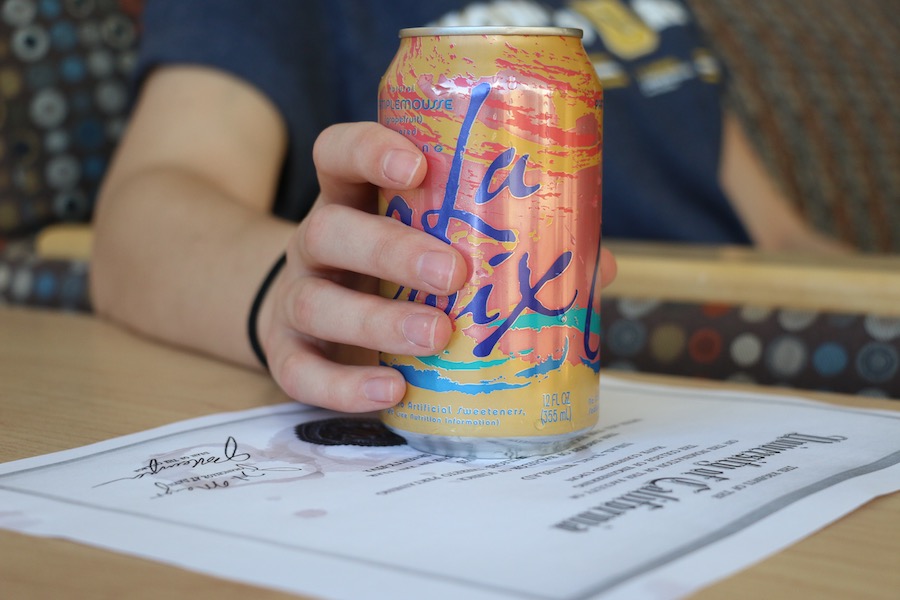
Shortz, a longtime La Croix addict, aptly chose to use her degree as a coaster for her favorite drink.

“I’m so excited that I’m finally reaping the benefits of my degree,” Shortz said. “The worst thing in the world is when you want to drink an ice cold La Croix with your friends, but you look like a fool when you’re caught without a coaster. I’m really glad I’m finally taking control of the situation and my life in general.”

When asked about other ways Shortz has managed to use her English degree, she avoided the question, nervously sipping her La Croix and avoiding eye contact.

Though Shortz was incredibly quiet about her job prospects, The California Aggie feels she was merely taking Kendrick Lamar’s advice and being humble. An admirable move.

After an uncomfortably long period of time, Shortz revealed that she has, in fact, taken up competitive La Croix drinking as a full-time job.

We’re not really sure what this means, but we support her and are sure it takes a lot of skills that she definitely learned from her English degree.

It just goes to show that paying exorbitant amounts of money to go to school isn’t at all a waste, and with enough naivety and La Croix, anything is possible!


Written by: Lara Loptman — lrloptman@ucdavis.edu

(This article is humor and/or satire, and its content is purely fictional. The story and the names of “sources” are fictionalized.)

Off-campus living or barely living?

0
JAMIE CHEN / AGGIE

Tips for transitioning to an off-campus student life

Every time you look toward your sink full of dirty dishes, do you ever wonder if it’s even worth it to cook? Do you miss the Dining Commons and regret every time you complained about it freshman year? Well then, you are experiencing that all-too-relatable transition from dorm life to apartment life, and suddenly dorm life seems like a utopia you didn’t appreciate enough. Here are some tips for a slightly smoother transition:

  1. Do the dishes immediately

Don’t let them pile up! Especially in a house of 5 to 6 people, dishes pile up so fast, you can’t possibly recall what you ate in all those plates. Doing the dishes right after cooking or at least completing your meal avoids a dirty sink, angry housemates and flies.

  1. Make a cleaning schedule

This one is not just to write on a white board and leave on the fridge like a showpiece. It’s meant to actually be followed. Make a pie chart of chores divided into equal parts for each of your roommates and rotate jobs each week this way. Have a weekly deadline of when it needs to get done so that everyone stays on task. This breaks down apartment maintenance and makes it feel a lot more manageable.

  1. Transportation

This is a big one. Especially for those who aren’t a bike ride away from campus, getting to and from class is a daily hassle. Unitrans is still a mystery to many. The eastbound and westbound directions can leave people crossing their fingers and hoping that both they and the bus end up at the station at the same. Checking the bus schedule in advance and spending some time to research different stops and lines can save a lot of time and stress when you’re on the go.

  1. More on Transportation (And a word on TAPS)

Campus transportation is no joke. For this reason, it needed a sequel bullet point. For those that are driving to campus, beware of a $50 penalty you may have to pay in addition to an expensive parking permit if you are not careful about the lot you park in. Always double-check if C permits are allowed in that lot, and sometimes within the one lot is subdivided between A and C permits. TAPS is very efficient at what they do, so don’t leave it to your lucky stars. Do your homework. There is also an interactive map of campus parking online that you may want to utilize when planning what structure to park in and how to get there.

  1. Meal Prep

Cooking in between classes or after a long day on campus can be tiring and stressful. To avoid last minute meal making, try to cook ahead of time. A lot of people keep their vegetables chopped and a meal or two made on Sunday evening to help the week run smoother. Packing a meal for lunch on campus the night before can also help save some money and time during the morning crunch.

  1. Have some fun

Really though, have fun! Apartment life may come with upgraded responsibilities, but it also comes with some upgraded comforts. You can now come back to a real home and not a little box that you were dumped in with two others to share during freshman year. You can make your own food the way you like it, save money on dorms and meal plans and get to know your new housemates better. Cooking a Saturday meal together can bond the whole house — after all, the stomach is the way to the heart!

Written By: Sahiti Vemula — features@theaggie.org