59.1 F
Davis

Davis, California

Wednesday, December 24, 2025
Home Blog Page 687

UC Davis women’s field hockey closes out regular season with home victory

0
ZHEN LU / AGGIE
ZHEN LU / AGGIE

Aggies end Senior Day with 2-0 win over Cal Golden Bears

Before taking the field for one last time, the UC Davis women’s field hockey team entered last Friday’s game with a chip on their shoulder and a message to send. The team would not leave quietly.

Whether it was the added pressure of Senior Day or the looming threat of rain, the Aggies took the field against the Cal Golden Bears on Oct. 28, and imposed their will; taking control of the game’s tempo for nearly 70 minutes en route to their 2-0 victory over the visiting team.

“The whole team has worked hard, and it’s always nice to go out on a winning note,” said head coach Chrissy Kilroe.

Before the game, the team honored all of its departing seniors alongside their loved ones as they took the field before their final home game: goalie Beth Lee, backs Eden Borsack and Lauren Copeland and forwards Courtney Hessler, Kat Jackson, Agustina Singh and Kayla Wigney.

“I’m really proud of them,” Kilroe said. “It’s not easy to have a new coach [senior year] playing different systems, but they have 100 percent bought in.”

Not everything came easy for the field hockey team this season, which ended regular season play with a 5-12 record overall. Despite the hardships that plagued the season, Kilroe believes the year was still a success.
ZHEN LU / AGGIE
ZHEN LU / AGGIE

“It was inspiring to see how hard they worked, and how on board they were,” Kilroe said.

Despite the preseason festivities and the looming threat of rain, there was still a game to to be played. The team showed up on the back of Wigney, who came into the game having scored just one goal on the season. By the end of the first half, however, she had increased that total to three.

“It was really nice to have everything come together and play for 70 minutes and finally get this result,” Wigney said. “I think there was a lot of emotion that went into this game and also a lot of intelligence; and in the end, the emotion and the intelligence paid off.”

While the ball stayed on the offensive side of the field for a majority of the game, especially in the first half, the victory would not have been possible without the stellar goalkeeping of Lee, who helped keep Cal scoreless, including one brief stretch near the end of the first half when she withstood a flurry of kicks from the opposing team. Lee finished the game with six saves.

“I think we really build our composure off of each other,” Lee said. “[…] My defensive unit really helped our composure during that situation.”

Both Lee and Wigney took time to reflect after the game, sharing what they will miss most about playing with their Aggie teammates.

“It’s been a great journey: four years,” Lee said. “It’s been long, but it’s also been so memorable and so rewarding.”

Wigney’s takeaway came in the form of her teammates, even crediting them for her great night.

“Not many other people in the world will have the opportunity to have the bond, that type of chemistry at this level,” Wigney said. “Just being able to be good friends and being able to play well together is enjoyable.

Kilroe hopes that the graduating seniors recognize their personal growth when reflecting on their time as Aggie athletes.

“I know 100 percent that they have [grown as players] — but I also hope that they have grown as young women and take their leadership skills that they have gained here at UC Davis to become strong, powerful women within their community,” Kilroe said.

While the regular season is over, there is still more field hockey to be played. The UC Davis field hockey team will travel to Stockton to face Albany at 2:30 p.m. on Thursday, Nov. 3 for the America East Championship tournament.

Written by: Bradley Geiser — sports@theaggie.org
Paleobiologists uncover earth’s history, reach new depths

SANDRA CARLSON / COURTESY

Department of Earth and Planetary Sciences’ vast array of research extends from ocean depths to other planets

For many, the first thought that comes to mind when hearing the word “paleontology” is dinosaur bones. But what about paleobiology? The Department of Earth and Planetary Sciences at UC Davis houses world-class paleobiologists researching marine organisms like photosynthetic bacteria and brachiopods, vertebrae fossils and even microorganisms that may have once lived on Mars.

Paleobiology is the study of early life and the history of Earth that utilizes tools from geology, paleontology and biology alike. Understanding biological and environmental history is key to studying fossils because it may explain why a certain organism went extinct.

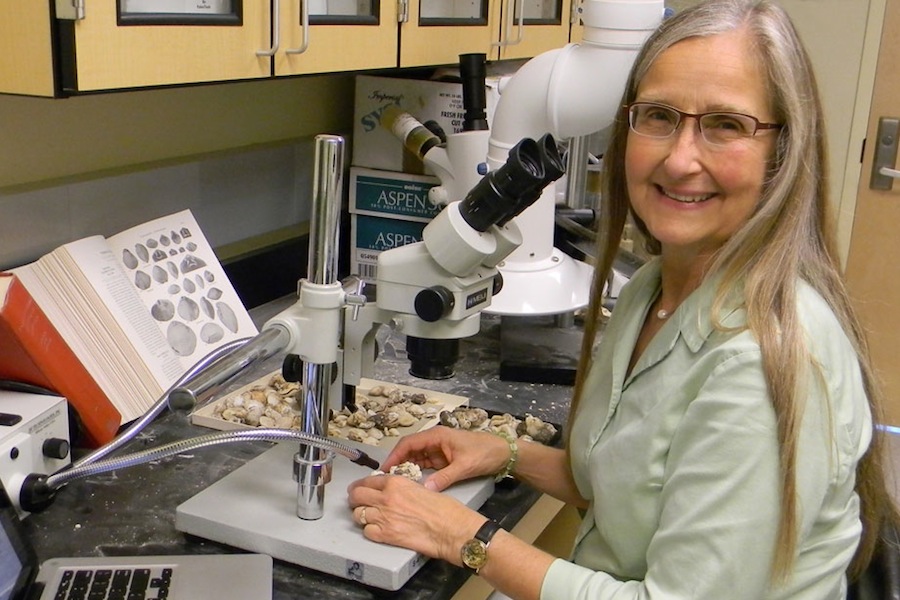
Sandra J. Carlson, professor of the Department of Earth and Planetary Sciences and UC Davis faculty member of 30 years, is one of the few paleobiologists that studies brachiopods. Brachiopods are marine organisms that have a similar appearance to clams, and tend to live in deep, cold water near the equator or poles.

“Brachiopods today are living, but 95 percent of them are extinct […] I look at how the living brachiopods can give us information of the past,” Carlson said.

Much of the brachiopod research investigates how these previously abundant organisms changed in morphology, or physical appearance, as well as what factors contributed to their extinction.

“We don’t eat [brachiopods], nor are they diverse, but it is important to study them because they give us information on atmospheric and ocean health,” Carlson said.

Carlson has published groundbreaking research on the evolution of brachiopods, and received the 2016 Encourage Award by the Association for Women Geoscientists (AWG).

Serving as the president of the Paleontology Society (PS) from 2012 to 2014, and later returning as a council member, Carlson has strengthened the partnership between the PS and AWG to encourage women in the field of paleontology and support paleobiology students throughout their academic careers.

Carlson’s hard work also includes creating scholarship awards for undergraduate, graduate and masters students, as well as early-career researchers. In addition, Carlson helped to double the value of each scholarship.

The number of applications for these scholarships increases every year, and they have supported a number of determined young women pursuing paleontology.

Another researcher in the Department of Earth and Planetary Sciences is professor Ryosuke Motani, whose focus is studying vertebrate organisms, specifically Mesozoic marine reptiles.

“We are trying to figure out how the evolution of vertebrate animals in the past were driven or restricted based on certain factors, like the type of environment during that time,” Motani said.

Previous field work has taken Motani to China, where he excavated fossils from the marine Triassic of South and Southwest China. His current research involves studying the physics-based functional morphology driving the evolution of animal shapes during the worst mass extinction 251 million years ago.

Another focus of paleobiology research involves understanding the origin of oxygenic photosynthesis on Earth. Dawn Sumner, professor of Earth and Planetary Sciences, collaborates with the University of Canterbury, New Zealand, the Natural History Museum of London and the Massachusetts Institute of Technology to discover new characteristics of photosynthetic bacteria.

“Right now I am working with bacteria that grow in lakes in Antarctica that are photosynthetic during the summer but not during the long, dark winters,” Sumner said.

Sumner and her team analyze the evolutionary relationships between these bacteria and similar organisms in order to explain how oxygenic photosynthesis evolved. Such research can benefit climatologists and geologists, since the appearance of oxygen in the Earth’s atmosphere has drastically affected Earth’s ocean acidity, atmosphere and potential for life over time.

Sumner’s experience with understanding early life on Earth made her an excellent candidate for a NASA committee seeking evidence of life on Mars.

“[We had to ask] how do you look for life on another planet when it might not exist? How do you make that search useful scientifically even if life never existed on Mars?” Sumner said.

The committee sent the Curiosity Rover to a location on Mars where there may once have been liquid water. The goal was to analyze the sediments there and see if the environment could have harbored life similar to life on Earth.

“We have found evidence [of] ancient lakes and rivers that were once capable of supporting life similar to some bacteria on Earth,” Sumner said. “We do not have any evidence that life was actually present; we have not found any fossils.”

Exploring Mars with a robot gave scientists ground images that couldn’t have been seen before. Although the robot has limitations when it comes to data collection, the results are highly valuable.

“Results also show that the surface of Earth and Mars were likely similar when both planets were young, 4.6 to 3 billion years ago,” Sumner said.

Mars is very different than Earth and is extremely cold, so it is unlikely that life could persist, at least near the surface.

Many labs on campus offer undergraduate students opportunities to pursue research in paleobiology. The Department of Earth and Planetary Sciences website lists professors and research groups currently working on projects.

“[Paleobiology is] something you can pursue for the rest of your life if you are really interested,” Motani said.

Written by: Shivani Kamal — science@theaggie.org

Election day coverage with the Daily Show Correspondents

COMEDY CENTRAL / COURTESY

Hasan Minhaj, Roy Wood Jr. discuss upcoming election

What better way to watch the news than with a bit of comedy? The Daily Show uses satire to criticize current affairs, making it a unique “alternative” to watching the news. Of course, while The Daily Show shouldn’t substitute your average news channel, it does offer different perspectives to these stories.

With the presidential elections rapidly approaching, the show is bound to have a plethora of political news to share. The California Aggie recently had a chance to join in on a special college conference call with Daily Show correspondents Hasan Minhaj and Roy Wood Jr. about the upcoming election.

The Daily Show frequently discusses mainstream social issues regarding racism and sexism in America, and Minhaj and Wood have an understanding of the magnitude of these problems going on today, especially in light of recent events from the presidential debates.

“I feel like I have the responsibility to make sure I’m doing my job well. I have a wonderful opportunity on this platform to tell stories that I feel like should be told about my race or things that are important to me,” Wood said.

However, as with any comedy show, mixing jokes with politics can evoke very mixed audience reactions.

“If someone’s offended by anything I do at The Daily Show, that’s just what it is. You’re talking about issues that matter to people, and issues have a lot of different perspectives and opinions, so there’s always going to be someone who disagrees with you,” Wood said. “You just go on the Facebook comments on The Daily Show fan page and see tons of disagreeing every single day on videos that have 30 million views — 30 million people thought this was funny but there are 12 comments in there of somebody who said it’s ‘too this and that.’”

Minhaj also noted that it is important for comedians to recognize institutional power when deciding who to direct their comedy at.

“You can make fun of of institutions and power structures that can take it. These people who hold power over other people, they can take it. So you can punch up at that. I try not to punch down at women, children, minorities — people who are already disenfranchised,” Minhaj said.

The Daily Show is funny, but what makes it engaging and relevant is the fact that it condenses news stories for its audience, because let’s be honest — the news can often be confusing. And not only can it be complicated, but the recent havoc of the upcoming election is causing people to develop “election fatigue.”

If there’s one show to keep audiences on their toes and provide a break from feelings of desperation regarding the election, it’s probably going to be The Daily Show.

“We’re basically comedic sympathizers. We take just really, really complicated esoteric information, and in seven and a half minute acts, we’re able to break it down, pepper in really funny stuff and I think that’s why people like it. To give the college analogy, we’re like funny history professors essentially,” Minhaj said. “You can tune into the Daily Show and we could sift through all that stuff and be like ‘Hey, did you hear the main things that came out?’ and there’ll be some jokes along the way so it would feel like less of a chore. That’s really what we are.”

The Daily Show will be hosting a one hour live special on election night, Nov. 8 at 11 p.m. on Comedy Central.

Written by: Becky Lee — arts@theaggie.org

David Sedaris returns to UC Davis

VENOOS MOSHAYEDI / AGGIE

Author and humorist hopes to entertain, inspire

There are not many authors who have been nominated for several Grammy Awards, won Time’s “Humorist of the Year” and whose non-fiction essay about being “Crumpet the Elf” at a Macy’s department store has become a classic NPR holiday tradition. This may explain why author, humorist and radio contributor David Sedaris is so incredibly popular. Time and again he has impressed audiences with his mainly autobiographical work that seamlessly weaves together the tales of family life, humor and everything in between.

Sedaris will be returning to the Mondavi Center on Nov. 11 for “An Evening with David Sedaris,” where he will be reading from essay collections and engaging with the audience.

Jose Ramirez, a fifth-year English and computer science double major, believes that Sedaris has cross-platform appeal as an author and a humorist and likened Sedaris to the closest thing we have to a rock-star author. Ramirez appreciates the brutal honesty of Sedaris’ autobiographical work, including the “uncomfortable” bits that make it so easy to relate to.

“He goes into a lot of detail about issues that his family had, and it’s very personal but also very funny! A lot of it’s very tragic, but it grips you he mixes it in and tempers it with a lot of humor,” Ramirez said.

Ramirez also addressed why one would attend a live reading session with an author and the benefits that this could provide compared to only reading their work. He believes that “hearing one of his stories performed live is almost like experiencing it for the first time,” and that one does not necessarily have had to have read his work in order to be moved by the author.

Jacinda Townsend, an assistant professor of English and the author of Saint Monkey, also believes in the power of seeing an author live.

“When a writer reads to you, you’re having a whole different experience than you are when you are simply connecting to it on the page,” Townsend said. “Literature is a way to understand the human condition, and actually going to see an author talking about how he or she went about turning these marks on paper into an understanding of the human condition is just a marvelous thing.”

Sedaris certainly touches upon the human condition in his work; he has written about his sister’s tragic suicide and the difficulties of family life.

Sedaris is a frequent contributor to The New Yorker and often reads his work on NPR, the platform which originally put him on the map. He has mastered the art of work that is both interesting and translates well to being read aloud.

Jeremy Ganter, the associate executive director and director of programming at the Mondavi Center, is also a fan of the author.

The live Sedaris experience is uniquely communal — he knows how to connect with an audience and that adds new dimensions and inflections to his work. For me, and I’m sure for many others, it’s similar to seeing the script of a beloved play finally realized in front of you,” Ganter said.

Since writers can be underrepresented in terms of appearances at larger venues, the benefit to students of having an author welcomed for a large event cannot be ignored.

“For students, particularly those exploring creative pursuits, I can think of few better examples of the power of writing about what you know. His work is deeply personal but is often so side-splittingly funny that you just can’t help being open and happy about hearing what he has to say, warts and all, about himself and about human nature,” Ganter said.

The event will take place at 8 p.m. in Jackson Hall. For more information about ticketing, please visit the Mondavi Center website at https://tickets.mondaviarts.org.

Written by: Pari Sagafi – arts@theaggie.org

Sparking a different way of thinking

0
AMY YE / AGGIE
AMY YE / AGGIE

New Cognitive Science Club provides students with educational opportunities

The Cognitive Science Club (CSC) kickstarted this past summer and is already proving popular among cognitive science majors and nonmajors alike.

Cognitive science is a new major that students were unable to declare up until last Winter Quarter. The purpose of the CSC is to promote the major and spread the importance of the subject.

Jane Lee, a second-year cognitive science major and public relations director for CSC, helped to found the club over summer, building the organization from the ground up.

“Cognitive science is the study of human intelligence and is a very broad subject that you can apply to many different fields,” Lee said. “Within the major itself, you can get a [Bachelor of Arts], which focuses more on psychology and philosophy of the mind, or a [Bachelor of Science] which has [one] track that focuses on neuroscience and [another] track that bridges computers with the brain.”

Webster’s Dictionary defines the field of cognitive science as an “interdisciplinary science that draws on many fields (psychology, artificial intelligence, linguistics and philosophy) in developing theories about human perception, thinking and learning.” The club aims to address these various aspects, while also placing an emphasis on how humans can use computers to analyze the brain or use the brain to analyze computers.

While the fields studied in cognitive science may seem drastically different from one another, CSC strives to use hands-on tactics to educate the student body on the importance of tying these various fields together.

“We try to structure meetings in a class discussion way, for example hosting professors or graduate students to speak about their research and expertise,” said Abigail Pearman, third-year cognitive science major and vice president of internal affairs for CSC. “In general, the first half of the meeting will focus on discussing the field and the different paths you can take, and in the second half we will work in groups to imagine projects we can design.”

Even though CSC is still in its first quarter of operating, it has already detailed plans for educational projects and resources for conducting successful experiments. For example, the club was able to obtain an electroencephalogram (EEG) headset, which is used to detect and record electrical activity in the brain by analyzing brain wave patterns. Club members will be able to use this sophisticated instrument, and thereby discover more about cognitive science and also about themselves and the functions of their own minds.

The CSC plans to start a YouTube channel as another means to introduce the field of cognitive science.

“We’re planning on publishing educational videos about what cognitive science is or how it could be applied to different careers,” Lee said. “Some of our officers will be interviewing professors about their research and field of expertise.”

As with any field of science, laboratories are essential to testing hypotheses and collecting data. Diana Olivan, second-year cognitive science major and club secretary, explained that one of the club’s challenges has been getting access to labs on campus, but the officers are diligently working on plans to get their members into labs and designing projects as soon as possible.

“We are setting up workshops to help […] members who are interested learn how to get into a lab and start a study,” Olivan said. “We’re definitely trying to provide [students] with the resources that we’re having trouble finding. [Information on] getting into a lab and getting the qualifications to even begin a study have been topics we are informing students about through workshops and through our projects.”

While CSC has many benefits when it comes to research and projects, Lee, Pearman and Olivan all agree that the most substantial benefit of the club is that it forms a supportive community of students who are all interested in the field of cognitive science, despite what their respective majors may be.

“I really like the community aspect of [CSC],” Lee said. “It’s really awesome to be in a room full of people who are passionate about the same things that you are and to be able to discuss topics you’re interested in and work on things as a team.”

The broad spectrum of topics discussed in cognitive science are applicable to not only classes on campus, but also to bringing in a community that is new to the major. The officers of the club enjoy learning about the mind, expressing themselves and collaborating on tying their various interests together.

“This club addresses something that a lot of other clubs don’t, in terms of specifying our major and providing a support system,” Olivan said. “It provides a flexibility to members to do what they like to do, whether that be attend general meetings, learn more about the major, attend workshops or work on projects. It’s a great way to expand your field of knowledge and have fun while doing it.”

Students of any discipline can find the CSC in Young 166 at 7 p.m. on Tuesday nights.

Written by: Gillian Allen — features@theaggie.org

Livestock industry fights for right to be “herd”

USDA / LANCE CHEUNG [CC BY 2.0] / FLICKR
headshot_arEmissions at forefront of obstacles to animal sustainability
One of the most prominent issues in sustainable animal agriculture today is debunking the idea that not eating meat is the best way to reduce carbon emissions from livestock.

The amount of news articles claiming that meat will be the destruction of Earth has grown dramatically in the last few years. CNN, The Washington Post and many other news outlets have all released pieces against animal agriculture. Many of these reports have actually been revised because they presented incorrect information to the public.

The beef cattle industry bears the brunt of bad publicity, mainly around issues of water consumption and land usage.

The amount of beef cattle raised in the United States has decreased by 36 percent since 1950, says the UN’s Food and Agriculture Organization’s (FAO)  Livestock Environmental Assessment and Performance Partnership (LEAP). Because of this great reduction in the number of cattle, ranchers use less water and occupy less land.

Additionally, Frank M. Mitloehner, a UC Davis animal science professor, says 70 percent of the land used to raise beef is non-arable. This means the land cannot be used to grow plant-based foods because of the poor soil quality. But cattle take advantage of the land by grazing on native grass species, which helps maintain the overall biodiversity of the ecosystem. Their excrement also provides helpful nutrients, like carbon and nitrogen, for plants and soil.

Livestock agriculture has been fighting an uphill battle since the FAO’s 2006 book Livestock’s Long Shadow claimed that livestock was responsible for 18 percent of global CO2 greenhouse emissions. After further investigation, it was found that the experimental data that generated this value was not performed correctly.

The FAO performed a life cycle analysis (LCA), tracking livestock from birth to death and measuring the carbon footprint of everything that goes into raising animals, from feed and bedding to transportation and processing. This data was compared to the transportation sector. But the same detailed LCA was not applied to vehicles, which skewed the data.

In order to properly determine the true carbon footprint of livestock, the FAO created LEAP in 2012, which unified the agricultural sector in efforts to reduce its emissions output.

Since then, the carbon footprint of livestock has been estimated at 14 percent of all emissions — far less than the footprint of the transportation sector. In the United States, beef cattle production accounts for only about 4 percent of carbon emissions, says Mitloehner.

Various large organizations believe that reduced meat intake is a viable approach to lower the amount of pollution cattle produce through their digestive systems. But while lowering intake of red meat can be beneficial for one’s health, abstaining from meat isn’t plausible to address carbon emissions.

Too many people across the globe, especially in developing countries, rely on livestock as a primary source of income, says Ermias Kebreab, a UC Davis animal science professor. Not only will this drastically impact the lower-income population, but eliminating the beef industry will be detrimental to plant-based agriculture.

Manure from livestock is used as fertilizer to provide nutrients to crops in place of chemical fertilizers. While some claim compost does the job just as well, the science doesn’t agree. Compost is a soil stabilizer and does not “feed plants.”

There isn’t yet a clear-cut solution to the many issues facing the environment stemming from the livestock industry, and one solution is unlikely to be found.

The livestock sector is not perfect. There is still a lot of room for improvement, from reducing water usage to improving general management. While there have already been significant improvements in the last 60 years, there is still a long road ahead if livestock agriculture is going to attain its goal of achieving true sustainability.

Written by: Alice Rocha — asrocha@ucdavis.edu


Disclaimer: The views and opinions expressed by individual columnists belong to the columnists alone and do not necessarily indicate the views and opinions held by The California Aggie.

Battle of the Heavyweights

headshot_niPresident Obama spends final days in office locking horns with Putin
As the American election season hits full steam, two titans are still trading blows. U.S. President Barack Obama, champion of the entrenched Democrats, and Vladimir Putin, hero-president of the Russians, have been trading blows since 2009. Now, this battle between heavyweights is in its final round. And it won’t be long until a new American champion enters the fray.  

Obama’s strategy regarding Russia has been a mixed bag of old party tricks. In response to Russian aggression in Ukraine and Crimea, Obama has relied extensively on sanctions in concert with the EU, which have worked to an extent.

But economic warfare has an uncanny tendency to garner popular support against a common enemy, even while the country’s economy is weak. In this case, sanctions on Russia have had a relatively minor impact compared to the country’s economic woes that, according to many economists, have stemmed mostly from low oil prices unrelated to Western interference. But who do Russians blame for these bad conditions? The West and its sanctions.

In Syria, Obama was dealt a high card that lost to Putin’s pair of deuces. Putin’s brazen bombing campaign, acting jointly with Syrian President Bashar al-Assad’s attacks on civilians and American-backed rebels, afforded leverage over any sort of American strategy that avoided boots on the ground.

This antagonistic power-play was exactly the response Russia needed following the Crimean annexation because it reaffirmed Russia’s status as a world-beater not hesitant to back up its aggressive words with actions. Putin has won the initial rounds. But America still has more hands to play.

At home, Obama will soon be replaced in the boxing ring. Between the two presidential candidates, Hillary Clinton by far has the more hawkish policy on dealing with Russia. She backs a no-fly zone in Syria as a tactic to reduce Assad’s –– and, in turn, Russia’s –– air dominance in the besieged city of Aleppo and to leverage the Russians in a way that Obama has been unable to manage. It might just work.

Donald Trump, on the other hand, has dominated the news with his comments endorsing Putin. Last year, Trump gave a defense for Putin’s implied assassination of dissident journalists. This past June, Trump offered Putin and his army of hackers a chance to interfere in the American election, urging them to dig into Clinton’s emails. Trump said in July, “there’s nothing I can think of that I’d rather do than have Russia friendly.”

A counterargument may be raised: why don’t we try to be ‘friendly’ with Putin, lay aside our differences and create new goals together, as Trump seems to wish?

Here’s the answer: it undermines our powerful reputation as a military and diplomatic maverick. It automatically declares Russia the victor in Ukraine and Syria and gives Putin the precedent to continue pillaging without fear of military reprisal.

American admirers of Putin often point to his “strength” in contrast to Obama’s “weakness.” But latching onto Russia in a statement of solidarity would only make America weaker; we would be cozying up in an inferior position with a man who rigs elections, silences journalists and annexes territory in complete defiance of international law. American presidents typically avoid these behaviors for good reason.

In contrast to alliances with nations like Saudi Arabia, an alliance with Putin doesn’t have much strategic significance. The United States doesn’t need Russia serving as its gatekeeper to Europe (we have NATO and the EU for that) or even to Asia (thanks to Japan and other signatories to the beleaguered TPP).
Russian military brawn is unnecessary given traditional American military dominance. There simply isn’t much to gain from a Russo-American partnership.

The fight between Obama and Putin will continue when Obama’s successor ascends to the Oval Office in January. Putin isn’t leaving the ring anytime soon, and warming up to him is not the answer. It’s the next American president’s job to finally knock out the bear for good.

Written by: Nick Irvin –– ntirvin@ucdavis.edu

Disclaimer: The views and opinions expressed by individual columnists belong to the columnists alone and do not necessarily indicate the views and opinions held by The California Aggie.

Politics for breakfast, anyone?

CAT TAYLOR / AGGIE
CAT TAYLOR / AGGIE

Davis residents gather for ‘Politics and Pancakes’ election discussion

About 20 Davis residents sat down on Sunday, Oct. 30 to discuss the 13 propositions on the election ballot this year, all while diving into pancakes and delicious brunch favorites.

The goal of the meeting was to have a discussion about the pros and cons of different propositions in order for residents to better understand what the ballot propositions entail and where they, as voters, stood on them.

At the end of the meeting, the main organizers created a humorous and informative voter guide with the straw polls from the discussion and distributed it both in print and online.

Although the event appears to be a quintessential tradition specific to Davis, meetups like this take place across the country during important election years. Danielle Fodor, co-founder of Davis’ Politics and Pancakes, started the event with two of her roommates when she was in graduate school at UC Davis.

She emphasized that the aim of both the meetup and the guide is to simplify the election for Davis’ 60,000 residents and highlight issues that are often overlooked by the electorate.

“The ballot is oftentimes overwhelming, most of us know who we’re going to vote for, for president, or even for governor, but there are so many other things on the ballot that are actually really important things that affect our lives. It’s often difficult to figure out, even for very smart, well-educated people,” Fodor said.

She also highlights that the act of sitting down and discussing the election with community members can reduce the anxiety surrounding the election, as people see that they are not the only ones who feel overwhelmed and unsure.

“It makes it all feel less stressful, because oftentimes, we look at the ballot and think, ‘I don’t know whether I am qualified to make this decision’, and then when you sit there with a bunch of other people, you realize that nobody really knows what decision to make,” Fodor said.

One of the co-authors of this year’s guide, Bobby Arlen, is new to the event, and said that he was encouraged to get involved when he stumbled across a Politics and Pancakes voter guide in a previous year and was impressed by its content.

“I thought it was the greatest resource for voting that I’d ever seen. People always are saying that they’ve changed their minds on issues. I’ve had people say that our voter guide was more helpful to them than the official guide,” Arlen said.

According to Alan Miller, a co-organizer of this year’s event and a regular co-author of the voter guide, the bi-partisan discussion during the event shows that opinions are often not completely in line with people’s preferred political parties. Miller said that for issues like the abolition of the death penalty, the straw poll showed unanimous backing for the proposition.

“We try to present all opinions that are brought up in the meetings, we don’t try to sway the vote one way or another. We kind of just give people an idea of what the general feeling of the group was by conducting straw polls,” Miller said. “We got people who represent all different sides to each proposition, in no way do we keep it in a [specific] party’s perspective of the matter. We did unanimously vote on certain matters even though we may have different opinions on why we voted for it. I’m really hoping to get more folks involved regardless of age or experience [because] I think everyone has something to bring to the table.”

In terms of the size of the event, Fodor admits that it has stayed between 10  and 40  people over the years, but points out that the influence of the guide has exponentially increased. She says that during Davis City Council elections, candidates often ask if they can sit in on the meetings to hear what issues matter to the electorate.

“People who are campaigning realize that we have some sway and that certain voters listen to us and that’s interesting,” Fodor said. “I think that the size of the event itself stays small, but, if anything, the number of people we influence grows year by year.”

To see previous Politics and Pancake election guides, visit www.davisvanguard.org.

Written by: Juno Bhardwaj-shah – city@theaggie.org

InterVarsity enforces new, anti-gay policy for staff

JAY GELVEZON / AGGIE

Davis students speak out against organization’s stance on human sexuality

Earlier this month, InterVarsity Christian Fellowship/USA, one of the largest Christian ministries operating on college campuses, released a policy change notifying staff members who held theological views in support of gay marriage that they should step forward for involuntary termination starting Nov. 11.

The organization, which operates on 667 campuses and serves over 40,000 students in the United States, announced the policy change after a four-year review of the Bible and the group’s theology on gender, sexuality and marriage, examining the Scripture’s words on human sexuality and reaffirming a stance that the group said it has held for 75 years.

“We have always expected employees to reflect the ministry’s theological beliefs, as would be true for any church, synagogue, mosque or religious organization,” said Greg Jao, vice president of InterVarsity and director of campus engagement, in a statement responding to backlash to the new policy. “We recognize employees who disagree, or whose beliefs have changed over time, will leave employment because we have reiterated our beliefs.”

Heather Nguyen, a fourth-year psychobiology major and a member of Davis InterVarsity, believes the new policy creates tensions within the organization.  

“Those terminations across the country have created this climate of fear and self-censorship amongst staff members because if they don’t align with InterVarsity’s policy of human sexuality then they jeopardize their livelihoods,” Nguyen said. “It sends this message that queer students are not loved for who they are in InterVarsity spaces.”

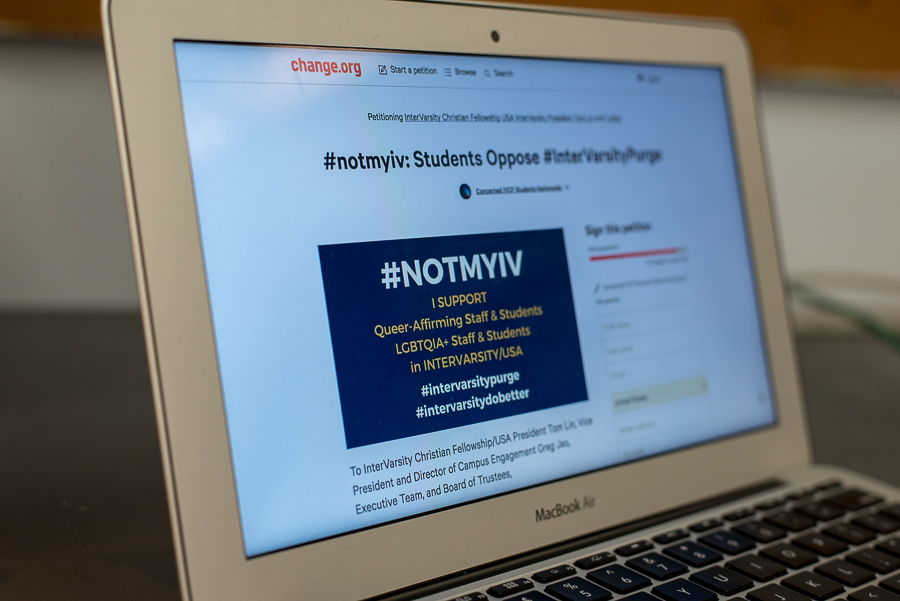
Since the policy announcement, students have expressed disagreement with the group. A Change.org petition, created by student members of InterVarsity, asks President Tom Lin, Vice President Jao, the executive team and Board of Trustees to reverse their decision on same sex marriage and to acknowledge the experiences of LGBTQIA+ individuals.

“We are students who oppose InterVarsity’s policy of involuntarily terminating staff who openly affirm same-sex relationships as God-blessed,” the petition states. “Some of us who sign this petition are queer and Christian. Some of us are Christian and queer-affirming. Some of us share InterVarsity’s redeemed sexuality theology. All of us are Christian. All of us are or have been in InterVarsity. All of us wholeheartedly oppose this policy as siblings in Christ.”

InterVarsity/USA has said that staff members would be allowed to stay as long as they uphold the group’s theological principles.

Zac Fielding, a third-year psychology and sociology double major and a member of Davis’ InterVarsity who identifies as queer, said that the InterVarsity’s new position is affecting its students and staff in a different way.

“I think this specific policy is different because before, a lot of the ways in which InterVarsity would sort of go into the personal lives of their staff members, were things about pre-marital sex, drug use and alcohol abuse,” Fielding said. “And I think in those cases, they’re reaching into the personal lives of their staff members more so from a way that didn’t necessarily devalue them as people.”

For Nguyen, a singular interpretation of what the Bible says about human sexuality goes against many of the practices she has learned in her time at InterVarsity.

“By creating a policy like this, it’s politicizing something that is incredibly personal,” Nguyen said. “I would say that InterVarsity is overreaching by making staff all agree on one theological interpretation, especially because inductive study is all about having different interpretations.”

As an interdenominational organization, InterVarsity uses inductive bible study by focusing on scriptures and sharing interpretations amongst its members.

Fielding said that the UC Davis campus’ diversity helps bring in members of different backgrounds. With the new policy, he said that InterVarsity as a national organization should keep in mind many of the students that take part in its membership.

“We’re fortunate in a way where Davis is a more liberal community, so InterVarsity at [UC Davis] is more liberal,” Fielding said. “But I think it’s because InterVarsity [is] a national public organization, they pride themselves in reaching out to students and helping students and serving students. And so I think the students that they are serving should have some sort of say in how InterVarsity serves them. […] If InterVarsity is attempting to serve students in a way which is actually harming students […] then it’s more the organization’s problem to fix versus the students’ [problem].”

Written by: Ivan Valenzuela — campus@theaggie.org

Voters to decide on fate of ASUCD Judicial Branch

GENESIA TING / AGGIE

Senate passes ballot initiative to dissolve judiciary

On this quarter’s Associated Students of the University of California, Davis (ASUCD) ballot is a proposition to eliminate the ASCUD judiciary. The bill, written by ASUCD Internal Affairs Commission Chair Nick Flores, was placed on the ballot 26 calendar days before the election. Ballot initiatives must be voted on by the senate four weeks before the election for constitutionality.

“I interpreted the Constitution’s time frame for legislative ballot measures to mean they are acceptable so long as they are passed in the fourth week ahead of the election,” Flores said via e-mail. “Per my interpretation of the constitution, this measure is constitutional, as the election is being held in the fourth week following the passage of the bill.”

According to ASUCD President Alex Lee, the Judicial Branch is in charge of interpreting the ASUCD Constitution.

“Interpretation of the Constitution is constitutionally left to the Judicial Branch which I have tried to appoint justices to,” Lee said via e-mail. “As an executive, I personally favor pragmatism and the spirit of our governing documents over the exact wording.”

Flores leads the initiative to dissolve the judiciary mainly due to his belief that the branch is unnecessary. Although the measure is on this quarter’s ballot, he originally tested the idea of dissolving the Court with ASUCD last quarter.

“I talked with current ASUCD officials as well as ASUCD alumni to learn as much as I could about the history of the court, and did some research about their various rulings throughout the years,” Flores said via e-mail. “Our conversations were never held with animosity toward any [specific] justices; rather, we discussed how the court as an institution has served the association, and if it is worth keeping around. I don’t see a place for the court […], as they maintain no unique powers that do not already exist in ASUCD. That is why I wrote the bill.”

Flores saw it best to completely disband the court than try to amend its processes.

“Constitutionally, ‘The Association is…constituted to create and provide services and activities which its membership shall consider important to fulfilling the experience of being a student attending the University of California, Davis,’ and I decided that the court ultimately is not vital to fulfilling ASUCD’s constituted duties,” Flores said via e-mail. “I discussed with senate about whether we should revitalize the court or dissolve it altogether, and we ultimately decided it no longer functions in ASUCD.”

However, Chief Justice Malcolm Rivera believes that this inutility comes from a lack of support from the other two branches.

“The problem I have with the ballot measure is, the main argument is that the court is useless,” Rivera said. “[…] I have been chief justice for nearly a year and I have yet to preside over a court meeting because the president and senate have not been as quick as they probably should have been in appointing new justices.”

Rivera holds that the ASUCD Senate and Executive are biased towards the court.

“As long as I’ve been a part of the court, there’s been this conception that members of the court are unqualified to interpret the Constitution,” Rivera said. “When a controversial decision is made, or really any decision is made, there’s one member of ASUCD who says that we aren’t doing our jobs correctly. I’m not going to lie and say that it doesn’t bother me when I was actively part of the court and we were holding meanings, it was very disheartening and very frustrating for me to have people tell me, every time I do my job, I did it wrong. Opinions […] rendered by the court and those opinions not being accepted has caused animosity between the judiciary and the other two branches.”

Additionally, Rivera believes that much of the court’s “uselessness” comes from constitutional issues being handled internally, rather than through the courts.

“I think that the court has a purpose as a mediator between the other two branches, but there needs to be a higher emphasis on, one, not solving unconstitutional activities internally, and two, a higher emphasis on the attorney general being very active in searching out for potential complaints within the ASUCD,” Rivera said.

Rivera did offer his own view of how the court system could be repaired, believing that there are “ways to work around that problem” that don’t go as far as entirely cutting out the system.

“I personally believe that if quorum was lowered from five to three, for example, and then the overall size of the court was also lowered, that could get around that issue.” Rivera said. “We would be able to have meetings and we would be able to accept court cases, which we haven’t done in four and a half quarters. I think it’s unfair to say we don’t handle enough court cases when we are unable to even give responses to court cases because we don’t have quorum.”

Students can vote on this ballot measure alongside senate candidates from Nov. 8 at 8:00 a.m. until Nov. 11 at 12 a.m. at elections.ucdavis.edu.

Written by: Kenton Goldsby — campus@theaggie.org

A night of blessings

ROB LOUD / FLICKR
ROB LOUD / FLICKR

Sunday school with Chance the Rapper

It was the Sunday night before week 6 — before a week full of midterms and papers — but nobody in the Pavilion seemed to care, because we were all too busy enjoying the whimsical, heartfelt and joyful experience that is Chance the Rapper’s Magnificent Coloring World Tour.

Chance certainly brought his best to Davis, dancing and spinning and bantering with the various puppets on stage, a touch that sometimes made me feel like I was watching some bizarre and ridiculously entertaining episode of the Muppets. The set design itself was incredible, with dazzling and complementary lights accompanying each new song. Chance was backed by a drummer, keyboardist and trumpeter, additions that added effusive energy to an already vibrant concert. There is an infectious joy to his live performance that makes it impossible not to smile and dance along, even when I was thinking about the pages of Chaucer I had to read after the show.

But a review of Chance’s show would be incomplete without mention of the controversy that has accompanied the Davis concert. The ASUCD Entertainment Council shut down the initial event page after a student who asked non-black folks to give up their floor seats to black students became the victim of a barrage of racist and transphobic attacks. This ugly incident revealed that racism is still very much alive in Davis, California, no matter how hard some people may try to deny it. Spaces like the Chance concert exist for healing, and for dealing with all the pent-up anger that comes from attending an institution that was not made for you, one that is hostile to your very being.

Near the end of show, Chance treated the crowd to a rousing rendition of “All We Got,” a song that includes the lines “Music is all we got / So we might as well give it all we got.” Hip-hop stems from music like African slave spirituals, jazz, blues and gospel — genres that black people developed in order to survive systematic oppression in America — and while it’s true that anyone can enjoy Chance’s unique brand of hip-hop, non-black students will never be able to truly identify with the “we” that Chance and Kanye are referring to because that is simply not a part of their identity. And that’s okay.

What’s not acceptable is victim blaming, tone policing and quoting someone out of context. Opinion editor Eli Flesch argued in his latest op-ed that the Chance controversy is evidence that UC Davis is falling into a “culture of victimhood.” He blames identity politics for causing minority groups to “retreat inward”   as if it were a bad thing that people of color would want to find community with each other and not share something with the white people who have long been upholding systems of oppression.

Identity politics are not polluting the American university. People chalking “Trump 2016” around student cultural centers and college groups hosting events called “An Illegal Immigrant Killed My Child” are polluting our university. People need to continue rallying against hateful incidents like these and ignoring critics who insist on having a “civil and polite dialogue.” Being angry and being an activist are not mutually exclusive things. Ignoring identity means downplaying the anger and frustration that is part of the lived experience of people of color; asking people to “rise above identity politics” is a slippery slope that leads to comments like “I don’t see race.”

The crowd at the Pavilion exploded in deafening cheers when Chance burst into his verse from Kanye West’s “Ultralight Beam.”

“This is my part, nobody else speak / This is my part, nobody else speak” Chance rapped, saying it twice in case we didn’t hear the message the first time: sit down and be quiet, especially if you’re going to speak on a topic you don’t know about. Maybe it’s time to educate yourself and give someone else the chance to speak their part.

Written by: Amanda Ong — arts@theaggie.org

New museum opens to public on Nov. 13

BECCA RIDGE / AGGIE FILE

Jan Shrem and Maria Manetti Shrem Museum of Art grand opening to feature four innovative exhibitions

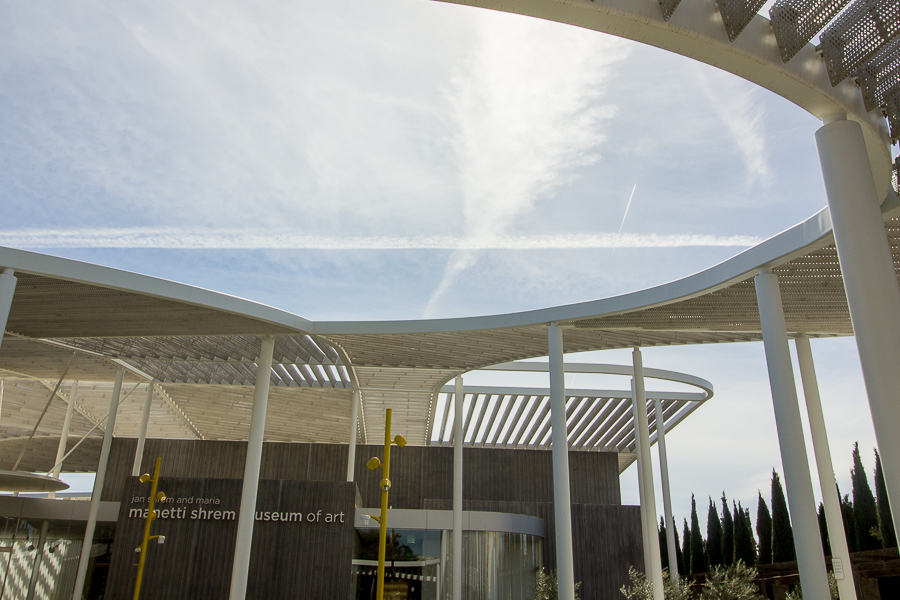
The Jan Shrem and Maria Manetti Shrem Museum of Art will hold its grand opening on Sunday, Nov. 13 at 10 a.m.. Four opening exhibitions — Out Our Way, Hoof & Foot: A Field Study, A Pot for Latch and The Making of a Museum — will be displayed following the grand opening.

Out Our Way presents the creations of 12 artists hired by Richard Nelson, the founding chair of UC Davis Department of Art in the 1960s.

Hoof & Foot: A Field Study is a video project by Chris Sollars, a Bay Area artist and art professor at Mills College in Oakland. The video shows the symbiotic relationship between animals on the UC Davis campus and the life of UC Davis students.

A Pot for Latch is an interactive exhibition, in which attendees can participate by exchanging artwork with the museum’s selected collections. This is an activity designed for people to look back at the growth of the Department of Art as well as forward to the exciting future.

“This is actually related to the 1960s art faculties and their costumes, because in the 1960s art faculties used to give art to each other,” said Karen Nikos-Rose, the associate director and media representative at Manetti Shrem Museum.

The Making of a Museum will exhibit videos, models and drawings that illustrate the fascinating process of constructing the museum.

As the most anticipated building debuting in the coming month, no one can overlook the museum’s impressive architecture. SO-IL, an internationally-renowned architecture firm founded in Brooklyn, New York, created the striking design that is visible from Interstate 80.

The design’s signature feature is the Grand Canopy outside the museum. At first glance, the Grand Canopy is an imposing cover for this single-story, 30,000-square-foot building. Moreover, the intricate dappled patterns on the canopy turn the intense nearby lighting into changing shadows and silhouettes.

“I also love how well our architects thought about the whole experience, and our mission of having people come to experience the space, not just visit,” said Elisa Massenzio, a fourth-year design and Italian double major at UC Davis and student assistant at Manetti Shrem Museum.

Apart from the grand lobby, the museum also has a courtyard and two lounges for visitors to relax, along with free Wi-Fi and plenty of power outlets.

The new museum aims to serve all UC Davis students, not singularly those who study art or art history. In fact, there will be a reception for current UC Davis students the night before the museum opens, complete with music, pizza and student performances.

The museum has also created a student coalition to try to engage all students. Students can apply to be a member of the coalition and get involved in various museum projects.

“The museum wants to be a community space for students, and the best way to do that is have it be by students,” said Carmel Dor, coordinator of student engagement at Manetti Shrem Museum. “Students will also get a taste of the different things that happen in a museum and get to shape the student experience.”  

For more information about Manetti Shrem Museum, visit its website, manettishremmuseum.ucdavis.edu. Admission is free for all visitors.

Writtten by: Betty Wu — arts@theaggie.org

Guest Opinion: No on Prop 54: a special-interest power grab

DAVID MONNIAUX [CC BY-SA 3.0] / COMMONS
There’s been a lot of talk about big money and the power of special interests in our elections this year. Proposition 54 embodies the worst of both.

Prop 54 is on the ballot solely because one California billionaire, who, after spending millions of dollars trying to influence California policy and elections, is now using our citizen initiative process to pursue his own political agenda. Not a single other Californian has made a contribution to this measure. Not one.

The billionaire, Charles Munger Jr., has dumped more than $10 million of his own money into securing passage of this measure. (For the record: Munger is one of the largest donors to California GOP legislative candidates and contributed $100,000 to a SuperPAC that supported failed GOP presidential candidate Carly Fiorina last year.)

Mr. Munger’s interest in Prop 54 seems to be straightforward: he wants to slow down the progress being made by California’s legislature. And that’s understandable — the Palo Alto billionaire fought against increases in education funding, pension reform and other causes the Legislature has taken up to move our state forward.

Under the guise of “transparency,” Prop 54 will introduce unnecessary new restrictions on the way laws are crafted by the Legislature. It will empower special interests to pry apart carefully negotiated legislative agreements through arm-twisting and other tactics by requiring all legislation to be put on hold for 72 hours before lawmakers can vote on it.

Special interests already have too much power in Sacramento. Prop 54 will give them more power.

Legislation like the Fair Housing Act (which ended housing discrimination), last year’s bond measure to address California’s drought and this year’s hikes in the minimum wage would have likely never have happened if this measure had been enacted. Neither would our state’s landmark climate change law or dozens of other laws that took months to negotiate.

Former State Senate President pro tempore Darrell Steinberg said that if Prop 54 was in place during the bipartisan 2009 budget deal — which offended just about every special interest in Sacramento — the state would have gone bankrupt.

Why? Because every special interest in Sacramento was getting its ox gored, and its lobbyists were using backhanded tactics to prevent fee hikes (which the Republicans didn’t want) and spending cuts (which the Democrats didn’t want). Had that agreement been put on hold for 72 hours, lobbyists would have had the time to rip it to shreds.

Another dangerous provision of Prop 54 will allow the use of legislative proceedings for political advertising.

That will lead to two things: grandstanding by lawmakers who want to use official footage for their campaign ads as well as the use of snippets of legislators for use in attack ads. It’s for that reason that neither the United States congress nor 45 other states allow it. Yet Prop 54 would rewrite our constitution to permit it.

Proponents of Prop 54 say that the measure will reduce the power of special interests. If that’s the case, why are so many special interests in Sacramento — left and right — lining up behind it? Do they really think they support Prop 54 because it will weaken their ability to influence of legislators? Of course not.

There are parts of Prop 54 that are well-intentioned, including requiring all legislative hearings to be accessible to citizens.

But read the fine print: the poison pills included in this initiative far outweigh its benefits.

Steven Maviglio, former press secretary for Gov. Gray Davis and communications director for three Assembly Speakers, is Chairman of Californians for an Effective Legislature. For more information, visit www.NoOnProposition54.com

HUMOR: Facebook event cover photo more fun than party will ever be

BRIAN LANDRY / AGGIE

headshot_blThe story of a man who lures guests to his parties with deceptively fun photos

According to a report obtained by The California Aggie, local student Brendan Yarden, a third-year communication major and aspiring clown-college graduate, is throwing a party this coming Friday.

“A huge part of throwing a party is having a really good event photo and description on Facebook,” Yarden said. “You really have to draw people in. That’s why I always make sure to Google pictures of people at parties that look super fun. But when guests get to my house, I have something completely different set up. One time I just played music in my headphones that only I could hear and passed around a single beer for everyone to share. To me, that’s fun. But now my parties are empty, and I’m not sure why.”

The Aggie talked to some guests of Yarden’s past parties. One was Ariel Chung, a second-year English major and owner of not one, but four loaves of rotting bread that should probably have been thrown out by now.

“I got invited on Facebook to a party and the event photo showed a bunch of people in a huge house,” Chung said. “There was neon paint sprayed everywhere, and it looked like everyone was having a really good time. But the party was completely different from the event photo. When I got there, Brendan was just telling ‘scary’ stories about the time he locked himself in a porta-potty and thought that the echo of his voice in the waste chamber was another person. I tried to leave, but he had barred the doors and I had to listen to the entire three-hour story.”

Other people shared similar stories about Yarden’s parties.

“I was really drawn in by the event photo,” said James Rodriguez, a fourth-year applied mathematics major and aspiring VHS-tape manufacturer. “But I was disappointed to see that Brendan spent the entire party playing recordings of himself making cat noises. Over and over. Needless to say, I won’t be going back to one of his parties.”

It should be interesting to see what Brendan decides to do for his Facebook cover photo this time to entice people to come to his next party. So check your Facebook for an invite soon. Actually, don’t. You’re probably not even invited. How sad.

Written by: Brian Landry –– bjlandry@ucdavis.edu

Empowering students and staff

0
CHRISTIE NEO / AGGIE

UC Davis Police Department, Safety Services hold monthly self-defense training sessions

Learning skills that range from verbally deflecting unwarranted comments to striking key areas during hand-to-hand combat are crucial parts to protecting oneself from danger on a college campus. In addition to self-defense and martial arts courses offered by the UC Davis Department of Physical Education, there is also a monthly training program that provides students with the opportunity to learn self-defense skills.

According to the UC Davis Police Department website, the campus has experienced an increase in robbery and sexual assault cases since 2014. Although the overall crime rate of UC Davis is low in comparison to that of California in general, the rate of violent crimes at UC Davis increased significantly from 2013 to 2014.

To help students and staff combat possible threats, the UC Davis Police Department and UC Davis Safety Services hold a monthly self-defense training session that emphasizes safety and situational awareness, as well as instructs students on how to protect themselves in realistic dangerous situations. Taught by Rocci Twitchell, the training program aims to help individuals build self-confidence and feel secure wherever they are.

“We want everyone to be safe,” Twitchell said. “We want everyone to at least have some kind of skill to […] have the confidence to stand [their] ground. I tell everyone to come to my self-defense classes to be empowered.”

Twitchell, who also works for the fire prevention unit on campus, has taught the class since the program began in 2013. His experiences from being bullied at school when he was younger motivated him to take martial arts lessons. Because of this Twitchell has trained in  various schools of self-defense including Muay Thai and boxing.

“I get to train with some really fantastic people,” Twitchell said. “One of my instructors […] was Larry Hartsell; he used to train with Bruce Lee in his Bel-Air home. My other instructor is guru Dan Inosanto […] the guy who fights Bruce Lee with the red sticks in The Game of Death.”

During the first part of the session, Twitchell gives a powerpoint presentation on situational awareness, explaining possible dangerous circumstances and how to quickly identify them.

“If you’re conscious about things going on around you, [a session] tends to [give] you a high sense of what’s happening instead of […] being totally paranoid about everything,” said Rhejinald Walker, a UC Davis Facilities Management employee who trains with Twitchell. “You can identify trouble before it actually happens.”

The presentation is then followed by active physical training and drills. The course mainly teaches effective hand, elbow and knee techniques for self-defense and escape.

“We kind of base [the training] on ‘run, hide, fight,’” Twitchell said. “If you can run and get away, perfect. If you can hide and get away, even better. But if you’re cornered and something happens, you have to fight.”

The class also instructs students on how to utilize common school supplies for self-defense when under attack.

“You’d be able to know how to use everyday tools or utensils […] to be able to defend yourself,” Walker said. “Even stuff as simple as your cellphone or books.”

The class emphasizes self-awareness education, making the training session a unique experience.

“The biggest takeaway from [Rocci’s] class was how much of any preparation is mental,” said David Slipher, director of marketing and communications for the College of Biological Sciences, in an e-mail interview. “It’s not so much physical. It’s your awareness and your understanding of the situation that you’re in. Mental preparation is the foundation that is going to get you out of a potentially dangerous situation.”

In addition to self-defense training, Twitchell also leads monthly classes on fire extinguisher training and active shooter survival. All of these classes are free on campus, and students and staff can register for them by visiting the UC Davis Police Department website and emailing the program coordinator.

“I think that [the classes] leave a positive impact,” said Raul Castaneda, a UC Davis Facilities Management employee. “You can get physically fit, you can get mentally strong and […] it also will help you defend against somebody that may attack you.”

Written by: Jennie Chang — features@theaggie.org