59.1 F
Davis

Davis, California

Wednesday, December 24, 2025
Home Blog Page 686

Rescuing our furry friend

0
KELSEY GREGGE / AGGIE

Vet students, undergraduates balance pets with school

As students enter college, they also find opportunities to take part in adult activities like adopting pets. For some UC Davis students, adopting pets serves as a way to focus their attention on something other than school.

“My housemates and I wanted a dog for company and also […] for therapy,” said Vyvy Ha, third-year evolution, ecology and biodiversity major and owner of a 6-year-old rescue dog named Lexi. “College is stressful, and dogs eliminate stress because they’re so cute and fluffy.”

Many UC Davis students adopt pets for various reasons, including mental health and comfort. Having pets also encourages physical health, since animals need exercise too. Students find that especially during exam season, getting out of the house with an animal is a great way to stay active. However, owning a pet can, at times, be a struggle to balance.

“It’s definitely a little bit difficult sometimes to make sure that [my dog] gets walked every day and has exercise, especially when it’s the middle of the quarter and midterms and essays are piling up,” said Kelsey Clausen, fifth-year psychology major and dog owner. “But it’s not hard to try and find 10 minutes at least to take her out.”

Students in search of a furry friends had the chance to adopt a pet of their choice on Oct. 23 when a group of UC Davis veterinary students collaborated with 20 different animal shelters to put on its annual animal adopt-a-thon. The event, which took place at Davis Central Park, included an Animal Health Fair as well as animal demonstrations such as agility races and frisbee competitions.

“I had such a great team of volunteers and people to help me out,” said Katie Krebs, third-year veterinary student and project director for the event. “Seeing […] the enthusiasm of the volunteers, […]  the rescue organizations and the people coming out to learn […] makes it an awarding event.”

The project was funded by a grant from the American Veterinary Medical Foundation (AVMF), which holds an application process each year for projects, seven of which are chosen for the grant. AVMF has funded the adopt-a-thon project for the last three years.

“Being able to spread awareness is super rewarding,” Krebs said. “Companies like [AVMF and Banfield Pet Hospital] make it possible for us to do these things.”

The event allowed animals of all kinds, including dogs, cats, parrots and more, to come and enjoy services such as the free veterinary clinic, which gave free health checkups and vaccinations. At the Animal Health Fair, many of the veterinary school clubs presented different health topics from microchipping to household items hazardous to pets.

“We were hoping to […] spread awareness about […] animals, and make it a little easier for people to adopt an animal,” Krebs said. “[Adoption is] a way animals get a new lease on life.”

Yolo County is home to a number of pet adoption shelters, including the Yolo County Society for the Prevention of Cruelty to Animals (SPCA). The SPCA hosts adoption events on Saturdays at the PETCO on West Covell Blvd in North Davis. Some students live in housing where animals are not allowed, while others live in pet-friendly environments. Even though some people live with housemates who are willing to take turns with animal care, there are often still times when no one is home.

“Making sure that someone’s home with [Lexi] to […] take her out once in awhile [can be challenging], and my schedule is pretty busy this quarter,” Ha said.

To solve this problem, the veterinary school at UC Davis allows students to take their pets to class with them, which gives students the opportunity to exercise and spend time with their pets while at school. On days when she has a heavy schedule, Krebs brings both of her rescue labrador-mixed dogs to school.

“Being able to bring them to school gives me the peace of mind,” Krebs said. “When I tell my older dog we’re going to school in the morning, she gets so excited. I couldn’t imagine being in vet school without [both of] them.”

In particular, many students have animals for mental and emotional support. Similar to the “therapy fluffy” events that are held on campus, pets often provide personal comfort in times of stress.

“Whenever I’m having a bad day, I’ll just pick […] up [my cat] and cuddle with her,” said Lindsay Hedgecock, fourth-year community and regional development major. “She’s super sweet.”

Despite the challenges that balancing schoolwork and a pet can pose, animal adoption can be overall beneficial to both the owners and the animals. Students can return from school to see a rescued furry friend, but more importantly, the animals find loving homes.

“I’m a dog person. I’ve had a lot of dogs growing up,” Clausen said. “I love [that] they  cuddle up with you and then they fall asleep and snore — it’s so cute.”

Written by: Allyson Tsuji — features@theaggie.org
The technology behind note taking

0
LUCY KNOWLES / AGGIE

How note-taking shapes college campus

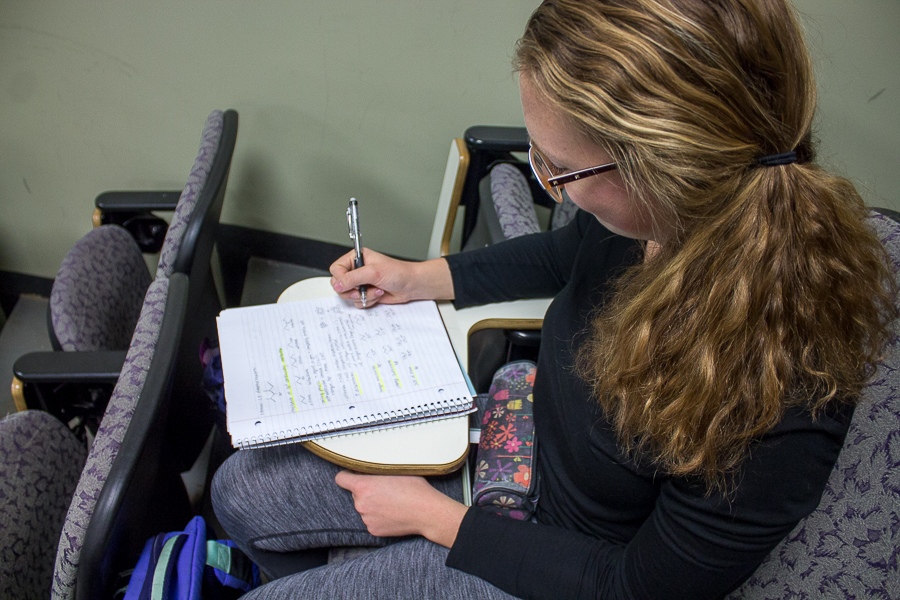
Entering a UC Davis lecture hall during class on an average weekday, there are hundreds of students. Some are sleeping, some are on their phones, but most students are taking notes.

Students can use notes to annotate class material, retain and process what they learn in class and study for their countless exams. Regardless of the class and type of notes, some students on campus aren’t able to take the notes for themselves due to learning or physical disabilities. In this case, the UC Davis Student Disability Center (SDC) pays some students to work as note-takers.

“I try to find somebody in the same class [as the client] that’s been a notetaker before,” said Danielle McAlister, administrative assistant of the SDC. “After I connect them, it’s up to [them] to determine how they want to do things.”

Students who need a paid notetaker are evaluated by the SDC specialists, who work to figure out what will work best for the client.

“[This service] is important to our clients on our campus, [they are students] who don’t have the ability to take notes and need a note taker,” McAlister said. “They can learn just like other people in class, they get the same information and they have something to study. They get to participate fully in class as opposed to not [at all].”

Styles of note taking vary. Some students, whether for themselves or for another classmate, prefer to take notes by hand. Others prefer to type their notes on a laptop or another device. In many classes at UC Davis, it doesn’t matter what style you decide on. However, in a select few classes, some professors prefer one way or the other.

Second-year economics and political science double major Maryam Awwal took an introductory linguistics class during Spring Quarter of 2016. Her professor, Raul Aranovich, banned the use of technology during lecture.

“Basically on the first day of class he told everyone that he has a no technology policy because it is distracting and he doesn’t think that typing notes is the best way for students to actually learn,” Awwal said.

According to Awwal, Aranovich would give the lecture slides to students beforehand and expect them to print them out and bring them to class.

“I think no technology is definitely a good rule to have in classes,” Awwal said. “Any time that people actually bring their laptops to class they’re always just on Facebook, and I can see them scrolling through their newsfeed and watching Tasty videos I stop paying attention and end up watching those Tasty videos too.”

It just so happened that Professor Laramie Taylor of the Department of Communication was scrolling through Facebook when he came across a discussion regarding banning laptops in class. It motivated Taylor to go out and look for research on the topic, which led him to designate a section of the hall as a technology zone during his lectures.

“There is research that shows pretty conclusively that, not only does using a laptop in an instructional environment reduce the attention of the user, but it also reduces the attention and the learning of those sitting around the user,” Taylor said. “It becomes a justice issue. If you want to use a computer and harm your own education that’s fine that’s your choice. But if that’s not what you want then you have the right to be free from those distractions.”

Taylor provides every student in his class with a fair opportunity to learn in their own way. Taylor found that about a quarter of his class sits in the tech zone. The tech zone is meant for students who wish to use any type of technology as well as students who are indifferent to technological distractions.

“My favorite study is actually an experiment where they randomly assign people to have either a laptop or not have a laptop or sit next to someone with a laptop,” Taylor said. “Even with random assignment […] they find that sitting near someone with a laptop hurts.”

Students who don’t sit in the tech zone are taking all their notes by hand. According to Taylor, writing notes by hand forces students to process and consider the material, which makes it more likely to move into long-term memory.

“It turns out that unless computers are highly integrated into the course by the instructor, using a laptop in class impairs learning,” Taylor said.

Unlike Taylor’s classes, almost every student in Professor Anna Uhlig’s Greek, Roman and Near Eastern Mythology lecture has a technological device out during lecture per her instruction. Uhlig uses a platform called Top Hat to keep students engaged in class. Students can answer questions as if using an i>Clicker, except that they answer using their laptops or phones through the Top Hat app and are able to respond to the interactive questions in their own words.

“One of the things that I really appreciate about Top Hat is that it allows, particularly in a large-format lecture class, for students to immediately respond and try [to] simplify some of the things I’m talking about in their own head,” Uhlig said. “So much of [this course] is based in technology [that] it makes sense […] to use the most up-to-date technology.”

Uhlig’s Classics course follows a hybrid format, with parts of the material administered online. In her previous large lecture classes, Uhlig used i>Clickers to encourage class participation and has only made the switch to Top Hat this quarter.

“[Large lectures] have so many students and you know that they’re thinking so many interesting things, [but] you get to hear almost none of it in the course of your teaching,” Uhlig said. “The clickers really only allowed for a one-size-fits-all multiple choice question […] but the thing that Top Hat allows is, in particular, these student-generated responses.”

In addition to the technology used to contribute to class discussion, Uhlig also finds that a number of her students prefer to have the lecture slides in front of them in class so they can take notes alongside them.

“There’s a lot of terminology that I use from the ancient world […] that I think can be a little bit challenging for students,” Uhlig said. “Having the slides on their computer and being able to see how the words are spelled […] was something that students had in fact requested and found helpful.”

Written by: Fatima Siddiqui — features@theaggie.org

UC Davis faces issue of overcrowding

ALEXA FONTANILLA / AGGIE

Construction in progress for classrooms, lecture hall spaces, triple-occupancy dorms

Increases in enrollment at UC Davis have created a demand for additional housing and classroom space. Due to both UC Davis’ own 2020 Initiative and UC President Janet Napolitano’s call for an increase in enrollment, UC Davis enrollment is now on an incline.

Numerous on-campus groups and organizations will be affected by the increase in the students, including Student Housing (SH) residents, sports clubs and administrators.

SH has been preparing for the increased enrollment, according to Richard Ronquillo, assistant director of Student Housing.

“I know housing has planned for those growths,” Ronquillo said. “That’s why we did a renovation of our housing facility in Tercero this summer — to accommodate the growth.”

SH will open a new Tercero residence hall in fall of 2017, while plans for a second dining facility in Tercero and a two-year renovation process of Cuarto’s Webster Hall are almost underway.

This year, some housing units were converted to triple-occupancy rooms in order to accommodate for additional students.

“A lot of our newer construction was built with the idea that it could be either double or triple [occupancy rooms],” Ronquillo said. “The square footage is there for triples if we need them, but we can also double them if that’s what the need calls for. We have a lot of adjustment with our housing.”

However, triple-occupancy rooms are not ideal for students like Harrison Morrow, a third-year wildlife, fish and conservation biology major who has lived in a three-occupancy room during his time at UC Davis.

“I lived [in a triple] and there must have been three other two-person rooms [in the suite],” Morrow said. “That’s nine guys sharing one living space, two bathrooms and two showers. […] It gets kind of hard to move around there.”

A separate yet similar challenge which Morrow currently faces is finding adequate space for the UC Davis club rugby team to practice on.  

“Oftentimes this year, we practice on Hutchison Field and about half of that field is taken up by [intramural] sports,” Morrow said. “There’s a group of graduate students that goes and plays soccer out there a couple times a week and oftentimes we will have to go and talk to them and be like, ‘Hey guys, we have this field reserved actually.’ That’s kind of a testament to the fact that there are students who want to go out and have access to these open areas but there’s not enough space to accommodate all that.”

In recent years, UC Davis has resorted to using unconventional spaces as classrooms and lecture halls, including Jackson Hall in the Mondavi Center.

“I have a class in the Mondavi Center right now,” Morrow said. “I don’t think that was put there to accommodate academic needs. They are going to have to start finding more unconventional ways to house these students. […] I think it would be more worthwhile to just focus on your student body and making sure their experience is good without […] trying to enlarge it when you don’t have the resources available.”

Alternatively, Matt Traxler, associate vice provost for academic planning, supports the use of Jackson Hall as a lecture hall.

“I have been in Jackson Hall when it was being used for classes, and in my experience as a professor, it works perfectly fine as a lecture hall space,” Traxler said. “It’s a beautiful facility and the acoustics are fantastic. There have been some issues with some sound and display, but those have been worked through by the staff at Mondavi and I am confident that those issues have been addressed.”

Traxler believes that UC Davis’ most pressing concern is the need for larger lecture spaces, leading the university to turn to places like Jackson Hall.

“The reason why we approached Mondavi Center is because on this campus, the space needs we have are particularly acute in the larger classroom spaces,” Traxler said. “There are some smaller classrooms where […] the supply is sufficient to meet the projected demand. […] Using Jackson Hall essentially gives us another large lecture space we can use while we finish off the new large lecture hall on California [Avenue], the rebuilding of Walker Hall and so on.”

With a vast number of students transporting from class to class via bikes, bike parking is also considered in the choosing of lecture hall locations.

“[Bike parking is] something we worked on when we approached the Mondavi Center about using Jackson Hall,” Traxler said. “It’s something we talked to the Shrem Museum before they are letting us use their large lecture space. That corner of campus did not have much by way of bike parking so we made some investments to increase the number of bike parking spots over there so students taking courses [over there] would have a place to put their bikes.”

Written by: Kenton Goldsby – campus@theaggie.org

Guest: Confessions of a Californian Cubs fan

0
LIZ MCALLISTER / AGGIE

Chicago’s baseball team brings home championship to spellbound world, fulfills 108 years of fans’ playoff dreams

The Windy City has been holding its breath for 108 years. On Nov. 2 at 11:47 p.m., in a storybook ending to a winning season many decades in the making, the city’s aching lungs were relieved; fans, in equal parts disbelief and electrified joy, watched their beloved Chicago Cubs celebrate a hard-won World Series Championship.

In a different time zone during that same evening, I sat  — in pathetic enslavement to academia — studying for my last midterm of the quarter. The monotony of memorization was punctured by the sound of a Chicago radio broadcast crackling to life: “They did it! The Cubs have won the two thousand and sixteen World Series!”

Reader, I tell you — moments of heaven on earth exist for all of us and that instant was mine.

Since before the world’s first skyscraper was built, my family lived in the Chicago area, and after the invention of the radio they faithfully tuned into Cubs games. Although we have largely relocated to the West Coast and our white and blue ‘W’ flag now goes up across from Bruins and Lakers pennants, we remain unashamed Cubs fans. Accustomed to short-lived playoff bids, my family would watch the last regular season games while eating Chicago-style hot dogs and crackerjacks, celebrating yet another failed year.

As my grandfather had been waiting reverently for this moment for over eighty years, my baseball allegiance had been decided decades before I was born. My dad coached Little League baseball for years and, much to my adolescent chagrin, always tried to secure the Cubs jerseys for my team.

One year he bought Crocs emblazoned with the Cubs’ logo for our entire family. After a (very) short grieving period, my pair has been laid to rest in the back of my closet near a Reyn Spooner button down (instead of a tropical Tommy Bahama shirt, it has bat-wielding bear cubs and miniature Wrigley Fields all over it). And now that I live in northern California, my dad has taken it upon himself to volley any number of insults toward my adopted allegiance to the Giants.

This year, the year, he bought our family “Try Not To Suck” t-shirts, a reference to the coaching style of manager Joe Maddon and, although no one recognizes the joke up here, I still wear mine in solidarity. My inherited love for the Cubs is a non-recessive genetic disorder. I just can’t seem to get rid of them.

I had been keeping up with the series whenever I could glance at a TV or stream a broadcast, even biking 30 miles on a stationary bike at the gym to watch a nail-biting Game 5. During this season alone, I’ve watched the Cubs at stadiums in Arizona, San Francisco, Los Angeles and San Diego. Having watched the boys in blue take the field so many times over so many years made this win all the more wonderful.

Many fans have had similar experiences of quirky familial traditions and outlandish persecution over years of adherence to the lovable losers. And while the Cubs have proven their prowess and grit since April, fans have been proving their faithfulness for over a hundred years.

In a series of heartwarming reactions to the championship win, the bricks outside Wrigley have turned into a makeshift monument to family members and friends who weren’t able to stick around long enough to see their Cubbies bring home the trophy this year.

An entire community has been built around the cursed baseball team from Chicago. Players from the Blackhawks, Chicago’s hockey team, and the Cubs routinely support each other at sporting events.  The Cubs have gifted us with irreplaceable personalities like broadcaster Harry Caray, heroes like Ernie Banks and Ron Santo, and talent like Greg Maddux and Ryne Sandberg. We have immortalized the celebrity of Cubs fans such as Steve Bartman, Bill Murray, John Cusack and Eddie Vedder. Over the years, we have loved and lost familiar faces such as Sammy Sosa, Ryan Theriot and Kosuke Fukudome.

But our unrelenting willingness to be made fun of has been rewarded. While the final game of the series was held in Cleveland, 350 miles away, the city of Chicago shut down major streets surrounding Wrigley to allow Chicagoans the freedom to celebrate what is for many a once-in-a-lifetime experience.

Joe Maddon, the Cubs manager and the epitome of geniality, stated that winning the series was a team effort. In all likelihood it was the combined efforts of years of assertive management decisions, hopeful fans, renovating Wrigley Field and favor from the baseball gods.

But for the men in blue on the field that night, no statement could have been more true. First baseman and three time All-Star Anthony Rizzo said the series was a rollercoaster of emotions. And we certainly knew it — we cheered at the television when recovering slugger Schwarber got aboard and when Russell hit his grand slam; we furrowed our brows when Lester threw his wild pitches and when Fowler stole second moments after being hit by a pitch.

But most importantly, this series and this year brought together every Chicago fan who has rooted for the Cubs since 1908; Chicago’s victory parade drew over five million people and became one of the top ten largest gatherings in history.

The celebration is not exclusive to the baseball world. Everyone knows a Cubs fan. That evening, suffering from self-imposed exile for the sake of studying, I received texts and calls from family and friends (including Dodgers fans) celebrating with me. Even those who claim baseball is “boring” begrudgingly offered partially-enthused congratulations because they understood the fulfillment of a dream deferred throughout generations.

People love sports because they bring us together in fanatic loyalty to our hometown teams while pitting us against our rivals — all for the love of the game. We love baseball because it celebrates hard work, raw talent and camaraderie. There is no shortage of the thrills of unknown factors like wild pitches, unintentional walks, injuries and rain delays.

All of these, and more, were on display during Game 7. But they have been on display in Chicago for over one hundred years, sparking friendly rivalries and ridiculous traditions. The Cubs are no longer the lovable losers; they deserve their championship because, in winning, they brought together millions of people in an increasingly divided world.

Whether you hate sports altogether or root for the Giants or Dodgers, we all know what it feels like to be the underdog. The Chicago Cubs, a franchise I’ve seen defeated time and time again, has always maintained its integrity and resolve, no matter the adversity.

So take a moment to acknowledge what I believe is the most incredible feat of sportsmanship and struggle in over 100 years. Go ahead and high-five a Cubs fan; you just can’t make up a comeback story like this one.

Written by: Liz McAllister sports@theaggie.org

The far left, liberal utopias and Portlandia

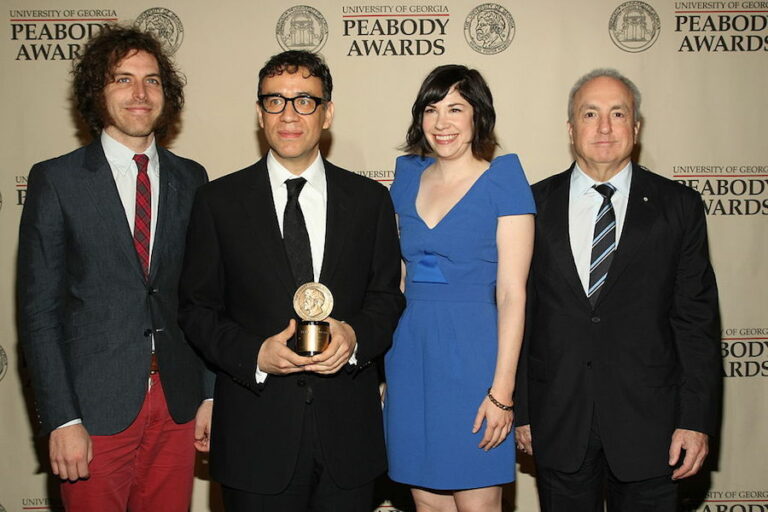
ANDERS KRUSBERG [CC BY 2.0] / PEABODY AWARDS
headshot_ssPortlandia simultaneously celebrates and mocks liberal cliches, culture
I grew up in a town called Sebastopol, located about an hour north of San Francisco. Sebastopol is small, community-oriented and quaint. Although it used to be known for family-owned apple orchards, it’s losing its charm to large-scale and invasive vineyards. What it strives for and succeeds to maintain, however, is a hippie vibe.

At any hour of the day you can pass by the local Whole Foods, which feels more like a co-op than a huge grocery corporation, and find groups of old friends, a pungent dank smell wafting off of their organic hemp sweaters and Birkenstocks. The Sunday farmers market reverberates with energy as drum circles grow near the town square, a senior chorus takes its chance at a Gwen Stefani song, a fermented food stand racks up a line and vendors sell organic-only vegetables.

You can find a similar Sunday afternoon in the scenes of Portlandia, a comedy sketch show starring Fred Armisen and Carrie Brownstein. Their show incessantly plays at the stereotypes, cliches and irony of living in a place as “down-to-earth” as Portland and takes a close look at the new Millennial-hippie culture.

Portlandia embraces progressivism, as the characters often challenge binary gender constructs, partake in many different types of relationships — heterosexual, homosexual, platonic — call for humanely-raised meat, protest the police, ostracize those who don’t bring reusable bags to the grocery store, fight for unpasteurized milk and embrace many more left-wing cliches.

However, by existing on a broadcast show, the quasi-hippie community they portray loses its counter-culture, alternative aura and instead becomes mainstream enough to draw an audience and clean enough to be widely appealing.

Armisen and Brownstein, who write and star in Portlandia, create a liberal utopia on two levels. First, they satirize Portland through a number of archetypical characters free of real-world concerns and swayed only by far-left morals. Second, they design the show itself to be enjoyed almost exclusively by like-minded liberals and upper-middle class hippies.

The show, with its niche content and audience, makes no attempt at actualizing the liberal ideologies it spends so much time illustrating.

Walking through Sebastopol, I can pass by the house whose owners were featured in the local paper for refusing to vaccinate any of their kids, as well as numerous signs for local ballot measures, especially those requiring listing GMOs on food packaging.

What Portlandia fails to do is offer liberal views that may be challenging or unappealing. By painting such a perfectly humorous picture of hippie life, the show doesn’t accomplish political change or much realism.

But perhaps realism is not the goal, and Portlandia is meant to simply be an escapist’s tool. The viewer has reason to believe that Armisen and Brownstein are liberal themselves and are not offering a harsh mockery of the culture, but simply exposing how absurd it can be when shown from only one side.

A 2012 New Yorker article entitled “Stumptown Girl” offers an analysis of Portlandia with a focus on Brownstein and her relationship to Armisen. The article recognizes Portlandia as a show specifically attuned to satire, “an extended joke about what Freud called the narcissism of small differences: the need to distinguish oneself by minute shadings and to insist, with outsized militancy, on the importance of those shadings.”

That is the lens from which the viewer understands Portlandia: a satirical criticism of a stereotyped lifestyle in such an extended form that it’s not meant to be a realistic representation.

Take, for example, “First Feminist City,” an episode from the show’s most recent season. This episode features two of the show’s most well-loved characters, Candace and Toni, who run a non-profit feminist bookstore. When Portland is declared the first feminist city, tourists flock to the bookstore like never before — comical to viewers accustomed to the bookstore routinely having no customers.

Candace is excited by their newfound popularity and becomes part of the first feminist superstore, marketing and profiting from feminism entering the mainstream. Toni is enraged at Candace’s willingness to be a figurehead for feminism and ultimately inspires their earthy-crunchy feminist following to take down the “Femi-Mart.”

Portlandia doubles down on satire in episodes like “First Feminist City”; not only does the show itself mock aggressive and exclusive feminism, but it also exposes the flaws of the feminist community within the show.

The synchronicities within the two utopias created by Portlandia are fascinating, layered and contemporary. Armisen and Brownstein mock a world that they are a part of, both in fiction and reality, living flawed and inconsistent lives.

Still, when I walk through Sebastopol and pass the bead store, I can’t help but feel Portlandia has somewhat accurately represented the absurd quirks and realities of living in a liberal utopia.

Written by: Stella Sappington — sasappington@ucdavis.edu

Humor: Speakers to be installed in classrooms for weekly 10 a.m. chancellor announcements

BRIAN LANDRY and CHARLES MIIN / AGGIE

headshot_evAdministration hopes to improve transparency


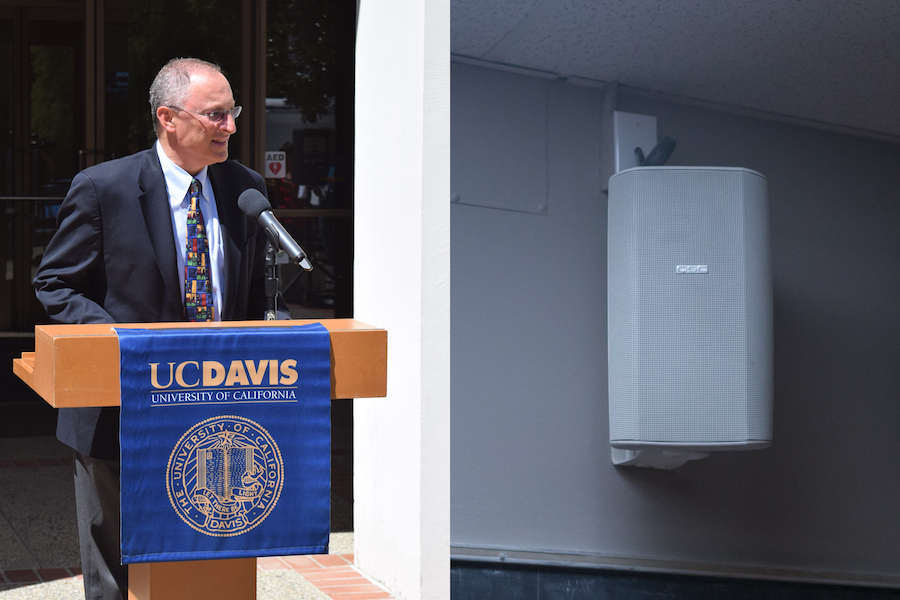
Given the distrust students currently have for UC Davis administration, the university announced on Tuesday that it will be installing speakers in every classroom and lecture hall on campus, the purpose being to have students hear weekly announcements from the chancellor.

Students and faculty alike have expressed their discomfort with the lack of administrative transparency after Linda Katehi’s actions that dramatically increased her salary as a result of her position on boards for private institutions and textbook companies.

Interim Chancellor Ralph Hexter followed her scandal with a scandal of his own. He was accused of embezzling funds during his time at Hampshire College. Hexter wants to change how students perceive the administration.

“I just don’t trust what’s going on. I like the idea of the chancellor getting in contact with us, but I don’t think this is the way to do it,” said Kevin McGrady, a third-year managerial economics major. “We’ve seen the videos of Katehi in our emails and that was just weird. I hope this will be better, but I doubt it.”

Professors are questioning the decision as well. Although many want better communication, they doubt this new method will be effective.

“I like it, but I don’t. Class starts at 10. How am I supposed to begin teaching? I don’t want to hear some bigwig talk about what he has done in the past week and have that taken out of my teaching time,” said Larry Richards, an English professor who has a particular dislike of technology.

Others feel that giving students a window into Hexter’s doings is a good idea.

“Is it a little bit silly? Yes. Does it feel like high school? Yes. I like it, though,” said Lily Marx, a first-year design major. “It’s cool and gives us something new. Let’s do it.”

Richards brings up a valid point that Hexter has yet to address, which is when class time will officially start. If Hexter plans to speak during class, he will take time out of learning, but if classes start 10 minutes later, students would not show up until the lecture officially began.

By forcing members of the university to arrive early and listen to what he has to say, Hexter might just turn UC Davis into a modern-day 1984.

Questioning the credibility of ETHAN VICTOR? You can reach him at ejvictor@ucdavis.edu. Feel free to help with his followers-to-following ratio on Twitter @thejvictor, because it is pathetic right now.

Reaching new heights in collegiate aviation

0
DANIEL TAK / AGGIE
DANIEL TAK / AGGIE

University Airport of UC Davis provides aircraft services, flight training for community

An airplane takes off and flies miles above Davis. The student operating the plane looks out the window at an aerial view of campus, identifying the oval shape of the Aggie Stadium, the roof of the Mondavi Center and the painted bike circle logos. For students who want to experience flying an airplane, the University Airport of UC Davis is the ideal destination.

Managed by UC Davis Transportation and Parking Services (TAPS), the University Airport is a public general aviation airport located on the west side of Davis. The airport was first founded by C. Harold Hopkins in 1946 and officially became part of UC Davis in 1950. It provides various aviation services, from aircraft storage to fueling.

Aircrafts that do not exceed 12,500 pounds are allowed to operate at the airport. The airport hosts approximately 35,000 take-offs and landings each year, and stores about 60 based aircrafts. For storage, the airport offers rentals for hangars and tie-down spaces.

Moreover, the airport is home to the Davis Air Repair and the Cal Aggie Flying Farmers, which offer additional services to the aviation community. The Davis Air Repair provides repair and maintenance services for aircraft, while the Cal Aggie Flying Farmers offers flight instruction to anyone who is interested in learning how to fly an airplane or even obtaining a pilot’s license.

“[The Cal Aggie Flying Farmers] is a flying club,” said Cliff Contreras, director of TAPS. “It is a host of pilots that provide instructions [to the public] on how to fly, whether you’re a student, staff, faculty or someone within the community.”

There is no set amount of lessons that a student is required to take. Students can register for as many classes as they need to develop the skills necessary to obtain their pilot’s licenses. Students who only wish to fly once may ask for a demo flight, in which they get 30 minutes in the air. Flight instruction at the University Airport consists of both classroom training and air training.

“Each time you go there, you have a brief demo with a little toy plane, and the instructor will tell you […] how the air flows and what you can do with the plane,” said David Fung, a fourth-year applied statistics major and former student of the flight school. “Then you go into lesson and you practice those skills. It’s a mixture of both class and going in the air — and then coming back down and having a debrief of what you did right and what you did wrong.”

In addition to offering flight training, the Cal Aggie Flying Farmers also provides aircraft rentals for licensed pilots.

There are only about 20 airports nationwide that are university-affiliated. UC Davis is the only UC campus to own an airport.

“The fact that [the airport is] owned by a public university [is] almost unprecedented,” Fung said. “Also, the flight school [is] non-profit, so if you were to get a training course for a [pilot] license, this would probably be the cheapest place to get your flight lessons.”

Students believe that the University Airport and its training classes are a great way for those with an interest in aviation to gain hands-on experience with aircraft flying.

“I believe there’s a liability in the [flying] classes, but I think that it’s a good idea because it opens opportunities for people,” said Kasy Tu, a third-year managerial economics major. “I think it just depends on the regulations — who can be teaching the classes, who can fly and when — but overall I think it’s a good idea.”

With the airport’s many resources in aviation training, Contreras hopes to establish a stronger connection between the airport’s programs and UC Davis academics.

“We think it’s quite the jewel within the university resources to have our own airport,” Contreras said. “We are starting to build more interest from the academic community, and seeing the airport as something that can help the university serve its mission. If we can tie ourselves more closely to academics, then that’s our goal.”

More information about the airport and its services can be found on TAPS’ official website.


Written by: Jennie Chang — features@theaggie.org

Cannabis cultivation permit problems persist

MEENA RUGH / AGGIE
MEENA RUGH / AGGIE

Farmers overwhelming medical marijuana market causes “land rush” in Yolo County

Yolo County supervisors voted on Oct. 11 to enact a moratorium prohibiting additional permit requests for cannabis cultivation due to the high volume of permits the county had already received. The board met again on Oct. 25 and voted 3-2 to continue the moratorium, pending additional considerations.

The moratorium was originally initiated for several reasons, including numerous requests for permits that engulfed the existing staff, concerns with cultivation sites near sensitive areas (such as schools and parks) and worries that demand for cultivation sites (for medical marijuana) would drive up land prices.

“There was this sudden rush of interest in Yolo County that we really needed to put the brakes on,” said John Young, Yolo County agriculture commissioner, according to CBS Sacramento.

However, there was some opposition to this prohibition. Don Saylor, Yolo County supervisor, voted against the moratorium, citing the sudden prohibition as unreasonable. The deadline for applications ended on Oct. 11 at 5 p.m., only hours after the board voted to pass the moratorium.

“I know that there are some people […] hoping to establish legal cultivation sites who were in the process of meeting their requirements but had not yet fulfilled those exactly,” Saylor said. “It was an unfair thing to tell them that they cannot proceed. I thought we should make individual, case-by-case decisions whether someone was in the process and exercising due diligence for the requirement or if they were just coming late to the game.”

Before the moratorium can be removed, the council needs to make sure that the cultivation ordinance applies to all parties involved. They must also ensure that the county has the revenue to pay for regulation enforcement and application processing.

However, this doesn’t seem to have stopped many countywide growers. The number of illegal growers, though still unknown, is estimated to be between 400 and 800. Illegal cannabis growing creates a challenge for the community and its leaders.

“[Growing cannabis without a permit] is illegal so it creates public-safety dangers, potential theft, environmental degradation through inappropriate use of water, redirecting creeks, […] using illegal pesticides and more,” Saylor said. “Then since it’s an illegal activity there may be a presence of firearms, large amounts of money, all those elements of an illegal operation. One of the things that I am interested in is moving away from the public-safety risks and the environmental hazards of illegal cultivation.”

Saylor hopes to move toward a regulatory framework, permitting the cultivation of cannabis under specified conditions, which in his view is a preferable approach to prohibition.

The council will revisit the issue again on Nov. 22 with additional considerations, including the voter decision on Proposition 64, which could open up cannabis cultivation for non-medicinal use.

Dennis Chambers, chief deputy agricultural commissioner, said that this “land rush” has also driven land values dramatically higher, possibly three times or more, but understands that some rural communities are wary of cannabis cultivators who might disrupt Yolo County culture.

“There is a fear that all cultivators are less than scrupulous and are not business people or they are just trying to turn a quick dollar,” Chambers said. “What we’ve found is that is not the case. By and large, these people are businessmen and want to do things right.”


Written By: BIANCA ANTUNEZ – city@theaggie.org

Governor Jerry Brown vetoes mental health bill for public colleges

ROSIE SCHWARZ / AGGIE FILE

Bill would have established grant program for university mental health services

Governor Jerry Brown vetoed the College Mental Health Services bill, also known as AB 2017, on Sept. 24, which would have required the Mental Health Oversight and Accountability Commission to establish a grant program for mental health services at public colleges and universities.

Governor Brown stated the reason for his veto was because the bill did not specify the amount of funding necessary. He felt that the complexity of mental health requires a specific source of funding.

AB 2017 originally stipulated $40 million from Mental Health Services Act (Proposition 63) income tax to be given to universities throughout California. Funding would be based on each university’s capacity to match the grant’s funding, with only 5 percent of the funding to be used for administrative costs. These funds were removed in the final draft of the bill sent to Governor Brown.

[The 5 percent restriction would have] increased the actual effect [the bill] would have had on students,” ASUCD Senator Samantha Chiang said via e-mail. “However, when the bill went through appropriations committee, the guarantee of $40 million was removed altogether, only to be replaced by a nebulous mental health grant.”

Daniel Nagey, legislative director of the Office of Advocacy and Student Representation, added that the bill would have allowed community colleges, CSU’s and UC’s to apply for up to $5 million in grant funding to go toward their respective mental health services.

Earlier this year, a statewide study published by the UC Student Association found that on average, most UC’s did not adequately address their communities’ mental health issues. In an A to F ranking, UC Davis received the highest score among other UC’s by meeting outreach standards, but lacking in accessibility and diversity. Most UC’s rankings averaged at ‘C,’ with UC Davis scoring ‘B-.’

Nagey disapproves of UC Davis’ ranking on mental health issues and thought that the funding from AB 2017 would have alleviated the UC system’s poor rankings, by being able to hire more counselors with diverse backgrounds and gain space to house new resources.

“It would have been important to college students because our mental health resources on campus currently are poor,” Nagey said via e-mail. “Mental health accommodations can not be at best a B-. This means students are waiting weeks to get their first appointment just to get quickly deferred to another resource off-campus that costs students a lot of money.”

Dr. Dorje Jennette, director of academic satellites for Student Health and Counseling Services, said he expects that follow-up efforts to improve the bill are achievable. He thinks AB 2017 would be beneficial to the UC Davis community’s mental health.

“We would have the opportunity to go the extra mile in promoting resilience among all UC Davis students, in improving the coping skills of students who have had to fight an uphill battle to succeed and in streamlining access to thorough professional care,” Jennette said via e-mail.


Written by: Yvonne Leong — campus@theaggie.org

Guest Opinion: Connections between Brexit, the Colombian peace process and the US presidential election

PUBLIC DOMAIN / AGENCIA FARIANA DE PRENSA

This year, three important governmental elections have taken place around the world — in Great Britain, Colombia and the United States of America.

There are multiple connections among these events as well as important lessons to be shared and understood from them.

One of the common themes is not only each decision’s transcendental character for the future of the respective countries, but also the role that hate has been playing in the voters’ motivations.

Britain’s citizens had to decide between remaining a part of the European Union (EU) or leaving the EU in order to be able to close its borders and prevent the arrival of immigrants and refugees, and also, apparently, to improve its economic conditions.

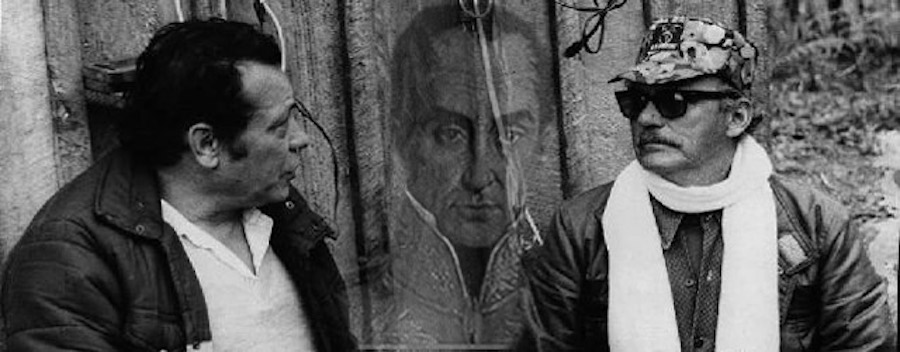
Recently, the nation of Colombia had to vote on whether or not to end a 50-plus-year armed conflict by implementing an agreement between the government and the guerrillas of the Revolutionary Armed Forces of Colombia (FARC).

FARC is one of the major producers and exporters of illegal drugs such as cocaine in the world — one of the reasons why the U.S. government has, for decades, invested billions of dollars in order to defeat them through a program called Plan Colombia. As a result of the peace agreement, FARC agreed to put down their weapons and give up committing crimes in exchange for reduced punishment and political participation.

The other option for the Colombian people was to vote no and stay at war until one, the agreement could be renegotiated to toughen its terms against FARC, or two, the state could defeat them through armed action (which has not been possible in a half-century of conflict).

Critics of the peace process oppose it because of the abominable crimes committed by FARC that are unforgivable for some, but not necessarily the direct victims, whose own suffering has made them more amenable to a compromise.

Similarly, with election day around the corner, the American people must choose a presidential candidate to lead their country for the next four or possibly eight years.

One candidate, Donald Trump, has proposed public policies based on, among other things, the enforcement of border control, police action against the African American community and the Black Lives Matter movement, the repeal of the Affordable Care Act (Obamacare) and tax breaks and loopholes for wealthy and big corporations.

In contrast, Hillary Clinton advocates for better relationships between police and communities through education and understanding, government support of universal healthcare for people who cannot afford it and a fair tax policy that does not cater to corporations and the nation’s wealthiest individuals.  

Another commonality between these three elections is the deep divisions they have created in their respective societies, which has caused animosity to rise even among families and friends. The decision was already made in the case of Great Britain, and the results were a polarizing picture: 51.9 percent voted for leaving the EU over the 48.1 percent that voted to remain.

Colombia, which earlier this month made their decision, voted no, by a 50.22 percent margin rejecting the final agreement to end the armed conflict with FARC, over the 49.77 percent that voted in favor of it.  

Unlike Britain and Colombia, the United States has not yet had its election. The polls have predicted a nail-biter.

Despite Clinton taking a bit of a lead in recent weeks, if we look back to the end of July, the gap was less than one point. The margins in the Brexit (as Britain’s exit from the EU was named) vote, the Colombian peace process vote and the U.S. Presidential race are slim. And with the decisions that have been made, and will be made, it could be said that almost half of respective voters feel or will feel that they have not been heard or validated, which presents a potential legitimacy problem that could significantly affect the stability of these nations now as well as in the future.    

In terms of shared experiences and lessons learned, Brexit appears irreversible despite some of its supporters being confident they can renegotiate a deal with the EU that favors Great Britain.

On the contrary, in Colombia, despite the election’s results, there is still an opportunity to renegotiate the agreement already signed and achieve some form of peace. Although the result is uncertain, the truth is that both political forces (no and yes supporters) have attenuated their differences and considered other creative options that include ideas from both sides of the debate.

In the end, if a renegotiation was to be achieved, the peace process would gain more legitimacy from the people. And if there was more consensus among the people, implementation of a final peace plan would be significantly easier.

In the case of the United States, no matter what the results of the election are, the winning candidate should take into account the claims of people who did not support them, precisely as a way to not dig deeply into the feelings of hate that have seemed to run through both candidates’ campaigns.

Still, this would only seem possible if the winner is Hillary Clinton, who is conciliatory and has not resorted to Donald Trump’s xenophobia and hate.

Natalia Arbeláez Jaramillo is a Colombian lawyer and a former technical advisor in the Congress of the Republic of Colombia. She is currently taking an Intensive English Program at UC Davis.  

Meet the fall 2016 Senate candidates

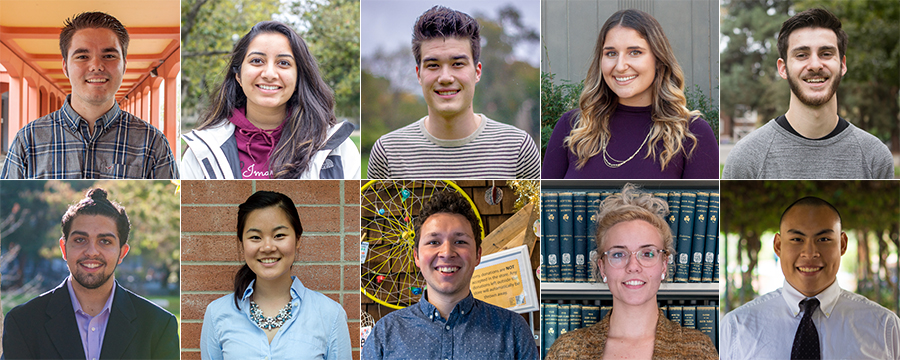
ASUCD Fall Quarter Senate Candidates (LAURA LONG, CHARLES MIIN, DANIEL TAK, NADIA DORIS, AMY HOANG, CAT TAYLOR, KELSEY GREGGE, BRIANA NGO, IAN JONES, ALEXA FONTANILLA / AGGIE)

Senatorial candidates explain platforms, discuss qualifications

Anastasia Ruttkay

Anastasia Ruttkay, a fourth-year international relations major, has decided to run for senate on the Based slate in order to increase sexual harassment awareness and prevention across campus. With experience as a member of the Alpha Phi sorority as well as a past senatorial staff member for current ASUCD president Alex Lee, Ruttkay wants to implement programs within Greek life to prevent occurrences of sexual assault from happening at UC Davis.

“Greek life is one of the main demographics a part of those who contribute the statistics on one in five women in college getting sexualy assaulted,” Ruttkay said. “[Right now] there’s nothing within the individual chapters where there’s a resource for sexual assault prevention.”

If elected, Ruttkay would work with the Study Abroad Office to provide resources in order for students to easily assimilate into a new culture and would fight for increased visibility within the campus administration, especially with the newly elected chancellor.


Matthew Yamaguchi

Matthew Yamaguchi, a fourth-year managerial economics major running as an independent candidate, has focused his platforms on resources for clubs and organizations in order to spread collaboration and constructive efforts. His background in economics and business has inspired him to run in order to help students contribute to the campus.

“The main idea [of my first platform] is to create a physical space for students, clubs, organizations and student-run projects to really collaborate and work together,” Yamaguchi said. “[You can have] all these clubs working in unison […] and the idea is to have all [of them] working together.”

If elected, Yamaguchi would also focus on the use of fields under consideration for residence hall expansion in the Long Range Development plan, as well as the transportation needs of the campus in the form of ride-sharing partners and emergency services. His experience with the Unitrans unit of ASUCD has exposed him to this need of the student body.


Alexander Rodriguez

Alexander Rodriguez, a third-year history major, is running for senate in order to bring to light the multicultural aspects of the UC Davis campus. One of this independent candidate’s biggest platforms includes bringing different groups, organizations and clubs of various representations together to showcase the resources these communities can provide.

“[I’m] really trying to celebrate our diversity […to] show that Davis has so much to offer and every student should feel welcome,” Rodriguez said. “[Students should] be able to be themselves and celebrate themselves, and [I want] to educate people and get people interested in [different views], whether it be a culture or religion.”

As a part of the Muslim Student Association, Rodriguez wants to emphasize the importance of providing the campus with resources meant for specific demographics. His platforms focus on creating a cleansing station for the Davis Muslim population and beyond, representing students’ experiences in the expansion of mental health resources and educating the campus culturally and spiritually overall.


Madison Wheeler

As a third-year English major and transfer student, Madison Wheeler is running independently for senate to emphasize the devotion she has for supporting her community. Wheeler wants to provide the campus with resources within her platforms of campus safety and security.

“My platforms [are] just making sure that people are safe on campus and can get the help when things go wrong,” Wheeler said. “One of the main concerns that I [have] is the fact that there is only one sexual assault assembly that is mandatory for students as incoming students, and I thought that that was a little odd because if someone is here for five years, […] they just don’t  hear about what sexual assault really is.”

Wheeler, if elected, plans on simplifying resources for survivors, including the implementation of a student-based support group and streamlining the sexual violence prevention website. In addition, Wheeler plans on adding substantive lighting and expanding emergency systems on campus. Although she has only recently transferred to UC Davis, Wheeler understands the importance of these resources on such a large campus.


Simran Grewal

Simran Grewal, second-year neurobiology, physiology and behavior major and Summit candidate, hopes to bring more diversity to ASUCD if elected.

“ASUCD serves the student body and it represents all student voices and all those student voices are from different majors, different programs [and] different ethnicities,” Grewal said. “And I thought I’d like to make a difference in ASUCD and have people of different majors come to be involved.”

Grewal previously served as chief of staff for Senator Sevan Nahabedian and is the current vice chair of the Internal Affairs Commission (IAC) and chief of staff for ASUCD Vice President Abhay Sandhu.

Grewal’s platforms include expanding both public health education and dietary diversity on campus. She also wants to install coffee vending machines on the first floor of the library and increase library hours during finals week.


Julie Jung

Julie Jung, who is a second-year political science major and part of the Summit slate, currently serves as an interim senator.

“I actually wasn’t planning on running until maybe a week after I got sworn in,” Jung said. “I realized that there [were] just so many things to do and I couldn’t complete [them] all within one quarter and I knew that I needed to have this seat for at least a whole entire year for me to be able to do something impactful and for me to have a meaningful Senate term.”

Jung hopes to improve the relationship between the senate and the ASUCD units, increase student accessibility to campus food resources like The Pantry and encourage more international students to become involved in ASUCD.

“I know that, as an international student, there [aren’t] many chances for [international] students to get involved within ASUCD,” Jung said.

Jung plans on being a support system for the various areas of ASUCD if elected.


Alexander Keyser

Alexander Keyser, a third-year political science major and Summit candidate, has previously served as vice chair of the Internal Affairs Commission as well as chief of staff for Senator Sam Park. If elected, Keyser plans on helping ASUCD units gain more knowledge regarding ASUCD in order to work more efficiently.

“I’ve watched [the units] struggle with adopted senator programs and seen bills that they’ve tried to pass fail for stupid reasons and I was kind of sick of it,” Keyser said. “I want them to have more influence in ASUCD.”

Keyser also wants to raise awareness of the mental health resources available to students. One of Keyser’s platforms is to change the Intercollegiate Athletics funding from a student fee service to a college paid service in order to increase efficiency.


Jose Antonio Meneses

Jose Antonio Meneses, second-year political science major and Based candidate, hopes to establish a legal undergraduate clinic if elected, likely through the establishment of an additional ASUCD unit.

“I decided to run as a sophomore because I think a lot of people don’t understand how the association works,” Meneses said. “And when I say that, I mean that platforms that you put forward need to be accomplished and platforms do take time. And so as a sophomore, I know I have [an] ample amount of time to work on these platforms.”

Meneses, who has previously served as a legislative aid under former ASUCD President Mariah Watson and has worked with Senator Georgia Savage on her “Let’s Talk about Sex” sexual assault awareness project, also plans on increasing retention and graduation rates for the Asian Pacific Islander community as well as bringing domestic violence awareness and prevention programs to UC Davis.


Zachary Moore

Zachary Moore, fourth-year economics major, is running on the Summit slate. Although he has no formal senate experience, Moore has interned at CALPIRG and is part of several business organizations.

Moore’s platforms include increasing career preparation and networking resources on campus.

“When guest speakers or recruiters from firms come to campus they usually do stuff through student club organization[s],” Moore said. “By running them through the [Internship and Career Center], it will get them more publicity [and] allow more students [to have access to these opportunities].”

Moore also plans to create a UC Davis mobile app interface so students can see which study rooms are currently available in addition to installing Buddy Benches on campus as a means of encouraging community members to mingle.


Daniel Nagey

Daniel Nagey, a second-year managerial economics and psychology double major and Based candidate, has worked as legislative director for The Office of Advocacy & Student Representation and deputy director for Lobby Corps.

“I’m familiar with how the entire structure of ASUCD works,” Nagey said. “So I think that’ll be a really easy transition for me to hop into Senate especially because I have worked with senators [and] coworkers of mine have become senators, so I’ve been through the process of being with them as they ran in previous years and see[ing] what they do on a daily basis. I would say I’m fairly to very familiar with how meetings run and whatnot.”

Nagey’s platforms include addressing food and housing insecurities, increasing transparency surrounding tuition increases and destigmatizing mental health.

UC Davis men’s water polo battles to win hard fought game in final minutes

0
IAN JONES / AGGIE
IAN JONES / AGGIE

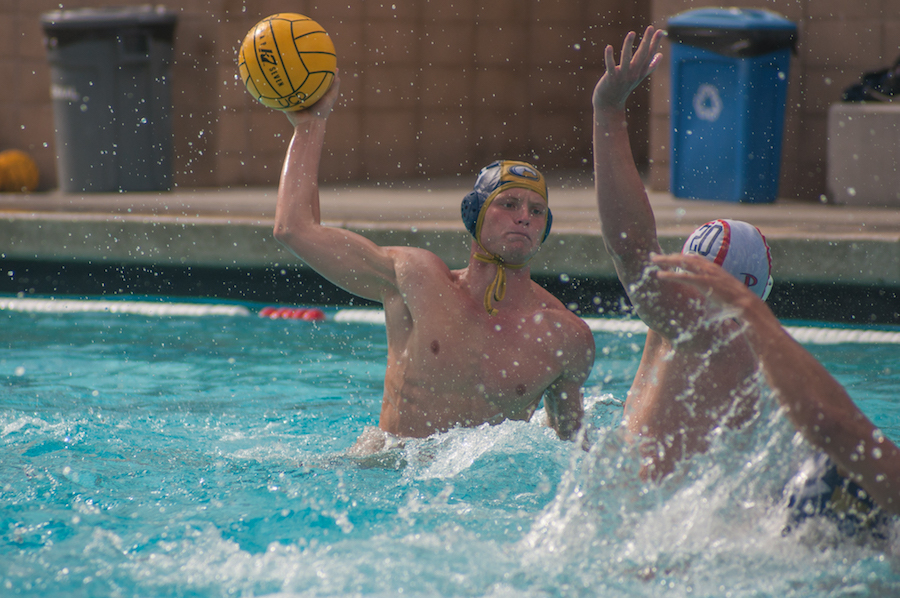
The Aggies fight hard Saturday to earn a 10-9 win over Pepperdine University

The overcast weather last Saturday afternoon at Schaal Aquatics Center did not foreshadow the UC Davis men’s water polo performance, as an intense and hard-fought non-conference game allowed the Aggies to come out victorious over the Pepperdine University Waves, 10-9. Leading up to this game, UC Davis and Pepperdine were both tied for the No. 8 spot by the NCAA Men’s Water Polo Rankings, and the win moved the Aggies to an overall record of 19-4 on the year.

Freshman center Eric Martel and attacker Yurii Hanley, sophomores utility Sasa Antunovic and utility Nick Coufal and juniors attacker Cory Laidig and utility Morgan Olson-Fabbro all found the back of the net to contribute to the UC Davis win. Junior goalkeeper Spencer Creed also came out strong in the match, saving eight of the 14 Pepperdine shots in the first half.

Martel scored the first goal for the Aggies in the first set to give the team a 1-1 tie after the first period. Antunovic and sophomore attacker Marcus Anderson would each score in the second period of play to give the Aggies the lead at 6:44, but the Waves scored three unanswered goals to take the 4-3 lead at halftime.

IAN JONES / AGGIE
IAN JONES / AGGIE

“We didn’t talk about how many goals we were down,” head coach Daniel Leyson said. “We just talked about what we needed to do and tried to stay focus and calm. [The team] really responded well and battled back a couple times which was really great.”

Laidig scored in the third period to tie the game at 4-4. By the 3:38 mark in this period, Pepperdine scored two more goals to take a 6-4 lead. Coufal found the back of the net for the Aggies, and with Hanley not far behind, they were soon tied at 6-6. Pepperdine made a penalty shot with 2:06 left in the third, and sophomore attacker Ido Goldschmidt equalized for the Aggies with just seconds left in the third period, tying the game at 7-7.

At the start of the fourth period, Anderson added another goal to his name, but Pepperdine quickly countered with its own to tie the game at 8-8. Olson-Fabbro

IAN JONES / AGGIE
IAN JONES / AGGIE

scored his first goal of the game for the Aggies to give them the lead, but the back and forth scoring continued as the Waves tied the game once more, at 9-9.

With 2:45 left in the game, Goldschmidt scored a high goal to give the Aggies a 10-9 lead. Pepperdine received a possession with 13 seconds left, but the defense from UC Davis prevented any chance of a goal, and the Aggie came away with a win.

“I think if you emerge victorious in such a hard fought battle against a team that has beaten us before, it is a great testament to how hard these guys are

working and that can give us more confidence moving forward,” Leyson said.

Saturday’s win was against the highest ranked opponent the Aggies have beaten since the opening weekend of the 2015 season.  

The UC Davis men’s water polo team finishes its conference play this week with two home games, one against Loyola Marymount Thursday at 6 p.m., and the other against UC San Diego Saturday at 12 p.m.

“We are going to try to get better one step at a time,” Leyson said. “We know that LMU and San Diego are huge conference rivals and they always give us their best performance. They are gonna come in here and give us a very tough game, so we need to be on top of our game and prepared for tough battles.”

Written by: Ryan Bugsch sports@theaggie.org

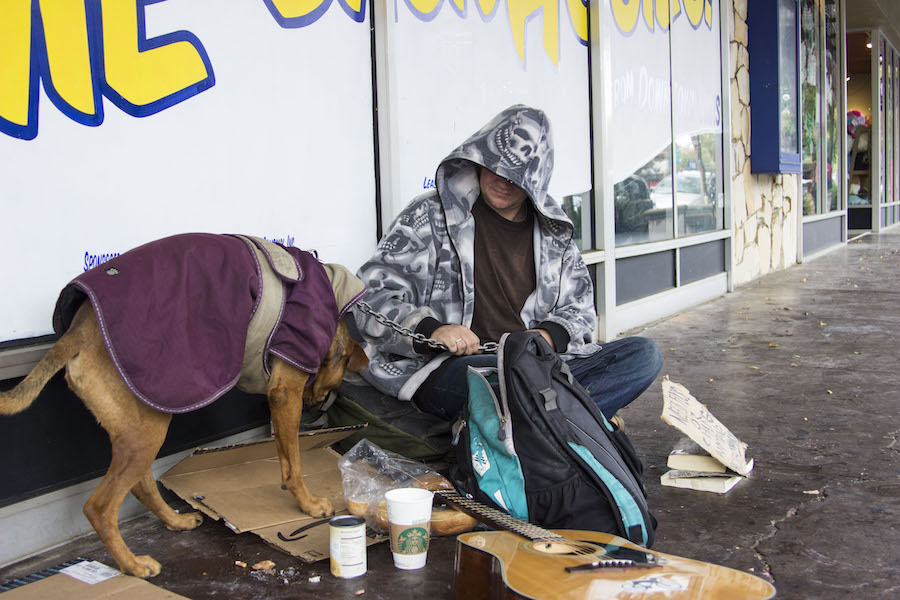
Davis Homeless Shelter seeking volunteers for winter

AMY HOANG / AGGIE
AMY HOANG / AGGIE

Volunteers to complete day-to-day management tasks, guest screening during November to March season

The Interfaith Rotating Winter Shelter (IRWS) is seeking volunteers for two positions to help with day-to-day management tasks and guest screening during its upcoming November to March season.

Those on the host site team will perform tasks such as helping with volunteer sign-ups and making sure the organization is running smoothly, while those on the shelter operations team will coordinate the intake process for guests and will help maintain the shelter conditions as the host site changes.

IRWS, an almost fully volunteer-run organization, provides a homeless shelter to Davis locals. On a given night, the shelter supports 25 to 45 guests, providing each of them with hot meals and a place to sleep, including a cot and a sleeping bag.

“We are the only emergency homeless shelter in Davis,” said Eric Elton, board of directors chairman for IRWS.

Elton added that the shelter does not have a waiting list and takes guests regardless of sobriety.

The Yolo County Homeless Count 2015, an annual report completed by the Yolo County Homeless and Poverty Action Coalition (HPAC), reported that on the night of Jan. 26, 2015, 131 individuals in Davis were considered homeless. This number varies on a nightly basis; the count does not include individuals who may spend their nights at friends’ residences or in foster homes.

Jose Jimenez, an advocate for the homeless in Davis and associate for Street Medicine Sacramento, stressed the seriousness of the issue.

“Substance abuse is a main reason for homelessness,” Jimenez said.

Jimenez said that in order to successfully tackle the issue, local programs need more funding and community-based participation.

While in a given year some 1,500 individuals contribute their time to help IRWS, more volunteers are still needed. Both volunteer and internship positions are offered at IRWS each year, though internship applications are no longer being accepted for this season.

Volunteers and interns alike have benefited greatly from their experiences with the organization. Marie Belen, who is now beginning her third year as an intern for the IRWS, fondly recalls talking to a guest about a shared interest.

“It was really neat because at the moment we were connecting,” Belen said.

Belen believes that working at IRWS has positively changed her perceptions about homelessness and has given her a chance to interact with others in the community. She said that the IRWS is a great place to start helping the homeless since it offers a supportive and safe atmosphere.

For more information about joining IRWS, visit its website at interfaith-shelter.org or e-mail irwsteam@gmail.com. IRWS will be hosting an open house on Nov. 10 at 7 p.m. at the First Church of Christ Scientist.

Written by: Anya Rehon — city@theaggie.org

The 2016 presidential election

HANNAH LEE / AGGIE
HANNAH LEE / AGGIE

Student body, student organizations voice sentiments toward general election

Next Tuesday, Nov. 8, is a day that will forever leave a mark on United States history.

This 2016 presidential election is like none other for a multitude of reasons, one of those reasons being that the nation may have its first female president.

The UC Davis student body has expressed strong sentiments toward the election and the future of the country through The California Aggie’s General Election survey, which asked the question of how, in the students’ opinion, UC Davis thinks politically. The online survey polled around 200 students across all years and colleges, and allowed them to voice other options such as their race or gender if desired.

One particular group is the Davis Students for Hillary (DSH), a political community on campus supporting Clinton and the Democratic Party in the election. Samip Mehta, fourth-year political science major and vice president of the club, described that DSH hosts events such as club banking, debate watches and debates with groups that support different candidates from other parties.

“We are freely progressive but consider ourselves ‘blue-dog’ Democrats,” Mehta said. “However, we are not as liberal as certain Bernie [Sanders] supporters because we have more conservative views on finances, prices and political feasibility.”

While surrounding areas are predominantly conservative, Mehta considers Davis to be “extremely liberal,” which can be seen in the poll results taken from the student body.

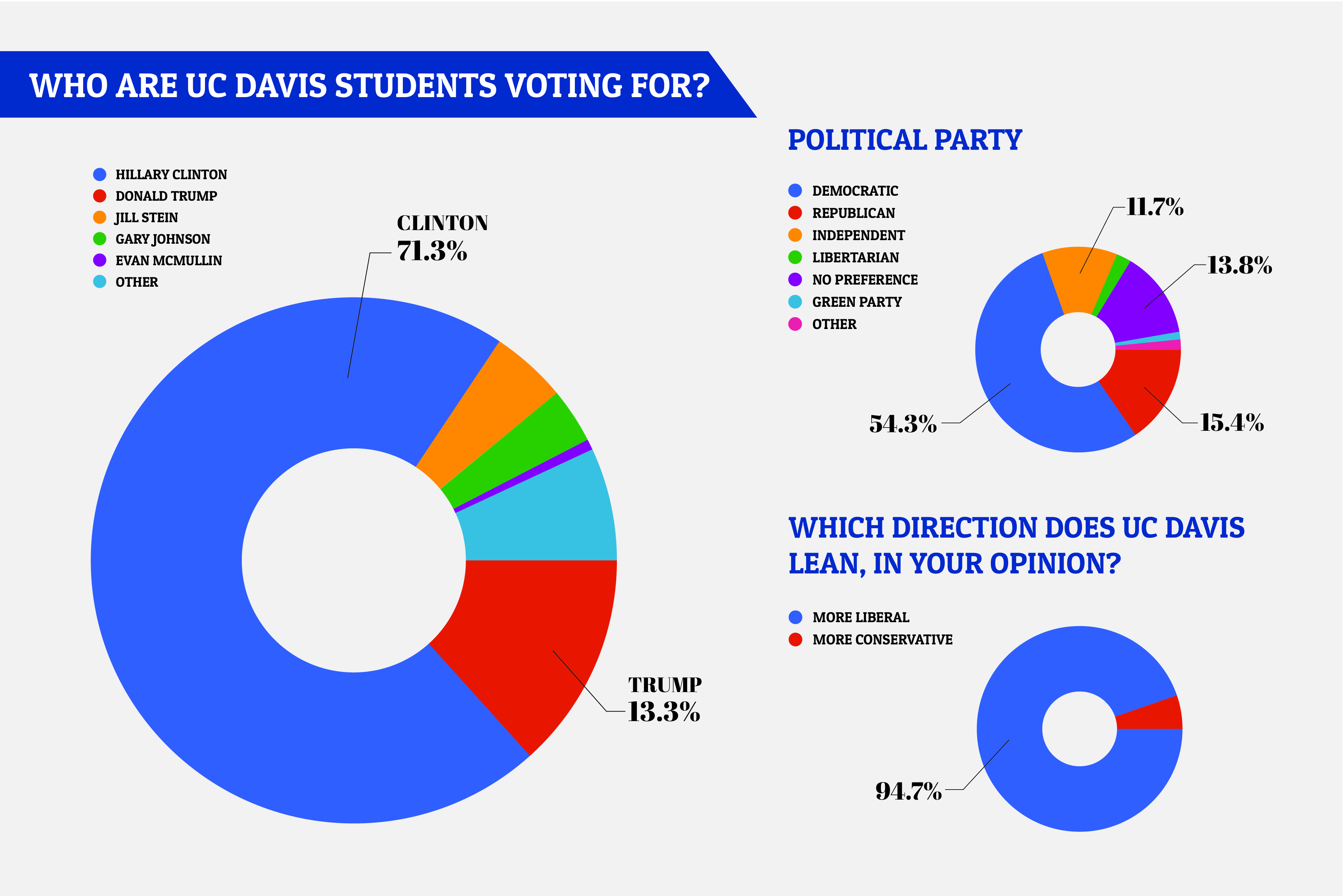
54.3 percent of the student population surveyed said that they were democratic compared to 15.4 percent that said they were Republican. 71.3 percent said they were voting for Hillary while 13.3 percent said they are voting for Donald Trump. While it is clear that the DSH believes that Hillary is the most capable of all the candidates, Mehta is nonetheless concerned for the health of the two-party system.

“I personally feel really strongly that the [those in the] GOP at this point should readdress [themselves], and think ‘am I a Trump conservative, or am I a McCain conservative?’” Mehta said. “The same goes for the Democrats. Should we address ourselves as blue-dog Democrat[s] or progressive liberal[s]?”  

The California Women’s List at UC Davis is another on-campus political organization and is a chapter of a statewide political action committee devoted to fundraising for democratic women elected into state office.

The California Women’s List aims to allow students to network with people in politics as well as fundraise campaigns to elect democratic women to state office, all while operating as a statewide political action committee.

Michaela Worona, third-year political science major and president and co-founder of the Women’s List, is mostly concerned with the treatment of women in this year’s election.

“I just hope that even though women are gaining more visibility through Clinton’s candidacy, we don’t take for granted that feminism has achieved its goal,” Worona said. “[Hillary] is still being treated much differently [compared to] Trump. It’s enlightening to see the way that gender comments and behavior are still at play even though women are gaining more visibility.”

The “nasty woman” memes and shirts of Trump’s disrespectful comment toward his candidate in the final debate bothers Worona, since it reveals a lot about U.S. politics with regards to gender. However, the 76.1 percent of the students who answered The California Aggie’s General Election survey were female, which suggests that UC Davis women have not been ultimately deterred by the controversial politics in this election.

When asked in which direction UC Davis leans as a political entity, 94.7 percent of students said that the campus is more liberal than conservative. However, the voice of the Davis College Republicans (DCR) can still be heard on the UC Davis campus.

Nicholas Francois, third-year political science major and chair of the DCR, described how his organization makes a difference within the state by attending California Republican Party Conventions and volunteering with Republican candidates running for state positions.

“Most campuses are known for being liberal, Davis having a reputation for being one of the most liberal in the nation,” Francois said. “While we may see liberal biases expressed by some professors and even in UC hiring practices, Davis doesn’t tend to represent ‘militant liberalism,’ meaning [that] while we disagree on many things, we feel that there’s not hostility between us because of these differences.”

As one of the only openly Republican groups on campus, the DCR has done its best to represents its own interests while still addressing the opinions of others. The group emphasizes the need for political alignment within each party, as this particular election has taken a toll on both sides.

“We are a conservative organization and we are Republicans, but we are individuals representing diverse people. The party is in-line with many millennials’ beliefs,” Francois said. “This is a difficult national race for both parties […] but it’s important to realize that historically, this has happened before and allowing opposing ideas to have a voice in your own party is how parties survive and how change occurs.”

Professor of political science at UC Davis Robert Huckfeldt noted that while this is true from a general perspective, he has also noticed a variety of political views on campus.

“[The campus] is considerably democratic and liberal, and in that sense it reflects the views of the state,” Huckfeldt said. “We do see […other political beliefs] when we ask people to do questionnaires. From this we see that we do have a substantial number of conservative Republicans keeping us honest.”

On the topic of this particular election, Huckfeldt, like Mehta and Francois, expressed his concern and premonitions about the health of the political party system.

”[The two party system] is badly fractured right now and they’re having trouble holding it together during this trying time,” Huckfeldt said. “Democratic politics require two healthy parties but now the Republican Party is on life support and that’s not good for Democrats either.”

Huckfeldt noted that elections — especially the 2016 election — are wake up calls for both Democrats and Republicans to take the population’s problems more seriously. Huckfeldt encourages students to remember that political parties are solely for winning elections.

“[Students] have to buffer [the dirty politics] and realize that maybe things aren’t quite as bad as they’re making them out to be in terms of the other side,” said Huckfeldt. “The whole thing is predicated on winning so I would encourage everyone not to despair.”

Written by: Gillian Allen and Sahiti Vemula — features@theaggie.org

Propositions are underrated: Go Vote!

JONATHAN CHEN / AGGIE

California votes on 13 state-wide initiatives this November

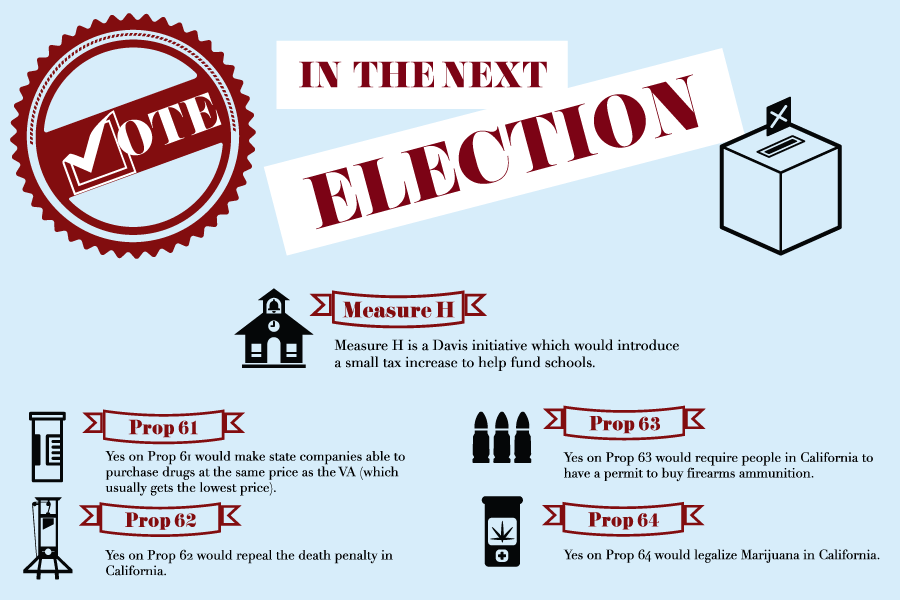
There are 13 statewide propositions on the ballot this year, ranging from Proposition 64, which would legalize the recreational use of marijuana, to Proposition 62, which would repeal the death penalty.

Other propositions include an initiative to force drug companies to sell the state prescriptiom drugs at the same price that they charge to VA (Proposition 61), and a measure to allow non-English languages to be used as a method of instruction in public schools (Proposition 58).

Robb Davis, City of Davis mayor, has not formally endorsed any statewide initiatives at this time but is supportive of Measure H, a local initiative which would renew and slightly increase a previous tax which goes towards funding Davis’ public schools.

“We have a long history here of parcel taxes, meaning it’s a flat tax on a niche parcel for the city, to fund various school programs,” Davis said. “The citizens of this community, over the years, have pretty much systematically said, ‘we want to tax ourselves to provide more resources for students.’ It’s basically to provide a broader array of opportunities for students than they would get if we just relied on state funding.”

While many long-time Davis residents, like Davis, are aware of the local initiatives on the ballot this year, some of UC Davis’ 30,000 students are voting in their hometowns and therefore might not be as interested in Davis-specific measures.

Nick Talbott, graduate student in the Department of Comparative Literature, is voting in Berkeley and is supportive of Proposition 64, which would legalize marijuana in California. However, he admitted that while there are a few propositions that his colleagues are aware of, many of the smaller initiatives get very little attention.

“I think that there are three or four Propositions’ that people know about, but some of the lettered one’s go unnoticed,” Talbott said. “I think there should be more done to advertise some of the individual ones, instead of the larger ones that people are getting a lot on already.”

Carlos Castaneda, a first-year biochemistry and molecular biology major at UC Davis, is interested in a few propositions on the ballot this year, but agreed that much of the talk surrounding the November election has focused on the presidential election rather than the initiatives.

“I’ll be honest and say that I’ve only talked to a few friends [about the election] and, for most of them, the general conversation goes to the Presidential race. I feel like [the propositions] should be taken into account [more] because […] the impact of the propositions is also important,” Castaneda said.

To see a detailed list of all the initiatives on the ballot this year, please visit ballotpedia.org.

Written By: Juno Bhardwaj-shah – city@theaggie.org