55.7 F
Davis

Davis, California

Wednesday, December 24, 2025
Home Blog Page 685

Aggies rusty against Vikings in 51-29 loss

0
BRIANA NGO / AGGIE
BRIANA NGO / AGGIE

UC Davis football loses big against Portland State

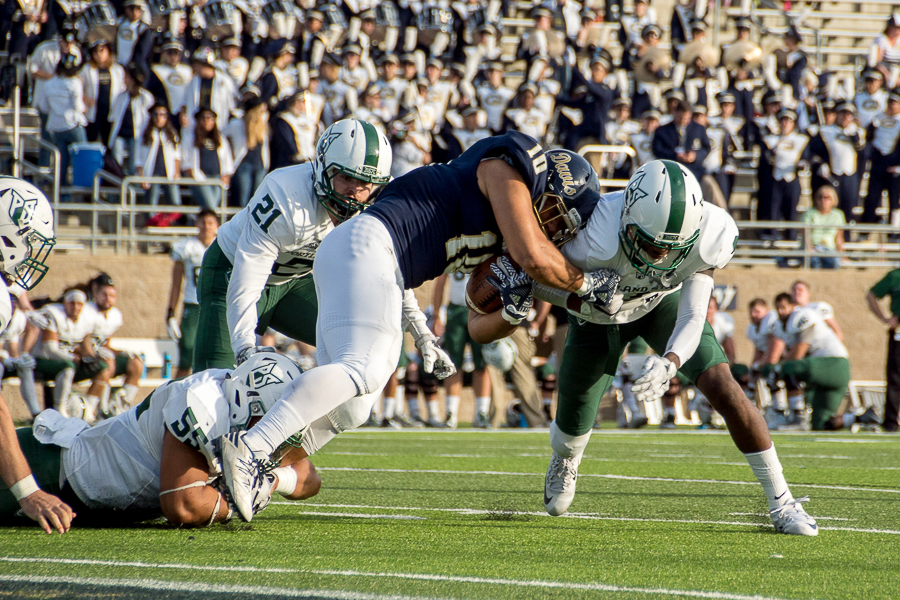
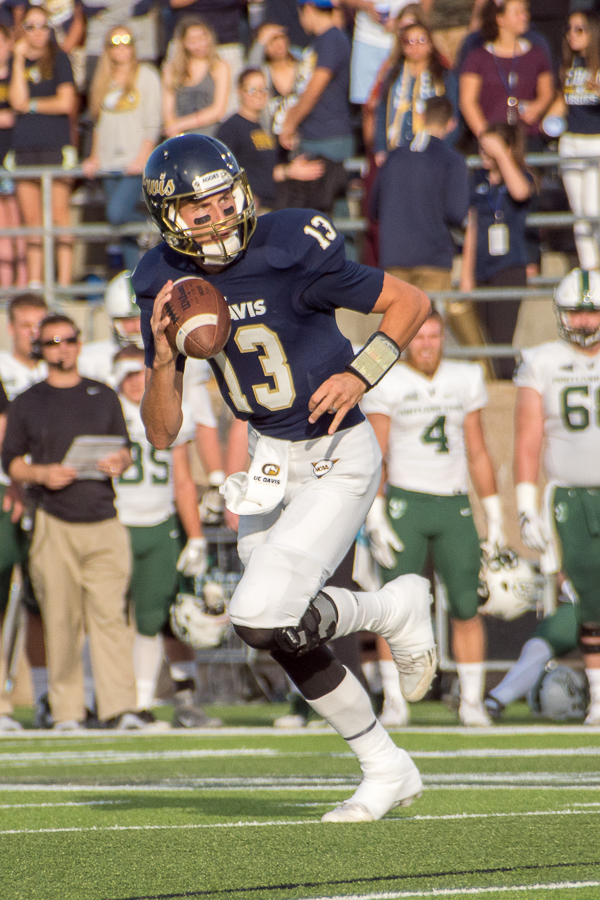
Coming off a bye week, the UC Davis football team fell to the Portland State Vikings, 51-29, after a dismal performance at Aggie Stadium on Saturday.

UC Davis struggled in Saturday’s showdown, gaining just over 400 yards on offense while allowing over 600 yards to Portland State. In comparison, the UC Davis defense has only allowed an average of under 300 yards in the last three games. The Aggies have led with the fewest penalties in the conference this season with just 46.8 penalty yards per game, but they received nine penalties for 68 yards against the Vikings.

“They just outplayed us,” head coach Ron Gould said. “[Personal fouls] are very uncharacteristic of our team, it’s just something we don’t do. […] It’s unacceptable, but we’re going to correct it.”

UC Davis received the ball to start the game but couldn’t get anything going on its first drive. The Vikings then took advantage of their starting drive to get a quick touchdown, putting them up 7-0 early in the first quarter.
BRIANA NGO / AGGIE
BRIANA NGO / AGGIE

The Aggies marched 75 yards downfield and responded with a touchdown pass from senior quarterback Ben Scott to freshman wide receiver Jared Harrell. However, freshman kicker Matt Blair missed the extra point, making it 7-6. Portland State then extended its lead to 10-6 with a 22-yard field goal that was followed by another touchdown to further extend its lead to 17-6.

UC Davis then fumbled the ball in Vikings’ territory, leading to a Portland State touchdown that made it 24-6. The Aggies were held to a field goal that cut the Vikings’ lead to 24-9, but Portland State responded with a field goal of its own though, which put the Vikings back up by 18.

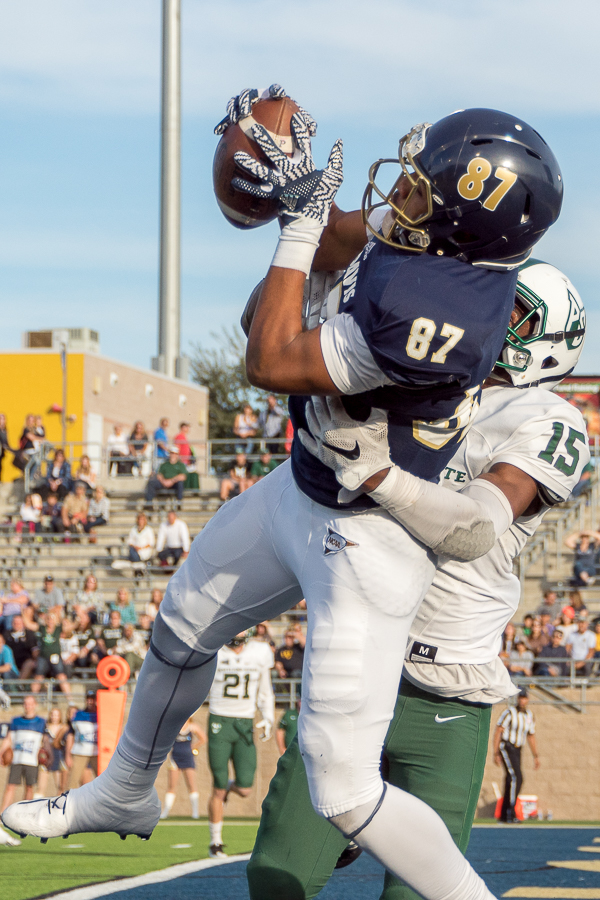
Though Scott’s pass to sophomore wide receiver Keelan Doss in the endzone cut the Vikings’ lead to 27-16, the Vikings could not be stopped and scored a quick field goal to end the half with a 30-16 lead.

Portland State came out of halftime with two quick touchdowns to extend its lead once more to 44-16. The Ags looked disoriented as they tried to go for it on fourth down in the red zone, but Scott ended up throwing an interception instead. On the Vikings’ ensuing possession, the Ags came up with a big sack from junior linebacker Ryan Bua and a blocked field goal attempt deep in their own territory.

Three penalties targeting and personal fouls during three consecutive plays on the UC Davis defense led to a Vikings’
BRIANA NGO / AGGIE
BRIANA NGO / AGGIE

touchdown for a whopping 51-16 lead.

Junior quarterback CJ Spencer came in for the Ags to replace Scott near the middle of the fourth quarter and threw a 14-yard

touchdown pass to Harrell, and another extra point miss by Blair made the score 51-22.

UC Davis then recovered its own onside kick but still couldn’t convert on fourth down. In the final minute of the game, Spencer took it to the house to finish off the scoring.

After the game, Spencer commented on how the Ags just could not get it done.

“We just didn’t capitalize when we needed to capitalize,” Spencer said. “We just have to bounce back and not let this game dictate our future and just keep going and look forward.”

The Aggies hit the road to face Big Sky Conference opponent Montana State this Saturday and return to Aggie Stadium for the Causeway Classic against Sacramento State on Nov. 19 at 1 p.m. to finish out the season.


Written by: Nicolette Sarmiento sports@theaggie.org

Bridging yoga and health care

PIERRETTE WISEMAN [CC BY-NC-ND 2.0] / FLICKR
Researchers study effects of yoga as a potential treatment for children with ADHD

According to the National Health Interview Survey (NHIS), yoga is the sixth most commonly-used complementary health practice among adults, with about 21 million participants nationwide. The survey also found that 3.1 percent of U.S. children, some 1.7 million, practice yoga.

UC Davis recently sponsored an intervention study researching the effects of yoga to improve attention and impulsive behaviors in children displaying attention-deficit hyperactivity disorder (ADHD) symptoms. The study followed 23 children exhibiting ADHD symptoms who were 3 to 5 years old from the Triumph Center for Early Childhood Education in Sacramento.

Symptoms of the disorder include making careless mistakes, engaging in risky behavior, trouble concentrating, being squirmish, having a hard time resisting temptation and having difficulty getting along with others, as stated by the Center for Disease Control (CDC).

“Anyone can benefit from practicing yoga, but there may be some added benefits for kids that have difficulty with attention,” said Samantha Cohen, UC Davis Developmental Behavioral Pediatric Fellow and principal investigator of the study.

The primary purpose for the yoga intervention study was treatment for ADHD symptoms. The participants practiced yoga both at home and at school for six weeks every day. School yoga sessions were taught by an instructor who led the participants through breathing exercises and engaging poses such as ocean, outer space or jungle adventure.

ADHD is present in about 5 percent of the child population in the United States, making it one of the most common childhood neurodevelopmental disorders, according the American Psychiatric Association.

Previous studies have looked at yogic interventions in various age groups, but the primary therapeutic strategy on the preschool level has been centered around teaching parents strategies to manage and alleviate their child’s symptoms.

“I decided to focus on that [preschool] age group to see if yoga would be something that would be beneficial as a type of behavioral therapy […] to help with learning some self-regulation skills,” Cohen said, “Things that they could use from when they’re young and on the way through their life.”

Studying ADHD to find solutions and preventative measures for the symptoms will help millions of children as well as older age groups because symptoms often persist into adulthood.

Biological data collected included recording heart rate variability every three months. Additional data was collected through surveys completed by parents and teachers, including: rating the participant’s attentional attendance, concentration, pro-social behaviors, impulsive behaviors, emotional state and peer problems.

“Some of the kids would do yoga throughout the day. At random times they would do poses or they would teach their friends poses. Other kids wouldn’t do it on their own, but if you prompted them to do it they could,” Cohen said.

If no yoga session was held at school, a children’s yoga video was provided to the participant’s caregiver to practice at home. Encouragement from the children’s’ parents and teachers to participate in yoga activities was highly reinforced.

One of the primary differences Cohen’s study noticed was that the intervention’s efficacy varied depending on the environment.

“When we put the kids out of class to do the yoga it didn’t work as well as when we […] had the whole class participate together,” Cohen said.

Cohen noted that there is still a ways to go, with the need to perform larger studies with more participants. Although, if the indications of current research scale well, Cohen hopes that more parents and educators recognize the potential mindfulness yoga techniques have to offer both at home and in the classroom.

Cohen also encourages parents interested in getting their children involved in yoga to explore the classes currently offered by many Davis yoga studios.

Recently, the 2015 National Health Statistics Report listed reasons for practicing yoga as reported by yoga users: general wellness and disease 80 percent, improving immune function 30 percent and improving memory and concentration 31.2 percent.  

“Yoga truly helps ameliorate pain, rejuvenate and revitalize the body after holding repetitive positions and motions,” said Ellen Street, a fourth-year clinical nutrition major and yoga instructor at the Activities and Recreation Center, in an e-mail interview.

The emphasis on awareness of breath and movement encourages strategies similar to clinical therapies. In doing so, yoga also offers a chance for anyone to gain the skills needed to cope with the demands in their lives, especially students.

“Students need yoga. […] Biking, walking, sprinting to class and of course, sitting, studying and reading –– [they] take a toll on your body!” Street said via e-mail.

Tonya Keck, yoga instructor at the Student Health and Wellness Center, promotes routine practice among students.

“Mainly the pressure is so strong as a college student, and everyone has so much stress on them that [yoga is] a release,” Keck said. “There are so many different types of yoga and that’s another benefit […] you can pick from whatever works for you.”

Yoga’s benefits are applicable to a wide range of ages and personalities, and as this practice becomes more popular in Western culture, further benefits are being researched as a valid approach to preventative medical care and treatment.

“There’s a reason this practice is still going strong after it’s origin 5,000 years ago,” Street said.


Written by: Logan Sidle and Shivani Kamal – science@theaggie.org

Certain Women has heart, but lacks character development

AGGIE / GENESIA TING

Michelle Williams, Kristen Stewart give excellent performances

Certain Women is an understated drama written and directed by acclaimed indie director Kelly Reichardt (Old Joy, Night Moves).

Set in the beautiful, vast, snowy landscape of Montana, the movie follows the intersecting lives of four women: Laura Dern as a frustrated and empathetic lawyer, Michelle Williams as a quietly determined wife and mother, Kristen Stewart as an exhausted lawyer-teacher and newcomer Lily Gladstone as a lonely ranch worker. The film follows the lives of these women with a quiet gaze which many aren’t used to in an age where the loudest and brightest movies make the most money.

Michelle Williams gives an impressive performance as the silent yet powerfully determined Gina, who is intimidating even to her own family. Gina is bent on building a home from the ground up, and sets her eye on acquiring sandstone from the front yard of a lonely, elderly man named Albert. It’s clear that Albert has some emotional connection to the stone, but Gina convinces him to sell it, suppressing her feelings of guilt from manipulating him.

This moment portrays a complex, well-written female character: empathetic, yet resolute enough to accomplish what she wants. Often, women in film are either portrayed as caring to a fault, putting everyone else before themselves, or as masculine, emotionless and ruthless. There seems to be a lack of women in movies who act like real humans, so Gina’s character was incredibly refreshing.

The cinematography was also stunning, often lingering on a character’s face, which at first made me impatient and uncomfortable. However, as the film progressed, I started to enjoy the long takes. The lack of dialogue forces the audience to decipher what the characters are feeling by carefully studying their faces, and the cinematography allowed for many beautiful, subtle moments during which we see emotions play out on an actor’s face.

There are, however, some aspects of the film that I personally didn’t enjoy.

I’m always hesitant to call a movie “slow,” because films nowadays are filled with non-stop action, fast-paced dialogue and quick editing that doesn’t leave time to contemplate a scene. But there were far too many long and stationary location shots, and once the monotony of everyday life in a small town of Montana had clearly been established, any additional time that was spent on those shots took away from moments that could have been used for character development.

I also wasn’t satisfied with the exploration of the characters, and wish that we would have gotten additional time with them.

Maybe we’re meant to get only a glimpse into the lives of these women, who are in ways so different and yet so similar. All four are lonely and misunderstood, and we’re informed of this in such small, silent moments; there is no self-indulgent, pseudo-intellectual dialogue about why and how these characters are suffering. The audience sees it in quiet moments, such as Gina’s quick and heartbreaking reaction when her husband and daughter dismiss her desire to be included in whatever joke they were just laughing about. Or when Jamie, played by Stewart, continues to attend a night class she isn’t enrolled in, hoping that the teacher might notice her.

The film doesn’t make a big show of the important moments, preferring to let the audience come to their own realizations and because of this, I recommend this to anyone who thinks they’d enjoy a change of pace in their movies.


Written by: Pari Sagafi — arts@theaggie.org

2016 Fall Quarter election results announced

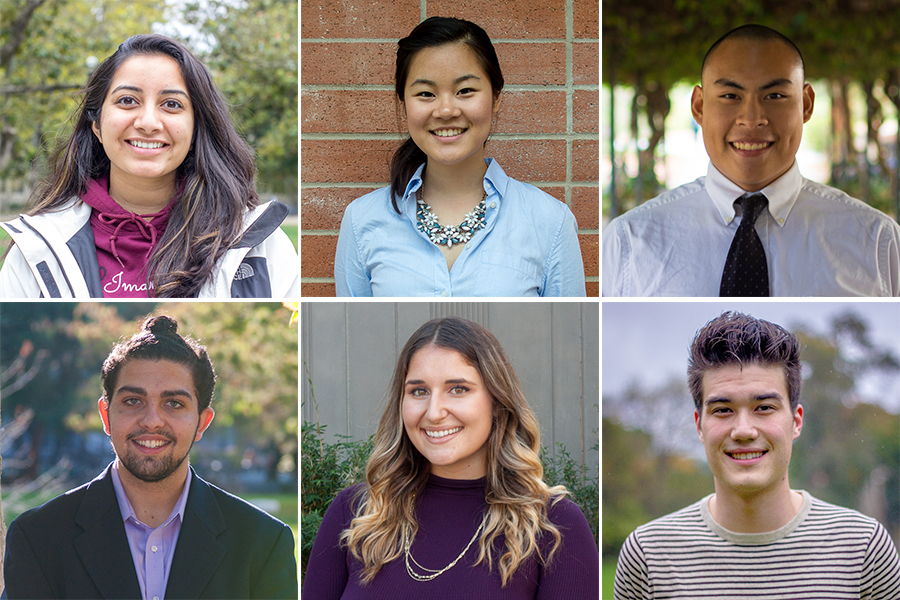
Simran Grewal, Anastasia Ruttkay, Julie Jung, Daniel Nagey, Matthew Yamaguchi and Jose Antonio V. Meneses (AMY HOANG, CAT TAYLOR, DANIEL TAK, IAN JONES, LAURA LONG, KELSEY GREGGE / AGGIE)

Six senators elected, judicial branch to be dissolved

Fall Quarter election results were released online at elections.ucdavis.edu on Nov. 11 at 4 p.m.. 2,116 students voted on senators to represent the UC Davis student body in ASUCD Senate.

Out of the 10 candidates who ran, six were elected. The six new senators are Simran Grewal, Anastasia Ruttkay, Julie Jung, Daniel Nagey, Matthew Yamaguchi and Jose Antonio V. Meneses. Grewal and Jung ran on the Summit slate. Ruttkay, Nagey and Meneses ran on the BASED slate, while Yamaguchi ran independently.

The sole measure on the ballot, an amendment to dissolve the ASUCD judicial branch, passed.

Written by: Alyssa Vandenberg  — campus@theaggie.org


Note: Updates made to reflect the result of the judicial amendment on November 16, 2016. 

Students hold anti-Trump rally at Memorial Union

BRIANA NGO / AGGIE
BRIANA NGO / AGGIE

UC Davis students continue to protest Trump’s presidential victory

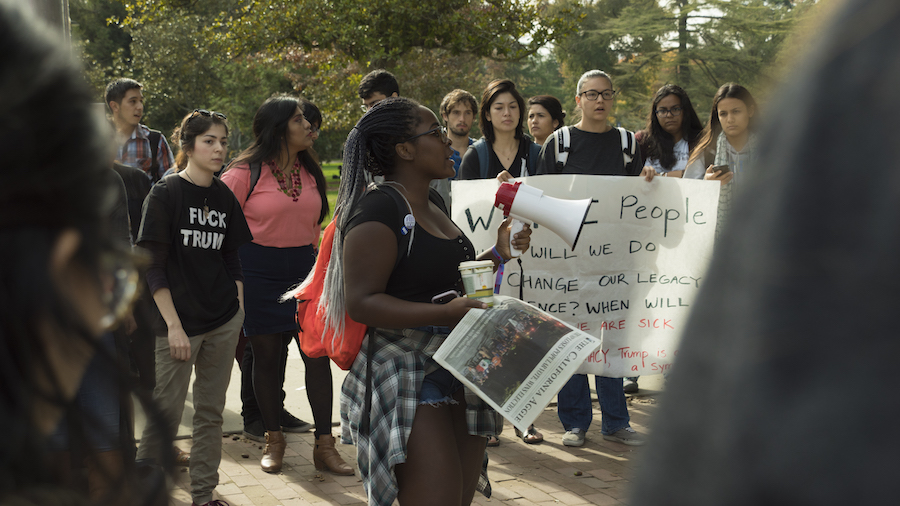
Over 100 students gathered at the Memorial Union (MU) flagpole at 10:00 a.m. on Nov. 10 to protest Donald Trump winning the presidential election.

The rally began with several UC Davis students sharing their thoughts and fears post-election as well as ways to move forward in protesting Trump’s presidency. Some students led chants, such as “say it loud and say it clear, immigrants are welcome here.”

The protesters then marched throughout campus with their signs, which included phrases like “Trump is not my president” and “fight against white supremacy.” As they marched, they chanted “No Trump, no KKK, no fascist USA” and “f*uck Donald Trump.” The group returned to the MU around 12:00 p.m. Students then took turns speaking into a megaphone about ways to resist a Trump presidency and leading chants such as “we are America, Trump is not America,” “not my president” and “the people united will never be divided.”

Students attended the rally to find hope during a fearful time and solidarity with others in the UC Davis community.

“I’m scared for me, I’m scared for my family, [for] my family members that are illegal,” said Jenifer Elizabeth Velazquez Sanchez, a third-year psychology major. “I came here legally but I’m still not a citizen so I fear for myself and I fear for my safety and I fear for my fellow classmates’ safety and I just think it’s ridiculous how someone like this can get into power and I do think it is like ‘white lash,’ like some other people have mentioned against minorities and against different people, against LGBT community, against Hispanics, […] it’s just a shame to me and it is scary.”

Many students found comfort in coming together as a community and showing support for those who felt threatened by a Trump presidency.

“I’m just so proud of us as students, that we actually can make a difference,” said Amber Kumar, a third-year computer science, design and communications major who attended the rally. “The fact that the millennial map says that we’d all vote for Hillary is just out of this world to me and I know that we’re all feeling a lot of pain and I’m just glad that we can put that pain into passion and make it into something very constructive. So I’m very proud of us as a school.”

Chris Alfaro, a third-year political science and Chicana/Chicano studies double major, appreciates that UC Davis provides a space in which students can protest the election results.

“I have a lot of friends at other universities,” Alfaro said. “I posted a video of a protest and one of my friends was like ‘I’m glad that you guys are protesting. Unfortunately my school isn’t.’  […] I’m proud of the fact that my school provides [this] space for everybody.”

Written by: Alyssa Vandenberg  — campus@theaggie.org

Post-election processing spaces available for UC Davis community

DANIEL TAK / AGGIE
DANIEL TAK / AGGIE

SHCS and CAN to provide healing spaces for students this week, next week

On Nov. 8, Donald Trump surpassed the 270 electoral votes needed to win the presidential election. To aid students who may fear for the safety of themselves and others after this election result, Student Health and Counseling Services (SHCS) and Community Advising Network (CAN) are providing processing spaces for the UC Davis community this week and next week.

The times and locations of these processing spaces are listed below:

11/9/16 from noon to 2:00 p.m. in the Cross-Cultural Center PEACE Lounge (http://campusmap.ucdavis.edu/?b=223) with SHCS CAN

counselor Tatum Phan.

11/9/16 from 3:15 to 5:00 p.m. at Casa Cuahetemoc for Chi/Lat students with SHCS counselor Adriana Torres.

11/9/16 from 4:00 to 6:00 p.m. in the Educational Opportunity Program cottage (http://campusmap.ucdavis.edu/?b=240) with SHCS CAN counselor Roxana Reyes.

11/10/16 from 1:00 to 3:00 in the Student Recruitment & Retention Center

(http://campusmap.ucdavis.edu/?b=143) with SHCS CAN counselor Tracy Thomas.

11/10/16 from 4:00 to 6:00 p.m. in the WRRC Resource Room (http://campusmap.ucdavis.edu/?b=111) with SHCS CAN counselor Sheetal Shah.

11/14/16 from noon to 2:00 p.m. in the International Complex Third Floor Conference Room with SHCS CAN counselor Sheetal Shah.

11/15/16 from 4:00 to 6:00 p.m. (location TBD) with SHCS CAN counselor Roxana Reyes.

11/15/16 from 5:00 to 7:00 p.m. in the CARE Office with CAN counselor Maia Huang.

11/16/16 from 12:05 to 1:30 p.m.: Supportive Discussion for Grad/Professional Students in King Hall, Room 1301.

11/16/16 from 4:00 to 6:00 p.m. in the Cross-Cultural Center with SHCS CAN counselor Tatum Phan.

11/17/16 from noon until 2:00 p.m. in the Center for African Diaspora Student Success (http://cadss.ucdavis.edu) with SHCS CAN counselor Michelle Burt.

11/18/16 from 2:00 until 4:00 p.m. in the Student Recruitment and Retention Center with SHCS CAN counselor Tracy Thomas.


The following processing spaces, although not facilitated by SHCS, are also available for students:

11/9/16 from 4:00 to 5:00 p.m.: Cuppa Tea Dialogue, LGBTQIA Resource Center

11/9/16 from 5:00 to 7:00 p.m.: MESA Processing Space, in the LGBTQIA Resource Center, with Jinni Pradhan

11/9/16 from 5:00 to 8:00 p.m.: Extended Hours/Processing Space, AB540 and Undocumented Student Center


Compiled by: Alyssa Vandenberg  — campus@theaggie.org

This article was updated on Nov. 11 at 2:05 p.m. to include new resources available to students. 

Is America on the cusp of a historic decline?

GAGE SKIDMORE [CC BY-SA 2.0] / CREATIVE COMMONS
Donald Trump’s improbable triumph answers no questions

headshot_efWhat’s the story of this election? How, in the months ahead of Donald Trump’s inauguration, do we confront the uncertainty we now face as an increasingly rogue nation? Do we begin by trying to explain the election by asking the basic, practical questions — was it the whites without college education? The industrial midwest? The turnout in Wayne County, Michigan? — or do we ask the questions that don’t have immediate answers? Will we ask the existential questions that reflect the severity of the reckoning our nation now faces? Or will we pretend to know the answers, instead of attempting to seriously investigate how a bigot assumed the presidency after running a campaign fueled on racial and ethnic hate?

Do voters and nonvoters recognize they sanctioned that hate and made it possible for a businessman who called for the death of five innocent teenagers to now be the ultimate arbiter of justice in a bitterly divided nation? Did they see that in his victory speech, Trump couldn’t seem to say that he would be a president of all Americans without reeking of the stench of his crony surrogates? And will that be the Trump presidency? — a collection of power-hungry failures named Christie, Carson and Giuliani vying for prime real-estate in their new boss’ vastly empty brain? Did we elect an empty shell to be filled by the worst of the establishment voters repudiated with historic ferocity?

And when we ask about these voters, and how the polls, with all their statistical clout, failed to capture their beliefs and leanings, will we think about an actual scenario in which that happens — a pollster calls, gets a person confused about what’s being asked and then gets angrily cursed down — and will we consider the ways in which that curse could have suggested the paranoid, alienated mindset of many Trump voters?

Is there a certain sting now to calling Trump supporters paranoid and alienated? Did they not make it to the polls? Does the characterization stink of the same liberal elitism that they so vehemently reacted against with what CNN contributor Van Jones aptly called the ‘whitelash?’ Will we try to quantify the exact, numerical consequences of that whitelash by quantifying the slow erosion of the Voting Rights Act, passed in 1965 to end racial discrimination at the ballot box, or will we stop to consider what allowed lawmakers to get away with disenfranchising the black vote in the first place? Was it backhanded tactics to close polling stations? Or was it a population largely apathetic to people who don’t look like them? A tradition in the Republican party of saying one thing (no voter fraud) and meaning another (no blacks allowed)?

Or should we blame someone else entirely for this American tragedy?

Will we blame third-party Johnson voters in Florida or young Jill Stein supporters in Ann Arbor, Michigan? And if we do — which we might, because nobody likes to think they didn’t do enough and everyone likes to point fingers — would we be so blind as to not see that Trump could have been and threatened to be a third-party candidate, and that the anger that drives people to make unreasonable protest votes is the same that elected a real-estate mogul with no relevant political experience?

Should we blame the dozens of elected officials who, by the sole virtue of Trump running under their party’s name, gave him a free pass for one inexcusable act of racism, bigotry and sexual assault after the next? Will we be able to hold these men and women accountable if America becomes an authoritarian state or will we fail as we did when Mike Pence managed to dance around his running mate’s disgusting con-man behavior in the vice presidential debate?

Do we have the wherewithal to tangibly support those who have the means to hold power accountable? Will we buy newspaper subscriptions? Will we donate to law schools training future civil right attorneys? Or will we become a nation defined as much by its complacency as the stupidity of its next leader? What will this fight look like? Will it make America better? After the largest political upset in American history, can we make any claim to certainty anymore?

Written by: Eli Flesch — ekflesch@ucdavis.edu

Students protest Donald Trump’s presidential victory

JAY GELVEZON / AGGIE

Students march through campus, Downtown Davis to express frustration with election results

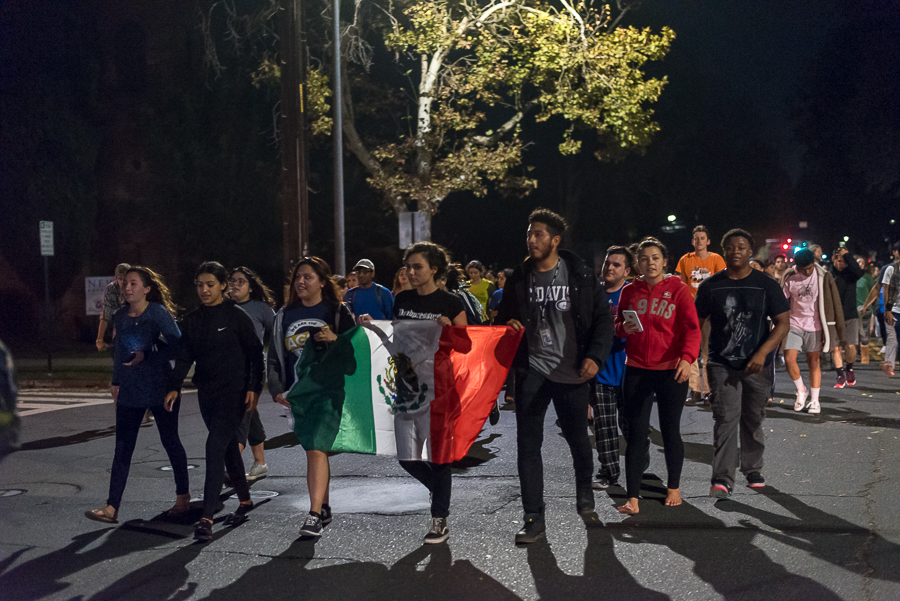
At around 11:30 p.m. on Nov. 8, a few hundred students began marching through campus and Downtown Davis to protest Donald Trump winning the presidential election.

Student chants during the march included “f*ck Donald Trump,” “Trump is an asshole” and “not my president.” At times, protesters blocked Russell Boulevard while police remained on standby.

“I actually think this is a beautiful protest because we’re all coming together as one and protesting against Donald Trump,” said Luisa Gonzalez, a first-year undeclared student.

For many students, the protest provided not only a way to express disappointment in the election results, but also an opportunity to demonstrate their political views in a way other than voting.

“I personally can’t vote because I’m too young, so this is my way of still voicing my thoughts,” said Christal Juarez, a first-year English major.

Karen Lopez, a first-year student majoring in human development, said that the protest allowed her to have a voice in the election.

“I’m not a citizen, so this is my way of making my voice heard,” Lopez said.

At around 2:00 a.m., the protesters gathered in front of the Whole Foods in Downtown Davis. At that time, protesters spoke on why the election result mattered to them and stressed the need for the protest to remain peaceful.
Post-election results protests occurred at universities nationwide, including UC Santa Barbara, UC Berkeley and University of Oregon.


Written by: Alyssa Vandenberg — campus@theaggie.org

Senate endorsements: consider the following

HANNAH LEE / AGGIE
HANNAH LEE / AGGIE

ASUCD’s Fall Quarter Senate elections begin next week. To help UC Davis students choose the most qualified students to represent them, the Editorial Board interviewed all 10 candidates. After asking a series of questions about their platforms and knowledge regarding campus issues and Senate itself, the Editorial Board chose to endorse three candidates. While the majority of candidates had good intentions, these three candidates had the most experience and specificity to their platforms as well as the wherewithal to complete them.

No. 1: Simran Grewal

As a neurobiology, physiology and behavior major, Grewal would bring an element of diversity to a Senate that is lacking STEM representation. Grewal, who currently serves as the vice chair of the Internal Affairs Commission, has the experience and passion to incite change. The Editorial Board is impressed by the level of detail in Grewal’s plans, which include increasing dietary diversity on campus and keeping the library open for 24 hours a day during finals week, as well as how informed she is about campus issues.

No. 2: Julie Jung

As the former junior chief of staff to ASUCD President Alex Lee and a current interim senator, political science major Jung has the knowledge and experience needed to achieve her platforms, including making ASUCD more accessible for international students. Jung, who chose to run in order to complete the platforms she started working on during her time on Senate this quarter, has detailed knowledge about the goings-on of campus and ASUCD as a whole. Additionally, the Editorial Board appreciates Jung’s commitment to increasing and expanding resources for ASUCD units.

No. 3: Daniel Nagey

Managerial economics and psychology double major Nagey has a passion for student justice that will make him an effective senator. He is invested in advocating for and destigmatizing mental health awareness on campus, increasing transparency from the administration and addressing food and housing insecurities for students. His awareness of issues that matter for students will help him make an impact on campus.

The candidates will debate on Monday, Nov. 7 from 12 to 1:30 p.m. at the CoHo.

The Editorial Board encourages students to vote at elections.ucdavis.edu. Voting is open Tuesday, Nov. 8 at 8 a.m. until 12 a.m. on Nov. 11.

Russell Westbrook’s year

0

TIM SHELBY [CC BY 2.0] / FLICKR
Russell Westbrook was put in a difficult position in the beginning of July. His longtime partner in crime and teammate, Kevin Durant, opted to join the Golden State Warriors in probably the biggest free agent acquisition in NBA history aside from LeBron James’ decision to join the Miami Heat in 2010.

After Durant’s departure, many fans, analysts and pundits speculated that the Thunder organization was doomed. Westbrook surely had to follow Durant’s footsteps and leave now, right? Many predicted he would bolt at the end of the 2016-2017 season and go back to his hometown, Los Angeles, to bring the Lakers back from the dead. He was born in Long Beach. He went to UCLA. Going to the Lakers was going to be the next move, but it never happened.

Westbrook extended his contract with Oklahoma City. The NBA community assumed he had to go elsewhere. Being in Oklahoma City as a perennial contender is one thing, but fans believed his desire to remain was contingent on the strength of the roster. Westbrook signed a three-year extension worth $85 million to stay in Oklahoma City.

As a self-proclaimed fashion icon agreeing to another three years in a cowboy town that many believe can’t contain personalities such as his, this move was shocking. Now, Westbrook is out to claim that he can do it alone, and he is off to one hell of a start.

Last Friday, Westbrook tallied 51 points, 13 rebounds and 10 assists in a game against the Phoenix Suns. This was the first time a 50-point triple-double has occurred since Kareem Abdul-Jabbar did it 40 years ago.

Oh, and that wasn’t just some anomaly. Westbrook was just one assist away from tallying another triple-double in the first game of the season. This will be a recurring theme this season.

Westbrook will have some absolutely filthy stat lines this season; he’s out to prove that he doesn’t need KD or anyone else to keep his team near the top of the Western Conference.

Westbrook’s decision to extend with Thunder after Durant’s exit was, in my mind, the most admirable move a prominent athlete has made since I can remember.

Westbrook has the old-school mentality that many former athletes love to see, because it reminds them of their generation. Westbrook never pouted, never complained and took this as a challenge. And it’s fueling him to become a man on a mission.

This breakup has set him on track for a historical season, and I’m clamoring to watch it all unfold. I still get the jitters thinking about Durant vs. Westbrook Round I on Thursday, Nov. 3.

The matchup between the Warriors and the Thunder won’t encompass all the animosity from the fans that we will see once Durant returns to Oklahoma City, but it should be a memorable one nonetheless.

Written by: Michael Wexler — sports@theaggie.org

Kanye West and Cirque Du Soleil just an Uber ride away

COMMSCOPE [CC BY 2.0] / FLICKR
New Golden 1 Center offers more accessible entertainment venue for UC Davis students

Sick of trying to find a way to get to San Francisco or Oakland for concerts? Look no further than the new Golden 1 Center. Located in the heart of downtown Sacramento and home of the Sacramento Kings, the Golden 1 Center is a multi-purpose arena that hosts concerts and other entertainment events.

Unlike some large arenas, the center has implemented many new sustainable practices. Sacramento is known for its farm-to-fork philosophy, and Golden 1 honors that by bringing concessions from within a 150-mile radius and by donating all leftover food to Sacramento Community Food Bank and Family Services. On top of that, any leftover fryer oil is converted to biodiesel by a local family-run business.

Another new aspect to the center is the Art Collection. This collection is the result of the Sacramento Kings’ partnership with the Sacramento Metropolitan Arts Commission. The team has already contributed art currently displayed in downtown Sacramento and has also donated $5.5 million to the “Art in Public Spaces” program.

And no need to fret about getting tickets — this new arena has a seating capacity of 17,500, so there will be plenty of chances to get tickets to sporting events and concerts.

Here are some highlights of the upcoming season:

Kanye West: SAINT PABLO TOUR / Sunday, Nov. 19 at 9 p.m.; tickets start at $26

Kanye has added a second leg to his tour along with new dates and locations, including Sacramento. Tickets went on sale on Oct. 22 at www.livenation.com. This tour promotes his chart-topping new album The Life of Pablo.

Cirque Du Soleil: Toruk The First Flight / Wednesday, Nov. 30 to Sunday, Dec. 4; tickets range from $30-$100

This new Cirque Du Soleil show is based on James Cameron’s Avatar. This show takes audience members to the world of Pandora to experience storytelling like never before. Cirque Du Soleil is known for its beautiful visuals and ability to transform venues into different worlds through the power of dance acrobatics.

Electric Christmas / Thursday, Dec. 8 at 6 p.m.; tickets are $36, $40 and $75.

Fan of alternative music? Check out this event hosted by Radio 94.7, the best radio station in the Greater Sacramento area for alternative artists. The lineup for this event includes Capital Cities, Milky Chance, Glass Animals, The Naked and Famous and Warpaint. And since this event is at the end of finals week, it can serve as a good way to end finals on a high note.

V101 Throwback Holiday Jam / Saturday, Dec. 10 at 8 p.m.; tickets range from $30-$75

The event features live performances by Bone Thugs-N-Harmony, Juvenile, BLACKstreet, Ginuwine, En Vogue, Baby Bash, Zapp and JJ Fad. It is put on by Pacific Concert Group and the V101 radio station, Sacramento’s home for throwback hip hop and R&B.

Written by: CaraJoy Kleinrock — arts@theaggie.org

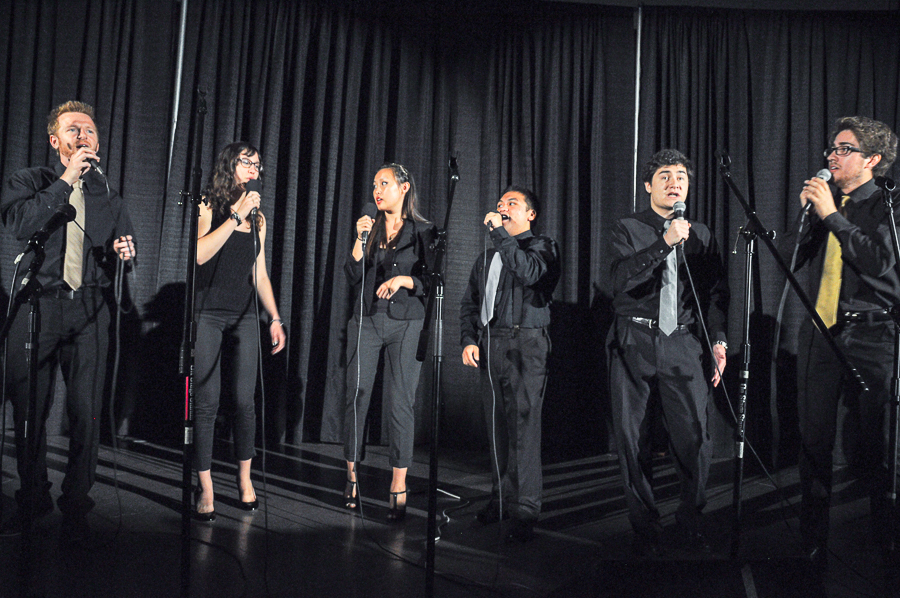
Introducing the Davis Chamber Choir

JAY GELVEZON / AGGIE FILE

Davis Chamber Choir offers different approach to a cappella

The Liquid Hotplates, the Lounge Lizards, the Spokes: these student-run a cappella groups are ubiquitous on the UC Davis campus. With a repertoire of pop mash-ups and catchy melodies, their performances have an effortless appeal. But lesser known is the Davis Chamber Choir (DCC), which lacks such campus familiarity.

But that’s not to say its sound is any less lovable; Ashley West, second-year music and sociology double major and DCC member, emphasized that DCC performs a variety of tracks.

“It’s a different approach, I would say. It’s classical music — but not all of it; we do jazz and pop interspersed with that. That makes us different than other student music groups on campus,” West said.

DCC members, who are mostly trained musicians, have a strong overlap with other campus organizations like Band-Uh! and various a cappella groups.

“From the other a cappella groups, I get that for them it is a fun activity more than it is theoretical. There’s definitely more of a nerdy type [in DCC],” West said.

Yet DCC is no stranger to fun. Whether it’s performing at the Bookstore’s grand opening this fall or caroling around the holiday season, DCC ensures its performances are lively and entertaining — and that its friendships are strong.

In fact, personal relationships are heavily emphasized for the chamber choir. Nicole Villalon, second-year student animal science and music double major, explained that, for her, DCC was a way to meet people immediately after arriving in Davis.

“I’ve always viewed choir as a place where I can meet my closest friends, especially at a new school. So I decided to join choir here so I could get a head start on meeting people,” Villalon said.

Bailey Cooke, DCC director and second-year music major, similarly mentions the importance of DCC relationships.

“It’s been a bountiful source of friendship, personal expression and learning. I’ve learned so much about not only choral music and leadership but also how music can touch others and inspire in ways unmatched by any other medium,” Cooke said.

West mentioned the importance of DCC friendships, despite the group’s recent growth and the challenges that such growth entails.

“We’re a bigger group than usual. We were 24-ish last year, and now we’re more like 30 — which is awesome; now we have this big sound. But we want to maintain the closeness and the friendship aspect, so we have to be more intentional about that this year,” West said.

But like any on-campus organization, DCC has faced its fair share of challenges. After a recent policy change by the Department of Music, DCC (and other non-department music organizations on campus) was no longer able to practice in the music building. It now holds its bi-weekly rehearsals in Olson Hall.

“We had the luxury of rehearsing in the UC Davis Music Building last year and for a few weeks this quarter. Many full sized pianos and acoustically-sound practice rooms were at our disposal,” Cooke said. “We were expelled from the building a few weeks ago when the music department mandated that all non-department affiliated ensembles not rehearse there. We’ve since relocated to Olson Hall and although it hasn’t been ideal, we’ve made it work and are still able to rehearse effectively and efficiently.”

However, West emphasized that this was in no way a conflict between DCC and the Music Department, but simply a minor inconvenience the group faced and overcame.

“Another thing that’s come up is satisfying different people’s wants with the repertoire. Some people want to do more carols, [and] some people say we need to do more pop songs,” West said. “Obviously there’s no way to please everyone, and [it’s a challenge] trying to balance that so everyone can be really excited about what we’re singing.”

Less challenging for DCC, however, is music. With consistent rehearsal schedules and a dedicated (and talented) team, its performances are a wonderful surprise.

“I think we have street cred in the fact that we sing with passion as well as technical excellence. I’d like to further our reputation for excellence,” Cooke said.

West noted that the majority of the group’s audience is musically trained, but anyone can enjoy their music.

“People who aren’t [musically] trained enjoy our music, but they wouldn’t know that they would,” West said. “Like the ‘choir’ in the name is off-putting, or something.”

But, of course, talent supersedes recognition. Don’t believe it? Take a listen. Check out DCC’s cover of Steam Powered Giraffe’s “Honeybee” on YouTube, or attend the group’s performance at the annual Alotta Capella event on Dec. 2 at 7 p.m.

Written by: Ally Overbay — arts@theaggie.org

How other countries do gun control right

PUBLIC DOMAIN / ARPINGSTONE

headshot_taAmerica could stand to learn a few things from other nations about gun laws


Controversial as the statement may seem, America is actually not the best at everything — especially when it comes to gun violence and gun laws. Our gun homicide rates are 25.2 times higher than those of other high-income industrialized countries such as England or Japan.

Unlike America, the United Kingdom decided to act on gun legislation when a tragic mass shooting in 1996 occurred at a primary school in Dunblane, Scotland. In the months following Dunblane, a nationwide fever of public debate ensued. The Snowdrop Petition was launched and a judicial inquiry was initiated. These actions and their consequences were all swift and groundbreaking. The Snowdrop Petition, which called for a ban on private gun ownership, elicited 750,000 signatures.

To put that into context, after the Sandy Hook Elementary shooting in Connecticut, 300,000 people signed a petition on the White House’s official page. After taking into account the total population of England versus America, that’s about 12 times the public support in England for gun control following a prominent national tragedy.

That public pressure, as well as the anticipation of the Cullen Inquiry, which would report official findings about the shooting and ways to prevent it, worked well for the United Kingdom. The U.K. banned all handguns above 0.22 caliber with the Firearms Amendment Act of 1997, and extended it by banning all handguns regardless of the caliber in an amendment to the legislation the same year.

Since then, England’s firearm-related mortality rate has dropped to 0.3 percent.

Out of 127 million people, only 710,000 civilians own a private firearm in Japan, meaning that less than one percent of the entire population own a gun. Their law, which dates back to 1958, is the closest to a zero-tolerance gun policy that the world has seen.

It states that no one is permitted to own a firearm or sword, with a few exceptions, such as only being able to own a shotgun with a rigorous licensing process. Japan’s firearm homicide rate? Only 0.1 percent.

Even though Japan is one of the most stringent gun-control nations in the world, the United States could still stand to learn from their firearm background-check process. In Japan, before someone can even think about owning a weapon, they have to attend special classes on firearm use, pass written and oral tests, take a drug test and undergo a comprehensive background check. Only if all these tests are passed with no red flags can a gun be purchased.

Although it’s impossible to project exactly what would happen in the United States if laws such as these were implemented, it is safe to say that deaths by firearms rates would decrease.

By having to undergo background checks, criminals with a past history of violence or abuse would be weeded out. Having to take a series of training and educational classes would deter impulsive or suicidal prospective owners. A drug test would highlight those who may not be in the best condition to own a gun at that point in their lives.

Other issues, such as not being able to filter people who are dangerous, but don’t necessarily have a written record of violence or criminal activity, still need to be addressed. But we need to start somewhere.

The United Kingdom’s change came after a horrifying mass massacre of children. Japan’s came in an effort to unify the population. When, and what, will it take for America’s change to come?

Written by: Tamanna Ahluwalia — tahluwalia@ucdavis.edu

Disclaimer: The views and opinions expressed by individual columnists belong to the columnists alone and do not necessarily indicate the views and opinions held by The California Aggie.

At The Crossroads: Bridging cultural divides by bridging technology and storytelling


JAY GELVEZON / AGGIE

headshot_tdAs our world grows increasingly connected through technology, the opportunity to interact with others from different cultural, political and religious backgrounds is also increasing. Social media allows users to communicate with individuals across the globe in mere seconds, promoting civilized sharing of ideas across cultures and, consequently, building a more tolerant global environment with less conflict.

But the sustained cycles of war, bigotry and injustice within nations and their residents prove otherwise, frequently defining the social and political atmospheres both between and within countries. As accentuated by the recent presidential election, the failure to connect with different cultures is painfully evident within our country — a nation ostensibly founded on tolerance and freedom.

This past year in politics has dishearteningly shown that instead of learning about and embracing the unique backgrounds of other Americans, many citizens automatically resort to fear of cultural differences and foreign communities. An increasing reluctance to be sensitive to the hardships of other cultures reflects a dearth of empathy deemed acceptable by many American residents and leaders.

And simmering cultural intolerance isn’t just a phenomenon of the presidential election. Recent studies have provided empirical evidence of decreasing levels of empathy among Americans over the past few decades, often pointing to Millennials’ self-centered behaviors that earned them — well, us — the title “Generation Me.”

College students today, despite being one of the most liberal and open-minded populations in American society, have displayed lower levels of empathy in comparison to older generations.

A study published in 2010 by the Association for Psychological Science by the University of Michigan noted that college students’ empathy has dropped by a staggering 40 percent since 2000, while the National Institutes of Health reported that 58 percent of college students in 2009 placed higher on the narcissism scale than those in 1982.

Yet our generation has theoretically enjoyed more access to humanizing pieces of information than any other age group in history. Why haven’t reports on nations in crisis like Syria inspired compassion within us? Why has technology failed to repair our nation’s “empathy deficit” that President Obama warned about a decade ago?

Despite the staggering amount of information available from our pockets, there isn’t a huge incentive for users to inform themselves about unfamiliar concepts or cultures through technology like the Internet. People often structure their social media experiences to reflect their already-established interests — following Twitter accounts, reading news sources and subscribing to subreddits that merely reiterate and reaffirm their beliefs.

Perhaps most troubling is the magnitude of users unaware of their ideological insulation. Facebook admitted to using algorithms for its news feed that muzzle opinions conflicting with users’ views. Social scientists Walter Quattrociocci, Antonia Scala and Cass R. Sunstein further published a draft paper offering quantitative proof for the existence of echo chambers on social media sites, particularly Facebook.

This becomes even more worrisome when you consider that two-thirds of American Facebook users — a little under half the US population — utilize Facebook as a primary news source.

Even when confronted with new or opposing ideas, technology doesn’t require individuals to participate in actual civilized discourse. One glance at the hellish cesspool of Youtube’s comment section shows that trashing others’ ideas often comes more easily than engaging in respectful conversations.

But the world is more diverse than our individual beliefs. Although it’s perfectly valid to use technology to refine one’s argument, the inability to honor or even encounter contrary ideas is detrimental to growing empathy, which requires putting oneself in the mindset of another — a process key to understanding anyone with a radically different background.

Hearing others’ stories triggers our brains’ mirror neurons, which are central to strengthening empathy. It’s no surprise, then, that researchers at The New School found that reading works of literary fiction — which frequently offer intense glimpses into the psyches of central characters — enhances our capacity for empathy.

Literature has repeatedly been at the forefront of social change because of its ability to incite widespread empathy. Harriet Beecher Stowe’s anti-slavery novel Uncle Tom’s Cabin depicted slaves as human beings — showing Southerners, many for the first time, that their shackled workers weren’t just property. Stowe additionally shocked Northerners who were indifferent towards slavery by displaying the cruel treatment of slaves by their owners. Uncle Tom’s Cabin became the second best-selling book in the United States, helping to spur the 1850s abolitionist movement. By humanizing slaves through storytelling, Stowe transformed not just a few apathetic hearts, but an entire nation.

Another example of the influence of storytelling on empathy comes from Art Spiegelman’s Maus, the only graphic novel to have won a Pulitzer Prize. Maus follows the extensive conversations between Art Spiegelman and his father, Vladek Spiegelman, a Holocaust survivor.

I was startled by my deeply emotional response to Maus. I had learned about the grisly horrors of the Holocaust in school. I had seen The Boy in the Striped Pyjamas and studied The Diary of Anne Frank. A year and a half ago I read Man’s Search for Meaning, a harrowing memoir recounting Viktor Frankl’s time in the Auschwitz-Birkenau concentration camp. Since I had accumulated knowledge about the Holocaust throughout my life, I didn’t expect to walk away from Maus feeling fundamentally changed.

But understanding doesn’t just entail knowledge — true empathy requires the emotional experience of imagining one’s self in another’s position. As Vladek’s suffering — which included witnessing the capture of his family and friends and the extermination of those around him — unfolded before my eyes in Spiegelman’s illustrations, I couldn’t help but put myself in his shoes.

How would I say goodbye to my parents, knowing that they could be taken directly to the gas chambers in Auschwitz? How would I reconcile the insurmountable sadness of knowing that my brothers were to be gunned down and thrown into a mass grave?

Sobering, excruciating questions like these that have made me think about Maus almost every day since I finished it.

But beyond Vladek’s story, I acquired the perspective of a Holocaust survivor’s child. Part of Maus’ effectiveness stems from Spiegelman’s ability to skillfully juggle multiple mindsets. He thoroughly examines not only the life of a Holocaust survivor, both during and after the war, but also the heartbreaking guilt many second-generation Jews experience.

I never considered the reverberating consequences of the Holocaust, besides the loss of family and friends, on successive Jewish generations before reading Maus. Art Spiegelman admits, “I feel so inadequate trying to reconstruct a reality that was worse than my darkest dreams. And trying to do it as a comic strip!” The sheer weight of being a survivor’s son, unable to comprehend the past trials of his parents, never crossed my mind.

Most significantly, I experienced these emotional revelations in response to a tragedy that’s already considered one of the most horrific in history. I became more empathetic towards a group for whom I already possessed great compassion.

Ultimately, knowing that six million Jews died as a result of Nazi persecution wasn’t enough. No statistic can capture the emotional and mental impact of something as devastating as the Holocaust. Even if they’re relaying crucial information — like the inconceivable death toll of genocide — pure statistics dehumanize and erase the personal stories of their subjects. It’s easy to use statistics to strip away the humanity of large groups of people.

One of the most recent and obvious examples of this tactic can be found in Donald Trump’s campaign, which has thrived on fearing “the other” — whether that insinuates Syrian refugees, Mexican immigrants, women or simply anybody speaking out against him.

He depicts Muslims as monsters by (falsely) claiming that “thousands and thousands” of Muslims celebrated in New Jersey as the World Trade Center collapsed. He (falsely) declared that the majority of Mexican immigrants are criminals, drug dealers and rapists.

His son, Donald Trump Jr., likened Syrian and other refugees — persecuted individuals with heartrending stories — to Skittles to make an egregiously false statement about potential terrorists entering the US (when, according to the State Department, fewer than 20 out of 785,000 refugees have been arrested or removed for terrorist concerns).

Dehumanizing methods like the ones employed by Trump discourage cultural acceptance and often lead to unprovoked violence, like the attack on a homeless Mexican man by two Boston brothers.

They claimed that “Trump was right — all these illegals need to be deported.” The attackers exemplify the consequences of dehumanization and ignoring empathy: in their eyes, Mexicans aren’t human — they’re “illegals” who deserve punishment.

When presented as facts, Trump’s unfounded quips and statistics silence the stories of thousands of people. And without a conversation, there’s little hope for empathy.

Whether Hillary Clinton or Trump win the election on Nov. 8, the effects of Trump’s campaign will continue to haunt the nation. His offensive remarks have damaged countless communities and exposed the prejudices in our culture. But rather than simply bemoaning the events of this election, I still believe in the ability to change hearts through storytelling.

Perhaps we thought our nation was better than what we’ve revealed during this past year and a half. But now that we know these prejudices exist, we can start making changes in the right direction.

Rather than slinking away to our separate political corners on Nov. 9, we need to engage in thoughtful conversations about the future of our country — with gentleness, compassion and a recognition that those across the political aisle are also humans.

Social media can spread stories and increase empathy, but only when it’s used to its full potential. While the echo chambers of most social media sites shield individuals from contrary opinions, polarize ideologies and prevent progress, users don’t have to remain unacquainted with the world’s extensive spectrum of beliefs.

Social media must work to bridge the divide between political parties, religions, races, genders and cultures. By providing a platform to communicate with people from a multitude of backgrounds, technology has granted us the ability to create an environment more harmonious and empathetic than ever before.

For the safety of our nation and fellow human beings, we can’t continue living in our own ideological bubbles.

Written by: Taryn DeOilers — tldeoilers@ucdavis.edu

Disclaimer: The views and opinions expressed by individual columnists belong to the columnists alone and do not necessarily indicate the views and opinions held by The California Aggie.