



Migratory birds make Davis home for the winter

Yellow-rumped warbler, red-shafted flicker prepare for breeding
On Jan. 16, Lois Richter, a docent for the UC Davis Arboretum, led a tour highlighting winter birds in Davis. Richter has been giving this tour every year for five years, and she explained that the Arboretum did not have any outdoor winter events before hers.
Richter did a presentation including a slideshow of the birds and then went for a walk in the arboretum to point out the birds that she had been talking about.
Two birds that Richter indicated as her favorites were the Colaptes auratus and Setophaga coronata, commonly known as the red-shafted flicker and yellow-rumped warbler, respectively. The yellow-rumped warbler, among other migratory birds, changes its appearance in the winter.
“Yellow-rumped warblers look different in the winter than in the summer,” Richter said. “The plumage is very bright in the summer and in the winter their plumage is much duller and grayer.”
The yellow-rumped warbler flies all the way to Canada and Alaska in the summer and flies down to California, Arizona and Mexico in the winter.
The red-shafted flicker, also known as the northern flicker, is very widespread across the United States, according to Richter. The species migrates into Canada and Alaska in the summer and flies down into the southern states and Mexico in the winter. There are even some parts of the U.S. where they can be seen year-round.
“Each individual bird has a place it likes to hang out in the summer and then another place it likes to hang out in the winter,” Richter said. “One [red-shafted flicker] might go from Oregon to Mexico and another one might go from Alaska to Davis. You don’t know which bird is doing which.”
Marilyn Ramenofsky, a professor at UC Davis studying the physiology and behavior of migratory birds, indicates that migratory birds are traveling long distances in order to breed. The breeding season is only one and a half months for migratory birds and before they travel, the birds must undergo an increase in muscle mass.
“When [a migratory bird] arrives at a great distance, it must be ready to start to breed. A lot of the changes, although we don’t see them on the surface, are getting started here in the wintering grounds,” Ramenofsky said.
The migratory birds need a month to prepare for breeding before they migrate and therefore, need an environmental cue to initiate these physiological changes. These birds start feeding more, fattening and changing once photoperiod, the period of time during the day that there is light, starts to increase.
Comparatively, non-migratory birds have to respond to local cues, such as precipitation, weather, bud bursts and insect emergence. The nuttalli, a subspecies of the Zonotrichia leucophrys, commonly known as the white-crowned sparrow, does not have to change its weight as much as migratory birds before breeding. Not only do native birds not have to travel to breed, but they also breed for six to eight months.
According to Ramenofsky, there are also different types of migrant birds, such as long-distance migrants and middle-distance migrants. Alison Kent, a board member of the Yolo Audubon Society, indicates that Davis is an important winter destination along the Pacific Flyway.
“Birds in general move to where there’s food,” Kent said. “The Central Valley, where Davis is, is a very important wintering place on the Pacific Flyway especially for water birds, such as ducks and geese.”
On the Yolo bypass, hundreds of ducks and geese can be seen during this time of the year. Additionally, birds such as the yellow-rumped warbler can be found in the Arboretum until late April.
Written By: RIVA BALLIS – city@theaggie.org
Medical marijuana patients now allowed to privately grow own medication
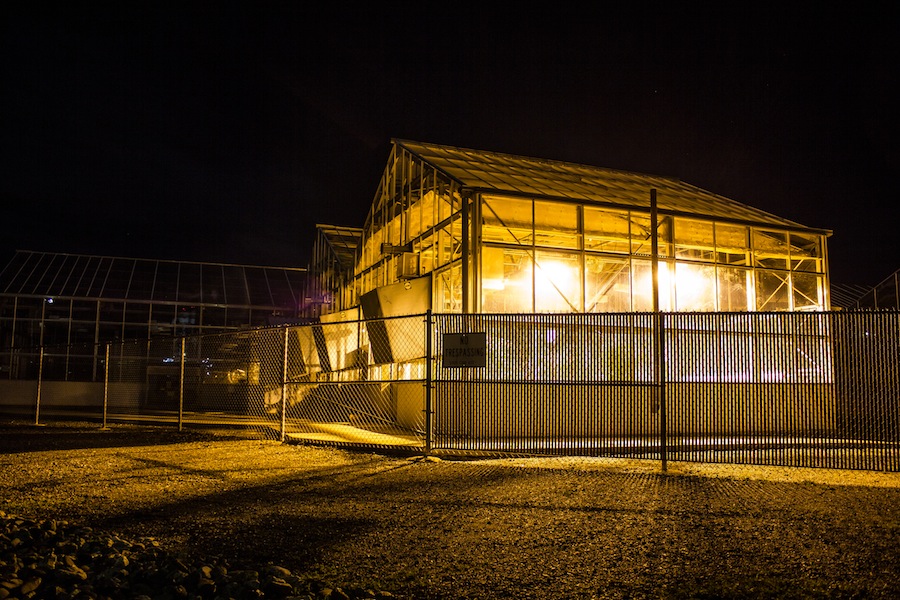
City Council passes temporary ordinance allowing indoor cultivation of marijuana for medical use only
On Jan. 12, the Davis City Council unanimously passed a local ordinance allowing patients who rely on medical marijuana as treatment to cultivate up to 50 square feet in their homes.
Assembly Bill 21 (AB 21) a California bill that went into effect on Jan. 1, requires cities or counties to enact local ordinances regulating the cultivation of medical marijuana by March 1, or they will have to follow state regulations.
Under AB 21, cities and counties are given only three months to develop policies that either prohibit or regulate cultivation of marijuana.
“If the city does not act to adopt something that’s effective prior to March 1, the council will be forever banned in the absence of another change from the state legislature to do something in the future,” City Attorney Harriet Steiner said.
At the City Council meeting, Councilmember Brett Lee emphasized the importance of keeping local control rather than surrendering control to the state. The state’s regulations are “a one-size fits all” that are not designed to meet the needs of Davis.
Councilmember Lucas Frerichs agreed with the importance of maintaining local control and even expressed interest in collecting revenue from the taxation of marijuana if it is legalized for recreational use in the future.
Currently, Davis bans medical marijuana dispensaries from operating within the city, and patients rely on dispensaries in neighboring cities and delivery services.
“I’m interested in potential[ly] changing not only an expansion of this current ordinance, but also the possible change in the prohibition of dispensaries,” Frerichs said.
Members of the public were divided on the issue of whether the city should prohibit cultivation. Some expressed concern that there is an inadequate amount of research on the effects of marijuana for the city to make a balanced decision, while others questioned if the council should take any action at all. The council was asked to make a decision considering the cultivation ordinance as a medical and health issue.
“We’re talking about policies that affect patients with a legitimate medical need,” said Ian Roland, a patient and part-time UC Davis student.
None of the council members supported taking no action, agreeing that the city should be in control and not yield their authority to the state.
The City Council unanimously voted to pass an ordinance that allows indoor cultivation of medical marijuana, prohibiting outdoor and commercial cultivation of marijuana in all zoning districts in the city. The ordinance limits marijuana cultivation to 50 square feet per patient and 250 square feet for the patient’s primary caregiver.
“I’ll support [the motion to prohibit commercial cultivation] for the purposes of this temporary ordinance,” Frerichs said. “I do think there needs to be a larger discussion certainly about outdoor cultivation, but also about commercial cultivation.”
The ordinance does not to require registration for patients and primary caregivers and gives the city the ability to amend its law and modify the regulations as it sees fit.
The ordinance is not meant to be permanent; city staff have agreed to revisit the issue of medical marijuana by the end of the year, and the ordinance shall last no more than 18 months from the date of adoption.
Written By: CARLA ARANGO – city@theaggie.org
Afrikan Black Coalition calls for UC to divest from Wells Fargo
Coalition’s demands due to Wells Fargo’s investments in private prisons
In January, the Afrikan Black Coalition (ABC) created a petition calling for the University of California to divest $425 million worth of stock from Wells Fargo due to the banking and financial company’s financial support in private prison companies.
The coalition recently succeeded in getting the university system to relinquish $25 million invested directly into Corrections Corporation of America (CCA) and The GEO Group, the two largest for-profit prison companies in America.
The organization is now focusing on the UC’s investments in Wells Fargo, which owns nearly 1.5 million shares in both CCA and The GEO Group. In 2012, the banking company also loaned a $785 million line of credit to CCA. Additionally, $300 million of The GEO Group’s corporate debt is held by Wells Fargo, according to a 2012 report.
According to the coalition, the private prison business adds to the country’s history of incarcerating African Americans at disproportionate rates.
“Black students are intimately familiar with the disproportionate rate at which Black bodies are rounded up and fed to the carceral system,” said Anthony Williams, the prison divestment communications director for ABC, in a press release. “The impact of mass incarceration on Afrikan and immigrant folks in the United States cannot be ignored.”
For years, private prisons have been the subject of discussion revolving around the ethics and the conditions of the facilities. In 2009, a panel of state judges ordered the state of California to reduce its prison population to help overcrowding, leading to a reduction of 25,000 inmates.
Eyonna Woghiren, the external vice-president of the UC Davis Black Student Union, talked about the effects that private prisons have on minority populations.
“We see black and brown people are being incarcerated at high rates and being given harsher sentences for the crime, in comparison to their white pupils,” Woghiren said in an email interview. “Until this rotten system is changed and rebuilt, African Americans and other minority groups will remain marginalized.”
When asked about the UC’s plans for its stocks invested in Wells Fargo, Claire Doan, a media communications specialist for the University of California Office of the President said that the university is not planning to sell any of its current investments in the company.
“There are no plans for the UC system to let go of its Wells Fargo investments,” Doan said.
In 2015, Columbia University became the first university in the U.S. to divest from private prison companies. While Columbia’s effort, which began in early 2014, was much longer than ABC’s campaign that led to the UC’s divestment, Woghiren notes that the UC’s campaign against Wells Fargo will be much more significant.
“Pushing for divestment for the UC system in itself was an action many did not feel could be accomplished but it didn’t stop us from mobilizing,” Woghiren said. “Going forward things are going to get more difficult in regards to Wells Fargo, but we will not stand to see this business flourish on the backs of our people.”
Written by: Ivan Valenzuela – campus@theaggie.org
Album review: Panic! At the Disco returns with ‘Death of a Bachelor’

Brendon Urie’s new album has hits and soon-to-be fan favorites
Panic! At the Disco (P!ATD) released its fifth album on Jan. 15, marking a glorious return to the sounds of 2005’s A Fever You Can’t Sweat Out, with added panache. Brendon Urie, the group’s frontman, recorded the entire album as the only remaining member of the band. This release is a celebration of Urie’s own brand of cabaret-esque emo glam, and the entire album listens like a Broadway Circus, if there ever was such a thing.
The chanting chorus of “Victorious” kicks off the album with a bang, proclaiming, “Tonight we are victorious / Champagne pouring over us / All my friends were glorious.” While the lyrics could easily come off as a cheesy attempt at Top 40 pop, Urie’s vocals and the synth notes in the background turn it into a sure party anthem.
Track two, entitled “Don’t Threaten Me With a Good Time,” samples the well-known song, “Rock Lobster,” from The B-52’s self-titled 1979 album. This unexpected sampling is indicative of Death of a Bachelor’s genre-bending quality. Urie manages to blend the band’s original brand of emo rock with touches of new-wave pop as well as some notable jazz influences.
“Emperor’s New Clothes” is the fourth track of the album and is as magnificent and catchy as P!ATD’s earlier work. Their line up has been in flux since the creation of the band, with Urie the only remaining member. With this album, he has finally moved beyond the stress of replacing members; this song is his powerful celebration of independence. Urie sings, “Welcome to the end of eras / Ice has melted back to life / Done my time and served my sentence.” Urie is finally his own emperor, and the album is better for it.
“Death of a Bachelor,” the album’s title track, is smooth and velvety. Urie’s vocals are accompanied by a sweet but subtle bass line. He somehow weaves Sinatra-esque vocals over a sensual and modern rhythm section. The song seems to be inspired by Urie’s recent marriage and offers a tender message: “How could I ask for more? / A lifetime of laughter / At the expense of a bachelor.” The track feels definitively Urie. It is new, it is different and it all meshes extremely well.
The second half of the album gets nostalgic. “Golden Days” and “House of Memories” are both songs about growing older and looking back on better times. Though “Golden Days” listens more like an appreciative tribute to youth, “House of Memories” drips with danger and focuses on past lovers. The two tracks complement each other and attest to Urie’s unique ability to make what could be tired lyrical content sound fresh and radio-ready.
The album’s finale, “Impossible Year,” is another Sinatra-inspired number with slow-rolling piano and lamenting vocals. The song feels melancholy and ends the collection on an underwhelming note, with lines like “There’s no sunshine / This Impossible Year/ Only black days and sky gray / and clouds full of fear.” The last track gives a different impression from the rest of the album, so beware. Don’t let it leave you with the wrong vibe — the album is lively, triumphant and a true listening pleasure.
Panic! At the Disco is back with Brendon Urie in his rightful place-at the helm. Death of a Bachelor is an excellent release, filled with soon-to-be hits and fan favorites. Withholding the odd addition of “Impossible Year,” the only legitimate complaint about this album is that it is only 11 songs.
Written by: Sara Williams – arts@theaggie.org
‘Band of Robbers’ a quirky take on the adventures of Tom Sawyer, Huck Finn

A movie Mark Twain would be proud of
Band of Robbers, a modern-day twist on Mark Twain’s stories of Huckleberry Finn and Tom Sawyer, is a movie I’ve been anticipating for a year, and I was not disappointed. In fact, the film was so charming that it made me forget about my terrible experiences with Huck Finn in high school. Written and directed by brothers Adam and Aaron Nee, this movie will bring the audience members back to their carefree days of childhood.
The Nee brothers have written a delightful script, full of witty dialogue that Twain himself would be proud of. In this adaptation, Huck (Kyle Gallner) is newly released from prison hoping to have a fresh start. Tom (Adam Nee) has other ideas. Tom is now a police officer in his early 20s and a corrupt one at that. This was an interesting choice, but it paid off because it gave the character much more depth. Who would have ever thought that Tom Sawyer would grow up to become a cop?
Upon Huck’s release, Tom gets their old group of friends back together to have one big adventure. Their group of friends include Joe Harper (Matthew Gray Gubler), whose character is the most loyal of them all, and Ben Rogers (Hannibal Buress). Tom and his friends plan to rob the pawn shop where the local legendary Murrell’s treasure is rumored to be. He is partnered up with straight-edged rookie Becky Thatcher (Melissa Benoist from Supergirl and Glee), whom he falls for immediately.
Tom is usually a smooth talker with the world’s greatest confidence, but when it comes to Becky, he’s at a loss for words. The casting of Tom and Becky was perfect, and they genuinely seem like a pair of awkward, wide-eyed teenagers in love. Their chemistry is undeniable, and while I wanted to see more of their interactions, I think the Nee brothers did an excellent job balancing the romantic subplot with the main treasure-hunting storyline.
They have also managed to retain many aspects of Twain’s stories while adding modern updates to keep the audience entertained. I particularly enjoyed their take on Jim, who was an escaped slave in Twain’s original work. In this adaptation, Jim is now Jorge (Daniel Edward Mora), an undocumented worker who speaks only Spanish. Mora gives a powerful performance and updating the character of Jim was definitely a savvy choice.
The rest of ensemble is equally incredible. There are actors from all different backgrounds. Gubler, from Criminal Minds and Suburban Gothic, along with Nee and Hannibal, usually play quirky and comedic roles. Gallner and Lang, on the other hand, are best known for their dramatic work. I went into the movie worrying that these different acting styles would clash, but the combination of all these talents creates a lovely, nostalgic movie that will leave audiences wanting to go on an adventure of their own.
WRITTEN BY: Cara Kleinrock – arts@theaggie.org
Humor: UC Davis student wins powerball, donates $3 million to humanities programs

William Narf, a first-year communications major at UC Davis, is one of three people to have won the most recent Powerball of $1.5 billion. This was Narf’s first time ever playing the lottery, and he won big. Narf will donate $3 million of his winnings to various humanities programs at UC Davis.
“I figured I would just go in and buy a ticket,” Narf said. “I recently turned 18, so a few friends went with me to a gas station. I guessed a bunch of numbers, and it all worked out.”
The specifics of where the money is going has yet to be released, but the interim dean of the College of Letters and Sciences, Susan Kaiser, expressed gratitude on behalf of the liberal arts community.
“We cannot thank Mr. Narf enough for his contribution to our school. The first step is bringing back our performing arts programs,” Kaiser said.
When he was in high school, Narf played the saxophone for three years before the music department was cut in his fourth year.
“Humanities programs are ignored a lot in today’s world,” Narf said. “I have seen a lot of programs go down the tube, whether it was at my high school, or here at [UC] Davis. People tend to say it’s due to ‘underfunding.’ I’m doing my best to eliminate that.”
Various performing arts programs at Davis were defunded in 2010 as a means of preserving the hammocks on the Quad, which require an upkeep budget that ranges between $10,000 to $20,000 a month.
UC Davis will name a wing of the social sciences building after William Narf.
You can reach ETHAN VICTOR at ejvictor@ucdavis.edu or on Twitter @thejvictor.
Davis’ most intriguing animal friends!

A closer look into the interesting animals that make up UC Davis
Though you may not know it, UC Davis is home to many interesting and unique species of animals. You might see them every day on your way to class or might have never heard of them before, but these animals are a huge part of campus.
Rhesus Monkeys
Located on campus, the California National Primate Research Center (CNPRC) houses over 5,000 monkeys, a majority of which are rhesus monkeys. Researchers focus on behavior and neuroscience, infectious diseases and immunology, reproductive and regenerative medicine and respiratory biology and disease with this species. They serve as an invaluable research species, as they share about 93 percent of their genes with humans.
Various species of butterflies, ants, fish, turtles, frogs and even river otters!
Aside from being a place to relax or study, the UC Davis Arboretum is home to “[seven] species of fish, [three] species of amphibians, 19 species of reptiles, 45 species of butterflies, 18 species of ants and hundreds of other insects and invertebrates,” according to its website. Take a walk alongside Lake Spafford and keep an eye out for all these animals, including the Davis’ North American River Otters.
Golden Eagles
Eagles are characterized as “raptors,” or birds of prey. Though technically not located on campus, the California Raptor Center (CRC), in affiliation with the UC Davis School of Veterinary Medicine, takes in roughly 300 sick and injured raptors each year and nurses them back to health. According to its website, the CRC currently has three golden eagles named Aquila, Fuzzy and Sullivan.
Titi Monkeys
About 100 South American tree-dwellers referred to as “Titi monkeys” are located in the CNPRC. They are primarily used to study social bonds, since — much like humans — they live in monogamous family groups.
Alpine Goats
The Dairy Goat Research Facility, located on Shields Avenue, houses about 200 goats, with the base herd made up of of Alpine goats. Researchers study various aspects of the herd, including their genetics, reproduction and behavior. The goats can also be seen in several UC Davis classes, such as Introductory Animal Science.
Barn Owls
Also categorized as raptors, Davis’ barn owls live in the CRC alongside many other bird species. Athena, one of the barn owls currently living at the center, suffered a right wing injury before transferring to the CRC. Since she has imprinted on people and now considers herself more of a human than a barn owl, Athena cannot be released back into the wild. Citrine, another barn owl, was transferred to the CRC for eye injuries and is being kept there for rehabilitation.
Wild Turkeys
Wild turkeys pop up in urban and uncultivated areas in the city of Davis, and can be seen often on or around the UC Davis campus. Keep an eye out for a line of them crossing the road while driving or biking!
Written by: Fatima Siddiqui – features@theaggie.org
The Elephant in the Room: Islamophobia’s limited narrative
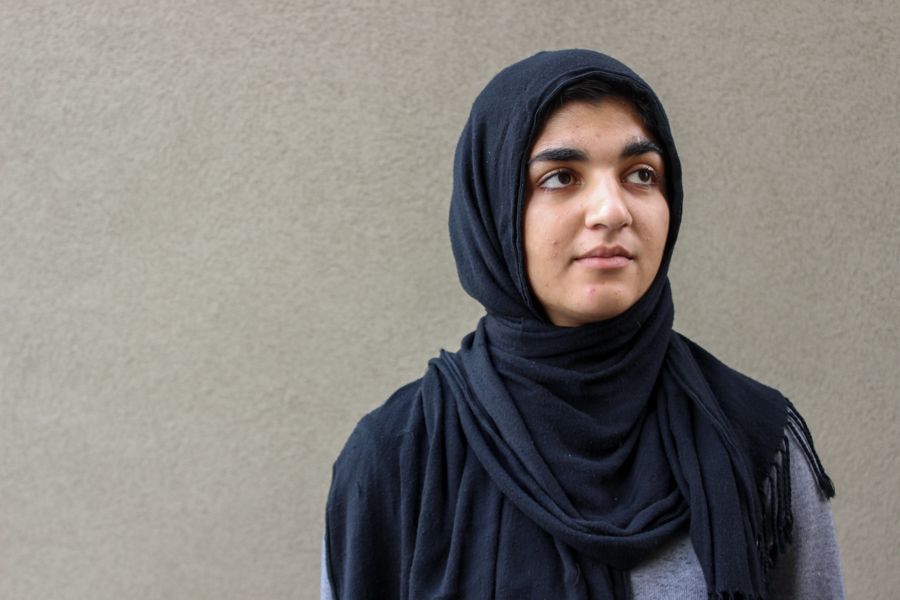
Prejudice exists in America against every demographic, largely excepting the white, Christian male that has seemingly enjoyed the pleasure of becoming our nation’s neutral. If you don’t identify with that category, you are systematically treated as “the other.” While each group faces differing levels of discrimination, among the most grotesquely violated people are Muslims.
The term “Islamophobia” was coined to express the unfounded hatred of Islam and prejudice against its followers. Contrary to popular thought, this is not a new issue. Perhaps the prominence of contemporary American nativism arose post 9/11, but the history of using Islam in fearmongering actually extends back to the 16th century.
In the early 1500s, European powers ravaged and annexed a wide array of countries. This European imperialism also signified the start of the slave trade. It was African American Muslims who led the most powerful slave revolts in the New World colonies. White slave owners saw them as a challenge to their authority. The justification for colonizing African lands was the moral betterment of the native population. To the dismay of the colonizers, this group of people, possessing their own religion and culture, did not need civilizing. To legitimize their subjugation of this group, white people painted a barbarous picture of black Muslim culture.
The vilification of Muslims and fear of their political power in America came to fruition as a backlash against Malcom X. Shortly after his ascent, The Hate That Hate Produced aired on television. It portrayed Malcolm and his followers as the radical side of the Civil Rights Movement. The movie did little to distinguish the majority of Muslims from Malcolm X’s purported extremists. It described adherents to the Muslim faith as a reclusive and alien population. With this one film’s popularization within mainstream culture, Muslims were successfully branded as “the other.”
There are roughly seven million Muslims living in America, suffocating under the ostracism that is “the other.” Terror attacks only perpetuate misconceptions and further the divide. Terrorists do not serve as the mouthpiece for Islam. The religion in itself is one of peace and plurality, accommodating many interpretations of its holy book, the Qur’an. Because of this, the religion is broken up into sects. No one particular faction can represent the whole. In fact, terrorist groups like ISIS make up only 0.000625% of the 1.6 billion Muslims worldwide.
The media has done a spectacular job of exploiting fears and fostering an unscrupulous bias against Muslims. Presidential candidates have further fanned the flames of egregious generalizations, perpetuating the Muslim terrorist narrative. Using terrorism to justify a quiet xenophobia has spilled into horrific violence against an overwhelmingly peaceful group. People are holding armed protests, women are being attacked, children bullied, mosques burned, Qur’ans vandalized and hate speech plastered on social media and sent in letters. The animosity Muslims receive is effectively terrorism. Yet the media has successfully limited the narrative. Apparently, Muslims aren’t worth reporting on unless they’re behind the gun.
ISIS has killed far more Muslims than Westerners, but the media has a tendency to devalue brown and black lives. They don’t report the frightful slaughter endured by our brothers and sisters overseas every day. Hiding the full story and struggle of the Muslim population has essentially dehumanized them, making for easier subjugation and discrimination. The less empathetic we become, the more we play into the terror plot.
This is just what ISIS and other terrorist organizations want. They want fear. They want us to turn a blind eye to their genocide. They want us to kill for them. The way to combat terrorism is to not be unnecessarily fearful, to engage in interfaith understanding and to welcome our Muslim neighbors.
You can reach KATELYN COSTA at kcosta@ucdavis.edu.
Political Ambiguity: Social conservatism, Republicans, crime and drugs

The Republican party lies at the center of social conservatism in America. Or, at least that’s what it seems. To figure out if the GOP stands true to its reputation, we must define social conservatism and its beliefs toward drugs and crime.
Model social conservatives are often critical of the rapid changes within our society, calling for a more pragmatic approach toward 21st-century developments. They are not necessarily against any and all change, but rather they encourage the preservation of values and beliefs that have been a part of our society for so long.
British journalist Peter Hitchens is a wonderful representation of the social right. He feels that Britain’s culture and values have been destroyed in the last 50 years by government policymaking that deliberately engineers societal change. Although not all social conservatives write with Hitchen’s obituary-like tone, they do all ask for a solemn analysis of the speedy change occurring around us. They ask people to question why something should be altered, and what would be lost from changing our actions or beliefs. Hitchens calls for retaining essential parts of our society that, despite being antiquated, keep civilization standing. Social conservatism should not be confused with reactionary beliefs like reintroducing segregation. They are more concerned with preserving, rather than reinstituting, old policies.
Within the Republican Party, many social conservatives call for a greater focus on punishing drug dealers and enforcing existing laws, especially ones that deal with cannabis and other narcotics. According to a study from the Pew Research Center, about 65 percent of conservative-leaning Republicans are against marijuana legalization, compared to 59 percent of Republicans overall. Support for keeping marijuana criminalized is a key priority of social conservatives who feel threatened by recent policy changes regarding the drug. Legalization comes into direct conflict with many of these conservatives who hold the attitude that drugs are immoral.
An increased drive to rehabilitate criminals, rather than punish them, is an example of a changing social attitude that some wholeheartedly oppose. Many social conservatives believe criminals cannot be rehabilitated and that society would be best if they received greater punishment for their misdeeds.
The Republican party continues to uphold its ties with social conservatism, especially in respect to drugs and crime. The GOP takes into account the strength of their socially right support base. But recent developments in social attitudes have led to calls to the party to change or tone down its stance on many issues. While the electorate and the party are definitely not as socially conservative as they were in the 80s, we can only wait and see if Republicans will continue to challenge progressive ideas like marijuana legalization or criminal rehabilitation.
You can reach JUSTIN CHAU at jtchau@ucdavis.edu. Feel free to email me any thoughts you may have about this column or previous ones.
UC Davis grants $1M toward development of robotic harvesting technology
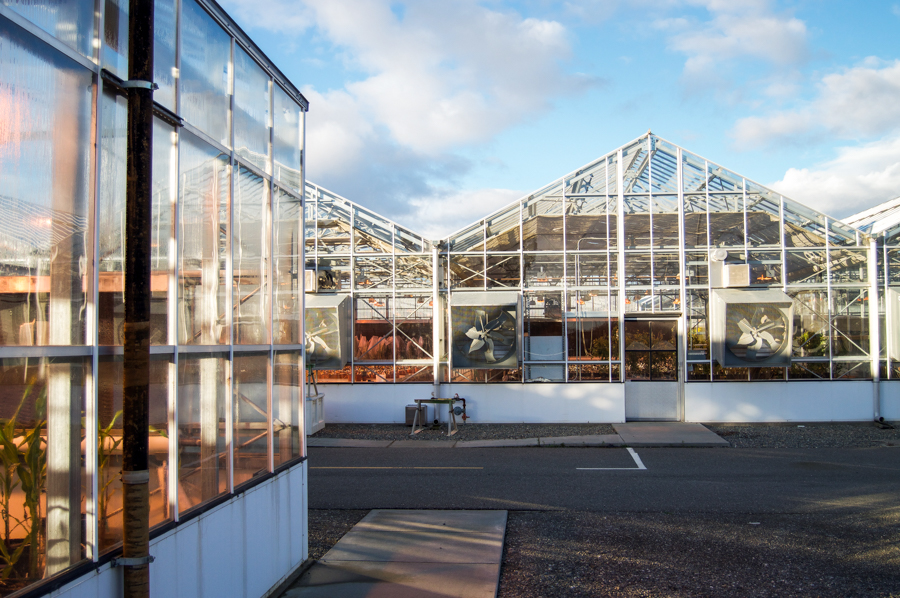
Partnership between UC Davis and Carnegie Mellon University to produce a robotic harvesting aid
In December 2015, the U.S. Department of Agriculture’s National Institute of Food and Agriculture (NIFA) provided $1 million of funding to UC Davis to produce innovative robotic harvesting technology.
Stavros Vougioukas, a UC Davis professor of biological and agricultural engineering, will be leading the project with a team of researchers from UC Davis. He will be collaborating with Dr. Stephen Nuske, from Carnegie Mellon University, who will lead another team in developing the computer vision systems for the project.
“This project aspires to develop affordable technologies for next-generation, robotic harvest-aid orchard platforms,” Vougioukas said. “The machines we envision will function as co-bots that collaborate with fruit pickers by physically carrying them and intelligently adjusting their vertical positioning with respect to the canopies in the orchard.”
Vougioukas said that NIFA, which funds robotics in the field of agriculture, chose to fund his project after he submitted a proposal last year.
“There is a new call each year and UC Davis submitted a proposal, which was selected for funding after a peer review by the panel of experts,” Vougioukas said.
Daniel Schmoldt, national program leader for NIFA, hopes that this project will provide advantages for U.S. farmers.
“By accelerating the adoption of robotic harvest-aid platforms, the project will bring financial benefits for U.S. fruit growers; market advantages for companies building agricultural equipment; increased safety and higher wages for farm workers; work opportunities for a wider, less physically capable labor pool, including women who are the backbone of rural communities; and fresh affordable fruit for consumers,” Schmoldt said.
Rufayda Dhamani, a first-year sustainable agriculture major, believes that developing robotics at UC Davis will provide many benefits for farmers.
“Already, modern farmers are utilizing fully to semi-automated machinery for agricultural functions such as harvesting and sorting, and to keep a better track of their farm,” Dhamani said. “I’m hoping that in the future the robotics industry is able to make cost-efficient products, so that more farmers [will] start incorporating robotics on their fields.”
Vougioukas is optimistic about the project and the eventual impact that it could have on the agricultural community.
“Everyone here is very excited about this project,” Vougioukas said. “We expect that some of the technologies developed through this project will diffuse into commercial platforms and contribute to increasing their adoption by growers.”
Written by: Nick Griffen – campus@theaggie.org
UC Davis scientist first to measure air quality in Aliso Canyon following massive methane leak
Methane leak doubles emissions for L.A. Basin
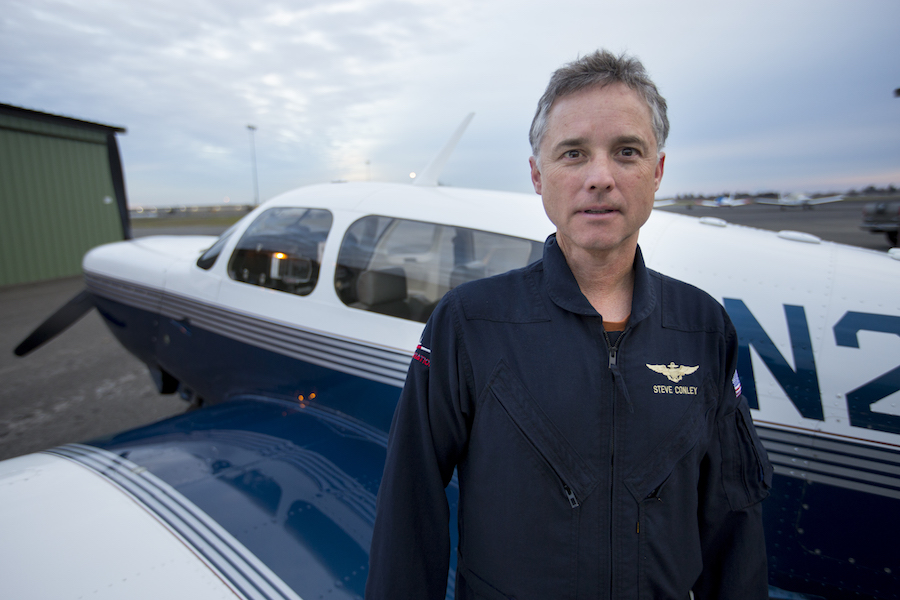
In early November 2015, UC Davis scientist Stephen Conley completed the first measurement of methane in the area surrounding last year’s methane leak at the Aliso Canyon Natural Gas Storage Facility near Los Angeles.
The leak began on Oct. 23 and continues to release methane into the surrounding area. Conley measured the level of methane in the air using a pollution-detecting airplane. He is the only individual to have collected data regarding the air quality of the area since the leak was initially discovered.
The last flight that Conley took through the area was on Dec. 23. He estimated that the leak has emitted approximately 80,000 tons of methane.
“This is by far the largest single leak we have ever measured, and its magnitude is comparable to what is estimated as the total emissions coming from the entire L.A. Basin,” said Ian Faloona, Conley’s colleague and fellow UC Davis scientist.
According to Faloona, officials had been concerned about the facility due to its age and older infrastructure. The facility in Aliso Canyon is the second largest natural gas storage facility in the United States. A gas company named SoCalGas owns the facility and is responsible for the leak.
Conley emphasized that he was surprised when he saw the initial measurements of the air quality in the area. The amount of methane released due to the leak will have lasting ramifications for the surrounding areas and for the state of California as a whole.
“For the rest of L.A. and the state, it changes our greenhouse gas emissions,” Conley said.
According to Conley, this leak doubles the daily emissions rate for the entire Los Angeles Basin.
“Now they are drilling a whole new well to try to tap into the damaged well so that they can plug it up with cement, and they think they should have that done by the end of February,” Faloona said. “But these things are very tricky because they don’t want to do anything to endanger people and erupt the combustible gas so their actions have to be as careful as possible.”
Conley completed his initial flights through the area on behalf of the California Energy Commission (CEC). He is contracted with the CEC, but the pollution-detecting plane is part of his private business, Scientific Aviation. According to Faloona, the California Air Resources Board is currently overseeing the work that Scientific Aviation is doing to measure the air quality in the region.
Since the leak began, residents of the nearby neighborhood of Porter Ranch have complained of nausea, nosebleeds, headaches and dizziness, likely due to the high level of methane in the area.
California Governor Jerry Brown declared a State of Emergency for the area surrounding the leak on Jan. 6. The declaration of emergency outlined various policy changes, including daily inspection of gas storage well heads and regular testing of all safety valves used in wells, that will be implemented in light of the accident in Aliso Canyon.
While authorities are continuing to fix the leak, it is likely that methane will continue to be emitted into the surrounding area until late February or early March.
“I believe this accident will raise the awareness of this potential across the industry and closer regulations, monitoring and retrofitting will probably come about because of it,” Faloona said.
Written by: Laura Fitzgerald – campus@theaggie.org
ASUCD appoints Tiffany Lung as newest senator
Lung replaces former senator Gabriel Lee Johnson
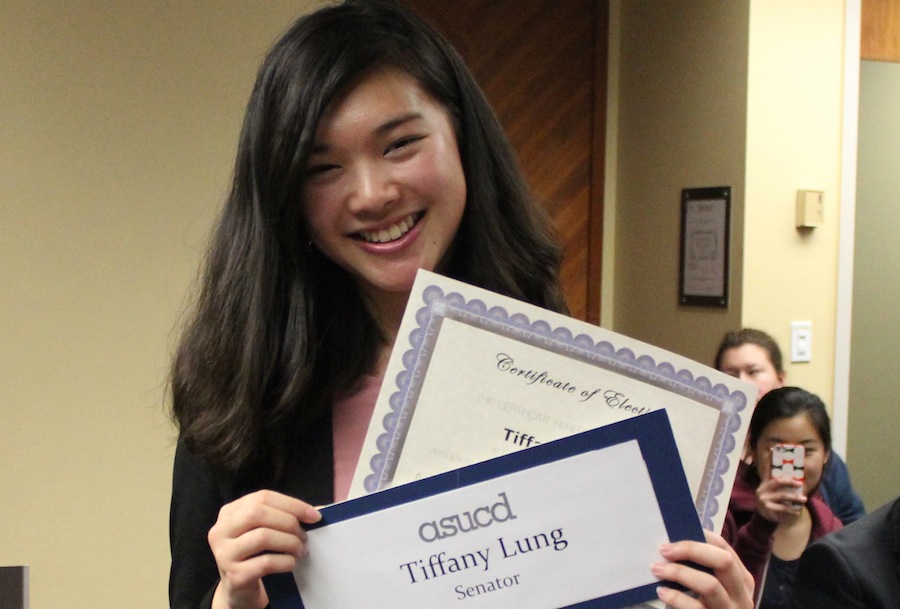
On Jan. 21, ASUCD appointed Tiffany Lung, a second-year human development major, as an ASUCD senator. Lung replaces former senator Gabriel Lee Johnson, who resigned in early January.
ASUCD President Mariah Kala Watson chose Lung out of candidates who submitted applications online after Johnson’s resignation.
“She has proven time and time again to be an active member who shows up and participates in all aspects of ASUCD,” Watson said. “She volunteered on senate staffs, worked on projects with the executive office and has helped different units. The committee and I [believe] that she [is] the best fit for the job. She [has] platforms that [are] simple yet impactful to make the most of her time on the table.”
Lung’s platforms for her time on senate include improving schedule builder and bringing extension cords to the ASUCD Coffee House. She also hopes to convert faculty-only parking lots into student-teacher parking lots to make more parking available for students.
Lung, who has interned for senators Roman Rivilis and Alex Lee, served as Lee’s chief of staff and currently holds the role as Lee’s campaign manager for the upcoming Winter Quarter election, as a part of the newly formed Summit Slate.
“I want to leave a lasting impact on campus in ASUCD with [Lee],” Lung said. “If [Lee] is elected for ASUCD President, his five platforms are jobs, academics, clubs, advocacy and ASUCD reform. After working together for almost a year, our teamwork is unparalleled.”
Written by: Alyssa Vandenberg – campus@theaggie.org
City of Davis to implement organic waste cart program

Program supports city effort to reduce landfill waste
This July, the City of Davis will commence its new organic waste-cart initiative which will prevent organic items from being placed in the landfill when they can be composted.
According to Jennifer Gilbert, conservation coordinator at the Davis Public Works Department, the organics program will help the city reach its goal to compost or recycle 75 percent of its waste.
“All customers will receive an organics cart for food scraps, food-soiled paper and yard materials […] you’ll have the garbage cart, the recycling cart and then the organics waste cart,” Gilbert said.
Gilbert explains that some Davis residents are concerned about how there will be fewer collections for yard materials through the program. However, Gilbert stressed that despite the reduction in collections for yard material, residents will be allowed to leave their yard materials on the street five days before collection.
“Right now, we have two containers: one for regular trash and one for recyclables. The idea is that we will collect the organic waste so that it doesn’t have to go to the normal landfill,” councilmember Brett Lee said. “The green waste [organic] container [will be] picked up on a weekly basis; it will travel to a different place than the normal landfill and they will […] reuse [the material] for compost uses. It is part of the city [and] state’s goal to reduce the amount of waste we generate.”
The 75 Percent Initiative, a statewide recycling goal run by CalRecycle, is at the forefront of California’s massive effort to reduce the waste that goes to the landfill. The program aims to have 75 percent of all waste recycled, reused or composted by 2020 and has been responsible for pushing new legislation to help the state achieve this goal.
“The 75 Percent Initiative is a statewide goal and not a mandate […] California already leads the nation when it comes to environmentalism and sustainability, so we’re just trying to solidify our dedication to this effort,” said Lance Klug, public information officer in the Office of Public Affairs at CalRecycle. “We’re [also] going to pass other policies, and have passed other policies, that help us get closer to that goal.”
In setting up organic waste-carts, the City of Davis is taking yet another step to become greener and more sustainable for the future, getting closer to its goal of 75 percent waste reduction.
“Currently we are at 64 percent waste reduction so we’ve got an additional 11 percent to achieve our goal,” Gilbert said.
Written By: JUNO BHARDWAJ-SHAH – city@theaggie.org
Yolo County prepares for El Niño floods
High levels of rainfall leave many wondering if Davis is flood ready
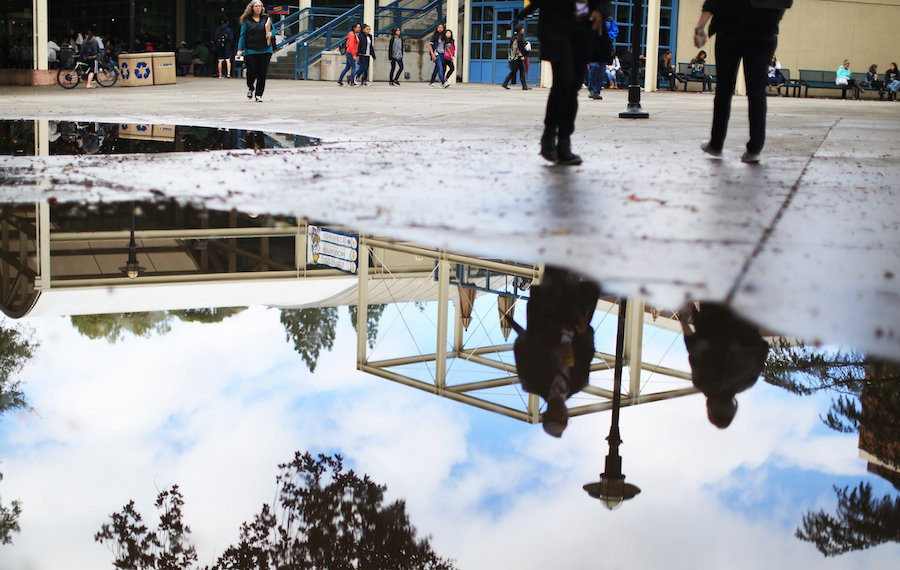
Yolo county has evaluated its flood prevention measures to prepare for the expected El Niño, a weather cycle that brings changes in wind patterns and increased rainfall. In the past few weeks, Davis and the surrounding areas have been bombarded with significant downpours, which could result in future flooding if heavy rain persists.
“We’ve been in a drought for such a long time. It’s very unexpected to have this much rain in such a short period of time,” said Davis resident, Alex Christopher. “I’m happy because it’s going to help with the water supply, but I don’t think we’re prepared for a serious flood situation, simply because it hasn’t happened in a long time.”
On average, Davis accrues about 21 inches of rain annually and flooding has never been an issue for the city.
“We have a preventative maintenance plan of our drainage system for flood preparedness in place throughout the year,” said Dave Rodriguez, collection systems supervisor from the Davis Public Works Department. “There are over 3,000 drain inlets, 19 drainage pump stations and 15 miles of storm water drainage channels that are inspected, maintained and monitored weekly. Our staff attends weekly safety meetings and receives continuous training to be prepared in case of an event like El Niño.”
In the past, the month of January rarely pulls more than 2 inches of rain. For 2016, the city already received 3.5 inches of rain this month.
“It hasn’t been like this in a long time,” said Amanda Bradley, a Dixon resident. “Last time I remember so much rain, it was back in the late 80s. One year I remember it would go a good two weeks with nonstop storms.”
In terms of the water supply, the recent influx of rain will be helpful, but definitely not a solution to California’s current drought. A recent report by Capital Public Radio stated that despite the surge of water that has hit the Sacramento area, the water supply is still around 65 percent of the ideal level.
Woodland resident Carlos Espinoza believes that, although flooding is a concern, it is overshadowed by the pressures of the already existent drought.
“I don’t think flooding should be our main concern,” Espinoza said. “I’m happy we’re getting rain and I hope it keeps coming. It’s scary thinking about the drought we’re experiencing and I can only hope the rain we are receiving will lessen the pressures from it.”
The UC Davis Department of Land, Air and Water Resources (DLAWR) website states that the key to harnessing the rainfall is within the California farmlands. Farmers across the area are digging ditches and wells in the hopes of collecting and using the water from rains that are anticipated to continue.
DLAWR also stated that collecting rainfall in farmlands will significantly reduce the risk of downstream floods. In essence, the solution to potential flooding will also improve California drought conditions.
Written By: Tristen Thalhuber– city@theaggie.org