55.4 F
Davis

Davis, California

Thursday, December 25, 2025
Home Blog Page 792

ME/SA Community Week hosts shadeism discussion

Combatting discrimination based on skin color

As part of Middle Eastern and South Asian (ME/SA) Community Week, the Indian Student Association (ISA) of UC Davis hosted its first discussion on shadeism and sexism within the South Asian community last Thursday in the Student Community Center (SCC).

“Shadeism” is relatively unknown term — in fact, many of the attendees had never heard the word before. Shadeism describes the discrimination against people with darker skin colors within a community, and has been known to be particularly present within the South Asian community.

Many members of the South Asian community do not know how shadeism rooted itself in their culture. Some have suggested the British colonization and westernization of India may have contributed to the idea, while others believe that Hinduism, India’s dominant religion, has long viewed light skin as a symbol of purity and holiness in their goddesses and women. However, many students that attended the meeting agreed that the current generation of South Asian-Americans continue to be deeply affected by shadeism in their daily lives.

“I’ve been affected by shadeism my entire life,” third-year international relations major and ISA Director of Technology Avanti Baronia said. “My older relatives have judged my beauty based on a standard of darkness and have said, ‘You’re so beautiful for a dark girl.’ But why is my skin color a caveat for my beauty?”

Learning that others had bounced back from certain negative experiences with shadeism gave Baronia a feeling of empowerment. She said she felt enlightened by the opportunity to hear about her peers’ experiences with shadeism and find commonalities and differences in their stories.

The discussion, organized without any specific questions in mind, was designed to allow students to share their thoughts and stories in a safe space. Shruti Thundiyil, a fourth-year communication major, was surprised by how much having a safe and enclosed space in the SCC benefitted the discussion.

“Everyone’s honesty and openness really stood out to me,” Thundiyil said. “A lot of the time I feel that when you’re discussing culture, you can’t speak about what’s on your mind because you don’t feel comfortable, you don’t feel educated enough to contribute or you are afraid about being politically incorrect. There are other discussions on campus where I feel like people are scared to even enter the discussion. That wasn’t the case here.”

A majority of the attendees at the event were female, and many revealed that comments made by their relatives suggested that the South Asian community was unlikely to find girls with darker skin attractive or even suitable for marriage.

Fourth-year environmental science major and ISA Director of Operations, Taran Sahota, recalled being told at the young age of seven that she would never find a husband in the future because of her dark skin. Her friend, Parteek Singh, second-year biochemistry and molecular biology major and ISA Director of External Affairs, found Sahota’s anecdote particularly striking.

“For me, I think the biggest takeaway from the discussion was was realizing that South Asian females are so impacted by shadeism in so many more ways that males,” Singh said. “Little girls as young as seven are being told that they won’t get married because of their skin colors. It not only hurts their feelings in the moment, but I think it impacts them psychologically for years to come.”

According to Singh, his invites to outings at the beach or a sunny day in the park are often met with responses like “we don’t want to get any darker than we already are.” Singh even knows of family members that have quit outdoor sports or activities out of fear that their skin will turn darker.

Many of the event’s attendees agreed that the first step to eradicating the problem is to form discussions about it.

“Shadeism and sexism can be such taboo topics, like so many other topics in the South Asian community,” Thundiyil said. “I believe the first step in fixing a problem is acknowledging it. I think our South Asian community is particularly bad at addressing things and we tend to sweep it all under the rug. But these issues are affecting everybody and I think it’s important to address that.”

Thundiyil hopes that ISA will continue to host and advertise such discussions in the future and has suggested arranged marriage, dowry and South Asian pop culture as possible topics for discussions in coming quarters. Baronia and Singh said ISA is equally as interested in hosting these discussions, and hope that future discussions could involve guest speakers or a more structured format to allow for smaller and larger group conversations.

“I think the next step is to have more student groups engage in this issue,” Baronia said. “The change has to start with our generation. As frustrating it is that our socialization has come from our parents, we can’t really expect to change the older generation. I think we need to reach out to more people of all backgrounds on this campus because I don’t think shadeism is unique to the South Asian experience.”

Graphic by Jennifer Wu.

Baby got (your) back

Davis Food Co-op provides a support group for new parents

On G street in downtown Davis is a small house with cheerful yellow walls, a pink roof and large windows.

This little house is the Davis Food Co-op’s Teaching Kitchen, and it is a meeting space for many of the Co-op’s interest groups and cooking classes. On Tuesday and Wednesday mornings, however, the house is filled with the shrieks and laughter of Co-op’s youngest members and their mothers: the New Parent Network.

“I’m responsible for all the circles and networks that the Co-op hosts,” Davis Food Co-Op Marketing Director Julie Cross said. “We have a crafting group, a knitting group, a gluten-free group and a gardening group that meet once or twice a month. But the New Parent Network is the only one that meets every week.”

The network began in 2010 after the Co-op received news of the success of a new parent support group at a co-op in Boise, Idaho. As a facilitator, Cross found a meeting space and now works to promote events and create press releases, but she enlisted the help of Lesley Nelson, a midwife working in Davis, to lead the actual group. Nelson has since moved, but the group remains active with the help of current coordinator Melanie Gentles.

“When I had my first of three kids, I was part of a new mother group at Mother and Baby Source in downtown Davis and it absolutely saved my life,” Gentles said. “I had been a member of the Davis Food Co-op for about 10 years by the time I had my second child and heard that they were starting a similar network. Eventually they asked me to help coordinate and I was very happy to provide that service.”

Gentles begins every meeting by providing a free snack for the children — this week, it was fresh mango. After eating, the children sprawl themselves on the floor and entertain themselves with toys like Legos and puzzles.

“My daughter is not yet two years old and a little too young for pre-school,” network member and UC Davis psychology alum Andrea Francisco said. “This is a great opportunity for her to be around kids her age. I have only been to a couple of meetings, but depending on how my daughter is feeling, I would love to come back every week.”

Of course, the network isn’t just a playdate for children. The primary purpose of the group is to bring together those navigating parenthood and seeking support. Network member Anna Wood-Vasey Darbee remarks that raising young children can be both a joy and a serious challenge.

“It’s amazing to connect with other parents especially when you have a newborn baby,” Darbee said. “You can do all the research you want, but there’s this shell shock you still go through in the first few months after giving birth. It’s so nice to sit in a room of people who are going through what you’re going through and can completely understand what it feels like to only get two hours of sleep.”

Darbee, whose oldest child is now three, is a long-standing member of the network. Though she has switched jobs through the years and has missed meetings in the past, she said the support and friendships the network provides has never dwindled, even if her level of involvement has decreased.

In the past, the Co-op’s other circles have eventually ceased to exist after a lack of interest. Though the group might meet with great interest at first, coordinators or passionate members move away, resulting in decreased attendance over time. Cross recalls that meetings for the Co-op’s Vegan Group had to be canceled when only two members remained. Cross believes that the New Parent Network is one of the few groups that is unlikely to stop meeting.

Even parents that have stopped visiting the Teaching Kitchen on a weekly basis or have moved away from Davis maintain contact with the Co-op and the group.

“Just last week we had an old member send us a message through Facebook,” Cross said. “She moved from Davis but raised her first child here five years ago. Now she wants to bring her daughter back to a New Parent Network meeting so that she can reconnect with friends and [her] little girl can see the kitchen where she played and formed her first memories.”

Photo by Anisa Bashiri.

Davis Ground Zero clothing, board shop to close after 18 years

Downtown sees increase in restaurants, decrease in retail

After 18 years of business in downtown Davis, Ground Zero ski shop will be closing its doors on June 28. Ground Zero’s lease contract was up for renewal and according to Executive Vice President of Ground Zero, Brendan Mohr, their landlord doesn’t believe that the business can handle the rent increase because they are a retail business as opposed to a restaurant.

Mohr said that over the last few years he’s observed a large increase in restaurants moving into the downtown Davis business core, and an exodus of retail businesses. Mohr attributed this to the fact that people tend to leave downtown Davis to do their shopping. He identified Target as an example, among others, as the kind of retail store that draws people out of the downtown area for shopping.

“Although it doesn’t affect us directly, it takes people away from the business core of Davis,” Mohr said.

Mohr said that he understands why retail isn’t as attractive as a restaurant for a long-term tenant from a landlord’s perspective. He said restaurants are more able to handle the high-leasing rates of downtown Davis. This year several new restaurants such as Blaze, Firehouse Subs and Shabu Shabu Extreme have all opened in Davis within a span of a month.

“For the health of the commerce community and the general public, it is important to focus on what’s most popular,” Mohr said.

Stephen Jaycox, chief marketing officer and design director for the Davis Commons said that he feels the businesses within the Davis Commons have been stable because they have maintained relevance within the community.

Jaycox said that one of the reasons some businesses haven’t lasted in the Davis Commons was because businesses over time lost sync with the consumer base.

“Some were very very specific operations like [The] Melt, where it looked like the brand needed to respond to the shifts in consumer taste,” Jaycox said.

The Melt closed its doors in February. Although Jaycox could not disclose what business will be going into the space that The Melt most recently occupied, he did say it would likely be a culinary experience as it is located next to the outdoor tables and chairs that line the walkway in front of the Davis Commons storefronts.

Ground Zero will maintain their original Natomas location, but Mohr said they’ve enjoyed being part of the Davis community.

“I strongly urge people to support their community because it does come back to them,” Mohr said of supporting local business.

Graphic by Jennifer Wu.

Vendors at Davis Farmers Market share information about food production with customers

Trudy Kalisky was a graduate student at UC Davis when she and her husband Mo decided to start their own business. Over the years it developed into what is now the Upper Crust Baking Company, an artisanal bakery known for its unique bread and cookie recipes. They’ve been selling at the Davis Farmers Market for 28 years.

Kalisky believes the Farmers Market is an educational opportunity for students.

“I think it’s part of the whole learning experience because you get to see and talk to people who produce the product,” Kalisky said. “It’s not a grocery store, where the grocery manager doesn’t know what he put into it.”

Kalisky buys wheat from a mill in Woodland that gets its wheat from the Sacramento Valley, but she says that when buying from bigger mills it’s difficult to know when or where it’s from.

“Most mills have a scientist on staff. In a big mill they don’t always have the same wheat, so [that scientist] has to make his or her brand name all the same all the time, and he’s mixing winter wheat from Montana with summer wheat from God-knows-where. What’s special about [the wheat in Upper Crust’s bread] is that it’s all locally grown, and it’s absolutely the best wheat I’ve ever used,” Kalisky said.

On Saturdays, Upper Crust has booths at eight different farmers markets between San Francisco and Rocklin, but Kalisky is always at the Davis table.

“This is my home base,” Kalisky said. “Everybody in town knows me, and [the Farmers Market] is important to me. I think a lot of people trust me because I’m here all the time and I know what I’m talking about.”

Sustainable Farming

Ron Toppi farms for Massa Organics, which has been selling at the Davis Farmers Market on and off for the past four years. Massa Organics is a small family-owned farm located near Chico along the Sacramento River. Greg Massa and Rachel Krach started the company in order to find ecologically sustainable ways to grow rice. Since 2004 they’ve expanded their produce to include almonds and wheat, and begun raising livestock such as sheep and pigs.

“We don’t do any of the spraying that conventional growers do,” Toppi said. “Sometimes in the early spring just before the [almond] bloom we’ll use organic sulfur for a fungus, but this year we didn’t have to. Our orchard is dual-purpose so we raise sheep in there. We don’t really have to do a lot of mowing or fertilizing because the sheep do all that work for us.”

Toppi says that because they don’t mow, the grass retains moisture, thereby saving water.

“When we do water, the moisture retention is much better than [it is for conventional growers]. That cuts down on the amount of water you’re going to need because the ground doesn’t dry out as quick,” Toppi said.

In their rice and wheat fields, they rotate in safflower, a flowering plant which has  seeds that produce a vegetable oil. Massa converts the oil into biodiesel, which they then use to power their equipment. This crop rotation process also prevents weeds from settling in.

Recently, a statistic highlighting almond production as a major water user has been gaining attention. According to a 2011 study conducted by the United Nations Educational, Scientific, and Cultural Organization Institute for Water Education, it takes approximately one gallon of water to produce a single almond. Toppi believes that the representation has been given a disproportionate amount of attention when considering farming methods.

“The difference between organic and conventional growing is pretty significant, and that’s part of the story that’s not being told. Some organic growers spray, but they’re still not spraying as much as conventional growers,” Toppi said. “[Conventional growers] have to mix the chemicals with water in spray tanks, [so] that’s thousands of gallons of water annually that a lot of organic growers aren’t using because they’re not [fumigating the crops] as much.”

Toppi said he believes the statistic is helpful in understanding water use.

“I think it’s a good number to put out there because when you look at the bigger picture and you look at the big industrial agricultural system that’s out there, [growers in that system] do use a lot of water,” Toppi said. “Way more than is necessary to grow good, healthy food for people.”

Gardening Paradise

Lloyd Johnson has been selling his produce at the Davis market for 19 years. He’s known for his overwintered onions, but his cash crop is tomatoes, which he grows on his farm just 18 miles away in Winters.

“[My wife and I] live in Davis, I lease the farm, and I’ve been on the same property for 19 years,” Johnson said. “It’s five acres. It’s just gardening paradise here. There’s 10 feet of topsoil, without a rock, and we have a well. With this climate you can grow anything. It’s really amazing.”

But Johnson is still weary of the drought and possible water restrictions.

“Do I want a shower or a handful of almonds?” he joked.

His crops have yet to make him face that choice.

“The reality is that drought years are easier for a vegetable farmer, and the tougher years are when you get the real wet rain here, because it’s hard to get things planted,” Johnson said. “The soil’s got to dry up before you can get the tractor in. And then we’ve had cold wet years where the tomatoes don’t ripen until a month later, or we weren’t able to plant them because it was too muddy. So [during] droughts, as long as I can turn on the well and get water, it does sort of make my job easier.”

Johnson still thinks there are ways to cut down on water use.

“I don’t consider [growing food] wasting water, it’s just using it, although it does need to be used wisely. People have to realize the value of water, and pay more for it, and then [they] will use it wisely. When they’re getting it for almost free, it’s a waste of resources if you’re not having to pay the cost of it.”

The Davis Farmers Market is located at Central Park on Fourth and C streets, Saturdays from 8 a.m. to 1 p.m. and Wednesdays from 2 to 6 p.m.

Photo by Anisa Bashiri.

News in brief: Students, staff, campus police officers meet for coffee, donuts

Students, student housing staff and UC Davis Police Department (UCDPD) personnel met in the Segundo Academic Advising Center on the morning of May 5 to bond over coffee and donuts.

Over 30 students, officers, cadets, housing staff members and UCDPD student assistants attended.

Student Housing Conduct Coordinators Josh Chave and Trent Kennedy organized the event to foster informal connections between residents, staff and UCDPD officers.

Chave said officers’ interactions with Segundo residents during emergency situations would proceed more smoothly if the two groups were more familiar with each other.

Chave and Kennedy said they hope similar events will become a regular occurrence.

Graphic by Jennifer Wu.
Senate Brief: April 30, 2014

ASUCD Vice President Gareth Smythe presided over the weekly senate meeting on April 30. The meeting was called to order at 8:11 p.m.

Environmental Policy and Planning Commission Chair Marissa Ayala and senators Anabiah Syed, Miguel Guerrero, Roman Rivilis, Sarah Priano and Anas Tresh were not present at roll call.

Tresh arrived at 8:28 p.m.

A large majority of the meeting was spent in appointments and confirmations. During this period, senators made confirmations in the following order:

Ian Demment, Lydiah Maranga and Chidinma Ohanele were confirmed as members of the Child Care Administrative Advisory Committee (AAC).

Seanne Louvet was confirmed as the director of Cal Aggie Camp.

Demment, Chelsea Hernandez, Sara Rogers, Jasmine Sandhi and Stephani-Nicol Webb were confirmed as members of the Disabilities Issues AAC.

Kelsey Drain was confirmed as a member of the UC Davis Fire Department Advisory Committee.

Nate Kommju, Alexandra Leiga and Samantha Solomon were confirmed as members of the Status of Women at Davis AAC.

Stefan Chen and Jessica Lee were confirmed as members of the Media Board AAC.

Hannah Howerton, Hannah Sada, Michelle Wang, Amy Yip and Alina Pogorelov were confirmed as members of the Arts and Lectures AAC.

Erika Maria Hapa was confirmed as the director of The Pantry.

Bethany Celio, Naftali Moed and Miki Lei were confirmed as members of the Transportation & Parking AAC.

Nathan Sy was confirmed as a member of the Regents Scholarship Administrative Advisory Committee.

Anna Lam and Jing Mai were confirmed as members of the Course Materials & Services Fee Administrative Advisory Committee. Intended confirmed Yun Sun was not present due to a family emergency.

Nicole Garcia was confirmed as the director of Aggie Reuse.

Erica Koopman-Glass was confirmed as the director of Campus Center for the Environment.

Karen Xu was confirmed as a member of the Regents Scholarship Administrative Advisory Committee via Skype.

Kari Kiyono and Suhalla Sikand were confirmed as members of the Aggie Public Arts Committee.


Legislation

Senators considered a piece of old legislation, Senate Bill #69, which allocates $298.38 in order to print 2,500 updated ASUCD brochures. The bill was passed by an 8-0-4 vote.

All other old legislation was tabled. This list consisted of Senate Bill #66, Senate Bill #70 and Senate Resolution #15.

Senators approved the minutes from the April 23 senate meeting.

Senators considered a new resolution, Senate Resolution #16, whose passage would indicate senate’s support for running a fee referendum in Winter 2016 that would fund the UC Davis chapter of CALPIRG.

Senators discussed whether the resolution was lawful relative to UC Office of the President policy and Constitutional Amendment #28, which prohibits fee-based initiatives funding membership dues to any organization operating outside the jurisdiction of the UC Davis Campus. Ultimately, senators referred SR16 to the ASUCD Court.

Business & Finance Commission Chair Joanna Jaroszewska indicated that her commission would probably fail SR16, as its contemporary version did not include any figures. Smythe put over a 6-1-5 vote to un-refer the resolution from Business & Finance Commission.

Smythe adjourned the meeting at 12:23 a.m.

Graphic by Jennifer Wu.
Study reveals that online classes don’t necessarily yield positive results

A recent study conducted by Cassandra Hart, an assistant professor in the UC Davis School of Education, and education doctoral students Michael Hill and Elizabeth Friedmann found that student grades and completion rates of community college students are lower when they take online courses as opposed to face-to-face classes.

The researchers studied students who entered community colleges in California in the 2008-09 school year—which totaled to over 2.3 million students. They followed these students through the 2011-12 school year, comparing students from the same college taking classes available in both online and in-person formats.

Hill, who is in his fifth year of teaching students online, said that one issue with online classes is the delayed reaction time between professors and students. Hill said that teaching a class face-to-face allows teachers to quickly alter the way they explain a concept if needed, such as explaining a concept in a different way if students in the classroom look confused. However, he said that, in an online classroom, it takes much more time for teachers to receive this feedback from students and thus adapt their teaching styles.

As UC Davis and other colleges have moved towards offering more online classes for students, this research study shows the potential disadvantages of doing so.

“The findings from the community college data have serious implications for other systems, including the UC,” Friedmann said. “The UC’s Online Pilot Program is testing out online courses in different departments and campuses. While this could have positive benefits for expanding student access and reducing costs, our negative results show the expansion of online education needs to be done carefully in order to maximize student success.”

Hart says that while this study was done at the community college level, it still can relate to the online courses for UC schools.

“These findings are a little bit of a cautionary note in terms of throwing tons of resources into online classes,” Hart said. “But at the same time, courses will continue to change and get better over time. So if you could extrapolate these results to the UC system, there would certainly be a bit of a cautionary tale here.”

Hill says that there will likely be follow up studies to this report.

“There probably will be a lot of follow up studies, especially trying to continue to identify some of the mechanisms to answer those questions about what are some of the positives of an online class, what contributes to student performance or what potentially detracts from student performance,” Hill said.

Hill also hopes that future research will help educators better understand student and faculty interaction in online classrooms, while Friedmann believes that research regarding how engaged students are in online classes, such as by recording how often a student logs into the online course, could be useful.

“I think that the key takeaway is that there is no one size fits all approach,” Hill said. “Whether it’s the UCs or other institutions that are implementing online classes, understanding different student learning styles and maybe even more importantly helping students understand those learning styles [is important].”

Friedmann adds that online classes are becoming increasingly normalized, and therefore we need to improve the success rate of online classes.

“Online higher education is not just a trend, and can provide additional options for student access,” Friedmann said. “But policymakers and institutions need to ensure students are just as well-prepared to succeed online as they are in a face-to-face classroom.”


This Week in Senate

On April 23, the ASUCD senate meeting began with a call to order. During Appointments and Confirmations, senate confirmed former ASUCD senator Gareth Smythe as the new vice president, following former vice president Robyn Huey’s recent resignation. Senate also confirmed two new Outreach Assembly members.

During Unit Director Reports, the unit directors of the CoHo, Project Compost and the Whole Earth Festival gave updates on current projects. CoHo director Darin Schluep discussed how the CoHo plans to continue limiting waste and become more inclusive, as well as gave an analysis of sales. Project Compost director Jessica Siegel described the current challenge of this unit: a high demand for compost, but not enough supply. The director of the Whole Earth Festival Christopher Myers explained the challenges the unit has faced to put on the festival this year due to the budget decrease.

During Presentations, members from Club Finance Council (CFC) presented a year-end review to Senate, in which they described the process of how they allocate money to different groups on campus.

Two new bills were introduced: a bill that will amend section 209 of the bylaws in order to re-organize the responsibilities of the Outreach Assembly into several assemblies, as well as a bill to allocate $298.38 for 2500 ASUCD brochures.

Additionally, old legislation was discussed. Senate passed Senate Bill #63, which reflects updated long-range plans for ASUCD units, such as manager additions and updated student employee numbers.

Senate Bill #67, a bill to create new Executive Staff positions as well as alter the pay rates of these positions, was also passed.

In Public Discussion, senate members discussed the need to become more connected to ASUCD units, decided on the location of the budget hearings later this quarter and discussed the upcoming “Pizza and Politics” Town Hall on April 30, where students will have the opportunity to meet and talk with ASUCD officials.

The meeting adjourned at 12:19 a.m.

Alyssa Vandenberg can be reached at campus@theaggie.org.

Ask Katehi: 26th Annual Undergraduate Research, Scholarship, and Creative Activities Conference

0

This past weekend, our campus hosted the 26th Annual Undergraduate Research, Scholarship, and Creative Activities Conference where many of your fellows Aggies were participants. The conference attracted 550 students, more than 1,000 attendees and showcased the great interdisciplinary work that our faculty and students are doing.

Undergraduate research is one of the core principles of a large public research university like UC Davis and is something that I want as many students as possible to participate in.  It is something that I was fortunate to have experience s an undergraduate at the National Technical University in Greece and it helped me solidify my interests in electrical engineering and taught me how to think critically and analytically. For those of you who are not yet engaged in research, I encourage you to visit the Undergraduate Research Center and seek out a faculty member to explore your research interests. I think you will be very happy you did and it will add a great deal to your education at UC Davis.

As always, you can email me your thoughts and questions to askkatehi@ucdavis.edu. I will try my best to answer you in my Ask Katehi column.

Rape? Yes, I do want to talk about it: The “normal” response to sexual assault

0

Let’s play a game. I’m going to give you two scenarios. I want you to guess which one is the more likely response to being sexually assaulted. Ready?

Option A:

Amy was raped by a stranger a few weeks ago. During the assault, Amy was completely terrified, but reacted quickly and cleverly. She escaped the situation right away and called the police. Amy told her friends, family members and even a therapist about what happened to her and has found comfort in the incredible support she has been given. Amy tends to hide in her room for fear of running into her attacker (she knows how unsafe it would be for her to see him ever again), and has decided to remain abstinent from sex until marriage. While things have been tough for Amy, she seems to be dealing with her situation in a healthy way.

Option B:

Sara was raped by her boyfriend a few weeks ago. She loves her boyfriend – everybody does. He is charming, charismatic and the kind of guy everybody wants to be around.  Sara stayed with her boyfriend even though he raped her. She continued to have sex with him, but also had sex with other guys. She liked to feel in control again. She loved to go out, get drunk, and wind up with a random stranger. Sara refused to talk about what happened to her, and how would anybody know? She continues to be a straight-A student and an amazing athlete. Nothing can bring Sara down.

Did you guess A? I thought you might have. Seems like a pretty reasonable response.  I mean, if you were just raped it’s not like you’re going to be sleeping around or going out to parties. It’s not like you’re going to keep spending quality bonding time with your attacker, right?

Wrong. While I can’t say for certain that Amy isn’t out there somewhere, every survivor I’ve encountered has behaved a lot more similarly to Sara.

People have a distorted understanding of how a victim of rape should behave. Think about it. If you’ve never experienced rape, or real trauma of any sort, you’re going to assume that when people are traumatized, they’re just experiencing normal feelings of fear (but to a greater degree). You’re going to think, “Okay, so if I’m terrified of talking dolls (after watching Chucky), then a rape victim must be terrified of their rapist… or men… or the outside world… after being raped.” It’s more or less a logical conclusion to jump to. It’s why our society assumes that every victim’s response will be as “normal” as Amy’s response was.

But here’s the thing: our brains process severe trauma differently. Rape is not on the same level as your fear of heights. It’s on the same level as attempted homicide. And that process is something you have not experienced until you have. It’s something you do not understand until you have to.

Listen up. There are two main structures in the brain at play when processing a traumatic event: the hippocampus and the amygdala. The hippocampus is the brain structure that processes and forms memories. The amygdala is the part of the brain that processes emotional stimuli – including fear. The amygdala and the hippocampus must work together to process information. Normally, this process works pretty well.

However,  the hippocampus and the amygdala are sensitive to hormone fluctuations, and during a traumatic event, your body basically goes crazy with hormones. It produces adrenaline to help with a “fight or flight” response. It produces cortisol (the stress hormone) to aid in your body’s energy, to give you strength to fight back. It produces opiates to relieve some of the emotional and/or physical pain you experience during and after the assault. And it produces oxytocin – a hormone designed to increase positive emotions – in attempt to help  numb the severity of your pain.

These hormones are essential for your body’s survival during an assault, but they completely interfere with your normal processing. Your body is simultaneously releasing so many different hormones when it is in ultimate survival mode. It’s trying its best to save you. It is acting out of desperation—and this means sacrificing certain key parts of your functioning.

Which brings me to my point. These activated hormones in your body, released during rape, hinder your brain circuits controlling rational thought (located in the prefrontal cortex).  This means that victims literally CANNOT think rationally. Not during the trauma and not for a long, long time after the trauma. It means that a survivor is solely functioning through their amygdala – the emotional center – and is temporarily not capable of making any rational decisions. Any.

If we understand the real biology behind what happens during severe trauma, we can understand that Sara isn’t so crazy after all. No, she’s doing her BEST to function while her brain returns to its normal processing state. Her reaction isn’t going to make sense to anyone, it doesn’t even make sense to her. But that doesn’t mean it’s wrong or not “normal.” As weird or confusing as her reaction might be, it IS understandable. Hell, if she walked around campus wearing a gigantic bear costume and only communicated via growling it would be pretty understandable too.

There is no “normal” response to rape. There is only surviving – which more often than not means doing really ridiculous and stupid things. Make a conscious effort to understand what real rape victims look like and why. Because sometimes they look like crazy gigantic bears. And sometimes those bears could use a hug.


Like her bluntness? Contact Maddy Pettit at mepettit@ucdavis.edu

For writers, by writers

Stories on Stage Davis to feature student fiction writers

It’s not easy being a writer: the hours are long, the work is solitary and grueling, and you don’t often get a lot of acknowledgment. But on this upcoming Saturday the literary community of Davis will gather at the Pence Gallery to acknowledge and celebrate the work of two exceptional writers from the UC Davis creative writing master’s program. Stories on Stage Davis will be presenting the winning short stories from its second annual UC Davis Fiction Contest. Becky Mandelbaum, a first-year student in the creative writing program, took first place with her story “Queen of England”, while Lissa Miller, a second-year creative writing student, was awarded second place for her story “The Armadillo.” The contest was open to any currently enrolled UC Davis student who has taken at least one creative writing class at UC Davis. Stories on Stage director, Jeri Howitt, noted that this year’s contest brought in more than twice the number of entries as the inaugural contest last year.

“I’ve never heard anyone read any of my fiction [aloud],” Mandelbaum said. “But I saw a Stories on Stage with Tobias Wolff and the actors were so good and it was fun to see the stories come to life.”

Mandelbaum’s story will be performed by Andy Jones, City of Davis poet laureate and UC Davis faculty member.

“As a practicing poet, I read works out loud on the radio at the poetry night reading series and at my own readings, so I have lots of practice performing before a crowd,” Jones said.

Jones said that one of the most difficult parts of preparing for his performance was figuring out how he wanted to portray the different voices in the story.

“There are two boys in the story that I’m reading, one man and a mom, and so [I’m] trying to figure out how to represent these with somewhat different inflections so that the reader can know who is who,” Jones said.

He also made sure to pay attention to pacing while preparing for his performance.

“It’s a good-sized story so paying attention to pacing is important, because you want to leave room for potent moments of impact on the character and audience,” Jones said.

Miller’s story will be performed by Joyful Simpson, an actress, writer and educator who is currently pursuing an MFA in dramatic art at UC Davis. Miller said she appreciated the opportunity to hear her work read aloud by an actor and was curious to see what the end result would be.

“It’s like a partnership between the performing arts and literature,” Miller said.

As a writer, she also appreciates the immediate feedback one receives from seeing her piece read in front of a live audience.

“I think the reason that I came here is because it gives you two years just to write and and be around other writers so you get immediate feedback on your writing which is something you don’t necessarily get [elsewhere],” Miller said.

Mandelbaum agreed that readings like this are important because they allow other writers to see what their fellow writers are up to.

“Writing is such an isolated thing so it’s nice that it’s a community event so everyone can come together and have a collective experience as opposed to reading [alone] which is such a solitary event,” Mandelbaum said.

Jones believes that fiction contests like this are important because community is an critical aspect of a writer’s life.

“It’s important to celebrate authors. Writing a book is solitary painstaking work and it’s a burden and I’d say that an opportunity to come together with a bunch of other writers, actors and readers gives us authors a chance to come out of our workrooms. It also gives the fiction writer a momentary rush of the playwright, in that she gets to hear her work performed and get to hear other people laugh, or cry,” Jones said.

“The event will be held at the Pence Gallery this Saturday, May 9. A minimum donation of $5 is requested. Doors open at 7 p.m. and the reading starts at 7:30 p.m.. For more information, visit storiesonstagedavis.com.

Courtesy photo by Stories on Stage Davis. 


News in brief: celebrating culture with open arms

Shifa Community Clinic to host Culture Show

shifa_ar


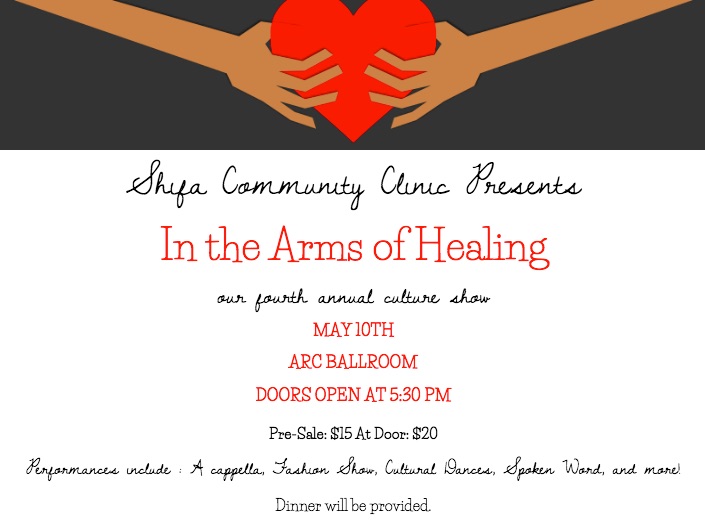
Every spring quarter, the Shifa Community Clinic hosts a culture show to celebrate the diversity and talent within the UC Davis community. The 2014-15 academic year marks the clinic’s fourth year hosting the event. Themed “In the Arms of Healing,” this year’s culture show will occur on Sunday.

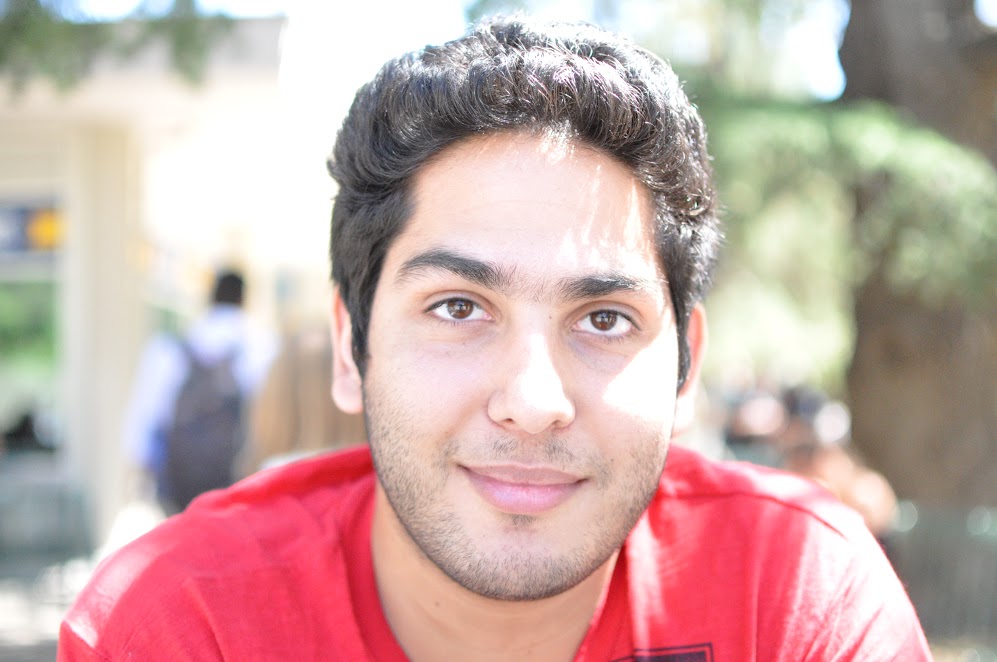
Farsam Fraz, a fourth-year chemistry major and Shifa personnel manager, put into perspective the significance behind the show’s theme.

“In Arabic, the word ‘shifa’ literally means ‘healing,’” Fraz said. “The meaning behind the title of our event this year is to reflect the open arms and hearts of our clinic.”

A non-profit student-operated medical facility, Shifa Clinic, provides health services to medically uninsured patrons of the greater Sacramento region.

One of Shifa’s main objectives is to break down the language barriers often pervasive in healthcare communication. The clinic is attentive to those with backgrounds in Urdu, Hindi, Punjabi, Arabic, Bengali, Fijian, Farsi, Bosnian and Russian.

“Our doors are open to people from every type of background, and we strive to provide the absolute best care for our patients,” Fraz said.

Shifa also strives to provide the public with healthcare professionals representative of its community’s diversity. By doing so, the clinic hopes to create a more welcoming and supportive environment for all patients.

Shifa’s Culture Show seeks to personify the organization’s efforts to illuminate the significance of cultural awareness.

“Our annual culture show reflects the diversity amongst our volunteers and the community we serve,” Fraz said. “The unique characteristics and attributes of our medical staff and undergraduate volunteers is what makes Shifa, Shifa. We would be nowhere without the collective efforts of everyone.”

Ultimately, the Shifa Community Clinic Culture Show brings together medical discipline and the arts as a grand ode to culture. The celebration will feature dance, music, poetry readings, fashion showcases and more.

Aisha Hameed, Shifa board member and fifth-year international relations major, explained that the performances represent cultures of various countries, such as Pakistan, India, China, Japan and Latin America.

“Through watching the performances we hope attendees can appreciate the beauty of our diverse community, a diversity that is reflected in the way the clinic offers culturally competent medical services to our patients,” Hameed said.

By bringing together such distinct fields of studies, the Shifa Community Clinic demonstrates that diverse cultures can also thrive together.

“In the arms of healing, we are putting together this culture show so we can continue to better serve our patients and help them live longer, healthier lives,” Fraz said.

The event will take place in the ARC Ballroom from 5:30 to 8:30 p.m. Admission for the culture show is $15 for presale or $20 at the door. All proceeds will go directly to helping Shifa’s patients. For more information on the Shifa Community Clinic and its culture show, please visit its Facebook page.

Courtesy Graphic by Shifa Clinic.

Myths and misconceptions about health: What is autism anyway?

0

There are numerous misconceptions about what autism is, what the causes are and how it is experienced. Autism, like any other disorder, is complex and variable. Unfortunately, it gets simplified by many of the misunderstandings surrounding it. I want to highlight five of the many myths people have about autism, in the hope that readers will gain insight into the complexity of the disorder.

Tendency to homogenize autism

One misunderstanding that people have is that everyone with autism has more or less the same experience and set of symptoms. Generally, it is assumed that they are all socially withdrawn, non-communicative, unresponsive and engage in repetitive or self-abusive behavior. However, autism is not a homogenous disorder— it is a spectrum disorder. This means that autism is a broad category containing various forms of the disorder. The disorder ranges from mild to severely impaired. Some people may have Asperger’s syndrome or may be high functioning autistics, either being mild cases.

It is incredibly difficult to predict the child’s future, especially considering the immense variability in diagnosis and treatment. For example, at age three, two children may exhibit the same set of symptoms indicating that they have a severe form of autism. However, only one of them may end up significantly recovering, while the other may not. Unfortunately, there is no standard method of determining how the child’s disorder will end up. To illustrate, Temple Grandin, an autistic woman, was labeled as severely impaired at the early stages of her disorder. She is now a Professor of animal science, an autism activist and has published a bestselling book. Grandin even has her own biographical film.

Tendency to fear autistic individuals

People unfamiliar with autism tend to be easily frightened by the autistic. This might be due to their outsider perspective. It is assumed that if a person cannot articulate what a majority considers culturally appropriate, or that they do not follow social norms of communication, then that person is crazy, weird or scary. If you think back and reflect, how many times have you turned away from a disabled person, afraid to look them in the eye? How many mothers have you seen tell their children to look away from a disabled person? Although it may be unusual to be socially withdrawn, non-communicative or unresponsive, it does not legitimize these reactions.

People with autism are cold and unempathetic

People with autism tend to be characterized as uncaring and cold. However, it is not that they are incapable of feeling, rather that they have difficulty reading other people’s emotions. To empathize with somebody, you need to be able to read their emotions, communicate your sentiments and have a mutual cultural understanding of how to appropriately display empathy. This is a difficult task for autistic individuals because many of them have trouble reading faces and making eye contact. The ability of reading body language is crucial to empathy, but it is an ability difficult to obtain for autistic individuals. In addition, many people have problems with nonverbal and verbal communication, so even if they do feel empathy, they may have difficulty expressing it. Thus, autism’s so-called unfeeling nature is more likely due to a lack of social communication, rather than a lack of emotional response.

Vaccines Cause Autism

Many people blame vaccines for their child’s autism. It was believed that the preservative, Thimerosol, contained in vaccines might increase the risk of autism. However, studies have yet to indicate this link; in fact, many studies suggest the rejection of this claim. There have been nine CDC funded studies disregarding the link between autism and vaccines. The vaccines are incredibly safe and beneficial.

“Refrigerator Moms” Cause Autism

There was an assumption, particularly in the 1950s, that autism resulted from cold and distant parents. However, there is no indication that parenting causes autism, especially considering that it is a problem with neurological development. That is not to say that parenting has no influence over the experience of autism. Of course, abuse and neglect would hinder recovery, whereas deep care and acceptance would facilitate it.

Tiffany Marquez can be reached at tmmarquez@ucdavis.edu.

Graphic by Tiffany Choi.

How would you rule?

Students consider their first order of business if in charge

If you were stranded on a desert island and are designated ruler of that island, what would your first rule be?

juliana_noronhaJuliana Noronha

Second-year neurobiology, physiology, and behavior major

“My first rule would be for them to call me ‘master of the universe!’”


kiarash_shayestehKiarash Shayesteh

Fourth-year mechanical engineering major

“My first rule would be: don’t leave the group.”


cori_griffinCori Griffin

Second-year human development and communication double major

“I would assign [everyone] roles first.”


leila_nomaniLeila Nomani

Second-year psychology major

“No murder.”


wesley_jimenezWesley Jimenez

Second-year neurobiology, physiology, and behavior major

“[Everyone is] equal.”


brandon_nicholasBrandon Nicholas

Third-year civil engineering major

“Everyone [has to] share food with one another.”


seanne_louvetSeanne Louvet

Third-year human development major

“The first rule of my island is: ‘Don’t talk about the island.’”


ricardo_guillotyRicardo Guilloty

First-year mechanical engineering major

“He who does not work, does not eat.”


bharathi_ghandiBharathi Gandi

Third-year nutrition major

“Everyone gets paid equally.”


amanda_zuckerAmanda Zucker

Third-year civil and environmental engineering major

“Be nice to one another.”


jeff_beachJeff Beach

Second-year evolutionary ecology and biological diversity major

“No killing.”


nick_alonzoNick Alonzo

Third-year statistics major

“Listen to Mr. Bungle.”


Photos by Jian Gelvezon.

Graphic by Sandra Bae.

In Our Nature: The Mother’s Love

0

Just the right amount of sunlight, just the right amount of rain. With these balances and a little fertile ground, the seed becomes the tree. The branches will find a shape of their own design, but by what providence have they grown under? It is the nurturing of the Earth that brings the tree up hearty and strong – the nutrients beneath its roots, the wind beneath its leaves. In this loving care, the tree rises from its green cradle to stand tall on its own. But it’s never really alone.

In many ways, human growth follows a path similar to that of the trees. There are many factors that affect how we become who we are, but the providence by which we grow is the loving care of what or who raised us. However, unlike the wild trees I described above, we’re part of society’s carefully cultivated garden, and those who have raised us have been the most gracious and compassionate gardeners the world has ever known. They are the mothers and mother figures in our lives. With Mother’s Day coming this Sunday, I’d like to say a few words about what they mean to us and to the Earth.

Now, there are many ways people go about being mothers, and that’s one of the reasons we see such wonderful diversity of character all around us. But I can only talk about my own experience, and I am incredibly blessed and grateful to say that my mother is one of the most generous, caring, compassionate persons I’ve ever known. She’s been there through all of my life’s brightest and darkest moments to support me and make sure things are alright. Sometimes this has consisted of big stuff: going to any length to help me when I’ve made a mistake too big for me alone to fix, or holding me when my world feels like it’s falling apart. More often it’s just little things: the hugs she would give me before school every day, or the great food I can count on receiving nearly every time I go home. But at the center of it all is the one guiding spirit all mother figures share: the selfless love with boundless generosity.

What I’ve come to see, and what I want to share with you today, is that the source of this love lies at the center of the source of all things, Mother Nature herself. Now, some might find this strange; maybe to them, nature seems a dispassionate monolith, doling out rewards and punishments according to impersonal and unvarying laws. But how can such a reduction capture how it feels to see the look in a mother’s eyes when she gazes upon her newborn child? To smell the rain as it brings new life to the parched land? To feel the warmth of a loved one’s embrace spread through your body all the way to the corners of your soul? Everywhere around us, we can see and feel how Nature nurtures and embraces the beautiful world to which she gave life. And even with all her power, it is with a most intimate tenderness that she coaxes her progeny higher and stronger into the best version of whatever they were made to be.

To mother, therefore, is to accept Nature’s highest calling. Caring for the people and things one loves is what we were meant to do, an inclination embedded so integrally in our roots that it fails to even require a reason. Those who mother connect with the greatest and truest good that nature offers: the deep and abiding love living in the heart of all things.

So this Mother’s Day, we should all try to find a way, if we can, to give back to those mothers and mother figures who have given us so much. But in the spirit of the selfless love mothers really work under , I’d like to suggest that we all take the next step and pay it forward. Plant a flower; make a new friend; tell somebody you love how much they mean to you. When raised by gardeners, gardeners we too can become. Spend some time nurturing the garden of your loved ones, and like a mother you too can bring a little more love into the world.

Happy Mother’s Day, Mom! I hope you liked this one; it’s for you.

Look up, look out, look around – love is in our nature.

Nick Jensen can be reached at njensen@ucdavis.edu

Graphic by Sandra Bae.