54.1 F
Davis

Davis, California

Tuesday, December 23, 2025
Home Blog Page 843

Culture Collide music festival set to showcase international indie talents

0

Festival offers affordable chance to discover new cultural

music

On Oct. 14 to 15 and Oct. 16 to 18, the Culture Collide music

festivals will be underway in San Francisco and Los Angeles, respectively.

The festivals, which will feature the headlining acts Cloud Nothings and

Clap Your Hands Say Yeah, will also be presenting numerous international

musicians, with more than 40 bands playing in the San Francisco festival

and over 60 acts from 25 different countries playing in Los Angeles.

Culture Collide festival founder Alan Miller, who also leads Culture

Collide’s editorial platform, stated that the festival offers a great chance for

the discovery of music, culture and innovation.

“We at Culture Collide have gone around the world and delegated the

search for talent and found really great talent. I think for a college student

with little travel experience, this can be a great chance for discovery,” Miller

said in a phone interview.

Because of its international focus, Culture Collide will be offering a

stage for international sounds that deviate from indie music of the North

American variety.

“Although Culture Collide primarily features indie music, there are

different types of music that come from different places. For example,

Swedish bands have great sensibilities to pop music, and you have bands

from Korea with awesome electronic sounds,” Miller said.

Along with the music, Culture Collide will also be hosting a creative

summit where keynote speakers will be leading talks, which Miller invites all

Aggies to check out for free.

“The creative summit […] is a great chance to check out the different

panels to learn about culture, the music business and technology,” Miller

Rainbow Jackson, a band hailing from the Echo Park neighborhood

of Los Angeles, won’t be traveling very far to play at the Los Angeles

festival, but stated that they are looking forward to performing with well-
known groups and discovering international bands at Culture Collide. Sam

Dagger is the lead guitarist for Rainbow Jackson.

“It is our first time playing, but we have lived up the street from the

event grounds for the last few years [and] so we have attended CC many

times. It will be really nice to be able to play the same neighborhood we

have been playing since the beginning, but to a much wider audience of

people who not only came from all around L.A., but to bands from around

the world as well,” Dagger said in an email response.

As it’s Rainbow Jackson’s first time playing at the festival after a few

years of attending, the band members said that they expect to jump into

their set in true rock-and-roll fashion.

“It has always been a great time going and seeing bands from around

the world that we wouldn’t otherwise get to see in L.A. As far as our set

goes, we’re going to turn up loud and have a bunch of fun playing our

favorite songs for people who have never heard them before,” Carlisle said.

According to Miller, Culture Collide offers not only the intimacy and

affordability of seeing your favorite local acts, but also the exciting chance

to experience fresh sounds and perspectives.

“Culture Collide is a unique festival; for example in [San Francisco]

you can pay $20 to see 40 artists, which is very rare, and it’s a really

intimate scene. You can see bands from Israel and Korea and actually go

backstage after the show and meet them,” Miller said.

Both the San Francisco and Los Angeles festivals will be at

multiple venues and are for ages 21 and up. For more information, visit

CultureCollide.com.

Photo by Dave Lichterman

Featured Artist: Bryce Vinokurov

0

UC Davis art lecturer to be featured at Alex Bult gallery


artlecturer_ar_1

UC Davis art lecturer Bryce Vinokurov will be presenting his most recent work “Tel Aviv: Urban Landscapes” at the Alex Bult Gallery in Sacramento. A preview will be held on Oct. 9 from 6 to 9 p.m., and an open reception will be held on Oct. 11 from 6 to 9 p.m. The show will run from Oct. 9 to Nov. 1.

The gallery, which features 55 art pieces inspired by various buildings throughout Tel Aviv, Israel, is influenced by Vinokurov’s recent four-month stay in Tel Aviv during the spring. According to the artist, the gallery will not include paintings of specific sites from Tel Aviv, but rather collages of buildings and landscapes that Vinokurov witnessed during his time there.

Vinokurov pointed out that it was the grittiness of Tel Aviv that attracted him to the city. He also noted that there was a combination of first and third-world aspects in the city that led to his decision to use Tel Aviv as the inspiration for his next art exhibit.

“So you’re walking through Tel Aviv and there’s this beautiful bow house building and it’s really fancy, and then [right next to the house] you’ll have a guy in a cart with a horse selling watermelons. It’s cool,” Vinokurov said.

Additionally, due to the abundance of bow houses, which are pristine-looking buildings with curved fronts, Vinokurov chose a very monochromatic palette for this show, which is a departure from his usually colorful work.

“It’s also called the white city because of all these bow house buildings,” Vinokurov said. “There’s a lot of greys and blues and whites.”

Jeff King, a former graduate student of Vinokurov, previewed Vinokurov’s upcoming show. King compared the aesthetic of Vinokurov’s exhibit to that of other current prominent painters.

“Many seem to quietly verge on abstraction and subtly reference more recent painters like Richard Diebenkorn and Marlene Dumas,” King said. “It’s an intriguing body of work that I’m eager to spend more time with.”

Vinokurov has been visiting Tel Aviv on and off for over 20 years. While he had wanted to produce art on the city since he was young, it wasn’t until recently that Vinokurov noted that he has matured enough to capture the essence of Tel Aviv in a way that satisfies him.

“The city is not Paris, and it’s not traditionally beautiful, so I think for years I’ve not been able to make it somehow into a body of work,” Vinokurov said. “Now I think I’ve kind of embraced the grittiness of it.”

artlecturer_ar

For those who have visited Tel Aviv, Vinokurov said that he hopes his exhibit will bring a nostalgic feeling for the city. Vinokurov hopes visitors of his exhibit that have not been to Tel Aviv will be able to visually experience the city as he has.

“Whether it be ‘Oh, I want to go there’ or ‘That’s a little rough around the edges’ or whatever they want to say about it, I want them to have a view of Tel Aviv through my eyes,” Vinokurov said.

Vinokurov said that he was always interested in art as a child, though he notes that it wasn’t until his time in college that he realized art was something he wanted to pursue. While he is an artist first, Vinokurov also explains his love for teaching, which he describes as a symbiotic relationship with his students.

“What’s amazing is people are always like, ‘Do you get bored?’ My answer is ‘no’ because every class is different, every student is different,” Vinokurov said. “You’ll find somehow a student uses a combination of paint that I never knew you could. I learn just as much from them as they learn from me.”

Brodie Hegg, a former undergraduate student of Vinokurov, detailed his experience in Vinokurov’s printmaking class that led to his appreciation of art.

“Bryce was always helpful and never seemed fazed by our constant mistakes. He just calmly helped us figure out how to make our work better,” Hegg said. “I would not have had the same appreciation had I not taken Bryce’s courses.”

In response to young artists looking to pursue a career in art, Vinokurov advises students to practice copiously, look everywhere for inspiration and not give up.

“I think the advice for a young painter is to stick with it,” Vinokurov said. “There are going to be times when you feel that you’re not good. There are going to be times when you feel that you’re great. Just keep producing tons of work and you’re going to get through.”

Hell yes on Yes Means Yes

University sexual assault awareness initiatives a step in the

right direction

Last year ASUCD passed Senate Bill No. 67, reimplementing

the Sexual Assault Awareness & Advocacy Committee (SAAAC) to be

comprised of seven voting members, nine ex-officio members and two

ASUCD senators. The committee intends to improve the educational

programs that address rape culture by collaborating with ASUCD and

several campus departments.

SB 67 cites personnel issues for their inability to get the committee’s

feet off the ground last year, but ASUCD hopes to reinstate the committee

in the coming month with some added structural changes. We commend

ASUCD for recognizing the urgency of the issue and taking initiative to

combat the prevalence of sexual assault.

The University of California Student Association (UCSA) kicked off

the UConsent campaign this August, encouraging students from all UC

campuses to join together to build on President Obama’s recent “It’s On

Us” campaign. UC Davis endorsed the national efforts Monday.

Gov. Jerry Brown has also begun to tackle the issue on Sept. 28

by signing Senate Bill No. 967. The bill, commonly known as the “Yes

Means Yes” bill, addresses the issue of sexual assault on California college

campuses and is the first of its kind to lay out a clear definition of consent.

Additionally, it will affect how all California universities and community

colleges address rape and sexual assault accusations. It states that the

standard of “affirmative consent” would require both participants to actively

and verbally consent to sexual activity.

It is imperative that the rest of the nation follow suit in defining

consent, especially as in this past year, several sexual assault survivors

spurred the U.S. Department of Education to conduct an investigation of 55

colleges for violating Title IX regulations, which detail how schools handle

sexual assault cases.

We hope to see more action taken by ASUCD in the future. The

SAAAC is certainly a step in the right direction to bring awareness to sexual

assault on our campus. It is pleasing to see that the UC regents, along

with the state of California, are taking a hard look at the current realities

of sexual assault and making serious attempts to educate and provide

resources to students.

This Week in Sports

0

Sept. 29 through Oct. 5

With so many sports for Aggie fans to follow but so little time, we’ve decided to cover

the entirety of UC Davis athletics action in one spot. Here is what happened in UC Davis sports

between Sept. 29 and Oct. 5.

Men’s Soccer (4-0-7):

UC Davis vs. Cal State Fullerton (3-1)

UC Davis vs. UC Riverside (1-0)

Men’s soccer saw Big West regular season play open up for the year, facing both Cal

State Fullerton and UC Riverside at home. In the first match, the Aggies scored a season-high

three goals, including a career first by freshman Kyle Higgins. Sophomore goalie Armando

Quezada ended the game with three saves, only allowing one shot past him.

The Aggies’ second game of Big West play saw them shutout the UC Irvine Anteaters.

Sophomore Connor Willis-Hong provided the lone goal as the Aggies continued their

undefeated season. UC Davis and Penn State University are now the only undefeated teams in

Division I men’s soccer.

For more in-depth coverage of UC Davis men’s soccer, read our soccer recap.

Women’s Soccer (3-7-3):

UC Davis vs. UC Riverside (0-0)

UC Davis vs. Cal State Fullerton (1-1)

Coming off of a six-game losing streak, the UC Davis women’s soccer team has

managed to tie its last three games, all of which were at home. In the first, the Aggies managed

to hold a strong UC Riverside team to zero points behind senior goalie Taylor Jern’s strong

play. Jern finished the day with six saves, vaulting her into third place for all-time saves in the

UC Davis record books.

The Aggies were poised to score a win against Cal State Fullerton, until a heartbreaking

goal was scored by the opposition on a penalty kick in the 86th minute. UC Davis scored its

lone goal from junior defender Lauren Paul, who scored in the eighth minute.

Women’s Volleyball (7-9):

UC Davis @ Cal Poly (3-1)

UC Davis @ UC Santa Barbara (3-0)

The women’s volleyball team was able to capitalize on early Big West matches this

week. Visiting Cal Poly, UC Davis saw strong play from a number of players, including senior

middle blocker Katie Quinn, who led the team with 10 of its 17 blocks.

Against UCSB, the Aggies were able to score a sweep as they dominated three straight

sets. They will return home for a one-game homestand against UC Riverside on Oct. 11 before

heading back to the road for four straight games.

Men’s Tennis:

Aggie Invitational Oct. 3 to 5

The UC Davis men’s tennis team started its season off at home with the Aggie

Invitational. Several Aggies saw success over the weekend, including freshman Everett Maltby,

who surprised the No. 1 seed in Flight B. Maltby was eventually defeated by fellow Aggie and

sophomore Bryce McKelvie, who ultimately won his draw. Sophomore James Wade was also

able to leave his mark, winning the Flight A consolation round.

No other singles players were able to make it past the quarterfinals and both doubles

teams were defeated in the semifinals of their respective draws.

Football (1-4):

UC Davis @ Portland State (14-23)

Playing in a hostile road environment, the Aggies allowed themselves to fall too far

behind and ultimately lost despite a strong comeback bid. Portland State pulled ahead by 17

points in the first hand, anchored by a strong rushing attack. While UC Davis was able to pull

within three points in the third quarter, their offense was effectively stopped in the fourth when it

gained only 31 yards on three drives.

Portland State was able to capitalize on an unusually sloppy Aggie defense that allowed

them to rack up 254 rushing yards. Meanwhile, UC Davis gained just 44 yards on the ground.

While some confidence should be found in their second half performance, their loss in a

winnable game is something that the Aggies should worry about.

Men’s Water Polo (7-8):

No. 11 UC Davis vs. No. 2 Stanford (5-17)

Despite their lofty national ranking, the Aggies failed to impress against a strong

Stanford team. Senior Chris Richardson and junior Sean Grab were able to account for four

out of the Aggies’ five goals, but saw little help from their teammates. Meanwhile, Stanford was

pulled to their dominant victory by Bret Bonanni who currently plays for the U.S. Senior National

The UC Davis team will take its talents on the road for the next three games, where it

should be able to capitalize on lower ranked competition.

Women’s Field Hockey (3-8):

UC Davis vs. No. 5 Stanford (5-1)

The women’s field hockey squad went up against, and lost to, a Stanford team ranked

No. 5 in the country. The UC Davis women’s field hockey team briefly tied the game at 1-1

before watching Stanford hold them off the board for the rest of the day. UC Davis will be at

home for two more games, against UC Berkeley and the University of Pacific, so perhaps home-
cooking and lower ranked competition will lead to a few more wins.

Photo by Courtesy Wayne Tilcock/aggiephoto.com.

Swiper No Swiping

0
Evan Lilley - The Aggie
Evan Lilley – The Aggie

UC Davis Dining Commons (DC) recently implemented a new rule that will only allow students with meal plans to have 10 guest swipes. This means that those students can only swipe in 10 additional guests a quarter. The rule will limit the sense of community that sharing swipes has created in the past among freshmen and upperclassmen, while also limiting the ways in which students can use the swipes they have already purchased.

An officer of Student Development said one reason for the new policy is to prevent freshmen from feeling pressured to use their swipes to let in big groups of people from extracurricular activities they are involved in. This was specifically listed as an issue among athletes and students participating in Greek Life who may feel that they have to swipe in their whole team or multiple members of their sorority or fraternity.

In our experiences and based on what we’ve seen with others, the act of swiping in a group does not result from feeling pressured, but from wanting to create community or friendship. Swiping in a friend can help those two students bond, or allow a freshman to show appreciation to an upperclassman for a being mentor. In most cases, freshmen are happy to swipe in the people that participate in groups with them.

Buying and selling swipes to other students was another act that led to this rule. In previous years, there has been a Facebook group that students with meal plans could post on, offering to sell swipes to anyone who wants to eat at the DC for a reduced cost. Last year, many upperclassmen bought swipes from freshmen for $2 or $3, instead of paying the $12 it costs to enter the DC without a meal plan. While freshmen were making a small profit from this, they had already paid for the meal plan. This is why it should not really matter whether they sold their swipes or used them. Also, freshmen often don’t realize how many swipes they will need, resulting in too many swipes than they know what to do with. Selling their unused swipes is a way to redeem them for cash.

Another issue associated with swiping students in is the rush of meals that DC cooks have to prepare at the end of the quarter or year, right when students decide they need to use all of their swipes before the meal plans change. However, it is completely possible that the DC will still face this problem without unregulated guest swipes. When freshmen realize that they have too many swipes left at the end of the year, they will want to use them. This will lead to going to the DC more often than they did all year, and that will again lead to the overload of demand for meals that was the problem with unlimited guest swipes.

One way students can redeem their unused swipes is by trading in their remaining swipes at the end of the year for $3 in Aggie Cash per swipe or by donating their swipes to a Swipe Out Hunger Fund, which helps feed students throughout Yolo County. Both of these options have also been available in previous years, but they were not advertised, which has meant that students do not get a full value for the swipes that they already purchased. If these options go unadvertised again, many freshmen who purchased meal plans will not use their swipes, trade them in, or donate them. will not redeem their unused swipes.

The fact that Aggie Cash is no longer valid at off-campus venues means that students who redeem their swipes for Aggie Cash have fewer options compared to years past. Gaining $3 in cash from a swipe sold on the Facebook group would remove this restriction, since that money can be used anywhere. The lack of places with which students can use Aggie Cash shows that this option is not as viable as selling a swipe for cash would be.

Students are left with limited options when they are given a finite amount of swipes to use every quarter, and having only 10 guest swipes is detrimental to the sense of community that students who swipe their friends into DC have been able to form in the past. When students buy a meal plan, they should be able to use those swipes however they want to, whether they are swiping themselves in, a friend in, or their entire family in. Ultimately this rule will not benefit students who have bought meal plans, and it may not fix the issues that the DC aims to resolve.

Letter from the Editor

We’re picking ourselves up and dusting ourselves off. The Aggie is back and ready to accompany you as you drink your CoHo coffee.

For The Aggie, the past couple of years have been tumultuous to say the least, with printing being reduced from four times a week to twice a week, and then to once, followed by a well-fought and largely welcomed attempt at instating a fee which would have financially stabilized the paper. This year, we’re starting off with an online publication and a staff driven enough to see the physical papers back on newsstands in time for our centennial. Through a news partnership, we hope to have our inky Aggie back in your hands by January. Until then, we’re optimizing our new dwelling online with new articles twice a week and a redesigned homepage coming soon.

Our editorial board is focused on releasing quality news and multimedia content as well as maintaining a lively website. Additionally, we plan on beginning an online classifieds section later in the year — a good first step to getting back on our feet.

Last year the difficult decision was made to eliminate editor stipends, and as expected, this model will continue into the start of this year. Despite this penny pinching, editors continue to exhibit the same motivation and devotion to this newspaper. Similar to the way many of The Aggie’s alumni credit their work in our newsroom for their post-collegiate successes, I like to credit my UC Davis experience to The Aggie.

Nearing the end of high school, I discovered that I was on the waitlist to UC Davis, with the outcome depending on a 200-word statement explaining why I should be admitted. My reason, oddly enough, was that I wanted to join the award-winning Aggie, which, to the admissions officer that admitted me, was a good enough reason. Seeing that there is no journalism program on campus, our staff recognizes what I learned early on: They need The Aggie as much as it needs them.

As is the case with many struggling college newspapers, we’ve had to wear multiple hats that differ from that of the traditional editor’s. Taking on the roles of contract negotiators, account managers and media strategists has become necessary in light of the variable direction of journalism, but we’re hopeful that in time we’ll be able to narrow our focus and think less like businesspeople and more like journalists again.

We invite you to take the trip down into the Freeborn Hall basement to pick up an application and see what we do.
Send questions, concerns or kind words to MUNA SADEK at editor@theaggie.org.

(Re)Fashioning Gender: Get in Loser, We’re Going Shopping

0

If you thought this column was going to be about the movie Mean Girls, I’m so sorry to have to tell you that it’s not. But please, before you leave to re-watch clips of what is probably the best teen movie ever made, I have a proposition for you: Find me a place where I can comfortably shop for gender-neutral clothing. Seriously. I dare you. I’ll even buy you the limited edition director’s cut of Mean Girls if you succeed. (I’m kidding. Probably all I can afford to give you is a high five.)

In all seriousness, the struggle to find clothes that aren’t exclusively made for women or men is extremely difficult. Sure, American Apparel has a few items that are labeled “unisex,” but you can’t deny the fact that their store is divided into two distinct sections solely devoted to men and women.

Virtually every other clothing store you might find yourself in is also divided by gender. Why is this? When did we, as a society, decide that it was necessary to ascribe girls to wear dresses and boys to wear to baggy jeans? And what does this do to the people who are gender confused or gender neutral or gender anything else that falls outside the spectrum of masculine and feminine?

The division of gender is probably most prevalent in where we do (and don’t) shop. From the moment we enter a clothing store, we make a decision: Are we a boy or are we a girl? Most of us, however, probably don’t even realize that we’re making this decision. That is because we’ve been either a girl or a boy all our lives and therefore it’s only natural that we shop in the section that’s assigned to us. Right?

That’s just the problem: most people stick with the genders that are assigned to them at birth. They never consider the idea that not all facets of that gender are true for them. If you’re a girl, for example, have you ever been shopping in the men’s section? (I mean other than for your dad or your boyfriend or some other male-identifying person.) If you haven’t, you’re missing out on some majorly comfy T-shirts. And have you checked out the pants? So many pockets!

But, maybe men’s clothes aren’t your style. I totally get that. It’s understandable that many women are perfectly happy with the clothing choices available to them. And the same goes for men. However, even if you are comfortable with your options, not everybody is comfortable with theirs.

Also, you can’t deny the fact that some people don’t have any options available to them. When clothing stores divide themselves into two separate sections for men and women, they are completely forgetting about (or completely ignoring) the tons of other identities that simply don’t fit into either of those categories.

There is a whole spectrum that dismantles the notion of a gender binary, which is a social dichotomy that restricts gender to rigid ideals of masculinity and femininity. Think of this spectrum as a rainbow: rainbows don’t have just two colors, right? That would be so lame! Rainbows have tons of colors with tons of different shades. Some colors are dark and some are light. Some like to be referred to as Sir and others as Ma’am, and, well — you get the picture.

The fact that shopping malls are so diligent in making only two sections available to only two genders is completely irrational. It obliterates the whole beautiful rainbow spectrum metaphor thing that I just blew your mind with.

It also instills in us archaic notions of overly-simplistic gender binaries which lead to all sorts of problems like sexism, homophobia, transphobia and other issues that are generally tied to gender. By forcing everyone to abide by a rule that they essentially have no control over, people’s gender identities become mutilated at best, or completely erased at worst.

So the next time you go shopping, I challenge you to ask yourself: are you a boy or are you a girl?  Maybe you’ll find the answer easy, but maybe not. Or maybe you won’t have an answer at all. Either way, I can almost guarantee that you’ll find yourself posed with only two options that are considered valid in the eyes of the clothing store.
If you’d like to dismantle heteropatriarchy or participate in other fun and wholesome activities, contact Chelsea Spiller at ctspiller@ucdavis.edu.

Edumacation with Calvin and Hobbes: The Institution

0
Watterson, Bill. There's Treasure Everywhere: A Calvin and Hobbes Collection. Kansas City: Andrews and McMeel, 1996. Print.
Watterson, Bill. There’s Treasure Everywhere: A Calvin and Hobbes Collection. Kansas City: Andrews and McMeel, 1996. Print.

I came to college to learn. I’m interested in many subjects and have been fortunate throughout my life to enjoy the benefits of top quality public education. But learning, when done right, is never easy, and is often hindered by varying circumstances, policies and individuals.

Calvin, from the popular comic, Calvin and Hobbes by Bill Watterson, lives the woes of modern education and displays intelligent cynicism on the matter — an intelligence distinct from the poor test grades he receives. Calvin and Hobbes can help us understand issues concerning education in a comical way (because I’ll be damned if I make this column another homework assignment).

This column will address the discrepancy between self-education and institutional education. The strip above illustrates the problem in a simple manner: boy feels he’s learned enough, teacher says no, boy sits back down.

Institutional education (which sounds bad, I know) exists in part to provide resources and professional guidance to students. It presupposes that the teachers know more than the student and that the student will benefit from time in their company. Often, teachers do know more. But sometimes, they do not, and these circumstances can be difficult: a professor has spent their lives invested in academia, and you?— you’re a pompous eighteen-year-old, who doesn’t have credentials. Still, the closed-minded professor is no myth.

Compromise has always been the best method for centering two opposites. Discussion forums provide compromise in our higher institutions. An active exchange of ideas benefits everybody, but in primary and secondary education, discussion is often squelched. Participation rates are low and participation grades often have the effect of doling out an easy 10 to 20 percent of a student’s grade. Even the boy as quiet as a mouse in the back corner scrapes up a couple points.

The participation in the classroom only slightly improves in college, a phenomenon which I believe can be explained by the fact that most students find a niche in college and want to talk about what interests them. Still, I’ve been in a 500-student lecture where not one person was brave enough to ask a question (including me — “I had no question”).

The irony here is that smaller classes find more people talking up — at UC Davis, these classes are called discussions. A classroom is cozier than a lecture hall. These classes are often held weekly, taught by a teaching assistant and go on for an hour. Let me ask: Why? I came to college to learn; if the compromise in learning is discussion, why does the institution give us such little time in the tight-knit classroom, when there should really be more?

The solution might be an academic Freaky Friday of sorts, which would involve the professor leading discussion (where their expanded knowledge would be more required than in lecture) and the TA going over the basics in lectures that occur once or twice a week.

The contrast between discussion classes and lectures seems to echo the classic liberal arts college vs. research university argument, which is that professors have more time for students at liberal arts schools. But why should a research university be much different? To account for the large amount of discussion section, perhaps a professor should be required to host a third of discussion sessions, and do a lecture per week.

One could even argue for making office hours on an appointment only basis, given that all the students would be in direct contact with the professor through discussion. This contact, which would be conducive to research, would give the professor a large pool of students for finding potential research assistants. The whole process would be more involved, help mutual learning and would show how being more interactive with students will benefit the professors working at a research university.

I wonder what Calvin would think. He would probably shun any form of enclosed environment, preferring the great outdoors to any inkling of authority. Well, the unruly boy is only six years old; he has a lot of truths to learn. Though I find it hard not to sympathize with him given the stare-down he’s just received from that dastardly teacher.


To tell Eli that he needs an education, you can reach him at ekflesch@ucdavis.edu or tweet him @eliflesch.


Tunespoon: Do What U Want

0

Music is sound. It’s also a cultural, social, emotional and economical phenomenon. I want to explore them. Welcome to Tunespoon.

“Let’s turn this into a dance party.”

I was at a tUnE-yArDs concert last June, and front-woman Merrill Garbus prefaced dancy anti-vigilante anthem “Stop That Man” with the above command. It was Saturday night at San Francisco’s Fillmore, the city’s counterculture Mecca, and I was ready. Everything about her performance of the song played into the perfect go-wild atmosphere. The frenetic lights and kooky laser patterns, the relentless funky clackof a looping drum beat and everyone on stage jumping up and down like robots fueled by the energy of a quarter-note groove. It was fantastic. And then I saw around me:

People standing still. Well, not perfectly still, but it wasn’t the dance party she asked for. I do not call the minute baby-bobbing of knees a dance. I was thinking, “Why wouldn’t this audience comply with her? The money they paid surely should let them own this night.”

I saw Arcade Fire this summer, and from where my seats were, the anti-dance sickness was omnipresent. Everyone got up out of their seats, but wasn’t dancing. The tall baseball cap guy next to me even had his freakin’ arms crossed.

I wondered why people could not bring themselves to move. Especially to dance music. tUnE-yArDs is a musical project whose work sounds just as electric as their band name looks. It’s wild, caffeinated neo-tribal playground chants for manchildren. Arcade Fire is by comparison more refined, but the energy of the sheer size of the group is incomparably visceral. Both have musical and thematic inspiration from Haiti, taking special focus on Haitian folk dances. By filtering their influences through a North American indie rock kaleidoscope, they create new ways to move their audiences. The artists are more than doing their part. So why does it seem that audiences aren’t doing theirs?

It all depends on what a person does with music. Mothers lullaby children to dreamland. Souls singing in the pulpit uplift their spirits. EDM teens’ hearts race in anticipation in a beat-drop buildup. In its purest form, music is sound that induces physical change in a person. It helps you focus while studying for midterms, keeps your mind off the heavy breathing during a run, or can help you sleep. It can evoke a bad breakup from the past, or back to broadway to that musical you love. Music attaches to you, so consequently, it’s an incredibly private experience. Listening to music in public through headphones separates you from the outside world. So it is understandable that in a sweaty venue with other people, sharing this deeply individualized experience with strangers can be uncomfortable. Or maybe even embarrassing. You may even feel ashamed to express your appreciation.

But only you can own it. Treat it like was made for you alone to hear and embrace. This performance belongs to you just as much as everyone else. Even if you don’t know this song, or have never heard that piece before, you’re there with the artist, so let go, and make the most of the little time you have together. In this generation where people walking down the street will shoot a glare if you so much as whisper a song to yourself, you don’t have many opportunities to be enveloped in your love for sound. Those who eye you are jealous. They wish they had ownership of their experience as much as you do.

Of course, every venue is different. Watching Big-Name Pop Starlet at Insert-Sponsorship-Here Arena has a lot of teenage hormonal energy to feed off. At a metal fest, go ahead and start that violent, communal thrashing. A tiny venue in the middle of a car plaza may evoke more subdued reactions, but don’t let the quiet intimacy intimidate you — relax, absorb, applaud. At the Mondavi Center, be the first to give a standing ovation.

Do what you want, what you want with your body, because your music is absolutely yours, and no one can ever change that.

You can turn anything at all into a dance party by contacting STEVEN ILAGAN at smilagan@ucdavis.edu.

Back to school recap of men’s teams

0

SoccerRecap_IanPalmer


While the school year is just starting for most students, UC Davis sports teams have already been hard at work competing across the country for several weeks. For those of us who are unable to keep up with the 10 teams who have already been in action this season, here is a one-stop guide to how UC Davis men’s teams have been playing during this summer break. UC Davis women’s teams are covered in a separate article.

Men’s Cross Country (1st, 4th, 6th place finishes):

The men’s cross country squad opened up their 2014 season well, winning the Aggie Open over Sacramento State. Although nobody managed to place in the top two individually, junior Brandon Pugh took third place, and the fifth through 10th-place finishers were all Aggies.

In the second meet of the year, the WCC Preview race, the Aggies finished fourth out of eight teams and were led by a 15th-place finish by sophomore Austin Goins.

Most recently, UC Davis finished last in a very competitive six-team meet at Stanford. Once again, the Aggies were led by Pugh who finished 13th overall.


Men’s Golf (5th, 10th, and 5th place finishes):

Through three tournaments, junior Luke Vivolo has proven himself to be a leader for this season’s men’s golf squad. Vivolo led the Aggies to a fifth-place finish in their first tournament by tying for sixth with a 2-over tournament.

Despite struggling on the last day of the second tournament of the season, the Saint Mary’s Invitational, Vivolo once again finished the highest individually of any UC Davis player. As a team, the Aggies limped to a 10th-place finish out of 16 teams.

At the Kikkor Husky Invitational, senior Matt Seramin led the team by finishing 11th individually. The team finished only nine strokes out of first place, settling for a fifth-place finish.

The UC Davis men’s golf team will conclude their fall season at the Alister MacKenzie Invitational on Oct. 12.


Men’s Soccer (2-0-7):

Technically, the UC Davis men’s soccer team remains undefeated this season. While this is certainly admirable, the record shows a less dominant performance that includes seven ties and only two victories. Still, they find themselves in third place in the Big West standings and should be very encouraged by their strong play thus far.

With the school year now beginning, the Aggies are opening up Big West play by taking on Cal State Fullerton and UC Riverside who have three and five losses, respectively.

The men’s soccer team’s first significant challenge should come when they visit the seven win UC Irvine on Oct. 9.


Men’s Water Polo (7-7):

Over the summer, the UC Davis men’s water polo team quickly climbed to a 10th-place rank nationally. The Aggies, who have not lost at home thus far, rebounded nicely from an early five-game losing streak by winning six out of seven including wins over No. 18 ranked Navy and No. 19 ranked Whittier.

With only five home games remaining in the season, the Aggies must begin to play better in away matches after losing their first three. If junior Sean Grab, who has scored 20 goals and assisted on 13 more, continues to play as effectively, UC Davis should have no trouble continuing to dominate the competition.


*All team records up to date as of 10/1

Aggies football suffers first home loss

0

FootballRecap_Pasturel01

UC Davis (1-3, 0-1) was defeated for the first time at Aggie Stadium this year, as they faced the Eastern Washington Eagles (4-1, 1-0), by a score of 37-14. The Eagles are currently ranked No. 2 in the Football Championship Series as they opened Big Sky Conference (BSC) play.

The Aggies were led through the air by senior quarterback London Lacy with 172 yards and a touchdown and in the running game by senior running back Colton Silveria who gained 35 yards on 12 runs. Still, it was not enough to tame an Eastern Washington team led by highly touted quarterback Vernon Adams Jr., who leads the BSC in total yards and touchdowns.

The Aggies came out strong and held the Eagles to only nine points in the first half. The Eagles scored a touchdown in the first quarter, but failed to convert the PAT attempt. Sophomore running back Manusamoa Luuga responded with a two-yard touchdown, which lifted the Aggies to a slim lead. However, the Eagles converted a 27-yard field goal with three minutes left in the first half which put them ahead 9-7 by halftime.

Senior linebacker Steven Pitts led the Aggie defense with 11 solo tackles, which includes 2.5 TFLs. Redshirt freshman Darryl Graham and sophomore linebacker Brady Stibi also contributed eight solo tackles each and combined for a sack.

Eastern Washington scored three touchdowns in the third quarter to add to their two-point lead. The Aggie defense struggled to contain Vernon Adams, Jr., who had a total of 303 yards and completed 23-of-28 attempts.

The Eagles presented a balanced attack, as they scored touchdowns through the air and on the ground. Jabari Wilson, Adams, Jr. and Mario Brown rushed for touchdowns. Adams, Jr.  also threw two touchdowns, one to Cooper Kupp, a 61-yard reception, and another to Blair Bomber, a 40-yard reception.

After the game, UC Davis Head Coach Ron Gould expressed mixed feelings about the play of the Aggies.

“I’m very, very pleased with the energy and the effort that our kids played with for 60 minutes. We had some drives where we shot ourselves in the foot,” said Coach Gould. “We converted some third downs that would extend some drives but they got called back for penalties. That’s a little disconcerting. We’re not a team that has a lot of penalties but tonight we had several at inopportune times. When you’re playing a really good football team, it’s paramount you don’t have those penalties.”

The Aggies travel north to Portland State to face the 1-3 Vikings in Portland, Oregon on Oct. 4 at 4:30 p.m.

Game notes: Total attendance was 6,954. Senior running Colton Silveira is now in the top 10 rushing leaders in UC Davis history with 1,432 yards.

University to partner with Chile, develop new Life Sciences Innovation Center

0

On Sept. 17, UC Davis announced that it would be partnering with the Chilean government in a joint effort to develop the UC Davis Life Sciences Innovation Center in Chile. Researchers from Chile and UC Davis hope that their collaborative efforts and public sector research will be conducive to creating regional, national and international business opportunities.

In a press release, the university stated that the goals behind the creation of the Innovation Center are to increase economic competitiveness, research and development in both Chile and California, with a focus on the agricultural industry.

Research and development will cover agricultural topics such as plant breeding and climate change technology. Both the Chilean and Californian economies rely much on agriculture and food production, as agriculture is the second largest industry in Chile and California is the fifth largest supplier of food for the global community. UC Davis also has a top-ranked agricultural program that has consistently proven to be reputable and internationally respected.

“We expect to have active research projects in viticulture and enology, plant pathology, genomics and climate change initiated quickly,” said Alan Bennett, a professor in the Plant Sciences Department at UC Davis.

The project would help establish more commercial products that were developed out of research discoveries and allow the relationship between Chile and California to continue to grow since the launch of the Chile-California Program in 1963. This program has sought to enhance collaboration between Chile and California in areas such as agriculture, education, water resource management and highway transportation.

According to Bennett, a main goal of the UC Davis Life Sciences Innovation Center is to “effectively transfer research results, knowledge and intellectual property to support local and global innovation.”

Bennett said he thinks the project will strengthen the historical ties between Chile and California as well as serve as an “international hub between UC Davis [and] Latin America.”

“This will serve as a platform to bring new research projects to UC Davis that will engage faculty and students,” Bennett said. “Importantly, it will also strengthen the international perspective to research and [lend to] a broader understanding of problems and issues that other countries face. The initial focus of the center will be in agriculture, where there are many similarities between Chile and California but also important differences.”

Creators of the innovation center are working with a 12-million-dollar budget for the first three years of the project. The Chilean government will fund $6 million of that budget through a grant from the Corporación de Fomento de la Producción de Chile (CORFO), the country’s economic development agency. The other $6 million would be obtained through industry and university partner cost-sharing, $1.5 million of which would come from UC Davis.

According to Bennett, the next step in funding the project is to establish the UC Davis Life Sciences Innovation Center as a nonprofit in Chile owned by the University of California. The center will then be scheduled to begin operation in Chile by January 1, 2015.

“This new Innovation Center will also help support and advance UC Davis’ goals to promote economic opportunities for California and throughout the world,”  said Linda P.B. Katehi, chancellor of UC Davis. “It furthers the work of our excellent agricultural programs and also follows the goals and mission of the UC Global Food Initiative to develop, demonstrate and export solutions — throughout California, the U.S. and the world — for food security, health and sustainability.”


Legislation to provide Californians with sick days passes

0

Starting July 1, 2015, the Healthy Workplaces, Healthy Families Act of 2014 will ensure that all Californians employed for 30 days or more will receive paid sick days.

Six and a half million workers in California are currently not allotted paid sick days. The bill entitles employees to one paid sick hour for every 30 hours worked from the commencement of their employment.

This legislation aims to increase familial wellness, prevent the spread of illness in the workplace, lower healthcare costs, decrease employee turnover and help support a thriving middle class.

“Employers benefit, workers benefit and ultimately, the California economy benefits,” said Sen. Ricardo Lara (D-Bell Gardens).

The bill was signed into effect on Sept. 10 of this year, making California only the second state in the United States to require that employers provide paid sick leave, the first state being Connecticut in 2011.

As reported by the Huffington Post, such ordinances are now coming to cities including New York, San Diego, Portland and Washington D.C.

Paid sick leave benefits all California workers, however, the passing of this bill is a major motion in support of working women. According to the 2013 U.S. Census, there were 12 million single-parent families in the United States and 80 percent were headed by women.

Under the new bill, single mothers, or any primary caregiver, can take paid sick leave to care for a sick child or elderly parent.

“To jumpstart the middle class, we must unleash the full potential of America’s working women. When women have fairness and balance between work and family, we know there are no limits to what they can achieve — and when women succeed, America succeeds,” said Rep. Nancy Pelosi (D- San Francisco), in a press release.

Cara Peters, a fourth-year human development major and member of the Women’s Health Initiative Club at UC Davis, said that this bill not only supports single working women but also women in the workplace whose partners do not have the option to stay home with sick children while they go to work.

“This could bring a lot more equality into households, making it so that either parent has an equal opportunity to act as the caregiver for the child or elder,” Peters said.

Peters emphasized that this bill will allow working women the freedom to make both their professional and family priorities in their lives, rather than having to choose between the two.

“No woman should feel pressure to leave her job because of the societal expectation that she must be home to be the primary caregiver. The signing of this bill may relieve much of this pressure, as women can feel empowered to be both a caregiver and a provider for her family,” Peters said.

According to Rep. Pelosi’s statement on the passing of this legislation, she hopes that the signing of this bill inspires Congress to make similar motions on a national level.


Davis celebrates Chinese culture through food and film

0

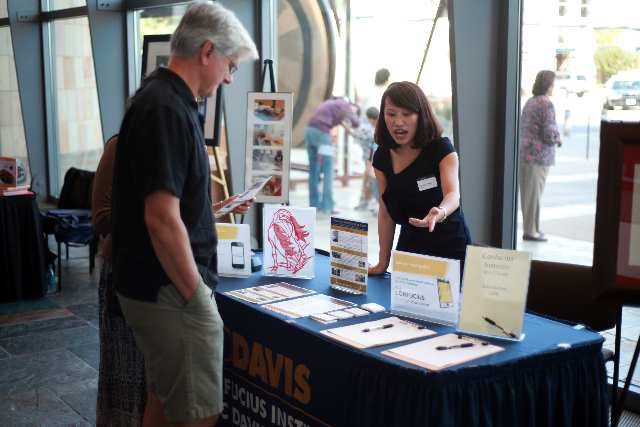
Last Saturday the Davis community celebrated Global Confucius Institute Day and the Davis Chinese Film Festival’s opening ceremony at the Mondavi Center. The gala event featured a photo exhibit, a showing of Eat Drink Man Woman by Oscar-winner Ang Lee and a question-and-answer panel of four distinguished speakers. Not only did the event present fine forms of art but also intimate perspectives of Chinese culture and values.

Global Confucius Institute Day commemorates the 10th anniversary of Hanban (Chinese National Office for Teaching Chinese as a Foreign Language). It also pays honor to all institutes devoted to teaching Chinese language and culture, including UCD’s very own Chinese Language program. In fact, the Davis Confucius Institute centers its teachings on Chinese food and beverage culture.

Michelle Yeh, panel moderator and UC Davis’ department chair of East Asian Languages and Cultures, provided educational insight on the significance of learning food history.

“Food provides a unique prism through which to understand society, history and culture,” Yeh said. “Chinese food has a history of 5,000 years; it has developed many regional fares, each with distinctive features and tastes. It’s no exaggeration to say that Chinese cuisine is an exquisite art form and a powerful cultural expression. For Chinese people, food is not only sustenance but also medicine, symbolism, social relations and rituals.”

Fittingly, the gala’s showing of Eat Drink Man Woman depicted Chinese familial structures and traditions through food.

Sheldon Lu, a UC Davis professor of comparative literature who was one of the panelists, stressed what he hoped attendees gained from the movie and subsequent Q & A.

“[I hope attendees understand] how the old generation needs to adapt to change, new ideas and new lifestyles; and at the same time, the young generation needs to appreciate traditional values. The old and new should try to understand each other’s values and perspectives,” Lu said.

Along with nuancing the Davis Confucius Institute’s mission, the film screening also kicked off the Davis Chinese Film Festival, which will took place over five different days in Sept., showing a total of 12 movies.

MUSE spoke with the film festival’s co-chair, Ning Wan, who commented on the unique ways film represents Chinese culture.

“Movies are made up of a story, a visual aesthetic, a soundtrack, a script, acting styles and many other components that are shaped by culture,” Wan said. “The audience can take in different cues about Chinese culture, history, life, etc. through a movie that might not be as readily apparent through other forms of art. Movies can showcase things in real time such as dance, conversation flow and mannerisms.”

The film festival will feature a total of 12 hand picked movies. According to Wan, the film committee made sure to select films that mostly focused on life in modern China. However, a few movies take place during historical periods.

“The 12 movies will allow the audience to look at different aspects of life in China. […] We hope that through watching these movies, people will learn more about Chinese people and their culture,” Wan said. “Similar to how the U.S. is comprised of states with different cultures, China is made up of many provinces whose cultures cannot be captured in a single movie. There are so many different cultures in China; we hope that people leave with a better understanding of Chinese life.”

Overall, the celebration was meant to be a grand toast to Chinese culture’s legacy. The overall goal of the gala was to open doors to new understandings about new and old Chinese culture, but also to introduce some of the many unique cultural perspectives the Davis Chinese Film Festival will manifest.


Associated Student Dining Services increase prices

Starting Sept. 22, much of the food and beverages sold at Associated Student (AS) Dining Services increased in price for the first time in four years. AS Dining Services, made up of the ASUCD Coffee House, CoHo South Café and CoHo-To-Go Convenience Store, last increased prices in 2010. While certain foods, including yogurt and whole fruits, have remained at the same price, other items have become more expensive. This change is largely due to the increase of California’s minimum wage, which has gone from $8 to $9 per hour. Prices generally increased about 30 to 50 cents per item.

“We’ve been looking at this, probably for the past year, as something on the horizon we would need to address,” said Darin Schluep, food service director of AS Dining Services. “When we first heard of the plan to increase California’s minimum wage, we knew we would have to react to that.”

Schluep says that increasing food prices also played a role in his decision to increase prices at AS Dining Services.

“There are increases in the costs of doing business in food services,” Schluep said. “We are certainly not alone in having to increase prices. We’ve seen a 33 percent increase in poultry prices in the past years; dairy prices have gone up. As [the prices of] some of these staple items have gone up, we can absorb that for a certain amount of time, but we eventually have to change.”

Rachel Pyle, the out-front student manager for AS Dining Services, said she initially felt nervous about the change, but understood the need for the price increase.

“The first time I heard about the plan to adjust prices was at one of our management meetings toward the end of the [last academic year],” Pyle said. “When the causes were all explained (increasing food prices over the last few years and the increase in minimum wage) it all made sense, but naturally I was a little nervous to see customer reactions.”

Some students who frequently buy food from the AS Dining Services were disappointed with the price increase.

“I think the CoHo’s decision to increase prices is unfortunate,” said Zoë Rossman, a second-year evolution, ecology and biodiversity major. “It’s so wonderful to be able to go grab a cheap, good meal between classes. Of course I’ll still go there, but as a student, spending a bit more here and there really does add up.”

While Pyle has seen a few disgruntled customers over the price increase, she believes that business at the AS Dining Services will remain stable.

“The price adjustments are all very minimal, and [as] one of the most inexpensive food establishments on campus… I don’t think the adjustments will have a huge impact on our business,” Pyle said. “Since we are bringing new projects for the fall to offer more variety, I think our business will only increase.”

Schluep said that he hopes that students will understand the reasons behind the price increase and continue buying food through AS Dining Services.

“I’m hoping our customers will understand the situation we’re in,” Schluep said.

Schluep also stresses that he took the students into consideration when making the decision to increase the prices.

“We never do these things lightly,” Schluep said. “We understand that we’re in an environment where everyone’s on a fairly tight budget. We did a lot of research and we feel as though we’ve maintained our status as the least expensive food in town.”