52.4 F
Davis

Davis, California

Tuesday, December 23, 2025
Home Blog Page 878

Aggie Arcade: Your weekly dose of video games

0

PlayStation Now

Sony recently sent out beta invites for PlayStation Now, the company’s upcoming streaming service in which PlayStation 4 owners can play old PlayStation, PlayStation 2 and PlayStation 3 games on the new console. I highly doubt one of those invites will be coming my way, but count me among the excited PS4 owners.

Many people in the video game community were upset with the news that the PlayStation 4 and Xbox One would not be backwards compatible. I still play plenty of PS3/360 games, which means I have a giant PS3 and 360 right next to my shiny new PS4. At a certain point I’m going to run out of room for video game consoles!

Sony aims to solve that problem with PlayStation Now. A key partnership with streaming company Gaikai was announced last year — an announcement met with both enthusiasm and skepticism. The idea of streaming old games sounds great on paper, but execution is the most essential component. If Sony does succeed, we’re looking at a huge boost for the PS4.

PlayStation Now will likely come with some kind of subscription service or rental fee for individual games, which creates an interesting dynamic. On the one hand, I feel weird paying for games I already own on previous Sony platforms. But at the same time, I know the limitations of my willpower. If I see a bunch of awesome PS2 role-playing games (RPGs) available to stream, I’m going to fork over the money. I’m like Fry from Futurama in one of those “Shut Up and Take My Money” meme images.

The option to stream also averts any need to download games, though that brings us to a potential concern. In order to use PlayStation Now, the user must have a reliable internet connection and bandwidth — a 5 Mb/second minimum to be more specific. Not everyone will meet those requirements, which cuts off a portion of the potential audience.

There’s also the chance that the service will not work as intended. Imagine playing an old PS2 classic, only to have your memories ruined by noticeable lag and other technical issues. That’s the pessimist in me talking, but Sony did recently show off the service to a select few. The press got some hands-on time with PlayStation Now at the Consumer Electronics Show (CES) last month, and The Last of Us and God of War: Ascension — both PS3 games — appeared to run well.

PlayStation Now will publicly launch this summer, and I sincerely hope it works. We’re still years away from having robust game libraries for the PS4 and Xbox One, but including PS1, PS2 and PS3 games all on one system definitely helps. Then I can actually have some more space for important things, like a gigantic TV.
World’s most advanced instrument for imaging plants turns skyward

The search for planets outside our solar system is an underreported but active field. Dozens of powerful instruments have been designed to detect these faint heavenly bodies in unique ways. Whether ground-based or in orbit, they face numerous challenges. The Gemini Planet Imager (GPI) opened in November last year and is the most recent addition to this exclusive group of space investigators.

The GPI is the world’s most advanced instrument for directly observing light coming from Jupiter-sized, or Jovian, planets. Located in Chile, it is the culmination of a decade of work among many institutions, including UC Santa Cruz, the Lawrence Livermore National Observatory and UCLA. GPI is designed to observe the atmospheres of large young planets within tens of light years away and take their spectra, which reveals the planets’ composition.

“Newly-formed planets are very warm, and the Gemini Planet Imager looks in the infrared to detect their light,” said Jeffrey Chilcote, a graduate student at UCLA and a contributor to the GPI project.

Hot solid objects emit light with a continuous spectrum across many wavelengths. Hot gases emit light at only specific wavelengths. Consequently, hot solid objects surrounded by cooler gasses will show a near-continuous spectrum with dark lines corresponding to the emission lines of the gasses. By comparing the absorption lines of the object with emission spectra of known gases, the chemical composition of objects can be determined.

However, several problems stand in the way.

“The main problem for direct imaging is atmospheric seeing (twinkling of starlight) … This basically distorts the image and makes it look larger by moving the image around so we do not have very good detail resolution,” said Patricia Boeshaar, a UC Davis astrophysics professor.

Furthermore, the brightness of the host star, which is often seven or eight magnitudes higher than the target planet, make observing the planet difficult.

“[It’s like] trying to see a firefly on the rim of a searchlight,” Boeshaar said.

The GPI contains several components to overcome these obstacles. Its adaptive optics system, an essential organ in any serious ground-based space observing endeavor, corrects the light coming through our atmosphere.

A large deformable mirror takes the distorted light and reflects it as corrected waves in a process similar to how a carnival mirror changes how you look. The GPI’s coronagraph blocks out the light coming from the host star so that its planets may be more easily visible. The sky is imaged onto a mirror with a small hole: the desired light is reflected, but the unwanted light from the star goes through the hole. While imperfect, these corrections allow enough legroom for valuable data to be collected.

The real goal of GPI and any exoplanet search activity is to uncover clues about the formation of our universe. What causes planets to form around stars? How common are planets in solar systems?

“We have a couple of questions about Jovian planet formation mechanisms. Do they form by core accretion, where the solar system coagulates but eventually builds up gas, versus planet formation like gravitational collapse?” said Michael Fitzgerald, astrophysics professor at UCLA.

In core accretion — the current prevailing theory — a core with a large mass forms by numerous collisions between smaller bodies. Hydrogen and helium eventually envelope the core until the supply (usually leftovers from star formation) is exhausted. In gravitational instability, the self gravity of a massive gas disk collapses into fragments, becoming giant planets. No solid core is required.

” There are also questions about system evolution. We have inferred that the orbits of our giant planets are not where they were long ago,” Fitzgerald said.

This is inferred by the distribution of small bodies in the solar system, like the asteroid belt and Kuiper belt. Their orbital properties indicate a migration.

GPI is set to conduct a 600 star survey to observe their planets this year. How many questions it can answer about our universe remains to be seen.

Police Briefs

0

Tuesday 1/28
Surprise party
An unknown male was inside the reporter’s apartment on Albany Avenue drinking and playing music. The reporter had no roommates and no idea how he got inside.

Wednesday 1/29
Makes skin crawl
A squirrel was found dead on Second Street appearing to have been skinned.

Give him some credit
On East Covell Boulevard, a transient asked if he could use the reporter’s credit card to see if it worked, saying he was a police officer investigating the reporter.

Friday 1/31
Cataclysm
Someone was suspicious of a subject with a drill at the manhole on Glide Drive, believing it related to calls for the past few days about people trying to retrieve a cat.

Saturday 2/1
Drove him to drink
A seemingly drunk male was wandering through the street and tried to get into someone’s vehicle while they were stopped at the light on Anderson Road.

Purranoia
An unknown female pounded on someone’s door on Alvarado Avenue stating she lost her cat. When she saw the person’s kittens she tried to claim they were hers.

Police briefs are compiled from the City of Davis daily crime bulletins. Contact EINAT GILBOA at city@theaggie.org.

Katehi serves coffee at CoHo

0

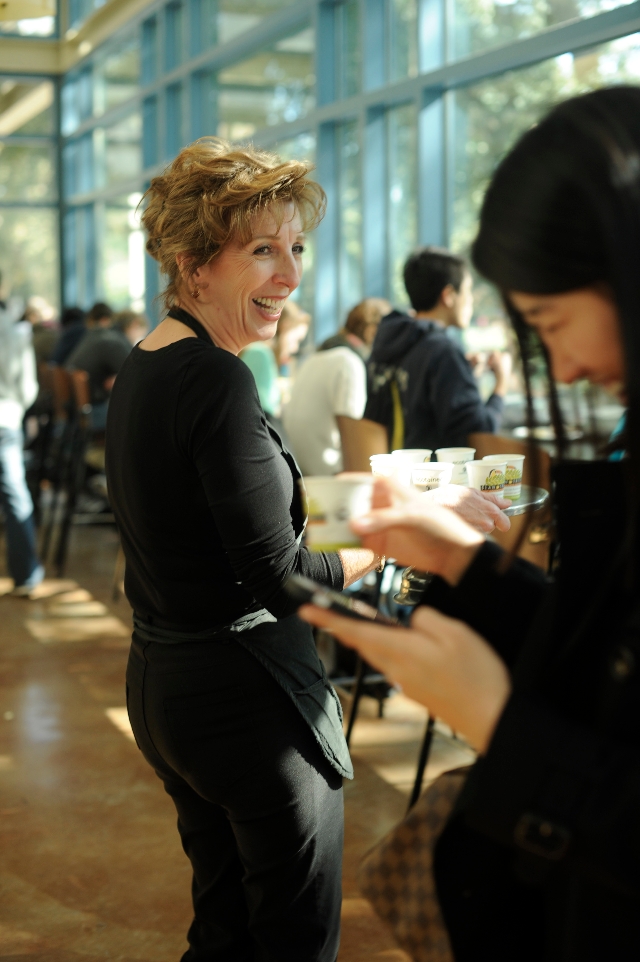
Chancellor Linda P.B. Katehi delivered service with a smile at the ASUCD Coffee House (CoHo) on Monday as part of her participation in the University of California (UC) crowdfunding effort, Promise for Education.

In the midst of funding cuts and financial difficulties last fall, UC launched its first crowdfunding platform to raise scholarship funds for undergraduate students. In a call to anyone who was interested in the cause and willing to help, UC recruited people to make promises that they would fulfill once a certain amount of money was donated.

Those who wanted to participate made their promises, set with a donation goal and got the ball rolling. The fundraiser ran for six weeks leading up to Oct. 31. One thousand promises were set, 3,900 contributions were made and over $3.1 million was raised.

Educators, celebrities, students and more made promises ranging from the silly to the strenuous. Katehi promised to serve coffee at the CoHo if the goal of $5,000 was reached and host a VIP Greek Gala if $10,000 was raised. Both goals were exceeded, and, on Monday, Katehi strapped on an apron and got to work.

“She caught on pretty quickly,” said Chris Greene, a fifth-year human development major and CoHo worker. “The first thing she made was a cappuccino foam, which is one of the hardest drinks to make. It was really surprising because for her first time she did really well.”

Though not everyone knew why Katehi was working at the CoHo, many students responded positively to seeing her there.

“I didn’t know it was going to happen,” said Cammile Gunsauls, a fourth-year design major. “I didn’t know this was why she was here, but that’s really cool.”

Students noted the fact that this was a rare opportunity to interact so closely with the chancellor.

“I’ve only seen her at big rallies,” said Chris Miller, a first-year Japanese major. “She’s been sort of a distant figure so it’s cool that she’s sort of coming down to the student level. I think it’s awesome that she’s following through on a promise, because so many higher officials don’t do that.”

The $10,000 goal set by Katehi was exceeded by the end of the fundraiser. All money raised goes into the general scholarship pool for undergraduate UC students who qualify for financial aid.

According to the Promise for Education website, the state currently covers 39 percent of a UC student’s education, a significant drop from the 78 percent it used to cover. This is due in part to a $900 million cut in state funding received by UC in the past five years.

“Last year, for the first time ever, students and their families shouldered a bigger share of the cost of their public education than the state,” stated the Promise for Education website. “And with that shift comes growing questions about the value of a college education.”

With many students unable to afford to attend the universities that they are qualified to attend, extra financial aid can make the difference.

“About one-third of tuition revenue is put aside for financial aid,” said Dianne Klein, spokesperson for UC. “We are looking under every rock and around every corner to raise more money. [The fundraiser] increased the money we have to give to students who need financial assistance.”

As participants in the Promise for Education fundraiser continue to fulfill their promises, UC will continue to initiate innovative fundraising campaigns.

This Week in Senate

0

ASUCD Vice President Bradley Bottoms presided over the senate meeting on Jan. 30. The meeting was called to order at 6:15 p.m.

The meeting was comprised mainly of discussion about several pieces of legislation, including five bills and three senate resolutions.

Susan Kee-Young Park from the UC Davis Office of the Ombuds made a presentation explaining how Ombuds is a good resource on campus. Ombuds is an independent and impartial resource that helps solve any conflicts between the faculty, staff, administrators or postdocs and the UC Davis administration. Ombuds does not get involved but offers strategies and tips to solve resolutions peacefully.

Senate Bill (SB) #21, which changed the attendance policy for commission interviews, was passed with no objections. SB #23 to implement a Long-Range Plan for Project Compost was passed with no objections. SB #27 to include the chairs of the Internal Affairs Commission (IAC) and Environmental Policy and Planning Commission (EPPC) on the Unit Renovation and Space Allocation Committee (URSAC) was passed with no objections. SB #28 to revise Chapter 17 of the ASUCD Bylaws was passed with no objections. SB #32 to remove the phrase “encouraged to resign” from the Bylaws, in regards to censures, was also passed with no objections.

Senate Resolution (SR) #5, which calls for a new Master Plan for Higher Education for the State of California, was passed without objection. The current Master Plan has not changed in 53 years. It is the responsibility of the California state government of Higher Education to adapt to and fix inequities of the K-12 and higher education systems. A committee will be formed to draft an entirely new plan.

SR #7 to pursue an end to actions that seek to ostracize, harass or disenfranchise segments of the UC Davis community, authored by University Affairs Director Dillan Horton, was debated. Senators Miles Thomas and Jonathan Mitchell were against the resolution because it represented “words without any action.” Senator Mariah Watson wanted to add a clause to urge administration to create forums on the education of diversity. SR #7 was re-referred to the Ethnic and Cultural Affairs Commission.

SR #8 details the problems and barriers to affordable education and offers a solution to make more flexible and affordable course material available to students. The resolution was passed with no objections.

The meeting then moved into public discussion before adjourning for closed discussion at 10:30 p.m.

News in brief: KDVS celebrates its 50th anniversary

1

KDVS, UC Davis’ non-commercial student-run radio station, celebrated its 50th birthday on Feb. 1. Organized by KDVS events director Estefania Alvarez, a free public party was hosted at Rock Band University, featuring both local and Bay Area bands.

Musical performances included Big Sticky Mess, Whiskey Business, Genius, Chad Stockdale and Robert, Beast Nest and Virga. There was a special appearance from Mr. Turntable Head, the mascot of KDVS. Former general managers (GM) were also in attendance.

“I just want to give a big shoutout, a big thank you, to all the former staff members — that’s anyone that’s ever volunteered at KDVS. I joke about us selling out but really, KDVS has stayed true, and that’s awesome,” said Neil Ruud, GM from 2010 to 2012.

The freeform spirit wasn’t lost in the celebration — Ruud deadpanned to the audience about the yet-to-be-determined 2014 to 2015 replacement GM Cameron Cairns.

“We’re going to be holding a competition very soon, actually, to determine the next GM,” Ruud said. “All the former GMs gather around a giant vat of beef stew — this is held under the tower, actually at the Yolo County Landfill — and the new GM is determined by who can survive in the beef stew pit the longest.”

In 2014, the station launched its newly-redesigned website at KDVS.org, and they created an app that streams their live broadcasting.

The station began broadcasting February 1, 1964, from the laundry room of the now-abandoned Beckett Hall dorms. The progressive station has interviewed the likes of Ronald Reagan, Angela Davis and recently Fran Lebowitz.

KDVS is the only UC radio station to broadcast constantly, every day of the year. It is also the parent organization for its record label, KDVS Recordings, the non-profit Common Frequency and the Radio Engineering Research Group at UC Davis. Every quarter, the station also publishes their free newsletter KDViationS, written by the station volunteers.

The station has relocated its broadcasting location multiple times over its 50 active years, settling its main studios in Lower Freeborn Hall in 1966 and the station transmitter from the tower of the Yolo County Landfill just last year.

Workshop to aid dance interpretation

1

If you have ever gone to a dance performance and felt completely bewildered as to how you should interpret the barrage of constant movement and expression emitted from the stage, then maybe you should check out “Life & The Meaning of Dance.”

On Feb. 8 at 7 p.m. and Feb. 9 at 2 p.m. and 7 p.m., the Pamela Trokanski Dance Company (PTDC) will combine lectures and performances to create an interactive understanding of the meaning of dance and how one interprets dance.

“Life & the Meaning of Dance” is part of the annual Davis Dance Project. The project, which is thematically oriented, aims to promote artistic literacy in the art form and is highly unique due to its hands-on educational aspect.

Members of the crowd will be able to participate in some of the dances. Lectures about differing elements of movement and the purposes behind dances will also be facilitated throughout the event.

Pamela Trokanski, the founder and director of PTDC, started her company in 1984 after relocating from New York. Over the past 30 years she has seen thousands of dancers participate in classes and recitals, effectively becoming a staple part of the Davis dance community.

Regarding the upcoming performance, Trokanski discussed the idea behind this year’s Dance Project.

“I wanted to give people ways to think about dancing. I wanted to give people who are unfamiliar with dance and allow them to have access to some of the tools that can help understand and interpret dance,” Trokanski said.

Michele Tobias, a board member and dancer in PTDC, has been in the company since 2006. She will have her choreography performed at the event and looks forward to the audience participation.

“There’s a lot to look forward to about the performance. One thing is that I get the chance to present my own choreography that I originally developed during a summer composition class at the Pamela Trokanski Dance Workshop. Another is the lecture/demonstration. That part is really fun because while we’re on stage, the dancers can see how the audience reacts to what we’re doing,” Tobias said.

PTDC will also be performing with special guest performers and The Third Stage, a multi-generational dance company that works alongside the PTDC.

The Third Stage, founded in 1994, includes dancers from the age of six to 83 and allows for members of the Davis community to participate in introductory dance routines.

Allegra Silberstein, the oldest dance member of The Third Stage at age 83, has been a part of the company since its inception. Silberstein commented on why she has continued dancing and what dance means to her.

“Dancing makes me feel so alive. There are things with dance that you can’t express through other mediums of art. It also is a very spiritual experience for me and I feel very connected to something greater than myself while I’m dancing,” Silberstein said.

The performance will take place at the Pamela Trokanski Dance Workshop, 2720 Del Rio Place. Tickets are $12 for general admission.

UC Davis students plan mission to Mars

0

A popular inspirational phrase suggests people “shoot for the moon,” but that’s not far enough for Eclipse Rocketry. This interdisciplinary group of UC Davis students has taken on the challenge of making possible a manned mission to Mars.

Ben Holmquist, a fourth-year mechanical and aerospace engineering major, captains a team of over 20 members of various majors and ages, all with at least one thing in common: their interest in space and rocketry. This interest has inspired each of the members to come together in pursuit of designing a mission plan to send human beings on a trip around Mars for the first time.

Holmquist said that this is part of an international competition put on by a foundation called Inspiration Mars.

“They’re one of the few private foundations that is trying to raise funding and create a mission design for a private manned mission to Mars,” Holmquist said.

The foundation’s goal is to raise money and design a plan to send a pair of humans to fly by Mars in a 501-day mission in early 2018, an important time period for the probability of a successful mission.

“It’s all about alignment of the planets really. In 2018, it’s the absolute ideal alignment for this kind of mission. It’s the shortest way you can go to Mars and back,” Holmquist said.

The time limit is a major factor in the planning process, which is why the team only has until March 2014 to write a 50-page comprehensive mission plan and submit it for judging. But for this fairly new team at UC Davis, the time crunch is nothing new.

“Last year we participated in the NASA USLI competition, which is the University Student Launch Initiative, where university teams across the nation go to Huntsville, Alabama, [where] everyone basically designs, fabricates and flies a high-powered rocket. It’s all built and designed from the ground up. It was a really rushed time schedule because the club kind of came about halfway through the project,” Holmquist said.

According to Alejandro Pensado, a third-year mechanical and aerospace engineering major and vice president of Eclipse Rocketry, the team had a short time to come together and finish their rocket for their first competition, but impressively managed to pull it off.

“Getting there in itself was a victory. The way the project was organized was to mimic NASA’s business plan. It starts with a proposal, your idea gets picked up and then you have a series of reports you have to do to make sure your design is going to be safe, it’s going to work, you’re sticking with schedule, cost and so forth. Every time you do that you give a presentation to some NASA engineers, then you get approved and you move on to the next phase. So there are teams that don’t pass those phases,” Pensado said.

But Eclipse Rocketry did pass, and they successfully launched their rocket in the competition. The team chose not to gear up for another USLI competition when Inspiration Mars’ mission plan arose as an opportunity.

Their ability to work well together under pressure and time constraints has paid off in big ways with their current competition. Holmquist emphasized the individual efforts of the team, and their ability to bring everything together. With people working on everything from communications and launch systems to life support and mental health, Holmquist said that cohesion between the sections is a priority.

“Basically, there are nine large components of the mission that we think deserve individual attention. Before winter break everyone had written their own independent report and analysis on their section,” Holmquist said. “Every section met with varying success, everyone had a report, and everything is on track to come together to be, we think, a very successful and reasonable mission plan.”

Though the foundation will judge the mission as a whole, any unique and helpful elements of the individual sections might be used in the foundation’s final mission.

“I think there’s some really cool stuff in our report that might not be in anyone else’s, so hopefully we’ll give them some thoughts, and then if they get their funding together and eventually do this, we will have contributed to a really great scientific achievement as college students,” Holmquist said.

Molly Townsend, a second-year grad student working on a PhD in biomedical engineering, is in charge of the “human” element of the project. She pointed out the trade-offs between each of the components, and the importance of communication.

“Everything has its sort of trickle down, that’s why everything in this club is focused on communication between the different sections,” Townsend said.

On the subject of trade-offs, Holmquist, Pensado and Townsend all commented on the time commitment for the project, and compared it to having one or even two extra classes. They said balancing time was difficult but not impossible.

“As far as we know, nobody failed any classes,” Pensado said.

Overall, they all said they found their work on the project very educational. Townsend said her part in it has helped with her dissertation, as most of her work focuses on the problem of the loss of bone mass experienced by astronauts in space.

Pensado said he doesn’t believe there is a single class that teaches the variety of subjects he’s learned about in his time in the competition.

“After this, I know a good amount about every single part of a mission design. I can have a conversation with someone that is an expert in this field now and know what I’m talking about, know the problems you’re gonna run into, some of the solutions and the current state of technologies. It’s been the single most educational thing that I’ve done in school, and also the most motivational thing. For me, it’s been an extremely positive experience,” Holmquist said.

News in Brief: Phishing scam hits UC Davis Health System

0

In mid-December, the UC Davis Health System was hit by a phishing scam, in which 1,800 patients may have been affected.

The system is comprised of the UC Davis School of Medicine, Betty Irene Moore School of Nursing, Practice Management Group and UC Davis Medical Center in Sacramento.

Three clinicians’ email accounts were breached, but no patient Social Security numbers, financial information or health records were compromised. The emails mainly included minimal patient admission information, medical record numbers and names.

The breach hit mid-December and was first realized when the clinicians noticed deleted emails from their accounts. Their email addresses were also being used to send messages outside the system.

The scam artists used malicious software to conduct a phishing scam; however, data security experts are unable to pinpoint the exact nature of the breach. The hackers tried to phish for passwords and financial information, but there is no evidence of identity theft.

“Because of the automated nature of this type of phishing scam, it’s unlikely that any individual email messages were viewed or accessed,” said Senior Public Information Officer Charles Casey. “We have had some calls with concerns and questions, but we’re not aware of any actual patient email problems as a result of this breach into three accounts.”

The Health System’s email program is encrypted to prevent such an event from occurring. The three affected clinicians forgot to encrypt their outgoing emails, allowing access to their accounts.

The exact scam artists responsible have not been identified, but UC Davis has taken immediate measures.

“Our IT department deleted the phishing email and blocked access to the phishing website, as well as alerted UC Davis staff to the scam,” Casey said.

In addition, the Health System notified government agencies, such as the California Department of Public Health and California Attorney General’s office. The UC Davis Police Department is also investigating the breach.

According to Casey, this is the first time, to the best of their knowledge, that a UC Davis Medical Center account has been hit by such a scam.

— Nicole Yi

News in Brief: UC Davis Wears Red Day to take place Feb. 7

0

On Feb. 7, UC Davis Wears Red Day will take place on Hutchison Field at 11:30 a.m. The event will raise awareness for heart disease as a leading killer of both men and women in the U.S. UC Davis Wears Red Day coincides with National Wear Red Day.

The goal of the event is to break the Guinness World Record for the largest human heart formation to spread awareness for heart disease in the U.S. The current record is at 11,116 people. All who attend are encouraged to wear red and participate in the breaking of the record. Pictures will be taken at 12:30 p.m.

According to Andrew Crotto, event manager at UC Davis, planners are expecting at least a 12,000 person turnout at the event.

“To show just how dedicated we are to this important cause, we have set our sights incredibly high,” UC Davis Chancellor Linda P.B. Katehi said in a press release for the event.

The hope for the event is that a variety of UC Davis organizations on campus and in the community can be involved in spreading awareness with their own unique talents and strengths.

Special event T-shirts have been created and sold at the MU since Jan. 21. These red shirts will also be available on the Hutchison field before the event. Short-sleeved shirts will be available for $5 and long-sleeved shirts for $8. One dollar from each T-shirt purchase will be donated to the Women’s Cardiovascular Medicine Program at UC Davis.

The project was spearheaded by the chancellor’s office alongside Dr. Amparo Villablanca, Director of the UC Davis Women’s Cardiovascular Medicine Program, and Adele Zhang, Curator of the UC Davis Design Museum.

Following the heart formation on Hutchison Field, the student-organized Battle Heart Disease Fair will take place from 1 to 4 p.m. in the ARC Pavillion. The fair was organized by Alpha Pi Sigma sorority and will have information tables and health screenings.

Additional event details can be found on the UC Davis website and on the Facebook event titled UC Davis Wears Red Day.


— LAURA FITZGERALD

UC President Napolitano holds first Google Hangout

0

On Jan. 28, UC President Janet Napolitano hosted the first of a series of live online Google Hangouts. Student representatives from five UC Schools made up a panel that could ask questions and give feedback during the Hangout. There was also a chat for those watching online to comment and ask questions.

During the web talk, Napolitano said that the series was the result of many students asking to learn more about the updates that the UC Office of the President (UCOP) is making to the school system.

“This is part of our ongoing efforts to be in touch with students, both undergraduate and graduate, on issues like tuition, assistance for graduate students and professional school students, diversity and inclusion, sustainability and all the other initiatives that we have under way,” Napolitano said.

The web chat focused on issues such as job training for graduate students, in-state tuition for student veterans, financial aid, textbook prices and aid for undocumented students.

Questions from the chat box were chosen by UCOP representative Sarah Fidelibus and given to Napolitano to address. Many of the questions asked by students in the chat box regarded Napolitano’s previous occupation as Secretary of Homeland Security.

UC Davis University Affairs Director Dillan Horton said there is still a lot of concern surrounding Napolitano’s previous occupation and her opinion regarding AB 540, a law that allows for undocumented students to attend college in California.

“Students still want a response on AB 540 students,” Horton said. “We’re wondering if Napolitano will take accountability.”

A large focus of the web talk went to Napolitano’s initiative to allocate $5 million to undocumented students. The money will go towards financial aid for undocumented students who are enrolled in the UC because of AB 540.

The panel consisted of UC Student Regent and UC Irvine School of Law student Cinthia Flores, UC Riverside graduate student Lewis Luartz, President of the Student Veterans Organization and UC Santa Barbara student Paul Malone, Board Chair for the UC Student Association and UC Berkeley student Safeena Mecklai and Daily Bruin reporter and UCLA student Kristen Taketa.

UC spokesperson Brooke Converse said that UCOP reached out to members of the UC Student Association (UCSA) and students Napolitano had met during her visits to create the panel. The panel will change during the next web talk, as will the discussion topics. Future talks will feature faculty and staff, as well as other students.

Horton said that the student panel was put together quickly, which is why it was difficult for UC Davis students to get involved. Another possible reason that UC Davis students were not included in the panel is their limited involvement with UCSA.

“It seems disingenuous that student leaders who often have the opportunity to participate with Napolitano were on the panel,” Horton said. “But we don’t know what kind of panel would show up if students were chosen randomly.”

Aneil Dhillon, president of Davis Regents Scholars Society, does not think representation in future web talks will be an issue.

“UC Davis should get involved and I don’t think we’ll get neglected,” Dhillon said. “There will be significant activism if we do.”

Horton said he is glad that Napolitano is reaching out to students with the web talks. He said that more campus visits will also be a great help in connecting students to the UC President and staff.

ASUCD President Carly Sandstrom also said that visits to campus are important.

“I do appreciate the fact that she is reaching out to students and letting them know what she is working on,” Sandstrom said. “However, I do hope that there continues to be more candid dialogue with students, not just through using social media.”

UCOP recently released a newsletter for students to keep up with policies, initiatives and news. Subscriptions require a name and email, and the newsletters come out monthly. The date for the next Hangout is still undetermined.

ITDP presents “The Space Between”

0

“The Space Between,” a new choreography produced by the ITDP, aims to explore the meaning of the space between people. The choreography is performed by Rosemary Hannon, Brandon Gonzalez and Megan Ransmeier. MUSE spoke with Gonzalez, a Master of Fine Art candidate who also conceptualized “The Space Between.”

MUSE: What is your choreography about?

GONZALEZ: It’s called “The Space Between,” and it’s an exploration of that space between people, between dancers and between the audience. We’re questioning and exploring what exists in that space. It’s about 30 to 40 minutes, but since it’s an improvised movement piece, the length might vary a little bit. We’re working with improvised structures, so some ideas of what we’re doing will be set but there will be sections where the performers are creating the movement in the moment.

What inspired you to come up with this choreography?

I became interested in the contact that we make when we’re not in physical contact, and how we communicate and understand the people around us not only through touch but through space as well. My major influence was contact improvisation, which I’ve done a lot of before. It’s a form that was founded by a number of people, namely Steve Paxton in the early 1970s. It’s hard to describe. It’s an exploration of movement and physical touch, a kind of wobbling in contact with other bodies. It’s an influence of martial arts mixed with modern dance, becoming an expressive physical form. Out of that way of thinking, I’m expanding that way of being in contact and communicating with other bodies — deep listening developed internally and externally. The movement choices and compositional choices are based on that listening.

How did your collaborators influence the project?

Because we’re doing improvisational work, there’s a kind of sharing of authorship that happens between the choreographer and the performer. It’s going to be a back and forth between me proposing ideas and providing scores and material and the dancers taking it into their own exploration and coming up with new material. It’s a conversation rather than a straight dictation.

Why did you return to school to get your MFA?

I wanted a dedicated space to develop my artistic work while being in a situation where I had access to resources like theater space and other artists to collaborate with. I think being an artist in the U.S. is challenging because there isn’t a lot of financial support, so for me it was a way to find that support I was looking for as well as a way for me to deepen into my interests and connect with other thinkers in other fields who I feel influence and inspire my interests. I’m also interested in teaching, so that’s another thing an MFA allows you to do.

Anything else?

People who don’t normally go to a movement production should know that there’s a kind of specificity in the compositions that we’re creating, but there’s also an abstractness and openness where we’re really wanting to bring people into the present moment with us. We’re not dictating a linear narrative, so we just would like people to come with that open sense of attention.

“The Space Between” will be performed in the Arena Theater in 112 Wright Hall on Feb. 22 at 8 p.m. and Feb. 23 at 6 p.m. Admission will be free.


News in Brief: Plastic bag ban to extend to Davis stores July 1

0

On July 1, the City of Davis will join 89 other cities and counties across California that have come together to ban plastic bags from retail stores.

Approximately one-third of the cities and counties of California now participate in the bag ban, a huge jump from 2011, when only 15 cities and counties were involved.

Getting the bag ban to the City of Davis is part of a huge effort to reduce plastic waste nationwide. According to Donna Farvard, the president of the UC Davis chapter of CalPIRG, the average person receives approximately 200 plastic bags per year.

The ban will be extended to all stores in the city, with the exception of some nonprofit organizations, such as Davis Community Meals.

According to Farvard, general reactions to the ban have been very positive, but she has noticed that students are slightly more enthusiastic about it than some community members.

“You get some community members who aren’t as fond of the bag ban, but the overwhelming majority are in support,” Farvard said.

Interestingly enough, most of those not in favor of the ban are more worried about losing the practical use of plastic bags than about how they’re going to carry their groceries out of the store, according to Farvard.

“They’re so practical to have around the house, it’s going to be frustrating to go without them,” said James Kim, a Davis community member.

Farvard believes that most retail stores are in support of the ban, because not having to supply customers with free bags will reduce their costs. Customers will still be able to purchase paper bags for 10 cents.

“Paper bags are a better option for the environment, because they break down more easily than plastic,” said Janine Spiers, a second-year UC Davis graduate student in the conservation ecology program.

Plastic bags never biodegrade completely, they continue to break down into tinier and tinier pieces of plastic. Currently, in the North Pacific Garbage Patch, there are six times more pieces of plastic than plankton in the water, which means more pollution than food for fish.

While talks about an ordinance have been in place for some time, if all goes as planned it will be in full effect by July.

“All ordinances have a phase in, and many plastic bag ones have had more than a year,” said City of Davis Mayor Joe Krovoza in an email. “[And] so stores have time to adjust their practices.”

— Taylor Cunningham


Softball gears up for 2014 season

0

Who to Watch:

It’s finally that time of year again. After an icy Fall Quarter and the first round of winter midterms now a thing of the past, the beginning of February means one thing: the long awaited start of UC Davis’ spring sports.

After months of preparation, the athletes that make up the UC Davis softball team are ready for their 2014 season. With four seniors, three juniors, 10 sophomores and eight freshmen coming into the year, the squad is a young one. Eighteen of the team’s 25 players are underclassmen and the Aggies are looking to introduce the Big West Conference to a new, young set of players ready to dominate on and off the diamond.

Looking back at the Aggies’ 2013 season, several players can be marked as threats for this year. Leading the team with a .308 batting average, along with a .349 slugging percentage in the 2013 season, sophomore Christa Castello looks to have another stellar year at shortstop.

Castello received multiple accolades after her freshman year, marking her as a force to be reckoned with this upcoming spring. In 2013, she was named to the All-Big West Conference Second Team, was sixth in the Big West in stolen bases and tied another Aggie for the longest hitting streak of the season at eight games. She also was the 105th toughest batter to strike out in the country. With one year of collegiate play now under her belt, Castello is expected to be a huge contributor for the team both offensively and defensively.

Another standout freshman from 2013 was Jasmine Lee, who finished the year with an overall batting average of .266 and .286 slugging percentage. Lee collected multiple accolades alongside Castello. She ranked as the 58th toughest batter to strike out in the nation and also led the Aggies with 10 multiple-hit games and held the fourth-highest batting average.

Finally, one cannot forget junior pitcher Justine Vela, who finished 2013 with an outstanding 2.03 ERA. Named to the All-Big West Conference First Team, Vela ended her sophomore season with six national rankings: 14th in hits allowed per seven innings, 35th in shutouts, 82nd in ERA, 84th in strikeouts per seven innings, 87th in strikeouts and 135th in victories. Within the Big West Conference alone, Vela led the league with a minuscule .177 opposing batting average and was third overall in both ERA (2.03) and strikeouts (175).  Now a seasoned veteran, Vela enters her junior season as an Aggie who is expected to lead the team both on the mound and in the dugout.

Preview:

With the team’s schedule released in mid-December, the athletes have a challenging set of games ahead. They will face 10 teams that competed in last year’s NCAA Tournament, two of which played in the women’s College World Series. However, the women are ready for the challenge.

“Our entire program cannot wait for the 2014 season to start,” said head coach Karen Yoder.

The Aggies start the year with the UNLV Sportco Kick-Off Classic in Las Vegas, Nev. from Feb. 7 to Feb. 9, facing Arkansas, San Diego and Washington.

With another fresh slate in 2014, the team looks to start strong with three wins and carry that momentum throughout the spring.

— Sloan Boettcher

Corporate alumni offer students networking opportunity

0

On Feb. 6, students will have the opportunity to personally meet and network with five corporate professionals. From 8 to 10 p.m., the Finance & Investment Club (FIC) will be holding their sixth-annual Career Panel in 1003 Giedt.

“This is a great place to meet very powerful people,” said Mike Eidlin, a fourth-year economics and Japanese double-major who attended the panel last year. “This is your chance as a Davis student to put your foot in the door.”

Eidlin said these business professionals typically only pay attention to target schools — the renowned business schools like Harvard, Princeton, Yale and others.

Although UC Davis’ Graduate School of Management rapidly rose last year in Forbes’ ranking of MBA schools, they largely cater to only graduate students.

“There’s not that much help around the campus for business students,” said Andy Feldman, president of FIC and a double-major in economics and communication.

At only six years old, FIC is the oldest business club on campus. Fourth-year managerial economics major Jimmy McCutcheon, vice president, said UC Davis never had a club strictly for business — there had only been business fraternities.

However, in 2007 students Charles Chen and Dinesh Ganapathiappan founded FIC to unite UC Davis’ top finance students. According to Feldman, at FIC students could help each other succeed in the financial world, despite coming from a non-target school, by increasing their opportunities to network.

According to their LinkedIn profiles, Chen is currently an associate at Fifth Street Management LLC, and Ganapathiappan is a consultant / officer at State Street Investment Analytics.

“Everyone who has ever heard of the club, or who has not, should come to the Career Panel,” Feldman said.

The visiting panelists range from vice presidents and managing members to founders and CEOs. Four of the five panelists are UC Davis alumni. McCutcheon said the guests will talk about their past experiences and how they went from Davis to their current positions. At the end of the presentation, attendants will have 15 to 30 minutes for one-on-one talks with the panelists.

“It could lead to an internship or more connections down the road,” McCutcheon said.

Feldman said this portion of the panel lets attendants exchange business cards, shake hands and make an impression.

“So dress to impress,” Feldman said. “Come in full business garb.”

Feldman adds that, in the past, attendants have come from Sac State, Berkeley and surrounding areas just to meet these panelists and expand their networks.

Feldman and McCutcheon have actively made efforts to advertise the Career Panel. He said flyers have been posted on cork boards around campus and handed out to interested students. Various members of the club have also been tabling and making speeches in economics classes.

“We created a Facebook event and invited hundreds of people who we think would benefit from [it],” Feldman said.

The Career Panel is one of the few FIC meetings open to the public. Other events are limited to members only — and FIC has high standards according to McCutcheon. At every meeting, members are expected to act in a professional manner and dress business-casual. To find the best candidates, he said potential members must go through an application and interview process.

“That includes a cover letter, resume and a one-page stock report,” McCutcheon said. “We’re looking for driven people who want to succeed in the business world.”

Feldman said he and McCutcheon both wanted to be part of a tight-knit club that could teach its members how to invest, enter the job market and find internship opportunities. Both were admitted to FIC through the same application process that students complete today.

However, Feldman said even non-business majors can experience significant personal growth from the club. He said every student should learn to make connections with people who may become assets later in life, discover different industries and understand what it means to be financially intelligent.

“Everyone should understand the basics of finance and investing,” Feldman said.

He also said it’s crucial for even non-business students to learn how to budget, save and invest their money for financial security — whether it be through a personal account, a 401(k) or 403(b) plan or whatever suits their needs.

“We exist to teach those interested in investing some of the best techniques to do so,” Feldman said.

Without the Finance and Investment Club, Feldman said students can miss out on an opportunity to learn about investing at a young age — which, he said is the best time in a person’s life to start.