59 F
Davis

Davis, California

Thursday, December 25, 2025
Home Blog Page 920

Spring graduates reflect on final college expenses

While renting the 38-dollar cap and gown is the only mandatory expense for walking in the Commencement Ceremony, add-ons such as tassels, diploma accessories, travel expenses for loved ones and last-minute Davis memorabilia purchases have many grads wondering about the actual cost of graduation.

Cap and gown provider Herff Jones suggested that students purchase one of two packaged options instead of simply renting their caps and gowns.

“If you spend $90 for a grad pack, you get the cap and gown, but also extra tassels, a diploma cover and a one-year Cal Aggie Alumni Association (CAAA) membership,” said Kevin Hadidjaja, a fourth-year exercise biology major. “The CAAA membership [played a part in why I bought the package]. It allows me to still be part of [the] Davis community and to support the association.”

The 90-dollar package provides a middle-of-the-road approach for graduation purchases. The pack contains more substance than the plain cap and gown but less fanfare than some of the more expensive options.

“The next package up from [the 90-dollar package] is the 263-dollar package. It’s got announcements, thank you cards, two tassels and an extra fancy frame. I didn’t choose to get it because I’m a poor college student,” said Ruben Almanza, a fourth-year environmental policy analysis and planning major.

Almanza’s parents offered to purchase the more expensive package for him, but he declined.

“I don’t have a need for it; I’m not one to send out greeting cards,” Almanza said. “And I already feel like paying to wear a gown that’s been used a hundred times is pointless, so I wouldn’t want to pay more.”

Some see the packages as a way for the University to make those last few dollars off of college students before they graduate.

“You’re paying to wear something for a couple hours. The picture frames and tassels are overpriced. Graduation is a business, not a celebration,” said Christine Higgins, a fourth-year political science and history double major.

Class rings are other add-on expenses for graduates, but those interviewed agreed that they were not intriguing options.

“I’m not a ring guy, so I didn’t look into it, but that being said, I haven’t heard about anyone in my class getting one, either,” Almanza said.

Other than paying for graduation attire and accessories, students have to factor in travel expenses for their relatives and are becoming creative to keep costs down.

“My family is driving in, and they are staying in my apartment. [It was easier than dealing with] jacked up prices for Davis hotels, which filled up a few months ago,” Hadidjaja said.

Others already knew to expect to pay the full price in order to have family present for the big moment.

“My parents are flying up from SoCal to see me graduate. I tried to tell them not to, that is wasn’t worth the cost, but they thought otherwise,” Almanza said.

Almanza went on to say that his parents also insisted that he get senior portraits through the company that Davis’ commencement homepage links to.

“It’s $25 to get one picture with a cap and gown and one picture with my own clothes on,” Almanza said. “I know as soon as I get in there that they are going to try and charge me for more pictures.”

While some feel that these last-minute purchases and accessories are worth the money, others feel that graduation expenses are impractical.

“All of the stuff for graduation is marked up. Getting the diploma framed is expensive. I’d much rather get a 20-dollar frame from Target and hang it on my wall,” said Michelle Rugg, a fourth-year civil and environmental engineering major.

Rugg’s ideal price point is much lower than available for purchase through the University. According to the Herff Jones and UC Davis Bookstore websites, official diploma frames cost anywhere from $100 to $200.

Those who want to display their degree at a lower price can make use of a diploma cover, which is sold at the Davis Bookstore. At the listed price of $12.95, the vinyl and satin cover is just right for Zac Dillow, a fourth-year mechanical engineering major.

“I’ll probably buy [the diploma cover],” Dillow said. “My diploma deserves a nice presentation. The last thing I want is my degree thumbtacked on my wall. I’m proud of my work here at Davis, and I want to display that.”

As graduation nears, students are keen to stay economically savvy and keep in mind that while graduation is a milestone event, it doesn’t necessarily mean it needs to be a milestone expense.

“Our graduation has a different vibe. Instead of this really hyped-up celebration, it’s more of a pat on the back and a ‘good job, you did it,’” Dillow said. “I feel like while there is a lot being offered as far as merchandise goes, [graduation] isn’t as big of a deal [to future graduates] as it could be.”

HANNAH KRAMER can be reached at features@theaggie.org.
City council approves Fifth Street redesign

On May 28, the Davis City Council approved the long-awaited project to redesign Fifth Street. The final project is anticipated to cost $1.9 million.

“The project is intended to make a safer street for pedestrians and cyclists between A and L streets,” said Kelly Stachowicz, deputy city manager for the City of Davis. “We want a safe path of travel going down the street.”

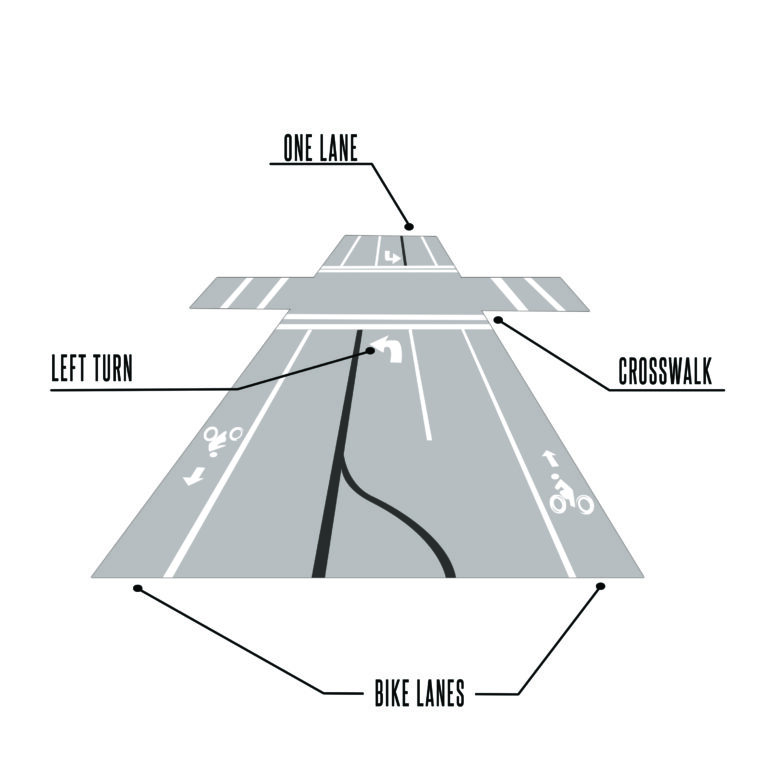
According to a report by the City of Davis, the redesign will change the street from four lanes to two lanes with designated bike lanes on either side. Turn pockets, a dual left-turn lane and striped pedestrian crosswalks will also be added. Additionally, new traffic signals will be added to the F and G Street intersections and the existing signals at A, B and L streets will be modified to accommodate the changes.

Pedestrian safety will be improved by adding pedestrian-activated crossing lights at the crosswalks of C and J streets.

Roxanne Namazi, senior civil engineer for the project, said the absence of bike lanes on Fifth Street, between A and L streets, creates a gap in the movement of cyclists along the Fifth Street/Russell Boulevard corridor.

“The east-west corridor provides a continuous bicycle route from Mace Boulevard at the east city limit, all the way to the west city limit near County Road 98,” Namazi said. “This entire corridor provides an off-street path, except between A Street and L Street, where cyclists must either share the road with motorists on Fifth Street.”

This project has a long history in the City of Davis and it has taken many years for it to be recognized, said Steve Tracy, a Davis resident and member of the Old North Davis Neighborhood Association (ONDNA).

In 1993, the City of Davis general plan was updated and it included a proposed redesign of Fifth Street to improve bicycle and pedestrian safety.

“The city staff was very hostile to the idea at the time and didn’t do anything for about 10 years,” Tracy said.

The ONDNA revisited the plan in 2003 and then presented the plan to city council and asked that the redesign be implemented. City council agreed to look into the matter and conducted several traffic studies.

The only change implemented from these studies was new traffic lights at the F and G Street intersections, Tracy said.

Emily Tracy, community outreach coordinator for Davis Bicycles!, said that in 2009 they were finally successful in convincing the city to move forward with the plan after a successful campaign from Davis Bicycles! and the ONDNA.

“Over 2,500 signatures were collected from residents all over the city asking the Council to address the safety and comfort concerns for all users of Fifth Street by implementing a road diet, improving pedestrian facilities and adding bike lanes,” Emily said in an email.

On Sept. 8, 2009, the petition was presented to City Council and they unanimously endorsed the project. However, the City of Davis Public Works survey of the Fifth Street corridor that started in 2008 was not yet completed, so the final project design was approved on April 27, 2010.

Most of the project cost will be covered by a 836,000-dollar Sacramento Area Council of Governments grant awarded to the city in 2010 for the project, Namazi said. The city was also awarded $200,000 in Highway Safety Improvement Program grant funds in 2012 to provide for pedestrian safety improvements.

“The street is a major connector from the northeast corner of Davis to the campus and those not in cars are very vulnerable to accidents on Fifth Street,” Tracy said. “We are trying to save lives.”

The City of Davis report states that Fifth Street between A and L streets sees average daily traffic of 12,000 to 17,000 vehicles.

The city will now put the project out for bidding and try and find a contractor within the $1.9 million budget. They hope to start construction in August and have most of the major work done by September so it is out of the way by the time Fall Quarter classes start at UC Davis, Stachowicz said.

Namazi said that city staff is trying to accommodate for traffic delays that will occur during construction by developing a public outreach strategy that includes the details of each project, including project locations, time-frame and detours.

“As the current best practices for street design continue evolving, it will be important to revisit all our streets from time to time to make sure we are supporting all modes of transportation to the limit of available funding and space,” Emily said. “Fifth Street is certainly the biggest priority for bicycle and pedestrian safety improvements right now, but there will always be room for improvement throughout the city.”

PAAYAL ZAVERI can be reached at city@theaggie.org.

Artists showcase work at ‘Past Reservations’

On May 23, UC Davis’ Master of Fine Arts (MFA) studio art candidates hosted the annual first-year studio art show reception which many arts faculty members, art studio majors and art enthusiasts such as myself attended.

The event, which took place in the old Nelson Gallery offices in the Art Building, launched the student-work exhibition that ran through June 4.

The event will showcase the works of first-year MFA candidates. The MFA is a small and interdisciplinary two-year art graduate program that is made up of artists working across mediums and topics.

Every year, the MFA puts on the exhibition in hopes that it will serve as a more official introduction to both the school and the surrounding community that takes pleasure in participating in the arts.

This year, however, the artists felt particularly attached to the exhibition because they literally built it themselves. The old Nelson Gallery offices have been out of use by UC Davis for the past few years and have been used as storage for the local gallery.

Students decided that they wanted to host their show in their own art building, so the group of seven students and a couple of professors single-handedly emptied out the offices, sifting and prodding through items that had not been touched for years, in order to create their own space where their artwork could be enjoyed by the public.

As a result, the exhibition is entirely a product of their own work, as they have created a space that convenes all of their very different artistic creations.

“You never see this in the reality shows, like ‘Work of Art.’ It is such a challenge for young artists to create their own exhibition, let alone the space in which it takes place,” said Brett Davis, one of the student artists. “It gives you such pride as an artist, knowing that you produced every inch of the entertainment.”

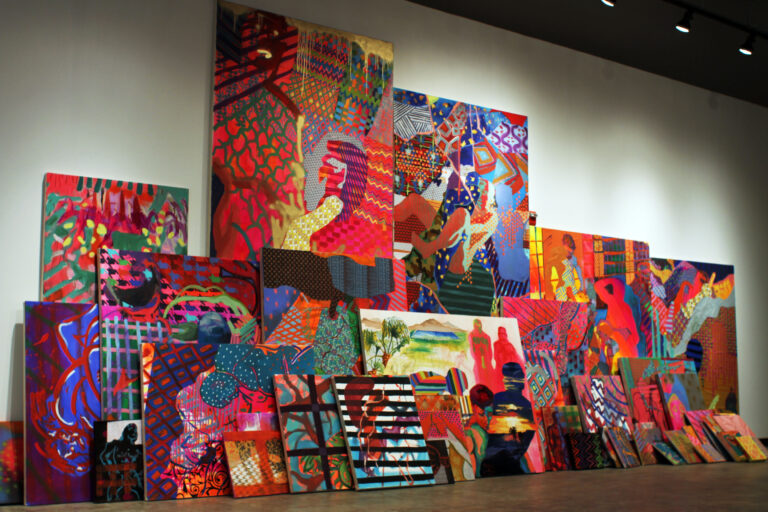
For many of these students, the exhibition serves as the first opportunity to showcase their work to the public eye. This year’s show, entitled ‘Past Reservations,’ incorporates works by prospective MFA candidates Brett Davis, Alyssa Lempesis and Daniel Harano, whose work I was particularly taken with.

Davis’ polychromatic creations contrast magnificently with the hospital-white walls of the gallery and immediately drew me in. Only from a closer point of view can people see that behind the carnivalesque colors lies a darker truth.

Two of Davis’ paintings, “Love is In and Out” and “There, there” drew inspiration from a pediatrician’s book. Behind the colorful surface, people can see the children’s serious expression, evoking their physical pain and suffering.

Using oil on either canvas or ceramic, Davis tries to identify what connects people to one another.

“I try and see what I can use as source materials, and how I can use it as a way to communicate. I try and get back to the messiness of connection,” Davis said.

Another artist’s work that caught my eye was that of Alyssa Lempesis. Having studied studio art at UC Berkeley, she came to Davis to find a closer community of artists, which she successfully found in the tight-knit group of seven students.

Lying on the ground, her sculptures attempt to invite a tactile reaction, as they are made from materials that relate to the body.

“I was drawn by the link between figuration and abstraction. I want people to feel seduced into touching my work. I specifically chose to present it on the ground, because people are more aware of space on the floor. I also specifically chose to use urethane as a material because of its seductive quality,” Lempesis said.

Equally as puzzling is the sculpture by Daniel Harano, a ceramics student from the University of Hawai’i. On the righthand corner of the gallery lies a mound of what could be perceived as thousands of squirming snakes — his artwork, “In Ignotus.” Upon approaching it, people realize that it is made of thousands of carefully formulated pieces of clay that climb up the wall and down to the floor.

“My work extends from my curiosity about the natural and mechanical world; how they’re alike, how they differ, how they can be combined into a singular form. As a result, I work nearly exclusively in clay. Similarly to the ideas that drive my work, clay as a material encompasses both the natural and mechanical world. It’s a tough material to work with, continually pushing me to the limits,” Harano said.

The students believed the show was a major success.

“I am extremely proud of the first-year show. I think it was a huge success and I couldn’t be more proud of what we did to overcome all the obstacles put before us. We’re a force not to be taken lightly and we proved it in this show,” Harano said.

LARISSA MURRAY can be reached at arts@theaggie.org.

Davis Dirt to put on Street Food Rodeo

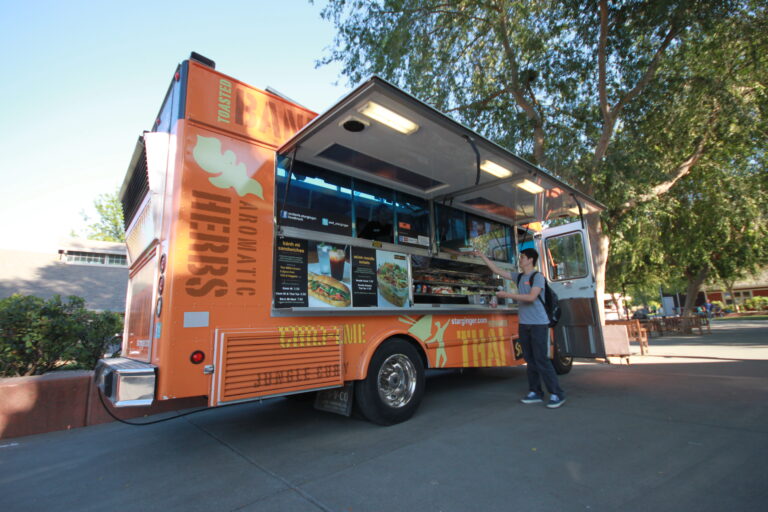
The Davis Dirt will be putting on a third Davis Street Food Rodeo on June 7. Sixteen food vendors will be serving food between 4 and 9 p.m. on Sixth and G Streets. Part of the proceeds from the event will be allocated to the Davis School Gardens.

Vendors at the event include Hawaiian food from Addison’s Originals, Addy’s Paella and vegan, gluten-free desserts from Bliss Creations.

“Food trucks are not seen much in Davis and we like to promote and start fun events for Davis,” said Davis Dirt editorial board member Melanie Gentles. “We thought it’d be a great opportunity to do a fun event and bring something we typically can’t have in town and benefit the community.”

The event has been welcomed by the community and attracted some well-known food trucks. Event organizers and The Davis Dirt’s editorial board members, Melanie Gentles and Annie Meckstroth, have taken steps to improve the event.

“We introduced street performers at the second event to reduce line waiting. There’ll be live music and … community folk dancing. At the last rodeo, people young and old were dancing together … It’s hard not to laugh, you just have a good time,” Meckstroth said.

They have increased the number of trucks and vendors. This time there will be 11 food trucks and six other vendors, Meckstroth said.

At the past two events, vendors were asked to donate 2.5 percent of the gross sales to benefit the Davis School Garden programs. So far they have raised over $1,000. This time, five percent of the gross sale proceeds will be allocated to Cesar Chavez, Fairfield, Patwin and Birch Lane Elementary Schools.

A challenge with the event has been the expense, especially due to the challenges that come with food truck culture.

Whether you’re a mobile food vendor, a self-propelled wagon or cart selling food, you have to have a public health permit and a business license,” said Bob Bowen, promotions manager for the City of Davis. “In most cases they have no connection to Davis and are not existing establishments. We don’t want someone out of town to take business away from the businesses of people in the community.”

The event has come with challenges for this reason.

“The Yolo Credit Union has sponsored the event because it’s so expensive. They’ve given a lump sum donation which allows us to donate money at the end of the day to cover the costs. The city and downtown are nice to work with we are grateful for their cooperation,” Gentles said. “Part of the reason you don’t see food trucks very much is because the permits are very expensive.”

Recipients of the ASUCD Entrepreneurship Fund, Larry Faygin, a second-year electrical engineering major, and Ben Bigelow, a second-year mathematics major, will be starting a food cart on campus next spring. Their food cart will serve Mexican cuisine.

“Food trucks are a great source of grassroots innovation in the food industry. They allow talented cooks to make really creative dishes with less risk than they would face at a traditional restaurant. They are relatively cheaper to operate than a traditional restaurant, given the lack of rent to be paid,” Faygin said.

Faygin said the Street Food Rodeo exposes the Davis community to new types of cuisine which are not as common for the City of Davis.

“It’s a small but significant step in appealing to Davis’ very diverse demographic,” Faygin said.

GABRIELLA HAMLETT can be reached at city@theaggie.org.

Column: Some shake

0

One easy way to take better care of your weed is by investing in a grinder. Grinders are cheap and simple, and they keep your dirty hands from ruining your weed.

The most basic type of grinder is called the two-part grinder. Its name comes from the fact that it’s made up of only two parts: two matching plates with inward facing teeth.

Because of their simple design, two-part grinders are the usually the cheapest, especially if they’re made of plastic. There are some that are made completely out of metal, and while these are a little more expensive, they are impressively sharp and will last you a lifetime.

To use a two-part grinder, place some of your buds in between the teeth of the plates and then turn the plates in opposite directions. Be careful not to grind too many times, though: It is very easy to over-grind your weed.

One annoying thing about working with two-part grinders is that you need some kind of container to dump your weed into after it is ground. While a tabletop will usually suffice, things get tricky when you find yourself in a vehicle with no papers or CD covers to use as a surface.

Three-part grinders are made up of two bladed plates like two-part grinders, but they have an additional piece that attaches to the bottom. This third part acts as a container that catches your weed after it is ground.

Unlike two-part grinders that continuously grind your weed, three-part grinders have little holes which allow weed to fall into the container section after it has been crushed to a certain size.

Three-part grinders are a little more convenient because they don’t require you to dump your weed out onto some separate container. They really come in handy when you’re on the go because they can be sealed shut to keep your weed from spilling or from smelling up the place.

Weed is a lot easier to work with when it is ground. It is perfect for rolling joints because it is smooth and doesn’t have any awkward lumps or sharp stems to poke holes in your papers.

It is also perfect for packing into bowls because it burns evenly without clogging up your pipe.

Three-part grinders require the least amount of physical contact with your weed. Breaking weed apart with your fingers is not only time consuming, it also usually causes a lot of the keif to rub off.

Keif is the pollen-like crystals on the outer coat of weed. It is sweet and sticky, and it is very high in THC.

Unfortunately, keif usually sticks to the grease and dirt on your fingers, which is why your hands end up really sticky after manually breaking weed apart. Using a grinder helps your weed stay clean and allows all the keif to remain intact, which is
important because more keif means a stronger high.

If you really love keif, then you should consider a four-part grinder. These have one more compartment at the bottom that catches and collects all the keif that falls off your weed. This extra section is often called a pollen catcher, and it is separated from the rest of the grinder by a special screen that only allows the tiny keif crystals to fall through.

Keif is delicious and you can sprinkle it over your bowls or across the inside of your joints for a sweet, but extremely potent high.

It does not take long for keif to accumulate in the bottom compartment. Depending on what kind of weed you use, it only takes a few days for a good amount to build up. If you wait a couple weeks though, you’ll be in for an even tastier surprise.

If you do end up buying a grinder with a pollen catcher, make sure it comes with a little plastic shovel. It stores nicely inside its compartment, and will make your life a lot easier when it’s time to scoop out some keif.

Even if your grinder doesn’t have a pollen catcher, you can still extract and smoke all the keif that inevitably sticks to the teeth. To do this, simply freeze your grinder. The cold temperature will cause all the keif to unstick and fall off after a few quick thuds against a hard surface.

LEO OCAMPO can be reached at gocampo@ucdavis.edu.

Livestrong Foundation Challenge ride to take place in Davis

On an average day, most bicycle-riding Davis residents are doing so with the purpose of transportation or exercise. However, on June 23, riders in the Team Livestrong Challenge bike ride will have the opportunity to bike with another purpose: benefiting those affected by cancer.

The 2013 Team Livestrong Challenge series consists of three rides, each in a different city, according to Matt Florio, fundraising and events coordinator for the Livestrong Foundation.

After the Davis ride, the second ride will take place in Philadelphia, Pa. from Aug. 17 to 18 and the third ride will take place in Austin, Texas on Oct. 20.

The event begins and ends in Central Park and riders will start at 7:30 a.m. The ride is multi-distance, said Florio, with Davis riders having the option of riding 25, 45, 65 or 100 miles. This is the third year the event has taken place in Davis.

“We’ve been doing this for a number of years. Before Davis the event was in San Jose for three years and was then moved up to Davis,” Florio said. “With Davis being very cycling-focused, we thought it would keep it fresh.”

In the last three years alone, over 15,000 riders have participated in the Challenge series, Florio said. According to a press release issued by the Livestrong Foundation, Team Livestrong has raised over $80 million dollars since 1997 to pursue the goal of the foundation, to “fight to improve the lives of people affected by cancer now.”

The Team Livestrong Challenge ride is only one of over 20 athletic events which raise funding and awareness for the foundation.

According to Florio, funding toward the foundation does not go to cancer research, but instead directly supports those with cancer.

“We provide programs and services for cancer patients. If someone is diagnosed, they’re going to have a lot of questions, and there are things we can do immediately — answering insurance questions, general care [and] emotional support,” Florio said. “People are going to have those questions and they’re going to want to talk to someone. We have trained staff, called navigators, to talk to people and refer them to other organizations who can help them as well.”

Riders in the Livestrong Challenge must fundraise at least $250 beforehand in order to ride or, if not, can pay the amount themselves. Those who cannot or do not wish to ride but still wish to be involved can also volunteer at the event.

This year’s event is more locally focused than years prior due to a partnership with the Sacramento Region Community Foundation.

Five percent of the funds raised from the Challenge will be distributed to local cancer-related organizations via the Sacramento-based foundation.

“This is a new thing for us,” said Linda Cutler, CEO of the Sacramento Region Community Foundation. “They want to increase their contribution to the community, and that money will stay local.”

According to the website of the Sacramento Region Community Foundation, their mission is “to serve as a leader and trusted partner in expanding philanthropic activity and enhancing its impact for the betterment of our community.”

According to Cutler, the foundation manages approximately 450 donor-advised funds worth about $110 million in assets. Donors set up a fund through the foundation, and the foundation distributes the money to a cause chosen by the donor. Funds without a specified use are known as unrestricted.

“We try to encourage local giving, and when we have unrestricted funds we’re committed to keeping it local,” Cutler said. “The next generation of donors, by large, are interested in this local impact and sustainability.”

Other new developments this year include a children’s bike rodeo to take place at Central Park during the challenge, according to the press release. The rodeo is free and is intended to “teach kids the proper bike safety and handling skills they need to ride around the city recently ranked as the fifth most bike-friendly city in the world by Active Times magazine.”

A post-event party will also be taking place at Central Park, Florio said.

“We have food, drinks and music,” Florio said. “We want to create a fun atmosphere.”

In addition to being a fundraising event, the ride serves the local community as well.

“We saw the Team Livestrong Challenge as a timely opportunity to make a lasting impact in the community,” said Nick Denby, Livestrong Foundation vice president of development in the press release. “Davis has always been a great host to our event, and we are proud to work with them to improve the lives of people affected by cancer today.”

Both riders and volunteers can still sign up at teamlivestrong.org. Rider check-in and bib pick up will be taking place at Central Park on June 22 from 10 a.m. to 4 p.m. and also on the morning of the event, during which riders can still register as well.

MEREDITH STURMER can be reached at city@theaggie.org.

Students, families participate in community-specific graduations

Eight seconds, for many, may not seem like a meaningful amount of time, or a long enough time for anything significant to occur. But for Alejandro Sandoval and other graduates who will be present at the 2013 Chicano and Latino Graduation Celebration on June 15, it will be a significant eight seconds indeed.

“Each person gets eight seconds to make a speech,” said Sandoval, a fourth-year sociology and Chicano studies double major and soon-to-be graduate. “It’s more memorable.”

The Chicano and Latino Graduation Celebration is one of many community-specific graduation celebrations celebrating the accomplishments and identities of UC Davis graduates, including the Black Graduation Celebration, Filipino Graduation Celebration, Southeast Asian Graduation Celebration, South Asian Middle Eastern Graduation Celebration, Muslim Student Association Graduation Celebration, Native American Graduation Celebration, Asian American Studies (ASA) Senior Awards Banquet and the Lavender Graduation Celebration.

“I think it adds a lot to the graduation experience,” Sandoval said. “It’s more personal; you’re with 200 other students for Chicano grad.”

According to Sheri Atkinson, director of the Lesbian, Gay, Bisexual and Transgender Resource Center (LGBTRC), this will be the 17th annual Lavender Graduation Celebration at UC Davis.

“Lavender Graduation provides a safe environment for students, faculty, staff and community to recognize the accomplishments of UC Davis lesbian, gay, bisexual, transgender, intersex, queer and ally (LGBTQIA) graduates,” Atkinson said in an email. “It encourages LGBTIQA students to celebrate their accomplishments and academic endeavors at [UC Davis] while providing inspiration to other undergraduates.”

Lavender graduations, also known as rainbow graduations, are common at other universities, especially those with LGBT resource centers, Atkinson said.

“Recognition is important for the many contributions these graduates have provided to the campus and the LGBTIQA community,” Atkinson said. “I think these graduations are important acknowledgements of the success of underrepresented and underserved communities.”

Although all the celebrations share this spirit of recognition and celebration, the format and details of each event vary.

“The event includes dinner, a few speakers including Provost Hexter and a student keynote speaker, recognition of the graduates and presentation of the Angelina Malfitano Award to one of the graduates,” Atkinson said.

According to Jinann Bitar, Native American student affairs officer for the Native American Studies (NAS) Department, some of the celebrations are connected to their respective departments, such as Native American Studies, while others are connected to student organizations.

Participants in the Native American Graduation Celebration include students who identify as Native American, as well as NAS majors and minors.

“Identity-specific student organizations want a way to have their families join them in celebrating their accomplishments,” Bitar said. “We want to provide a space for them to join their students.”

Bitar acknowledged that the vast amount of students in the college commencement ceremonies often limits the amount of tickets available to each undergraduate. These ceremonies aim to celebrate not only the students, but also the collective efforts and sacrifices of the students and their families.

In addition to accommodating family members and other supporters, these graduations provide opportunities for cultural celebration and increased student retention, Bitar said. Cultural customs can be incorporated into what is not just a graduation celebration but also a reaffirmation of identity that students may have been exploring and defining during their college years.

“Native grad also impacts student retention. They’re seeing other students within their major or who they identify with, and prospective students also see students graduating who they may identify with as well,” Bitar said. “Retention and cultural celebration — there aren’t a lot of other opportunities for that.”

While these graduation ceremonies share a common goal of celebration, they share something else that may not be as readily apparent.

“None of them have specific funding from the university,” Bitar said.

According to Bitar, organizers of graduation celebrations must seek out funding for these events at the beginning of each year from within the university as well as private donors. Most participants in graduation celebrations have to pay a fee to supplement the cost of the event. The Native American Graduation Celebration is the only such celebration in which students do not have to pay a fee due to private donors.

ASUCD currently provides $4,000 to fund community-specific graduations. A bill proposed on May 2, Senate Bill 94, would have increased funding by $1,300.

According to the preamble of the ASUCD Constitution, “The Association is also constituted to create and provide services and activities which its membership shall consider important to fulfilling the experience of being a student attending the University of California, Davis.”

Senate Bill 94 failed to pass at this year’s ASUCD budget hearings.

“Programs and services for these communities have limited funds, and we count on financial support from others to be able to provide these types of events,” Atkinson said.

MEREDITH STURMER can be reached at city@theaggie.org.

Editorial: News

0

This past week, students have stressed over their exams, finding plane tickets home or securing local storage for their possessions.

During the same week, in Turkey, a taxi car drove into a crowd of protesters, killing a 20-year-old who was demonstrating against his government. Over 3,000 others were injured in violent clashes between outraged citizens and police after a peaceful protest was met with tear gas and pepper spray.

This has global implications. Most of us haven’t noticed.

The developing story is eerily familiar to the events of November 18, when a UC Davis police lieutenant wrongfully pepper sprayed a group of students who were occupying the Quad.

The fallout can still be felt today, and many of us never even noticed the Davis Occupy Movement until it reached an extreme.

To the outgoing class of 2013, as you traverse out into the world of internships, graduate schools and career-building opportunities, take time to see what’s happening in your community, your country and your world. Recognize that news does affect you and it can help you make a difference.

Without the news, we lose an essential tool to reach out to the public. Newspapers are meant to inform people about important, pressing issues facing the community.

For the people in Turkey, as well as the world at large, it is essential that news is disseminated. When the public is armed with correct, easily accessible and current information, the possibility of positive change turns into a reality.

To those staying in Davis, make sure to equip yourself with the information you need, be it from The Aggie or any medium you prefer.

The Aggie, albeit a small, humble product of everyday students, is your resource to find out what is happening on campus and in your community.

Campus Judicial Report

Do Not Disturb
A student was referred to Student Judicial Affairs (SJA) for resisting police officer orders while under the influence. Two officers were called to the student’s apartment to address loud music after several neighbors complained. The officers approached the apartment and ordered the student to open the door. The student refused and cursed at the officer. She kept resisting the officer’s orders while other students in the apartment pleaded with her to open the door. Finally, after a few minutes, the student unlocked the door and confronted one of the police officers. She pushed the officer and told him to get out of her apartment. The officer handcuffed the student and took her into custody. When the student met with a Judicial Officer, she agreed to be placed on Deferred Separation status, which means that she waives her right to a formal hearing if she is again referred to SJA for any similar conduct. Since the student’s behavior involved serious misconduct (pushing a police officer), the student was not only arrested but also referred to SJA, which maintains off-campus jurisdiction in certain types of cases.

Great Minds Write Alike
A professor reported two students to SJA for suspected collaboration on a quiz. The students were taking the same class and decided to study together for the quiz. Their answers on the quiz, however, were identical and the professor concluded that the students must have collaborated on the quiz. When the two students met with a Judicial Officer, they stated that their similarities came from their identical study sheets, which they asserted that they both just memorized and regurgitated for the quiz. The instructor insisted that she expected their work on the quiz to be original, and the fact that the two students had the same exact answers indicated that their work was plagiarized, in this case from themselves and each other. After some discussion the students agreed to be placed on disciplinary probation until 2014, which means that if they are found in violation again they will most likely get suspended. On top of that, they agreed to complete 15 hours of community service for the academic misconduct. Also, the professor gave both students a zero on the quiz. It should be noted that although students frequently memorize answers on a study sheet and repeat those answers on a test, this “plagiarism” is rarely an issue. However, it may become an issue if other students give the exact same responses you do as a result of having identical study sheets.

The Hangover – Davis Edition
A student was referred to SJA after he was caught on campus under the influence. A police officer apprehended the student after receiving information about an intoxicated student walking from campus toward downtown Davis. When the officer confronted the student, he stated that he was celebrating his 21st birthday, but his friend had left him alone at the bar and he was simply trying to get home. The officer detained the student for public intoxication and told him that he would be referred to SJA. When the SJA officer met with the student, he accepted probation until graduation for his social misconduct.

UWP looks to launch professional writing major

Currently only available as a minor, students may be able to pursue a major in professional writing as early as fall 2014.

Formerly the expository writing minor, the three-year-old professional writing minor will garner nearly 180 graduates by the end of this summer.

Given the successful acceptance of the minor, the University Writing Program (UWP) faculty is looking into the possibility of offering a major in professional writing — this would be the first of its kind in the UC system, according to a June 4 press release.

Requiring about 64 units, the major would be designed to accommodate double majors and would offer three concentration tracks, including scientific and technical communication, journalism and digital communication and writing in communities and organizations.

Gary Sue Goodman, writing minor and internships faculty advisor, said that the proposal is in the process of being developed.

“As you might expect, many writing minors enjoy writing and feel confident about their communications skills. However, a large number have elected the minor for the opposite reason: they feel that strengthening their inadequate writing skills is crucial to achieving their academic and professional goals,” the press release stated.

According to Goodman, the program wants to make a more intensive study of writing possible on campus.

“We seek to extend undergraduate training in the theory, history and skills associated with writing studies, thus preparing students to enter graduate programs, professional schools and a wide range of professions. In short, we seek to prepare students not only to work as professional writers but also to excel as professionals who write,” Goodman said in an email interview.

Goodman added that a number of new courses have already been developed and approved, including Introduction to Professional Writing (UWP 10), Theory and Genre in

Professional Writing (UWP 100), Technical Writing (UWP 104T), Professional Editing (UWP 112A) and additional courses in advanced journalism courses.

“The proposal for a new major must demonstrate students’ interest. We can infer students’ interest from the popularity of the minor and from students’ pursuing independent majors in writing, but the petition and other signs of student support will be crucial,” Goodman said.

Emily Alameida, a first-year student currently developing an independent major in professional writing, said she imagines her major will not differ greatly from the proposed UWP major.

“If this major were currently available, I would most definitely pursue it. Before finding out about individual majors, I was already determined to minor in professional writing, so a major is just a step better,” Alameida said in an email interview.

According to Goodman, once the UWP faculty and program committee approve the proposal, it will be then sent to the Letters & Sciences College Executive Committee. Then it would sent to the Dean of Division of Humanities, Arts and Cultural Studies, the Undergraduate Council and finally to the Chancellor.

She said the notion that writing is merely skills-based and not an academic field is mistaken.

“Rhetoric has been a subject of study since classical times, and writing studies has developed as a distinct academic field over the last 50 years,” Goodman said. “Professional writing is a disciplined, theoretically grounded practice, rooted in an understanding of communication not only as a professional skill, but as a rhetorical act and a force for socio-cultural, environmental and political change.”

Because student interest should be reflected in the proposal, a petition is available on the UWP website for students to endorse the approval of the professional writing major.

MUNA SADEK can be reached at campus@theaggie.org.

You’re majoring in what?

Editor’s note: You’re Majoring in What? is a new Aggie column that features students of UC Davis’ lesser-known majors.

Alicia Berg is a fourth-year hydrology major from San Pedro, Calif.

What is hydrology?
Hydrology is the study of water in all aspects. This includes the physical, biological and chemical elements of water and its distribution around the planet.

Why did you choose it as your major? Is it something you’ve always wanted to study?
When I was in high school I traveled to Kenya many times. I saw firsthand how people regarded water. It is the ultimate life source and is beyond precious. I was raised in LA and my personal water supply was never an issue that I had to deal with. Once I became aware of the value of water, it was like a switch I couldn’t turn off. After that I knew what I wanted to study, and I actively pursued it.

There are different concentrations in hydrology. What is yours?
I focus on surface water and especially aquatic systems, like wetlands.

What jobs can you get with hydrology? What do you plan to do?
You can get a variety of jobs because everywhere in the world needs to manage their water sources. I plan on working with restoration and conservation projects either through the state or nonprofit organizations. I also hope to be involved with the education process of water awareness for youth and communities.

Are there any hydrology classes you’d recommend to students who are considering this major?
HYD 10: Water, Power, Society is a really good introduction course to the history of water in California (which is incredibly complicated and fascinating) and general water processes. Also, HYD 143 is a course on eco-hydrology that incorporates many facets of hydrology and gives a good basis of Excel models for studying hydrologic data.

How big or small are the classes?
The classes are small. I’ve had classes as small as seven people and as big as 40.

What’s the best part about majoring in hydrology?
It is a science that reaches into many disciplines and gives a solid education base that can be used to further specialize in the field. It is also a tight-knit community, and the students are friendly and helpful to one another. I have learned an incredible amount about my environment, politics, mathematical models and technical science.

Are there any downsides?
It is definitely a challenging major. All of the prerequisites are the same as the ones for engineers. Many of the courses can be overwhelming at times, but the reward of success is beyond worth it.

MUNA SUDEK can be reached at campus@theaggie.org.

Aggie Arcade

This is the last Aggie Arcade of the quarter, which means summer vacation is right around the corner. Obviously I’m excited about the much-needed break, but that’s not the only great thing about next week. This year’s Electronic Entertainment Expo (E3) begins on June 11, which marks arguably the most exciting time of the year for video game enthusiasts like myself.

E3 always features big game announcements, but all eyes will be on Microsoft and Sony this year as they show off their brand new consoles, the Xbox One and PlayStation, 4 respectively. Although each company already held separate events to reveal each system, E3 will be the first time we get to really see games in action on the next-generation hardware.

Microsoft is the one company with a lot of unanswered questions in regard to the Xbox One’s library of games. Executives promised numerous exclusive titles for the upcoming console at the reveal event last month, but we didn’t actually see many of those games. Forza Motorsport 5 made an appearance and that will almost certainly be playable at E3. But what other big-name releases does Microsoft have up its sleeve?

Apparently Rare, the developer behind franchises such as Banjo-Kazooie and Perfect Dark, will revive an old series and bring it to the Xbox One. I mentioned Banjo-Kazooie and Perfect Dark because those are my best two guesses. We can’t forget that Perfect Dark Zero was a launch title for the 360 back in 2005, so it wouldn’t be shocking to see the studio repeat the process for Microsoft’s next console.

Aside from that, we don’t know a whole lot about Microsoft’s plans for E3. The mystery adds an air of intrigue to the company’s press conference, but part of me also worries about the lack of information. I went into the Xbox One reveal event not knowing what to expect and my overall feeling was one of disappointment. I hope that gets replaced by a far more positive reaction following E3.

Sony’s appearance at the expo will likely be more predictable, but that may be a good thing. I know that games like Knack, The Witness, Killzone: Shadow Fall and Deep Down will be shown at the event, and I’d love to see more of each of those titles. At this point all I’m looking for is a solid launch lineup to justify an immediate purchase of the system — the company has nearly sold me already just based on the reveal event back in February. It would be nice to see a surprise or two for the PS4 though.

And then there’s the strange case of Nintendo, which has no new hardware to display. The Wii U continues to face slumping sales, and E3 may be the last big opportunity for the company to salvage some level of success. Although it relies far too heavily on the nostalgia of famous mascots to garner interest, I admit that the announcement of a new Super Mario or Zelda game would capture my attention. At this point the Wii U really needs that system seller.

Even though I express a certain level of pessimism when it comes to this year’s E3, I imagine I’ll still wake up like an excited kid on Christmas Day when the event begins on June 11 — well, I have my last final that day, so I have to wake up early anyway. But the point is, E3 2013 will be fascinating to watch, regardless of the outcome.

ANTHONY LABELLA can be reached at arts@theaggie.org.

—-

In this week’s Aggie Arcade I play The Swapper, an indie puzzle game that came out just last week on Steam. Cloning represents the key mechanic in this striking sci-fi game — players can create up to four clones that react to the original character’s actions. In addition, the player can then swap between clones. Needless to say, things get complicated pretty quickly.

This also means I get stuck a few times in the video — I blame it on the pressure of performing while recording. In fact, I solved the puzzles with relative ease shortly after making this video (I promise!). I guess it’s possible that I’m just bad at puzzle games … I’ll leave that for you to decide.

The Nelson Gallery to implement new teaching resource

The Richard L. Nelson Gallery, established in 1976 and currently located in Nelson Hall, is in the process of creating a new teaching and learning space that it will be implementing in fall of 2013. The space will utilize the Jan Shrem and Maria Manetti Shrem Museum of Art, also located in Nelson Hall.

According to Robin Bernhard, the Nelson Gallery’s Art Collection Manager, the new space is designed to “incorporat[e] an experimental and flexible space into the existing Nelson Gallery that will be dedicated to research, course instruction and special projects in all fields and disciplines across campus.”

The classes are to be a direct collaboration between participants and the Gallery’s Permanent Collection. Also known as the Fine Arts Collection, it houses 5,000 objects that historically range from antiquities to contemporary art, according to Bernnhard. Classes that take full advantage of the collection will get priority class reservation for the project space.

Along with the incredible selection of pieces of art, instructors and classes will also have access to “classroom meeting space, equipment (i.e. projectors), display space, preparatory and installation assistance, lecture space, meeting space, performance space, chairs [and] tables,” Bernhard said.

Students, teaching fellows, researchers and faculty members can book the space for classes, along with already established university courses making reservations. The ideal class size is 25 or less. They can utilize the space for a one-time event, regular meetings or a quarter-long session.

In order to introduce the project space to the community, the Nelson Gallery will hosting monthly events such as tours, performances, lectures or new project openings, starting Oct. 24.

Bernhard is now reviewing classes for fall 2013. For more information, or to inquire about class reservations, contact her at (530) 752-3775 or rlbernhard@ucdavis.edu.

— Tanya Azari

Davis Music Fest to rock out Downtown

On June 22 and 23, a South by Southwest (SXSW) style experience will come to Davis for its third iteration.

The Davis Music Fest will feature approximately 40 artists playing at venues all over town, including Central Park, Delta of Venus and Sophia’s Thai Kitchen.

Danny Tomasello, the director of the Davis Music Fest as well as the nonprofit Music Only Makes Sense, used the music festival SXSW as a model for his festival.

“We’ll use any venue that has the manpower to run the show and coordinate volunteers. We put the bands in that space and get volunteers for three hour shifts. As long as we have the venue doing the work, we’ll work with them,” Tomasello said in a phone interview.

The headlining artist, bluesy rock musician JD McPherson, will perform at the Mondavi Center, marking the first time the Mondavi Center partakes in the Davis Music Fest.

According to Tomasello, the Mondavi Center reached out to the festival’s organizers.

“The Mondavi Center was interested in being involved in the festival and they suggested JD McPherson, since they thought he would be a good fit for the festival,” Tomasello said.

McPherson expressed excitement about playing at the festival.

“We have played a few festivals and they’re always a good time,” McPherson said in a phone interview. “It’s interesting to see folks who haven’t seen us before. I also love that part of the country, so we’re real excited to play there. It’s a beautiful place.”

The way the lineup came to be was through a booking committee, musicians contacting the festival, as well as fan input. The general criteria, according to Tomasello, was that the bands “could sell tickets on their own, even for a few bucks.”

The festival organizers wanted to select local artists as well as musicians that Davis music fans wouldn’t see normally.

Alicia Murphy, a fourth-year hydrology major, is one of the festival’s performers. She will play at Sophia’s Thai Kitchen at 6 p.m. on Saturday, and she views this show as the beginning of a four month tour.

“I’ve always wanted to play at Sophia’s,” Murphy said. “Playing there is a big deal for me because it’s a hot spot in town. It’s got a hot vibe, nice lights and nice drinks. I’m pretty stoked.”

While marketing the festival and reaching out to the public, Tomasello experienced support from the community.

“People know about us. I’ve gone to the Davis Farmer’s Market to promote the festival and people have come up to me and told me that they had a blast before. People have bought me beers and have high-fived me in the street,” Tomasello said.

Murphy hopes that people come out to the festival.

“It’s a good opportunity to bar hop, get a taste of the local music scene and to just enjoy the town for what it is.”

JOHN KESLER can be reached at arts@theaggie.org.

Column: Make it up

There’s something strange about watching Davis squirrels approach us on the Quad with hungry eyes, opening their mouths as if about to speak. And there’s something uncanny about seeing a Davis cockroach scamper across our linoleum floors like a hockey puck after months of hiding in the shadows.

Yes, these sights are common to us all as Davis residents. And since I’d rather see literal hockey pucks scattered on my kitchen floor, and since I’d prefer to hear that squirrel ask me for a piece of my banana in a hoarse smoker’s voice, can’t I just pretend these things are true?

I’ve found that everyday sights and experiences can be turned into artistic subjects just by looking at them with your head twisted at an angle. It’s like when you’re in an art gallery, you’re looking at literally, say, a picture of a bell pepper. But is it really just a bell pepper? With those smooth curves and suggestive twists, doesn’t it sort of look like a sultry fetus? Did you ever think a fetus could also look sexy?

Sometimes it’s more fun to fill in the gaps in your understanding of the unknown by creating your own version of the story. When you walk into your bedroom and find two naked strangers passed out on your bed, and you ask yourself, “Uh, what the hell?” isn’t it better to tell yourself, “This isn’t my room. I’ve barged in on a scene from an alternate universe”?

Well, maybe not. But the point is, we can make things up — in fact, we should make things up, and often. In small ways, we can help ourselves make life a little more interesting in order to suit our various needs. Whether directly art-related or not.

Sometimes my need for turning the inexplicable or the mundane into something exciting means seeing those patterns on trees as eyeballs, and staring back at them intently. Or looking at squirrels gather in the shadows beneath the trees and watching them scatter like marbles as I bike through them. Or making up worlds where stalkers become almost loveable, or where you can use your hair to capture fish like a net.

As an observer in this world, I try to build things out of whatever becomes available to me. So am I saying that art can be found outside of art galleries, and perhaps in our own lives and minds every single day? Yes. That’s what I’m saying.

I love art. I’ve been in love with drawing and painting since I was a wee child, I’ve dabbled in photography and I study art history out of my interest in how art shapes us and how we shape art. I love the art of making things up so much that I’m dedicating my last year in Davis to writing a Thesis in Fiction. I love looking at art, living in it and making it, in all of the forms art takes.

Due to my love and respect for the arts and as the newly appointed arts editor, I assure you that we will be reporting real art events. Real concerts, live theater performances, physically present works of art in galleries that exist. And all of these events will be covered by real reporters, providing true facts and unfabricated quotes. And it’ll be great.

But in this column, I will talk about things I may or may not make up, depending on how important I find it to revamp things I see into a more artistically-refined subject. I will give you a glimpse into the way I see the world (which, I warn you, might get a little funky) and I hope my vision freaks a lot of you guys out (while, hopefully, you people are sadistic like me and come crawling back to this column to swallow up a weekly dosage of oddities).

Let’s just say I’m doing this for our own good. Because we all need to incorporate art into our lives, in whatever screwed up way we can. I’d rather see these little Davis bike rides as something more like rides on a broomstick that hovers awkwardly close to the ground, as I often imagine, and hope you will too.

Feel free to tell CRISTINA FRIES how awkward her interpretation of art is at arts@theaggie.org.