58.4 F
Davis

Davis, California

Tuesday, December 23, 2025
Home Blog Page 213

Best spots to skateboard on campus 

From beginner to advanced, here are the places to hit 


By SIERRA JIMENEZ — arts@theaggie.org


Whether you’re a beginner just learning how to TicTac on the board or the next Tony Hawk, skateparks are notoriously intimidating. Learning how to cruise and land sick tricks on your board is definitely a marathon, not a sprint. Below are the best spots on campus that are less daunting than a skatepark and open to all levels. 


West Entry Parking Structure 

Atop what the locals call “Hutchinson” is a Davis favorite for cruising and learning new tricks. Popular around sundown, this parking structure has the best views of the picturesque Davis sunsets. The population on the last floor of the structure is always varied — from photographers to skaters, this is a place for all. Positioned at a slant, as a parking garage naturally is, it is perfect for getting the hang of standing on the board or bombing all the levels of the garage from top to bottom. With a relatively smooth surface, there are minimal potholes to avoid, which makes it easier to practice your board tricks. With curbs to practice small jumps, this is a nice and easy place to get comfortable on a board without all eyes on you. 


Death Star

Smooth and secluded, this spot is the perfect place to practice cruising or tricks off of the many staircases that make up the Social Sciences and Humanities Building, otherwise known as the Death Star. In a maze of various staircases and hallways, there is an endless supply of spots to learn jumps or perfect a landing without many eyes watching. Everyone already gets lost in that labyrinth of a structure, so bring a board and check it out for yourself. Additionally, the stairs off of the Death Star facing iTea have some gnarly steps to practice jumps and landing tricks — especially if you like the attention of all eyes on you with all the hot food spots right off-campus. 


Davis Gap

Located at Roessler Hall, this is a destination all skaters aspire to hit. Famous skater Chris Joslin raised the bar for skaters near and far by landing a tre flip off of what many compare to looking down a mountain. “When you’re standing on top of that mountain it’s hard to imagine anybody making it to the bottom alive,” stated Thrasher Magazine in the YouTube description of Joslin’s legendary jump in 2016. Going off the walkway, over the giant bush patch and landing on the ground, this is a jump not many can make — but hey, maybe see if you can. 


Olson Bridge Dip 

Especially on a cruiser, the bridge next to Olson Hall on campus is a fun little roller coaster dip for any skater. Not necessarily the hardest thing to hit on the board, it is a nice change from the level ground on the rest of campus. It is almost a campus skate ramp for students getting to and from class. It is a good spot for beginners to feel comfortable on dips and small hills — learning how to reposition balance in your feet and your body differently than on an even ground. Although rather beginner-level, it puts a smile on everyone’s faces who are on wheels (even bikers). 


California Hall

Despite the years of construction and noise it took to build this modern hall, it was all worth it for Davis skaters. The smooth concrete allows for uninterrupted cruising. No potholes, no rocks and no cracks, this is the ideal spot for any skater — whether it be skateboarding or roller skating. The high that skaters get when hitting smooth pavement is sublime. If you’ve got new wheels, loosen up your trucks and get it on at California Hall, where twisting and turning is the name of the game. Longboarding or riding any board with polyurethane wheels will make you feel exhilarated and free as if you were hitting rips on a surfboard. 


Written by: Sierra Jimenez — arts@theaggie.org

 

Quarantine Order rescinded in Yolo County for people exposed to COVID-19 

The decision was based on guidance from the California Department of Public Health 


By SHRADDHA JHINGAN — city@theaggie.org


A press release published on April 8 announced that the Mass Quarantine Order has now been rescinded in Yolo County. This means that people who came in close contact with someone who has COVID-19 but do not show any symptoms are not required to quarantine anymore. The only exception is if they work or live in high-risk settings.

The press release explains that the change was brought about in Yolo County following a change in the general recommendations for quarantine by the California Department of Public Health (CDPH). Though individuals are no longer required to quarantine after exposure, they should keep getting tested.

“Exposed persons should still get tested for COVID-19 3-5 days after an exposure and wear a mask around others for 10 days, but can continue to work, go to school, and participate in normal activities as long as they have no symptoms,” the press release reads. 

Public Health Officer for Yolo County Dr. Aimee Sisson explained that the change in quarantine guidelines in Yolo County helps to reduce discrepancies with rules and recommendations at the state level. Sisson also noted that vaccines have made this change possible in the press release.

“I am rescinding the local Quarantine order in order to reduce confusion created by having different guidance at the local and State levels,” Sisson said in the press release. “The change recognizes that COVID-19 pandemic continues to evolve, with transmission levels decreasing and safe, effective vaccines available.”

According to Yolo County’s COVID-19 dashboard, as of April 22, the seven-day average for COVID-19 cases was 7.1 per 100,000. Additionally, the test positivity seven-day rate was 1.4%. 

The press release also notes that because the incubation period for various variants of COVID-19 is less than it has been in the past, people may only be aware of having the virus after the incubation period is over.

“As the incubation period of circulating variants of the SARS-CoV-2 virus has grown shorter (now averaging 2-3 days), quarantine has become less useful, with many exposed persons receiving notification of an exposure after their incubation period ended,” the press release reads.

Public Information Officer for Yolo County John Fout provided further information on how the change in quarantine guidelines was made possible. Fout stated that the change was made based on recommendations from CDPH.

“Basically, the change in a sense came from guidance from the California Department of Public Health, and what we’ve learned is that with the new variants of Omicron is that the time for the incubation period is much shorter than it used to be,” Fout said. “It’s now averaging about two or three days.”

Fout added that because of the short incubation period, people may not be infecting anyone by the time they become aware of being infected.

“So most people, by the time they actually find out they test positive, they’re actually no longer able to expose anyone with the virus,” Fout said. 

Captain Lauri Hicks, the chief medical officer of the CDC’s COVID-19 response, said in a webinar in January that previous infection however does not mean a person cannot be reinfected.

“People who have been previously infected, even with the Delta variant or ancestral strains, are not necessarily protected against infection with Omicron,” Hicks said. 

The webinar also explains further changes to quarantine and isolation guidelines in various settings as of January 2022. For more information on the changes to the Quarantine Order in Yolo County or COVID-19, people can read more on the press release or visit Yolo County’s COVID page.


Written by: Shraddha Jhingan — city@theaggie.org


Senators were informed of upcoming changes to Transportation Services, examined new legislation

SB #73, #76, #71 and SR #29 passed unanimously 


By SYDNEY AMESTOY — campus@theaggie.org


The meeting was called into order by Vice President Juliana Martinez Hernandez at 6:14 p.m. on Thursday, March 22 who then read the land acknowledgement.

First on the agenda was a presentation by Transportation and Parking Services (TAPS), more specifically the bicycle program. The program’s role includes the impounding of abandoned bikes and the maintenance of bike racks on campus. The program has been unable to hold in-person auctions of impounded bikes and has instead held online auctions.

The presenters spoke about finding more ways to convince students to register their bicycles, as only 85 bikes have been returned to their owners this past year due to a lack of registration.

Perry Eggleston, the director of TAPs, then gave an overall report of the fiscal year and what it might mean for students. 

Transportation is currently in the process of paying off debts from construction during the pandemic. The 2023 fiscal year will see an increase in prices in all parking zones because of this, Eggleston said.

“We’re asking ourselves, how can we keep this program going and still provide the revenue we need, and not push against the most vulnerable students on campus,” Eggleston said. 

TAPS plans on introducing a new service to help students, in which those parked against the rules will instead receive an invoice that gives them until midnight to pay the daily rate rather than a $55 citation. There will also be the implementation of the UC Davis alumni-created parking app Japa, which uses sensors to accurately track empty parking spaces on the campus’s least-used lots, such as Lot 30. There will be an increase in L zone spaces — the most affordable to students — in Lot 30 as well as at the Sacramento Health campus.

Students can also expect some underutilized spaces to become C+ spaces, which can be used by students at a higher daily rate.

Following the TAPS presentation, came the confirmation of the new ACUSD controller, second-year Derrick Mayer, who was voted into the position unanimously by the Senate. 

The table then confirmed fourth-year Mackenzie Field as the new vice chairperson for regulations and finance for the ACUSD Internal Affairs Commission (IAC), who was also voted in unanimously.

Associated Student Dining Services, which runs the CoHo and CoHo South, then provided its quarterly report. 

Quarterly updates included the printing of paper and braille menus for all locations, the reopening of Ciao Pizza in the Memorial Union and new hours for all markets. However, there may be higher prices on some items in the coming future due to inflation. There are also talks of creating a new employee area and patio at CoHo, but these plans are still in the discussion stage.

Senators then gave reports of their proceedings, meetings and other activities for the past week.

There was no new legislation introduced at the meeting, so instead senators looked at legislation already passed through the IAC: SB #73 and SB #76.

SB #73 was introduced by Senator Dennis Liang and seeks to change the UC Davis official mascot from Gunrock the Mustang, to a cow of an undetermined name. The bill passed through the Internal Affairs Commission and was unanimously passed by the Senate. The measure will now be placed on the spring 2022 ballot.

“I know this has been a long and arduous process, I really want to commend [Senator Liang] and [his] team, I know it has been a really hard road to get this on the ballot,” Senator Sergio Bocardo-Aguilar said.

SB #76 seeks to create a director of communications role for the ACUSD executive branch out of preexisting positions, which would subsequently replace those positions in the official bylaws. It passed unanimously.

SR #29, a student resolution, addresses the UC Davis California National Primate Research Center. The authors of the bill seek ASUCD support in the condemnation of the center and its alleged abuses, as well as support towards demands to move UC Davis away from animal testing involving primates. The resolution passed unanimously. 

Finally, SB #71 was considered. In the bill, the donation drive committee, which recently came under the ASUCD legislative branch’s guidance rather than the executive branch, asks for $3,000 for operational fees. After deliberation, an agreement was reached that $1,700 would be paid up front out of the Senate reserves, and the additional money would be sourced from the special projects fund. If that additional money is not in the fund, or provided by the fund, then the committee could return to the next Senate meeting. 

“We should give them the money in full, and make sure the money comes from [the legislative branch],” Senator Owen Krauss said.

SB #71 was passed unanimously.

The meeting was then adjourned at 9:12 p.m. by Martinez Hernandez. The meeting ended a few minutes earlier than scheduled.

Written by: Sydney Amestoy — campus@theaggie.org


Culture Corner

The Art Desk’s weekly picks for movies, books, television and music 


By ANJINI VENUGOPAL — arts@theaggie.org


Album: “Asha’s Awakening” by Raveena (2022)

In a word, Raveena’s concept album is ethereal. The album is from the perspective of a Punjabi space princess and, according to a post on Raveena’s Instagram, centers “FEELING ALIVE” in the quiet and loud. The first half of the album is dreamy and feels galactic, with Bollywood sounds mixed with powerful bass lines and R&B and light rock elements. Raveena credits Asha Puthli as a major inspiration, and Puthli joins her in “Asha’s Kiss,” a glorious, dreamy track. The second half of the album is meditative, with the album even ending on a 13-minute-long guided meditation. Some critics have said this is an unnecessary component of the album; I don’t mind it, though I do prefer some of the earlier tracks. The first time I listened through the album I was walking through the Arboretum — I may not have been floating through the universe among stars and magical aliens, but feeling grounded in nature seemed an oddly appropriate way to enjoy Raveena’s almost psychedelic tunes. Her earlier music was contemplative yet airy, and she has expanded beyond that in this album with some less mellow tracks. “Kismet” and “Secret,” for example, exude a confidence that is empowering to see from a young, female South Asian American artist. 


TV: “Russian Doll” (2019)

I’m not sure what’s more compelling about this show — Natasha Lyonne’s outfits and hair or her dry one-liners as she navigates the nonlinearity of life, time and grief. There are a few Netflix shows that have a better second season than the first (I’m looking at you, “Bridgerton”), but in my experience, a lot of second seasons of popular shows ever so slightly miss the mark. The second season of “Russian Doll” came out last Wednesday, and though it was not as good as the first season (which I would give five stars), it’s worth the three and a half hours it’ll take you to watch — if you don’t mind chaos. I overuse the word “chaos,” but there is quite the dose of chaos in this show. It’s so chaotic at points that it’s almost frustrating to watch Lyonne’s Nadia continually fail to internalize that she should maybe just slow down for a second. The first season involves time loops and arguably has more structure than the second season’s storylines centering time travel and body-switching. Season one is plenty existential on its own, but season two somehow makes it grittier, investigating generational (and other) trauma. It’s a lot, so be prepared. Anyway, as Nadia says, “Thursday. What a concept.” 


Book: “Crying in H Mart” by Michelle Zauner (2021)

Too many jokes have been made about crying in a bedroom or on a train while reading Zauner’s book already, but yes, I did in fact shed some tears reading this book. Zauner, who is the lead vocalist and songwriter for Japanese Breakfast, expanded her 2018 New Yorker essay into this powerful memoir, writing about growing up Korean American in Oregon, her relationship with her parents and the growing pains of feeling caught between cultures. The book opens with Zauner stating: “Ever since my mom died, I cry in H Mart.” After her mother is diagnosed with terminal cancer, Zauner navigates her desire to reconnect to and reclaim the culture her mother tried to impart through food, language and more. Zauner’s mother’s death is not written into the book as a concluding point at the end; instead the unraveling and processing of grief is a core part of what makes the story so touching and painfully honest.


Movie: “Get a Clue” dir. Maggie Greenwald

The last time I wrote one of these, I hyped up the Lindsay Lohan version of “The Parent Trap” as a family favorite and the ideal comfort watch. To stay on brand, I would like to recommend the 2002 wonder that is “Get a Clue,” featuring a 16-year-old Lohan and 14-year-old Brenda Song (of Disney Channel fame). I recently watched this for the first time, and marveled at the age-appropriate casting of high schoolers and fantastic outfits. It may not be the peak of cinema, but there is a certain appeal to watching aspiring journalist Lexy (played by the one and only Lohan) run around trying to solve a mystery and seemingly learning that she is, in fact, a bit hoity toity — she takes the New York Subway for the first time with a friend, and it is quite the awakening for her that she can’t just call a car. There are plenty of other meaningful movies you could watch, but sometimes you need to put on a Disney Channel original movie (a DCOM, if you will) and sink into a couch for a couple hours — “Get a Clue” is a great option.


Written by: Anjini Venugopal — arts@theaggie.org


The UC Davis Symphony Orchestra premieres ‘Kuleshov’

An innovative new piece from a French-Argentine composer was performed on April 21


By JACOB ANDERSON — arts@theaggie.org


On April 21, the UC Davis Symphony Orchestra put on a performance called “Effects and Dances,” comprising two contemporary pieces, one of which has never before been performed in the U.S. The premiere of Oscar Strasnoy’s “Kuleshov” — a piano concerto here starring a California-born doctorate student at Cornell, Ryan McCullough, on the principal instrument — is the nexus of the evening. Strasnoy himself is here, and the French-Argentine composer takes the stage alongside McCullough and UC Davis Symphony Orchestra conductor Christian Baldini before the music starts.

Strasnoy is in an eye-catching pinstriped suit and explaining the cinematic influence behind the structure of “Kuleshov.” Named after the Soviet filmmaker Lev Kuleshov, the piece is centered around an aural application of Kuleshov’s editing ideas. It comprises a series of musical “images” that rotate around one central theme. It’s meant to provoke the listener — is that theme really the same as the one before it, or is it shifting alongside the context in which it’s invoked? The degree to which context and repetition affect the perception of one musical idea is Strasnoy’s fascination, apparently. Talking with Baldini, he says his “main source for this work was silent film accompaniment music from the 1920s. Surely those musics were influenced by certain features of those composers, so my references are surely second hand.” 

Strasnoy’s striking ideas are part of what he’s termed a rejection of “artistic homogeneity,” in which many young composers become stuck imitating their teachers fruitlessly. 

“I would recommend [students] avoid as much as possible emulating the contemporary musical currents taught in universities, which turn almost all students into epigones,” Strasnoy said. “Being an artist means being free to do whatever you want with whatever ideas, material or media you want. If you don’t achieve that degree of independence, you will not be an artist, you will be a craftsman, which is not bad in itself but was probably not your initial plan.”

His desire for originality comes through in the concerto, which places the stark, challenging main theme between more expansive sections that give it time in which to breathe. McCullough is the most striking part of the ensemble, and he’s almost shaking in his seat as he hits the most violent chords in the piece toward its end. 

The second piece in the show is Jimmy López Bellido’s “Fiesta!” which combines elements of Latin-American, Afro-Peruvian and modern pop music, an effort which the show’s program declares has the intention of “establish[ing] a connection with younger generations.” Three of the piece’s four movements are named after modern trends in electronic music — ”Trance 1,” “Trance 2” and “Techno” — the lattermost term he connects to Hindu music, where “melodies unfold through a series of melismas against a pedal note and over a span of several minutes.”

This second piece is more constant and conventional than Strasnoy’s, but the integration of modern musical concepts still separates it from any kind of formalism. The later movements reach a hypnotic pitch, through which heavy percussion echoes.

The orchestra takes their bows alongside Baldini, Strasnoy and McCullough at the show’s end, and the audience is left to consider the ways in which these two composers have satisfied their desires to push music in unconventional directions.


Written by: Jacob Anderson — arts@theaggie.org


UC Davis’ Women’s Rogue Ultimate Frisbee Club reaching end of busy season

The return to play this year has brought back competition and community in the Rogue Ultimate Frisbee Club


By KATHERIN RAYGOZA — sports@theaggie.org 

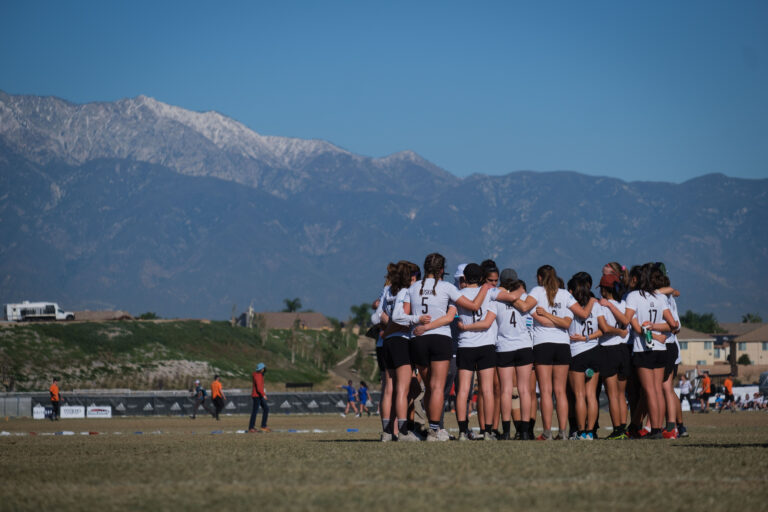
In fall quarter 2021, UC Davis Women’s Rogue Ultimate Frisbee teams finally began their season of sectionals in Roseville, CA and were more than determined to compete their best in hopes of achieving nationals.  

According to USA Ultimate, the sport of Ultimate Frisbee continues to grow in popularity has expanded all throughout the U.S. and in 42 other countries. It is known for its friendly nature, while also still being competitive. 

Kylie Crisostomo-Rickman, a fourth-year English and plant biology major and B-team captain, decided to join the Rogue Ultimate Frisbee club because of its unique, friendly environment.

“We play in a way that is still competitive, but there isn’t as much anxiety, like being cut from the team,” Crisostomo-Rickman said. “Since a lot of people don’t have a background in Ultimate, we’re all learning together. So playing isn’t as intimidating as other sports.”  

Even at a high level, the players adhere to something called ‘The Spirit of the Game’,”  said Emily Goodman, a fourth-year human development major and A-team captain. 

“It’s this mutual understanding that we’re all going to make the game as competitive as possible but also just uphold spirit and the rules. And you’re still able to compete at a high level,” Goodman said.

There are no referees to enforce strict rules, which is why “The Spirit of the Game” is significant for all levels of competition. Competitiveness is always encouraged among the Ultimate community.

As the sport’s community continues to grow and gain popularity, mindful behavior is enforced to all players all throughout the season. The community feeling alongside competing as a team is what attracts many players to this club sport.

“What drew me to the sport was the community. It’s a smaller sport, so you’re able to get to know people a lot better,” Goodman said. “If you hear someone’s name who plays Ultimate Frisbee, you also get this bond [with them] that they play this really niche sport. Through traveling over the past years, I was able to meet people all over the country.” 

Goodman and Crisostomo-Rickman are both captains for each team and guide and prepare their teams to have a chance at victory. They are also presidents of the team, which means they take on two roles. As presidents, they figure out fundraising and travel all by themselves. 

They emphasized that they don’t have a specific person to coordinate their finances or their travel situations. Which is why it is important for them to have several officer positions and for everyone on the team to help out. 

“It makes everyone’s job easy because everyone is on board to help,” Goodman said.

As captains, they work with coaches in terms of the trajectory of the season and what they would like that to look like. They also lead warm ups, team meetings and they are the point of contact between the coaches and players. 

“We’re a very fun team and all about learning,” Crisostomo-Rickman said. “We have a good time, and people seem excited to take a break from school, especially for those who have busy schedules.”

COVID-19 also impacted the team, which caused them to stop practicing for a few months. They would meet for Zoom practices and have team bonding exercises, such craft night, online trivia or Jack Box games. Although some people on the teams said they had a tough time adjusting to not meeting in-person, they also had to accommodate their schedules for their 2021-22 season and made up for the lost games during another COVID-19 stoppage.

“This year we have played two seasons in one because we’re making up for the season that was supposed to happen during COVID,” Goodman said. “Having nationals in the fall was really unique, but it’s usually in the spring, like May. So we’re having to do two full seasons in one school year.”

Besides COVID-19 being a challenge, one other challenge Rogue Ultimate Frisbee faces is that many people do not have a proper conception of the sport. According to Goodman and Crisostomo-Rickman, many people assume that Ultimate causes the same levels of anxiety as sports, or people believe that Ultimate is not a real sport just because it lacks the same popularity as other sports in the world. If people were to actually play Ultimate, they would say otherwise, the captions said. 

“When I tell people that I play Ultimate Frisbee, they don’t know that it’s a ‘real sport’, but we’re practicing a lot,” Goodman said. “We put in a lot of time, and it’s competitive, on top of running the team ourselves.”

For some college students, it is a sport that involves unique sportsmanship and offers a sense of camaraderie. Although Ultimate Frisbee may seem like something you would do as a recreational activity, Crisostomo-Rickman and Goodman say that the competition can be intense and the club provides a good opportunity to participate in that kind of sport. 


Written by: Katherin Raygoza — sports@theaggie.org


Senate special session called to discuss attendance policy  

A majority of the ASUCD Senate called a special session on April 13, regarding Senators Sergio Bocardo-Aguilar’s and Sofia Saraj’s absences in regularly scheduled and special meetings  


By JENNIFER MA — campus@theaggie.org 


The Senate special session on April 13 was called to order at 8:20 a.m. by Internal Vice President Juliana Martinez Hernandez, who then recited the UC Davis Land Acknowledgement. 

Senator Harris Razaqi, who called for the special session, was absent without prior communication about his appearance at the meeting. 

The special session was called to discuss a violation of Section 902 of the ASUCD Bylaws.

“The ASUCD Senate expects voting and ex-officio members to attend all regularly scheduled and special meetings of the ASUCD Senate as specified in the ASUCD Bylaws,” it states. “The ASUCD Senate also expects all ASUCD Chairpersons and voting and alternate members of subordinate bodies of the ASUCD Senate to attend all regularly scheduled and special meetings of their respective body.”

Senators Sergio Bocardo-Aguilar and Sofia Saraj were in violation of the bylaws because Bocardo-Aguilar was attending meetings virtually on Zoom instead of in person, and Saraj was absent from multiple meetings. Consequently, there may be a closed session in which Bocardo-Aguilar and Saraj could be removed from the Senate table.

Aurora Schunemann, a member of the public, said she opposed removing Bocardo-Aguilar from the Senate due to his contributions over the past two years, which include hybrid learning and support to individuals who are immunocompromised.  

Member of the public Kayla Garcia-Pebdani opposed Bocardo-Aguilar being removed as well, as he is the only Latinx representative on the Senate table.

Martinez Hernandez clarified that neither senators would be removed during the special session.

Member of the public Adriana Leal shared a personal experience regarding harassment, where Bocardo-Aguilar was a person for her to talk to. She said he made her feel safe and provided resources as well. 

Another member of the public, Michelle Andrews, said it was undemocratic to remove Bocardo-Aguilar from the Senate since the student body voted him in.

Maria Martinez also mentioned how the removal would be unfair since the Senate has previously done remote work over Zoom due to the pandemic.

Member of the public Andrew Jeremiah Muench echoed the sentiment of unfairness as only letting Senators attend in person would hurt commuters, the international student community and those who have health concerns. 

Member of the public Jackson Clark Mills said it was hypocritical to punish Bocardo-Aguilar for attending meetings on Zoom when the special session itself was over Zoom.

Member of the public Calvin Wong also had a problem with the special session. He claimed there was a lack of transparency and he only knew about it because he is enmeshed in ASUCD. There was no public post to alert the student body about the special session, and it was also late notice. 

External Affairs Vice President Saishruti Adusumilli encouraged the Senate table to take everyone’s comments seriously as this was the most engagement from the student body in around six months.

Bocardo-Aguilar then spoke on his own behalf, saying he was not in violation of the bylaws as the policy did not restrict attendance on Zoom.

Vice President Martinez Hernandez then restated she was just doing her job and that a special session must be called if there is a violation of the bylaws. 

Senator Radhika Gawde moved the conversation to focus on Senator Saraj as she missed the special session along with the previous two meetings with no communication.

Senator Owen Krauss echoed this sentiment, saying that he only wanted a closed session for Senator Saraj, not Senator Bocardo-Aguilar.

The Senate table then moved to Senate discussion, where Senator Gawde motioned to have a closed session for Senator Saraj. The motion was seconded. 

Senator Saraj was contacted for comment by The California Aggie, but had not responded as of April 26.

Martinez Hernandez adjourned the meeting at 9:45 a.m.


Written by: Jennifer Ma — campus@theaggie.org


UC Davis baseball drops two of three games to Hawai’i

The offense struggled to bring runners home as the Aggies lose the series at home


By GABRIEL CARABALLO — sports@theaggie.org


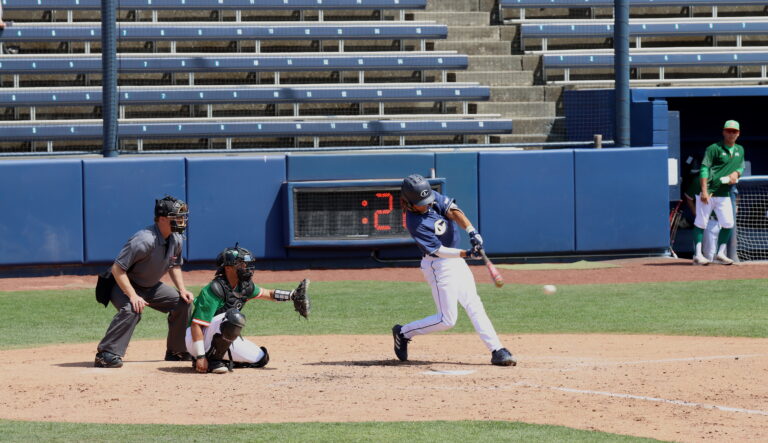
The UC Davis baseball team took on Hawai’i in a three game series over the weekend. It’s been a rough season for the Aggies’ baseball team, but there have been some bright spots. After beating the University of the Pacific in early April with an epic 14-11 win, the Aggies are now on a four-game losing streak. 

The Aggies faced the Rainbow Warriors in a close game on Friday afternoon; however, the start couldn’t have been worse for the team. Starting pitcher Nathan Peng began the first inning by hitting two of Hawaii’s batters, eventually leading to a 1-0 run lead for Hawai’i off zero hits. Peng only played two innings, garnered one strikeout before the bullpen was called, and pitcher Nate Freeman took the mound for the remainder of the game. 

“Freeman came in for the third inning; that was the plan,” Head Coach Tommy Nicholson said during the post-game interview. “We were hoping to get through those first couple innings with minimal damage against us. Nathan had a rough go with the first-two batters but minimized that inning by only giving up one.”

Coach Nicholson made this decision, making sure Freeman’s able to, “pitch into the eighth and ninth innings of the game.” He said Freeman could’ve pitched “two to three more innings” given how good he looked. 

Freeman and the fielding held Hawai’i for the third inning, but gave up a run late in the top of the fourth inning before closing out Hawai’i for the inning. The score now being 2-0 in favor of Hawai’i, the Aggies were able to crush out two base hits during the bottom of the fourth inning, but were unable to secure any runs or bring them in. 

During the fifth, the Aggies defense held Hawai’i to zero runs and hits. On offense, the Aggies only manifested one base hit for the inning. To begin the sixth, Freeman hit the first batter, and after a couple hits from the next batters, Hawai’i scored again. Now taking a 3-0 lead over the Aggies, it would be the final time Hawai’i scored in the game. 

The remainder of the game would go in similar fashion. The Aggies got hits, but were unable to capitalize on runners in scoring position to close the score. 

“We’ve been hitting a lot recently and I felt confident we were going to,” Nicholson said. “We just couldn’t break through and chip one here or there.” 

The Aggies were successful in out-hitting Hawai’i by 8-5 — three hits courtesy of left-fielder Nick Iverson who went 3-for-3 on the plate. However, the team was unsuccessful in hitting when it mattered most, which was a key detail in the game.  

When asked about what how he wants to improve, Nicholson said, “We’re gonna keep practicing hitting in the cages, but I think we need to do a better job of putting the ball in play with two strikes.”

Putting time in the batting cages will help in capitalizing on runners in scoring position and diminish what Coach Nicholson deems as their “achilles heel” of getting the ball in play during clutch scenarios. Hitting is one of the Aggies strengths; they just weren’t able to hit it home this time. 

Aside from batting, one of the team’s strengths was their fielding. Time and time again, the infielders and outfielders made play after play to keep the Aggies in the game. Either hustling for ground balls to get the batter out or one of their few spectacular double plays. The defense held it down as much as they could. 

“We played good defense, and even though we weren’t scoring, we were still in that game all the way to the end,” Nicholson said, emphasizing the importance of their defense.  “It was nice to see that the pitching and defense kept us in the game.” 

Coach Nicholson was not wrong about the defense. Even though their pitching was solid, some are left to wonder if not for the three pitch-out walks maybe the narrative around this game changes. Another key detail in how this game played out. 

The squad seeked to work on their achilles heel, sustain a high defense and minimize errors for the remainder of the series and season. 

On Saturday, the Aggies were able to bounce-back and secure their fourth win on the season. It was a close win over the Rainbow Warriors in a stunning 3-2 victory, as the Aggies were able to come back to score two runs in the eighth inning and the winning run in the ninth on a walk-off single by freshman infielder Nick Leehey. However, Sunday produced a crushing defeat for the Aggies in a 1-17 loss to the Rainbow Warriors to end the weekend and series —

a game that saw Hawai’i score nine runs in the ninth inning. 

UC Davis moves to 4-22 on the season and will have two non conference games — including one against Stanford — before they resume Big West play May 6-8 in Northridge against Cal State Northridge. 


Written by: Gabriel Caraballo — sports@theaggie.org


Rhesus monkeys are sensitive to their own heartbeat

This study serves a potential model for Alzhiemer’s disease and depression


By MONICA MANMADKAR — science@theaggie.org


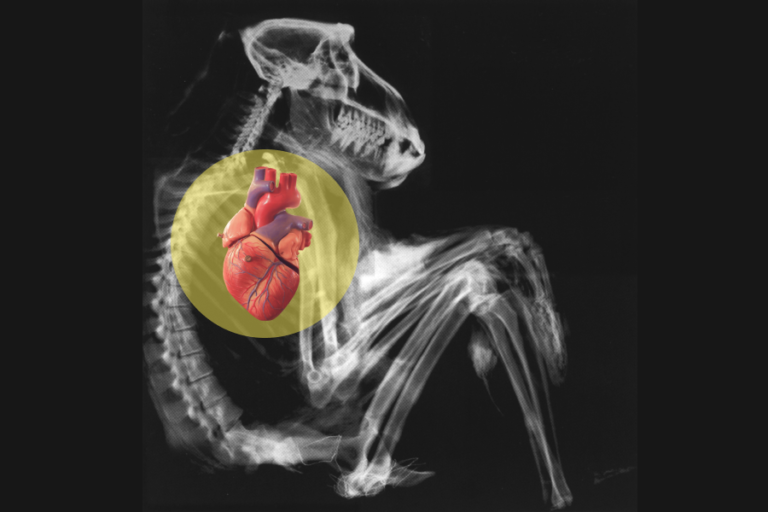
According to a study published on April 11 by the Proceedings of the National Academy of Sciences, rhesus monkeys are able to perceive their own heartbeats.

Researchers from the California National Primate Research Center at the UC Davis and Royal Holloway, University of London teamed up to create the first animal model of interoception. Interoception is the perception of sensations inside the body by your brain, such as the ability to acknowledge when your heart races. 

The findings in the study help provide an essential foundation for future research in psychiatric and neurological dysfunctions that are associated with anxiety, depression and Alzhimer’s disease. 

“I’ve been interested in interoception for ages — my first published empirical paper (in 2004) was on interoception and emotional experience in humans,” said Eliza Bliss-Moreau, an associate professor in the Department of Psychology, via email. 

Bliss-Moreau’s lab works to understand the neural mechanisms of affective processes and interoceptive processing. In order to understand the neural mechanisms of interoception, the researchers need to show that it can be indexed in monkeys through a similar process that is already in humans. 

The team started with monitoring four rhesus monkeys who were placed in front of an infrared eye tracker which displays stimuli in sync with the monkeys’ heartbeats. Through this experiment, the researchers were able to present behavioral evidence that the monkeys were able to detect their own heartbeats and have an interoceptive sense, just like humans, said Joey Charbonneau, a third-year Ph.D. candidate in the department of psychology. 

“We show that monkeys have an interoceptive sense of their heart beats that is similar to what is observed in infants,” Bliss-Moreau said via email. “Both monkeys and infants look for longer and stimuli that are not in sync with their heart beats, compared to stimuli that are in sync with their heart beats.”

While the study allowed the researchers to understand what interoception looks like with both monkeys and infants directly, the overall takeaway was looking into the evolutionary background of interoception. Moreover, the researchers could then choose other traits that are also interoceptive based on this study’s results. 

“This study really helps us understand what the evolution of interception looks like and we can say that long ago monkeys were able [to] make that detection on a moment by moment basis based on their heartbeat,” Charbonneau said. 

Charbonneau explained how this study may help the researchers understand when this trait evolved and determine what models are accurate to compare in the lab. He discussed how interoception is extremely important for emotion regulation and mental health in adults; however, researchers still don’t know much about this. 

Deficits in interoception have been linked to neurodegenerative disease, which would allow this study to be used in future research about understanding how the brain and body functions. Although the study is not a specific model for depression, understanding the neural mechanisms of interoception may help researchers understand the neural mechanisms of mood disorders.

Looking to the future, Bliss-Moreau said that the next immediate step is to test more monkeys and see how generalizable the effects are in a bigger sample. Charbonneau is also interested in understanding how other factors, like breathing and hunger, are seen in monkeys. 


Written by: Monica Manmadkar — science@theaggie.org


An Ed Board-approved Davis bucket list

Activities students can try while attending UC Davis


There’s no doubt that Davis has plenty of incredible activities and places to explore. At times, yes, this small cow town may seem drab, but after spending a few years here, members of the Editorial Board have come to realize how much it has to offer.

As third and fourth-year students, we know a thing or two about the best activities in Davis, so we’ve decided to pass on some of our wisdom. Lucky you! Whether you have six weeks or six years until you graduate from UC Davis, here’s a compilation (a Davis bucket list, if you will) of activities and traditions that all students must try:


The Tercero cows: First off, we recommend petting the Tercero cows. Likely one of the most well-known spots on campus, the Dairy is a perfect place to bring friends and take selfies. With their gentle presence, soft faces and adorable moos, there’s a reason why some students want to make a cow the new mascot

The Eggheads: Likely as well-known as the cows are the Eggheads, five painted bronze statues scattered around campus with goofy and over-the-top expressions. We recommend taking photos imitating their classic faces, such as the studious Bookhead, whose nose is tucked into a book outside the library. 

Views from Hutchison: For reasons beyond the Editorial Board’s current scientific understanding, Davis has some of the most beautiful sunrises and sunsets we have ever seen. Atop what most people call “Hutch” (its official name is West Entry Parking Structure), students can watch glorious pinks, purples, oranges and yellows dance across the sky. 

Farmers market: A well-known activity for Davis residents on Saturday mornings and Wednesdays in the early evening is the farmers market. A perfect place to buy local produce, catch up with friends and host a picnic, it is a quintessential Davis activity and one that all students must try before graduating. The Editorial Board highly recommends the apple juice, Dumpling House and challah. 

Putah Creek: For those who love nature, exploring Putah Creek is an excellent way to spend time outside, get some fresh air and exercise. In the sweltering months of late spring, summer and early fall, taking a dip or tubing in the cool green water is great for cooling off. Just watch out for sharp branches downriver and don’t tie your car keys to an innertube (a member of the Editorial Board can personally recommend taking these precautions). 

The Arboretum: The Arb is another Davis staple, and is especially enjoyable in the spring and fall. With flowers blooming in the spring and leaves changing colors in the fall, taking a stroll or settling down on a picnic blanket to eat some cheese, bread and fruit is a necessary part of obtaining the ultimate Davis experience. 

Quad hammocks: If you see an open hammock on the Quad, sprint there as fast as you can. Don’t look back to see how many other people are also running there. If you do not take the opportunity, you may never get it again — but if you succeed, you can bask in the sun and appreciate one of the most luxurious experiences UC Davis has to offer.

Shopping at small businesses: Davis is beloved for its charming local business, including Treehouse Vintage, Armadillo Music, The Avid Reader, Logos Books, All Things Right & Relevant and more. Whether you are shopping for holiday gifts or just looking to treat yourself, there are a variety of amazing businesses to browse through. 

Dining at local restaurants: In addition to local shops, Davis’ delicious restaurants are also something to celebrate. While it is impossible to include all of our favorites, some of the Editorial Board’s notable picks include Sweet and Shavery, Mishka’s Café, Guads, Good Friends, Thai Canteen, Burma Eat and Ali Baba. If you’re looking for a quick treat on campus, we highly recommend the coconut curry pho served at the CoHo. 

The Trinity: For anyone who wants to explore the 21+ activities that Downtown Davis has to offer, members of the Editorial Board (who are all of drinking age) highly recommend Davis’ local bars and breweries. If you’re looking for the quintessential Davis bar experience, you can try the Trinity, which is three drinks at three bars in one night. To complete the Trinity, you start with the Wicky Wacky Woo at Cafe Bernardo’s Wiki Bar, then drink the Thaibreaker at Sophia’s (we think) and finish with the FML at Red 88 Noodle Bar. Alleged to be some of the strongest drinks in Downtown Davis, the Editorial Board highly recommends drinking plenty of water and taking your time to complete the infamous feat. For non-drinkers, try the Davis Dessert Trinity.

Trivia nights: We highly recommend checking out a weekly trivia night. With Sophia’s Thai Kitchen on Tuesdays, University of Beer on Wednesdays and Woodstock’s Pizza on Thursdays in Downtown Davis; no matter someone’s midterm schedule, it’s likely there’s a trivia night you can make it to. While most of these nights are hosted at bars for 21+ individuals, anyone under 21 can attend Woodstocks’s Thursday trivia nights. 


While it’s impossible to include everything that makes this school and town special, the Editorial Board hopes this brief compilation of popular Davis activities helps everyone get the most out of this town and their college experience. 


Written by: The Editorial Board


Yolo County Judge creates public speaking program for elementary school students

Judge Peter Williams hopes that public speaking program helps and inspires kids in Yolo County


By SOFIA BIREN — city@theaggie.org


Judge Peter Williams was appointed as a judge for the Yolo County Superior Court by former governor Jerry Brown in 2018. Before that, he spent the majority of his law career working in the California Department of Justice. In 2019, Williams decided to create a program to expose children to public speaking, a skill he believes is integral for any profession.

In the winter of 2019, Williams began to contact school boards, superintendents and the former mayor of West Sacramento. He was eventually able to get three schools on board, according to Williams. He said that he originally contacted the Davis schools, but they already had their fair share of after school programs. This debate program, according to Williams, is designed to supplement gaps in school programming — not replace it. At this point, his program began to be adopted by schools in Woodland and West Sacramento.

Once Williams gauged interest for this program and had schools on board, he began to design a curriculum. The purpose of creating a curriculum was to align the program with a succinct and effective timeline, but more importantly make the program easy for the teachers who agreed to participate, according to Williams. 

“It really requires somebody who has true dedication to the job that will say ‘Hey, I’ll take a lunchtime once a week, or maybe a little more to give my kids this opportunity,’” Williams said. “I would tell them [the teachers] in turn, ‘Here’s what I’m going to do, I will prepare a curriculum.’” 

The curriculum that Williams created was a three-month program that provided a lesson or activity for the kids every two weeks. 

However, by the time Williams had created a curriculum and confirmed a number of attorneys interested in volunteering for the program, the pandemic disrupted his plans. 

“Once COVID hit, everything shut down,” Williams said. “It kind of looked like it was going to start up again, and then everything shut down again. I was kind of disheartened. But then this last go-around I said ‘I’m going to try this one more time.’ So this last time it was really hard to get the teachers back on board, except for Ms. Johnson, a teacher at Plainview Elementary School […] She was really enthusiastic and her kids were really well prepared.” 

This year, he had only one class participate in his program, with many more classes agreeing to participate next year. Despite that, Williams was happy with the progress he saw in the kids this time around. He sent a list of possible topics for the debate to Johnson, but changed course when the students decided they wanted to have a debate on a topic of their choosing: whether or not children should have more screen time. 

Williams was excited that the students were enthusiastic enough about the program to choose their own topic. At the end of the three month curriculum, Williams invited them to the courtroom, where he presided over the debate wearing his judge’s robe. 

When asked if he thinks this program helped the students, or would have helped him in the past, he said, “I think this program would help anyone.” 

Lucy Soriano, who has been teaching for 31 years for LAUSD, says that public speaking is an invaluable skill. 

“Public speaking at a young age will increase their confidence and prepare them for any aspects in their future,” Soriano said. “Because once they get to high school, college or any job they will eventually have to speak in public. In elementary school they struggle with speaking in front of an audience, be it their peers or adults. But, the more practice they get, the more it will improve their communication skills and ability to persuade.”

Carla Piedrahita, a teacher for LAUSD who has been teaching for more than two decades, says that it is crucial to introduce public speaking in the classroom at a young age but in the right environment. 

“Implementing public speaking in the classroom in elementary school is incredibly important because the insecurities they have when speaking will only increase without practice,” Piedrahita said. “It is incredibly important to not only practice speaking in front of their peers, but to create an environment in which they are comfortable doing so. Once they are comfortable they can make mistakes and grow without the fear of being judged.”

Williams said that although the program has not been around long enough for him to see any long term improvement, he is confident that his program is making a difference. He hopes it inspires the students who have the opportunity to experience the program to participate in speech and debate in middle school and high school. 

“The biggest gift I can give them is public speaking,” Williams said. “I wish I had it growing up, and I’m confident that if those kids were able to debate in the courtroom, then they can speak anywhere.”


Written by: Sofia Biren — city@theaggie.org


UC Davis Student Farm experiences two burglaries in March

The Student Farm saw two back to back break-ins at the end of spring break and right before spring quarter started with total losses estimated at a few hundred dollars


By JENNIFER MA — campus@theaggie.org 


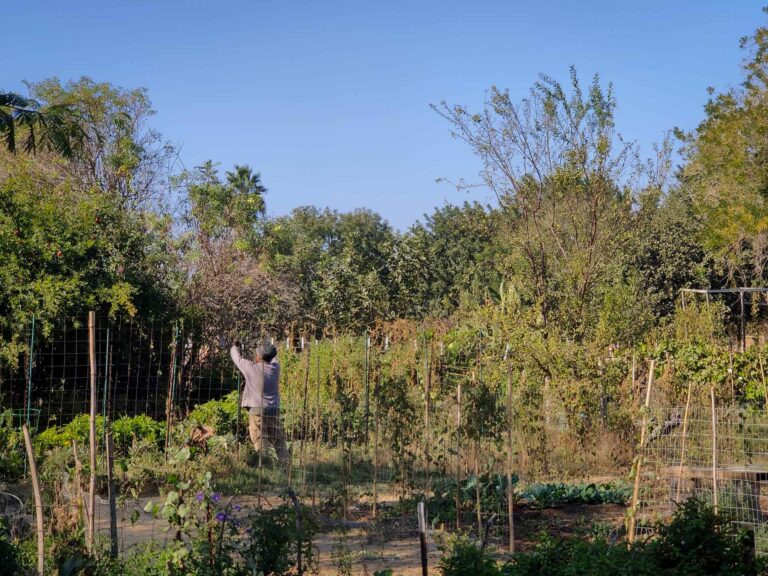
In March, two burglaries occurred at the UC Davis Student Farm, according to Student Farm Director Katharina Ullmann.

On March 27, Ullmann said she discovered a broken lock and a stolen harvest cart at the Student Farm.

Two sheds had also been broken into that day and there was an attempted break-in at a third shed on March 28. This break-in involved the theft of raincoats and gloves, food items, walkie-talkies and harvest tools. The tools stolen were two knives used to harvest lettuce and other crops. 

These total losses are estimated to be around a few hundred dollars, according to Ullmann.

The Student Farm has had previous break-ins over the past two years, one of which was a break-in at a shed reported on Feb. 1, which most likely took place during remote instruction at the beginning of winter quarter 2022.

These break-ins and burglaries have not been exclusive to the Student Farm. Bainer Hall also experienced a series of burglaries throughout fall quarter 2019, which was covered by The Aggie.

According to News and Media Relations Specialist Andy Fell, there are many outbuildings around campus which are typically difficult to secure, especially when there are not many people on campus.

“We do advise anyone not to leave valuable items in sight or in unsecured locations,” Fell said via email.

Ullman, who reported both break-ins, currently does not have information concerning the recovery of the equipment nor how the police will investigate suspects, as the UC Davis Police Department (UCDPD) is managing the case. UCDPD did not respond to a request for comment as of April 21. 

Ullman, however, did share the steps being taken since the spring quarter break-ins to ensure there will not be a repeat occurrence. 

“We are working with our campus partners to determine stronger locking solutions,” Ullman said.

She stated that the most frustrating aspect of the situation is that it diverts the attention of Student Farm employees.

“It is unfortunate that the break-ins happened at the start of spring quarter, when we would much prefer to be focusing on our work and the students,” Ullman said.


Written by: Jennifer Ma — campus@theaggie.org


KDVS hosts independent music festival ‘Operation: Restore Maximum Freedom’

The event director says the event promises to be an alternative to corporate-backed, mainstream festivals

By JACOB ANDERSON — arts@theaggie.org

Operation: Restore Maximum Freedom,” the KDVS-run music festival that’s been happening since 2005, will be on April 30 at 212 15th Street, the Red Museum, in Sacramento. More than a dozen musicians from Davis, Los Angeles and elsewhere will be giving their best onstage and supporting the local music scene.

Event Director Claire Tauber, a fourth-year student studying sustainable agriculture and food systems, told The Aggie over email that she hopes the event will “be many students’ first exposure to a DIY music festival post-COVID. We’re really excited to be able to revive that tradition.” 

She said she hopes the event will help provide an alternative conception of what a music festival can be, opposed to the onslaught of mainstream festivals like Coachella, which host only mainstream, corporate-backed artists. 

“In this sense, we are trying to ‘restore maximum freedom’ of creative expression for music lovers to enjoy,” she said.

Tauber also spoke against being a bystander when it comes to local artists — in her eyes, it takes active participation from the community for a local music scene to survive and grow. 

“I think Operation: Restore Maximum Freedom has benefitted the Davis community because it exposes people, many of whom are from other states or countries, to new up-and-coming artists who may not get coverage otherwise,” she said. “Having a thriving music scene is something that has to be actively cultivated, and throwing festivals like ‘Operation: Restore Maximum Freedom’ can get people excited and encouraged to participate in that creative community.”

Among the artists who will be at the festival are Valley Palace, Pork Belly, Beast Nest, Maya Songbird, Cryogeyser and Toner. “Cryogeyser and Toner are both fantastic,” wrote Tauber. “Cryogeyeser is a shoe-gaze-y indie act out of LA that was one of my most listened to bands of 2021, and Toner is a band out of Oakland that is guaranteed to blow you away. We have some KDVS DJs performing as well, like Big Sammy!”

In terms of running the event, “Operation: Restore Maximum Freedom is 100% a group effort,” Tauber said. “We truly could not do it without the dedicated help from the rest of the KDVS staff and the Red Museum.”

Operation: Restore Maximum Freedom promises to offer a full 11 hours of music, from noon to 11 p.m., and might be the first opportunity for many students to experience the joy of live independent music since the start of the pandemic. 

Written by: Jacob Anderson — arts@theaggie.org


UC Davis football close out spring practice, look forward to the fall

Dan Hawkins and his team aim for another playoff run as they conclude spring practices


By MARLON ROLON — sports@theaggie.org


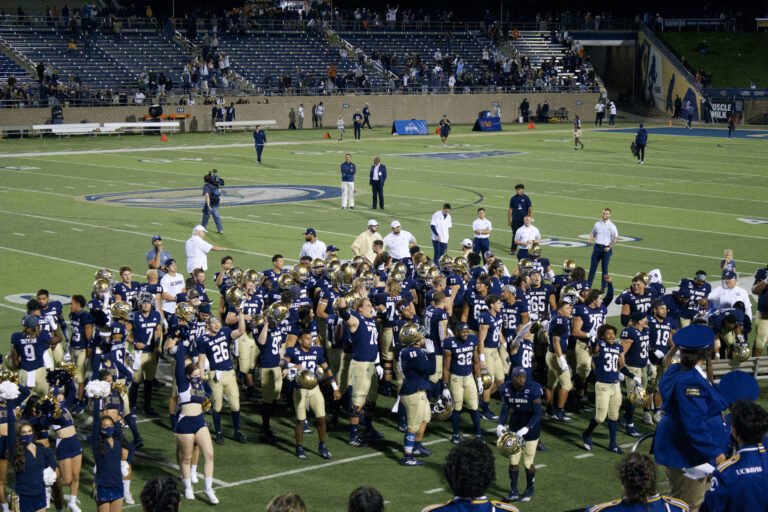
Spring practice came to a conclusion Saturday morning at UC Davis Health Stadium after a grueling three weeks of hard work on the gridiron for UC Davis Head Coach Dan Hawkins’ football team. They ended their training camp on a high note.

“It’s been really good,” Coach Hawkins said. “We’ve made a lot of really good strides and a lot of good learning moments. We’re very healthy; it’s an education. It’s [about] getting your football Ph.D., and you gotta learn.”

Hawkins seemed happy with the way his team progressed during camp. However, he seemed even ecstatic to have a spring camp after a three-year absence due to the pandemic.

“Technically it’s the first; we were kind of in between winter and spring, and then we’ve always been winter, so this is the first time [we had a camp] really all spring,” Hawkins said.

Coming off an 8-4 season and an FCS playoff appearance in 2021, UC Davis football hopes to continue to trend upward for the upcoming 2022 season with the addition of new talent as well as returning players. 

Ten newcomers signed with the Aggies for 2022 back in February, six being transfers, in addition to their freshman class that had already signed. Although all were not present for spring practice, they will be soon. A notable signee who plays the wide receiver position was third-year Andre Crump from San Jose State, where he only played 16 games. He brings value to the WR room; coming from the FBS division, he brings experience and speed at the top level of college football. 

UC Davis lost a key contributor on special teams, punter Daniel Wheelan, who declared for the upcoming NFL draft. The Aggies hope to have found his replacement: a graduate student from Colorado State University Pueblo, Justin Dwinell, who averaged 43 yards per punt. 

Coach Hawkins seems to love his quarterbacks: the more he has, the better. Third-year QB from San Francisco City College Jack Newman joins Hawkins’ rich quarterback room. Newman passed for 3,583 yards, 38 touchdowns and only six interceptions in his last year with San Francisco City. He is a player who will compete and challenge for some playing time, as he used spring to get used to the system. 

Another player who brings some valuable experience on defense is graduate student Evan Tattersall, who played 20 games as a linebacker at UC Berkeley. A player who played in big games will help solidify the defense, an area that has its question marks. 

Hawkins also bolstered the receivers room with the additions of Samuel Gbatu, Logan Kraut and Laviel Pickett.

Spring practice is an opportunity for players to showcase their qualities and show the coaches why they deserve a starting role. 

“The spring is definitely a time to show these coaches that you’re meant to be here and you’re going to show them what you do well, what you do consistently,” said UC Davis linebacker Nick Eaton. “Everybody is coming out here with that on our mind, with a lot of energy and with something to prove. Everybody has a chip on their shoulders, that was definitely displayed today in between the white lines.”

Intensity was high on both sides of the ball during the last scrimmage, there was a scuffle between teammates. Nothing was personal, as it’s normal for players to go at it as they try to turn heads to earn a role. This is something that Hawkins wants to see from his players: players who are hungry, players who want to win, players that want to be there. 

“Energy was high, testosterone was high, dudes were flying around; it was the last day to prove yourself to these coaches that you’re meant to be out here,” Eaton said. “Everybody’s looking to carve themselves a role.”

Hawkins said he was pleased with the way his quarterbacks performed. There are six quarterbacks on the spring roster: Miles Hastings, Trent Thompkins, Mitchell Dixon, Gunnor Faulk, Grant Harper and Jack Newman.

Last season, the Aggies starting quarterback was Hunter Rodrigues who helped beat powerhouse Tulsa to open the season. However, Rodrigues began to struggle halfway through the season eventually being replaced by Hastings who had a strong campaign. Hastings struggled against South Dakota in the postseason only to be benched after two quarters. Rodrigues seemed to get the offense moving with his mobility until he had to throw the ball which resulted in four interceptions. The Aggies would lose 54-26 in their second appearance in an FCS postseason.

With so many questions as to who will be the starter when fall comes around, it will be difficult for the coaching staff to decide who will take the reins. 

“Mitch [Dixon] has had a good camp, they’ll make it tough on us. We gotta figure this thing out but we got a good crew there,” Hawkins said.“They’re learning; it’s still an uphill learning curve for them, but they’re coming along. You look at Jack [Newman]; every practice, he’s just gotten a little bit better. It’s been good.”

Hawkins put the quarterbacks to the test during scrimmage. The defense put the pressure on the offensive line going after the quarterback was the only way to emulate a real game situation. The QB’s felt the heat, closing out the scrimmage with a pick-six. 

“We got a few turnovers out there today. I don’t care if it’s lacrosse, basketball, [if] you have turnovers you’re going to lose the game so that’s a big deal,” Hawkins said. 

Besides the quarterbacks battling it out, the wide receivers also showed out in an attempt to make a statement. Hawkins decided to let the quarterbacks loose in an attempt to show the qualities that his receivers have. 

“Obviously, you have a bunch of receivers that have been out, injured, [and we’re] trying to get those guys figured out and the quarterback situation figured out, so we hucked it around a little bit more than we normally would,” Hawkins said.

The coaching staff was pleased with how the offensive line is progressing since most of their starters returned. The O-line is key to get their run game going — a strong element in their identity. UC Davis thrived when they mixed the pass game with the run game. 

“We know we have a returning offensive line, we have an excellent backfield and we know we feel like we can run the football and be successful there,” Hawkins said.

After practice concluded, players and coaches sounded optimistic, excited and relieved that they made it through camp. They’re motivated to start the season to get back to the postseason. Hawkins has changed the culture within the program. Making the playoffs twice in the last few years is what they’re used to around Davis. 

The program is known for its academics being a formidable institution — top 10 public universities in the nation. However, the football program is growing, producing NFL prospects and winning the Big Sky Conference championship while making the playoffs and advancing to the second round in 2018. In 2021, the Aggies upset a FBS team in Tulsa on the road. In the same season they set a record in attendance.. Even though the goal is to improve as a football team, for Hawkins and students on the team, academics comes first.

“We are all student athletes and the student comes before the athlete and I would say that at UC Davis, we take a lot of pride in academics here,” Eaton said. 

After last year’s postseason exit Hawkins had this to say about UC Davis, “UC Davis is a nationally ranked top 10 academic institution in the country; we are No. 1 in the world in many academic categories.”

Now that spring practice has concluded, the athletes will focus on their academics as they prepare to go into the summer to prepare for the fall season. 

The Aggies will open the season on the road against UC Berkeley (Sept. 3). They will fly to South Dakota for a FCS Playoff rematch (Sept. 10), they play their first home games of the season against San Diego (Sept. 17) and Weber State (Sept. 24). Then, UC Davis will travel to play Montana State (Oct. 1) and return to host Northern Arizona (Oct. 15).

Hawkins and company will travel to Colorado to play Northern Colorado (Nov. 22) and return back home for two straight home games against Cal Poly (Oct. 29) and Idaho State (Nov. 5). UC Davis will close out the season on the road against Idaho (Nov. 12) and Causeway Rival Sacramento State (Nov. 19). 

To be back into the playoffs won’t be easy, but the players take pride in wearing the blue and gold. If they can collectively come together, we can expect to see the Aggies back in the postseason contending for a championship.

 “We always say that being out here is not your right; it’s a privilege, and we take that to heart,” Eaton said. “Every time you step on this field in this uniform, you should wear it with honor and pride, and you give it your all.”


Written by: Marlon Rolon — sports@theaggie.org


Study by UC Davis scientists highlights overlooked threats to California whales

The study, led by graduate students at UC Davis, looks at gaps in policy geared toward ending human-caused whale mortality


By SONORA SLATER — science@theaggie.org


Whales face a multitude of human-caused threats — from entanglement in crab traps, to marine debris, to increased noise pollution. The Ocean Protection Council plans to mitigate these threats in such a way as to achieve a zero-mortality rate for human-caused whale fatalities along the California coastline in the next 10 years.

In order to assist in realistically achieving this goal, a group of scientists from UC Davis, as part of the Sustainable Oceans project, looked into the main threats currently facing whales and the existing policy targeting some of the sources of whale mortality, according to a recent press release

Their study, published in early April in the journal Marine Policy, found that while some of these threats have been met with relevant policy responses — including through regulation of the crab fishing industry and speed limits on boats in certain areas off the California coast — other factors in whale mortality such as nutritional stress and access to prey should also be considered in policy. 

Helen Killeen, a Ph.D. candidate in ecology at UC Davis and a co-author on the paper, talked about why considering a wider array of factors is important in reaching this goal. 

“If as a state we’re saying we’re going to bring whale mortality down to zero, but we’re only going to do those two things, it’s really important to have an answer to the question, do we think those are the only two things that lead to whale deaths caused by human action?” Killeen said.

Co-leading author Eliza Oldach, a Ph.D. candidate in ecology at UC Davis, said that some of these “fuzzier” causes of mortality, while harder to pin down, are important to consider. 

“While we have policy in place for some of the bigger, more acute, more obvious sources of whale mortality, what’s actually killing whales is an overlapping network of all of these different sources,” Oldach said. 

Priya Shukla, one of the co-authors on the paper and a Ph.D. candidate in ecology at UC Davis, gave an example of acute versus broader stressors. 

“One of the key examples are things like pollutants,” Shukla said. “You can trace where waste is coming from, or with sound, most of that is coming from boats. But then you get things like climate change, which is a lot tougher. […] There’s no specific ship or specific factory that is putting waste in the ocean that is causing these things, [so] it’s a lot more challenging to create policy to target that.” 

Killeen gave another example of overlapping issues: the Dungeness crab fishing industry, and its connection to whale entanglement. 

According to Killeen, when people fish for crab, they drop a big metal cage over the side of their boat and let it sink to the bottom. It is attached to a long rope with a buoy at the top, so that when fishing crew return to collect the cage once it’s full of crabs, they can find it and pull it up. However, while the cages are in the water, the rope stretches through the whole water column. 

“Whales will sometimes swim through [the area] and the ropes will get wrapped around the fins or wrapped around their body cavity,” Kileen said. “If they’re unable to get the rope off of them it can result in really terrible damage to their bodies or even just additional levels of stress that aggravates other problems like preexisting disease or trouble finding food. So it either makes life harder for them, or it results in fatalities.” 

However, according to Killeen, while Dungeness crab fishermen are often pointed to as the problem, in reality the issue is much more nuanced. 

“In 2014 to 2016 there was this warm blob in the ocean,” Killeen said. “The coastal ocean off the coast of California became warmer during that time period, and that impacted the distribution of prey that whales feed on, forcing the whales closer to shore.”

After a surge in entanglements, the state was forced to temporarily shut down the Dungeness crab fishery, at great economic cost to the fishermen.  

In the paper, the authors mention several programs that they believe to be addressing whale mortality in a promising and holistic way — one of which is the Risk Assessment and Mitigation Program (RAMP). 

RAMP, according to Killeen, uses physical data about the state of the ocean to make predictions about how risky it will be for crab fishermen to drop their cages in the water at particular times and places. 

“When the model-predicted risk level gets too high, the state will say, we’re going to shut down the crab fishery in several weeks,” Killeen said. “We think that there are going to be too many whales close to shore, because that’s where the prey is going to be. And they can give [the fishermen] several weeks heads-up, which allows them to more efficiently allocate their effort and resources and saves them money in the long run.” 

Shukla said that their study sees this as one example of a solution that takes interdisciplinary needs into account. 

“If you bring in this panel of people to think about whales and also crabbing and also climate change and also pollution, you’re going to have a lot of head-butting at first because people are going to have different priorities,” Shukla said. “But the idea is that through conversation we can […] create solutions that are beneficial enough that at the end of the day, everybody’s interests are served.” 

This idea of framing research around policy and management solutions at all is somewhat novel, according to Shukla. Typically, academics are trained to use their own observations to drive question-asking. However, the Sustainable Oceans project “puts the policy focus on the front end of the research,” according to their website, which is part of why this study developed in the way it did. 

“The idea often in academic environments is just to advance knowledge, but with this paper, we’re synthesizing knowledge to develop a new idea, and I think that’s actually really key,” Shukla said. “By looking at what policies already exist and just tweaking them a little bit […] we’ll actually be able to make some really dynamic changes. We don’t need to come up with something brand new, we just need to update what we already have.” 


Written by: Sonora Slater — science@theaggie.org