55.5 F
Davis

Davis, California

Tuesday, December 23, 2025
Home Blog Page 22

Now is not the time to stop paying attention

It can be tempting to distance yourself from politics and social issues, but we have an obligation to advocate for change 


By THE EDITORIAL BOARD


With no shortage of shocking news, it’s been a year so overwhelming it has often felt fictional; we’ve all been turning off our brains to brain rot a little bit. Maybe it’s TikTok, Instagram Reels or, for some of us, YouTube Shorts — it’s been understandable to want to take a break from everything going on.

The “almost forgot this was the whole point” trend on TikTok reminds us to appreciate the little moments and cherish the whimsy in life. While these moments matter and are integral to our well-being, the largely innocent trend at times feels reminiscent of stoic outlooks. Yes, it’s essential to appreciate these little moments, but it’s also important to remember that calling for justice and caring about issues worldwide is also “the whole point.” It’s good to take mental health breaks and reconnect with nature when you can, but there is such a thing as too much distance.

Stoicism has gained popularity in recent years, with a sea of “daily stoic” books and increasing interest online. The belief is straightforward: Prioritize the things that we can change and recognize what is actually in our control. This mindset can be healthy at times, especially when dealing with anxiety, but when so many are suffering around us, we all have an obligation to do the right thing.

Actor and former Governor of California Arnold Schwarzenegger recently voiced a similar point, asking climate activists to take action, given the state of the country. Schwarzenegger urged those critical of the current administration to “stop whining and get to work.” 

While this approach may come off as harsh or unfair, it reminds us that we do have to take action. As several activists, poets and civil rights leaders have said before, “We are the ones we’ve been waiting for.” 

It’s easy to feel like most things are out of our control — that we are helpless to the ongoing tragedies and crises across the globe. We must be careful not to develop social apathy to the world around us. There are ways in our day-to-day lives that we can still advocate for justice. 

Even if it’s just working a 9-to-5, there, too, we can have tough conversations with people and remind ourselves to prioritize helping others in our work. We all have a vital part to play, but our impact is maximized when we all contribute.

Recently, President Donald Trump instituted a travel ban targeting 12 countries; there are also seven others with partial travel restrictions. This blatant act of xenophobia and racism is something that should concern every single one of us — even those who may feel distant from news like this. 

Amidst the ongoing Israel-Gaza conflict, Israel recently instituted a blockade to prevent Palestinians from receiving humanitarian aid. There is no shortage of crises overseas, and this news still demands your attention — it always will. Even if certain issues aren’t trending in the media or online the way they used to, we have an obligation to educate ourselves and to take action when possible. 

As many global leaders turn a blind eye, individuals with less diplomatic authority have taken on more responsibility. Activist Greta Thunberg, a role model for our generation for years now, is still leading the way as she sails to Gaza alongside several other activists, with the goal of delivering humanitarian aid to Palestinians. 

“Hope Greta and her friends can swim!” United States Senator Lindsey Graham said on X

Israel has stated that they plan to block the ship’s arrival and will “act accordingly.” While attitudes like these can feel surreal, this rhetoric is deserving of consistent attention and condemnation. 

Of course, these issues don’t stop overseas. As we enter Pride Month, the general attitude toward queer acceptance has been noticeably different this year. Suddenly, companies don’t have Pride Flag profile pictures, and it seems like “rainbow capitalism” is doing what it’s always done: only supporting marginalized groups when it benefits them. 

Several corporations have stopped funding and supporting Pride events, resulting in budgetary shortfalls for planned events and parades this month. For example: San Francisco’s Pride event has a $200,000 gap in its budget after losing donors; Heritage of Pride in New York City has a $750,000 budget gap; Kansas City Pride has lost nearly half of its total budget. This is a result of opportunistic corporate leadership actively targeting the LGBTQIA+ community, as well as all marginalized groups. 

This editorial could go on for pages listing horrifying news nationwide, but our conclusion would remain the same: We can’t distance ourselves from injustice, abroad and at home, and we have to advocate for change in our day-to-day lives. 

If you’ve been reading our work since January, you know we’ve had no shortage of editorials discussing pressing news around the world. As the academic year comes to an end and we share our final thoughts before fall, the Editorial Board urges you to be an active part of your community, to not grow desensitized to news and to take action against injustice. 


Written by: The Editorial Board
 

Aggie House to operate in new property in collaboration with ASUCD

The partnership between the transitional housing shelter and the student government has led to the creation of a new subunit and highlights new long-term priorities for addressing basic needs

By SAIRAKSHA THIRUNAVUKKARASU — campus@theaggie.org

As more college students across the country begin to live out of their cars, it is clear that student housing insecurity is one of the most prevalent challenges in higher education today. At the UC Davis campus, it is the reason why Aggie House exists. 

What is Aggie House?

In a 2024 university survey, 19% of UC Davis undergraduates reported that they were sometimes or often unable to pay their housing costs on time; 50% said that they had worried about being able to cover their housing costs.

Motivated by similar statistics in 2019, a group of students who, then part of the ASUCD Housing and Transportation Committee (HTAC), sought to offer further emergency housing options for the undergraduate population. 

This led to the formation of Aggie House in 2021, a transitional housing shelter run by students. With a staff composed entirely of volunteers, Aggie House currently operates at a townhouse with The Belfry in Downtown Davis and holds a maximum of nine students. 

Aggie House External Co-President Isabella Navarrette, a third-year political science and sociology double major, said that the shelter is committed to getting students back on their feet.

“This organization is truly built with the mission of helping students,” Navarette said in an interview. “We provide residents up to a year of free housing, free meals and case management services — one of the most beneficial parts of our program — which helps residents find more stable housing.”  

Since their founding, they have served over 70 residents and served as a model for similar shelters at UC Los Angeles, University of Southern California and several other college campuses.

Still, some within the student government want to help Aggie House do more.


ASUCD Collaboration and VESTA 

For years, Aggie House and HTAC have been in the talks for a potential collaboration, both sharing the same goal of addressing housing insecurity. 

HTAC Chair Christina Smith, a fourth-year political science – public service major, talked about goals with accepting residents. 

“They have had over 240 applicants since their inception but haven’t been able to take on all those applicants,” Smith said. “We want more residents to be able to join.” 

In the beginning of this year, Aggie House and ASUCD formed a long-anticipated partnership which demonstrated the student government’s commitment to housing and basic needs for now and the future. 

“[Smith helped] Aggie House as a student organization get a foot in the door of ASUCD,” Navarette said. “They helped craft up the legislation that needed to go to the Senate and get money as well as generally just advocating for us and making our mission known.”

These efforts led to the creation of a new ASUCD subunit under the existing Housing Advising for Undergraduate Students (HAUS)  — mostly responsible for holding quarterly housing fairs — called the Vital Emergency Shelter and Transitional Assistance (VESTA) in late February

“Aggie House will still retain our status as a registered student organization, so we still have our autonomy in that way,” Navarrette said. “Our relationship with VESTA is strictly a financial partnership as they provide us with rent costs for next year.” 

Having relied entirely on grant funding in the past, Aggie House hopes their partnership with ASUCD will bring a newfound stability to the organization. 

“Institutional support through ASUCD is a really big milestone for us because we’re not as worried about just surviving as a shelter, but now we have a little bit of protection and security that the university provides,” Navarrette said. 

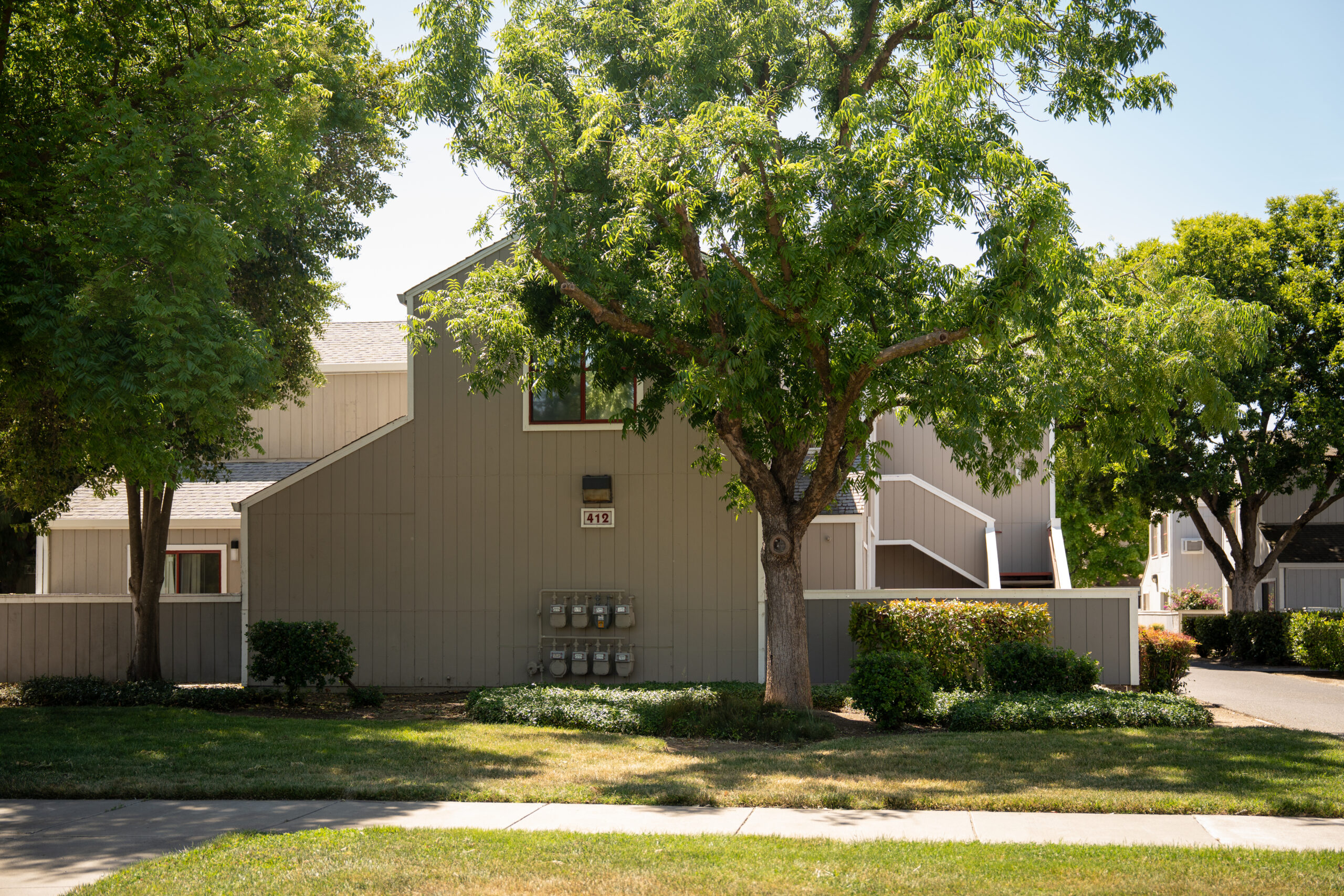
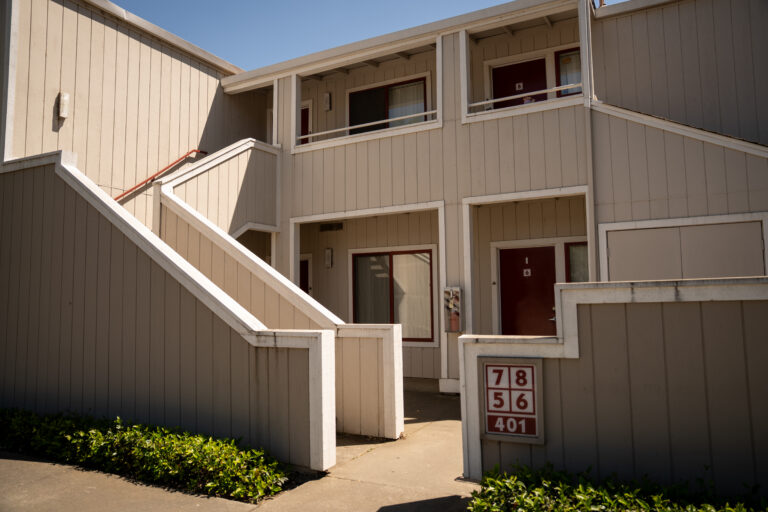
ASUCD and Aggie House officials have been working to establish a transitional housing shelter at Russel Park, an apartment complex close to the main UC Davis campus (Ojas Mishra / Aggie).

Potential Move to Russell Park 

Along with the creation of VESTA, ASUCD President Gaius Ilupeju announced that the Senate is allocating $80,000 for Aggie House’s operations to be conducted in a property at Russell Park for the 2025-26 academic year. The money is under VESTA’s control and thus goes in the larger HAUS budget. HTAC does not handle finances and instead works with Aggie House on external advocacy. 

The new property seeks to combat previous challenges including inconsistent funding, lack of space for more residents and disability access accommodations. 

“[Though] they have a wonderful house currently at The Belfry, you can’t even get a wheelchair through on the bottom floor,” Smith said.

While ASUCD previously stated that Aggie House will definitively move to the Russell Park location in February, and the latter confirmed that they have received an offer from the complex and are leaning toward that location, both groups told The Aggie in late May that they are still in the process of finalizing the move.

Aggie House’s main priority is to secure a bigger property that will allow for increased capacity. 

With the Russell Park location, however, they will be able to hold a lot more people than their current capacity with The Belfry. At the moment, Aggie House projects that 10 bedrooms will be available at Russell Park, with some of the rooms likely being double/triple capacity. 

As for the allocated money, Navarrette told The Aggie that the $80,000 is strictly going toward rent for Russell Park while any operational expenses Aggie House has will be covered by grants they’ve already received for the upcoming year. 

“Though we’re not entirely sure how much our operational and programming expenses are going to be with this increased resident load, that is not our primary concern for this upcoming year,” Navarette said. “In the years following, we hope to have the same amount of stability.”


Challenges in Housing

HAUS Unit Director Sam Hopwood, a fourth-year political science major, is aware that ASUCD and Aggie House are fighting an uphill battle.

“The UC, in my opinion, is not doing the job of getting students housed on an administrative level,” Hopwood said, who also pointed to failures at the state and federal level. “I see ASUCD as a student government that is capable and has the responsibility of providing students with their basic needs.” 

Recently, Ordinance 2670 in Davis criminalized public camping so those experiencing homelessness could be penalized for acts such as sleeping on park benches. 

“If you don’t have housing and have a misdemeanor record, it’s much harder to try and get housing,” Smith said. “It’s creating this vicious cycle of homeless people never escaping from the correctional system. We have a systemic problem.”

Even with the Russel House plan coming to fruition, housing challenges within the project have already arisen.

“It’s going to be a lot more residents next year and therefore an increased burden on our case management team that works primarily with residents and connects them to additional resources,” Navarrette said. The long-term vision for ASUCD is that VESTA will not just serve Aggie House but other housing initiatives and programs in the future to further support students. 

“In an ideal world, we don’t want Aggie House to exist,” Smith said. “We’re going to get out of the game if there’s no housing insecurity for undergraduates, which is the best possible situation.” 


Next Steps in Student Housing 

Recently, HTAC — which until recently was part of the ASUCD executive branch — moved back to the legislative branch in order to expedite their hiring timeline so the future committee members can be more prepared with housing projects when starting the next academic year. 

Despite the challenges they face, the collaboration between the ASCUD Executive Team, HAUS, HTAC and Aggie House has led to what they hope will be a long-term partnership. 

“If we were to think about ASUCD’s next big thing, especially as we go into the 2030s, I think this is it,” Ilupeju said of VESTA at the February meeting where it was created. “The direction we’ve been heading the last few years is working with campus partners to offer more robust services for students. That’s exactly what this does.”

Other ASUCD officials and bodies have collaborated on this project as well, with the ASCUD Pantry, External Affairs Commission and Student Housing and Dining Services have also extended their support. 

“This is all a student-driven undergraduate initiative,” Smith said. “There were people who don’t have a whole lot of work experience but a whole lot of heart.” 

Those interested in learning more about Aggie House or volunteering can contact them via email at aggiehousedavis@gmail.com.

“What we have in ASUCD and Aggie House is really special,” Hopwood said. “This is a bunch of 20- and 21-year-olds who are given money to do something really incredible.” 

Written by: Sairaksha Thirunavukkarasu — campus@theaggie.org

Davis and Yolo County representatives meet for their bimonthly 2×2 meeting

The meeting discussed housing programs, encampment cleanups and crisis resources 


By YUENJO FAN — city@theaggie.org


On May 14, the city of Davis and Yolo County hosted a joint 2×2 meeting to discuss the county’s Pacifico project, F Street encampment cleanups and the county’s Crisis Now model.

The meeting began with discussions on the Pacifico Housing Support Program, Yolo County’s plan to rehabilitate Davis’ vacant Pacifico housing into an affordable housing unit for vulnerable and low-income families.

Ryan Pistochini, the director of Yolo County General Services, provided positive news about the project’s progress.

“We have moved forward with the remaining design, [now] at 100% for the project,” Pistochini said. “As we go through the design, what will happen next is that we will continue to work with the city collaboratively on what our design intents will be for the building.”

The design for Pacifico, a California Work Opportunity and Responsibility to Kids (CalWORKs) program, will be checked for approval by the county and Davis Building Division in September of this year. Following this, the project will be put out to bid for viable contractors in November, where the county will need to approve the contractor.

Next on the agenda were updates on the cleanup of unhoused encampments on Davis’ F Street. Both the Davis and Yolo County Social Services Departments worked together to handle the encampment cleanups.

Dana Bailey, the director of city of Davis Social Services and Housing, provided more details on how the situation was approached.

“We did a lot of work, so we had an understanding of who was there [and] what the conditions were, and we worked together to determine what the response would be,” Bailey said. “We were all in agreement that, working together, the first response would be engagement.”

Individuals in the encampments were encouraged to contact Davis Community Meals and Housing for supportive outreach. Meanwhile, the Davis Police Department, Davis Code Enforcement Department and the city’s homeless outreach team also worked to notify and provide support for the unhoused individuals, some of whom have lived in the encampment for multiple years.

Interim Director Yolo County of Social Services Marisa Green elaborated on this issue, detailing one of the main reasons for the F Street cleanups.

“There was a concern about fires,” Green said. “So much debris had started to gather there, and it was so dry, […] it really started to be a safety hazard for fire season. Additionally, there was a lot of debris that was related to drug use and also lighters and flammable liquids. There really were concerns that it could just ignite, especially with the railroad tracks [as] sparks fly and things of that nature.”

Lastly, the meeting touched upon the county’s crisis response initiative. Tony Kildare, the interim behavioral health director of Yolo County, explained how the crisis response model includes three steps: a number to call, someone to respond and a place to go. While the county operates a call center and a 24/7 crisis response team, a health facility has not been developed yet.

“Our budget wasn’t penciling out in terms of what we needed to do in order to establish a standalone receiving center that was county-operated through a contractor,” Kildare said. “So [now], we’re pivoting to a different approach. We are exploring a couple of different options with existing providers who are providing the same type of services or similar services.”

Currently, the county is looking at two potential facilities in Sacramento and one in Woodland. A sole-source contract has been planned with a provider in Sacramento named Wellspace, while the county is still targeting contracts with the two other locations.

The Davis/Yolo County 2×2 meeting occurs every other month at City Hall between two members of the Davis City Council and two members of the Yolo County Board of Supervisors. More information can be found on their website.


Written By: Yuenjo Fan — city@theaggie.org


Find the good in every story, even your own

After four years at The California Aggie, working as city news reporter, editor and editor-in-chief, I’m ready for what comes next 


By CHRIS PONCE — editor@theaggie.org


When I first came to Davis, I wasn’t exactly sure what I wanted to do with a political science degree. Social justice and local issues have always been important to me, but I knew I didn’t necessarily want to work in politics or government. Journalism felt like an option worth exploring — in this path I have discovered a passion of mine that has become core to who I am. 

One of my University Writing Program (UWP) professors often says that writing is a never-ending process, but at some point you have to hit the “send” button. I’m understanding exactly what that means right now. Even now, I am constantly thinking about something I should have included or a paragraph that should be condensed, so please bear with me, there is so much to say about the last four years. 

I came to college nervous and unsure. I grew up in a small desert town you probably never heard of, with Joshua trees and tumbleweeds instead of universities and resources. Moving to a college town like Davis was the biggest culture shock of my life; I felt far from my family, my culture and everything else familiar to me.

It wasn’t until working at The California Aggie that Davis felt like home. I applied for two jobs as a first-year: columnist and city news staff writer. Unfortunately, I was rejected from a paid role (trust me staffers, I’ve been there, too), but I became a proud volunteer city news reporter. One of my first articles was a breaking news story about a tragedy in Sacramento. I remember sitting in the study lounge in my dorm, typing away to have something for my editor. 

One of my friends asked me, “Why are you doing all of this if you aren’t even paid?” and I remember thinking to myself, “Because I wanted to.” My first quarter as a writer not only influenced what I wanted to do but helped me fall in love with the Davis community.

There is no better way to learn the ins and outs of a city than working as a city reporter. From the street performers you see day to day, to the activists who make Davis feel inclusive, to the farm workers picking your crops — working with the city news desk is how I learned about Davis in an intimate and personal way (the good and the bad).

In news, we understandably have a tendency to remember the bad stories more than the good ones. However, for my sanity, I’ve learned to look for goodness and humanity in every story, even in the worst of them. I know that can sound cheesy, but trust me — when it’s your job to report on deaths, bomb threats, war-torn families and hate groups — you have no other choice. 

And believe it or not, it’s easier to find humanity in these stories than you might think. One of my last articles for the city news desk was about a vigil for the loss of civilian and children life in Gaza; Reporting on vigils like this should be heavy on any reporter’s heart. When I got there, I introduced myself to the organizers before it started; They handed me a lit candle, and I pulled out my notes. There, wax dripping down my finger, I heard from people with families in the region fearing for their safety, speaking with hope yet uncertainty. 

In these darkest moments is where you will find humanity standing together the most. The vigil was hosted in unity by several churches of different religions: Jewish, Christian and Muslim faiths stood together for a common cause — humanity. I think this moment speaks for itself. 

This is just one example, but in almost every story you can find the good. That’s not to pretend everything is always fine and happy — I don’t pretend to be naive to the ugly truths all around us — only that the best of humanity can be found just about everywhere. This is a message, going beyond journalism, that I will carry with me into my life. 

Following my time as a city reporter, I worked as the city news editor for two years. Here I learned the importance of leading by example and fostering a supportive environment for reporters. For my last year at Davis, I became the editor-in-chief to take a new approach in advocating for our newspaper. 

As editor-in-chief, I’ve had to actively fight for our right to report freely just about everyday. This role showed me the obstacles that all publications face when trying to do quality journalism. There will always be people in power challenging these rights, so there must too always be people defending them.

In many ways, news groups are like a fourth branch of government, a necessary component for checks and balances. Newspapers keep those in power accountable; Many times, we are the only true watchdogs they have. This responsibility inherently comes with uphill challenges, and I’m sure it will for years to come. But these hurdles will never stand in the way of persistent journalists with a deadline. 

So fast forward four years and here I am, days away from graduation and the rest of my life. I will be leaving UC Davis as a double major with my Bachelor of Arts (B.A.) in political science, B.A. in philosophy and a minor in professional writing. 

My parents never went to college; They weren’t given the same privileges and opportunities many of us have been given. As a Chicano I can’t explain the pride I feel approaching graduation day. For years, people in power have actively tried to stop people like me from receiving a higher education. Walking on stage and receiving that diploma is itself an act of resistance and resilience for all of us Chicanos approaching commencement. 

To my parents, thank you for all of your hard work and support. And thank you most of all for the example you have laid for me. I wouldn’t be here without the inspiration you both are. Thank you to the rest of my family, too; Without you guys, I wouldn’t be who I am or where I am today. 

To my partner, thank you for always supporting me and standing with me every step of the way. No one challenges me to work my hardest while still letting me know when it is okay to take breaks the way you do. Figuring out life and the uncertainty that comes with it has never been easier than with you. 

To my friends, thank you for your comfort and consistency. I’m grateful for those who have stayed by my side in life, regardless of the changes it brings. 

To my philosophy professors, thank you for helping me challenge myself in academics. I wouldn’t have double majored if it weren’t for Professor Sandoval, Dr. Thor or Professor Basevich. I’m incredibly grateful to have learned under some of the best academics in their field. You have all taught me the importance of asking “why” for every situation. 

I wanted to also give a special thank you to Professor Maganini for helping me fall in love with journalism and teaching me how to search for the truth everywhere I go. Thank you to Laurie, Alyssa, Hannah, Vince, Madison, Maya, Zoey, Ana, Megan, Katie and the rest of The Aggie staff who I’ve grown so close with these last few years. And most of all, thank you to The California Aggie for helping me grow into the person I am.

These last four years went by fast, but the memories I’ve made in Davis will always be a part of me everywhere I go. If I had to end this column with any advice, I’d encourage you to look for the truth everywhere in life and to find the good in every story, even your own. 


Written by: Chris Ponce — editor@theaggie.org

Chris Ponce is the 2024-2025 editor-in-chief. Before this, he was the city news editor for two years and a city news staff writer.

You can pluck your roots from the ground and plant them elsewhere

Even though it doesn’t feel like the grass is greener on the other side, it probably will be 


By ANA BACH — opinion@theaggie.org 


Like many fourth-years making the time to write down their parting words, I too have fallen victim to procrastinating my final sentiments at The Aggie. My time at the paper started very organically when a good friend of mine and then Managing Editor, Katie DeBenedetti, asked me for a recommendation on a good book to read. Much to her liking, I rambled for over 20 minutes on how “Normal People” and “The Virgin Suicides” altered my brain chemistry for the better. After heading my long-winded recommendation, she suggested that I apply to write for the arts and culture desk — so, here we are. 

It took me a while to find my footing in Davis. I made the leap from the East Coast, confident in my decision when I graduated high school, only to discover that moving across the country wasn’t as easy as I thought it would be — shocker. Before I had found The Aggie, I was just another English major who had no idea what I wanted to do with my love for writing. I was so confident in my foundation, the interests that allowed me to stay grounded in my environment and the fear of not finding that same security in college terrified me. Everything that I felt connected to and appreciated was thousands of miles away, and I wasn’t sure that I would find that Davis. 

The Aggie was just the catalyst for me finding something meaningful to put my time into that would benefit my community. Since then, I have joined organizations and made friendships that I would have otherwise never made had I not been afraid to ask questions and get involved. Davis gives you all the resources to navigate the tedious process of finding out what kind of person you want to be. What they don’t tell you before coming here is that you have to make those decisions for yourself. There isn’t going to be someone holding your hand and guiding you through it, but there will be people extending one if you are willing to take it. 

I know this column has thrown the most random advice your way, but I guess what I’m trying to say is that if you too have this same fear of not feeling rooted within your surroundings, know that you will be fine. Stay after class to talk to your professor, tell that person that you like their shoes, sign up for local volunteer opportunities, go to that houseshow, try that restaurant that you have had your eye on, get out of Davis — fill the time that you have while you have it. 

If you have made it to the end of my column, I urge you (in typical Ed Board fashion) to say “yes.” Ground yourself in new outlets, experiment with what you are good at and cherish how easy it is to connect here. The real world is scary from the vantage point of a small college town, but carry the things that have made you feel grounded in who you are here and plant them where you go next. Carry bits of Davis with you and sprinkle them in new places. You don’t need to start over entirely, but see what new things will bloom from what you grew in Davis (apologies, had to end on a cheesy note). 


Written by: Ana Bach — opinion@theaggie.org 


Ana Bach is the Arts & Culture Editor and has been in the role for two years. Before this she was an Arts & Culture staff writer.

The powerful truths in small stories

An homage to the town that helped me grow in self-understanding through its mosaic of lives


By HANNAH SCHRADER — city@theaggie.org

It’s difficult to find words that do justice to the profound ways that The Aggie has shaped me throughout my college career. Despite not having an ardent passion for journalism when I started as a staff writer at the city news desk, I loved reading, writing and politics and felt the position suited my interests well enough.

It was shortly into the position when I started facing the challenges of being a journalist. I was worried about making tight deadlines, having to break out of my comfort zone to interview strangers and navigating covering emotionally charged topics. But there were moments in my reporting that made me clear-eyed about why I was working for The Aggie.

One of my most memorable stories was a Tree Commission meeting I covered. At face value, these commission meetings can be pretty monotonous and pedantic, but this specific meeting was different. A retired professor spoke during public comment and requested the help of the commission to remove a tree with roots that kept breaking her utility lines, and would continue to do so if not removed.

The commission ultimately decided not remove the tree as they are not allowed to remove healthy trees but conceded the problem was the city’s making for planting a tree right over her utility box.

Watching this professor advocate for herself was empowering, but it was even more empowering to get to write an article sharing her story. I am a big proponent of transparency and accountability in government, and this article helped me to realize the extent to which I was contributing to those goals. 

In my mind, I was no longer just reporting on municipal affairs, but rather, telling the stories of the victories and losses of the people in the Davis community.

It was this passion for reporting that ultimately brought me to apply for assistant editor, then editor of the city news desk. Although my former editor, Chris, was a hard act to follow, being editor this past year has only further ignited my passion for the importance of journalism.

I have been able to write fascinating editorials on the obstacles we as students are facing, critically evaluate global issues and learn from the exceedingly talented group of students that make up the Editorial Board.

Becoming more involved in The Aggie has been the best experience of my college career, and I feel eternally grateful for the opportunity to work closely with the hardworking and kindhearted individuals that make this student paper what it is. From spending hours talking off topic during Editorial Board meetings, answering niche icebreaker questions at storyboard meetings and reading stunningly well-written city news articles, it is safe to say this position has brought me so much enjoyment.

Lastly, to my writers, it is your talent, dedication and passion that make this desk what it is. I feel extremely fortunate to have gotten the privilege to support the work of these amazing reporters. Nothing has been more meaningful to me than seeing city staff writers in shoes I was once in. Navigating heavy topics, learning how to write in AP style and, most importantly, learning about themselves through uplifting voices in Davis.

My time at The Aggie has been challenging, eye opening and radically rewarding. I feel lucky to have been a part of something so difficult to say goodbye to. 


Written By: Hannah Schrader city@theaggie.org


Hannah Schrader is the City News Editor. Before this, she was the City News Assistant Editor and a City News Staff Writer.

From layout artist to leader: my journey with The California Aggie

I’ll miss The Aggie 


BY ARIANA NOBLE — apnoble@ucdavis.edu 


Who would’ve thought I’d end up as the layout director of The California Aggie? Honestly, me. I’ve known since my second year of high school that I wanted to pursue journalism, even if not as a writer. My love for newspapers only deepened in college, and while I may dread late-night layout Tuesdays, the experiences, relationships and skills I’ve gained have made it worth it.

As an incoming first-year at UC Davis, I remember nervously DMing The Aggie to ask if there were any layout openings. To my surprise, I received a quick response with a link to apply. In the post-COVID-19 slump, the team was in desperate need of help and, lucky for me, they were hiring just about anyone. I joined as a volunteer alongside two other students, treating the role as a side gig. But by second year, I became a paid layout artist and started to understand the behind-the-scenes systems: who to contact for missing pieces, where to find our puzzles and how the paper came together each week. That same year, I was asked to step into the role of layout director.

My third year was a learning curve. I was still figuring out how to lead efficiently while juggling scheduling, oversight and mentorship. Thankfully, The Aggie was regaining momentum, and with that came a flood of layout applicants. I’d never conducted interviews or reviewed resumes before, but I dove in. I onboarded seven new layout artists and built a team I now proudly call my layout army. That year sharpened my organizational skills, leadership and, most of all, my patience.

Now, as a fourth-year and layout director, I’m incredibly proud of how far our department has come. I’ve witnessed each team member grow in confidence, time management and design expertise. I’ve also learned how to adapt my communication style to better support others and how clarity and compassion go hand in hand in leadership.

Of course, none of our success would have been possible without the support of every department within The Aggie. Our photo and design teams are endlessly creative, our editorial staff has a sharp eye for storytelling and our editor-in-chief and managing editor work tirelessly behind the scenes to ensure every issue is the best it can be. The Aggie is a true team effort, and I’m grateful to have been a part of it.

As I prepare to move on, I’m filled with gratitude for the opportunities and growth this role has brought me. I’ll always carry this chapter with me, not just as a layout director, but as someone who found passion through visual storytelling. I will take these skills into my post-grad career of marketing. 

Long live journalism. Long live The California Aggie.

Drawn into the Unexpected

From sketching student life to leading a design team, UC Davis gave me the courage to grow into opportunities I never thought I was ready for — and I’m so glad I dared to try


By LANHUI ZHEN — lazhen@ucdavis.edu 


My story at The Aggie began when I first saw the vacancy posting for the cartoonist position — thinking, “Finally! A dream on-campus job that lets me express my love for illustration and storytelling.” As a cartoonist, I illustrated many moments of humor, heartwarming stories and social commentary drawn from everyday student life at UC Davis. Seeing my artwork getting printed and distributed all over campus was one of the most rewarding experiences! 

I later joined the layout team to broaden my skills. To be honest, at that time, I doubted if pasting some text and images onto a page was really going to help me. Fast forward, I am so glad I took on the experience. It gave me a holistic understanding of how each part of The Aggie fits together to meet production deadlines and brings the paper to life, which grounded me when interviewing for my current design director position. 

Before becoming the design director, I actually had never been on the graphic design team, nor did I have any prior experience in design directing elsewhere. Looking at the usual path that many past design directors took — started out as volunteer designer and worked their way up, it still feels crazy how I dared to apply. Although I was starting the team from the ground up again, it pushed me to harvest all the lessons from past experiences in a professional setting, i.e., class group projects, facilitating discussions as an orientation leader, design thinking tools and ways that my professors critiqued design. 

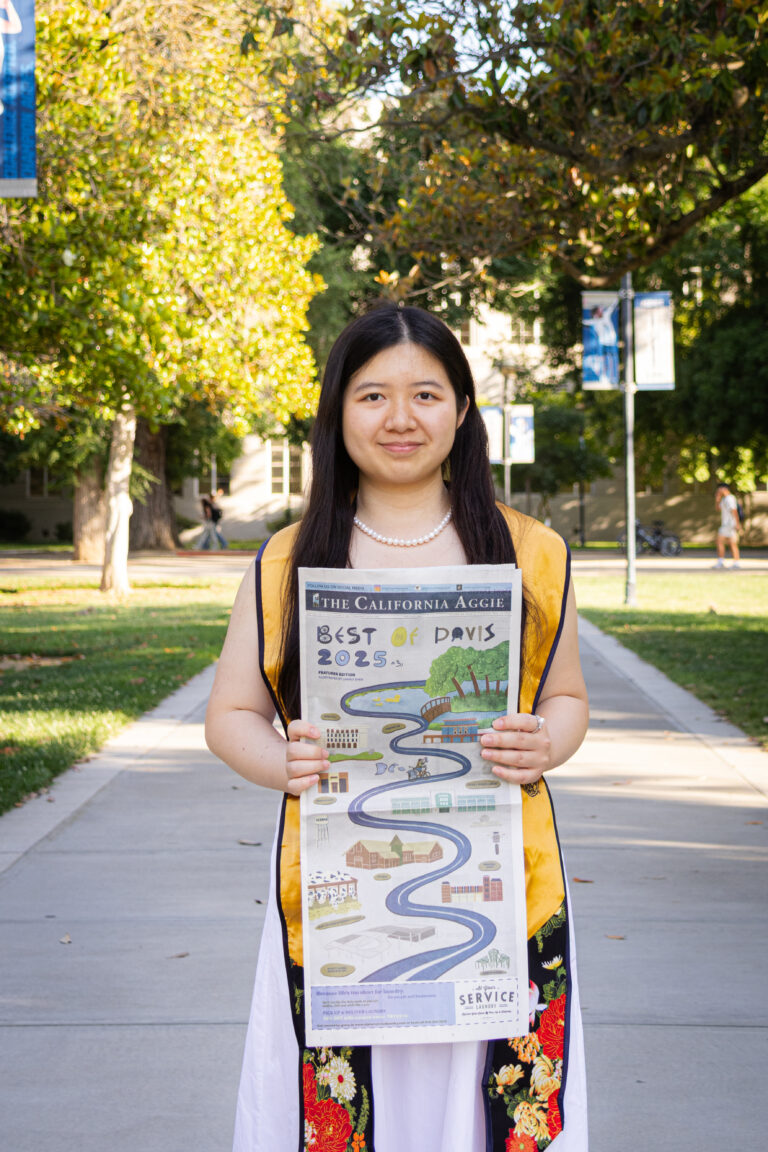
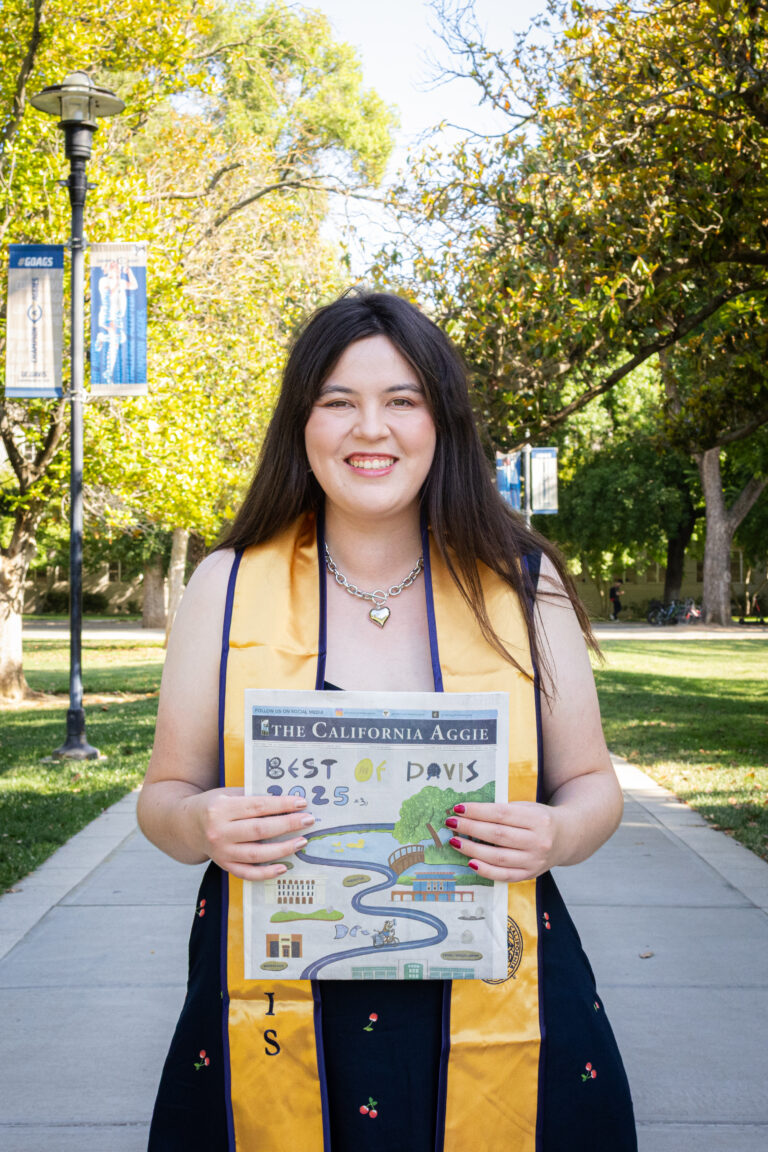
This role taught me to think holistically, problem-solve creatively and grow in ways I never anticipated. Thank you Chris and Alyssa for trusting me! Serving this role, I had the opportunity to design a merchandise line for the first time, design-direct my favorite issue, Best of Davis 2025 (yes, the one I am holding onto!) and lead an incredibly talented team: Savannah, Crystal, Darixa, Kayla, Stephanie, Jason, Nova, Emily and Veronica. Watching each of you grow was such a joy, and I’ll always cherish all the memories from our weekly brainstorming meeting. Thank you to the rest of the managing staff! It’s been so great working with you all, and I never expected to learn so much about journalism just by being around such passionate editors! 

If I could leave one piece of advice to my younger self, I would say, “You don’t need to wait until you feel 100% ready to chase an opportunity, because you never will. As long as you meet the majority of the qualifications, just go for it! You will learn the rest on the job. And remember, every experience counts, even if it’s a small one.” 

I would like to give special thanks to Professor Jae Yong Suk, Professor Akshita Sivakumar and Professor Christina Cogdell for their unwavering support and mentorship, reshaping my understanding of what architecture can be and what it can do, and inspiring me to think critically about our sustainable future. 

I am also incredibly grateful to the many friends I have met throughout my four years at UC Davis — each of you carry such a unique energy and perspective, and I have learned so much from every one of you. 

And of course, to my most beloved parents, thank you for the unconditional love and support, and for always lifting me back up whenever I hit roadblocks. 

There are still so many memories I wish I could share, so many lessons I’d tell my younger self and so many more people I want to thank. But as I close off this chapter, I’ll say that UC Davis has taught me that there’s so much more than what I could ever have imagined. I’ll miss the feeling of stumbling into new ideas and meeting new people each quarter, when learning felt exponential and discovery never stopped. Being a double major taught me how two disciplines view the same world in entirely different ways — and that there’s rarely one “right” answer. Those countless “aha” moments, where ideas collided and clicked, are what I’ll carry with me most. I’ve learned to think more critically, more curiously and more compassionately. 

To my alma mater — thank you. Until next time! 


Lanhui Zhen is The California Aggie’s current design director. She joined The Aggie in October 2023 as a cartoonist under the opinion desk. In March 2024, she also became a layout artist under the layout team. She is graduating with a bachelor’s degree double majoring in design and managerial economics. 


Written By: Lanhui Zhen lazhen@ucdavis.edu 


Crying in my Civic

Reflecting on my time in my Honda Civic after I failed an exam


By ILEANA MONSERRAT MERAZ- immeraz@ucdavis.edu


Don’t be alarmed. I’m okay, I swear. However, I can’t say the same about me back in 2021 on a cold December day in my Honda Civic in a community college parking lot. 

Imagine tears, snot and a messed-up first-year just sobbing in her car with a crying face worse than Kim Kardashian’s. Yeah, scary. 

Now, obviously I wasn’t just crying because I randomly felt like it. I had just failed my third midterm in a row for a required calculus class I was taking at my old community college. 

For some context, before I became a political science major and came to UC Davis, I was a community college astrophysics major. Dreaming to go to UC Berkeley and becoming the next Nobel Prize winner. The requirements were math heavy, the workload was intense and repetitive. Wake up. Math. Eat. Sleep. Repeat. 

So, when I knew that I had just bombed my third midterm of the quarter, I thought life was over. How on earth could I be a good astrophysicist without being able to do basic calculus? How would I ever transfer to my dream university without being able to pass every math class with flying colors? Did I just fail my first class? Oh my gosh, what is Mom going to say?!

My crashout reached its peak when I ran from my classroom where I had just taken the exam to my rusty dusty (but reliable) 2012 Honda Civic. I opened the door, jumped into the backseat, laid down and just cried. But not like one of those cries that you get randomly when you get emotional but a real, can’t-catch-my-breath, suffocating cry. 

An exam had just changed my entire future. What the hell was I going to do now? 

Before I tell you the rest, let me begin with this. For those of you who don’t know, I am from Silicon Valley, home of tech, innovation and, basically, a bunch of STEM kids. Yes, I was one as well.

I had grown up going to science camps at Stanford University and spent time teaching myself how to code during classes in the summer. I was the one and only awkward kid in the corner with a bad haircut and a desire to learn everything and anything about science. I really had a passion for it.

As I grew up and went to high school, I began taking other classes like Advanced Placement Chemistry and Advanced Biology. Both allowed me to want to continue my education in STEM even further. I was academically gifted and had many teachers tell me I was smart and could go far with science. However, little did I know that I had just begun to burn out. 

When one burns out, academic pressure feels slightly different. It feels like you are constantly making a life or death decision, and if you make the wrong choice, then you would be doomed forever. Hence, my car crashout; where the pressure finally made me crack.

My face was puffy, and my eyes looked like I had just put a ton of red paint on them. It was bad. 


I had given close to six years of my life eating, living and breathing science, and finally, with one exam, I felt it all just go away just like that. My future was undetermined, and I didn’t know what to do. 

I continued to sit in my Civic for close to half an hour just contemplating all the wrong ways my life could go; how I had just disappointed myself, my parents and probably ruined my chances at ever transferring. 

The more I reflect on my crashout, the more I solidify my beliefs that black-and-white thinking was my downfall in this moment. Never did I ever consider retrying the class or even listening to myself as to if astrophysics was really what I wanted to do or if it was just the thing that was expected of me given my track record. The gray area never seemed to exist. 

I wish I could go back in time to my first-year self in that Civic and comfort her, letting her know everything was going to be okay. That she would end up passing that class (thank you curve!) and that her real path was just a few quarters away. She wouldn’t have believed me of course (again, she was just in her own black-and-white world), but at least I could have planted the seed in her head to not think in extremes and that she still had three and a half beautiful years ahead of her. 

I would have told her that listening to herself and her very secret love for the humanities was the way to go and to not quiet that voice that told her that was where she needed to be.  Impressing others shouldn’t be the goal when it comes to choosing your path and now I extend this message to you, loyal Aggie reader, that believing in the gray area may just be the way to go. 

I finally believed in the gray area my fall quarter of my second year of college and made the change to the humanities. With that being said, I applied for transfer that same quarter and visited what ended up being my dream school all along, UC Davis. I thrived in my new major and found a passion for school, life and the keeping of my peace. The pressure was lifted, and I could finally become who I was meant to be. 

I am proud to say that I will be graduating from this university this spring with my bachelors degree in political science and a minor in economics at the Golden 1 Center. I’ll be walking the stage at the Saturday graduation and will be driving myself in that same Honda Civic I crashed out in. What was once the vessel of uncertainty and dread will become a chariot of hope for the future and the home of a full-circle moment I will never forget. Sometimes one just needs to cry in their Civic, so go do it!


Stepping out of my comfort zone

How I learned to take chances on things that I would have never expected to take me so far: The California Aggie being one of them


By MATTHEW MCELDOWNEY — city@theaggie.org


I remember the first leap I took when choosing to work for The California Aggie. It was the application portal and the essays. The vague idea that I wanted to be a part of Davis’ life and community on some deeper level was one reason I described in these essays. 

Frankly, I was not fully convinced of everything I wrote in these essays (I’d be surprised if anybody was), but suffice to say, I am glad to have had these doubts silenced. If The Aggie has taught me anything, it would be that even the smallest stories could lead you down the most unexpectedly, unforgettable rabbit holes.

The process of writing an Aggie article really allows for this feeling of discovery. An article can begin from something as inconspicuous as a dead Facebook post or as spontaneous as a flyer on a wall that day. Even today, I feel this compulsive urge to skim the posters pasted on the windows of Davis businesses downtown. But as I have come to understand, the reporting and the interviews really allow somebody to explore the interpersonal stories and experiences that an eye-catching headline could never do justice to. 

For the year I’ve been a writer for The Aggie, I have had the pleasure of meeting some of the most welcoming group of skaters in a ditch somewhere off to the side of Highway 80. I have had the opportunity to tour a state-of-the-art feline veterinary facility despite my cat allergies. It is not every day that one gets to sample a variety of artisanal honeys, but I was able to have the experience of tasting and rating honey alongside some of my close friends in Davis. 

Most of all, in these moments and all of the moments I have had reporting and writing for this publication, I had the rare chance to get a snapshot into the lives of so many others whose lived stories still touch me deeply. 

As my Aggie journey comes to an end, I know now that I have been truly humbled to have been a small part of so many different stories in Davis. And, I feel truly lucky to have taken a gamble on myself to do something like The Aggie, even if I, myself, did not really know what this journey would have in store for me.


Written By: Matthew Mceldowney city@theaggie.org

New people, new places

The California Aggie helped me get to know my school, my city and my future career 


By RORY CONLON — city@theaggie.org


As a transfer student, it can feel like you’re in a hurry. I spent my first year at UC Davis hustling to get the classes I needed to graduate and adjusting to living on my own for the first time. 

As I went through all of this, I wondered if I was missing out on a part of the college experience. I met a few new friends and explored some places on campus, but I felt disconnected from a lot of the school, the city and, most importantly, the culture of Davis. 

I initially joined The California Aggie, because I had been a part of my community college newspaper, and I wanted to keep getting reporting experience. The year I’ve spent on this paper has not only changed the way I see journalism, but it’s also allowed me to explore and understand Davis in a way I never would have otherwise. 

As a staff writer on the city news desk, I meet with my editor, Hannah, and a team of about eight other writers every week. We each pitch three ideas for stories that we want to cover for that issue of the paper. 

Once we’re assigned a story, we have about 10 days to attend events, interview people, write stories and edit them for publication. 

My first assignment for The Aggie was a 9/11 remembrance event where people climbed hundreds of flights of stairs in honor of the first responders who served at the World Trade Center. As I interviewed firefighters, police officers and members of the army at the event, it was interesting to hear why they chose to serve. 

For some, it was as simple as walking up to an information booth at their school career fair and deciding to take the plunge. For others, it was a deeper, more personal commitment. 

One young man, who was Latino, said he became a police officer to build trust with his community and make them feel safe to reach out in their times of need. Another young woman decided to become a police officer to continue her family’s commitment to public service. 

To the people who served, 9/11 symbolized perseverance and strength in the face of terrible odds. To their family members, it symbolized sacrifice. 

I’ve now written about 30 stories for The Aggie, and each one comes with a distinct set of memories. I’ve attended city council meetings; interviewed downtown business owners; talked to DJs playing a morning set at the cafe; asked drunk people for their opinions at an art  gallery showing; listened to state legislators debate policy and so much more. 

One story that always pops into my head was when I covered an art show at a local elementary school. From the way it was advertised, I had been expecting a big event in a school auditorium, but when I got there, it was a small, intimate event set up in the school’s backyard. 

The students ran around on the playground and sat with their parents to watch someone’s grandfather play songs on his guitar. The teachers and the principal of the school were directing people to the art, which was hung up along the bank fence in neat rows. 

The youngest kids there were kindergarteners, who made colorful finger paintings of their favorite foods. The oldest kids there were sixth graders, who made detailed drawings of their favorite dishes and the people who cooked for them. 

I laugh about it now, because I was so serious trying to interview people about this art. But the sweet thing is that no one made fun of me for trying — in fact, everyone I spoke with was laidback, relaxed and happy that someone had wanted to cover that event for the paper in the first place. 

Journalism is about breaking news, speaking truth to power and giving people the information they need to make decisions about their lives. But through my work at The Aggie, I learned that it’s also a way to tell stories about ordinary people coming together and celebrating something meaningful to them. 

As I think back on my time at Davis, my first regret is that I didn’t join The Aggie sooner. Being on this paper not only solidified my interest in reporting, but it also introduced me to so many different people that I learned from, in big ways and small ones. 

My second regret is that I am leaving this city just as soon as I’ve gotten to know it. 

Though it’s a sad thought, I look forward to what’s next. I don’t know if I’ll end up in the town I grew up in or a whole new one entirely, but my time at The Aggie has taught me to slow down, look around and embrace the unexpected. 


Written By: Rory Conlon — city@theaggie.org


From across the pond to The Aggie!

How studying overseas sparked my interest in local storytelling 


By ELIZABETH BUNT — arts@theaggie.org 


I joined The California Aggie as a writer the summer after my third year at Davis. As an English major with creative writing emphasis and a professional writing minor, it was kind of a miracle I hadn’t stumbled upon it sooner. 

I spent the summer between second and third year in Scotland on a UC Davis study abroad program. The course was on travel journalism and counted for a significant portion of my minor. During that summer, my classmates and I were given an assignment in Edinburgh and our only instruction was to find stories. It was the best assignment I could have been given. During the weeks I spent there, I spoke to people I would never have otherwise met and went to cultural events I would not have otherwise attended. Journalism opened the door for me to experience the city in a new way. 

When I came back to Davis, I felt the urge to explore the town in the same way. For a while, I wrote on my own about what was happening around me. This easily fit into my creative writing class work anyway. But it wasn’t until the spring when I decided to apply to The Aggie as a writer, starting to write consistently for the arts and culture desk over that summer. 

Writing for the arts desk has allowed me to connect to Davis in a new way. Part of my job has just been to keep an ear to the ground and find out what’s happening in town on a week to week basis. For me, that has meant finding out more about literary and music events, tracking local galleries, learning about new exhibits and, most importantly, spotlighting art produced by Davis locals. 

Through The Aggie, I have been introduced to an entirely different side of the Davis arts community in such a fulfilling way. Above all, it has been so much fun tracking down local events and people and learning about the beautiful things being created in our town. I have loved being able to use my writing to bring attention to all Davis has to offer. Writing for The Aggie has reaffirmed for me that journalism is a way of showing love for a place and I dearly love Davis. 

All of this is to say that I have had the best time writing for The California Aggie. I’ve met cool people and seen new sides of Davis. I am so glad that my study abroad turned into a love for journalism that pointed me to The Aggie; Not to mention that seeing my words in print every week has been an insanely cool experience. 

I have nothing but good things to say about The Aggie and its role in the Davis ecosystem. Anyone who has stuck around to the end of this rambling should take this as their sign to get involved. You won’t be disappointed. 

Written by: Elizabeth Bunt — arts@theaggie.org

Personal growth and bus love stories

 My four-year-long codependent relationship with The California Aggie


By ALLISON KELEHER — adkeleher@ucdavis.edu


Long ago in Davis, a little undergraduate student applied to be a volunteer layout artist for The California Aggie. Spoiler alert — I’m the little undergraduate student. I entered UC Davis with a background in graphic design, and with absolutely no aspirations of pursuing that as a career, I sought out organizations on campus that would allow me to express myself creatively. Lucky for me, I found the only position that solely worked with my favorite Adobe Program: InDesign. Every Sunday night, I could be found in my first-year dorm room slouching over my laptop, creating new layouts for the newspaper. 

As I neared the end of my first year, my aspirations grew, and I took a leap into a new position at the newspaper: distribution manager. I was thrilled by the idea of driving around campus in a white van to deliver newspapers. It was a unique experience, and I am forever grateful for the opportunity. However, my brief rendezvous with slinging newspapers came to an early end. It was a tough decision, but I realized I had taken a position with the newspaper that didn’t provide a creative outlet — which was the reason I had joined in the first place. 

Meanwhile, I was also enduring second-year struggles surrounding my major and career path. That year of my undergraduate life was filled with uncertainty, as I took classes for a major I didn’t enjoy and kept a job that didn’t fulfill me. At the time, it was difficult to work through that discomfort in order to find myself — dare I say, the classic college experience. If there’s any advice that I can give about that, it is to trust your intuition. Things have a way of getting better with time and all you can do is be there for yourself through it all. 

Moving forward, I entered into a time period of my life which I dubbed “my bootstrap era.” This essentially means that I was working on myself and doing what I felt was right for me. Or, picking myself up by my bootstraps. I highly recommend labeling it this way: It makes the process way more entertaining. This was when I was blessed with the volunteer humorist position at The California Aggie. 

It all started when I pitched my love story about the G and the J Unitrans bus lines during my interview. Thankfully, the hiring staff wasn’t scared away by my bus fanfiction, and I was bestowed with the honor of being a humorist. 

With this position, I felt like I was challenging myself creatively again — things were back on track. My first article was the G and the J story, which effectively launched my micro-career in UC Davis humor writing. To this day, I meet new people who say they have this one story pinned on their walls at home. My debut in the newspaper was a success. I am incredibly grateful for the opportunity to write little stories for the newspaper and expose my strange sense of humor to my classmates and colleagues. All I can hope is that my future employers don’t Google me. 

My experience as a UC Davis undergraduate student was uneven and all over the place, but that’s what makes it fun. There are so many opportunities available and it takes pretty much four years to sort through all of them to find the ones that fit. I am excited to carry this experience — and this digital footprint — with me as I grow my professional career. 


Written by: Allison Keleher — adkeleher@ucdavis.edu


A beautiful, heartfelt goodbye to the opinion column

I only knew her for a year


By TARA ROMERO — tcrome@ucdavis.edu


Writing about myself directly for an article feels so gross. Usually, I can hide behind a communal “we” or a pointed “you.” Even when I use the “I” pronoun in my columns I get to feel a bit distanced, since few people would recognize my name. Yet, here I am, opening up about my life and feeling a little bit vulnerable.

The thing is, I really shouldn’t feel so exposed. Writing for the opinion desk, I’ve already made so much of my own life and political views visible. 

At times, the opinion desk is one of the scarier places to be at The Aggie. Certainly not the scariest — I think that title probably belongs to the layout director or the editor-in-chief. However, writing opinion columns can be very vulnerable, and that’s the scary part. There’s a reason the paper puts the disclaimer, “The views and opinions expressed by individual columnists belong to the columnists alone and do not necessarily indicate the views and opinions held by The California Aggie.” We get tasked with taking a stance — a stance that belongs to us and us alone as writers. 

I’ve only been writing for The Aggie for one year. I joined the opinion desk because my hubris told me that I had something to say. It took me a while to find my footing. At the beginning, I wrote a lot more fluffy, light-hearted articles (and trust me, I still love writing a good fluff article). I was too nervous to write about anything more controversial in fear that I wouldn’t be able to do the topics I cared about justice — so, I avoided them.

A month or two in, something in me flipped. I realized that I wanted to say something more; I wanted to take a real stance with my writing. If I’m writing for the opinion desk, I might as well actually have an opinion.

So, I started writing more about political topics that I felt passionate about. I felt myself learning my own political voice over the course of this year, and I’m very proud of my work — something I rarely say. Whenever I turn in an essay, I’m convinced I’m the worst writer in the world and that my professor should blow me up with a stick of dynamite over how bad of a job I did.

Writing opinion columns is so vulnerable, but that’s what makes opinion writing so necessary. As Artificial Intelligence is beginning to replace our humanity in every field of writing, and as we continue through the age of social media blasting misinformation across everyone’s timelines, we need vulnerability in our persuasion.

Persuasion itself is becoming somewhat of a lost art. Ideally, persuasion should be a one-sided conversation that is rooted in human connection, with the goal of convincing other people to view the world the same way you do. In reality, persuasion has turned into propaganda — into a “who has the most clickbait headline” contest where only the readers are losing.

Through vulnerability, there is authenticity. Through authenticity, there is real persuasion. Real persuasion is the only way to resist this era of propaganda and misinformation — alongside, of course, local and reliable news sources such as our very own The California Aggie.

So, take this as a love letter to the opinion column. Writing persuasion pieces has taught me so much about myself, and I hope all of my fellow writers’ and outstanding editor’s stories this year taught you all something about yourselves or the world. 

I will end this column on a vulnerable note. As I leave behind my brief time as an unpaid writer (that’s how you know I was in it for the love of the game) and as an unpaid student, I am entering into this unknown chapter of my life. I’m graduating without the slightest clue about my future, but I trust my love of writing and my newfound voice will guide me wherever I go.


Written by: Tara Romero— tcrome@ucdavis.edu


Signed, Jalan Tehranifar

You can’t have my autograph (unless you ask nicely)


By JALAN TEHRANIFAR — features@theaggie.org


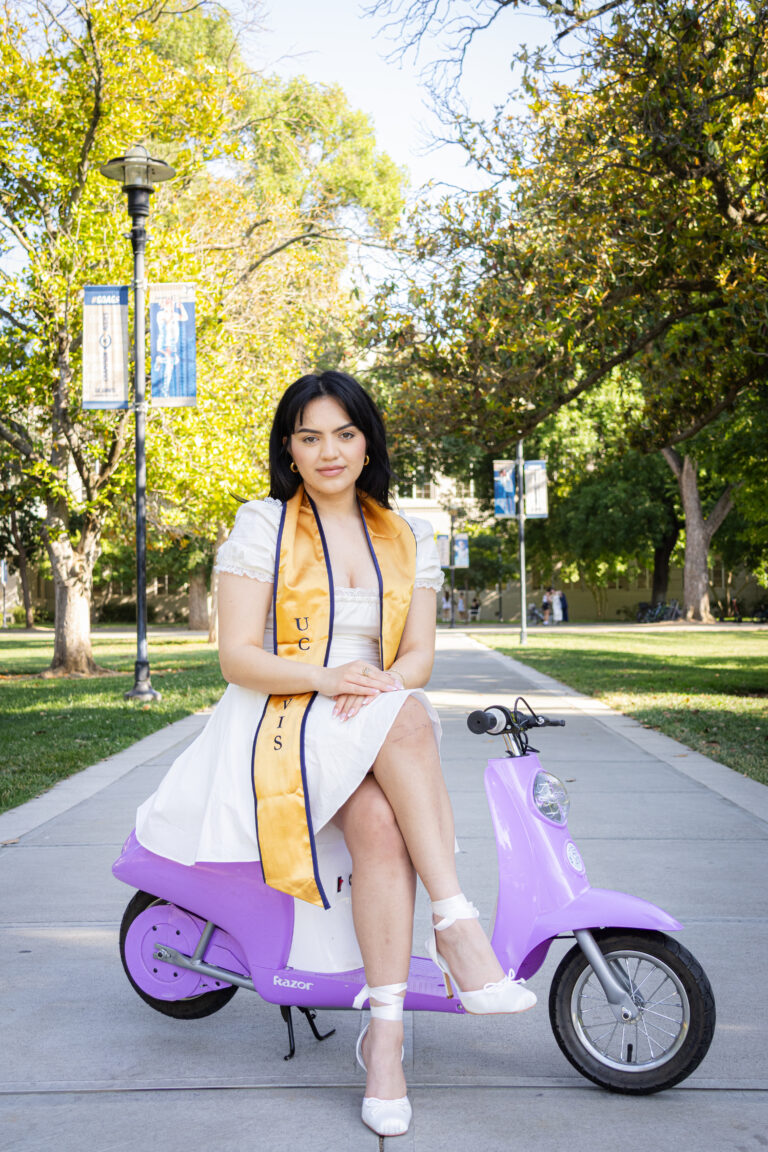
My name is Jalan Tehranifar, and I’m the girl you’ve seen around campus on the tiny purple moped (it’s meant for children) — but that’s not all that I am. 

When I first arrived at UC Davis at 16, I was stepping into the unknown — both for myself and for my family. As a half Persian, half Armenian daughter of immigrants, I was the first of my siblings to go to university, the first in my extended family to move away from home for college and the first to chase a future in law. There was no roadmap for this. Just determination and a deep belief that I could build something new. And somehow, I did.

UC Davis became more than a college campus. It became a place where I unraveled, regrouped and slowly rebuilt. I started out as a biological sciences major and quickly learned that discipline alone can’t carry you through something you don’t love. Struggling in school was a wake-up call — but also a turning point. I found my way to international relations, and in doing so, found a version of myself that felt more aligned, more alive. Being Armenian and Persian has always meant holding complex histories and hybrid identities. Studying international relations gave me the language to make sense of that — to see the personal and the political as deeply intertwined.

Writing for The California Aggie was one of the first things I did here. I joined the features desk my very first quarter, writing articles all throughout my first year. I took a break for a few years, but when I returned as a fourth-year, it felt like coming home. Writing for The Aggie allowed me to connect with the history of UC Davis and with students I might never have crossed paths with otherwise. Journalism taught me how to listen more deeply and speak more precisely — skills I’ll carry with me for a lifetime.

One of the most meaningful parts of my time at The Aggie was creating the “Senior Send-offs,” a series I began in 2022 and revived this spring. Each spring, I interviewed four graduating students — one from each college — and wrote personal profiles that celebrated their time at UC Davis. The send-offs became a way for me to reflect not only on others’ journeys, but also on how we all leave pieces of ourselves behind when we move on. There’s something special about putting someone else’s story into words and knowing it’ll live on in the archives — proof that they were here, and that they mattered.

One of my favorite jobs during college was filming coaching tape for the UC Davis football team for the 2024-25 season. Instead of interning at a legal office (which I should have been doing), I was at the UC Davis football field for every practice and every home game. This season was one of our best, and it was exciting to see students care so much and cheering on their fellow Aggies. It reminded me how much fun this campus can be, especially when we all show up for each other.

But what I’ll carry with me most are the friendships. The people I met here — some unexpectedly, some slowly over time — became part of my everyday life. And I know they’ll stay in my life long after I leave. I hope me and my girls will always be silly together.

Though I’ll be walking the stage this June, my story with UC Davis isn’t quite over. I’ll spend my final term studying abroad in Paris this fall through the UC Education Abroad Program. And after that, I plan to attend law school, with the goal of pursuing a career in international law.

As much as I’ve loved being a journalist, I know my work going forward will take a different form. But the curiosity, clarity and care that journalism demands will always be part of who I am.

To those still in the thick of it: Your dreams mean absolutely nothing if you don’t put in the work to make them real. There is potential in everyone. I hope you recognize yours — and make something lasting out of it. Also, put lights on your bike. I got hit by a car twice (within 10 days).


Written by: Jalan Tehranifar — features@theaggie.org