53.5 F
Davis

Davis, California

Tuesday, December 23, 2025
Home Blog Page 267

Youth sports programs adapt to changes due to COVID-19 pandemic

0

New safety measures implemented to comply with social distancing guidelines

The COVID-19 pandemic has forced youth sports programs to adapt in order to comply with social distancing guidelines. Davis Youth Softball, Davis Little League and the Barbara Morse Wackford Community & Aquatic Complex in Elk Grove have adapted their programs to ensure the safety of their staff and players.     

Davis Youth Softball Publicity Chair Sarah Roseen explained the values that players learn through their program. 

“Our players learn the fundamentals of softball,” Roseen said. “We really value having fun, learning the fundamentals, making sure that all participants play, learn the game and hopefully learn to love it.”

Roseen further explained how Davis Youth Softball has a recreation league for both new and returning players, a youth league for ages 4–16 and a select league that competes in regional tournaments. 

Roseen commended the parents and players for adapting to new social distancing guidelines imposed by the pandemic. 

“We’ve shared what our expectations are in terms of health and safety,” Roseen said. “The parents and the players have just been great in terms of following those requirements and keeping everybody safe, so now we’ve been playing for a couple of months and it’s been really fun.”

Roseen described the other new adaptations that have been implemented, which include social distancing, expanded dugouts, alternating seating for players, additional distance in the dugout, hand sanitizer and antibacterial wipes. 

Roseen noted Davis Youth Softball’s focus on prioritizing the safety of others. 

“I think our priority is to keep everyone safe in this pandemic as long as it takes,” Roseen said. “We would love to increase our numbers of participants and get the word out around Davis that we are a fun, inclusive and great way to get kids outside and participating in a sport.”

Roseen emphasized her gratitude for the community and their support during these challenging times. 

“I want the community to know that we are really focused on being a fun, inclusive league,” Roseen said. “It’s great to be part of this community that values the whole child and wellbeing, and sports in general play a really big part in that.” 

Jefferson Nguyen, a UC Davis third-year Civil Engineering major and Sports Recreation Leader at the Barbara Morse Wackford Community & Aquatic Complex in Elk Grove, explained via email how the pandemic caused the sports recreation leaders to be laid off.

“When the pandemic began and lockdown came into place, I and my fellow part-time coworkers were actually laid off, leaving only the full-time administrative staff and a few senior part-timers,” Nguyen said via email. “All sports programs were suspended and the Rec. Specs. were repurposed to various maintenance and child-care roles.”

Nguyen further explained how part-time staff were rehired in March 2021 after restrictions began to be lifted in Elk Grove. 

“Part time staff were finally rehired throughout March and we began assisting the coordinators in the PE style sports program (known as after school sports) as well as Adult Softball scorekeeping,” Nguyen said via email. “These two are our only current programs and they are both held outdoors and we check every participant’s temperature as they arrive.”

Nguyen described the importance of youth sports for child development, especially during the pandemic.

“Youth sports is very important in children’s lives because it promotes an active lifestyle and socialization,” Nguyen said via email. “During the pandemic, where many sports facilities and programs are closed, it can be hard for kids to find the opportunity to play their favorite sports in a safe and controlled environment. Our programs offer them an escape from being stuck at home all day and keep them active during their childhood development.”

Nguyen added a final note regarding the return to normalcy that playing sports represents. 

“The competitive nature of sports is not something that can be replaced,” Nguyen said via email. “Allowing kids to participate in sports once again (in a safe way) is huge for their mental health and a sign that things are getting better.”

Director of Coaching and Player Development and Safety Officer at Davis Little League Carina Bender-Abrams explained that before the pandemic, Davis Little League had approximately 700 to 800 Little League players between the ages of 4 and 12. 

When the pandemic began, several adaptations had to be made, including adjusting foot traffic around the complex, instructing parents on locations of where to pick up kids, prohibiting spectators, temperature scanning, hand sanitizing and masking. A new role was also developed called Safety Parent, who would ensure that kids follow proper safety guidelines so that the rest of the staff could focus on coaching.

“As restrictions lifted over the winter, we were able to have a fairly normal season, with the addition of masks and hand sanitizing,” Bender-Abrams said. “Our hope is to be able to continue to play and to continue to grow.”

Bender-Abrams noted the benefits of kids playing youth sports from both a mental and physical standpoint. 

“Being part of the team is a huge positive for a lot of kids,” Bender-Abrams said. “It’s a huge social and emotional outlet to be able to be outside with your peers doing something that you love.”
Written By: Jelena Lapuz — city@theaggie.org
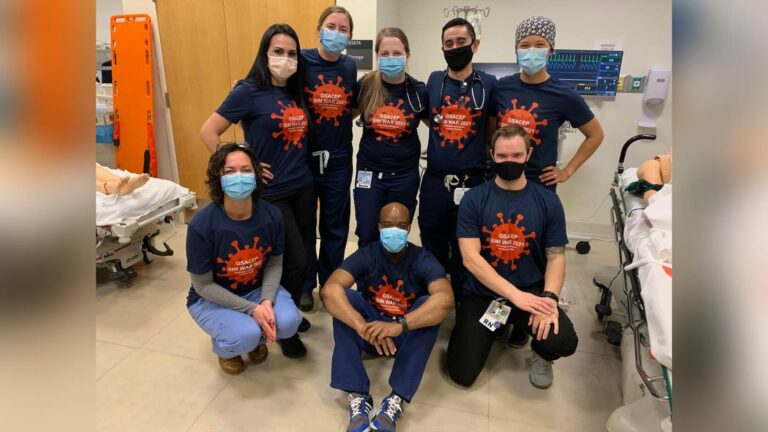

UC Davis Emergency Medicine residents win SimWars competition

A team of UC Davis Air Force residents beat out residents from Navy, Airforce and Army programs across the country in a military medicine simulation

On April 8, 2021, the emergency medicine physicians in the UC Davis Emergency Medicine Residency program participated in a head-to-head competition against military emergency medicine residents from across the country. The competition, called “SimWars,” was organized by Air Force Lt. Col. Dr. Roderick Fontenette, the military associate program director at UC Davis Health. 

“The SimWars competition is a competition against military emergency medicine residents from across the country—it’s Army, Airforce and Navy residents,” Fontenette said.

The competition was part of the annual Government Services Symposium organized by the Government Services Chapter of the American College of Emergency Physicians. The SimWars competition gives residents from across the country and across the branches of the military the opportunity to compete against one another in simulated patient scenarios. This year, more than 30 residents from seven teams competed in the SimWars. Each participating team, including the Air Force team from UC Davis, was composed of emergency medicine residents, varying from first-year to fourth-year residents, as well as registered nurses and respiratory therapists. 

This year’s competition and conference differed from previous years as it had to be hosted online remotely. Every team competed from their home campus, using scenarios written by Fontenette and their home facility’s simulation centers. Some schools had to drop out due to these technical constraints, dropping the number of teams from nine to seven, according to Fontenette. 

The simulated scenarios were designed to resemble situations that military physicians are likely to encounter in the battlefield, but ones that civilian physicians might not ordinarily face. 

“They were real cases,” Fontenette said. “It was a mass casualty event, multiple patients coming in. First patient came in after stepping on an IED, had traumatic amputations, had to be intubated, altered mental status, most likely a traumatic brain injury. Then the other patient came in, penetrating gunshot wound to the left chest with a reported 13 other patients coming in. Just like you would take care of the patients in Afghanistan or the Horn of Africa, you had to take care of your patients because these are all military residents and I wanted to make sure they had military-type scenarios.”

In order to complete these scenarios, each team had to utilize their facility’s simulation labs, employing high-fidelity manikins that can “produce pulses, heart rates, hemorrhages, sweat, vomit and speak,” said Dr. Ian M. Julie, an associate professor of emergency medicine and the medical director of the simulation center at UC Davis, via email. These high-fidelity manikins were ideal for this type of simulation because they could be programmed to meet the needs of the SimWars scenario.

“If you want practice cutting open a chest and repairing an injured heart, you need an animal model,” Julie said via email. “But if you want dozens of medical students to practice assessing a very sick asthma patient who requires diagnosis, medication and intubation, […] a manikin can do it repeatedly, the same way every time and without ethical dilemmas.” 

These simulation manikins allowed each team across the country to have a patient with the same vital signs that responded the same way to any interventions. The UC Davis residents completed and filmed their scenarios in the UC Davis Health Center for Simulation and Education Enhancement. During the pandemic, the center was modified to incorporate virtual learning so it had all the equipment needed to compete in the SimWars and record every step along the way using Zoom-enabled workstations and wall-mounted cameras. 

Air Force Capt. Dr. Jasmine Neeno, a third-year emergency medicine resident at UC Davis, was the team lead for the UC Davis team. Neeno led the team to victory this year, narrowly beating out the Army team from the Medical College of Georgia. 

“We did a really good job of communicating and listening to suggestions and advice when we had difficult patient situations, which I think is what ultimately carried us to victory,” Neeno said. “[All teams] practice similar medicine, but I think the difference was that I felt that we worked better as a team.” 

As the UC Davis residents celebrate their victory this year, they look forward to returning back to an in-person conference and competing again next year to defend their title. 
Written by: Justin Weiner — science@theaggie.org

Professors discuss global vaccine inequity and its potential consequences

0

With growing vaccination rates in the U.S., two professors share their thoughts on the consequences of the inequitable distribution of COVID-19 vaccines

While vaccination rollout in the U.S. is well under way, with about 42% of the population at least partially vaccinated as of April 25, there are still many countries who have not been able to vaccinate even 10% of their population. According to experts, this inequitable distribution of vaccines has epidemiological, political and economic consequences, not only within the countries that have limited access to vaccines, but throughout the world as a whole. 

Bob Gilbertson, a distinguished professor of plant pathology at UC Davis, pointed out two factors that contributed to a lack of vaccine access in developing countries. First, Gilbertson stated that many countries struggled to respond quickly to the outbreak of the COVID-19 pandemic and lack the information needed to produce vaccines. Second, many countries lack resources and funds to produce their own vaccines and are outcompeted by countries such as the U.S. and the U.K.

Before herd immunity is reached, more COVID-19 variants can arise. The more the virus circulates, the more opportunities it has to mutate. These variants, which have the potential to be more transmissible or more pathogenic, can spread not only within developing countries, but also to different parts of the world.

“We know this virus does not respect countries’ borders,” Gilbertson said.

Gilbertson emphasized the importance of trusting science. He hopes that the U.S. will continue ramping up vaccine production so the government will be able to assist other countries that cannot produce enough vaccines for their population on their own.

“I continue to tell students that one of their jobs today is to go out as ambassadors for science and that they have to try to be aware, reasonable and argue against anti-science,” Gilbertson said. “People need to get the message out that these decisions are based on solid scientific research and that these vaccines are totally safe.”

Selva Demiralp graduated from the UC Davis Economics Ph.D. program in 2000 and is now a professor of economics at Koç University in Istanbul, Turkey. Demiralp stated that even if the entire population was vaccinated and herd immunity was attained within the U.S., there would still be significant economic costs of vaccine inequality.

For example, if the pandemic is still active in Turkey, COVID-19 would continue to negatively impact the Turkish—and in turn, world—economy. Turkish production would still be limited due to lockdowns, and Turkey would not be able to export as many goods to other nations. 

According to Demiralp, this would impact the U.S. economy because the U.S. imports intermediate goods from Turkey. For example, Turkey might export steel to the U.S. that can be used in car production. If Turkey cannot produce as much steel, then it will reduce car production in the U.S.

 If the populations of richer countries are vaccinated within the first half of 2021 while lower income countries can only vaccinate half of their populations, the total costs of the loss of exported goods worldwide will be $3.8 trillion, according to Demiralp. Up to half of the total cost will be borne by the richer countries, Demiralp said.

To prevent further economic loss, the World Health Organization (WHO), the Coalition for Epidemic Preparedness Innovations (CEPI), Gavi and other institutions put together the COVAX initiative. Their goal is to initiate a cooperative effort to manufacture two billion doses of vaccines to inoculate 20% of each country’s population.

“Our research highlights that it is not an act of charity but an act of rationality to contribute to efforts such as COVAX,” Demiralp said via email. “This is because in the absence of equitable distribution of vaccines, the wealthy countries would need to pay trillions of U.S. dollars, which is much more than the cost of producing enough vaccines to inoculate the world population.”
Written by: Liana Mae Atizado— features@theaggie.org

The crisis in India is our crisis too

We can do more on a national and individual level to support people in India and those of Indian descent in our local communities

As things start to slowly progress to a version of life before the COVID-19 pandemic in the U.S., it can be easy to fail to pay attention to other countries who are struggling so much more. India is currently dealing with a deadly wave of COVID-19, with a daily average of nearly 400,000 cases and over 3,000 deaths. 

As members of a publication, we know how important it is to stay informed and how important our job is in keeping people informed. We believe news organizations in the U.S. need to do a better job at reporting on the deadly outbreak in India and that they need to refrain from the use of traumatic photos, as consistent exposure to such photos in the media leads to desensitization. Members of the American public should not need to see graphic images in order to feel empathy for the catastrophe Indians are currently facing. Although we are only a campus newspaper, we are holding ourselves to the same standard by reporting on how the outbreak has been affecting UC Davis students and professors in India or with family there.

We believe professors need to be incredibly accommodating to students who are coping with the ramifications of this crisis and we hope students extend the same courtesy to any professors who are or have family in India. Chancellor Gary May’s statement on the outbreak in India encourages such communication, and we believe professors need to take the first step to open a dialogue with their students and reassure them that accommodations are available for those in need.

Countries around the world need to provide as much help as they can in the form of medical supplies and vaccines. The U.S., U.K., EU and Pakistan have committed to sending supplies like ventilators and oxygen concentrators, but we believe they need to be sending more supplies, including vaccines. 

The U.S. has a stockpile of the AstraZeneca vaccine, which it has not yet approved for use, and President Joe Biden has announced the U.S. plans to donate 60 million doses to countries in need, but India is in urgent need of vaccines now as thousands are dying and hundreds of thousands are getting infected each day. 

It is a privilege to turn down a vaccine—30% of the American public is currently not planning on getting a COVID-19 vaccine—when only about 2% of India’s population has had the opportunity to be fully vaccinated. The COVID-19 pandemic is a global crisis, and when one country is struggling to contain an outbreak, all countries are affected. Our government needs to act much more quickly in this crisis where timing is so important, especially because the vaccines take several weeks to provide immunity. 

There are also things you can do on an individual basis. Check in on your friends and professors of Indian descent and offer support where you can. If you have the means to donate money, you can do so through international organizations like UNICEF, PATH, the International Medical Corps, Care India, the Association for India’s Development, Project HOPE, Give.asia and Americares or through organizations in India like the Indian Red Cross Society and Ketto. Locally, multiple UC Davis organizations are collaborating to create a fundraiser to support organizations providing aid. India needs your help and your Indian community members need your support.

Written by: The Editorial Board

Students reflect on safe activities from Picnic Day 2021

0

A second Picnic Day spent in the pandemic comes to a close

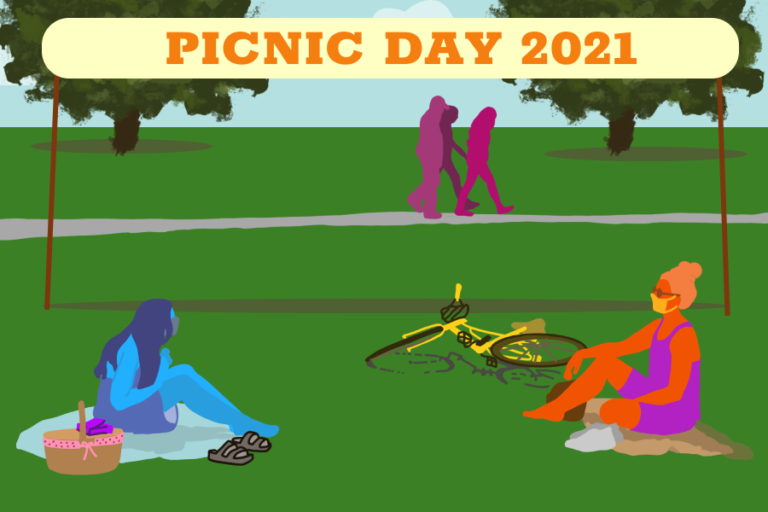
Picnic Day, a yearly UC Davis event, took a different course this year and last due to the COVID-19 pandemic. All official Picnic Day operations were completely virtual, creating a new reality of online activities for students and the community. UC Davis students adjusted to these new circumstances by celebrating Picnic Day safely as the COVID-19 pandemic continues. 

Caitlyn Liu, a fourth-year English and communication double major and the Picnic Day Chair, shared that the Picnic Day board operated completely virtually while preparing for the event. Although this is now the second Picnic Day that has taken place virtually, Liu shared that the board worked to create new events specifically designed to the online setting this year.

Liu shared her happiness with the way the event turned out, which mimicked in-person Picnic Day experiences, such as musical entertainment and a scavenger hunt.  

“I think the event was a success,” Liu said via email. “For those who wanted to attend a virtual Picnic Day, we gave them the best experience we could.”

In fact, Liu revealed that this year’s event had increased attendance compared to last year’s virtual Picnic Day. While it is not yet known if Picnic Day 2022 will be in-person or virtual, Liu celebrated this year’s success in including students during an isolating time. 

“My favorite part was that we got to create an online space for students to continue to feel connected to campus while we’re all away,” Liu said via email. 

Yesenia Morales, a second-year animal science and management major, participated in the virtual Picnic Day event this year. While Morales is not currently living in Davis, she was determined to experience this Davis event online. Morales participated in the online activities and said her favorite parts were the animal events. 

Morales shared that despite not physically being at Picnic Day, she felt a sense of belonging through the virtual event. 

“I still felt a part of this special day through the fun activities such as the exhibits, entertainment and animal events,” Morales said via email. 

As a second-year student, Morales has never attended an in-person Picnic Day. Looking toward the future, Molares hopes to one day attend Picnic Day in Davis, enjoying the fresh food from the vendors and spending time with friends and family.  

Anya Sturm, a third-year mathematical analytics and operations research major, celebrated this year’s Picnic Day outside with her housemates. She shared that while this year’s experience was not the same as previous years, she felt a sense of solidarity while celebrating the day. 

“It felt nice to wake up and be like, ‘Okay, everyone is waking up to Picnic Day, and whatever it looks like for them, it’s still going to be a good day,’ and to know that everyone in Davis was celebrating it in some way,” Sturm said.

Sturm shared that Picnic Day is an important part of the Davis experience, as it’s a day when the whole city comes together to celebrate. 

“It’s the day that really makes the Americana old farm town and the college town really overlap,” Sturm said. “I think the rest of the year, it’s very much residents of Davis and college students, whereas Picnic Day is the one day where everyone’s just together.”

Reflecting on her Picnic Day experiences, Sturm looked back to Picnic Day in 2019, when she celebrated with friends in Davis. 

“It was just like hanging out with what felt like the entire city in Central Park, and then just going around to various friends’ houses, and all of them had live music and small concerts going on,” Sturm said.

Looking forward, Sturm is ecstatic at the prospect of experiencing Picnic Day in person once again with live music and the Davis community. As the timeline for a return to normalcy remains in the minds of many, Sturm reflected that an in-person Picnic Day next year could be a happy indicator of normal life. 

“I feel like Picnic Day is such [a] cool benchmark of like, ‘Well, maybe things will actually look normal by then,’” Sturm said. 
Written by: Nora Farahdel — features@theaggie.org

Let baseball players interview in their native language

0

We need to stop judging people by foreign language interviews

Professional baseball players come from all over the world and speak many different native languages; it’s part of what makes baseball such a great game. Thirty percent of baseball players hail from outside the U.S. Many of baseball’s newest stars are players not comfortable with English, and it should be our responsibility to make their learning process as smooth as possible. Not all Japanese and Korean players are shy and reserved, and not all Latin players are “daft and uninteresting,” we just need to let players interview in their preferred language to eliminate these harmful stereotypes. We miss out on their great personalities by forcing them into awkward interviews.

How fans often judge players who are not proficient in English is discriminatory. Fans assume the personalities of these players purely out of laziness and stereotypes—which is unacceptable. When Japanese and Korean players play their way into Major League Baseball (MLB) they are often older than average because of their time spent competing in their home country. Because of their age as well as general opinions of their dispositions, fans see their short and quiet interviews and label them as a quiet type of a person because of it. When we see Latin players who are often younger, however, their short, quiet and misinterpreted interviews “earn” them the label of “stupid and comical.” The same interview given by the players of two different ethnicities often comes with drastically different results simply due to discrimination.

These sorts of issues are hard to avoid. It’s extremely difficult to get people to completely ignore their prejudiced minds—there is no easy fix. It’s not like these players aren’t trying their best to learn a new language either. Most can communicate with their English-speaking teammates just fine after a season or two of practice, but casual conversation is entirely different from interviews. 

You took a language class for a few years in high school or college, so you would be absolutely fine doing a job interview in that language, right? No, you wouldn’t be, so is it any surprise that a player who is still taking English lessons wouldn’t be either? With your entire career relying on making a quality outwards appearance, it would feel irresponsible giving an interview in a language you aren’t comfortable with. One wrong word or misinterpretation could alter your whole career; why take the risk? Expecting foreign players to take a risk like that almost daily is unfair and needs to stop.

There shouldn’t be shame associated with using a translator to help during an interview. Using the help of a translator is still making an effort to learn the language and shouldn’t be a sign of negligence like it’s seen as of now. A prime example of this in today’s game are the players Gleyber Torres and Gary Sanchez. Both Yankees players from Spanish-speaking countries take different routes to giving interviews, and still, both receive unwarranted abuse over their decisions. Torres receives flak over interviewing without a translator in broken English and Sanchez draws ire for using a translator because he’s “lazy.” Is there any way to make critics happy?

This doesn’t only happen to Latin players either. Hall of Fame outfielder Ichiro Suzuki, who happens to be Japanese, drew criticism for only giving interviews in Japanese using a translator. The long-time outfielder constantly stated that he didn’t want to be misunderstood due to not being fluent in English. Does that make him a bad person? This is all without mentioning the recent firing of Kevin Mather, ex-CEO of the Seattle Mariners. 

Mather gave a horrific 45-minute interview at a local rotary club where he insulted both the respected pitcher and coach Hisashi Iwakuma in addition to 21-year-old star prospect Julio Rodriguez for not knowing English yet. Thankfully he was quickly removed from the organization, but the fact that this mentality still exists in team front offices and is embedded in the media is appalling—it makes my blood boil.

While there are still many issues in America’s pastime, there are more foreign stars in the game than ever before. The MLB is in a golden age of diversity, with young phenoms from all over the world taking over the game and spreading joy to all. Japanese player Shohei Ohtani has taken the league by storm as both a pitcher and hitter for the Angels, with Ippei, his longtime translator, right by his side. Venezuelan star Ronald Acuña Jr. is bringing the Braves and fans dynamic plays we didn’t know we needed to see; Juan Soto spearheaded the Nationals’ 2019 World Series win and Fernando Tatis Jr. just signed a $330 million contract to try and do the same for the Padres—both Dominican and at the top of the league. The game wouldn’t be how it is today without these players; we need to make sure we treat them with respect like we would any native English-speaking player.

Fans can’t see the true personality of players when they have to interview in a language they aren’t fluent in and yet they often disparage them for using translators. We need to stop judging our stars based on unfair interviews and instead enjoy them for their true selves. We aren’t and wouldn’t want to be judged based on our statements given in a language we aren’t yet comfortable with, so we need to extend that same privilege to others. It’s not easy for these players to talk to us in a language new to them, so let’s show some human decency and cut them a bit of slack—it’s the right thing to do. 

Written by: Alex Motawi — almotawi@ucdavis.edu 
Disclaimer: The views and opinions expressed by individual columnists belong to the columnists alone and do not necessarily indicate the views and opinions held by The California Aggie.


Taking a minute to humble Trader Joe’s

0

I’m losing friends over this

I bought a pair of boxing gloves and scheduled an appointment with a therapist just for this article—I’m ready for the backlash. 

I like Trader Joe’s. Shopping there is consistently a fun experience. Between their Hawaiian theme and wide range of products, I often mistake the aisles for being a nautical-themed Disneyland ride. Not to mention, the products are more affordable than other grocery stores, making it a smart option. I’m simply here to shed light on the negatives of Trader Joe’s—considering that no soul ever dares to do so.

Let’s begin with the decor. While I think the Hawaiian theme is fun and playful, let’s not dismiss its tackiness. It looks like a Florida retirement home up in there. There’s probably an elderly couple living in the Keys with the same tiki torches by their “Welcome” mat. Oh, and as for the Trader Joe’s font, it’s the same font used to say what beers are on tap at no-longer-hip bars.

On to the employees. I’ve never met a rude staff member at Trader Joe’s. Considering how friendly and helpful they are, I shouldn’t even bring attention to their minimal flaws. I’m just going to say that I may or may not consistently get roped into a 10-minute conversation with the cashier. We start by discussing which Joe-Joe’s flavor is the best and within the next minute, I’m learning about their difficult relationship with their stepchild. 

As for the food itself, I actually can’t trash-talk it. (Or as I like to call it, “Trader Joe’s talk it…” Kidding.) All the food is good and exciting to try; I’ll just admit it.

As I’ve poorly stated my argument in opposition to Trader Joe’s, I’d like to take this time to highlight the beauty of a Raley’s grocery store. Ugh, Raley’s feels like home. You never quite know what characters you’ll find there or which no-longer-available products you’ll find at the back of the shelves.

I hope that this deep dive into the flaws of Trader Joe’s didn’t offend you too harshly. I have asked that my family members make their Instagram accounts private and that my location remain unknown, as I’m afraid of how you all will react to my take. Forgive me.

Written by: Kate Harges — klharges@ucdavis.edu 

Disclaimer: (This article is humor and/or satire, and its content is purely fictional. The story and the names of “sources” are fictionalized.)

Commentary: RuPaul’s restrictive drag culture

“RuPaul’s Drag Race” propelled drag into mainstream media, but it has fallen short as new forms of expression counteract restricting expectations

“RuPaul’s Drag Race” is indisputably a great piece of reality television and competition show, as proven by the show’s 19 Emmy wins and 29 total nominations. Not only has drag queen RuPaul Charles’ show been met with incredible success and popularity in its original form, but it has also quite literally taken over the world with multiple international spin-offs, All-Stars seasons, yearly conventions and much more. Now that it is clear that drag is fully settled in mainstream media and entertainment, we have to ask if the media we are consuming is holding the art form back or letting it grow. 

RuPaul and what appears to be his drag empire have been consistently followed by controversy and ridicule, ranging from critiques on the editing of the show to recent questions about the source of RuPaul’s authority over the biggest force in drag culture right now. The TV show host, singer, self-proclaimed “Supermodel of the World” and apparent oil fracker has most notably come under fire for some remarks pertaining to why he would not let either trans or cisgender women compete in his drag competition. His reasoning was rooted in some incredibly outdated views on correlations between gender, gender expression and strict adherence to what is now so clearly a defunct binary in drag (and the world at large for that matter). While RuPaul has since apologized for his remarks, and most recently has cast the show’s first openly trans contestant, his vision of drag and his show continues to create an incredibly rigid box for what—in the real world—is an entirely fluid art form. 

RuPaul continues to view the core of drag as solely the act of dressing up in an overly feminized fashion and continues to emphasize the importance of some shift between the performers’ presentation out of drag and how they look in character. More often than not, this sadly works to reinforce a gender binary, at least in terms of presentation, or what it means to “embody femininity” as a drag queen. The most prominent example of RuPaul’s limited vision of drag constraining some of his own show’s contestants is with the drag queen Ginny Lemon on the U.K. version of the show. Lemon and Bimini Bon Boulash, another contestant on the show, spoke openly about being non-binary and viewing their drag as their purest form of creative expression, a way to play with people’s expectations of how they should dress. 

When it came time for Lemon to strut the runway on the show, they stayed true to their personal, often androgynous, campy and loose-fitting outfits. On multiple occasions, RuPaul and the judges had something to say about Lemon’s presentation, and essentially forced them to choose an extremely feminized and sexy look consisting of a pink bodycon dress, hip pads, and a breastplate—something Lemon was not entirely comfortable doing. The problem here is not that RuPaul encouraged a contestant to step outside their comfort zone, but rather that he could not accept Lemon’s unconventional drag style and the range they showed within that—with body hair showing, an un-cinched waist and entirely theatrical makeup. 

This is not to say that there are not queens who found success on Drag Race who go out without altering their entire bodies to create RuPaul’s favorite “female illusion”—it just so happens that they all have a few similarities. These queens are most often (I am currently unable to find an exception) thin, tall, hairless and essentially present like runway models (i.e. Violet Chachki and Naomi Smalls)—an established form of androgyny that RuPaul can accept in drag. 

RuPaul’s Drag Race has done so much to introduce millions of people, regardless of their gender or sexuality, to the art of drag, and the passion and talent it takes to be a drag queen. However, after almost 13 years, it’s high time to ask for a more contemporary representation of this creative community. Since the show aired in 2009, drag has changed drastically, and it is hardly fair for RuPaul to impose his own vision of what drag “is” (as if it was one singular thing) on queens who are coming up with entirely novel and often much more fluid ways of expressing themselves. Old-school rules simply do not work when the game has completely changed, and RuPaul should accept these changes and adapt his show accordingly, or allow for a new perspective to step in. 
Written by: Angie Cummings — arts@theaggie.org

Terrible news: Two people you hate just started dating

0

They deserve each other, but the worst among us don’t deserve them

Theodore was in one of your classes. He’s undeclared but keeps telling people he’s planning on majoring in comparative international economics, which isn’t even a major at UC Davis. Or, in fact, anywhere else. He’s against all forms of government but when you asked him, “So, anarchy?” he responded, “No, I’m against all forms of government.”

Jessica is your friend’s roommate. She’s dedicating herself to a moral vegan existence, which you know more than enough about because she’s brought it up in every conversation, including the one where you tried to talk about your grandfather’s death. (No one was asking you to eat the body, Jessica). At restaurants, she never tips.

Through the gravity of fate, they’ve fallen together—and now they won’t shut up about it. Individually, they may be terrible, but together they’re infinitely worse. They’re a pool party and electricity. They’re stale tortilla chips and a toothache. They’re Romeo and Juliet, but, you know, how it actually ends.

She’s an amateur actress; he’s a writer. Together, they’re conspiring to create the worst one-woman show to exist. It’s about “childhood, remembrance and homophobia.” They’re both straight, and it’s a musical.

Oh, God help us—they just made a joint Instagram account. They want you to immediately follow it and like all their posts. 

They’re wearing matching outfits they’ve “thrifted” from a store that sells $50 Guns N’ Roses t-shirts. The caption is an Ed Sheeran quote.

Look at this one: “You stole my heart, but I’ll let you keep it #mywholeworld  #loveofmylife.” First of all, they’ve been together for a month and have broken up twice already. Second, how do you MLA cite an Instagram post in your villain origin story?

He’s serenading her now. Where did he even get that ukulele? Was that thing in his bag this whole time? Sorry, “organic hemp tote.” He’s playing Wonderwall. At some point, it’s gotta be legal to hack into their account and shut this whole thing down. 

Oh no, they’re talking about getting a dog. Call PETA. You just know they’re going to make an Instagram account for it too.

Are we really back on the musical? Did you tell them you can’t go? No, I already used the dentist excuse. Say something else. Oh my holy Lord, tickets are $40? For a show that takes place on the balcony of her apartment? All of the songs are just “Mamma Mia!” with the words rewritten. 

No, we have to get out of this conversation. Fire, tell her there’s a fire. Killer bees. I don’t care where. C’mon. 

Oh no, they’re onto us. You have to leave me behind. Run, please, while you still have the chance. Theodore’s trying to pitch his new idea for an experimental reggae-EDM album. Remember me. 

Written by: Annabel Marshall — almarshall@ucdavis.edu 
Disclaimer: (This article is humor and/or satire and its content is purely fictional. The story and the names of “sources” are fictionalized.)

Local fire agencies prepare for wildfire season through meetings and webinars

0

Officials urge residents to learn about evacuation routes and how to protect their homes

Yolo County fire prevention agencies are currently in the process of preparing for this year’s wildfire season. The Green Valley Fire Safe Council, the Yolo County Resource Conservation District (Yolo County RCD) and other local agencies held a webinar on April 26 about wildfire preparedness. 

Julie Rose, a Yolo County resident and owner of Fiddler’s Green Farm since 1991, has been forced to evacuate three times throughout the over 25 years she has lived  in Capay Valley. During the lightning strike fires in California, she said there was no availability for fire departments to assist them in the sparsely populated area, and she was evacuated for about six days.

“From our farm, we could look to the west and in a quarter of a mile, see the flames approaching our property,” Rose said. “The air quality was super bad.” 

As a member of the Capay Valley Fire Auxiliary, Rose recently attended a virtual meeting with several other agencies, including Yolo County emergency services and fire departments. There were about 35–45 people there, half of whom were representatives of different agencies. She explained how the meeting taught her that there were many actions they could take to prepare for the next fire season.

“I basically just had gone in thinking I was going to help provide food [for the firefighters during the next season], and that’s important to me in itself,” said Rose. “[The representatives of different agencies] were included to think bigger than just providing food.”

Rose highlighted a few aspects of wildfire preparation that the agencies discussed, including evacuating livestock, creating a database to store information, how volunteers could label addresses on properties and identifying which residents may need additional assistance in an evacuation. She highlighted the importance of preparing for wildfire season well in advance.

“We can hopefully more easily support our firefighters,” Rose said. “I do think it’s better that we are planning for the worst.”

In explaining the importance of fire education for residents, Yolo County RCD Program Manager Tanya Meyer emphasized that most homes that have burned down in wildfires were not prepared to withstand ember storms.

“We’re doing as much education as we can through the Fire Safe Council, both ours and our neighbors in Solano County,” Meyer said. “Education can save a home because oftentimes the homes will ignite when the fire is far away.”

Meyer said that the webinar included several speakers, including Aaron Latta, the CAL FIRE Battalion Chief for the Sonoma Lake Napa Unit, who discussed the current state of California wildfires. Speakers also presented on evacuation.

Meyer explained that the webinar will also teach residents how to protect their home.

“We’ll talk about things you can do around your home outside in a defensible space,” Meyer said. “Another topic will be what’s called home hardening, like cleaning gutters.”

CAL FIRE Information Officer Will Powers urged residents to always be aware of the risk wildfires pose.

“Evacuations have been taking place throughout the last five years with the major fires we’ve had in the unit,” Powers said.

CAL FIRE also provides information about preparing for wildfires, including items to put in an emergency supply kit. The CALFIRE app allows users to create personalized wildfire preparation plans and keep updated on active incidents.

Powers emphasized the importance of being prepared, especially during the summertime when the weather may be hotter and drier. He noted that wildfire season is year-round in California.

“Know your evacuation routes throughout your residential areas,” Powers said. “Sign up for any Facebook pages throughout your sheriffs or fire departments within those counties.”

Rose shared that preparing for wildfire season occurs on a community-wide scale. 

“Fire preparedness is sort of an expression of care for the community, work for the community and each other,” Rose said. “That is really hope.”
Written by: Ellie Lee — city@theaggie.org

UC Davis integrates new virtual patient care technology in Deep Brain Stimulation program

NeuroSphere, an app that connects to patients’ implanted devices, expands telehealth to make healthcare more accessible remotely

The Departments of Neurology and Neurological Surgery at the UC Davis Medical Center recently became the first hospital in Northern California to adopt NeuroSphere, a remote patient care system created by the medical device company Abbott Laboratories. Utilized in tandem with its device as part of the Deep Brain Stimulation (DBS) program to help relieve movement disorders, the app has revolutionized telehealth to provide better patient accessibility to health care. 

Neuromodulation therapy involves modifying the way the nervous system processes electrical impulses. The DBS program is one established form of neuromodulation therapy that focuses on treating patients screened and diagnosed with movement disorders like Parkinson’s disease, essential tremor and dystonia. 

Laura Sperry, an adult nurse practitioner and the program director for the DBS program at the UC Davis Medical Center, described how health care providers previously required in-person visits to adjust the device for DBS patients undergoing neuromodulation therapy.

“The only way that we could connect with the patients, modify their settings, check their battery status and see if they have any abnormal impedances that might indicate a fractured or damaged system was in the clinic,” Sperry said. “Patients needed to be within a few feet from us so that we could connect with them through Bluetooth or a wire, depending on the system that we’re using.”

For these patients with motor disabilities, the device operates internally, being embedded in the chest of the patient with a wire connecting through the back of the neck to electrodes surgically implanted on the brain. Following surgery, patients would oftentimes have to make multiple visits to the hospital to have their devices fine-tuned, which could be burdensome for any patient, let alone those who live outside the area.

Dr. Kiarash Shahlaie, a professor in the department of neurological surgery practicing cranial surgery and conducting research at the UC Davis Center for Neuroscience, emphasized how NeuroSphere expands accessibility of health care to patients by just requiring them to have a Wi-Fi connection.

“For a hospital like UC Davis, which has such a big geographic catchment area, we’re the only academic medical center all the way up to the Oregon border,” Shahlaie said. “So we have patients that live hours and hours away that come here because we’re specialized, and we have this ability to to do these operations and implant these devices. Some of the devices require pretty frequent visits early on, especially if you want to really fine-tune it, so this platform is pretty exciting because it allows us to treat patients anywhere in the world. As long as we can get online and get access to their device, we can have a visit with them.” 

Dr. Lin Zhang, a clinical professor in the department of neurology and the co-director of the DBS program, further described the convenience of NeuroSphere for both health care providers and patients. 

“The significance is being able to give the patients the convenience to not have to come to the clinic and to be able to receive the same level of care as if they were here in person, at home,” Zhang said. 

During the pandemic, the expansion of telehealth with NeuroSphere is a big step toward enabling access to health care for many who cannot travel or fear in-person visits at hospitals. Shahlaie provided a glimpse of how NeuroSphere might shape the future of healthcare with smarter and precise technology. 

“We think these devices are going to get smaller, so we certainly anticipate the implants to get smaller,” Shahlaie said. “They’re certainly getting smarter, meaning that the systems that used to all be open-loop, kind of just stimulating [the brain] blindly all day long, are now becoming closed-loop. They have an input and a decision to stimulate the brain, and so we anticipate some degree of AI, where computers have algorithms and they get better and better over time to modulate the brain more effectively, since every brain is going to be different.” 
Written by: Brandon Nguyenscience@theaggie.org

UCD genetics department starts making new animals ‘just for fun’

0

“Why cure cancer when I can make like, a really big rat?”

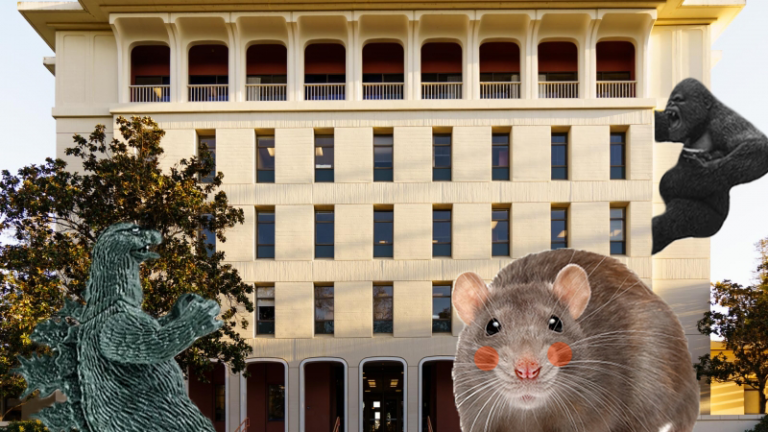
Cancer research will have to wait as UC Davis genetic students have grown tired of their usual lab work and decided to create their own animals. The whole campus has run amok with their newest creations. Sightings of rats the size of buses, turkeys that can fly and cows that can stand on two feet have been reported all over campus. While the administration is trying to do its best to control the situation, it seems as though there’s no end to these adorable and terrifying new creatures. 

But where did this collection of charismatic creatures come from? Are these spectacular specimens some sort of strange new species? And why is there a blue hedgehog that keeps eating all of my chili dogs?

“I mean, it started out just like these things always do,” said UC Davis genetics graduate student Wus Updaug. 

“Me and a couple other grad students were complaining about how we could totally make real-life versions of Pokémon. The only thing stopping us was that we aren’t allowed to use the lab equipment for personal reasons. But with the pandemic and everything else that’s happening these days, we thought we deserved our very own Pikachus, y’know? We haven’t perfected the formula yet, but we’re really close. The last rat had all the right colors, it was just the size of the MU. You want one?” Updaug said. 

Despite these cute characters’ wholesome beginnings, classes and on-campus research has been halted for the foreseeable future. A horse that seems to be permanently on fire has burned down the entire university vineyard, a lizard and a monkey-like creature were last seen fighting one another in Putah Creek and the previously mentioned rat was last sighted at the Memorial Union bus stop eating every Unitrans bus in sight. Well, all except the blue one for some reason. With the campus feeling more like an old B-side movie, who knows when campus will return to normal.

But this writer has had enough as well. Screw normal. Life hasn’t been normal my entire life. Who says students can’t learn in an environment that also includes a 30-foot-tall rat or a fox with two tails? These creatures are the pinnacle of genetic engineering and UC Davis should be proud of the remarkable strides its students have made for science and the good of all humanity. In my completely unbiased opinion, I believe that UC Davis should let all these creatures roam free no matter what and increase funding for the genetics department. Oh, and they should definitely not fine these students for any of the damages caused by their creations. Can I get my Pikachu now?
Written by: Ian Cosner — iacosner@ucdavis.edu

Despite challenges, Muslims continue to celebrate Ramadan during the pandemic

Students share their experiences handling COVID-19, being full-time students and trying to fast for over 16 hours a day

Currently, roughly 1.8 billion Muslims worldwide are celebrating their second Ramadan during a pandemic. From sunrise to sunset, practicing Muslims all over the world will not eat a single bite of food or drink a droplet of water. This year, Ramadan, the Muslim holy month, began on April 12, and will last until May 12, 2021.

Ramadan is a 30-day time period, usually the ninth month of the lunar-based Islamic calendar, where practicing and able Muslims fast from sunrise to sunset. So why do Muslims fast and how do they celebrate Ramadan?

Firstly, Ramadan is one of the five pillars of Islam and is a commandment for those Muslims who have the resources and physical ability to engage in the practice of fasting. It is also the month in which it is speculated that the Quran was revealed to the Muslim Prophet Muhammad. 

For Muslims, it is the holiest month, as Allah’s Messenger said, “When the month of Ramadan starts, the gates of heaven are opened and the gates of Hell are closed and the devils are chained.”

Omar Altamimi, a third year political science and religious studies double major, explained his views on Ramadan. 

“First and foremost it’s a commandment,” he said. “God commanded us to fast and so we do. A lot of it is about depriving yourself of materialist, worldly things and the things that aren’t spiritual.” 

Rawan Karaki, a fourth year biological sciences major, related to this belief: “To get closer to Allah is the main point of the month of Ramadan.” 

Practicing Muslims will usually wake up before sunset to have their pre-fast meal, known as suhoor, around 4:00 a.m. They will then most likely engage in the first of the five daily prayers, Fajr. 

Throughout the day, practicing Muslims will try to pray each of the five prayers, which includes Fajr, the prayer before sunrise, the afternoon prayer Dhuhr, the late afternoon prayer ‘Asr, the sunset prayer Maghrib and the final evening prayer ‘Isha. 

They will then break their fast once the specific time of the sunset has occurred, a practice known as iftar, which includes the first bite of food since sunrise and then usually a large dinner or feast. 

Those who are exempt from fasting are often those who are pregnant, have an illness, are traveling, those who menstruate and young children. 

There is some discussion regarding exactly what actions break a fast, however, the general consensus is that a fast is invalidated when one engages in any of the following: intentional eating and drinking, intentional vomiting, engaging in sexual practices between spouses and other sexual behavior. 

Many regular practices can even break a fast, such as applying make-up or nail-polish or even listening to music. A fast is also undermined when a Muslim engages in cursing, lying, gambling and practicing other sinful behaviors.

In addition, another intended effect of fasting is to bring Muslims’ faith closer to their creator and for them to empathize with the suffering of the less privileged. 

“One most basic reason is to feel with the poor even just for 30 days, because they don’t have the blessings and privileges we have,” said Cenna Abboushi, a third year neurobiology, physiology and behavior major. “When you fast, we feel that empathy. It’s good once a year to refresh your body and mind.”

Muslims celebrate Ramadan in their own subjective ways, but one common sentiment is building a sense of community and breaking fast together. 

The act of breaking fast with family and friends is one thing many Muslims have been unable to do because of COVID-19. 

“Celebrating Ramadan during the pandemic has definitely been challenging,” said Malika Haji, a second-year managerial economics major. “I’ve been doing my best to make the most of Ramadan by attending daily [virtual] meetings with other sisters in the community and reciting the Quran every night.”

Abboushi shared discontentment with the transition into celebrating Ramadan through a virtual format.

 “It’s not as much of a big celebration,” Abboushi said. “In Davis it now feels like a chore because you miss the community. With my roommates, [we] try to eat iftar together or read the Quran together. For my friends who have been vaccinated, there’s really small gatherings [we have].” 

Ramadan during a regular year is difficult, but during a pandemic it is made even more difficult, as there is such a lack of community interaction and support.

Despite continued struggles of celebrating Ramadan during a pandemic, Altamimi explained improvements this year in light of eased restrictions.

“Ramadan is definitely community-based so not being able to gather with friends and family as much as pre-COVID times really takes out an important part of this month,” he said. “But this Ramadan is better than the first pandemic Ramadan because there are now less community restrictions due to advancements with the COVID situation.”

Karaki echoed this sentiment: “Because of the pandemic there is less getting together with friends and family so Ramadan can seem a bit lonely in a way,” she said. “But I am grateful to be able to at least celebrate Ramadan with my direct family.”

In addition, there is also the added stress of being a full-time college student who is fasting during a pandemic—which can be quite a struggle. 

Since many colleges do not make official accommodations for many fasting Muslims who are also taking classes, some students say that practicing can be challenging. 

“It’s been rough trying to make time to perform religious activities when balancing school, extracurriculars, work, and a pandemic on top of it all,” Haji said.

Abboushi agreed: “Being a student, the most difficult part is fasting without being home with your family, just because when you are at home, your family is preparing meals and you go to the mosque after. I have to focus on school all the while I can’t eat. And I have to worry about having to prepare my meal, which is basically taking more time from my study time to prepare the food to break fast.”

Yet, Ramadan is also a celebration and something many Muslims look forward to, even with the loss of meals and constant dehydration. 

“[My favorite part about] Ramadan is breaking my fast with my family,” Haji said. “There’s something about Ramadan iftars that just hit different. The food we prepare at home is unmatched and I look forward to it all year.” 

Abboushi also appreciated the feeling of being connected to others and sharing a meal.

“[My] favorite part of Ramadan is the family and friend iftar parties, even if they aren’t happening this year because of COVID,” she said. “It’s the one time during the day everyone has to take a break from school or work and we all eat together. You get to see everyone and catch up on our lives and with people you haven’t talked to in a while.”

For Altamimi, spirituality is an important part of the celebration. “There’s this background of spirituality during Ramadan,” he said. “The major focus is to strengthen your relationship with God. And also the great food is a plus too.” 

Karaki explained the feeling of accomplishment that comes with completing a fast.

 “Besides being surrounded by family and friends, I would probably say that my favorite part would have to be the wonderful feeling of accomplishment you feel after you break your fast. It’s a really gratifying and humbling feeling in my opinion.” 

One major event many Muslims look forward to is the smaller celebration known as the Eid al-Fitr, which in Arabic means “the feast of breaking the fast,” which usually falls directly after the 30th day of fasting. 

For many Muslims, Ramadan is a month full of blessings, of becoming aware of one’s own privileges and abstaining from sinful behavior. According to these students, ramadan is a testament of practicing Muslims’ devotion to becoming both better human beings and becoming even closer to their God, especially as they continue their traditions in the face of a pandemic.
Written by: Muhammad Tariq — arts@theaggie.org

Yolo County District Attorney’s Office launches new criminal justice transparency portal

0

New portal provides community with access to Yolo County DA’s Office case data to increase accountability in the criminal justice system

On April 6, the Yolo County District Attorney’s (DA’s) Office launched Commons, its new criminal justice data transparency portal. The project was developed in collaboration with the nonprofit organization Measures for Justice in an effort to increase accountability. 

During the inaugural livestream for the database, Yolo County District Attorney Jeff Reisig explained that the motivation for reaching out to Measures for Justice was a continued lack of reliable data as a prosecutor.  

“I’ve been a prosecutor for 24 years and in order to have any real, meaningful, actionable conversation about criminal justice or criminal justice reform, you have to have thorough and accurate data,” Reisig said. “What’s frustrated me over my career is how difficult it’s been to get that data from all levels of government.” 

Commons enables the community to see this data for themselves, Reisig explained. 

“Commons has what people want,” Reisig said. “People in Yolo want a policy goal that the prosecutor commits to every month, assurance that the data wasn’t cooked, a monthly stream of data and the ability to filter the data.” 

Justice Fiona Maazel, the director of communications for Measures for Justice, explained that personal stories about problems within the criminal justice system need to be accompanied by data.

“Most people would agree the system needs work,” Maazel said via email. “Mostly what we hear in the news and from friends and colleagues are stories. Stories and anecdotes. Which are very powerful but not powerful enough to make a lasting change.” 

Maazel explained that this is why Measures for Justice focuses on attaching meaningful data to these powerful stories.

“Combined—stories plus data—we’re able to see the humanity and the trends and patterns attached to it that expose what’s happening in the system every day,” Maazel said via email. “Data ratify experience.”  

Although Measures for Justice just finished launching Commons in April, Maazel said that it has no plans to slow down. 

“We are expanding,” Maazel said via email. “We are already bringing Commons to markets in New York, Albuquerque and Louisiana. Since Commons launched in Yolo, we’ve been flooded with requests.” 

Maazel encouraged Yolo County residents to visit the Commons portal and provide feedback.  

“These are your data and they reflect the experiences of your community,” Maazel said via email. “Commons is all about opening up pathways for communication around a common set of facts. Most importantly, tell us what you think.” 

Tessa Smith, the chair of the Multi-Cultural Community Council (MCCC) for the Yolo County DA’s Office, explained that the MCCC became involved in the Commons project in an effort to uncover more information about the Yolo County criminal justice system.

“Information was submitted to the counsel that sparked an intense conversation that required further input,” Smith said via email. “We wanted ‘the rest of the story.’ Yolo Commons is an attempt to provide the rest of the story to our community.” 

Smith described how residents can create systemic change by looking into the data.

“When the truth (data) is at hand, the community can use it to shape a narrative that systems—in the face of facts—can not refute,” Smith said via email. “We can chart the successes of systemic issues being addressed in real time so that in challenging moments of collective angst, we can stand with a system that has shown interest, commitment and effort toward dismantling systemic issues.”  

Conversations about recent tragedies and enduring traumatic historical realities are difficult but necessary, according to Smith. 

“The truth of our American history requires that we meet in that truth and plot our way forward together—it requires a willingness to be uncomfortable together,” Smith said via email. “There are already disparities and disproportionate involvement documented for Black and Brown and First Nation groups.” 

Smith explained that in order to have meaningful change, conversations around criminal justice reform must be based on data. 

“What does it take to mitigate, reduce and address these statistical facts? That is the conversation moving forward,” Smith said via email. “Innovative approaches to systemic failures can be addressed, policy initiatives are born and reform can happen.” Written by: Yan Yan Hustis Hayes — city@theaggie.org

UC Davis partners with University Credit Union to renovate and rename Pavillion

0

The credit union will provide free membership to students, faculty, staff, alumni and retirees and oversee the addition of two new ATMs on campus

A new partnership between University Credit Union (UCU) and UC Davis will fund maintenance for the ARC Pavillion on campus and provide students, faculty, staff, alumni and retirees a free UCU membership. 

“University Credit Union will provide financial literacy, financial well-being programs, student employment opportunities as well as specialized offerings to help students achieve their educational aspirations,” said David Tuyo II, the CEO of University Credit Union.

The company intends to support all individuals affiliated with UC Davis, according to Tuyo II.

“The vision of the founding body of [UCU] member-owners was to create a financial alternative to the big for-profit banks serving all within the university community, leaving no one marginalized or outside of participation in economic prosperity,” Tuyo II said. “In 2021, we are projecting to give back an amount equal to 100% of our net income to the university community and create value for our member-owners that is 500% of the same amount.”

UCU has hired a UC Davis alumni member to serve on campus, and they are planning to hire additional students and alumni for their advisory center that will be located at the Memorial Union (MU).

The university’s choice to partner with UCU was deliberate and due to the credit union’s mission to support universities and give back to the community, according to Heather Hunter, the executive director of the university partnership program. 

“The partnership will initially support graduate student travel awards, student employment opportunities and student financial education and wellness programming,” Hunter said. “As the partnership evolves, we will work with Student Affairs to identify additional areas to support student initiatives.”

In addition to supporting student groups on campus, UCU will also offer aid to individual students.

“University Credit Union will provide free membership to our students, faculty, staff, alumni and retirees,” Hunter said. “Our campus stakeholders will have access to the great benefits that University Credit Union provides its members.”

The partnership will allow the credit union to be an accessible financial resource for students.

“Financial decisions that students make now will have an impact for years to come,” Tuyo II said. “University Credit Union will help guide students and provide the knowledge necessary so students are empowered to make the best and most well-informed decisions to accomplish their goals.”

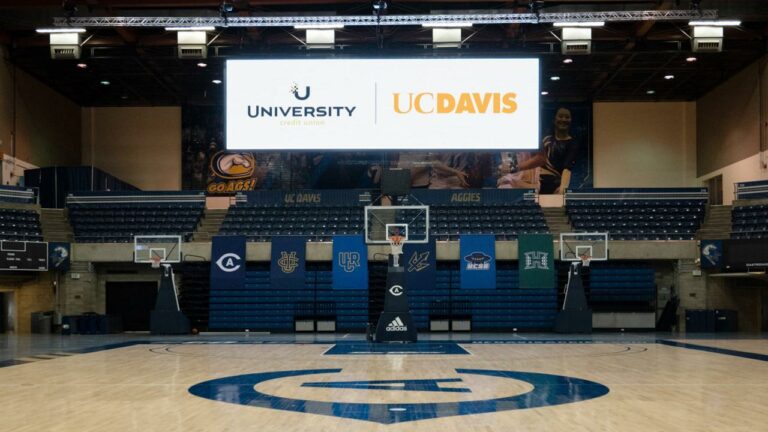
Students will also be benefitting from the partnership due to the upcoming renovation of the Pavillion. On July 1, the Pavilion will be renamed the University Credit Union Center (UCUC). This name change will be accompanied by updates to the center, notably a new video board. 

“The new Daktronics video board [is over] 13 ft high and 46 ft wide; [it] will show replays and real-time statistics,” Tuyo II said. “The videoboard can also be used for campus events throughout the academic year, in one of the largest on-campus multiuse facilities in Northern California, with seating capacity approaching 6,000 for basketball games.”

The credit union has a longstanding relationship with the University of California and the sports conferences, including the Big West, in which Davis students compete. 

“This partnership will benefit our athletics department as well as our broader campus community,” said Jim Les, the head coach for men’s basketball. “Our core values of building champions for future success align perfectly.”

In order to offer accessibility to students, the UCU will be installing two ATMs at UC Davis. Although they are still evaluating a couple of locations, they are predicted to be located in the MU and the new UCUC.

Student Affairs will be meeting with UCU annually to identify areas of need for undergraduate funding, beginning in the 2021-2022 academic year, according to Hunter. 

“This partnership between UC Davis and University Credit Union will set an example for how such a relationship can grow beyond the naming of a building, with initiatives that will benefit our whole campus,” said UC Davis Chancellor Gary May in a news release.
Written by: Maddie Duley — campus@theaggie.org