54.1 F
Davis

Davis, California

Tuesday, December 23, 2025
Home Blog Page 355

Researchers develop field test for toxic mushrooms

New diagnostic test screens for mushroom poisonings in humans, animals

Researchers from UC Davis and the United States Department of Agriculture (USDA) have developed a portable field test for detecting the presence of the toxin amanitin found in poisonous mushrooms. Eating poisonous mushrooms causes over 100 deaths per year in humans and many more in animals. This quick screening test can help doctors and veterinarians alike determine if their patients are suffering from the effects of consuming toxic mushrooms.

“For the longest time we figured dogs can be exposed to these mushrooms, but we didn’t have an assay to confirm exposure,” said Robert Poppenga, a professor of veterinary toxicology in the school of veterinary medicine. 

This new diagnostic test changes that. Dr. Candace Bever, a UC Davis graduate now working at the USDA, developed an antibody based quick-screen to test for the presence of amanitin in a urine sample. While her test looks like a pool pH strip in a little plastic rectangle, it is far from simple.

“It’s based on an antibody,” said Mike Filigenzi, an analytical chemist in the California Animal Health and Food Safety Laboratory. “An antibody is a molecule that grabs onto another molecule very specifically, like a lock and a key. In this case, her test is based on the ability of the antibody to grab onto the amanitin. She can use that to show whether it is in the mushroom or not.”

To use the test, researchers place a drop of liquid — usually a urine or tissue sample — onto the paper strip. The liquid wicks upward and reacts with antibodies embedded in the paper. If both lines are visible, the result is negative, but if one line disappears, that means the sample tests positive for aminitin. The result is easy to read and could even be used by amateur mushroom collectors as a field test. 

UC Davis researchers confirmed the accuracy of the quick test using the old-fashioned in-lab method, Filigenzi explained. 

“Our type of testing is considered a gold standard,” Filigenzi said. “It uses complex, expensive instruments and it takes time. [Bever’s] test is a few bucks and it’s very quick.”

This quick screening test has several advantages for both veterinarians and primary care doctors. It’s fast, accurate and cheap. While it is not yet available to the public, there are plans to commercialize the test and make it widely available for hospitals, vet clinics and, potentially, amateur mushroom foragers. In hospitals, the test could expedite treatment for serious cases of poisoning.

“The first sign of poisoning is vomiting and diarrhea,” Poppenga said. “After that, the patient seems to recover, but then they get sick from the liver damage. The physician can test urine for the toxin very quickly to rule in or out exposure without having to ship it to a lab like ours for testing.”

People tend to brush off these symptoms as food poisoning, but even after they subside, the toxin filters through the liver and can cause even greater damage and death. In serious cases, the only treatment is a liver transplant.

“Medical personnel may not be able to identify a mushroom by sight,” said Mike Davis, a retired professor of plant pathology and author of Field Guide to Mushrooms of Western North America. “A test makes it possible for a non-mycologist to rule out mushrooms with that toxin.”

If a dog shows signs of liver problems that are characteristic of amanitin poisoning, veterinarians can now use this test to get a positive or negative result in minutes.

“We collaborate with an emergency veterinary clinic in Marin County,” Poppenga said. “When they have a suspicious case, they send us the samples. Typically, we can get results back to them in about half a day. The nice thing about that is that the pet owner can decide whether to pursue treatment quickly.”

If the test becomes commercially available, the time to diagnosis may decrease even more drastically as vets can perform these screenings on-site without a full lab test.

In addition to its medical applications, the test could also be of interest to amateur mushroom foragers. With the right experience, the mushroom collector could test fungi for aminitin in the field. A negative result, however, does not mean the mushroom is edible. This test in particular checks for the presence of the chemical compound aminitin, so a mushroom may still contain other toxins that cannot be detected.

The rule of thumb with mushrooms in the wild is to not eat them at all. While this seems straightforward, there are still many cases of poisoning every year in humans.

“One of the issues is that, in Southeast Asia, there is a type of mushroom that is edible and very delicious that looks very much like one of the toxic mushrooms here,” Filigenzi said. “People who immigrate over from areas where those mushrooms are common will collect toxic mushrooms not knowing what they’re getting is deadly. There have been a number of poisonings based on this scenario.”

So, while that death cap mushroom may look appetizing, think twice before touching it. 

“These are pretty nasty mushrooms,” Filigenzi said. “Don’t eat them.”

Written by: Lauren Glevanik — science@theaggie.org

Jews & baseball: A Love Story

Assimilation through America’s favorite pastime   

It was a bit of a long ride to the field, taking the better part of half an hour. When we got there, the smell of hops and yeast coated the field like a veil, courtesy of the Anchor Steam brewery across the street. The grass was deep green and the fog cleared, exposing a blue, cloudless sky. The man up to bat was large in stature and swung the stick like Thor’s hammer, thunder crackling as wood met leather. It was a line drive to me, the third baseman. My brain did a thousand tiny calculations. I stopped it, threw to second, got the force out and smiled. I never liked sports, but I sure as hell loved baseball. 

  The story of the American Jew is the tale of a constant struggle to assimilate, a perpetual othering while trying to accept whatever external culture comes your way. It makes sense, then, that there has been a long and storied history of the Jew in America’s favorite pastime: baseball. Speaking as a Jew myself, one of almost self-parodying levels, I have always seen the sport as a way to better understand the culture which I was born in and one the rest of my family has tried deeply to weave themselves into. 

The first presence of Jews in baseball was during the ownership of Negro League teams in the 1920s — both members of the tribe and Black individuals were not permitted in the entirely White national baseball leagues, and the relationship they fostered became fairly symbiotic. With promotion from their Jewish benefactors, players in the Negro League achieved far reaching fame and better oppurtunities to play. The two groups relied on each other and worked together to operate in a system that rejected both of them. 

In addition, the relationship between the Black and Jewish communities ran even deeper, especially when examining baseball legend Jackie Robinson. Much has been written about what Robinson did for baseball — most prominently the shift within Major League Baseball to eliminate race restrictions. Hank Greenberg, one of the first Jewish baseball greats, once collided with Robinson at first base during one of these groundbreaking games. What followed was a sheepish smile, with Greenberg whispering into Robinson’s ear, telling him that if he wanted to overcome his critics, he had to beat them in the beautiful game. Although narratives in sports are often dramatized in history, it seems like there was genuine support between Black and Jewish players, a direct result of their position in the sport. 

There’s an old line my Semitic friends and I toss around whenever we get together: “It’s up to interpretation!” Born from a beginner’s Torah study class as a response to try to justify not understanding the text, we now say the line whenever we take the wrong exit or a waiter brings us something we didn’t order.

This is all to say that the flexibility of our central text is paramount to the Jewish experience. When speaking of baseball as a form of assimilation, this is particularly important.

In 1934, Hank Greenberg was one of the crown jewels of the Detroit Tigers, and the question of whether he was going to play on Rosh Hashanah, one of the holiest Jewish holidays, was central to many people both on and off the team. After meeting with a rabbi, Greenberg decided that it was fine, as the Torah does not technically forbid playing games on that day. Greenberg went on to win the pennant, and Americans began to rethink their opinion of Jews, rolling back some of their prejudices. 

There are some things, however, that are very much set in stone. Thirty years later, at the first game of the 1965 World Series, Sandy Koufax abstained from playing. With people wondering what was going on, Rabbi Bernard Raskas of Temple of Aaron in St. Paul, sternly notified the public that everything was fine. Koufax was in the aforementioned synagogue, attending services. It was, after all, the first day of Yom Kippur.  

It was a moment of pride for all American Jews, from the sunny sidewalks of Los Angeles to the smelly yet endearing subway of New York City. The fans, however, were a different story. The Los Angeles Dodgers, Koufax’s team, lost 2-0. The first game is often symbolic of the whole series but not always so. After losing a second time, they came back with a solid three-game sweep. Spirits were high. Koufax was looking sharp, but not sharp enough it seemed — the opposing Minnesota Twins clinched game six. Initiating a seventh meeting, the Dodgers, led by the southpaw pitching of Koufax, overcame the odds with a 2-0 victory. After this moment, Koufax was universally admired, and in 1965, the American Jew cemented a place in baseball history. 

This isn’t to say there isn’t a Jewish presence in baseball today. The process of assimilation has run its course in many ways, with affectionate nicknames like “Hebrew Hammer” entering the sport’s lexicon. Ryan Braun, the Milwaukee Brewers’ left fielder, is perhaps the most well-known, along with Alex Bregman and Ian Kinsler from the Houston Astros and San Diego Padres, respectively. These guys, especially Braun, live up to the greats in many ways, compared to the likes of other Jewish all-stars like Al Rosen and Cal Abrams.

“It’s weird to me that there haven’t been more successful Jews in baseball right now, especially when you consider that many of them live in Los Angeles or New York,” said Ryan Cohen, a second-year communication major. 

He went on to mention past legends. 

“My family absolutely idolizes [Sandy] Koufax because he would never pitch on Yom Kippur,” Cohen said. 

In many ways, there seems to be a reverence for the past. Past or present, for many, the Jewish presence in baseball brought a form of salvation, however small. 

“In terms of sports, baseball was one of the few with big Jewish players, with the most idols to look up to, in a way,” said Noah Bennett, a recent graduate who studied environmental science and management. “It was so insane that people who have looked at us as weak or unathletic were suddenly rooting for us.” 

Bennett spoke seriously, but paused for a laugh midway through our conversation. 

“It was just good to see that,” Bennett said.  

I stopped playing baseball after high school, content to throw around a ball with friends on the beach or at the park. I don’t watch games on television either — they don’t come anywhere near the excitement of being at a stadium, with a large order of Gilroy garlic fries, begging the concierge to let me onto the Coca-Cola slide. I follow the sport, but in a lot of ways, I look at baseball as a compass, one that was invaluable in helping me navigate a culture that was not my own. I’m sure for many Jewish players, professional or not, it is much the same. 

Written by: Ilya Shrayber — arts@theaggie.org

Entitled commentary culture is taking over our online feeds

Twitter’s “Fleets” will exacerbate our culture of entitlement — and they’re stupid 

Twitter’s newest feature — “Fleets” — will allow users to post their most fleeting thoughts and opinions, designed to vanish in 24 hours. Twitter claims that the new Fleet feature is a response to users complaining that they don’t feel comfortable tweeting because tweets can be seen and replied to by anybody. That’s the same thought process behind Instagram and Snapchat stories, which seem to be so profitable that Facebook is now prioritizing stories on their Messenger app and Instagram. These features give users the ability to post temporary opinions and are only making it easier for us to have weaker opinions. 

Our culture is becoming increasingly entitled. We criticize and hate when shows don’t end our way or when a free agent signs with a different team. On Twitter, this culture seems to fester as a form of easy expression for our least thought-out stances and takes.

I recognize that it’s ironic that I am hating on opinions in an opinion piece. The difference in long form opinion is that it necessitates development and thought — not just the emotion and angst behind a tweet to garner a reaction, but an opinion designed to provoke thought. Entitlement on social media is often aimed toward just being heard, as opposed to facilitating productive discussion. 

You can put thought into your tweets and create a massive thread, but the platform is inherently reduced to reaction and disappearing commentary. 

Twitter was created as a platform for users to share their thoughts and whatever else it is they want to share, but that doesn’t mean any of us actually want to read it. Opinions matter, but only when they are thought out and especially when they are backed by research and understanding. And those types of opinions are far more exciting to engage with, too — they can go further than just reverting to a lazy, ad hominem attack. Informed opinions make for better discussions and better online culture. 

The loudest opinions are often the most extreme opinions, simply because they garner the largest reactions. This vocal minority is filling in for what the majority of users actually think and stand for. These are the opinions we should be ignoring. We should reward those who go the extra mile to make thought-out arguments, because with the ever-increasing number of opinions online, yours are getting less and less valuable. 

At the Consumer Electronic Show in 2017, Twitter’s Chief Marketing Officer Leslie Berland called Twitter a “platform, a product, a service, a water cooler, a time square, a microphone.” She’s right, Twitter is a tool that can be utilized for any purpose. But right now, it is lazily used by many, with no added value or substance. 

Twitter’s recent proclamation to prioritize accurate news, however, transitions away from this lethargic utilization of the platform for the better. Discussions built on fact are the ones that matter. We only have 280 characters to get our point across — let’s not waste them. 

Twitter doesn’t have to be used just for fleeting opinions. The platform has been used for networked activism and protests across the world. Using Twitter as a digital tool for organizing and publicity was vital in the Egyptian revolution of 2011. The number one Twitter hashtag in 2011 was “#Egypt” instead of some pointless American trend. 

Even with national politics, Twitter doesn’t provide a representation of what the majority of voters think. Most people are not actively discussing politics online — a lesson we should have learned from the 2016 election, Brexit and so on. The uproar and outcry online leads to echo chambers that see no other way than their own. The perspectives we see on the platform are just a microcosm of who we choose to follow. 

So what should we do if our opinion doesn’t really matter online? We need to understand that Twitter and all other social media are not genuine representations of the reality around us. That is the only way we will be less entitled in our opinions and stay out of shouting wars, name calling and stubbornness. 

In-depth conversations that are based on reality are what these platforms could and should be providing.

Yes, distractions are necessary — but not in abundance. If we want to have a better online experience, we need to change that for ourselves. These companies are only going to make changes that generate revenue for their shareholders, not to create a better culture. Cultivating a better environment is on all of us.

Written by: Calvin Coffee — cscoffee@ucdavis.edu

Disclaimer: The views and opinions expressed by individual columnists belong to the columnists alone and do not necessarily indicate the views and opinions held by The California Aggie

Valley Clean Energy enters into long-term contract for 50 megawatts of solar power

The agreement with Aquamarine Westside, LLC will help Valley Clean Energy reach its goal of 75% renewable energy by 2020

Valley Clean Energy, the local electricity provider for Davis, entered a 15-year contract with a solar park in Kings County to provide more renewable energy to Yolo County. Once commercial operation begins in late 2021, the solar project will supply 50 megawatts of renewable energy to Davis, Woodland and unincorporated areas of Yolo County. 

This contract marks a significant change in the way the relatively new electricity provider has purchased energy. Valley Clean Energy, founded in 2018, had only entered into short-term energy contracts which can range from a few years to seasonal purchases. Gordon Samuel, the assistant general manager of Valley Clean Energy and director of Power Resources, explained the financial benefits of a long-term contract.

“This is going to help us in that we will be procuring competitively priced long-term clean energy,” Samuel said. “The nice thing about it is that it’s all from renewables and it’s stably priced, so we’re not going up and down as the market fluctuates.”

When completed, the Aquamarine solar project will be a part of Westlands Solar Park in Kings County, which is led by the real estate investment firm, CIM Group, LLC. In a press release published by CIM, the company explains that the contract between Valley Clean Energy and Aquamarine Westside, LLC will be the start of the construction of the solar park. 

“The first phase of CIM’s development at Westlands Solar Park includes Aquamarine, a 250-megawatt solar photovoltaic project, which has obtained all entitlement and conditional use approvals following a full environmental impact review,” the press release read.

The company also described the potential production power of a fully operational Westlands Solar Park. 

“[Westlands Solar Park is] one of the largest permitted solar parks in the world that could grow to more than 2,700 megawatts (2.7 gigawatts) of renewable energy potential at full buildout, which could provide clean energy to more than 1,200,000 homes,” the press release read. 

During a competitive bidding process, Valley Clean Energy chose the Aquamarine project for more reasons than just its competitive pricing, like its comparatively local source. Samuel claims that environmental factors also influenced the electricity provider’s decision.

“It checked a lot of the other environmental boxes as well,” Samuel said. “It does not have any impact on environmentally protected species. The land use is not prime agricultural land, so it had additional benefits that we put value on.”

Jim Parks, the director of customer care and marketing for Valley Clean Energy, explained that the site of Westlands Solar Park used to be farmland but no longer has optimal farming conditions. 

“In this particular property, there was some salt intrusion that made the land a poor choice for agriculture and actually a good choice for solar panels,” Parks said. “You’ve got some land that is damaged in some way, and you can put solar panels on there and get some great benefits out of it.”

Once the project enters commercial operation, it will begin a shift toward solar power for Valley Clean Energy, which sourced 48% of its energy from wind renewables and 37% from large hydropower in 2018. Though a valuable renewable resource, solar energy has challenges of its own. 

Parks described how large-scale battery storage can help in the daily challenge of solar energy: when the sun sets. 

“There’s a big peak when solar begins to shut-off,” Parks said. “Suddenly, everyone’s turning on their air conditioning and increasing their electrical loads and then there’s no more solar generation. Those are the times when you want the storage to kick in to reduce that need.”

Ultimately, this contract will help Valley Clean Energy work towards its goal of 75% renewable energy by 2022. Eventually, Valley Clean Energy hopes to obtain all its energy from carbon-free sources. 

Besides the positive environmental impacts, this contract will lead to economic effects, as the Westlands Solar Park will, “contribute to economic development in Central Valley communities by diversifying the region beyond agriculture and create a substantial number of clean energy jobs,” according to the CIM press release. Parks says this economic growth is initiated through these contracts. 

“It’s contracts like ours that facilitate construction of plants like this,” Parks said. “They get the contract, they go, ‘Okay, we need to produce this energy by this amount of time,’ and it gets the construction process going.”

Written by: Madeleine Payne — city@theaggie.org 

Recreational axe-throwing business coming to Davis

Smart Axe will expand to Davis with plans to start UC Davis student axe-throwing leagues

Smart Axe, a recreational axe-throwing business which originated in Rancho Cordova, plans to open a location in Davis in the next three to four months. 

Doug Link, the CEO and co-owner of Smart Axe, along with partners Mark S. Allen, Jim Corbett and Mike Lispon, described his plans for Smart Axe to become part of the UC Davis community.

“We’re going to focus on getting in with the college students, building leagues that are inter-fraternity, sorority and club,” Link said. “We want to build our league there in Davis and focus on the college students.”

Brandon Bui, a first-year political science major and a member of the Sigma Chi fraternity, agreed that some fraternity members would most likely want to participate in a league.

“We already have brothers who like to throw axes, so I’m sure there would be a lot of interest,” Bui said.

Members from Phi Delta Theta echoed a similar response — Logan Winston, a fourth-year chemical physics major, was not sure if any members already throw axes, but he said members would likely participate. 

“We have people in our fraternity who are part of a bunch of different clubs, so we’re a pretty diverse group,” Winston said. “I’m sure some people would be part of it.”

Phi Delta Theta member Kent Cassidy, a third-year computer engineering major, was interested in joining himself.

“Axe-throwing is bad-ss, and I want to be a part of it,” Cassidy said, slamming his fist enthusiastically on the table. “I did it once before and it was cool, but in a competition environment — I think I’d have a lot of fun with that.”

Cassidy’s enthusiasm supported Link’s belief that younger people want physical, unique experiences. 

“I think this generation is always looking for some kind of out-of-home, fun activity,” Link said. “They don’t do a lot of camping, so axe-throwing just kind of fits. You come and enjoy it — an outdoor-feeling experience — but it’s a safe, indoor activity.”

Not all students are completely sold on the idea. Erolina Kamburova, a first-year theatre and dance major, said while she would join friends to throw axes, it wouldn’t be her first choice of activity.

“I guess I would go, but I would say plate shattering is more up my alley if I were to do something physical to relieve stress,” Kamburova said. “I think if a group of my friends was going I would say, ‘Yeah, sure,’ but I don’t think it would ever be my idea to go.”

Kamburova added that she couldn’t see herself joining a league, saying that her schedule is already busy enough.

For 75 minutes of axe-throwing, Smart Axe will charge the general public approximately $20, according to Link. There will most likely be a discount, however, for students and leagues.

Everyone in the Smart Axe facility will be required to sign a waiver. Link explained that axe-throwing can be dangerous, but Smart Axe takes precautions to prevent any injuries.

“Axe-throwing is inherently a dangerous activity, but we on-board every single person with a safety briefing,” Link said. “We have an ‘axe-pert’ who monitors you at all times.”

Link emphasized his excitement over bringing Smart Axe to Davis and making his business an important part of the city. 

“We’re really looking forward to Davis,” Link said. “We think it’s a great market — this is something unlike anything else down there. We’re looking forward to becoming a cherished community aspect.”

Written by: Eden Winniford –– city@theaggie.org

In light of new initiative, what do the Principles of Community mean to UC Davis?

Following 30th Principles of Community week, a look into university’s “four words campaign”

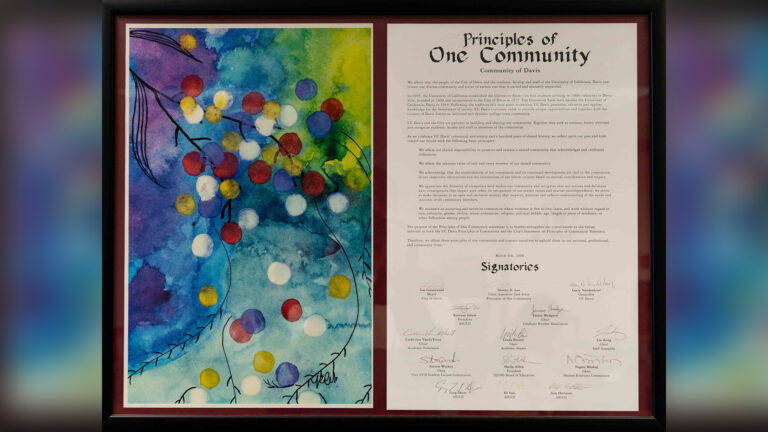
For the past 30 years, the UC Davis campus community has aimed to stand by its Principles of Community, but have students noticed? The week of February 23rd was Principles of Community week ー where faculty and students celebrated the Principles of Community and workshopped how to better apply them to the community. Held at both the UC Davis campus and the university’s health campus in Sacramento, the week of the celebration included various speakers addressing topics such as microresistance, freedom of expression and disability resources.

The California Aggie asked random students on campus: “Do you know what the Principles of Community are?” And among those randomly asked, most said no. One student, who understood the aspirational purposes of the Principles of Community, said that to him they are “kind of bulls–t.”

The Principles of Community have existed for almost exactly 30 years, and students are told about them during orientation, when applying for any job in ASUCD or even sometimes when joining an extracurricular organization. So why don’t more students know what the Principles of Community are? 

“The Principles of Community are aspirations, not policy,” said Mikael Villalobos, associate chief diversity officer in the Office for Diversity, Equity and Inclusion. “[They] were made in response to the reality that we were growing as a campus community, and that we were going to experience demographic shifts.” 

Villalobos was one of the many students 30 years ago who took part in the discussion to create the Principles of Community. But the Principles of Community are not just aspirations alone. 

“The Principles themselves are connected to […] several [university] policies,” said Vice Chancellor of Diversity, Equity, and Inclusion Renetta Tull — meaning that some of the aspects of the Principles of Community can be enforced by university policy, but not everything in the Principles of Community is tied to policy. 

“The university will forever challenge to reach the aspirations of what the Principles promise to be,” Villalobos said. 

With each new year, as the community continues to grow, steps are being taken to further spread the Principles of Community. 

“It seems to be reaffirmed every five to six years or so,” Tull said of the Principles of Community. “[New students] are able to see that [the Principles of Community] are something that we hold on to, something that we refer to.” 

The administration is taking new steps to spread the Principles of Community to students through a campaign called the “Four Words.” The focus of the campaign is to highlight the four words in the Principles of Community that are most important to the campus — the four words chosen will “embody what we feel the Principles of Community mean now,” Tull said. 

“I think that having something that’s distilled down to something that people can remember very easily is going to be very important when we talk about what our core values are,” she explained. 

The campaign is still in the planning phase, but it will include a social media campaign with “posters, laptop stickers” as well as an effort to highlight the Principles of Community at certain campus events, such as orientation and Picnic Day.

“The hope is that, by September, by the time Fall Quarter starts in 2020, people will have a firm grasp on the four words that are part of the Principles of Community,” Tull said. 

Despite these efforts, the Principles of Community might not always be upheld. In the past two years, the university has been accused of bias against low-income students and ethnic and racial minorities. 

“We will fail, but it doesn’t mean that we don’t make meaningful dents in making sure that our campus community continues, or strives to be, as welcoming as it could be,” Villalobos said. “That’s the beauty, and also the challenge of the Principles of Community.”

Written by: Alex Weinstein — campus@theaggie.org

What is the Constitutional Cleanup Amendment?

Future ASUCD Winter Elections moved to Spring Quarter

The results of the 2020 ASUCD Winter Elections celebrated sweeping victory for the extensively campaigned Basic Needs and Services Referendum. But Senate Bill 31 was not on the ballot alone — the Constitutional Cleanup Amendment, CA 67, was listed beneath SB 31.

The reforms addressed in the Constitutional Cleanup Amendment, however, are significant. The amendment intends to: “Further define the position of External Affairs Vice President (EAVP), shifting the timing of ASUCD Elections, institutionalization of binding 10-year plans, clarification of processes for Special Elections, and transitioning successors through an online file storage system.” 

EAVP reform

According to ASUCD President Justin Hurst, the description for the EAVP role was not previously outlined in the constitution. 

Hurst said the EAVP “is a position that is analogous with other campuses.” The UC Student Association is composed of all UC campus’ EAVPs, and Hurst noted now the association is “along with all the other UC’s.” Hurst clarified that EAVP is not a new position, rather, its definition was simply missing in the Constitution until now. 

Elections reform

In response to shifting ASUCD elections from Winter Quarter to Spring Quarter, Hurst explained that the change will not be implemented this Spring Quarter, but rather starting in Spring Quarter 2021. Therefore, newly elected officials will serve for an extra quarter, with the exception of the EAVP, whose election will remain in the fall. 

Newly elected Student Advocate Ashley Lo commented on moving the elections. times. 

“All the other UC’s, in their associated student bodies, […] have elections in Spring Quarter,” Lo said. “We’re the only one who does it during Winter Quarter.”

Both Hurst and Lo noted that when Hurst was sworn in, he attended UC-wide meetings as a brand new president, while other members in attendance were at the end of their terms.

“The presidents of all the UC Associated Students meet up regularly, and oftentimes it can be difficult when we have different people terming in at different times,” Lo said. “It can create a disconnect in communication when there are people with different experiences because they are at different parts of their terms.”

Institutional memory reform

Moving elections to Spring Quarter coincides with another item listed with the amendment reforms: creating an online transitioning member file storage system. 

“ASUCD has a historical problem with transition and institutional memory,” Hurst explained. “This was an effort to have online resources so people aren’t starting from scratch.”

Hurst and Lo commented on their own difficult experiences transitioning into their roles, and how they hope the revised constitution will prevent miscommunication in the future.

Hurst noted that he only had one transitional meeting with his predecessor. His first month as ASUCD president was confusing and exhausting, considering ASUCD’s budget deficit and incompatible term schedule with the rest of the UC campuses. 

Lo encountered similar difficulties in her transition into her role as Internal Affairs Commissioner when, as a freshman, the chair of her commission suddenly resigned.

“There was someone on my commission who was a junior, so he took over his chair, [but] then, about four weeks into his term, he let us know he could no longer continue because he was leaving to study abroad,” Lo said. “It was certainly a very sudden transition. Since he was leaving to study abroad, he couldn’t be too much of a resource. I would have appreciated more resources and knowledge about the role — what it entails — along with some of just the small details.”

Lo referred to the online file transition system as “Guidelines for institutional memory sake; a resource to know what the role has been, what it is now, and how I can improve it.”

Institutionalization of 10-year plan, special election reform

The last two items on the amendment background included “clarifying the processes for special elections,” and “institutionalization of binding 10-year plans.” Hurst noted that these two items go hand in hand with each other as we see the effects of the amendment play out.

“[The 10-year-plan] was very much a plan B for if the fee referendum didn’t pass, having a more experienced executive team working on the budget,” Hurst explained. “In the 10-year-plan, we included a lot of transition and institutional memory. In particular, one of the things we implemented was a shared Google drive between ASUCD.” 

Given that CA 67 passed, Hurst predicts that there will be a special election regarding constitutional measures and the 10-year-plan in the spring. 

“Even though special elections were heavily explicit in the constitution with the wording, it was not explicitly defined as something ASUCD could do,” Hurst said. “By making it explicit and putting it in the constitution, there’s no legality question about whether a special election is to be called by the Senate.”

The constitutional amendment simply unifies ASUCD’s term calendar and governmental practices with the entire UC Associated Students to ensure effective communication and successful transitioning. In addition, it recognizes ASUCD’s functions in official wording.

Hurst explains, “[CA 67] brings our current practices into line with the Constitution.”

Written by: Hannah Blome — features@theaggie.org 

UC Davis is a ‘top producer’ of U.S. Fulbright Scholars

Seven scholars are recipients of prestigious award celebrating global perspectives

The Chronicle of Higher Education announced that UC Davis is a “top producer” of Fulbright U.S. Scholars for the 2019-20 academic school year. 

UC Davis is ranked fifth under the “doctoral institutions” category, tied with schools like Texas A&M University at College Station, UC Berkeley, University of Michigan at Ann Arbor and Washington State University. Categories are determined by the Carnegie Classification of Institutions of Higher Education. 

“Being a ‘top producer’ of Fulbright Scholars demonstrates our commitment to advancing the university’s mission through global engagements and partnerships,” said Assistant Director for the Global Professional Programs Jennie Konsella-Norene via email. 

UC Davis has produced seven Fulbright U.S. Scholars for 2019-20. 

These scholars include David Corina, a professor of the Department of Linguistics; Steven Fennimore, a cooperative extension specialist in the Department of Plant Sciences; Brianne Holden, a Study Abroad program coordinator and advisor through UC Davis Global Affairs; Carson Jeffres, a staff research associate from the Center for Watershed Sciences; Naomi Martisius, a research associate with the Department of Anthropology; Scott Palmer, an advisor with the Undergraduate and Prestigious Scholarships; and Richard Sayler, a graduate student with the Department of Chemistry, according to the UC Davis website

“Fulbright is a very well known, prestigious international exchange program,” Konsella-Norene said. “Therefore receiving a Fulbright award is quite an accomplishment.” 

According to the Fulbright website, the Fulbright Program was created to “increase mutual understanding between people of the United States and people of other countries.” Funding for this program comes from an appropriation made by the U.S. Congress allocated to the U.S. Department of State’s Bureau of Educational and Cultural Affairs. 

“UC Davis faculty who travel abroad on Fulbright U.S. Scholar Program awards gain important global perspectives and experience, which they bring back to UC Davis and to their teaching, research, and international partnerships,” Konsella-Norene said. “They also forge new ties with researchers and universities worldwide and share their knowledge and expertise.” 

The Fulbright U.S. Scholar Program only offers approximately 470 teaching, research or both teaching and research awards in over 125 countries, according to the Fulbright website.

Applicants are evaluated based on the following review criteria: applicant training, background and experience; quality of project; the project’s potential impact, outcomes and benefits; personal qualities; previous Fulbright awards’; veteran status and diversity and geographic distribution. 

“The Fulbright Program continues to be an integral part of UC Davis’ and Global Affairs’ efforts to strengthen and enhance our international leadership, education, and research collaborations,” Konsella-Norene said. “We pride ourselves on welcoming the world to campus and connecting campus with the world, and the Fulbright Program has tremendous opportunities to do just that.” 

UC Davis was previously announced as a Fulbright U.S. Student Top Producer for the 2018-19 academic school year. 

Every year, faculty who are interested in pursuing Fulbright awards abroad are given the opportunity to attend a workshop hosted by a Fulbright Program representative invited by UC Davis. Help with navigating the award catalog and support with the application process is provided by the campus liaisons. 

“We also engage with our Fulbright community and continually look for ways to promote their stories of impact, working closely with our communications team to highlight some of the amazing collaborations that have resulted from UC Davis connections with the Fulbright Program and to help amplify the experiences of our Fulbrighters,” Konsella-Norene said. 

Written by: Aarya Gupta — campus@theaggie.org

Commentary: Are we in a simulation?

Everything, nothing is real 

Since the dawn of artificial intelligence (AI), theories about the nature of our existence tend to  credit some greater power — human or otherwise — with the creation of our artificial reality. This concept sounds absurd to most, but there are believers, and they make some fair points. 

There are different hypotheses that explain the formation of our supposed simulation. Some believe AI gained self awareness, took out humanity and created this world to keep us at bay, making us, too, AI. Others believe we’re simply living in a computer generated reality, not necessarily created with malicious intent. It could be that humans produced us for research to better the human race. These ideas are explored in academia and the media alike. 

With the creation of increasingly more advanced technological systems, these questions become more relevant. Is it possible to construct consciousness? If so, should we be worried that those systems out-conscious, or out-human, us, potentially taking over the world we’ve created? Did we even create this world? Do we even have a say over our own lives? 

There’s a jump in logic there — perhaps justifying why most of us don’t believe the simulation theory. But there are also those who don’t believe that our level of complexity and intelligence was purely created by nature. It’s not so bizarre of a concern when you think about it. Why are we so much higher up on the ladder than the rest of our fellow animals on Earth? There are solid scientific theories for how we became the highly sentient and intelligent species that we are, most of which are believable. But we are still theorizing, so what’s to say one theory is more plausible than the next?

Well, for starters: evidence. There is countless scientific data that argues we started out as cells, growing and forming and reforming until we were two-footed, fire starting cavepeople, and of course, we quickly excelled from there. This, along with the fact that we are all experiencing a pretty convincing version of life, wherein physical sensation and free will seem awfully real. 

There are those moments, though, that trip us up. Some may call them coincidences, but to others, it’s a “glitch in the simulation.” For Cole Creedon, a second-year design and cognitive science double major, these coincidences are too precise to just be a random, perfect alignment in time and space. 

“My roommate and I met randomly after he slept through his orientation group,” Creedon said. “We learned we had super similar experiences growing up, similar interests and dislikes. Oftentimes we can communicate stuff without even saying anything. I think we are similar lines of code.”

This is a situation we’ve all encountered. Maybe not so spot-on, but most of us have at least heard of those two people who have a mysteriously similar past, or have personalities so alike that you’d think they were twins if you heard them speak. Why does this happen? It could be that there’s some overlap in experience or type of person. But the odds that they come into contact with each other? That seems slim. And yet, it happens. So maybe there’s an alternative explanation. Maybe when they, whoever they are, coded us, they slipped up or got lazy and replicated a little too much code among us, resulting in all these “coincidences” we come across. 

Another viewpoint is that the simulation is at least a possibility. Henry Kavanaugh, a second-year design major, explains why it can’t be totally ruled out.

“I just think that humans have only been alive for a short amount of time, and we’ve already started creating these crazy virtual realities that are getting so close to mimicking real life,” Kavanaugh said. “It’s impossible to rule out being in a simulation because we already have second worlds that are so similar. It just seems eerie.”

This idea was originally put forth by Nick Bostrom’s simulation hypothesis, which argues the same idea: High computing power is in the foreseeable future, and it’s fair to assume that future generations will use it to create simulations in order to observe their forebears. Elon Musk also backs this concept, along with Bostrom’s proposal that superintelligent AI may be a threat to humanity.

It’s definitely worth a thought. If we are on our way to creating something that looks like this life, then the idea of other beings constructing our world seems a lot more plausible. 

The idea of a simulation is also rationalized when compared to other existential belief systems humans have drafted. Think about religion, specifically Abrahamic faiths. There’s a man in the sky who came along to create life. He made some statements, snapped his fingers and voila, the seas, the trees and all nine million animals appeared on Earth. There is less logic behind that than the simulation theory, and yet half the world’s population is convinced it’s true. 

There’s a fine line between creative and crazy, and this theory walks it perfectly. On the one hand, it’s an interesting thought experiment, one into which you can delve pretty deeply. There are several existential questions that are readily answered by the fact that nothing is real,  that we are living in a game of sorts. On the other hand, this appears to be my life, and I’d like to think it’s more than just a game. 

It doesn’t make any sense that this wouldn’t be real, but this raises the  question, what does real even mean? Can life be real, without truly being real? That is to say, could my experience of this simulation feel real to me (and is that enough), despite it potentially being a series of algorithms of which I am merely unaware?

There is clearly no definitive way to know how real our existence is. Many have posited ideas that question the reality we believe that we understand. That sounds a little vague, because it is. No one really knows why we’re here or what we’re doing, which is arguably why these radical ideas are thought up: to give us some reason for existing. 

In my opinion, what’s real is my experience of life, regardless of its origins. If some greater being is controlling my life, or if I’m really just an algorithmic machine following a set of rules, it’s all the same to me. As far as I’m concerned, I chose to wear a green sweater today, and my deep love for french fries is completely genuine and specific to my personality. But maybe I was just coded to say this for you, and as I write it’s not me who’s controlling my fingers but someone or something else who wants to make sure we never find out that —

Written by: Allie Bailey — arts@theaggie.org

The second woman at UC Davis Veterinary School shares her path to education

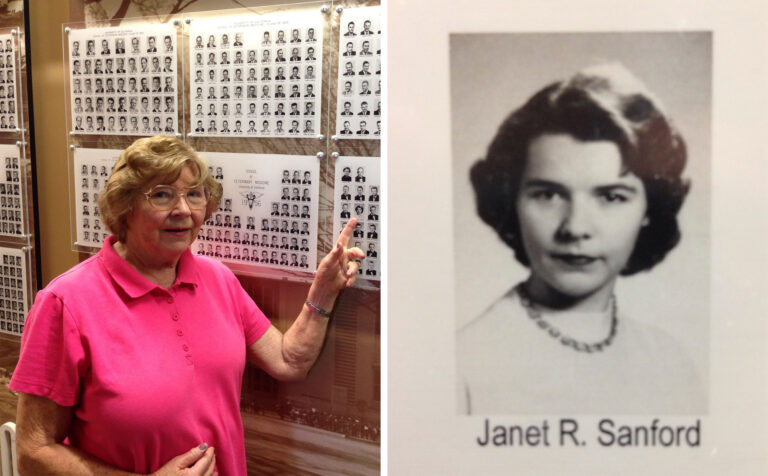
Janet Sanford speaks about her experience as the second woman admitted to UC Davis School of Veterinary Medicine 

The California Aggie spoke to Janet Sanford about her experience for women’s history month. Our HERstory series will continue throughout the month of March. 

In a class of 45 students, Janet Sanford was the second of two women to be admitted to the School of Veterinary Medicine at UC Davis. The school opened its doors to women in the 1950s, and Sanford graduated in 1957. Her admittance paved the way for future women to pursue a career in veterinary medicine. Since the 50s, women have even surpassed the number of men in the industry, according to the American Veterinary Medical Association. At UC Davis, the veterinary school class of 2023 is overwhelmingly made up of women. 

“We did something right since it’s 80% women now,” Sanford said.

Horse girl at heart

Growing up in South Wales, Sanford discovered her love of animals at a young age.

“I started wanting to be a veterinarian when I was six,” Sanford said. “Then I met my first pony and got into horses.”

Her work with horses inspired her to pursue study in veterinary medicine when she finally settled in California with her family.

“I had started out wanting to take care of horses,” Sanford said. “One of the good things when I got [to Davis], because I was horse-crazy, was a very nice man in the horse barn. I had a horse given to me to take care of.”

Despite being initially inspired by her love of horses, Sanford’s ultimate career path involved smaller animals. She recalled a time she cared for a dog who had been bitten by a snake. 

 “I married my husband who liked small animals, and I have loved small animals ever since,” Sanford said.

Today, Sanford still loves looking after animals, both big and small. 

“My passion for horses has gone on to this day,” Sanford said. “I have just lost my saddle horse, but I’m 87 years old [so] that was probably a good thing.”

Differences in Davis

In addition to the increase in women’s attendance, UC Davis today is different in other ways, according to Sanford.

“To see the changes, it’s incredible,” Sanford said. “The size of the campus, now it’s amazing and has so many good programs.”

When Sanford attended Davis, the campus was significantly smaller and more rural; she even lived in a farmhouse for part of her time at school.

“There was only North and South Hall when I was there,” Sanford said.

Fighting stereotypes

As a young woman, when sharing her future goals with others, Sanford often received negative feedback.

“My local vet who took care of my animals said, ‘Oh that’s ridiculous, they don’t take women,’” Sanford said. “I said, ‘Well it’s time they did.’”

When applying, Sanford faced opposition from within the veterinary school.

“The first dean, he had old-fashioned ideas, but I was pretty determined,” Sanford said. “I had some very nice mentors that convinced the board that I should be there.”

As a minority in her class, Sanford often felt that she was not taken seriously. 

“One male came up to me and said ‘You’re taking up a man’s place, you’re never going to practice,’” Sanford said. “But I held my own and didn’t back down.”

The other students at Davis, however, were more accepting.

“I have enjoyed every minute of school and I never felt resented,” Sanford said. “I tried to pull my weight and do the best I could.”

Written by: Sophie Dewees — features@theaggie.org

The movie rating system is pointless

The system is highly subjective and outdated 

There is a scene in the movie “Cinema Paradiso” where the town priest reviews every single film to see if anything needs to be cut before it plays at the theater. This includes kiss scenes, sex scenes and everything in between. He just rings his bell at any hint of raunchiness, and the projectionist then promptly snips the scene out. 

Although our current rating system is thankfully far from that, it still evokes the same problematic subjectivity.

The Motion Picture Association of America (MPAA) was first established in 1922 and shouldered the task of censoring Hollywood productions, rather than being left to the government. Later, the Hays Code was adopted to set guidelines for film producers in the hope that, “If motion pictures present stories that will affect lives for the better, they can become the most powerful force for the improvement of mankind.” 

Essentially, films had to abide by three rules: Not lower the moral standard of the audience, improve the standard of life and not violate any form of law or sympathize with those who do. 

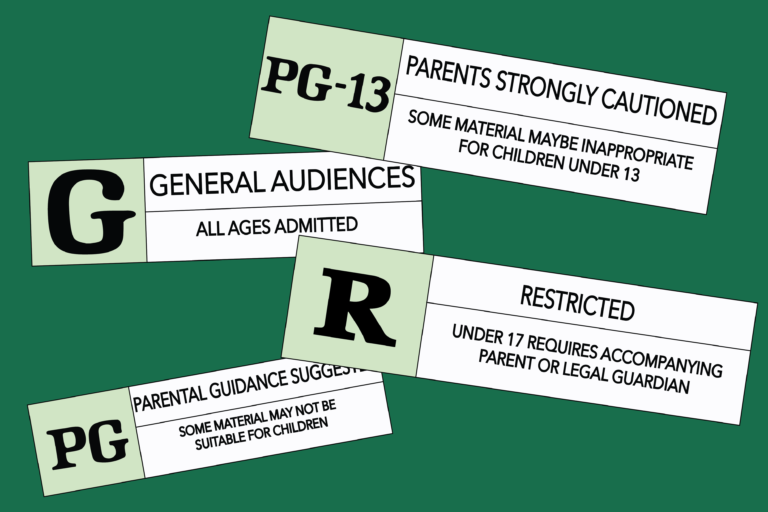
In 1968, this changed to the rating system we all know and love today: General Audiences to NC-17. That being said, it has been 52 years since the MPAA has last properly revised its rating system, and, at this point, it’s simply outdated.

Perhaps what is most useless about the rating system is the ambiguity in how it is all decided. In Kirby Dick’s documentary “This Film is Not Yet Rated,” he reveals that the MPAA does not disclose any information regarding their rating decisions nor do they tell filmmakers which scenes need to be cut out or edited to change that result.

The members of the Classification and Rating Administration (CARA), who determine ratings, consist of average American parents with children ages five to 17, with the expectation that they will be rotated out every five years. Dick’s documentary revealed this not to be true, with parents overstaying their time on the board, having children over 17 and failing to keep up with our changing culture.

At least two members are required to be representatives of the Catholic and Protestant Church. The expectation that two religions, out of the plethora of religions that are practiced in the United States, are to intercede in the decision process is absurd. Unfortunately, the earlier image of a priest ringing a bell at sex scenes is not that different from our contemporary rating system.  

The MPAA also places a disproportionate emphasis on sex over violence. While films that contain genuinely violent and heavy themes often receive R ratings, scenes with sex and profane language are rated NC-17.

“They’re too easy on violence yet bizarrely reactionary when it comes to nudity and language,” notes film critic Michael Phillips

There is also a strong bias against films with LGBTQ+ themes. The film, “Love is Strange,” which centers around a homosexual couple, is rated R, despite its lack of nudity or violence. Meanwhile, Tarantino’s gore-heavy “Kill Bill” shares the same rating — posing the question of what truly makes a film “adult.” 

The new film-adaptation of “Hamilton,” which is set to be released next fall, has also gone through censorship. By redacting profane language, creator Lin Manuel Miranda hopes to open the musical to wider audiences.

“I don’t think we’re depriving anyone of anything if we mute an f-bomb here or there to make our rating,” Miranda said. 

Although the musical already deals with themes of adultery, the language seems to be a more pressing matter in embodying Disney’s movie standards of PG-13 or lower. 

As a fan of “Hamilton,” I was disappointed upon hearing this news. After seeing the musical live myself, I can attest that the f-word is the icing on the cake for many of the lyrics.

“It’s time for more people to condemn the MPAA and their outrageous antics,” said David Chen, the managing editor of Slash Film. “We’re heading towards an age when we don’t need a mommy-like organization to dictate what our delicate sensibilities can and can’t be exposed to. I deeply hope that the MPAA’s irrelevance is imminent.”

The rating system’s problem lies in its overt subjectivity. Violence, sex and language have various levels of extremes and therefore cannot be consolidated into a single rating. Especially with religion involved, the MPAA will never be objective in their decisions.

The MPAA may be useful in avoiding awkwardly watching sex scenes with your parents or from shielding kids from gruesome material, but at the end of the day, it deters filmmakers from creating fully-realized art. 

If an f-bomb is needed to really sell a line of dialogue, let it. Films shouldn’t have to change for the sake of appeasing theater-viewing standards. In a society already exposed to such themes in the news and outside our homes, I can assure you that these elements are not all that surprising.

Written by: Julietta Bisharyan — jsbisharyan@ucdavis.edu

Disclaimer: The views and opinions expressed by individual columnists belong to the columnists alone and do not necessarily indicate the views and opinions held by The California Aggie

Chancellor visits Feb. 26 Senate meeting to address UCPath, COLA, coronavirus

Students impacted by UCPath failure may receive monetary compensation

The Feb. 26 Senate meeting was called to order at 6:12 p.m by ASUCD Vice President Shreya Deshpande who began the meeting by congratulating the table on the association’s recently-passed Basic Needs and Services Referendum.

“We quite literally saved the association with the referendum passing,” President Justin Hurst said.

Hurst also congratulated the table on the election’s successful turnout — the largest turnout in ASUCD history, with around 30% of undergraduate students voting. In the past, ASUCD elections have resulted in student turnouts as low as 4%. 

The majority of the meeting focused on an open discussion between members of the Senate table and Chancellor Gary May. Several UC Davis vice-provosts were also in attendance. 

May said he expected students to have questions about both coronavirus and COLA activity.

Elena DeNecochea, Gender and Sexuality Commission chair, addressed UC Davis’ controversial partnership with Dignity Health, a Catholic Hospital chain. Dignity has a history of restricting health care services based on religious beliefs. A recent report published by a UC working group assessing UC Davis’ existing partnerships said Dignity’s “disengagement is de facto discrimination against the poor, and especially against women and children of color.”

The report also stated that Dignity adheres to “ethical and religious directives for the Catholic health care services” that exclude reproductive health care and care for LGBT+ communities. 

“The partnership with Dignity Health is a clear slap in the face to the work that we do and the values we believe in, that our LGBTQIA students are humans and they have rights,” DeNocochea said.

“I think our true objective should be to serve as many needy patients that we can, with the caveat that if we have a partnership, they need to abide by our principles and if that can’t happen, we shouldn’t have that partnership,” May said.

May acknowledged that he is not in the position to make a decision on UC Davis’ partnership with Dignity Health and that the issue is being referred to the UC Regents. He said he will address the issue with the Regents.

 DeNecochea also asked about the university’s ongoing actions in response to the flawed implementation of UC Path. 

“A lot of us want to see a lawsuit, we want to see compensation,” DeNecochea said. “It’s not legal to go months without pay for work.”

May acknowledged issues with the implementation of UCPath during Fall Quarter. 

“Any time you implement a large software system there are going to be glitches,” May said. “We have owned the mistakes that we’ve made and tried to resolve those.”

One UCPath glitch caused more than 800 faculty, staff and undergraduate employees to experience paycheck issues during Fall Quarter. Many went unpaid for more than one pay period and others experienced incorrect payment amounts.

With other UC campuses that had already implemented UCPath experiencing similar issues, it seems that UC Davis had an opportunity to address the system’s shortcomings before implementation here.

According to May, there are still 15 to 20 existing issues with student pay as a result of students starting work before they have been properly on-boarded. May also said there have been no residual paycheck issues during Winter Quarter.

According to May, UC Davis leaders are currently engaged in discussions working to put forth a proposal that may offer additional monetary compensation for affected employees. May did not disclose when students would expect to see this proposal.

Jonina Balabis, the chair of the Ethic Cultural Affairs Commission, then addressed coronavirus outbreaks and racism toward Asian and international students on campus.

“What steps is the university taking to really be there for its students?” Balabis asked. “International students, in particular, often feel already alienated by the college administration.”

Balabis said international students and Asian students have been targets for racist insults and bullying as a result of the coronavirus outbreak.

“For specific incidents of racism or bias, we hope you will file a complaint,” May responded.

May also cited his online posts calling for students to invoke the Principles of Community as a tangible step the university has taken to minimize incidents of racism in response to the coronavirus outbreak.

When asked if any campus bodies have reached out to international students in response to racism stoked by coronavirus, May said leadership has not reached out in any way.

Discussion then moved to address recent COLA strikes at UC Santa Cruz and across other UC campuses.

May acknowledged the legitimacy of graduate students’ frustration. 

“Everyone recognizes the housing crisis in California,” May said. “We would be foolish to ignore that or suggest the situation is optimal for our students.”

At the same time, May said graduate students’ demands would cost the university hundreds of thousands of dollars that, according to him, the university does not have access to.

May has met with graduate students groups on campus twice in the last week and said he is willing to meet with leaders going forward. May also suggested that despite the validity of graduate students’ demands, breaking a union contract could set a dangerous precedent going forward. 

Written by: Ally Russell — campus@theaggie.org 

Making a MESS: Student-artist duo Lila Simpson and Shirin Mavandad promote inclusivity, sustainability

MESS focuses on designing graphic tees for customers of all backgrounds

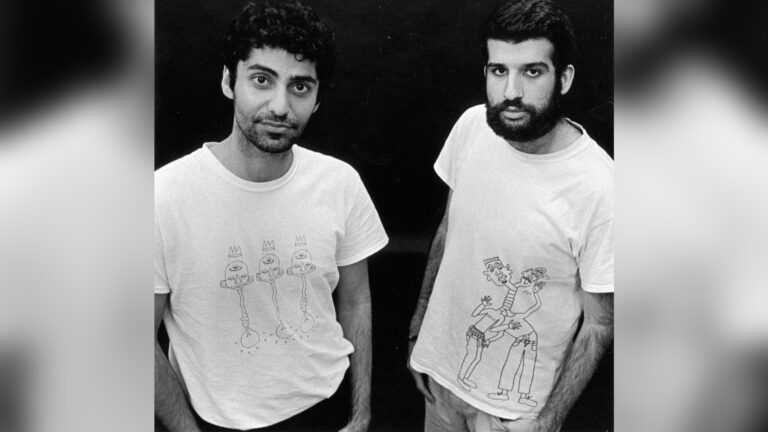
Although Lila Simpson and Shirin Mavandad began their artistic endeavours individually, they found a similar artistic spirit in one another at a volcano in Costa Rica. Ever since, the two have been inseparable in the creation of their up-and-coming brand: MESS.

The two students both studied abroad in Costa Rica in Fall Quarter of 2018, but it wasn’t until a trip to a volcano that their friendship truly sparked. They trusted one another from the get-go and immediately took an interest in each other’s art, even going so far as to share their sketchbooks with each other. This is a very personal thing to do as an artist — and to both Simpson and Mavandad, it can be like showing someone your mind. 

Ever since officially starting their brand in the summer of 2019, Simpson and Mavandad have been creating and expanding their abstract aesthetic on an individual yet cohesive level. Simpson, a fourth-year evolution ecology and biodiversity major, said cartoons, anime, horror movies and alternative music influence her creative process. She appreciates the creative and “gross” aesthetic portrayed in these genres. 

“Things that aren’t real, […] like abstract, are a lot more interesting to me than the physical, actual world I live in,” Simpson said. She enjoys producing exaggerated and abstract art that isn’t stereotypically beautiful but is “appealing to a different part of [the] brain.” 

She is most successful in her new designs for MESS because she gets into what she calls the “artistic flow” — where creative ideas come naturally and build on one another. In fact, some of her best tee-shirt designs have come from doodles she made in class. 

“[Art] is a way for me to put my thoughts onto a page,” Simpson said. “In a way, that makes sense to me, but not necessarily [to] someone else. Someone else can look at it and interpret it. But everyone’s also going to have their own interpretation.” 

As for Mavandad, a fourth-year environmental policy and planning major, her cultural and ethnic background influences her aesthetic the most. Growing up in the Bay Area, street art played a vital role in her specific, curated style. The simplistic geometric and linear designs with creative fonts inspired the aesthetic for MESS, since many of their tees feature the same linear designs.

Mavandad realized that her Iranian cultural identity has also subconsciously influenced her art. Her designs parallel Persian rugs and cartoons she grew up watching. 

“It’s cliché to say, but [art] is really meditative and makes me super happy,” Mavandad said. 

MESS focuses on designing graphic tees for customers of all backgrounds. Their selling point is their inclusivity, affordability and sustainability. They do not cater to one gender. Instead, they create and sell gender-neutral clothing that appeals to all tastes. 

“When we take our photos, we show all types of people, all genders, ages and ethnicities wearing the shirt,” Simpson, who is the primary photographer for MESS, said. “It’s really for everyone. It’s not marketed toward a specific person.” 

In addition, they sell their products at a low price, taking into account the college student’s budget. Along with being inclusive and affordable, Mavandad started screen-printing their shirts on thrifted tees in order to incorporate sustainability in a typically unsustainable industry. 

“Obviously, the idea for putting [our designs] on thrifted shirts is to be sustainable,” Simpson said. “But I think it’s also the idea that we’re not putting more material into the world, we’re just putting more ideas into the world.” 

The embodiment of their brand is to reach a wide audience and promote creativity. Their brand name, MESS, is an acronym for “Mind Elevation, Soul Stimulation.” Mind elevation means feeling creative, and soul stimulation means feeling empowered and inspired to carry out personal aspirations. Mavandad describes it as “feeding your soul.”

As of right now, they promote their brand via social media (@mess_graphics) and by word of mouth. Although they would love for their endeavours to grow, they are happy to simply create art and have others enjoy their product. 

The artistic duo may be a “MESS,” but they sure know how to sell their brand to be inclusive to all people, while upholding their personal artistic values in the process. 

Written by: Sierra Jimenez — arts@theaggie.org


UC Davis officials address decision to make Spring Quarter instruction remote

Information released regarding future instruction, commencement

Editor-in-Chief Kaelyn Tuermer-Lee, Managing Editor Hannah Holzer, Campus News Editor Kenton Goldsby, Opinion Editor Hanadi Jordan and Arts and Culture Editor Liz Jacobson sat down with the following UC Davis administrators on Friday to talk about decisions concerning remote instruction due to the coronavirus. Below is a transcript of the meeting that has been edited for length and clarity.

Title and introduction:

Chancellor Gary May

“My style is collaborative, I expect all my colleagues to be subject matter experts in their particular role, and they are. We occasionally have missteps or fumble things, but that’s going to happen anywhere. My role is kind of just to frame the problem, ask a few questions. At the end, I have to make the final decision, but not always.”

Interim Vice Chancellor for Student Affairs Emily Galindo

“I’m thinking about, ‘What are the impacts going to be to our students, those that live on campus, those that live off campus.’ Also, we have 800 staff, so I’m also thinking about how these decisions will impact those individuals.”

Provost Ralph Hexter 

“All the deans report to me.” 

Psychology Professor Kristin Lagattuta, the chair of the Academic Senate

“I’m a mother of two college children, so I also very strongly empathize with the student perspective, and I am a mother of a college athlete, so I empathize with the absolute disruption to spring sports. I’m a faculty member, I also see it from the Senate chair perspective of trying to see the bird’s eye view of how this all goes together.”

Vice Chancellor of Finance, Operations and Administration Kelly Ratliff 

“For all the issues related to human resources and employment, but also everything related to facilities and custodial and those sorts of things, the folks that do campus event planning, that’s all with me. And there are aspects with travel — domestic travel, insurance — for this particular circumstance, those are issues my team is helping with.”

Chief Marketing and Communications Officer Dana Topousis

By “remote learning,” does that mean that students will be sent home and moved out of their dorms?

Emily Galindo: No, that’s not our intent. The campus is still open and we want to allow for that to continue. The situation is fluid though, and I think you have to appreciate that. We are planning to message our students who live in the residence halls now that when we get through with Spring Break we will remain open and that the services will be available to them.

Ralph Hexter: What we’re trying to emphasize is options. Students must have [the ability] to access the material remotely, likewise, individual faculty, given health status or risk, we want to make sure they have the option of delivering material remotely.

A lot of rumors were circulating about what would happen to Spring Quarter instruction. Why the delay on the message?

Ralph Hexter: When we do issue statements, we want them to be as complete and unambiguous as we can make them. That’s why partial information is so misunderstood and turns into rumors.

What has the decision-making process looked like up to this point? 

Emily Galindo: The first meeting was our phone call on Jan. 28. So it’s been since then, that on a weekly or every other week, there have been a number of us that have been on phone calls, beginning to talk about what the situation is. And our calls started primarily with our healthcare folks. 

We have the Student Health and Wellness Center, and we have a medical director, and she is very much in alignment with Yolo County Public Health. We have been getting direction from there. The phone calls have increased as well as the amount of participants on the calls as it’s become a bigger situation. We had our weekly phone call this morning with Student Affairs, Student Housing and Dining, safety risk folks and communications folks. People report out on what’s the latest. 

Then we have [an] emergency crisis management team. They’re more focused on policy than the practical logistical things that happen on a regular basis.

Kristin Lagattuta: I had 15 hours of meetings yesterday.

Ralph Hexter: For example, the Chancellor is on a call every morning with his opposite numbers at 7:30 a.m. and I’m on a call with the other executive vice chancellors for the system at 7 a.m. Part of our calls are trying to learn from one another, and to the extent that’s possible, figure out where we can be exactly in conformity. But there will be local variations — one obvious reason is we’ve got two campuses who are on semesters, and the rest are on quarters. 

Kelly Ratliff: We had a system-wide call with my counterparts and had a group of folks on the phone about remote work. It all involves folks from other campuses. Some of the functions like human resources are both Sacramento and Davis. And if you’re a healthcare worker, it’s a very different circumstance. What does it mean to talk to our employees about people who can and might be able to work from home versus healthcare workers who can’t? Depending on these different scenarios, we bring in our own health experts. So we’re lucky we have the UC Davis Medical Center. They have an amazing infectious disease team. We have our own folks in occupational health, kind of like student health and wellness. 

Kristin Lagattuta: And at the medical school, we have people who are expert epidemiologists and [ones on] coronaviruses, too, and they are working worldwide. So it’s incredible expertise we’re drawing from.

Kelly Ratliff: The formal decision structure relies on that emergency crisis management team. And then Gary [May] is the ultimate decision maker. There are some things where UC President Janet Napolitano has taken the lead — in terms of some of our employment practices and paid leave, Janet [Napolitano] set those policies, like the travel restrictions. The category two and three travel restrictions were set by the president. And then we’re implementing locally how it affects our systems and our language. [The decisions are] implemented by individual managers and supervisors because they know their own work best.

Kristin Lagattuta: The Academic Senate basically has authority over decisions involving courses and instruction and grading. We’ve been meeting regularly for several weeks now trying to figure out how to improve and basically lax some of the rules about how instruction goes. Normally, if a professor wanted to move some or all of their course material to remote instruction, they’d have to go through this lengthy approval process. And so suddenly, when you’re faced with this emergency situation, you can’t have these very strict rules. Everyone’s really trying their best to align with the guiding principle, which is really maximizing how many students could finish Winter Quarter. We’ve had a lot of emergency meetings where we discuss a lot of these issues. We want students to be successful. We fully recognize this is stressful. 

As you likely know, we have a lot of professors who are over 60-65 years old and we want to give them control to make certain decisions so they can protect their health. It’s balancing all of these interests and really getting a lot of very dedicated faculty in the room to make very, very thoughtful decisions, and they’re not easy decisions to make. We’re really encouraging faculty to be as caring and flexible to their students as possible. We can’t police all that. We’re hoping that all faculty will have the best interest of students in mind when they’re making these decisions. But it’s challenging, it’s challenging for everyone.

Emily Galindo: On behalf of the chancellor, one of the things that he did when the fire situation happened, he did again this week: He called together student leaders from his Graduate Student Advisory Board, the Undergraduate Student Advisory Board [and] the ASUCD Executive Office. And he asked the question: ‘What do you think we should do? And what do you think would be most helpful?’ 

Given the decision to cancel all in-person finals, why did the university not cancel in-person instruction during Week 10?

Ralph Hexter: There’s sort of two horizons that are guiding our decisions: How do we protect — to the extent possible — the health of the people involved in the activity? And then, as we shift from containment to mitigation, how do we [decrease] the frequency of the number of peoples we bring together? 

A week ago Friday, [and] a week ago Saturday, we weighed what would be realistically able to achieve [and] we chose to strongly encourage the making available of the opportunity to access the material remotely. We felt that we would, in reality, achieve the same thing [by] cutting down the number of classroom meetings and the number of people attending by strongly encouraging rather than simply mandating, which, personally, I think would have led to a feeling that we just kicked over an ant hill, and people would have thrown up their arms. 

Ken Burtis, who’s the faculty advisor to chancellor and provost, has been going around this week and visiting some classrooms and he said that there’s so few students in the classes that are being held that we’re achieving that recommended social distancing and then some. And I will just comment that Berkeley faced a very different rhythm because they’re semester, so it was in the semester and not the last week of the quarter. 

Kristin Lagattuta: And also emphasizing student choice — some students don’t learn as well remotely because there’s a lot of distractions going on, and we wanted to maximize student choice to be able to attend in the classroom. We imagined only about 30% of students would actually show up to classes, if not fewer, so you could spread out. But I think that again, in situations of uncertainty, giving a level of control and choice to people to make those decisions are really important. As students, that last week of the quarter — [when] people are giving the final midterm or you have class presentations — [it] can be overwhelming for students if all of the sudden you’re just like, ‘No more, you don’t get to do this anymore.’ And for faculty too, it’s very challenging. 

I know students joke about how faculty can’t even work the technology in the classroom at the time of the lecture, how can they be expected to do all this stuff online? They were frantically trying to figure out, ‘How do I do Zoom lectures? How do I integrate these things into Canvas? How am I going to do these online quizzes?’ They’re working so many extra hours to make this happen for their students in order to maximize the quality of education they can provide to students. 

With some professors giving out 100%s on finals, there’s been a discrepancy in terms of grading and examinations across classes. What is the university doing to ensure all students receive fair marks?

Kristin Lagattuta: Our major guiding principle [was] to maximize the opportunities for students to finish Winter Quarter by offering more flexibility to instructors to make those decisions — they’re the best authority of their class [and] of how much their students learn. I don’t think there can be a one-size-fits-all. I don’t think there is one fair approach, because someone could argue, although it’s nice to get 100% on the final for everyone, is that fair?

Ralph Hexter: We worked very closely with the Senate. So there was a whole range of possibilities — not to have a final, having the final remotely, [changing] the weighting of the final. One other thing was to have a take-home final or an alternative assignment. All of that is really built on what already exists. 

I don’t think the university can guarantee, even in the regular operation, that everything is fair in the sense that everything is equal between one class or another. We certainly hope that within any framework people are working fairly and that there are opportunities for appeals. I will acknowledge clearly, that in this unique situation of sudden changes, there might be more opportunities for discrepancies.

Kristin Lagattuta: When we offer those additional flexibilities, we strongly encourage them to minimize the amount of change or disruption to what their stated grading practices were going to be [for] that course. 

When did discussions with other UC campuses begin and when did discussions with UCOP begin regarding the situation? And when did UCOP issue its first directives around the coronavirus?

Kelly Ratliff: The first one I’m recalling had to do with travel and it’s [from] February. [For] the system-wide calls, in many ways, Davis was first. We had the first community transmission patient at our medical center, and then we had the situation with our students who were being tested. The system-wide interaction started before that, because as soon as folks knew about our coronavirus patient and students under isolation, my email was going crazy. Some of this was happening starting in late January, when we first had our case. And then every one of my system-wide groups moved to weekly calls starting then. 

It looks like we’re making different decisions on different campuses. In some cases we are, but often that’s right now driven by the public health guidance. For example, when you read and see what’s happening with large events, mass gatherings, the original guidance that was coming out of Yolo County had to do with 150 people. So that’s how we start — at 150. Their public health advice in Santa Clara County was 50. We each have our own situations. UC Davis happens to sit in a couple counties. We have locations in Solano, Yolo and Sacramento counties. There are different reference points, different local circumstances, but we’re all again doing our best to share information about those things.

Ralph Hexter: Yolo County could not agree with Sacramento County on certain things.

Kelly Ratliff: Which also happened during the fires.

Ralph Hexter: We were waiting for Yolo County to come out with guidance. What finally came out was that Yolo and Placer County and Sacramento County had already done something different, which is extremely challenging for us. Our UC Davis Health has clinical operations in both of those counties, not to mention others. 

Kristin Lagattuta: As the Senate chair, we also have a system-wide component. I meet regularly with the Senate chairs from the other divisions of all the other campuses. We’ve been sharing a lot of the decision-making regarding, ‘What are we doing about instructional practices? How are you handling remote instruction? How is that all working?’ We’ve been really drawing from each other in these uncertain times to try to figure out what the best practices would be. 

What sort of issue areas does UC President Janet Napolitano have unilateral authority over and what directives has she given?

Kelly Ratliff: Our labor agreements are system-wide — so on some of the employment issues and issues around paid leave. And guidance [on] travel. We have a president with experience from Homeland Security, so some of these things are sort of more natural even in her own areas of subject matter expertise. 

Possibility of a refund

Kelly Ratliff: As campuses are deploying their instructional model in similar but different ways for Spring Quarter, depending on local circumstance. How might we consider thinking about folks asking about refunds? There’s going to be [a] conversation and a standard approach about the mandatory system-wide fees and tuition, which will not be refunded because everything we’re doing is not closing the campus.

Kristin Lagattuta: It’s actually more expensive in many ways because we’ve had to get all the Zoom pro licenses for the instructors, the examity costs $20 a student for every student proctor and there’s thousands of students going to be proctored this way. The university is actually pouring a lot more resources into this to make this happen. I’m getting all these texts from [professors] talking about all the equipment that they’re buying just so they have things at home in order to deliver the kinds of instruction that they the students need.

What is the thinking right now in terms of commencement ceremonies?

Kelly Ratliff: The very clear message right now is that we’re still planning on commencements. That may change, but we want to lead with: ‘We’re still planning on commencements in this sea of uncertainty.’ We’re trying to do things in rolling time fields — that will make some folks uncomfortable, because it still won’t be certain. For now, that’s the decision framework, because so much is changing. Our messages last Saturday were the first of all the UC campuses, then all of a sudden we quickly became last. None of us ever imagined like what happened with the NBA and the NHL and the symphony and the opera and the Mondavi [Center].

Kristin Lagattuta: We fully recognize how absolutely crushing it would be to students and their families to cancel those really beloved and momentous events, especially graduation. We don’t want to take those decisions lightly, we really want students involved in that and whatever happens with graduation, right now it’s there. We don’t want to get rid of it. That’s such a time of celebration that to let go of that [would be] heartbreaking.

In terms of the implementation of “remote instruction,” what will happen to research laboratories?

Ralph Hexter: Our commitment is to have the university open and be in operation. We’re thinking of giving everyone, to the extent possible, the flexibility to work or study remotely. When it comes to research labs, each one is going to have to decide.

As you may or may not know, we have five million research animals, most of them are fish, but there are a lot of quadrupeds as well. Nothing against fish, but they all need to be taken care of. So we have critical operations, like the clinical operations at the medical center, [that] we would never shut down. We would [look] at the individual personnel in the lab — if anyone is immunocompromised or has a health need or a family need that requires them to be reassigned, we’ll figure out a way to cover it.

Kristin Lagattuta: My research lab is at the Center for Mind and Brain, and so what we’ve been talking about is really limiting, as much as possible, human subjects’ participation in studies too. And so most of us have sort of shut that down unless they’re really critical, longitudinal studies where you have to test a child at a certain age. But then actually making it completely voluntary for those families and letting them know, and increasing how much we’re cleaning everything and really trying to only have the lab personnel that really need to be there so we can have more social distancing too. It’s really, really challenging because graduate students are working on their dissertation research, and I have many undergrads who volunteer in my lab, so we’ve said that we’re not having them come in because they’re interns. But that’s missing out on educational experiences for them too. We have a Senate Committee — a Committee on Research — and they’ve been sort of informing some of these decisions too, but it’s really challenging.

What is the university planning to do in respect to in-person labs for course credit?

Ralph Hexter: That is one of the topics under most active discussion now. Yesterday morning, on our AVC call, we were hearing from Berkeley, where chemistry was videoing the processes, having either the TA or the TA plus a couple of student volunteers do the experiment, get the students to see what the meanings are, they remotely take it down, do the calculations. So when it starts to get down to labs, there’s no one-size-fits-all. I’m aware now that that was actually already ongoing here. So I think some of them will be handled that way in a very creative, remote fashion, and I think that’s interesting. I was talking to a graduate student who, himself, teaches a lab, and he was saying actually right now in lab, sometimes the technician does the literal experiment and the students just get the data and have to figure out the calculations. 

This will require some work in the department and Senate level, [but] there may be some [where it] is utterly impossible, and perhaps other arrangements will have to be made. Students could potentially take a lab in another quarter, but if the student were to need to graduate, I’m hopeful that they would find ways to adapt. And advisors in the departments now can make adjustments.

Kristin Lagattuta: Outside of labs, you have the performing arts and studio arts, and that also provides a lot of challenge for students too. But yes, we would anticipate increasing flexibility.

Ralph Hexter: Because we’re not closing the campus, some of those activities may take place on a voluntary basis in the actual venues.

Kristin Lagattuta: The other thing we’ve also discussed is increasing Summer Sessions. So if the situation changes by summer, maybe some of the lab courses that would normally take place in spring, we would have a larger number of options for students to take in the summer. Of course, we can’t predict with certainty what’s going to be happening in the summer, but that’s also something that faculty and departments are thinking very strongly about — how to maximize how many students make that progress toward graduation and being mindful of that.

Given that the date to file for graduation was Friday, if students who were planning to file for graduation in Fall Quarter now want to rethink that decision and graduate this Spring Quarter, will the deadline be extended?

Kristin Lagattuta: That’s a good question, we will find that out.

Ralph Hexter: This is a really great example of why it’s wonderful to share these things, because new questions come up that we’ve never thought of.

Increasing Pass/No Pass registration

Kristin Lagattuta: During November 2018, when the campus was closed due to fire, several students signed this petition saying, ‘Can we extend the Pass/No Pass deadline?’ And we thought about that very thoroughly. What we decided — and I think it still holds in this case too — is that the Pass/No Pass, while even right now feels very good for students and very stress-relieving, it has a lot of future negative consequences that a lot of students might not think about in the here and now. You need a certain amount of graded units for graduation. A lot of graduate professional schools require certain classes to be graded. So what we decided in November of 2018 — and, again, still stands now — is that we’re requesting that advisors in colleges are flexible with this. If someone really wants to extend that Pass/No Pass, they would tell them, ‘This would be the consequences and things that could potentially happen, so you can really make an informed decision.’

Residence hall contracts

Ralph Hexter: One example of a deadline or of a date that I know that we’re changing […] is residence halls contracts.

Emily Galindo: If a student goes on Spring Break and then they decide that they don’t want to come back, then we’re going to increase the flexibility if they want to cancel their contract, understanding then that they would have to move all their belongings and move out.

You mentioned that students will not be getting a refund next quarter, but for students who have to enroll for an additional quarter who otherwise planned to graduate this quarter, is monetary compensation something that is being considered?

Kelly Ratliff: I think we’d have to think carefully about the scenario. We’re imagining that everyone will still have the ability to maintain the same level of progress toward their academic degree next quarter as they otherwise would. In all these things, it’s important for us to say we have case-by-case circumstances. People have unique circumstances related to housing or other things, so we always have places and processes for literal case-by-case, but sort of the overarching assumption for all these things is we’re still maintaining the order, it’s going to look different.

Is the university considering how it would retain on-campus and student jobs?

Emily Galindo: That’s our challenge. That’s part of why we continue to say that the campus is open, because we know that a lot of our students need their jobs. And for our revenue-producing units — in particular ASUCD [and] our housing and dining, which is self-supporting — if the revenue doesn’t come in, then it makes it very difficult for them to pay. We all know the hit that the Coffee House took with the [Camp] Fire, and so those are the kinds of things that we don’t want to see happen. I think we’ll have to continue to have conversations about that. 

Kelly Ratliff: Fewer folks are riding Unitrans, fewer folks are going to the few venues, and so it’s very much on our mind. We have custodial staff — in some ways, their workload has gone up right now. But if we’re mostly not using classrooms in the spring, what does that look like? There’s a lot of issues and definitely a lot of thinking and planning and trying to find ways we can preserve. This is one of the things the federal government is talking a lot about and the state will as well in terms of different provisions for unemployment and those sorts of things.

[At] UC Davis, we won’t be able to backstop and be a full unemployment agency. That is one of the sort of the terrible real life impacts of these [mitigation measures], but we’re definitely going to look for all the ways we can help mitigate and leverage, including if there’s federal or state programs to make sure we’re maximizing everyone’s opportunity. Sometimes the way we make our decisions will make people more or less eligible for those sorts of programs, and so that’s something for us to also [consider]. Whatever we can’t manage ourselves, we want to make sure that how we implement creates maximum opportunity for folks to use other sorts of programs that are available.

The Sacramento Bee reported that UC hospitals will now be using their own screening tests for COVID-19. Will that apply to our on-campus health center?

Emily Galindo: We do have the test available. We are partnering with Quest Diagnostics. But we’ve got a criteria for who gets the test and there’s already been some friction with folks going in or calling in and saying ‘I need the test.’ The advice nurse goes through the questions and based on your responses, that determines whether you’re at priority for the test.

Kelly Ratliff: This will be something that’s evolving. The capacity at the [UC Davis] Med Center is brand new. We’re in two counties, and so there also will be guidelines about transporting samples. Over time, if we develop capacity and we have our own expertise, we’re going to want to make that available to our own students. It’s all quickly evolving.

If and when the Student Health and Wellness Center develops the capacity to administer screening tests for COVID-19, will students who aren’t covered by SHIP be given the test for free or at a discounted price?

Emily Galindo: I don’t have that answer.

Are there any major concerns about how a transition to remote instruction would impact the university’s finances?

Kelly Ratliff: There are a lot of concerns. There are concerns about the worldwide impact of this. There are also concerns about students’ own decision making about staying or showing up in the fall. There are a lot of places we’re experiencing higher costs to have tools to mitigate the risk from the virus. We just rented as many portable hand-washing stations as we could. We want to have those on hand and figure out how to deploy them. There’s many different examples of how the university’s finances will be affected by this situation.

Ralph Hexter: I think this will ripple for a number of years. I don’t even know. For example, those of us who are above 60 think, ‘What is this going to mean for the UC retirement fund?’ 

We’re absolutely wondering, ‘What are yields going to look like?’ We’re going out with our admissions decisions, and I’ve been in awe over many years [at] the skill of admissions professionals with knowing how to hit the right enrollment numbers, but that’s based on historic data, and the ability for prospective and admitted students to visit campus. 

Not to mention, when we add the horizon of the international students, even if they wanted to come, will they be able to? We are in a maelstrom of uncertainty.

Kelly Ratliff: We’re doing the best contingency planning we can in many places. We have reserves. That’s an important part of anyone’s financial resiliency. But we just had an emergency not that long ago — [the Camp Fire]. And this one is really very hard to predict. So there’s thinking and planning, but there’s so much uncertainty around it. We have big estimates that have a lot of uncertainty on them. While they are helpful, they’re still not something you can easily see and go, ‘Oh, yeah, let’s write a check.’

Written by: Kaelyn Tuermer-Lee, Hannah Holzer, Kenton Goldsby, Hanadi Jordan & Liz Jacobson — campus@theaggie.org

Remote instruction planned for Spring Quarter, Picnic Day canceled

Instruction to be done remotely for most, if not all, of spring

Classes will be given remotely for all of Spring Quarter 2020 at UC Davis, according to an announcement made today by the UC Davis administration.

“As the spring quarter progresses, we will continue to monitor the coronavirus crisis and may reassess our directives,” according to the announcement. “Nonetheless, the decision to allow for remote instruction will continue throughout spring quarter. Should the situation improve, instructors may be given the option to resume in-person classes but would not be required to do so. Students, however, would still be allowed to finish their spring courses remotely.”

The decision was made in order to safeguard the health and safety of students and instructors in the wake of the novel coronavirus and the disease it causes, COVID-19. 

In-person classes may resume at some point during Spring Quarter if threats are mitigated.

UC Davis is the last undergraduate UC campus to transition its instruction from in-person to remote. In the last few days, UC San Diego, UC Berkeley, UC Irvine, UC Merced, UC Santa Cruz, UCLA, UC Santa Barbara and UC Riverside have issued statements about the transition. Other universities and schools throughout the nation have also either switched to online instruction or closed entirely.

“We will have what we’re calling ‘remote instruction,’ not ‘online instruction,’ available for the spring — likely for the entire spring, but we will have a checkpoint in the middle to decide whether we will continue or whether that will be more or less restrictive,” said Chancellor Gary May in an interview with The California Aggie. 

There is no plan to close the campus — it will remain open, and students living in Student Housing-run facilities will be allowed to stay.

“The campus is still open and we want to allow for that to continue,” said Emily Galindo, the interim vice chancellor for Student Affairs. “The situation is fluid, though, so you also have to appreciate that as well. We’re planning to message the students living in residence halls as well. We don’t close during spring break anyways. We intend to remain open and the services will remain as well.”

This move to remote instruction will include classes given through an online medium, such as Zoom or lecture capture. 

Picnic Day and Commencement

Picnic Day has been canceled. There are currently no plans to cancel the spring commencement exercises, but a decision to cancel them could happen later.

How decisions have been made

Up until now, the university has been making decisions based on a “rolling framework,” according to Vice Chancellor Kelly Ratliff in an interview with The California Aggie. This newest decision will allow the situation to remain fluid — it “emphasize[s] options” and allows for “maximum choice” by students and faculty, according to Psychology Professor Kristin Lagattuta, the chair of the Davis Division of the Academic Senate, in the same interview.

Members of the campus administration have been in at least weekly communication with their counterparts across the UC system — Ratliff, for example, has moved bi-weekly phone calls with her systemwide equivalents to weekly meetings. 

Beyond speaking with other administrators, May proactively communicated and met with student leaders on campus. He convened extra meetings of the Chancellor’s Undergraduate Advisory Board and the Chancellor’s Graduate Advisory Board to hear student concerns and opinions. May continues to consult his two student advisors to the chancellor, who were involved in meetings regarding the move to remote instruction.

While UC Davis has autonomy over many decisions, some mandates have come down from the UC Office of the President and UC President Janet Napolitano, a former Secretary of Homeland Security. These decisions include those surrounding employment and travel. Travel to areas of the world most affected by the virus — China, South Korea, most of Europe and Iran — continue to be prohibited, and those returning from these countries must self-isolate for 14 days, per UC guidance. More updates from UC Davis will be posted here every Friday beginning next week.

Travel

Nonessential travel to any international destination must be avoided, under guidance from UC Davis Global Affairs. Personal international travel is strongly discouraged under the same guidance.

Additional information from campus administrators about how the coronavirus outbreak will affect students, course instruction and the campus will be released by The California Aggie shortly.

Written by: Kenton Goldsby — campus@theaggie.org