55.7 F
Davis

Davis, California

Tuesday, December 23, 2025
Home Blog Page 361

Historic landmark that is Davis Varsity Theatre provides escape from traditional movie experience

Students, employee reflect on the value of the venue as landmark, film house, gelateria

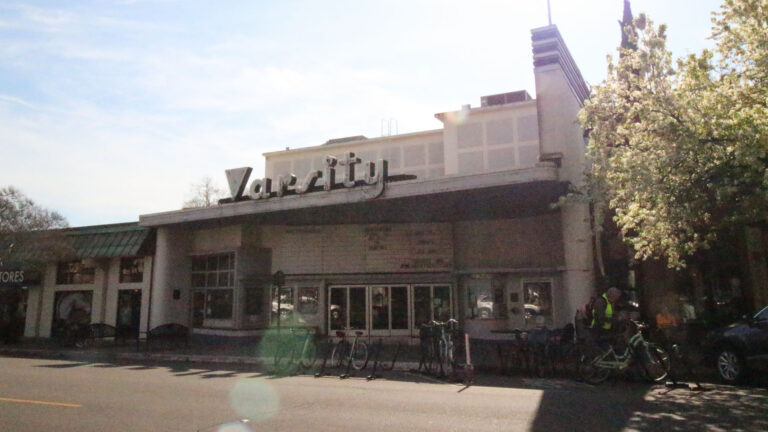
Driving down Second St., a celebrated and historic piece of Davis still stands in the form of the Varsity Theatre. The structure is known for its unique exterior, as it is one of two streamline moderne buildings that still stand in Davis. A part of the Art Deco movement, the building features aerodynamic lines and nautical elements.

Designed by architect William B. David, the cinema is one of 13 constructed in the Northern California region. David was also responsible for the construction of the Arcata Theatre Lounge, as well as multiple theaters in Sacramento. David also contributed to the creation of Hollywood sets in the 1930s, representing the form of the motion picture in multiple ways. 

The Varsity Theatre has resided in Davis since 1921. Originally built on top of an old blacksmith shop, the theater moved to different locations downtown before settling at the spot it currently resides at. As newer cinemas were built, the Varsity was used as a performing arts center until 2005, when it became a single-screen art house cinema. 

Whitney Martinez has worked at the Varsity Theatre for 14 years, ever since the theater reopened its doors in 2006.

“Originally, when Varsity first opened in the ’50s, it was the first movie theater in Davis,” Martinez said.  “[Now,] we bring in very unique films, films that you would never hear of, and it’s really cool to be exposed to that different genre.”

The theater is not only a historic landmark, it is also an integral part of the community given that it is owned by the city of Davis. 

“The city does own the building, so we have a lot of city events,” Martinez said. “We have the MLK celebration every year, as well as the UCD film fest. It’s cool that we have this venue to offer.”

The multitude of ways that the Varsity has served the community allows it to be a dynamic feature of Downtown Davis, providing a space for people to gather. Indigo Kelly, a second-year cognitive science major, talked about her experience.

“I went there a while ago and I loved it,” Kelly said. “It was very old-timey, and I loved that there was a little gelato place connected to it. I feel like people don’t go to movies enough, and they have super cool old independent films.”

As moviegoers compete with the ever present comfort of Netflix, students voiced a sadness regarding the change in the times. Alison Newens, a second year, agreed with Kelly’s sentiment. 

“It is such a good way to go out with friends, instead of just lying in bed,” Newens said. “It’s a whole experience, from the popcorn to the place, whereas staying at home just isn’t like that.”

The well-known theater continues to be a force in the Davis community: It brings together cinema and people to form the venue that it is today. With its unique showings and exuberant decor, the Varsity remains a staple for the most enthusiastic moviegoers.   

Written by: Athena Aghighi — features@theaggie.org

Dave Chapelle doesn’t need social media, but everyone else does

Social media has transformed comedy by elevating it

What makes you laugh the most? Is it your friends, family or favorite comedian? Probably not. For most of us, our laughs are now ignited by the stuff inside the little boxes we scroll through everyday on our social media feeds: Tiktok videos, Twitter zingers and the like. Much of social media is designed around the interactions that comedy provides. 

All of my favorite comedians are all on social media. They make me laugh more in a week than in a Dave Chapelle special that I only get to see once every few years. Once you find your people on these platforms, they become better mediums. Narrowing down your sense of humor and aligning it with your cultural interests would have been next to impossible before these platforms — certain voices just weren’t heard before. But now, Mike Drucker gives me all of the video game jokes I need, Jon Lovett supplies all the political wit and Jason Concepcion deals all the NBA spice. 

The immediacy of social media is what makes it so great. Current events and television shows garner the wittiest reactions in real time that can be shared within seconds. The accessibility of social media overcomes the physical and economic hurdles of seeing a live comedy show. Individual tickets for Chapelle’s last two shows were no less than $190. And most comedy venues are not built with disabilities in mind — the act can be hard to see even for non-disabled individuals.  

Social media is now the crux of countless comedians’ careers. It is now the most important tool for rising comics to elevate their comedy. Just look at your favorite YouTubers: Joe Rogan owes much of his present success to the platform he built and the community he’s grown on social media. Social media gives Rogan the kind of exposure and opportunity that was unheard of before. The growing ties between the necessity of social media and comedy is emblematic of the growing role social media plays as a tool in any profession. 

A vital aspect of comedy is the feedback that comedians get from interacting with a live, vulnerable crowd, which is absolutely missing on social media platforms where comments are often filled with excessive hate. Instead, social media offers interactive feedback in the form of likes, retweets, shares, mentions and views. Something that is quantifiable, yet not qualitative at all.  

This doesn’t mean that comedy as a whole is pulling its punches. Each new Chapelle special (and many other Netflix specials) addresses progressive events in our culture, but these are rarely ongoing. Social media, on the other hand, currates topical comedy for you immediately. It takes the effort out of giving you a laugh (or a muffled chuckle). You don’t have to witness the stand-up struggle if you don’t want to, and you don’t have to suffer through a three drink minimum either or un-godly admission prices. 

Social media doesn’t have to replace traditional comedy — it can elevate it. Hasan Minhaj’s Netflix special “Homecoming King” –– filmed at the one and only Mondavi Center — intertwines social media with massive screens and tells a modern story that requires social media to move forward. 

Chapelle, the greatest comic of our time, is hardly on social media at all. His comedy exists in a realm of context that isn’t possible on social media. Take most of his punchlines out of context and people would be calling for his head (some still are). Yet Chapelle is so good that he straddles the line between the new comedy world and the old. He commands your attention on your screens and when he comes to town because he has gravity. But he’s the only person big enough to do that. 

Some claim that Chapelle is a comedy bygone who hasn’t progressed with the rest of us. That couldn’t be further from the truth. Comedy is about pushing limits and crossing lines. You should hate that you laugh at some of the jokes comics say, and that’s exactly what social media boils comedy down to. The overwhelming majority of jokes, memes and videos online are not funny at all. But the best stuff surfaces to the top with the help of interactive feedback through algorithms. Once you find comics that fit your sense of humor it just works. And you can go support those comics in real life if they ever come your way — or just support them online like a normal person.

Written by: Calvin Coffee — cscoffee@ucdavis.edu 

Disclaimer: The views and opinions expressed by individual columnists belong to the columnists alone and do not necessarily indicate the views and opinions held by The California Aggie

Guest: Vote “Yes” on Measure G

Measure G ensures that teachers receive the compensation they deserve 

Disclaimer: The views and opinions expressed by individual columnists belong to the columnists alone and do not necessarily indicate the views and opinions held by The California Aggie.

I came to Davis for my education, and teaching in the public school system is what kept me here. As a teacher, and now as president of the Davis Teachers Association, it is clear that we need Measure G to ensure that public education continues to be foundational in Davis. UC Davis students may only spend a few years in the community or they choose to stay — either way, casting a vote in favor of Measure G is a way to support the community here and honor the teachers that helped you succeed and make it to college. Voting Yes on Measure G will provide an immediate pay increase to public school teachers in Davis.

I arrived at UC Davis as an undergrad in 2010 because it’s a fantastic, world-renowned public institution, nestled in a town that embraces education. During my time as an undergrad, I completed an internship at Harper Junior High, took every education class I could and eventually applied and was accepted to one of the best graduate teaching credential programs in the state: UC Davis. I want to create positive change in this world, so becoming a teacher was an easy decision. During graduate school, I was lucky enough to be a student teacher at Emerson Junior High in West Davis. Upon receiving my teaching credentials, I went to work here in Davis.

Choosing to become a teacher or school employee is not a decision to take lightly. It is profoundly rewarding to work with students and help them realize their potential, but the sad reality is that teachers make less than other professions that require similar education levels and effort. I’m sure that the student teachers and professors reading this know the peculiar challenges of creating lesson plans, grading work and standing in front of a class of students with the day’s lesson.

As many teachers are reaching retirement age, fewer college students are choosing teaching as a career path. In Davis, we expect about 25% of our public school teachers to retire in the next five years. Meanwhile, attracting new teachers is made even more difficult because Davis compensates educators 3% to 7% less than the regional average.

The compensation gap is a surprise to many.  After all, doesn’t Davis pride itself on being a community that values education from pre-school to advanced degrees? The fact is that most public school funding comes from the state. The state’s policy is to provide additional funding to schools with more students living in poverty and speaking English as a second language. This is commendable because public education should provide equal opportunity to every child. But it leaves Davis public schools with less funding to pay teachers than surrounding communities.

I chose to stay in Davis after student teaching at Emerson, but the student teachers I now train are not making that choice, and the reason is compensation. It’s hard to ask young teachers, who often leave school with student debt, to stay here when they can make more at virtually every other school district in the region. Students, schools and new educators all benefit from the experience and stability of veteran teachers, but as they begin to retire, the void left by their absence must be filled. We have to attract new teachers and educators to continue to serve our students.

Measure G helps the Davis Joint Unified School District address these growing problems.

As an Aggie alum and local teacher, I encourage you to vote Yes for Measure G and support our students, teachers and community.

Written by: Victor Lagunes 

Victor Lagunes is a UC Davis alum and president of the Davis Teachers Association.

Davis City Council to discourage tobacco addiction among minors, banning flavored tobacco

Flavored tobacco bans to also be implemented in Woodland, West Sacramento

The City of Davis recently announced that a flavored tobacco ban is under discussion following Yolo County’s Tobacco Retail Permit program that was implemented in 2007, according to a city staff report. The “Tobacco Retail License ordinance” was created to monitor and regulate the sale of tobacco to minors and, now, a flavored tobacco ban is being discussed as an extension of the ordinance. 

Woodland and West Sacramento will also be implementing similar bans on Apr. 1 and Apr. 15, respectively. 

According to The California Department of Public Health, 80.8% of young people between the ages of 12 and 17 who have used tobacco began by using flavored tobacco products. Thus, “banning the sale of flavored tobacco and flavored tobacco products within city limits is a start in addressing the concern that flavored tobacco products are primarily marketed to youth,” according to the staff report. 

Dan Carson, a Davis City Councilmember and a previous director of health policy analysis for the nonpartisan California Legislative Analyst’s Office, explained the role of the council in the discussion of the flavored tobacco ban. 

“Basically, what we did was give instruction to our city staff to begin working on an update to our existing restrictions on tobacco licenses to add a ban on flavored tobacco products to that list,” Carson said. “The city has tied in, for many years, to a Yolo County program by which businesses that wish to sell tobacco products get a retail permit under certain conditions.”

The ban has not yet been implemented and is still being finalized, according to Carson. 

“It’s not been implemented yet in the City of Davis,” Carson said. “In our case, we’ve directed city staff to begin work on a new city ordinance that would make these changes and so there’s a regular process by which that is done — [it] requires a certain amount of public notice once the appropriate legal language comes before us for approval.”

One of the aims of the flavored tobacco ban is to reduce flavored tobacco consumption among minors. Kelly Stachowicz, the assistant city manager for Davis, explained the impact that the flavored tobacco ban would have on the Davis community. 

“The proposed ban is really aimed at making it more difficult for underage individuals to purchase flavored tobacco or flavored tobacco products,” Stachowicz said. “A lot of the products have been geared towards enticing a younger crowd of people to purchase them — they look like candy or something like sweets, things like that. So this is an effort to try to curb the ability for young people to purchase [such] products.”

Studies have shown that people who develop addictions to tobacco or nicotine products often start using these products from a young age, such as at 14 or 15 years old, according to Stachowicz. Eighty percent of young people who have used tobacco products at least once in their lives started by using flavored products, according to the staff report. 

Elisa Tong, an associate professor of internal medicine, physician and researcher in tobacco policy and cessation, provided further details about the impact that the proposed ban would have on young people. 

“A ban on the sales of flavored tobacco products is an important first step to help youth and young adult initiation of tobacco and encourage current tobacco users to quit,” Tong wrote via email. “From the California Student Tobacco Survey (2017-18), one in eight California high school students use a tobacco product (e.g. electronic smoking devices, little cigars or cigarillos, hookah), and 85% of those have flavors.”

Carson noted that the number of young people using tobacco products has been on the rise in recent years, which contrasts with the decline that occurred before the introduction of products such as e-cigarettes and flavored tobacco.

“There has been a trend across the state where the number of youths who were smoking in other ways had been in dramatic decline partly because of public education happenings then as it had run for many years,” Carson said. “But then the advent of flavored tobacco and e-cigarettes and the like — suddenly we’ve seen a trend across the state, and here in Davis as well, of a huge rebound in use of these products.”

The use of products such as e-cigarettes and flavored tobacco has possible implications for young people. In a 2016 survey, it was found that 84% of the 85 surveyed “tobacco retail stores” in Yolo County sold little cigars in flavors that are suitable for children, such as strawberry and grape. Eighty percent of the time, they were sold for less than $1, according to the city staff report.

“The CDC has noted that the combination of flavors, nicotine (especially with the new nicotine salts), and marketing tactics have all contributed towards what the Surgeon General has deemed a youth epidemic in vaping,” Tong wrote. 

Although tobacco products cannot be sold to those under 21 in California, “most young people get their products from informal sources and online purchasing is easy to circumvent,” according to Tong.

Carson noted that the use of such products could lead to a cycle of addiction.

“So, we’re very concerned that this will lead to another generation being hooked on nicotine, with potentially terrible health effects,” Carson said. “Our intention is to try to make these products unavailable in our community and therefore prevent this from continuing.”

Written by: Shraddha Jhingan — city@theaggie.org 

Guest: The ethnic cleansing in India that no one is talking about

Prime Minister Narendra Modi is displacing and detaining India’s Muslim population, and the world stays silent 

Disclaimer: The views and opinions expressed by individual columnists belong to the columnists alone and do not necessarily indicate the views and opinions held by The California Aggie.

As the Western World grapples with the rebirth of white supremacy and Nazism, India, too, is faced with a right-wing fascist movement led by Prime Minister Narendra Modi. The ruling party of the Indian government is the Bharatiya Janata Party (BJP), a far-right political party whose primary agenda for the country is to transform its large, secular democracy into a Hindu nationalist state by cleansing its population of non-Hindu citizens

Prime Minister Modi was previously directly linked to a pogrom that killed hundreds of Indian Muslims in the state of Gujarat in 2002. As a result of his role in this ‘small-scale’ ethnic cleansing, Modi was subjected to a travel ban imposed by the U.S., United Kingdom and other European countries. He was even denied a diplomatic visa to the U.S. for violations against religious freedom, which was lifted by the Obama Administration.

This past week, we have witnessed violent Hindutva mobs descend upon majority Muslim neighbourhoods in Delhi, the nation’s capital, killing close to 40 Muslim individuals so far. This is a state-sponsored pogrom, as reports emerge that the mobs were specifically brought in from outside the city. The death toll continues to rise while the world watches silently. 

Since Modi’s rise in leadership, there has been a sharp uptick in mob lynchings of Muslims and Dalits (members of lower caste groups) as well as an increase in the number of sedition charges filed against journalists, writers, historians and student groups. Since the BJP’s victory in the 2019 elections and subsequent expansion of their parliamentary majority, Modi and his government have taken several steps toward disenfranchising minority groups and other vulnerable populations. This includes the abrupt revocation of the special status of Kashmir, the only Muslim majority state in the country, followed by a complete internet and communication shutdown in the state — now into its sixth month — and more recently, the passage of the Citizenship Amendment Act (CAA) along with the creation of the National Register of Citizens (NRC).

The CAA extends citizenship by naturalization to refugees of six religious minorities from Pakistan, Afghanistan and Bangladesh, but excludes Muslims. It represents a blatant violation of the constitutional right and commitment to religious equality, and blocks the entry of refugees on the sole basis of religion.

This act goes hand in hand with the NRC, a registry of identification of “genuine” Indian citizens. The government filters out “illegal immigrants” in states bordering Bangladesh by seeking documentation that proves an individual’s ancestry to people who have been citizens of India prior to 1971 — the year of the Bangladesh Liberation War that produced many refugees fleeing to India. The NRC has already been implemented in one state, Assam, and was used to strip the citizenship of 1.9 million people who now face the threat of detention.

These two acts are just the tip of the iceberg in a deep-seated hatred of Muslims in India that traces its roots back to the early years of independence from Britain in the 1950s. The Hindutva ideology relies on the victimization of the upper caste Hindu majority by instilling unfounded fears of an ‘invasion’ of Hindu spaces by undeserving and encroaching Muslim and Dalit populations. Television news channels, which are the primary source of news for the general Indian public, are dominated by an Islamophobic narrative that is comparable to the Nazi Germany’s narrative of Jews. Social media websites and apps such as Facebook and Whatsapp are equally weaponized to spread misinformation and rumors, leading to extrajudicial killings and mob lynchings. It was also found that Indian Americans and Indian citizens living in the U.S. and the UK were among the biggest contributors to the BJP’s 2019 re-election campaign. A significant percentage of asylum seekers at the U.S.-Mexico border were Indian nationals seeking to escape the brutality of communal violence and cast-based violence, according to The Guardian.

In an immediate response to the passage of the CAA in December 2019, students of two Muslim majority universities, Aligarh University and Jamia Milia, rose up in peaceful protest. They were met with extreme brutality from police. Since the start of the protests, hundreds have been injured and at least 25 people have been killed. This brought students from universities all over the country to protest in solidarity against the CAA and NRC. In addition to student demonstrations, women and children have been peacefully protesting at Shaheen Bagh, an influential neighborhood in Delhi for over a month and a half. These mothers simply wish for a safe and tolerant space for their children to grow up in and are being demonized by the far-right counter-protestors and politicians as agents of ISIS or the Pakistani government, or both. 

The CAA and NRC impacts the lives of millions of Indians: queer and trans folk, Muslims, Dalits, Adivasis (tribes of the Indian Subcontient) and women. 

This is an ethnic cleansing in progress. It is happening and will continue to happen while the world watches and does nothing. Yet there is still hope in the Indian people, as millions are rising up to protest on college campuses and schools across the country. 

Protests of solidarity are being held in many universities across the world, and it is morally imperative that UC Davis students take up this cause to stand with Indian students. This is a mass movement of resistance against fascism that is unfolding in front of us, and merits urgent mobilization. The world is in the throes of global alt-right resurgence. Apolitical neutrality is not an option. We must raise our voices wherever we can and ensure awareness spreads on this issue. 

Written by: Manisha Koneru and Nimra Farooq

Manisha Koneru is a fourth-year evolution, ecology and biodiversity major. Nimra Farooq is a first-year comparative literature major.

AFSCME Local 3299 service, patient care workers ratify contracts with UC

Workers protected by a contract after three years out of contract

Service and patient care workers affiliated with the American Federation of State, County and Municipal Employees (AFSCME) Local 3299 union ratified their contracts from UC on Jan. 31 and Feb. 7, respectively. The two classes of employees work under separate contracts.

On their Twitter, the union announced that 99% of service workers and 99% of patient care workers voted to ratify the contracts, reached on Jan. 22 and Jan. 28. 

The ratification is “an important step forward for workers [and] an important step forward for this university,” according to a statement from AFSCME spokesperson Todd Stenhouse published in the Daily Bruin

AFSCME Local 3299 workers represented by the union, along with union supporters, have led strikes six times in the past two years, as the negotiations for new contracts have been ongoing since 2017. The most recent strike, on Nov. 13, protested alleged job outsourcing and unfair labor practices. 

Osiris Hal, a second-year psychology major interning for the union, said that the contract came out of students’ love and dedication for the workers.

“The next step for Davis looks like telling the rest of the campus our story and the collective work that was done by workers and students in order to continue fighting for others,” Hal said. 

AFSCME Local 3299 workers at UC Hastings are still in negotiations for a contract.

Written by: Janelle Marie Salanga — campus@theaggie.org


Oscars 2020: A telling and historic night

With all odds up against it, the 92nd Academy Awards did not entirely fall flat

At its worst, the Oscars can be a pretentious, stodgy ceremony that fails to capture the true essence of film and the arts. It harps every year at its lack of diversity while still refusing to adapt. But at its best, the Oscars can write history –– or at least properly commemorate those who do.

As expected, the 92nd Academy Awards was far from perfect. Janelle Monáe’s opening performance, which celebrated the snubbed films and female directors of the year, perfectly encapsulated the ongoing war between the actual Oscar attendees (including viewers at home) and the members of the Academy.

Year after year, the Oscars find a reason to apologize for its shortcomings. If it isn’t “#OscarsSoWhite,” it’s “congratulations to those men,” that best abbreviates Oscar controversies. And every year, this critique becomes the focus of the evening, which invokes awareness, if anything, for future ceremonies.

Although it is important to challenge what we see lacking at the Oscars, we should recognize that these issues do not start and end at the ceremony. 

In response to the overbearing “whiteness” of Damien Chazelle’s “La La Land,” film scholar Desiree Garcia made a point to say that the casting of white leads “says more about what it takes to get a movie made in Hollywood than the intentions of the director.” But if the film industry wishes to solve the “#OscarsSoWhite” issue, people of color should be cast in pivotal movie roles. As long as producers continue to enable Eurocentrism in film, the Oscars will always be “so white.” 

Perhaps the biggest letdown of this year’s Oscars was the lack of female best director nominees. In its 92-year history, only five women have been in this category, with one winner, Kathryn Bigelow, back in 2010. Although director Greta Gerwig’s “Little Women” received six nominations, Gerwig herself didn’t receive any for her phenomenal adaptation.

There were, however, some redeemable qualities of the night.

Eminem’s performance, though unexpected, was a nice reminder that the Academy has given credit where it was due in the past. “Lose Yourself” is timeless, not only as the first rap song to win an Academy Award, but also as an accurate reflection of the interests and demographics of filmgoers during its time.

Idina Menzel’s performance of “Into the Unknown,” featuring the dubbed voice actress of Elsa, was a nice gesture toward the effort of representation as each performer sang in their native language.

Even James Corden and Rebel Wilson’s nod to the monstrosity that is “Cats” was amusing and showed that Hollywood can make fun of itself at times. We don’t have to pretend it was a decent movie when the cast doesn’t even bother.  

But of all the victories and losses that night, the multiple wins that “Parasite” received –– especially as the first non-English speaking best picture –– was the most astounding. It was clear from Jane Fonda’s pause and subtle smile before announcing the final winner that she was about to read cinematic history.

And as amazing as “Parasite” is, it wasn’t standing uncontested. Films like “Once Upon a Time in Hollywood” and “1917” definitely checked off the boxes for quintessential winners. Knowing the Academy, it seemed unlikely that an international film would be awarded anything outside its own category.

Seeing Bong Joon Ho win four major awards in one night, which hasn’t happened since Walt Disney, was astonishing. To commemorate a South Korean film as the best of 2019 shows that cinematic greatness does not exist solely inside Hollywood. “Parasite” is more than just a foreign film –– it’s a fantastic film.

It goes without saying that the Oscars aren’t a testament of brilliance. Plenty of amazing films or actors get brushed under the rug each year. In shedding light on the lack of diversity and inclusivity, hopefully, the Academy and producers will reconsider future decisions. 

The Oscars will never please everyone. But what they do succeed at is making people disappointed and outspoken –– and maybe that’s enough to help mold the future.

Written by: Julietta Bisharyan — jsbisharyan@ucdavis.edu

Disclaimer: The views and opinions expressed by individual columnists belong to the columnists alone and do not necessarily indicate the views and opinions held by The California Aggie

No winner crowned in Beer-For-a-Butterfly contest for first time in 49 years

Capturing cabbage white butterfly proved impossible

A butterfly for a pitcher of beer is not a fair trade, except in the eyes of Arthur Shapiro, a distinguished professor in the department of evolution and ecology.

Each January for the past 49 years, Shapiro holds a contest between himself and the Davis community to find the first cabbage white butterfly. In his “Beer-for-a-Butterfly” contest, Shapiro promises a pitcher of beer to the first person to capture a Pieris rapae, or cabbage white butterfly in Sacramento, Solano or Yolo counties. And they must capture it before him. For the first time, however, no winner was crowned this year.

Shapiro studies phenology, which is the seasonal timing of biological events. Since 1972, Shapiro has held this contest to track the emergence of cabbage white butterflies as a part of his research. Shapiro picked this butterfly for the contest because it is easy to see and the average person would not have difficulty finding it.

This species finds warm, protected places to stay during the cold months and then emerges when the weather begins warming, usually in January. For most years, the “first flight” of the butterfly is between Jan. 1 to Feb. 22, averaging at the date of Jan. 20. Each year, except for this year, the butterflies emerged earlier. Last year, Shapiro won the contest by finding the first butterfly on Jan. 25, the earliest recorded day in Suisun City in 47 years.

“The idea is that he’s documenting the emergence of these butterflies earlier and earlier as climate changes and weather patterns shift to an earlier warming season,” said Jacob Montgomery, a class of 2017 masters graduate who won the contest in 2016 and currently works as a project manager for California Trout in the Central Valley Region.

In order to win the contest, contestants must capture an adult cabbage white outdoors — no caterpillars or pupae — and deliver it alive to the department of evolution and ecology at 2320 Storer Hall. They must provide the exact time, date and location of the capture with their name, address, phone number and/or email for the data record. 

Catchers usually have the best luck finding these butterflies in “vacant lots, fields and gardens where its host plants, weedy mustards, grow,” according to a news release from the department of entomology and nematology.

This year Shapiro saw a female butterfly on Jan. 30 in Winters near Putah Creek, but was unable to capture the specimen. As a result, he extended the contest until 5 p.m. Sunday, Feb. 2, and then again until Monday, Feb. 3, but nobody brought him a butterfly, so he closed the contest. Even though no winner was declared this year, Shapiro still got what he needed: the date of the cabbage white’s first flight of 2020. 

“He’s not going to misidentify it,” said Greg Kareofelas, a butterfly expert and volunteer at the Bohart entomology museum. “There’s nothing else he could identify it as.”

Since the start of this contest in 1972, Shapiro has created a large database about cabbage white emergence dates. He has noted that the butterflies have been emerging earlier each year due to hotter weather, making this year an anomaly. Although this was the latest year of capture since 2011, Shapiro said this does not discount the prevalence of global warming.

“When I say that it’s a weird year, it’s because we’ve had very little rain, we’ve had pretty little cold weather,” Kareofelas said. “So even though we’re having kind of nice warm days, and the butterflies should be emerging now, they probably don’t believe that this is truly the time to come out.”

Shaprio believes the reason for this change in butterfly emergence is the lack of colder weather and earlier frost melt, which would cause the butterflies to come out of their winter dormancy sooner. Also, the populations of the butterflies seem to be decreasing, making the probability of seeing one even lower. 

“The cabbage white was delayed a little bit this year, but normally they would have come out a little bit earlier than what he first saw, and since he’s first seen it, he hasn’t seen a whole lot more of them,” Kareofelas said. 

In the contest, Shapiro has been defeated only four times — all by UC Davis graduate students, according to the news release. Montgomery won in 2016 and Adam Porter, Shapiro’s graduate student, defeated him in 1983. The other two winners were Sherri Graves and Rick Van Buskirk, Shapiro’s former graduate students, who both won the title in the late 1990s. 

“People who know about [the contest] are so excited when they hear about it or when somebody wins because that’s like a big deal if you can beat Art Shapiro at his own game,” Montgomery said.

Winners of the contest are brought to the G St. Wunderbar for a celebratory beer with Shapiro, as the original bar of choice, The Graduate, closed. Also, the previous winning beer, Pabst Blue Ribbon (PBR), has been replaced with the new house beer, Hamm’s beer. If an underage student were to win the contest, then they are given the cash value of the beer, Shapiro said. 

Before he won, Montgomery had been aware of the contest for many years since he grew up in Davis and attended UC Davis for graduate school. He said he always saw the cabbage white around Davis and the surrounding area as well. And then, on one fateful Saturday morning in January 2016, Montgomery captured his prized butterfly on the way to the Farmer’s Market. 

“This butterfly was like sitting in a little bush in our garden on a lavender bush,” Montgomery said. “I just grabbed it and put it inside real quick, and sent off an email. [Shapiro] was asking me to confirm it and send some pictures and videos and confirmed it was the one.” 

Montgomery drank a Lost Coast Great White beer, but, to him, the greater prize was the chance to hang out with Shapiro for an hour at The Graduate. 

“I mean, the beer’s good, but hanging out with that guy is great,” Montgomery said. “He’s got some amazing stories and just a vast knowledge of these intricacies of relationships and butterflies and flowers and ecosystems.” 

Montgomery enjoyed hearing stories from Shapiro’s work where he spends over 200 days a year in the field. The hours Shapiro spends making these observations helps him be an accomplished biologist, and this knowledge is one reason students are drawn to the contest. 

“I mean, [Shapiro]’s a legend, right?” Montgomery said. “So if the butterfly legend is telling you ‘I got this butterfly contest,’ you know that has a certain appeal to folks that are interested in that kind of thing.”

 Shapiro’s contest is an example of citizen science, as it is a good way to engage the general public yet still provide him with data. For anyone looking to compete in the 2021 Beer-For-A-Butterfly contest, Montgomery’s best advice is to look early and try your luck.

“It’s like anything else,” Montgomery said. “You have to be in the right spot at the right time.” 

Written by: Margo Rosenbaum — science@theaggie.org

Aggies’ home winning streak comes to an end

Huskies hand UC Davis men’s tennis first home loss of 2020 in 4-0 sweep

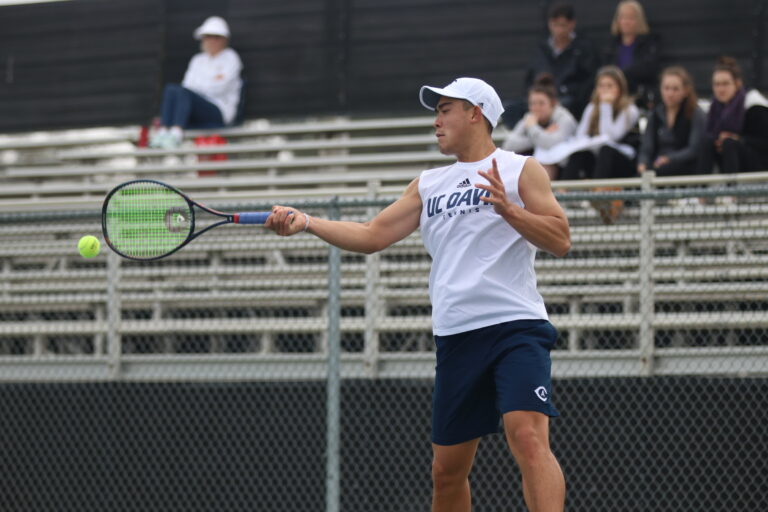
Following a 4-3 win over Santa Clara University, the UC Davis Men’s Tennis team was swept 4-0 by the Washington Huskies, handing the Aggies their first loss at home this season. 

UC Davis was playing without senior David Goulak this weekend, leaving the team without his usual influence at the top of most singles and doubles matches, while also moving several players up one spot in the lineup. 

The Aggies started off the match strong, taking the first doubles match, as freshman Andrei Volgin and sophomore Daniel Landa dominated their opponents 6-1. The pair won both of their doubles matches this weekend and only gave up one game in two matches. 

“We’re getting better at our doubles overall; this weekend was pretty good,” said Head Coach Eric Steidlmayer. “We ended up losing the doubles point today, but I actually thought we played pretty well.”

Washington won the second doubles match 6-2 over junior Dariush Jalali and freshman Andras Necz, so it was up to the junior tandem of Ivan Thamma and Chethan Swanson at the one spot to determine whether or not the Aggies would get the doubles point. 

After giving up a 5-3 lead to Washington’s Jack Davis and Alexis Alvarez, the Aggies forced a tiebreak which ultimately led to the Huskies taking the doubles point, giving them the lead 1-0 going into singles play. 

The Huskies maintained control in the singles matches and defeated UC Davis in the first three matches, taking every set and clinching the match 4-0. Washington took the first two singles matches 6-4, 6-3, first against Swanson and then across junior Arjith Jayaraman. The Huskies took the final match over Necz, 6-2, 6-3.

The three matches that were left unfinished were played by Thamma, Volgin and Jalali. Although Thamma struggled early in his match, falling 6-3 in the first set, he was able to come back and take the second set 7-5. The final set was just beginning when Washington clinched the match. 

Volgin offered one of the more compelling matches of the day, coming up from a 4-1 deficit to take his first set 7-5, and was down 2-3 in his second set when his match was also left unfinished. 

The energy levels of team members were definitely on display at this match, as there were consistent moments of celebration or shouting of praise for one another in between or during sets. 

“It’s something that we emphasize a lot,” Steidlmayer said. “The energy is good and I think they want to be good players, and they know they need to bring that to be a good player.” 

Sunday’s loss marked the Aggies’ first defeat at home this season, giving them a 4-1 record at home and 6-4 overall. 

Steidlmayer discussed the team’s success rate at the UC Davis Marya Welch Tennis Center, explaining that the fans “energize everything,” and that the team feels comfortable at home. 

As far as any improvements going forward, Steidlmayer believes being a good tennis player means “having great focus,” which is something he thinks the team can improve on over the next couple months. 

The Aggies split their road trip to San Diego this past weekend, falling 4-0 to San Diego State on Friday but rebounding with a clutch 4-3 win over UC San Diego on Saturday. Now it’s back to Davis to host the Golden State Invite, beginning this Friday.

Written by: Rain Yekikian — sports@theaggie.org


Fellini: 100 Years Later

An ode to the director of “La Dolce Vita,” master of absurdism 

Over the years, I’ve realized I’m a terrible person to watch movies with, which is especially problematic as someone who goes around calling themselves a “cinephile.” I can be prone to shouts and exclamations, but it’s at its worst when my excitement becomes incoherent. It’s usually Frederico Fellini, who would’ve had his 100th birthday late last month, that provokes this type of excitement. 

Despite him being a director so ingrained in the canon of film, one rarely hears much about Fellini. Gone but not forgotten, the bellissimo of his work lives on, and a retrospective of both the man and his accomplishments are long overdue. 

I first heard of Fellini from Adam Pfahler, the owner of the now-defunct but forever legendary San Francisco rental spot Lost Weekend Video. As one of the owners of the place, Adam seemed, to my 18-year-old self, the most knowledgeable man in the world when it came to cinema. He was also the drummer in a little band called Jawbreaker, which only added to his pedigree of “holy sh-t, this dude is sick.” Turns out, he was just a guy who really, really loved movies and had a passion for good art in any form. 

I like to say I was employed at Lost Weekend exceptionally briefly, but in truth, I just hung out there a good amount in its last years on Valencia Street, painting cabinets and pretending to understand what mise-en-scene meant. Those were some of the best years of my life, and ones that I liken to a Fellini film — selfishly dramatic, beautifully absurd and, more than anything, indulgent. 

I decided to jump back into things and throw on “La Dolce Vita,” a 1960 flick that was one of Fellini’s better known cinematic offerings, examining a journalist chasing the titular atmosphere throughout Rome. But immediately, I recoiled, for obvious reasons. The very act of “throwing on” something like “La Dolce Vita” was in itself already doing the film an injustice. I am aware of how much I sound like a first-year film major at NYU, but the point still stands — some of the beauty that comes with certain art is the circumstance one finds themselves in while engaging with it. Fellini, and “La Dolce Vita,” specifically, wafts with importance and demands precise attention. 

You may throw on something like “The Office” or “Parks & Rec” while you deal with the malaise of everyday life. But that is exactly the opposite of the world in which Fellini lives. The opening scene of “La Dolce Vita” is a testament to this: We see a helicopter flying over Rome, the pilot getting distracted by a bikini-clad belle donne all while the helicopter transports a giant statue of Jesus Christ. The world Fellini constructs is one of surrealism, but one that avoids pretension — for the most part. 

Instead, there is a freewheeling embrace of the absurd found throughout his work. Especially in “La Dolce Vita,” but deeply present in works like “La Strada” and “8½,” there is a love for the ludicrous, as well as the indulgent. In “Vita,” narrative structure is a reflection of this: seven distinct “episodes” are drawn for the viewer, with a prologue, intermezzo (intermission) and epilogue. 

The inclusion of an intermezzo is particularly fascinating. Is it a stylistic choice to let the story flow, or a directorial decision made because the audience simply couldn’t keep up with Fellini’s perceived vision and needed a break from such a cinematic masterstroke? With Fellini, one finds that the line of self-importance is carefully drawn and sometimes overstepped. 

But perhaps there is more insight here than appears at first glance. The chapter-esque structure of “La Dolce Vita” and other films like “8½” are eye-opening glances at how much Fellini’s work mirrors that of a storybook. Large swatches of characters, absurd situations and lessons layered throughout reflect the fable-like quality of Fellini’s films. Yet there isn’t anything childlike in his work, as most of his films have a run time of at least two hours and are shot in black and white with the aforementioned surrealism gleaming throughout. To watch something like that is to get lost in a world, one that is very much not about how things are but how things feel. 

For a long time, I have been on a quest to find meaning. I believe most people in college are as well, whether they are conscious of it or not. Film is one of the things — like any art form — that will never fully explain things to you. Instead, it gives one a compass to go and find out on their own. Fellini is a director who ignited a love for absurdism in me, and he also shows that sometimes it’s okay and even encouraged to indulge. We are, after all, simply searching for the sweet life. 

Written by: Ilya Shrayber — arts@theaggie.org

City rolls out concrete plans to crack Davis pothole problem

City’s new “Pothole Patch 2020” program combines online reporting and dedicated team to identify, fill potholes on Davis roads

On Feb. 11, the City of Davis announced the start of their Pothole Patch 2020 initiative — a newly formed four-person team of Public Works employees dedicated to the task of finding and filling local potholes, aided by an online community reporting system. 

The Pothole Patch team will address resident pothole reports on a daily basis, in addition to seeking out and fixing potholes independently. The crew has already filled hundreds of Davis potholes, according to a press release

“These rolling repairs are done without significant traffic impacts,” the release read. “In the past two months, the pothole crew has proactively patched over 400 potholes, and the City wants to continue this work with the public’s help.”

Community reporting is a central part of the city’s strategy to identify and fix as many potholes as possible, according to Barbara Archer, the City of Davis Communications Manager.

“We’re looking at this as [a] partnership with city residents — how we help can make our city better,” Archer said. “It has yielded great results.”

The city is encouraging Davis residents to report potholes directly via the city’s updated website. Residents can flag potholes for the crew to fix via the Pothole Patch online reporting tool by emailing reports to pwweb@cityofdavis.org or calling 530-757-5686. 

The program’s page includes instructions on what details to provide in the pothole reports.

“To ensure that the City’s pothole crew can locate each pothole, please provide specific information whenever possible: approximate size, where the hole is on the roadway (use nearest intersection), and if there is a nearby landmark or address that can guide the team,” the site reads. 

Archer said the city received only a handful of pothole reports from community members in the early days of the project. Once the city began promoting the program online, however, there was a significant uptick in resident reporting.

“The city has patched over 400 potholes, starting Dec. 19 to the present,” Archer said. “Some of those were resident-reported, but we were only getting about five to ten resident reports a week. Last week — because of our outreach with the press release and on social media — we got 55 resident reports.”

The Pothole Patch webpage features an FAQ section, discussing in detail how potholes will be filled with polymer concrete and tamped down by repair crews. This process can be performed in the cold months as well as the summer, according to the site. 

“The City of Davis Pothole Project Crew uses cold-patch asphalt repair,” the site read. “This is a quick, simple and cost-efficient fix.” 

The city’s outreach effort follows reports that Davis has some of the worst roads of any city in the region. A staff report presented to the city council during the Jan. 14 meeting highlighted the city’s urgent need for road repairs as well as the huge costs associated with the repairs. Archer, however, said the new program predates the most recent report. 

Davis streets scored an average of 57 on the Pavement Condition Index (PCI), a number between 1 and 100 assessing the general degree of wear on the road pavement, according to the January staff report. This ranking indicates that the average Davis street is in “Fair” condition, but the report notes a “clear downward trend” in the city’s pavement quality over the last decade. Bike path pavement has fared worse with an average 52 PCI rating. 

Davis’ PCI pavement quality ranks among the lowest for cities in the region. In a study, the roads of Woodland, Dixon, Winters, Sacramento and West Sacramento all scored higher on the PCI scale than those of Davis. The roads under county purview scored lowest of all in the area, earning an average “Poor” rating. 

The city set a goal in 2013 to achieve a PCI of 68 for major roadways, 65 for moderate-capacity roads, 60 for residential areas and 68 for bike paths — ratings that would put them in the higher end of “Fair” quality, according to ASTM standards. Improving Davis roads will be expensive, however, especially when added to the cost of fixing similarly degraded pavement on bike paths. 

“The analyses indicate that in order to meet the City’s target PCI values, the City needs to spend approximately $79 million on streets and $38.7 million on bike paths over the next 10 years,” the report read. 

Written by: Tim Lalonde — city@theaggie.org

UC Davis student-made wines could soon be on the market thanks to this California Senate Bill

20,000 bottles of student-made wine could enter market

State Senator Bill Dodd (D-Napa) introduced legislation that would amend existing laws to allow UC Davis to sell wine produced by viticulture students. A similar bill, Senate Bill 683, passed in 2016, aimed to grant licenses to university-associated nonprofit mutual benefit corporations to allow for the sale of wine, but that bill has yet to be implemented due to technicalities of the language. This most recently introduced bill would correct these technicalities.

Currently, UC Davis viticulture and enology students participating in VEN 124L, a winemaking laboratory class, have the opportunity to gain hands-on experience making wine. Samantha Sanchez, a fourth-year viticulture and enology major, explained more about how winemaking factors into students’ curriculum.

“We all get to make our own red and white wine batches over the course of the quarter,” Sanchez said. “We are given a ‘budget’ and can only spend as much as our budget allows in terms of changing protocol or running lab analyses.”

Students in VEN 124L have the opportunity to simulate tests done in the wine industry, choosing between running lab analyses or making different changes to their batches of wine. Part of the class helps students understand the financial components that go into winemaking. Students in VEN 124L make thousands of gallons of wine over the year.

“The wine is disposed of or saved in storage for research, depending on the head winemaker,” Sanchez said.

This bill would allow the state Department of Alcoholic Beverage Control to grant a special nonprofit sales license to a UC Davis nonprofit to sell up to 20,000 gallons of wine to corporations. From here, corporations would sell wine to winemakers who would be responsible for packaging and selling the wine to consumers. 

The State of California produced 248 million cases of wine in 2018, according to Discover California Wines. The 20,000 gallons UC Davis would hypothetically be able to sell translates to about 8,500 cases of wine per year.

Opposition groups, including Alcohol Justice, have spoken out about the bill, claiming it perpetuates binge-drinking culture. Carson Benowitz-Fredericks, the research manager for Alcohol Justice, commented further on the organization’s issues with the bill.

“We have always opposed colleges and universities from promoting alcohol consumption,” Benowitz-Fredericks said. “A significant number of people studying and living there are under the legal drinking age and therefore exceptionally vulnerable to harm from alcohol overconsumption. SB 918 strengthens an already questionable policy that undermines UC Davis’ mission to create a safe and healthy environment for its students. Sending the message that selling alcohol is an appropriate way to fund the university sends the message that alcohol is essential to a higher education.”

The UC Davis Viticulture and Enology Department will derive profits from the sale of student-made wines, all of which would subsequently benefit students. 

Dodd sees the department’s ability to make money from student-made wines as a positive, rather than a drawback of the bill.

“It’s a win-win situation that ensures students get to see their efforts come to fruition while supporting the program for future generations,” Dodd wrote via email.

Other universities, including Fresno State and Cal Poly, have organized similar arrangements and already sell student-made wine. Senate Bill 683 would apply solely to UC Davis.

A large part of students’ learning experiences involves making mistakes and learning along the way — and winemaking is no exception. 

“We’re all amateur winemakers, so the class isn’t graded on how good the wine is, but how well you understand the winemaking process and why your wine went right or wrong,” Sanchez said.

For this reason, UC Davis would ensure student-wine meets a certain quality before selling it. Other wines below this quality level would be sold as wine vinegar.

Students are working with high-quality grapes sourced from Napa Valley, on-campus vineyards and UC Davis’ Oakville Station Vineyard.

David E. Block, the chair of the Department of Viticulture and Enology, commented on other factors motivating efforts behind this bill.

“As the most sustainable winery in the world, it doesn’t make sense for us to be pouring our wine down the drain year after year,” Block said. “This will give us a much more sustainable means of disposing of our wine, and any income from the sales will be re-invested into our teaching, research and extension programs to help us help the California grape and wine industry.”

The UC Davis viticulture department is already actively involved in the wine industry, boasting a 40-acre research vineyard located in Napa. The Oakville Station Vineyard is also home to multiple research facilities, including the Harry E. Jacob Research Facility and the Robert J. Barone Laboratory. 

Written by: Ally Russell — campus@theaggie.org

Fast and studious: Autophiles find community in Davis parking lot

Davis Motorsports Club brings together all car owners, from Civic to Lamborghini

If you passed by the South Davis Safeway this past Thursday night you may have been perplexed to see a slew of students and adults chatting in an inconspicuous parking lot. What on earth could have brought this crowd here? 

Varying in age and background, they are united by one trait — a fervent passion for all things cars. Automobiles as diverse as their owners are packed throughout the lot — ranging from an oh-so-sultry sky blue Ferrari 458 Italia to a souped-up sleek black Toyota Supra.

Davis Motorsports Club, or DMC, the organizer of the meet, gathers motorsport enthusiasts from all over the Davis area to meet up, relax and, on occasion, head out to the track. 

For many of the members, high-octane fuel courses through their veins.

Michelle Ahn, DMC treasurer and a third-year biochemistry and molecular biology major, discussed how her affinity for automobiles is rooted in her family.

“I first got into cars when I would play Need for Speed Underground and GranTurismo with my older brother, my younger brother and my father,” Ahn said. “My father is also an exotics collector and kind of like a part-time dealer as well. He was also really into building model cars. Sunday afternoons, I would sit down and help him with those.”

Ian Phillips, DMC president and a fourth-year material sciences major, has also been ingrained in car culture for as long as he can remember. From an early age, he worked with his dad, fine-tuning and admiring the different cars that passed through the family garage. These included a highly coveted Mercedes that nearly made it to the distinguished Pebble Beach Concours.

“My dad was a car guy and he always had a big ol’ laundry list of cars that he had,” Phillips said. “His most important one was from the ’80s when he restored a Mercedes 190 SL.”

Off to the Races

DMC has been a part of the Davis community since the early 2000s. Russell Shigata, a DMC veteran who was involved during the club’s founding, discussed the organization’s racing roots.

“A long time ago, it was very different.” Shigata said. “We were much more motorsport-oriented and a lot of them focused on the auto crosses. Some people did the Lemons racing and there were typically a lot of track days. Afterward, we’d meet at a pizza place and talk cars.”

 In the early years, DMC was heavily influenced by the racing scene where they fine-tuned cars; pushing them to their limits. Shigata discussed the Davis area’s intimate connection with the 24 Hours of Lemons (not to be confused with the world-famous, prestigious 24 Hours of Le Mans). The racing series attracts teams from all over the U.S. The event’s trademark stipulation is that cars raced cannot cost no more than $500 at purchase, hence the name “lemons.” Teams consisting of a driver and their pit crew modify the vehicles for the track, and go racing.

“The 24 Hours of Lemons is a big racing series,” Shigata said. “Probably, the fastest growing racing series. They’re all over the United States and they’ve got several races going on every month. I’d say per capita, Davis has more race cars there than anybody else. It was insane. When I was doing it there were at least half a dozen teams there who had some association with Davis.”

 Shigata reflected on his time at Lemons. His team raced a late 1970s BMW 21, but modeled the German car after a Russian one.

“[The car] was called Emmerich, which was kind of ironic because it was modeled after the Moskowitz race car, which is the only successful Russian Rally Team.”

DMC Today

Since its origin, the spirit of the club has fluctuated greatly.

“Now it’s more like a car show type of thing,” Shigata said. “You know, you hang outside with your car and take pictures of all the cars and everything else. But it’s funny because it seems like every couple of years, the focus shifts depending on who’s in the club.”

Recently, DMC has seen an influx of international students who bring high-end exotic cars to the lot. 

“We’re starting to see that now a lot of international students who are a little more affluent,” Shigata said. “They can bring some really expensive hardware out here.”

Despite coming from opposite sides of the world, members find a special appreciation for each other and their machines.

“Everyone has every range of car,” Phillips said. “From a $500 civic that’s from the 80s to a Lamborghini Aventador. These people talk, and the person with the Aventador is like, ‘Sh*t, I love your Civic.’ And the Civic person is like, ‘Wow, I love your Aventador.’ It’s crazy how much how often you see that. The people with these with beautiful expensive pristine cars also love the grassroots movement.”

Fighting Stereotypes

Compared to DMC’s relaxed meets, the broader Central Valley is also filled with more rowdy car events.

“We call them organized takeovers,” Phillips said. “A whole bunch of people come and say we’re going to disturb traffic. Thousands of people will show up at a parking lot and you get this giant car meet. Then some guy yells over a megaphone, and everyone leaves at the same time. So 1,000 straight pipe loud cars all leave and run every light together. It’s really a mess. It’s extremely illegal.”

Unfortunately, takeovers — or sideshows as they’re referred to in the East Bay Area — have stigmatized car tuning practices. Both Phillips and Ahn were quick to distance DMC from this side of car culture.

“It screws over responsible car owners,” Phillips said. “The club has no affiliation to any of that. [Takeovers] put a tint on [car culture]. If a non-car person hears loud modified cars they might think of [these events] because that might be their only exposure as far as modified cars go.”

DMC combats these stereotypes; keeping their activities and interactions focused on the cars and not the mayhem.

Across disciplines

Many members of DMC are associated with a wide array of car-related ventures outside of the club. In addition to attending DMC events, Kenley Hendron, a third-year material sciences and engineering double major, is the composites lead on the UC Davis Formula-E racing team. Hendron discussed how being integrated into Davis car culture through DMC and beyond helps the team excel.

“Say I have to design some new component for the suspension of the race car next year, I come [to a DMC meet] and I’m talking to my friends and then I see that one of my friends has a different suspension setup. I’m like, ‘What suspension are you running? What makes it different?’ Then I’m like, ‘Oh wait, if this person did this on their car, maybe I could apply it to the mine,’” Hendron said. “It’s that interconnection — not necessarily just with DMC — that drives all of our innovation.”

Their collaborative free-wheeling spirit has served the team well in the past.

“We got fourth place overall out of 40 electric car teams I believe,” Hendron said. “That’s competing against schools like MIT, Caltech and Carnegie Mellon where we are basically the underdogs.”

For many autophiles, cars are not only an engaging hobby, but a unique way of life that shapes their perspective. Their problem solving mindset helps build critical thinking skills that apply to other pursuits.

“I’ve talked to CEOs and VPs of large Fortune 500 companies, and they say that they like hiring car people because they know their mindset,” Phillips said. “They know that they work well in teams, think through problems and troubleshoot.”

Despite the many benefits of working on cars offer, perhaps the foremost is a gateway into a flourishing community. 

“It doesn’t really matter who you are.” Hendron said. “Cars are something that brings everyone together.“ 

Written by: Andrew Williams — arts@theaggie.org

Player Spotlight: Sara Tsukamoto

UC Davis Women’s Tennis’ top singles player gives insight into athletic career

Third-year design major Sara Tsukamoto is a force on the UC Davis women’s tennis team in both doubles and singles. The Kailua, Hawai‘i native began playing tennis at the age of three, following in the footsteps of her mother and her siblings. But it wasn’t until the age of nine that Tsukamoto began getting serious about playing. 

A four-star recruit, Tsukamoto was ranked No. 113 in the nation and No. 3 in the state of Hawai‘i when she was recruited out of high school. As a freshman at UC Davis, she ended her first season with an undefeated 4-0 record at the number three doubles spot with her partner, senior Nikita Pradeep and a 11-0 record as the number five singles player. By her sophomore year, she posted a 13-11 overall singles record, playing mostly at the number two spot and was awarded a Big West Conference Honorable Mention for Singles. 

The California Aggie sat down with Tsukamoto to discuss her start in tennis, how she manages her time at UC Davis and her collegiate career so far.

The California Aggie: Was tennis a family sport for you?

Sara Tsukamoto: Yeah — my mom played. My dad likes to say he played, and I don’t think he did that much. And then my sister actually played all throughout her years up until high school. She was really good in high school, but she just didn’t play in college. And then my brother also played. So yeah, it was definitely a family sport.

TCA: What made you decide to continue playing tennis in college?

ST: I just love playing tennis every day. And I definitely wanted to keep playing once I graduated high school. So I wanted to choose a school that was good at tennis and academically, and UC Davis was just like the perfect fit for both.

TCA: How do you manage your busy schedule as both a tennis player and a design major?

ST: For me, what works is I just like to use my planner and just schedule things out. So for example, I don’t have class on Monday. So I’m like, “Okay, Monday morning I’ll practice [individually] all morning and then also do practice with the team. And then after practice, I’ll go home and just study.” So I just make plans like that to find a balance between both.

TCA: Can you talk about your experiences as a design major and how you’ve liked the program?

ST: I’ve recently just switched into the design major. It’s been difficult at times because design has a lot of studio time, which is like a three-hour class period. So it’s either from 1-4 p.m. or 9-11:50 a.m. So that sometimes interferes with practice. But other than that, it’s been a lot of fun. Right now I’m taking classes towards textile design. So we do screen printing and a lot of stuff on Adobe, which is really fun. It’s fun to see what you can make.

TCA: How did you get into design?

ST: Funny thing, my dad was actually a product design major, I think, so he was telling me about it, and I just liked creating stuff and the creative side of design. So I took Design 1 in the fall my sophomore year, and I really liked it. I just started taking more design classes, and I just got really into it. So I was like, “Might as well just be a design major.”

TCA: Looking forward, what do you hope to do after graduating college?

ST: What I hope to do is work for an athletic company to work on textiles and stuff like that. Kind of related to fashion, but also, including textile design and patterns. Like [working for] Lululemon or Nike — that would be really cool.

TCA: You’ve been playing pretty well recently. Overall, how have you been feeling this season?

ST: I’d say I’m definitely doing a lot better than my previous years. I know I’ve been starting off rocky — definitely my freshman year and my sophomore year. But I think playing number one this year, I have to be solid in order to win. So I think I’m just focusing on staying relaxed and playing my best because you are playing the best players from each school, so you can’t really expect to win every match. But as long as you just try your best you’ll get good results.

TCA: How do you think you’ve changed athletically over your three seasons with the team?

ST: I would just say I think I just realized, “Okay, I need to buckle down during the season.” Instead of focusing on so many other things, I just need to focus on school and tennis and some extracurricular activities in order to do well in both school and tennis.

TCA: What are you looking forward to for the rest of the season? What are your goals both individually and for the team for this season? 

ST: I think our team goal is definitely to win all of our conference matches and hopefully win conference. I know some of the girls are injured or we have girls sitting out, so definitely when everyone can get back on the court, I know that we’ll definitely do a lot better and we’ll be a really good team. I think [Lauren Ko] and I — my doubles partner — we’re a really good team. So I’m hoping that we could definitely get ranked this year. So that’s one of my goals for doubles. And then for singles, hopefully get ranked or just have an overall good winning record after season.

Tsukamoto and the rest of the UC Davis women’s tennis team will be back in action at home this weekend when they take on CSUN on Saturday at 11 a.m. and UC Irvine on Sunday at 10 a.m. 

Written by: Priya Reddy — sports@theaggie.org

UC Davis student tests negative for coronavirus

Three students released from isolation following negative test result

A UC Davis student who had been isolated after showing flu-like symptoms has tested negative for coronavirus. Following the test results, the student and the student’s two roommates were removed from isolation.

UC Davis officials released a statement early Saturday evening updating the community on the recent development.

“Yolo County Public Health notified staff this afternoon (Feb. 29) that the UC Davis student who was quarantined and tested for COVID-19 had a negative result,” the statement read.

Despite the negative result, UC Davis is still encouraging students to practice safe hygiene to protect against illness.

“Student Housing and Dining Services will maintain its intensified cleaning program,” the statement read. “The campus continues to recommend individuals practice proper hand-washing and other good hygiene.”

On Thursday, representatives from the Davis community and Yolo County held a press conference to inform the community that three students were in isolation over concerns of the coronavirus. According to Dr. Ron Chapman, a Yolo County health officer, the Center for Disease Control (CDC) only tests samples for coronavirus virus at one location in the U.S., which is why it can take a few days to know the test results.

“Unfortunately, there is only one testing place in the United States, and it is in Atlanta, Georgia at the CDC,” Chapman said. “At this point in time, we’re usually looking at three to four days to get the results back. The CDC is doing hundreds of tests from all over the county.”

In a statement emailed to UC Davis students following the press conference, Chancellor Gary May encouraged students to stay calm amid the recent panic about the spread of the coronavirus in the U.S.

“While the progression of COVID-19 is still emerging, the CDC is reporting that for the general American public, who are unlikely to be exposed to this virus at this time, the immediate health risk from COVID-19 is considered low,” May said.

Written by: Madeleine Payne — city@theaggie.org