55.5 F
Davis

Davis, California

Tuesday, December 23, 2025
Home Blog Page 362

Over fifty-four UCSC strikers notified of dismissal for continuing to withhold Fall Quarter grades

UC files unfair labor practices claim with state against union, UAW Local 2965 files counterclaim against UC

Fifty-four graduate students at UC Santa Cruz who are part of the Cost of Living Adjustment (COLA) movement were notified on Feb. 28 that they will either not receive Spring Quarter appointments or that they will be dismissed from appointments for spring if they have received an appointment. 

This notice came in the form of a Notice of Intent to Dismiss

Over 30 other graduate students reportedly also received a one-sentence email letting them know they would no longer be under consideration for or receive appointment to teaching assistant, graduate student instructor, tutor or reader positions for Spring Quarter.

These actions come on the heels of the continued withholding of Fall Quarter grades by graduate students participating in the COLA movement through Feb. 27 — a date designated by UCSC External Vice Chancellor Lori Kletzer. Kletzer had previously said the administration would check if grades were submitted by Feb. 27 and, if they were not, consequences — possibly including termination — would be enforced. That date was originally set for Feb. 21, but it was extended to Feb. 27.

“We have been left with no choice but to take an action that we had truly and deeply hoped to avoid,” Kletzer wrote in a Feb. 28 email to the UCSC community. 

The COLA movement began in November as graduate students became increasingly frustrated with their attempts to negotiate with UCSC administration. In December, some graduate students went on a grading strike without the permission of their union, United Auto Workers (UAW) 2865. It escalated on Feb. 10, when strikers stopped all university labor. Graduate students supporting a COLA at UC Santa Barbara are now on their own full strike, as of Feb. 27. 

The UC filed an unfair labor practice charge against the graduate students’ union on Feb. 26, alleging that the union supported the graduate students’ strike. UAW 2865 responded in a statement, saying that the strike was not organized by the union or authorized by a vote of union members, and that the UC’s charges were “duplicitous.”

UAW 2865 then filed its own unfair labor practice charge against the UC on Feb. 27 that said the UC refused to meet with the union to negotiate a COLA, instead trying to engage in “unlawful” bargaining with individual graduate students and university-funded organizations, such as the UC Graduate and Professional Council (UCGPC).

UCGPC refused Napolitano’s Feb. 21 offer to meet to negotiate a COLA in a Feb. 22 statement. According to UCGPC’s president, Connor Strobel, UCSC is the only UC that has not ratified the UCGPC charter, leaving the university without a representative on the UCGPC board.

“Despite UCSC electing not to have a board member, we remain committed to amplifying the concerns of graduate students at every campus,” Strobel said.

UAW 2865’s president, Kavitha Iyengar, said in a Feb. 28 statement that the union stood in solidarity with those terminated at UCSC.

“The union will keep demanding that UC come to the table and bargain to provide a cost of living adjustment for 19,000 ASEs,” Iyengar said. “And we will keep organizing, keep holding actions, and keep speaking up until all of us are paid fairly for our work.”
Calls for action have been increasing on other campuses. Polls to gauge graduate student support of a wildcat strike at UC San Diego, UC Irvine and UC Berkeley have begun circulating as of Feb. 26. International colleges, unions and professional associations have also expressed support and solidarity for the movement. Senator Bernie Sanders (I-VT), in a Feb. 28 tweet, called the firings “disgraceful” and called for Janet Napolitano and UCSC to “stop this outrageous union busting and negotiate in good faith.” 

Undergraduate support for the strikers at UCSC, however, has diminished.

Though striker Angie Sijun Lou, a literature graduate student at UCSC, called the undergraduates at Santa Cruz the “backbone of the movement” in a previous interview with The California Aggie, the disruption of a computer science midterm on Feb. 27 caused undergraduates on Reddit to express their anger and frustration

“Our intent was to invite STEM students, many of whom have been hesitant to join the picket line, to learn about the history of radical activism at UCSC,” a representative from UCSC’s COLA movement said about the disruption on Reddit. “We hope you will engage with us to help us learn from and repair this misstep, and do better in the future.”

The representative also said that the disruption, which reportedly lasted around 10 minutes, was led by an “undergraduate ally” of the movement and that those who disrupted “did not know there was a midterm beforehand.” 

UCSC STEM graduate students published a Feb. 29 statement on the firings, calling themselves “disgusted” and “enraged” at the administration’s decision and “de-facto deportation of striking international graduate students.” 

As of writing, their statement said at least 212 STEM graduate students in eight STEM departments have pledged to refuse teaching assistantships in Spring Quarter in the wake of the strikers’ dismissal.

“Instead of firing the people who dedicate their lives to the mission of education and research at UCSC, we demand that you resolve this strike,” the graduate students behind the statement wrote.

Strikers at UCSC are calling for a “day of action” on March 2 in solidarity with those fired. UC Davis will be holding an emergency rally that day at the MU.

Graduate students supporting a COLA at UC Davis began their own wildcat grading strike on Feb. 27. They are withholding Winter Quarter grades except under select circumstances

In an email Feb. 29 responding to an inquiry from The California Aggie, Melissa Lutz-Blouin, the UC Davis Director of News and Media Relations, said the administration has made no formal commitments at this time with regard to the movement’s demands.

UC Davis Provost Ralph Hexter sent a letter on Feb. 27 to the graduate community at UC Davis reminding them that “UC Davis graduate students are a valued and integral part of the university community” and that under their UAW 2865 contract, they could not engage in “any activity that directly or indirectly interferes with university operations while their contract was in place.” 

In response, the UC Davis graduate students behind the COLA movement published a statement on Twitter that said they would strike until their demands were met.

“Their [the administration’s] letter today merely another confirmation: the university does not care about us,” the statement said. “Instead of hindering undergraduates, this grade strike reminds us that this is our university.”

Written by: Janelle Marie Salanga — campus@theaggie.org

Editor’s Note: This article has been updated to include additional information released after the initial time of publication.


February honors heart health, brings awareness to nation’s leading cause of death

Three heart scientists speak on importance of this month

As February comes to a close, so does American Heart Month, which spans the entirety of February, giving doctors, friends and families the perfect opportunity to continue or start the conversation of heart health and what it entails. President Lyndon B. Johnson first proclaimed the designation of the month in 1964, inspired by his personal experience with heart disease. Since then, every president has declared February as Heart Month each year to bring awareness to the nation’s leading cause of death and a major public health issue in the U.S.

Heart disease is a catch-all phrase for a mix of conditions that can affect the heart’s structure and function. Someone dies every 37 seconds in the U.S. from heart disease, according to the Center for Disease Control and Prevention

Often heart disease can be “silent” with little to no symptoms, which can result in someone not being diagnosed until they experience clearer symptoms like a heart attack, heart failure or an arrhythmia. These symptoms are far more severe, highlighting the importance of knowing your risk factors. 

“It is my hope that everyone, regardless of age, will take time in February to learn their risk factors and talk with family members about if and how heart disease has affected them,” wrote Javier Lopez, a cardiologist, via email.

The main factors to monitor are blood pressure, blood sugar, cholesterol and weight, along with eating and physical activity habits. Maintaining healthy levels of all of these factors is vital in preventing the development of heart disease. If people start analyzing their own lifestyle habits and speaking with their doctors about their risk of heart disease, earlier prevention can occur. Understanding your own risk for heart disease is crucial to improving your heart health, and is an important first step to addressing this illness. 

“I also hope everyone discusses their risk factors with their doctors, who are their partners in monitoring and reducing their risks of heart disease,” Lopez said. “Those conversations can truly promote long and healthy living without chronic diseases.”

  Additionally, advances in medicine and diagnostic methods have improved cardiologists’ ability to detect and treat heart disease. At one point, the best treatment method was surgery. Now, there are many other treatment options which can be catered to each patient’s specific needs. Improvements in medications that prevent hypertension and high cholesterol are reducing symptoms and decreasing the risk of heart attacks or strokes. 

Basic science research that studies the functions and structure of the heart has tremendously increased the understanding of heart disease. Luis Fernando Santana, a professor and chair of the Department of Physiology and Membrane Biology, is studying calcium channels in the cells of heart arteries. The amount of calcium that passes through the calcium channels can affect the constricting of the arteries. When arteries are constricting more often, hypertension may be increased, which results in high blood pressure, a risk factor for heart disease. 

Santana’s research focuses on a very basic mechanism of the heart and he has discovered that there are key differences in how the calcium channels function in men and women. By better understanding these differences, medicine can be catered to men and women. 

“We want to learn about general biological concepts by studying male and female and by the process provide better treatment,” Santana said. “We learn something very fundamental but then can apply that to medicine.”

Scott Simon, a professor of biomedical engineering, strives to understand the early stages of atherosclerosis, the buildup of plaque in the arteries. The Scott Lab conducts research on the way lipids in the bloodstream enhance inflammation and has found that high levels of lipids trigger an inflammatory response, which sends out innate immune cells to repair damage. The lab wants to know the way monocytes, a type of innate immune cell, effect plaque buildup in the arteries and, in turn, increase the chance of atherosclerosis. Simon hopes to ultimately develop more effective medicine. 

“It would be great to develop therapeutics,” Simon said. “We try to understand things at the most basic molecular level and through using the mechanism we have learned we want to design better drugs.”

Santana and Simon’s research is helping advance medicine and the tools available to doctors. It is especially important to have basic science research focused on better understanding the differences in sexes as that will allow for more effective treatment methods, according to Santana. 

The deaths due to heart disease are declining, but Lopez, Santana and Simon all agree that increasing awareness is vital to reducing heart disease. Only one month is dedicated to this issue, but it is important to take what is learned in this month and continue the conversation throughout the whole year. 

“Awareness of where you are with your own risk factors is a prerequisite to mapping your personal goals for maintaining or improving your heart health,” Lopez said.

Written by: Alma Meckler-Pacheco — science@theaggie.org 

Aggie baseball stays hot with second series win

Arenado’s walk off propels UC Davis to 5-3 start

The UC Davis baseball team is off to a hot start and hastily building confidence two weeks into the 2020 season. 

The Aggies are getting contributions from up and down the roster, regardless of age or experience, and have played themselves into an early winning run at Dobbins Stadium. 

UC Davis took three out of four games against North Dakota State over the weekend, culminating in a doubleheader sweep on Saturday afternoon and a dramatic 3-2 comeback win in the nightcap.

Trailing 2-1 for the majority of the game, the Aggies found themselves five outs away from defeat when junior shortstop Tanner Murray stepped up to the plate, representing the game’s tying run. Murray promptly drilled an 0-1 pitch nearly 400 feet and over the fence in straightaway left field, sending the home dugout into a frenzy. It was a huge sigh of relief for UC Davis who had failed to reach base in its previous 10 at-bat’s, starting all the way back to the fifth inning. 

“We were struggling in that second game to put a good offensive approach together,” said UC Davis Head Coach Matt Vaughn. “Tanner gets the big swing and it kind of wakes our guys up a little bit and then we started having some quality at-bats and luckily it wasn’t too late.”

In the bottom of the ninth, the Aggies put runners on the corners after a walk and throwing error. Redshirt-sophomore third baseman Kyler Arenado lined a walk off RBI single to right-center field, sending everyone home happy. The entire Aggie bench bolted out of the dugout to mob Arenado, as a big celebration commenced in shallow center field. 

The Aggies stand at 5-3 after two weeks of play, grabbing series wins over Utah and North Dakota State and falling to USF in between. 

The biggest question heading into the season was the Aggie pitching staff and its ability to give the team a chance to win every time out. So far, a quartet of freshman hurlers — Kaden Riccomini, Zach Carrell, Nate Freeman and Kai Janowicz — has given the team a big boost and provided quality innings, especially in middle relief. 

“It’s exciting when those freshmen can build a little confidence and start figuring out ‘Hey I belong here,’ and now you can start doing some really good things,” Vaughn said. 

In Thursday’s series opener — a 6-2 victory for the Aggies — Freeman came out of the bullpen and finished off the victory with three and a third no-hit innings and three strikeouts. 

Riccomini got the start on Friday and was roughed up in a seven-run first inning, giving up four earned runs. But the young right hander battled out of it and went another three scoreless frames before exiting. This was a critical performance for the Aggies, who needed to conserve their arms in advance of the doubleheader the next day. 

Carrell was a key contributor in the final game of the series, throwing three and a third scoreless frames in the middle innings to keep the Aggies within striking distance before their late comeback. Janowicz pitched a scoreless top of the ninth, setting the stage for the dramatic finish in the bottom half. 

“Carrell was awesome,” Vaughn said. “He was pounding the zone and only got behind one guy in that whole time.”

Overall, sophomore Jake Spillane has emerged as the ace of the staff so far, allowing just 10 hits in 13 innings of work and winning both of his starts. He cruised through seven strong innings in the first game of Saturday’s doubleheader, striking out seven and giving up two runs. 

Defensively, UC Davis has been sturdy at every position, committing just one error in eight games. Although that one mistake led to three unearned runs in Friday’s 7-4 defeat, UC Davis has been as dependable as expected in the field. 

“We’re a solid defensive team and if we just throw strikes we’re always going to have a chance to win games,” Vaughn said.

At the plate, the Aggies have a half dozen players hitting above .300 and the top of the lineup has picked up right where it left off last season. Redshirt-junior designated hitter Spencer Gedestad has been a mainstay in the heart of the lineup with 11 hits and a .407 average. Elsewhere, players such as sophomore Jalen Smith, redshirt-junior Alejandro Lara, redshirt-senior Logan Denholm and Murray are consistent threats every time they step into the box. 

The Aggies will continue their non-conference schedule with three more home series over the next four weekends, starting with Loyola Marymount University on Friday. The team is already making strides on the diamond thus far and hopes to keep the momentum rolling before Big West play begins at the end of March. 

Written by: Brendan Ogburn — sports@theaggie.org

Record number of Greek organizations have recognition revoked after hazing incidents

Pending investigations underway, call for culture shift from CSI, OSFL

Since November 2019, three Greek organizations on the UC Davis campus lost their recognition with the Office of Sorority and Fraternity Life (OSFL) and their Registered Student Organization status after incidents involving hazing — a record number since 2005. Sigma Mu Delta, Delta Sigma Pi and Zeta Psi were placed on the Revocation of Registration for at least five years. 

Aside from these three organizations, three other organizations – Theta Tau, Alpha Epsilon Pi and Sigma Lambda Beta – are pending an investigation with the Office of Student Support and Judicial Affairs (OSSJA) due to misconduct.

None of the Greek organizations mentioned above responded to a request for comment before this article went to press.

“My pledge process was mentally and physically draining as well as time consuming,” a recent pledge of one of the revoked organizations said. “If we didn’t follow conduct, we would get some sort of physical punishment — push-ups, sit-ups, planks, squats. We also had to memorize a load of information and recite or else we would get yelled at along with some sort of physical punishment.” 

This pledge also explained that although they were given time for academics, they were usually kept out past midnight while pledging. 

“The entire process was basically rigged so that the pledges would have to endure a lot of physical and mental strain,” the pledge said. 

Another pledge from a different revoked organization recounted coming home with scrapes on their knuckles from push-ups and ingesting an unknown concoction of mixed drinks for not following conduct.

OSFL hosts mandatory prevention education sessions for members of Greek life — such as alcohol risk and reduction, social justice essentials, hazing and sexual violence and assault — in an effort to prevent these kinds of issues.

Director of the Center of Student Involvement Kristin Dees and OSFL Assistant Director Valerie Lamarre-Laurent maintain that they reiterate university expectations during prevention education for new and current Greek life members, at quarterly meetings with each chapter president and at community meetings. 

“Prevention education introduces new members to the culture that we would hope and expect the chapters on this campus to adhere to and follow,” Dees said. “If you don’t see that [expectation] followed, the bystander and upstander intervention really speaks to different ways on how to share information.”

Over the course of the year, the groups are required to have a total of 80% of their members attend prevention education sessions and misconduct training. If a chapter does not meet the requirement, a warning is issued and the group has a short period during Fall Quarter to fulfill the requirement or face registration revocation. So far, all fraternities and sororities have fulfilled the requirement.

In regards to hazing reports, Dees and Lamarre-Laurent explained that their roles focus on prevention efforts, while OSSJA oversees disciplinary action. Students are able to report incidents of hazing that will be reviewed and investigated by OSSJA, according to the OSFL website. 

“The university provides organizations, including Greek letter organizations, with written notice about alleged violations and an opportunity to respond,” said Donald Dudley, the director of OSSJA. “The length of the process prior to making a decision can depend on the information that OSSJA gathers and reviews. I won’t comment on any particular cases, however, since this is the first year in which OSSJA has reassumed responsibility for RSO conduct. We are determining how to best manage these investigations into our caseload.”

Nathan Kushner, president of the Interfraternity Council (IFC) at UC Davis, said that the IFC follows policies against hazing.

“IFC here at UC Davis has a very strict policy against hazing adhering to UC Davis student organization policies and the North American Interfraternity Conference (NIC) guidelines,” Kushner said via email. “Any reports of hazing I have received or will receive are sent directly to Student Judicial Affairs. My board does not personally handle any hazing conduct, we simply respect and enforce all sanctions handed out by [OSSJA].

Members of some Greek organizations that are currently under investigation mentioned the lack of transparency and communication from OSFL and OSSJA during investigations. 

“There has been practically no communication on OSFL’s end as well as [OS]SJA’s end, so we’re kind of in the dark,” said an executive board member of one of the Greek organizations about the investigation process. “Some of the allegations are baseless and sort of unjustified. I can understand why they’re not making everything transparent to protect those who have made allegations, but I feel like it’s a ‘guilty until proven innocent’ kind of thing which is really frustrating.”

In the midst of the misconduct investigations, some members expressed that their pledging process taught them time management and helped them to bond with other pledges.

“I would not consider anything I did a form of misconduct, because we were allowed to drop out of the process at any time without question,” a recent pledge said. “We all knew what we signed up for and we were all prepared to go through with that process.” 

Dees noted, however, that the Greek community nationwide needs a culture shift.

“I think Davis is a piece of that larger community and anytime you are trying to shift and change a culture that has embedded traditions that need to be changed, everyone would love it to go faster than what is reality,” Dees said. “It’s going to take time and we wish it would go much faster, but we are doing the proactive and preventive education that we have set in place and we are excited to see some of the results of those as time goes on.” 

Dees also highlighted that the prevention education program was introduced three-and-a-half years ago by OSFL as a requirement process for the Greek community. 

“I think the recent suspensions are part of the problem, but I also think part of it is that folks are aware of the policies that are being violated which is why things are coming up as opposed to not realizing that there are issues,” Lamarre-Laurent said. “The more that we do education, the more folks are aware of what should and should not be happening.That’s pretty on target with what happens when you are doing increased education around high-risk behavior.” 

Written by: Graschelle Fariñas Hipolito — campus@theaggie.org

Call for increased support for ASUCD Refrigerator Services voiced at Feb. 13 Senate meeting

Crystal Juarez sworn in as interim senator

ASUCD Vice President Shreya Deshpande called the Feb. 13 ASUCD Senate meeting to order at 7:08 p.m. The meeting began with presentations from Student Health and Wellness and the Club Finance Council. 

During elected officer reports, each senator focused on spreading the word about the upcoming elections, which took place from Feb. 18-21, before the publication of this article. Senator Shondreya Landrum emphasized her efforts to inform Panhellenic organizations and Senator Mahan Carduny suggested reaching out to Camp Kesem, efforts that were intended to reach a large swath of students. 

Senator Khalil Malik reported his upcoming efforts to increase support for ASUCD Refrigerator Services. Currently, first-year students can rent miniature refrigerators and microwaves for $60. Malik noted that the revenue generated by ASUCD Refrigerator Services provides funding for a variety of student services, yet it does not receive appropriate resources nor support. 

Fourth-year student Crystal Juarez was sworn in as an interim senator. Following her confirmation, she sat on the board for the remainder of the meeting and will contribute to ASUCD decisions for the upcoming month. 

Senate Bill #25, which redefines the External Affairs Commission, was passed by the board. SB #27, which was authored by ASUCD President Justin Hurst, was also passed. SB #37 allows for a more flexible interviewing process in ASUCD hirings. The previous ASUCD Constitution required rigidly specific interviewing requirements, and Hurst’s SB #37 would amend the constitution to require fewer members to be present, which has previously been problematic due to conflicting schedules. In response to the bill, Controller Kevin Rotenkolber emphasized the importance of releasing ASUCD vacancies before the quarter begins in order to avoid interviewing fiascos. 

The highlight of the night, however, was the consideration of SB #31, the Basic Needs and Services Referendum. The Senate passed the bill, allowing for the referendum to be placed on the Winter Quarter ASUCD Elections ballot. Senator Juan Velasco requested a roll call vote. Nine senators voted in favor and three abstained. The abstentions came from two absent senators and the abstention of Senator JB Martinez. The passage of SB #31 prompted applause throughout the Senate floor.

Finally, the board extensively debated Constitutional Amendment #67. Hurst intended the amendment to be a “backup plan” in case the fee referendum did not meet the 20% minimum participation threshold for its results to be considered valid. Hurst explained that it would allow for the future ASUCD Senate to create two budgets, including a 10-year plan for ASUCD budget reconstruction and a complete dismantling of ASUCD. However, CA #67 generated disagreement among senators over the 10-year plan wording. Kyle Krueger, chair of the Environmental Policy and Planning Commission, suggested changing the wording to “long-term plans” instead. Senators Andre Spioglio and Camille Randolph, Rotenkolber and Deshpande agreed that CA #67 is inappropriate considering that the fate of Basic Needs and Referendum was still unknown at the time. Rotenkolber emphasized that the idea of presenting anything contrary to the referendum on the ballot is concerning. 

ASUCD External Affairs Vice President Adam Hatefi responded in defense of the 10-year plan. Hatefi insisted that the 10-year plan is a solid preventative measure, and that ASUCD “should not give anyone from administration any ground to affect ASUCD.” In an initial roll call vote, CA #67 failed to pass. The table decided to amend the wording, and CA #67 passed. 

Since this meeting took place, both the Basic Needs and Services Referendum and CA #67 were approved and passed by voters.

The meeting was called into a closed-session at 11:17 p.m. 

Written by: Hannah Blome — campus@theaggie.org

An anomaly: Jye Citizen owns his individuality, launches lifestyle and clothing brand

More than just t-shirts, Anomaly SCF is a creative space that empowers community

“I found myself always being an anomaly, I guess you could say just being the only African American or one of the few… that’s kind of where the idea of Anomaly came from, being my own individual, creating my own lane.” 

Anomaly SCF is not just a clothing brand, but a lifestyle for third-year managerial economics major and Jye Citizen. Last year, Citizen met with his mentor, Markell Johnson — founder of the fashion brand Rare — and together, they laid out ideas of what Citizen wanted his brand to be: a creative space. 

“Anomaly is a brand that I hope will spark creativity and individuality through whoever comes in contact with it,” Citizen said. 

Anomaly began as a space for Citizen’s writing, inspiring the creation of a blog, podcast and clothing line. The brand’s full name, Anomaly SCF, stands for Anomaly Stone Cold Fool, after a phrase Citizen’s grandmother used during his childhood. 

Citizen hosts the podcast “Forever Loading” with his UC Davis men’s soccer teammate Kameron Carey. The podcast is focused on hip-hop and pop culture. The blog covers sports, music, fashion and poetry, as well as how to balance being a student, business owner, athlete and creator. 

“I just try to let my creative juices flow,” Citizen said. “This is where I get to release my ideas.” 

Carey, a third-year design major, brings Citizen’s ideas to life using the Anomaly platform to test out different designs. Both are influenced by their own senses of fashion — Citizen’s personal style being a mix between a “Fresh Prince of Bel Air” Will Smith and Chance, the Rapper.

The two recently launched their Black History Month long sleeve t-shirt. 

“I remember exactly when the idea came to me,” Citizen said. “I was watching an episode of ‘That’s So Raven.’ It was a Black History Month episode. They were trying to teach us about important [historical] figures that may have gone under the rug a little bit.”

Citizen had also recently watched — and was inspired by — “Hair Love,” the animated short film that won an Academy Award this month. After collaborating with Carey, the pair settled on the idea to combine the power of words with the power and symbolism of Black hair. 

“I wanted to put the important people in history in the hair,” Citizen said. “And the tagline is “know your roots,” which is the roots of being important to Black history, as well as the power of Black hair.”

The tee features Black and African American icons Muhammad Ali, Dr. Martin Luther King, Jr., Harriet Tubman, Madam CJ Walker, Robert Abbott, Langston Hughes, Katherine Johnson, President Barack Obama, Colin Kaepernick, Jesse Owens, Maya Angelou and Malcom X. 

Within the afro on the tee, there are what looks like quilting squares and stitching — meant to represent the movement toward freedom and equality.   

“It reminded me of a quilt and how each historical Black leader has built on the other, coming together as one, building onto [progress], like a quilt,” Carey said.  

To promote the new design, Citizen held a photoshoot with different UC Davis students, all of whom are Black and African American, wearing the shirt in its four available colors: maroon, green, yellow and white. 

“There’s kind of like a feeling of fulfillment in my idea coming to fruition,” Citizen said. “And I have a lot of friends saying Black is beautiful. So it was a feeling of fulfillment [and] joy, knowing that I’m gonna be able to put [my message] out and teach people that they are beautiful and that they should be happy in their own skin.”

Both Citizen and Carey commented on the misconception that products from a Black-owned business aren’t for everyone. Anomaly’s mission and message are for anyone who identifies with being an anomaly. Carey noted that his involvement in the organization taught him the power of inclusivity around a common theme. 

“If you’re confident enough to purchase a Black History Month shirt, that’s more power to you,” Citizen added. “We appreciate any and all support we can get. My brand is for everybody.”

Citizen’s focus is on building his business to a point his ancestors would have considered successful, which is why he has focused his business’ purpose beyond turning a profit — giving back to his community. Ten percent of Anomaly’s proceeds go toward underfunded schools. Beyond this, Anomaly hopes to inspire youth, promoting the message that their differences make them unique and should be celebrated.

“Being the anomaly reminds us that it is more than okay to be ourselves,” said Kaleb Schirmacher, a third-year neurology physiology and behavior major who has purchased clothing from Anomaly.

Citizen is currently in the process of designing his spring and summer collection, which will be available on www.anomalyscf.com/shop. More content can be found on Instagram (@anomalyscf_). 

Written by: Liz Jacobson — arts@theaggie.org

Across the aisle: Club leaders discuss elections, predictions for primaries

0

On-campus voting for state primaries will take place March 3 in the Garrison Room, from 7 a.m. to 8 p.m.

With the escalating race for the Democratic nomination and the upcoming Democratic primaries in California, students who registered Democratic face the task of sorting through campaign advertisements and biased and unbiased news sources to make an informed decision when voting. 

This is no easy task, according to Brooke Pritchard, a third-year political science major and president of Davis College Democrats (DCD). 

“I just think the most important thing in voting is making sure [of] the information you get,” Pritchard said. “Every news [source], no matter how factual you think it is, everything has a bias. I just want people to crosscut those ideologies, […] things that have historically been a binary and try to deconstruct that.”

Even if students do not vote in the primaries, the fluctuating popularity of the Democratic candidates and the states of the two major political parties is of interest to many Davis students. This includes Noah Dickman, a fourth-year economics and political science double major and president of Davis College Republicans (DCR). 

“I have never seen a political party try so hard to lose an election,” Dickman said, referring to the Democrats. 

Politics as usual?

A large portion of politically-inclined individuals feel that the two major political parties are becoming more polarized, each moving further away from a moderate agenda. DCD and its members reflect the changing views of the Democratic party, according to Pritchard.

“This has been an organization that’s lasted over a decade,” Pritchard said. “Definitely at the start, they were more moderate, and now we’re transitioning to leaning further left. I feel like Bernie Sanders has really changed the scope of that and exciting more of the electorate. Not only have we [become] less moderate and more progressive, but also more diversified.”

In regards to the primaries, Pritchard said her ideal candidate would solve past problems for the party, such as changing DNC requirements.

“I’m definitely happy that there [have] been long-term ailments of the Democratic party that [are] finally being seen and brought to light,” Pritchard said. “I’m hoping that whoever gets elected is going to be able to cure that.”

To Dickman, not just the Democratic party but American politics in general seem to be changing as a whole.

“I think that we’re kind of in a stage [of] celebrity politics,” Dickman said. “I think we’re going to see a lot more people running as personalities [and] policies are not going to matter so much in the future.”

With all due respect…

On a liberal-leaning college campus, Dickman said it can be difficult to feel comfortable discussing his political views.

“[A] college campus is supposed to be about learning how to confront different ideas, especially how to process things you disagree with,” Dickman said. “To me, the worst thing you can do is try to make the thing you disagree with disappear. Throughout history, […] all of the worst ideas have come from […] someone trying to suppress a message.”

According to Dickman, DCR tries to encourage differing opinions among Republican students at Davis.

“It’d be super boring if we just had a room full of people agreeing with each other,” Dickman said. “Maybe once or twice a quarter we have debates within our club about different things Republicans disagree on. On basically every issue you can think of, we have a few people who disagree.”

DCD has a similar respect for dissenting views within the Democratic party, according to Cece Garofoli, a second-year international relations major and director of political affairs for DCD.

“In a Democratic club, you’re definitely going to get more left-leaning [members], but that doesn’t mean everyone’s for Bernie,” Garofoli said. “I’d say we get a variety of viewpoints. We try to ensure that everyone’s viewpoint is accepted and able to be heard.”

During the primaries, given the variety of views present among members in the club, DCD does not hold debates.

“Everyone has their own views, and that’s why we’ve made it a policy not to talk about the primary elections […] because we want to stay unified,” Pritchard said.

Despite different candidate preferences, for Garofoli, there is a clear sense of unity within the party.

“At the end of the day, we’re all Democrats,” Garofoli said. “We all […] share similar values.”

Understanding biases

Reading multiple news sources provides a more holistic view of current events and politics, and can help students be fully informed, according to Dickman. 

“Most people tend to read the news that they already agree with,” Dickman said. “I read maybe 10 news sources a day. I like to see what the other side has to say. Usually, the truth is, if every different story says the same thing, it’s probably true and then everything else is kind of editorialized.”

Most news sources come with slight to significant biases apparent in their presentation and selection of facts — or lack thereof. 

“If you read only Fox News, you’d think that there is absolutely nothing to Ukraine that just happened,” Dickman said. “If you read only MSNBC, you’d think it’s the end of the world. The truth is somewhere in between.”

The approaching elections

According to Garofoli, the student voting turnout on campus for the 2018 midterms was significantly low — only 4%. For this election, Garofoli hopes to see an increase.

“For the amount of students eligible to register on campus, I just really hope that for this primary, at the very least, we can increase turnout exponentially on campus,” Garofoli said.

Pritchard hopes students will inform themselves about the issues and people they choose to support.

“If people were more informed, they would feel more trusting of the government,” Pritchard said. “It’s all about making that information accessible in language and bringing it to everyone’s attention.”

Registered voters can cast their ballot on campus for the California state primary election on March 3 in the Garrison Room on the second floor of the MU from 7 a.m. to 8 p.m.

Written by: Sophie Dewees — features@theaggie.org

With plans to hire a counselor for RAs in the works, RAs discuss pressures of the job

0

New positions will be introduced next year, budgeting in process for hiring on-site counselor

Resident advisors (RAs) have a significant role in helping first-year students acclimate to college. The work they do, however, can be particularly challenging and emotionally exhausting, sparking a discussion of whether increased mental health services should be available to them.

RAs are trained to deal with homesickness and high stress situations including instances of sexual abuse, drug abuse, alcohol poisoning and suicidal tendencies. 

“Any RA may go through a situation that can be particularly distressful for the residents involved as well as the RA having to deal with the situation and having to process that afterwards too,” said Breanna Rodriguez, a fourth-year psychology major. 

Director of the Office of Student Development Branden Petitt is working with Director of Counseling Services Paul Kim to design and find money for a full-time counselor in residence who would be hired by the Counseling Services but would be assigned to have an office in the residence halls to provide follow-up with residential students who are having a crisis as well as support for the RAs assigned to deal with those issues.

Petitt is currently in the budget process for this and has submitted the request for funding. He says that if they get the funding, they plan to move forward quickly.

“Obviously, that can be a significant amount of money, and being stewards of university funds and student money, I want to be cautious of hiring a position like that [since it] certainly can be a cost for the students too,” Petitt said. “But in my opinion, it feels like it’s pretty important at this point and valuable for our community. I think it’s just always an ongoing effort on our part to make sure we’re being mindful of what the issues are and trying to address them along the way.”

This past summer, during RA training, many RAs brought up the topic of mental health. Rodriguez said they are encouraged to talk to coordinators about high-stress situations, but second-year biochemistry and molecular biology major Chloe Tannous said she’s unsure if that’s the best way to approach it. 

“We’re always told, ‘Oh yeah, talk to your supervisor about it,’” Tannous, a current RA, said. “But you don’t always feel comfortable — it’s one of those things where if you were to open up to your supervisor about it, some people might think, ‘If my supervisor thinks I’m struggling dealing with this, are they going to fire me?’ I don’t know how comfortable most people feel about opening up to their bosses about their mental health and how situations affect them.”

A professor for one of Tannous’ classes planned to hold a review session for an upcoming midterm on one of two days. One of those tentative times was scheduled for the same time as her staff meeting. Tannous sent an email to her supervisor saying that she might not be able to make it because of the session.

“Basically what he [asked] me was, ‘If you could only miss one staff meeting for the whole year, would you miss it for this review session?’” Tannous said. “From my perspective, I don’t know how I feel about the staff actually supporting RAs with their time management skills because in that situation, I didn’t think he was realizing that I am here to be a student, not to be an RA.” 

 The review session ended up not coinciding with the staff meeting, but Tannous said she realized how difficult it was to put being a student first when there were such high expectations from supervisors.

Tannous will not be an RA next year, largely because of constraints — RAs are approved to participate in 10 hours of outside activities, Tannous said, and they are not allowed to have other jobs. Other restrictions include not being allowed to take classes after 6 p.m. and not being allowed to go over 16 units.

“I guess that is Student Housing’s way of making sure that you put yourself first as a student, and so you have time to focus on both your schoolwork and being an RA,” Tannous said. “But I also think it’s important for Student Housing to realize that most people are able to make those judgments for themselves.” 

Tannous hopes to get more involved on campus and with her major, perhaps by joining a clinic, and doesn’t think that she would be able to as an RA. 

“One thing that [RAs] talk about is getting burnt out,” Tannous said. “A lot of people get burnt out and they don’t reapply because the job can be — it is — kind of draining.”

Despite some of her issues with the position and decision to not be an RA for the following year, Tannous said she has enjoyed being an RA.

“It’s really fun being an RA, I really do like it,” Tannous said. “I like meeting the residents and bonding with my staff. I just don’t think it’s the right decision for me.” 

General responsibilities for RAs include being regularly available for their residents as well as weekly duties such as making rounds, being on call and monthly event planning. In order to manage their time effectively, their schedules are meticulously planned and RAs make plans far in advance.

“Without Google Calendar and my lists, I would be lost! I’ve learned incredible time management skills in this job,” third-year biopsychology major Priyanka Shreedar said via email. “We have so many deadlines, due dates, meetings and reports to complete within a week that you really need excellent calendar-keeping skills.”

Whereas Shreedar applied for the job because of her good experience with her RA as a first-year, Rodriguez became an RA in her third year after living off campus the previous year. She didn’t have the best experience during her own first year, and she wanted to help students like her who weren’t necessarily social. 

“Being a freshman in college is a difficult experience and it really helps to have someone looking out for you, checking in on you and encouraging you when you feel down,” Shreedar said. “My philosophy as an RA is to introduce myself as a policy enforcer but to really emphasize that I’m here to support them as a friend, confidant, advisor and “big sister” figure. I strive to make sure that college really does feel like a home away from home; I give a big hug to every one of my kids each time I see them and make it a point to remember names, when their midterms are and the highs/lows of their week.”

Rodriguez discussed the unpredictability of the job — after returning from a three-day weekend, a number of her residents wanted to chat, and she ended up talking to them for about five hours. Sometimes, such conversations can get in the way of the work or studying that she had planned to do. The social interactions, however, are one of Rodriguez’s favorite parts about the job. 

“A lot of people come from places where they don’t get a lot of experience of diversity or new clubs,” Rodriguez said “[Seeing my residents] get more educated on a lot of topics and finding real passions are probably the coolest things that [I] get to see and also get to help influence.”

Petitt talked about changes being implemented by Student Housing next year to help with work-life balance for student staff. Instead of an RA, there will be a community assistant (CAs) and after hours assistants (AHAs). The goal of these new positions is to structure hours such that the CAs can concentrate on their floors instead of doing rounds and similar work. 

“It’s a win-win, because it reduces stress and is a more meaningful job for the CA,” Petitt said. “And at the same time, the students living with us are getting more personalized attention and have direct access to someone.”

Fourteen AHAs have been hired for the 2020-21 academic year. They will be split between the three residence areas and The Green at West Village, they will be the first-responders to help with facilities issues and they will also serve as extra customer service from 11 p.m. to 2 a.m. to help with lockouts and other issues that may arise during that time.

In regards to mental health, Petitt discussed the reimplementation of the live-in resident director model. Staffers have direct access to professional staff members living in the building. 

“I think UC Davis is not unique in the sense that all campuses nationwide seem to have a hard time keeping up with a lot of the mental health concerns for students, student staff and the like, even professional staff,” Petitt said. 

Written by: Anjini Venugopal — features@theaggie.org 

Humor: #news

It’s what’s happening

It’s here: Your first self-reported #news article, 100% free of journalistic bias. When we make promises, We Deliver, just like the US Postal Service. So from now on, the journalists will be cut out of the equation, and their inherent bias toward wanting to actually inform you will be forever stymied, like a rugged American individual charging noggin first into a wicked web of bureaucratic red tape. We know we said the tweets wouldn’t be organized in any particular way, but we ran the thousands of tweets through a neural network computer program to pair related posts together in sequence. Baby steps. But don’t worry, real journalists had nothing to do with this. At least we incorporated some Insta stories into this #news report for variety! We’ll be expanding to all social media platforms soon. Now, as an influential social media influencer once said, just moments before millions of people spontaneously became measurably dumber, “Social media makes you smarter.” #news

Headline: Local germaphobe/health guru dies grisly, unsanitary death after contracting infection from soap dispenser at vegan cooking retreat

By THE NEWSMAKERS — 

Probably deserved it haha plus the new vegan thrift shop already closed and theirs liberla tears #news#macklemore. I pre-ferd animal crackers anyway! #news. But what about the sugar in the wrap? If that’s a wrap then it’s a wrap! Game over #news#esports. THat’s not sports. It tis a game. Wear you sacrifice ur life to spend it in front of a tv. Just like jesus at the coho #news. But Judas betrayed him by not voting YES on the fee referendum #news#judaspriest

#easybiblical. And one of the two was communist, like Bernie LOL #news#maga.

George Zimmerman is suing Mayor Pete and Pochahontas for defamation to get money #news that’s actually #news and he’s such a races but at least he likes guns! #news #theblues. He’s from a man from Florida man, but guilty. Enter Florida man and your birthday and you’ll get funny Florida man stories haha like a news article in the news #news #stainformed. Mine says “88-year-old Florida man sets raccoon on fire for eating his mangoes” #news. Was the racoon using a spoon at least? #news.

Wow. My yung son Don just asked if he can eat his apple with a spoon cuz the forks flew away. He’s so cute! #news#insta#nofilter#noforks #breakfastday4of45#45Prez. Wait are there actually a foods u can’t eat with a spoon no matter what like ever? #news#spoon. Yeah no try eating the apply with a spoon dumbass! #news#spoonchallenge. I tried to apply the apple with a spoon and it didn’t work.#news #spoonchallenge. No if you slam the apple on the spoon at the perfect angle, it will break #spoonchallenge #applechallenge #news.

Waddup, I’m ridin’ shotgun in the Subaru with my bruh Tucker here whose driving with apples glued to both his hands for the #applechallenge and we’re tryna get our video on the local new tonight so once we hit 69 he’s gonna turn upside down, put his feet on wheel and try to break all the spoons that are jammed underneath the brake so we don’t crash LOL #applechallenge #spoonchalenge#instajam#news.

Written by: Benjamin Porter— bbporter@ucdavis.edu

(This article is humor and/or satire, and its content is purely fictional. The story and the names of “sources” are fictionalized.)

UC Davis is working with city, county to manage student housing challenges by increasing available housing

0

Survey shows increase in vacancy rates of apartments, average rent

Apartments in the City of Davis were more vacant in 2019 than the year before, according to an Apartment Vacancy and Rental Rate Survey commissioned by UC Davis Student Housing and Dining Services. The survey, which was published on Feb. 5, found a slight increase in the combined vacancy of apartments leased by unit and apartments leased by bed, from 0.5% in 2018 to 1% in 2019. 

Although both types of apartments experienced an increase in the vacancy rate, the vacancy rate for apartments leased by unit only increased from 0.4% in 2018 to 0.6% in 2019. The vacancy rate for apartments leased by room, however, increased much more dramatically — from 0.7% in 2018 to 3.4 % in 2019.  

The Apartment Vacancy and Rental Rate Survey is conducted annually by Student Housing and Dining Services in partnership with BAE Urban Economics, a private real estate consulting firm located in Downtown Davis. Michael Sheehan, the associate vice chancellor for Student Housing, Dining and Divisional Operations, explained that the survey is intended to help UC Davis officials make informed decisions about housing. 

“The objective of the survey is to provide information that will help inform planning decisions on campus and throughout the broader Davis area,” Sheehan wrote via email. “For example, survey results help campus officials assess the current housing market conditions faced by UC Davis students, faculty, and staff. The survey results also help the university to assess the likely feasibility of proposed campus housing projects.”

UC Davis is currently working on several projects aimed at expanding housing options for students. Recent on-campus housing developments include the opening of Yosemite Hall last fall and the addition of the Latitude dining hall in the Tercero Residence area. The university is also working on expanding housing options for continuing students with the development of The Green at West Village, which is on track to have 3,300 beds by fall 2021, according to Sheehan. 

These projects are a part of a housing plan established in a 2018 memorandum of understanding between UC Davis, the City of Davis and Yolo County. In fall 2019, a Joint Annual Housing Report issued by UC Davis, the City of Davis and Yolo County outlined the progress made in adhering to the memorandum of understanding through the construction of housing on campus and within the city. The report also explained why low vacancy rates are a reason for these endeavors.

“Policy responses to the low vacancy rates have included new City of Davis rental registration requirements adopted by the City of Davis and approval of new housing construction by both the City of Davis and UC Davis,” the report reads. 

Sheehan specified the upcoming goals emphasized in the memorandum of understanding (MOU). 

“Within the MOU there are targets to house more students on-campus,” Sheehan wrote. “We have met the 2019 target of 10,500 beds and we are on track to meet the 2021 target of 12,500 beds and 2023 target of 15,000 beds.”

The efforts to increase available housing is aimed at controlling the blended rental rate for units and bed leases, which experienced an overall increase of 5.5% since 2018. As mentioned in the Joint Annual Housing Report, low vacancy rates can cause, “property owners to sell properties at higher than regional averages and to charge yearly rental rate increases that could exceed typical inflation rates.”

Sheehan addressed the steps UC Davis is taking toward reducing rental rate prices. 

“The rent increases in the market are a concern,” Sheehan wrote. “It is an intended outcome that rent increases will be better controlled once greater on-campus inventory has an impact on the overall vacancy rate.”

UC Davis is also working toward developing more resources for students who live off-campus, according to Sheehan. 

“Additionally, UC Davis is in the process of creating a basic needs advocate position to liaise with property managers and help resolve student-landlord issues, and support housing and food security efforts on campus,” Sheehan wrote. 

Overall, the MOU and the Joint Annual Housing Report are an important example of campus, city and county collaboration on student issues. Matt Dulcich, the Local Government Relations Manager at UC Davis, mentioned the potential of future collaboration between UC Davis and local government.

“The recent collaborative efforts for student housing will hopefully be a model for future projects such as transportation, homelessness services, and many others,” Dulcich wrote via email. 

Written by: Madeleine Payne — city@theaggie.org 

Culture Corner with Itzelth Gamboa

The Arts Desks’ weekly picks for movies, books, music and television shows.

Television: “Dirty John” 

Based on the real life story of Debra Newell, this Netflix true-crime series came from the podcast of the same name. 

Debra Newell is a successful woman in her 50s. She has it all: a lasting career, a home in Newport and the kind of money that everyone hopes to make one day. The only thing missing from her life is a loving husband, so when John Newman miraculously pops up in her life, it’s a dream come true. He seems perfect: He is loving, caring and handsome. But as red flags pop up, it’s hard to distinguish between his different fronts. 

This short crime series was the most interesting show I watched last summer, which means a lot because all I did last summer was watch Netflix.

Movie: “Life Itself” dir. Dan Fogelman

I watched “Life Itself” late at night over Winter Break at my mom’s request. She promised it was going to be the best movie I have ever watched and she has never been more right. The movie begins with college sweethearts Will and Abby (played by Oscar Isaac and Olivia Wilde) starting their life together, but as their story progresses, their life intertwines with a couple from Spain, a wealthy landowner and a troubled young boy with a tragic life story.

The movie is beautiful,heartbreaking and strangely fulfilling. Fogelman bases the plot on the classic butterfly effect, how one person’s impact comes full circle. I’ll admit that the first 20 minutes or so are too slow for my liking, but when it picks up, the plot itself grows legs and starts running. 

Book: “It’s Kind of a Funny Story” by Ned Vizzini 

Ned Vizzini writes his life story between the lines of this book where we meet Craig, a boy who studied all night, got into the school of his dreams and checks himself into a mental health clinic in the hopes of washing his depression away. But when the youth wing closes and the hospital has to put young and old together, Craig meets Bobby. Bobby shows him a new way to look at life, to go through it day by day and make it all a little better — and funny enough, Bobby is also a patient. Through the halls of the clinic, Craig gains a sense of who he wants to be and comes to terms with his life. 

What’s best about this book is when people ask, “What book are you reading?” the answer is “It’s Kind of a Funny Story,” and whoever asked the question waits in anticipation for the funny story. 

Album: “Bank on the Funeral” by Matt Maeson 

Any Matt Maeson album will do, but for the sake of this article, let’s go with his newest album. “Bank on the Funeral ” was released early last year, but Spotify just recently blessed me with this alternative, indie music a few weeks ago in my Discover Weekly. Maeson’s music brings me down to earth and adds a dramatic flair to my walk to class.

Written by: Itzelth Gamboa — arts@theaggie.org

After shooting of Davis teenager, city confronts gun control climate

In the two weeks after unintentional shooting death, Moms Demand Action presents in Davis, Dixon hosts gun show

On Feb. 6, 19-year-old Jerred Vargas was shot and killed, presumably in an unintentional shooting by his older brother. Davis Police Lieutenant Paul Doroshov provided details of the case. 

“Based on the initial comments, it was suspected to be an accident,” Doroshov said. “But we would investigate something like that just as seriously as anybody else who lost their lives to a gunshot, so the overall investigation is still ongoing.” 

The weapon was a semi-automatic handgun, according to Doroshov. At this time, it is unknown if the brother, who is in his 20s, owned the weapon. 

Less than a week after this tragedy, gun-safety advocacy group Moms Demand Action gave a pre-planned presentation to the Davis City Council’s Feb. 11 meeting. Co-lead Emily Ault referenced Vargas’ death.

“I’d like to take a moment to acknowledge the recent, tragic unintentional shooting in Davis last week of one of our high schoolers,” Ault said. “Our hearts go out to the family, friends and school community of the victim, to the first responders on the case and our community at large.”

Moms Demand Action member Jill Crowley explained the mission of their group, which was established in Yolo County in September 2018.

“We are a grassroots movement of Americans fighting to keep guns out of the hands of dangerous people and create a culture of responsible gun ownership,” Crowley said. 

Dixon, which is nine miles from Davis, later held a firearm show on Feb. 15 and 16.

At the firearm show, Solano County Deputy Sheriff Joseph Pinder ran a booth explaining the application process for a concealed carry permit. Pinder described his view on civilians carrying firearms.

“It gives you the option to protect yourself, because law enforcement isn’t always available,” Pinder said.

John Arabia, a Vacaville resident and owner of the Dixon Gun Show, echoed similar sentiments about the protection that firearms can offer. 

“While I grew up, my parents owned firearms,” Arabia said. “I was in law enforcement. I like firearms and, in law enforcement, I think they’re a tool.”

Davis Mayor Brett Lee called for increased education on firearm safety at the Feb. 11 council meeting.

“Even without the very tragic incident of this past week, I think there is a good understanding that by having people be knowledgeable about some very simple steps they can take in terms of storage — that the community as a whole will be much safer,” Lee said.

Moms Demand Action provides this educational opportunity with its Be SMART program. 

“The Be SMART campaign promotes responsible gun ownership to reduce gun deaths,” Crowley said. “It focuses on education and awareness about child gun deaths and responsible gun storage.”

In the case of Vargas, it is currently undetermined if his brother received firearm training. Doroshov, however, still underscored the need for proper training of firearm owners.

“In general, I would always urge people to take some kind of gun safety class if they decide to purchase a gun,” Doroshov said.

Despite the varying views on firearm ownership in the Davis area, Crowley reminded the city council that everyone can agree on some aspects.

“We all want our kids to grow up happy and healthy,” Crowley said. “We each have the right to make responsible decisions about how to protect our home, [and] if we can prevent even one child [from] gun death or injury, it’s our responsibility to do so.”

The shooting has prompted calls for firearm education and Doroshov emphasized its devastating nature.

“It’s just a tragic event for the family involved,” Doroshov said. “Our hearts really go out to them, because it’s unimaginable.”

Written by: Eden Winniford –– city@theaggie.org

Construction of two health clinics to commence on campus

Clinics to serve UC Davis faculty, staff

Construction on a new UC Davis Health clinic, which will serve as an extension of the UC Davis Health clinic located on West Covell Blvd. in Davis, will commence in April of 2020, according to the UC Davis website.

This clinic will be built on the corner of Hutchinson Drive and Dairy Road, toward the west end of Parking Lot 40. Students will continue to receive their healthcare at the Student Health and Wellness Center on La Rue Road.

“The site offers a convenient campus location, with access to campus utilities, bicycle and pedestrian paths, and walkways and adjacent visitor parking,” said Jim Carroll, the university architect and associate vice chancellor of UC Davis Design and Construction Management, via email.

Construction is expected to be complete by October of 2020, and the opening is slated for November of 2020. The clinic will be open Monday through Friday from 7 a.m. to 7 p.m. 

Boldt Co., “a nationally ranked general contractor” that focuses on healthcare as one of its nine key industries, according to its website, received the construction contract for $5.3 million.

“Boldt has a long-standing local presence in Sacramento, and has completed significant work on campus,” Carroll said. “The team was selected via a rigorous best-value evaluation process.”

Primary care services will be extended to faculty and staff, and other community members who are patients of the UC Davis Health system and physicians will be practicing at both the West Covell Boulevard clinic and the new clinic.

“The new UC Davis Health Primary Care Clinic will offer convenient primary care for faculty and staff on campus as an extension of our West Covell clinic,” Carroll said.

This 4,000-square-foot clinic will feature nine private examination rooms in an open clinic space, according to Carroll. The construction of this clinic will allow the West Covell clinic to add advanced imaging services like ultrasound and mammography services. 

“The intent of this new clinic is to serve the campus community as conveniently as possible for primary care needs,” Carroll said. “This new clinic will provide an opportunity to expand […] services […] at the West Covell location […] so patients will not need to cross the causeway for these services.”

Overall, UC Davis Health is committed to “improving lives and transforming health care by providing excellent patient care, conducting groundbreaking research, fostering innovative, interprofessional education and creating dynamic, productive partnerships with the community,” according to its website.

“This new clinic is one of two new facilities on the main campus being developed and financed by UC Davis health to increase the service level for the campus community,” Carroll said. 

UC Davis will also spearhead the construction of another clinic, set to open in 2022, stationed in the Student-Athlete Performance Center.

This clinic has a heightened emphasis on sports medicine and physical therapy services, and it is a product of the expanded partnership between UC Davis and UC Davis Athletics.

UC Davis faculty, staff and students, as well as patients, not directly affiliated with the university will be welcomed at the Student-Athletic Performance center clinic.

“The clinic within the Student-Athlete Performance Center (SAPC) has similar public access, but also a significant connection to the Intercollegiate Athletics program on campus,” Carroll said.

This clinic also includes “nine examination rooms, multiple specialized treatment consultation and procedure rooms, a robust x-ray suite, physical therapy services, and office and conference room space for clinical and medical staff,” according to Carroll.

The only change to care that patients should see is the building in which they receive it.

“We hope that patients will continue to experience the same great UC Davis Health care they have always received, in a convenient, on-campus location,” Carroll said.

Written by: Aarya Gupta — campus@theaggie.org 

Conviction of Harvey Weinstein is not end of holding serial abusers accountable

Weinstein’s conviction is a victory, but systems of gender-based violence must be dismantled entirely

Earlier this week, beleagured Hollywood producer and convicted rapist Harvey Weinstein was found guilty of felony sex crime and rape, but was acquitted of the two most serious charges of predatory sexual assault, according to The New York Times. It is suggested that these decisions were made because the “jurors did not believe the testimony of Annabella Sciorra.”

These accusations against the now infamous Weinstein launched what is now a pivotal moment in the #MeToo movement: One of the most powerful men in Hollywood is being held (somewhat) accountable for his actions. Dozens of brave women stepped forward to bring attention to decades of sexual abuse and assualt allegations, and detailed how Weinstein used his power to ruin the careers of those who dared to speak up. 

This verdict, while hard-won, shows how far we, as a society, still have to go in order to hold abusers of power accountable. This culture of suppressing allegations and voices extends far beyond Hollywood — it permeates everyday workplace culture, academia and homelife. 

Recently, three brave women came forward to The California Aggie to share their stories of sexual assault. Unfortunately, students at UC Davis are not spared from the same gendered and situational privilege that emboldens men like Weinstein. It was only last year that former members of the now-disbanded Band-Uh! shared accounts of hazing, assault and a generally “toxic” culture. 

The New York Times Editorial Board wrote: “It shows how difficult it can be to bring abusers to justice, particularly when they are wealthy and powerful. It shows how much the #MeToo movement has changed American life. And it shows how far society still has to go.”

The Editorial Board couldn’t agree more. This has also taught us that it is important to believe women and survivors, and that coming together can enact change. Too often, we are told that hashtags and marches won’t accomplish anything, but as we’ve seen this week, they can. We are powerful when we unite to call out abuses of power. 

In the Weinstein case, and in cases like those against Bill Cosby and Larry Nassar of USA Gymnastics, it literally took dozens and dozens of survivors to come forward for serious investigations to begin. It took persistence in the face of adversity by survivors and journalists.

In these cases, one voice should have been enough. The systematic silencing of women allows for people like Weinstein to serially abuse their power and privilege. It is especially important to support and empower people of color and members of the LGBTQIA community, as they are at a greater risk for experiencing sexual violence. It is time for lawmakers, institutions of power and law enforcement to better support and empower survivors. It is time for voters to extend this movement to the ballot box. Alleged rapists sit in the Oval Office and on the Supreme Court bench. Mike Bloomberg, a Democratic candidate for president, has been under pressure to release women from nondisclosure agreements that are preventing them from taking action against comments made by Bloomberg.

The Board supports all survivors of rape, sexual assault, harrassment or gender-based violence of any kind — whether or not they have come forward or reported. We believe you and we will always believe you, and we hope that this decision will serve as a catalyst to hold abusers accountable.  

Written by: The Editorial Board

Three UC Davis students in isolation due to concerns of coronavirus infection, CDC testing one student

News of isolated students comes after news breaks of UC Davis Medical Center patient tests positive for coronavirus

Three UC Davis students who were roommates in Kearney Hall are in isolation for potentially being exposed to the coronavirus. The isolation comes after a patient being treated at the UC Davis Medical Center tested positive for coronavirus (COVID-19) earlier this week, which is the first case of coronavirus in the U.S. contracted without a known source of exposure. 

There is no indication that the three students who are currently in isolation at UC Davis have been infected via community spread — a distinct difference from the coronavirus case at the UC Davis Medical Center. The students were alleged to have either recently traveled to a high-risk country or been in contact with someone with a similar risk.

One student who is showing flu-like symptoms is undergoing isolation at home, and the Center for Disease and Control (CDC) is testing them for COVID-19. The other two were contacted by UC Davis staff and placed in isolation last night, though they have no symptoms.

Chancellor Gary May explained the actions taken by the university to protect students in a statement sent to UC Davis students via email. 

“To date, no one in Yolo County or on the UC Davis main campus has tested positive for COVID-19,” the statement read. “We do want you to know, however, that out of an abundance of caution, three members of the campus community who had been living in Kearney Hall are currently in isolation.”

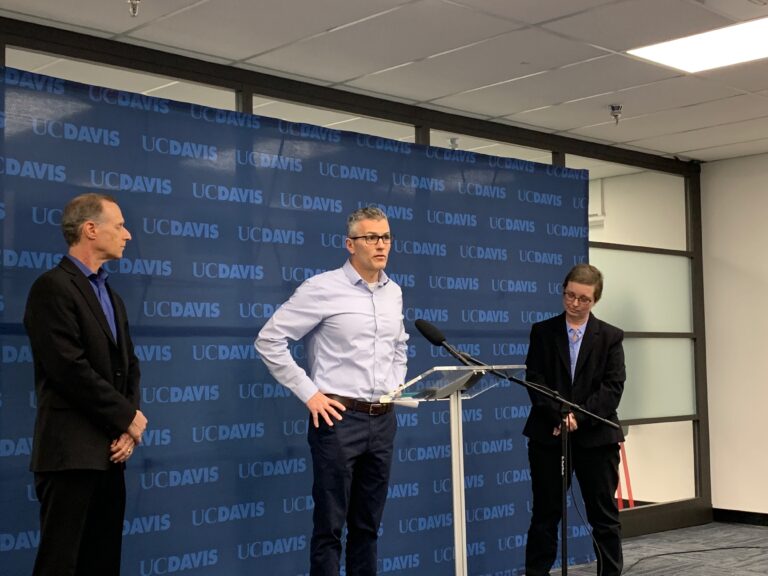
In a media press conference at Mrak Hall on Thursday afternoon, representatives from UC Davis and Yolo County discussed the effects this may have on the campus and the city. 

“One student is offsite — he’s been off site since the 25th,” said Michael Sheehan, the associate vice chancellor for Housing and Dining Services. “The two remaining students we connected with last night, and we’ve offered them another opportunity on campus where they can be isolated, and we moved them last night.”

Yolo County Health Officer Dr. Ron Chapman said these precautionary measures are similar to those taken throughout the country.

“Since Feb. 3, the federal government has been restricting and screening folks that have entered the United States from mainland China,” Chapman said. “All those travelers from China are restricted, isolated or what we call quarantined. The three individuals we’re looking at here at [the] UC Davis campus, we’re doing the same thing with them [that is being done] with travelers from all over the country.”

The two students who are not showing symptoms will remain in isolation for several days, according to Chapman. 

“The federal guidelines are a 14-day isolation or quarantine, from the day of exposure,” Chapman said. “If at any time during those fourteen days the person becomes symptomatic, like a runny nose, a cough, a fever, […] they would be considered for testing for the coronavirus.”

Meanwhile, UC Davis is taking extra precautionary measures to protect students from potentially being infected. Dr. Cindy Schorzman, the medical director of Student Health and Counseling Services (SHCS), elaborated on measures taken at SHCS, according to CDC guidelines. 

“We are asking every student who comes in for an appointment at the Student Health and Wellness Center about their recent travel history, as well as about any possible contacts with people who are known to be sick with COVID-19,” Schorzman said. 

As for the residence halls, “daily disinfection practices are being implemented within all Student Housing and Dining Services properties,” according to May.

Chapman further explained that the virus is not being transmitted through community spread and, thus, does not pose a large threat to the Davis community. 

“In Yolo County, in the city of Davis, on the UC Davis campus, there is no evidence for the spread of the coronavirus, and there is no evidence of the transmission of the virus,” Chapman said.

The news of the isolations comes one day after news broke that a patient being treated at the UC Davis Medical Center tested positive for coronavirus. UC Davis published an email that David Lubarsky, the vice chancellor of Human Health Sciences and CEO of UC Davis Health, and Brad Simmons, the interim CEO and chief operating officer for UC Davis Medical Center, sent to UC Davis Health employees about the confirmed case of coronavirus. 

“This patient was transferred to us from another Northern California hospital,” the email read. “Since the patient arrived with a suspected viral infection, our care teams have been taking the proper infection prevention (contact droplet) precautions during the patient’s stay.”

The patient was not tested for coronavirus until Feb. 23, several days after being admitted, though the medical center requested testing by the CDC.

“This is not the first COVID-19 patient we have treated, and because of the precautions we have had in place since this patient’s arrival, we believe there has been minimal potential for exposure here at UC Davis Medical Center,” the email read. 

As an additional measure, several employees were asked to stay home to ensure their safety.

“Out of an abundance of caution, in order to assure the health and safety of our employees, we are asking a small number of employees to stay home and monitor their temperature,” the email read. “We are handling this in the same way we manage other diseases that require airborne precautions and monitoring.”

Written by: Madeleine Payne — city@theaggie.org