55.4 F
Davis

Davis, California

Thursday, December 25, 2025
Home Blog Page 373

Fare hikes: are they fair?

Raising fares is a possible option for financing public transportation, but it’s more complicated than we think 

Public transportation is great for a myriad of reasons — like reducing greenhouse gas emissions and aiding regional economies — but getting public transportation to work effectively is complicated. One possible solution to improve the quality of American mass transit is raising fares.

I always try to get around via public transportation, as it tends to be relatively inexpensive. This is part of why I feel public transit is so vital to our societal functioning. It’s a cost-effective mode of travel for people of all socioeconomic backgrounds; however, the effect of these low fares and low funding has a noticeable impact on the quality of our transportation.

The now-archaic streetcar was a very popular mode of transportation for most city-dwellers about a century ago, but died out partially due to stagnant fares

In 2018 most of California’s transit funding came from the local government. About 18% of the funding came from fares and fees — a significant chunk when assessing its contributions to the financing of public transportation.

Part of the issue with financing public transportation is that public transit is increasingly being seen as a welfare service as opposed to a public utility. Public transit is an important resource, especially for low-income riders, hence the need to keep fares low and affordable for all. 

Although raising fares helps update the quality of our public transit system, it’s important to keep in mind that many of the people who rely on this system are not be able to afford a fare hike. Not only would this be a very unpopular proposition among riders, it could likely lead to a fall in ridership levels, and thereby further decrease the farebox recovery ratio, a measure of a transit system’s profit computed by dividing fare revenue by operating costs. Fare hikes could be a viable option, but relying on them would be an unsustainable option for mass transit and ridership. Commuter rails, among other modes of mass transit, are already unaffordable for many low-income riders. To raise fares would be to widen the existing inequities in transit.

Improving the financing of public transportation isn’t an easy and clear-cut process, so it can’t be fixed with one simple solution such as raising fares. The subsidization of public and mass transportation is important. Good transportation doesn’t have to be a question solely of equity — it can be a great opportunity for sustainable and profitable growth. The agglomeration that comes with good public transportation is great for regional economic growth and local businesses. Paying undue attention to the subsidies for public transportation gives a skewed view of the cost of other modes of transportation. The gas tax that drivers pay isn’t even enough for services like road maintenance, and, more importantly, it doesn’t account for the true cost of driving cars — the societal cost of externalities such as traffic congestion or pollution.

There are other options for making public and mass transportation financially sustainable that doesn’t involve fare hikes. Through a method like land value capture, the accessibility of public transportation generates economic value that can be captured and used as a potential funding stream for public transportation. 

Public and mass transit is too essential to neglect. Our public transportation systems are necessary and yet we do not afford these systems the economic value they need to thrive. If we choose not to implement methods like land value capture and instead raise fares, we must take into account the impact on those who would be most affected. 

Written by: Simran Kalkat — skkalkat@ucdavis.edu

Disclaimer: The views and opinions expressed by individual columnists belong to the columnists alone and do not necessarily indicate the views and opinions held by The California Aggie


Police Logs

Err on the side of caution on dating sites

January 17

“Man behind store fixing bike and yelling at passerbys aggressively while holding unknown item in hand, possibly a hammer.”

January 18

“Dorm under construction. Workers using power tools.”

“Vultures eating dead animal.” 

“Vehicle was seen driving slowly through neighborhood last night and is now parked.”

January 19

“Loud music from the backyard.”

January 20

“Complaint of drums/keyboard.” 

January 21

“Horns honking and banging sounds coming from lot.”

“Reporting party was on a dating site, the subject he met gave the reporting party a bank account number and told him to use it to pay off his debt, and then purchase gift cards for the subject. Reporting party’s bank called him stating that the payments were declined due to fraud.”

January 22

“Kid’s backpack left on the bike path unattended. Reporting party was passerby advised it’s on the bike path near Richards/Olive.”

“Road rage incident, minor verbal between involved parties.”

UC must end contracts with Dignity Health

Transgender people deserve dignified healthcare

The UC’s existing affiliations with health systems that restrict care based on religious doctrine have been found to have “life-threatening” consequences. That’s not a hyperbolic statement — that’s the exact wording of a finding published on Jan. 28 by a UC working group tasked with assessing the UC’s affiliations with health systems like Dignity Health.

The Editorial Board condemns the egregious partnership between the UC and Dignity — a health system that abides by Catholic doctrines that restrict care for women and LGBTQIA individuals. Existing UC-Dignity contracts explicitly “restrict UC students and instructors from providing care” that’s in conflict with religious doctrine observed by Dignity, a recent article in The California Aggie stated. 

As long as the contracts with Dignity exist, the UC is participating in an “openly discriminatory model of healthcare” — a sentiment expressed by a Los Angeles Times columnist and one with which we wholeheartedly agree.

In response to criticism over this partnership, Dignity claims it is committed to providing healthcare “to all people of all backgrounds,” including “providing women’s health care and specialty care for the LGBTQ community” — yet all evidence points to the contrary. The UC has also defended the partnership: Because the UC and Dignity are the two largest Medi-Cal providers, a collaboration allows “the University to remain focused on increasing access to care for medically vulnerable or underserved patients,” according to UC Spokesperson Andrew Gordon

This rationale is inherently and insidiously flawed. Twenty-four out of 39 Dignity hospitals are Catholic and, according to the Daily Bruin, 24 out of 39 Dignity hospitals “reject the use of gender-affirming practices such as hormone therapy and surgeries.”

There is, therefore, distorted logic in the UC’s claims that this partnership allows it to provide additional care to vulnerable populations. Transgender individuals are a medically vulnerable and underserved group, but Dignity prohibits gender-affirming care by rejecting “the possibility of a person having a gender that differs from their sex assigned at birth,” according to the UC working group.

In September of last year, a California appellate court ruled that Dignity discriminated against Evan Minton, a transgender man, when one of its hospitals turned him away from receiving a hysterectomy — the procedure was “canceled two days after he told a nurse he is transgender,” according to Modern Healthcare.

The UC working group was tasked with assessing whether the UC should “affiliate at all with organizations whose institutional policies (a) prohibit the use of contraception, abortion, assisted reproductive technology, gender-affirming care for transgender people, and the full range of end-of-life options and (b) permit non-clinicians to make clinical decisions affecting the health and safety of individual patients irrespective of the professional judgment of health care providers and/or the informed decisions of patients.” Members of the working group itself were so divided in their beliefs over this issue that some members decided they could not associate their names with the final report.

The UC is a system that has defined itself based on principles of inclusion and celebrating diversity. It’s then baffling that the UC permits discrimination of any form to exist in its practices.

Last year, physicians, students and activist groups protested over a potential expansion of the UC-Dignity partnership. This proved successful when, in May, the proposed “extensive affiliation” plan between Dignity and UCSF ended. The LA Times called this “a victory for reproductive rights.” 

UC-Dignity contracts at other campuses like UC Davis, Los Angeles, San Diego, Riverside, Irvine and San Francisco, however, still exist. The fact that the UC has chosen to turn a blind eye to the very real consequences of this partnership is outrageous and appalling. Minton himself summarized this inexcusable partnership best via Twitter: “Hospitals exist to provide care, not to deny people care OR pick and choose who to give that care to. And we DEFINITELY can’t stand by and let our state’s schools do that.”

Written by: The Editorial Board

Editor’s Note: A previous version of this editorial stated, “A woman being treated in a UC facility who was hemorrhaging from a miscarriage was not able to safely terminate her pregnancy in order to stop the hemorrhage.” That is incorrect. The WCGA report states that such an incident could only occur at a non-UC facility. The Aggie regrets the error.

UC Davis research tests feasibility of sea urchin ranching as method of combating kelp forest decline

Turning hungry sea urchins into delicacies might save kelp ecosystem they threaten to eat away

The odds seem to be against California’s kelp forests and their ecosystems. Not only are rising ocean temperatures making it difficult for the kelp to thrive, but also due to the declining number of starfish and sea otters, the sea urchin population boom is eating away at the ecosystem. This overpopulation is harming even the urchins themselves, who are eating away their habitat, yet still starving because of their vast numbers.

“The kelp forest in California has seen a massive reduction, possibly a 90% reduction in kelp production,” said Karl Menard, aquatic resources manager at the UC Davis Bodega Marine Laboratory. “There’s already been an economical impact because the urchins don’t have significant gonad growth because there’s not enough food for them, so their value and price has dropped significantly.” 

Urchin-centered earnings are not the only industry that has been impacted by the loss of kelp forests. Abalone fisheries have also been impacted due to a loss of food sources for the fish. The lack of kelp makes population rebound for the abalone seem unlikely. 

“The kelp has crashed in Northern California and has not come back for years now,” said Jordan Hollarsmith, a former graduate student who studied the effects of rising temperatures and ocean acidification on giant kelp populations. “What we’ve seen is a complete ecosystem shift. With that has come huge economic losses for all those little coastal communities that used to have big influxes of people coming to spearfish and abalone dive in those kelp forests.”

On-land urchin ranching has become a potential solution to urchin overpopulation. This technique is different from traditional urchin harvesting, because the urchins available in the sea bed are starved to the level that they have no real market value. Urchin ranching would involve the removal of the creatures from their natural habitat before being placed in a controlled environment. There, they are fed before being harvested for their fleshy roe or inner gonads. The Bodega Marine Laboratory is working with Norwegian-based shellfish company Urchinomics to test the feasibility of such measures. 

“Our goal is to restore the kelp forest into vibrant ecosystems by removing overgrazing sea urchins and bulking their roe up in on-land facilities and selling those sea urchins to top tier restaurants globally,” said Denise MacDonald, the director of global marketing for Urchinomics. “The demand [for urchin roe] is growing and the supply is declining. In North America specifically, they’re using it in things like salad dressings and pastas and [other untraditional seafood dishes].”

Turning urchin ranching into a commercial habit will take time and effort. It requires non-traditional diving techniques to procure urchins in a manner that allows survival so that they may be kept in on-land facilities. The urchins are then fed artificial food pellets for 8 to 10 weeks before they can be harvested. Additionally, there is an issue of transportation and the popularization of the method. 

“We’re in the final quarter of the one-year feasibility study,” Menard said. “The results are very positive so far.” 

The hope is to financially incentivize coastal communities and corporations to harvest from these ‘urchin barrens’ so that overgrazing is controlled and the kelp forests have the opportunity to grow and be replanted.

These advances would in no way be an end-all to the issues faced by California kelp forests. Their decline can be attributed to a series of events, including urchin predator populations, like sea stars, being affected by disease, marine heatwaves, like the Blob, warming the nearshore ocean and mass mortality in red abalone.

“[Urchin ranching] might help people find jobs in sustainable fields, feed people and that’s great,” Hollarsmith said. “I am not convinced right now that it is enough to make any measurable, beneficial impact on the kelp when this looming danger of more marine heatwaves is always on the horizon.”  

Urchin ranching is certainly a pathway to begin making a marine impact. If commercialized, a contribution to kelp conservation could be made by simply eating a meal. For a more long-term solution, discussions around the management of marine resources and fisheries are necessary. 

Written by: HUSN KHARABANDA hkhara@ucdavis.edu

TikTok: A deeper look at the new social media students are obsessed with

On TikTok, the stupidity of a joke or the obvious lack of effort is the punchline

TikTok is one of social media’s most recent additions that has surged in popularity over the past year. Referred to by some as Vine’s annoying younger sister, TikTok has become a go-to for content creators and teens who want to become content creators. 

TikTok is unlike any other social media. The app is the product of a merger between Musical.ly and ByteDance in 2018. Talent, comedy and thirst traps coexist in the form of video, giving anyone with minor technological skills the ability to create and entertain. The minute-long videos give way for a scripted skit, a painting tutorial or, most commonly, a choreographed dance. There is still plenty of bad content to be found, but it is undeniably unique as a platform. 

“I don’t really know much about it, […] I’m just doing it for fun,” said Naomi Solomon, a second-year communication major. 

Katia Goldberg, a second-year wildlife, fish and conservation biology major, described TikTok as “more of a joke than other social media.”

“I would never really go to TikTok to look people up, it’s more of a comedy thing for me,” Goldberg said. “The people who take it seriously are funny as hell.”

This isn’t necessarily everyone’s perspective — college students seem to be a little bit older than the primary age demographic on TikTok. Most users are in high school, which is perhaps why the content is so amusing to adults. And with those teenagers directing their own minute-long videos for the world to see, things get risqué, fast. 

“There’re a lot of girls putting this image out there and they’re 13 years old,” said Mehar Durah, a second-year cognitive science major. “A lot of creators are underage, but come off as not underage.” 

Beyond some unsettling sexual content, there’s also the typical risk of young people hiding behind a screen.

“What I see on the “For You” page makes me really worried; they seem to be using it in a destructive way,” Solomon said. “There’s a lot of cyberbullying. If I was a fourteen-year-old girl, I wouldn’t want to be on there.”

Others have had a more positive experience. 

“What I’ve seen is that the community of TikTok [is] supportive and complementary,” said Brock Johnson, a fourth-year communications major. “While [people on] Instagram are body shaming and wrapped up in an image conscious culture, a lot of the people on TikTok don’t fit that mold. The uniqueness of each person is celebrated on TikTok.”

TikTok can also be addicting. The screen is completely taken up by the video you’re watching, even blocking the time display on the top of your phone. The “For You” page is just a stream of what everyone is posting, creating a variety of endless entertainment.

“I’m an ex-user,” Durah said. “I had it for three weeks. I would spend a lot of time on it. It was instant gratification. I didn’t have to think because it was so much content. It’s a waste of time and it shouldn’t be a thing.”

The app has impacted some more than others. That said, TikTok seems to be making a significant cultural impact. The ability to instantly go viral from a hit video is especially appealing. There are several teenagers who are now social media moguls with brand deals galore, solely from making dancing videos. The dances are prevalent, with big-name celebrities taking a stab at the daunting moves. And even people who don’t use the app know a TikTok song or two. 

“It influences Spotify top songs; a lot of them are from TikTok,” Durah said. Once a TikTok-er goes viral doing a shimmy to a catchy tune, you can expect to hear it on the radio, ever to be associated with a specific sequence of arm and body movements. Some of the popular songs include “ROXANNE” by Arizona Zervas and “Lottery (Renegade)” by K CAMP.

In fact, one of Davis’ own has experienced the fame that TikTok can bring.

Johnson, a UC Davis football player, posted a video last January that went viral overnight.

“The night before I had 300 followers, and the next day [the video] had 300,000 views,” Johnson said. “The next day [my teammates and I] made another video that went viral. It’s at 7.4 million views right now. From there it took off, I got a ton of followers and really grew the account. I was lucky to hop on the trend early.”

Johnson is still reaping the benefits of this claim to fame — sort of. 

“I got an email from ByteDance [the owner of TikTok], inviting me to be a part of their Super Bowl campaign,” he said. His TikTok video of dancing football players would be included in their commercial, but he had to decline the offer.

“NCAA owns our likeness, so they won’t let me,” Johnson explained. Despite the recent passage of legislation in California that will allow collegiate athletes to be compensated for their likeness, the law won’t take effect until 2023, preventing Johnson from accepting deals like the one he was offered by ByteDance. 

Even so, Johnson has profited from his many millions of views. He gained around 10,000 Instagram followers after the fact, helping to promote his social media marketing coaching company.

Though it isn’t as common as other top social media apps, TikTok has made its mark. No social media is truly social media without its share of people who make it their full time job; perhaps, then, what’s made TikTok so influential is the particular type of content that’s posted. 

“They seem to put in the least amount of effort and it’s hilarious,” said Tessa Leonard, a second-year environmental science and management major. “It’s sh*tty comedy.”

Although the editing features and length of the videos allow for some full-on short films, a lot of the popular content is fairly basic — the stupidity of a joke or the obvious lack of effort is the punchline. It’s almost a counterculture to the social media we’ve been raised on, where we only display the best version of ourselves online. As cringey as a self-deprecating teenager might be, at least it’s real. 

“It seems a lot more homemade, it’s a less formal social media,”  Leonard said. “You don’t have to put your best self on TikTok; it’s more authentic.”

Written By: Allie Bailey — arts@theaggie.org

Food Recovery Network at UC Davis reduces waste, helps community

0

Student-led UC Davis chapter recovers food waste on campus to help increase food security

According to a 2019 Food and Agriculture organization study, almost a third, or 1.3 billion tons, of all food in the world is wasted — yet, food insecurity remains a pressing issue, particularly among university students. Nearly 30% of college students in the U.S. reported experiencing food insecurity in the past year. 

As part of the UC’s zero waste campaign, UC Davis has been implementing policies to actively combat food waste on campus such as composting consumer food waste, introducing trayless dining and providing sampling options in its dining commons. Though it was announced that UC Davis will not be meeting its zero waste goal by 2020, it still plans on continuing its efforts to achieve sustainability. The UC Davis chapter of the Food Recovery Network has also been hard at work, recovering food from the markets and dining commons that would have otherwise been wasted and redirecting it to those in need. 

The chapter is part of a national non-profit organization that spans 44 states, with 230 chapters on college campuses in the country. Since its founding in 2013, Food Recovery Network at UC Davis has recovered more than 50,000 pounds of food, including frozen meals and items that are close to their expiration dates. These recovered resources are then donated to those in need within the Davis community.

Alicia Marzolf, a third-year English major who is also the events coordinator of the Food Recovery Network, explained how the food recovery process works at the markets and dining commons. 

“One night, [the dinings commons will] make a bunch of pasta, or whatever, and anything that doesn’t get given out to the students gets frozen in bulk, and that’s what we recover, and then we bring it to Davis community meals which is a homeless shelter, and they’ll warm it up and prepare it,” Marzolf said. “With the market stuff, that’s stuff like sandwiches and wraps, like wrapped stuff, that typically gets given to the Pantry and Aggie Compass. That’s the stuff that students can kind of grab and go.”

The members also work with the Davis Farmers Market every Saturday, doing recovery of the leftover produce and passing it out at Solano Park apartments, an apartment complex that is mainly for students with families. The event, however, is open to everyone, and many seniors in the community also stop by, according to Marzolf. 

Second-year English major Anne Fey, who is also in charge of education and outreach at the Food Recovery Network, finds the volunteer work she does with the people at Solano Park rewarding, citing it as her favorite part of the work she does with the chapter. Fey previously worked as a city news writer for The California Aggie. 

“It’s great to work with the people from Yolo Food Bank and the people from Solano Park apartments,” Fey said. “The RAs are really awesome, and we work with the same people from Yolo Food Bank every week so it’s great to build those relationships with people in the community who are working on trying to make sure people are fed and trying to reduce food waste locally.”

The national organization also has a program that provides its chapters with the opportunity to work remotely as interns over the summer. Soumya Douriseti, the technology director of the UC Davis chapter, and Fey were involved with the program last summer and worked to create a guide to start more advocacy to reduce food waste. They presented their work at the National Food Recovery dialogue last October at Drexel University in Philadelphia. 

“I was really surprised by how cool that was,” Fey said. “We kind of get in our own world a little bit with just doing our work and thinking about our chapter here at UC Davis, so to actually talk to people from other chapters and then brainstorm with them about different ideas for what the whole network could look like in the future, it was really cool to talk to people from all over the country about that.”

Currently, the chapter is working on expanding their food waste reduction efforts by building a curriculum to teach children about minimizing their food waste. Though the project is still in the early stages, they chapter hopes to introduce the program in the next few quarters.

Marzolf encourages any interested members to reach out to the chapter via email or through their Facebook page. 

“We always love people getting involved; we love new volunteers, so if you want to get involved, please reach out to our email,” Marzolf said. “We really love getting new people.” 

Written by: Lei Otsuka — features@theaggie.org

Catfishing and the loneliness pandemic

Predatory catfish are preying on our loneliness and desperation

Tinder announced last week that it would give users a blue checkmark if they passed its new catfishing test. Tinder’s community team will initially screen verified photos to check for potential catfish, with software eventually taking over. But should humans even be trusted to identify catfish if so many of us fall for them time after time? 

Catfishing is an act of deception only possible in the online world. Real people make a fake online presence and lure others into a romantic online relationship. Not only deceptive, catfishing is a predatory practice that emotionally and financially abuses romantic hopefuls and strings them along for weeks, months and even years. 

Shouldn’t we already be more aware of catfishing as we interact more and more in the online world? Or are the catfish themselves becoming better at preying on our need for attention and connection? 

Loneliness is increasing worldwide, and many are calling it a pandemic. A study published in 2015 found that social isolation, actual or perceived, is associated with an increased risk for early mortality. The study also found that the health effects of long periods of isolation are equivalent to those of smoking 15 cigarettes a day. With social media becoming increasingly rooted in our daily lives, ambivalence toward the loneliness pandemic is now more apparent than ever. 

Take a moment and think about how much time you spend in front of a screen each day. The typical American averages up to 12 hours a day between phones, tablets, computers and projectors. It only makes sense that we would form relationships through the screens we spent half our time staring at.

We don’t just meet friends face to face anymore — the online world makes it easier to meet new people and stay connected to them. And why wouldn’t we form more relationships online where we have more control over how we are perceived by others? 

The term “catfish” as it relates to online dating is derived from the relationship between codfish and catfish. Codfish are notoriously difficult to bring to market because, when frozen or stored in tanks, they lose their texture and flavour. Catfish will relentlessly chase codfish, so sailors on fishing vessels determined the best way to maintain fresh codfish was to throw a few catfish in the tank to keep the cod in shape. The codfish taste fresh by the time they get to port.

Catfish keep everything alive. It’s no wonder why, in our online interactions with them, we so often overlook glaring red flags for the excitement of the chase. We do the exact same thing in “normal” relationships. We choose to believe in people and what they say. We want to be happy and we want someone with whom to share that. But how much are we willing to put up with in order to achieve that? 

Romantic relationships are difficult because they are complex — built on trust and predictability while trying to keep things fresh. Relationships are arduous to maintain, so when we find them easily, we want them to be real. 

Every relationship is bound to have its secrets, but having a relationship online that hides an entire identity is not any average secret. Relationships built on any amount of lies are bound to collapse. 

To some extent, we are all catfish when we present ourselves online, and even more so when we present ourselves on platforms like Tinder or Bumble. We try to portray ourselves in the best light possible, often at the expense of our own honesty. We build profiles to attract and collect as many matches as possible. But these are deceitful habits no matter how pure our intentions may be. These lies we tell don’t go away; they are buried –– with the potential to resurface later. 

Love is difficult to navigate in our relationships. It makes us think and behave irrationally. It is often an attraction that we cannot control, and something for which we are willing to do anything.

Our loneliness has made us desperate to love and be loved and, in this desperation, we have found it easier to convince ourselves that we have found real love, even if the one we love is a facade. 

Written by: Calvin Coffee –– cscoffee@ucdavis.edu

Disclaimer: The views and opinions expressed by individual columnists belong to the columnists alone and do not necessarily indicate the views and opinions held by The California Aggie

Interfaith Rotating Winter Shelter provides homeless refuge from elements

Over two dozen Davis homeless welcomed into 10 rotating church locations from December to March

On Monday, Jan. 20, homeless guests were welcomed into the Davis Christian Assembly as part of the Interfaith Rotating Winter Shelter (IRWS). 

The IRWS is a volunteer organization that provides the homeless population of Davis with two daily meals and a place to sleep in 10 churches from December to March. Each church can host up to 25 guests at a time for one to two weeks. 

Pastor Jonathan Zachariou of Davis Christian Assembly described the significance of the program. 

“When you work with these guests, it’s sobering to figure out that they live outside,” Zachariou said. “It’s really taxing to live without shelter. It works against you physically and then it seeps into your mental capacity. It’s exhausting.”

Each day, the program provides guests with a cot and clean sleeping bag, a hot dinner and a bagged lunch. A free, volunteer-based laundry service is also offered that collects dirty laundry and returns the clean clothes after two to three days. 

Along with these services, some locations also prepare entertainment for their guests. The Davis Christian Assembly often plays movies — it showed Men in Black: International on Monday night. Zachariou commented on the importance of entertainment. 

“We know it’s still a big environment and it’s a program, but we try to make it as homely feeling as possible,” Zachariou said. “We tell them every night that we want them to relax and feel like they’re at home.”

Two student volunteers from UC Davis were present during check-in. Both students are third-year psychology majors who heard about the program through one of their psychology classes. Charlotte Metcalf, one of the student volunteers, was already interested in social work before her involvement in the internship.

“I had been looking for something related to social work and homelessness because I’ve always been drawn to it,” Metcalf said. “It’s been really nice to get some hands-on experience, and I feel like this program really does throw us into this, which is what I need. I love it.”

The other student, Yuliana Virrueta, did not have a prior interest in social work before joining the program. Instead, she was trying to find a way to become involved in the City of Davis.

“I had been looking for something to do in the community here since I wasn’t really familiar,” Virrueta said. “I’ve done a lot of community service before, and it’s nice to do something here.”

When asked about her comfort levels during the program, Virrueta said that she acclimated to the new environment after a few shifts. 

“Over time, you start to get more comfortable — you get to know the people, so it becomes normal,” Virrueta said.

Metcalf agreed and added to Virrueta’s comment. 

“You learn to deal with certain people in certain ways,” Metcalf said. “Just the way they would prefer to handle certain things. You might not know in the beginning, and it might upset certain guests, but you learn ways around it — it ends up working out for both sides.”

The two students have volunteered with the rotating shelter for the past three weeks. Before going onsite, they completed a mandatory training program about mental health issues and ways to defuse stressful situations. 

Student volunteers complete an array of tasks, including checking in guests, supervising overnight and distributing equipment. Any interested students should visit the Interfaith Shelter’s website for more information as well as contact the program’s administration.

As more guests filed in and helped themselves to bags of chips and bread rolls, Zachariou surveyed the scene and explained his thoughts on the importance of the program. The program is not meant to solve the homeless crisis in California, but Zachariou described how it helps as many local people as possible during the harshest months of the year. 

“The key to volunteerism is to make a difference for one person,” Zachariou said. 

Written by: Eden Winniford –– city@theaggie.org

Guest: Fact Finders trip showcases the beauty and complexity of Jerusalem

Learn more about the Arab-Israeli conflict by taking a Fact Finders trip 

Disclaimer: The views and opinions expressed by individual columnists belong to the columnists alone and do not necessarily indicate the views and opinions held by The California Aggie.

During the beginning of summer, I had the opportunity to go on a geo-political trip called Fact Finders, a subsidized travel program that takes non-Jewish students to Israel to learn more about the Arab-Israeli conflict. I am one of five Jewish student leaders on the trip, tasked with relaying my individual and unique Jewish perspective to the majority non-Jewish student leaders with the hope of uniting student leaders and building a first-hand perspective of the Arab-Israeli conflict. Despite traveling to many controversial areas in the region, including the West Bank and Gaza border, I have chosen to focus on Jerusalem because, throughout my research, Jerusalem continues to be the most serious point of contention for all parties involved in the Arab-Israeli conflict.

There is no place on Earth like Jerusalem. Needless to say, the history of this ancient city is notorious throughout the world because of its significance in all three Abrahamic religions. Since Jerusalem is home to all three religions, you can imagine the complexity of the city. The Old City is comprised of four quarters — although they are not quarters in the sense that they are evenly distributed, it is just meant to describe that the city is divided into four parts. There is the Jewish Quarter, Armenian Quarter, Christian Quarter and Muslim Quarter, with the Muslim Quarter making up the majority of the quarters. Each quarter is individually unique and brings its own special light to this ancient city. 

We visited the holy sites of all three religions, including Al-Aqsa Mosque, the Dome of the Rock, the Western Wall and the Church of the Holy Sepulcher, all of which are less than a square mile from each other. As a result of the 1994 Israel-Jordan peace treaty, Israel agreed to recognize and maintain Jordan’s special custodianship over Muslim holy sites in Jerusalem, including the Temple Mount. So, there are Jordanian officers that guard the entrance of the compound and who regulate activities on the Temple Mount, while Israel reserves the right to enter for security matters if needed. 

On the Temple Mount, also known as the Al-Aqsa Compound, sits Al-Aqsa Mosque and the Dome of the Rock, important to Muslims as the place where Mohammad is said to have gone to heaven. The Temple Mount is the third holiest site in Islam following Mecca and Medina, and is said to be the site where Mohammad began his revered “Night Journey.” For the Jewish people, the Dome of the Rock is said to house the foundation stone, from which the world was made and the site where Abraham offered to sacrifice his son Isaac. Unfortunately, non-Muslims are not allowed inside the Dome of the Rock, and visitors are questioned upon entry to distinguish between Muslims and non-Muslims. 

Below the Temple Mount sits the Western Wall, also known as the Wailing Wall. It is the western support wall of the Temple Mount, which lies above, and is the holiest site for the Jewish people. Built in 20 BCE as an expansion of the Second Temple, it is the only surviving part of the sacred temple after the Romans destroyed it in 70 AD. In tears, I touched the stone and prayed, pushing notes into the cracks as I held my friends tightly and stood in front of something that many of my ancestors never had the opportunity to see. For thousands of years, every year on our holiest holiday, Yom Kippur, we say: “L’shana haba’ah b’yerushalayim,” which means “next year in Jerusalem” — and here I was. It is customary to write notes and push them into the cracks of the wall, so that your thoughts and prayers can be elevated there, in the heart of the world. 

As you venture in the quarters of the Old City, the Church of the Holy Sepulcher is hidden within the Christian Quarter, along with over 40 other holy sites, and captures the hearts of Christian pilgrims of every sect and country as the site where Jesus of Nazareth is said to have been crucified, buried and resurrected. Near the entrance of the church rests the anointing stone. The anointing stone was where Jesus of Arimethea prepared Jesus’ body for burial. Behind the stone is a remarkable mosaic depicting the body of Jesus being anointed following the crucifixion. Tourists from all over the world will kneel to touch the stone that once held the body of Jesus Christ while clergy from the different sects of Christianity roam the sacred halls. 

To fully understand how intertwined these religious sites are in Jerusalem, picture this: To ascend the Temple Mount, which houses Al-Aqsa Mosque and the Dome of the Rock, you walk up and over the Western Wall. Jordan controls general security on the Temple Mount and armed officers scan visitors while Israel maintains general security over Jerusalem. Opposite Al-Aqsa is the Dome of the Rock, a golden shrine containing the foundation stone. For Jews, the foundation stone is said to be the rock from which the world was made. And for Muslims, it is said to be the place where Muhammad began his revered “Night Journey.” Then, less than a half a mile away, is the Church of the Holy Sepulcher, hidden within the streets of the Christian Quarter and a beacon of Christianity for Christians all around the world.  

Everywhere you go in Israel, you never forget Jerusalem. But what you remember most is that as you pray at the Western Wall, the Muslim call to prayer sounds from above at Al-Aqsa; you recall the church bells ringing from next door at the Church of the Holy Sepulcher, and you remember there is nowhere on Earth like this. You remember that the love for Jerusalem shared by those who visit is transcendent.

I have only included highlights of the trip from my perspective, however, this is an amazing opportunity for anyone interested in learning more about the geopolitics of the Middle East or the Arab-Israeli conflict in general. 

Written by: Sascha Recht 

Sascha Recht is a third-year neurobiology, physiology and behavior major at UC Davis and the Hasbara Israel Campus Fellow for UC Davis. 

To submit a guest opinion, please email opinion@theaggie.org.


Humor: “Great works of art are always controversial,” says creative genius Jared Kushner about his divisive Middle East peace plan

A political failure or an artistic triumph?

If you’re a sane human being, an increasingly rare combination of traits, you likely remain hopeful that we can still achieve a peaceful two-state solution to the Israel-Palestine Conflict — a solution that shows great respect to Palestinians and Israelis alike, while also forcing both sides to make concessions. Arriving at this ideal outcome requires an elegant and artful approach to diplomacy. 

This is why art patrons worldwide were positively thrilled when President Donald Trump delegated the Melania-old — excuse me — millenia-old challenge of bringing peace to the Middle East once and for all to his baby-faced son-in-law, Jared Kushner. Kushner is an up-and-coming real estate artist known for his avant-garde work in the slumlord sub-genre. Despite being new to the art of diplomacy, Kushner has demonstrated great humility.

“‘Every artist was once an amateur,’ said Ralph Waldo Emerson,” said Kushner. “I learned that quote after my dad bought me that ticket to Harvard.”

To prepare for this diplomacy-real estate fusion project, Kushner quickly read 25 books on the Israel-Palestine conflict to bring himself up to speed with the professionals. Yet he remains confident that his youth has given him a leg-up on the career diplomats whose tastes tend to be more traditional and perhaps less tolerant of the fresh creative spirit of younger people, especially those in real estate.

“‘Every child is an artist — the problem is how to remain an artist once we grow up,’ said Picasso,” said Kushner.

It took three years, but the Kushner peace deal has finally been released, and the silky soft contours of Kushner’s cushy face prove that he has not grown up. What does that mean for the quality of the piece itself? Well, it’s clear that Kushner went about drawing his new map of the Middle East with great skill, technical mastery and command of his craft, painting a clear picture of how he envisions the future borders of the Israeli and Palestinian states.

“‘A picture is a poem without words,’ said Horace,” said Kushner. “Alternatively, ‘You don’t take a photograph, you make it,’ said Ansel Adams.”

Kushner’s magnum opus, however, has fiercely divided the critics, with many suggesting that he lacked inspiration and purity of artistic intent. The deal was labeled provocative and unfair, with The New York Times writing that the plan “strongly favors Israeli priorities rather than having both sides make significant concessions.”

“‘Painting is easy when you don’t know how but very difficult when you do,’ said Degas,” said Kushner. Kushner later noted that it would be unwise to make concessions, given that snack-food wrappers are noisy and would clutter the table, distracting from the peace-making process.

 The plan has sparked protests in Gaza and the West Bank, and Palestinian Authority President Mahmoud Abbas has already rejected it. This has not dispirited Kushner.

“‘Creativity takes courage,’ said Henri Matisse,” said Kushner.

The widespread anger over the plan is likely related to Kushner’s bold creative decision to entirely exclude Palestinian input. Nevertheless, President Trump and Israeli Prime Minister Benjamin Netanyahu are pleased that the uproar over this daring aesthetic choice has distracted their fans from their respective impeachment and corruption trials. Netanyahu referred to the plan as the “deal of the century,” despite the international community’s strong criticism of its flaws.

 “We don’t make mistakes, just happy little accidents,’ said Bob Ross,” said Kushner. “We didn’t actually want to make a deal that pleases everyone — we wanted to challenge people intellectually and expand their ideas of what’s possible with the “peace deal” medium. Plus, what great works of art haven’t been controversial? Think of Igor Stravinsky’s ballet, ‘The Rite of Spring.’ It’s a mark of success that our work has infuriated people in the same way as one of the greatest works of modern art of the 20th century.” 

At the 1913 Paris premiere of ‘The Rite,’ the audience rioted in response to the violent, subversive, modernist music and choreography.

“‘Lesser artists borrow, great artists steal,’ said Stravinsky,” said Kushner. 

Given the significant portions of land in the West Bank that Israel would be allowed to “annex” under the plan, it’s obvious that Kushner truly aspires to be considered a great artist.

Written by: Benjamin Porter— bbporter@ucdavis.edu 

Support drawn for Dec. 6 climate strike — one of many recent climate-related strikes in community

Community members, students see different approaches to solving climate emergency

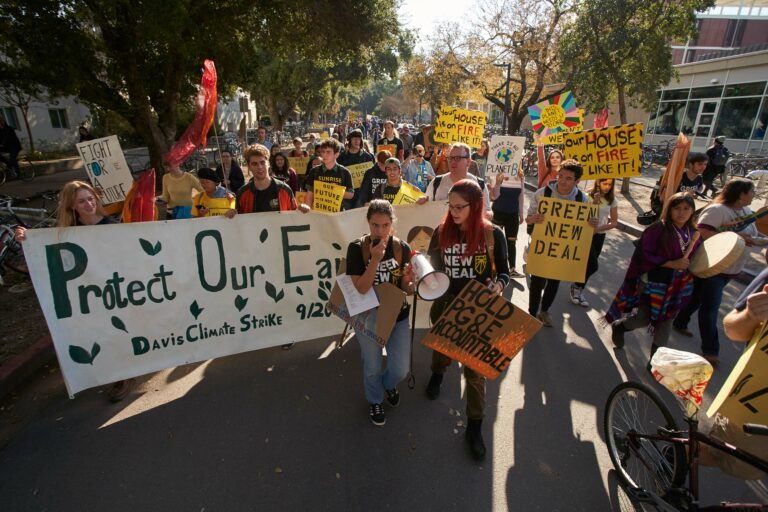
Fall Quarter 2019 at UC Davis started and ended with a climate strike. At noon on Dec. 6, the Davis chapter of the Sunrise Movement organized a climate strike in solidarity with Fridays for Future, which drew students and Davis community members to the Quad. 

The strike began at the Quad but then moved to Central Park at 12:30. There, members listened to speakers “discuss the threat that climate change poses to our society and what we can do about it,” according to Sunrise Davis’ listing on the Patch website. Sunrise Davis members have striked every Friday since Sept. 20, the listing said.

Similar to the Sept. 20 and Sept. 27 strikes in Davis, organized by Davis High senior Amber Crenna-Armstrong and third-year environmental science and management major Megan Phelps, respectively, the Dec. 6 strike demanded action toward the climate crisis. The listing also called for California Governor Gavin Newsom to demand carbon neutrality by 2030 and advocated for the phasing out of fossil fuels. Strikers chanted “Hey, hey, ho, ho, fossil fuels have got to go!” in support of these aims. 

At the Quad, strikers posed for a picture with a “Protect our Earth” banner before heading toward the park, and they held up signs with slogans like “Dear Democrats, Step Up or Step Aside” and “The Climate is Changing, So Why Aren’t We?” 

Former Davis Mayor and current City Councilman Michael Corbett showed up to support the students who were striking. Corbett said he thought the city council should be doing more, citing Davis’ reputation as an environmentally friendly city that “broke ground across the world in the ‘70s,” in part for the 1972 Energy Conservation Building Code, which instituted mandatory energy conservation standards across all new construction.

“Right now, we want City Council to move faster,” he said, speaking generally about Davis community members in support of the strike. “We’re asking that they hire a senior staff level person in charge of making things get done that were planned eight or nine years ago.” 

The City of Davis passed a climate emergency resolution meant to address climate change by 2030 in March and is drafting a 2020 comprehensive Climate Action and Adaptation (CAAP) update to the 2010 CAAP Plan, but Corbett also suggested that the city do more to reduce the carbon footprint created by cars. 

In a 2012 Davis Community Greenhouse Gas Emissions Update, the city found that “more vigorous and potentially difficult mitigation measures pertaining to transportation behavior will likely be necessary to consider.” 

Corbett emphasized top-down changes, which UC Davis is also trying to implement. In 2009, the campus said it aimed to be zero-waste by 2020, a goal it failed to meet

A revised sustainability plan that sets more realistic goals is in the works, according to Dana Topousis, chief marketing and communications officer for UC Davis. ASUCD also passed a Climate Emergency Resolution, authored by Phelps and others on the Environmental Policy and Planning Commission. It stated that ASUCD stood in solidarity “with cities and college campuses across the United States in declaring a climate emergency.” 

While community member Sue Barton agreed, saying policy leaders’ actions were important, she also said she thought these kinds of grassroots movements create power.

“The marches in the ‘60s forced the government to act,” Barton said. “It’s people getting out and expressing their concerns about what the future is going to look like for their kids and grandkids that will cause change.” 

And Kimberly Evans, a third-year environmental science and management major who had previously striked on Sept. 27, said that it was important to start with grassroots movements for major issues like climate change. 

“It was a simple argument that started making me reconsider my role: If I don’t do something, who do I expect to do something?” Evans asked.

Not everyone joined the strikers. Third-year biological sciences major Anthony Ramirez saw the strikers both arriving at and leaving the Quad but said he did not have time to participate in the strike and did not have previous knowledge about it.

“Maybe someday I would participate,” Ramirez said. “But right now, I just think it takes too much energy.”

And when the Sept. 20 strike — which began at the Mary L. Stephens library — was held, the Davis Unified School District published a statement “encouraging students to express their civic engagement through peaceful assembly and constructive activities on campus” and said district and “school staff will be dispatched to supervise students who leave campus.”

Despite mixed sentiments toward the strike and the actions needed to accomplish climate actions, Evans said she remains hopeful. 

“Even if it’s nothing we can solve in one day, one week, or even a few years, the more people we can gather together to understand that it’s a problem, the better,” Evans said. “We might not be able to affect the policy-makers of today, but we can affect the people around us and the policy-makers of tomorrow.” 

Written by: Janelle Marie Salanga — campus@theaggie.org

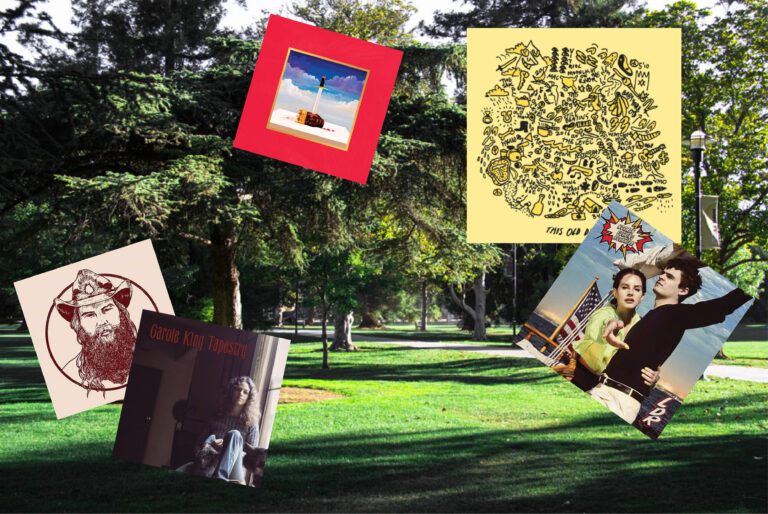
Five albums that describe UC Davis

An exploration of music as community

Campus is a strange place. Don’t get me wrong, since being admitted here I have sung the praises of UC Davis to an arguably annoying amount, both in print and to friends.

There’s beauty everywhere you look, even if you have to squint sometimes. There’s not a better way to remind ourselves of who we attend school with than by looking at the albums that describe us as a campus. This is an exploration at who you’ll find in our little university, in our little slice of Cowtown, in five albums. 

Kanye West – “My Beautiful Dark Twisted Fantasy”

You already know who this is. Late to class, has a Supreme sticker on their laptop or their HydroFlask (although it is in truth probably both). They’re most likely an economics or an engineering major who feels deeply connected with hip-hop even though they are probably from a suburb of Los Angeles. This won’t take away from the fact that they will inevitably explain the ins and outs of hip-hop’s most recent magnum opus that is Kanye West’s “My Beautiful Dark Twisted Fantasy.” “It has layers,” they will say. “Did you even hear the piano on ‘Runaway?’ What about the Bon Iver feature?” “This is the greatest album of all time,” they’ll yell at you, as you patiently sip on CoHo coffee. If they don’t own a pair of Timberland 6” Tan Work Boots, you can bet they’ll spend most of their time in their 400-person lecture browsing for them. You can find this person hanging by the Quad, lost at the Death Star or anywhere that isn’t Shields Library. 

 Chris Stapleton – “From A Room”

They think they’re as smooth as Tennessee Whiskey, but in truth, you’ve never understood that because every time you’ve had whiskey, it’s really burned your throat and made you look like an idiot in front of everyone. These are the people in Agricultural Sciences, looking to make their bread and butter. They effortlessly pull off a flannel better than you ever will. Chris Stapleton’s “From A Room” plays softly in the background whenever they walk into a room, whether it’s to outdo you in a farming demonstration or just knock back a cold one. (And they love to knock back a cold one.) City folk just don’t get them, and we probably never will. You can find these people around the Student Farm, passing by Mrak Hall or anywhere a field of wheat is present, trying to desperately learn its secrets. 

Mac DeMarco – “This Old Dog”  

Do you smell that? It’s a mix of American Spirit Blues, mason jar quinoa and not showering after a Yosemite trip. Print is a visual medium, yet one can catch a whiff just from that description alone. There is a 99% chance they are not in STEM, but if they are, you can bet they’re there to dismantle the worker-exploitative, oppressive regime from the inside. There is also a 99% chance they believe in Communism and a 100% chance they have never talked to anyone who lived in the former Soviet Union. 

With a love for old synthesizers and being emotionally unavailable, they throw on Mac DeMarco’s “This Old Dog”  to unwind from a long day of posting watercolors on their Instagram. This is all to say that “Old Dog” folks are always quite warm, albeit a little intimidating. (Their tattoos of vegetable gardens really put the pressure on you to seem interesting during casual conversation.) They throw the best parties, with people who actually dress up in theme, a rare find with the imminent collapse of Davis Greek life. Find them hanging around Cruess Hall or Turtle House and being rightfully exhausted after their CoHo shifts. 

Lana Del Rey – “Norman F*cking Rockwell”

Lana Del Rey is an artist who I’m not very familiar with, but can understand the general gist of what she’s going for, just like I can gauge the general vibe of this crowd. Super into Glossier. Also super into not calling you back.

Carole King – “Tapestry”

Ah, the ol’ reliable. There are days when everything can go wrong. These are the days when you need a friend, one who won’t let you down. Stern, smart and an all around warm person. Which is why “Tapestry” by Carole King is such a mainstay in their life; exuding a sort of energy you’ll never not appreciate. They’re the friend that has a really serious internship, a crazy thesis project, a super steady partner and somehow still manages to do meal prep. You are jealous, but not so much so for it to delve into envy. It’s a good vibe. They’re probably a political science major or something else important to the fabric of this country. Either way, they’re a keeper. 

Written by: Ilya Shrayber — arts@theaggie.org


Vote on tuition hike for UC put on hold after Regents receive fierce backlash

Students alerted only a week prior to planned vote

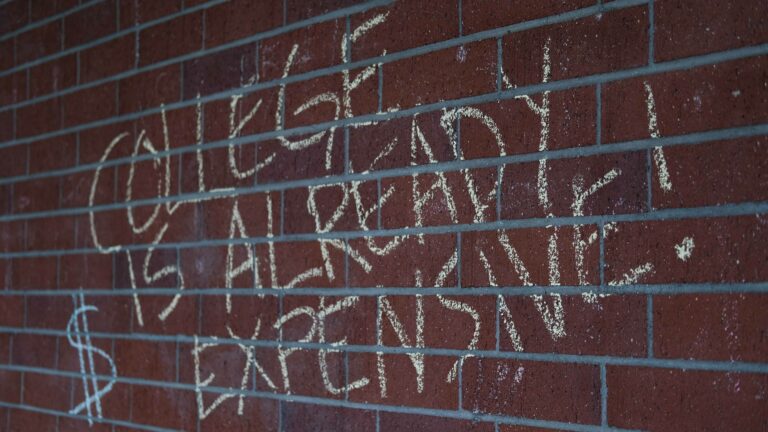
In a plan to provide more financial aid funding and avoid a decline in the quality of UC education, the UC Board of Regents proposed two different tuition increase models. After backlash from students, the vote on the tuition proposals was postponed.

The Regents, who met on Jan. 22 to discuss the two proposals, were faced with backlash from students worried about the extra financial strain that students might face because of a tuition increase. They argued that an increase would hurt individuals already attending the UC, and said it would also impact the diversity of the UC system — one of its six key values.

Students were also given only one week of notice prior to the scheduled vote, although Regents are required to give a month’s notice. Before a vote could happen, the potential tuition increase was switched to a discussion item. It is currently unknown when or if this item will be put to a vote. 

Two tuition increase models are being considered. The first, a traditional yearly increase, would adjust tuition cost with inflation and would apply to all students — current and future. The second model, called “cohort-based” tuition, assigns a fixed cost for each incoming class. This model would only affect future students. 

Although it is not abnormal for the Regents to consider a tuition increase at the beginning of the year when the governor releases the budget for the next fiscal year, this situation felt abnormal to UC Student Association President Varsha Sarveshar.

“Normally, when [the Regents] vote on tuition increases, they’re only voting on tuition increases for the next academic year,” Sarveshar said. “This time, they’re voting on tuition increases between [the] 2020-21 school year and 2024-25 school year.”

Sarveshwar also said that the inflation-based tuition increase model would likely create an increase between 10% and 15%, or a $14,860 to $15,535 final price tag over five years for in-state students. The current tuition is approximately $13,509.

“We do not take changes to tuition and fees lightly,” said UC President Janet Napolitano. “And while it may seem counterintuitive, increasing tuition actually provides more funds to cover the cost of attendance who need financial aid the most.”

who need financial aid the most.”

But these numbers can’t be taken at face value, since student loan debt is often left out of the equation. 

“When you propose tuition increases by one or two or three or 400 dollars, that isn’t really the amount that the tuition is going up by,” explained ASUCD Chief of Staff Adam Hatefi. “[It] is that amount plus 20 years of interest on the loans that the students are going to have to take out to pay for that hike that you just proposed.”

Furthermore, even though more aid may be given to those who need it most, there is some concern that any tuition increase would deter potential applicants.

“There are far, far too many California high school students who, due to a lack of privilege and a lack of institutional knowledge, don’t know that their education may be supported by financial aid, and may not apply [to a UC] due to sticker shock alone,” Sarveshwar said.

Students from almost all of the UC campuses, many of whom just returned from Winter Break or are preparing for midterms, attended the mid-week Regents meeting with the hopes of having their voices heard by the Regents. The Regents met at the UC San Francisco Mission Bay campus — notably the only UC that does not enroll undergraduates.

Students highlighted the impact a tuition increase would have on them, their families and their peers at the UC.

“I’m a first-generation college student and a proud child of immigrants who came to America for a better life,” said Kimberly Giantran, a second-year student at UC San Diego. “My parents are living their dreams through me. I can’t let them down and let all of their sacrifices go to waste. Look at me. Look at the students standing with me and behind me. Our livelihoods are on the line.”

Look at me. Look at the students standing with me and behind me. Our livelihoods are on the line.”

In addition to affecting current UC students, concerns were voiced about what a tuition increase would do to diversity within the UC system. 

“For the past eight years, tuition has remained constant and stable for California residents and class diversity of residents has multiplied, seeing more Black students, Latinx students, queer students, trans students, that which makes our environment and education rich and full,” UCLA student Sofia Hsu said.

So what’s the reasoning behind the proposed tuition hike? According to the discussion item summary written by the UC Office of the President (UCOP) intended for the Board of Regents, the tuition increase is needed to supplement the $3.996 billion in State General Fund provided in the Governor’s State budget proposal for the 2020-2021 fiscal year.

“The University’s budget request to the State, if fully funded, would have avoided the need for a [tuition] increase,” said a representative in an email. 

California Governor Gavin Newsom contradicts this notion. 

“Given the major increase in higher education funding provided in last year’s budget and the similar increase proposed by Governor Newsom for next year’s budget, he believes that the proposed tuition increase is unwarranted, bad for students and inconsistent with our college affordability goals,” said spokesperson Jesse Melgar in a statement.

The long-term impacts were not fully considered, according to one student.

“The proposals that were originally on the table today were nothing but shortsighted ways for the university to make up projected deficits in which the state, our ultimate benefactor, should be on the hook for,” said David Hickman, a UC San Diego fourth-year. 

According to UCOP, the added tuition money would go toward the making and sustaining of “all of the mandatory and high-priority investments included in the

2020-21 Budget Plan for Current Operations approved by the Regents in November 2019.”

Some of these “high-priority” investments include the elimination of achievement gaps, increasing graduation rates, increasing enrollment, the expansion of student access to mental health services and increasing faculty compensation.

Some, however, question whether the added tuition would really go toward these goals.

“The top 35 UC employees with the highest gross pay in 2016 are all men, 29 of which were prominent doctors at UC hospitals, four of which were coaches, or former coaches, of men’s football and basketball teams,” said ASUCD External Affairs Commission Chair Shelby Salyer. “Their state-reported pay ranged from $1.1 million to $3.6 million a year.”

Sayler explained how these numbers stand in stark contrast to the countless students at UC Davis who, due to the transition to UCPath, are allegedly still awaiting pay from Fall Quarter or to the union workers at UC Davis who are still bargaining in order to make salaries that can support their basic needs, or even professors, who had the lowest salaries out of all the UCs in 2015.

During the Regents meeting, Chair John Perez said, “I have never and will never vote for a broad-based tuition increase that impacts current students. I have said that in our effort to have predictable and affordable tuition that I’m open to conversations around cohort-based tuition, which have clear guarantees of no increases into the future for students that are affected.” 

Sayler disagrees that the cohort model is better than the inflation-based one.

“It feels like they are trying to divide that collective bargaining block that is students together,” Sayler said. 

The result is an unbounded increase in tuition.

“If these five year increases are passed at a later meeting, and I then ask students to advocate for the budget, I worry that their response will be simple: What is the point if they’re raising tuition anyway?” Sarveshwar asked at the Regents meeting.

“If these five year increases are passed at a later meeting, and I then ask students to advocate for the budget, I worry that their response will be simple: What is the point if they’re raising tuition anyway?” Sarveshwar asked at the Regents meeting.

Written by: Jessica Baggott — campus@theaggie.org

Students talk about recent fentanyl-laced cocaine epidemic

Alert: Snow in Davis

The week before Christmas, Aaron Hall and Jamez Manning, described as “young men in the Oakland music scene,” died due to an overdose of cocaine laced with fentanyl in Oakland, according to the SF Chronicle. Unfortunately, these aren’t isolated incidents. 

 According to the San Francisco Department of Public Health, death rates have increased 150% since last year in the city due to an increase in fentanyl overdoses. In fact, the deaths of celebrities like Mac Miller, Lil Peep and Prince have been tied to the synthetic opioid. 

Recent pop culture has suggested that fentanyl has only struck the Bay Area’s cocaine supply, however, that’s not the case — the epidemic is prevalent in areas around the U.S.

Fentanyl, a painkiller used in hospitals that’s 25 to 50 times stronger than heroin, is now finding its way into the cocaine business. The question then is: Why would cocaine suppliers want to intentionally drug and kill their customers? 

According to Rolling Stone, there are two hypotheses as to why fentanyl is being snuck into the drug supply.

The first hypothesis is that a sloppy workspace leads to cross contamination. The majority of cocaine dealers don’t comply with federal health and safety guidelines. As a result of a failure to properly clean up work spaces, trace amounts of of fentanyl get into other products.

The second hypothesis points to malicious motives: Fentanyl is a cheaper substitute. Drug cartels could mix the cheaper substance into their product, thus making a higher profit by selling it at the same street price. A way to make a few extra bucks in exchange for human lives. 

Whether a regular drug user or not, anyone who snorts a fentanyl-laced cocaine line may suffer the consequences. Are people aware of the epidemic or are they simply turning a blind-eye to get a little “kick?” UC Davis students share their experiences with cocaine now that the epidemic has become widely recognized.

“I have been known to recreationally use the ‘sneeze,’” said one anonymous design major. The student said he said he doesn’t necessarily enjoy doing coke. In fact, he “feels pretty shitty about [himself]” and each time he “never wants to do it again,” but when he’s drunk he disregards those feelings. Though he is aware of both the epidemic and the fact that it may be laced with a fatal substance, he partakes in the “blow” anyways.

“I feel like no one does drugs because they’re safe,” he said. “You do drugs because they’re not safe, because it’s something you shouldn’t be doing, but it makes you feel good. Whether a drug is safe or not is not going to prevent you from doing it. It’s a hard thing to pinpoint down why people do drugs.” 

Even when the consequences are potentially deadly, people are still taking a bump of cocaine to feel the rush from the drug. 

“Every once in a while, I’d do a little nose snow,” said one anonymous history major. “It just makes you feel good, makes you have more energy. It’s like a symbol of doing something crazy and fun for a lot of people.”

This student tests his cocaine before partaking in the drug by using fentanyl test strips. Although “it makes [him] feel like a dork because a lot of people are just doing it” without testing it beforehand, he does it for his own safety. He said he would “absolutely” snort a line without the test, but he just “happens” to have them, “so why not [use them]?” 

Some users, however, stay away from cocaine altogether if it hasn’t been tested beforehand. 

“I feel like yes, before knowing [about the epidemic], I would’ve done it, but now, absolutely not,” said one political science major.

This student knows that the cocaine she intakes could be laced, but she only does it if she knows where it came from and if it’s been tested beforehand. She said she does not crave cocaine regularly, but if it’s presented to her, then she wants it. 

The UC Davis students who spoke to The California Aggie said they do not seek out cocaine themselves, but will take it if it’s readily available. Of course “there’s that group of people who you know does [coke],” the political science major said. 

Why do people do cocaine, especially if they know of the potentially fatal dangers associated with it?

“Most of the time when I do [cocaine], I am drunk, and then it actually sobers me up, and makes my night better and more safe because I don’t go as crazy. I am actually more in control,” the design major said. 

Another reason why people partake in cocaine in a party setting is to rally — the classic college stereotype of drugs, sex and rock and roll. People may be taking a line or a bump in order to continue the hype and seem like a party “tank.”

At the end of the day, getting a drug test can save a life — they are easy to find and affordable, available at drugstore chains and even Amazon.

“I do it for my safety and for the safety of others,” the history major said. Party safely. 

Written by: Sierra Jimenez — arts@theaggie.org

The names of students who spoke about doing drugs have been omitted in order to protect their identities.

Don’t be a stranger to foreign films

Just read the subtitles

“We don’t make films for continents or countries — filmmakers create films for their personal dreams and obsessions,” said “Parasite” director Bong Joon-ho in an interview with The New York Times.

Bong Joon-ho’s achievement of having the ninth foreign film nominated in the Best Picture category is a big accomplishment for South Korea and international cinema as a whole. Film audiences are becoming more and more globalized, as demonstrated by the South Korean movie’s success in the United States. If “Parasite” wins the Academy Award for Best Picture this year, it will be the first foreign film to do so.

That said, it is surprising that an international movie hasn’t won before. Although the Academy Award for Best International Feature Film category gives recognition to these works, many of these films deserve to be pitted against Hollywood productions.

Part of the appeal of international cinema is that it gives viewers an insight into the social systems of other countries. It can be easy to forget that movies are made outside of Hollywood and that the problems Americans face are not always globally homogeneous. 

In “Parasite,” however, we are momentarily transported to the realities of class dynamics and income inequality in South Korea. We watch the Kim family try anything to escape their poverty, whereas simultaneously, the Park family can seemingly afford to lose anything. Both families leech off each other inadvertently, but only one can survive the repercussions.

Even with South Korea’s improving economy in recent years, income disparity and the widening wealth gap still remain an issue. This film presents this societal flaws, which some outsiders might not be aware of.

Parasite not only speaks to the challenges relevant in South Korea, it also reveals the global ubiquity of issues like poverty and class inequality. The reason that this film was so widely successful was because it observed the clash between the “upstairs” and “downstairs.” None of this is foreign to us.

Besides “Parasite,” there are countless foreign films that cinematically communicate with us better than English-language movies. Giuseppe Tornatore’s “Cinema Paradiso” won the Academy Award back in 1990 and has since left its mark on cinematic history as a love letter to film and to life. The sentiments expressed in this movie can be felt universally, regardless of whether you understand Italian or not.

In 2019, Alfonso Cuarón’s “Roma” took home three awards, including Best Foreign Language Film and Best Director. The film, which centered around an indigenous woman in Mexico City, engaged in topics like class, culture and race in a delicate and moving manner. Although it lost the best picture to “Green Book,” it won the hearts of many.

This past Winter Break, I spent a good deal of my time watching old Russian movies with my mom. Although my family is from Armenia, their childhoods consisted of a lot of Soviet Union-produced cinema. One of these movies included Vladimir Menshov’s “Moscow Does Not Believe in Tears,” which won an Oscar in 1981. The title, which is a Russian saying about resilience, best encapsulates the film’s depiction of the realities of living independently. The protagonist, Katerina, endures restless nights, a disloyal boyfriend, single motherhood and, essentially, being alone.

After the credits rolled, my mom turned to me and said something that roughly translates to, “It’s a movie about life, you know?”

Despite not understanding Russian and lacking firsthand knowledge about the hardships portrayed in the film, I knew what she meant. It is not just a Russian movie in the same way “Parasite” is not just a South Korean movie and “Roma” is not just a Mexican film. It is simply a film about life, and no language barrier can complicate that.

Ultimately, people should watch more foreign films. Movie theater chains, such as Cinemark or Regal, should expand their showings so that these films are more accessible to audiences. Most of us turn subtitles on anyways while watching Netflix, so don’t let that be the only thing stopping you from seeing other perspectives.

Written by: Julietta Bisharyan — jsbisharyan@ucdavis.edu

Disclaimer: The views and opinions expressed by individual columnists belong to the columnists alone and do not necessarily indicate the views and opinions held by The California Aggie