61.7 F
Davis

Davis, California

Sunday, December 21, 2025
Home Blog Page 544

Collaboration brings together at-risk youth, UC Davis men’s basketball

VERONICA VARGO / AGGIE

Boys from Progress Ranch interacted with favorite basketball players thanks to coordination of CMN 130 class project

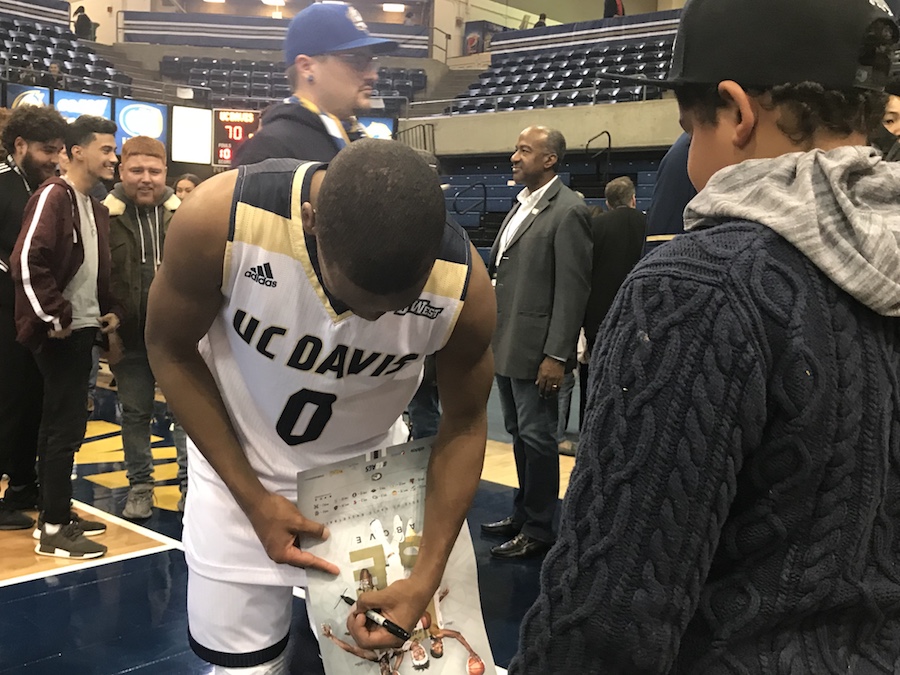
At the final UC Davis men’s basketball game of the season, there were a few special fans in the bleachers cheering on the Aggies. Five UC Davis students enrolled in CMN 130: Group Communications partnered with Progress Ranch to give young at-risk boys the opportunity to cheer on and interact with their favorite players.

It began with a group of UC Davis students who were tasked with completing a volunteer project in their community for the CMN 130 course. The project has made such an impact that some of the group members, like Jennifer Seymour, a second-year physics major, are considering changing their majors to communication.

“We knew that we wanted to [work with] at-risk children and we found out that Progress Ranch was located within the Davis community,” Seymour said.

Progress Ranch is a non-profit organization that houses emotionally at-risk boys in Davis. Since 1976, Progress Ranch has dedicated itself to offering both residential care and treatment services for boys aged 6-15.

After consulting the boys at Progress Ranch and Activity Coordinator Leola Taylor, the group chose the final home game against Hawai’i for the special event. The students also coordinated with Kristin Moore, assistant director of athletics marketing. The boys then had the opportunity to watch the game in reserved seats and afterwards got autographs from the UC Davis men’s basketball team.

One young boy told The Aggie that he was excited they picked basketball as their event. “Number zero” junior guard TJ Shorts II is his favorite player.

“[Coming to the game] makes me feel happy and it’s very fun,” he said. “[Shorts II] is super cool.”

He got the opportunity to talk to his favorite player and excitedly showed off his signed poster to his friends after the Aggies beat the Rainbow Warriors 70-59.

“The kids were super energetic and hype [sic],” said Joshua Garcia, a third-year communication major involved with the project. “They all play football, basketball and baseball, so for them to come out and meet some of [the players] and the team… it was really cool to see their faces. It becomes more than a project, it becomes something special and near and dear to our hearts. It’s more than just getting an A.”

Taylor expressed the importance of students and groups coordinating events such as this.  

“It’s important to volunteer if you can” Taylor said. “It’s important if you see a group home that needs something and you’re able to assist, like donating or fundraising.”

This CMN 130 project created an opportunity for these young boys, whose struggles are often unseen, to interact with strong role models — UC Davis student-athletes.

“Kids are special,” Garcia said. “[Working with them], we know we can impact the future.”


Written by: Liz Jacobson — sports@theaggie.org

Review: Eddie Izzard “Believe Me” Tour

EDDIEIZZARDFANS [(CC BY-SA 2.0)] / FLICKR
Renowned comedian Eddie Izzard visits UC Davis on Book Tour

Eddie Izzard brought his international book tour to Jackson Hall of the Mondavi Center on Feb. 28. Izzard, a famed British comedian and actor, is on tour promoting his New York Times-bestselling memoir, “Believe Me: A Memoir of Love, Death and Jazz Chickens.” The California Aggie joined the crowd Wednesday night to see Izzard in his element.

As the lights dimmed and the crowd hushed, a tall man emerged from backstage. It only took a moment to realize, much to the delight of the whistling crowd, that he was actually anything but tall, as his height could be attributed to his massive knee-high leather platform boots. Further inspection revealed that he sported a turquoise blouse, a power suit jacket, brightly painted red nails and makeup. Eddie Izzard had arrived.

A self-described “straight transvestite, or male lesbian,” Izzard came out at the age of 23 while trying to get his comedy career off the ground. He addressed this occasion and many more seminal life moments throughout his show.

Izzard’s book is autobiographical in nature, and his book tour follows suit. He spent the show recounting his turbulent childhood and adolescence with an interactive grouping of Google Maps, personal photos and excerpts from the 2009 Emmy-nominated film “Believe: The Eddie Izzard Story.”

From the moment he took the stage, Izzard dove right into his set, beginning with his birth in Yemen, where his father was working for British Petroleum. Soon after, the Izzards moved to Belfast in Northern Ireland, where Izzard spent much of his youth. His nomadic life continued, with stops in Wales and Britain.

Izzard had no outright stand-up comedy in his act; instead, he simply told the story of his life on his own terms, which unsurprisingly involved various acts of humor. Throughout the show, Izzard charmed the adoring crowd with different voices, mannerisms and stories all rooted in his comedic nature. He described in detail how he got from point A to point B concerning his career, sexuality and family life.

The show was incredibly unique in this sense, providing constant humour in a less overt comedic tradition. With that being said, the production was unapologetically unpolished. The photos and excerpts shown throughout were essentially a slideshow on a projector behind Izzard. Oftentimes there was lag or a wrong photo showed, leading Izzard to poke fun at his crew controlling the projections. While this wasn’t a huge drawback, it did foster a feeling as though one was at a family reunion and not a $60 comedy show.

And perhaps that was Izzard’s goal. On his personal website, the tour is described as “an intimate, unique experience” — it was just that, and more.

Izzard interrupted such storytelling for a Q&A with the audience, with questions ranging from advice for the LGBTQIA community to his opinion on the rudest animal. It truly became an opportunity for the audience to dig deeper in their understanding of Izzard in both serious and comedic ways.

Izzard ended his show by discussing both his marathons and his theory about the world. He believes this is our last century on earth and, because of that, he hopes and believes it will be the century with the most equality.

On the subject of equality, Izzard professed his admiration for the former South African President Nelson Mandela. In Mandela’s honor, Izzard provided videos and photographs of his “27 marathons in 27 days” challenge, in which he ran 27 marathons in a 27-day period. He chose the number 27 to represent the number of years Mandela was imprisoned during apartheid.

Lastly, Izzard shared his theory: we are always at the center of the Earth because if you go in any direction, and stay that course, you will someday return to the same spot where you began. He also mentioned continuously his disbelief in God and how we are the master of our own destinies.

As a key aspect of his book, this theory was unlikely to be omitted from his show. However, Izzard’s beliefs were a hollow end to the show. Instead of providing unifying or inclusive statements, Izzard ended with divisive comments that surely ruffled feathers in the audience. The ending provided the audience with Izzard’s perspective, and much like the show’s production, this was also unapologetically unpolished.


Written by: Rowan O’Connell-Gates — arts@theaggie.org

What’s lost in automation?

MIREYA PEREZ-LOPEZ

Legal battle over self-driving technology and Uber stories

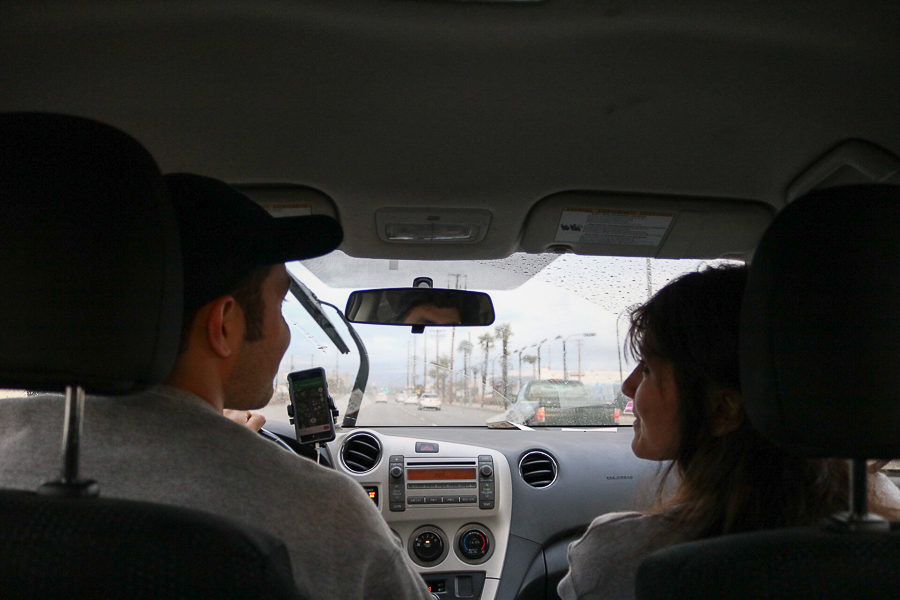
The Uber ride can be an unusual modern location for friendship in the technological age. Finding oneself in close contact with a new person can yield both surprisingly positive and negative results. What about getting in a car with no driver, but rather a program running autonomously? This is the direction in which Uber is going, although automated Ubers are not yet sailing the streets of Davis. The company has tested the technology on the streets of Pittsburgh, Penn. but it has not yet been released en masse.

The impacts of self-driving technology on the public are also under common scrutiny. Automation will obviously have huge impacts on those who drive for Uber and possibly Lyft. Though Uber contends that it will direct previously employed drivers toward services like door-to-door flu shots through the company, the UC Davis community has concerns and words of encouragement of their own. Third-year psychology major Lexi Singh was unsure about the technology.

“I don’t know how I feel about self driving cars in general,” Singh said. “You lose an important social aspect because you don’t have a person that you’re interacting with necessarily. But that would also be just really interesting being in a car that’s just automatically driving. That would be actually pretty exciting to be in a self-driving car, but it would also be scary. I think I don’t really understand the technology very much to say what my opinion on self driving cars would be.”

Many people likely don’t know the specifics of self-driving programming. Infamous Uber driver Karaoke Caddy Man, or Stephen Brumfield, shared a story from his many hours on Davis’ roads. Brumfield was turning on Sycamore Lane when the light turned green, but the truck in the turn lane next to him didn’t go. The truck blocked his view of the crosswalk, so he waited too. It turned out to be a woman, pushing a stroller and pulling a toddler along behind her.

“I don’t know if their technology can handle that,” Brumfield said. “If this technology sees a green light, is it just gonna go? I decided to slow down early […] had I just kept going at 20 miles an hour by the time the technology would have seen that stroller, it would have been too late.”

Annika Lin, a third-year psychology major, isn’t so concerned about the technology itself, but rather what defines a successful Uber ride. For Lin, it’s getting to the destination.

“I’m not really afraid of it, I think it could be good if it was an automated thing because sometimes I get in an Uber and then they’ll refuse to take me because they’re like ‘oh I didn’t know it was going to be that far,’” Lin said. “I just got into an Uber and now I have to call a new one. So I think this automated thing would be cool because they can’t say no and you’re not really burdening anyone so you don’t have to tip them. It’s not like I really talk to my Uber anyway.”

How valuable is the five-minute Uber conversation, really? There’s certainly a split experience between receiving an effective service and having a social experience. Uber is one moment in the day when a stranger can become a friend or an acquaintance and the world draws in close. Second-year mechanical engineering major Ayan Siddiq knows this experience intimately.

“There was one time I was with a lady […] she was telling me about her daughter and how [she] was taking her to the zoo later in the day,” Siddiq said. “I was talking about how I don’t really like the concept of zoos. And then she starts saying how in a way, humans are also held captive, like in society. We were kind of just going back and forth about that, it was a very interesting conversation.”

Siddiq can see the benefits of automation regardless of concerns about technology and socialization.

“In general, they’d be able to put more cars out if it’s automated,” Siddiq said. “I don’t think the interaction between the rider and the driver is necessary, but it is fun to have. So I think it could be beneficial.”

Although some riders have a social experience on their way to their location, the job could also be a social one for some drivers. First-year English major Lili Eichler and first-year genetics major Esme Hassell-Thean shed light on a unique example.

“I’ve heard a lot of Uber drivers say that Uber is kind of therapy for them, just meeting new people,” Eichler said. “Like there’s this one Uber driver that we had, and he had Parkinson’s. He was the nicest guy. He said that Uber basically just appeased a lot of his symptoms.”

Eichler and Hassell-Thean each recalled notable moments shared with Uber drivers, one culminating in the realization that the driver worked on campus and knew exactly where to take them. However, Hassell-Thean ultimately articulated pros potentially outweighing the cons.

“I’m fairly neutral on the idea because the social bit can be nice, but it also carries the risk of having somebody that’s slightly odd,” Hassell-Thean said. “Although I think for the drivers, Uber is a good thing for students to do to make money because it’s a flexible schedule. But as a consumer I don’t think it matters.”

The Karaoke Caddy Man feels more strongly about the social significance of jobs that are quickly becoming automated. Despite having financial stakes in Uber’s evolution, Blumfield reflected on personal experience.

My daughter works at McDonald’s, or she used to,” Blumfield said. “They decided to put a kiosk in there for you to go and order your food. So what happened to the smiling, and everything else that comes along with it? So we’re losing that. And obviously with McDonald’s it’s been lost years ago because nobody likes the job because they’re not getting paid enough.”

Blumfield has been an Uber driver for just over two years. He has installed a cordless karaoke system in his car and operates under the pseudonym ‘Karaoke Caddy Man’ on Instagram and Snapchat where he connects with his past guests.

“I’ve met so many people doing Uber and Lyft,” Blumfield said. “I mean, they’re all on my Instagram I’m watching their lives continue to grow. I mean tons of people. I keep up with them, and we still talk. All those memories would have just been a blank ride.”

The Karaoke Caddy Man has actually been sought out by people who have yet to ride in his car and sing with him. He recounted a recent positive experience while working and waiting to be called, although he cautioned that riders don’t understand how difficult it is to make a profit when he’s forced to idle while they meet the car.

“Just a couple of weeks ago I was was sitting in front of Blondies and I was just sitting in the car, you know, rapping and singing like I normally do and I just hear all this screaming ‘ahhhh’ and I’m like ‘what the heck is going on’ and they open up the door and they’re like ‘are you the Karaoke Caddy Man? […] oh my god we’ve been waiting the whole year to get in your car!’”

Whether or not Uber will try to automate Blumfield is something he will wait and see to find out.

“At some point I guess it’s going to happen and you know I don’t know if I’ll still be driving at that time but if I am, hopefully I’ll continue to […] still have passengers in Davis that will call me,” Blumfield said.


Written by: Stella Sappington — features@theaggie.org

UC Davis student fighting for new city flag

DIANA LI / AGGIE

City Councilmembers reluctant to recognize new flag

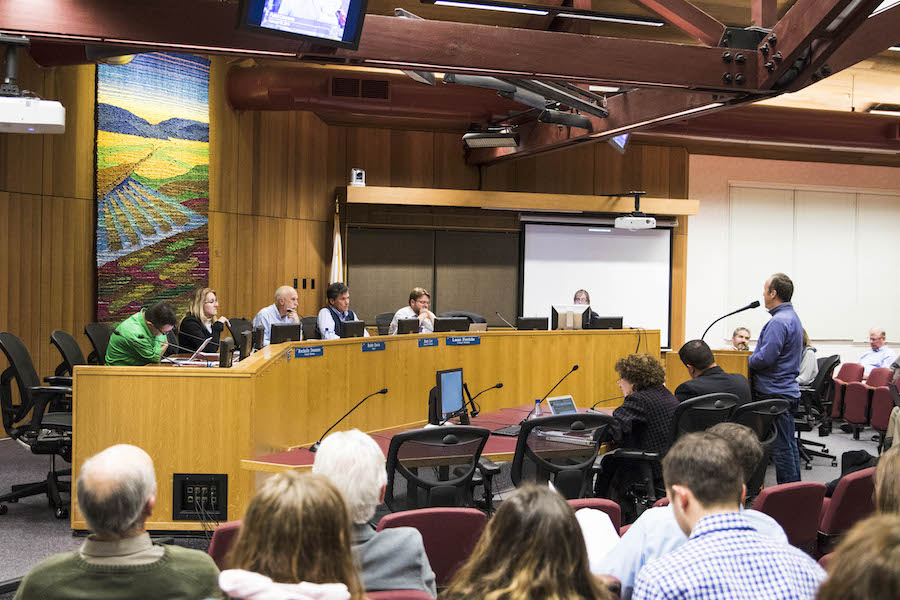
On Feb. 20, UC Davis student Aiden Ramey laid out his case for a new city flag to Davis City Council members.

Since mid-October, the Davis Vexillology Club — vexillology being the study of flags — has been working to create and implement a new flag with UC Davis design students.

DVC, led by Ramey, launched a website in December where anyone can vote for their favorite flag design. Ramey and his team have narrowed the list down to five flags, each of which is meant to represent the city of Davis through specific colors and symbols. They also created a Facebook page to raise awareness and get people involved in the campaign.

“People sometimes say, ‘We have more important things to do than worry about a city flag,’ or, ‘Why does Davis need a flag,’” Ramey said, “and my response is, ‘If we had a great city flag, we would have a banner for people to rally under to face more important issues.’ In Chicago, police officers who have died are often buried with their city flag, not the American flag. Their flag is a source of pride and love for their city. Our flag should be that, too. Davis is a great city, and every great city deserves a great flag.”

Ramey was inspired by a TED Talk about flag design by Roman Mars, a vexillology aficionado and creator of the 99% Invisible podcast.

“For me, Davis has something special that I don’t think you can get from many other places, and I take pride in that,” said Andre Codner, who has worked on behalf of DVC to spread the word about the project. “I think this is why we need a flag. Flags — not seals or logos — show how much the community cares about where the flag is representing.”

Bob Bowen, the public relations manager for the City of Davis, thinks the city already has an appropriate flag: Davis’ city logo.

“It’s [the logo is] one of the most recognizable brands in the U.S., we have found,” Bowen said. “It’s recognizable. It plays into our sustainability, our healthy lifestyle and the bicycles. The very rare occasion when we have needed a city flag, we had a researcher from UC Davis borrow one and take it to the South Pole, to the scientific research center there.”

At the meeting on Feb. 20, City Council officially recognized Davis’ city logo as the flag of the city for the time being. Mayor Pro Tempore Brett Lee encouraged Ramey to continue searching for a new city flag but preferred the city logo.

“I’m not ready to get a new tattoo,” said City Councilmember Will Arnold.

Longtime Davis resident Erick Lorenz thinks the logo is good for stationary and plaques and makes a perfectly fine banner when hung horizontally against a wall but loses its value when hung vertically or looked at from its backside.

“The designs proposed by the DVC avoid these problems by using geometric patterns and elements that work in any orientation and from any direction,” Lorenz said.

Although the DVC has already received over 1,100 votes, Ramey acknowledged that there is still a lot of work to do if they’re going to get their designs recognized. Ramey has pledged to get a tattoo of the flag if they accomplish their mission.

“A flag is not the most important thing that the city needs, but a well-designed official flag could be a point of focus for city pride and civic awareness,” Lorenz said.

There is no current end date for the project. Ramey and the DVC plan on continuing their efforts until they get recognition from the city.


Written by: Dylan Svoboda — city@theaggie.org

Corporations make change when government won’t

CAITLYN SAMPLEY / AGGIE

Dick’s Sporting Goods, others restrict gun sales

In response to the recent shooting in Parkland, Fla. that killed 17 students and faculty and the typical sluggish reaction by representatives to ban assault rifles and ammunition, companies have begun to take gun control into their own hands.

Dick’s Sporting Goods announced last week that it would no longer sell assault-style rifles and high-capacity magazines or sell any gun to customers under 21 years of age. Other gun retailers like Kroger and L.L. Bean have also raised their age restrictions from 18 to 21, with Walmart further prohibiting the sale of any items resembling assault-style weapons. These announcements came after multiple companies cut ties with the National Rifle Association, including MetLife, the First National Bank of Omaha and Delta Air Lines, which is consequently facing political repercussions from Georgia state leaders.

Each high-profile mass shooting in the U.S. has followed the same disheartening, sickening pattern: a national outpouring of shock, mourning and rage, public outcry for an improvement of laws to prevent these tragedies and, ultimately, political inaction — until the next massacre, when the cycle repeats. Each time, anti-gun control politicians credulously cross their fingers in hopes that, somehow, without any amendments to the law, this was the last one — yet over 1,600 mass shootings have occurred in the U.S. since Sandy Hook in 2012.

But this time might be different, thanks to the legion of courageous student-protesters demanding stricter gun laws from their state and national representatives. Activists partaking in the National School Walkout on Mar. 14 and the March for Our Lives on Mar. 24 plan to keep the conversation alive, refusing to yield until weapons intended for the battlefield are banned from civilian possession. Companies big and small are using whatever power they possess to reduce the likelihood of another tragedy — because, as Edward W. Stack, chief executive and founder of Dick’s, proclaimed: “Thoughts and prayers are not enough.”

However, the efforts of corporate America and activists won’t accomplish the level of change necessary to combat the nation’s irregularly high rate of gun violence. Dick’s and Walmart are only two out of the nearly 64,000 gun stores registered in the U.S. Many gun owners purchase their firearms from other sources, such as unlicensed sellers and gun shows, enabling them to bypass background checks.

Nonetheless, the Editorial Board commends the corporations’ decision to act and, at the very least, encourage discussion and pressure other gun retailers to adopt similar policies. This is not a move that will definitively curtail the frequency of mass shootings, but it’s a symbolic one that’s nevertheless critical and poignant.

The most influence still rests in the hands of GOP lawmakers, who, despite being put to shame by the students and corporations, have largely failed to budge. It’s time that Republican politicians take a cue from major retailers and millions of Americans demanding tighter gun laws. As representatives of the developed country with the highest rate of mass shootings, they must stop offering empty platitudes of sympathy and instead start putting the lives of their constituents above the gun lobby.


Written by: The Editorial Board

The Spanish Dilemma: Does being Hispanic require knowing Spanish?

FARAH FARJOOD / AGGIE

How living in the U.S. affects Latinos’ Spanish proficiency

As a Mexican-American, I’ve had to traverse a weird limbo of being proud of my heritage while also embracing American societal norms.


For instance, growing up, I was teased about my accent. My Mexican friends said I sounded too white when I spoke, while my American friends said I had a Spanish accent. I felt like I wasn’t Mexican enough by other Mexicans’ standards and I wasn’t American enough according to other Americans.

People have an outdated belief that Hispanics must speak Spanish. Movies, pop culture and social media sure make it seem like that’s the case.

When a person of Hispanic descent does not speak Spanish, they are seen as not “authentic,” as if it’s a disgrace to their culture for not knowing their mother tongue.

According to the Pew Research Center, 71 percent of Hispanics say it’s not necessary to speak Spanish to be considered Hispanic, while 28 percent say it is necessary.

In this case, I agree with the majority of Hispanics. Being Hispanic and not knowing Spanish does not make you any less Hispanic than someone who does speak Spanish. It’s a flawed argument. Your identity is not defined by other people’s expectations.

Even when Latinos do speak Spanish, they are often judged by other Hispanics and Americans for failing to reach perfect fluency. I like to order food in Spanish at Mexican restaurants — I feel like they’ll make the food better. Yet I always feel anxious and self-conscious when I do so because I worry that my accent is not up to par with other Latinos’ Spanish — partly because I can’t naturally roll my Rs. So even though I am a first-generation Mexican-American, I still worry about my use of Spanish because I’m scared that other Latinos will look down on me for failing to pronounce words correctly.

Does speaking Spanish automatically prove that you’re an “authentic” Hispanic? No. Then everyone who knew Spanish would brag about being Hispanic, even if they’re not.

The only reason I know Spanish is because my parents immigrated here. I had no choice but to learn Spanish, or else I would not be able to communicate with them. If my parents were proficient in English, I’m sure that I would have grown up in an English-dominant household.

Nevertheless, it’s notable that speaking Spanish is important to Hispanics. A survey conducted by the Pew Research Center asked, “How important is it to you that future generations of Hispanics living in the U.S. be able to speak Spanish?” 95 percent of Latinos agreed that it’s very important.

But data also shows that only 7 percent of foreign-born self-identified Hispanics say they mostly use English, with this level increasing to 43 percent in the second generation and 75 percent in the third and higher generations. Or another way to put it: each successive generation of Latinos is less likely to know Spanish than the last. Why might this be? Maybe because living in the U.S. requires the population to know English. Imagine living in the U.S. and not knowing English. Imagine the struggle.

Hispanics should not be criticized for not knowing Spanish. It doesn’t define your identity. I always had a hard time understanding why I couldn’t fully fit in as a Mexican or American. I felt like a mudblood.

Now, I embrace my cultural heritage. I’m proud to be Mexican because I get to enjoy the amazing food and music that my culture has to offer. I’m proud to be American because I love living in the U.S. I’m the best of both worlds.


Written by: Alejandro Lara — lmlara@ucdavis.edu

Disclaimer: The views and opinions expressed by individual columnists belong to the columnists alone and do not necessarily indicate the views and opinions held by The California Aggie.

Tats and Tech

JESSE STESHENKO / AGGIE

How technology has found its way into the tattoo industry

The image of a tattoo artist hunched over a light table with pencil smudges covering the side of the artist’s hand may not be as true as it was before. For many, a pencil has been replaced by a stylus, a light table and paper by an iPad. Indeed, technology has integrated itself into the tattoo industry, changing the way that artists design their tattoos, as many tattoo artists have transitioned to using applications such as Procreate to design their tattoos on an iPad.

“Procreate basically has everything you could do with paper and pencil,” said Phil Geck, a tattoo artist at Davis tattoo parlor Death or Glory. “It has the same process as if you were designing on pen or paper, but all in one easy application.”

With its various functions, this tool can create the same effects that one could produce with the old-school design method.

“You can use a colored pencil on it, you can add layers to it and go over it with a pen tool and have that in a seperate layer,” Geck said. “I think people are able to do a lot more and get more intricate with it since there a lot more tools in here and different effects. Say you wanted to play with light sources — there’s an airbrushing tool.”

For Jonathan Martinez, another tattoo artist at Death or Glory, the application also makes it easier to reference drawing form the internet, having it side-by-side with what he’s drawing.

However, the application not only copies the old-fashioned tattoo design process, but also improves upon it.

“From this app, I can transfer it directly to the copy machine and print out how many sizes of it I want on the paper,” Geck said, “instead of having to draw it and then trace that again on tracing paper and then sending it to the copy machine and sizing it a few times and then going over it and stenciling it. You can also take a picture of someone’s arm, for example, if they want to get the tattoo on their arm and import that image from your phone onto the app and draw on the arm so that they can see what it looks like.”

With these types of improvements, the integration of this app has allowed for greater efficiency.

“It’s really changed productivity and cut down my drawing time by at least 50 percent,” Martinez said.

It also allows for the artist to be more mobile in the designing process, not limiting them to the tools only available in a tattoo parlor.

“If I want to draw on the run or do it in a public space, I don’t have to haul a drawing board or a bunch of paper,” Martinez said. “Sometimes I used to have to get here to draw, and now it’s with you all the time. I like to draw in bed, and there’s no mess when I’m drawing on my iPad.”

Another benefit of this technological transition has also been the limited environmental waste.

“I used to carry in my backpack that I would carry my light table, big thing of tracing paper which has a huge cardboard backing, tape and regular paper and pens and pens — tons of stuff,” Geck said. “Now everything I use now is rechargeable. We didn’t realize how many materials we were using until we stopped; that’s a huge plus.”

For Geck, “ego” might get in the way of some artists choosing not to use such new technology.

“I like to adapt to my surroundings and also my time is very valuable, so if this can save me time and help me in the process of being creative I’m for it,” Geck said.

Whether or not a tattoo artist uses technology in design depends on personal preference, according to Jake Stebbins, a third-year computer engineering major who has a tattoo.

“More hardcore artists may feel more confident designing something from scratch on a more classical medium like paper and might see using technology is cheating,” Stebbins said. “I think that using technology is a totally viable option, especially if the artist designed them on their own. To me it’s just another medium like canvas or paper; I don’t think technology inherently just removes the human element.”

However, there are some limitations to using applications like Procreate, since they lack the human feel that is necessary for some designs.

“The feel is one drawback; you can’t feel the graphite to the paper,” Martinez said. “You can’t feel the friction. When I do a lot of script, I have to still do it on paper rather than the app. While the app can mimic it pretty closely, script is more a hand-control style thing that the iPad is too sensitive for.”

For Stebbins, the designing method of tattoos is not necessarily the deciding factor in deciding his tattoo artist.

“I would be somewhat indifferent to the use of technology by a tattoo artist,” Stebbins said. “If the artist feels more comfortable doing it that way, it’s fine by me. I just would want them to be the one that makes it, not a program or design found somewhere else, unless it’s the exact one that I want.”

Whether a tattoo is designed on paper or on a screen brings up the question of how and in what sectors technology has embedded itself in society. Tattoo artistry seems to be the next realm.

“It’s the classic question of digital vs. analog: both have their pros and cons but at the end of the day it comes down to how you want to design it to get the output you want,” Stebbins said.


Written by: Caroline Rutten — arts@theaggie.org


Guest: Refugee international medical graduates brain waste in Sacramento

JASLEEN_KAUR [(CC BY-SA 2.0)] / FLICKR
IMGs face barriers to contributing to the U.S. economy, communities

Our world-class economy in the United States is a result of four centuries of immigrant contributions and their integration into our communities and workforce. The past two decades of wars in Afghanistan, Iraq and Syria have brought a new wave of immigrants and refugees and California is seeing a significant increase in foreign-educated adults making a life for themselves and their families as new Americans. These individuals bring diverse and impressive educational backgrounds capable of enriching the American economy: engineers, scientists, doctors, teachers and social workers. Yet many find themselves underutilizing their advanced degrees, including MD degrees, instead working in low-wage jobs to make ends meet. This issue of foreign-educated immigrants unable to utilize their skills and education is called “brain waste.”

In the U.S., international medical graduates make up 25 percent of the U.S. physician workforce and 4 percent of the overall nurse workforce, according to the American Public Health Association. Little data, however, is available on the number of unlicensed IMGs who are refugees or Special Immigrant Visa holders. In addition to pre-migration war traumas, IMGs are confronted with post-resettlement severe everyday life difficulties. California is home to the city of their maximum concentration: Sacramento.

What are the obstacles? 95 percent of seniors in U.S. medical schools get into medical residency whereas most immigrant physicians do not. Due to “residency bottleneck,” increasing numbers of medical graduates compete for a capped number of residency slots. The 5-year post-graduation policy in U.S. medical residency programs also bars many Education Commission for Foreign Medical Graduate certificate holders from admission to training. In addition, American residency programs prefer applicants with clinical experience acquired in the U.S. Many Arab immigrants’ foreign work is thus not recognized. And it is difficult to get such experience outside of medical school or residency. Foreign-trained physicians often need assistance in English proficiency and exam preparation in navigating the path to licensure. To address this issue, UC Davis will head a cross-sectional descriptive study directed by Dr. Patrick Marius Koga, the director of Ulysses Project at the UCD School of Medicine, and Dr. Abdul Bashir Noori, the Ibn-Sina director. Along with Master of Public Health students and research assistants, barriers to a successful professional reentry of refugee and SIV IMGs — whether in practicing medicine or in alternative health, research or academic careers — will be researched to inform policy recommendations.

Our current workforce and employment systems erect barriers that prevent the minds and skills of new Americans from contributing to our economy in a more meaningful way by reaching their full potential. As Americans, our strength and future as a nation depends on our ability to embrace and integrate our immigrants fully and welcome and utilize their expertise. Policy changes must be made or programs implemented so that IMGs overcome these obstacles. With refugee IMG integration into the medical workforce, we may see a positive effect on the health of their own local refugee communities.

Nathanael Rodriguez is a fifth-year psychology major and public health minor at UC Davis. He is also a participant in the Stanford Medicine Center of Excellence in Diversity in Medical Education’s Leadership Education for Aspiring Physicians (LEAP) program to improve the health of Northern California communities, in which he is one of the research assistants.


Written by: Nathanael Rodriguez  

Disclaimer: The views and opinions expressed by individual columnists belong to the columnists alone and do not necessarily indicate the views and opinions held by The California Aggie.

First statewide estimation of NOx in California

DR. IAN FALOONA / COURTESY

Agricultural nitrogen oxide emissions higher than previously thought

While California regulates nitrogen oxide emissions from cars and engines, an unexpectedly significant amount of the gases may be coming from an unrecognized source: agricultural lands. A UC Davis study shows that agricultural lands emit between 20 and 32 percent of the total nitrogen oxide gases in the state, far more than previously thought.

“The model we used showed a large and previously undetected source of NOx coming mainly from fertilized soils,” said Maya Almaraz, a postdoctoral fellow in the Department of Land, Air and Water Resources at UC Davis, in an email interview. “While this was surprising at first, after diving into the literature we found that this compared well with estimates of soil NOx in other agricultural regions of the world. This is the first study of its kind to take place in California, so we still have a lot more questions and a lot more to learn about soil NOx in rural areas of the state.”

NOx gases are an air pollutant harmful to human health, which is why they are regulated by various state agencies, including the California Air Resources Board. NOx can also help form fine particulate matter or react with volatile organic compounds in sunlight to form ground-level ozone, two of the components of smog. Some of the worst air quality sites in the nation are found in the Central Valley.

“NOx includes NO and NO2,” said Edith Bai, a professor at the Institute of Applied Ecology at the Chinese Academy of Sciences in an email interview. “NO is usually quickly oxidized to NO2 and so they are usually expressed as NOx. They are air pollutants and have been linked to upper respiratory disease, asthma, cancer, birth defects, cardiovascular disease, and sudden infant death syndrome, and environmental problems such as ozone depletion and acid rain. Many studies have reported high NOx emissions from croplands. Especially, several recent in situ experimental studies suggested that soil sourced NOx emission into the atmosphere may be high. However, in California, there is no state-wide estimation of soil NOx emission.”

Some earlier studies had measured NOx from cropland within 200 kilometers of Sacramento, but study co-authors Almaraz and Bai expanded their scope to include all of California, including some of the most heavily fertilized agricultural lands. They created a model combining a mass-balance and stable isotope model and used multiple data sources to predict the amount of NOx emitted from cropland, which had never been done before. Aircraft from Scientific Aviation flew over the San Joaquin Valley and collected gas to compare the results.

“These methods are both different from more traditional chamber based point measurements that are limited in their range and satellite imagery, which is unable to differentiate between soil and fossil fuel produced NOx,” Almaraz said. “Models like ours have been used elsewhere to estimate NOx emissions, just never before in California.”

Both strategies together suggested higher fluxes than reported by the CARB. In fact, Imperial Valley had some of the highest emissions ever recorded. While the researchers could not sort the collected NOx by source, the process of elimination provided sound evidence that agricultural lands were major contributors of NOx gases.

“The aerial measurements got the total NOx concentration and did not control for NOx transported from roadways or cities,” Bai said. “However, the NOx fluxes from the roadways and cities were estimated by previous studies. When we subtract these fluxes from the total NOx, we can get soil sourced flux.”

The amount of NOx emitted in a particular area was measured by sampling air collected by plane at various heights above the ground. As NOx rises, it mixes with the clean air above, becoming diluted. In the Central Valley, mountains on the east and west sides create barriers for air mixing and dilution. Ian Faloona, a biomicrometeorologist and associate professor in the Department of Land, Air and Water Resources at UC Davis, explained why NOx tends to stick around California.

“One of the things my work is focusing on is trying to really understand the meteorology of how the air moves through [the Central Valley],” Faloona said. “Air flows in and it slams into these mountains and doesn’t have enough energy to go over it. So it just kinda pools up here, and then it circulates and splashes around and slips out here and there, but you have this big mass of air that’s just sitting there. It gets polluted, pollution gets mixed into it, and it just sits there. So there’s definitely a meteorological problem because you’re in this giant bathtub, and so the air just doesn’t ventilate. That was the problem with Los Angeles.”

Los Angeles is now relatively smog-free compared to its early days. The air quality in the Central Valley hasn’t been improving quite as quickly, but thanks to programs focused on vehicle emissions, industry, and other particulate sources, the air quality is improving.

“NOx has been nicely decreasing in the San Joaquin Valley — NOx is the precursor to ozone — and that’s another important point of this,” Faloona said. “The precursor is going down, and so as we clean up our air, more and more things are going to become apparent that weren’t apparent when it was totally dominated by car exhaust.”

Back before the Clean Air Act and pollution reforms, the agricultural emissions seen in the study by Bai and Almaraz would have constituted a small fraction of the overall budget. As mobile emissions grow less and less, other sources emerge as frontrunners.

“But as we steadily improve our air quality, these types of things become relatively more important,” Faloona said. “That’s my justification for why everyone’s missed it so far.”

The results of the study indicate a need for more testing and measurement of NOx from cropland so that the soil pathways can be better understood and accounted for in the state budget. NOx produced by agriculture varies with soil moisture, temperature, and fertilizer application. Some areas may emit more than others. Bai and Almaraz suggest several possible alternatives that could minimize nitrogen emissions while maintaining production efficiency. Slow release fertilizers allow plants to more efficiently take up nitrogen, while cover crops have been shown to lessen NOx emissions.

“We are not pointing the finger at growers they provide a huge service to society and should be commended for what they do,” Almaraz said. “Rather, it’s critical that we focus on incentives to bring the latest nutrient management technologies to farms, so that growers can produce food more efficiently, increasing their bottom line and improving environmental health.”


Written by: Kira Burnett and George Ugartemendia — science@theaggie.org

Lawsuit filed against MLB player agency for performance-enhancing drugs

KAILA MATTERA / AGGIE

Agency’s allegations of providing players with performance-enhancing drugs looms over spring training startup

On Feb. 13, a lawsuit was filed against one of Major League Baseball’s top player agencies, ACES, for allegedly paying players under the table and directing clients to resources with performance-enhancing drugs — all with the first games of spring training just mere days away. The lawsuit was filed specifically against ACES brother duo Seth and Sam Levinson in the New York State Supreme Court by Juan Carlos Nunez, one of the agency’s ex-employees. Nunez is seeking $2 million in “unpaid commissions” and $500,000 in fees and expenses.

Nunez’s lawsuit claims that the agency has been providing players with PEDs for years and plans to have a signed document from Kirk Radomski. Radomski was a key figure in the MLB’s Mitchell Report about 10 years ago, and he pled guilty to both charges facing the Levinsons. Radomski’s affidavit is proposed to say that he frequently provided PEDs for the agency’s clients as well as including a detailed explanation of the delivery route the illegal substances would regularly take; Radomski was reportedly paid in cash by ACES for the various steroid deliveries.

The lawsuit also describes that the ACES brothers were allegedly involved with Biogenesis’ Anthony Bosch, a notorious drug dealer who was arrested in 2015 for impersonating a doctor and prescribing PEDs to both professional and amateur baseball players — including those at the high school level. Sam Levinson supposedly directed many notable baseball players, including Seattle Mariners all-star Nelson Cruz, to Bosch and was completely aware of Bosch’s typical act of prescribing drugs that contained testosterone, growth hormones and many other performancing-enhancing drugs. The lawsuit writes that the Levinson brothers made illegal payments to players to convince them to take the drugs, with full knowledge that these acts violated the MLB’s official rules, the laws of the players’ union and U.S. federal law.

Nunez himself was sentenced to three months in prison and house arrest in 2012 for creating a fake website to cover up the tracks of Melky Cabrera, a then-San Francisco Giants outfielder who failed a drug test that same year; he was then fired from the agency. The point of the phony website was to fool the MLB into believing that Cabrera had taken a PED on accident, mistaking it for a healthy substance he had read about online. Nunez said that he was forced to take the fall for the agency when Cabrera tested positive for testosterone, allowing ACES to slip away from the incident with minimal punishments. He also accused Sam Levinson of urging him to call the New York Daily News to clear ACES’ name in the midst of Cabrera’s scandal, with the promise of being financially compensated for his acts. The Levinsons are predicted to look back on Nunez’s history as evidence against his case.

While the Levinsons did release a statement on Nunez’s toxicity as an employee, they have not released a statement on the lawsuit itself.


Written by: Kennedy Walker — sports@theaggie.org

Does it smell like school spirit?

JULI PEREZ / AGGIE

Students reflect on Davis’ unconventional school spirit

UC Davis is ranked among the top public universities in the nation, a fact that seems to instill a sense of pride within the students that attend the university. However, when roaming around the campus it is not difficult to spot a fellow student representing another school.

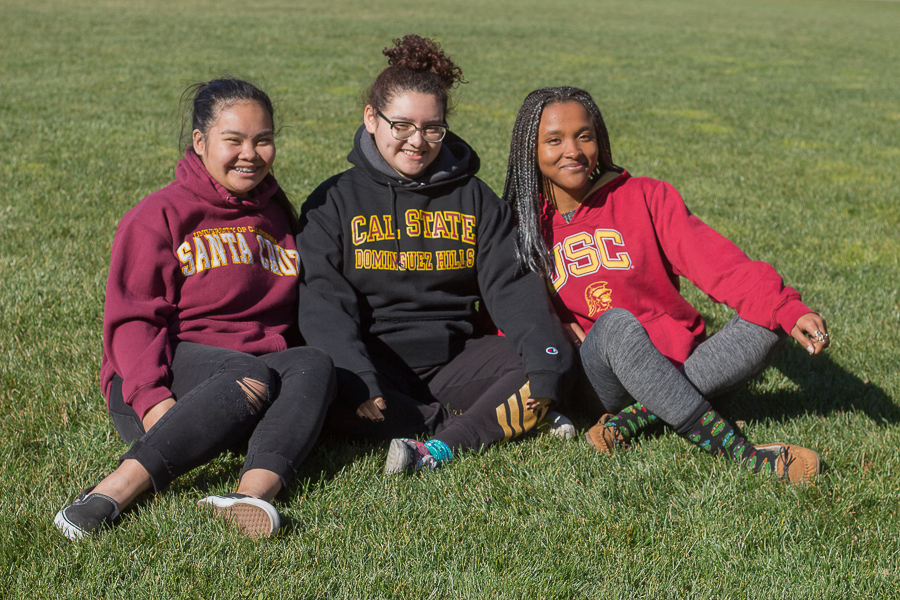
Stanford, Cal and USC are among the top choices of schools many students on campus choose to represent in their apparel. But where’s the logic in Aggies representing a school they don’t attend? Is this an issue rooted in the level of school spirit throughout Davis, or yet another quirk Davis has to offer?

School spirit is a term that generally induces a positive sense of identity within members of the same educational institution. However, the forms in which school spirit manifests differ from person to person. Some regard school spirit as showing pride for their school by wearing school colors and attending sporting events. Others believe that school spirit is something they possess by simply getting involved with campus events or school clubs. Davis is known to have one of the largest university spirit groups in the nation, known as the Aggie Pack. But how much school spirit does the Aggie Pack represent?

“To me, school spirit means taking pride in the values and accomplishments of your school” said Nora Williams, a fourth-year international relations major at UC Davis. “Davis has some really talented sports teams but also our university produces a lot of groundbreaking research […] it definitely gives you a sense of pride everytime you hear something cool that an Aggie alum is doing post-grad.”

According to Williams, school spirit is not something that solely pertains to athletics, but rather anything that pertains to the university itself. For the past four years Williams has felt a great sense of pride in attending a prestigious and nationally-ranked university. From Decision Day up until her last quarter at Davis, Williams expressed how grateful she felt to be a Davis student.

“The people at Davis are so unique,” Williams said. “I am proud to be a part of a community where there is such a strong drive for service and justice […] I constantly see things about how Davis is number one for this or top 10 worldwide for that and it definitely makes me want to brag everytime I go home.”

By attending such an academically rigorous school, getting out to sports games can be difficult, especially with the amount of stress students deal with from work to school to extracurricular activities. The city of Davis and the university itself offer a variety of ways for students to relieve stress and have a good time, but attending sporting events does not seem to be a popular choice among students.

“To be honest, the first and only sporting event that I attended this quarter was [because I] tabled for Camp Kesem,” Williams said. “I really wish I had more time to watch sports games […] those athletes don’t get anywhere near the hype they deserve.”

Jon Amadi, a first-year undeclared student and football player at UC Davis, expresses a different opinion on the level of school spirit he has noticed around campus. Though Amadi feels a great sense of pride for Davis in terms of academics, he believes that the support for athletics at Davis is not nearly as prominent.

“A lot of my friends go to other schools that are really involved and have a ton of school spirit and students attend games more frequently,” Amadi said. “Davis is definitely known to be more of a research and academic school rather than a school focused on athletics [and] it’s not like we have a bad athletic history, people just don’t seem to care about the athletics.”

Amadi described the lack of attendance from the student body at football games as well as other sporting events he has attended, such as gymnastics, lacrosse, soccer and basketball.

“The only time we had a good amount of people attend […] was the very first game we played and the game against Cal Poly,” Amadi said.”I thought us winning the first game would have a bigger ripple effect among the student body and cause people to come to games more often.”

The impact that the audience, or in this case student body, has on the performance of sports players as well as people involved in the arts is immense. Amadi explained how having people cheering for you in the stands is a totally different experience than just having alumni and family watching. In a way, the active participation from the student body creates a greater sense of community within the university.

“Even getting 50 people to come to every game makes a huge difference,” Amadi said. “[Getting people involved] is not something that is going to happen overnight, but it is a step towards strengthening our school spirit. It’s super cool when there’s a bunch of students out there supporting you […] because to an extent it feels like they have your back.”

So what is it that hinders students from attending school sporting events or school events in general?

“Kids are more focused on school,” Amadi said. “When you come to college it’s kind of like a means to an end, meaning you are here so you can get a better job or go to graduate school, and I think a lot of people here have that same tunnel vision [and] they miss everything else going on around them.”

For most people, attending sporting events is primarily a social event rather than a way for people to show school pride. Amadi shared his experiences going to various athletic events and how it changed his experience at Davis.

“It’s actually really fun going to games,” Amadi said. “Watching people do what you can’t do [in reference to gymnastics] gives you a better appreciation for the people within the Davis community.”

There are several universities much like Davis that are more research and academically-oriented compared to sports, yet those same schools seem to have a significantly different turnout at sporting events. Thomas Halligan, a first-year materials science engineering major, explained why he feels like Davis has less school spirit in terms of sports compared to other universities located in California.

“Sports programs at schools like Berkeley or USC are a lot bigger,” Halligan said. “There is a lot more money that goes into advertising and [as a result] there are bigger events surrounding their athletics programs.”

With the argument of money aside, there still seems to be a disconnection rooted within the student body in terms of school pride. Halligan further explains what he believes this disconnection is.

“There isn’t cohesion,” Halligan said. “There is the research aspect which is very much in its own world and then there is the athletics aspect which is also very much in its own world [and] each part is kind of broken off into its own thing and there isn’t much of a connection.”

To bridge this sense of disconnect, Halligan proposes various solutions that could potentially increase student involvement at games as well as school events. Branding and faculty involvement were among the two plausible solutions to address the problem of the lack of cohesion.

“If the university markets school events better they have the power to hype up these events and brand themselves more effectively,” Halligan said. “I don’t think Davis does enough in terms of social media […] having a bigger presence on these [media platforms] might increase school spirit and involvement on campus.”

Halligan detailed the amount of influence professors have on the students. By bringing the students and faculty together to support the school, the community becomes more tight-knit.

“If a professor you look up to, like Enderle, attends a game you are more likely to show up,” Halligan said. “Whether your reason for attending is to get on the good side of the professor [or] recognizing your professor as a member of the community.”

The city of Davis as well as the university has many appealing attributes. From a vibrant city to a nationally-ranked public university, students have a lot to be proud of.

According to Halligan, Davis has the potential to pave the way for future Aggies to be more active members of the Aggie Pack.

“Davis is a really unique school and there are a lot of aspects that make it a great university if it were broadcasted on a bigger scale,” Halligan said.


Written by: Sneha Ramachandran — features@theaggie.org

Swine flu 2.0

JAMIE CHEN / AGGIE

Reports say flu vaccine effectiveness especially low this season

Sniffles, coughing and fevers, oh my! February marks the peak for influenza season, which this year is proving to be particularly nasty. The Center for Disease Control reports a record-breaking year, the worst since the H1N1 swine flu in 2009. Like the rest of the nation, UC Davis was hit hard this year. Vaccinated or not, the bug has spread through the student body like wildfire.

So why is the flu hitting so hard this year? Dr. Cindy Schorzman, the medical director at the UC Davis Student Health and Wellness Center says one reason is due to the effectiveness of this year’s vaccine.

According to current CDC estimates the vaccination effectiveness is 39 percent, which is higher than previously reported,” Schorzman said.

The Los Angeles Times reported early on in the flu season the projected vaccine effectiveness to be just 10 percent based on data from Australia’s flu season, which starts earlier than the U.S.

“Historically [the U.S.] follows a similar pattern of effectiveness [to Australia] because the strains tend to be similar,” Schorzman said. “However, the vaccine in the U.S. was more effective this season than Australia in their flu season.”

Though the United States’ vaccine was found to be considerably more effective than predicted, these initial reports affected whether people got the flu shot this season.

“I think that the press had an unfortunate impact on the numbers of people getting the flu shot,” Schorzman said.

This is one of the major factors that caused this flu to hit the country so hard this season. Emmy Hughes, a third-year managerial economics major who tested positive for influenza, opted out of getting vaccinated this year.

“I didn’t get vaccinated the year before, and I heard it was only 15 percent effective this year, so I didn’t think it was that important,” Hughes said. “But mostly I think it was laziness.”

When asked about the vaccinations offered at the Student Health and Wellness Center, Hughes said she was unaware of these services. Hughes started getting sick on a Friday and experienced symptoms such as high fever, coughing, sore throat and even fainting.

“I blacked out a couple times,” Hughes said. “I was eating and passed out at the table, and then I woke up and got up and I passed out on the floor again.”

Fainting is not a common flu symptom, but she explained that fainting was not uncommon due to her anemia. She was concerned nonetheless.


“I went to the Davis Urgent Care,” Hughes said. “It was Saturday, so it was the closest open resource.”

She tested positive for influenza and was prescribed Tamiflu.

“They also gave me a prescription for cough syrup and told me to take NyQuil, which helped me sleep,” Hughes said.

Trevor Carpenter, a first-year computer science major, went to the UC Davis Student Health and Wellness Center after showing similar symptoms where he tested positive for influenza.

I don’t have the student insurance, but they were very helpful,” Carpenter said. “The whole process was very quick. I met with a nurse and a doctor within a half an hour. It was a very positive experience.”

Like Hughes, Carpenter also did not get vaccinated this year.

“I thought about it, but I heard it didn’t have a high success rate this year,” Carpenter said.

When asked if he would have reconsidered getting the flu shot if the effectiveness was not so low, Carpenter said this wouldn’t have influenced his decision. Because he had never had the flu before, Carpenter didn’t know how severe flu symptoms were. The Student Health and Wellness Center prescribed Carpenter with Tamiflu, recommended painkillers and rest. His virus and symptoms were present for a week.

February is the peak of the flu season, but by no means is it over, and there is still time to get a flu vaccination. Schorzman also explained that even though the 39 percent effectiveness report is lower than other years, it is still worth getting.

“People who are vaccinated if they get sick will often get a less severe version of the flu, and that is in general, not just this season,” Schorzman said.

To prevent getting sick it is recommended to get adequate rest, wash your hands frequently and pay attention to self care.

“I definitely still encourage the flu shot, even though it is later in the flu season, we expect the season to last through the end of March,” Schorzman said. “Sometimes this will extend beyond, but it is not officially over until the health department, here the Health Department of Yolo County, issues a press release stating that it is over.”

In response to Hughes being unaware of the available resources at the Student Health and Wellness Center, Schorzman spoke about a flu awareness and vaccination campaign.

“We are trying to get the word out,” Schorzman said. “We do have a flu awareness and vaccination campaign, and we are trying to get a larger campaign going for next fall. This covers what the flu is, what the symptoms are and how to prevent the flu, including vaccination.”

The Student Health and Wellness Center is still offering and administering flu shots through the end of the season. More information can be found on the Student Health and Counseling Services website.


Written by: Grace Simmons — features@theaggie.org


Recruiting season for UC Davis students

KYLA ROUNDS / AGGIE

Students take advantage of recruiters to secure future jobs, internships

In the midst of recruiting season, students are doing all they can to gain exposure to companies and lock down jobs or internships following the end of the school year. In addition to applying to companies online, students also have the opportunity to attend on-campus career fairs, often hosted by UC Davis, where company representatives come to campus to meet and network with students and alumni alike.

Speaking to recruiters may be one of the most effective ways for students to find potential jobs or internships, as students are able to directly make their mark on recruiters rather than have their resume and online application get lost in a sea of other applicants.

Jessica Hyunh, a UC Davis alumna, found luck in attending a UC Davis-hosted career fair. She noted that attending a career fair and talking to recruiters was much more effective in her job search than applying for jobs online, which tends to be the more traditional route of looking for opportunities.

“The job search was rough after graduation since I graduated in the fall instead of in the spring,” Hyunh said. “I didn’t find any jobs before I graduated; I actually didn’t start searching for a job until after graduation. Career fairs after graduation were super useful — that’s where I found my first job after college.”

Hyunh had a very positive experience talking to recruiters, as the recruiters she spoke to understood her intended professional route. She now works for Lending Club, a job she eventually received through initially attending a UC Davis career fair.

“I originally interviewed [at Lending Club] for a sales role and got rejected,” Hyunh said. “The recruiter understood that I didn’t really fit the sales route. Instead of letting me go immediately, she considered placing me in a different role. I interviewed again and I got the job [reviewing loans].”

Hyunh had vocalized that a position in recruiting was her intended career path. Lending Club offered her the chance to switch to a recruiting position after a year of working in the loans department of the company.

Some students take this opportunity to explore as many career fairs as possible by going so far as to travel to other colleges, such as UC Berkeley, to increase their exposure to recruiters and hiring companies.

Jeffrey Ge, a fourth-year managerial economics major, attends career fairs outside of UC Davis. Ge understands that other prestigious schools, like UC Berkeley, offer a wider variety of companies that may help him gain exposure to more potential job opportunities.

“The hardest part is [logistically] trying to get there and make everything work,” Ge said. “When I first talk to recruiters, I would say where I’m from and tell them that I’m from UC Davis. I would let them know that I understand that Davis isn’t the best at recruiting heavily, which is why I’m willing to go the extra distance to come to Berkeley. I know that Berkeley is a target school for specific fields.”

While Ge hasn’t yet found luck in attaining a job offer from these outsourced career fairs, he has found that recruiters have given him positive feedback for taking the initiative to attend a career fair so outside of his proximity.

“They would often say things like, ‘I know that’s really far, it’s impressive you came all this way’ or ‘Wow, that shows a lot of determination,’” Ge said. “Going the distance shows you have the determination, but they still want to make sure that you have the skills for the job.”

In addition to attending career fairs outside of UC Davis, many students take advantage of events such as hackathons to talk to company representatives. Companies sponsor these hackathons and provide gear for students to “hack” or use in their coding projects.

Representatives from these companies are also present at the event to talk to students about the products and offer more information about the respective companies. Students have the opportunity to network with these representatives, offer their resume and potentially land an internship or job while at the hackathon.

Students often make the time and energy to make the trek to various hackathons at schools both near and far. At CalHacks, the recent hackathon at UC Berkeley, UC Davis students made their way to the Bay Area in order to participate in a weekend of coding and networking. Students report colleges such as UC Berkeley as having much better hackathon sponsors than colleges like UC Davis, with sponsors more willing to engage with students and stay at the events for longer periods of time. However, some students have reported having disappointing interactions with company representatives at these events.

Varshini Anata, a third-year computer science major, frequents such hackathons and interacts with other hackers and recruiters. While she has had ample experience talking to different company representatives at these hackathons, she notes that some of her interactions with recruiters have been negative due to her educational background at UC Davis.

“[The recruiters at smaller companies] don’t usually ask me what university I go to,” Anata said, “But when I talked to bigger companies like Microsoft, [I noticed that] the first thing they ask is was what university [an individual] goes to.”

Talking to recruiters at such events generally entails giving a short elevator pitch and walking them through past work experiences. Students attempt to make good impressions on recruiters in hopes of being offered an interview or maintaining a professional contact when they may later be searching for a position. As such, many students are inclined to make their mark on larger companies with recruiters that may have more sway in their professional field.

“[The Microsoft recruiter] didn’t initially ask me what university I go to; I went through my experiences instead,” Anata said. “She confirmed what university I went to at the end of our talk, but still took my email and told me to add her on LinkedIn.”

While her in-person experience with the Microsoft recruiter wasn’t negative, Anata noted that after their discussion the recruiter wasn’t willing to converse with her more.

“I emailed her but she didn’t respond. When I talked to her in person it was a good experience, but after that she didn’t reply,” Anata said. “I did notice that they were mainly only taking resumes from students from UC Berkeley. They didn’t take many resumes from students from other colleges.”

Talking to recruiters can help students get the job or internship offer that they dream to receive. Aware of this, many students carve time out of their schedule to get as much face-time with recruiters as possible.


Written by: Alyssa Hada — features@theaggie.org

Soroptimist International of Greater Davis presents college scholarships to women

KYLA ROUNDS / AGGIE

Organization’s annual Live Your Dream Awards provide $2,000 to two single working mothers

On Feb. 21, Soroptimist International of Greater Davis hosted an information and awards night at Repower Yolo on E Street. The organization named two recipients of its annual Live Your Dream Awards. In addition, the club presented money to the Multi-Disciplinary Interview Center and gave insight about the club for any prospective members.

Soroptimist International is a global organization that works to empower the lives of women, girls and children through hands-on projects, fundraisers and awards. Since the Greater Davis chapter was chartered in 1985, its primary goal has been to help local women, girls and children from Yolo County.

“The Soroptimists is an international program, established in 1929 [by] a lady down in Oakland,” said Wanda Winton, the organization’s former president and the current charity co-chair. “There was always men’s organizations — like the Rotary Club — and she said ‘Well, we should have something for women.’ There are now about 1,300 soroptimist clubs worldwide.”

According to Winton, the aspect that differentiates the soroptimists from many of the other community service organizations in Davis is that they prioritize their service over socializing. Much of their work also helps empower women in their own communities.

“The majority of our funds are from our local businesses and merchants, and so we try to give back to our local community,” Winton said.

In the past, the club has been known for hosting its annual charity golf tournaments and helping fund the MDIC, a Woodland center that provides abused and foster children with resources and legal aid, along with many other projects. The Live Your Dream Award — formerly known as the Women’s Opportunity Award — was presented on Feb. 21 and has been a Soroptimist International staple since 1972. The local Greater Davis chapter has been presenting the award for around 10 years.

“We give grants to women who are heads of households who are going to school so that they can continue their education,” said Susan Wilcox, the charity’s co-chair. “It’s usually a $2,000 grant, and we provide two of those a year.”

For Rita Durgin, the president-elect and sitting president, the award is representative of why she joined the club. In 2012, Durgin — then a working, single mother and a student at Sacramento City College — applied for and received the award.

“I could use it for anything,” Durgin said. “I could use it toward books, I could use it toward a new washer, if the car had broken down; it was for anything that was gonna keep my head above water. Raising three kids and going to school — it’s really hard, and that money really helped me at a time that I needed it.”

The Soroptimist Club tracked her progress, and in 2015, Durgin decided to join the club as its director. Three years later, as president-elect, she remembers how big of an impact the Live Your Dream Awards can have.

“The story that the women shared last night was that this money couldn’t come at a more opportune time as heads of households,” Durgin said. “They’re trying to advance themselves, their educational and professional careers. And so that’s what it means to me, you know, just helping to empower other women with their goals and their dreams by any means possible. It’s just been a very important stepping stone.”


Written by: Hannan Waliullah — city@theaggie.org

Police Logs

NICKI PADAR / AGGIE

Keep your own trash

Feb. 13

“Reporting party believes neighbor dumped trash into his garbage bin while out on the street during pick-up day.”


Feb. 14

“Reporting party concerned about a trail of Ritz crackers laid out on the sidewalk and nearby bushes, leading to a white van with cracked windows parked in front of residence. Reporting party believes it is suspicious because the crackers were laid out like a trail from up the street to vehicle. Vehicle appears as if someone is living out of it.”


Feb. 15

“Male shoplifted candy bar — now in front of business threatening to ‘187’ employees refusing to leave.”


Feb. 16

“ID taken away at bar, reporting party states he is of legal age and employee at the bar is refusing to give his ID back.”

“Several subjects on the roof of a house.”


Feb. 17

“Male subject threw a stick and a bicycle at the reporting party — reporting party took the male’s bicycle and is now standing by at above location.”

“Reporting party found wheelchair left in front of his residence this morning — reporting party concerned it’s dumped stolen property.”

“Occurred at 1900 hours: reporting party thought she heard someone jiggle the door handle, and her light sensor came on.”


Feb. 18

“Group of approximately 20 chanting. Possibly school related.”

“Reporting party received call from unknown subject stating that he has her address and was going to go to her house — gave her the address. Reporting party is concerned for her roommate that is home alone — requested area check, unknown description on subject.”