59.3 F
Davis

Davis, California

Sunday, December 21, 2025
Home Blog Page 545

Grant awarded to Yolo Hospice

JEREMY DANG / AGGIE

Yolo Hospice receives $60,000 grant for advance care planning

Partnership Healthplan of California and The Coalition for Compassionate Care of California awarded Yolo Hospice a $60,000 grant for advance health care planning in the community.

Yolo Coalition to Honor Choices — a coalition formed by Yolo Hospice that includes Yolo Healthy Aging Alliance, Woodland Healthcare and Citizens Who Care — aims to provide education and awareness for advance care planning.

“Advance care planning is the discussion that someone has with their family or physician about the care they are unable to receive for themselves,” said Amy Turnipseed, senior director of external and regulatory affairs of Partnership Healthplan of California. “Making sure that the people around us understand the wishes of those who are unable to speak for themselves is our focus.”

Silvia Molina, a Yolo Hospice community ambassador and the project management coordinator for the grant, also emphasized the importance of advance care planning.

“We are really trying to reaching the broader community,” Molina said. “Anyone over the age of 18 can have an advance care directive. Different cultures believe in different things when it comes to ends of lives. And so we have experts for that — to have those conversations.”

Sheila Allen, the executive director of Yolo Healthy Aging Alliance, talked about the possible benefits that could come with this grant.

“The mission [of Yolo Healthy Aging Alliance] is to enhance the well-being of older adults,” Allen said. “We are very interested in being a part of this grant because its goal is to educate the community. Part of this grant is the coalition. We are developing the coalition to get input and views from different organizations.”

She further emphasized the importance of having these conversations.

“Having this conversation is not just for the very old or the very sick,” Allen said. “Everybody should think about what it is they would like to do if they can’t speak for themselves — who would they like to speak on their behalf.”

Turnipseed highlighted what the grant means for the Partnership Healthplan of California.

“The partnership sees the goal of this grant as to bring the community together, to build the community coalition that can help advance health for individuals and doctors,” Turnipseed said. “It gives them a forum to talk about their end-of-life options. Everyone should have the education. Here at Partnership Healthplan, we make sure employees have the resources to have these kinds of advance care planning conversations with their families.”

According to Molina, the grant money can be expected to be allocated toward the larger goal of making advance care planning accessible and heard to the public.

“We are planning to have advance care planning events,” Molina said. “We will be having a workshop where people, if they feel like talking, can talk about who they want as their health agent, talk to their family and then — if they feel they can — go ahead and fill [out] the documents, which will then be sent to their doctor.”

Yolo Hospice will have its first kick-off event in August, though outreach will begin sooner.

“We will be working with Aging Alliance to to get the word out to the people, and we will start on that as early as March 26,” Molina said.


Written by: Rabiya Oberoi — city@theaggie.org


Editor’s note: A previous version of this article attributed the quotes from Partnership HealthPlan to Public Affairs Manager Dustin M. Lyda. The quotes are from Amy Turnipseed, Partnership HealthPlan’s senior director of external and regulatory affairs. The article has been updated to reflect these changes. 
Duke law professor presents lecture on voting rights law

VENOOS MOSHAYEDI / AGGIE

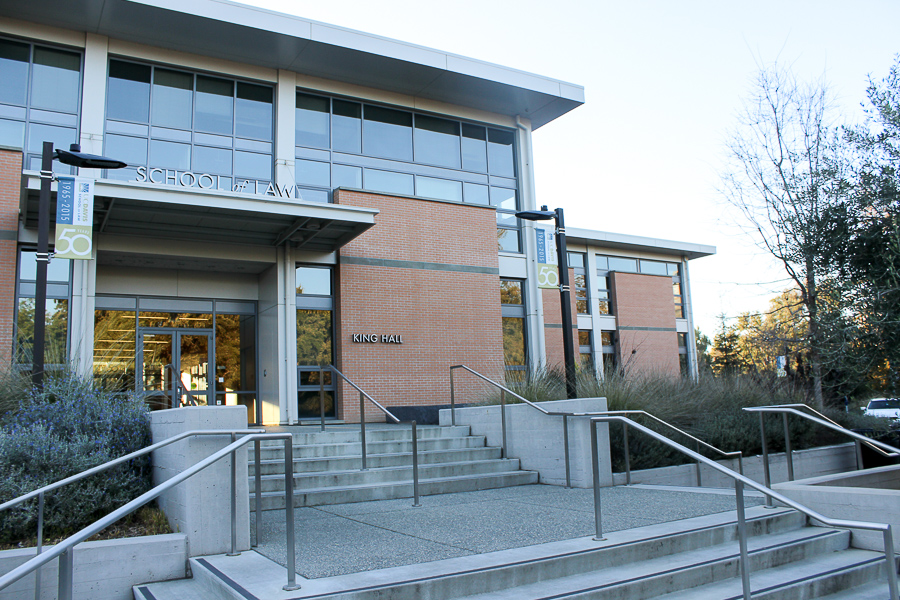
Guy-Uriel Charles speaks at King Hall

Duke University professor of law Guy-Uriel Charles delivered the annual Edward L. Barrett Jr. Lecture on Constitutional Law at King Hall on Feb. 6. Charles spoke on voting rights law and policy in the United States and analyzed the history and future implications of the Voting Rights Act of 1965 and the 2013 Supreme Court case Shelby County v. Holder.

Charles emphasized that his lecture, “Race, Exit, and the Voting Rights Act,” would answer two overarching questions related to voting rights law:

“First, what has been the key to the success of the voting rights model in the last fifty years?” reads an informational page about the event on the School of Law website. “Second, where should voting rights law and policy go from here?”

Throughout his speech, Charles cited the Shelby case as a landmark step backward for voting rights.

“It functionally neutered what former Solicitor General Donald Verrilli called an iconic statute in part of American history,” Charles said.

In Shelby County v. Holder, the Supreme Court struck down a crucial provision of the Voting Rights Act, ruling that it was unconstitutional to require state and local governments to earn federal approval before changing voting laws. This provision targeted specific states and areas that had a history of discrimination against certain communities of voters.

“One result has been the passage by many state legislatures of a number of voter ID laws and other measures that disproportionately impacted voters of color,” said the dean of King Hall, Kevin Johnson.

Charles agreed that the Supreme Court’s decision in Shelby had very tangible consequences for voters nationwide. According to Charles, following the ruling, certain states passed a number of legal measures that could prevent minority communities from voting.

“Following the Court’s decision in Shelby County, [North Carolina] rushed through, in what seemed to have been the heat of the night, an omnibus voting rights law that eliminated same-day registration, adopted a stricter voter ID requirement, limited voting hours, made it harder for young people to vote, et cetera and et cetera,” Charles said.

Later, he mentioned that “it has now become almost reflexive to cite Shelby County for all that perhaps ails voting rights law and practice.”

However, Charles noted that there were positive consequences of the Shelby County case. He observed that the Supreme Court’s decision sparked a revolution against new laws that had the potential to suppress the vote.

“Shelby County has become essentially a crie du coeur — a symbolic rallying cry for voting rights activists,” Charles said.

Charles observed that the implications of the Shelby County case will be difficult to combat, let alone reverse. He concluded that although Shelby County was a big step backward for voting rights law, the nation must move forward and continue to fight for voting rights.

“As a consequence of [Shelby County], voting rights policy will have to break away from its past and embrace its future,” Charles said.


Written by: Jacqueline Moore — campus@theaggie.org

DUI: Misdemeanors to Manslaughter

JEREMY DANG / AGGIE

Driving under influence; any substance can impair

Driving under the influence refers to the act of driving a vehicle while being under the influence of any drug or substance that can impair one’s ability to drive safely. DUI arrests can range from minor misdemeanors and traffic violations to counts of manslaughter for causing someone’s death.

“I think it’s more of an issue than people seem to think,” said UC Davis police officer Jose Pinedo. “I feel that some of the drivers that are under the influence — not all of them are doing it out of spite. Sometimes they’re just not thinking clearly which tells me that there needs to be a push for more of an education for those individuals.”

Education and raising awareness around the issue of DUI has been a focus of UCDPD outreach officers. There are many myths, as Pinedo expressed, that need to be broken around DUI, such as the notion that alcohol is the only substance that is problematic, or misunderstanding what it means to be under the influence. Blood alcohol concentrations do not necessarily need to be at 0.08 percent or above for someone to be impaired.

“People sometimes think they are at their limit and stop [drinking] one to two hours before driving, but that may not be the case and may not work out,” Pinedo said. “They could still be way over the limit. [In] the arrests that I’ve been involved in, a lot of them aren’t in the right mindset to think that they are impaired. A lot of them seem to think that they are okay to drive and are pretty shocked by it. So we need more education.”

Part of this education involves understanding that alcohol is by no means the only substance that can lead to impairment and subsequently a DUI. According to Pinedo, a very common misconception is that smoking marijuana can lead to any less of a violation. Pinedo has noticed this to be an issue in the Davis youth community,

“Most people understand that drinking and driving is a huge issue, but I think a lot of people don’t understand that being on other substances and driving is also a really, really big issue,” said Mahima Rupakula, a second-year chemical engineer who has had a couple friends face DUI charges. “I’ve met so many people who say, ‘it’s okay, I’m not drunk.’ It doesn’t matter. It’s still a problem. You should not be driving. People should start to learn that just because you’re not drunk, doesn’t mean you’re fully functional to drive. In some countries, there’s a law that says if you look sleepy, you can get pulled over and get ticketed.”

In addition, the amount of alcohol or other substances that can lead to impairment in an individual varies heavily from person to person. Depending on metabolism and body mass index, people can have very different tolerances. This means that some may seem functional even over the legal blood alcohol concentration, while others may be impaired at a level significantly below that.

“Think about your friend who’s really short and really thin,” Pinedo said. “Now think about them drinking two beers within one hour and compare it to somebody who is significantly taller and significantly weighs more — you’ll see the impairment levels be significantly different. The shorter individual who will probably be really impaired by those two beers and that doesn’t necessarily mean that they’re above a 0.08 percent, because again it is just two beers. However, their perception for time and distance and reaction time is impaired. Just because you are not at 0.08 percent, doesn’t mean you are not impaired.”

In Pinedo’s opinion, the best way to avoid a DUI is to make a plan for transportation before alcohol impairs one’s judgement. He suggested a Lyft, Uber, designated driver or any other option to avoid risking the driver’s life and the community around them.

“For Davis residents, its only about $8 to $10 to get an Uber or Lyft, and that service is phenomenal,” Pinedo said. “I think it started becoming a popular thing here starting 2015, and I saw DUIs just drop dramatically. I know sometimes we are in financial hardship and can’t afford $10 here and there, but it’s definitely better than getting into an accident or accumulating a DUI misdemeanor — it’s cheaper than that. Another thing is to just try and get a designated driver. One of your friends has to be willing to be able to help you out. It’s not safe and it’s not worth it.”

Getting a DUI can cause financial strain, create a criminal record and, especially for UC Davis students, also has implications and punishments from the university.

“Pay attention to how much you’ve been drinking throughout the entire night, versus just stopping an hour or two before you drive, because it’ll definitely carry on past that,” Pinedo said. “And for those individuals that are planning to drink heavily that night, I’d definitely have a game plan set before you start drinking. That way, when you’re halfway through drinking, you’re not going to be tempted to take the keys or get behind the wheel.”

Lashkara at UC Davis, a Hindi film dance team, chose its story line this season to bring light to DUIs. The dance tells the tale of a couple that was engaged, but got themselves into a DUI situation, ending with the woman losing her fiance. She looks back a few years later, and contemplates the life she could’ve had with her partner, if only they hadn’t made one wrong decision.

“The main reason we were inspired to use that as our topic is because we wanted to show how life isn’t always how you expect it to be,” said Anjana Benny, a second-year neurobiology, physiology and behavior major and captain of Lashkara. “Our title is one decision, and we wanted to show how one decision can literally change your life, [or] anyone else’s life. One single decision, like going out and getting in a car and driving, that one small decision can literally either end or change your life.”

Anjana expressed how many people don’t realize the imminent danger of a DUI and believe that they are somehow different or immune to the consequences of such a decision.

“You don’t imagine these things ever happening, until you’re put into that situation,” Benny said. “It’s a really big eye-opener. A lot of people just don’t realize that it could happen to them, and it happens to so many people. If a person is drunk driving, first of all the driver themself is going to be in jeopardy, all the people in the car are in jeopardy, and also all the people on the road are in jeopardy. That’s a good amount of people who could possibly get hurt really badly.”

Driving is an activity that requires an alert individual with fully functioning reflexes, depth perception and sense of judgement. It requires active thinking and motor skills, and any state of mind that is sub-par to this poses a risk to the driver and everyone on the road with them. From being intoxicated to simply being fatigued from a long day — any decrease in awareness can pose a threat.

“Don’t be on anything and driving,” Rupakula said. “Don’t be too sleepy and driving, don’t be texting and driving, don’t be eating and driving.”


Written by: Sahiti Vemula — features@theaggie.org

Last Week in Senate

HANNAH LEE / AGGIE

Controversial prosecution of UC Davis student by Yolo County District Attorney discussed

The weekly ASUCD Senate meeting was called to order by Vice President Adilla Jamaludin on Feb. 15  at 6:10 p.m. in the Mee Room of the Memorial Union. Controller Jin Zhang and Senator Khadeja Ibrahim were absent.

The meeting began with a monthly report from Judicial Council Chair Ryan Gardiner. Gardiner began by stating that the Judicial Council had been relatively busy of late with “10 cases in the past seven days.” He discussed ongoing projects that members of the Council are working on, including but not limited to: the reorganization of government documents, changes to ASUCD election rules and maintenance of transparency within the judicial system at UC Davis.

Jamaludin then moved to have Public Discussion brought further up in the meeting agenda. During this portion of the meeting, a member of the community brought to light the recent prosecution of current fourth-year comparative literature major Noah Benham. Benham was prosecuted by Yolo County District Attorney Jeff Reisig and, according to the speaker, was prosecuted while protesting the presence of Milo Yiannopoulos on campus last January.

The community member raised concerns about the lack of involvement from the student body in the case, which will be tried in Woodland on March 5. The community member additionally stated that he felt that the charges were too extreme and that he is creating a petition to drop the charges.

In response to the statement, ASUCD Senator Josh Dalavai elaborated on his opinion on Reisig, stating that the DA is known for exacerbating the administration’s recommendation of punishment in such cases and is “antagonistic and biased.”

Lastly, the community member brought up the June elections for the Yolo County DA position and asked for the support of the Davis community in the election — highlighting candidate Dean Johansson.

ASUCD Senator Rahi Suryawanshi mentioned the Police Accountability Board Meeting which took place on Feb. 21.

The Public Discussion segment was followed by the confirmation of candidates from the Disability Rights Advocacy Committee. The candidates included second-year psychology major Brielle Hadley, fourth-year biological psychology major Kelly Murrell, second-year animal science major Jennifer Lin and third-year communication major Daniella Aloni. During a brief Q&A session with members of the Senate, topics included a walkout for disability awareness, understanding the intersectional identities of individuals with disabilities, making the campus more welcoming and a discussion as to where ASUCD itself could improve its accessibility to DRAC. All candidates were confirmed by the Senate.

The next portion of the meeting was a housing presentation delivered by David Taormino, a representative from the West Davis Active Adult Committee. Taormino detailed the proposal he submitted to the City of Davis Community Development Department. The 75-acre apartment site is located on the north side of Covell Boulevard, west of Sutter-Davis Hospital and will offer 325 for-sale units,150 affordable senior apartments and an Activity and Recreation Center. Taormino stated that this housing plan is not restricted to senior citizens ages 55 plus only, but is meant to “combat loneliness” and will allow members of the Active Adult Community to interact with the youth of Davis by renting or selling their homes when they move to the WDAAC.

Taormino stated that this project was “a quid pro quo” in the sense that the student body is expanding and has a growing need for housing, and the senior community in Davis has a growing need for a new senior living community; the exchange proposed was support for this housing plan in order to benefit the student housing market in the long run.

This presentation was followed by the introduction and confirmation of OASR candidate Destiny Padilla, a second-year community and regional development and Chicano studies double major, who received recognition from multiple senators regarding her active, involved presence on campus.

Next, Senate Resolution #14 was presented. It supports a proposal brought forth by Health Education and Promotion which would require two non-instructional days per quarter. The resolution passed.

Senate Bill #24 allotted $742.29 to renovations on the bike circle near the Student Community Center including the addition of painted butterflies. The bill passed.

Interim Senator Shaniah Branson authored Senate Bill #34 which would create a mandated mentorship program between those in ASUCD and those new to ASUCD. A lengthy discussion on the bill followed.

“When I came into ASUCD, I didn’t know the system at all,” Senator Jesse Kullar said. “The website was a mess. I’ve constantly asked senators to come out to me. No one reached out to me; I had to reach out to other people. It came to my attention that a group chat was made excluding Shaniah, me, and [Michael] Gofman about this bill. The people who originally wrote the bill were shut down. This is unacceptable.”

As in previous Senate meetings, Jamaludin expressed her frustration with the state of the Senate.

“One thing you can’t legislate however is genuine relationships,” Jamaludin said. “Both sides have to try. I’ve seen many Tables come and go. In the past we’ve worked so well together. If anything this bill is a proxy for things on the Table right now. In the next week switch up seats and don’t write bills to the same goddamn people. It’s week six, I’m terming out and if I leave from the Table in the same state as it is now I’d be so upset.”

The bill passed.

The Senate agenda moved on to cover ex-officio reports, elected officer reports and the approval of the past meeting’s minutes.


Written by: Priyanka Shreedar — campus@theaggie.org

Editor’s note: A previous version of this article did not include Destiny Padilla’s majors. Padilla is a community and regional development and Chicano studies double major. The article has been updated to reflect this change. 

New findings in brain processes using virtual reality

HALLE DIMSDALE-ZUCKER / COURTESY

VR environments allow for immersive participation, incongruent findings

Have you ever walked toward the CoHo to get to your bike, only to find out your bike is an entirely different location? You might have realized your bike is actually at Wellman, but recalled that yesterday it was at the CoHo. The information stored in your brain was retrieved incorrectly.

A paper published in the Nature Communications journal by Ph.D. candidate Halle Dimsdale-Zucker and her colleagues at the Ranganath Lab used virtual reality to place participants in two distinct houses. The houses were carefully controlled environments filled with about 200 easily recognizable objects, ranging from a football helmet to a bowling pin to a bookcase.

Participants would watch a few short videos showcasing the virtual environments, which differed in their object placement. They would then be shown images of objects and be asked whether or not they observed them in any of the videos.

Their brain activity would be recorded using an fMRI scanner to determine what parts of the hippocampus were activated when a person was retrieving certain types of memories. The hippocampus “files” information by time and location (spatial memory) and the context of that time and place are stored separately (episodic memory). Both are needed to reconstruct stored memories.

“What we found was, brain activity in these very specific parts of the hippocampus, was very sensitive to when the events took place,” said Charan Ranganath, the director of the memory and plasticity program at UC Davis and a professor at the Center for Neuroscience in the Department of Psychology. “What you could find is that in one area [of the hippocampus], which is called CA1, it was lumping together memories of objects that you saw in the same movie, but it filed the memories completely differently if they were seen in different movies.”

This split could be likened to the organization of computer files either by time or by the type of file. Memory can also be compared to writing down information. The pen is used for encoding the information and the piece of paper with the information is stored for later use. It’s like having a grocery list on the piece of paper and needing to retrieve the information while at the store.

“But what’s different about our memories and writing down something on a grocery list, is that our memories aren’t a snapshot of what happened,” Dimsdale-Zucker said. “Our memories are a reconstruction of what we think happened. It’s not just as simple as bringing out your grocery list and saying, ‘Oh, all ten items are on my list’. It’s more like if you pulled out your grocery list and maybe things are written in a slightly different font, and some of the letters are missing, and some of the items aren’t there.”

The use of VR isn’t new in memory research, but as technology improves, it is important to bring a different and immersive experience to the participant. List learning doesn’t have the same level of engagement as a VR experience.

“[VR] provides a way to make precise brain measurements with fMRI from observers having a real world experience that mimics daily life,” said Joy Geng, an associate professor of psychology who studies how attention affects information processing. “The work is innovative because it combines the best of ecologically valid research [research in which a variable in a simulated environment can be generalized to real life situations] with highly controlled research.”

According to Dimsdale-Zucker, there are “exciting discrepancies” between the paper’s findings and others in the same field.

“There’s been a lot of models and theoretical work proposing different regions of the hippocampus represent different types of information, but in humans, there’s been limited information that that’s actually true,” Dimsdale-Zucker said. “This is one of the first studies to report a dissociation between regions of the hippocampus for representing information in different ways.”

Jared Stokes, a Ph.D. candidate in Arne Ekstrom’s human spatial navigation lab, compared his work and that of Dimsdale-Zucker’s, noting that there are major differences in the experimental design which are causing these discrepancies. He is optimistic that the improvement of technologies like VR may help in aligning the experimental results of other scientists, given that the designs of the experiment is similar.

“It’s been a challenge to try and figure out a way to functionally dissociate these regions,” Stokes said. “I think that in some ways, her findings haven’t mapped out to a lot of people’s findings, but neither have [other scientists’ findings] mapped onto other people’s. There’s basically just a lot of incongruities in the research, and I think trying to understand these gaps is a real challenge, but it’s exciting.”

Dimsdale-Zucker is planning to follow up on her research about spatial and episodic memory by turning her focus to remembering temporal information. She hopes that her work can “build up the instruction manual” and improve the lives of citizens, especially the elderly who may be experiencing memory problems.

“I think better understanding not just how we remember objects or items, but how we remember this related information is going to be really critical for understanding how memories work in the future,” Dimsdale-Zucker said. “That’s something that I and other people in the Ranganath Lab have been working on quite extensively.”


Written by: Jack Carrillo Concordia — science@theaggie.org

Humor: Which inconvenience of my day you are based on your zodiac sign

PUBLIC DOMAIN

These inconveniences might surprise you!

Sometimes we have days that are inconvenient. This means that the only way to cope is by choosing to release stress in a healthy way, such as talking to a friend or peer, or to release it in a better way, such as creating a listicle that chronicles said inconveniences in a way that also arbitrarily groups people together. So let’s start with the obvious:

Running over a cement block with my car: Gemini, Scorpio, Aquarius, Leo, other evil signs

If you’re a Gemini, Scorpio or any other sign that I take issue with, the inconvenience of my day that I grant you is when I ran over a cement block with my car. Like the cement block, you are very stubborn and I probably won’t notice you. Unlike the cement block, you do well under pressure (even if that pressure is a very heavy item, like my car).

Being tired despite eight hours of sleep: Cancer, Taurus, Pisces, Libra

Cancers and similar signs are usually depicted as whiny and overly emotional, which is exactly why they perfectly identify with how I feel on a daily basis. I got, like, probably eight hours of sleep, but that is definitely not going to stop me from complaining about how tired I am.

Trying to only have one cup of coffee a day, but forgetting I had a cup of coffee earlier, and then having another cup of coffee: Virgo, Sagittarius

Virgos are known for being very precise, and Sagittariuses probably are, too. For that reason, these signs have been granted the honor of identifying with my miscalculation of my caffeine intake — a rookie move, but one I make on the daily, regardless.

My Hydro Flask water getting warm: Aries

This is obviously a joke, because my Hydro Flask water never gets warm. I put ice in my Hydro Flask at 8 a.m. Right now? It’s 3 a.m., and that water is still colder than Davis when it rains. Aries are perfect, because that’s my sign, just like Hydro Flasks are perfect, because I own one.

As you can see, the signs all have their own unique personalities, but Aries is inherently better than all of them. As you can also see, I have many inconveniences per day, but if you feel bad and would like to make a donation, I have been known to never turn down condolences in the form of LaCroix.


Written by: Lara Loptman — lrloptman@ucdavis.edu

(This article is humor and/or satire, and its content is purely fictional. The story and the names of “sources” are fictionalized.)

UC Davis Comparative Border Studies Mellon Initiative in its last year

ZOË REINHARDT / AGGIE FILE

Reflection, stakes, future of program

Members of the UC Davis community over the past few months may have noticed the palpable presence of the UC Davis Comparative Border Studies Mellon Initiative on campus. The presence has expressed itself through the current art exhibition at the Manetti Shrem Museum entitled “Welcome?” curated by professor Susette Min and the recent panel “Border Protests and Transnational Solidarities,” a roundtable of scholars and activists negotiating the violence and resistance of borders as the initiative finds itself in its final year.

Since 2016, the Mellon project has been researching and organizing around the comparing of contested border zones internationally. Feeling that transnational border studies are of the essence at this historical moment, co-chairs and UC Davis Professors Sunaina Maira and Robert Irwin have led the charge. They are accompanied by two graduate fellows, two visiting scholars and many affiliated faculty and graduate students alike who pursue migrant and border experiences.

“We recognize that the US border regime is only one of many that shares technologies and strategies of containment, exclusion, counterterrorism, surveillance, policing, and racial violence around the world,” the mission statement said. “This larger network of migration control has had detrimental consequences for the freedom of movement and for migrant rights around the world. We condemn the imperial, racialized, and violent exclusion of migrants globally, as starkly visible in places such as Israel, Australia, the European Union, Argentina, the Dominican Republic, India, and elsewhere.”

Though this excerpt can’t say it all, it touches on some of the sociopolitical conditions essential to a study of borders and migration, which include racialization, gender, militarization, nativism, nationalism and imperialism. Zunaira Komal, a first-year student in the cultural studies Ph.D. program, takes a critical approach to the border zone of Kashmir, disputed between China, India and Pakistan since decolonization of the area following British imperialism.

“Everyone kind of has a starting point for how they get into things, and my mom is from Kashmir,” Komal said. “I kind of just grew up with a lot of stories of separation […] my grandma’s family, her sister got married and went to the other side of the border and then due to the wars and stuff they just never talked to each other again. We didn’t even know she had a sister until very, very recently when her [sister’s] grandkids […] moved back to the Pakistan side of the border. And that’s not a unique story. That was kind of my starting point. Coming to college and taking classes about colonialism and imperialism and secular empire, just sort of beginning to connect the dots of like okay there’s a repeating pattern for why this is happening in Palestine, why this is happening here, why this is happening in the U.S.”

The repeating pattern referenced by Komal is key to the pursuit of the comparative border studies. How do we make sense of the trends of settler colonialism around the world?

Robert Irwin, a professor in the Department of Spanish and Portuguese, works from a U.S. and southwest border perspective. For him, issues of U.S., Latin and Central American migration are impossible to ignore in his courses as they directly affect some of his students.

“The threat of deportation which is all over the news, debated in very dehumanizing ways, in politics and in the media, I can see the effects day to day,” Irwin said. “I could visibly see how the election took a physical and mental toll on my students.”

Irwin, like his students and many others, has a personal stake in the developments of immigration policy. As covered recently, Irwin has worked on a video project called “Humanizing Deportation,” which shares the experiences of deportees.

“My grandparents were immigrants […] I have lived myself in Mexico as kind of an undocumented immigrant there for a while, I have married to an immigrant, I have relatives, my in-laws in Mexico,” Irwin said. “This is my world. To see that world so violently under assault in a country that I thought was more welcoming has been something that I’ve also felt very deeply.”

These experiences in many ways provide emotional information to the goals of the Mellon Initiative. The “mental toll” that the militarization and reinforcement of borders takes on students like those at UC Davis demands immediate attention.

“The Mellon project addresses questions of not just migration […] but migration and borders from the perspective of lived experience of people who are affected often in very devastating ways by borders and the politics of borders and the securitization of borders,” Irwin said. “What we want to do is not just address the very tense and violent border contexts around the world but also put them in dialogue with each other and see what we can learn from each other.”

The more that Irwin studies and follows border politics, the more he can see them encroach into his classroom curriculum, if not for the better than out of necessity and pertinence.

“I’ve been learning more about expulsions, mass deportations going on between Colombia and Venezuela, between Haiti and the Dominican Republic […] Argentina expelling Bolivian and other immigrants, kind of following the master deportation model of the United States,” Irwin said.

Migration policies do give credence to the approaches of the United States, making a comparative study of borders essential. Scholars and activists like Irwin, as well as professor Sunaina Maira, of the Asian American Studies Department, emphasize transnational approaches to migration and resistance. Maira applies the idea of transnational solidarity to her research.

“I got interested in the idea of transnational solidarity in response to the wars in Iraq and Afghanistan, and the occupation in Palestine and an example of the way in which people were crossing borders in order to connect what was going on in their homelands,” Maira said. “Since 9/11 there has been this broader coalition […] which we see with the ME/SA program […] that’s bringing together communities from different regions with a kind of shared concern around U.S. military intervention and occupation but also with some overlapping histories of cross connection and exchange. These regions are also border zones.”

Maira’s research is informed by years of involvement in activism. She privileges a reconciliation between scholarship and activism, a tenuous relationship in spaces like the university. Thus, the recent and final major event hosted by the Mellon Initiative was extraordinary to Maira and Irwin alike.

“What I think was really kind of powerful was that we had five women of color speaking and we didn’t actually intentionally plan it that way,” Maira said. “I think what was really wonderful was that it was really a mix of academics and activists and scholars. It’s sometimes very difficult to bring people who don’t have academic jobs into the university and allow them to sit at the table with those who are scholars.”

Inclusion of activists from outside of the university ameliorates another challenge faced by border studies, which is the separation of disciplines and departments that often eliminate the possibility of truly transnational and comparative study.

“I think that while on the one hand the university is a place where people get to do critical research […] what often happens is these conversations happen in silos,” Maira said. “For the most part people are focusing on particular regions but are not necessarily looking at them transnationally and when they’re looking at them transnationally they’re not always looking at the questions we’re interested in, which are the very notion of a border, like where does it come from and why are people challenging it, or crossing it, or fortifying it or resisting it.”

The university is at once a challenging and optimal space in which comparative border studies can be conducted. It is the location of the AB 540 and Undocumented Student Center, of a campus radical sanctuary collective that hosted Resist Trump Tuesdays, of the Migration Research Cluster and a recent Migration Research Portal site, but it is also a place that reproduces or invests in systems of oppression.

“There’s a way in which universities get portrayed as like super liberal, diverse institutions through which we can do justice work and it increasingly doesn’t seem like the right avenue for me to do that work,” Zunaira said.

Maira herself has written a book called “The Imperial University,” using UC Davis as a case study, which challenges both the problematic nature of the university and the tendency to be complicit.

“Those of us who are scholars at U.S. universities can use that as a space for activism and challenging the complicity of the university,” Maira said.

Her aspirations and commitment to reforming the University perhaps can be paired ideologically with projects like the Comparative Border Studies Mellon Initiative. Reflecting on a successful roundtable on transnational solidarity, Maira was pleased.

“This theme of kind of solidarity and crossing borders was very powerful,” Maira said.


Written by: Stella Sappington — features@theaggie.org

Humor: Everyone groans as English major makes another Freud joke when asked for his ID

CAITLYN SAMPLEY / AGGIE

Shut the hell up, Ned

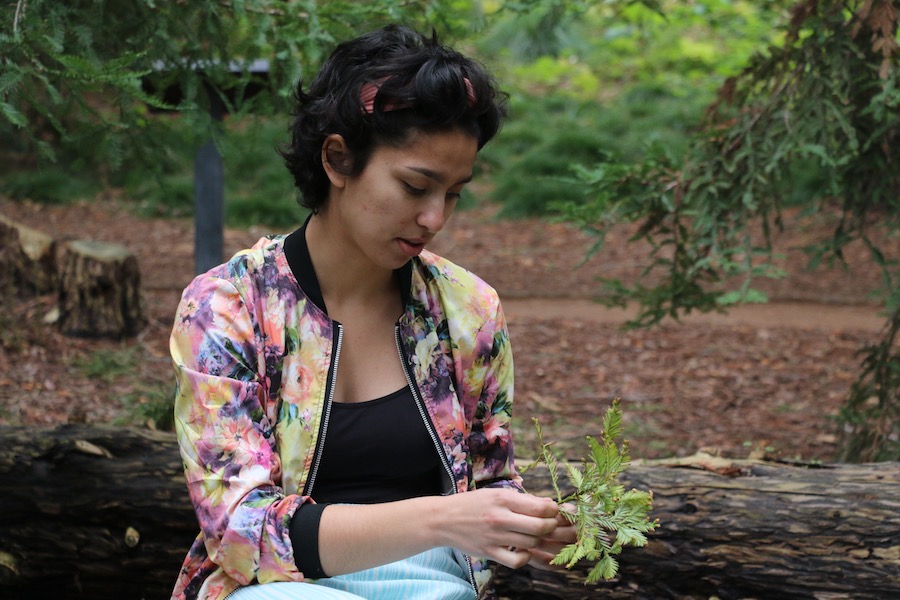
Ned was feeling good today. He had the best joke ever for the bus guy. He loved the bus guy, and he loved riding the bus, and most of all he loved any opportunity he could get to show how much he knew about the 20th-century psychoanalyst Sigmund Freud. He walked up to the bus stop, excited to try out this new joke that he’d been working on until like 2 a.m.
The bus pulled up: butterflies. He was so nervous, but so excited to give this one a shot. He knew that everyone would immediately love him and also think he’s really cool when they realized he reads a lot.

He stepped onto the bus.

“Student ID, please,” said the bus driver, who hadn’t looked to see who was getting on his bus. The bus driver turned to see Ned and braced himself for what was about to happen.

“Well, I…”

“No. Shut the hell up,” the bus driver said, cutting Ned off before he could be an asshole and burden everyone with some dumb joke that like 1 percent of people would actually get.

“But—”

“No, dude. No one wants to hear it. Seriously. It’s like 9 a.m. People are trying to just get to class. We’re all STEM majors, anyway.”

Ned was defeated. He would definitely write some poetry or a song about this later. They’d all regret it once he dropped an indie classic. He sat down.

“Guess I’ll just have to prepare a Kant joke for tomorrow,” he thought to himself.


Written by: Aaron Levins — adlevins@ucdavis.edu

(This article is humor and/or satire, and its content is purely fictional. The story and the names of “sources” are fictionalized.)

Style watch: earthy tones and functionality reign

JESSE STESHENKO / AGGIE

Casual fashion proves most important for students

After the two-week bliss of 70-degree weather — in the middle of what is usually a cold Davis winter — came to an end, students made their way back to the warmth and comfort of their winter wardrobes. If any fashion lesson is to be learned, coziness is key. This can be achieved by the minimalist maxim “less is more.” After all, doing what comes effortlessly often makes for the best outfits. This is proven by two sustainable agriculture and food systems majors: fourth-year Deirdre Feeley and third-year transfer student Aaron Lee.


ASW: Where is everything you’re currently wearing from?

Feeley: I went to a women’s retreat this past weekend, so this is from one of my friends who had like a whole clothing exchange. I don’t know, she always gives me really good jeans like really great Levi’s. So this is like my third pair that I’ve gotten from her, but I’ve lost the other two, so yeah, basically friends.


ASW: How does that clothing exchange you mentioned work?

Feeley: If you look into where your clothing’s all being produced — the clothing that we as college students can afford — it’s like “Oh sh-t i really don’t want to be supporting H&M or Forever 21.” Then we [a group of friends and I] just said “Hey, let’s get together and trade.”


ASW: What inspires your style? Any specific people, magazines, fashion houses, brands, etc.?

Feeley: Definitely being a farmer. Really a combo of being like a farmer and a baker, then also growing up in the Bay Area. I feel like all of that together. These are my farm shoes, and then like I wear loose jeans in the kitchen and then like also just growing up listening to hip-hop, living in Richmond.


ASW: What drives the evolution of your style?

Feeley: I feel like it’s just more day-to-day. Just [depends on how I] wake up, how I’m feeling, what I have to do today. It can be very different.


ASW: Any trends you’ve tried out in the past that you regret?

Feeley: That I regret? Ever in my life? Oh yeah. When I was younger I used to want to be a fashion designer. When I was in 7th grade and 6th grade I would like pour over Teen Vogue. When I was 18 I cut my bangs really short like baby bangs, and that was fine. Then I kept being unhappy with them, so I kept cutting them shorter and shorter, and then I bleached them. They were just like this weird orange, and I just waited for them to grow out.


ASW: What made you not want to be a fashion designer anymore?

Feeley: I think I just felt like it was so wishy-washy, and I feel that way about trends, also. Especially in our generation, it’s kind of sped up. It feels like you’re not really chasing anything worth it at the end of the day. I still like clothing as an expression, but that’s it.

ASW: What are some of the staples in your wardrobe or things you find yourself wearing often?

Feeley: These [my boots], definitely these. Actually a raccoon stole my old ones while I was camping. And probably this [my windbreaker] is my new staple now, it’s so good. Scarves. I really love scarves.


ASW: Can you describe your style in three words?

Feeley: Variable. Me. Fun.


ASW: What inspires your style? Any specific people, magazines, fashion houses, brands, etc.?

Lee: Well I mean, I started wearing boots working on my grandpa’s farm, and then I just liked this jacket because it’s fluffy. […] I love Levi’s.


ASW: Has your style evolved over time?

Lee: Yeah, I used to wear just like Converse and jeans and a T-shirt generally, but then I just started wearing boots and started doing more western wear probably a year or two ago.

ASW: What are some of the staples in your wardrobe or items you find yourself wearing often?

Lee: I wear my boots every day; always wear jeans, never wear shorts; always wear my satchel, belt buckle, always. Usually it’s a T-shirt or like a flannel [on top].


ASW: Any trends you’ve tried out in the past that you regret?

Lee: In elementary school I used to wear super baggy pants, and I used to have really long hair.


ASW: When did you first find yourself interested in fashion?

Lee: I don’t care about fashion really, I just wear what makes me happy.


ASW: How would you describe your style in three words?

Lee: Practical. Western. Country-ish.


Written by: Cecelia Morales — arts@theaggie.org

The problem with eco-friendly trends

MARINA OLNEY / AGGIE

Environmental fads are only good while they last

You might have seen what appears to be overly enthusiastic clean-up crews — individuals running with hefty bags scouring the streets for trash. Most likely, you have witnessed plogging, a running trend from Sweden that combines jogging and litter pick-up. The activity gets its name from a mashup between jogging and “ploca up,” which means “pick up” in Swedish.
If you Google search “plogging,” you will find that this new fitness trend has gone viral. With so much attention given to the eco-friendly activity, plogging seems great for the environment, right? But the problem with environmental trends like plogging is that they eventually go out of style.

Trends help people test out lifestyle changes, but they can quickly be swapped out for the next craze. Fads like the tiny house movement come and go. What looked great on social media — that cutesy, refurbished shipping container — works out not-so-great in real life. Now, people want bigger, not smaller, houses. And bigger houses, unless they are solar-powered and energy-efficient, tend to be worse for the environment.

On the other hand, some trends, like locavorism — a movement in which people only eat local food — and recycled packaging, have helped drive the food market. That’s why companies like McDonald’s, which has pledged to switch to recyclable packing by 2025, are choosing greener business models.

“Our customers have told us that packaging waste is the top environmental issue they would like us to address,” said Francesca DeBiase, the sustainability officer for McDonald’s.

Research has shown that Millennials care about sustainability, and companies are trying to adopt eco-friendly practices to gain their business. Sustainable brands are immensely popular. (If I had a nickel for every Patagonia fleece I saw on campus, I could buy a new Patagonia fleece.) Sustainable brands like Patagonia, which has actually been around since the 1970s, use recycled and organic materials that are better for the environment. Patagonia encourages buying used gear through its Worn Wear program, too.

The zero-waste movement, another rising trend, has recently gained national attention as bulk stores have become more commonplace. Companies like New York-based Package Free sell sustainable items, such as reusable produce bags and stainless-steel straws, that help people reduce waste.

A bamboo toothbrush “helps to eliminate one of the most prevalent forms of ocean plastic pollution, plus it looks insanely chic in your bathroom,” says the Package Free website.       

Bamboo toothbrushes will not only help you save the world. They will make you look super cool while doing it.

All this is to say that we have the potential to make real changes out of our current fascinations. We just have to stick with trends until they take hold.

“The most important thing is to understand the power of buying,” said Bea Johnson, the author who started the zero-waste living trend. “Every time you buy, that’s a vote. You have the power to support a practice that is either sustainable or not.”

We are the difference between a passing fad and real change.

So grab your plog sack and hit the streets — before the trend passes and you’re left looking like a total rube.


Written by: Jess Driver — jmdriver@ucdavis.edu

Disclaimer: The views and opinions expressed by individual columnists belong to the columnists alone and do not necessarily indicate the views and opinions held by The California Aggie.

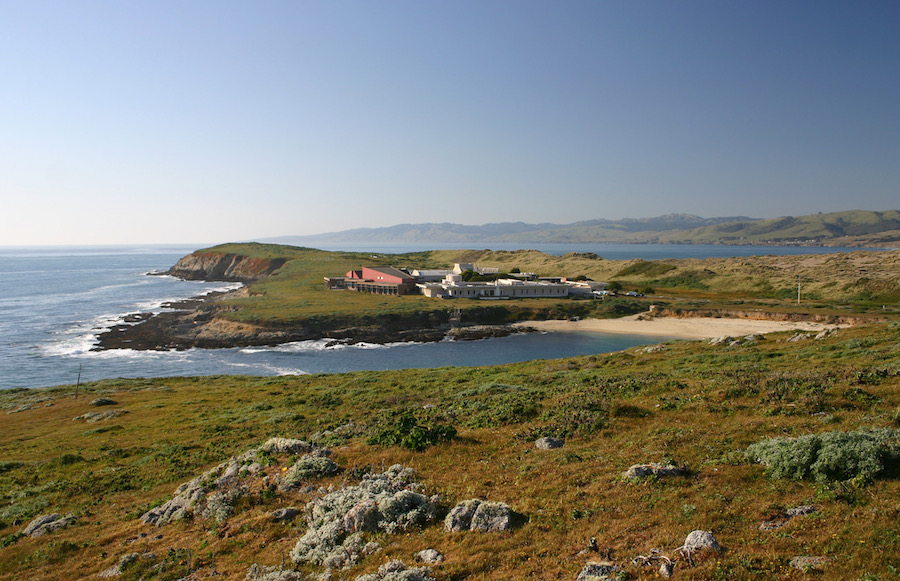
Reserves a Reliable Resource

BODEGA BAY RESERVE / COURTESY

Natural Reserve System was created for conducting research projects

Even at one of the top public universities for research, embarking on a research project as a student may seem overwhelming and issues that hinder progress may arise. For instance, a considerable amount of research is best done outdoors, where people may tamper with equipment that is left out. This is where the Natural Reserve System comes in.

“The Natural Reserve System actually consists of 39 reserves across the state of California. UC Davis manages five of those reserves, so each reserve belongs to a home campus [in the UC system],” said Suzanne Olyernik, the reserve director at the Bodega Bay Marine Reserve.

Like the other reserves, public access is restricted so experiments can be set up without human interference. The 39 reserves, owned by the University of California, consist of local habitats that are protected so researchers can securely work on projects pertaining to the environment and the natural world.

“[The reserves] go from Northern California all the way down to far Southern California and from the coast where I am all the way over to the Eastern Sierras,” Olyernik said. “It’s the largest system of natural reserves that any university has in the world, so it’s a pretty great system, but I would love for more people to know about it.”

Although UC Davis only manages 5 of the 39 reserves, any student can go to any one of these reserves. In fact, people from outside the UC system or even outside of the country can apply to do research projects at the reserves.

“It’s often a really neat setting for students to come to because you also get to meet people that are also interested in some of the same things you’re interested in, but also maybe you’re interested in other disciplines who are doing work at a field station, and you get to interact with them on this really small community basis,” Olynerik said.

Some funding through the Natural Reserve System is available for graduate students to work on projects at the reserves. Undergraduate students can use the facilities as well, but they often work for an advisor or graduate student who started a project.

Laura Jurgens, an ecologist and marine scientist, is currently working with the Smithsonian Environmental Research Center and Temple University, but used the Natural Reserve System for her dissertation on temperatures of mussel and seaweed beds.

“So when I came to Davis, one of the aspects of orientation for new graduate students in ecology was to introduce you to the reserves system,” Jurgens said. “So we got to go visit many of them. It’s amazing how few undergrads know about it because it’s a really fantastic resource.”

Since the reserves are located in California habitats, most of the research is conducted by students interested in wildlife biology.

“Certainly we see a lot of people from wildlife, fish and conservation biology that are doing projects associated with their classes, or people doing their thesis with an undergraduate advisor they found,” said Jeffery Clary, the associate director of the UC Davis Natural Reserves. “And I suspect that’s largely because their undergraduate advisors they’re working with are familiar with the reserves, and are sending them that way. I suspect in the other kinds of majors […] advisors aren’t automatically thinking of us as a place for their students to be working.”

While students who are doing wildlife biology projects may seem the most natural fit for California habitats, students of any major can apply to study at the reserves if their research question pertains to the environment or resources in a particular reserve.

“Also we’ll [Bodega Bay Reserve] get more interest from students who are in the humanities or the arts, and some of the reserves attract students from engineering and other disciplines,” Olynerik said. “Particularly at Quail Ridge, they have a lot of engineering students that are interested because they have a wireless mesh network out there, and they do a lot of engineering around tracking animals, using sensors and using tracking systems, so there’s definitely room for lots of different disciplines to be involved in the field stations.”

One of the easiest ways to check out a reserve is through a class. Field classes taken through UC Davis often end up using one of the reserves.

“It’s been a few years now, but we actually went through the course catalog and […] it was over a third of all classes on campus with a field component where they were using at least one UC Davis reserve. It is one of the most common places for field classes to go,” Clary said.

In addition to the outdoor space, the reserves have other resources. The Bodega Bay Marine Reserve has a laboratory, some of the reserves have overnight accommodations for students, and some, such as Quail Ridge, have special technology that researchers can use.

“We’re a great resource,” Olyernik said. “Our mission is to provide these amazing habitats for research, education, and public outreach.”


Written by: Rachel Paul — science@theaggie.org

Davis Enterprise welcomes new editor

JORDAN KNOWLES / AGGIE

Sebastian Oñate to replace Debbie Davis as editor

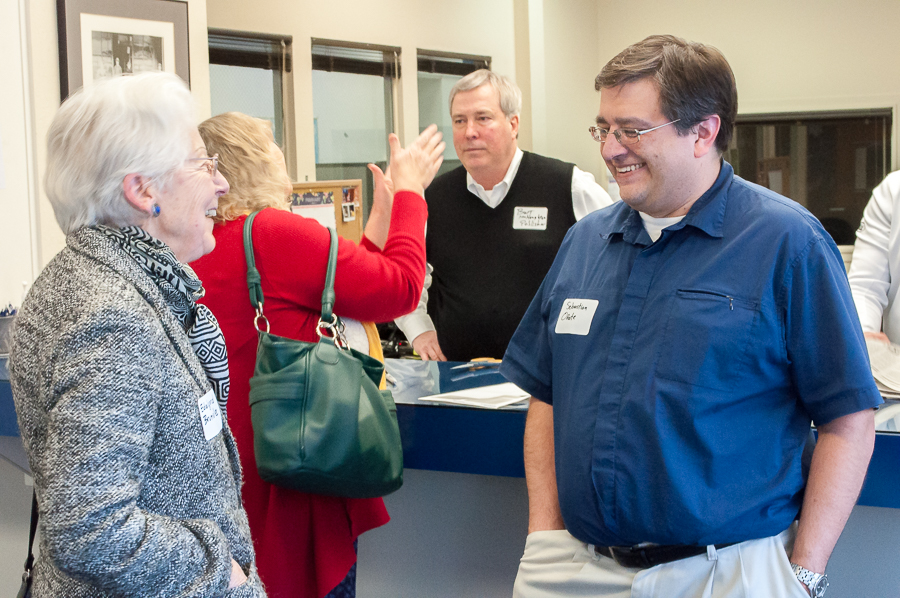
On Feb. 21, The Davis Enterprise held a reception to celebrate the promotion of Sebastian Oñate from associate editor to editor of The Davis Enterprise and to bid farewell to Debbie Davis, the current editor and assistant publisher of the local newspaper. Several community leaders and organizers, from police chief Darren Pytel to Yolo County Sheriff Ed Prieto, joined the Enterprise event to meet the new editor.

“I’ve been at The Enterprise for more than 38 years, and Bruce’s total time here — as editor, sports writer and sports editor — totals 16 years,” Davis said. “So obviously, our departure is going to leave a couple of holes in the newsroom. But our staff is truly a team, and everyone is stepping up to take on new responsibilities. Sadly, due to many staff reductions over the past 10 years, we’ve been asked to do that time and time again. This staff loves The Enterprise and will continue to work hard to produce a community newspaper of which this great town can be proud.”

Davis, a USC School of Journalism alumna, has worked for The Enterprise since 1979. As a member of the Davis Chamber of Commerce, former president of the Rotary Club and longtime community volunteer and organizer, Davis has played an integral role in the Davis community since becoming editor of the Enterprise in 1982. She will be stepping down alongside her husband, Bruce Gallaudet, the current sports editor for The Enterprise, on March 2 and plans to move to the San Francisco peninsula.

“When Oñate takes over as editor (with Wayne Tilcock now the sports editor), it means The Enterprise won’t miss a beat,” Gallaudet said via email. “Together they have about 40 years at the newspaper and each knows their new responsibilities from a unique perspective. Debbie and I have tried to share our experience and knowledge, but both will stand on their own with a wealth of background. Better choices couldn’t have been made to handle a community newspaper.”

Oñate has lived in Davis since 1986, having graduated from Davis Senior High School in 1992. He earned a degree in engineering from Marquette University in Milwaukee, giving him a technological background that Enterprise staff members hope will give him an edge on adapting the print newspaper to the digital age and moving the local business forward. He’s worked for the Enterprise since 1999 and has been working under Debbie Davis as an associate editor since 2000.

“It’s very big footprints I’ve got to fill,” Oñate said. “My advantage is that I’ve been at Debbie’s right hand for 17 years now and I’ve gotten to know how she operates and what the best way to do this job is […] I feel keenly the responsibility of this position. I know people love the Enterprise; I know people depend on the Enterprise for certain news that you can’t get anywhere else. People look to us for that.”

Oñate, Davis, Gallaudet and Bob Dunning, a longtime columnist for the Enterprise, all noted the diminishing capacity within which The Enterprise is forced to operate. The four journalists mentioned how new technologies and larger digital news formats have affected the number of readers and, over time, caused a drop in the output of The Enterprise. To adapt to the new digital format, Gallaudet noted, via email, that the future of The Enterprise would see “new, reader-friendly technology.” All four were confident in the future of printed news and the future of The Enterprise within the Davis community.

“He’s a really sharp guy,” Dunning said of Oñate. “Obviously it’s a very expanded role — a much more public role than he had before […] But in terms of knowing the newspaper and knowing what we need to get in and be efficient, he’d be top-notch. If he can fully replace Debbie, he’ll be a miracle worker. She’s that good. And I believe that he will.”


Written by: Ahash Francis — city@theaggie.org


ICC warns students to be wary of suspicious job offering

ANH-TRAM BUI / AGGIE

Scammers contact students posing as potential employers

In January, students were contacted via email by fake employers claiming they obtained the students’ contact information from the UC Davis Internship and Career Center.

These postings are in fact a scam for students’ money, and they appear most frequently at the start of every new term.

According to Marcie Kirk Holland, the executive director of the ICC, the fake job postings often claim they are in some sort of emergency that requires a quick transfer of funds and they ask the students to make this transaction from their personal accounts.  

The address that students are asked to send their personal funds to is often outside the U.S., typically in the Philippines or Russia.

In exchange for handling the “emergency,” the fake employer promises to reimburse the students with a significant bonus. Students will often receive a check or money order soon after from the fake employer. Holland sent an email to The California Aggie concerning the fraud.

“This often tricks people into the false assumption that this is a legitimate request and the check or money order must be valid,” Holland said via email. “Banks cannot detect counterfeit money orders, nor bad checks until the checks bounce or money order is rejected. They will not know to question you when you make your deposit. Standard practice is that if you deposit funds, you are vouching for their legitimacy and your bank will not reimburse you if the funds are insufficient or counterfeit.”

As a result, when students transfer their money to these fraudulent employers, they not only lose the money that they sent, but their banks may also close their accounts.

The ICC was recently informed that a student who fell victim to the scam had lost several thousand dollars and had their bank account closed.

“I think it’s really unfortunate that scammers are exploiting students who often barely have enough money to pay for our housing, transportation and food,” said fourth-year communication major Stephanie Pomales.

The ICC reminded students that “NO employer or internship supervisor should EVER” have students use their personal bank account as part of their position.

“Although the vast majority of Aggie Job Link postings are legitimate, students should know that con artists seem to be preying on students nationwide at the start of each quarter,” Holland said in the email. “They post positions that seem legitimate and are therefore approved for posting. In addition to the ICC’s screening, it is important for YOU to evaluate a position before you accept it.”

Holland also published an article on the UC Davis website with more tips on how to avoid becoming the victim of scams.

Some main points mentioned in the article include refraining from sharing personal passwords or banking information with an employer, verifying that the email address of the potential employer matches the company they represent and contacting the ICC (at  ajlhelp@ucdavis.edu or 530-752-2855) with regard to suspicious job or internship offers.


Written by: Clara Zhao — campus@theaggie.org

Sourdough & Co. opens in University Mall

ZOË REINHARDT / AGGIE

New sandwich shop holds its own against competitors.

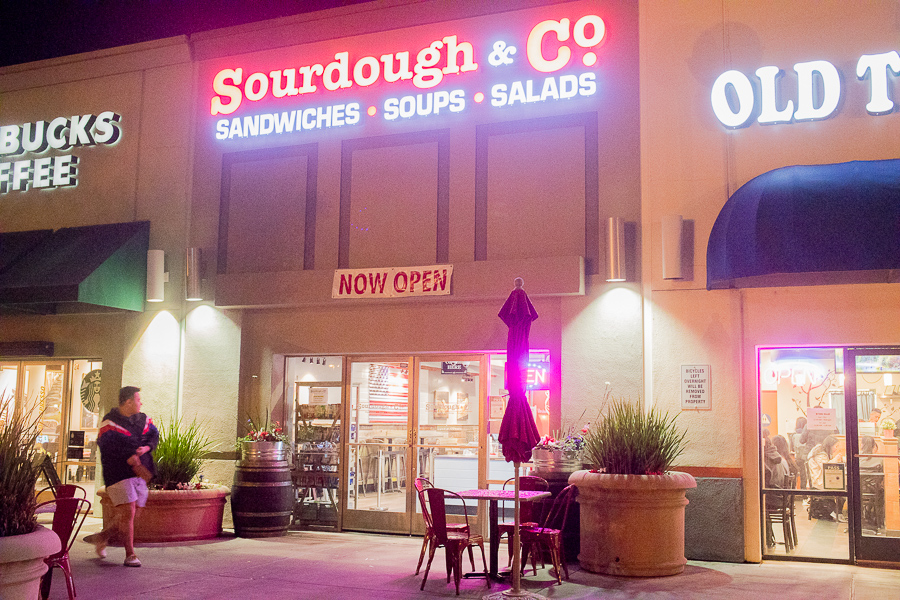
The art of sandwich-making can be a delicate process, but Sourdough & Co. manages to get the job well done while still maintaining its own unique style and taste. With eight other locations in nearby areas such as Sacramento and Roseville, Sourdough & Co. is the most recent addition to the dining scene of the University Mall on Russell Blvd. With the new store’s arrival, the U-Mall’s resident sandwich shop, Subway, now has a competitor just a few doors down, and a substantive one at that.  

First things first: let’s talk about the bread. I would say the bread alone is good enough to convince customers to return for another sandwich. So named for its sourdough bread, Sourdough and Co. offers perfectly toasted and freshly baked loaves of sourdough for just the right amount of crunch in every bite. The menu is self-explanatory, with an array of 14 different sandwiches to choose from, including roast beef, pastrami, chicken salad and garlic pesto turkey. After that, customers can decide on their cheese of choice.

All the sandwiches are served on sourdough bread (unless otherwise specified), along with the shop’s house spread, lettuce, tomatoes, onions and mustard. For vegetarian or vegan customers, options are pretty limited — that is, in comparison to Ike’s Love and Sandwiches, with its endless array of different vegan combinations. Although I personally found my veggie sandwich to be slightly lacking in flavor and variety, the meal was still tasty and satisfying. Like most sandwich shops, Sourdough & Co. also offers an extensive selection of chips and drinks that you can add to your order for $2.95. And on those extra chilly days of Winter Quarter, opt for a bread bowl with its soup of the day, which varies among clam chowder, tomato bisque, cream of potato and more.

Beyond the food itself, Sourdough & Co’s interior offers a warm, rustic and American-esque feel. On a rainy Davis evening, I was eagerly welcomed by the warmth of the restaurant and the friendliness of the staff behind the counter.

“The atmosphere is really cool,” said second-year human development major Addy Newman. “It almost feels like you’re eating a home-cooked meal.”

Newman opted for the garlic pesto turkey sandwich, claiming after her meal that this place definitely made a better sandwich than the neighboring Subway.

“The sandwiches at Sourdough & Co. feel lighter than the heavy meals at Ike’s,” Newman said.

The final verdict: Sourdough & Co. is worth the visit. Although it may not live up to the gourmet style of Ike’s or the customizable familiarity of Subway, this sandwich franchise holds it own amid the evolving dining culture of Davis.

Sourdough & Co. is located at 825 Russell Blvd. and is open from 10 a.m. to 7 p.m. on weekdays. For more information, visit their website.


Written by: Sydney Odman — arts@theaggie.org

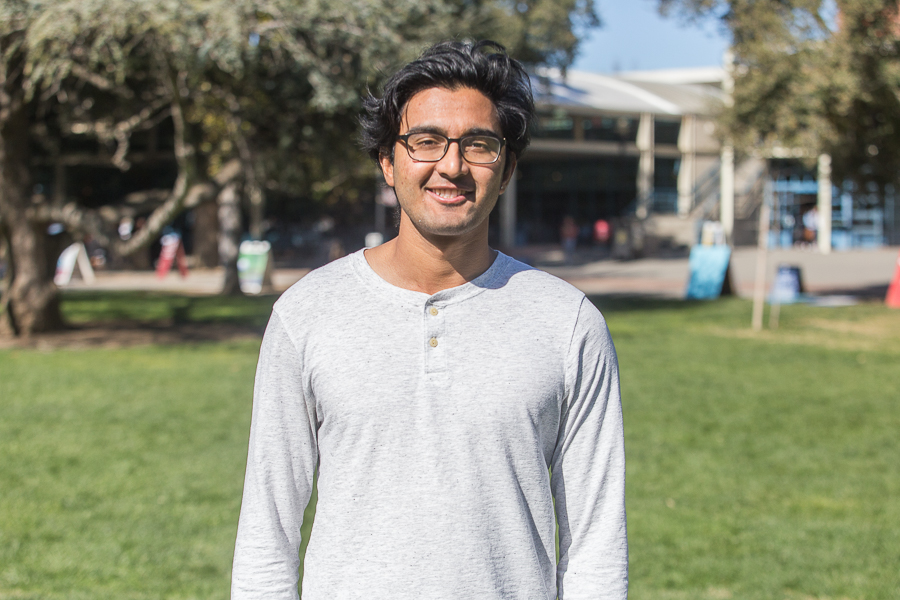
Aggie Profiles: Aayush Kunwar

ZACK ZOLMER / AGGIE

Nepalese athlete uses talents to advocate for people in his home country

On the third day of competition, despite having pulled a muscle only a few days prior, Aayush Kunwar was feeling good about his upcoming race. It was the middle of winter and the dirt track was soft and wet, but he was determined to not let anything stop him from doing his best. He proceeded to sprint spectacularly in the 100-meter relay and his team won first at the 2017 Nepalese National Games.

“[My team is called] the Armed Police Force, and [the opposing is] Army,” said Kunwar, a fourth-year economics major. “We defeated Army for the first time in the history of Nepal in the relay, and I was the new team member. Since then everyone started talking to me, all the coaches from the different regions started talking to me, all the national athletes. And they knew that I study in California. It’s a good thing, it’s a new thing to them, they see me as a beacon of hope.”

Kunwar has been on this particular mission to become a “beacon of hope” far before last winter. It’s something that has developed in the past few years of his life as he’s learned more about himself and the world he comes from. In fact, his story begins on the opposite side of the planet: Nepal.

Kunwar was born in Nepalganj but tends to say he’s from Kathmandu, the capital of Nepal. He comes from an upper middle class family, and therefore Kunwar was fortunate to have the best education and childhood he could ask for, where all of his needs and those beyond were met.

“The public school education system in Nepal is poor, so if you are from a good family you are sent to private schools,” Kunwar said. “So I went to a private school and we were made to study English from nursery school.”

In the middle of the 1990s, the Nepalese Civil War broke out in Nepal between the monarchic government and the communist party. Kunwar’s parents sent him and his brother to boarding school in India so that they could continue their education without worrying about the war.

“During that time it was a set routine for us,” Kunwar said. “We woke up at 6 a.m., went out for some physical exercises — as a group, like the whole school would be out doing some physical exercises. It’s compulsory, you have to wake up at 6, do some exercises and then go back, take a shower, and go to school.”

At his school, the different houses, or groups of students, would compete against each other in sports like basketball and soccer. Kunwar liked playing both these sports, and he even represented his house in basketball senior year. It was his activity in these sports that he attributes to the development of his speed on the track.

“Since I was so good in basketball and soccer, they sent me for track and field as well and I finished second I think in the 200 meters, my first race basically,” Kunwar said. “I think studying in India exposed me to different, other activities other than academics. I was more into sports, that’s how I started doing track and field.”

After returning to Nepal in 2008 to complete high school, Kunwar continued to play soccer and basketball. This is when he started to truly shine in track and field, and in 2011 he was considered Nepal’s best national athlete under the age of 18.

“That was a turning point, I’d say, because I got a gold medal in 200 meters and 400 meter relay in high school level,” Kunwar said. “Then our school started taking participation in all these national events, national competitions that were happening. In one of these national competitions I became the best national athlete because I won my 200 meter race, 400 meter race and long jump.”

Despite his success, Kunwar’s father was not completely happy with his decision to focus on sports. Kunwar mentioned that in Nepal, athletics are not considered a prestigious activity, let alone a career. It’s around this time that he started to take serious note of this situation around athletics in his home country.

“Living conditions of athletes in Nepal are not so good either, so even if you’re a professional athlete, you’re not respected,” Kunwar said. “And apart from that, track and field is not a nationally accepted super game. It’s a big deal here [in the U.S.]. I was reading, it was like some billion dollars go to sports here in the United States, but it’s a different story in Nepal.”

After Kunwar graduated high school, he came to the United States to join his parents living in the town of Santa Rosa, just north of the Bay Area. His father already worked in the country, which made it easier for Kunwar and his family to move and gain permanent residency.

Kunwar then enrolled in Santa Rosa Junior College before transferring to UC Davis. After deciding soccer wasn’t for him, he started training in track and field at the JC.

“I just kind of fell in love with the sports,” Kunwar said. “I started getting better and better. Then all the sudden one day when I was breaking my personal best after best, my coach was just like ‘why don’t you try out for Nepal?’ We just started looking for the best athlete in Nepal and how his times were. My personal best beat his personal best, that’s how I was like ‘yeah I think I should try for Nepal.’”

And so began Kunwar’s journey to achieve even greater success at the sport, something he wanted to achieve so he could eventually be a voice for Nepalese athletes. The stark reality of it all, he realized, was that the basic facilities and equipment he received the the JC were far better than anything the athletes receive in Nepal. He claimed it’s not that Nepalese runners aren’t good at their sport, but that they lack the infrastructure to achieve their fullest potential.

“While in JC, we were training on a synthetic track, and every time I got injured I would get facilities, like I would go to the training center and get ice bath and things, for free,” Kunwar said. “But back in Nepal we just run through the injuries. Whenever I go there and train it’s just a dirt track and running there hurts my shins so bad. [When] I asked my teammates, ‘do these [pains] happen to you?’ they’re like ‘all the time but we just run through it’ — there’s no other option.”

Nepal is made up of a caste system of distinct social stratification amongst different castes, or classes, of people. Athletes in Nepal tend to come from the lowest caste and face a number of challenges because of this. Unlike in the United States, where athletes get sponsorships and make good money, athletes in Nepal do not, and therefore cannot afford all the athletic gear they need.

“The government [doesn’t] pour in money and I think there’s [government] corruption going on,” Kunwar said. “All these people are from ethnically poor backgrounds and they can’t raise their voices [because…] first off, they’re from military backgrounds, so they have to be disciplined and they can’t raise voices against their leaders or authority. Secondly they’re from lower caste, they’re not [well] educated people, their salary was not high.”

Essentially, Nepalese athletes are not able to speak for their betterment due to these social and economic restrictions. So in the summer of 2016, when Kunwar was training in Nepal with his fellow track and field athletes, he decided he wanted to work as hard as he could so he could become a voice for these people he feels so deeply for.

“You have to be good at what you’re advocating for,” Kunwar said. “So my goal, I’m [getting] better so I can have a voice, like I have a reason to talk.”

Even though Kunwar wasn’t able to join the UC Davis track and field team when he came to school here in the fall of 2016, he’s been working hard to build the strength and motivation to focus his goal.

“I still talked to my coach at the JC, about all the improvements I could do like that, and also my coaches from high school,” Kunwar said. “It was just giving me more hope. I was talking to the athletes from Nepal too and how they want me to come back and change things. They were saying this indirectly but I could feel the vibe.”

This motivation is what led up to the winter of 2017, when Kunwar heard the National Games were happening and felt a deep urge to go. Without his father’s knowing but his mother’s help, he snuck away to Nepal to compete. This is when his team won gold in the relay race against Nepal’s seemingly undefeatable team, an event that further reinforced Kunwar’s dedication to his goal to become an advocate and uplift the living standards of Nepalese athletes.  

The biggest problem Kunwar has noticed is not only the lack of facilities and funds, but the lack of exposure for young people who have great potential.

“I’m going to go talk to my coach and see if he can get scholarships, because back in Nepal we didn’t know you can get sports scholarships,” Kunwar said. “It was all about ‘you have to be good in academics, that’s it’ and I had so many friends who were super good athletes but they just had to give up basically, there’s no future.”

Kunwar is graduating from UC Davis this spring and already has plans for the next few years of his life. The South Asian Games are coming soon, and they’re happening in Nepal. It’s Kunwar’s goal to get selected for these games, but regardless of the outcome, he wants to continue training in athletics roughly two more years and then become an advocate.

“There was this article that I read, it was this Nepalese guy who is super good, an academia-related person, and people asked him why [he] doesn’t stay here in the United States, and he said, ‘there are plenty of people like me in the United States, but they need people like me in Nepal’ because it’s an underdeveloped country and there needs to be a strong leader that can change the rhetoric around Nepal,” Kunwar said. “And that applies to me too. I would be a need in Nepal, that’s where I want to be, that’s where I want to go.”


Written by: Marlys Jeane — features@theaggie.org