57 F
Davis

Davis, California

Monday, December 22, 2025
Home Blog Page 654

UC President selects Gary May as new UC Davis chancellor

GEORGIA INSTITUTE OF TECHNOLOGY / COURTESY

UC Board of Regents to vote on the appointment later this week

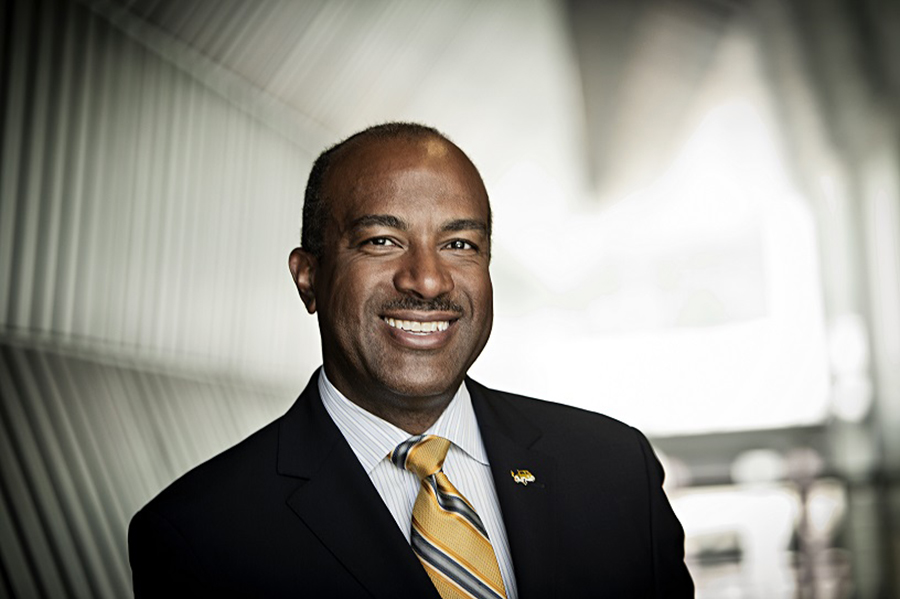
University of California (UC) President Janet Napolitano announced her selection of Gary May as the new UC Davis chancellor on Feb. 21. May currently serves as the dean of Georgia Tech’s College of Engineering.

“Gary May is a dynamic leader and an accomplished scholar and engineer with a passion for helping others succeed,” Napolitano said in a press release. “He was chosen from an extraordinarily talented pool of candidates because I believe he’s the right person to guide UC Davis to even greater heights, advancing academic and research initiatives, building a stronger community with students, faculty, and staff, and furthering relations with the larger Davis and Sacramento areas.”

May will replace Ralph J. Hexter, who has been serving as interim chancellor since Napolitano put former Chancellor Linda P.B. Katehi on investigative leave last April. Katehi resigned as chancellor in August.

“I could not be more pleased, nor more excited, to serve as the next chancellor of the University of California at Davis,” May said in the same press release. “UC Davis is renowned for its excellent education and research, for providing its diverse student body with exceptional pathways for upward mobility and leadership, for giving its faculty opportunities for impactful discovery, and for serving the state and nation in areas of critical need. These values speak to my spirit, and I cannot wait to join the campus community.”

The UC Board of Regents will meet on Feb. 23 to vote on the appointment, and, if approved, May will begin this role on August 1, becoming UC Davis’ seventh chancellor. In the meantime, Hexter will continue to serve as interim chancellor.

Written by: Alyssa Vandenberg  — campus@theaggie.org
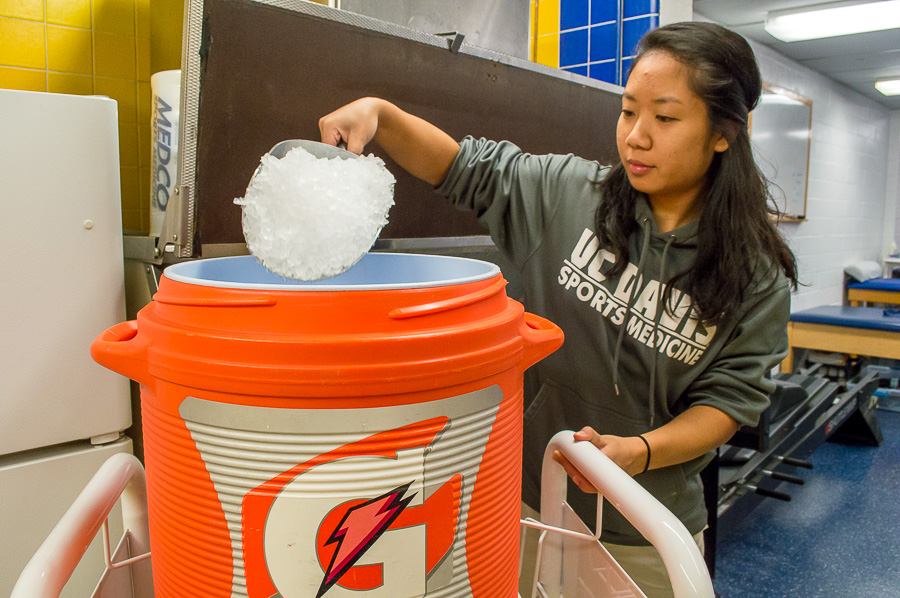
A day in the life of an athletic trainer

0
CAT TAYLOR / AGGIE

The California Aggie shadowed one of UC Davis football’s athletic trainers

The role of the athletic trainer is one that many people don’t think about when watching their favorite sport. The Aggie had the recent chance to follow Matthew Davey, one of the assistant athletic trainers for the UC Davis men’s football team, to observe what he does every day as a trainer.

The day started at 5:30 a.m. at Aggie Stadium in the athletic training room. Injured players were among the few in the room, stretching out their injuries and getting ready for conditioning training. Then it was down to the field in the cold, windy and rainy weather that felt as if a monsoon were about to overtake the stadium.
Davey dictated different exercises for different players depending on their injuries. Some of the players were designated to run the stadium steps, some to jog around the field and some to do minor exercises in order to ensure they were staying minimally active. At about 7 a.m., it was back inside to dry off and finish the morning. Because the football team is currently in the off-season, the team is limited to two conditioning sessions a week, on Tuesdays and Thursdays.

Following the early morning session, The Aggie was able to conduct an email interview and ask Davey about his profession as an athletic trainer and what it entails.


What made you want to get into the field of sports medicine?

I have always had an interest in sports medicine, initially in becoming a doctor but I became more aware of the field of athletic training in high school when I met the athletic trainer at my school. When I got to college it didn’t take me long to decide that going to medical school was not something I was interested in. I started the athletic training internship as a 2nd year and I knew that was the field for me. I have the best seat in the house for games that I work and I spend my day working with athletes and around sports. Athletes are willing and able to work very hard at getting better from an injury and at improving their performance, this makes my job much more rewarding because my patient works just as hard as I do at getting better and I can see the immediate fruits of our labor in the athlete’s success on the field.


In a nutshell, what are the things your job entails in season and off season?

The majority of my day, both in-season and off-season is committed to rehabilitation of injuries. We have all manner of musculoskeletal injuries from basic ankle sprains to surgically repaired knees and shoulders. Every year we get an injury that we, collectively, have never seen before. That challenge both in evaluation of that injury as well as learning how to properly rehab that injury is one of the parts of my job that I love. Rehab/Prevention accounts for 75% of my time, the rest of the time is on the field covering practice where we are on hand in the event there is an injury either during practice or during a game.

You mentioned some new training programs you put together recently. Could you just briefly say what they are and a brief description about what they do as far as your line of work?

We are always developing new preventive programs geared toward keeping athletes injury free. Currently we are utilizing a yoga-based flexibility and balance program combined with a core strength squat-training program. I have used a lot of yoga and pilates-based exercise programs in the past as preventive programs.


Do you also handle administrative work as well as the physical training aspect?

The administrative side of the job takes up a lot of time. Outside of normal day-to-day documentation of injuries and rehab notes I am personally responsible for maintaining our emergency response equipment. As a sports medicine staff we have 8 AEDs located at various sports facilities and in the athletic training rooms. These are located so that no event either practice or game goes on without quick access to an AED should it be needed. It is my responsibility to check all the AEDs on a monthly basis to ensure each is in working order. We also have oxygen tanks, spine boards, blood pressure cuffs and other emergency equipment that I am responsible for maintaining on a regular basis.

Your profession seems one that you put a lot of time into. Is that safe to say?

The role of the athletic trainer in the athletics department is to manage the physical well-being of the student-athlete, and to a certain extent the mental well-being as well. Whether we are handling the care of the student-athlete or ensuring that they are referred to the proper people to handle that care, it is all our responsibility. The players understand this so they will contact us first any time they have a health concern. I have been called at 2am by a player who was in a bike accident on his way home from the library, we’ve been called when a player punched a wall out of frustration late at night. Pretty much any time a player is feeling sick they call us first to see if they should see a doctor — regardless of the time of night.

What are the most rewarding parts about this profession?

By far the most rewarding part of my profession is seeing the athlete I have worked with go through their rehab process, get back on the field and be successful again. After all the time and energy is invested, to see them get back on the field and succeed makes it all worthwhile.

What are some of the negative aspects of this profession?

One negative side is the toll it takes on family and personal life. With the time we spend at work, and that we often spend on work while at home, family time can suffer. When we play on the road I will be away from my family 3-4 weekends a month. In season we have a game or practice or have rehab 7 days a week, and can spend as much as 16 hours a day at work during Fall camp. It truly makes me value the time I have with my family, and it makes very thankful that my wife supports me in what I do.

What is one thing that you feel most individuals assume or don’t know about sports medicine that you want to clarify?

We do so much more than just tape and ice athletes. We are all Master’s degree educated and have many years of experience and taping and icing, while important, are actually a very small aspect of what we do. We put in an enormous amount of time and energy maintaining education in the most current trends and knowledge in the sports medicine and rehab fields. We truly care about the health and well-being and success of the student-athletes we work with.

*This interview has been edited for length.

Written by: Ryan Bugsch — sports@theaggie.org

Fossil discovery provides new evidence to life after mass extinction

RYOSUKE MOTANI / COURTESY

New marine reptile fossil found, questions life at end of Permian period

The Permian mass extinction occurred 250 million years ago and wiped out nearly 96 percent of the planet’s species. However, a recently-discovered marine reptile fossil sheds lights on how quickly life rebounded after the extinction.

The recovered fossil, sclerocormus parviceps, was found in a quarry in Anhui Province, China. Ryosuke Motani, a professor in the UC Davis Department of Earth and Planetary Sciences, along with his colleagues published a paper in Nature Scientific Reports describing the fossil and how this new evidence changes ideas about the evolution of life millions of years ago.

The fossil belongs to a group called ichthyosaurs, a dolphin-like marine reptile that lived in the ocean during the Mesozoic age when dinosaurs walked the Earth.

“What was striking about this animal was that it was large for the time period it came from,” Motani said.“[Though] its head is really small for the body, and we don’t know why this is the case.”

Despite resemblance to dolphins and fish, the sclerocormus parviceps is said to have fed at the sea bottom due to the shape of its snout and would suck in its prey.

Closer relatives would be reptiles such as lizards, snakes and crocodiles because of the ichthyosaurs reptilian skull and fins.

“This animal was very heavily built and its bones are very thick,” Motani said.

Further analysis of the ancient animal determined it was about 5 feet in length, had a short skull and short, stocky body.

In addition, the animal had four fins and a long tail that took up more than half its body length. The animal most likely used its forefins to maneuver itself while swimming.

Over time, it can be observed that the ichythosaurs’ lower arm and finger bones became significantly shorter and eventually the finger became disk-shaped.

According to the fossil record, once ichthyosaurs appeared, they diversified rapidly. Many fossils of different body types have been found, especially from the early and middle Triassic period around 251 to 199 million years ago.

“[The sclerocormus parviceps were] predators […] about the size of humans. To feed this predator in the sea, you have to have enough food,” Motani said. “This means small animals [they consumed] were already there.”

Five major mass extinctions are evident in the fossil record, identified by around 50 percent of species going extinct at one time on a global scale.

“The End-Permian was the largest of these five, it’s estimated somewhere between 90 to 96 percent of the species on earth went extinct,” said Amanda Glynn, a Ph.D. candidate in the Department of Earth and Planetary Sciences.

With the massive end-Permian extinction, there was not only more space on Earth, but more environmental roles that a wider range of organisms could take over.

“You also have, at that time, changes in sea level, which [made] it more favorable for things to go back into the water,” Glynn said.

Scientists have proposed various theories on why the Permian mass extinction occurred. Some of the more popular theories include an asteroid impact, or an intense volcanic eruption that clouded the sky with ash, blocking the sun and polluting the air.

“Different mass extinction events appear to have been caused by different environmental changes,” said Jonathan L. Payne, a Stanford University professor and the chair of Stanford Geological Sciences. “In the case of the end-Permian we have no strong evidence for an asteroid impact, in fact, we have a lot of evidence for volcanic eruptions.”

Other scientists cite evidence for global climate change with sudden rapid heating and cooling, in which organisms would die off because they could not adapt.

A final theory suggests a catastrophic, earthquake-triggered release of methane gas from under the seabed, global warming or an asteroid impact.

There is no solid consensus in the scientific community about which theory or combination of theories proves to be true.

With the conditions of the end-Permian extinction, more organisms made the transition from land to water, resulting in the evolution of these marine reptiles.

Although there was variation among the marine species, there was a general trend of the orgasims evolving from a lizard-shaped body to a fish-shaped body.

The lizard-shaped ichthyosaurs had similar characteristics to living catsharks today, with a more slender backbone and a larger number of vertebrae. The fish-shaped ichthyosaurs had similar characteristics to living great white sharks, consisting of a thick body and backbone and a crescent shaped tail.

More information about these animals can be found on Motani’s ichthyosaurs webpage.

“Many people argue that we are entering a period of extinction that could rival some of the major mass extinction events throughout earth’s history,” Payne said. “The farther back in time we search the geological record, the farther forward in time we can see what our planet is going to look like.”

With the discovery of fossils like the sclerocormus parviceps and other organisms as well, the geologic history of Earth continues to unfold.

“This research is important because it tells us about how life recovers after mass extinction,” Motani said. “It is part of a series of studies about how life copes after massive environmental changes.”
Written by: Molina Hauv and Shivani Kamal — science@theaggie.org

Student Sounds: Samantha Sipin

BRIANA NGO / AGGIE

Davis graduate talks female powerhouse musicians, literature, the blues

Samantha Sipin’s sound can be deconstructed by the threads of her influence: a strand from Amy Winehouse, another from Carole King — each one interwoven by the needle of blues and soul.

For the singer-songwriter, music is never “new.” It can only be understood in the light of the musical pioneers and composers and lyricists who came before her.

“Really nothing is original. I can’t stress that enough,” said Sipin, a recent UC Davis graduate. “And so whenever I write something, or something sounds like something [else], I am very deliberately trying to show my appreciation for the people who have written like that before.”

But Sipin’s humility extends beyond her speech. Eager and well-spoken, she can immediately identify the musicians who contributed to the cultivation of her soulful sound. When she speaks of such musicians, she is thoughtful and gleamy-eyed, slow and deliberate in her descriptions.

“After watching [Amy Winehouse’s] biopic, it was especially enlightening to me how much her divide was due to people putting pressure on her and people having this idea of her because she might have been sloppy a couple of times — and that image was just perpetuated,” Sipin said. “And then she just fell into it. But underneath all of that, she really was depressed, and she had her own demons, and she was working through things, and you could see that in her music.”

In fact, the sincerity of Sipin’s admiration was enough for her to write and compose “A.W.,” a song dedicated to Winehouse.

“I think her lyrics offer some real poetic talent, and I don’t think of myself as anywhere near the songwriter she is because her lyrics are so strong,” Sipin said. “But also vocally, it’s effortless for her. She’s never trying too hard, she knows exactly what’s she doing, and she never sings a song exactly same way twice […] And that requires an incredible amount of musical knowledge and comfortability and confidence that I don’t think people really understood while she was alive.”

But Winehouse isn’t Sipin’s only pool of wisdom.

“In terms of songwriting, I really love Carole King. She’s an extremely prolific songwriter, and I don’t know if the masses understand how far-reaching her music is,” Sipin said. “She’s been covered by a number of girl groups from that era, and then her songs have been popularized by other artists. But in terms of songwriting, she’s the big inspiration.”

Lyrically, Sipin thrives. And with powerhouse vocalists like King and Winehouse as her idols, it’s no surprise. Sipin admits her music follows a theme of unrequited love, but acknowledges this wasn’t intentional. It’s simply what she’s feeling.

“It’s not necessarily something that I love talking about, but it’s on my mind enough, and it resonates with people,” Sipin said.

This theme becomes apparent in her track “You Smile,” and the melancholic lyrics are well-accompanied by her swinging falsetto and bluesy guitar strumming: “I love the way you smile at me / But you smile all the time […] I can take a hint / I know who I am / I realize it may take a while to start this all again.”

As an English major, Sipin’s appreciation for lyricism makes perfect sense. She attributes her understanding of writing mechanics and rhythm to her English and literature studies.

“I think the most helpful thing that English has done is the study of meter and poetry, and the way that words have stressed syllables and unstressed syllables, and finding how they fit in with a melodic line that you’ve written,” Sipin said.

She adds, modestly, that her own skilled lyricism has been acknowledged before.

“I was telling a friend (she was asking about me) that I was an English major, and she said, ‘No wonder you write songs really well,’” Sipin said. “And I took that as a big compliment because when you look up to people like Carole King and Amy Winehouse, you don’t think much of yourself.”

Reading, too, has been a creative catalyst for Sipin. Angela Davis’ book Blues Legacies and Black Feminism altered her perspective on blues, and Sipin explicitly takes note of the way blues songs are constructed.

In this way, Sipin is also a historian. Mentally cataloguing the work of earlier musicians, she recognizes that every sound she makes can be attributed to that of another. It is for this reason that she cannot put her music on a pedestal.

“Since then, I’ve been thinking more critically about the form of songs that I’m using, because not until I read that book did I really realize the historic origins of blues music and how it was mainly a vehicle for people from emancipation,” Sipin said. “I try very much to pay homage to the artists that have written in the same styles.”

Looking forward, Sipin anticipates opportunities to expand her skillset and knowledge of music. Having only graduated in the spring of 2016, she is exploring different career options as well as the future of her music.

“Right now I’m broke and I need to work, but eventually I am going to sit down and pay attention to myself and work on my musicianship, and do all the planning that it takes — and all the boring stuff that it takes — to be really good,” Sipin said. “Right now, it’s just been ‘fresh out of college,’ and not having all the time that I could to dedicate to music.”

On a more technical level, she hopes to expand her music into something more robust. Take a listen to her SoundCloud and its collection of solo acoustics, and this becomes apparent. Her soulful melodies beg for the companionship of a full ensemble.

“At the moment, I am starting to try and reach out and kind of networking for people to play with, people to bounce ideas off of,” Sipin said. “But ultimately, for people to grow a band with […] I think to play music like The Alabama Shakes would be really good.”

Honing in on her sound is a modest goal in comparison to her others. As a queer woman of color, Sipin aspires to establish and maintain confidence in her identity and her sound.

“I want to make sure that I represent myself in such a way that’s strong and confident and proud of my identity. Because the other option is not being open,” Sipin said. “I think that it’s a way for me to kill two birds with one stone — expressing myself through my music and creating music. That hopefully appeals to people, while also confirming my own identity.”

Behind this humility, however, there lies a confidence in Sipin — a confidence in music, in its history and in its stability. It is this appreciation of the past that will sustain her in the future.


Written by: Ally Overbay — arts@theaggie.org

TV Revisited: The Office

NICKI PADAR / AGGIE

It’s more exciting than pretzel day — revisiting The Office

The Office — yes, the witty, dry-humored show that everyone seems to have watched  — has an underlying social narrative. It explores the absurd simplicity of the average American life, and, interestingly, how the lives of average folk intersect and overlap. The hit TV show is ostensibly a comedy, but an interesting new lens ushers in a different experience and a new sensation.

In my Mind, Brain and Computer class, we explored the idea that humans, like computers, follow an algorithm. Though each person is unique, there are fundamental ways we live our lives, dominated by social norms and biological principles. There seems to be a general pattern — a specific way of living — that people follow.

My exploration of this idea was prompted by my multiple viewings of The Office’s finale, in which Pam (played by Jenna Fischer) ends the show with a poignant quote: “I thought that it was weird when you picked us to make a documentary. But all in all… I think an ordinary paper company like Dunder Mifflin was a great subject for a documentary. There’s a lot of beauty in ordinary things. Isn’t that kinda the point?”  

The Office’s plot is about nothing. Concepts for TV shows are usually something unique and exciting things that have never been done before. The Office, on the other hand, is about the daily lives of a mid-level paper company’s employees (one of the most boring jobs I can think of, I might add). Moreover, there is no redeeming quality in the lives of the characters; they and their problems are as simple as their jobs. In itself, it should not be such a captivating show. But each character, in one form or another, resonates with viewers. The Office is really about its viewers, about the algorithm of everyday life and existence.

The employees of Dunder Mifflin embody a rather dramatic stereotype of everyday, common people: Michael (played by Steve Carell), the unmarried and awkward middle-aged man; Angela (played Angela Kinsey), the annoyingly uptight cat lady; Oscar (played by Oscar Nunez), the overqualified one; and Ryan (played by B.J. Novak), the new Millennial. Again, these are tropes, and it would be outlandish to say that all these characters embody all types of people in middle America. Nonetheless, the viewer can identify each character by someone they know personally. And interestingly enough, these vastly different characters work a nine-to-five job five days a week, and their lives interplay despite the diversity. Indeed, it is the algorithm at play here, the standardization of people that is identifiable to the viewer. That is what makes the writing and casting of the show so masterful.

Jim (played by John Krasinski) and Pam are interesting characters, as they are by design the “normal” people of the show. While many of the characters are, as stated, exaggerated stereotypes, Jim and Pam are the everyday folk. For this reason, they are the voice of reason during the show’s wacky antics. They are also the least dramatic yet most popular characters. Because they represent the underlying fear and anxiety of the middle-class life, they are bored and frustrated. Pam has a job that utilizes none of her artistic talent, and Jim has too much wit, intelligence and people skills to work a desk job.

A quote from the season four episode, “Survivor Man,” showcases this — as Jim and Michael are having a one-on-one conversation, and Jim confesses he doesn’t think he’ll still be working at the office in ten years. Michael replies, “That’s what I said. That’s what she said.” They are not risk takers and thus, they have fallen into a boring and life-wasting cycle. This is why viewers root for Jim and Pam’s love story — we want them to succeed because we consciously or subconsciously want the same for ourselves.

It cannot go unnoted that topics like race, gender and sexuality are expressed satirically in the show. Episodes like “Diversity Day” and “Women’s Appreciation Day” poke fun at stereotypes and tensions that exist in society and in the everyday workplace. The jokes make an interesting point beyond using comedy to address societal ills. It is important to note how people react, or more importantly how they don’t react, to these jabs. In turn, this creates an acceptance of racism, homophobia and misogyny in everyday life. While these forms of prejudice and discrimination are inappropriate, they exist, and The Office doesn’t hide that.

Possibly the most blatant proof of my analysis is that The Office is a mockumentary. It is a reflection of us and our society — and it is realistic. Of course the show is masterful in its comedy, but the hidden jokes and images have become quintessential to our modern sense of humor and are a satire on the ridiculousness, the insanity and the captivation of everyday existence. As Pam said, sometimes simplicity is beautiful; recognizing the absurdity of a simple existence and the standard algorithm makes it all the more interesting.
Written by: Caroline Rutten — arts@theaggie.org

Reverse trend of low voter turnout

HANNAH LEE / AGGIE

Vote in ASUCD elections next week

Voter turnout in recent ASUCD elections indicate a student body disconcertingly apathetic toward both elections and student-run government.

Turnout for voting on senate candidates in the most recent Winter Quarter election reached 4,441 votes — over 1,000 less than in 2013. Polling hit rock bottom in Winter Quarter 2015, with only 792 students voting out of the 28,384 eligible voters, a staggering 2.79 percent of the undergraduate student body.

It’s difficult to understand the significance of these numbers without putting them in perspective, but the fact of the matter is that UC Davis’ statistics pale in comparison to other UC’s numbers.

In 2016, 12,559 students voted in UC Berkeley’s Associated Students election. In that same year, UCLA and UC Santa Cruz boasted voter percentages of 40.3 and 39.74, respectively, in their elections.

Part of UC Davis’ consistently low voter engagement can be attributed to ASUCD’s insufficient presence on campus. Although many senators run on platforms intended to bridge the gap between student government and the student body, ASUCD’s engagement with UC Davis students has shown little to no improvement.

However, ASUCD alone is not to blame for the student population’s lack of involvement in government.

UC Davis’ low turnout is also in part due to the student body’s disinterest in those who represent them at the student government level. This disinterest is unsettling considering these representatives handle topics on campus such as sexual assault, mental health, cultural competency, undocumented students, safety and so many more issues that affect UC Davis students on a daily basis.

To not take part in the election of ASUCD officials means accepting when one of these issues falls by the wayside.

This applies on a national and international level as well.

Although Hillary Clinton won the popular vote by a margin of almost 2.9 million, and despite the fact that President Trump’s current approval rating sits at a meager 41 percent (lower than the past nine U.S. presidents’ approval ratings during their first February in office), 40 percent of eligible Americans still did not vote in the general election. Voter apathy could arguably be the reason that the most sexist, racist and reckless modern-day candidate to run for office now holds the position of one of the highest elected officials in the world.

This past November showed that, no matter the significance of an election, and no matter the amount of people it affects — people simply don’t vote.

Don’t be one of those people.

The Editorial Board urges students to vote in the upcoming ASUCD election, running from Tuesday, Feb. 21 until Friday, Feb. 24. Ballots are available at elections.ucdavis.edu.

Whether it be a national, community or university election — make your vote count, because all politics starts on a local level.

Humor: Panicking student just throws one thing into each type of trash can

How an incident involving trash cans sparked a movement
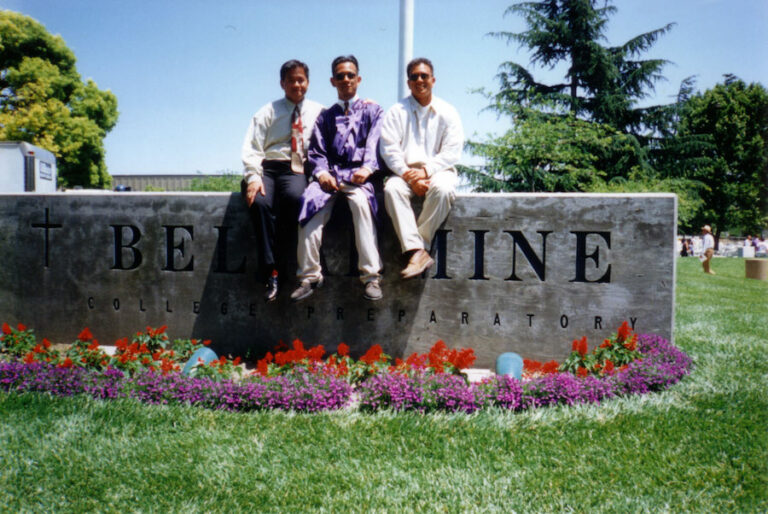
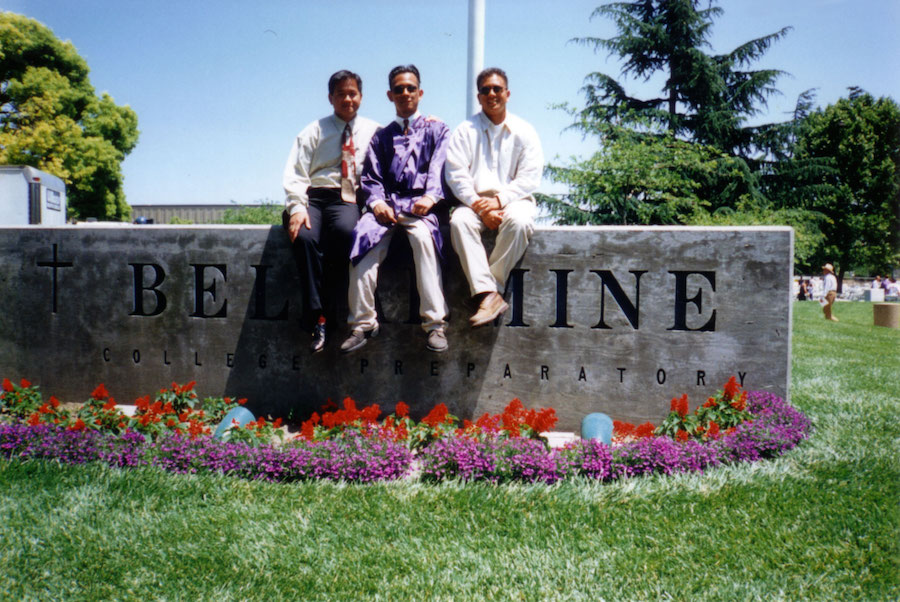
Many UC Davis students will relate to the sense of panic that comes from standing in front of the familiar set of three trash cans — landfill, recycling and compost — that are most common on campus. Though it can be confusing for everybody, garbage-related incidents don’t usually make people angry. Usually.

The event in question occurred one week prior to whatever day you are reading this very real hard-news article. William Scab, a first-year environmental policy analysis and planning major and shoelace impersonator, was going to throw away his trash when he started to panic.

“See, all I was trying to do was throw away what was left over from my lunch,” Scab said, before talking at length about his horrible experience. “I had an orange peel, a coffee cup from the CoHo and a paper plate. It’s that simple. But when I saw the three trash cans I just didn’t know what to do. I was used to the ones inside the CoHo that have the nice little pictures to follow — but I was on the roof, and there were no pictures to follow. That’s when the panic started to set it. With no idea what in the world I should do, I just made some really rash decisions that in my mind ended up being really brilliant. The CoHo coffee cup said ‘compostable,’ which is not the same word as ‘compost,’ which was on one of the bins, so that one obviously went in the landfill because it was a coffee cup and coffee is brown like dirt, which is what makes up land. Oranges are going, like, extinct or something so they definitely need to be recycled and put back into the environment — so I recycled that one and ended global warming in the process. And then the plate I just figured should be composted because if you put paper back into the ground it will grow into a tree again, because that’s where paper comes from. Nailed it.”

Scab went on to explain that he felt disturbed by the amount of thinking that had to go into the process of throwing away his food that day.

“It was really unnerving that I had to put an ounce of thought into the way I threw away my food,” said Scab. “It’s just like when people tell me I have to ‘think’ about what I say, and can’t just say whatever I want. Why should I ever have to put any effort into thinking about anything? It reminds me of when people told me I couldn’t lose my son. I was like, ‘watch me.’”

Scab is not alone in his way of thinking. Students are citing the trash can incident as a reason to do away with all trash cans on campus. They have formed a group called Davis Criticizes Recycling, and their motto is simple and to the point: “We want to be trash.”

“What we’re calling for is to be one with trash,” said Trish Turnip, a spokesperson for Davis Criticizes Recycling who consumed what would have been her twin sister in the womb. “No trash cans means no limits on our freedoms. We want to be able to throw our trash wherever. We want to be able to live alongside the trash, and really feel what it’s like to be actual human garbage. It’s our right.”
Written by: Brian Landry — bjlandry@ucdavis.edu

Question the value of private and charter schools

ANGELO MERCARDO [CC BY-NC-ND 2.0] / FLICKR
The current administration poses a unique threat to American public education
Betsy DeVos’s narrow confirmation as Secretary of Education, in which Vice President Mike Pence had to step in to break a tie, has stirred up unexpected controversy for a position that has historically been confirmed without much opposition. As a department considered less important than others, the federal government’s role in education is limited in scope, and most of the power with respect to education resides at local and state levels. However, the fierce opposition to Betsy DeVos’s confirmation has raised pertinent questions about many long-standing issues of the U.S. education system.

DeVos’s controversial views on American education are already well-known. She believes in the privatization of public schools and has long advocated for the expansion of charter schools and for-profit schools, as demonstrated by her efforts in her home state of Michigan. As justification for her views, she believes that all parents — rich and poor —  should have the luxury of choice in deciding where to send their children to school. The DeVos couple has consequently poured their enormous wealth into private schools, leading to the rapid growth of charters in Michigan.

Charter schools receive government funding, but aren’t part of established public school districts. They’re governed by separate non-federal institutions — some for-profit, others mostly non-profit. So even though they’re funded by taxpayers, they’re under no obligation to perform to the same standards as public schools. They’re an example of public asset privatization, and can charge any tuition they like, with the freedom to change the curricula any way they want.

While charter schools were meant to provide a smaller, more intimate learning environment, the institutions and people governing these schools often have their own agendas. This has led to a rapid increase in religious schools that teach according to their beliefs. The students attending would potentially be unprotected from racial or gender discrimination because the schools don’t have to match the same standards of transparency as public schools. These schools blur the separation between church and state, and many teach controversial topics such as creationism instead of evolution, the evils of homosexuality and the “harmful” effects of birth control. Private schools may teach a similar curriculum, but the key difference is that private schools don’t receive taxpayer funds. It’s unfair for taxpayers to spend their money on these schools when they receive no information about — and may not even agree with — the state of children’s education at the charters.

So why are parents sending their children to such schools, especially if they cost more? The answer lies in the growing number of school vouchers. School vouchers are state-funded programs that pay for students’ tuition, allowing lower-income families to afford education at good private schools. Voucher schools are also private schools — but of a slightly different category. Most of the students’ tuition is paid by school vouchers, but the schools themselves follow the rules and regulations of private institutions.

The bigger issue with most charter and voucher schools is that most of them are run by corporate organizations only interested in profits. Much like the public-school system, charter schools have varying degrees of academic performance throughout the country — which mainly depend on the socioeconomic level of their locations. Poor or rural neighborhoods have lower educational standards at their high schools, while the urban elite have access to much better public education and a wider choice of private schools. While public schools in rural areas may be incentivized or given additional support to help improve their students’ performances, the government is not responsible for the students in charter schools.

The current administration should realize that governing the most powerful country in the world takes very different skills than running a large corporation. In a company, profits and losses are the first and foremost priority. In a country, the citizens’ well-being and security take precedence. And unlike most other policies, the way we approach education will affect the future generations that will grow up to make important decisions for the country.

It’s our responsibility to make sure that those are good decisions.
Written by: Shohini Maitra — samaitra@ucdavis.edu

Disclaimer: The views and opinions expressed by individual columnists belong to the columnists alone and do not necessarily indicate the views and opinions held by The California Aggie.

Behind the scenes of student housing

0
NICHOLAS CHAN / AGGIE

A look into the life of an RA

In every residential building on campus behind the door marked “resident advisor” lives a student who pulls the strings that make dorm life possible. UC Davis resident advisors (RAs) juggle an array of responsibilities, from resident issues to student housing duties to academic obligations.

“It’s always scary getting into freshman year when you don’t know anyone,” said Mackenzie Miller, a third-year biological sciences major and RA of Thoreau Hall in Cuarto. “[The RA job] is focused on your residents and building a community on your floor [and] trying to foster friendships between them […] so they get to know each other.”

In order to be an accessible resource for students, RAs live in the dorms with their residents and are trained in topics ranging from communication to diversity to social justice. RAs also perform regular duties that include weekly on-call nights, when they go on rounds to survey the residence halls and conduct one-on-one “knock-and-talk” meetings to check on the wellbeing of residents.

“On rounds, […] we have to walk through […] every single hallway,” said Brooke McMahon, a second-year environmental chemistry major and RA of Tercero’s Currant Hall. “You have awkward encounters with people in the bathroom and then you end up chatting in the bathroom. Being on call […] is important, because you have to have someone here that’s […] responsible enough to take care of people when they need to be taken care of at obscure hours of the night.”

For Miller, being an RA in Cuarto is a slightly different experience because of the suite-style living situation. Miller shares a suite with other residents and works in a partner community where she splits the responsibilities of her floor with another RA.

“[Cuarto] can present a bit more of a challenge because you’re unable to knock directly on a resident’s door,” Miller said. “It’s a bit of a different dynamic of having two [roommates] living together and then also [with] suitemates. I think it has definitely improved my ability to work in a team with other people.”

Many residents do not realize that apart from on-call nights and knock-and-talks, RAs  are also required to put time and effort into detailed administrative tasks. They plan and host socials for their residents such as movie nights, tie-dyeing, mug decorating and karaoke. For academic purposes, they also put on Residence Hall Advising Team programs that are focused on schedule-building, declaring and switching majors and other types of academic advising.

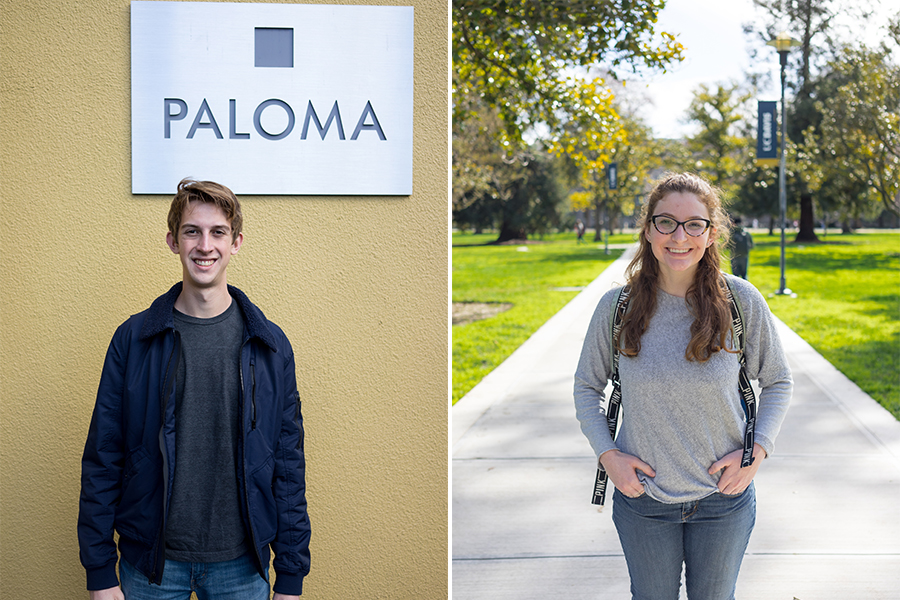
“It [is] a great feeling when you put on a social event for the residents and you have a really high turnout and the residents genuinely seem to enjoy the event,” said Nick Irvin, a second-year comparative literature major and RA of the Paloma building in Segundo’s Regan Hall. “You, as an RA, put in a lot of effort to make that happen. It really feels good.”

The job is considered a full-time position at 20 hours a week, but it can require more or less time depending on issues with residents. In return for their time and effort, RAs are compensated with free housing in the residence halls and a free meal plan in the dining commons.

“It can be a life-changing experience,” said Chuck Huneke, assistant director of the Cuarto Residence Hall Area. “It is very different from a typical student position. You can work in the ARC or the library […] and have wonderful experiences, but I think [the RA job] is a unique position in that it allows you to work with a breadth of issues.”

Because RAs are also students, the balance between their academic lives and their job responsibilities can be challenging, especially if they participate in other extracurricular activities, all of which must be approved by Student Housing.

“It’s a pretty time-consuming job,” Miller said. “You live where you work. It’s [the RA’s] job to help [the residents], but you have to be able to know your boundaries. You […] want to be there for them, [but] you have to be flexible.”

An RA’s job is to advise residents, as the title suggests, but in addition to on-call duties and social or academic program planning, they also attend a weekly staff meeting and, in the fall, a mandatory class that expands on topics from their two weeks of training prior to the school year starting.

“The RA position can take some time,” Huneke said. “Trying to balance that with a social life […] can be an ongoing challenge. We talk to [the RAs] regularly about drawing healthy boundaries; in order for them to be successful as an RA we need them to be successful as a person.”

Despite the heavy responsibilities, McMahon said that working as an RA is rewarding in the friendships it builds and the community it fosters.

“It warms my heart to see all of [the residents] becoming friends,” McMahon said. “The greatest reward is […] just seeing how all of them have changed […] from the beginning of the year to now, […and] the way that they do things and see things and interact with people. That’s very cool.”

From the experience, RAs also learn skillsets and habits useful for everyday life and future occupations.

“A big reason why I wanted to become an RA was to enrich my professional development a bit,” Irvin said. “I think there are aspects of leadership and organizational skills that will absolutely come in handy later on in whatever career I decide to do.”

According to McMahon the unexpected surprises that come from interacting with residents are a major part of the experience.

“[Residents] do a lot of funny things,” McMahon said. “There was one boy […] that would wait for us in the bathrooms for when we would do rounds. He would wait to scare us or have full on conversations with us from inside of the stall.”

Despite the hard behind-the-scenes work that the position requires, McMahon, Miller and Irvin find the job a worthwhile experience.

“Connecting with these people is a necessary part of the job, and it’s a really rewarding part as well,” Irvin said. “I’m pleasantly surprised by how much that part has ingrained itself in me.”
Written by: Allyson Tsuji — features@theaggie.org

City of Davis awarded funds for new recycling bins

0
NADIA DORIS / AGGIE

CalRecycle donates $197,851

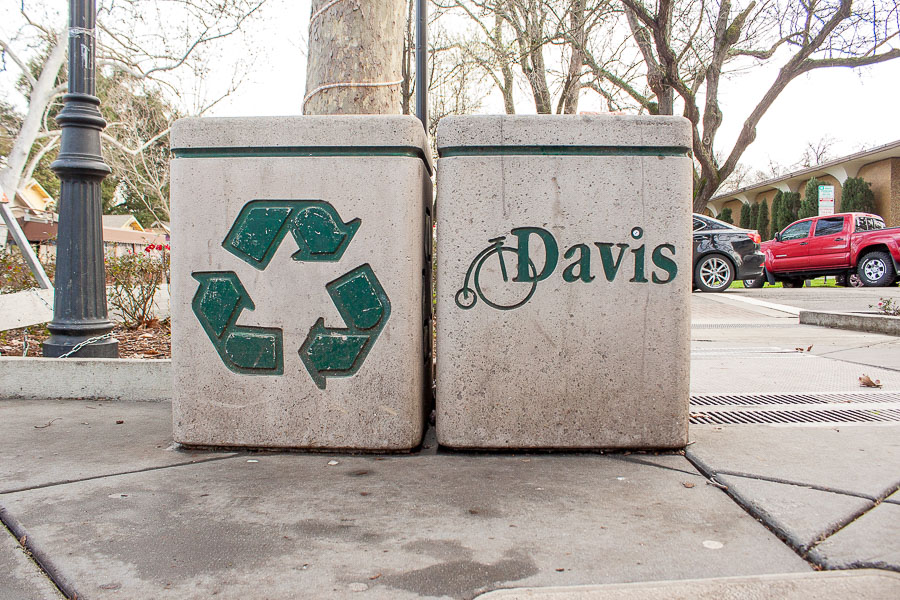
The City of Davis will soon have new recycling bins throughout town thanks to a $197,851 grant awarded by the State Department of Resources, Recycling and Recovery (CalRecycle).

“The funds will be used to purchase new recycling bins for the Downtown core area, parks and greenbelts and to purchase a few solar compacting trash/recycling units,” said Jennifer Gilbert, conservation coordinator for the City of Davis Public Works Department in an email interview.

With new bins, waste overflow and crew maintenance will be reduced. Currently, many of the existing bins lack clear labeling and are too small to allow items to be placed inside, causing bins downtown to regularly overflow with waste. Because of the excessive amount of waste production, park crews spend hours each day managing this waste issue.

“Our parks crews spend 5 hours a day, 7 days a week emptying bins from Downtown Davis. Within hours of the bins being emptied, they are overflowing again,” Gilbert said.

To help relieve crew workers and reduce waste production in the city, Gilbert suggested that residents divert personal waste into recycling and organics bins at home and at work.

In downtown Davis, the new grant funds will also go toward solar powered bins. Solar powered bins crush waste to reduce overflow and, once full, alert the city through a messaging system that the bins can be emptied. It is grant funds like these from CalRecycle that make purchasing new and innovative waste solutions a possibility in Davis and throughout the state.

Each year, CalRecycle, a department within the California Environmental Protection Agency that oversees waste handling and recycling programs, is able to award grants to hundreds of public and private entities throughout the state.

According to the CalRecycle website, “During the 2016-2017 Fiscal Year, 172 grants were awarded totalling up to $36,926,744.”

Gilbert said that in the future, if the recycling program receives more grant money, they will allocate more funds toward dedicated outreach.

Members of the campus community are also working hard to address waste reduction and waste production. The Waste Reduction and Recycling program, coordinated through the Office of Environmental Stewardship and Sustainability, wants to help the campus reach its zero waste goal of diverting trash from landfills by 2020.

“In the last fiscal year, UC Davis had a 73% diversion rate, 4th among other UC campuses. We need to improve our diversion rate as the goal approaches, but we need everyone to help,” said Sue Vang, program manager for Waste Reduction and Recycling in an email interview.

To help the campus reach its goal, Vang recommended that students make an effort to compost more — not just food, but napkins and other items as well. She’s hoping that she can bring more composting collection services to the Coffee House later this spring.
Written By: Anya Rehon — city@theaggie.org

Katehi controversy prompts decline of UC administrators seeking profitable subsidiary board positions

BRIAN NGUYEN / AGGIE FILE

Tighter policies require greater approval of outside jobs

Due to new policies implemented after the investigation of former UC Davis Chancellor Linda P.B. Katehi, University of California (UC) administrators are no longer seeking compensated board seats outside of their senior management jobs at the UC campuses.

In 2015, the UC reported that the majority of approved board positions had compensation, with a total of $1.57 million for 42 managers. After establishment of the new policies, however, the 2016 report noted that 11 managers were approved for their outside activities from July 21 to Nov. 30, only three of which were paid positions that totalled to $9,510 in compensation.

“The new policy requires two levels of review and management approval,” a UC report read. “In addition, more detailed reviews are conducted to assess real or perceived conflicts of interest or commitment, and reputational risk.”

Activities now have to get approval through the campus chancellor, the president of the university or the chair of the Board of Regents. The 165 managers, which include UC President Janet Napolitano and campus chancellors, have also been limited to only two paid outside positions as opposed to the original three.

This decrease in UC administrators seeking additional compensated board seats comes after Katehi’s resignation last year, where she faced a series of controversies including holding seats on two for-profit boards.

Bernadette Fox, a fourth year-international relations and women’s studies major, believes the policies are in place to give the UC administrators “insurance” and hide their mistakes.

“Katehi and [other chancellors] have really tarnished the brand of the UC in the last year or so,” Fox said. “By them being able to review these positions they can vet them and make sure from an outside perspective it doesn’t look bad for the UC as a whole. […] I think it kind of put them in check as far as how greedy [they] want to be.”

Emily Breuninger, a fifth-year sociology major, thought the policies were unsatisfactory and did not demonstrate progress in terms of addressing the large amount these administrators make beyond their outside jobs.

“If Katehi can get away with taking all of these outside board seats over years and years, and it passes by unnoticed, then I don’t see what’s there to stop other chancellors or senior administrators from doing the same thing,” Breuninger said. “I don’t think there [are] sufficient mechanisms to ensure that there aren’t conflicts of interest or that chancellors are prioritizing their campus duties over their outside seats.”

Although the managers are allowed to maintain the board positions they currently take on, Fox thinks the decrease in approved board positions is because the administrators are trying to avoid humiliation, and not solely because of Katehi.

“Everything that the UC does is very well calculated and is about protecting the expansion of the business model of the UC,” Fox said. “It’s embarrassing to me that it took what it did to get such basic policies put into place.”

Breuninger believes that such policies will not help bring about change at the chancellor level, since the main problems reside within the regents.

“If the regents are corrupt then everything is corrupt,” Breuninger said. “Their actions are more egregious.”

Breuninger added that the UC administrators are afraid of criticism and losing their jobs.

“I don’t think that [the policies have] to do with any sort of change in heart on their part,” Breuninger said. “This is something that’s in the public eye right now, so I don’t have any hope or optimism that once public attention is turned away from it they won’t go straight back to their usual operation.”

The UC Davis and UC Office of the President’s media relations did not respond to The Aggie’s request for comments regarding the intentions of the new policies.
Written by: Jeanna Totah — campus@theaggie.org

ASUCD Senate passes resolution submitting comments on LRDP

NICKI PADAR / AGGIE

SR #7 asks university to increase capacity for future campus housing

On Jan. 26, ASUCD passed a new resolution to submit comments on the Notice of Preparation for the Environmental Impact Report (EIR), the next phase for the UC Davis Long Range Development Plan (LRDP).

Resolution #7, authored by Sara Williams, the External Affairs Commission chair, proposes a larger share of on campus housing than previously planned for the 2017-2027 plan. The resolution passed with a vote of 10-0-1, with Senator Shaitaj Dhaliwal abstaining.

As required by the California Environmental Quality Act, the university released a Notice of Preparation, which allows for comments regarding the drafting of the EIR that will eventually be submitted.

“UC Davis requests input regarding the scope and content of the Draft EIR that is relevant to your agency’s statutory/regulatory responsibilities or is of interest to individuals, to ascertain potential environmental impacts of the project,” the notice read. “Responses to this NOP are requested to identify: 1) the significant environmental issues, reasonable alternatives, and mitigation measures that should be explored in the Draft EIR; and 2) whether your agency will be a responsible or trustee agency for the project.”

The current LRPD includes plans to provide housing for 90 percent of enrollment growth and 40 percent of all Davis-based students by 2027-28.

ASUCD, as well as the Davis City Council, which passed a concurrent resolution, proposes that the university revise those plans to be able to house 100 percent of enrollment growth and 50 percent of all Davis-based students.

Ricardo Martinez, a fourth-year political science and philosophy double major and ASUCD senator, said that the 50/100 proposal will help students who are forced to search for housing outside of Davis.

“What the resolution says is that UC Davis should meet the 50 percent in-housing threshold for students so that we can accommodate more students here on campus to live here instead of having them go outside the city and not, you know, find any housing because right now vacancies are really low,” Martinez said. “So the City of Davis has a problem with housing and that in-turn affects students who often times can’t find a place to live and usually what they do is they go with friends or they live in Woodland and it’s just, it’s not a good mix when it comes to housing.”

UC Davis began planning the LRDP in the fall of 2015. After Feb. 17, the last day for individuals and government agencies to submit comments on the EIR, the university plans to draft the LRDP and EIR for public review in fall 2017. UC Davis will submit the finalized versions to the UC Regents for consideration in early 2018.

ASUCD President Alex Lee, who signed off on the resolution, said that housing in Davis has become a major problem that needs further discussion before UC Davis can move forward with the 10 year plan.

“I definitely think that the issue of housing isn’t going away anytime soon,” Lee said. “The issue is just going to get worse and worse and by the time we see any construction start on the proposed LRDP, it’s going to be pretty bad by then. I think that the city and the campus need to do their part to provide housing for all of it’s population, of course the key demographic is students, who are the majority of both populations, of the city and of the campus.”

The City of Davis and the University have been in continuous discussion since LRDP planning began, although there hasn’t always been mutual agreement regarding the final steps.

“I think the relationship between the City of Davis and UC Davis is not that well and it’s not cohesive in terms of them having a mutual understanding,” Martinez said. “So I think there needs to be an improvement, especially by administration, to reach out to the City of Davis and the mayor, because the City of Davis has been reaching out to the administration, and they haven’t been that responsive. I think the resolution puts the administration on notice and lets them know that students are aware of the current issues that are going to affect them now and in the future, so I think it would be good for the administration to take student concerns into account moving forward in the next 10 years.”

Written by: Ivan Valenzuela  — campus@theaggie.org

UC releases 2016 Annual Report on Sustainable Practices

MEENA RUGH / AGGIE

UC Davis leads in sustainability with largest solar power plant of any university

The University of California’s 13th Annual Report on Sustainable Practices was presented at the UC Board of Regents meeting on Jan. 25. The 2016 report relays both the UC’s successes and challenges ahead in regards to renewable energy, water conservation, waste reduction, food sustainability and UC-wide sustainability goals.

“We’re attacking this challenge on multiple fronts — undertaking basic and applied research, teaching, changing the way we operate, investing in climate change solutions and being a model of positive change,” said UC President Janet Napolitano in the report.

The report highlights UC Davis’ implementation of its 16.3 MW large solar power plant, the largest known on any university campus, which generates approximately 33 million kilowatt hours for the campus and reduces greenhouse gas emissions by about 14,000 metric tons annually.

UC Davis has been consistently meeting or approaching UC-wide sustainability goals. The campus achieved the 2014 policy goal of reducing greenhouse gas emissions to 2000 levels, diverted 73 percent of its waste from the landfill and reduced growth-adjusted potable water consumption by 36 percent from the 2020 baseline, thereby achieving the 2025 policy goal early.

Camille Kirk, assistant director of sustainability at UC Davis, cited additional instances in which UC Davis has been at the forefront of sustainability.

“UC Davis continues to demonstrate leadership in sustainability, through efforts like […] investing in our pathways and bikeways to enable sustainable transportation and achieving a 27 percent reduction in water use at the Davis campus over the past year,” Kirk said via email.

Llyod Knox, a physics professor at UC Davis, also believes that UC Davis is at the forefront of increased sustainability.

“Student activism initially stirred the university conversation about reducing our carbon emissions all the way to zero,” Knox said via email. “In 2013 Janet Napolitano declared we would do it by 2025. UC Davis is a leader in the system on this front, doing more to realize this goal than any of the other campuses.”

A program launched systemwide in 2016 aims to give students the tools to face global climate change. In the summer of 2016, faculty across the UC system attended workshops to develop new material incorporating climate change and sustainability into existing courses.

“Preparing our students to be leaders in the areas of climate change and environmental sustainability is no longer an option; it is an imperative,” Napolitano said in the report.

UC Davis offers many classes on sustainability, climate science and research on environmental and sustainability questions. Students also voted in 2016 to establish the Green Initiative Fund, which supports sustainability projects and student internships.

“Here at UC Davis we view the university as a living laboratory, where we are finding and implementing solutions that will be adopted elsewhere,” Knox said via email. “Students can get involved, contribute and learn useful skills, through project-based courses.”

Two interdisciplinary courses, A Path to Zero Net Energy: A Hands-on Approach (ABT 289A) and Pathways to Climate Neutrality in California (PHY150), are open to non-science majors. In both classes, students can work in small teams on real-world carbon emission reduction projects.

ABT 289A will be taught by biological and agricultural engineering professor Kurt Kornbluth in the spring of 2017 and PHY150 will be taught by physics professor Lloyd Knox in the fall of 2017.

UC Santa Barbara, UCLA and UC Berkeley have already surpassed the 1990 greenhouse gas emissions level, which they were supposed to stay under until 2020.

In order to reach the 2025 goal UCs will need to reduce emissions by over 1 million metric tons of CO2. This would equate to taking approximately 850,000 passenger vehicles off the road for one year. Unfortunately, current efforts are not enough to reach carbon neutrality systemwide by 2025.

More information regarding the 2016 Annual Report on Sustainability can be found on its website. Interested individuals can also look at a sustainability map of UC Davis.
Written by: Yvonne Leong — campus@theaggie.org

Bigger isn’t always better: Regan Hall’s tight-knit community

0
VENOOS MOSHAYEDI / AGGIE

Life in Segundo residence halls

Back in September, residents of Regan Hall gathered in the courtyard for an ice cream social to kick off the school year. Marina Navarro, a fourth-year art history major and Resident Assistant, took advantage of Regan’s yard to plan a fun event for incoming students to hang out.

“When I have to do socials it’s just the building social and I can have it out here [in the courtyard],” Navarro said. “We have, neighborhoods, as we call them […] having little socials [together].”  

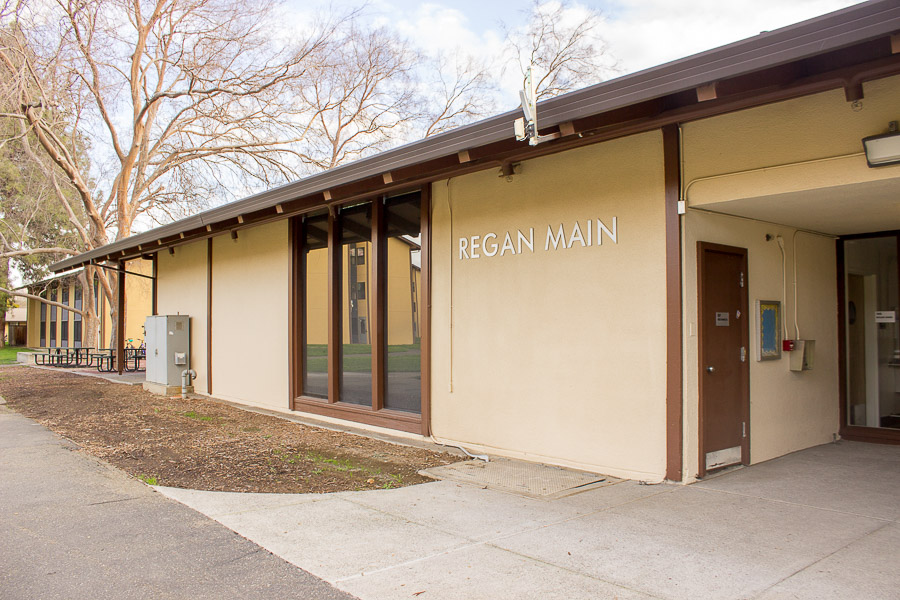
Built in 1965, Regan Hall consists of seven buildings: Campo, Rienda, Nova, Paloma, Indio, Talara and Sereno. It became the campus’ first co-ed residence hall in 1969.

Named after two past members of the UC Davis faculty, Regan Hall is a collection of student housing buildings located in Segundo and has been a temporary ‘home’ for generations of UC Davis students. Michael Regan was a professor within the College of Agriculture from 1922 to 1951 and Susan Regan became the first female faculty member at UC Davis in 1922.  

The buildings of Regan Hall house a total of 460 students throughout the seven halls. Situated in the North end of campus, Suzie Khishen, a first-year political science major, finds the location ideal.

Well, I really like the location,” Khishen said. “I think I would take location over […] anything else because it’s so convenient, but it’s […] definitely not as nice as the other dorms like I’ve seen.

According to Mika Bekkerman, a first-year sociology major, these buildings are not usually students’ first choice since they are some of the oldest student housing buildings on campus.

“I know I was kind of upset about [my dorm assignment] at first, just because like other people had newer dorms, but I’m actually really glad I live here,” Bekkerman said. “There’s less people here, [and there are] closer communities.”

Navarro has experience in other other halls in Segundo and Tercero and has found that the accessibility of Regan Hall is its biggest issue.

“The part that I don’t like about [Regan Hall] is that there’s no elevators,” Navarro said. “If you’re disabled you really don’t have a choice on whether you can go to the second floor or not. If you [live] on the second floor and have a family member or friend who is disabled, you’re kind of forcing them to not be able to visit unfortunately.”

Bekkerman has found that the lesser number of students in these older halls creates a close-knit community.

“Everyone here is super friendly,” Bekkerman said. “This feels more like a camp rather than a college dorm sometimes and […] I started paying less attention to [its] facilities.”

Narravo enjoys the collection of halls despite the smaller size of the buildings.

“I like being in Campo,” Navarro said. “I actually find the community a lot closer. I found that I’ve gotten along with this community a lot better than other communities because they are a whole building as opposed to split up between floors [like in other buildings]. It’s kind of hard to gain that sense of community [there], whereas […] here you’re actually getting everyone seeing each other.”

Each building has its own lounge where residents can study, socialize and get much closer to one another despite living on different floors.

“[The students] are using the same lounge [so] everyone kind of knows you or at least recognizes each other,” Navarro said. “In other buildings, […]  you can go a whole quarter and then you’re like, ‘wait, you live here?’ […] Regan does a good job of making it more like community […] as opposed to other buildings where it can be kind of divided by floor.”

Regan Hall is structured with facilities like laundry rooms and a main lounge that are shared by the entire complex. It also holds some of the campuses Living-Learning Communities, like the Native American Theme Program in Campo.

“People are always walking around, talking and hanging out,” Bekkerman said. “The lounge is always popping […] playing [games like] cards against humanity. It’s kind of like a camp sometimes, […] I don’t think I would have the same experience in another dorm.”

The smaller buildings have made residents more familiar with each other, according to Bekkerman.

“My favorite part [of living in Regan Hall] is [that] I’m pretty sure I know the names of most of the people on my floor,” Bekkerman said. “It’s a very small amount of people [and] you just get to know [them].”

Regan Hall provides a unique housing experience to the residents.

“There’s always someone to talk to, always something to do, always someone to say hi to, [and] everyone is so friendly,” Bekkerman said. “I’m really glad that I live here.”
Written by: Elizabeth Marin  —  features@theaggie.org

Humor: School to install stop sign near Death Star to distract from tuition hikes

CIERA PASTUREL / AGGIEstop

Campus creates diversion in an effort to avoid institutional crisis

The first UC tuition hike in six years has made for a time of unrest on the Davis campus. A proposed annual $282 increase for in-state student tuition is set to direct resources for the purpose of lowering the student-faculty ratio and improving the classroom environment. For out-of-state students, however, the increase comes at a much greater price of around $1,500 annually. The last tuition hike was six years ago.

With the student body reeling, the university has put in a stop sign at the intersection of North Quad and East Quad, in front of the Social Sciences Building (otherwise known as the Death Star) to distract from the problems at hand. A sly move, but admittedly calculated.

“We were on the side of evil, but we put in a stop sign,” said Bill D. Rhodes, director of Street Development. “That corner is home to more accidents than any other location on campus. We’re heroes for this.”

In a classic authoritarian move, UC Davis has created a distraction to blanket the real matter at hand. The intersection is the most dangerous on campus, with 30 reported accidents each quarter. This is more than three times the second-place location, the walkway in front of the Segundo Dining Hall.

The implementation of the new road sign is an attempt by the administration to show that it cares about its students as it offers them a temporary fix to a much greater issue. Some students, however, are not fooled.

“Yeah, no. Not gonna work,” said Neil John, a fifth-year nutrition sciences major. “I’ve been here four years. I’ve seen my fair share of cover-ups. Just look at how last year it was discovered Katehi tried to scrub the internet of pepper-spray. I know a fraudulent move when I see one. And this screams fraud.”

Other students see this as an opportunity to better the campus.

“Honestly, if they’re going to create a small raise in tuition and then cover it up with weird amenities that make us forget what they’re doing is wrong, I’m all for it,” said Noah Sense, a first-year undeclared student.

The school is admittedly creating a diversion to cover up a larger problem. The new sign will help, but it shouldn’t take a tuition hike to ensure the safety of its students, especially with something as simple as putting up a red octagon on a pole. The move is long overdue, and it is insulting that it must come at the expense of $282 per quarter from every in-state student in the UC system.

While the funding would be going to the right cause, taking money from people that aren’t students would be a better place to start. With salaries well above $300,000, the administrators in power could stand to ease the financial burden on those who need the most help — students.
Written by: Ethan Victor — ejvictor@ucdavis.edu