55.9 F
Davis

Davis, California

Tuesday, December 23, 2025
Home Blog Page 693

UC Davis women’s field hockey team breaks new team records

0
JAY GELVEZON / AGGIE

The Aggies break two new school records in big win, look forward to finishing their season strong

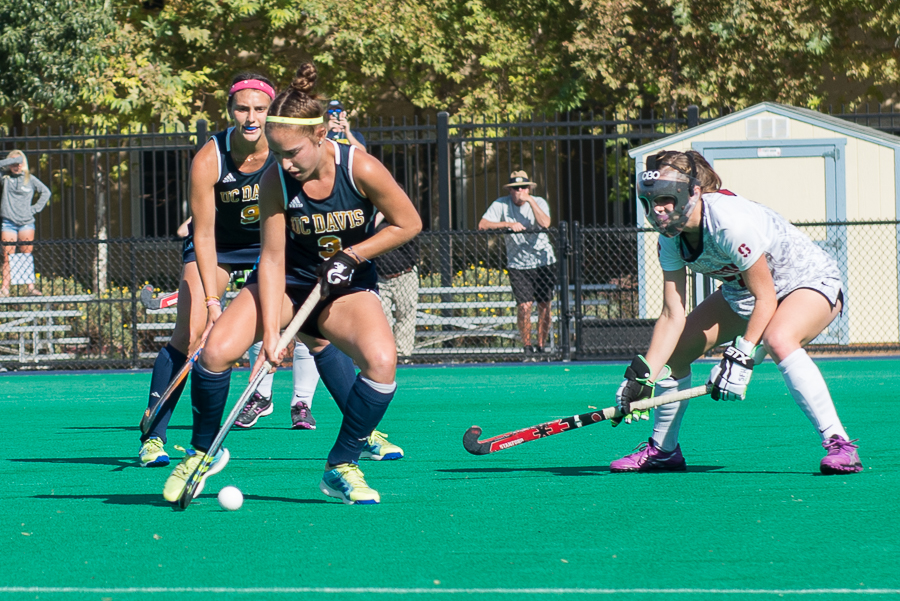
The UC Davis Aggies women’s field hockey team was able to produce a dominating win over LIU Brooklyn on Sept. 25, defeating their opponent by an impressive 10-0 margin. Not only did the Aggies top their team record of the largest margin of victory and the biggest margin in a shutout (previously nine goals), but their impressive defense also did not allow their opponent to take a shot the entire game.
JAY GELVEZON / AGGIE

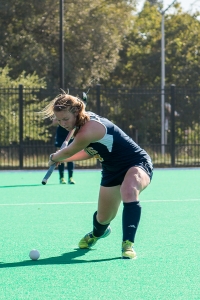
During the game, freshman forward Kathleen Humphries gave a dominating performance that culminated in three goals off of only four shot attempts against LIU Brooklyn. Humphries’ performance led her to be named by America East Conference as Rookie of the Week. Humphries became the third Aggie in history to record six points in a single contest.

“I think that was a game that the team has worked really hard for,” said head coach Chrissy Kilroe. “It’s always nice to break records. The team really came together as far as working together and scoring.”

Humphries was proud to contribute to a team that did not let its opponent take one shot the entire match.

“[The game] was definitely a team effort,” Humphries said. “The dynamics of this team have changed and I am so fortunate to be playing with these girls. That award wasn’t just on me, it was a team effort and I love playing for this team.”

Even though this win is beneficial for the Aggies, they are 0-3 in Big West Conference play, but could make a mark for the season overall.
JAY GELVEZON / AGGIE

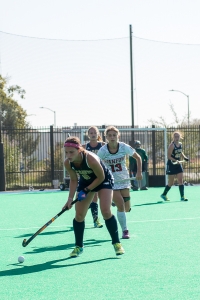
“Going forward, if we can continue to play our system and play our game I think that we are going to compete, and I hope we can come up with some big wins within the conference and the rest of the season,” Kilroe said.

In their most recent conference game against Pacific, the Aggies took a tough 3-2 loss.

The Aggies play their next conference game away against Stanford this Friday, Oct. 21, at 6:00 pm. They return to the Aggie Field Hockey Facility on Friday, Oct. 28 at 3 p.m. to face UC Berkeley in their final game of the season.
Written by: Ryan Bugsch  – sports@theaggie.org

The evolution of the closer

0

ARTURO PARDAVILA III [CC BY 2.0] / FLICKR
Michael Wexler explores the importance of major league closers stepping out of the confines of ninth-inning roles

In the quest for a World Series, a team’s bullpen is of the utmost importance.

For those unfamiliar with the term, a bullpen is comprised of roughly seven pitchers who come into a game to relieve starting pitchers of their duties. Because relief pitchers are typically only expected to pitch between two and four innings on any given night during the regular season, it’s easy to underestimate the importance of a strong bullpen, especially when big-name starting pitchers take up the most media attention.

Regardless of the weight people place on the importance of the bullpen as a whole, conventional baseball wisdom and fans alike applaud a team’s closer.

By the traditional definition, a closer is a baseball team’s best bullpen arm and is usually designated for the final three outs of a game in which a team is up by three runs or less. The traditional definition, however, is malarkey. Yeah, I said it, malarkey.

By confining a closer to this ninth-inning role, teams spread themselves thin in situations with higher leverage. In big games like the playoffs, a team cannot afford to compete without using their best arm. A perfect example of this is the failure of Baltimore Orioles to utilize their closer Zach Britton in the recent American League Wild Card Game.

Britton, a legitimate Cy Young award candidate, had one of the most dominant seasons as a closer in recent memory. He pitched 67 innings to the tune of a 0.54 ERA with 47 saves and 74 strikeouts. For those who don’t understand baseball jargon, suffice to say his season was historic.

Britton, however, was not used in the extra innings of last week’s AL Wild Card Game against the Toronto Blue Jays that would’ve sent the O’s to the American League Division Series against the Texas Rangers. Orioles’ manager Buck Showalter left his best arm unused when the game was on the line, and the Orioles lost and their season ended because of it.

Managers have begun to abandon this approach during this year’s playoffs. Los Angeles Dodgers manager Dave Roberts learned a thing or two from Showalter’s mishap in Game Five of the NLDS. Roberts brought in star closer Kenley Jansen in the seventh inning of a game in which the Dodgers were up by one run with one man on base with the Nationals’ biggest bats next in line to hit. Jansen proceeded to throw 51 pitches for 2.1 scoreless innings, which is unchartered territory for a closer, and the Dodgers held on for the win because of it.

Cubs closer Aroldis Chapman was used in Game One of the National League Championship Series in the eighth inning as the Dodgers threatened with the bases loaded, and Andrew Miller has been deployed in almost every late-inning high-leverage situation since being traded to the Cleveland Indians in late July.

Just because the ninth inning is the last, doesn’t necessarily mean it is of the most importance. The best arm in the ‘pen should come in the game when the situation calls for it, because if the other arms fail to keep the game in check he may never get the shot to come in at all. Closers are given the spotlight, more money in free agency and disproportional love from the fans.

It’s about time that managers started abandoning the traditional confines of their ninth-inning routine and started using them in spots where they are needed most.
Written by: Michael Wexler – sports@theaggie.org

Publishing undergraduate research: on-campus resources

JAY GELVEZON / AGGIE

UC Davis offers many outlets for STEM students to creatively publish, showcase their work

Students at UC Davis may remember the old high school days when English teachers pounded the restrictive five-paragraph essay format into their brains. As STEM majors enter college, there are various clubs and scientific journals available as platforms to publish research and document experiences far beyond the limiting five-paragraph rule.

The Aggie Transcript, The Narrative Pre-Health Club, Explorations, Prized Writing and UC Davis Health Student Review are just a few of the avenues students can pursue. The Aggie Transcript and The Narrative Pre-Health Club accept submissions in media forms other than writing, such as art, photography and video.

“Whether undergraduates choose to stay in academia or not, writing is involved in most careers, as is project and time management,” said Lauren Fink, neuroscience Ph.D. student and editor-in-chief of Explorations: The UC Davis Undergraduate Research Journal.

Writing in scientific fields has become a crucial skill in today’s society. With the rapid advancement of technology and research, writers must be able to effectively convey their ideas to both experts and the general public.

“Publishing is valuable evidence to employers or future graduate schools of a student’s ability to write and to carry a project through to a conclusion,” Fink said.

Large class and laboratory sizes make it difficult for students to apply their knowledge to current events or share their information to others in a more original way. Showcasing writing at a university level shows initiative to learn and grow.

“Writing is a way to express yourself and [students] have the opportunity to express what they learned,” said Nicole Strossman, fourth-year biochemistry and molecular biology major and senior editor of The Aggie Transcript.

The Aggie Transcript is a unique scientific journal because it is student-run. The editors take the time to work with students, helping them to edit their submissions. The goal is to produce high-quality pieces of writing that allow students to retain a sense of originality in their submissions.

Published work from this journal covers topics in health and medicine, genetics, case studies in biology and even literature reviews of scientific papers.

The most recent article published was a case report on Tourette Syndrome in the health and medicine category.

“We have two faculty advisors that provide their input from a writing perspective and science perspective: Dr. Sean Burgess of the Department of Molecular and Cell Biology and Dr. Katie Roger of the University Writing Program (UWP) department,” Strossman said.

The Narrative Pre-Health Club (NPH) also consists of a journal committee which publishes written pieces about reflections or narratives on pre-health experiences. This includes personal stories about volunteer experiences, classes, clinical work or any subjective topic relating to the journey of a pre-health student.

“We feel that analyzing and sharing our stories at a deeper level not only allows us to better understand ourselves, but also to identify the person we each aspire to be as future health professionals,” said Murtaza Khan, co-founder of NPH.

NPH is distinctive from other journals on campus because it allows students to appreciate why they are pursuing a college education, and a career in the health field specifically.

“[Think back to] the time you used to visit your mother in the hospital as she fought cancer. That one class that piqued your interest in the workings of the nervous system. The many times you feel burned out by the daily struggle of […] classes, to pursue a seemingly distant dream, but keep on persevering nonetheless,” Khan said. “We all have these experiences […] I think it’s important that we sit down and reflect on them to pinpoint exactly how they’ve shaped us.”  

A scientific journal that exclusively publishes undergraduate research is Explorations. In order to submit a piece of writing, a student must have a faculty sponsor, who references a few potential experts in the paper’s field. These experts are then asked to review the submission with the help of the journal’s editorial board.

“We have published articles from a variety of majors such as art history, sociology, psychology, engineering, math, sciences, english and agriculture,” said Fink. “We hope that our journal reflects the range of thought expressed on our campus and certainly aim to have the research published in Explorations come from as many different disciplines as possible.”

If students are looking to publish research or writing from a class, UC Davis’ UWP has developed Prized Writing. Expository writing entries must have been written as an undergraduate student in concurrence with taking a university course. Selected submissions are published and featured in the Prized Writing book, sold at the university book store.

Scientific and student-run journals based at the UC Davis medical school have year-round opportunities to apply to their editorial staff.

“Just like publishing is a good experience for an undergraduate, learning what goes into editing and publishing an academic journal is a great opportunity for students,” Fink said.

The journals on campus continuously grow as the number of submissions increase every quarter. Both The Aggie Transcript and NPH are seeking to publish their first hard-copy journals  with selected published articles.

Students who decide to publish their work each get to advantageously network their ideas early on.

“[Publishing research is] also good for other undergraduate students to see what their peers are doing,” Strossman said.

Staying informed and discussing new and current ideas in the varying scientific fields can only help students in their future education and careers.
Written by: Shivani Kamal – science@theaggie.org

The shaky reality of living in California

0
CINDY CHEUNG / AGGIE

UC Davis researchers discuss implications, Southern California earthquake advisory

A Southern California earthquake advisory from the California Office of Emergency Services (Cal OES) shook the nerves of the public all across social media from Sept. 30 to Oct. 4. The advisory reminded all California residents of the potential dangers of a large earthquake affecting urban areas, including Davis.

“Warnings are usually fairly cautious in their language in order to avoid inciting chaos,” UC Davis professor emeritus Donald Turcotte said. “Uncertainties are so great because the chances are one in 100, but the risk is always there. So warnings are given out just in case.”

For Turcotte, the advisory was more precautionary than anything else. For California, where public knowledge of local earthquakes is widespread, a warning based on a wild guess is better than none at all.

“There is always a risk in trying this information [on] the public because people don’t deal well with low-probability issues,” said geology professor Michael Oskin. “They tend to overemphasize [the probability of an earthquake], and it does not help that some news organizations are only seeking publicity for themselves and will hype things. The reality of [the warning] was that [there] was an enhanced chance [of an earthquake] over the long-term.”

Cal OES issued the advisory due to concerns that an earthquake near the San Andreas Fault would trigger a larger earthquake as a part of an “earthquake swarm.”

According to James McClain, a professor in the Earth and Planetary Sciences, his department defines an earthquake swarm as an unusually large number of earthquakes, densely packed over a short period of time. This occurs when one fault may be slipping, or a number of closely spaced faults are slipping slightly.

This particular San Andreas swarm took place near the Salton Sea. The concern was that it would trigger an even larger earthquake along the San Andreas Fault. The advisory is no longer in place, meaning that, for the moment, there is no longer an increased probability of an earthquake happening along the fault.

“There is an increased probability of an earthquake during one of these swarms […] but probability is not stationary,” Oskin said. “We don’t understand earthquakes sufficiently [enough] to say ‘yes’ or ‘no’ if something is going to trigger an earthquake. There are times where earthquake activity is enhanced, and we should be more wary of other things happening. It is not like forecasting the weather yet.”

California has multiple faults that are cause for concern when it comes to earthquakes. However, the impact of earthquakes on certain faults varies throughout the state.

The San Andreas Fault in Southern California is under the most surveillance by seismologists since it is due for an earthquake. According to McClain, the Hayward Fault in the East Bay is the nearest fault to Davis that is due for an earthquake.

“Every part of California has some sort of earthquake potential that people should be concerned about,” McClain said. “However, we do not have to worry about [how a] Southern California [earthquake could affect us], and they do not have to worry about a big earthquake here.”

The concern for this advisory was in the increased probability of a quake occurring along a fault that is due for an earthquake. Earthquakes tend to happen along the San Andreas about once every 300 years, according to Oskin. So, in a year, the probability of an earthquake is one in 300 and one in 10,000 every day. During this swarm, the probability went from one in 10,000 to one in 100, which warranted the advisory.

“During this swarm the likelihood increased by a factor of 100,” Oskin said. “It is still a 1 percent chance that the earthquake [could be] the next day. That level of change in probability from very small numbers to another very small number [causes] a very big relative increase.”

Since Davis is rather far away from the coast, the city would not be as affected by a large earthquake on the Hayward Fault as it would be by its after-effects. So, for Oskin, remaining prepared for the possibility of a large earthquake is a vital aspect of living in this state.

He suggested that Davis citizens stay informed of building codes for earthquakes and make sure the contents of their homes are firmly screwed down to avoid getting hit by something falling during a quake.

“We haven’t had a very large earthquake in California in more than two decades that has affected urban regions, [but] it is good to be reminded that we have a very large earthquake hazard in California,” Oskin said. “Maybe this particular reminder was a little bit overblown […]  but there is a benefit to reminding people of the hazard that they should prepare for.”
Written by: Amanda Cruz — features@theaggie.org

Hold your horses, bike polo is in town

0
JENNIFER KUTZLEB / COURTESY

Davis Bike Polo expands, players find sense of community in club

As one of the largest bike towns in the nation, Davis is no stranger to bike-related activities, including the up-and-coming sport of bike polo.

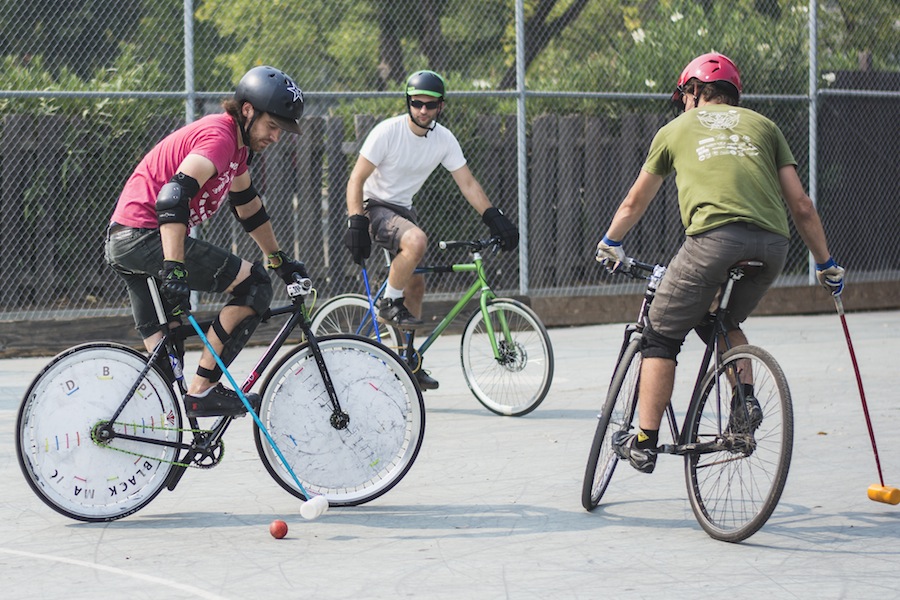
The game of polo is similar to hockey in that the ball is passed around by a piece of equipment instead of hands with the objective of scoring a goal on the opposite end of the court. In modern bike polo, played on a hard surface court, the players use mallets to hit the ball while riding bicycles rather than horses.

“The club […] is really welcoming of people at all levels,” said Edward Henn, Davis Bike Polo club member. “I love bikes and I love riding bikes […] but [I had] no polo experience. [The members] are really encouraging.”

Davis Bike Polo was established in 2011, but according to Jennifer Kutzleb, club representative and UC Davis Department of Sociology doctoral student, the grass version of the sport has been in practice since the 1800s. At that time, the game was much more similar to horse polo.

“It was kind of like a poor man’s polo, [for] people who couldn’t afford horses,” Kutzleb said. “We [still] sit atop something, but other than that we don’t share that much in common with horse polo.”

The modern hardcourt version of the sport originated in Seattle, Wash., in the early 2000s. The idea arose from bike messengers who spent their time in between deliveries playing early renditions of the game.

Davis Bike Polo meets three times a week in West Manor Park, located in West Davis. Players of all ages, genders and experiences are welcome at the polo hardcourt, which resembles a tennis court.

“The first time I heard about [the club] was on Picnic Day,” Henn said. “I saw [the club] in Downtown Davis; they did an exhibition. It just looked like a whole lot of fun.”

Bike polo requires strength as well as technique: players maneuver both their bikes and their mallets to score goals.

“I really like that it’s very technical,” said Tricia Wong, member of Davis Bike Polo. “I spent a large part of the last year just trying to get better. It’s not one of those sports that you can just learn really quick.”

Davis Bike Polo prides itself on its inclusivity, since the sport is globally dominated by men. Once a month, as a way of recognizing other genders in the sport, the club hosts Women Trans Femme (WTF) nights where individuals who identify as such get to socialize and play the game.

“I feel like I’ve gained so much self-confidence,” Kutzleb said. “I spend a lot of time working on academic[s]. It was just so much fun to be athletic. [The sport] has been really cool for [my] self-development.”

The club is part of a continental organization called the North American Hardcourt Bike Polo Association, which is made up of clubs from all over the United States and Canada. This year, Davis Bike Polo hosted the 8th annual North American Hardcourt Bike Polo Championship in Folsom, Calif., with two qualifying Davis teams, one of which finished in eighth out of 36.

“It was a really proud moment for us,” Kutzleb said. “The guys who [finished eigth] started the club together way back in the day.”

The sport of bike polo, however, is not restricted to just North America. Players travel all over the world to compete, from Europe to Canada to Mexico.

“I’ve traveled so much because of [bike] polo I’ve been to Europe four times in the last two years,” Kutzleb said. “That’s one of the best parts about [the game], it breaks down […] barriers. You get there, and you have something in common with people.”

For people who want to try out the sport, Davis Bike Polo lends out loaner bikes and mallets. New players are then assimilated into the sport with drills and coaching from more experienced players. Players also wear helmets and pads as safety precautions.

“It’s really hard to ride a bike in a small space […] you feel like you’re going to crash and freak out,” Wong said. “[When I first started] I would get stuck in the corners a lot […] but I’ve definitely gotten better.”

The club includes a range of participants, from 12-year-olds, to graduate students, to older adults.

“I’ve definitely gained a lot more friends,” Wong said. “Davis is kind of tiny, [and] I grew up in big cities. [Bike polo] is really nice because it’s a fun activity to do in Davis.”

Since the bike polo community in Davis is small, the players get to know each other well. The experienced players are generous in their advice and support towards newer players.

“It’s been an easy thing for me to get involved in and […] get more skilled at just because of the encouragement of the people that are doing it,” Henn said. “The feeling of camaraderie [is strong.]”

Despite their different levels of experience, Henn, Wong and Kutzleb all agree that the bike polo community has positively impacted their lives.

“It’s been such a good experience,” Kutzleb said. “When I first started the sport I could barely ride a bike. Now I can do stuff on a bike I never imagined [I could].”
Written by: Allyson Tsuji – features@theaggie.org

Suicides by firearm more common, preventable than you think

DAVE HERHOLZ  [CC BY-NC 2.0] / FLICKR
DAVE HERHOLZ [CC BY-NC 2.0] / FLICKR
A bad day, impulsivity, easy access to guns makes for a deadly combination

Suicide, which is the 10th leading cause of death in America, has increased by 17 percent since 2010. And more than half of the 42,773 Americans who killed themselves did so with guns — a number that is far greater than the number of people who were killed in homicides and accidents by firearms combined.

Those are startling facts. And to someone like me, who was under the impression that mass shootings and homicides were the leading causes of gun violence, these facts are mind-boggling.

Easy access to guns pose a huge problem for these very reasons. Compared to other methods of suicide, such as drug overdose, poison or inhalation of car exhaust, pulling a trigger is almost always lethal and irreversible.

Where attempt at suicide by firearm has an 85 percent mortality rate, drug overdose is fatal in less than 3 percent of cases, giving the troubled individual a second chance at his or her life. In fact, 9 out of ten attempted-suicide survivors do not go on to try to take their life a second time, and many of those survivors also seek professional help.

Moreover, studies have found that states with more lenient gun laws and therefore more household gun ownership have a higher suicide rate than those with stricter gun laws and less household gun ownership. Suicide is rarely a long, carefully engineered plan that suffering individuals engage in. It’s usually preceded by events such as an explosive fight with a significant other, a devastating layoff or a trigger to a haunting experience.

It’s usually caused by an impulse decision. It’s usually preventable.

This impulsivity is key. According to a 2001 study conducted by the Center for Disease Control, survivors of a near-death suicide attempt were asked to report how much time had passed between when they decided to take their life and when they actually attempted to do so.

Four percent said less than five minutes; 48 percent said less than 20 minutes; 70 percent said less than one hour; and 86 percent said less than eight hours. There is little time between the decision and the action. Factor in the easy access to guns –– no background checks and no evaluation of mental health or stability of the buyer –– and it makes it that much faster for a volatile individual to get a gun and get out.

This is why it’s imperative to create laws that restrict access to guns, or at least create an accountability system on the part of gun sellers, who currently have no obligation to screen a buyer before making a sale.

When Ralph Demicco, owner of Riley’s, a gun shop, learned of suicides committed with firearms from his store, he decided to investigate. He found that when looking back on multiple instances, tell-tale cues popped up: a customer asking for only a small amount of ammunition, looking uneasy or, the biggest indicator, starting to cry after being asked a few questions. With a little prodding and questioning, the intending customer was deterred from buying altogether — further proof that the fragile impulsivity so characteristic of at-risk individuals is capable of being disarmed with a simple line of inquiry on the part of gun dealers.

If change cannot begin with the law, it must begin with the individuals who place guns into the hands of unstable and despairing souls. But we must begin to ask the right questions.

It’s not a question of whether or not you are pro-gun or anti-gun, because everyone will always be on one side of the matter. The question, as Madeline Drexler of Harvard Public Health eloquently put it, is how do we solve the issue of gun suicide?

And only when we start asking the right question can we, as a society, come to a consensus on how to save the lives of our fellow Americans.


Written by: Tamanna Ahluwalia — tahluwalia@ucdavis.edu

HUMOR: Arboretum to be demolished for new computer lab

DEBPARNA PRATIHER and VENOOS MOSHAYEDI / AGGIE FILES

As UC Davis runs short on space for computers and classrooms, the administration is looking for more places to provide help for its students. The largest open space is the Arboretum.

Located on the southernmost tip of campus, the Arboretum is home to thousands of different species of plants, animals and insects. Todd Donald, director of Campus Development, explained in a press conference on Monday why construction will soon begin to create more space.

“Bottom line, we need space to put this computer lab and there aren’t enough rooms. You have kids taking classes out past the football stadium, that is far,” Donald said. “Here at Davis, the campus is large, but we don’t like far.”

The Arboretum is an important part of student life. It’s an iconic symbol of the UC Davis campus. It will be moved in order to make room for two new computer labs and seven new classrooms. The easternmost part of the arboretum will be demolished, after the trees, but before the path that runs right next to Mrak Hall.

Naturally, there has been unrest. Students and professors have expressed dissatisfaction at the destruction of the greenery.

“From a spacing point of view, the construction makes sense. From every other point of view, the construction is an abomination of student life. The people watching there is incredible,” said Brady Ziegler, a fourth-year plant sciences major and son of economics professor Lauren Ziegler. “I go there to study; it’s quiet. My mother goes there to grade papers. I grew up in Davis, and I don’t want to see it leave.”

The school has yet to announce the design plans for the new building, but the estimated cost is hovering around $10 million. The money is coming out of student tuition, not from donations provided by alumni or the green initiative. Once again, the school is using a large budget in order to further its own agenda.

While computers are important, so is open space. There are better and more convenient locations to begin construction on campus rather than campus’ most beloved hangout spot. The recently renovated Memorial Union comes to mind when considering other spaces that could have been filled.

Construction is set to begin fall 2017. Students have been encouraged to go to the Quad in order to get their fix of people watching, as well as plant and insect company.

Questioning the credibility of ETHAN VICTOR? You can reach him at ejvictor@ucdavis.edu. Feel free to help with his followers-to-following ratio on Twitter @thejvictor, because it is pathetic right now

Written by: Ethan Victor – ejvictor@ucdavis.edu

Korean Broadcasting System sends reporter to Yolo Food Bank

NADIA DORIS / AGGIE
NADIA DORIS / AGGIE

South Korean reporter travels halfway across the world, documents rice donations

Felix Kwon, a reporter from South Korea who works for the Korean Broadcasting System (KBS), ventured 18 hours this past September to visit the small city of Woodland — all for rice. Felix had traveled halfway across the world with a film crew to visit the Yolo Food Bank (YFB) established there.

Recently, the South Korean government put into effect a rice donation program for their local food banks. As a result, Kwon came to learn more about small local food banks and decided to interview those involved, namely those associated with rice production, a staple in a typical Asian diet. KBS, the largest public television network in South Korea, allowed Kwon to choose his destination for the documentary.

The team began their research and came upon YFB, which distributes across 11 counties and has donated 355,294 pounds of rice, totalling over 4 million individual servings for those in need. Conaway Ranch, a large corporation of rice-growers located in Woodland, largely contributes to this effort as YFB’s greatest benefactor.

This system intrigued Kwon, since South Korea’s public programs for food-insecure residents differ widely from those in Yolo County. Kwon paid particular attention to the relationship between the YFB and the ranch.

“Rice is a staple of the Korean diet and if we can create this kind of partnership between rice farmers and food banks in South Korea, it could help a lot of hungry people,” Kwon said in “Yolo Food Bank attracts international attention.

The idea that farmers were willing to donate their own profits to help those in need perplexed Kwon. However, YFB marketing and communications coordinator Kevin Brown and Conaway Ranch environmental consultant Maya Kepner agreed that the farmers belong to a community where people care about each other and want the best for their neighborhoods.

“We live in this agricultural region that produces some of the world’s finest produce. Our proximity to it allows us to form partnerships with local farmers who want to do good and help their neighbors in need,” Brown said. “A lot of growers participate in our Shared Harvest program where they pledge a small percentage of each harvest to the Food Bank, we then turn around and redistribute it throughout the community. It’s a beautiful thing that fulfills a real need right here at home.”

The Conaway Ranch Shared Harvest program has helped donate rice and produce to programs for food-insecure individuals and families for the last three years, donating about 163,000 pounds of rice to various food banks across California.

“What started out as just Yolo County now reaches about 18 counties in California,” Kepner said. “It’s a story of people coming together — the farmers, the ownership group and the local food banks to provide food for people who really need it.”
Written By: Bianca Antunez – city@theaggie.org

Chancellor advising committee hosts series of townhall discussions

BRIANA NGO / AGGIE
BRIANA NGO / AGGIE

Search for Katehi replacement continues

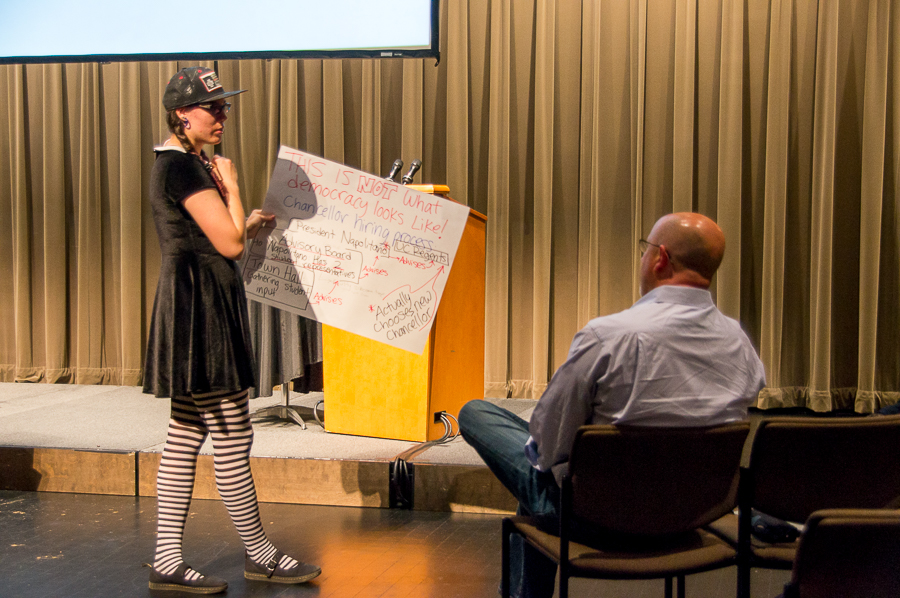
A series of public town halls were held on Oct. 11 at UC Davis’ Vanderhoef Studio Theatre, where members of the University were invited to express their concerns in the search for a new chancellor. The sessions were hosted by members of the search advisory committee, a group of representatives selected by University of California (UC) President Janet Napolitano, to assist in the search for viable candidates.

Student influence in this process is very important, as it is only through the diverse voices of our students that the University continues to serve our needs,” said Rachael Goodhue, professor and chair of Agricultural and Resource Economics and chair of the Davis Academic Senate, via e-mail. “We must voice our input to ensure that future generations of UC Davis students have a chancellor worthy of our institution.”

The town halls began at 8 a.m. and lasted throughout the afternoon. Ari Kelman, a professor of history and a member of a five-person faculty subcommittee in the search advisory committee, believes that the faculty and students in attendance had constructive feedback for the committee.

The point of a town hall meeting, according to Kelman, is to offer campus constituencies the opportunity to share any qualities they desire in a new chancellor with the faculty subcommittee and chancellor’s advisory search committee.

“In this particular town hall, we heard from staff and we heard from people who were very eloquent about what they are hoping to see. We heard about some of the challenges that they face and whoever is hired into this position likely may face,” Kelman said. “We heard about some of the things that make this campus really great. All of these things are exactly what we’re looking for out of these town halls so that we can then go back to the full search advisory committee and help make the very best and most informed decisions that we possibly can in the course of this process.”

The advisory committee convened for its first meeting on Sept. 27 in the ARC Pavilion. As the UC hopes to have a qualified candidate by January, the committee will assist Napolitano with input and suggestions until then. After the President has selected a candidate, she will present them to the regents who will then hold a vote.

Shane White, the vice chair of the systemwide Academic Senate leadership, said that faculty and students have brought up several recurring concerns.

“I think a couple of themes have come across very clearly and one very important one is pride in the incredible success of UC Davis and a desire to continue on an upward trajectory,” White said. “We’re here to listen, we’re here to understand from the people who are here, the students, the staff, the faculty [and] what they believe.”

Representatives of the advisory committee who were present at the town halls also included Elly Oltersdorf, the undergraduate student representative,  Brian Riley, the graduate student representative and former chair of the Graduate Student Association (GSA), Jessica Potts, chief administrative officer in the Department of Chemistry, and Oscar Dubon, former chair of the UC Davis Staff Assembly and professor of Materials Science and Engineering at UC Berkeley.

Katrina Brock, the chair of GSA who was present at the undergraduate and graduate student town halls, had concerns about the selection process.

“Overwhelmingly, it seems like people are just frustrated with the process and the fact that no matter how much on-campus engagement the student reps and the faculty reps do, there’s ultimately one person who’s going to make the decision,” Brock said. “And I think people really want to change that, and that’s the conversation that they want to have before having the conversation of what we want in a chancellor.”
Written by: Ivan Valenzuela – campus@theaggie.org

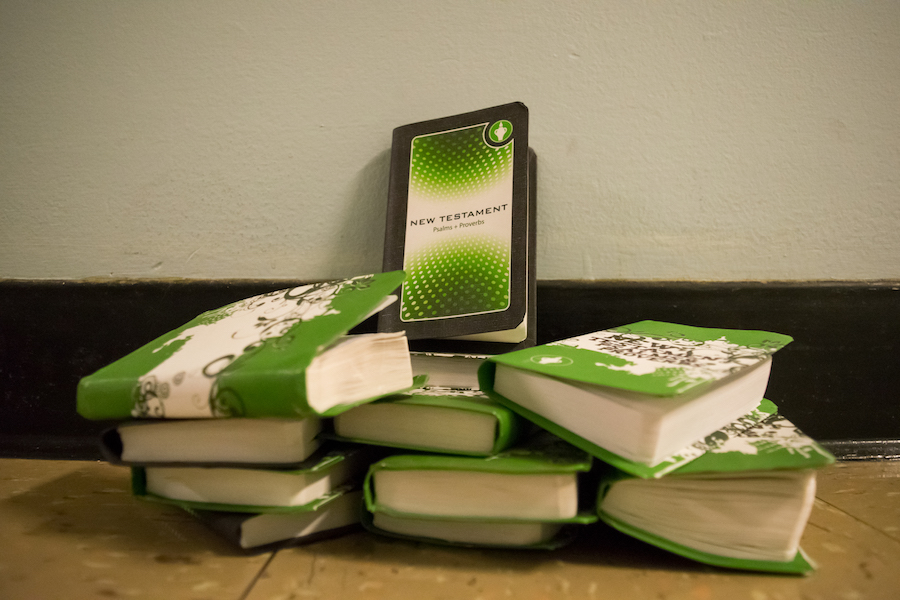
HUMOR: Number of mini Bibles in Davis surpasses number of people, bikes

BRIAN LANDRY / AGGIE

Growing number of small Scriptures causes problems on the UC Davis campus

It’s long been a rumor that the number of bikes in Davis is greater than the number of people. I’m not sure whether or not this is true, but I do know the chemical formula for photosynthesis.

But it’s not the number of bikes that’s making headlines this week; it’s the sheer number of mini Bibles that are now popping up around town. The new rumor going around is that the number of mini Bibles in the City of Davis exceeds the number of people and bikes combined.

It might seem like this isn’t much of a problem for the average student. After all, how could some tiny versions of the New Testament possibly affect anyone? I’m glad you asked.

“I was running a little late to class the other day and had to bike really fast to get there, so I was all sweaty,” said Mimi Gross, a third-year religious studies major and distant blood relative of Food Network star Guy Fieri. “So I finally got to class and thought that I had spotted the only open seat in the entire lecture hall. But in reality, the seat was not open. It was instead occupied by a mini Bible that stared back at me and laughed as I was forced to leave lecture due to lack of seating. I was bullied that day.”

Gross is not alone. The Aggie talked to several students who had similarly bone-chilling stories. One of these students was Thomas Mulligan, a second-year physics major and succulent enthusiast.

“There I was, just riding my bike to class, when a mini Bible came along and shoved me off of my bike and watched me skid across the pavement,” Mulligan tearfully recalled. “I feared for my safety that day. The vengeful look in the Bible’s eyes was a lot to handle. I told the campus police but they just looked at me like I was crazy. ‘Miniature books can’t shove people off bikes’ they told me. ‘Only regular sized books can do that.’”

It’s probably safe to say that the mini Bibles are damaging the Davis community. Despite the fact that they have been committing violent acts against students, they’re also causing a lot of congestion issues on campus. Mini Bibles clog bike paths, hog tables at the CoHo and talk up a storm in the library while the rest of us are trying to study.

We need to put an end to these random people on our campus handing out these “inanimate objects” that are clearly causing real damage to student life at Davis. Please. Before it’s too late. Things are really getting out of control. A gang of mini Bibles stole my car today and I don’t even have a car.
Written by: Brian Landry — bjlandry@ucdavis.edu

Homecoming rain bodes well for Aggie football

0
JAY GELVEZON / AGGIE

Aggies get first conference victory at Homecoming on Saturday, defeat Bears 34-21

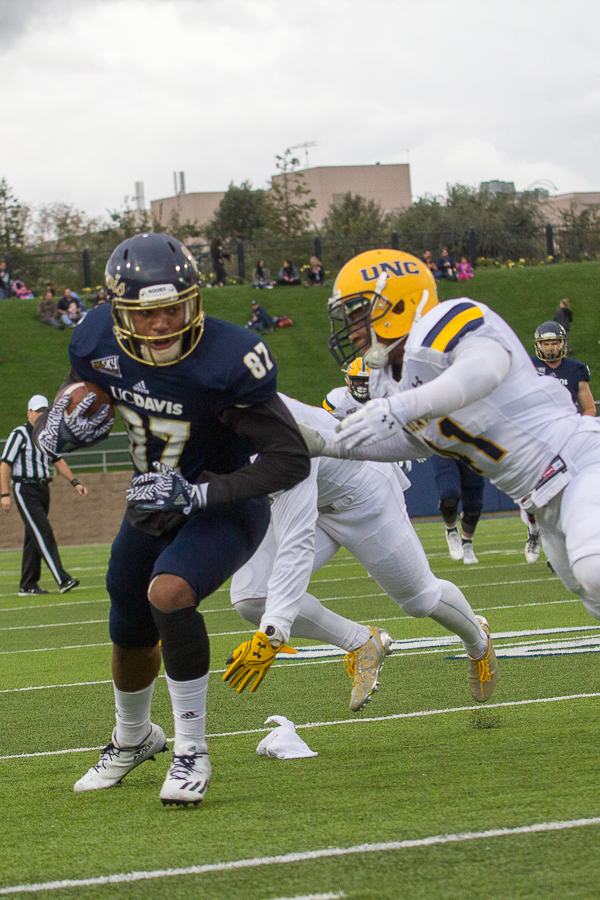
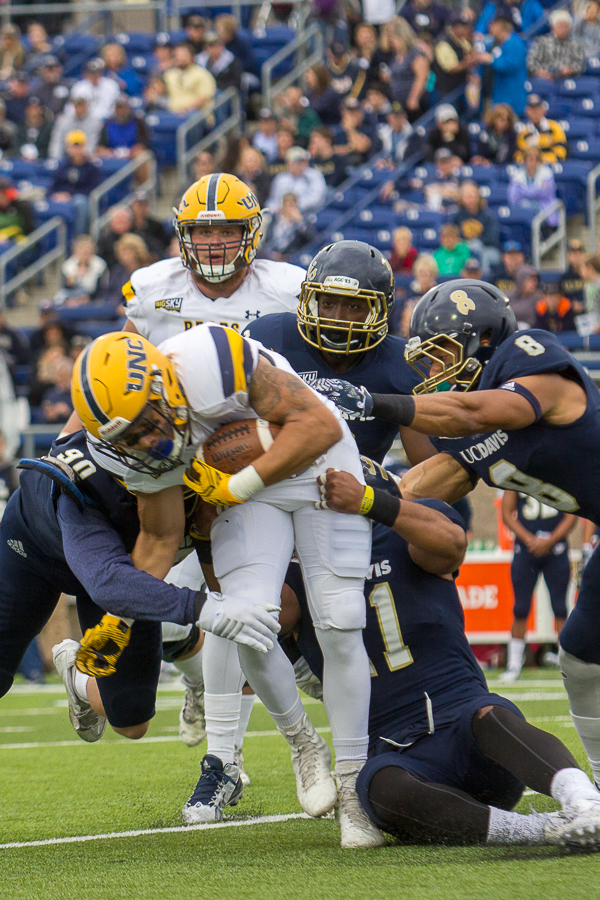
The UC Davis football team welcomed alumni and current athletes back to Aggie Stadium for Homecoming last Saturday as they snapped a four-game losing streak by defeating the University of Northern Colorado Bears, 34-21, in their first Big Sky Conference victory of the season.

It was a rainy, windy evening, but fans still turned out to support the Ags on their first game back at home in two weeks.

The Aggies’ defense has been top-notch this season, with a season-high four sacks on the road against Southern Utah just a week before. It was a similar story Saturday night.

The Aggie defense carried the team with big sacks and stops. The Ags started off strong in the first half with their defense stopping the Bears’ opening drive quickly. They went up, 3-0, on their first drive of the game, after a 32-yard pass from senior quarterback Ben Scott to freshman wide receiver Jared Harrell deep into Bears’ territory set up a 38-yard field goal for freshman kicker Matt Blair. Northern Colorado scored on its following drive, putting them up 7-3.

UC Davis regained a 10-3 lead with an 83-yard drive ending with a one-yard touchdown rush from senior running back Manusamoa Luuga, who led the team in rushing with 27 carries for 93 yards and two touchdowns.

JAY GELVEZON / AGGIE

After stalling yet another Northern Colorado drive with a big sack on the third down by senior defensive lineman Zak Pettit, the Ags got the ball back and marched 70 yards down the field to score off another rush from Luuga, extending their lead to 17-7.

The Bears came back with a 20-yard touchdown and UC Davis’ Blair missed a 29-yard field goal, making it 17-14 going into halftime.

UC Davis broke tradition this year and held the annual Hall of Fame induction at Homecoming instead of in the spring, honoring six former Aggies for their athletic achievements at the half volleyball player Jill Changaris, football’s Jason Hairston, gymnast Tanya Ho, wrestler Derek Moore, gymnast Jon Trunk, swimmer Scott Weltz and former associate athletics director Larry Swanson.

At the start of the second half, Northern Colorado’s defense held the Aggies in their own territory on their first drive of the second half, but sophomore running back Joshua Kelley broke tackles to rush an explosive 31 yards into the endzone and lift UC Davis to a 24-14 lead.

The Bears stayed within reach with a fourth-down touchdown late in the third quarter to make it 24-21. The Ags responded with a Blair field goal to make it a dangerous six-point deficit for Northern Colorado, 27-21.

With just under three minutes left to play, UC Davis’ junior cornerback Isaiah Olave got the 11-yard pick six, capping off the Aggies’ 34-21 victory.

With no turnovers from the offense and key defensive plays, head coach Ron Gould said that the team finally found its rhythm by communicating.

“You see our kids playing with the confidence, playing with the energy and playing with the kind of poise that we need to play with,” Gould said. “They had the right mindset. They had the right heart and the right attitude.”

JAY GELVEZON / AGGIE

As Gould talked about team cohesion, Luuga talked about his responsibility to his team as a senior running back after his two rushing touchdowns.

“I gave it all I could give,” Luuga said. “If I know I gave it everything I’ve got, then that’s all that matters to me. And I did that and as a collective, we got that [win] and it’s great.”

Getting that first conference win means a lot for quarterback Scott, who talked about Olave’s interception as a turning point for their team.

“I actually got really emotional,” Scott said. “It hadn’t felt like we put it all together yet, but when I saw him get the interception and take it all the way back it was a big sigh of relief. Just a big joy.”

After this win, UC Davis hits the road to compete against Cal Poly San Luis Obispo on Saturday, Oct. 22 at 6 p.m. The Aggies will return to Aggie Stadium on Nov. 5 at 4 p.m. to host Portland State.

Written by: Nicolette Sarmiento  — sports@theaggie.org

MLB postseason predictions: round two

0
PUBLIC DOMAIN
PUBLIC DOMAIN

George McConnell gives Major League Baseball his best guess for upcoming championship series’

I write this article with a heavy heart. Last week, the Giants blew a three-run lead in the ninth inning, ending their season, and more importantly, blowing my prediction.

I haven’t felt heartbreak like this since my sixth-grade girlfriend broke up with me by way of a two-sentence email. But much like sixth grade, I am forced to move on and look forward to this week’s best-of-seven American and National League Championship Series and, eventually, the World Series.

Division Series/Wildcard Recap

First Round Predictions: 3/6

Wildcard

Toronto 5, Baltimore 4

San Francisco 3, N.Y. Mets 0

ALDS

Toronto, Texas (3-0)

Cleveland, Boston (3-0)

NLDS

Cubs, San Francisco (3-1)

L.A. Dodgers, Washington (3-2)

American League Championship Series: Cleveland Indians vs Toronto Blue Jays

Winner: Toronto in six

I’m not sure anyone out there has any remaining interest in my opinion after splitting the opening round, but like most Bay Area sports fans after this year’s NBA Finals, I’m tired of Cleveland.

As New York Knicks center Joakim Noah famously said, “You think Cleveland is cool? I’ve never heard anybody say ‘I’m going to Cleveland on vacation.’” I’ve never heard anyone say that either, Joakim, and I would bet the Blue Jays are going to win this series as fast as they can so they can get out of the ninth-most dangerous city in the United States and start preparing for game one of the World Series on Oct. 25th.

Both teams are coming off division series sweeps, but the red-hot Blue Jays lineup will expose the culturally insensitive Indians’ lack of pitching and win this series in six games. The bottom line is that times are tough in Cleveland, and things aren’t going to get much better after the Indians drop the American League Championship Series to the Blue Jays.

National League Championship Series: Chicago Cubs vs Los Angeles Dodgers

Winner: Cubs in seven

I was forced by birthright to root against the Dodgers, yet I can’t help but appreciate this 2016 Dodgers squad as I watched them battle past the Nationals in the National League Division Series.

This postseason has been as dramatic as any in recent memory and I doubt the National League Championship Series will be any different. And although this series is going to come down to the wire, the Dodgers just don’t have enough pitching to see it through. Already lacking in that category, the Dodgers were forced to overuse their two best arms in Clayton Kershaw and Kenley Jansen in order to win game five of the NLDS.

Even at their best, it is unlikely the Dodger bullpen would have the resilience to get past the high-powered Cubs’ offense, but in its current state, it would take a miracle.

My final reasoning for a Dodgers loss is one of great social consequence. Should the Dodgers win the pennant, the disproportionately loud minority of Dodger fans on campus (such as Michael Wexler, one column over) would not let the rest of us hear the end of it. For the sake of all of us, Cubs in seven.

World Series – Toronto Blue Jays vs Chicago Cubs

Winner: Toronto in seven

A lot of people complained about my lack of statistical analysis in last week’s prediction article, but as Charles Barkley once said, “All these guys […] that talk about data analytics, they got one thing in common, they ain’t never played the game and they never got the girls in high school.”

I didn’t get that many girls in high school either, but I did turn down a D3 baseball scholarship to go to UC Davis, so that may qualify me to forecast a Blue Jays’ championship. The Blue Jays’ offense awoke from its September slumber in the ALDS, collecting eight bombs and an .895 OPS in just three games. The Cubs World Series drought will extend to 109 years, and a Canadian team will claim the highest title of America’s pastime.


Written by: George McConnell sports@theaggie.org

Pledging for protection

0
DANIEL TAK / AGGIE
DANIEL TAK / AGGIE

SCHS launches “Helmet Hair Don’t Care,” encourages students to wear helmets

The UC Davis Police Department has recently been stopping students biking to class for quick talks — but not the sort of talks you might think you’d get from a campus bike cop. Instead, these students are each receiving $5 CoHo gift cards as a “thank you” for wearing a helmet while biking on campus.

“We want to recognize students [who] are choosing to wear helmets and normalize helmet-wearing on campus,” said Shantille Connolly, wellness health educator.

To encourage students to wear helmets, Student Health and Counseling Services (SHCS) launched the “Helmet Hair Don’t Care!” campaign on Sept. 26. SHCS additionally teamed up with the UC Davis Police Department for the “Helmets have Perks” part of the campaign.

The campaign’s slogan was created in the UC Davis honors challenge class in Spring Quarter 2015. In the class, multiple focus groups discovered that appearance and peer use are two of the main barriers that keep students from wearing helmets.

“[Wearing helmets] is just something so simple to do to prevent long-term brain trauma,” Connolly said. “It doesn’t seem like biking to class could be really dangerous but unfortunately there are a lot of things that are out of our control.”

SHCS put on a trial run of this campaign as a pilot last spring. Health Education and Promotion collected data from Spring Quarter 2015 and found that only 7.9 percent of UC Davis undergraduate students wear helmets, compared to the national average on college campuses of 30 percent. They also received data from the UC Davis Fire Department (UCDFD) on the number of calls they respond to regarding head injuries.

“We recognized that there is a need for this on our campus, so our department was tasked with developing some campaign to promote bike-helmet usage,” Connolly said.

The campaign consists of two parts — the social marketing campaign and the pledge. For the social marketing campaign, SHCS took photos of current UC Davis students that wear helmets and spread them via campaign messages across campus and on social media.

“That part of the campaign is more targeted toward normalizing helmet-wearing behavior and addressing the barriers related to wearing helmets,” Connolly said.

The pledge reads that, “As a UC Davis student, I pledge to always wear a bike helmet on every ride, even on short trips, because my brain is more important than helmet hair.”

Students can sign the pledge virtually or on paper and can then redeem a free helmet from the Bike Barn. Connolly said that the goal is to distribute about 1,000 helmets to students.

SHCS applied for funds from Safety Services through their “Be Smart about Safety” program last spring. The funds received are intended for projects with the intention of reducing the “frequency and severity of potential loss in the areas of our workers’ compensation, general liability, employment, auto and property programs.”

Through this, SCHS was able to allocate a large part of those funds toward buying the complementary helmets and contribute to campus safety as a whole.

“We’re going to continue to promote the Helmet Hair Don’t Care pledge […] essentially until we run out of funds for helmets,” Connolly said.

Students can also choose to purchase $13 helmets from the Bike Barn after they sign the pledge. This stock was brought into the Bike Barn last spring to provide an affordable option to students who wanted to wear helmets, but were unable to purchase the pricier options. Students who wore helmets on Oct. 13 and visited the Bike Barn also received a free CoHo burrito.

About four weeks after signing the pledge, each student will receive a follow-up survey. The survey consists of 10 questions, asking students whether or not they are still wearing a helmet, their beliefs about helmets and their perceived obstacles against wearing helmets.

“There are a lot of bikes in Davis and a lot of potential for bike accidents,” said Christa Hoffman, second-year economics and environmental sciences double major and mechanic at the Bike Barn. “We’re putting a lot of time, energy and money into our education so it’s important to protect your head.”

At a school where the most common mean of transportation is biking, second-year undeclared student Nathan McPhaul is one of the many students who cycles most days to get around. After seeing the campaign messages on Unitrans buses and in the dining commons, McPhaul chose to sign the pledge.

“I think it’s just really important […] that we all remember that there’s more than just how your head looks, and that safety is very important,” McPhaul said. “On a day to day basis it’s easy for me — or for anyone — to kind of forget about that.”
Written by: Fatima Siddiqui — features@theaggie.org

Put voting above everything this November

HANNAH LEE / AGGIE
HANNAH LEE / AGGIE

Buck trend of low voter turnout amongst college students

California Secretary of State Alex Padilla met with the University of California (UC) Board of Regents last month to discuss a partnership to promote the registration of college-age voters for the 2016 General Election through The California Student Vote Project. The memorandum of understanding set forth by the UC and Padilla was one of mutual commitment to “educate, empower, and register students to vote” across all of the UC campuses.

The Editorial Board would like to extend its support of this project and strongly encourage UC Davis students to register to vote by the Oct. 24 deadline in order to participate in this year’s presidential election.

Padilla’s work has not gone unnoticed by the UC Davis community, with the Associated Students of the University of California, Davis (ASUCD) promoting student voter registration and emails circulating around the campus reminding students of the registration cutoff date. However, recognition of election day within the classroom is also necessary to increasing youth voter turnout. The University of South Carolina, the University of New Hampshire and Purchase University of New York have regulations of exams and classes on Election Day, allowing students to take the time to prioritize voting for the issues that will impact their well-being, such as student loans and healthcare. The Editorial Board therefore encourages the UC to follow the example of these universities and to uphold the memorandum of understanding with Secretary Padilla and its promises to UC students.

In the 2014 Midterm Election, eight percent of the population between the ages of 18 and 24 voted, with only 52 percent of them registered to vote. This put us 20 points behind any other age demographic. The 238,000 students in the UC system are an incredibly well-educated and informed group; there is a great possibility that this group, according to a statement on the Secretary of State’s website, can “dramatically increase voter engagement in upcoming elections.” UC Davis Center for Regional Change’s California Civic Engagement Project reports that 34 percent of voters aged 18 to 24 registered and 17.9 percent turned out to vote in the 2016 General Election Primaries in California, which is considerably higher than the 5.2 percent in the 2012 Primaries.

California has so far seen the biggest registration turnout in history, with 18.2 million voters registered by Sept. 9 for the 2016 General Election. However, college-aged students comprise of only 12 percent of these registered voters, three points lower than the total percentage of 18 to 24 year old eligible voters in Yolo County, and eight points lower than the percentage of voters who come from the 66 and over range. College-aged voters have room to grow. The percentage of one of the largest demographics in the state should not still represent the smallest demographic in the polls coming up for Nov. 8.

This election is particularly important because of the general direction of the country, state propositions and local and statewide officials on the ballot. No matter your political affiliation, voting preference or background, issues unique to California must be addressed by the students of UC Davis. This year is our opportunity to do our part.

Information concerning Yolo County’s ballot can be found on yoloelections.org, and a voter information guide is available through the Secretary of State’s website. Davis has prepared polling stations open from 7 a.m. to 8 p.m. all over town for those registered in Yolo County on Nov. 8. Students also have until Nov. 1 to register for a vote-by-mail ballot from their home town.  
With this, the Editorial Board encourages its readers to prepare for election day on registertovote.ca.gov by Oct. 24. Do the research necessary to make the best decision not only for yourself, but for your country and, most importantly, for your generation.

The Minority Report: The social effects of poverty

AMY HOANG / AGGIE
AMY HOANG / AGGIE

Understanding who’s living in poverty is the first step to alleviating its effects

Hillary Clinton released a child tax plan last week that the Center on Budget and Policy Priorities (CBPP), a progressive Washington, D.C. think tank, has estimated will help over 14.2 million families currently living in poverty.

Clinton proposed a change to the Child Tax Credit, which aids working families with children. Currently, families need to earn an income of at least $3,000 a year to qualify for the credit, so those making less than that are not able to benefit. The maximum credit is $1,000 per child under 17 years old. Clinton’s plan would eliminate this $3,000 threshold so families could benefit as long as they had an income. Clinton also wants to double the maximum credit to $2,000 for every child under five.

Although there are some skeptics, this plan has the potential to help millions of people living in poverty. While it isn’t going to get rid of poverty completely, Clinton’s proposal is an acknowledgement of this perpetual issue that plagues millions of families across the nation. More than that, Clinton has a clear plan to do something about the issue.

Clinton’s proposal has a high chance of succeeding, and it would benefit many families. But that doesn’t mean there isn’t more that could be done to effectively combat poverty. Even if Clinton becomes president and gains enough support to make this tax change, it will take time to be put into effect.

And the extra income can only go so far. For families in deep poverty — making less than 50 percent of the poverty line income — that income may not help them very much. And even if it does, they may still be hovering just above the poverty line. Clinton’s tax plan is promising, but not enough to guarantee financial, health or food security.

We also can’t just throw money at people and expect them to rise above poverty, or expect people to just “work hard” to escape it either. There are always other factors. Looking at the demographics of those living in poverty reveals patterns that may help us alleviate the seemingly intractable problems that come out of poverty.

According to the United States Census Bureau, 43.1 million people living in the United States were living in poverty last year. Compared to other groups, whites had the lowest rates of poverty, at 9.1 percent. The report also showed that 11.4 percent of Asians, 24.1 percent of African Americans and 21.4 percent of Hispanics were living in poverty in 2015.

When you consider gender, it also becomes clear that women experience far greater rates of poverty than men. These numbers also don’t take into account that people barely above the poverty line are struggling as well.

Educational attainment also proved to be a factor in whether a person was impoverished or not. In 2015, 26.3 percent of those 25 and older without a high school diploma lived in poverty. Compare this to the 12.9 percent of those with a high school diploma and the 4.5 percent of people with at least a bachelor’s degree who lived in poverty. That’s a significant difference.

It’s not a coincidence that the dominant group in society has the lowest poverty rate, nor is it a surprise that education — the “great equalizer” — plays a role. Given the social, economic and systemic privileges that whiteness affords, there are fewer external forces that prevent white people from obtaining an education and career.

We can say lack of education is the sole reason that people live in poverty, but that would ignore the fact that often, those in poverty simply don’t have the time or opportunities to pursue a college degree.

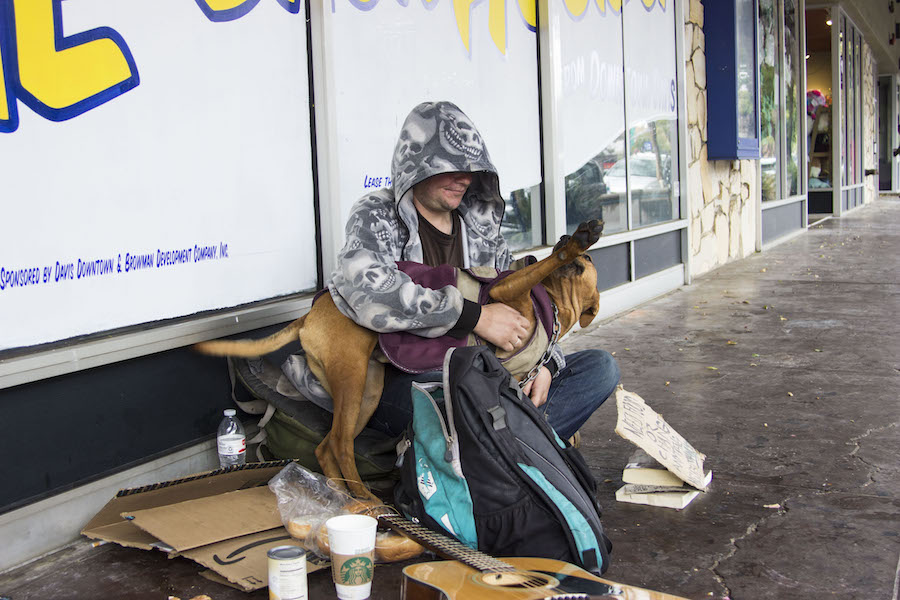
The fact is that education is not always an option. If you’re living in deep poverty, getting into the college of your dreams may not be your top priority. There are more pressing things to worry about, and schools aren’t created equal nor do they treat everyone equally. When there are actual systems of discrimination and oppression set up against minority groups, this can discourage people, who already have other stresses, from attaining an education.

We shouldn’t forget that there is a significant relationship between poverty and social dominance. The exact causes of poverty are ambiguous, and there is no concrete solution yet, but the more we begin to recognize different factors, the closer we will get to finding a solution that extends beyond just handing out money.

Written by: Jeanette Yue —jyyue@ucdavis.edu