53.5 F
Davis

Davis, California

Tuesday, December 23, 2025
Home Blog Page 706

How to create games with ModLab’s GameCamp!

LUCY KNOWLES / AGGIE

UC Davis ModLab’s GameCamp! teaches students, faculty, staff game design

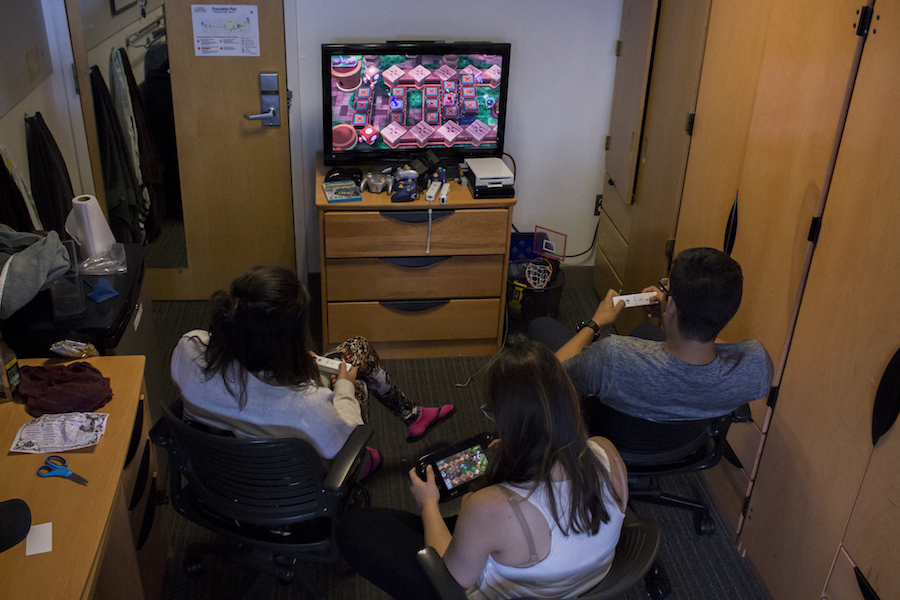
The UC Davis ModLab, an experimental laboratory used for media research, offers students, faculty and staff the opportunity to learn about game design. Created in 2015, GameCamp! is a series of free workshops throughout the year that teach introductory game design concepts.

“We want anyone who’s interested in game design at UC Davis to get these introductory concepts under their belt,” said Amanda Phillips, Interactive and Multi-Modal Experience Research Syndicate (IMMERSe) postdoctoral fellow and GameCamp! co-creator. “We cover everything from paper prototyping all the way up through tech-training. Any of these different software products that basically allow people to create video games without knowing how to program.”

According to Phillips, game design is limited to people who have access to technology, training in design and longstanding familiarity with gaming. GameCamp! was created to open up the world of game design to non-computer science majors and those who do not have experience with programming. The program also makes a special effort to attract demographics of people who do not traditionally participate in game design, such as women and people of color.

“What we’re trying to do is show that anyone can design games if they want to,” Phillips said. “That’s sort of the spirit behind [GameCamp!]. It’s opening up game design to a lot of different folks. The game industry by contrast is something like 80 percent straight, white men. It’s really cool that GameCamp! has been able to bring in the pool of people who are interested in designing games.”

In addition to workshops, GameCamp! also offers Game Jam, an event in which students compete against each other in teams of three to create their own unique game.

“Game Jam is an event that’s designed to get people to create games really quickly,” Phillips said. “It sort of short-circuits the perfectionism and this sort of creative loop that you get yourself into when you’re trying to create something new. The idea of a game jam is that you just do it. You’re going to create something in this constrained period of time.”

Whereas typical game jams last anywhere from a day to a weekend, the UC Davis event takes place over the course of an entire month. This year, UC Davis’ Game Jam kicked off on April 29 and ended on May 31.

“The reason we do this is because we’re working with people who are very intro-level in game design,” Phillips said. “So we want to give them time to learn the tools and figure out different problems that they may run into in the design process. Also, because a lot of the people that participate in Game Jam are students, we want to make sure we respect their time and acknowledge that they have coursework to do and exams coming up, that sort of thing.”

This is one reason why second-year computer science major Bayan Mashat decided to participate in this year’s Game Jam. Prior to attending GameCamp!, Mashat already had some self-taught knowledge of video game design. In her junior year of high school, she created an educational video game to teach kids web searching skills, including how to use Google’s search engine. For Mashat, the most difficult part of the game development process is the planning.

“You have to have a plan, an idea, a storyboard,” Mashat said. “You have to think thoroughly about the levels, the controls. Once you have all this done, you just have to execute it, which is easier.”

Although Mashat sometimes has problems coming up with ideas from scratch, she is able to build upon and work on other people’s ideas, which is why she attended Game Jam.

Game Jam is both a showcase and competition. Every team that participates in Game Jam gets a “swag bag” filled with items such as GameCamp! T-shirts, pens, tote bags and even bigger prizes depending on which category the team wins.

The first category is “Judge’s Choice Game,” in which the judges choose a game with  a seamless integration of gameplay, narrative and aesthetics. The second category is “Interpretation,” in which the game that interpreted the competition’s overall theme most creatively wins. The last category is “Innovation.” Judges select a game with innovative narratives, art design or game mechanics.

“We thought these categories were competitive, but also [left] enough space for people who have never designed a game before,” Phillips said. “They could potentially win the Innovation category, for example. We’re not looking for [something] polished, we’re looking for something interesting that people have created.”

ModLab also works in collaboration with the Game Dev and Arts Club at UC Davis. The Game Dev and Arts Club has offered students a place to hone their game development abilities with workshops, game jams and professional opportunities since 2014. ModLab provides the Game Dev and Arts Club with the necessary materials to run workshops and provides members with possibilities internships.

“ModLab has a lot of graduate [students] and professors who do projects and they often look for undergraduates to work on their projects,” said Michael Lee, fifth-year communication major and Game Dev and Arts Club president. “Last summer, eight of us joined one of their projects and some of us were paid with money and some were paid by credit.”

One thing Lee enjoys most about GameCamp! is learning how to work as a team.

“There’s a lot of communication and technical things where you have to communicate,” Lee said. “It’s probably the biggest thing I learned [from GameCamp!].”

Aside from technical and communication skills, what Phillips enjoys most about GameCamp! is working with students.

“[For me,] to see students discover that they can actually come up with really cool game ideas when they may not have thought of before they had the skills to do it [has] been the most rewarding part,” Phillips said.


Written by: Jacqueline Chu — features@theaggie.org
Davis Arts Center presents June Pop-up series

DANIEL TAK / AGGIE
DANIEL TAK / AGGIE

Local artists share artwork at weekly summer series

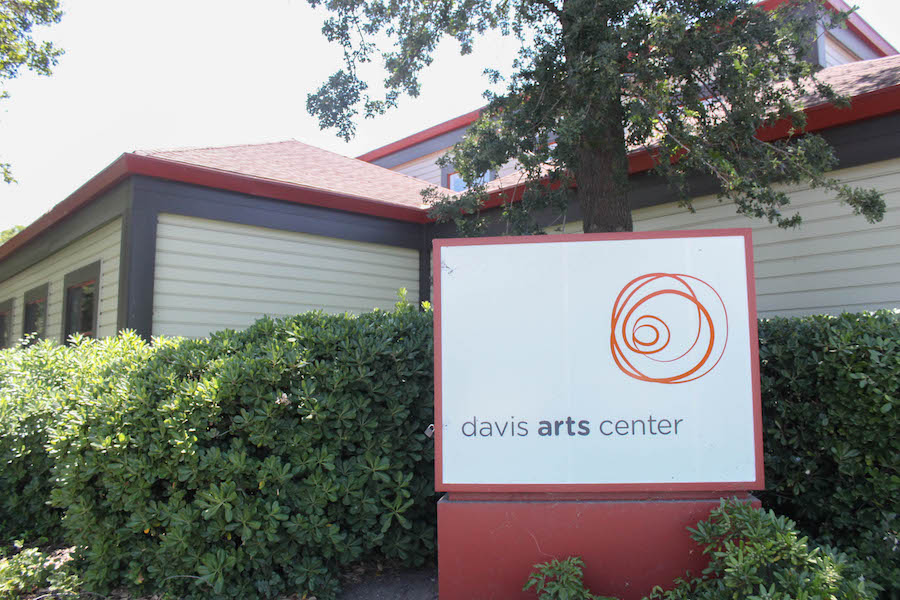
The Davis Arts Center is excited to present a month-long series of art exhibitions throughout June. The 3-4-6 June Pop-up features artists from Davis and Sacramento, who are all looking forward to the opportunity to share their work.

The series will be split up into three weeks, and each week will encompass a separate theme that links all the featured projects. Michael Azevedo, depute director for the Davis Arts Center, explains that artwork was strategically chosen to bring together pieces that complement each other. However, he chose not to disclose the themes for each week in order to keep them as a surprise.

“There are a lot of people who haven’t shown their work and we received a fair number of people applying for the show and it created a little bit different sort of show than we would normally do. Some of the work was just outstanding, but they actually all came together quite easily which was nice,” Azevedo said.

The pop-up series will include work from a book-making class that has taken place at the Davis Arts Center for the past six months, taught by Adele Louise Shaw. Students ranging from age 25 to 50 participate in the class, which has gone through all different styles of bookbinding including working with different materials for books and book covers. Shaw explains that many students have taken the class sequentially, and that they are looking forward to sharing their work.

“We’ve broken out of the zone for what is considered a book. I’m happy to be able to share the students’ work because I think it exhibits an incredible diversity of imagination and creativity and hands on art-making. I think it does a lot to cement the importance of the physical, tangible book in our digital age,” Shaw said.

Nicole Holt, a local Davis artist, also expresses her excitement about being a part of the pop-up series. Her project includes three acrylic paintings on canvases of different sea creatures.

“I was taking a class at the art center and saw a flyer. I decided to do it because I wanted to show my art and get more exposure so I entered in it,” Holt said.

The Davis Arts Center expects a great turnout to the series, due to the diversity of the artwork and talent of the artists. According to Azevedo, the response has been favorable from the public and the press, as many people are expressing interest. He notes that there have been very few opportunities for artists to exhibit work at a formal gallery outside of commercial spaces and educational facilities. Although there have been previous art exhibitions in Davis, people have found this series to be particularly intriguing due to the week-by-week aspect of it.

“I feel pretty confident that the shows have been well-received up to this point and I’m sure they will be well-received when they’re installed,” Azevedo said.

The event is free to the public and everyone is encouraged to attend. For more information, contact Michael Azevedo at mike@davisartscenter.org.


Written By: HADYA AMIN- city@theaggie.org

Bat Walk and Talk all summer long

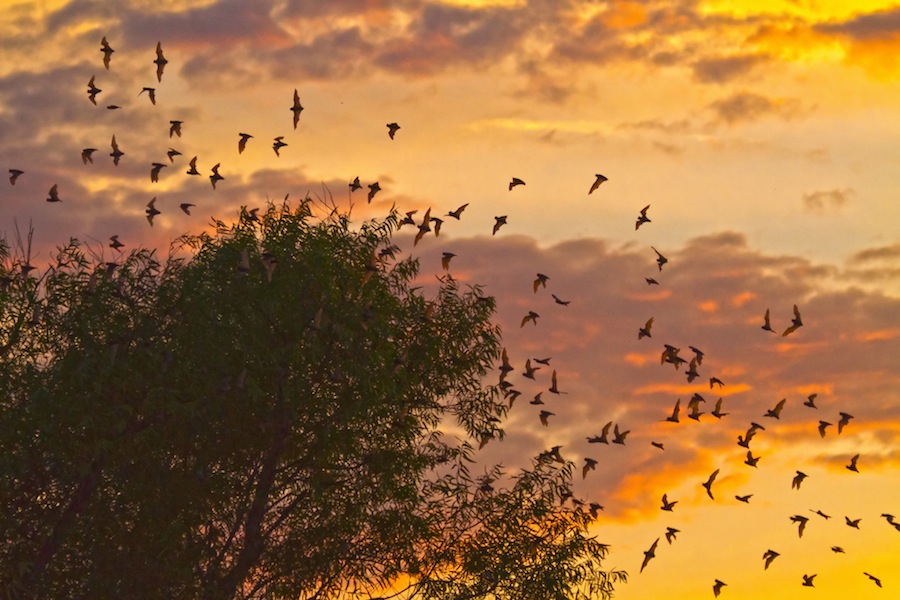
PHIL ROBERTSON / COURTESY

Yolo Basin Foundation showcases the lives of Mexican free-tailed bats under the Yolo Causeway

This summer, the Yolo Basin will not only house one of the nation’s most exciting wetlands, but also hundreds of thousands of bats. The Yolo Basin Foundation is hosting Bat Walks and Talks from late June to early September to showcase the interesting lives of these animals.

Attendees will learn about native species of bats, then caravan out to Yolo Bypass Wildlife Center to see the Mexican free-tailed bats as they fly out from their roost underneath the causeway

“Watching a bat fly-out is a memorable and exciting experience. Backlit by the colors of dusk, the bats stream from under the Yolo Causeway. It’s a local phenomenon not to be missed,” said Michael Herrera, volunteer coordinator for Yolo Basin Foundation, in a press release.

The Yolo Basin Foundation estimates that about 250,000 Mexican free-tailed bats live under the Yolo Causeway, which the bats inhabit every summer.

“It’s actually a maternity roost. In other words, it’s where the bats come to have they’re young, and they generally have one young a year,” said Rachel Long, farm advisor for field crops and pest management.

The young bats, called pups, roost separately from their mothers. Pups roost in the warmest places of the causeway and the is heat essential for rapid growth. This explaining why the bats enjoy Yolo County, since summer temperatures average 92 degrees.  

“Each mother gives birth to just one pup and she nurses her pup. Then, when the pup is around six weeks of age or so, it begins to learn to fly and hunt,” said Mary Jean Quirk from the Yolo Basin Foundation.

Many bat species roost in and around the Yolo Basin area, but the bridge, with its largeness and relative inaccessibility for predators, allows large groups of bats to fit easily in the enclosure.

“The expansion joints below the causeway, they are about one inch wide, and they are made of cement. So, they’re very safe little crevices for the bats to get into. They are about 20 feet up, so predators can’t get there. The circuits of the road helps keep it nice and warm,” Quirk said.

Besides the Mexican free-tailed bats, Yolo Basin Foundation estimates there are a number of other species of bats under the causeway. Big brown bats, in particular, also like to roost under the causeway. However, as Long explains, the bats do not generally experience any kind of competition.

“Some of [the bats] do roost together, and maybe there’s a sort of feeling of safety in numbers,” Long said. “Although they may tend to roost in similar areas, they tend to group based on species.”

Tickets to the Bat Walk and Talk are $12 each and can be purchased at the Yolo Basin Foundation website. Admission is free for children 16 and under. Reservations are required.


Written By: Samantha Solomon – city@theaggie.org

UC Davis students convert unused lawns into sustainable gardens

MONICA CHAN / AGGIE
MONICA CHAN / AGGIE

Lawns consist of low-maintenance, low water-using plants to combat California drought

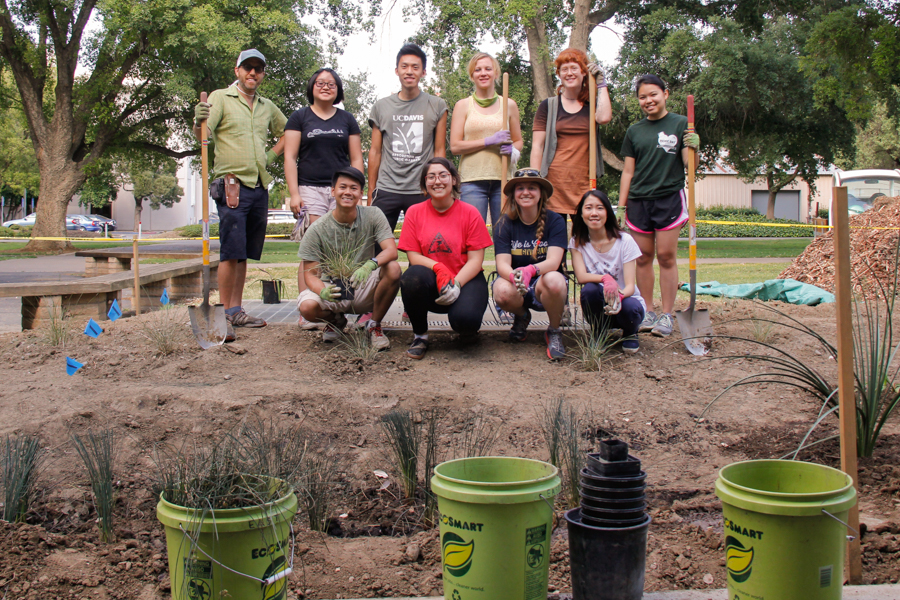
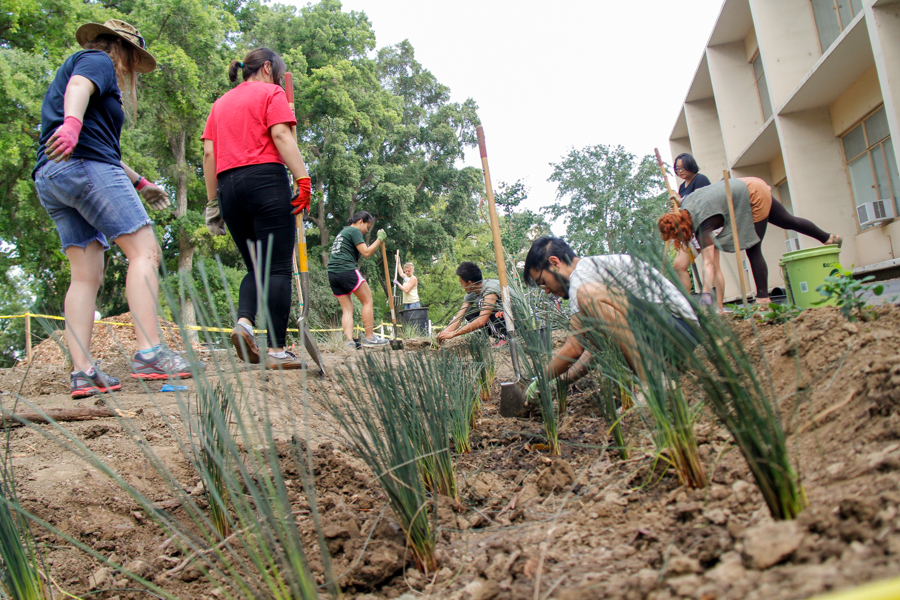
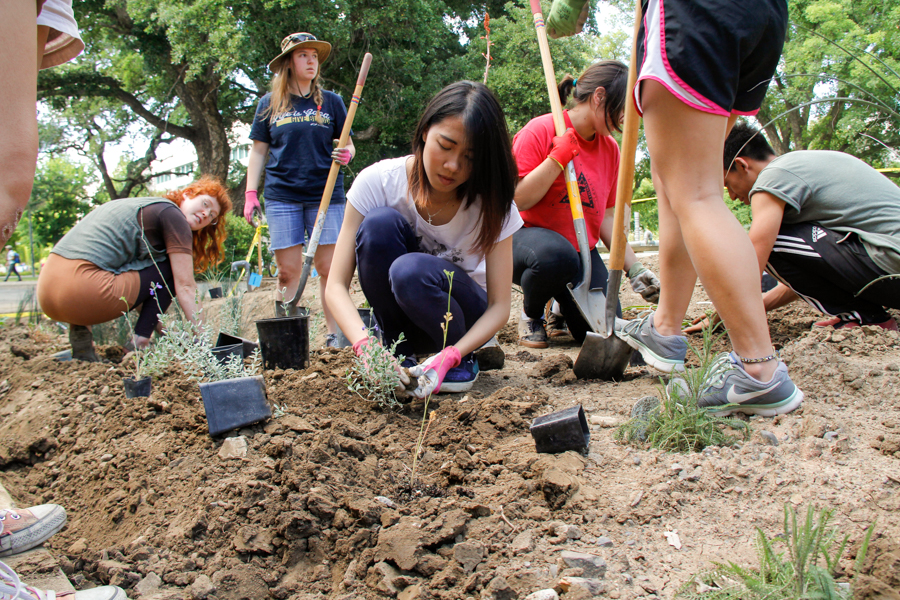
Recently, the UC Davis Arboretum Leading by Learning (LxL) horticulture student interns converted a grass turf near the south side of Peter J. Shields Library. Also, on May 25, interns completed a second on-campus sustainable garden in front of Everson Hall.

The new sustainable garden next to Shields Library will use 75 percent less water than the original lawn and consists of plants that are well-adapted to the Davis climate. The plant selections are also intended to create a better habitat for native wildlife and to provide food to pollinators and beneficial insects. Compared to the original lawn, the garden will be low-maintenance and will not need fertilizing or mowing.

“We are delighted with the work that the students from the [LxL] Program have done to convert part of the lawn outside Shields to a sustainable garden,” said university librarian MacKenzie Smith. “As California’s drought continues, it’s important that all of us on campus do our part for water conservation.”

The sustainable garden includes plants from the Arboretum All-Star program, which lists the 100 best plants for the area, ranging from trees to ornamental grass to flowering plants. The plants utilized include toyon, California fuchsia, blue note sage, and octopus agave.

“We wanted to choose plants that are low-maintenance and require minimal water,” said Kathleen Geurtze, the sustainable horticulture internship co-coordinator. “We also chose mostly pollinator plants and we took into consideration the blooming times for the plants, so all year-round there is always something blooming.”

Ryan Deering, a GATEways horticulturist and program mentor, said that Campus Planning has been working on a campus map of different landscape types and uses. The sustainable gardens focus on the patches of lawn not used for recreation, so the Quad and Mrak Hall lawn are exempted.

[There] was a spot next to the library that was small and visible with a lawn that no one was using for anything,” Deering said. “We are looking at a spot near Everson Hall, where the lawn got damaged during an expansion of the bike parking.”

Terence Wu, a fourth-year sustainable environmental design major and sustainable horticulture intern, said the sustainable gardens were created to combat the California drought.

“It is known that conventional grass lawns require an unsustainable amount of water, especially in California’s drought, and I believe that a change in vegetative composition would decrease water demand, provide habitat for pollinator species, and provide aesthetic pleasure,” Wu said.

Steffi Sin, third-year landscape architecture major and sustainable horticulture intern, found the visibility of the sustainable gardens to be one of her favorite facets of the projects.

“My favorite aspect of these projects is how visible they are to the community,” Sin said, “This allows topics such as lawn conversions, water management practices, and sustainability in landscapes to be a more talked-about subject, which helps bring awareness to how many different ways there are to improve the environment.”

MONICA CHAN / AGGIE
MONICA CHAN / AGGIE
MONICA CHAN / AGGIE
MONICA CHAN / AGGIE

Written by: Yvonne Leong – campus@theaggie.org

ASUCD no longer to give Picnic Day unit a monetary subsidy

picnicday_ca_GelvezonPicnic Day budgeted to garner $11,586 in revenue for the association
Picnic Day, the largest student-run event in the nation, will no longer be financially subsidized by ASUCD, according to next year’s budget. All funding for Picnic Day will now be provided through other means, primarily corporate sponsorships, which the unit has had in the past.

Last year, the subsidy that ASUCD paid to Picnic Day was $5,140. Next year, Picnic Day is planned to generate revenue for the association.

“Not only are we not receiving the subsidy that we did last year, but we have a negative subsidy of $11,586,” said Grace Scott, the Picnic Day chair from 2014 to 2016. “That is what Picnic Day, as a unit, will give back to the reserves.”

ASUCD Controller Joseph DeAngelo explained that every unit is being asked to make and save money. Since Picnic Day earned more than was budgeted last year, he wrote the budget with Picnic Day earning money for the association.

“This year, every unit is being asked to make money and every unit is being asked to save money,” DeAngelo said. “We took Picnic Day’s projected income from $30,500 in 2015-16 to $47,600. The way we arrived at this number was that I looked at actuals from the past four years. The biggest jump [in the budget] was in this business sponsorship income. $15,000 was originally projected, but the unit had done $27,000 so I put them at $30,000. […]  It is a realistic goal. They are doing $27,000, why would we put them back at $15,000?”

Picnic Day’s expense budget was decreased, but only marginally, according to DeAngelo.

“We did not really cut their expenses,” DeAngelo said. “Their expenses really only took a 10 percent cut. We did not get rid of any positions; we actually increased all of their positions stipends in accordance with the 12.5 percent that we are doing across the board. That is to comply with the mandate from Student Affairs. Their expenses, if you look at 2015-2016, were $23,314 and final approved [for 2016-17] were $21,945.”

Having a budget cut and having to earn money for ASUCD is not how Scott intended Picnic Day’s overage in fundraising to be used.

“Part of that budget surplus is that we wanted to reinvest in our unit and purchase more supplies and obviously you need more income to do that,” Scott said. “That is one of the things about being in ASUCD; every year, our budget seems to come under more and more scrutiny as the event gets larger and larger.”

Since Picnic Day has had sponsorships before, they have a model in place of how to run them.

“Some [sponsors] are campus partners like CAAA [the Cal Aggie Alumni Association], but a lot of them are corporate sponsors,” Scott said. “We have a sponsorship package and it has different levels: platinum, gold, silver, [et cetera]. We look first to local sponsors and then to larger sponsors to fill in the voids in our budget.”

Another concern is how this budgeting affects the spirit of the event.

“Picnic Day serves in my mind a dual function,” Scott said. “The first function is to put on an awesome event. It was […] voted The Aggie’s Best Event in Davis. The other function is aligned with ASUCD’s 2020 vision to give students an opportunity to learn and grow and be a part of something on campus. With these budget cuts, especially across other units, it doesn’t feel like that.”

Chelsea Hernandez, the incoming Picnic Day chair for 2016-17, is concerned about how much work the student who is in charge of fundraising will have to accomplish.

“My biggest concern is the well-being of the student who has to raise all that money,” Hernandez said. “It is really stressful to plan Picnic Day. It is not just that one day that everyone sees, it is eight months of planning for the director. Even though it is a long period of time, we do have deadlines in order to prepare everything. Honestly, I know we reached [$27,000], but a lot of that was last-minute. We had two businesses come the week of Picnic Day.”

Another Picnic Day planner, former vice chair Annette Nguyen, sees this increase in revenue becoming unsustainable in years to come.

“For the next year [and] the immediate year following, we are going to be okay,” Nguyen said. “We have had budget cuts year to year for the past few years and regardless of the increased amount we are expected to raise, we have always met that goal. I think our concern is more with the upcoming years in the future because I feel like every year they ask for more you meet [the goal], and then because that goal is met, they keep increasing [the target].”

DeAngelo has considered this fear while crafting the current budget.

“These are realistic income projections,” DeAngelo said. “At the end of the day, why would I project an unrealistic number? That would only hurt the association. If we were projecting fake money, that would only hurt us. When that money was not made, we would be relying on it. It would not behoove anyone to put something [in the budget] that I do not think they could meet.”


Written by: Kenton Goldsby – campus@theaggie.org

UC Davis releases proposed updates in 10-year plan

AMY HOANG / AGGIE
AMY HOANG / AGGIE

New university proposals seek to accommodate increase in student enrollment

On May 16, UC Davis released an update to its Long Range Development Plan (LRDP), a list of requirements used to outline the campus growth and community needs of the school by 2027.

“The goal of the proposed plan is to keep UC Davis compact and keep people connected,” said Bob Segar, assistant vice chancellor for Campus Planning and Community Resources, in a press release.

The LRDP lays out a plan to accommodate the increase in student enrollment capacity, which currently stands at 32,130 students. It is set to increase by 6,870 more students, while faculty capacity is set to increase by 2,405 to 14,500 members.

“They’re looking at the number of students we expect to accommodate in the coming years and they’re looking at how that divides up around the campus and what the demand is likely to be,” said Andy Fell, associate director of news and media relations. “The long range is about, ‘how do we plan for the future of the campus given the expected enrollment growth?’, and that goes along with more facilities, more faculty, more classrooms and so on.”

The plan is an update from the 2013-15 LRDP and emphasizes environmental and financial sustainability as well as promotes compact growth.

Lucas Griffith, the university’s campus planner, said that the proposed increase in housing will alleviate some of the current issues with finding living spaces in the city.

“The big issue in town is student housing,” Griffith said. “If we grow, where are all these students going to live? The housing market in Davis is 0.2 vacancy rate, so it’s really difficult to find a location to live in town and if we grow by 6,000 students and didn’t provide any campus housing, then our student body would be a commuting student body, and for a variety of reasons we value a local community.”

Currently, the university is looking at different locations on campus for developing new housing, including West Village, Orchard Park, Russell Field and Solano Gateway. The university currently houses 29 percent of UC Davis students but hopes to increase that number to 40 percent.

“If you live on campus you bike, you bus, you walk and you can live car-free,” Griffith said. “That is exactly what we need to be doing in climate change. That’s incredibly sustainable, but there’s also a community value of living on campus. You’re able to participate in more social programs, whether it’s a club or campus rec or you’re able to engage more classmates to do school work on a Saturday or Sunday.”

The plan is a part of three documents, including the Physical Design Framework and the Ten-Year Capital Plan, that each campus in the University of California system creates. All proposals must be signed off by the regents.

Written by: Ivan Valenzuela –campus@theaggie.org

Newly renovated Memorial Union bookstore to hold soft opening on June 6

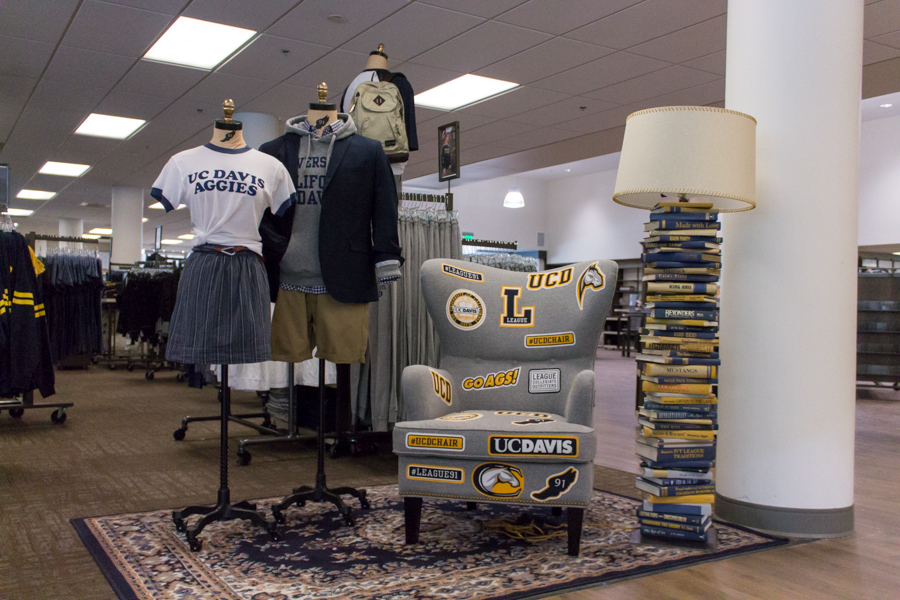
UC Davis' exclusive League chair and lamp, located by the apparel section. (LUCY KNOWLES / AGGIE)
UC Davis’ exclusive League chair and lamp, located by the apparel section. (LUCY KNOWLES / AGGIE)

Bookstore to include UC Davis-branded selfie chair, Amazon center, extended art supply section

The newly renovated bookstore at the Memorial Union (MU) is slated to have a soft opening on June 6 in anticipation of the grand opening at the beginning of Fall Quarter.

The soft opening will give full access to the store and the new Amazon center. The temporary bookstore set up at the ARC Pavilion closed on May 13 in preparation for the opening of the new MU bookstore.

Improvements to the bookstore include additional space, improved structural integrity and an updated interior design. The store will also have an Amazon location that will be fully staffed and provide a space for students to order, pickup or return Amazon purchases.

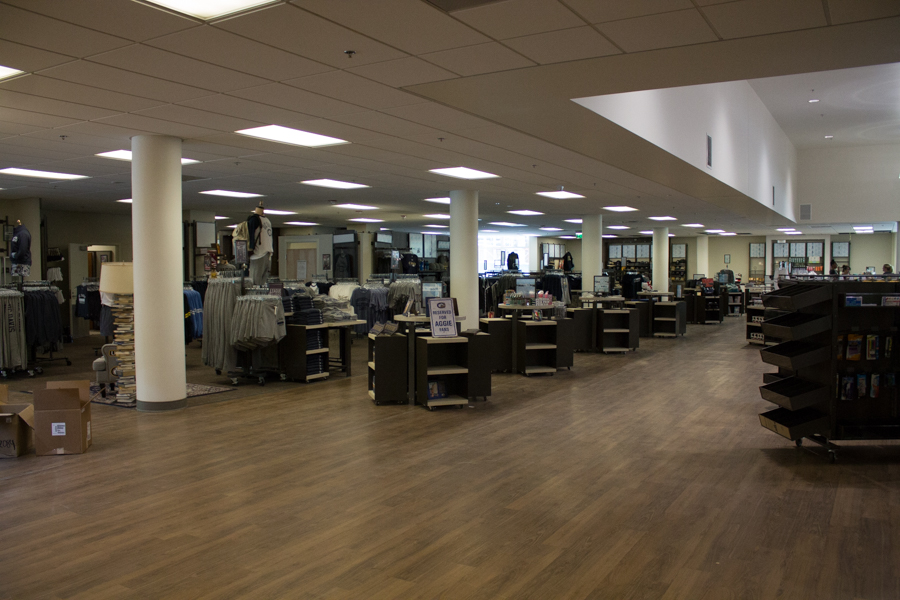
The upstairs portion of the bookstore will feature UC Davis apparel, the boutique area, the Amazon store, books from campus authors, UC Davis-pressed olive oil, a new seating area with charging stations for students and a new snack line called Aggie Snacks, which will consist of UC Davis-branded snacks such as trail mix, crackers and candy.

“The boutique [is] going to have a lot of fun items: items that are blue and gold, unimprinted clothing, lots of branded jewelry and Kate Spade [items],” said Carol Swafford, the project manager, in an email interview.

The bookstore will also sell Smashbox beauty products in addition to the Clinique line already sold at the store in order to provide students with more variety. The beauty products will be located in the new boutique area.

“I went to go visit Oklahoma State this year and Smashbox is just killing it there. So the more that we looked into Smashbox, the more we had to go with them,” Swafford said. “We’re not ready to give up our relationship with Clinique, so we’ll do both. But we’re doing Clinique on a smaller scale than we used to.”

UC Davis store partnered up with the college apparel company League to make a new UC Davis clothing line, which will feature new designs and softer shirts. League also made an exclusive chair and lamp that will be showcased in the bookstore. It is one of only two League chairs in the country, with the other chair at Arizona State University.

“[The chair] is custom upholstered with our fleece fabric that is used on [other products] in the store. It is supposed to be a selfie chair. We made it to make the bookstore a destination,” said Lauren Brown, a representative from League.

For the first time, the clothing department of the store will have dressing rooms, a request made by students when the bookstore was being designed.

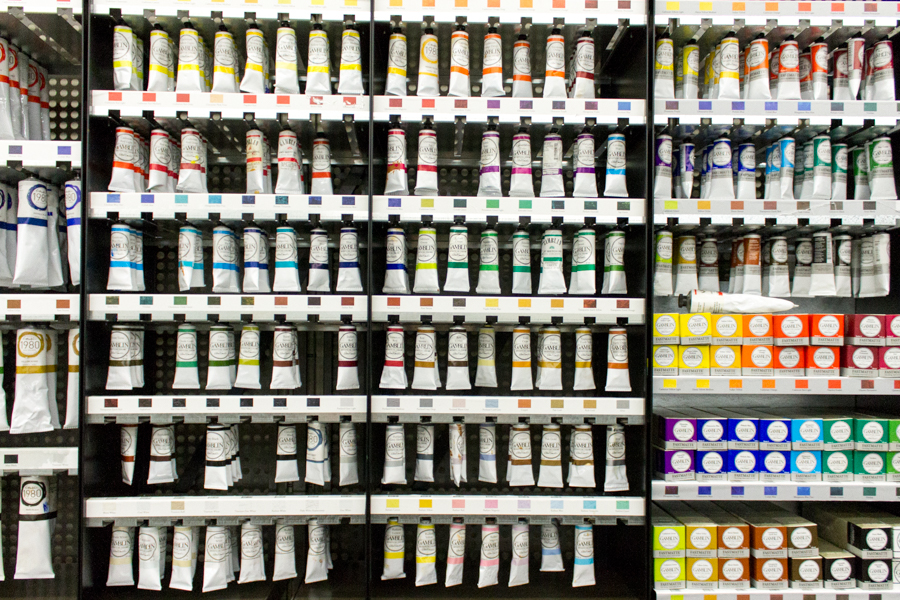
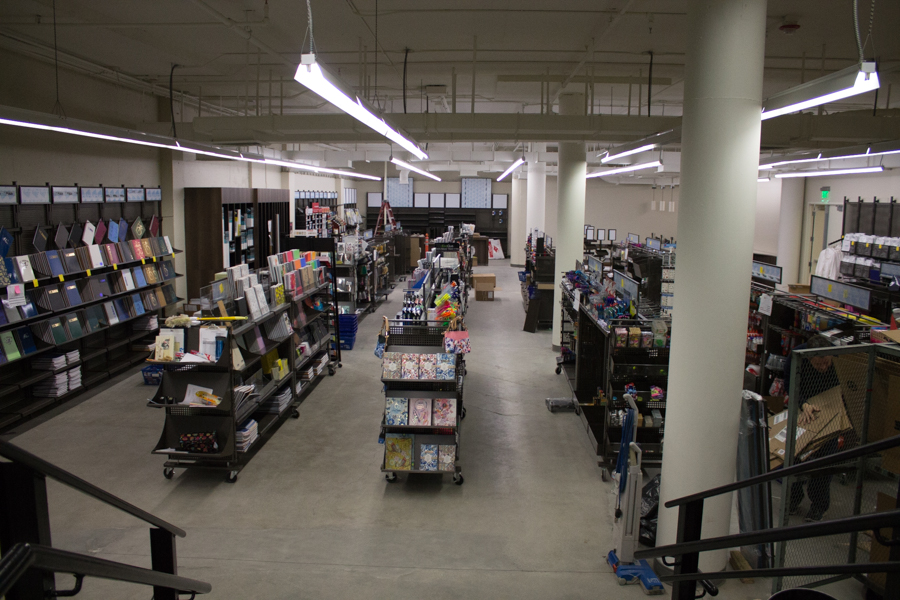
The downstairs portion of the bookstore will house textbooks, lab supplies and an extended school, office and art supplies section. This is the first time in many years that the bookstore will offer a wide variety of art supplies.

According to UC Davis school, office and art supply buyer Mary Testa, some of the new offerings will include an extended collection of notebooks, yarn, paper mâché letters, bike accessories, stickers and whiteboards. The art section will also provide pre-packaged kits of art supplies for students taking art classes on campus, based on what professors require for specific classes.

“We cater to the students first,” Testa said. “The art and design classes ask for supplies to be packed up, especially in the beginning classes.”

Additionally, the lower level will have a tech department for students to bring their Apple products for repair and diagnostic tests. This will differ from the already established TechHub on campus and give students an additional resource. The repair center will house state-of-the-art equipment, and students will be trained to work at the new center.

The renovation of the new bookstore was a two-year process, and required collaboration from several parties, according to Swafford.

“Otto construction, Design Construction Management, College Store Design, Campus Recreation Union facilities staff and students, student affairs marketing, UC Davis Strategic Communications, UC Davis facilities and the entire team of the UC Davis Stores students and staff have all played a critical role in the development and the future success of the store along with several other individuals and departments,” Swafford said.

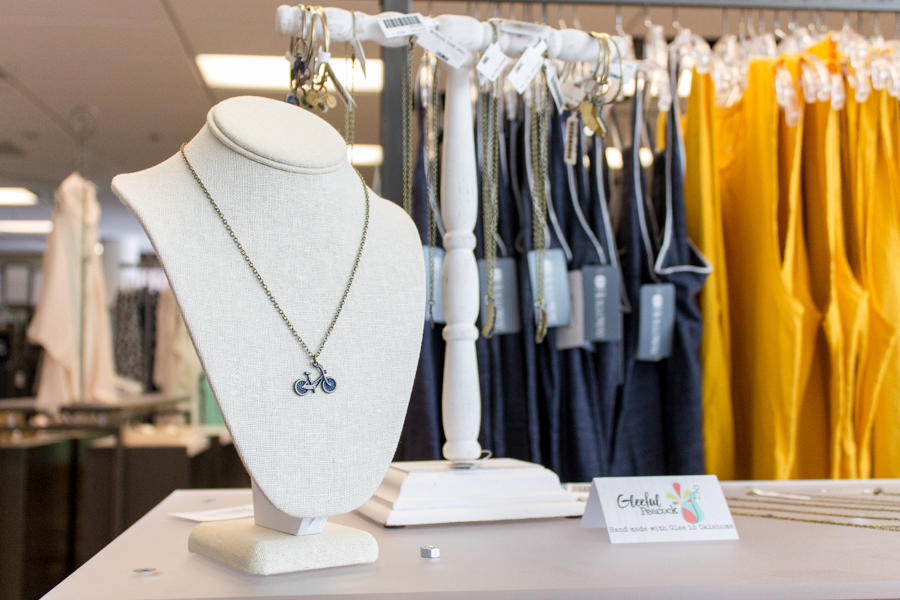
Bike-themed jewelry in the boutique. (LUCY KNOWLES / AGGIE)
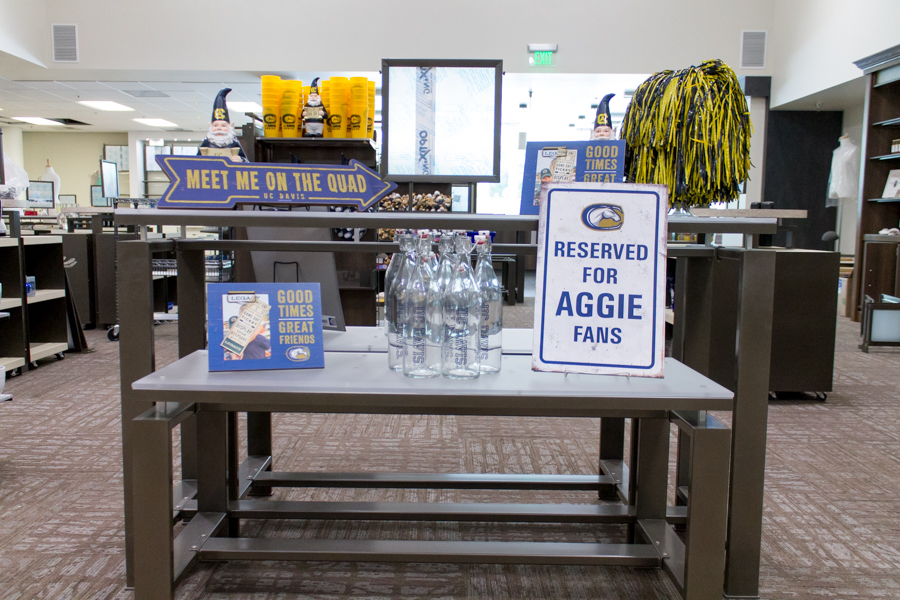
A display featuring new UC Davis items to be sold at the bookstore. (LUCY KNOWLES / AGGIE)
Large selection of paints now available at bookstore. This is the first time in many years the bookstore will feature an extensive art supply section. (LUCY KNOWLES / AGGIE)
The downstairs portion of the bookstore which will house textbooks, lab materials and art supplies. (LUCY KNOWLES / AGGIE)
Several display counters in the upstairs portion of the bookstore will display a rotating collection of UC Davis themed items. (LUCY KNOWLES / AGGIE)

Written by: LINDSAY FLOYD — campus@theaggie.org

Photo of the Week: 6/1/2016

Electric glow. (CHELBERT DAI / AGGIE)

Donald Trump to hold rally in Sacramento

MATT A.J.[CC BY 2.0] / FLICKR
Republican presidential candidate to visit on Wednesday

2016 Republican Presidential candidate Donald Trump is scheduled to hold a presidential rally in Sacramento on Wednesday, June 1. The rally will take place at the Sacramento International Jet Center at 7:00 p.m.

Doors will open at 4:00 p.m. and tickets are available on Trump’s official campaign website. The Jet Center is located at 5885 Flightline Circle.

Trump’s rally coincides with 2016 Democratic Presidential candidate Bernie Sanders’ rally at UC Davis, on June 1.


Written by: Kayla Zola — city@theaggie.org

The Draft Dilemma: Ben Simmons or Brandon Ingram

TONYTHETIGER [CC BY 4.0] / WIKIMEDIA COMMONS [Changes made, cropped]
With the draft lottery completed, the first two picks in the 2016 NBA Draft will be held by the Philadelphia 76ers and Los Angeles Lakers in that order. The clear cut choices for the top two selections in the draft are Louisiana State University’s Ben Simmons and Duke’s Brandon Ingram. Both of these young guns are clearly elite prospects, and to make matters more interesting is the fact that they play the same position. So who is a better fit for each team? Who will Philadelphia ultimately choose (leaving the Lakers to take the other)?

Simmons, the freshman out of LSU, is regarded as the prospect with the higher ceiling for NBA Stardom. An Australian native, Simmons has widely been compared to the likes of LeBron James for his elite combination of size and playmaking ability. At 6-foot-10 he has the court vision, ball handling skills, and instincts of a point guard, and that unique blend of size and skill is nothing to scoff at. Simmons is also tauted for his rebounding ability as he averaged 11.8 rebounds in his first and lone season in the SEC.

Is Simmons a good fit with Philadelphia? It definitely doesn’t seem like he wants to land there. Rumors have run rampant that Simmons would love to join the Lakers, as the big market would help him gain leverage for his shoe deal with Nike. This kind of mindset already makes me wonder if he’d bolt the city at the first chance to pursue an opportunity in a bigger market. In terms of on the court, I believe he’d be a fit if he were given room to grow into a LeBron-like role. Philadelphia is loaded with front court talent, but they need a playmaker to help round out their roster. If Simmons is allowed to assume the point-forward position he was born to play then he could be the ball-controlling presence that Philadelphia has desperately needed.

Simmons would be less of a fit with the Lakers simply due to the questions of ball distribution. D’Angelo Russell and Jordan Clarkson, both ball-dominant guards, have learned to coexist with each other, and because this is a staple of Simmons game, sharing the handling duties could be a huge issue. The Lakers need a wing who can complement both Russell and Clarkson by stretching the floor, and Duke’s Ingram can fulfill this role. Ingram, like Simmons, can dominate a game with the rock in his hands, but he is different in that he has the mentality of a pure scorer. Ingram’s game mirrors Kevin Durant’s and Carmelo Anthony’s, and despite his ability to create on his own, he is a great catch-and-shoot option and is a wonderful 3-point shooter, shooting 41 percent from beyond the arc in his freshman season. The Lakers are in desperate need of a lethal scorer who can spread the floor, so Ingram is their man.

A lot of hype has also surrounded Dragan Bender, the Croatian mystery man playing for Maccabi Tel Aviv, but I believe that ultimately the first two picks on June 23 will come down to Simmons and Ingram. Neither Philadelphia nor Los Angeles is in a position where they have the luxury of drafting an international unknown at this point. The risk is just too heavy. Ultimately, Philadelphia should go with playmaker in Simmons and hope he taps into his LeBron-like potential and let the better-fitting Ingram fall into the lap of the Lakers.

Written by: Michael Wexler — sports@theaggie.org

Women in athletics: Dr. Liz Applegate

Director of Sports Nutrition, Intercollegiate Athletics (ANGELICA DAYANDANTE / AGGIE)

The California Aggie sits down with the UC Davis director of sports nutrition to talk about sports, NUT 10, internships and cinnamon rolls

As the professor of Nutrition 10: Discoveries and Concepts in Nutrition (NUT 10) and director of sports nutrition for Intercollegiate Athletics (ICA), Department of Nutrition senior lecturer Dr. Liz Applegate educates a broad spectrum of UC Davis students. Not only does Applegate’s NUT 10 course boast over one thousand students from varying majors and backgrounds, she also works with all 23 UC Davis ICA teams. When factoring in the 31 years in which she has been teaching at UC Davis, it is clear that Dr. Applegate has made a huge impact on-campus.

Applegate’s current work in sports and science reflect her educational background. She was accepted into UC Davis as an undergraduate biochemistry major in 1974, where she competed on the field hockey and track and field teams. She stayed in Davis to pursue a Ph.D. in nutrition and swam on the local swimming team when her undergraduate eligibility in athletics ended. She also raced in triathlons for a number of years.

After accepting an offer to teach NUT 10 following graduation, Applegate’s knowledge of sports and nutrition made her the go-to expert in nutrition for UC Davis athletes. She was frequently asked by coaches to speak with the sports teams and was a resource for nutrition information for athletes. Eventually, her role in the athletics department became official when she was appointed the director of sports nutrition.

“I have very specific job duties now, but before it would be whatever anybody asked me to do,” Applegate said.

Nowadays, her duties include giving presentations about sports nutrition to every sports team before the start of each season and meeting with people in the athletics department, including coaches, athletic trainers, the sports medicine team physician and strength and conditioning coaches. She assists athletes in improving their diets and expands their knowledge of nutrition with informational handouts. She and her team of interns also run YouTube, Instagram, and Twitter accounts that provide accessible tips for healthy eating and nutritional facts.

For Applegate, having good nutrition is as important as having a good night’s sleep. However, having been a student-athlete herself, she understands that the commitment of being a student-athlete, which entails 20 or more hours a week of training, amounts to a busy schedule which can make maintaining a healthy diet difficult.

“Nutrition has a very big role [in performance], and I think that for a lot of these athletes it gives them that extra edge,” Applegate said. “That’s why I try to give them as much background as possible.”

Adam Levie, a senior on the men’s tennis team, has been meeting with Applegate regularly the past four years to go over his nutrition. Each meeting resulted in a slight change in what he ate, and the process has helped him transition to a healthier diet

“We’ve tweaked my diet for four years,” Levie said. “The first big thing that she changed was she switched me to whole wheat. Everything whole wheat. Whole wheat tortillas, whole wheat bread, whole wheat pita chips, anything, as long as it was whole wheat it was okay.”

These shifts in diet over a longer period of time allow the athletes to adjust to and enjoy the changes.
“Pretty soon, [the student-athletes are] not eating junky sweets and fast food, [they’re] reaching for other foods because [they] like how they taste and [they] enjoy the way it makes [them] feel as opposed to foods that don’t have good nutrition,” Applegate said.

Her experience with student-athletes coupled with her extensive knowledge about nutrition has also led to a ripple effect.

“[Dr. Applegate] is completely the reason why I got so interested in nutrition,” Levie said. “I love to talk to anyone about it and spread what she tells me, so that everyone that I know can learn from her.”

Aside from her work with UC Davis athletics, Applegate also educates an audience of 1000 or more students each quarter in NUT 10, an introductory nutrition course taught in an online and in-class hybrid format. The course covers the basics of nutrition science and tackles topics relevant to college students, such as food labels, nutritional effects of alcohol, chronic disease risks and dietary supplements. The class also incorporates activities such as Instagram challenges and a food log project, some of which have food-related prizes attached to them like In-n-Out and Dos Coyotes gift cards. She has also given out onions to vitamin-C deficient students after the food-log project.

Like her work with student-athletes, NUT 10 has been an opportunity for her to educate students on the importance of nutrition and make better decisions based on the information they are taught.

“One of the best things for me is at the end of the quarter, after [students have] taken the final, they walk up to me and shake my hands and say ‘I’ve lost thirty pounds because of this class’ or ‘I’ve now started exercising’ or ‘I never liked vegetables but now I do,’” Applegate said.

This is Applegate’s last quarter teaching NUT 10 because she has been asked to develop an online NUT 10 course for all of the University of California campuses. Many of the other UC’s do not have a nutrition department and their nutrition classes are taught by professors from other departments, so Applegate is making her own course virtual. While it is a great opportunity, the current workload of NUT 10, which requires her and a team of thirty others to handle, means that she can only do one or the other.

“They had asked me three years ago [to create the online course] and I said, ‘Are you kidding me?’ I’m 24/7 as it is,” she said.

In her 31 years of teaching, Applegate has received the Excellence in Education Award, the Excellence in Teaching Award, Distinguished Undergraduate Teaching Award and the Distinguished Scholarly Public Service Award from the University of California in 2012.

Lastly, Dr. Applegate runs two internships: the Sports Nutrition Internship and the Team Davis Internship. For the Sports Nutrition Internship, she recruits 10 to 14 senior and occasionally junior nutrition majors during Fall Quarter to help with her work with the many student-athletes at UC Davis. The interns create informational handouts, maintain Instagram and Twitter accounts, create videos, give student-athletes tours of the dining commons, and some even have the opportunity to meet sports teams with Applegate and give talks about nutrition.

Third year clinical nutrition transfer student Elsa Esparza was a sports nutrition intern and often educated student-athletes on nutrition, created handouts, conducted nutrition analysis for the volleyball team and helped run the social media handles. She found the internship to be a good way to apply her knowledge on nutrition and develop her leadership skills, as well as an opportunity to learn more about nutrition from Applegate.

“I love hearing her talk about nutrition because I know that everything she says is backed up by so many years of knowledge, experience, and wisdom, so personally I really value those moments,” Esparza said.

The two-quarter Team Davis Internship works with a group of special-needs individuals to improve their nutrition and increase their physical activity level through gardening. Gardening serves as an alternative activity to sports that can be used to get the participants outside and execute lessons that encourage dietary changes, such as increasing fruit and vegetable intake. Working with individuals from Team Davis, a nonprofit group that helps disabled individuals in the Davis community, Applegate and her interns gather around four plots of land in the Experimental Gardens every Saturday to garden and conduct lessons.

“It’s just a great experience,” Applegate said. “From the beginning when the interns started, they were quiet, they didn’t know how to interact with this population and now you would think they were their kids or something!”

In her limited free time, Applegate enjoys swimming, cycling and gardening. She also writes the column “Fridge Wisdom” for Runner’s World Magazine, has contributed to several nutrition related-publications and has appeared on “MythBusters”, “Good Morning America”, CNN and ESPN as a nutrition consultant. Also, she was also a nutrition consultant for the U.S. Olympic Teams.

Her indulgent food of choice is cinnamon rolls, and she hopes to go on her own bike tour named “On the Roll” in the future. During the bike tour she plans on visiting small town cafes around the U.S. in search of the best cinnamon roll. She has asked for recommendations from students every quarter and thus accumulated a varied list of places to go.

With her involvement in athletics, science, education and cycling, it seems that Applegate embodies some of the best things about UC Davis. While her enthusiasm for nutrition has inspired students for years, she will undoubtedly continue to do so through her new endeavors while continuing to be an invaluable asset to UC Davis athletics.
Written by: Julia Wu – sports@theaggie.org

BottleRock 2016: Oh, what a wonderful festival

JAY GELVEZON / AGGIE

Fourth annual Napa Valley music festival hits right note with tasty food and phenomenal headliners

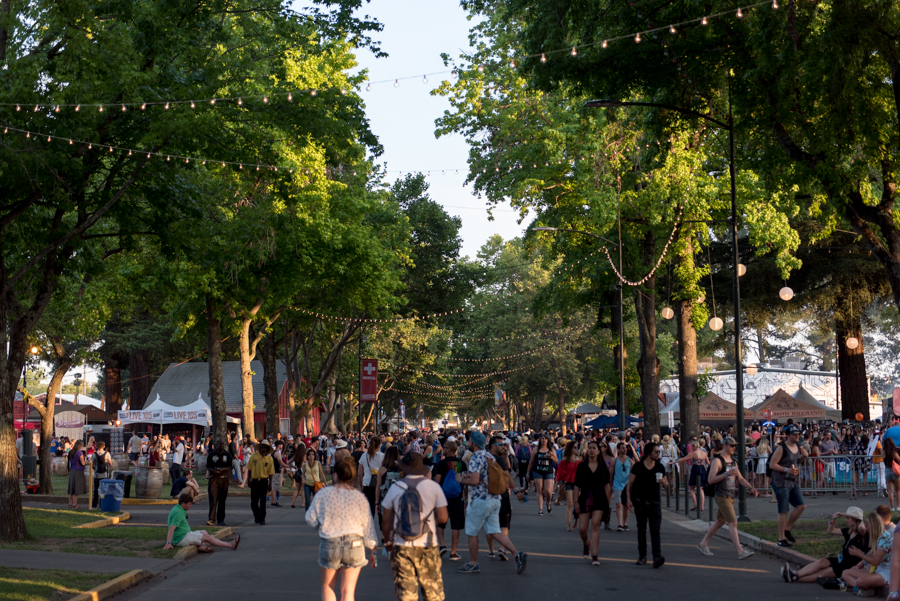
Where’s the perfect place to hold a music festival? To the estimated 120,000 people who attended the BottleRock Napa Valley festival this past weekend, the answer is now obvious: right in the heart of wine country, of course. Add in headliners like Stevie Wonder, Florence + The Machine and the Red Hot Chili Peppers and a good time is all but guaranteed even for a 20-year-old arts and culture reporter from a college newspaper (a.k.a. yours truly) who spent the weekend unable to purchase any alcoholic beverages.

But the magical thing about BottleRock is that you can be any age and still have a good time. Need proof? Look no further than the first band to hit the main stage on Sunday: The Helmets, a rock band consisting of four dudes all under the age of 12. The Helmets ran through a hard-rocking set that included covers of Nirvana’s “Smell Like Teen Spirit” and Green Day’s “Welcome to Paradise” and had the crowd dancing along the whole time. I saw babies (with noise protection headphones, of course) jamming out to the Lumineers and toddlers dancing in the Silent Disco. In other words, BottleRock is truly an experience for all ages. And with that, here’s the breakdown of my weekend, from the music to the food to the people and the overall vibes.


JAY GELVEZON / AGGIE

Music

I started Friday off with a set by the Cold War Kids. Having been a fan since their Robbers and Cowards days, I decided to forgo seeing Gordon Ramsay’s demonstration at the Culinary Stage to catch this set but was left feeling a little disappointed. While the performance itself was fine, it didn’t look like any the members of the band were particularly excited to be there and there was little engagement with the audience. They merely played the songs, thanked the audience for being loyal fans and left.

Grouplove, the next band to take the stage, was much more energetic and by the time they played their hit song “Tongue Tied,” the crowd was dancing along with an intensity that the Cold War Kids never managed to achieve during their set.

Stevie Wonder closed out Friday night with classics like “Superstition” that had the whole crowd feeling the funk. But he also made some odd musical choices, instructing the audience to call him DJ Tik Tik Boom and then launching into a long tribute for recently deceased musicians like Prince, David Bowie, Natalie Cole and Eagles drummer Glenn Frey by playing their biggest hits from his iPod. Wonder also used his platform to make some thinly veiled remarks against Donald Trump and his campaign.

He wasn’t the only artist who got political. With the California primaries just a week away, artists like Misterwives and Florence + The Machine all commented on the hateful rhetoric espoused by some of the presidential candidates and urged crowds to choose love and to vote to make their voices heard.

And speaking of Florence + The Machine, is Florence Welch even a real human being? Her band’s headlining set on Saturday was nothing short of magical. While Saturday was stacked with talent (Walk the Moon played the final show of their Talking is Hard tour at BottleRock and I fulfilled my high school dreams by rocking out with Death Cab for Cutie), Florence + The Machine truly stole the show. Dressed in a flowy, sheer green dress, Welch captivated the audience with haunting renditions of her biggest hits, all while twirling furiously around the stage barefoot. She was moving around with such ferocity, I was sure she was going to fall at some point, but she remained ever graceful and ethereal.

The highlight of a gorgeous set: during “Dog Days Are Over,” she instructed the audience to embrace the people around them, and then commanded everyone to take off one piece of clothing and wave it in the air. The result: an astonishing sight of strangers hugging strangers, of people losing inhibitions and waving and dancing feverishly, all set against the backdrop of a gorgeous Napa Valley sunset. Not a bad way to spend a Saturday night.

Sunday’s lineup was strong, with energetic performances from Misterwives (frontwoman Mandy Lee is a musical force to be reckoned with), the Lumineers and the Red Hot Chili Peppers but all through Sunday, I kept thinking back to the magical evening that was Saturday night.


JAY GELVEZON / AGGIE

Food

Since I couldn’t experience the wine for myself, I diverted my focus to food. There were lots of delicious vendors to choose from. With a wide variety of food trucks and restaurant booths, there was a type of cuisine to please every taste bud. The Culinary Garden also featured a large number of booths from local Napa restaurants like Mustard’s Grill, where I ate some perfectly cooked pulled pork alongside a crisp slaw, and Eight Noodle Shop, which served up some chilled rice noodles that were a perfect remedy to the weekend’s heat.

But the Menchi Katsu Burger from Morimoto Napa was by far the best thing I ate all weekend. The burger itself, breaded in panko and deep-fried, was juicy and perfectly cooked. The bun was well-toasted and strong enough that my burger didn’t fall apart as I was eating it and the kimchi that accompanied the burger was the ideal complement to a heavy burger: crunchy, fresh and just spicy enough.

I was glad to see the festival embracing local businesses and while I was line for Morimoto Napa, I struck up a conversation with a BottleRock Ambassador, who informed me his job was to check in with surrounding residents to see how they felt about the festival and find ways to improve the experience for locals. Things like these make it clear that the organizers of the festival truly value the city of Napa, which is a plus in my eyes.


Overall experience

I didn’t have a single negative experience with any of the BottleRock staff. From parking to gate entry to information inside the festival, everyone was incredibly accommodating and well-informed. Exits and entries were clearly marked and the grounds were well-lit. More shade would also have been appreciated considering how hot it got; I turned a couple shades darker even though I tried to be conscientious about applying sunscreen. The owners of Latitude 38, the company that runs BottleRock, stated in a press conference that they planned on adding more shaded areas, so hopefully this aspect will be improved next year.

BottleRock 2017 will be held May 26 to 28. I’m already looking forward to it and not just because I’ll actually be able to try the wine next year.

For more information about the festival, please visit their website.


Written by: Amanda Ong – arts@theaggie.org

Colors

Colors through photos

Orange (AMY HOANG)
Orange (AMY HOANG)
Blue (NICHOLAS YOON)
Yellow (DANIEL TAK)
Yellow (DANIEL TAK)
Red (ROSIE SCHWARZ)
Red (ROSIE SCHWARZ)
Blue (ARIEL ROBBINS)
Yellow (DEBPARNA PRATIHER)
White (NICKI PADAR)
White (NICKI PADAR)
Purple (VENOOS MOSHAYEDI)
Pink (ASHLEY LUGO)
Pink (ASHLEY LUGO)
Purple (ZHEN LU)
Purple (ZHEN LU)
Orange (DIANA LI)
Orange (DIANA LI)
Green (BRIAN LANDRY)
Yellow (LUCY KNOWLES)
Pink (ALEXA FONTANILLA)
Green (ANH-TRAM BUI)

Compiled by: The California Aggie Photo Desk – photo@theaggie.org

I’ve regretted several things in my life — but I’ve never regretted calling my mother

YINON RAVIV / AGGIE
YINON RAVIV / AGGIE

I hated calling my parents when I was a first-year. I was so tired of the arguments, of explaining myself, of getting nagged. I hated visiting home, because it washed out the taste of freedom I was having as a college student and filled me with the same boredom and suffocation I was so eager to escape. I love my parents. But I had to be my own person.

Following my freshman year, I came home for the summer after a wild Spring Quarter, but I was out of the house for 70 hours a week at my internship in San Francisco. It was ideal. I was creatively challenged at my job, and I relished the two hours I had to myself on my daily commute. I spent every evening at the gym. I love my family to death, but I had to be free. I had to be my own person.

Everything changed when my mom was diagnosed with cancer.

I learned about it three times. The first time was when she told me, while waiting in line at my family’s favorite mediocre Mexican restaurant one Friday night. The second time was immediately after, in the bathroom, gripping the sides of the toilet seat, my vision blurring, dry heaving, my whole world spinning. And the third time took place over the next few months, with mini-moments of relearning. I learned when my mom had her lumpectomy. When she found out she had to go through chemotherapy. When she lost her hair. When, for the first time in my life, I sensed pain in her voice.

It came in waves. But I was always underwater. I was always thinking about her. I felt like I was bobbing in the ocean, and some moments everything was calm, but other moments I was swept away with a mix of fear and anger and guilt and doubt. I’d be biking home, processing my day and a certain song would come up on my playlist, and I’d have to pull over on the side of the road. I was underwater. I couldn’t believe what was happening to me, to my little brother, to my little sister and to my dad. I couldn’t believe that it was happening to my own mother. I may have been in Davis, but I never felt less free in my life.

During Fall Quarter, I went home every three weeks to see my mom as she went through chemo. I shaved my head each time I went home because I didn’t want my mom to be bald alone. During Winter Quarter, she went through radiation and started recapturing some normalcy — getting back into her daily walks, getting back with her weekly poker group, getting back to playing “Hotline Bling” as loud as she could to embarrass my siblings when picking them up from middle school. Today, she’s healthy and happy. And while she’s still getting back into it, she’s as loud and intense and loving and funny and in-your-face and nagging and passionate as ever. I can’t fathom how lucky I am to write that.

First-year Yinon had to be his own person. But that’s not how life works. You can’t be your own person. Not when you go home to see your mom after she was just injected with a barrage of poisons but the house smells like Moroccan red fish stew and Ashkenazi Jewish desserts because the entire community brought dishes to make sure no one has to worry about not having a Shabbat dinner. Not when you start seeing your brother and sister more, and they tell you they wish it didn’t take cancer for you to be in their lives so much. Not when you text your dad asking for the Netflix password, and you wonder why he’s taking so long to respond, and you start getting frustrated, but then you hear your phone buzz and it’s your dad saying, “Sorry, had to be the family barber for a minute.”

You can’t be your own person when people need you. You can’t be fixated on your own struggles, enamored with your own successes, enraptured in your own day-to-day when you’re someone else’s pillar of strength. People tell you that you should always focus on yourself and do what’s best for you. I don’t disagree. At times, however, what’s been best for me has been what’s best for someone else.

Today, I can’t wait to call my parents. It’s the best part of my day.


You can reach YINON RAVIV at ravivyinon@gmail.com

Letting students get their hands dirty

BRIAN LANDRY / AGGIE

The Botanical Conservatory provides a place for students to learn, relax and observe plants.

You may have biked by them on your way to class or seen them glowing at the top of the Sciences Laboratory Building, but the greenhouses on campus are more than just your average plant-growing facilities.

The Science Laboratory Greenhouse is a production greenhouse for students to produce plants for class purposes only, while the Botanical Conservatory, off of Kleiber Hall Drive, provides a garden and museum to encourage an appreciation of botany in the community. The Botanical Conservatory houses about 2,500 different plant species from almost all of the planet’s climate zones and serves the Davis community as an educational and recreational facility.

“The Conservatory and the Greenhouses here are teaching support [facilities] for the campus,” said Ernesto Sandoval, manager of the Botanical Conservatory. “Our job is to grow plants for students to examine in classes, primarily in plant biology, so that they can see live plants as opposed to just pictures.”

Founded in 1959, the Botanical Conservatory offers free, self-guided tours to the public from 9 a.m. to 5 p.m. from Monday through Friday, as well as organized tours for UC Davis classes and elementary and middle school students. Despite the limited staff, Sandoval and those who help run the Conservatory strive to ensure that both UC Davis students and community members can enjoy its educational and aesthetic value.

“We are at a UC where students should be getting a top-notch education and seeing live specimens, which is something really important to students’ educational value,” Sandoval said. “At some other schools, students don’t always get to see live specimens. However, here at the College of Biological Sciences, we pride ourselves in providing as many live specimens as possible for students to observe freely.”

Hundreds of students in the Biological Sciences 2: Introduction to Biology (BIS 2) series come through the conservatory every quarter to examine particular plants and how they function. Another benefit of the greenhouses is that students can apply to be student employees and gain hands-on experience.

One of the student employees, Temme Von Lackum Dedlow, a fourth-year wildlife, fish and conservation biology major, first became intrigued with the greenhouse when she toured it as a BIS 2C student. Von Lackum Dedlow interned at the Conservatory last spring, and has worked as a student employee since the fall.

“I hope to go into biology with animals, not with plants, but I appreciate the work here for background experience and as a great time away from the average day of studying and staring at books and screens,” Von Lackum Dedlow said. “It’s a nice place to be, especially when I have a really busy class schedule, so three to four hour shifts every couple of days let my mind check out for a minute and allow me to get my hands in the soil.”

Another one of the classes that comes to the Conservatory is Plant Sciences 5: Plants for Garden, Orchard and Landscape (PLS 5), which focuses on gardening and landscaping. Before Sandoval leads the students through the greenhouses on the tours, he spends time introducing them to the different types of soils that the Conservatory uses and the importance of each one.

“Each week in PLS 5, we do things like plant crops, such as spinach, beans and bell peppers, and we also get to go on field trips to the Conservatory and vineyards,” said fourth-year neurobiology, physiology and behavior major Robyn Goldberg. “We went into the rainforest room first and saw the Spanish moss and the corpse flower [Titan arum], which is about 6 or 7 feet tall and is known to smell really bad. Ernesto gave a really entertaining and informative tour — I’ve never seen someone enjoy their job so much.”

The Botanical Conservatory features several different rooms, such as the rainforest and desert rooms, which house plant species native to those climate regions.

“Classes like PLS 5 at Davis are really cool because you get to bring home fresh produce that you grow yourself, and go to the greenhouses and observe plants that you wouldn’t normally see in your everyday travels,” Goldberg said. “You can read about what a waxy leaf or a large, segmented leaf looks like, but at the Conservatory, they can physically show you how it works and give you hands-on demonstrations of how each plant’s adaptations benefit them for survival.”

The Botanical Conservatory is another one of UC Davis’ hidden gems that introduces students to beautiful and exotic aspects of nature in the community, which is not something that every university can say for itself.

“Being able to look at a plant in three dimensions and see the adaptations on the leaf or physically touch its nectar is something that students can appreciate because that hands-on experience is a unique asset to have,” Von Lackum Dedlow said.


Written by: Gillian Allen — features@theaggie.org