58.6 F
Davis

Davis, California

Monday, December 22, 2025
Home Blog Page 759

Elephant in the room: Sexism in songs

0
NICKI PADAR / AGGIE
NICKI PADAR / AGGIE

You know that awkward moment when you’re sitting in the car with your mom, a good song comes on and all of a sudden the lyrics get sleazy and sprinkled with cuss words? It gets really uncomfortable. When did Selena Gomez and Justin Beiber’s songs get so sordid?  

Songs now aren’t any more sexist than they used to be. ”Brown Sugar” (1971) by The Rolling Stones details the rape of an African American slave woman. “Blurred Lines” (2012) by Robin Thicke jests about sexual conquest and entitlement, effectively condoning rape. It’s disconcerting how normalized lyrics like these have become.  

Artists are praised for (and even fight over the right to bear ownership to) songs that subjugate and objectify women. Even women have joined the game, singing songs about virtual enslavement to male sexual desires, advertising themselves as simple playthings. When a man’s ready, he can “come and get it.”

Why has the generational propensity for this type of music not dwindled?  Sex simply sells. There’s no secret that human beings possess a natural inclination for sex. Advertisers are especially adept at exploiting sexual desire in youth culture. It’s part of the human experience and will always live in our society. What is most troubling is that there are powerful men who stand on pedestals and choose only to disseminate messages of violent, non-consensual sex.

These messages are finding their way into the impressionable Millennial subconscious—although not equally.  According to Audrey Becker, who wrote for the Journal of Popular Culture, women are much more susceptible to implicit messages in media. Modeling is a means of learning; females more readily emulate the idols they listen to than their male counterparts. Furthermore, young women look to stars like Selena Gomez and Miley Cyrus for lessons on popularity. Research has shown that girls look to media for sex education. The more sexual content young adults are exposed to, the more likely they are to engage in sexual activity. Stars both desensitize fans to sexual objectification and are entrusted with giving sex advice — sounds like a conflict of interest to me.

While women in music and media tactfully model the submissive sex toy, men model the overpowering conquistador. Lyrics are chock full of abusive behavior, cheating and ignorance — not exactly the kind of virtuous example the role models of the Millennial generation should be following. The double standard in music is ominous and endless.

Many of my male counterparts are now quick to point out songs that categorize all men in a negative light and portray women as powerful. Yes, women too have begun to join the attack party. Taylor Swift has made a living off songs vilifying her ex-boyfriends. While her frivolous dating habits and broken heart lamentations are single-sided and vengeful, they are not sexist.

Sexism is the prejudice and stereotyping on the basis of sex, but stereotypes hold no weight without power. Women do not hold the same political, economic or institutional power as men: oppressors do not come from a lesser states of advantage. Thus, by means of the patriarchy, sexism pervades music.

Patriarchy feeds us this music. Patriarchy profits off this music. Patriarchy facilitates this music’s incorporation into our beings. As long musicians continue to sell and market sex, and as long as we continue to listen, sexism will always be in songs.

KATELYN COSTA is a first year Nutritional Science major clearly studying the wrong material.  Her sweet tooth prompted her to investigate life alternatives. Instead of vegan recipes, her Twitter feed is now flooded with political articles and feminist tweets. Her job in this column will be to hunt the Elephant in the Room: challenging your safe conceptions of unspoken issues and cultivating a healthy discussion. Cheers to perspective!

You can reach Costa at katelyn.costa97@gmail.com.

Humor: Mondavi Center responds to campus alcohol ban, starts making grape juice

0
DANIEL TAK / AGGIE
DANIEL TAK / AGGIE

UC Davis has already banned the consumption of alcohol on its campus. On Monday, the sale and production of alcohol was stopped at the Mondavi Center in response to this policy. Students have been complaining about “unfair treatment” for what they see as a double standard on the university’s part.

“If I can’t get rowdy with my friends on the Quad, then the Mondavi Center shouldn’t get to sell its wine,” said third-year engineering student Ben Mack. “Davis is just as much known for its social life as it is its wine, so if we can’t have one, there’s no way we’re having the other.”

The school’s policy on alcohol reads, “UC Davis strives to maintain a campus free from the illegal use, possession or distribution of controlled substances. Manufacture, sale, distribution, dispensation, possession or use of alcohol and controlled substances by University students and employees on University property.”

“We understand and hear the complaints of our students,” Joe Tupin, the chair of the Mondavi Center’s Board of Advisors said in an email interview. “We will continue making grape juice in place of our wine.”

UC Davis, ranked as one of the top Viticulture and Enology schools in the world, will continue making wine at its vineyard in Sonoma. Transportation will be provided to students to continue their studies, as classes will be offered in the laboratories. Construction will begin for classrooms starting May 23.  

You can reach ETHAN VICTOR at ejvictor@ucdavis.edu.

U.S. Government chooses UC Davis to measure national air quality

BRIAN LANDRY / AGGIE

UC Davis Crocker Nuclear Laboratory granted $13 million federal contract to monitor nation’s fine particles

In late 2015, the U.S. government chose the UC Davis Crocker Nuclear Laboratory to be the main contractor for both of the nation’s major federal fine particle air quality monitoring networks, the National Park Service’s Interagency Monitoring of Protected Visual Environments (IMPROVE) network and the Environmental Protection Agency’s (EPA) Chemical Speciation Network (CSN). Together, the networks monitor the urban air quality of over 250 sites nationwide, providing data that helps inform national air quality standards and regulations.

UC Davis was awarded the $13 million contract in mid-September, which is intended to be spent toward research for the next five years. As the primary contractor for IMPROVE since 1988, UC Davis’ nuclear laboratory was chosen as the main contractor for both networks because EPA recognized the consistency of having both networks managed by the same entity.

IMPROVE focuses on visibility, while CSN focuses on human health in urban areas; however, both networks measure fine particles and use the same lab analyses to determine chemical composition.

“We’ve developed a reputation for looking at data problems and trying to solve them, applying more data interpretation for the agencies,” said Charles McDade, CSN program manager at UC Davis. “We do more than just turn the crank.”

At the lab, scientists analyze air particles and determine where they come from, whether that be industrial emissions, agriculture dust or wildfires. The IMPROVE network has sampling sites at nearly every national park, including Yosemite and the Grand Canyon.

“Air particles kill people; that’s the bottom line,” said engineering professor Anthony Wexler. “The federal government measures it to see if cities are in compliance. Since we measure chemical composition, we can help them see what chemicals to regulate and can give them clues about what to fix.”

The data UC Davis collects from national parks are publicly available and used widely by scientists, agencies, stakeholders and the general public alike. The data is used for a range of purposes, from climate change studies and air pollution modeling to epidemiology research. The researchers hope that their work can help continue to improve air quality across the country.

“Across the Unites States, air quality is getting better and better everywhere,” said Nicole Hyslop, the IMPROVE program manager at UC Davis. “That’s largely because of cleaner vehicles and reduced numbers of coal-fired power plants.”

To follow the Crocker Nuclear Laboratory’s research, visit airquality.ucdavis.edu.

Written by: DEMI CACERES – campus@theaggie.org

Lower Freeborn

0

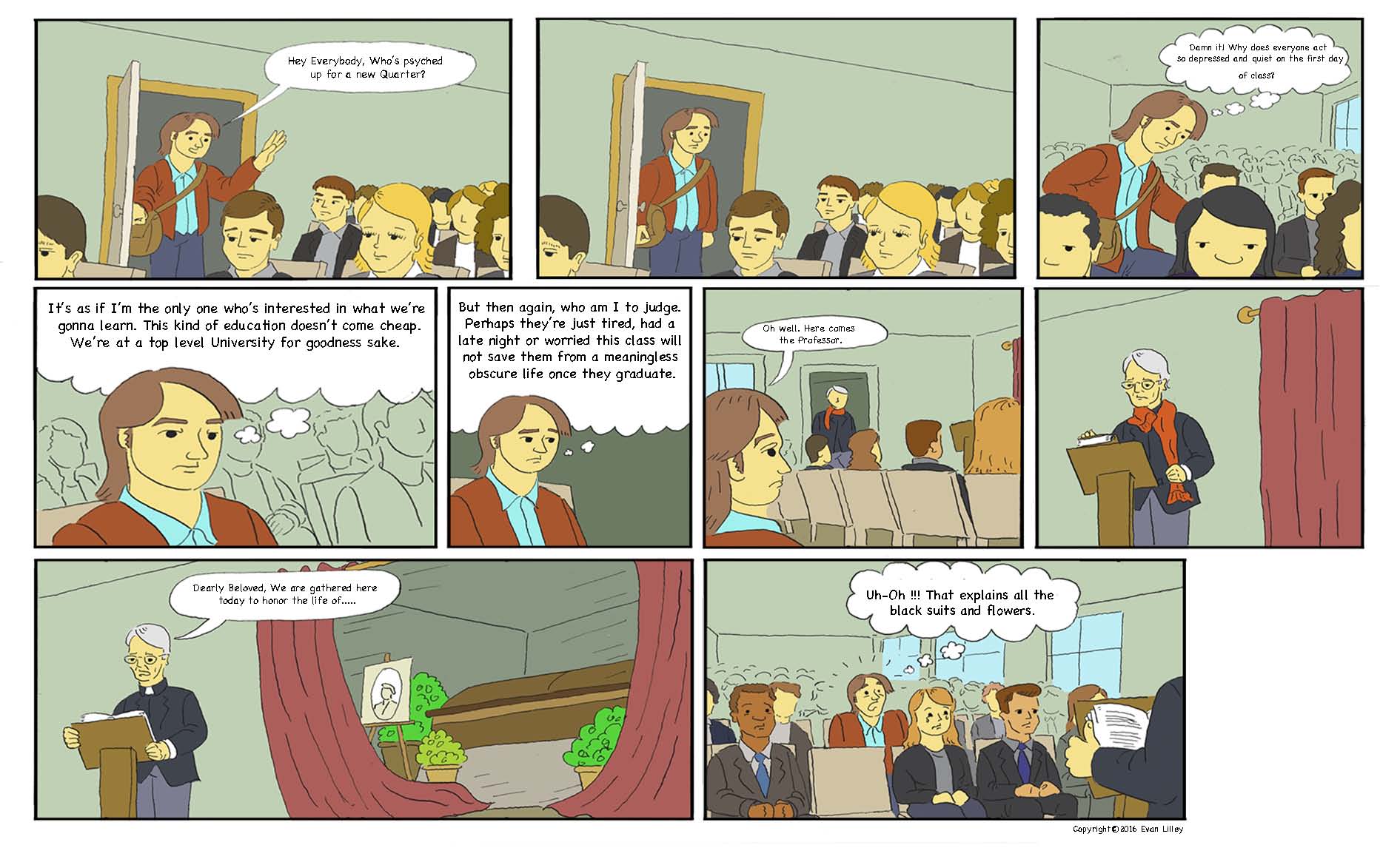
First day of class (click comic to enlarge)
Week 1 Cartoon Final_2

Letter from ASUCD Senator Thomas regarding violation of ASUCD Constitution

0
JAY GELVEZON / AGGIE

An Open Letter to All Members of ASUCD:

Throughout the course of our lives, we will sometimes encounter consequences that are not the result of our own wrongdoing. While we cannot always control the situation, we always have the power to choose how we respond to it. That is what is most important.

In the closing week of Fall Quarter, I was notified that my tenure as an ASUCD Senator would be coming to an abrupt halt. After serving only eight weeks, it was discovered that within the arduous nine-thousand-word text that governs ASUCD, a clause stated that an interim Senator could only serve in a vacated seat until “the seat is filled on a permanent basis at the next regularly scheduled Senate election.” In other words, the ASUCD Constitution indicated that as an appointed but not elected Senator, I was only supposed to serve until I could be replaced following the Fall Elections, which had already transpired two weeks earlier. With the elections finalized and the six new bright eyed, bushy tailed Senators preparing to take office in a few days, it put me in quite a tight spot that led to confusion as to how this error could have occurred, especially halfway through my term.

When I was first appointed, it was ubiquitously understood that I would complete the remainder of my predecessor’s term. However, this constitutional technicality stated otherwise. It appeared that I would need to resign even though my position would go unfilled since “count-back” elections could not apply to vacated interim seats. More importantly, this also mean that the Fall Elections could be seen as constitutionally invalid because only six Senate seats were publicized when it explicitly needed to be seven available.

At the center of it all, this predicament could potentially result in a 4-person Senate, with Senator Johnson’s recent resignation. Least to say, this was uncharted territory for me– who had no previous experience in student government–and the rest of ASUCD. To the best of my knowledge, the last time an interim Senator served beyond a single quarter was in 2004.

After hearing of this news, I spoke with the Elections and Internal Affairs Commission Chair to better understand the situation. While the outcome was unclear at the time, I knew I had a duty to own up to the situation and be transparent to the public. However, since this incident did not only impact me, but potentially the newly elected Senators, I decided to motion for a closed session to inform them and receive their input. I wanted to act as a collective legislative body. Therefore, the decision to publicize the issue or sweep it under the rug would ultimately be a unified decision, and not simply my own. I am pleased to say that the table shared a strong commitment of transparency, which has shown the character and integrity held by those sitting on the table.

With their support for whichever decision I would make, I had to be able to justify a reason not to resign, since it meant intentionally violating the Constitution. I took several things into consideration: my staff who’ve shown tremendous dedication, my platforms that I desire to see come to fruition, and most importantly the campus community, whom I’ve had such a privilege to serve.

After much reflection, the decision became quite easy. This situation brought to mind a much greater issue currently facing America: the legitimacy of laws in society. In essence, do all rules and laws serve the public interest, or are some rules arbitrary, outdated and convoluted, eventually becoming excessive and harmful to the public interest? Granted, laws do serve an essential function that, in the absence of, would probably lead to rampant chaos and anarchy. Nonetheless, should we have laws for its own sake even if it is not in the public’s interest? More so, should we exercise every legal right simply because we have it? Should we ostracize and belittle other’s religious beliefs simply because we have the “freedom of speech”, as in the case of Stop Islamization of America who hosted comic contests making fun of the Prophet Mohammed? Equally, should we allow for the under- regulated procurement of guns simply because we have a 2nd Amendment right to, even though we know that with each mass shooting, it could have been preventable?

Simply put, my answer is “No”! Laws should be challenged, changed, and even broken when they are not explicitly in the best interest of the public good. While ASUCD is only a small microcosm of the American society, I say all of this to say that I do not believe my resignation would be beneficial to the ASUCD community. It would actually be the inverse. With countless resignations, mental health concerns and politicized resolutions in the past year, my resignation would only bring more instability to ASUCD. I have strived to be consistent, reasonable, and reachable as I aspire to serve and lead. To be clear, I have no hidden agenda or political ambitions. I just have a deep desire to make this campus better than which I found it.

Therefore, I have decided to remain your Senator for the duration of my predecessor’s term and continue to build partnerships and provide opportunities and resources that will enhance your time here at UC Davis. I will continue to work to expand international-local student interaction, increase pre-professional resources for those who need it most, and to ensure that the recruitment and retention of underrepresented communities are on par with the student body at-large. I believe for those who can, to do, if and only if it is for the betterment of others. This is exactly what I intend to do.

Sincerely,

Kamaal Thomas, ASUCD Senator

(ASUCD President Mariah Watson and Senate President Pro Tempore Miguel Louis Guerrero also released a statement regarding Thomas and the situation: http://theaggie.org/2016/01/14/letter-from-asucd-president-and-senate-president-pro-tempore-regarding-senator-kaamal-thomas)


Letter from ASUCD President and Senate President Pro Tempore regarding Senator Kamaal Thomas

0
miguel_guerrero
JAY GELVEZON / AGGIE

Dear Undergraduate Students of UC Davis,

As a body, the ASUCD Senate, as well as the student government as a whole, has a responsibility to represent the 27,000 students that make up this campus, as well as to voice the concerns of the UC Davis students. To that end, it also maintains the important responsibility of ensuring that elected bodies maintain an open and transparent relationship with their constituents.

After the resignation of Senator Sahar Priano and a series of interviews, her seat was replaced with the selection of Kamaal Thomas. Senator Thomas began his interim term in October to serve the Senate table throughout the fall quarter. Following the Fall election of Senators Dalavai, Dhindsa, Jamaludin, Savage, Singh, and Tenner, the Senate and the Executive Office were notified of a potential constitutional violation with regards to the duration of Senator Thomas’ term.

According to Article 2, Section 11, Subsection 3 of the ASUCD Constitution, an interim senator’s term is to end after the next regularly scheduled elections, thereby making Thomas’ Senate seat invalid. T​he infrequency of this issue contributed to a lack of institutional memory around this procedure, leading to a failure to enforce this provision;​ the last occurrence was in 2004.

As a result of Winter elections beginning next week, the Senate Table has opted to allow Senator Thomas to complete his term following the end of the 2016 winter quarter. Senator Thomas has accomplished a great deal within the Association and has shown that he is more than deserving of his position.

We are working on an overall training program to better educate future student leaders so that issues like these will not occur again. O​nly through your support can we work to create a better campus community, and a better undergraduate student experience.


Yours in service,

Miguel Louis C. Guerrero, ASUCD Senate President Pro Tempore

Mariah Kala Watson, ASUCD Senate President Pro Tempore ASUCD President

(Senator Thomas also released a statement: http://theaggie.org/2016/01/14/letter-from-asucd-senator-thomas-regarding-violation-of-asucd-constitution)


Photo of the Week: 1/13/2016

What I liked about this photo when I took it was the cloud-like appearance of the water. When I look at it, I can see both clouds and water, and I think that makes this picture interesting to look at. (BRIAN LANDRY / AGGIE)

Humor: The 12 steps to take after you get your syllabus

0
MONICA CHAN / AGGIE
MONICA CHAN / AGGIE

A recipe for success.

It’s the first day of class. You sit down and shoot your professor a look that you hope communicates, “I will never do the assigned reading. Also, please don’t call on me. Ever.” The professor stands in front of the room and clears their throat. You know exactly what’s coming next: syllabus time! Or as I like to call it: “The handing out of stapled papers I’m going to lose within the next five minutes.” Here’s what to do when you get that useless stack of dead trees:

  1. Immediately start sweating. Conjure up the pit of terror you experienced during fall quarter finals and let it all out. Crying is recommended, but not necessary.
  2. Hold your syllabus in hand and, while the teacher is busy telling you about your assignments, stare at the wall and wonder about the plural of syllabus. Syllabi? Syllabuses? You’re not sure. Scratch your head to help you think.
  3. Someone is asking a question. Yikes. Start chanting “teacher’s pet” in your head. Rename this person Jimmy. God, we hate Jimmy.
  4. Flip through the pages, giving a tender kiss to each one. Whisper to it, “You’re going to be so tasty.”
  5. Here’s where the fun begins. Dig through your backpack and get out your portable blender. I know what you’re thinking. You thought it was a stupid Christmas present at the time, but it looks like Aunt Sally really does know what she’s talking about when she said you’d get a lot of mileage out of that thing.
  6. Next, get out the unsweetened vanilla almond milk you religiously buy from Trader Joe’s so that your vegan friends think you’re cool. Add a splash to your blender. Sprinkle in a few tears for good luck.
  7. Proceed to tear up your syllabus. Tear extra on the grades section. Add the shreds to your milk and blend!
  8. At this point your professor may be yelling, “What are you doing? Get out of here!” Ignore them and scream back, “Don’t worry, you can totally have some!”
  9. Once blending has commenced, look at the thick gloppy paste you’ve created and smile! Your parents would be so proud they’re spending $30,000 so that you can have the finest smoothie ingredients possible.
  10. Don’t be rude! Offer some to everyone but Jimmy. They’re probably looking at you funny, but that’s only because you forgot to add the secret ingredient, silly! Pick a few hairs off the ground, add as garnish and offer it again.
  11. Take a big gulp and feel your responsibilities slide down your esophagus. Congrats, you’re ready to take on winter quarter!
  12. Repeat for every class.

Written by: Alex Guzman – opinions@theaggie.org

The Chainsmokers to perform for UC Davis students in February

0
FRANK APOLLONIO / COURTESY

UC Davis wins performance through a national competition from Chainsmokers and Tilt.

The Chainsmokers, the electronic dance music (EDM) DJ duo responsible for such hits as “#Selfie” and “Roses,” will be playing a crowd-funded concert for Davis students and guests on Feb. 4 at Ace of Spades in Sacramento. The performance will be the duo’s fifth stop of the Tilt Tour, which was made possible through ticket presales on the Tilt app, which allows users to pool money together for a collective cause. UC Davis students were able to secure a performance by The Chainsmokers by being one of the first six universities to sell 800 tickets through the app.

Jordan Leu, a Community Team lead from Tilt, described the app as an easy way for users, especially college students, to collect money from groups. The app has been widely used in Greek life to crowdfund for larger events. It can also be used to simplify the process of collecting money for parties and road trips.

“Venmo is great for one-to-one transactions but when you need to collect $30 from 15 people, Tilt is definitely the way to go,” Leu said in an email interview.

The Chainsmokers are a rising force in the EDM scene and will be playing another show in Oakland on Feb. 6 along with EDM powerhouses Alesso, Diplo and Showtek. The Chainsmokers’ partnership with Tilt allows them to reach out to their fan base.

“As artists especially, we want to go to the markets we have the most demand and getting that data or figuring out the best way isn’t always easy,” The Chainsmokers said about the Tilt Tour. “So this really puts the power in the hands of our fans and that’s really exciting for us.”

Daniel Lin, a second-year biomedical engineering major, was the lead student coordinator with the Tilt Tour on campus. Lin helped spread the word about the tour and has been organizing the event since UC Davis won the competition.

“I told people you each buy two tickets, and then you have the opportunity to do whatever you want with that. You can sell them if you want,” Lin said. “The majority of people bought two, because it was essentially a competition. We got third place, and sold 850 tickets in 70 minutes.”

Lin and other Tilt campus ambassadors worked with student leaders to try to use an on-campus venue, such as the Activities and Recreation Center (ARC) Pavilion or the Memorial Union Quad. Their efforts were unsuccessful, but they were able to move the concert to Ace of Spades in Sacramento.

“Unfortunately, the venue had to be indoors, and it had to accommodate over 800 students,” Lin said. “The administration wouldn’t let us use the ARC, so we went to Ace of Spades in Sacramento, which is close to Davis.”

Tickets for the event are currently sold out, but some are being sold on UC Davis Facebook groups.

“The problem was that not everyone was able to get a ticket being that we had so many students,” Lin said. “When we sold out, people were frustrated because they are now being resold at $50. I tried my best to make an exchange group [on Facebook]. Hopefully students use that and everyone who wants to go can get a ticket.”

Attendees are in for a night of electro house beats and indie remixes, brought to you by Tilt. Doors open at 7 p.m. For more information, please visit the Facebook event page.

WRITTEN BY: Sara Williams – arts@theaggie.org

Political Ambiguity: National unity and its job in keeping nations together

0
TIFFANY CHOI / AGGIE

In our daily lives, we may joke around about a city, a state or a people that wants to become independent. According to a 2009 Rasmussen Reports survey, 18 percent of Texans support their state’s secession. The survey concludes that Texas exhibits comparable results to other states, but we just hear a lot about the Lone Star State in the news. But it does raise the question of whether there could ever be a time in the near future when a place or a people united in a common cause asks for separation from the United States.

There are many forces that may pressure a people to want to become independent. They may have a distinct culture which runs contrary to the mainstream of the rest of the country. Potential secessionists may feel absolutely alienated, or feel as if they are subject to some gross injustice. These people feel so strongly about breaking apart from their own country that they are willing to accept the great risks involved. Economic troubles or grave social injustices may unite previously polarized groups to seek independence from a country that they feel no longer represents them.

Nationalism or patriotism does not necessarily prevent secession. What ultimately keeps people together is a set of common values. A cohesive national identity holds people together no matter where they reside, or what their political or religious beliefs might be.

We must ask ourselves — what forces exist today that might have prevented secession in 1860? The U.S. at the time was a looser union than our present one. People at the time often identified with their state or religion before their country. After the civil war, “these” United States became “the” United States. The country became a single entity, rather than a country whose people had greater loyalty to their region. If a potential secessionist movement were to arise in 21st century America, it would have to destroy the central beliefs that exist despite many social divisions. Since the Civil War, we have never seen a people severely isolated to the point where they wish to leave the rest of the nation.

Ukraine is a recent example of a country that has increasing separatist sympathies. Much of Eastern Ukraine, through language and culture, shares many commonalities with citizens of Russia. In fact, many of the people who live in Eastern Ukraine identify as Russian.

Events in the last three years have certainly pushed people in this region to side more with Russia and to lose their sense of unity with the rest of Ukraine. They feel at odds with those from Western Ukraine, who predominantly speak Ukrainian and tend to identify more with the rest of Europe. With the coup and toppling of pro-Russian president Viktor Yanukovych, Russian-speakers in the east have seen event after event push them closer to separatism. The new Ukrainian government has failed to answer the concerns of Russian-speakers in the east. The Ukrainian government objected to Russian becoming the second national language, laid the blueprints for speedy integration into the European Union and enforced great cultural changes which include downplaying Ukraine’s historic relationship with Russia.

Whether or not you are convinced that common national identity can prevent secession, it’s important to have a conversation on this topic. You might come away with a different perspective about the United States, a country that has been generally successful in putting national unity ahead of any loyalty to state or social class. Analyzing the situation in Ukraine can provide explanations for secessionism. There are many other reasons a nation might want to secede. This will surely complicate how we gauge whether or not secession will become a reality in the United States.


You can reach JUSTIN CHAU at jtchau@ucdavis.edu.

UC Quits reaches milestone of 2,500 patients

KATE SNOWDON / AGGIE

UC-wide anti-smoking campaign extends to five UC medical centers.

In 2013, Dr. Elisa Tong, an assistant professor at the UC Davis Medical Center, created UC Quits, a program to combat the ongoing battle against tobacco within the UC Health System. What started as a pilot program in 2013 through the UC Davis Medical Center, UC Quits has grown to include five UC medical centers and has reached almost 2,500 patients struggling with tobacco and nicotine addiction.

UC Quits serves patients at each of the five UC medical centers. The program is designed to prompt frequent smokers to quit at a time when they are typically more open to the idea, such as when they are in the hospital or at the doctor’s office. According to Tong, patients will benefit by being offered assistance that is more systematic. Medications and counseling strongly increase an individual’s ability to quit; however, it often takes multiple tries, according to Tong.

“For example, when a smoker is admitted to the hospital, they may be offered [a] nicotine patch and gum to relieve or prevent withdrawal and cravings,” Tong said. “At discharge, they can be referred to the California Smokers’ Helpline, [which] offers free telephone counseling and support to stay smoke-free.”

Funded by the UC Center for Health Quality and Innovation, UC Quits is an initiative designed to improve the manner in which UC healthcare providers address patients struggling with tobacco use, addiction and exposure. The program is a tobacco cessation network that spans across five UC medical centers — UC Davis, UC San Francisco, UC Los Angeles, UC Irvine and UC San Diego, as well as the California Smokers’ Helpline at UCSD and the Smoking Cessation Leadership Center at UCSF.

According to Tong, tobacco is the leading cause of preventable illness in the United States. While tobacco products have significant harmful effects on those who use them, Tong said the long-term benefits of quitting are also significant. As of now, UC Quits has helped almost 2,500 smokers utilize the California Smokers’ Helpline for counseling and other guidance for quitting.

According to Keavagh Clift, a health promotion specialist at UC Davis, the percentage of UC Davis undergraduate students that have reported smoking a cigarette in the last 30 days has decreased from 7.5 percent in 2013 to 5.7 percent in 2015 as demonstrated through the 2015 UC Davis American College Health Association National College Health Assessment (ACHA-NCHA II).

“The 2015 data shows a positive trend with regard to a decrease in smoking rates,” Clift said. “Though encouraging, it is difficult to determine whether the ACHA Assessment decline in use is attributable to the policy as there was also a national decline in smoking rates of students entering into college during this same timeframe.”

In 2013, the UC Davis Medical Center established the first two-way referral service with the California Smokers’ Helpline. This is the signature difference between UC Quits and other programs designed to provide guidance to those seeking to quit smoking. The service enables medical providers to ensure that patients at some point interact with the California Smokers’ Helpline (1-800-NO-BUTTS) rather than relying on patients to make the call on their own time.

“Instead of asking a patient to call, now a provider can tell a patient they will receive a call,” Tong said. “Furthermore, the provider will get a results message back from the helpline if the patient did accept counseling and educational materials.”

The UC Davis campus became smoke and tobacco free in January 2014. Smoking and use of other tobacco products are banned both indoors and outdoors in all areas of campus, including parking lots.

“In January 2012, President Mark Yudof announced to all chancellors that the University of California would be smoke and tobacco free by January 2014,” said Julia Ann Easley, senior public information representative at News and Media Relations for UC Davis. “The systemwide initiative and policy change applied to all UC campuses and medical centers.”

According to Tong, the five UC medical centers went smoke-free before the 2014 UC-wide ban and the UC Quits program continues to fortify the policy through its growing success since its creation in 2013.

“UC Quits supports the smoke-free policy by creating more provider electronic medical record tools in helping patients not having to smoke during their hospital stay, which also has immediate health benefits, and offering assistance in quitting,” Tong said.

For more information regarding UC Quits, visit ucquits.com.

Written by: LAURA FITZGERALD – campus@theaggie.org

(House) Hunting Season

HEE-AH YOO / AGGIE
HEE-AH YOO / AGGIE

ASUCD organizes Housing Day, aids students in search for living space next year.

As the season for house and apartment hunting approaches, ASUCD’s Housing Advising for Undergraduate Students (HAUS) is preparing to host its annual Housing Day event for UC Davis students who are looking for information on housing options for the following year.

“Housing Day is essentially where apartment complexes from the Davis area and surrounding areas come and […] market their apartment complexes,” said Serena Santamaria, HAUS unit director and fourth-year psychology and English double major. “They’ll be there to answer any […] questions about floor plans or […] moving into […] apartment[s].”

Housing Day will take place on Tuesday, Jan. 26, from 10 a.m. to 3 p.m. on the bottom level of the ARC Pavilion.

“We’re also going to be having other student organizations there dealing with housing […] to answer any questions about leases [or] moving off campus,” Santamaria said. “We’re going to have other organizations as well talking about […] issues or problems students face moving off-campus.”

Many students are experienced in the moving off-campus process and are well aware of the challenges that arise in looking for a place to live.

“[My first year] I went and toured a bunch of different places to see which ones I liked,” said Todd Blackburn, a third-year biochemical engineering major. “Some difficulties we had definitely revolved around finding a place with a reasonable cost and good location.”

Some underclassmen are only just learning about how to plan for next year’s housing.

“[One issue is] finding an ideal number of roommates, depending on how many apartments are available,” first-year managerial economics major Manpreet Singh said. “Apartment spaces around Davis are filling up really quick. It’s hard to find an apartment that has a lot of amenities, such as free internet service or cable. [Another issue is] finding an apartment that’s close to campus.”

Many students seem to find that roommates can also pose a challenge in the search for housing.

“I’ve been talking to a lot of different [groups] like LGBTQIA,” Santamaria said. “[An] issue we’ve had is […] discrimination in the LGBTQIA community. [Some members of the LGBTQIA community] have had difficulties finding roommates.”

However, HAUS does its best to ensure that all students are provided with as much aid as possible in the hunt for housing. Housing Day caters toward the specific needs of students who plan on living off-campus and therefore offers many potential solutions for students who face challenges such as finding a roommate.

“We’re also planning on having a roommate-finder table as well,” Santamaria said. “There [are also] options of […] housing pages on Facebook […] that can help you split the rent with people.”

Many students are also searching for specific features and amenities in their potential apartments or houses.

“I’m looking for a decent place [that has] parking, because […] some of my roommates [and I] are bringing cars next year,” Singh said. “It would be […] convenient if they provided internet service. College students need internet.”

Luckily, Housing Day provides an opportunity for students to explore their options and find out which apartments offer the specific features that students want.

“We’re also going to be having a booth talking about transportation [for students who] have any questions about how to get to and from their housing complex,” Santamaria said. “[Housing Day will also answer questions regarding] any amenities that they personally want, whether or not there’s a printing room, or things that’ll help them academically.”

Despite the challenges that moving off-campus seems to present, many students have found the experience of living in houses or apartments to be quite agreeable.

“You have a lot more freedom to do what you want, compared to the dorms,” Blackburn said.

Although there are challenges that accompany living away from campus, students are usually able to adjust to any inconveniences they may experience.

“I’ve lived in Adobe at Evergreen for the last three years, so moving from on-campus to off-campus was a little bit of a transition,” Santamaria said. “I am living two miles away from campus, which at first was a little […] daunting […] getting myself to go to school two miles away, but I found that […] Unitrans is really great and biking is also a great option. I personally like my apartment a lot.”

Many upperclassmen have learned how to deal with the transition from dorm life to life off-campus from prior years of living in an apartment or house.

“It’s not always best to room with friends,” Blackburn said. “You should look for certain qualities that make for good roommates [like] cleanliness, responsibility, consideration, […] likes to bake—that’s always a plus.”

Along with advice regarding roommates and other housing recommendations, Housing Day will also provide various other surprises for students, including a few major giveaways.

“Last year we gave away an iPad, the year before we gave away laptops,” Santamaria said. “Also […] apartment complexes tend to give a lot of free stuff away.”

This year, HAUS has also decided to include more than just housing information for their annual event.

“We’re also going to be having an entertainment aspect to Housing Day […] just so that we have something else other than housing,” Santamaria said. “Entertainment Council is helping us put on a little sideshow, with a capella groups and different performers. That’ll be happening [from] noon to 2 p.m.”

Despite the difficulties that students may face in the hunt for housing, ASUCD’s Housing Day event hopes to put to rest some of these challenges.

“You really just have to make sure you find the right situation for you,” Santamaria said.

Written by: Allyson Tsuji – features@theaggie.org

Rainy days in the CoHo: your worst nightmare

0
MONICA CHAN / AGGIE
MONICA CHAN / AGGIE

El Niño is finally upon us, and staying warm and dry are probably the two most vital necessities in staying sane this quarter. As a result, the perpetually-full CoHo has become even more packed with students attempting to find a safe haven in the rainy weather. Here are some thoughts that we’ve all probably had while attempting to successfully complete the daunting task of finding a seat in the CoHo on a rainy day.


  1. “Why does rain even have to be a thing?”

It’s no secret that California is in desperate need of some water, since the state is experiencing a record-breaking drought. However, is the rain really necessary? Getting out of bed and to class is a difficult task as it is — the rain only makes being on campus even more inconvenient.


  1. “Getting a seat on a sunny day is hard enough!”

The CoHo is always full of students trying to get a boost of energy after their third espresso of the day. With the rain, the CoHo becomes even more populated with students trying to stay dry. Finding a seat now seems like an impossible task. The best thing to do is walk around slowly and aimlessly, while hoping someone will stand up and leave a seat to be stolen.


  1. “Don’t slip, please don’t slip!”

With endless amounts of students walking in and out of the CoHo, looking for seats and grabbing coffee, the floor inside is bound to be filled with water tracks. Pay attention to the floor in order to avoid the unfortunate mishap of falling down and hurting yourself (and your dignity).


  1. “Is my freshman stripe showing?”

Even if you are equipped with an umbrella, rain boots, a rain jacket and other rainy day accessories, there is truly no way to avoid getting splashed with water — especially if you bike. As a result, there is always the fear of having wet pants (in the most inconvenient of places). This thought will be at the forefront of your mind as you walk through the CoHo, but don’t worry: everyone else is most likely wondering the same thing.


  1. “Literally, who do I have to fight to get a seat!?”

As difficult as it is, finding a seat in the CoHo on a rainy day is an ordeal that most every UC Davis student goes through at least a few times in their time here. Everyone is trying to do the same thing: stay warm and dry. Remember this next time you see that soaking wet person desperately roaming around the CoHo; offer up the seat next to you or make room for another chair to fit at your table. Look out for your fellow Aggies, because El Niño has no mercy!


Written by: Amanda Cruz — features@theaggie.org

Aggie Open at Schaal Aquatics Center

0
DEBPARNA PRATIHER / AGGIE

Second meet of the year, more opportunity for fun.

After a convincing 160-132 victory over Fresno State on Jan. 8, the Aggies toned down the intensity at the Schaal Aquatics Center while competing in the second annual Aggie Open the following day. With league standings not impacted, many Aggie swimmers showcased their versatility by competing in events atypical to their standard races.

One case was senior long-distance swimmer Lexy Troup, who typically competes in events such as the 1000- and 1650-yard Freestyle. At the Open, Troup tried her hand at some short-distance events, including the 100 Backstroke and 200 medley relay, where she placed third and seventh, respectively.

“It’s a lot lighter [than the dual meet the day before, and] everyone’s happy and easygoing,” Troup said. “No one is too stressed out because they’re not swimming their main races, so it’s more enjoyable.”

One standout performance is a trio of victories collected by junior Kirsten Brand, who was a key component in the Aggie team that posted the fastest time in the 200-yard medley relay (1:50:17). Brand also secured individual wins in the 200-yard Backstroke (2:05:90) and the 50-yard Freestyle (24:47), along with a third place finish (59.93) in the 100-yard Butterfly.

Other notable showings include freshman Eva Chung, who had top four placings for every event she competed in, which included a victory in

DEBPARNA PRATIHER / AGGIE

the 100-yard Butterfly (58.26), second in the 50 Freestyle (24.53) and 100 Backstroke (1:00:47), and a fourth place finish in the 200-yard medley relay (1:53:61).

Not to be outdone, freshman Mia Facey notched together a pair of individual victories in the 100-yard Backstroke and Breaststroke, with times of 59.76 and 1:06:18. Unopposed Aggie wins include senior Cara Silvas in the 200 Butterfly (2:25:53), and sophomores Aislinn Dresel in the 200 individual medley (2:15:35) and Ali Sena in the 500 Free (5:26:81).

Some surprising faces made an appearance at the Open, as athletes from different UC Davis sports competed for the first time on Saturday. Ranging from soccer to water polo, these Aggies were quickly put to the test against the more experienced swimmers.

Colby Wadman, junior punter for the UC Davis football team, seemed undaunted by the task.

“Well, the mentality of swimming is a lot different than punting,” Wadman said. “I haven’t really ever done this [swimming competitively] at all, I just wanted to go out there and see what happened.”

It appeared as though Wadman and the rest of the non-swim team athletes were thrown into the deep end of the pool and when asked whether he received any pointers from the coaches, Wadman laughed.

“We [he and fellow football player Justin Williams] came in here blind, just trying to see what would happen and make the most out of it,” Wadman said.

The punter took home a respectable fifth place finish in the men’s 50-yard Freestyle with a time of 34.05.

The women’s swim and dive team’s next meet is set at home as they take on UC Santa Barbara on Jan. 23.

“They’re [UC Santa Barbara] our arch rivals in the conference, so we’re really going to get geared up to beat them,” Head Coach Barbara Jahn said. “There’s always some good head-to-head competition against them no matter where, home or away.”

Written by Eric Portillo – sports@theaggie.org

The Forest review: Interesting concept, disappointing movie

0
TIFFANY CHOI / AGGIE

You can’t see the forest for the Yūrei.

Having known about The Forest, starring Natalie Dormer, for over a month prior to its Jan. 8 release, I was sorely let down. The film centers the dark history of the Aokigahara forest at the base of Mount Fuji, famed for its high number of suicides. With such a dark and rich concept to begin with, I had high hopes for this movie, which although not completely dashed, were definitely somewhat squashed.

The movie opened with a clumsy exposition of the main character’s troubled and lopsided relationship with her twin sister, a classic trope. I’m already annoyed with Sara (Dormer). She decides on the spur of the moment to go and find her sister Jess, who has a history of mental illness and suicide attempts and who has disappeared into the Aokigahara forest.

Sara’s departure is abrupt and unbelievable, with very little explanation as to how she’s managed to swing this with her boss and how on earth she’s affording to go to Japan in a millisecond’s notice. Her husband is the only one who raises objections to her sudden decision, but is swiftly overruled.

We then get a clunky exposition scene, in which Sara meets an Australian travel writer, Aiden (Taylor Kinney), who gets her drunk and manipulates her into spilling her story. While there needs to be some way for the narrative to get Sara into the forest, stumbling upon a man who just happens to be making a trip in with one of the only guides the very next day seems a little too convenient.

My next problem was the poor monster development. Have you seen The Grudge? The Ring? Any Japanese or Japanese-inspired horror which involves ghosts or ghostly figures? Don’t worry about these monsters then, you’ve seen them all. Although there is a decent explanation of the Yūrei, the monsters who haunt the forests, the appearance of the Yūrei is done cheaply and obviously, going straight for shock scares rather than any insidious buildup. It’s explained that the Yūrei prey on sadness and are supposed to act as reflections of your own mind and fears, but the monsters that haunt Sara appear largely unrelated to her, which weakens the whole premise of the Yūrei. The monsters are not original or employed well enough, so although they look terrifying, they simply don’t live up to their potential.

All in all, disappointing. The idea of knowing that someone you love has wandered into a place famed for suicides is a horrifying concept, but the underdeveloped characters, poorly utilized monsters and cheap scares destroy the atmosphere.

Scary equivalence rating: having a bad day at school and your mum jumping out the closet at you. Not funny or scary, Mum.

Written by: KATE SNOWDON – arts@theaggie.org