52.4 F
Davis

Davis, California

Tuesday, December 23, 2025
Home Blog Page 769

City holds Alternative Conflict Resolution program

0
RAHIL SHETH / AGGIE
RAHIL SHETH / AGGIE

Meeting facilitates communication between Davis Police Department, residents

On Nov. 16, community members gathered at the Davis Community Church for the Alternative Conflict Resolution (ARC) program, which allows participants to share their views on the relationship between Davis citizens and the Davis Police Department (DPD).

The program was organized by the DPD, the Human Relations Commission (HRC) and Judith MacBrine, a mediator at ARC and a facilitator, coach and trainer at The Mirror Group. About 20 people attended the meeting, most of whom were Davis residents and HRC members.

“When I first moved to Davis in the 1980s, I made a wrong U-turn and the police were very rude to me. I really appreciate this program by the police department,” said Yvonne Clinton, a Davis resident.

The ACR program is an informal, confidential, mediated event that uses restorative practices such as the circle process, where participants communicate while seated in a circle formation. Program attendees meet face-to-face and resolve conflicts with the help of trained circle co-keepers who help to mediate the conversations.

“[Circle co-keepers are] responsible to set up space for dialogues and ask participants to maintain the space of the conversation,” said MacBrine, one of the circle co-keepers and a facilitator, coach and trainer at The Mirror Group.

All of the participants sat in a circle and agreed to six responsibilities: to honor confidentiality, remain in the circle, speak with respect, listen with respect, speak genuinely and respect the talking stick. Initially, they were asked to tell everyone the reason for being there. One by one, every person spoke on a microphone in the circle.

They were then asked about their opinions of issues between the DPD and Davis residents. The general response was that people tend to shout and get defensive when there is an argument and that no one takes the time to calmly sit and talk about it.

“In my experience in the police department, conflict shuts down active listening,” DPD Lieutenant Glenn Glasgow said.

The program seeks to facilitate more meaningful discussions.

“It is amazing how conflicts can be resolved by just a conversation,” MacBrine said.

Written By: RAHIL SHETHcity@theaggie.org

KDVS holds fall fundraiser following drastic ASUCD budget cuts

MONICA CHAN / AGGIE
MONICA CHAN / AGGIE

Student-run radio station seeks to raise $70,000 by spring quarter

KDVS, UC Davis’ community-based radio station, has recently undergone significant budget cuts from ASUCD. KDVS’ budget is lower than it has been since the 1970s, without taking inflation rates into account.

KDVS received a subsidy of $42,048 for 2014 and 2015. In contrast, the final approved budget for 2015 and 2016 has been cut to $25,180.

In order to combat these cuts, KDVS held a fall fundraiser on top of its annual spring fundraiser. Their goal is to raise a collective total of $70,000.

Unlike many of the radio stations licensed to universities, KDVS is one of the few stations left in the nation that is completely student-staffed. Dynn Javier, a second-year English major and the general manager of the station, finds that many people view the radio station as an invaluable part of the university.

“KDVS is, at least in the eyes of the community and the staff, a cultural asset and an educational platform,” Javier said. “We’ve pitched to our listeners, community and staff that two fundraisers a year, one in the fall and one in the spring, are indicative of growth here at KDVS.”

Joseph DeAngelo, a third-year political science and economics double major is one of the Business and Finance commissioners for ASUCD. According to DeAngelo, KDVS is only one of many ASUCD units that were affected during last spring’s budget cuts.

“Following a lot of on campus departments, we’re moving to what’s called zero-based budgeting,” DeAngelo said. “It’s essentially when the executive team looks at the actuals of this year and builds a budget from the bottom in order to develop the most efficient budget.”

Fundraisers are a key tool KDVS uses to raise money. About 80 percent of their operational budget comes from listener donations. The goal for both the spring and fall fundraisers is $35,000. Every radio program on the station has its own fundraising goal and uses incentives such as small gifts, promotions and on-air requests.

Ashley Hanson, former general manager of KDVS and a fifth-year clinical nutrition major, explained that the listeners of the station have been very supportive.

“We rang the alarm when they gave us less money than they ever have, and so many turned out in support of us,” Hanson said. “People know that we’re in distress and the people that care have already turned out to support us.”

The fall fundraiser lasted from Nov. 8 to 14. KDVS managed to raise $28,121 toward their $35,000 goal, surpassing ASUCD’s $16,868 subsidy cut. The spring fundraiser is slated to run from April 18 to 24.

Written by: Jackie Carmaz – campus@theaggie.org


Photo of the Week: 11/18/2015

PotW_Robbins
Crowds of people came to soak up the glow at the Autumn Lights Festival in Oakland, California on Oct. 16, 2015. (ARIEL ROBBINS / AGGIE)

UC Davis students march alongside other universities as part of nationwide “Million Student March”

BRIAN LANDRY / AGGIE

Students march across campus in support of free tuition, cancellation of student debt

On Nov. 12, UC Davis students rallied together in support of the “Million Student March.” The march, which began at the Memorial Union and traveled throughout campus, is a national movement that demands free tuition from public universities, the cancellation of all student debt and a minimum wage of $15 per hour for all campus workers.

Prior to the protest, students gathered in solidarity to show their support for students of color at the University of Missouri following a string of racially-charged incidents.

According to the protesters, the country has exceeded $1 trillion in student debt since 2012 and the average amount of debt a UC Davis student leaves with is $25,000.

Before the march began, students and organizers gathered at the MU flagpole to create a “web of debt” to symbolize how much debt each individual possesses. Students attached pieces of paper with their current amount of student debt onto a physical web to emphasize the cumulative debt of the student population.

The march followed the recent freeze on UC tuition, which began earlier this year and will last until the end of 2017.

Sam Alavi, the director of the ASUCD Office of Advocacy and Student Representation (OASR), voiced her opinion on who the students can hold accountable for this debt crisis.

“I personally think that our state legislature and our governor would be the best to notify of these issues,” Alavi said. “Because they are so far removed from college life, they forget what it is like to be a student.”

She also put an emphasis on the fact that a large amount of the state’s budget goes to prisons rather than to our education system.

“We spend a lot of unnecessary money on prisons, which prevents many people from going to schools like UC Davis,” Alavi said.

While Aiden Coyne, a research analyst for OASR, echoes Alavi’s point, he also believes that officials at UC Davis and within the UC system also play a part in influencing the massive student debt.

“I know politics [isn’t] popular, but we need to keep our politicians accountable,” Coyne said. “[Gov.] Jerry Brown, [UC President Janet] Napolitano and Chancellor [Linda] Katehi need to be made aware of these issues.”

In response to the protest, Andy Fell, associate director of news and media relations at UC Davis, recognizes the urgency of the student debt crisis.

“These are important national issues and students should certainly be working to raise awareness around the affordability of education,” Fell said.

OASR sees this protest as a way for local government representatives to feel the pressure of student burden.

“There needs to be transparency between students and the university,” said Elijah Pipersbury, OASR coalition coordinator.

Students protesters echoed the opinions of the organizers. Samantha Romero-Bothi, a third-year biochemistry major, expressed her feelings toward the lack of community within UC schools.

“The UC’s are [raising] their costs to compete against each other,” Romero-Bothi said. “They are like businesses.”

Emphasizing the fact that she transferred to UC Davis because of the financial aid package she received, Romeo-Bothi was able to provide an account for what the university assists with and what the university fails to provide.

“The financial aid gives me enough for tuition, but it does not cover basic living costs,” Romero-Bothi said. “I initially went to a community college because I knew I couldn’t afford going to a college like UC Davis.”

In regards to the march, Fell points to an article written by Chancellor Katehi for The Huffington Post, where she discusses the needed collaboration between students and administration in regards to addressing student debt.

“The overriding issue for me as leader of a public higher education institution is being able to ensure access and affordability as we also maintain institutional excellence,” Katehi wrote in the article. “It’s our responsibility — and opportunity — to do all we can to give them a helping hand. To me, this is what higher education is all about.”

Written by: Nick Griffen – campus@theaggie.org


Fitness training: quality over quantity

CAMILLA DAYRIT / AGGIE

Physical therapist, personal trainers stress the importance of good form during workouts

At some point in their four years at college, most students have probably promised themselves something along the lines of “I’m going to go to the gym at least five days a week from now on.”

It’s an admirable intention that serves as a great way to counteract the notorious “freshman 15.” However, proper workout form is not always practiced correctly.

“We have several students that come in on a routine basis, some that use [the Activities and Recreation Center (ARC)] sparingly and some that never use the facility,” said Tyler Scudero, coordinator for informal recreation for UC Davis’ Campus Recreation and Union (CRU). “Our goal with the ARC is to provide an atmosphere where students, staff, faculty, alumni and the surrounding Davis community can receive a workout.”

Although the ARC is open to undergraduate and graduate students most hours of the week during the academic school year, there are still many who are not interested in making use of this campus resource.

Yvonne Lo, second-year atmospheric science graduate student, said that while she would like to work out in the weight-room, she does not feel comfortable around the “serious lifters” who usually occupy this space.

“It’s intimidating because there [are] so many people,” Lo said. “Because I need help with my form, I have to have someone there with me.”

Bad form in fitness training is widely prevalent in gyms, and college students are especially prone to this, mostly due to their hectic schedules that allow no time for practice.

In light of this, quick workouts would be ideal. However, this can lead to improper lifting and overworking certain parts of the body. This has detrimental physical effects, including lifelong injuries if handled incorrectly.

“I see people doing bicep curls, but using their back and the rest of their arms too much,” said Scott Nelson, a fourth-year atmospheric science major. “Also deadlifts and planks — a lot of people arch too much and end up putting all the pressure on their back.”

Austin Hendrickson, fourth-year exercise biology major and personal trainer at the ARC, agreed with Nelson’s observations and said he observes form mistakes frequently at the ARC.

“The biggest [mistakes] come from misuse of squat racks — so front squats, back squats and deadlifts,” Hendrickson said. “They are easiest to injure yourself because they involve full body awareness and control.”

According to Susan Koo, physical therapist at Sutter Physical Therapy in Woodland, the most common weight lifting injury that she has encountered is lower back pain from faulty deadlift forms. If it goes unnoticed, the back pain may lead to herniated disks, which can require surgery.

“It’s important to engage your core to stabilize and maintain a neutral spine position when deadlifting,” Koo said. “Make sure to fold at the hips and not the lower back, keep the knees behind the toes, push through the heels and engage the glutes for the lift, and stop at the top with a glute squeeze to straighten the hips without hyperextending the lower back.”

Koo also said that it is important to make sure to continue performing the motion correctly when increasing weights, as many beginners tend to rush through lighter weights, increasing the risk of injury.

“One might have to start the deadlift exercise with lighter weights supported on a small step on either side so the bar is higher and you don’t have to bend as low if your hips are stiff,” Koo said. “But it’s important to train within your ability and range where you can still perform the motion with good form.”

One way students can ensure they learn proper form is by scheduling appointments with the ARC’s personal trainers. The ARC currently has six personal trainers who are certified by the American Council on Fitness and serve Davis students and community members with regards to their workout goals.

Hendrickson, who is also the captain of the men’s rowing club team at UC Davis, stressed that form is a subject matter that should be important to everyone, not just athletes.

“I always recommend to everyone to research the exercises they want to start doing,” Hendrickson said. “There is an overwhelming amount of information out there that is so easily accessible.”

According to Sports Clubs Coordinator Mike Dominguez, the ARC will soon be undergoing renovation which he hopes will promote confidence in students’ workout habits.

“The ARC will be putting more, smaller circuit areas for people so they don’t feel the intimidation of going into this big room with everybody else,” Dominguez said. “It’s so that they can go into a few pockets at the ARC where there’s only ten people, do their workout, and feel more secure because they won’t have to worry about so many people looking at them if they do something silly.”

Dominguez is interested in integrating the ARC’s personal trainers into group exercise classes to ensure students get more direct attention, and to avoid fitness mistakes that could lead to lifelong injuries.

“The best way to learn good technique is working one-on-one with a physical therapist or a certified strength and conditioning trainer,” Koo said. “They can demonstrate and provide the cues needed to perform the exercise safely and correctly.”

Written by Lisa Wong – features@theaggie.org


The Ethical Wallet: Spread the word, the right way

0

greenburg_opI’ll never forget when my friend went through a phase where she listened to the most abstract music she could possibly find. She took pleasure in informing the rest of us about a new band we had never heard of, hanging posters and memorabilia — proving herself to be the number one groupie. Her consistently desperate need to know every alternative band before anyone else led me to play a trick.

I asked her if she had heard of the “Infected Mushrooms” and their newest album Dirty Roots. “Oh yeah, I love that one,” she responded. It was funny at the time, because there was no such thing as the Infected Mushroom and they certainly had no dirty roots. Looking back I find it sad that I never again took any of her music advice seriously. I wanted nothing to do with her musical conversations because she thought she was better for her taste in music, and we all thought it was absurd.

I often worry that people feel the same way when listening to spiels on ethical consumption and other sustainable practices. Of course, some people simply have different opinions on the matter and will never change their mind. But, for a majority of people who are open to changing their habits, conversations surrounding such topics can be intimidating simply because of the way their peers discuss them.

Sharing information about small farmer-owned businesses, B-corps, organic products or forced labor free companies could not be more crucial. But in order to effectively spread this message, a person must carefully consider how they deliver their pitch. No one wants to listen to a know-it-all spew facts and brag about why their ethical lifestyle is superior to another’s. We all come from different backgrounds and were raised with varying values. It will never be acceptable to dictate how others should spend their money, or needlessly put down the things they believe in.

What we have been exposed to, or what we have chosen to educate ourselves on, determines everything we know or don’t know. The biggest mistake we can make in the fight for ethical consumption is to discredit someone for their lack of knowledge. If the goal is to get a majority of the population to shop with honor, then we must unite as a team. Successful teams have leaders, not superiors who think they are better.

If you are someone who refrains from big-name brands, shops only at thrift stores or grows your own vegetable garden, then congratulations are in order. Now ask yourself how you go about sharing this greatness with your community. Do you flaunt your completely organic fair trade kitchen? Or do you tell people the best place to find certain products and recommend the most affordable options?

Generally viewed as a progressive and sustainable town, Davis is filled with people who will tell you why shopping at the Co-op is better than Trader Joe’s. And they are right. But, telling someone their produce is bad and yours is good will never be an effective way to create change. I always keep a couple statistics that originally convinced me to change my practices in my back pocket to share whenever people are curious. I’m never looking to argue, but simply to converse and hear others’ perspectives with open ears.

If my old friend had ever bothered to stop and ask what my favorite songs were, I may have introduced her to something awesome. Everyone has something to add to the cause. Don’t miss their contribution because you’re too busy boasting about your values or listening to the Infected Mushroom.

You can reach Martha Greenburg at mzgreenburg@ucdavis.edu or at Twitter @marthazane94

Peace, poetry and Remi Kanazi

0
HEE-AH YOO / AGGIE
HEE-AH YOO / AGGIE

Jewish Voices for Peace and and Students for Justice in Palestine host event with poet Remi Kanazi

Today, Nov. 18, Jewish Voices for Peace (JVP) and Students for Justice in Palestine (SJP) will be hosting a workshop event on campus with Palestinian-American poet and activist Remi Kanazi. The workshop will include poetry, spoken word and stories from people whose lives have been impacted by the Israeli-Palestinian conflict. This event intends to promote peace and understanding between the Jewish and Muslim communities.

Kanazi is well-known for his collection of poetry titled “Poetic Injustice: Writings on Resistance and Palestine,” and for his numerous tours around the United States, United Kingdom, Europe and the Middle East. Kanazi is popular because his poetry offers his insights on the Israel-Palestine conflict, while also providing some comedic relief.

Third-year international relations major Shar Attaran, who is taking a Political Science 136: Arab-Israeli Conflict, explains her view on the complexity of the situation.

“The major things that cause conflict between the two groups are the very different narratives on almost every aspect of the conflict since the beginning of its history,” Attaran said.

According to Attaran, Israel believes that Palestinians do not need a sovereign state because they can easily integrate culturally with neighboring Arab states. On the other hand, Palestinians believe they inhabited the area before the Israelis and thus deserve their own nation.

First-year molecular and cellular biology major Eli Aboud realizes that the Israel-Palestine conflict should not be overlooked and is excited to hear what Kanazi has to say.

“It’s a pretty important thing to discuss, especially to me because my dad is Palestinian, so this really hits home,” Aboud said. “I have heard a lot of good things about [Kanazi] and I think it’ll be great to have him here teaching everyone about this conflict [through poetry]. [Kanazi] is also a pretty famous person in the Arab community. A lot of people can relate to his stories and opinions about the conflict, so I think this will be a great way for people to recognize how big this [issue] is.”

James Li, a third-year managerial economics major, also thinks that events like these are important because they allow for students to share their stories with others

“This event is important because it can reveal stories from both sides and hopefully people can find some common ground,” Li said.

The workshop hosted by JVP, SJP and Remi Kanazi should do well to enlighten students on this issue and ease tensions between certain groups.

The workshop will be in Rock Hall today, Nov. 18, at 7:30 p.m. and is free and open to all. For inquiries, please follow the link.

WRITTEN BY: Krishan Mithal – arts@theaggie.org

From the outside looking in: UC Davis aggression brings success

DEBPARNA PRATIHER / AGGIE

Men’s basketball goes 79-66 in win against Portland Pilots

After Friday’s loss that broke the 14-game winning streak of last years team, UC Davis men’s basketball bounced back to get their first win of the season in the second of a three-game homestead on Nov. 15. The Portland Pilots were left in the dust as the Aggies maintained a lead throughout the game for a 79-66 win.

“I told the guys after the game, ‘Sometimes you need to go through a little adversity to get better,’” Head Coach Jim Les said in an interview after Friday’s performance.

After fighting through adversity against North Dakota State University on Friday, the team managed to get back on pace, playing more aggressively and creating open shots for the Aggies’ leading scorer, junior guard Brynton Lemar, who managed to sink 18 points — only one point away from his career high.

The 18 points Lemar scored while constantly facing the elbow-throwing and jersey-pulling Pilot defense was a significant improvement from his six-point game against NDSU.

“On Friday, I felt like there was a lid on the rim,” Lemar said. “I just got back in the gym, changed my mindset, and stayed with it.”

The Aggies matched the Pilots in aggression, using their skills to open more shot opportunities.

“Getting to the rim more really created more of my shots. I feel like last game I kind of settled a little bit, so this game I was coming in thinking ‘get to the basket,’” Lemar said.

The team focused on playing with an inside out strategy, with the goal of every player being an active threat to the opposing team whenever they run inside the lane. The purpose of the inside out approach is to cause the other team to guard the lane, leaving more opportunities for each member of the Aggie offense to score, no matter the position or record.

No longer the sixth man coming off the bench, senior forward Josh Fox was a starting player who managed to serve as a shield, playing more intrusively while also scoring 15 points and only just failing to earn his second double-double by two rebounds. Fox played primarily inside the key, embodying the “inside out” strategy the team is adopting.

“I think we are a really good team, we just look a lot different [from last season],” Fox said. “We are going to play a lot different; we have a different style this year.”

DEBPARNA PRATIHER / AGGIE

While there was a surplus in free throws, sophomore center Nolan Berry sank all four taken in the first half and only missed one in the second half. Berry, along with junior forward Darius Graham added 10 and 12 points respectively.

Graham exhibited great leadership through his communication skills and his ability to serve as an extra set of eyes for players searching where to send the ball. Graham’s lack of tunnel vision had a ripple effect on the team. As a team, the Aggies appeared more confident in each shot taken. He, too, had a hard time putting up points since he appeared to be double — and even sometimes triple-teamed— with each attempt.

“Me and Coach have talked about that,” Graham said about the extensive coverage. “[I need to] come off the ball [and] try to use my speed to get out of those situations real quick.”


The Aggies have focused on working from the inside-out this season, with fresh faces to add to the banner, now displayed in the Pavilion.

Freshman guard Silar Schneider put up eight points, added four rebounds and saw a total of 20 minutes playing time.

“I feel like it’s my job to help them out,” Graham said, “I know being a freshman coming in, especially Silar [Schneider], Lawrence [White], and Rogers [Printup], those guys [who are] playing pretty good minutes, being in significant roles — there is a lot being thrown at them. For somebody like myself, who’s been through those situations already, [I want to] try and help them out and shorten that learning curve a little bit.”

The Aggies and the Pilots both hold a 1-1 record. UC Davis will play its third and final homestead non-conference game this Wednesday against Fresno Pacific.

Written by Veronica Vargo – sports@theaggie.org


Loss highlights need for strong offense

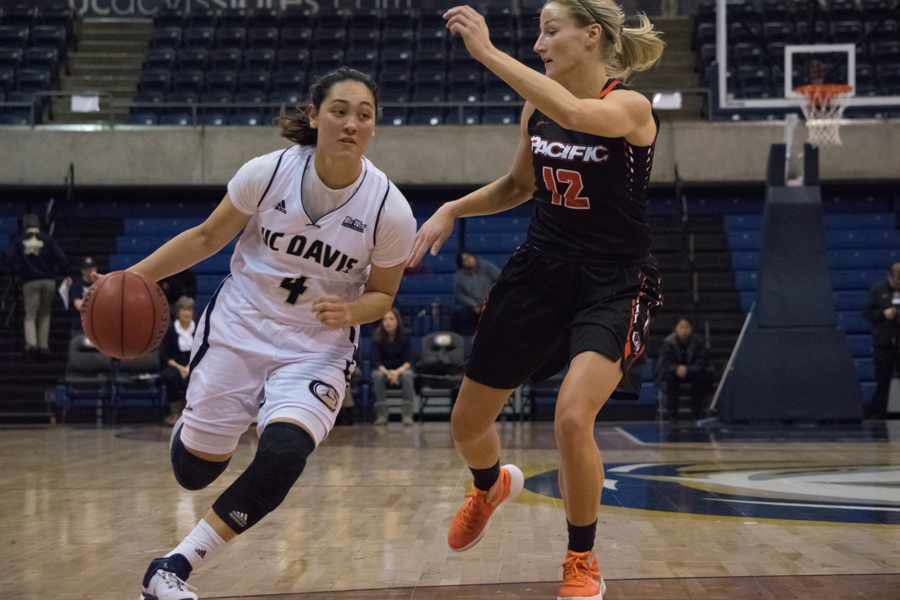
Sophomore guard Rachel Nagel attacks the basket in an attempt to give the Aggies the upper hand. (BRIAN LANDRY / AGGIE)

 66-53 defeat gives women’s basketball team 0-2 record in second official home game

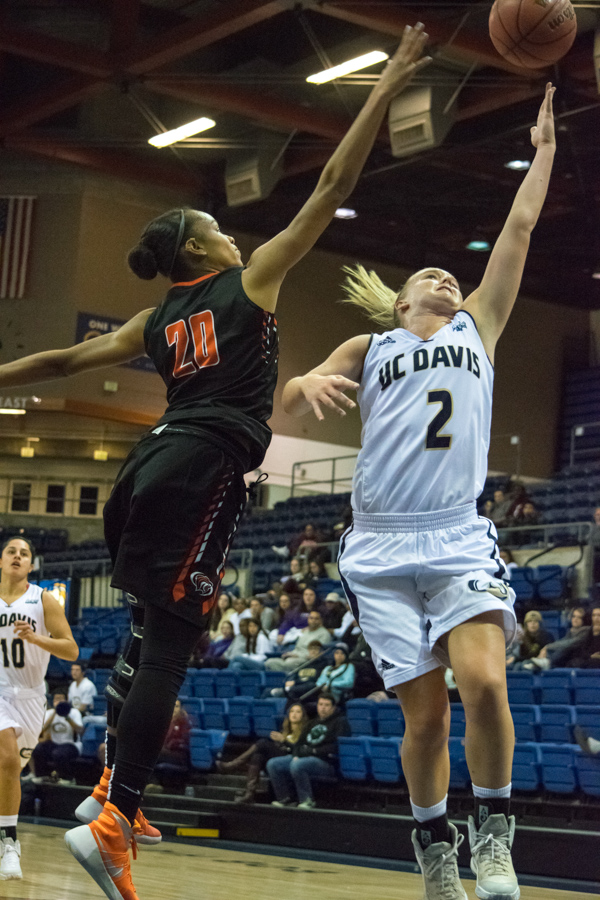
Entering the third quarter with a four-point lead, the Aggies deteriorated in the second half, allowing Pacific to turn it around for a 66-53 Tiger win. UC Davis women’s basketball fell to a record of 0-2 on Nov. 16 while Pacific went home, undefeated this season with two wins.

UC Davis played wide and spread out during the first half, sinking free throws and swishing three pointers.

But the clarity was short lived.

Inconsistency amongst the team resulted in sloppy play during the second half. The Aggies began to bunch up and scrambled to make it to the ball, bringing out the confidence in University of the Pacific as they remained in possession.

Sophomore forward Pele Gianotti stayed aggressive and focused regardless of the scoreboard, adding 11 points to tie her career high, as well as six rebounds. She displayed dominance as the game progressed and the gap increased.

Another dominant player, senior center Alyson Doherty, was on the court sporting kinesiology tape on her left knee and a black eye. Despite the injuries, Doherty picked up a few offensive fouls that could have been avoided. Head Coach Jennifer Gross said they will be looking to improve her performance in order to reduce the stress-causing fouls.

BRIAN LANDRY / AGGIE

Sophomore guard Dani Nafekh tied Gianotti with leading points by also putting up 11 points. She managed to shoot 100 percent in her free throws, gain three assists and add two rebounds. Regardless of the points she put up, scoring was not her focus and she doesn’t blame the Tigers for the team’s loss.

“It was us, we know,” Nafekh said. “They weren’t amazing; they weren’t UConn. We’ve played better teams. Kudos to Pacific — they played really well, but we know we can play better. We need to take it upon ourselves to perform up to our potential and play as hard and as well as we know we can.”

Nafekh also mentioned the team’s difficulty with staying consistent and how the focus in practice has been shifted to working out the kinks in their offense as they rely on defense for the majority of the game.

“I’m never thinking about scoring per se, I’m just thinking of doing what I can to get my team going […] I think once we click, it will be perfect.”

Gross agreed; two of four seniors are playing and lower classmen have been seeing a lot more playing time.

“We’re young,” Gross said. “We’ve been spending a lot of time (on defense) and we’ve kind of  put our offense on hold. Now we have to start getting our offense going a little bit too because we have the ability to score, we just need to get a better flow going offensively.”

While the crowd brought a lot of energy to the game last Friday against Stanford, Gross commented on the low energy displayed against the University of the Pacific.

“Once we get our spacing and our flow worked out, I have no doubt that we are going to be a really potent offensive team, we just have to be patient,” Gross said.

The team’s patience will further be tested tomorrow when they travel to San Diego State.

Written by Veronica Vargo – sports@theaggie.org

Battle against the Rainbow Wahine

0
ASHLEY LUGO / AGGIE
ASHLEY LUGO / AGGIE

UC Davis volleyball loses out to Hawai’i after winning first set.

After performing a sweep down the coast of California with double wins at UC Santa Barbara and Cal Poly, the Aggies returned to home court to face the No. 7 team in the AVCA Coaches’ Poll, Hawai’i, with hopes to replicate their win earlier this month against Fullerton. Despite winning the first set, the Aggies eventually fell to the Rainbow Wahine in a four-set battle of 23-25, 25-17, 25-22 and 25-17.

The first set began with the Aggies and Wahine going neck-and-neck in points. The Aggies were steadfast in face of the strong offensive tactics employed by the Wahine and managed to keep up the entire time. When the score was 23-23, junior outside hitter Allie Wegener served an ace for a point and sophomore middle blocker Aima Eichie made a kill to take the set.

The Wahine adjusted their strategy for the second set and became more successful in their kills. To counter this change, freshman libero Malia Bolko positioned herself to make digs on shots that slipped past the blockers. The Aggies closed the gap to 12-17, but the Wahine went ahead to win the set after a run of seven straight points.

Setting the tone with four points right off the bat, the Aggies pulled ahead with the lead at the start of the third set. Senior outside hitter Kaylin Squyres stole the show with 15 kills and eight digs, showing her versatility as both an offensive and defensive player. Once again, the game was neck-and-neck until the very end, when an Aggie service error led to a side-out and the Wahine made two consecutive kills to end the set.

The Aggies displayed their quickness in the fourth set as the Wahine began floating the ball over the net with greater regularity. Bolko was instrumental in setting up Squyres and freshman outside hitter Nicola Moore for the kill, as she posted a total of 23 digs. The Wahine overpowered the Aggies with the consistency of their kills, which amounted to 57, and the game ended at 3-1, a Wahine win.

“Winning the first game was good,” Squyres said. “We just need to work on sustaining that [play] for a longer period of time.”

Though the Aggies did not get the win they hoped for, many of them saw an improvement from their previous Oct. 16 face-off.

“I thought we were much more in the game than the last time we played Hawai’i,” Bolko said.

The Aggies will have their final away match against UC Irvine on Nov. 21 and return home for the last game of the season against Cal Poly on Nov. 24.

Written by Julia Wu – sports@theaggie.org

Aggie Style Watch: California cold

0
JAY GELVEZON / AGGIE

Busting out the scarves and sweaters.

With temperatures dropping and fall weather finally showing its face, Davis students have begun pulling out their sweaters and scarves. I went out this week in search of a fall look that embraces the weather and was not disappointed.

Alexandra Yan, a second-year majoring in neurobiology, physiology and behavior, embraces the fall weather with a more modern edge, without compromising comfort and practicality.

asw_ar_Gelvezon3ASW: How would you describe your style?

Yan: I like to be comfortable, but I try to keep myself looking pretty sleek or modern. That’s probably the best way I can describe it.

ASW: Do you have any fashion inspirations?

Yan: I don’t have a main inspiration. Usually it’s just what I see online. I like going on lookbook.com to see what people are wearing and trying to recreate some looks in my own way. My housemate has a subscription to Cosmopolitan so I sometimes look through that too.

asw_ar_Gelvezon2ASW: Would you say you put style over comfort?

Yan: I think you can have both comfort and style. I like to be comfortable and look well put together; it makes me feel good for the day.

ASW: What’s your favorite item in your wardrobe?

Yan: I have a circle scarf that’s a pretty teal color. It was handmade by my mom and is one of my favorites to wear during [the] winter.

ASW: Do you prefer dressing for cold weather or hot weather?

Yan: Cold weather. I feel like I can put on more during winter in terms of layering. In summer I’m just trying to stay as cool as possible.

ASW: Is there a decade of fashion that stands out for you?

Yan: I really like the ‘40s, even though I don’t really dress like the ‘40s. I like how it’s very feminine and modern at the same time.


WRITTEN BY: Dimitra Loumiotis – arts@theaggie.org

Being mindful of mental health

0
ACTIVE MINDS / COURTESY

UC Davis alumni, students team up to educate junior high students about mental health.

According to the National Alliance on Mental Illness, one in five children between the ages of 13 to 18 have, or will have, a serious mental illness in their lifetime.

In light of this, Julia Schleimer, a UC Davis alumna and Junior Specialist at the UC Davis Medical Investigation of Neurodevelopmental Disorders (MIND) Institute, created Talk about Change, a mental health education program for secondary school students. Schleimer teamed up with UC Davis faculty, mental health organizations, mental health professionals and student clubs to deliver a preventative mental health curriculum to ninth graders at Oliver Wendell Holmes Junior High School in Davis.

Schleimer’s inspiration for creating Talk about Change came from a class she took in her senior year at UC Davis, in which she was required to create a proposal for a feasible health initiative in the community.

“After I graduated, the idea kind of stuck with me and I kept thinking about how important and necessary this kind of program would be,” Schleimer said. “Mental health is one of the most important things in our life because it affects so many different areas of our life; it connects to our physical health, overall happiness and our ability to achieve our goals, so I thought having a program like this would be great for students in all aspects of their life.”

Each Talk About Change session consists of lectures that consist of teaching students about mental illness, hearing personal stories from UC Davis students and alumni and participating in activities and discussions.  Lecture topics cover mental health issues like depression, anxiety, substance abuse, eating disorders, bipolar disorder and suicide.

Schleimer first created Talk about Change in Spring 2015, seeking help from psychologists and UC Davis students to create a curriculum for a week-long program.

However, this fall, Schleimer has created a curriculum to spread across the Oliver Wendell Holmes Junior High students’ entire semester. Schleimer hopes that this longer curriculum will allow her to observe greater results.

“We spaced out the sessions because it gives students more time to think about these things and ask questions, and it creates a larger opportunity for change,” Schleimer said. “What we’re measuring is a change in knowledge, reported and intended behavior [for example, discrimination] and attitudes. I think spreading [the curriculum] out gives us a greater opportunity to see change. “

Undergraduate students from clubs and organizations, including UC Davis’ Active Minds, helped Schleimer to create this curriculum and lead activities and discussions for the kids.

“I think it’s really important to go in and talk to these kids about [mental illnesses] because they are about to go into high school, where they start feeling things that they haven’t felt before,” said Brenna Williams, fourth-year psychology and evolutionary anthropology major and president of Active Minds. “If [they’re] not educated about the normalcy of those feelings and that it’s okay to reach out for help, [they could feel isolated].”

The undergraduate members are also present at Talk about Change events to help the teenagers if certain topics are triggering for them. If a student leaves the room­­ — even to just use the restroom — a UC Davis volunteer steps out with them.

“We are there to make sure that [the students] are okay emotionally with what was being said [in the class],” said Raquel Medina, a fourth-year psychology and human development double major and Active Minds member. “If they want to speak up or if they have a problem going on, we acknowledge them and we’re there to send them to the counselors.”

For her efforts, Schleimer received a fellowship with the Mental Health Association of San Francisco’s Center for Dignity, Recovery and Empowerment, where she works with leaders in the field of mental health and stigma reduction from all across the world. Currently, Schleimer is applying to graduate school, but hopes that the undergraduate members of Talk about Change will continue her work.

“We found statistically significant results the first year, and I’m hoping we’ll find the same improvements in year two. That is a really great indicator that what we’re doing is actually making a difference,” Schleimer said. “Hopefully, it can be continued somehow.”

Written by: Fatima Siddiqui – features@theaggie.org

Deliver food to friends with JoyRun

0
DEVIN McHUGH / AGGIE

Food delivery app functions on a community basis.

This fall, an up-and-coming food-networking app made its debut at UC Davis. The app, called JoyRun, allows students to easily order and deliver food from local establishments to friends.

Founder Manish Rathi created the app after pondering how convenient it would be to have someone who picked up food for him and his wife, as opposed to going out of his way to get it himself.

“It’s a delivery network of students, for students, where you can pretty much deliver anything,” said Arteen Asgharzadeh, UC Davis alum and JoyRun campus growth lead. “It’s a [social] environment that allows people to interact and chat and get to know each other a little bit while also making money and getting good food.”

The app is downloadable for free at the App Store for both Androids and iPhones. According to JoyRun’s website, the app operates at any time of the day and costs simply the price of the food item plus “a tiny fee for the convenience.” Users pay through the app, eliminating any complications that cash may pose in the transaction.


As Campus Growth Leads for JoyRun, Asgharzadeh and UC Davis alumnus Arsia Sarlak take charge of business marketing and development as well as outreach. They focus on helping to grow the user base by visiting campuses in order to build teams and an overall solid base. Asgharzadeh and Sarlak also work with UC Davis interns to increase awareness of the app.

“Since we’re pretty new and still establishing ourselves, we’re working on new marketing leads and projects,” said Sean Ang, a fourth-year music major and JoyRun campus leader for UC Davis. “Right now I’m running the Facebook page; we’re always working on new marketing strategies, and we also do runs to generate new traffic.”

Asgharzadeh and Sarlak said they enjoy working for JoyRun since it serves as a way for them to stay in touch with the Davis community.

“We love that we get to be part of our community in Davis,” Asgharzadeh said. “We just graduated and we get to give back right away.”

As a current student, Ang said it is exciting to be involved in something that is still relatively new, and that opens the door to so many other opportunities.

“It’s really interesting to be part of something starting from almost the ground-up, which is an experience you usually don’t get with internships,” Ang said. “It’s really cool being more connected with the community and realizing all these connections can lead to really cool things.”

Although JoyRun is mainly food-based, items such as PVC pipes, candy bars and coins for parking meters have been delivered through the app as well.

Though JoyRun currently operates at only two college campuses, UC Davis and Sonoma State University, plans for expansion are already underway. Since the app is still relatively new, JoyRun coordinators hope to explore the option of non-food related interactions in one of the upcoming updated versions.

“We’ve had people put up warnings about drunk driving and community-based stuff that notifies the community [through the app],” Asgharzadeh said. “This individual came on and was like, ‘Watch out, be safe, don’t drive drunk’ just as an announcement and everyone on the app got a notification.”

The JoyRun team is also interested in expanding to serve food fundraisers held by school organizations and clubs such as selling tacos or Krispy Kreme donuts. In particular, Sarlak mentioned Challah for Hunger, a nonprofit organization at UC Davis that sells challah, Jewish braided bread, made by volunteers and donated.

“I ordered from [Challah for Hunger] a couple years back and I thought it was really good,” Sarlak said. “And to this day [I think about] how we can get those people to do it on the app, because they’d be reaching out to a whole different market.”

According to Asgharzadeh, JoyRun’s community basis and social aspect set it apart from other food delivery apps.

“We try to stay away from saying we’re a delivery service,” Asgharzadeh said. “We’re more of a network. Kind of like how Airbnb is not a hotel […] the idea is if you have extra space, why not help someone out?”

For $5 off your next order, use the code CALAGGIE.

Written by: Jacqueline Chu – features@theaggie.org

ASUCD Coffee House works toward sustainability through new recycling program

NICKI PADAR / AGGIE
NICKI PADAR / AGGIE

CoHo to donate proceeds toward ASUCD Scholarship Fund based on number of wrappers recycled.

The ASUCD Coffee House (CoHo) continues to become more environmentally-friendly through its participation in the New Jersey-based upcycling company TerraCycle’s Energy Bar Wrapper Brigade.

Through this partnership, which began in fall 2013, the CoHo collects used wrappers in the CoHo and the dining commons and sends them to TerraCycle to be recycled in exchange for money; shipping labels and costs are covered by the brigade’s sponsor, Larabar.

To support this recycling program, students can add their wrappers to the collection box by the Marketplace cashiers in the CoHo.

“They don’t even have to purchase [bars] here,” said Susan Houlden, CoHo kitchen production and sustainability manager. “We have [had] people bring [wrappers] in if they use a lot at home. We’ll take any brand, not just the ones we sell here.”

The CoHo receives points based on the weight of the wrappers sent in, and TerraCycle awards money based on these points. Houlden said that because wrappers do not weigh very much, only $50 have been earned so far.

“It’s hard because we get very minimal points per bag because they weigh so light, [but] at least [the wrappers are] getting diverted from the landfill, which was our main goal,” Houlden said.

The CoHo plans to donate all proceeds raised from this program to the ASUCD Scholarship Fund. The fund is a campus program run by ASUCD that awards seven undergraduate students scholarships from $500 to $1000 based on answers to a series of questions and their resumes. Any undergraduate student who is enrolled at UC Davis and is in good standing is eligible to apply for the scholarship.

“Even if you don’t care about waste, you care about money to support students,” Houlden said.

TerraCycle, which partners with many schools, companies and gyms to provide this recycling program, also offers a variety of other recycling brigade options.

“We have a lot [of brigades],” said Colleen Duncan, a publicist for TerraCycle. “A lot of our collections are packaging from food. We also do things like cigarettes, toothbrushes, things that you wouldn’t even think are possible to recycle. We also have Glad containers [and] personal care and beauty [as brigade options], which is big in schools and colleges.”

Houlden said that the CoHo is on the waiting list to participate in the chip bag brigade as well. She confirms that the CoHo is already collecting chip bags along with the wrappers, and that the unit currently has 20 pounds of chip bags ready to send in.

Hannah Ulansey, the unit director of the ASUCD Campus Center for the Environment, believes that this program has the potential to increase students’ environmental awareness on campus.

“In order for UC Davis to reach the UC goal of zero net waste, it is essential to bridge the gap between administration and the student body and to get students, the over 30,000 individuals [who] make up our campus, to take a larger part,” Ulansey said. “Diverting any excess waste from landfills will help [UC] Davis reach the 2020 goal, and where better to start then at the central hub of student life on campus?”

Written by: Alyssa Vandenberg – campus@theaggie.org

First things first

0
ARIEL ROBBINS / AGGIE

Students discuss their first thoughts in the morning

“What was the first thing you thought of when you woke up this morning?”

elizabeth_lin_rovingreporter_fe_Robbins
Elizabeth Lin, first-year, undeclared major

“I opened my eyes and thought, ‘it’s a nice day.’”


aileen_flores_rovingreporter_fe_Robbins

Aileen Flores, first-year international relations major

“Breakfast.”


trevor_metz_rovingreporter_fe_Robbins

Trevor Metz, first-year mechanical engineering major

“Midterms. Math.”


katherine_domenici_rovingreporter_fe_Robbins

Katherine Domenici, third-year microbiology major

“It’s going to be cold outside; I don’t want to get out of bed.”


weston_templeton_rovingreporter_fe_Robbins

Weston Templeton, third-year evolution, ecology and biodiversity major

“Oh crap, what time is it?”


lydia_williams_rovingreporter_fe_Robbins

Lydia Williams, alumni class of 2015

“I get to see my friends today!”


mariah_smith_rovingreporter_fe_Robbins

Mariah Smith, first-year food science major

“I thought I was going to be late.”


oscar_jan_rovingreporter_fe_Robbins

Oscar Jan, fourth-year clinical nutrition major

“I had ‘Tribute’ by Tenacious D stuck in my head.”


Yesenia yesenia_duenes_rovingreporter_fe_RobbinsDuenas, second-year human development major

“What’s for breakfast?”


sydney_garcia_rovingreporter_fe_Robbins

Sydney Garcia, second-year neurobiology, physiology and behavior major

“I have two midterms today.”


daisy_luna_rovingreporter_fe_Robbins

Daisy Luna, third-year biological sciences major

“I thought about my stats midterm.”


Mashari mashari_alangari_rovingreporter_fe_RobbinsAlangari, second-year electrical and computer engineering graduate student

“I lost my wallet two days ago so when I woke up, I had to go to the bank and get my

ID, my license, all of that stuff.”


charlie_rovingreporter_fe_Robbins

Charlie the Dog

“Bark.”


zachary_ramalingam_rovingreporter_fe_Robbins

Zachary Ramalingam, first-year sustainable environmental design major

“Oh no, I have to get up.”


Written by: Neha Mannikar – features@theaggie.org