55.9 F
Davis

Davis, California

Tuesday, December 23, 2025
Home Blog Page 770

This week in Senate

0
HANNAH LEE / AGGIE
HANNAH LEE / AGGIE

Senate discusses recent AP/IB decision, other issues

On Nov. 12 at 7:59 p.m., ASUCD Vice President Gareth Smythe called to order the quarter’s seventh senate meeting in the Mee Room of the Memorial Union.

There were two presentations during Thursday’s meeting.

First, ASUCD President Mariah Kala Watson’s executive staff presented the progress they have made throughout the fall quarter. All subdivisions of the executive staff, which include Administrative Affairs, Development, Public Engagement and Programs, delivered presentations.

The executive staff achieved several goals this quarter. They simplified the process of gaining credit for internships, increased the amount of scholarship money given to qualifying recipients and are in the process of creating a campus-wide directory.

Following this update, Watson presented a Memorandum of Understanding (MOU) with the Center for Student Involvement (CSI). In this MOU, ASUCD will be receiving money from CSI in return for primarily technology usage.

Several confirmations were made for various commissions. Senate confirmed members from the Environmental Policy and Planning Commission (EPPC), the Gender and Sexuality Commission (GASC), Academic Affairs Council (AAC), and the Ethnic and Cultural Affairs Commission (ECAC).

Next, Grace Scott, the unit director for Picnic Day, presented this year’s Picnic Day plans. The theme of this year’s Picnic Day is “cultivating our authenticity.” Scott also discussed this year’s parade marshall, Ramsey Musallam, a teacher who specializes in multimedia.

Three Senate bills were passed last Thursday.

First, Senate Bill (SB) No. 14 was passed. SB No. 14 was more of a clarification concerning the difference behind a statement and a platform. This bill officially defined the meaning of a statement and the meaning of a platform for future reference.

Next, SB No. 17 was passed, also a clarification. It clarified the position of The City of Davis Human Relations Commission representative as any member from the External Affairs Commission.

Lastly, SB No. 9 was passed, which will establish a University Library Committee composed of students and faculty to discuss how to better renovate the library to fit changing student needs. This committee will also serve to relay student interests to library staff. The bill passed with a 7-3-2 vote.

SB No. 15 was withdrawn from the meeting in order to undergo revisions. This bill would have established a transfer, re-entry and veteran committee which would provide input and improvements to the First Year Handbook.  

Senate ended with Public Discussion, where senators discussed the university’s recent decision to not allow AP/IB credits to count toward pass times. A majority of the senators believe that the decision was made without the consultation of any students or student representative.

Ritesh Mishra, chairman of AAC, stressed the importance of ASUCD providing student input for future academic decisions.

After public discussion, the meeting adjourned.

New Beans on the Block

ANH-TRAM BUI / AGGIE

Temple Coffee Roasters hosts opening party for new location in Davis

Temple Coffee Roasters, with their unique take on coffee, has arrived in Davis. Residents from across town flocked to the well-lit café, located at 239 G St., for the Opening Party held on Nov. 11.

Complimentary beverages, a live jazz band and a photo booth were just some of the festivities  showcased during the event.   

“We’re doing something different that Davis hasn’t seen before. We’re very quality focused — we buy the top percent coffee in the world and we’re really excited to bring it to Davis,” said Cole Cuchna, Temple Coffee’s director of Creativity and Barista Education.

Temple’s unique dedication to slow-drip brewing and large selection of coffee beans from around the world shows that quality is the name of the game. Memorabilia displayed around the café highlights the strong relationships Temple has built with their trusted bean farmers.

Temple currently has three cafés already in Sacramento and a fourth planned to open in the next year.

“Davis is our next-door neighbor.  It seemed like a natural fit, and we thought there was a need for us here,” Cuchna said.  “There is no one doing it how we do it.”

There was much hype surrounding the Opening Party, as many eager customers formed a long line outside of the café.   

“It’s about time a place like this [came] to Davis,” said second-year economics major Jacob Glazer.

Temple is well-known for their large variety of coffee beans and dedication to perfection.

“It’s nice to see a cafe respecting coffee from around the world.  Temple is a perfect place where I can be with my thoughts,” said second-year chemistry major Eugene Lee.

It appears that Temple Coffee Roasters has already found a niche in the hearts of many Davis residents and is proving to be an outlet for casual coffee drinkers as well as java junkies alike.   

Written By: TRISTEN THALHUBER – citynews@theaggie.org

This week in sports

0
TIFFANY CHOI / AGGIE

Aggie athletics action from Nov. 9 to Nov. 15

Men’s basketball (1-1)

UC Davis vs. North Dakota State (L, 79-71 (OT))

UC Davis vs. Portland (W, 79-66)

Starting off their season with three home games, the men’s basketball team took to the court on Nov. 13 against North Dakota State. Though the Aggies led 69-60 with two minutes left in the game, North Dakota tied it up, forcing the game into overtime where they overpowered UC Davis 79-71. This ended a 14-game winning streak from the previous season.

Read a recap of the game by sports reporter Aaron Sellers here.

Two nights later, UC Davis defeated Portland 79-66 after putting a powerful defense and an unrelenting offense onto the court. Junior guard Brynton Lemar put up 18 points and senior forward Josh Fox scored 15 for the night. Junior guard Darius Graham and sophomore center Nolan Berry were close behind with 12 and 10 points, respectively.

The men’s basketball team will play Fresno Pacific on Nov. 18 at 7 p.m. in their third straight home game.

Women’s basketball (0-1)

UC Davis vs. Stanford (L, 74-45)

Following a victorious exhibition game against Humboldt, the UC Davis women’s basketball team officially started their season with a game against Stanford in a double header that followed the men’s basketball home opener.

The Aggies remained extremely close to Stanford in terms of scoring for the first two quarters; the Cardinal only led with 29-24 going into the half. However, the third quarter is when Stanford took off and sealed the outcome of the game by scoring 31 points, only allowing the Aggies to put eight points on the board. The fourth quarter was more evenly played, but the damage was done.

The Cardinal took the game 74-45.  

Read a full recap of the game by sports reporter Lindsay Yim here.

The Aggies will play in the Pavilion tonight at 7 p.m. against Pacific.

Men’s cross country

NCAA West Regionals (13th place finish)

In a competition at the NCAA West Regionals on Nov. 13, the UC Davis men’s cross country team ran hard in their 10-kilometer race, coming in at 13th place out of 30 teams. A time of 31:47.0 gave senior Halsted a 27th place finish; he was followed six seconds later by classmate Amar Dholakia (31:53.7) in 34th. The remaining three scorers for the men’s team  seniors Cody Nguyen (33:04.8), Nick Ratto (33:39.1) and freshman Jordy Ceja (33:44.9) finished within 45 seconds of one another.

The complete results for the meet can be found here.

Women’s cross country

NCAA West Regionals (15th place finish)

Traveling to Seattle with their male counterparts, the women’s cross country team placed 15th in their 6-kilometer race in a field of 35 teams. Out of the Big West schools competing, UC Davis came in second behind Cal Poly, who finished two spots ahead of the Aggies.

The seniors were the top-three finishers for UC Davis. Erika Barr finished 27th individually with a time of 21:16.5, Christine Hoffman trailed Barr by 20 seconds, crossing the line at 21:36.6 for 52nd place and Katie Fry came in 13 spots later with a time of 21:46.9. Redshirt junior Nicole Lane (22:18.1) and junior Rianna Goins (22:33.8) were the final two scoring Aggies for the race.

Football (1-9, conf. 1-6)

UC Davis vs. Cal Poly (L, 55-38)

In the final home game of the season, the UC Davis football team played a high-scoring game against the Cal Poly Mustangs. Barely two minutes into the game, both teams had put points on the board, and by halftime Cal Poly had scored five touchdowns to UC Davis’ two, leading into the third quarter 34-14.

The Aggies forced two fumbles in the second half, leading to additional touchdowns. Their momentum carried them within reach of the Mustangs as UC Davis trailed 41-38. With a little under three minutes left in the game, Cal Poly scored the last touchdown to bring the final score to 55-38.

Senior wide receiver Alex Cannon had the best game of his career with 122 total yards gained and six catches, while sophomore safety Darryl Graham had 14 tackles another career high. Another Aggie with a career best was sophomore tight end Nolan Tooley, who gained 70 yards and scored a touchdown.

This gives UC Davis a conference record of 1-6 and an overall record of 1-9.

Men’s soccer (8-10-3, conf. 3-4-3)

UC Davis at UC Santa Barbara (L, 1-0)

After advancing to the Big West Semifinals with the defeat of CSU Northridge on Nov. 7, the men’s soccer team faltered against UC Santa Barbara late in the game, eventually losing 1-0. The majority of the match remained scoreless, largely due to the consistency of the defense on both teams.

UC Davis had six shots versus UC Santa Barbara’s 10, and senior goalkeeper Kris Schultz made three significant saves before the game was out.

The soccer team’s season ends with an overall record of 8-10-3 and a conference record of 3-4-3.

Volleyball (13-15, conf. 8-6)

UC Davis vs. Hawai’i (L,3-1)

In their second-to-last home game of the season, the UC Davis volleyball team lost to the Hawai’i Rainbow Wahine after playing four sets, 23-25, 25-17, 25-22 and 25-17. Freshman libero Malia Bolko led both teams with 23 digs, and senior outside hitter Kaylin Squyres claimed 19 kills. Though facing a team that had a 22-1 record heading into the game, the Aggies put up a strong fight and made the Wahine earn their win.

The volleyball team travels to UC Irvine on Nov. 21 for their penultimate game of the season.

Written by Bryan Sykes – sports@theaggie.org

Women’s basketball falls to Stanford in home opener

CIERA PASTUREL / AGGIE

The Aggies put pressure to keep game close with the Cardinal before falling in third quarter

UC Davis women’s basketball put up a hard fight against Stanford on the night of their official home opener, but ultimately ended up losing to the Cardinal 74-45. The Aggies started the game neck and neck with Stanford and even had the lead before the end of the first quarter at 15-14. The second quarter continued the tight race between the two with Stanford leading 29-24 at the half.

“I was so, so proud of our effort in the first half,” Head Coach Jennifer Gross said. “We were playing with passion and urgency, and we were battling. We’ve been talking since day one about our defense, and the first half we got a glimpse of how well we can play.”

The Aggies held the Cardinal to 30 percent shooting and four steals throughout the first half. After the break, Stanford came out with aggression, scoring 31 points to UC Davis’ eight, bringing the third quarter score to 60-32. The Cardinal also held the Aggies to 17 percent shooting for the second half to ensure their win.

“The third quarter, unfortunately, was another story,” Gross said. “We lacked some urgency and some energy and that’s where the game slipped away. I thought we played three very good quarters, but you can’t win games if you don’t bring it for 40 minutes.”

Despite the challenging third quarter, UC Davis continued to give Stanford trouble by scoring 13 points in the fourth and out-rebounding the Cardinal 24-23 for the half. The Aggies ended the game with 45 rebounds to the Cardinal’s 47.

“We’re young in terms of us running the new offense,” Gross added. “We struggled getting into it cleanly. We weren’t always on the same page, and that’s OK. We’re young and we’re staying the course and continuing to get better.”

Senior forward Alyson Doherty had her 11th career double-double with 10 points and 11 rebounds for the game. Sophomore guard Rachel Nagel led UC Davis with 18 points, hitting 4-of-10 from three-point range and grabbing five rebounds in 25 minutes of play. Another high for the Aggies was sophomore forward Pele Gianotti with 10 rebounds.

UC Davis next plays Pacific tonight at 7 p.m. in the Pavilion.

Written by Lindsay Yim – sports@theaggie.org

UC Davis basketball loses close game in overtime

JAY GELVEZON / AGGIE

North Dakota breaks Aggies undefeated home streak

The Pavilion has fallen. I repeat, the Pavilion has fallen.

The UC Davis men’s basketball team lost their opening game against North Dakota State, ending their 14-game-undefeated-at-home streak from the previous year.

“We just had some breakdowns at key times,” Head Coach Jim Les said.

Junior guard Lawrence White opened up the 2015-2016 Aggie season with a large steal into a foul, sinking one of the free throws for the first point of the game and season.

However, North Dakota was able to turn this early Aggie offensive around and jumped up to a quick lead. Key stops by junior center Neal Monson and junior guard Darius Graham equalized the game with 11:43 still on the clock for the Aggies.

After sitting out last season following his transfer from Butler University, sophomore center Nolan Berry came into the game in a big way, sinking a three with ease. His on-the-court size and positional awareness contribute to Berry as a dynamic playmaker. Berry will be an important figure off the bench in the Aggie offence for the coming months.

Senior forward Josh Fox came alive the second period, sinking 10 points and a flurry of rebounds.

CIERA PASTUREL / AGGIE

The Aggies’ offense did not once lose their lead throughout the second period. With a score of 69-60 and two minutes left in play, UC Davis looked like it had the game locked up. However, the Bisons were able to equalize the score in the last three seconds of regulation play and force overtime.

The Aggies were unable to stop North Dakota’s momentum, and the Bison went on to score 10 points before Monson could score two off of free throws.

The Aggies lost 71-79.

A key facet of the game was the Aggie’s penalty conversion rate. Making 15 of their 31 free throw attempts, the Aggies only made 48 percent of their penalty scoring opportunities. Clearly, a single penalty shot would have spelled an entirely different outcome.

“We practice them every day,” Les said. “We need to continue to practice them and try and work on ways to put pressure on the guys. I think it becomes a little bit of a mental game.”

The UC Davis men’s basketball team faced off against Portland on Nov. 15 and will compete against Fresno Pacific Nov. 18 at 7 p.m.

Written by Aaron Sellers – sports@theaggie.org

ASUCD fall election results

BASED candidates Adilla Jamaludin (left), Parteek Singh (center) and Georgia Savage (right) win three of six ASUCD senate seats. (JAY GELVEZON / AGGIE)
BASED candidates Adilla Jamaludin (left), Parteek Singh (center) and Georgia Savage (right) win three of six ASUCD senate seats.
(JAY GELVEZON / AGGIE)

ASUCD elects six new senators

On Nov. 13 at 12 p.m., ASUCD elections chair Daisy He revealed the results for the fall quarter election at the Mee Room in the Memorial Union.

In order of votes received, the six new elected senators are Mikaela Tenner, Georgia Savage, Joshua Dalavai, Parteek Singh, Puneet Dhindsa and Adilla Jamaludin.

Of the newly elected senators, Savage, Singh and Jamaludin are on the recently formed BASED slate while Tenner, Dalavai and Dhindsa ran as independents.

The incoming senators will replace outgoing senators Reem Fatayerji, Alex Lee, Casey Nguyen, Roman Rivilis, Brendan Chang and Andrea Velazquez.

The Aggie Card design that received the most votes was Option 1 (pictured below), which featured a UC Davis mustang in front of a gradient with the university’s colors.

MELANIE ZELAYA / COURTESY

In regards to his new position, Dalavai expressed his excitement to begin pursuing his platforms.

“I’m just really happy that I was able to get elected. I’m very excited,” Dalavai said. “There’s a lot of stuff that I want to get on the ground.”

For Singh, the positive election result is a welcomed relief for his stressful week.

“I didn’t sleep last night because I had a midterm this morning and I couldn’t study. I was extremely stressed,” Singh said. “I kind of feel relieved. Happy, relieved.”

Jamaludin, who initially placed seventh because of a technical difficulty, was in pure shock when she found out she nabbed the final sixth spot on the senate table.

“[I feel] very shocked. I mean, that was a quick turn. I was waiting for the screen to change again,” Jamaludin said. “I expected it to be very, very close so when I saw that I was expecting either way to happen. It’s still pretty crazy.”

The six new senators will be sworn in on the Dec. 3 ASUCD senate meeting. Complete results can be found online.

Written by: Jason Pham – campus@theaggie.org

UC Regents to vote on increased non-resident tuition, massive enrollment expansion

JASNA HOZDIC / AGGIE FILE

Regents seek to expand UC enrollment by 10,000 students by 2018

On Nov. 19, the UC Board of Regents will vote on a plan to expand in-state undergraduate enrollment across all nine UC campuses by 10,000 students by the 2018-2019 school year. The plan also seeks to increase non-resident tuition by eight percent with the goal of collecting $68.7 million in new revenue.

The enrollment expansion is in response to a proposed budget from the state, which will allocate $25 million to the UC if the system increases in-state enrollment by 5,000 students by fall 2016.

Additionally, the system is also proposing secondary increases of 2,500 in-state students for both fall 2017 and fall 2018.

If the plan passes, the UC will see a 20 percent increase in enrollment over the next three years. According to the plan, the proposal is an effort to increase access to the system’s educational programs and rebuild academic excellence.

“The University of California is meeting the challenge of educating as many students as it possibly can to meet, and solve, the challenges of the future,” said UC President Janet Napolitano, in a public statement. “We are committed to sustaining increased access to our campuses and the world-class education they offer.”

In regards to the increase in non-resident tuition, the proposed tuition hike is meant to provide the UC with additional revenue to support the incoming students and combat the recent slashes in budget from the state.

The UC regents will convene from Nov. 18 to Nov. 20 at the UC San Francisco Mission Bay Conference Center to discuss and vote on the plan.

A full agenda of the meetings as well as a live-stream of the open sessions can be found online.

Written by: Jason Pham – campus@theaggie.org

UC Davis fosters 13 new startup companies

0
startups_fe
ASHLEY PAE / AGGIE

UC Davis campus resources provide services for startup companies

In the last fiscal year, UC Davis services provided support for the development and success of 13 startup companies.

Established in 2013, Venture Catalyst is one of three divisions at UC Davis’ Office of Research. Its purpose is to support and provide resources to entrepreneurial researchers, faculty and students whose technology and research will be best commercialized through startup companies.

“The focus of Venture Catalyst is to be available as a resource for our academic researchers who have an aspiration to see societal benefit from their research through a startup company,” said UC Davis Associate Vice Chancellor for Technology Management and Corporate Relations and Executive Director of Venture Catalyst Dushyant Pathak.  

One of the startups that Venture Catalyst worked with in the last fiscal year is DNA to RNA (DtoR) Inc. This company has created technology that customizes transcription control sequences and optimizes gene expression for agriculturally significant traits in crop plants and livestock.

“This technology also has application to human medicine,” Pathak said. “In a very short period of time, after it went into our incubator…[it] was able to successfully raise capital from a San Francisco based fund which allowed it to really get on a much faster trajectory to developing its technology.”

Venture Catalyst also worked with ImmunoTess, a company that has created novel compounds for immunomodulation and inhibition of inflammation for enhancing the efficacy of immunotherapy. With the help of Venture Catalyst, the startup raised over $1 million to develop further technology, which is leading them into FDA-regulated clinical trials and hopefully, eventually into the marketplace.

Venture Catalyst’s focus is to enable the commercialization of technology for societal benefits through startup companies. Pathak said the objective of Venture Catalyst, in simplest terms, is to work with their innovators. This is why faculty and researchers make themselves available to any students who want to create a startup in order to help them through the process and to discuss the pros and cons of their idea.


According to Pathak, student technology is not amenable to a startup since they don’t lend themselves to building a business and instead act as a single-product opportunity.

“In those cases, the technology will be better commercialized by partnering with an existing or established company or licensing the technology directly to a large company,” Pathak said. “In some cases, there’s a substantial amount of additional proof of concept involvement [and] early research work that needs to be done before you can have the technology at a stage where the company will be able to raise capital.”

Venture Catalyst collaborates with other services on campus, such as the Engineering Translational Technology Center (ETTC) and the Child Family Institute for Innovation and Entrepreneurship (CFIIE), to provide better resources for prospective entrepreneurs.

The ETTC aims to help facilitate the development of startups by supporting tenure-track professors during a critical stage of idea development in a familiar, secure environment while also remaining close to their research and teaching missions.

“Oftentimes a faculty member or a student will have no clue about how to start a business, how to file legal forms, how to look for marketing [or] how to do a business plan,” said Executive Associate Dean and ETTC Director Bruce White. “We will assist the individual startup, connect them with legal sources that will help them incorporate and establish at the appropriate time.”

UC Davis also offers support and services for the CFIIE, which integrates science and business for social benefit. CFIIE offers students the opportunity to get involved with the Big Bang! Business Competition, an annual competition offering mentorship, team building, education, financing and networking for aspiring entrepreneurs.

“We offer about 25 workshops throughout the year that people can come and learn about business skills, business plans and pitches,” said Executive Director of the CFIIE Cleveland Justis. “And if they have an idea, we can help them start a company.”

In this year’s Big Bang! Business Competition, more than $40,000 was awarded in prizes, with first prize going to a mother-daughter duo who co-founded Scrumpt — an online service where parents can order weekly lunch kits for their kids as a way to provide healthy lunches. For 2016’s competition, more than $60,000 will be awarded in prizes.

“Our goal is to help the Davis community be more innovative and make sure the university is really supporting our entrepreneurs to the best we can,” Justis said. “Our tagline is ‘Ideas out of the lab and into the world.’ The idea is that getting ideas out to people and the tools to make their companies, their non-profits a reality.”

Justis said that the university is obliged to help foster ideas and make all resources available to the public, whether that comes in the form of companies, products or non-profits.

“We are primarily a research university, but we want the benefits of that research to reach society,” Justis said. “And we feel a real obligation to help society get better and a lot of the work being done at Davis is terrific as research, but that research can [also] be applied to make the world a better place.”

According to White, the U.S. has been a world leader from a global standpoint with regard to the importance of innovation and technology for many decades, but has recently lost its edge due to unparalleled innovation in other Asian and European countries.

“To keep America financially healthy, we have to innovate,” White said. “We have to be the leading edge of new products and research. This is a small contribution, but it helps assist the country in moving in that direction.”

Written by: Jacqueline Chu – features@theaggie.org

New ASUCD resolution requires Student Alumni Association to meet membership quota

0
BRIAN LANDRY / AGGIE

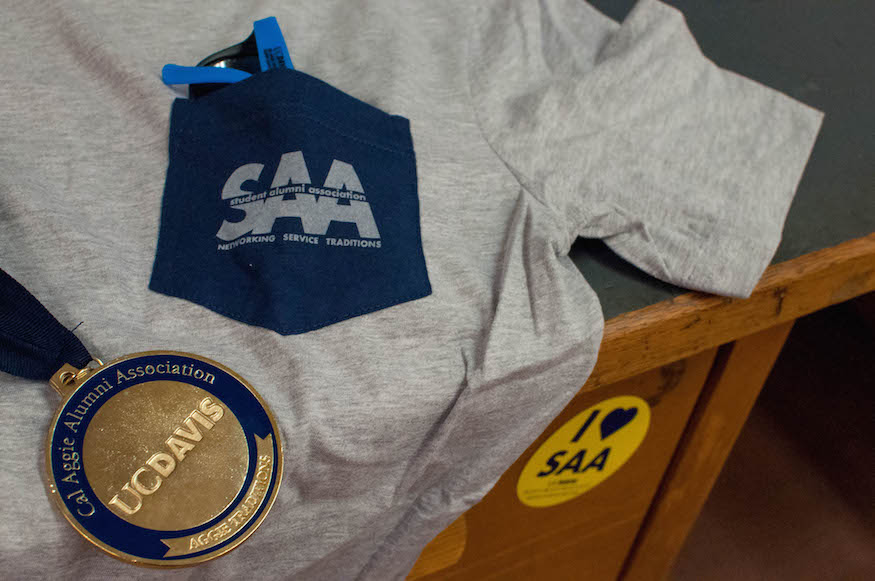
SAA must meet quota in order to continue collecting voluntary fees

The Student Alumni Association (SAA) has always collected voluntary fees from its members, but it has not been a concern for the organization until recently, when the association became a Registered Student Organization (RSO).

RSOs that collect fees must follow certain campus regulations concerning membership numbers. On Oct. 22, an ASUCD resolution was successfully passed, allowing SAA to continue collecting fees under the condition that they have a certain amount of people pledging to pay the voluntary fee by the end of this year.

SAA is an organization that allows individuals to enjoy the benefits of a Cal Aggie Alumni Association membership while still being enrolled as a current student at UC Davis. Previously, SAA was an unregistered organization, which allowed it to collect fees without needing to follow certain campus policies.

Current SAA president Annette Nguyen, a fourth-year neurobiology, physiology and behavior major, has been very involved with the resolution process. In an email interview, Nguyen specified what exactly the new resolution entails.                                                                                

“SAA has [successfully] passed a resolution through ASUCD last week stating that SAA has one year’s time to reach a membership of 10 percent of the undergraduate population in order to continue charging a voluntary quarterly membership pledge,” Nguyen said.                                                                        

ASUCD Vice President Gareth Smythe, a fourth-year political science and history double major, explained how resolutions are passed.          

“ASUCD can pass a resolution that states the opinion of the student government that [SAA] should be allowed to continue taking voluntary fees from students,” Smythe said. “The resolution has to be concurrently approved by the chancellor’s office and student government.”

Anne Reynolds Myler, the director of the Center for Student Involvement, explained that SAA is facing these special circumstances because of their voluntary fees.

“This is not a membership policy for all the clubs and all the student organizations that register have [to] follow,” Myler said

Myler made it clear that under normal circumstances, RSOs only need five active students.

Since the resolution was passed, a contract must be formed between UC Davis and SAA in order to sustain these policies.

“The contract is the mechanism for how the collection and the processing of the fees is going to happen,” Myler said.                                                    

Jillian Giblin, a fourth-year exercise biology major and SAA vice president of outreach, believes that complying with the new resolution should be simple. In an email interview, she explained that many students are highly interested in joining SAA.

“We do not find it difficult to motivate students to join SAA,” Giblin said. “Our goal of the [SAA] is to connect current students with alumni through various networking events.”

For more information about becoming a member of SAA, see their website.

“Many students are eager to join this organization and have the opportunity to talk with alumni in their respective fields,” Giblin said. “During outreach and tabling events, we do our best to inform students of the benefits, events and programs we offer, and encourage students to seek out additional information on our website or contact us if they have any questions.”


Students march across campus for Divest, Disarm: Davis for Black Lives protest

CIERA PASTUREL / AGGIE

Protesters demand university divest from private prisons, campus police disarm military-grade weapons

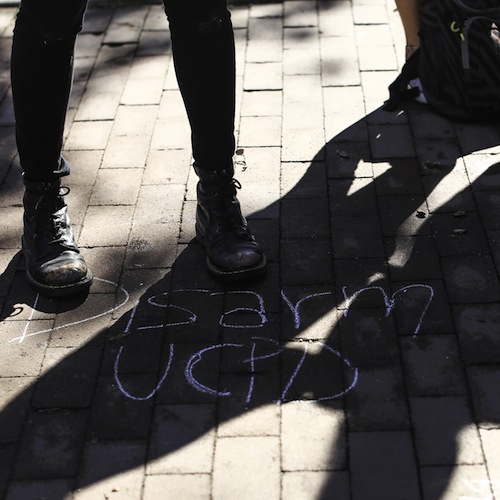
On Nov. 3, students gathered to partake in the Divest, Disarm: Davis for Black Lives protest. Organized by students under Davis Stands With Ferguson, the protest began at noon outside the Memorial Union. The protesters stopped by the university’s police department before ending outside the ASUCD Coffee House at 1:30 p.m.

The protest centered on two demands. First, it demanded that the university divest from companies which invest in the private prison system. Second, it demanded that university police stop using military-grade weapons.

The protest was primarily composed of student supporters. One of the supporters was Dorian Kariuki, a first-year biomedical engineering major who felt that the university was not legitimately addressing the concerns of students of color.

“The one incident that really sparked me to come [to this protest] is the incident of the post-graduate student that was kicked out of the library,” Kariuki said. “It’s the fact that we’ve had incidents similar […] and it’s been ignored [by the university].”

However, there were a few students present who disagreed about the overall ideas of the protest and its movement, including third-year political science major and transfer student Konnor Ternus. While he did not allow The Aggie to directly quote him, Ternus, who was moved by the recent campus shooting at Umpqua Community College, believes that arming police is necessary in providing a quick response in the case of an emergency.

The protest and all its differing perspectives are part of an ongoing nationwide discussion on mass incarceration and police-community relations. For fourth-year environmental science major Kyla Burke and Ph.D sociology candidate Brandon Buchanan, head organizers of the Divest Disarm protest, the protest is a continuation of the work previously made by Davis Stands with Ferguson.

However, according to Burke, the Divest Disarm protest is unlike previous protests organized by the group because it is specifically geared toward the racial problems that Davis Stands with Ferguson believes systematically exist in Davis and in the UC system.  

“This is a continuation of the Black Lives Matter movement on campus,” Burke said. ”This year we’ve kind of shifted our focus more on campus and how those issues, structures and systems [in the Black Lives Matter movement] affect our campus.”

The university itself has faced a number of allegations decrying excessive police force in the past. Just recently, on Aug. 26, an African American alumnus was forcibly detained by UC Davis police at the 24-hour study room. On Nov. 18, 2011, 10 UC Davis students were pepper sprayed by former university officer Lieutenant John Pike while peacefully protesting in the Quad. The incident gained international attention.

CIERA PASTUREL / AGGIE

According to Davis Stands with Ferguson, this is all part of the university’s history of using campus police to silence students who disagree with the administration. In a blog post entitled “Davis Stands with Ferguson: Two Steps Towards Dismantling State Violence,” the group explains the role they believe university police have played in greater depth.

“The history of policing is a history of racial terror; one which grows directly out of runaway slave patrols and the black codes,” the post said. “Building on this history, campus police were specifically introduced into the university system in the 1960s and ‘70s to quell student protest.”


The protesters attribute the suppression of student voices and the university’s continued financial support of prisons as perpetrators of a cycle of violence and systematic oppression, both locally and nationwide.

The protesters believe that, in order to stop this cycle, the university must first look at its investments. The UC system as a whole invests in companies which both directly and indirectly support major for-profit businesses, such as the Corrections Corporations of America (CCA) and GEO Group. These are businesses that solely profit through the growth and expansion of private prisons and detention centers.

Only recently did universities begin to divest from such companies. On Jun. 23, 2014, Columbia University became one of the first American universities to divest from funding private prisons. From March 2013 to March 2014, several UC campuses passed similar resolutions through their student government to divest their associations from companies which support the private prison business.

Proponents of the Divest Disarm protest are looking toward ASUCD to pass a similar resolution through senate. Currently, UC Berkeley, UC Santa Barbara, UC Los Angeles, UC Irvine and UC San Diego have all passed senate resolutions divesting their associations from businesses that indirectly or directly support for-profit groups like CCA or the GEO Group.

On top of passing a divestment bill, there have been ongoing discussions concerning how ASUCD can better improve the overall relations between students and officers.

Last year, ASUCD helped organize a series of open community forums where students were able to voice their concerns directly to police.

For ASUCD senate candidate Josh Dalavai, while the discussions are a good starting point, they should not be seen as a final solution towards the issue of police-community relations.

“The forums aren’t the be-all and end-all solution because it’s not on students to have to justify themselves to a department that should serve them regardless,” Dalavai said. ”They are a great step for establishing communication.”

The administration continues to support the work done by the UC Davis Police Department. In a written statement by Andy Fell, a media representative for the police department, he states the ongoing commitment police have to serve the students.

“Chief Carmichael and UC Davis Police are committed to serving all members of the community equally without bias,” Fell said in the statement.

Fell also stressed the existence of the Police Advisory Board (PAB), a committee separate from the police department which seeks to provide more accountability for students regarding police misconduct.

“We have an independent Police Advisory Board to investigate complaints we think [are] unique for a campus police department,” Fell said.

While Buchanan and Burke appreciate the existence of PAB, they see the board as an after-the-fact response. They believe there should be more preventative measures in place to stop police misconduct from occurring. For Buchanan, the weight of this protest still holds regardless of PAB’s existence.

“Instead of waiting for a cop to shoot someone or threaten someone with a weapon, we’re saying that they should be disarmed,” Buchanan said. “So instead of it being after the fact when it gets brought up to the Police [Advisory] Board, we’re saying it should never have to happen in the first place.”

My All-American review: Sports movie fails to wow audiences

0
CLARIUS ENTERTAINMENT

New football movie full of clichés and cheesy dialogue.

In his directorial debut, Angelo Pizzo fails to wow audiences with the generic underdog story, My All-American. It seems as if he’s taking his pen while going down the proverbial list of must-haves in your cliché sports movie and checks every box along the way. Overcoming insurmountable odds? Check. Bad acting? Check. Cheesy dialogue? Double check. Pizzo, neither innovative nor original, never offers anything new to moviegoers as his film, based on the real story of Texas Longhorn player Freddie Steinmark, gets the generic Hollywood big screen treatment. Despite its potential, My All-American fails to live up to the transcendent tale of Steinmark and ultimately ends up being just all right.

From the opening scene alone, this film has mediocre written all over it. The movie starts out in 2010 at the University of Texas with an interview of Coach Darrell Royal (Aaron Eckhart). By this time, Coach Royal is well into his eighties. Just one problem — the hair and makeup on Eckhart is obviously fake (think Johnny Knoxville in Bad Grandpa), making it hard for audiences to take this movie seriously and consequently setting a disappointing tone for the duration of the film.

My All-American then flashes back to the 1950s to tell the tale of Freddie Steinmark, narrated by Coach Royal. Colorado native Freddie Steinmark (Finn Wittrock) has always been labeled as too small to play college football. Teaching hard work and dedication, Freddie’s father is relentless in his training, developing an impressive physical toughness in Freddie both on and off the gridiron. The extra fight in Freddie is what eventually gets him offered a full scholarship to play for the University of Texas Longhorns. Alongside his Colorado teammate, Bobby (Rett Terrell), and high school sweetheart Linda (Sarah Bolger), Freddie makes a name for himself in Austin while helping to lead his team to an undefeated season. But just as the biggest game of his life approaches, Freddie is hit with a dreadful diagnosis that’ll truly test his grit and resolution.

Although Freddie’s story inspired America, much of the courage and spirit is compromised due to the desultory acting and filler storylines. If it weren’t for the respectable performances from Wittrock and Eckhart, I’m absolutely convinced that this subpar film would’ve skipped theaters and came straight out on DVD. The film truly hits on all cylinders when it comes to the portrayal of the bond between coach and player, leaving viewers wanting more focus on the development of this bond instead of on the lackadaisical fluff featuring Bobby and Linda. At certain points, it even feels as if Pizzo was too reliant on Wittrock and Eckhart to carry the team and continue to move the chains. Was showing the development of Freddie’s personal relationships a nice touch? Sure. However, it took too much away from what should have been the backbone of this story — Coach Royal giving the underdog a shot, paving the way for Freddie to cement his own legacy.

What was most irritating about My All-American was the questionable close-ups on the goofy-faced quarterback James Street (Juston Street) whenever there was an inspirational speech or a heart-to-heart between teammates, essentially rendering the touching moment useless. What was Pizzo thinking? Comedic relief? Wrong place, wrong time, just wrong.

Though the people of Texas may remember Freddie Steinmark for generations, I can’t say the same about this based on his life. My All-American will come, go and be easily forgotten. The film simply lacks the demonstrative substance that is required for a sports movie to be considered a classic, let alone decent. Craving football this weekend? Skip My All-American in theaters, relax on your couch and turn on the TV. Thank goodness for football season.

My All-American will come out in theatres November 13.

#InSolidarityWithMizzou

0

Yesterday, several UC Davis students took part in the “Solidarity with Mizzou Students March” as part of the Million Student March. This was in response to increasing racial tension at the University of Missouri and other campuses across the country.

In the face of university-wide injustices over the past months, Jonathan Butler, a black graduate student at the University of Missouri, went on a hunger strike after releasing an open letter that demanded accountability for the university president, Tim Wolfe, in the form of resignation or firing. Citing racist, sexist and homophobic incidents, Butler claimed in the letter that the “revolting acts that are occurring at Mizzou are a result of a poisonous infestation of apathy that has been spawning from University of Missouri system leadership.”

Wolfe said his administration was doing everything within its power to address the concerns of the student population, which included a plan to establish an online diversity training program. This did not satisfy the protesters, who demanded more significant action be taken. That came when the Missouri football team went on strike, influencing Wolfe’s decision to resign.

The power of a multi-million dollar athletics program cannot be understated. Last year, Missouri athletics brought in $83.7 million, for a total profit of $3.5 million after expenses.

Facing fines of $1 million for refusing to play in their Saturday game against Brigham Young University, the Missouri Tigers effectively held the university hostage over a significant economic value that the school had come to expect. Two days after the announced boycott, President Wolfe resigned his post.

Black students made up nearly half of the University of Missouri football team, yet only seven percent of the student body in Fall 2014. Across the nation, black athletes have the power to advocate for their historically underrepresented demographic, in situations when conventional protests do not produce the desired results.

UC Davis data for Fall 2012 shows that while 13 percent of student-athletes were black, only three percent of the entire student body was black. Over the past year, the athletics department brought in a total revenue of $31 million and incurred $29.5 million in total expenses, generating a little over $1.5 million in profit.

Freedom of expression is an essential right of any group vying for change. However, the sad reality is that administrations often ignore legitimate, meaningful demonstrations and only act when there are negative economic consequences on the line. The ability to hold a monetary incentive over a university’s administrative heads proves to be an effective way to make change when other methods are not gaining traction.

Injustice in any form must not go unanswered. The Editorial Board applauds the decision of the Missouri football team to use its position of power as a public face of the university to enact tangible, meaningful change. The football team has demonstrated the effectiveness that a group of students has when there is a need to bring a national spotlight to institutional inequalities.

The Internet Explorer: The pros and cons of social media

0

garcia_opIn the most fundamental sense, social media serves as a mediator for long-distance communication between two people, or even two entities, like a news source and the general public. And like all things, it has both good and bad qualities. I think of this duality metaphorically in terms of Newton’s Third Law, which roughly decrees that, for every action, there is an equal and opposite reaction. The same applies to social media. For its every flaw or defect, it also has a redeeming quality. Ultimately, the ‘good’ qualities overshadow the ‘bad’ ones, as they effectively enable a more connected society through the Internet.

Social media is often criticized for enabling the spread of unreliable and false information. But at the same time, many users credit these sites for being able to spread information faster than any other form of media. The negative criticism can easily be justified given the Internet’s relative anonymity for fabricating information. Because we don’t see any immediate threats, we don’t always hold ourselves accountable for what we share. On the other hand, over 50 percent of people now get their news from social media sites, and anywhere between 52 and 65 percent of media reporters claim to use sites like Twitter and Facebook to research their stories. In emergency situations, such as the infamous Aurora, Colo. theater shooting, social media sites were able to spread public awareness of the incident before news vans could arrive on the scene. And during natural disasters, social media allows people to let their loved ones know that they are safe.

Among other caveats of social media, students who are avid users tend to have lower grades. According to a 2010 study, students who use social media had an average GPA of 3.06 compared to non-users, who had an average GPA of 3.82. Two-thirds of teachers believe that social media distracts students more than helps elevate their academic prospects. However, some studies find that the opposite is true and that social media sites help students perform better in school. In fact, many students cannot fathom doing homework without some help from social networking sites. More than half of all students who use social media claim to rely on it for academic discussion and collaboration.

Social networking sites are also blamed for causing less face-to-face interactions between people. You’ve probably heard your dad, uncle or grandpa groan, ‘Why is your face always glued to your phone? Why don’t you go outside and interact with some real people?’ Well, they may be onto something. According to a 2012 study conducted by the Center for the Digital Future, the percentage of people reporting less face-to-face time with family in their homes rose from eight percent to 34 percent in the course of 11 years; 32 percent of respondents reported using social media or texting during meals instead of engaging with their families; and 10 percent of people under the age of 25 respond to social media and text messages during sex. However, social media can actually facilitate face-to-face interaction. They call it FaceTime for a reason, right? People often use social media sites like Skype to talk to people they seldom see, to maintain long distance or sporadic relationships and to organize in-person meetings.

I could go on.

Tell me that social media reduces employee productivity, and I’ll tell you that it is just as good for the economy. In recent years, corporations like Facebook and Twitter have produced revenue and thousands of jobs.

You could say that social media facilitates cyberbullying, and I’ll remind you that they also empower individuals to make social change through the sharing of images and stories. Recent cases of online activism include the #blacklivesmatter and #transisbeautiful movements.

I am not here to disprove any of social media’s flaws, nor to denounce those who find faults. I can sympathetically speak to both sides. And the statistics can vouch for every claim. Dichotomies relating to ‘good’ and ‘bad,’ or even ‘right’ and ‘wrong’ are false and confine how we interpret our modern world. Social media is no exception to this rule.

You can reach Jazmin Garcia at msjgarcia@ucdavis.edu

Prevent in-class distractions with Pocket Points

Pocket Points allows students to earn points for the time they don't spend on their phones. The points can be redeemed for discounts at various stores and restaurants. (NICKI PADAR / AGGIE)
Pocket Points allows students to earn points for the time they don’t spend on their phones. The points can be redeemed for discounts at various stores and restaurants. (NICKI PADAR / AGGIE)

Students can earn discounts at local restaurants by locking their phones during class

Pocket Points, which made its debut at UC Davis this fall, is a free app that allows students to earn discounts at local and online businesses for locking their phones during classes or while studying.

Created in 2014 by Chico State University students Mark Gardner and Rob Richardson, the app accumulates points while the phone is not in use, which can then be redeemed for coupons and deals. It is available for download at the App Store for both Androids and iPhones

“I feel like there is no reason not to be using it,” said Trevor Hadnot, a third-year biological sciences major and ambassador for the app. “I should be paying attention in class anyway, so I’m being rewarded for something I should be doing.”

Richardson said he first came up with the idea for the app when he noticed how distracted students were during class. He and Gardner teamed up and created Pocket Points hoping to solve this problem, and also to help bring more business to local organizations.

“It’s really difficult for some small business, and even online retailers, to get in front of the college students,” Gardner said.

The app works off of geo-fences which surround all academic buildings on campus, preventing students from rigging the app by using it when not in class or studying. The Activities and Recreation Center (ARC) is the only building on the Davis campus where the app will not work. However, steps are being taken to fix this problem.

The app was launched at over 65 of the most populous universities across America.  However, community colleges near these universities are included in the geo-fence, meaning there are over 150 active colleges using the app.

According to Gardner, Pocket Points has been a huge success at universities, keeping students off their phones for over “400 years’ worth of time.” Pocket Points not only benefits students, but also helps businesses that are participating.

“The reason these companies are loving Pocket Points is because they offer these small discounts and students come flooding through their doors,” Gardner said. “That’s their goal: to increase foot traffic and drive merchant sales.”

The establishments that are part of the app are mostly small local businesses such as  Pluto’s, Cultive Frozen Yogurt, Wingstop and The University of Beer. The app also has discounts from online retail stores such as Apache Pine, Design by Humans, Ivory Ella and Shoebrats.

The ambassadors of the app are working on adding restaurants such as Woodstock’s Pizza, Thai Canteen, Blaze Pizza and La Cantina, and recommendations for new restaurants can be suggested through the app.

Along with Hadnot, fourth-year managerial economics major and app ambassador Addie Green believes that Pocket Points could be an enduring solution to in-class cellular distraction.

“We have many long-term goals. We’re trying to get professors and [resident advisors] in dorms to promote [the app],” Green said. “We’re hoping that cellphones will no longer be an issue in classes.”

Written by Jackie Carmaz – features@theaggie.org

Putah Creek Winery’s ‘Gives Back Tuesday’ donates to local charities

ASHLEY LUGO / AGGIE
ASHLEY LUGO / AGGIE

Putah Creek Winery owners put their own spin on the #GivingTuesday initiative.

Jessica Chin Foo, managing partner and co-founder of the GARBA Wine Company, which owns Putah Creek Winery (PCW), has always had a strong interest in nonprofits and community development. Chin Foo, who is also a UC Davis managerial economics alum, previously worked with Freedom from Hunger, a global hunger prevention and anti-poverty charity.

After contacting some of her previous colleagues, Chin Foo learned of the #GivingTuesday initiative, where corporations donate a portion of sales to charity on the Tuesday after Black Friday. Although PCW is not as large as the corporations involved with this program, Chin Foo thought it would be more effective to give locally and regularly through her own initiative, Give Back Tuesday (GBT).

“[Some people] mentioned that some small businesses [donate a portion of their sales] every Tuesday, so I thought that could be something I could do. It would benefit the nonprofits but also [give] exposure for myself, being a new business on the block,” Chin Foo said.

From there, PCW proceeded to investigate the practicalities of GBT and whether it would work for their small business.

“In Davis there’s a really strong philanthropic community […and I] talked to some other businesses that were doing it in other states and [I thought], okay, well let’s do this,” Chin Foo said.

So far, PCW has been involved with the GBT program for around 11 months, since the beginning of 2015. Every Tuesday, the winery gives 15 percent of its total sales to a chosen nonprofit organization.

“It rotates every month, and we also have opportunities for these organizations to have parties here on Tuesdays where [nonprofits] bring in board members or just people who are involved [in their organization] and are able to raise some money on those days. For the most part, we contact different organizations that we felt were really positive to the community,” said Andy Weller, a Tasting Room associate at PCW.

The first recipient of PCW’s fundraising program was Yolo County Court Appointed Special Advocates (CASA), a nonprofit which provides advocacy for foster children.

“We recruit, train and screen volunteers from the community who are appointed to work with a child who’s in our foster care system,” said Tracy Fauver, executive director of the Yolo County CASA. ”When children have been abused or neglected [at home…], they [often] enter foster care which can be very scary and confusing. We provide volunteers who buddy or mentor those kids, but also can advocate directly to the court system if there are services or supports that those children need that haven’t been put in place yet.”

The funds Yolo County CASA receives from PCW and others are critical to running the organization, Fauver said.

“We [currently] have a staff of about five people who are supporting about 100 volunteers,” Fauver said. “With our small staffing we do all of the recruitment [and administration associated with running the organization]. We [train recruits] here in house so every advocate goes through a 30-hour training program. That training is [also] put on and organized by our staff.”

Yolo County CASA holds orientations at noon every Thursday at 722B Main Street in Woodland; more information can be found on their website.

According to Chin Foo, PCW has been working hard to set a positive example to show that people can run a for-profit business with a social conscience.

With regard to the funds raised over the past 11 months, Chin Foo admits that, as a small business, its contributions are modest.

“We’ve raised about, just from our wine sales, $2,000 overall. I wish it would be higher, but when the nonprofits come and do their own fundraisers the donors can give directly to them. It gives them access to direct funding but also it gives [nonprofits] tremendous exposure,” Chin Foo said.

More information about GBT events as well as information about the nonprofits that they are supporting in the coming months can be found on the PCW website.

Chin Foo explains that she has been encouraged by people’s enthusiasm to her initiative. On Tuesdays, five to 10 percent of the customers come specifically to help out a nonprofit they care about, while drinking good wine, of course. Chin Foo believes that having programs like GBT in Davis gives the city a good reputation among those visiting and she embraces the idea that businesses can do their bit.

“The world is not really fair,” Chin Foo said. “If a business [like mine] can make a little bit [of a difference], it makes me feel good.”

Written By: JUNO BHARDWAJ-SHAHcity@theaggie.org