55.9 F
Davis

Davis, California

Tuesday, December 23, 2025
Home Blog Page 771

Jacket designed for movement disabilities

The Enfold jacket was designed using origami techniques and shape memory alloy wires. (HELEN KOO / COURTESY)

UC Davis professor, design and engineering students create jacket that unfolds, fastens itself

With the help of Assistant Professor in the Department of Design Dr. Helen Koo, two UC Davis students designed and engineered the self-fitting, origami-style “Enfold jacket” for people with body movement difficulties.

Fourth-year design and psychology double major Jason Lin and second-year electrical engineering major Jasmine Zhou collaborated with Koo to create a jacket that would essentially fasten itself, saving the wearer the difficult tasks of buttoning and fitting into a jacket.

“I always had an interest in developing clothing for people who are sitting on a wheelchair, because special clothing would be needed for them,” Koo said in an email interview. “When they sit for a long time, their body shape and postures change, [causing] discomfort and pain. I wanted to develop clothing that could automatically [be] put on and off, and that could keep [the wearer’s] dignity and privacy and reduce the work of caregivers.”

Lin had an interest in the subject, having interned at the UC Davis Student Disability Center and taken a multitude of developmental psychology classes. After listening to Koo deliver a talk at TEDxUCDavis in April 2015, Lin became inspired to design fashion for people with disabilities.

“I realized [fashion] can actually help real problems,” Lin said. “[Koo] mentioned, ‘What if we could make clothes that helped people who couldn’t move very well, and the clothes kind of put themselves on?’ It sounded kind of magical.”

Lin contacted a peer with cerebral palsy, a movement disorder that often impairs motor skills, and asked her about any clothing difficulties stemming from her disability. The student mentioned difficulties with buttoning, which then gave Lin the idea of a design that might solve this problem.

“A jacket that would button itself up was the idea,” Lin said. “The whole point is to give people a sense of independence, because clothing yourself is a really independent activity.”

Lin and Zhou both began interning for Koo in spring 2015 at the Fashion Design and Technology Lab (FT Lab). With Koo’s supervision, the two students used their different branches of study to complete the Enfold project; Lin concentrated on the design of the jacket while Zhou specialized in the technical field.

“We combined knowledge and techniques of fashion design, industrial design and electrical and computer engineering,” Koo said in the email.

The Enfold jacket is made of polyester fabric that is folded, ironed and seamed with shape memory alloy, a wire that can be bent and then straightened with an electric current.

“The jacket would fold up using origami techniques,” Zhou said. “In parts of the folds, we would stick shape memory alloy wires, which would return to a straightened position when a current was passed through them. We integrated that with the origami part to unfold the jacket in such a way that the two parts of the jacket would come together and use a magnet to fasten.”

Lin applied his 15 years of experience with origami techniques to the Enfold jacket design.

“We were thinking of different ways that you can make clothes change,” Lin said. “I’ve been folding origami for a lot of my life, so that was my concept — putting origami folds into clothes.”

An Arduino micro-controlling device was used to run the current through the shape memory alloy wire. The wire is made of a nickel-titanium alloy designed to remember specific shapes that will reform once the wire is heated to a certain temperature– in this case, by the current from the Arduino.

“We had a few buttons that you push to get the shape memory alloy to activate,” Zhou said. “The purpose of hooking [the shape memory alloy wire] up with the Arduino is to change the behavior. We could make [the jacket] actuate faster or slower.”

Despite their best efforts, there were problems that both Zhou and Lin faced in each of their respective fields during the process. For Zhou, safely adding battery power to the jacket was challenging. Meanwhile, Lin faced obstacles in designing the jacket, including which fabric to use and assembling the pieces of the jacket.

“Trying to make it look good and do what it’s supposed to do was a real challenge,” Lin said. “It’s harder to fold the wire in sharp corners than you’d think, and just getting the two [sides of the jacket] to line up was a real pain.”

Due to the weight of the magnets, Lin and Zhou also experienced difficulties getting the wire to acquire enough force to push the magnets towards each other.

Because of these problems, the Enfold jacket was not completed as they had hoped, and various issues regarding the mechanics of the jacket have not yet been solved. However, Koo and her students said they are still hopeful for the future of the jacket.

“We want to develop [the jacket] into various items and designs including different sizes and transforming details,” Koo said. “Also, we want it to recover well, so that when we press the button, it can go back to its original shape, to make it easy to put on and off.”

Koo and her students considered the project both a learning process and an inspirational innovation for students with disabilities, which could lead to ground-breaking inventions in the future.

“‘Enfold’ means to fold something, and also to clasp something really lovingly, and that was where the whole project started — from a place of love,” Lin said. “We want to help these people that can’t really move as independently as other people. We want to give them this jacket that essentially clasps around them and gives them a sense of independence and warmth.

Written by: Allyson Tsuji – features@theaggie.org

UC Davis Bridge Program expands to Robbins schools

DEVIN McHUGH / AGGIE

Tutoring program makes impact on students in rural communities

Last year was the pilot year for the Knights Landing Bridge Program (Bridge), a community-engaged program that sends UC Davis students to tutor in local rural communities. While the program continues to grow in Knights Landing, starting this fall, it has also expanded into new areas, including the nearby town of Robbins.

At the beginning of this academic year, the program was officially renamed the UC Davis Chicana/o Bridge Program in order to reflect the growing areas it is serving.

An increase in funding for the Federal Work Study program has allowed Bridge to hire more tutors than in previous years. Currently, there are 140 tutors who visit the communities four days a week.

During the pilot program, the tutors relied on carpooling for transportation. With the expansion of the program, the superintendent of the Woodland School District, Dr. Maria Armstrong, has provided the program with two school buses to transport the tutors.

The tutors that are part of this program come from similar backgrounds as the students that they are tutoring. The UC Davis Chicana/o Bridge Program not only focuses on tutoring students, but also on promoting a university culture.

UC Davis Chicana/o studies professor Dr. Natalia Deeb-Sossa started the Knights Landing extension of the Davis Bridge program that UC Davis alum Janet Boulware founded. Deeb-Sossa described how big of a factor the tutors’ backgrounds play in the program.

“Many farmworker children oftentimes don’t see themselves as possible college students,” Deeb-Sossa said. “Part of our goal is that they see young people that come from their communities that look like them, that speak their language, that are in college. They see those [college students] and think, ‘Wow, that is a possibility for me.’”

Maria Clayton, a public information officer from the Davis Joint Unified School District, wrote in an email interview that students who consistently participate in the program show improvement both academically and personally.

“Assessments were conducted throughout the summer and the data demonstrates that most of our students who participated in program retained academic knowledge during this summer,” Clayton said. “In fact, a few of our students that participated made great gains during the summer and we have also seen an improvement in students’ grades.”

According to former tutor Ambar Hernandez, a fourth-year community and regional development major, the students not only show improvement in their academics, but also develop an extraordinary bond with the tutors. In an email interview, Hernandez described the special connection the students have with their tutors.

“The students truly love the tutors. The students get attached to the tutors very fast; they are always jumping off their chair to see if their tutor came to homework club,” Hernandez said. “We’ve even had some students tear up if their tutor doesn’t show up; they definitely get extremely attached. Many of these students are often overlooked, unheard, or misunderstood when it comes to academics. However, with this program the students are given a voice, attention, and the academic support necessary to ensure their academic success.”

UC Davis students gather for nationwide Million Student March

ASUCD President Mariah Watson speaks to the crowd of Mizzou activists. (JAY GELVEZON / AGGIE)

Students stand in solidarity for Mizzou prior to march beginning 

On Nov. 12, UC Davis students protested across campus for two causes. The first protest was held at 12 p.m., when students gathered in solidarity for the recent racially-charged events that occurred at the University of Missouri.

The stand in solidarity was in response to death threats that African American students at the University of Missouri have been receiving after the resignation of university president Tim Wolfe. Wolfe resigned following a series of protests demanding better treatment for minority groups on campus. UC Davis’ stand existed to put an emphasis on the racial discrimination that continues to happen at institutions of higher education.

Shortly after at approximately 12:45 p.m., students gathered for the nationwide “Million Student March” protest, in which they demanded free tuition from public universities, cancellation of all student debt and a minimum of $15 per hour wage for all campus workers.

The march, often referred to as #MillionStudentMarch across social media platforms, began at the Memorial Union and continued throughout the rest of the campus with the protesters expressing their demands.

More details to follow.


Give the flu the cold shoulder this winter

_MG_9433
AGGIE FILE

Five ways to stay healthy this flu season.

Flu season is upon us, which means it’s time to head over to the Student Health and Wellness Center or your local drugstore to get your annual flu shot! Still, getting the flu shot isn’t the only thing you can do to stay healthy this season. Check out these tips below so you can avoid battling the flu while studying for midterms and finals.

  1. Carry vitamins in your backpack

Although it’s not medicine, and is never a sure-fire way to “cure” the flu, a vitamin formula is easy to carry around, easy to drink with water and an easy way to support your immune system. Make sure to keep Airborne or some Emergen-C packets handy, so that in case you do feel like you’re coming down with something, you’ll be prepared to fight it.

  1. Invest in an alcohol-based sanitizer

Germ-X, Purell and even Bath and Body Works hand sanitizers contain 60 percent alcohol. Some even come with cute little keychains to attach to your backpack for easy access. Soap and water are great, but not always available when you’re in class or eating. Make hand sanitizer your best friend — it’ll always be there for you, even in your germiest times.

  1. Keep your work and living spaces clean

It’s easy to let things pile up when you’re swamped with work, but you’ll thank yourself for cleaning up the spaces that you use daily — especially if you live with roommates or work with other students. To ensure cleanliness, don’t leave any dark or damp corners around!

  1. Get enough sleep

It sounds simple enough, but any full-time college student knows that this is way easier said than done. Sleep is vital to a healthy immune system, and if you make sure to get enough rest, you’ll be a lot more prepared if a flu or cold develops.

  1. Put yourself first

Always make your health a priority. Take a break from school or other commitments if you come down with a flu or any other illness. Don’t push yourself and make it worse — give yourself a good few days to recover. Make some hot tea, get out those cozy, fuzzy socks and kick back with your favorite Netflix show or movie. You’ll feel much better with a couple days of rest than trying to push yourself through something that requires energy your body doesn’t have.


Written by: Anjali Bhat – features@theaggie.org

Prominent Native American filmmaker to come to Davis

0
KATE SNOWDON / AGGIE

Free screening of “Kissed by Lightning” to be held by Varsity Theatre.

The Varsity Theatre, in association with the C.N. Gorman Museum, will host a free screening of Mohawk visual artist and Director Shelley Niro’s debut feature film, Kissed by Lightning. The screening will be held on Tuesday, Nov. 17 from noon to 2 p.m. and will be followed by a Q&A with Niro.

Kissed by Lightning, starring and written by Niro, captures the journey of Mavis Dogblood, a Canadian Mohawk artist. Still grieving her husband’s death, Dogblood completes a series of paintings and travels to New York for an exhibit alongside her suitor. During the trip, she and her suitor have multiple experiences that force her to reckon with her grief. The journey is based on the Haudenosaunee legend of the Peacemaker and Niro wanted to keep this traditional story while blending with contemporary elements.

“You really want the story telling to be compelling, so that people can relate to it,” Niro said. “You don’t want people to feel like they’re listening to an old story.”

The blend of contemporary and traditional culture in Niro’s work is what drew Veronica Passalacqua, curator of the C.N. Gorman Museum and organizer of the screening, to Niro’s work nearly 20 years ago, and continues to attract her today.

“In terms of her filmmaking, she has a very clear point of view that makes her very distinct from other filmmakers,” Passalacqua said. “She’s a true storyteller and has always has been a storyteller.”

It took 10 years to create Kissed by Lightning, and Niro says that she never grew bored or frustrated with the long process.

“It’s like you’re living with characters in your head all the time until you can start developing them and start putting them into a film,” Niro said.

Niro, who grew up on the Six Nations Reserve in Ontario, Canada, said that one of her goals with filmmaking is to educate people as to what reserves are really like.

“In Native [American] work, you’re always trying to make people aware that there’s more to people than the stereotypes,” Niro said.

Stereotypes and misrepresentation are issues that still plague Native American communities. Passalacqua spoke about the effects of misrepresentation and underrepresentation on the Native artist, and how the Gorman Museum works to combat those issues.

“The real crux of [underrepresentation] is that underrepresented artists are not given the opportunity to do solo exhibitions,” Passalacqua said. “Solo exhibitions are needed [for artists] to advance their careers, whether they want to go further in the commercial world, or whether they want to go into the academic world [and teach].”

Passalacqua explained that the Gorman tries to combat this issue by holding at least one quarterly solo exhibition.

“The opportunity to have a solo show [and] to have a catalog published with it is something [the Gorman Museum] values very highly to support the community,” Passalacqua said.

Niro felt it was important to bring Kissed by Lightning to Davis, as she is familiar with the university’s Native American studies department. She believes it is important to screen the movie to people who have indigenous backgrounds or are interested in indigenous culture.

Dr. Zoila Mendoza, the chair of the Native American Studies Department at UC Davis, shares this sentiment. In a statement via email, Mendoza noted that as an underrepresented group (American/Alaskan Indian students make up one percent of UC Davis’ population), the Native community’s image in media is often distorted.

“Mass media, and perhaps some of the not-very-responsible teaching on campus and elsewhere, often presents biased and distorted perspectives of such history and reality,” Mendoza said in the email. “[These perspectives] perpetuate and increase the ignorance that creates stereotypes and racism.”

Mendoza believes that events like the Kissed by Lightning screening are important because they have the power to educate the public about a community that is often forgotten by the media.

“Events like [the screening] and discussion are valuable sources for the members of the UC Davis community given the fact that there are very few reliable ways in which members of this community can learn about the reality and history of Native Americans,” Mendoza said in the email.

Currently Niro is waiting for funding for other film projects, but in the meantime, she continues to focus on her visual artwork.

“Once you start making film it takes up your whole life for two or three years, but in between [films] I need something to do, otherwise I get antsy,” Niro said. “Photography isn’t easier, but you can make something in a lot less time. I have an exhibition of paintings here in [Ontario], at the Glenhyrst Gallery. It’s gone really well, we’ve had a few school groups [come] through, and it’s just nice to see your work hanging on a wall.”

For more information on the screening, visit http://gormanmuseum.ucdavis.edu/Exhibitions/events.htm.

Written by: RASHAD HURST and KATE SNOWDON – arts@theaggie.org

The Millennial Age: How we’ve created a ‘foodie’ culture

0
JENNIFER WU/ AGGIE
JENNIFER WU/ AGGIE

prokos_opWhether you’ve realized it until this point or not, Millennials are obsessed with food. We spend much of our time thinking about what we’re going to eat or where we’re going to dine, and technology has only helped foster this compulsion. Instagram, SnapChat, Pinterest, Facebook and Tumblr all allow us to share recipes, photos of our food and information on the best ingredients. Not to mention, sites like Zagat, FoodPorn and OpenTable assist us in seeking out and making reservations at the best restaurants all around the world.

These features ultimately cater to a high-maintenance Millennial attitude that says, “I want it fast, I want it now and I want it to be the best I’ve ever tasted.”

Social media and technology seem to be culprits in making us this self-absorbed. Through increasingly frequent online activity, we’ve implicitly acknowledged that people care about what we say, where we are and what we’re doing. And we like all of this. We like being trendsetters. If we didn’t, we wouldn’t be serial posting on social media about routine daily activities like where or what we decide to eat for lunch. Posting about the best meals we’ve had in a week is a way of virtually flexing our muscles.

Of course, whether or not we are the all-around narcissists we’re often made out to be is a matter of perspective. Still, it couldn’t be more apparent that our specific interest in food helps create a healthier way of life not only for ourselves, but for the future generation as well.

Maria Kiagias, marketing manager for the International Foodservice Manufacturers Association (IFMA), claimed that Millennials, as well as the younger Generation Z, are the focus of most food marketing research today.

“The food service industry is facing massive change in large part due to the demands of Millennials and new technologies,” she said. “An influx of locally sourced foods will override the freezer section, since Millennials demand more ethnic foods and healthy options.”

To put it broadly, Kiagias highlights our openness towards healthy and ethnic food choices as well as our strong aversion to spending money on processed food. As a result of our protests, many companies are making a larger effort to change their processes and products. While Kraft saying that they’re going to pull the yellow dye from their mac and cheese might seem like a small change, more adjustments like these will ultimately help nurture Kiagias’ vision.

Kiagias also cited an interesting phenomenon brought on by social media: the idea that we should be able to account for our food.

“Millennials want to know how their food was prepared and who prepared it. They want a story,” she said.

This could not be more true. Millennial obsession with food extends far beyond just a means of showing off. While we still look for low prices, we ultimately care more about what we are putting in our bodies, assigning the highest value to items labelled organic, locally grown, cage-free, free-range, grass-fed and hormone-free. In this sense, we are the most socially conscious food consumers to date.

You can reach HAYLEY PROKOS at hprokos@ucdavis.edu.

Students “Chat and Chill” with Senate at inaugural ASUCD Town Hall

Sean Guerra, Ethnic and Cultural Affairs Commission Chair, speaks at ASUCD's Townhall. (BRIAN LANDRY / AGGIE)
Sean Guerra, Ethnic and Cultural Affairs Commission Chair, speaks at ASUCD’s Townhall. (BRIAN LANDRY / AGGIE)

ASUCD senators teach community the inner workings of the association.

On Nov. 5 at 6 p.m., UC Davis students gathered at the TB 24 building by the Aggie Reuse Store to meet ASUCD Senators and commissioners. The informal gathering was part of the event “Chat and Chill: An ASUCD Senate Town Hall,” hosted by ASUCD.

The town hall consisted primarily of a question-and-answer portion with the audience members moderated by Aggie Studios News Director Miguel Raphael Bagsit and ASUCD Outreach Assembly Speaker Lauren Ashe.

The moderators began the event with prepared questions. They then welcomed the audience to ask their own questions and participate in the discussion with the senators and commission chairs. Free samples of the ASUCD Coffee House’s new kombucha drinks were also served during the hour-and-a-half event.

For the senators, the event provided students with a chance to learn about ASUCD’s history, what the association does and what the organization plans to do to help students in future.

“A lot of people refer to the student government as ASUCD, although technically that is not correct,” Senator Sevan Nahabedian said. “ASUCD is the entire undergraduate student population.”

Through the event, the audience learned the importance of ASUCD and the organization’s impact on other departments at the university.

“Departments will ask for ASUCD support when pushing for an initiative,” said ASUCD Senator Roman Rivilis. “While it may not seem this way, departments do look up to ASUCD, because we provide them a perspective of what students are looking for, and the services that students are actually using, so that optimizes the performance of all departments on campus.”

Members of the student government, including Senator Danielle Mae Santiago, hope that events like the town hall will increase student interest

Lauren Ashe (left) and Miguel Raphael Bagsit (right). (BRIAN LANDRY / AGGIE)

and involvement in the Senate, which will lead to a board that better reflects the student population and its needs.

Among the discussed topics was ASUCD’s role for students. ASUCD’s government contains a legislative branch, which consists of the Senate and commissions. The Senate oversees a number of units that serve the students, including the Coffee House, Bike Barn and Unitrans.

Each senator adopts units and provides them with a voice in student government of their needs. The senate manages a $13.1 million budget, which goes toward benefiting students in numerous ways, including keeping prices low at the Coffee House and paying students who work within ASUCD.

“When you pay your student fees, some of that money goes toward ASUCD,” Senator Casey Nguyen said . “There’s 22 to 24 units that ASUCD has that are all beneficial to all you as students. The budget is what makes those units possible. It goes to things like paying students. It basically helps [ASUCD] run and provide services for you all.”

In addition, each senator talked about their individual platforms that they are advocating for the coming year. These include accessible online degree checks on OASIS, new Aggie Card designs and a new Coffee House, among others.

For Senator Kamaal Thomas, that platform is student retention, especially for underrepresented minorities. Thomas believes that the reasons for the higher rate of dismissal for minority students includes the lack of resources available to them. As a spearhead behind the new Center for African Diaspora on campus, Thomas hopes extend this type of support to Chicano and Native American students.

“It’s clear that we haven’t been doing enough to work on these communities, and it’s something I wanted to work to make sure that each student feels like they belong here, they can succeed here and get a job afterwards,” Thomas said.

The Senate also spoke on its hope to improve its connection with the UC Student Association (UCSA) and the Student Advocacy Government Engagement.

The event ended with one audience’s question: “What’s the most ridiculous thing that’s happened in a senate meeting?” Santiago recounted a budget meeting last year when the senate stayed up until the early hours of the morning trying to approve a unit’s budget.

“That meeting didn’t end until 4:45 in the morning. It started at 6 p.m. That’s after the whole weekend: Friday, Saturday and Sunday — and that Tuesday also,” Santiago said. “We got really close, but we were also very delirious, but that’s how much we care about ASUCD and our budget!”

The event adjourned at 7:30 p.m. A complete video recording of the event is available on Aggie Studios’ YouTube channel.

Written by: Viet Tran – campus@theaggie.org

Winter season brings changes to the Farmers Market in Central Park

0
VENOOS MOSHAYEDI / AGGIE

Market at new time, with seasonal produce

With the cold weather setting in, the Davis Farmers Market at Central Park is gearing up for the winter season. Although the ninth best farmers market in the country is slower in the winter season compared to the other seasons, there is a large variety of new produce.

A wide range of winter produce, including pomegranates, kiwis, persimmons, apples, potatoes, onions, greens and winter squashes, are now offered at the Farmers Market for the season. Customers will still find the usual assortment of local eggs, honey and cheese, baked goods, dried fruit, nuts and wines.

“I want my children to eat the most healthy food possible and all the organic food in our house comes from the farmers market,” said Davis resident and father of two, Robert Moore.

The Saturday market will continue to take place from 8 a.m. to 1 p.m.  However, the Wednesday market will now take place from 2 to 6 p.m., instead of 4:30 to 8:30 p.m. due to daylight savings time.

Vendor Riffat Ahmad sells apples, melons, Asian pears, persimmons, peaches and tomatoes during the winter season, and gives out samples of his produce for tasting.

“We sell fruits based on season,” Ahmad said. “On Wednesdays, not many people stop by.”

Many people rely on the farmers market for its quality and reasonable prices.

“The farmers market sells better quality fruits and vegetables and at a lower price, than any other store,” said Davis resident Moira Williams. “This is my weekend home.”

The Davis Farmers Market will be hosting a pre-Thanksgiving market on Nov. 25 from noon to 6 p.m. In addition to its classic selection, this market will have the essentials needed for the Thanksgiving table, including flowers, fresh-baked breads, pies and prepared side dishes.

If you need to do some last minute thanksgiving shopping, make sure to stop by the farmers market; you’ll surely see some great winter produce in addition.

Women’s Basketball Season Preview

0
JAY GELVEZON / AGGIE

Exhibition Game Portents a bright Future

With a win under their belts and a tough road ahead, the UC Davis women’s basketball team looks forward to a big 2015-2016 season.

The California Aggie joined Head Coach Jennifer Gross in anticipation of this team’s upcoming season.

“I think fans are going to get to see a very hungry team,” Gross. “We’re not where we need to be in March yet [for the Big West and NCAA tournaments], but that’s okay.  We’re just focusing on getting better every single day.”

As a team, the Aggies have been focusing on the defensive aspect of their game by stressing the importance of stopping other team’s momentums while also being patient and trusting each another.

However, the Aggies can be exciting offensively as well.

Senior forwards Alyson Doherty and Celia Marfone shine as pillars of the Aggie offense and fans should watch out for them as they begin their season. Doherty was named two-time all-conference post and Marfone functions as the glue that will hold the team together.

Also returning is a talented sophomore group. Point guard Dani Nafekh, shooting guard Rachel Nagel and forward Pele Gianotti, are all sophomores hungry for minutes and ready to hit the court running.

This team also has some new faces to watch out for. Freshman forward Morgan Bertsch will be making plays as a post, while freshman guards Kourtney and Karley Eaton will seek to show some dominance and set the pace of the Aggie offense.

“We’ve spent a lot of time over the last few weeks talking to each player about what we need from them,” Gross said. “Just asking each person to do no more and no less.”

A recap of the women’s exhibition game against Humboldt can be found here.

The UC Davis women’s basketball team starts their season with a home game versus Stanford on Friday Nov. 13 at 7:30 p.m.

Written by Aaron Sellers – sports@theaggie.org

Photo the Week: 11/11/2015

PotW_Dayandante
Ever since I left the city, you… (ANGELICA DAYANDANTE / AGGIE)

Women’s basketball starts season with exhibition win

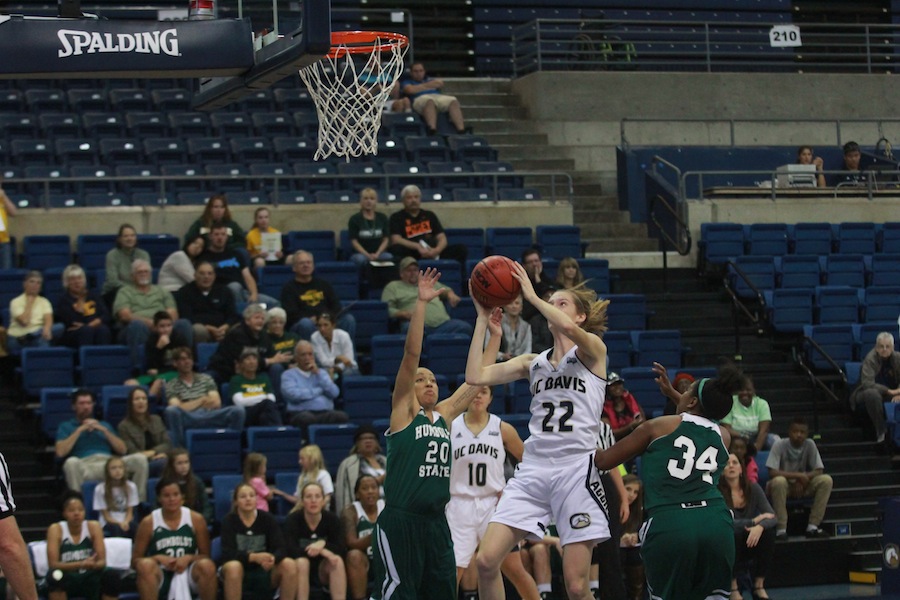
Morgan Bertsch puts a shot up against the Humboldt State Lumberjacks. (MONICA CHAN / AGGIE)

The Aggies take down Humboldt State in overtime, 77-64

Tied at the end of the fourth quarter 61-61, UC Davis dominated in overtime to win the friendly exhibition game 77-64 against Humboldt State at the Pavilion. The game, although not affecting the Aggies record, showed off their skills as they go on to the start the season on Nov. 13 against Stanford.

Senior forward Celia Marfone stayed on the court a total of 32 minutes to put up four three-pointers, including two overtime extended their lead.

Sophomore shooting guard Rachel Nagel shot 15 points and recovered six rebounds. Nagel led the Aggies in point scoring, followed by Marfone (12 points) and senior forward Alyson Dougherty, who put up 13 points in the game after sinking seven of eight free throw attempts. Together, the three put up 40 of the 77 points in the game.

Making six of 10 free throws, sophomore point guard Dani Nafekh added eight points to the game and two defensive fouls.

While the whole game endured nearly five minutes of tied time, the fourth quarter was neck and neck.

The Aggies stole the lead against the Lumberjacks, holding them at 54 points while UC Davis went on to put up 61. Humboldt recovered late in the quarter to tie the game at 61-61 with 16 seconds left on the clock. The Aggies called for a 30-second timeout but were unable to convert the final play of the fourth quarter, which ended up as a missed jump shot by Marfone that was rebounded by Humboldt.

A five-minute overtime period was granted and sweat covered the faces of both teams, each fighting hard for the win.

Sophomore forward Pele Gianotti played a key role in overtime, adding six of the 13 point lead by the Aggies.

Neika Puryear scored the final Lumberjack shot with a three-pointer from the far left elbow in the remaining 16 seconds of the game, and Humboldt trailed UC Davis by 11 points.

Morgan Bertsch, redshirt freshman forward for the Aggies, sunk the final shot of the game to give UC Davis a 77-64 win.  

The women’s team will compete in their official home opener against Stanford on Nov. 13 at 7:30 p.m., following the men’s basketball debut.

Written by Veronica Vargo – sports@theaggie.org

UC Davis develops intervention program for dyslexic children

HANNAH LEE / AGGIE
HANNAH LEE / AGGIE

Researchers, director, intervention coach discuss bettering education for dyslexic children

New research from the UC Davis Department of Psychology has revealed that when it comes to children afflicted with dyslexia, early intervention is increasingly necessary.

Dyslexia is a common learning disorder that affects nearly three million children in the United States each year, and is characterized by difficulties in memorizing, spelling, understanding language, learning words and speaking.

Dr. Emilio Ferrer, a UC Davis professor of psychology, has studied the development of certain cognitive abilities for many years with his colleagues from Yale University, Bennett and Sally Shaywitz. Their most recent longitudinal study focuses on child reading abilities from first to 12th grade, in which they found that dyslexic readers had lower reading scores which didn’t converge with the scores of typical readers.

According to Ferrer, the main finding was that the discrepancy was already apparent in first grade and serves as the reason why dyslexic readers are not able to catch up with their peers in later years.

“Our reasoning was, if […] the differences between reading proficiency were already present in first grade, then we have to intervene earlier than that [if we want to close the gap],” Ferrer said.

Ferrer’s research is the first step toward an ambitious project headed by his colleague, Dr. Emily Solari, an associate professor in the UC Davis School of Education. Solari has been interested in the reading capabilities of children since her dissertation and is in the process of implementing what she hopes will eventually become a nationwide intervention program for dyslexic children.  

“We often don’t know how to respond to those kids; we don’t know what to do with those kids,” Solari said. “We know that they’re struggling, but we don’t have the best tools to help them out.”

Through past pilot projects, Solari has found that, within small samples, individual attention and specific teaching methods have improved reading skills and comprehension, and in turn has developed a curriculum designed for dyslexic children. She is now looking to recreate her results in a larger-scale intervention program with a recent $3.5 million grant from the U.S. Department of Education’s Institute of Education Science.

“My goal is to get a good intervention program in the hands of teachers that is both feasible to implement and is going to benefit kids in their reading development,” Solari said. “So far, the data shows us that this particular intervention program is doing that. The real test for this study, since it’s on a much larger scale, is to see if we still get the same results.”

According to Ferrer, the program design starts with assessing the children, identifying those who are having trouble reading and then randomly selecting some of them to place into an intervention group. The remaining kids will make up the control group and follow the standard teaching curriculum.

The intervention curriculum is both code and meaning-based and focuses on the aspects that Solari believes are key to reading comprehension. Code-based means teachers will help kids learn how to put sounds together to make words, so they will be able to recognize and read them later on. Meaning-based focuses on developing higher-order language and comprehension skills.

After a period of three years, Solari and her team will analyze the reading results of each child to see whether or not the intervention program had any lasting effect, given that everything else was held equal.

“For this three-year study, the kids will be getting the intervention in first grade and we’ll follow them to second grade,” Solari said. “Hopefully we’ll get more funding to follow them more long-term.”

Although it is only a few months into their first year, Solari’s team has already brought teachers into UC Davis for training. Teachers receive the full intervention program curriculum and in-class coaching from Solari’s staff, who work with them in the classroom to make sure they are able to implement the program in the way it was intended.

One of Solari’s staff, Deanne Castaneda, is the program intervention coach and she accompanies the teachers back to their classrooms to oversee the implementation of the program into their class routine.

“The teachers attended training in the program and my job is to go in and help them in any way I can to implement the program,” Castaneda said. “I’m their support, I help them establish the routine of these activities for the kids.”

Part of the curriculum entails a series of games through which the teachers can give reading lessons. This method is much easier for the kids to become interested in the material and focuses specifically on helping them with their decoding of words and sounds, which will in turn help them with their reading.

Although optimistic about the future results, Solari acknowledges that the study has had its fair share of setbacks. Her staff has experienced resistance when working with teachers, some of whom have been teaching for 30 years or more and are unaccustomed to having their pedagogy advised.

“It’s very difficult sometimes to get teachers who are willing to change what they do,” Solari said.  “We’re asking them to change their teaching behaviors around reading because we’re trying to provide them with the tools they need to deal with the kids. For every single one of our teachers who’s new to the program, it’s the first time they’re doing this so there’s a learning curve for them too.”

Although the initial task may seem daunting, Castaneda said that most of the teachers she has worked with have been cooperative and excited about the intervention program. There is a feeling of unity among the educators and program staff, that they all strive to create a better future for children.

To bolster that feeling, the study has already shown promising results. Castaneda said she is confident that this larger study will yield the same results as the pilot projects, and is looking forward to improving education for more children with learning disabilities.

“I’m already seeing some gains with the kids and it’s really exciting,” Castaneda said.  “The program is breaking these things down step-by-step and working towards building up their reading and comprehension skills and it’s wonderful to see.”  

Written by: Lisa Wong – feaures@theaggie.org


The Ethical Wallet: The not-so-fair trade

0

greenburg_opOn the head of their website, Fair Trade USA boasts the slogan, “Every purchase matters.” It is true: every purchase does matter. But it seems that what we buy and how we choose to buy it may matter more to some than others.

Formerly known as TransFair USA, Fair Trade USA claims to be a nonprofit organization empowering farmers to gain access to fair wages, safe working conditions and the right to organize. As the third-party certifier of Fair Trade products, Fair Trade USA carries quite a significant position in the ethical food market. But how did they get to be so significant? In Fair Trade USA’s description of CEO Paul Rice, reference is made to the launching of their labeling, but not the birth of Fair Trade as an organization.

The original Fair Trade movement focused on democratically organized small farmers and producers. What started in 1986 as a small company called Equal Exchange, grew to join a number of farmers, alternative trade organizations, religious organizations and nonprofits throughout the globe. In order to challenge large plantations, agribusiness and multinational corporations, Equal Exchange became Fair Trade, working to connect consumers and producers in the market for their products.

Hoping to increase customer confidence when choosing products, Fair Trade brought in a third-party certification for products that met their standards: TransFair USA. This organization, founded in 1998, began labeling Fair Trade products in an effort to help consumers make ethical choices without having to do as much research beforehand. The public grew to trust and depend on the label and to this day, many of us choose the Fair Trade USA option when deciding between two similar products at the local market. It’s practically an instinctual form of decision making. We choose these products because we are led to believe they are the best for our health, our economy and our conscience.

Unfortunately, TransFair USA abused the trusting relationship it had developed with customers. Favoring quantity over quality, and in an effort to fulfill the great demand for their Fair Trade products, TransFair USA wanted to increase its supply. The only way to meet this new level of demand was to lower standards and certify companies that previously would not have met the requirements.

This posed a challenge for small farmers, who were originally the focus of Fair Trade. Suddenly, they were up against bigger producers who were cutting corners, paying lower wages to workers and producing much faster than these smaller businesses could manage.

The original Fair Trade objected to these changes in TransFair USA’s policies, and maintained their mission to support small farmers by reinstating the importance of slow and steady growth. The two companies values seemed to grow further apart. In October 2010, TransFair USA changed its name to Fair Trade USA.

A year later in 2011, Fair Trade USA announced “Fair Trade for All,” a new initiative that effectively began to certify large plantations left and right. “Fair Trade for All” frames its mission as an expansion of support, advocating that the inclusion of more farmers in their network will increase empowerment among small businesses. But in reality decreasing standards allow the certification of plantations and an increasingly impossible market for small farmers to succeed in.

Plantations tend to be individually owned for profit, as opposed to smaller farms where there is often equal ownership and more democratic decision making. Advocating for small farmer co-ops encourages a vehicle of change within the food industry, whereas plantation certification and support makes very little impact on economic control, political power or social change.

Because Fair Trade USA knew that the original Fair Traders as well as the International Fair Trade (FLO) would oppose the new standards paired with the initiative, they promptly left FLO and became an independent organization.

Fair Trade versus Fair Trade USA is an example of the many ways in which we as consumers are overfed with commercial options and deprived of facts. Although it is almost 2016, in terms of available food and trade information, it feels as if we are back in the 90’s. Facts are limited, the Fair Trade USA certification is at times reliable and other times not as much. Once again, we are left to our own devices to decide what companies and products we want to support.

Aside from doing my own research, I will be keeping an eye open for the Equal Exchange label, CLAC certifications and Fair Trade International approval when shopping for my products. All of these organizations have remained loyal to the original Fair Trade mission. These are the companies that trade fairly. These are the companies to whom “every purchase matters.”

You can contact Martha Greenburg at mzgreenburg@ucdavis.edu or on Twitter @marthazane94

The horrors of war through the eyes of a child

TIFFANY CHOI / AGGIE

A review of Cary Fukunaga’s film, Beasts of No Nation

Beasts of No Nation is a film about a West African boy named Agu, played by Abraham Attah, who is forced to flee his idyllic village because of incoming war. Agu’s father and brother are mercilessly gunned down by invading army forces and he eventually finds himself joining a group of rebel soldiers, thus embracing the responsibility, brutality and burdens of war.

This film effectively reveals the devastation of war and the use of child soldiers in armed conflicts. At the beginning of the film, we see a happy Agu engaging in normal, child-like antics, but his happiness and innocence is abruptly stripped away when he joins a group of guerillas fighting against the national army. Agu then begins to transition from an innocent child to a ruthless product of war.

Beasts of No Nation is Director Cary Fukunaga’s third feature film, behind Sin Nombre, Jane Eyre and the first season of “True Detective. Fukunaga spent seven years writing the script for this movie before filming started in Ghana. Those who are familiar with Fukunaga’s work know that he specializes in presenting harrowing tales of youth in uncompromising situations. Beasts of No Nation is no exception.

We follow Agu and his fellow guerillas marching through jungles and pillaging villages. Fukunaga presents an incredibly realistic and raw depiction of West Africa. The brilliant cinematography and stunning visual effects make the explosion scenes seem frighteningly graphic and real. At times, the movie almost feels like a documentary.

Another one of the highlights of the film is 15-year-old actor Abraham Attah’s debut performance as Agu. Attah’s moving portrayal reveals the tragedy of child soldiers as well as the detrimental effects that war has on people. Throughout the film, Agu witnesses and inflicts death on countless people and questions if his actions are truly noble, showing that there is a fine line between good and evil. He joins rebel forces to avenge the destruction of his family, but finds himself inflicting the very anguish he so heavily feels.

Seasoned actor Idris Elba is phenomenal as the power-hungry, steadfast rebel Commandant. At times, however, Elba’s performance seemed to overshadow and distract from Attah’s. There were instances where Agu’s character was put on the back-burner to focus on people like the Commandant and Strika, a fellow child soldier played by Emmanuel Quaye. The complexities of these other characters detract from Agu’s story, but luckily the latter parts of the film are able to revitalize Agu’s narrative.  

The score for the movie, composed by Dan Romer, is also insipid at best. Music is a vital part of a movie because it can stir emotions during dramatic events, but Romer’s score was so weak it was almost nonexistent. Scenes like the one in which Agu stormed a villager’s home or held a dying rebel soldier in his arms would have been more memorable had they been accompanied by a more vivid score.

But apart from these missteps, Beasts of No Nation remains a gripping movie. And as brutal as some scenes in the movie may be, there is always a sense of hope — hope that one day children like Agu will be able escape atrocities of war and finally live normal lives. Films like this show that the voices of people who suffer heinous events need to be heard and acknowledged. Beasts of No Nation is a cinematic marvel led by an extremely talented cast that uncovers the atrocities of war and brings our attention to the plight of people who have often been forgotten by history. Films like this show that the voices of people who suffer heinous events need to be heard and acknowledged.

Written by: Krishan Mithal – arts@theaggie.org

Elect your ASUCD senators this week

0

HANNAH LEE / AGGIE
HANNAH LEE / AGGIE

Online ballot open for Fall 2015 election.

This week, the ASUCD fall quarter elections ballot opened for voting. All current UC Davis undergraduate students are eligible to cast their vote online under a choice voting method in which voters can rank any number of candidates in order of preference.

This quarter’s election boasts 16 candidates competing to become our next senators, campaigning on a variety of student-interest platforms to win one of six coveted spots on the senate table.

Over the past few years, ASUCD elections have experienced painfully low voting numbers, resulting in a relatively unrepresentative association. Last fall quarter’s election saw a 10.4 percent voter turnout. The following winter’s election was even worse; only 792 students voted, or approximately 2.85 percent of the undergraduate student body.

According to the Elections Committee website, ASUCD elections exist to help students “serve their civic duty every quarter.” From our perspective, this statement manifests itself in two ways. First, elected officials take on the huge responsibility of serving students and using their voice on the table to better campus life. However, all UC Davis students also have a civic duty to participate in elections and to be informed voters.

ASUCD reaches far beyond student government. In addition to overseeing and budgeting 26 individual units, including the CoHo and Unitrans, senators have access to a unique network of connections that allows them to utilize non-ASUCD resources to make change. Not only do elected senators discuss issues affecting our campus on a weekly basis, but their voting rights also give them direct access to contribute to influential and often controversial campus decisions.

Regardless of whether or not you work in a student government position, the association will likely have some effect on your undergraduate career at UC Davis. So, while criticizing the actions of ASUCD officials is legitimate at times, we need to understand that all students play a crucial role in electing senators to their positions of power. We cannot expect to have a cohesive senate table representative of student needs with a low voter turnout.

A democratic voting process ensures that elected officials are actually representative of the student body. You deserve to have a say in deciding who represents you, as well as a responsibility to uphold the civic duty that comes along with being a UC Davis student. The Editorial Board encourages all students to take interest in choosing their representatives this quarter by reading up on the candidates and casting an informed vote, keeping in mind that the winning individuals will work on the table for an entire year.

Voting matters. Exercise your right today at elections.ucdavis.edu. The voting ballot will remain open until Nov. 12.