57.6 F
Davis

Davis, California

Tuesday, December 23, 2025
Home Blog Page 773

Vietnam Ambassador visits UC Davis

JAY GELVEZON / AGGIE

Ambassador Pham Quang Vinh discusses Vietnam and U.S. relations.

On Oct. 20, Vietnamese Ambassador Pham Quang Vinh delivered a speech on Vietnamese and American relations at the Memorial Union’s De Carlie Room. The ambassador’s visit to UC Davis represents an effort to bridge a connection between the U.S. and Vietnam that will benefit both countries economically, socially and culturally.

The one and a half hour long event, which was attended by approximately 70 people, was followed by a question and answer portion with the audience. The event was arranged by Asian American studies professor Kieu-Linh Caroline Valverde. Ambassador Vinh’s visit is the first formal visit made by a Vietnamese Ambassador to a University of California. His visit marks the 20th anniversary of diplomatic relations between Vietnam and the U.S.

“[This event] is in large part for the students,” Valverde said. “I want students to know that they can have access to high-ranking dignitaries, and they can engage them in conversation […] I wanted the ambassador to know that Davis has bright, critical-thinking students [who] are not afraid to ask tough questions.”

Ambassador Vinh wishes to expand Vietnam’s relationship with UC Davis and the United States in several areas, including political relations, foreign affairs, economic cooperation, science and technology, security and defense, education and “people-to-people exchange.” People-to-people exchange, which includes tourist visits, studying abroad and working abroad, offers opportunities to citizens of both countries in a bicultural and bilingual experience, according to Vinh.

“For Vietnam-U.S. relationships, I think that this year is an important year,” Vinh said. “If you look back in our history of 60 years, it seems that our relationship has been related to what I call cycles of 20 years. 1955 to 1975 we have war, and then from 1975 to 1995 we have embargo and people cannot understand each other. Now from 1995 to this year 2015, we have been developing our relationship, we have diplomatic relations, and then we have a comprehensive partnership […] so I think all the progress we have achieved is so tremendous.”

UC Davis has had an established connection with Vietnam through the International Program under the College of Agricultural and Environmental Science, in which UC Davis helps Vietnam along with many other countries agriculturally. Valverde explained that Ambassador Vinh especially wants to expand this relationship with UC Davis to the social science and humanities department to correct the common American perception of modern Vietnam.

“The big reason is because there are misconceptions and misperceptions, and a lack of information and good writing and research about the modern Vietnam,” Valverde said. “So these [newfound understandings] will be important areas of growth for a relationship between the two countries, for those outside of Vietnam to learn more about Vietnam, and those inside Vietnam to have access to information and research and training.”

Valverde is working towards establishing a center for Vietnamese studies at UC Davis that will support social research on modern Vietnam in order to encourage critical thinking about the future of the country and its relationship with the U.S.

The U.S. and Vietnam’s Trans-Pacific Partnership (TPP) was a frequent subject of concern for many students during the question and answer portion of the event, which signaled its significance and controversy among the audience. The partnership is a trade agreement that includes the U.S. and 11 other Pacific Rim countries (excluding China). Among the audience members who raised question concerning the agreement was fourth-year Asian American studies major Ralph Vin Imatong.

“There are plenty of reasons why Vietnam chose to continuously build a strong relationship with the U.S.,” Imatong said. “However, just like any partnership of this scale, personal interests are inevitable. I have questions such as what will the U.S. get from this partnership? What will Vietnam do to the poor people that will be displaced by this economic partnership? How will the government make sure that these giant companies will not take advantage of the Vietnamese people?”

Despite such issues of contention, Valverde sees questions like these asked by the students to the ambassador as a positive sign that international issues matter to students. She noted that in the past, certain sectors of the Vietnamese American community have been known to protest events promoting U.S. relations with Vietnam. Valverde believes that the ambassador’s visit signals a change in the Vietnamese American community.

“A couple years ago, this would be unthinkable,” Valverde said. “There would [have been] lots of protests, agitators, berating, heckling about human rights…but there was none of that. That’s historical, that’s monumental, it signals a shift. It’s saying students want to learn, they want to know, they want to engage, to have access.”

Imatong echoes Valverde’s insight.

“I do wish to see more events like this on campus,” Imatong said. “I think it is important for students to at least have a sense of what is going on in the world stage because whether we like it or not, we are affected by it in some way […] I think these kinds of events provide a space for understanding and empowerment for the students, especially in the Asian American communities.”

Ambassador Vinh’s visit is the most recent in a series of steps towards establishing a connection between UC Davis, the U.S. and Vietnam. The first step towards U.S. and Vietnam relations began with Vietnam’s General Secretary Nguyen Phu Trong’s visit to the U.S. last July. During his visit, he met with the Obama Administration to negotiate the TPP.

On a more local level, Trong met with California governor Jerry Brown to initiate the establishment of a sister city between Sacramento and Ho Chi Minh City, which led to Valverde’s visit to Vietnam this month to meet with universities and government officials in the country.

Valverde emphasised that the United States’ continued relationship with Vietnam depends on the support of the community, including faculty and students.

“Students don’t think they can ask for these things, so when they do, people listen,” Valverde said.

UC Davis looks to expand campus under “Campus Tomorrow” plan

ANH-TRAM BUI / AGGIE

Planned campus expansion in result of increasing enrollment, growing research.

Over the course of the next one and a half years, UC Davis’ Campus Planning Committee will develop and solidify “Campus Tomorrow,” the university’s next Long Range Development Plan (LRDP) that will provide a framework for efficient land use, renovation and building projects from 2017 to 2027. The committee will host several public community events in order to update the community on the current planning stage, as well as to provide a space for the public to offer their input.

“This plan is not actually about specific buildings,” said Robert Segar, assistant vice chancellor and campus planner. “It’s really more of a big land-use development pattern; so where is housing going to go, where [are] academics going to go? But with this as a backdrop, we use specific planning for every building project. We project forward and we say we’re going to need this much housing, this much academic space, this much recreational space — everything.”

The first of these events took place during open houses at Nelson Gallery from Oct. 22 to Oct. 29. At the open houses, poster boards displayed the initial scenario plans, while committee members walked around answering questions and requesting attendees’ to provide their opinions on what they wanted the future campus to look like.

All the poster boards presented at the open house are available on the Campus Tomorrow website, where members of the UC Davis community can learn more about the development plans and submit questions via email. The campus planners strongly encourage students to take the website’s survey, submit comments on what is important to them and participate in the campus planning decisions.

“The Campus Tomorrow exhibit illustrates our initial planning concepts for the next LRDP here on campus,” said Campus Planner Lucas Griffith, in an email. “We designed the exhibit to demonstrate the complexity of issues when attempting to create a more sustainable future and to engage our community in that process. We included a wealth of information in the exhibit to provide more context for key planning issues and more clarity in the planning process.”

Out of the previous LRDPs that spanned from 2003 to 2015 came the Mondavi Center, the West Village Apartments and the Student Community Center, among other projects.

The next open house public event, “Develop Preliminary Planning Scenario,” is scheduled to take place in February 2016. The resulting campus plans will go through an environmental review and public comment period before finally being submitted to the UC Davis Regents for consideration in April 2017. At each stage of the process, the planning committee asks for the Davis community’s engagement and participation in making key-planning decisions.

“People getting involved is key to this,” Segal said. “[I]f you’re in a place where no one is involved, then nothing is going to happen.”

The main needs for a development plan for UC Davis are the university’s increasing student enrollment and growing research. According to Campus Tomorrow’s website, UC Davis has plans to increase student enrollment from the present 31,500 to 39,000 and faculty and staff from 13,000 to 14,500 by 2027 in order to “broaden international reach, boost regional economic development, and provide a stable financial foundation for UC Davis.” This in turn creates a need for more housing and classrooms to accommodate students, and more labs and offices for faculty to do their research.

The development of the future of the campus depends on three goals: supporting academic enterprise (which includes labs, classrooms and academic spaces), enriching community life (housing, student activity, etc.) and creating a sustainable future (energy, transportation, etc.). Each of the three goals is strongly interrelated, each with a domino effect on the others.

“Let’s say we don’t build much student housing and there isn’t much student housing in the city,” Segal said. “That means a lot of students are going to have to commute. So then there’s going to be all those commute miles, all those greenhouse gases. If we provide a lot of student housing, we make all that go away, […] but then we have to think about how to supply all that student housing with energy, water and all the resources it takes to host it. So there’s always these trade-offs. We try to put building a strong community of people first, so people want to be here. We try to make that scenario happen.”

Although current building constructions do have budgets, Griffith explained that since the LRDP is a land-use plan rather than a proposal for specific buildings, no concrete budget has been set for it yet.

“The people in our budget office really value numbers,” Griffith said, “But this is so far out that it’s really hard to associate a budget, so there is no budget. This is like a city’s general plan. It is basically saying, how many square feet are you going to anticipate?”

The overall map divides the campus into sections, each with prospective planning concepts. Examples of this include proposed student apartments on Russell Fields and additional classroom spaces on campus marked as the Civic Core. The development plans balance the three goals — academic enterprise, sustainability and community life — by utilizing what Segal calls compact growth. He defines compact growth as building in ways that keep the campus within a small area.

Segal explains that compact growth means replacing sites in the middle of campus like parking lots and short buildings with taller buildings to prevent a widespread campus and to keep people close together as programs and classrooms grow.

“[Compact growth means] basically a ten-minute walk of the library,” Segal said. “That helps two things. [It] helps create places where people can interact more successfully, and it also helps conserve resources and mitigate against greenhouse gas emissions. So compact growth is the message of this project.”

The implications of not having a campus development to accommodate the growing student population and research can already be felt presently.

“They are using the multi-purpose room in the ARC as a lecture hall right now because they don’t have enough lecture halls,” said Leslie Mancebo, a campus planner specializing in transportation services. “So even now we’re seeing some of the effects of this [population] growth happening, without there being a plan for new development.”

Segal hopes that the effects of the LRDP will fulfill his visions for the future UC Davis campus.

“If you were to see a long line of buildings in a row [or] a single tall, high-rise building, would you say that is a campus? Probably not,” said Segal. “A campus is where we assemble buildings around these public spaces where public life happens and student events happen and people can run into each other and you can hold events […] that allow people to have a different kind of experience. That’s what’s special about a campus.”

Question an Athlete: Student athletes on who their role models are

0
ANGELICA DAYANDANTE / AGGIE

We asked student-athletes on the Men’s and Women’s Basketball teams: Who is your role model?

UC Davis Men’s and Women’s basketball athletes talk about who they have looked up to throughout their lives.


Georgi_Funtarov_questionanathlete_sp_DayandanteGeorgi Funtarov

Forward, third-year communication major

“I think my role model would be LeBron James because when I got into basketball he just got into the NBA. When you’re a little kid and somebody like him is doing amazing things, you want to be like him one day. The way he interacted with his teammates off the court just told me he was a good guy on and off the courts.”


celia_marfone_questionanathlete_sp_DayandanteCelia Marfone

Forward, fourth-year exercise biology major

“I look up to Kobe Bryant. I’ve followed him ever since he’s been a Laker and I think his story is truly amazing in how much he pushes himself. I aspire to be just as passionate about the game at his age.”


Brynton_Lemar_questionanathlete_sp_DayandanteBrynton Lemar

Guard, third-year communication major

“My role model has to be my dad. He has taught me so many life lessons like how to be a great person and a man. He came from Jamaica and made his life in California while helping my mom out. He is the most important figure in my life right now.”


Taylor_McGuire_questionanathlete_sp_DayandanteTaylor McGuire

Guard, third-year managerial economics major

“My role model and inspiration for basketball is Steph[en] Curry because he wasn’t much when he first came in [and] no one really recognized him for what he did, but now he is a superstar MVP, All-Star NBA Champion and everyone loves him. He has worked so hard and is such an inspiration.”


Darius_Graham_questionanathlete_sp_DayandanteDarius Graham

Guard, third-year sociology major

“Both my parents are my role models, but being a young man, my father especially.  I’m blessed enough to be in a two-parent household and my father has taught me how [a man should] love his wife and love his kids. I don’t have a girl right now but when that time comes for me to step up to that role, I’ll be able to do that.”


Nolan_Berry_questionanathlete_sp_DayandanteNolan Berry

Center/Forward, third-year human development major

“My role model is definitely my grandpa. He played in the NBA for ten years in the fifties, so being a basketball player I always looked up to him. He was also a good family man and a beacon, really strong in his faith.”


Morgan_Bertsch_questionanathlete_sp_DayandanteMorgan Bertsch

Redshirt Forward, first-year biomedical engineering major

“My inspiration would be my sister McKennan. She played basketball while at UC San Diego and was also an environmental engineering major. Now I’m a biomedical engineering major, so the fact that she made it through being in environmental engineering and playing basketball is a huge feat. I really just want to follow in her footsteps and do the things that I love.”


Rachel_Nagel_questionanathlete_sp_DayandanteRachel Nagel

Guard, second-year biological sciences major

“My role model would probably be my mom. She is the sweetest lady in the world. I remember as a sixth grader she would come rebound for me as my shots were bouncing everywhere. It was a lot of work. She has [also] given up a lot of her time and money so that I can live out my dreams here.”


Luca_Ferrari_questionanathlete_sp_DayandanteLuca Ferrari

Freshman Guard, first-year managerial economics major

“My role model would have to be my dad. He [is] a great family man and he also played college athletics so I always wanted to be just like him. He has supported me and taught me how to be a good man.”


Kourtney_Eaton_questionanathlete_sp_DayandanteKourtney Eaton

Guard, first-year undeclared physical sciences

“I have a cousin Luke who I have always looked up to. He was an athlete, super hard worker, had such a positive attitude. It was really nice to grow up with him and he is still my role model to this day.”

Divest, disarm, discuss

0
HANNAH LEE / AGGIE
HANNAH LEE / AGGIE

Public forums improve police-student relations.

On Nov. 3, dozens of students, staff and Davis community members marched from the Memorial Union to the UC Davis Police Station as part of the “Divest, Disarm: Davis for Black Lives” protest. The protest, which followed suit with the national “Black Lives Matter” movement, demanded that the university disarm its campus police and divest from private prisons.

The protest’s demands come on the heels of several recent incidents regarding police brutality on school campuses. Last month, a South Carolina police officer was terminated from his position after a viral video showed him slamming an African American female student against the ground during a violent arrest at Spring Valley High School.

On a more local level, in August, UC Davis police forcibly detained an African American alum for using the 24-hour study room on the basis that he is not currently a student. The recent protest also reminds UC Davis community members of the still salient 2011 pepper-spray incident that occurred on the same quad Tuesday’s protesters marched across.

Police brutality is not a new issue that the country is facing. People of all backgrounds, particularly minorities, and from all over the world have been voicing concern against this injustice for years.  However, incidents like this, noted above, remind students that these violent crimes can occur on our very own campus — in seemingly safe places like the library and by trusted individuals like campus police.

While Tuesday’s protest successfully publicized the need to hold the university and campus police accountable for their actions, the Editorial Board believes that UC Davis’ recently implemented police forums are also a valuable option for keeping the police department’s behavior in check year-round.

The forums, which began the past January, are planned by several campus organizations, including ASUCD, the Cross Cultural Center and administrators at the UC Davis Police Department, to provide students and Davis community members with a safe space to address concerns with local law enforcement.

The effort, which seems to be a relatively unknown resource on campus, is a valuable way for students to voice their opinions and communicate directly with campus police about the questions that they deserve answers to and the issues that they demand to see fixed. Conversation is key to keep any organization or individual transparent and accessible, and since the forums are open to the public, we encourage the community to utilize this potential policy-changing opportunity.

Tuesday’s peaceful protest was a promising start toward opening up the university’s eyes to police violence on campus, but daily demonstrations are not realistic. However, it is realistic for there to be ongoing conversation in order to strengthen the relationship between police and students.

Theatre department prepares fall production of Government Inspector

0
ANH-TRAM BUI / AGGIE

The cast and crew form a unified front to get ready for opening night.

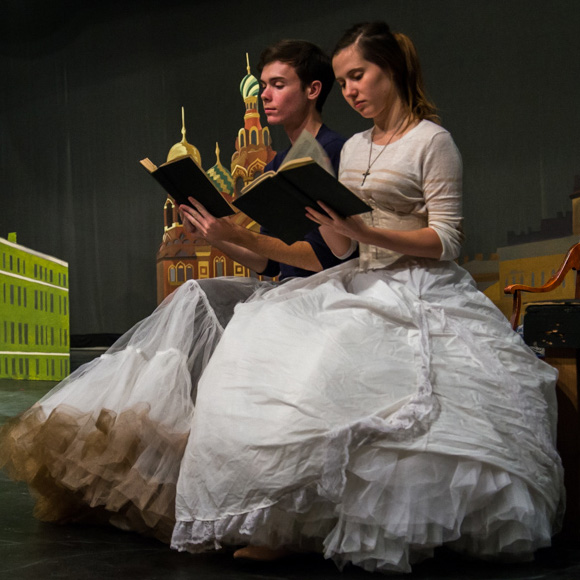
The UC Davis Department of Theatre and Dance’s fall production of Nikolai Gogol’s Government Inspector will have its opening night next Thursday on the Wright Hall Main Stage Theatre. The production will run from Nov. 12 to Nov. 15 and again from Nov. 19 to Nov. 22.

Gogol’s Government Inspector is a satirical comedy of errors exploring power and greed. The play revolves around the exploits of the citizens and officials of a small Russian town, where they believe a stranger is sent by the government to investigate corruption. Director Patricia Miller has chosen an adaptation by Scottish playwright David Harrower because she feels it best keeps the humor of the original play.

“[Government Inspector] involves a mix of [dramatic acting] and physical comedy,” said Miller, who holds an MFA in directing from UC Davis. “It takes [an actor] who can perform lines and be physical.”

Miller went on to explain that due to the physical nature of the humor, even the actors who were not speaking had to be mindful of their stage presence. During a recent rehearsal, this physicality became apparent, as characters bumped into one another, hopped over props and flung themselves across the stage.

The physical nature of the play also means that every actor’s role is equally important, regardless of number of lines. Following auditions, the cast went directly into ensemble work, doing improvisational exercises and acting out scenes together prior to delving into the text of the play.

“A lot of [Miller’s] direction is more about the relationship between the characters than the individual character,” said Ryan Gerberding, a second-year Theatre and Dance Major playing the role of Anna. “It’s our job to work on the individual characters and the director’s job to shape the show.”

Nakeema Brooks, a fifth-year dramatic arts major who will be playing the role of the town’s judge, enjoys Miller’s directing style.

“It’s all about the partnership,” Brooks said. “[The cast] is a chain that needs to keep the show together. If one person breaks the chain, the whole thing can fall apart. […] We have to support each other.”

The camaraderie of the cast is palpable during their rehearsal, as actors who are not in scene watch and laugh along with the play, serving as a supportive audience for their fellow cast members. The cast also exhibits a familial patience with one another, redoing scenes and rereading lines with no signs of frustration.

While cast members explained that this is simply the outcome of working together during long hours and the upperclassmen working together on previous productions, it is a unified front borne out of the desire to put on the best production possible. This unifying desire transcends the cast and also carries over to the crew working behind the scenes.

Brice Hilburn, a fourth-year dramatic arts major, works on the lighting crew for the show and shared the sentiment of the cast.

“Every creative aspect of the show is both an individual creation and a collaboration,” said Hilburn. “The entire purpose of every single aspect, whether it’s sets, lights, costumes, props [etc.] is to serve the show. It’s to make one collective show good.”

Ultimately, everyone involved with the production is aware that the quality of the show is wholly dependent on the combined effort of everyone involved. Following rehearsal, a run-through of the entire five-act play, the cast sits together and receives constructive criticism from Miller.

Miller’s work as a director becomes more evident during this session, as she suggests everything from how actors should fall to the floor to listening to Hugh Grant to counteract the effects of a California accent. As this feedback session concluded, Miller reminded the cast that they had succeeding in cutting the run time of the show and were twenty minutes closer to the projected run time for opening night. The group celebrated their victory and exited the rehearsal room together.

Government Inspector premieres Nov. 12 at 8 p.m. Tickets are $15 for the  general public and $10 for students. For more information including show times, visit http://arts.ucdavis.edu/seasonal-event/government-inspector.


Written by: RASHAD HURST – arts@theaggie.org

Aggie Style Watch: Mikal Mitchell

0
ARIEL ROBBINS / AGGIE

This week’s edition: Colorful prints and Jesus sandals.

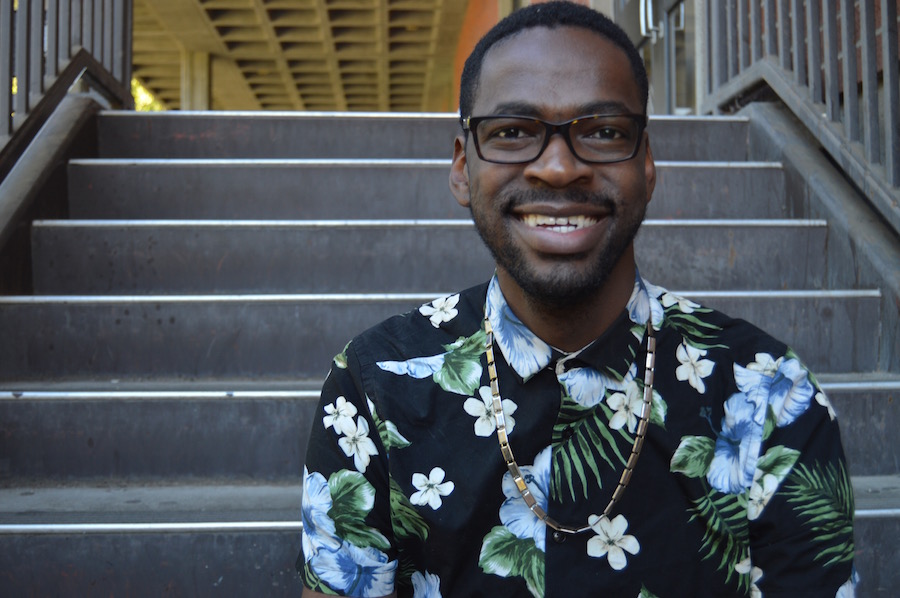
For this week’s edition of Aggie Style Watch, I felt as if the subject came to me instead of the other way around. From across the Quad, I spotted a loud, floral printed shirt that stuck out from the crowd. That shirt belonged to Mikal Mitchell, a third-year transfer student majoring in political science, who is not afraid to be bold in his fashion choices.

ASW: How would you describe your style?

ARIEL ROBBINS / AGGIE

Mitchell: I like anything that makes me noticed — even if I don’t need any help with that. I like any loud print. I’m giving you urban tropics today. Basically I go for any colorful, outdoor print.

ASW: What are some staple pieces in your wardrobe?

Mitchell: Always black skinny jeans and my Jesus sandals. Most of my clothes aren’t American. I think a lot of men’s fashion in America is basic and doesn’t give you many options. In Europe, they give you more options, even those that may be considered more feminine. You’ll usually see me in anything loud — I even sometimes have shoes that are prints. That’s me in a nutshell.

ASW: What are some of your favorite trends? The worst?

Mitchell: For guys I really like the pants that don’t fit all the way down — the three quarter length pants. I also like printed pants. For the worst, I hate wedge sneakers.

ASW: Do you have any fashion inspirations?

ARIEL ROBBINS / AGGIE

Mitchell: I used to not really be confident and I would look at things I like but think that I couldn’t pull them off. I realized I can pull anything off

with confidence, so I’d have to say that is my fashion inspiration — confidence.

ASW: Do you have any fashion advice?

Mitchell: My fashion advice is that if you like something, put it on.


Written by: DIMITRA LOUMIOTIS – arts@theaggie.org

The Millennial Age: An Education Evolution

0
JENNIFER WU/ AGGIE
JENNIFER WU/ AGGIE

prokos_opMillennials may be on the path to becoming the smartest generation. We’re connected to an unprecedented amount of information, but the question still remains: How do we learn?

Technology has challenged and transformed the way we learn. Institutions are constantly looking to further customize learning experiences through a plethora of exploratory programs. In essence, the increasing popularity of online education and collaborative learning projects coupled with the dominant, cutting-edge culture of Silicon Valley has revolutionized the education experience.

According to two education experts working with NYU, our everyday experiences affect how we think and process information. As a result, institutions and educators are forced to adjust their means of instructing students.

Over the last 15 years, online programs have become highly developed. Millennials have learned how to use technology to their benefit in nearly every facet of life, and as a result, many are content with receiving formal education through the Internet.

Using online programs is far more interactive than reading from a textbook. These programs require students to participate in virtual modules and create videos and presentations that are shared through online course management systems. UC Davis’ Smartsite is an example of such a system.

The NYU experts also found that learning retention skyrocketed when education was collaborative, rather than individualized.

Their study suggests that integrating discussion groups into a learning environment yielded 50 percent retention of a lesson’s material. A more hands-on, “practice-by-doing” method produced a 75 percent retention of material. The most successful procedure for retention was achieved when students were put in a teaching position. When students control their educational process, engross themselves in the material and have to find their own ways to present material, learning retention reached a high of 90 percent. All of these numbers are significantly higher than the 10 percent rate for reading and the meager 5 percent for static lectures.

Incubator programs, also known as accelerators, have become more and more important to Millennials in the business and tech scenes.

Incubators supply young entrepreneurs and their small businesses with mentorship and practical training. In many cases, these investors provide small businesses with workspace and connections to investor networks. Incubators essentially assist young masterminds who don’t yet have sufficient capital or manpower realize their goals. The programs refine business plans and ideas, help design quality products, aid in launching projects and assist in sustaining brands. They’re called ‘accelerators’ because they’re intended to speed up the growth and prosperity of new enterprises. Currently, these programs are largely based in the San Francisco area and are led by investment businesses.

Requirements for entering an incubator include submitting a detailed business plan. Screening committees for the programs are rather selective. They want to assist and cultivate enterprises with the greatest chances for success.

Millennial education is no longer a matter of merely reading a book or listening to a lecture, and then expecting us to apply those teachings in the workforce. Customized, interactive and individual experiences like those found in incubators are key to our learning process and future success.

Whether we realize it or not, UC Davis educators do a pretty good job of customizing our learning experience. I’ve taken countless courses in which I’ve devised lesson plans and taught the material to my fellow classmates. A large number of courses also include discussion sections. While sometimes these are not as effective as they could be for students, sections are at least designed to foster an environment where we can confer for the purpose of gaining a greater understanding of lessons.

Tools like Smartsite and MyUCDavis have also enhanced the learning process by making complementary materials, such as sample work and supplementary reading or podcasts, readily available.

Of course, Millennial education will continue to change in coming years as a result of our evolving environment and the ever increasing number of Millennials enrolling in higher education. Our own growth and contributions will have an extensive and inevitable impact on the next generation. The possibilities are endless for the future of education.

You can reach HAYLEY PROKOS at hprokos@ucdavis.edu or on Twitter @haroulii14.

Federal, state and local governments work to protect salmon in the Sacramento River

salmon1
ASHLEY PAE / AGGIE

$2.5 million project installed to keep salmon from straying into irrigation canals.

Irrigation canals threaten the lives of salmon as they swim up the Sacramento River on their way from the ocean to the spawning beds from where they were hatched. These misleading paths threaten their lives before having the opportunity to reproduce.

A $2.5 million project was developed in an effort to ensure that salmon do not stray from the Sacramento River, but return safely to their spawning grounds.

Peter Moyle, distinguished professor emeritus of the UC Davis Department of Wildlife, Fish and Conservation Biology Center for Watershed Sciences, explains that one crucial stage for salmon is when they are fry or smolt, the stages prior to being considered adult salmon.

“When they hit the ocean, they have to hit it at just the right time so that there’s enough food,” Moyle said. “They wander widely in order to find the patches of food of the right kind in order to grow rapidly and avoid predators.”

According to Jacob Katz, central California program director for California Trout, salmon must overcome numerous challenges in the early stages of their lives. As they’re about to reach their destination, one wrong turn can lead to their death.

“Drainage canals appear to be like a tributary. Often fooled by drainage canals, salmon swim in it thinking that they’re in a tributary and die,” Katz said.

Adult salmon use water flow as a cue while swimming upstream, and certain flows cause them to stray away from the Sacramento River. This leads them to travel up to 70 miles into drainage canals from which they cannot escape.

The Knights Landing Outfall Gates (KLOG) and Yolo Bypass are common places for salmon to deviate, leading them into the Colusa Basin Drain.  These two entry points have trapped many endangered winter chinook salmon.

Many of the salmon were rescued and placed back into the Sacramento River but the majority died before they were able to spawn due to stress.

RECLAMATION DISTRICT 108 / COURTESY

Reclamation District 108 (RD 108) took the lead and initiated the KLOG project. RD 108 contributed $400,00 to pay for the design plan and permitting.

According to Katz, the KLOG project installed concrete wing walls and a metal picket weir that allows irrigation water to flow out of the gate and into the river, but blocks fish from entering.

“The KLOG idea is simply to block [salmon]. We’ve really changed the way the water flows,” Katz said.

For construction costs, the U.S. Bureau of Reclamation contributed $1.5 million while the California Department of Fish and Wildlife and the California Department of Water Resources provided $300,000 each.

“This was a project that everybody was supporting,” said Lewis Blair, general manager of RD 108. “We’re really gaining momentum with this project.”

He said that the nongovernmental organization community as well as the state and federal government worked together to accomplish a solution to the problem which has been ongoing for many years.

According to Katz, farm revenues are adversely affected when salmon populations are in a crisis because it affects their water supply.

Katz said that the senior water rights holders understand that they have an obligation to sustain fish and wildlife populations.

“There is a real spirit of collaboration for these win-win projects,” Katz said.

The next project will be to build a similar structure at the Yolo Bypass via the Knights Landing Ridge Cut Canal (KLRC).

“[It’s important to protect salmon because] when [they] make it through all the threats of avoiding predators, successfully swimming through the ocean, just before they make it to their spawning ground, they’re lured into these drainage death-traps,” Katz said. “[It’s an] exciting partnership and [because] things are getting done, has a lot of promise.”

Written by: CARLA ARANGOcity@theaggie.org

Brief: Students gather for Divest, Disarm: Davis for Black Lives Protest

ARIEL ROBBINS / AGGIE

Students demand more from university police.

On Nov. 3, outside the Memorial Union (MU), students and staff gathered for the Divest, Disarm: Davis for Black Lives protest. Organized under the Davis Stands with Ferguson campaign, protesters rallied for administration to tackle the topic of systematic racial oppression present on college campuses.

The protest focused in on two demands. First, protestors demanded that administration demilitarize police from military-grade weapons. They also demanded the university to divest from private prisons.

The protest began at 12:00 pm by the Memorial Union flagpole. It started with speeches delivered from several students. Among the students who delivered speeches included lead organizers Brandon Buchanan and Kyla Burke.

Afterwards, protesters marched towards the university’s Fire and Police Department, passing through Olsen Hall and later by the Silo.

Once the group reached the police department, they posted flyers of their demands on the department’s entrance. Outside of the department’s building, students protested further about their demands to police.

The police did not respond to the protest outside of their building.

The protest ended outside the MU at 1:30 pm.

UC Davis coffee lab celebrates reopening after renovation

0
ASHLEY LUGO / AGGIE
ASHLEY LUGO / AGGIE

Renovated lab provides space for students to learn the engineering process behind coffee making.

On Oct. 23, the Chemical Engineering and Material Science department (CHMS) celebrated the grand reopening of the coffee lab in 126 Everson Hall. At the improved coffee lab, students can expect to see new lab benches, sinks, floors and air handling equipment.

“The space has just been renovated and it’s beautiful,” said biomedical engineering professor Tonya Kuhl. “The renovation and enormous improvements in the space were made possible by generous support by Chevron, the College of Engineering and one of our alumni John Wasson.”

The coffee lab has been redesigned for the popular class ECM 1, a hands-on class offered every quarter that focuses on energy input to roast and brew coffee.

In the class, students roast their own coffees, reverse engineer a Mr. Coffee maker with the intentions of creating a better brewer and finally present their results to a tasting panel. Performance is graded on a scale of which machines brewed the best flavor and used the least amount of energy to ultimately create the cup of coffee.

“They learn how to approach problems like a chemical engineer,” said CHMS professor William Ristenpart. “They learn about energy usage, ‘mass transfer’ during brewing, chemical reactions during roasting and more generally how to think holistically about the whole entire process of making coffee, including waste streams and inefficiencies.”

The idea of a coffee lab began in the hallway of an engineering building where Ristenpart and Kuhl were discussing how they could improve experiments for seniors in chemical engineering.

“Professor Kuhl proposed doing an experiment where we look at how a Mr. Coffee brewer works,” Ristenpart said.  “A light bulb went off in my head – why don’t we make a whole class about coffee and engineering?”

Now with over 500 students enrolled in the class every quarter, the professors are pleased with how the coffee lab helps show students that chemical engineering is a way of thinking about the world quantitatively to help solve typical everyday problems.

Vanessa Ming, a second-year chemical engineer major, is enrolled in ECM 1 this quarter. She considers the class a one-of-a-kind experience that is unique to UC Davis.

“I really like how it lets me see something as simple as making coffee through a chemical perspective,” Ming said. “I would probably never be able to take a class like this at a different school, so I am glad I can experience it here at Davis.”

Several companies and businesses have donated their resources and knowledge to the renovated lab, including coffee from Rodgers Family Roasters, equipment from VST Inc and advice from coffee-expert companies like Third Wave Coffee Roasters, Chocolate Fish Coffee Roasters, Wrecking Ball Coffee and the Specialty Coffee Association of America.

Kuhl expressed her excitement to see the coffee community growing at UC Davis and in the United States.

“The coffee community is really growing and filled with fantastic people,” Kuhl said.

Written by: Demi Caceres – campus@theaggie.org

Center for African Diaspora Student Success celebrates grand opening

ANGELICA DAYANDANTE / AGGIE
From left to right: Kayton Carter, Mariah Watson, Milton Lang, Dr. Adela de la Torre and Dr. Kawami Evans. (ANGELICA DAYANDANTE / AGGIE)

New center offers resources, safe space for African American students.

On Oct. 26, the Center for African Diaspora Student Success, a new resource location for African American and African students to find academic and community services, opened its doors at UC Davis.

The new center, located on the second floor of the South Silo, is part of the UC Davis African American Initiative, an effort focused on increasing and developing the presence of African American undergraduate students at UC Davis.

Kayton Carter, the director of Strategic African American Retention Initiatives, talked about the university’s development in creating the center and what it will mean for students.

“It started with concerned students and other groups of folks like the African Continuum and African American Faculty and Staff Association who were really looking at trying to make this space better for the African and African American student population,” Carter said. “If you talk with the students themselves, how they perform in class is sometimes a reflection of how safe they feel and how comfortable they feel outside of the classroom.”

Graduation rates at UC Davis are lower for African American undergraduate students than any other group. According to ASUCD Senator Kamaal Thomas, 33 percent of African American students graduate within four years. Retention and enrollment rates of admitted students have been major goals for the university.

ARIEL ROBBINS / AGGIE
ASUCD President Mariah Watson (ARIEL ROBBINS / AGGIE)

The new center will include academic and professional advising as well as computer stations, on-site tutoring and student support services. Thomas, a fourth-year international relations and Chinese double major, who also works at the center, discussed what the center brings to students at the university.

“Since my freshmen year, a lot of African American students always felt like there wasn’t necessarily a place to call home, a sense of community where they could see people that have similar faces as them,” Thomas said. “African Americans students, we’re less than 3.3 percent of the overall school population and so oftentimes we go into classes and we’re the only person of our skin tone that we see. And so, we definitely wanted to create a safe space where students of the African diaspora could interact with each other, learn from each other, grow with each other and get educated with each other.”

The center hopes to work on a holistic development for students, looking at academics, mentorship, health, well-being and career development. Thomas says that the center hopes to improve the four-year graduation rate for African-American students from 33 percent to 78 percent within the upcoming years.

Dorian Kariuki, a first-year biomedical engineering major, discussed her experience as a new student at UC Davis and finding the center as a place where she could interact with members of her own her own ethnic background.

“I thought that this was a really cool idea so I’m really happy that this happened. I was aware of the fact that it’s going to be a little bit different, especially being surrounded by people who don’t look like me,” Kariuki said. “The notions I had were that it wasn’t going to be that important to be involved in the African American community or the African diaspora community, until I got here. That’s when I really learned why it’s important.”

Thomas notes that he also hopes to see students from outside of the diaspora feel welcome to come to the space and be a part of the center.

“This is for the university as much as it is for the African diaspora, so we’d love to see other students come. We’re very welcoming; we’d love to see their faces and to see them partake in some of our activities and programs,” Thomas said.

As far as what she hopes to see from the center, Kariuki says that she looks forward to helping incoming students with the new community that she’s found.

“You need help to be able to succeed here,” Kariuki said. “Especially growing up in my identity as a black woman and being able to create that support system for others who may be coming in too, to be able to realize that we are part of a community and that one person’s success will be another person’s success and our whole community’s success.”

Written by: Ivan Valenzuela – campus@theaggie.org

UC Davis looks to students, faculty and staff for next “Big Idea”

0
TIFFANY CHOI / AGGIE

The California Aggie surveys four students on how they would spend the university’s budget.

On Oct. 19, UC Davis initiated “Big Ideas,” a campaign that calls upon students, faculty and staff to suggest progressive projects that the university should undertake. Big Ideas allows members of the UC Davis community to go online to submit their proposals on how UC Davis should spend its multimillion dollar budget to better the university.

Big Ideas follows the university’s previous goal from May of 2014, which raised over $1.1 billion from over 100,000 donations. The university requests that the submitted ideas are transformational, single-concept, leading-edge and uniquely executable by UC Davis.

Submissions will be accepted on an ongoing basis with the final date for submissions on March 1, 2016.  After all submissions are accepted, a committee comprised of deans, select administrators, faculty, students and staff will review the initial submissions and identify the projects with the most potential.

Big Ideas looks to build upon the unique niche that UC Davis currently holds. Chancellor Linda P.B. Katehi and provost Ralph J. Hexter stated why this initiative is so important.

“We ask that you participate in this process that is a critical first step in planning for the future of UC Davis,” said Katehi and Hexter in a joint statement. “We are looking for ideas from faculty, administrators, students, staff and other members of the academic community that will best shape our university in the coming decades. Ideas that, if given the proper resources, can change society.”

The campaign is in line with UC Davis’ “University of the 21st Century” movement announced in September, which looks to expand the university’s campus to Sacramento and build a new a veterinary hospital on campus. Concluding their statements regarding Big Ideas, Katehi and Hexter encouraged members of the university to take part in the campaign.

“This is your opportunity to take UC Davis to the leading edge and beyond,” Katehi and Hexter said. “The Big Ideas process, in concert with the ‘University of the 21st Century’ visioning exercise, will chart a course for excellence. We look forward to seeing the great ideas that are brought forward in the coming months.”

Several students voiced their own big ideas on how UC Davis should spend the campaign’s funds in order to better the campus.

james_hardin_bigideas_ca_McHugh“I think we should invest that money into the labs for tissue engineering, I think that’s the future,” said second-year biomedical engineering major James Hardin.


camille_woods_bigideas_ca_McHugh

“I would like to see more initiatives toward the retention and admission of the students of color on campus. I would [also] like to see more efforts put toward the unity of these communities,” said fourth-year English major Camille Woods.


harry_manasca_bigideas_ca_McHugh

“We should allocate it toward fixing up our renewable energy. Things and projects that aid people in zeroing out their waste. Making recycling more interesting or appealing toward more people,” said third-year biological sciences major Harry Manasca.


michael_diagle_bigideas_ca_McHugh

“I think it would be fantastic if we could make a free program or extension part of our school for immigrants, so that they can assimilate. Along with this fantastic education that they’ll receive at UC Davis, they should be granted citizenship at the end of it,” said second-year biochemistry major Michael Diagle.

Students, faculty and staff can submit their Big Ideas for the university at bigideas.ucdavis.edu.


Written by: Nick Griffen – campus@theaggie.org

Letter from the Executive Office//ASUCD about the stabbings at UC Merced

0
IMG_9977
From left to right: ASUCD Vice President Gareth Smythe, President Mariah Watson and Controller Francisco Lara (MARIAH WATSON / COURTESY)


To the students of the University of California, Davis,

Early this morning a student at the University of California, Merced stabbed four people on campus as classes began and was later fatally shot by campus police. Classes were canceled right away and campus was on lockdown to ensure the safety of the UC Merced students, staff, faculty, and affiliates. UC Merced will be hosting a press conference at 4 PM to provide information and recent developments to the public. Check emergency.ucmerced.edu for updates on the situation as they are confirmed.

Our hearts and prayers are with the students of UC Merced. We know that during this time it is critical to remain strong and come together as a single UC community. We will continue to be united as a university system in the face of terror and acts of hatred.

The Associated Students of the University of California, Davis are sending our support and love to our sister school. We encourage the students of UC Davis to continue sending messages of hope, checking in on fellow students, both on our campus and others, and providing comfort wherever possible. Never underestimate the power of a supportive text or phone call.

The President of ASUCM, Dominique Jones, said today “We will heal together, love together and grieve together. ‪#‎PrayForUCMerced‬ #BobcatStrong‪ #‎IStandForUCMerced‬ You are not alone in this, we are in this together!”

We affirm these words and support our fellow UC campus during this difficult time. Stay strong UC Merced!

Respectfully,

Mariah K. Watson
ASUCD President

Gareth R. Smythe
ASUCD Vice President

Francisco C. Lara
ASUCD Controller

Brutal UC Merced stabbing leaves five wounded

RUSSEL NECHES / FLICKR

Suspect deceased after being fatally shot by police

At approximately 8 a.m. on Nov. 4, five people were wounded in a brutal stabbing at UC Merced. According to the UC Merced Police Department, the suspect was fatally shot by the police about 15 minutes after and later died from his injuries.

The victims were stabbed in front of the Classroom and Office Building, according to a statement released by the university. According to the university, the suspect is a student, however, his name has not been released. The victims included both students and members of the university.

Two victims were transported by helicopter to a local hospital and three victims were treated on the campus. According to the university, all the victims are conscious.

Following the incident, UC Merced closed its campus and cancelled all classes.

More details to come.

Senate Endorsements: Consider the following

JAY GELVEZON / AGGIE

Fall Quarter ASUCD Election

With the 2015 Fall Quarter ASUCD Election approaching, The Aggie Editorial Board interviewed this round’s crop of candidates to make our quarterly picks on which contenders are ready to sit on the prestigious six-seat table. While this election featured several unprepared applicants, including a slew of candidates who didn’t seem comfortable enough with their platforms and ideas that they resorted to reading off their phones, this quarter’s cast was unusually strong compared to previous years. There were four that rose above the rest to make our list of endorsements due to their solid understanding of ASUCD, unique platforms and senator-ready potentials. The Aggie interviewed all 17 candidates with the exception of Jacqueline Obeid, who declined an interview with the Editorial Board, and Jordan Williamson, who did not respond to The Aggie’s request to interview.

The Editorial Board endorses the following candidates in order of preference:

parteek_singh_candidateprofiles_fe_Gelvezon1. Parteek Singh – BASED

With experience on the ASUCD Business and Finance Commission and an immense knowledge of ASUCD, third-year managerial economics major Singh impressed the Editorial Board with his creative fundraising ideas for his platforms and astute understanding of the association’s multi-million dollar budget. Singh, whose platform includes bringing Plan B vending machines, free STD testings and sexual assault awareness seminars to campus, showed particular promise in his resourceful financial outreach ideas, such as sharing resources among units and looking at grants for funding. With additional relevant ideas, such as increasing the presence of student organizations through residence hall club weeks and increased resources for underserved international clubs, Singh proved he is a ready-made senator deserving of The Aggie’s top spot.

josh_dalavai_candidateprofiles_fe_Gelvezon2. Josh Dalavai – Independent

In addition to his experience with ASUCD as the publicity director for the Office of Advocacy and Student Representation, Dalavai, a second-year political science and economics double major, caught the Editorial Board’s attention with his fresh and timely platforms primarily focused on improving student-police relations. Dalavai, who sees the university’s police-community forums as underpublicized resources, looks to increase the campus’ awareness of the forums as a safe space for the public to address concerns with local law enforcement. Dalavai, whose unique platform additionally includes increasing graduate school preparatory resources in the library for undergraduate students, also showed his willingness to critique the institution through his desire to increase transparency and accessibility within ASUCD, making him the perfect candidate to move things along.

nolan_matter_candidateprofiles_fe_Gelvezon3. Nolan Matter – Independent

After transferring to UC Davis in the fall, third-year political science major Matter has shown great potential as an ASUCD senator with an already impressive knowledge of how the association works and an eager attitude to learn more. Matter, who has already lapped several other third- and fourth-year candidates in attended senate meetings, shows incredible promise as a senator with feasible platforms and an approachable charisma. Following in the footsteps of other transfer senators, Matter’s main platform centers on furthering transfer resources for students including the introduction of a transfer-specific handbook and the creation of a committee to promote resources and ease the transition for transfer students on campus. With these students making up a huge chunk of the undergraduate population, including over 18,000 students who transferred to UC Davis this quarter, Matter seems like the right fit to represent the needs of this commonly underserved group.

mikaela_tenner_candidateprofiles_fe_Gelvezon4. Mikaela Tenner – Independent

Sporting a resume packed with ASUCD experience, Tenner, a fourth-year political science and international relations double major, is a more-than-qualified candidate prepared to take on one of the school’s leading roles in student government. Tenner, whose experience includes an internship with former ASUCD Vice President Bradley Bottoms, roles on various committees and a former seat on the ASUCD Court of Justice, impressed us with her vast knowledge of ASUCD and clear understanding of the path it takes for her platforms to become implementable legislature with prior experience assembling a bill for mental health. In addition to her experience, Tenner has a variety of quick-fix ideas that will have a huge impact on student satisfaction. These include Wi-Fi installation in the ARC and regular email reminders for pass times and drop days. Though Tenner’s platform also includes bridging a relationship between the university’s Greek community and ASUCD by bringing more Safeboats to houseboat trips, she shows an intelligent awareness of ASUCD’s budget through affirming that the funding for the boats will not come from the association’s budget, but rather fundraising efforts between ASUCD and the Greek community.

Polls for the upcoming election will open on Nov. 9 and close on Nov. 12. Votes can be cast online at elections.ucdavis.edu.