57.6 F
Davis

Davis, California

Tuesday, December 23, 2025
Home Blog Page 774

West Village falls short of energy-saving predictions

VENOOS MOSHAYEDI / AGGIE

Report reveals residents consuming more energy than predicted

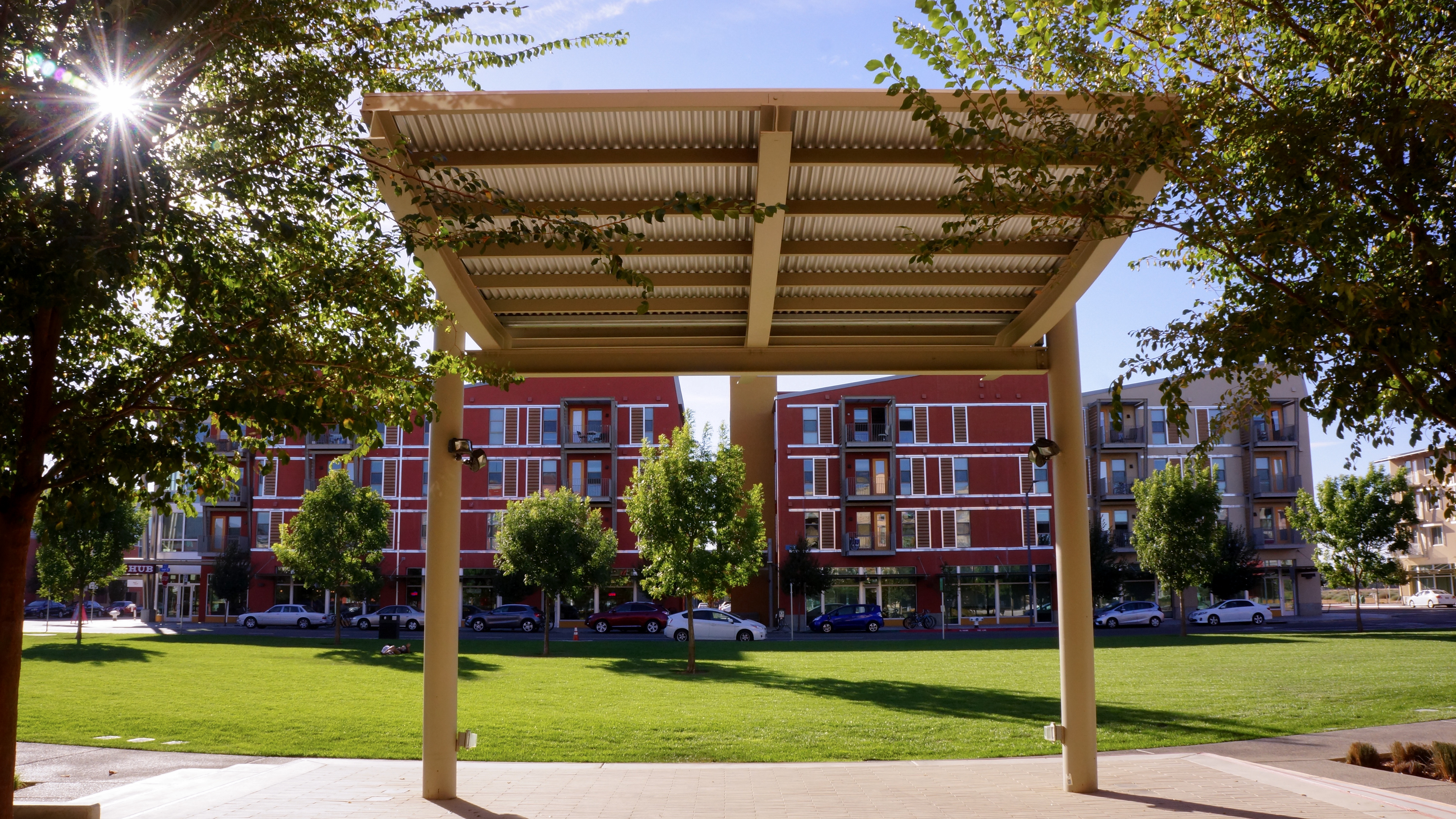
Student housing complex West Village recently released a report revealing that student resident energy consumption is substantially higher than initially predicted. According to the report, the amount of energy consumed was higher than the energy produced.

In 2011, West Village made headlines for becoming the country’s first zero-net energy goal community. However, in their 2013-2014 report, 82 percent of the total energy produced was attributed to the panels, compared to 87 percent the previous year. Data for the 2014-2015 cycle has not yet been collected. On average, residents living in the apartments consumed 201.3 megawatt hours (MWh) more than modeled in 2013-2014.

Sid England, assistant vice chancellor of sustainability at UC Davis and one of the original spearheads behind West Village inception, notes that the complex attempts to be zero-net energy is done through the use of power-saving solar panels.

“We set the goal of trying to get to zero-net energy on an annual basis. What we mean by that is the total energy is equal to what is produced on site annually,” England said. “We have 4.1 megawatts of photovoltaic solar panels that are installed on site [at West Village]. That’s what produces the electricity.”

In regards to the discrepancies in the report, a representative for West Village declined to comment.

Residents only recently began moving into the buildings in the Viridian Commercial Areas in West Village, adding to the increase in energy consumption. While commercial buildings do play a big role in the rise of energy usage, the report still confirms that residents are consuming more energy than modeled.

The Executive Director of the Energy Efficiency Center Benjamin Finkelor believes that residents have a lowered incentive to save energy since the cost of utilities is already allocated within their monthly rent.

“There is a lot of variability in how much [energy] residents use, and on average, they use more than we thought, in part because they don’t have a price signal,” Finkelor said.
NICKI PADAR / AGGIE
NICKI PADAR / AGGIE

Stephanie Martling, the vice president of asset management for West Village-partnered company Carmel, revealed to The Sacramento Bee that residents not only have low incentive to conserve, but are also uninformed of the energy that they are using.

“Sometimes we notice a particular unit might be 10 times higher than its neighbor. Oftentimes, these residents don’t even know they are using as much electricity because this is their first apartment,” Martling told The Bee.

The West Village Community Partnership launched a program in 2014 called EMPOWER that aims to promote sustainability and educate residents. This program is currently targeting high-energy users and creating incentives in hopes of encouraging students to reduce energy.

Third-year human development major and West Village resident Andi Vilaboy feels that residents are informed of their energy habits but simply do not have enough motivation to change them.  

“[Energy usage] is just not on the radar for a lot of college students. When you’re in college, you’re thinking about other things,” Vilaboy said.

Samantha Nady, another West Village resident and a fourth-year political science and history double major, shared a similar view on the residents’ lack of motivation.

“It’s irresponsible to say that college students don’t know what they’re doing, because they absolutely do,” Nady said. “However, the apartment complex needs to be aware that [residents] are college students and they aren’t going to read every email.”

While Finkelor is optimistic about West Village’s zero-net energy goal, he does find that there could be improvement in minimizing the residents’ energy usage.

“The real opportunity is in behavioral intervention. I don’t like to say it’s the users fault; we just haven’t fully optimized our ability to intervene,” Finkelor said.

Anjali Bhat assisted in reporting for the story.

Aftershock festival brings amazing show to Sacramento

0


KATE SNOWDON / AGGIE

A review of the good, the bad and the weird

The two-day Aftershock Music Festival, featuring artists as huge as Slipknot, Marilyn Manson and Deftones, smashed the four stages set up in Gibson Ranch Park and a record number of 45,000 people moshed their way through the gates. As I was more sober than literally anyone else attending, I caught some highlights that other people may have missed. Here’s a rundown of the good, the bad and the downright weird parts of my weekend.

THE GOOD

Marilyn Manson

The first CD I ever bought was a Marilyn Manson album, back when I was a tiny impressionable goth kid. Despite me hearing more than one person questioning his sobriety during his Saturday evening set, the incredible hits he played, including “The Beautiful People”, “Disposable Teens” and his cover of 80s classic “Sweet Dreams (Are Made of These)”, combined with awesome stage design (including stained glass effigies of the Antichrist Superstar) and a literally unforgettable voice, more than made up for any potential intoxication. Apologies to the man in front of me, who only put earplugs in after I started screaming.

KATE SNOWDON / AGGIE

Slipknot

Slipknot played a solid, heavy set on Saturday night, opening with “XIX”, an incredibly atmospheric track from their new album “The Grey Chapter”, but mixing it up with old classics such as “Duality”, and even finishing with a song from their very first album. They were full of intense, angry energy and the crowd responded in kind with a violence and pleasure only ever really present at Slipknot shows. Photographing them was an absolute dream, as was being able to be so close to the incredible stage set up, but I still think my favorite part of the set was when I got decked from behind in the mosh pit and lost my media pass. It’s not a Slipknot gig if you’re not bleeding afterwards!

All Time Low

All Time Low opened the stage on Sunday with a song from their new album, which evidently must be alright, judging from the insane crowd reaction. Although not my cup of tea, I admit their charisma lifted their performance from mediocrity. As I photographed the band, ducking multiple bras fired from behind, I climbed up onto some scaffolding next to a speaker to get a better angle for my shot. And then suddenly Jack Bakarat, lead guitarist, was standing on said speaker, offering me his guitar.

And then he was still holding it out.

Maybe he meant I should take it.

I was holding his guitar.

As I was ushered out of the photography pit and rejoined my friend in the crowd, I stood with a stupid grin on my face, screaming the lyrics to songs I’ve loved for years, and only occasionally interrupted by being kicked by very enthusiastic crowd surfers.

THE BAD

The Traffic

It was Saturday at 3 p.m. We were late. The traffic coming in to Aftershock was mental, and it took over 45 minutes to get round two sides of a field. I had a burrito though, so I didn’t care. By 4 p.m. and still sitting in traffic, I became irritated. We were so close to being parked it hurt. Finally, as we pulled up through the cloud of dust to the parking lot, I watched people throng around the car and into the festival site. Hundreds of people were still arriving, and at least half were carrying red cups of beer to drink before going in, in a last ditch attempt to beat festival prices.

Saturday night was worse. After stumbling semi-consciously back to the car, I began to pass out as my friend desperately tried to navigate the battlefield that the parking lot had become. As one person after another cut her off I dozed off. I jumped awake at 1:30 a.m. to find out we’d made it to the freeway, where in celebration she turned on the radio. Or maybe that was just to keep her awake.

THE WEIRD

Technical difficulties

Jane’s Addiction brought an incredible energy to the festival, as should the third last band of the weekend, playing their classic hits to an incredible light show. But it was their unusual performers that really made them stand out. Two girls were suspended by hooks through the flesh of their backs and were swinging and twirling to the music, all fun and games until one girl got stuck, at which point Jane’s Addiction swiftly closed down their set. Between that, and frontman Perry Farrell’s story about wrecking his car with a legless drug addict, it was an overall bizarre set with an even weirder end.

Costumes and creativity

While at a festival, I’m always searching for interesting people. I was not disappointed by Aftershock, where I encountered an incredible number of Dying Fetus fans, some incredibly under- and overdressed Slipknot fans and one man dressed as banana. My friend and I started playing a game called “Spot the Weirdest Person” and we encountered beauties such as:

“Oooooh that guy has a facial tattoo!”

“Yeah, but THAT guy is wearing a dinosaur onesie!”

“Did you see that girl with the bandana for a shirt?!”

The surreality of festivals never ceases to amaze me.

By festival’s end, I was absolutely exhausted. Thankfully new traffic measures were in place following feedback from the night before, and I managed to get home by 11 p.m. Collapsing into bed and mentally leafing through my weekend, I wanted to shake the hand of everyone who had a hand in creating Aftershock. From the booking agent to the friendly security to the technicians and artists, everyone gave it their all, and made it one of the most incredible musical experiences I’ve ever had the good fortune to attend. Here’s to another great festival year!

The Ethical Wallet: Do you take sugar and cream?

0

greenburg_opCoffee. I wake up thinking about it. My body aches and my head throbs when I’m deprived of this magic liquid. My soul feels weak and fragile before I take the day’s first sip. I am a coffeeholic.
I figure if I am making such a financial and physical investment, it should be informed and beneficial.

My new standards for a cup of joe aren’t very difficult to understand. Although changing my rather expensive habits will make a small impact on the coffee industry, I encourage all caffeine fans to pay attention and consider making similar changes to contribute to a better future.

Most of us have heard of the term “Fair Trade” and we’ve heard it’s a good thing. But the term is thrown around a lot and I want to make sure everyone knows the importance of this certification. It’s not like the meaningless label on your cracker box that says “60 percent less fat.” Fair Trade coffee has met a certain standard guaranteeing that smaller scale farmers who pick the seeds to produce your cup of coffee were paid an appropriate wage, worked under safe and humane conditions, were allowed to keep their land and produce higher quality products. While it’s easy to overlook these factors while sipping your coffee in a shop far away from its source, it’s important to remember that your $2.95 can be a vote toward a more sustainable future.

In addition to looking for Fair Trade coffee, I want to make the effort to find companies that meet the B Corp standard. B Corp certified businesses meet rigorous standards of social and environmental performance, accountability and transparency. They are transparent about their policies and are joining the fight to redefine success for businesses everywhere. But it’s hard to find a B Corp or an independently owned coffee shop when my head is pounding and my addiction is begging for relief. Luckily, I have found a couple options in Davis.

I have been making an effort to get my coffee at Pachamama on 1st Street. Pachamama is a certified B Corp business, and only sells coffee from farmer-owned brands that are a part of their enterprise. Businesses like this one create a foundation for small-scale farmers to succeed in growing their future products.

Starbucks also offers a Fair Trade blend called Fair Trade Italian Roast. Although Starbucks is not a B Corp, I will cave for this particular blend when left without any other options. Peet’s Coffee also offers a Fair Trade Blend, as well as Trader Joe’s and Whole Foods.

For a long time I avoided being a sustainable and informed consumer because the idea of it sounded daunting. Truly understanding all the different terms and labels was intimidating, but worth the trouble considering my caffeine dependence. I hope you and your coffee habit will join me as I upgrade my morning routine.

Ask Martha Greenburg to coffee at mzgreenburg@ucdavis.edu or on Twitter @marthazane94

Hot Italian to open in Davis this fall

0
restaurant_ci_Padar
NICKI PADAR / AGGIE

Hot food, Hot atmosphere, Hot Italian

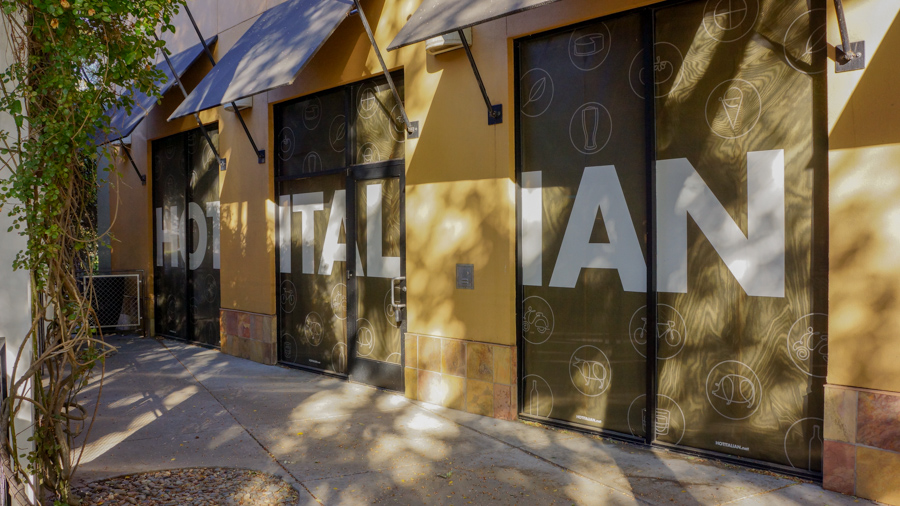
Hot Italian is bringing their traditional Italian cooking to the heart of Davis this fall, opening a new location at 500 1st St. Hot Italian currently has two locations — one in Sacramento and one in Emeryville.

The pizza and panini bar is expected to open in late November or early December. With Italian music, decor and televised sports, the restaurant seeks to create a traditional ambiance.  

Jesse Delzio, a first-year chemical engineering major, comes from an Italian background and looks forward to eating authentic Italian food.  

“I am really excited to go there because I have never eaten real Italian food since I have come here. Watching soccer and eating amazing food is all I want,” Delzio said.

The Davis restaurant will be smaller than the other two locations, at 1,500 square feet, compared to the 6,000 square foot Sacramento location. The restaurant will include both indoor seating and an outdoor patio.

The Davis location will also feature a take-out option, which is not offered at the Sacramento or Emeryville restaurants.

“The pick-up option will help people who are in a rush and still provide the same level of quality,” said Andrea Lepore, a UC Davis graduate and owner of Hot Italian.

According to Lepore, though the pizzeria is smaller in size, it will not compromise on the traditional offerings it is known for. The restaurant will have a slightly different menu but will still include the restaurant’s famous drinks and dishes, such as the Bellucci with housemade fennel sausage, tomato sauce, mozzarella and fresh ricotta cheese, or the popular Fiori with prosciutto parma, mozzarella, mushrooms, tomato sauce, arugula and Bariani truffle oil.

“We have had amazing times at the Hot Italian in Sacramento and now that there will be one in Davis, we will not have to travel so much,” said Michelle Paulsen, a Davis resident.

Hot Italian also has dishes for vegan and vegetarian customers, including gluten-free pizzas.

“I am really excited to be back in Davis and [Hot Italian] in Davis will continue the brand’s commitment to sourcing ingredients from local farms,” Lepore said.

Written By: RAHIL SHETH – city@theaggie.org

Three new slates emerge in upcoming ASUCD fall election

0
TIFFANY CHOI / AGGIE

What the fall of S.M.A.R.T and the rise of fresh slates says about the current needs of the student body

This fall, students are seeing an ASUCD senate election that is much different from last year’s. For the past few years, the NOW Slate and Students Matter: Activism, Retention, and Teamwork (S.M.A.R.T) Slate have had a significant presence on the ballots.

However, this quarter, three outside slates have emerged, two of which are new and one which has not been active since 2006. Slates act similar to political parties for ASUCD elections in the sense that they are comprised of student candidates who share similar platforms and views.

On the ballot this quarter are 17 candidates, nine of whom are affiliated with a political slate. Out of those nine, five are involved with the new Based slate, one is involved with the reemerged Friends Urging Campus Kindness (F.U.C.K) slate and two are involved with the new Smarter slate.

Georgia Savage, Adilla Jamaludin, Parteek Singh, Jacqueline Obeid and Lynn Ayala are running under Based. David Belcher and Jack Foley are running under Smarter. Lastly, Tyler Longenbaugh is running under F.U.C.K.

The nature of this quarter’s election starkly contrasts with the recent winter election and even elections before that. During the winter 2015 election, only six candidates ran, which produced an uncontested race and earned all the candidates a position. During the fall 2014 election, only seven candidates ran and all but one of the candidates were elected.

A majority of candidates ran under S.M.A.R.T for the 2014 and 2015 elections and a majority of the current student government is affiliated with S.M.A.R.T. Of the 12 current senators, seven are affiliated with S.M.A.R.T. Additionally, ASUCD President Mariah Kala Watson is also a member of the slate.

Longenbaugh believes the combination of S.M.A.R.T’s focus on student activism and a lack of political diversity led senate to put less focus on directly improving student life.

Not only did it distract the association from ongoing issues, Longenbaugh also believes that S.M.A.R.T’s focus on student activism, especially concerning issues like divestment, divided the campus further.  

“S.M.A.R.T spent a lot of time trying to [divest] and we ended up not divesting. For us, I would say that a lot of the issues that we’re talking about now, things like divestment, are important issues,” Longenbaugh said. ”But […] I think it’s easy to polarize the student body and have them get distracted from things that we can do here.”

Longenbaugh chose to resurrect a slate that has not been active since 2006 because he wants to ground the association on changes that he believes are easily within its power. The slate’s current pillars stand on community, accessibility, transparency and sustainability (C.A.T.S.). These are ideas that Longenbaugh believes directly serve the student’s immediate environment and are within the association’s reach.

In addition,Longenbaugh believes that the role of activism should play a minor role in the senate.

“I’m not saying it’s not important that you be an activist, but I’m saying that activism does not need to be necessarily the ASUCD’s position,” Longenbaugh said. ”ASUCD should exist to serve the students, make them aware of what’s available to them and give them opportunities.”

On the other hand, Savage and her slate believe that activism, specifically lobbying, is important and a necessary component in the association’s effort to improve student life. While there are some initiatives that fit within ASUCD’s budget, Based believes it is also necessary to lobby to effect changes which are outside the budget’s limits.

“Although [candidates] do often have amazing ideas, a lot of times it is hard to implement due to financial constraints,” Savage said. ”So being able to lobby and ask for money from outside sources […] should also definitely [be] utilized as a university.”

The slate’s emphasis on lobbying is only one portion of a multifaceted intersectional platform which seeks to ground the community. The slate operates under several primary values representing each of its members.

Those values include sexual assault prevention and mental health resources, international resources and representation, retention specifically for people of color, increasing club involvement and resources and food security. Some specific initiatives posed by members include providing Plan B vending machines, expanding on inclusive community spaces and hiring more bilingual counselors.

Based, according to Savage, represents a coordinated group of individuals whose initiatives all complement one another. While each member under Based focuses on different problems within the community, their solutions all intersect.

“We all heard each other’s platforms and thought about whether this would be a good idea and realized we could really help each other,” Savage said

The establishment of Smarter differs from that of Based, in that the Smarter slate was created in response to the recent years of uncontested or low-competition elections. While the candidates were unavailable for questioning, Foley addressed these concerns in his candidate statement.

“We are a big tent group from all walks of life with one common commitment: the idea that [s]enate should be made up of democratically elected officials, rather than people ushered in without competition,” Foley wrote in his statement.

The slate’s primary interest is in reforming the Club Finance Council (CFC), a council which they believe is extremely bureaucratic. In Belcher’s candidate statement he describes the system’s rigidness.

“CFC is extremely bureaucratic and has stringent guidelines regulating how clubs can receive ASUCD funding and how they can spend allocated funds,” Belcher said in his statement.

Despite the differing platforms among the slates, current ASUCD Senator Roman Rivilis advises all the candidates to test the feasibility of their ideas before trying to implement them.

“Research your platforms and test them with the department that you want to collaborate with to actualize them,” Rivilis said.

As Savage said, the rise of fresh political slates is representative of the changing needs of a university community.

“The dynamics of this school is constantly changing. Every four years, students graduate,” Savage said. “Different ideology and problems on campus are constantly coming to light. Students need to respond immediately to these problems.”

Find these three slates, as well as the independent candidates, on elections.ucdavis.edu. Elections will be held from Nov. 9 to Nov. 11.

Written by: Katrina Manrique – campus@theaggie.org

ASUCD debuts potential Aggie Card designs for incoming students

MELANIE ZELAYA and JULIANA LUNA / COURTESY

Design options to appear on fall ballot

During this fall’s election, UC Davis students will be able to vote for a new AggieCard design. On this quarter’s ballot are four possible designs that students can choose from.

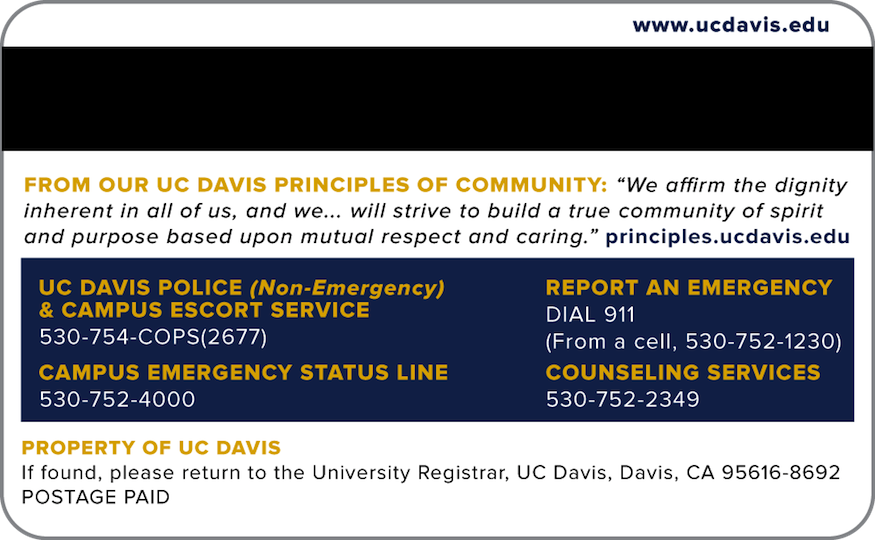
Designed by Melanie Zelaya and Juliana Luna, student staffers under ASUCD senator Alex Lee, all designs feature one or more key parts of the university’s identity. The first three designs feature UC Davis’ mustang mascot, while the fourth design features UC Davis landmarks such as an egghead, a Unitrans bus and the water tower.

All four options also have variations of the university’s blue and gold color palette. Additionally, the back of the card visually separates information using bolded and unbolded text, spacing and other differences, allowing for crucial information to be quickly identified.

Landing on the fall ballot was one of the first major steps for Lee and his staff in ensuring that AggieCards will be available in time for next year’s incoming freshman and transfer class. During their Oct. 13 meeting, senate passed Ballot Measure #1, allowing the designs to be voted on this fall.

This was a critical step for Lee and his team. By voting this quarter, there will be enough time for the card’s production company to manufacture cards for next year. The quick passage of this measure represents a rigid and time-sensitive year-long process, which started before Lee’s induction into office.

The idea of new ID card designs originated from two students: second-year design major Melanie Zelaya and second-year communications major Juliana Luna. Both first-years at the time, the two were heavily dissatisfied with the current Aggie Card. In their perspective, not only did the card fail to be visually appealing, but it was also unable to effectively convey crucial information.

“I came here to UC Davis, a freshman, and I looked at my ID card and they were ugly and there’s certain information on the back that’s important but you don’t even realize it,” Zelaya said.

Luna specified the problems with the design on the back of the card.

“[The back of the card] is a huge block of text and it’s all the same color,” Luna said.

The new cards will be distributed to incoming classes. For current students who are interested in changing their card, they will have to pay for a new card. Additionally, since the university already orders cards regularly, this new design will not raise student tuition.

After both joining Lee’s staff, they began to pursue the idea of changing the card’s design. Between then and now, Zelaya and Luna operated under a strict timeline of designing cards and communicating with the administration.

Luna, Zelaya and Lee first met with Vice Chancellor of Student Affairs Adela de la Torre. According to Zelaya, the vice chancellor was excited about their initiative and referred them to several helpful contacts.  

“[Torre] liked the fact that we as students came up with an idea and wanted to pursue this,” Zelaya said. “I guess it’s not [common] for students to approach administration and facilitate a project.”

MELANIE ZELAYA and JULIANA LUNA / COURTESY

However, collaborating with the administration presented its own challenges. In order for it to be approved by UC Davis, the design needed to coincide with the university’s design standards. Just recently, the university rebranded itself, including a change to its tagline. What was once the “One UC Davis” campaign shifted to a new campaign with a tagline “One of a kind, just like you.” Along with the rebranding came a change in the university’s design standards.

Under that transition, Zelaya and Luna utilized Marketing Toolbox, a free resource offered by the university for individuals interested in how UC Davis relays itself visually and textually. The toolbox was used to ensure all design choices coincided with the university’s creative direction. Zelaya and Luna took into consideration certain factors such as text, font and spacing.

As of now, Lee and his staff are awaiting the results of next week’s voting. However, for Lee, the project does not end there. There will be a process in certifying that new Aggie Cards are official UC Davis identification.

“The process won’t end just at the vote. […A]fter that, we’re going to have to work on the details of how it’ll be implemented then look at the ripple effect,” Lee added. ”For instance, [we need to predict] how different units, like Unitrans, take the change.”

The change will not only apply to incoming undergraduate students. The university’s incoming graduate students will also be receiving newly designed cards as well. For Lee, this is a massive university-wide change, a change that goes beyond updating a card’s appearance.

“If you think about it, [an ID card] is one of the first things you see when you come to Davis […] that really validates you as a student.” Lee said. ”It’s school pride [on] a large level. When you vote on November 9, you’re voting for a bigger [concept] about school spirit and what [students] can identify to.”

Students can vote for their favorite AggieCard design this quarter at elections.asucd.edu. Online voting will be open from Nov. 9 to Nov.11.

Written by: Katrina Manrique – campus@theaggie.org

Meet the 2015 fall Senate Candidates

JAY GELVEZON and ELI FLESCH / AGGIE

Senate candidates discuss platforms, goals for their prospective terms

zheng_xu_candidateprofiles_fe_GelvezonZheng Xu:

As an international student, first-year computer science major and independent senatorial candidate Zheng Xu wants to incorporate both international and domestic student voices as a way to execute change and implement goals.

“I want to help students and I want the students’ voices to be heard,” Zheng said. “I want Davis to be a really good place for students — UC Davis deserves to be that place.”

As a member of the UC Davis Chinese Students and Scholars Association (CSSA), Zheng’s platforms rely heavily on helping to bridge the gap between the international student population and UC Davis. He hopes to serve as a mouthpiece for those students by setting up a club and other channels for international students to learn more about their fellow Aggies.

If elected, Zheng plans to dedicate an entire week of the academic year to Asian and Eastern studies celebration at UC Davis.

“I want to make UC Davis a unique school,” Zheng said. “I want to make [our school] one of a kind [and] I think I can impact more people.”

josh_dalavai_candidateprofiles_fe_GelvezonJosh Dalavai:

As former publicity director in ASUCD’s Office of Advocacy and Student Representation, second-year political science major and independent senatorial candidate Josh Dalavai has a few very specific goals for his prospective term.

“I’m running primarily on a police-community relationship platform,” Dalavai said. “What that entails is ensuring that the UC Davis Police Department and the Davis […] Police Department are invested in the community and that the community is able to channel their concerns […] in a relatively accessible way.”

Dalavai plans to help this relationship in various ways, including promotion of a series of forums for the community to interact with Davis police officers. Other platforms he hopes to accomplish are increased graduate school preparatory resources in the library, and civic engagement and ASUCD transparency — to make ASUCD more accessible to UC Davis students.

“I believe that the title of senator gives the capacity and agency to do a lot of things you couldn’t otherwise,” Dalavai said. “It’s a great medium for connecting to administrators, community organizer and campus leaders throughout various organizations and groups.”

mikaela_tenner_candidateprofiles_fe_GelvezonMikaela Tenner:

As an involved member of Greek life, a writer for the Davis Political Review, a volunteer for Davis’s Sam Len Hillel House and a tour guide, fourth-year international relations and political science double major and Independent senatorial candidate Mikaela Tenner feels she will be able to help improve ASUCD’s productivity.

“I do have a lot of experience in ASUCD,” Tenner said. “I’ve been on it for three years in the executive branches and the judicial branches. I really have an understanding of the way it functions.”

Tenner’s platforms include a year-long project, a half-year project and several shorter ones. She hopes to expand mental health resources with her longest project, which aims to add peer counseling groups and expand mental health resources. She also plans to make Safeboats fundraising a more collaborative effort between both the Greek system and ASUCD, similar to how it was before 2013.

Her shorter goals involve adding WiFi to the ARC and some Schedule Builder changes, such as sending out warning emails on the 20-day drop deadline and the ten-day drop deadline, as well as appointment reminders to help students avoid missing their registration times.

“It has concerned me in the past three years [that ASUCD’s] productivity has declined,” Tenner said. “I’ve looked at actual statistics and there’s been a 60 percent drop in resolution. Having been a part of ASUCD for so long, this kind of knowledge will help me get the productivity up and be able to get things done.”

david_belcher_candidateprofiles_fe_GelvezonDavid Belcher:

Fourth-year political science major and SMARTER senatorial candidate David Belcher wants to improve the lives of UC Davis students, which is what he believes the primary function of student government should be.

“I’ve been here a long time, [and] I know what students really care about,” Belcher said. “I think what is most measurable and has a direct impact is small things that add up to a cumulative positive impact such as more outlets in the library, more hammocks on the quad, things that are accomplishable.”

With his involvement in Mock Trial, ASUCD court, Davis College Republicans (DCR) and swim club, Belcher believes his experience can help execute reform of the Club Finance Council (CFC), as well as his smaller, “more accomplishable” goals.

“I’ve been involved with ASUCD since fall quarter of my freshman year,” Belcher said. “I worked in legislative branch as assistant to senator, I’ve worked in the court for a few years — I’ve been around ASUCD so I think I can get things done.”

tiffany_jiang_candidateprofiles_fe_GelvezonTiffany Jiang:

As a member of Model United Nations and the Pre-Law Association, second-year economics major and independent senatorial candidate Tiffany Jiang believes her experience will serve to improve ASUCD policy.

“I’m really good at communicating with students and professional organizations, and I believe I can be a really good medium,” Jiang said. “I want to run for senate to increase voter turnout and to involve students on campus.”

Jiang hopes to increase campus engagement by collaborating with OrgSync in order to create a website or application that will connect students to clubs and organizations. She also aims to create better access to resources for immigrant, low-income, undocumented and first generation college students, and implement “Picnics with Professors” to improve relations between students and professors.

A few of her smaller platforms include improving bike safety on campus, creating a “Frosh Week” for UC Davis and working with the Greek community, clubs and students to raise awareness about sexual assault.

“I want to be an ASUCD senator because I believe [with] my experience and my personality — I’m someone that’s super involved and super insistent,” Jiang said. “I think that I’m really good with coming up with ideas and really good at making sure I follow through with them.”

parteek_singh_candidateprofiles_fe_GelvezonParteek Singh:

Third-year managerial economics major and Based senatorial candidate Parteek Singh believes that being a senator would increase resources for the goals that he has already been working to accomplish.

“[Being a senator would] give me more legitimacy,” Singh said. “Other organizations take you more seriously as a senator than as a student.”

Singh, who is contemplating on staying an extra year at UC Davis to double major in international relations, is the current president for the Council for International Development (CID) and a member of ASUCD Business and Finance Commission, as well as being a part of the Corporate Budget Council (CFC) and serving multiple senators in the past.

Singh’s main goal includes increasing resources for sexual health and clubs. He plans to implement a Plan B vending machine on campus, conduct more free STI testing for students and have a sexual assault awareness seminar on campus. He also wants to implement a “clubs week” at student housing buildings to create more “intimate situations” for clubs and students.

“[I want to] build a relationship with clubs and ASUCD, [and] increase and expand that,” Singh said. “ASUCD could do a lot more outreach via clubs and clubs could benefit from ASUCD because of the resources.”

georgia_savage_candidateprofiles_fe_GelvezonGeorgia Savage:

Third-year political science and gender, sexuality and women’s studies double major and Based senatorial candidate Georgia Savage has two main platforms in mind for her prospective term.

“My main platforms are, first of all, sexual assault and sexual violence prevention, [and also to increase] mental health resources,” Savage said. “I really want [my platforms] to be achievable [because] I know that in the last five years there’s been significant cutbacks, specifically from ASUCD.”

As legislative director for the Office of Advocacy and Student Representation, Peace Corps ambassador and chair of the Campus Climate Response Team (CCRT) with regards to sexual violence and assault prevention, Savage feels that her knowledge and experience will help to maintain this “achievable” mindset in student government.

With regards to sexual violence prevention, Savage hopes to bring the “Now UCSB” campaign to Davis, create a freshman sexual assault seminar class and organize a sexual assault work group. She also aims to extend the Counseling and Psychological Services (CAPS) limit of visits, create a peer education model and lastly, install some general improvement for campus resources such as more gender-neutral bathrooms, phone chargers in the library and more microwaves.

“I think also the things that I mentioned in my platforms affect everyone at UC Davis on a really wide scale,” Savage said.I’ve been involved in a multitude of things, so I really do have a wide understanding of the way this campus works and also needs based on different groups.”

nope_adilla_jamaludi_candidateprofiles_fe_GelvezonNoor Adilla Jamaludin:

An involved member of the Empower Arab Sisterhood and Students for Justice in Palenstine, second-year environmental policy analysis and planning major Noor Adilla Jamaludin and Based senatorial candidate hopes to improve international resources.

“[The members of “Based” slate] all represent different communities,” Jamaludin said. “That’s why we’re called “Based”—we’re from the grassroots.”

Originally from Malaysia, Jamaludin said she knows firsthand how language barriers can hinder students in academic and social settings. Jamaludin believes the first step to improving the resources and representation for international students is to hire counselors and peer advisors who are bilingual. She also wants to see more diverse food options in the ASUCD Coffee House — including international food.

Among her smaller platforms are increasing the ten-swipes per quarter that a student is able to donate with regards to the Dining Commons, working on increasing the Pantry’s accessibility and starting a “Pay-it-forward” campaign.

“I feel that I’ve contributed to the UC Davis community on that sort of grassroots level,” Jamaludin said. “I thought that this is another way to contribute back to the community, to run for senate.”

mark_hrobuchak_candidateprofiles_fe_GelvezonTyler Hrobuchak:

As vice president of the Mock Trial club, third-year sociology and political science double major and SMARTER senatorial candidate Tyler Hrobuchak said he knows firsthand how hard it is to run a club with economic constraints.

“I want to expand the funding for small organizations,” Hrobuchak said. “I really just want to provide university funding to the little guys on campus.”

Along with the Mock Trial club, Hrobuchak is also involved in in debate club, Model United Nations and Davis College Republicans.

Other than club finance reform, Hrobuchak advocated for some “general improvements to campus” such as more bike racks and more outlets in the library.

“I really want to give back to the student body that I’ve been a part of,” Hrobuchak said. “I really want to bring that [approachable atmosphere] to the student body — I want to bridge the gap between the students and the actual senate.”

puneet_dhindsa_candidateprofiles_fe_GelvezonPuneet Dhindsa:

With experience as a staffer for senator Alex Lee and as a member of Club Finance Council, fourth-year political science major and independent senatorial candidate Puneet Dhindsa believes she will be able to use her experience to execute her three main platforms.

Dhindsa’s platforms include campus resource optimization, self-care and collaboration with the Student Community Center to enhance campus diversity and community. She plans for bi-weekly events to be held on the quad to showcase resources for self-care, while also having open mics and social events to bring out clubs and improve community acceptance.

“I think one thing we all have in common is we all belong to different clubs and backgrounds,” Dhindsa said. “There are so many hate crimes on campus — if people were aware of just one or two things about different cultures, I think they’d have a different perspective.”

Being a full-time student can be stressful, and to combat this, Dhindsa hopes to bring yoga to the Quad, more “therapy fluffies,” as well as more general outreach about various recourses UC Davis has to offer.

“My main goal is to help students on our campus, to give them everything that they deserve,” Dhindsa said. “We pay so much tuition and we’re not able to use even half those resources; if we [are] able to invest so much money on campus, I think we deserve to take all that it has to offer.”

tyler_longen_candidateprofiles_fe_GelvezonTyler Longenbaugh:

As Karma Patrol Director for this academic year’s Whole Earth Festival, fifth-year neurobiology, physiology and behavior major and Friends Urging Campus Kindness (F.U.C.K.) senatorial candidate Tyler Longenbaugh hopes to help increase UC Davis’ sustainability.

“In a lot of ways, the campus is becoming more focused on devices socially,” Longenbaugh said. “Not that that’s a bad thing necessarily — but it’s sort of pulling us away from student-funded clubs.”

Longenbaugh streamlined his platforms into a simple acronym: Community Accessibility Transparency Sustainability (CATS). He is a firm believer that students should be aware of ASUCD’s plans and choices, and he plans to help bridge that gap by making ASUCD more transparent and accessible. On top of this, a few of Longenbaugh’s other goals include introducing food stamps to UC Davis students and creating a disabilities committee on campus.

“I want to be involved in advocating for things that Davis does really well,” Longenbaugh said. “I want to be involved in advocating for things like intersectionality, the rights of people who are not white men [and] I want to be involved in increasing our sustainability.”

jack_foley_candidateprofiles_fe_GelvezonJack Foley:

For second-year political science major Jack Foley, running as a SMARTER senatorial candidate symbolized a push for democracy.

“Why I joined the slate was for democratic principles,” Foley said. “I think the senate now is not very representative in terms of a mandate to lead the students of UC Davis. In the last election there were six people who ran and six people who were elected — not one of them had a competitive election.”

Foley’s three platforms include streamlining the club finance process and providing resources for clubs to raise their own money, updating bike repair stations on campus and providing better outreach to international students.

As a member of the UC Davis Mock Trial team and the Dead Arts Society, as well as having previous involvement in ASUCD, Foley believes he will be able to provide better resources to students campus-wide.

“I want to be able to represent students,” Foley said. “I think there’s a huge disconnect from the student body and the student government — [and I want to] bridge that disconnect.”

lynn_elisea_ayala_candidateprofiles_fe_GelvezonLynn Elisea Ayala:

With current senator Andrea Velazquez, the only Chicana senator on the table, terming out by the end of the quarter, second-year Chicana/Chicano studies major and Based senatorial candidate Lynn Elisea Ayala is most concerned with equal representation of the Chicana/o community in ASUCD.

“I’m running for supporting holistic resources for underrepresented resources on campus,” Ayala said. “UC Davis is going to become a Hispanic serving institute. Right now, UC Davis is 19 percent Chilat and it’s going to go up to at least 25 percent [by fall 2018 or 2019.] It’s really important to support the resources that benefit Chilat students.”

As chief of staff for Velazquez and with extensive involvement with the Movimiento Estudiantil Chicana/o de Aztlan (M.E.Ch.A), Ayala stressed the importance of retention in the Chicano/a community.

On top of this, Ayala also hopes to bring a taco truck to campus, joining a variety of food trucks on campus including Star Ginger Asian and Shah’s Halal.

“I want to be an ASUCD senator because I feel it’s really important for student government to reflect the demographics of the population,” Ayala said. “I want to be the voice of the students to represent their needs, as well as be an ally for other communities.”

Jordan Williamson:

Upon transferring to Davis over a month ago, third-year psychology major and independent senatorial candidate Jordan Williamson almost immediately recognized two things: a lack in procedures in disabilities services and high levels of sexual assault.

“I feel like disabled students at UC Davis are underrepresented,” Williamson said. “The reason why disabilities involve one of my platforms is because I have a disability myself, and my transfer to Davis for disability services hasn’t been a very smooth one.”

Williamson, who had a personal experience with receiving testing accommodations, believes that he could represent disabled students at UC Davis at a much higher standard than is currently in student government.

Along with working as an advocate for disabled students, Williamson believes that increasing resources for and helping victims to speak up is important to the prevention of sexual assault.

“I want to make a change at UC Davis,” Williamson said. “I want to leave it better than when I came in.”

Candidates Nolan Matter and Jacqueline Obeid did not respond to an interview request for the article, and former candidates Bennet Pollack-Reeber and Grayson Gordon dropped out of the senatorial race for the quarter.

UC Davis police forcibly detain African American alumnus for using 24-hour study room

JAY GELVEZON / AGGIE

Alum files complaint against police for excessive use of force

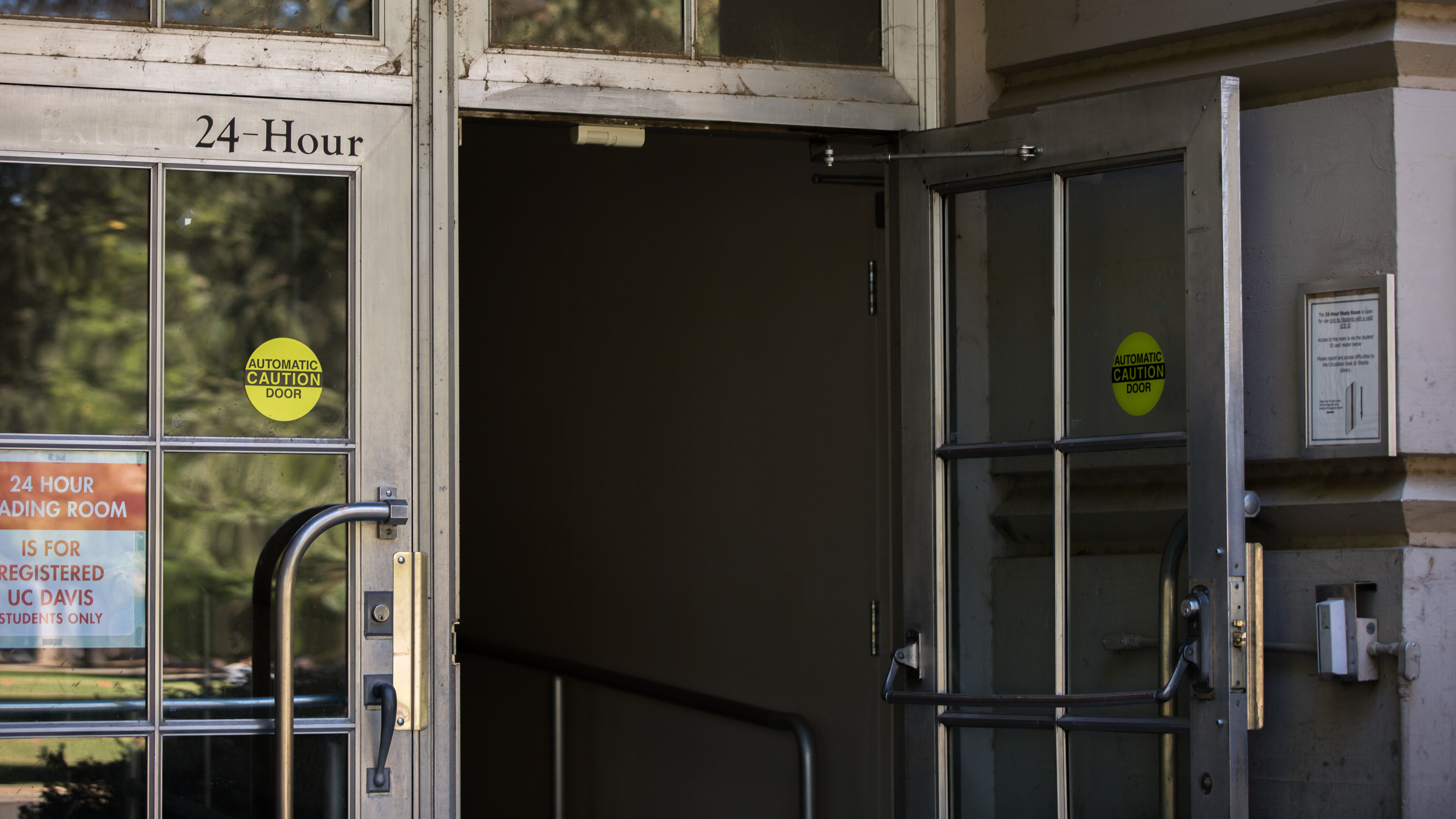
On Aug. 26 at 1:30 a.m., UC Davis police officers forcibly detained African American UC Davis alum Fayia Sellu from the 24-hour study room on the basis that he is no longer a student and was disturbing the peace, according to the penal code violation that Sellu was issued. Officers Guerrero and Sheffield approached Sellu based on a phone call reporting suspicion.

According to the police report for the detention, Guerrero reported to the incident “on a reported suspicious (redacted) who had entered without use of a card key.” In regards to who called the police to report the suspicion and the reason behind the redaction, UC Davis Police Chief Matthew Carmichael declined to comment because the incident is still undergoing investigation.

Sellu said that the officers approached him asking for identification. Afterwards, Sellu said he asked the officers to go outside to sort out the issue, believing that there was a mistake. Sellu, who was studying at the time the officers entered the library, said that he did not notice the officers at first because he was so absorbed in his reading. Sellu did not provide comment in regards to if he knew that he could not use the 24-hour reading room.

“I was approached by both officers in the 24-hour reading section of the Shields Library and asked for identification,” Sellu said in a statement. “I was asked to work outside and sort out my identification and I complied. On approach of the lobby, Officer Sheffield dashed for my right arm and twisted it in a motion as to get me faced down. Two other officers, waiting in the wings of the lobby, joined in and handcuffed me with no apparent tussle. I was definitely not fighting back. I was told among other things that my student ID had expired, hence terminating my access to the study lounge. I accepted that.”

Ethnic and Cultural Affairs Commission Chair Sean Guerra sees this incident as reflective of the numerous occurrences involving police brutality that have been gaining national media attention.

“The fact that Mr. Sellu stated he was glad he did not act in a way that escalated the situation is evidence in itself that in these situations the police entities are the actual perpetrators of violence and that the burden to not get violated, beaten or even killed is placed on the afflicted,” Guerra said via email.

Police released Sellu after issuing him a violation of California Penal Code 626.6, which states that “if a person who is not a student, officer or employee of a college or university […] is committing any act likely to interfere with the peaceful conduct of the activities of the campus or facility, or has entered the campus or facility for the purpose of committing any such act, the chief administrative officer or his or her designee may direct the person to leave the campus or facility. If that person fails to do so […] he or she is guilty of a misdemeanor.”

The issue of the penal code raises multiple questions in regards to Sellu’s situation. Sellu is a McNair scholar, a selective two-year program by UC Davis to encourage the pursuit of doctoral degrees for underrepresented minorities. As a current Ph.D candidate at UC Berkeley, Sellu falls under the definition of “student” provided in the 626 Penal Code, since he is a student of the University of California.

According to California Penal Code 626, “‘university’ means the University of California, and includes any affiliated institution thereof and any campus or facility owned, operated or controlled by the regents of the University of California.”

While the police had grounds to escort Sellu out of the 24-hour reading room since he was not a registered UC Davis student, as per Shields Library rules, they may not have had grounds to issue Sellu a 626 Penal Code violation, since Sellu is still a UC student.

A redacted police report of the incident released in the Davis Vanguard newspaper does not contain any reference to actions by Sellu that would violate the penal code, which furthers the ambiguity of the case. The police report also excludes the officers’ alleged use of excessive force. The report, which was issued on Sept. 26, was redacted after Sellu spoke out on his experience in an article in the Davis Vanguard.

For Black Student Union Vice President Eyonna Woghiren, such events touch on issues of being an African American student and feeling safe on campus.

“It’s so sad that he was just trying to study, and it’s like, you can’t even study anymore,” Woghiren said. “So where do you feel safe? He was in the library.”

Sellu’s complaint is currently under investigation by the Office of Compliance (OOC). The findings will then be referred to the Police Accountability Board (PAB), who will make a recommendation on a course of action to Carmichael, who has a choice to approve or issue his own findings, or resubmit the complaint to the OOC and the police accountability board for further review. The process, unique to UC Davis, of allowing multiple departments independent to the police department to complete the investigation reduces bias and holds the police department accountable.

“The fact that it is under investigation does not lend me the opportunity to answer specific questions because I’m not investigating it,” Carmichael said. “While I can’t speak to the events of the library, I can tell you we work diligently to serve every member of this community.”

The PAB consists of members of the academic senate, the academic federation, the health system, staff assembly, graduate students, undergraduate students and student life, in addition to seven alternates on the board.

“As the police chief, I’m waiting for the facts from the investigation […] It is my job to wait for all the facts to come in. I get presented not only with the investigation, I also get presented with a recommendation by the [PAB],” Carmichael said. “Once I have all the facts I will then make a decision […] For me to make assumptions at this time would be inappropriate, not only for members of this department but for this community.”

The PAB issues an annual report at the end of the year, which will detail complaints against the police as well as their resolution and Carmichael’s decisions. The review of police complaints takes an average of six weeks to issue.

“Our police officers embrace this program,” Carmichael said. “And thinking about safety and security on campus, there is nothing more important than keeping good relations with everyone in this community; That is a priority for me. This police department has to be seen as a resource; you have to feel safe and comfortable to come to this police for help.”

In spite of the pending outcome of the complaint review, the incident itself still signals the presence of subtle racial issues on the campus that haven’t been gaining as much media attention, according to Woghiren.

“This isn’t the first issue […] There’s so many incidents on campus that people overlook,” Woghiren said. “There are a lot of issues of race on campus that are hidden […] and a lot of people turn a blind eye to it. […] Bringing visibility to the issues is a very big thing.”

Woghiren questions why Sellu was singled out in the first place.

“Even if the police are punished for using the amount of force they decided to use, what about the suspicious call?” Woghiren said. “That is still an issue. [The caller] see[s] this male studying […] minding his own business. What incited you to call the police?”

Although Woghiren sees an improvement in the treatment of minorities at UC Davis, she believes that this incident is indicative that the university and society have a long way to go until all communities feel accepted.

“Davis is supposed to be committed to diversity and greatness as a community for everyone,” Woghiren said. “A lot of that has been in the works and we’ve been working towards it, but I definitely still think we have a long way to go before we can truly say that we’re committed to everyone’s success.”

Sunbirds squawk on Aggie Senior Day

KATE SNOWDON / AGGIE

Men’s water polo defeats Fresno Pacific 21-7 in final home game.

The UC Davis men’s water polo team took to the pool in their final home game of the season against Fresno Pacific University on Oct. 30. With a key 21-7 victory, the Aggies remain undefeated in conference play.

“It’s great to be in this position,” Head Coach Daniel Leyson said. “We’re happy to be where we are, but we also expect to be here.”

The night was also important because it marked the last home game for five seniors, and was a “bittersweet moment” according to senior utility Sean Grab.

“This is the culmination of being a life aquatic,” senior goalkeeper Nico Chapman said. “I wouldn’t have rather done this with any other group of guys.”

KATE SNOWDON / AGGIE

Grab and Chapman were joined by classmates Wes Lincoln, Evan MacCarthy, and Austin Beckwith.

“This senior class is one of the most close knit classes we’ve had, even though we’ve only been together for two years,” MacCarthy said. “We have something really special going on. We’re much bigger than teammates inside the water; we are great friends and family outside the water.”

The first period of competition showed the strength of the Aggies and all the time and energy they have put into the game. Coming out of the gates hard, an aggressive offense kept the ball deep into Fresno Pacific territory. However, the aggression did not pay off until junior utility Lyle Kipp’s skip shot for the first goal of the game.

Kipp was joined on the board by Beckwith who scored a point, and two goals by freshman Ido Goldschmidt closed out the first period 4-3.

The second period saw the Aggies pull away with a massive lead. MacCarthy, junior two-meter Jacob Ley, redshirt freshman Riley Venne, freshman utility Sasa Antunovic, Grab and Goldschmidt all added points to the board. Throughout this period, the Sunbird offense was completely locked down. In two instances, Antunovic reached high and intercepted passes leading to the aforementioned goals. The Aggies’ defense held the Sunbirds to 10-3 at the end of the first half.

The third period opened up with a goal by redshirt freshman Nick Coufal. Shortly thereafter, Beckwith added another point to his name and redshirt freshman Brock Gordon joined the other Aggies with a goal of his own.

As Chapman came in for sophomore goalie Spencer Creed, the Sunbirds ramped up their offense. The two teams traded goals until the end of the period, with redshirt freshman Marcus Anderson, Ley and Grab each adding points to the board to end the period 16-6.

The Sunbirds kept up their offense at the start of the fourth period, but the wall that was Chapman stood tall and rebuked their assault. It was not until the second power play for the Sunbirds that they were able to pierce the Aggie defense. This was the last goal the Sunbirds would score, while the Aggies would go on to score five more times.

Sophomore Spencer Galli, Grab and Gordon all added to the overall score by one each, while Anderson added two.

The game ended 21-7, a victory for the Aggies.

The Aggies face two challenging away games to close out their conference play on Nov. 5 and Nov. 7.

Men’s soccer advances to conference tournament despite loss

CIERA PASTUREL / AGGIE

UC Santa Barbara defeats UC Davis 1-0 in last regular season game.

In a defensive match that ultimately ended with a 1-0 loss to UC Santa Barbara on Oct. 31, the Aggies wrapped up their regular season with an overall record of 7-9-3 and a conference record of 3-4-3. UC Davis will advance to play in the Big West Conference Tournament.

Testing the Gauchos’ defense, UC Davis took the majority of the scoring opportunities early in the match, as many players made attempts at the goal, including back to back shots by redshirt senior forward Matt Wiesenfarth.

Weisenfarth’s attempts were denied by the Gaucho goalkeeper and the score remained tied at 0-0 until the 42nd minute, when the Aggies were whistled for a foul in the box, setting up a penalty kick for UC Santa Barbara. The Gauchos’ Kevin Feucht sent the ball to the lower left corner of the net to give UC Santa Barbara a 1-0 lead with under three minutes remaining in the half.

CIERA PASTUREL / AGGIE

UC Davis came out of the break and tested the Gauchos goalkeeper early in the second half as redshirt freshman defender Roy Boateng was able to get his head on a long throw and put it towards the lower left post. The Gaucho goalkeeper was able to make a diving save and keep the Aggies off the board.

“I feel really good about the team’s performance,” Head Coach Dwayne Shaffer said. “I felt like we created enough opportunities to at least score a goal but, unfortunately, things just didn’t go our way today.”

UC Santa Barbara responded by taking the ball towards the UC Davis goal and sent a bullet that clanged off the right outside post, keeping it to a one point game. The Aggies kept the pressure on the Gauchos by taking five of the final eight shots on goal in the last 25 minutes of the game but could not convert any of those opportunities.

“One of the good things is that we’re fully healthy and card-free,” Shaffer said. “Now we have a full week to rest, rejuvenate, and prepare for one game. This week, we’ll make sure the guys get a lot of treatment, have some fun during training, stick true to our team principles, and hope that one of our players gets hot and puts the ball in the back of the net.”

The Aggies earned the third and final berth out of the North Division in the Big West Tournament where they will be making their fifth consecutive appearance. UC Davis will play the second seeded CSUN out of the South Division on Nov. 7.

Philosophical enlightenment through dance

0
PAMELA TROKANSKI DANCE THEATRE
PAMELA TROKANSKI DANCE THEATRE / COURTESY

Pamela Trokanski’s Dance Theatre presents Blood, Reciprocity and Kevin Bacon.

Dance enthusiasts will be pleased to hear of the upcoming performance by Pamela Trokanski’s Dance Theatre (PTDT) titled Blood, Reciprocity and Kevin Bacon. PTDT is a contemporary dance company located in East Davis and has been around for nearly 30 years. Blood, Reciprocity and Kevin Bacon is a performance that aims to reveal the interconnectedness of human interactions and relations.

The director of the theatre troupe, Pamela Trokanski, explained the premise behind the show in more detail.

“[Blood, Reciprocity and Kevin Bacon] is a reflection on both the ways human beings have [created] various social structures that aid in our survival, as well as the implications of our actions on others,” Trokanski said.

The concept of the show is that all people are connected to each other, either via family ties, the “blood” part, or through some sort of mutually beneficial relationship, the “reciprocity” part.

“We’re basically exploring […] what reciprocity [is], how it evolved and how we connect with others throughout the world,” Trokanski said.

The performance uses interpretive dance to answer thought-provoking, profound questions that deal with our everyday interactions with other humans. Trokanski also wants to use the show to answer questions such as why people are excellent tippers, why some are fanatics about recycling and why some always remember to close the lid on the toilet.

The performers of the show have to deal with a variety of complexities, from the technical movements of the dance, to the deeply philosophical questions the performance stirs. Dancer Cindy Robinson says she has been preparing for this show since late August and that the training is quite extensive.

“I usually take between five to seven classes per week on technique, conditioning and choreography. In addition, we are in rehearsal every Sunday for four to six hours, depending on how close we are to the concert,” Robinson said.

Without a doubt, much is expected from the dancers, since a production this intricate requires exceptional performers. Trokanski mentioned that this performance will force the dancers to not only perfect their movements, but to tap into their interpersonal experiences to better convey the essence of the production.

When asked about their opinions about the show, some students, like fourth-year chemistry major Alex Smith, feel that answering obscure questions through interpretive dance and theater is both unusual and worth watching.

“Combining really hard-to-answer questions with dance and putting on a show [about] it is pretty unique […] I think it is worthy [to watch] because these questions can be difficult to answer, but if you combine them with dance it can be a lot more interesting,” Smith said.

Blood, Reciprocity and Kevin Bacon promises to be an amazing production of vigorous movements and philosophical enlightenment.

The show will be held at Pamela Trokanski’s Dance Theatre located at 2720 Del Rio Place, Davis CA and performances will be on Nov. 8th at 3 p.m., and Nov. 13th and 14th at 8 p.m. For more information, please visit the following link.

Aggie Daily Calendar

DailyCalTUES., NOV. 3

Salsa Tuesday

9:30 p.m.

The Graduate, Davis

Dance lessons with Cori from ‘Barbara’s Dancing Tonight,’ hosted by DJ Miguel. Tickets are $6.

Trivia Night

9:30 to 11:30 p.m.

Sophia’s Thai Kitchen, Davis

Compete against other teams in answering the hardest trivia questions! Free and open to all ages.

Women-Trans-Femme workshops: Hubs

5 to 8 p.m.

Bike Forth, Davis

Come learn about bike repair and maintenance on these bi-weekly workshops for only $5.

Tap the Mic Tuesdays

5 to 8 p.m.

Sudwerk Dock Store, Davis

Show off your musical, poetic or artistic abilities at this free open mic!


WED., NOV. 4

Unofficial Scrabble Club

5:30 to 11:30 p.m.

Crepeville, Downtown Davis

Play everyone’s favorite word game and compete with local Scrabblers! All levels welcome.

NaNoWriMo Write-In

7 to 11 p.m.

Crepeville, Davis

Come plan and write your original novel for National Novel Writing Month with other participants!

Open Mic

8 p.m.

Sophia’s Thai Kitchen, Davis

Enjoy a night of free entertainment including singing, poetry, dancing and more!

Trivia Night

8 p.m.

Ketmoree Thai Restaurant

Compete against other teams in answering the hardest trivia questions! Free and open to all ages.

Evan Daly

9:30 p.m.

Our House, Davis

Enjoy a night of live blues music free of charge.


THURS., NOV. 5

Una Chiacchierata

7:30 to 8:30 p.m.

Logos Books, Davis

Come join other Italian language speakers in the area to a full hour of Italian conversation with Franco Renosto.

DJ Smilez

11 p.m.

Our House, Davis

Dance floor opens up for a free night of dancing!

Trivia Night

9 to 11 p.m.

Woodstock’s Pizza, Davis

Join teams of three to six people to answer unique and challenging trivia questions. Prizes, fun and pizza are in store.


FRI., NOV. 6

International Film

7:30 p.m.

International House, Davis

Join both international and native UC Davis students during this free showing of an international film, complete with refreshments!

Folk Music Jam Session

12 to 1 p.m.

Wyatt Deck, Davis

Love folk music? Then join the folk-music players and listeners of Davis during this jam session!


SAT., NOV. 7

Local Live Music

9 p.m.

Woodstock’s Pizza, Davis

Enjoy a fun night of live music free of charge!

Davis Wetlands Tour

3 to 5 p.m.

Wastewater Treatment Plant, Davis

Take a tour of Davis’ unique wetland environments while learning proper ways to handle wastewater.

DJ Smilez

11 p.m.

Our House, Davis

Dance floor opens up for a free night of dancing!

NaNoWriMo Write-In

2 to 5:30 p.m.

Crepeville, Davis

Come plan and write your original novel for National Novel Writing Month with other participants!


SUN., NOV. 8

NaNoWriMo Write-In

1 to 4 p.m.

Cloud Forest Cafe, Davis

Come plan and write your original novel for National Novel Writing Month with other participants!

International Folk Dancing

7 to 10 p.m.

Davis Arts Center, Davis

Enjoy a night of dancing from all around the world, first time free!


Author Event: Shades of Blue

2 p.m.

The Avid Reader, Davis

Join authors Debra DeAngelo, David Lacy, Samantha White and Karen Lynch in celebrating the release of their new novel!

MON., NOV. 9

Pub Quiz

7 p.m.

de Vere’s Irish Pub, Davis

Free quiz night hosted by Dr. Andy, with teams of up to six players. Arrive an hour early to secure a table.

Artist Talk: Thomas GreyEyes

3 to 5 p.m.

C.N. Gorman Museum, Davis

Join Thomas GreyEyes (Diné) in discussing his recent works in this exhibition.

Zebra stripes: the phenomenon explained

JIM DINES / LA MUSEUM OF NATURAL HISTORY

UC Davis researchers explain why zebras have stripes.

The pioneers of the theory of natural selection, Charles Darwin and Alfred Russel Wallace, began the discussion of black and white coloration in mammals over a century ago. The debate has lasted over 120 years and has made little progress in finding a systematic approach to provide reasons for this color pattern.

For the last decade, UC Davis wildlife, fish and conservation biology professor Tim Caro and his team have had little luck researching in the fields of Katavi, Tanzania as to why zebras have stripes — until now.

“The idea of explaining why animals and plants have coloration is something that we all take for granted,” Caro said. “In this lab we try to do large-scale phylogenetic analyses, where we look at the coloration of [an animal] and try to relate those external coloration patterns to the kind of environment that they live in, or the prey that they hunt. There’s something else going on with zebras that is not as easily explicable [as other questions of mammal colorization].”  

Researchers’ understanding of animal coloration is rapidly developing, although only having been introduced in the field of evolutionary ecology in last 15 years.

Beginning about two and a half years ago, Caro mapped the pattern of striping across seven equine species and 23 subspecies. Scientists projected five hypotheses which were involved in the debate, including the concepts that the stripes are a form of camouflage against predators, a form of visual confusion against predators, a method of heat management, a form of social complexity and a method to fend off biting flies.

“It wasn’t until we visited the library here [at Davis] that we suddenly realized that we can put these into a common statistical model that pits one hypothesis against another,” Caro said. “You have these different hypotheses that are rather difficult to sort out because they all suggest the same area in which zebras live.”

Caro tested the five hypotheses on this statistical model to see which was most plausible.

“If you thought it was something to do with temperature, you’d expect the stripes to be found in very hot places…if it were something to do with social interaction, […] you might expect to find that zebras live in much more complex societies,” Caro said. “When you throw all those things into one large statistical model, there’s only one thing that came out everytime, and that is the extent of tabanid biting flies.”

Caro’s undergraduate researcher at the time, UC Davis wildlife, fish and conservation biology alum Hannah Walker compiled the information from UC Davis and four other museums, which included the Los Angeles Museum of Natural History and the California Academy of Sciences.

Walker now works as a graduate student at California State University, Long Beach (CSULB) with another member of the research group, Ted Stankowich, a professor in the department of biology at CSULB. Walker continues to study the colorization of black and white animals, namely in pandas and skunks, with both Caro and Stankowich separately.

“[Those museums are] where I took those measures, the graphs that are in the paper are from those. I did that kind of portion of data collection,” Walker said. “I also do a lot of research on the morphology of the biting flies […] and I did a compilation of the types of diseases that they carry and how susceptible equids are to those diseases and then how susceptible other non-equid species [would be].”

Tabanid flies, commonly known as horse or deer flies, are understood through Caro’s research to be abundant where the patterns of black and white striping are seen.

“[Tabanid flies] like humid […] and warm environments. [By] using environmental proxies to try and understand tabanid distributions, [we got] where the hotspots of abundance of biting flies are, and they match perfectly with where you find stripes,” Caro said. “[With that] you can discard these other hypotheses.”

Since 1981, multiple studies have shown that Tabanid flies avoid landing on flytraps and other surfaces that are black and white. According to Caro, the lab is trying to answer two questions: what aspects of striping might be visible or invisible to these biting fly visual systems, and what’s so terrible about biting flies in the first place?

That branch of Caro’s study has continued on to the present. Visual physiologist and UC Davis neurobiology, physiology and behavior professor Ken Britten was recruited to assist in answering the first question of a fly’s involvement in a zebra’s ecology.

He was able to suggest measurements for Caro to take in the fields of Tanzania, in order to calculate the polarization of the stripes. This work has revealed that the amount of polarization of the black stripes matches that of the white.

“[Horvath, a previous researcher,] has taken measurements of [tabanids] and polarization measurements of horses … [and] makes a very good case that…Tabanids are attracted to polarized light,”  Britten said. “The measurements of the reflection taken in Hungary show that dark horses have more polarization reflection than light horses do, and that led to the specific hypothesis that stripes on zebras are some way of combatting or diluting the attractive force of the polarized light signature for the tabanids.”

According to Britten, the eye of the Tabanid fly has polarization sensitivity in the very middle, rather than at the bottom of the eye like other flies; this creates a unique relationship between this striped equid and its pest.

Britten suggests that the branch of the study of polarization axes in tabanid flies is still in the works, and much more research can be done to understand the tabanids’ lack of attraction to the stripes.

In January, a study from the University of California, Los Angeles (UCLA) took a different approach in answering why zebras have stripes. This study suggests that the stripes, with alternating dark and light colors, are a form of thermal regulation.

“In their analysis, in one species of zebra, the more striped individuals were found in hotter climates, so they put forward the idea that black and white striping has somehow to do with setting up convection currents of air along the back of the animals,” Caro said. “Currently […] the weighted evidence shows that it’s biting flies, until they can show evidence that striping in some way sets up air currents to cool zebras. [It] seems highly improbable, because air currents don’t work if the zebra works or it there’s any wind, it has to be absolutely still.”

However, Caro recognizes that both studies are interpreting the same information and are close to approaching a correct answer.

“These studies are showing the same thing. Both the paper we brought out a year ago, [in which] we found an association with humidity and temperature and striping, and they found an association with temperature and also humidity […] and interpreted that to being a way for thermal regulating,” Caro said. “We interpreted it in a way of avoiding fly attack. So what we’re trying to do in [response to this was] bring the two studies together and say ‘really, we’re showing the same thing.’”

Caro, who spends half of his time on conservation efforts, believes that developing research that sparks the public’s interest pushes people to think more frequently about ecological issues. For Walker, educating children on why animals have specific colorations is one for the most important developments of these studies. Britten expects that a study of what attracts biting flies may lead to an understanding and even prevention of the transmission of tropical diseases.

“Everyone cares why zebras have their stripes; it’s such a spectacular adaptation. […] When Tim’s last paper came out, the phone was just ringing off the hook for a week,” Britten said. “People will have their own specific [reasons], but the question of why zebras have stripes is generally interesting — people are really excited about this stuff.”

Local organization aims to educate students about traffic safety issue

DANIEL TAK / AGGIE
DANIEL TAK / AGGIE

Yolo County Friday Night Live works to call attention to distracted driving.

A student-led study conducted near high schools in West Sacramento, Winters and Woodland analyzed tendencies of selected drivers in the area. Observed drivers were found to be engaged in activities that seriously impaired their focus while driving. Distracted driving includes eating or drinking, using a handheld device and listening to loud music.

Students observed over 3,000 vehicles and found that eating or drinking and cell phone use were among the most prevalent forms of distraction.

The student research project was funded by a grant from the Allstate Foundation and headed by members of Yolo County Friday Night Live (YCFNL) and its parent organization, the California Friday Night Live Partnership (CFNLP).

CFNLP’s mission is to support youth in becoming active leaders in the community. YCFNL and CFNLP are primarily youth-development organizations that seek to empower and educate young people through projects such as the distracted driving study.

Distracted driving is characterized by the California Highway Patrol (CHP) as any activity that threatens a driver’s visual, auditory, physical or cognitive abilities while driving. Traffic collisions are the number one cause of death among those aged 16 to 19, according to the CHP.

YCFNL has started promoting programs in local high schools to educate students about the importance of safety behind the wheel.

At Winters High School (WHS), one of the schools involved with the student research, teachers and YCFNL members have begun working with students in WHS’s Friday Night Live club to spread awareness about the dangers of distracted driving.

“Our mission is to promote teen activities that are safe and fun. We also want to educate our students about the dangers of drugs, alcohol, and distracted driving,” said Olivia Rodriguez, WHS Friday Night Live club advisor.

The club is one of many Friday Night Live groups in California high schools.

“It works with the kids to get the message out about how many [traffic collision-related] teen fatalities there are and how we can prevent them,” said Paul Fawcett, principal of WHS. “Having the opportunity to educate students about ways to prevent distracted driving amongst themselves and their peers is one way to hopefully lower those numbers over time.”

WHS recently hosted a Red Ribbon Week festival during which groups including Friday Night Live, Mothers Against Drunk Driving and American Medical Response were present.

“We want to educate our students that it does happen […] and that teenagers aren’t invincible. We think it’s really important to be teaching this to our students,” Rodriguez said. “If we could just teach them enough, where more lives could be saved—I think that’s our overall goal.”

CFNLP works to motivate and mobilize youth to better their communities. It provides support for Friday Night Live program in Yolo County and throughout the state. The partnership also collaborates with outside groups in an effort to address its wide range of focuses beyond traffic safety.

“Our job is to help young people see these things in their community and then do something about it,” said CFNLP Administrator Jim Kooler.

According to YCFNL Outreach Specialist Debbie Clarion-Clifford, the group actively targets both middle school and high school-aged students and has a variety of focuses, including alcohol and tobacco prevention and student mentorship, among others.

“[The program] gives the young people a voice in the community that they live in,” Clarion-Clifford said. “[It] shows the community that [young people] are willing to take a stand and make a difference.”

Written By: ANNIE ADACHI

city@theaggie.org

This Week in Sports

0
TIFFANY CHOI / AGGIE

Men’s Tennis

Pacific Tiger Invitational

Two singles and two doubles teams advanced to the finals of the Pacific Tiger Invitational in Stockton, and doubles team juniors Eli Whittle and Jesse Ross took home first place in the Flight B doubles main draw championship. Junior Bryce McKelvie advanced to the Flight A finals but lost in straight sets 6-2, 6-0. Alongside sophomore Tommy Lam, he played for the Flight A doubles title as well but fell to the Tigers 6-3.

Men’s tennis now goes on a hiatus until Jan. 13, when they will compete against Stanford.

Men’s Soccer (7-9-3)

UC Davis at Cal Poly (T, 0-0)

UC Davis vs. UC Santa Barbara (L, 1-0)

It was a tough game on the road for the Aggies as they stoutly defended themselves against the Mustangs, but with goalkeeper Armando Quezada’s three saves, the match ended in a draw after 110 minutes of play.

The last league match of the season was played against UC Santa Barbara on the Aggie soccer field. The sole goal of the match was scored by UCSB just three minutes before halftime. Despite the 1-0 loss, the Aggies keep their spot in the Big West Tournament and play against the second place team out of the South Division on Nov. 7.

Women’s Soccer (10-7-2)

UC Davis at Long Beach State (L, 2-0)

UC Davis at UC Irvine (W, 2-1)

The women’s soccer team took on their second-to-last league match against Long Beach on Thursday in hopes of clinching a spot in the Big West Tournament playoffs. Despite keeping possession throughout most the game, one goal by the 49er’s in the 39th minute and another in the 61st created a deficit that was hard to overcome. This loss means that the Aggies will play their last match of the year against UC Irvine.

The Aggies triumphed over the UC Irvine Anteaters on Sunday. The first half was scoreless but in the second, freshman midfielder Mckenna Moriarty and sophomore forward Zuzu Romano secured the victory with their two goals. Thus, the Aggies concluded their season on a high note, with an overall record of 10-7-2 and going 3-4-1 in the Big West Conference.

Women’s Volleyball (11-14)

UC Davis vs. CSUN (W, 3-2)

UC Davis vs. Long Beach State (L, 3-1)

It was a day of career highs for the Aggies as they battled out five sets neck-to-neck against CSUN on Thursday in the Pavilion, ending with a score of 25-20, 26-28, 25-16, 15-25, 15-8. Standouts included senior outside hitter Kaylin Squyres who tied the school record for most aces in a game while freshmen opposite Nicola Moore and redshirt middle blocker Kelechi Ohiri made career-high kills, hitting 14 and 12 respectively. The close match ended in a win for the Aggies.

The Aggies made a comeback in the third set on Saturday night’s Big West Conference game against Long Beach State but were unable hold off the Longhorns, who won 25-10, 25-22, 22-25, 25-20. Their next game will be held at UC Santa Barbara on Nov. 6.

Field Hockey (8-11)

UC Davis vs California (W, 4-3)

The festivities of Senior Day began before the game as seven graduating student-athletes were honored, among which were juniors Danielle Koehne and Erica Cohen, and seniors Courtney Hazy, Linnea Whitney, Hannah Drawbridge, Martha Duterte and Jamie Garcia. Cal made a dent in the mood when they scored four minutes into the game, but at the 17th minute forward Koehne made a goal and evened out the score to 1-1.

Both UC Davis and Cal scored again in the first half, creating a 2-2 tie. To counter another Golden Bear point in the beginning of the second half, midfielder Garcia scored two points within 15 minutes of each other and the Aggies captured the win. Check out a full recap by sports reporter Veronica Vargo here.

The UC Davis field hockey team ends its season with an overall record of 8-11.

Men’s Water Polo (15-7)

UC Davis vs. Fresno Pacific (W, 21-7)

The Aggies recorded a season high of 21 goals on the Friday night game against Fresno Pacific. Before the game, seniors Evan MacCarthy, Wes Lincoln, Sean Grab, Nico Chapman, and Austin Beckwith were honored for Senior Night.

The Aggies continue their conference winning streak at 4-0 and 15-7 overall. Their next game will be at UC San Diego on Nov. 5 and Loyola Marymount on Nov. 7.

Women’s Swimming and Diving (203-97)

UC Davis at Nevada

UC Davis vs. Loyola Marymount

The season opener for women’s swim and dive was at the Lombardi Pool in Nevada on Friday night. It was a successful start for many newcomers, with freshman Solie Laughlin winning the 200 back and freshman Mia Facey finishing top three in 100, 200, and 50 free. Junior Hilvy Cheung placed first in both the 100 and 200 butterfly.

The Aggies increased their record to 1-1 at the swim/dive dual against Loyola Marymount, where standout seniors Lucy Lafranchise and Audrey DeNeffe both broke the school record on the 1-meter dive board. Sophomore Courtney Schultz and junior Kristen Brand all placed first in their events, leading the Aggies to a 160-112 victory.

The next dual event will be on Nov. 6 at Utah and Nov. 7 at Brigham Young University.

Cross Country

Big West Conference Championships

The women’s cross country team had a successful finish, as seniors Erika Barr and Christine Hoffman took third and sixth place in the 6-kilometer race. Overall, they placed third in the team category as the men’s team bounced back from a disappointing sixth place finish last year by taking third place behind UC Santa Barbara and Cal Poly. Senior Trevor Halsted placed ninth in his individual 8-kilometer race.

The 2015 Doc Adams Open will be hosted by UC Davis at the Putah Creek Reserve Course on Nov. 7.