55.5 F
Davis

Davis, California

Tuesday, December 23, 2025
Home Blog Page 251

UC Davis rower reflects on Olympic experience

Seth Weil discusses finding rowing at UC Davis, competing at the Rio Olympics and the mental strain of elite sports

Seth Weil is a UC Davis graduate from Menlo Park, CA and a member of the U.S. 2016 Olympic rowing team. Until Weil came to UC Davis, he had never been a rower—or really had much interest in sports all together. Weil said that it was not until his freshman year of college that his passion for rowing started to grow. 

During his freshman year, Weil was approached by a fellow UC Davis student who suggested he join the rowing club. He decided to pursue it, and as soon as he joined the club, his love of rowing began. 

“The club program [at UC Davis]—along with [its] coaches—taught me how to row and kept encouraging me to do it as well as I could,” Weil said. “I was surrounded by students who were really competitive and cared a lot about the sport, so it was infectious for me.”  

Weil remembers that his college experience at Davis was incredibly positive, and he credits the town and school for giving him his start in a sport he never imagined that he would go on to have an elite career in. 

Weil said that remembering his roots in Davis is a main part of his motivation for wanting to succeed in rowing. 

“I always recognized that I came from Davis, which from the outside world isn’t substantial, but for me it was a big part of why I wanted to succeed,” Weil said. “I wanted to prove that the program and the people [at Davis] was just as competitive and hardworking as any other in the world. I felt like I had some natural ability which I was able to then leverage and show everyone else that Davis meant business when it came to rowing. This was very important to me and probably one of my primary [motivations] to be successful.” 

Weil graduated from Davis in 2005 with a mechanical and aerospace engineering degree, a psychology degree and four years of experience on the rowing team, but he decided that he was not done rowing after college. Weil decided to pursue a career in rowing post-graduation, but he recalls that the beginning of his career—and eventual path to the Olympics—was far from easy. 

Weil was not fast enough to get invited to the United States Rowing Association (USRowing), where athletes are chosen for the national team, right after graduation, but he continued to train independently. In 2013, Weil was invited to the USRowing training center, where he was asked to join the USRowing national team.

Weil was a member of the USRowing national team from 2013 until 2016, during which time he was named USRowing Athlete of the Year in 2015 and competed at the 2016 Rio Olympics in a coxless four-man boat, which placed first in the B heat final— and seventh overall.

After his Olympic experience, Weil decided to retire from rowing and pursue his professional ambitions. He explained that though he loved the sport, he found that rowing negatively affected his mental health at times, saying that he did not always have the healthiest mentality about the sport. Often, Weil found that he attached his self worth to his athletic performance, and the rigorous training required to compete at the elite level in rowing pulled him away from his family, affecting his lifestyle as a whole. 

“For me personally, I was trying to achieve enough to feel whole,” Weil said. “That transaction of achievement for self worth was tricky to balance. It was largely unattainable for my happiness over the long term. I was starting to realize I need to start doing work to have some self worth outside of sport without constantly trying to be the best athlete.” 

Weil now works as a senior flight test engineer at Pyka. 

His advice to other athletes aspiring to reach the elite level of their sport is to humanize the professional level. He encouraged athletes to shadow professionals and learn from them and stressed the importance of believing in your own capability.  

“Remain curious on how you can be better,” Weil said. “Figure out a balance of evaluating what you are doing right, and remember that working incredibly hard is something that requires a lot of thought.”

Written by: Emmanuel Fonseca — features@theaggie.org

Breaking Barriers offers isolated seniors technological support and companionship during COVID-19

The new club allows Davis students to form friendships with older adults and help them carry out technology-related ambitions

Inspired by the widespread loneliness experienced by members of every generation during the COVID-19 pandemic, Breaking Barriers, founded in September 2020, is a club that aims to build lasting connections between college students and members of older generations.

Kevin Ta, a fourth-year sociology major, originally joined Breaking Barriers because he saw a need to address this loneliness and create empathetic connections between older and younger generations.

“Our initial impression was that we would find older adults who were lonely or socially isolated, and we would connect [with] them,” Ta said.

After sending pen-pal letters back and forth between partners, Ta recognized that there seemed to be an interest among the older partners to learn more about technology, but had a hard time starting since they often felt that it wasn’t theirs to use. 

“A lot of older adults kind of run away from technology because they feel like it’s not meant for them; it’s meant for the younger generations,” Ta said. “But the ironic part is that there are even people in our generation who are confused and don’t know how to use certain technology, especially since every year, I feel like there’s something new.”

Ta’s Breaking Barriers partner, a woman in her 70s, is still actively pursuing an education. In Ta’s experience meeting with his partner, he’s noticed that he himself has benefitted from the research he’s done in order to help solve her technology queries. 

“The special thing about her is that she’s still going to school […], she’s getting a master’s in writing, so a lot of times we’ll work on papers together where she’ll ask me, ‘How do I create a bibliography?’” Ta said. “Sometimes, there’s things that I don’t even know, so in that case, I do a little bit of research […] It’s both improving her skills and my skills too.”

Third-year human biology major Erica Chiu is matched with a 91-year-old woman, who, much like Ta’s partner, doesn’t let age act as a barrier to her ambitions.

“My partner is 91, and she is still actively looking for jobs, so I was able to help her with making a resume because she didn’t know how to do that,” Chiu said. “I asked her to tell me her past experiences and then I made it for her and sent it over.”

One thing Chiu wishes her generation had in common with the older generations is a similarly unbounded mindset toward the possibilities one’s future can hold, no matter the age.

“I see that they have such a passion to continue improving themselves,” Chiu said. “We probably have this mindset of, ‘I’m going to retire at 60 or 70,’ but even though they’re at that age already, they still want to continue improving themselves and keeping up with society.”

Ta said that as he has formed a friendship with his partner, his outlook on his own life “timeline” has changed.

“We always talk about, ‘When is it time to stop?’ and for her, the answer is ‘never,’” Ta said. “She goes on about, ‘I’m still trying to travel to this place, learn from this person, I’m still trying to work.’ I used to think, ‘Once you’re over 50, you should probably think about retiring,’ […] but after meeting her, 72, still actively trying to improve herself, […] it kind of extends my frame of life.”

Desmond Cheung, a third-year biochemistry and molecular biology major, noticed that when the club was successful, there came a point at which elderly partners no longer needed technological assistance.

“I’m pretty sure some of our volunteers are [having the experience] where you actually help them to the point where they don’t need much help anymore, and then what do we do from there? It’s just trying to maintain a relationship as their friends,” Cheung said.

In Chiu’s experience with her partner, the relationship they’ve formed often feels familial. 

“It’s nice to have a bond with her because personally, I don’t have a great relationship with my grandparents and so it’s really nice to have her as kind of my partner and mentor sometimes,” Chiu said. “I remember one time, before we got off the phone, I was saying bye to her and I think she accidentally said ‘Oh, love you,’ to me.”

After originally joining Breaking Barriers to offer companionship to isolated seniors, Ta came to realize that the benefits of forming a friendship across generations is beneficial to both parties.

“We just want to get the message across to older adults that it’s not a barrier that only you’re dealing with,” Ta said. “Even our generation faces [technological] barriers, and we want to get through it, not just by ourselves but with the older generation because they’re going to need it just as much as we do.”

Written by: Lyra Farrell — features@theaggie.org 
‘Engineering Superheroes’ video series introduces material science to younger generation

New video series combines material engineering concepts and superhero icons for accessible education

‘Engineering Superheroes,’ a new Youtube video series with a single crowdfunded pilot episode currently released, seeks to introduce elementary school students to material engineering through exploring the science behind their favorite superheroes. 

Ricardo Castro, a professor in the Department of Material Science and Engineering at UC Davis, created the series. Castro has frequently found himself faced with a problem likely relatable to many—the struggle for a teacher to retain students’ attention throughout the entire duration of a lecture. According to Castro, some believe that lectures are simply too long, but he doesn’t think it’s that straightforward. 

“You go watch an Avengers movie that lasts three hours, and there’s undivided attention by everyone,” Castro said. 

While Castro recognizes that there are certain inherent differences between education and entertainment, he believes that a combination of both can be used in classrooms and beyond as a tool of simultaneous engagement and learning. 

In 2015, Castro began teaching a class at UC Davis called “Materials Marvels: Science of Superheroes,” that was aimed at allowing engineers who are primarily trained to think rationally to explore creativity. The class took material science, which, according to ucdavis.edu, is “discovering new materials and integrating them into engineering design,” and encouraged the inclusion of creativity in scientific innovation. 

“Creativity is something that is really the key for any innovation,” Castro said. “You cannot be innovative without creativity. But there are other things you also need—innovation needs the technical background to get it done.”

He went on to explain how superheroes fit into this concept. 

“Superheroes have no boundaries—they can do anything,” Castro said. “We start talking about them, and then you start bringing some concepts of science and technology back into the game. This creates a very big mass in your brain trying to connect; can I actually do this? Can I actually build a Thor hammer that can do what the Thor hammer does? Can I create materials that can only respond to a specific person?”

The course still exists and has even grown in popularity among non-engineering majors. However, Castro wanted to try expanding the concept to K-12 programs, offering an early introduction to STEM. Initially, the idea was to do in-person outreach, but when COVID-19 hit, their thoughts shifted to video. 

“Maybe we should record it, and create a storyline, and within that storyline we bring this concept of explaining the science of superheroes and tricking the audience to learn about those concepts and inspire them,” Castro said. “Say, if this is what you like, if you like Spiderman, if you like Iron Man, maybe you should think about becoming an engineer.”

The next step was to actually implement the idea.

“We ended up doing crowdfunding, and we were able to run a pilot,” Castro said. “After much time, we raised enough money to film the first episode. That was fun, it was exhausting, we filmed the whole thing in one day, but at the end I thought, wow! I have even more appreciation for Tom Cruise now.”

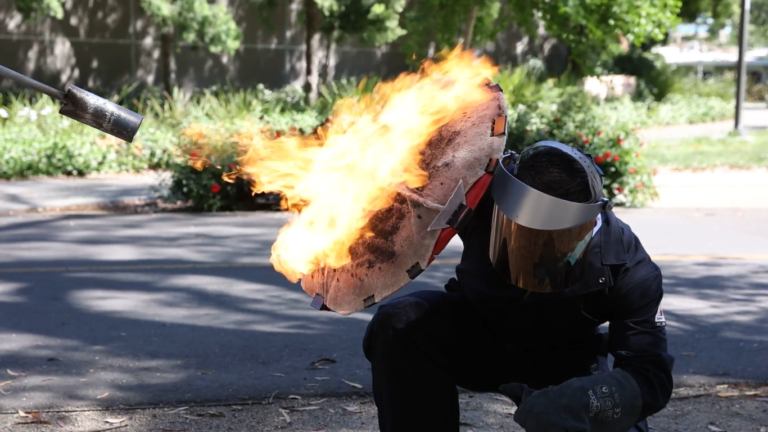
According to the website for Castro’s lab, the Nanoceramics Thermochemistry Laboratory, the first episode discusses the science behind Captain America’s shield, “[presenting] concepts of composite materials, atomic structures and [performing] a fun activity on the mechanical properties of chocolates.”

Isabella Costa, a Ph.D. student in the Material Science and Engineering Department at UC Davis, also participated in the creation of the first video. According to Costa, she collaborated on the script and experiment as well as being part of the cast. 

Costa emphasized that she loves both superheroes and the concept of introducing materials science to students at a younger age, especially as she herself didn’t hear about it until she was already in university studying mechanical engineering. 

“I know a lot of people don’t understand what we do, materials science,” Costa said. “If I had the opportunity that I’m trying to give to people right now, knowing about materials science and knowing what it is, I would’ve picked a different course. I really hope to make a difference.”

Costa went on to explain some of the steps the video went through during creation, with the goal of creating a widely accessible video. 

“We made all the presentations and video in English, but we made sure to include subtitles for other languages,” Costa said. “I also went over the video with my cousins, who are around 11 and 12. I wanted them to watch the video, I wanted them to read the script, and ask them hey, do you understand this? We want to be speaking ‘child language;’ speaking clearly, because these are complicated topics.”

According to Castro and Costa, they have lots of ideas for a second episode and beyond, contingent on audience reaction and access to funding for a continuation of the project. 

“The second episode is based on a little bit more [of] Captain America’s shield, but looking into fire resistance,” Castro said. “We already have all the script for that, we just need the money to do that. So, there are two ways. We are thinking of going crowdfunding again, but also we are approaching the National Science Foundation. They already signed that they are interested in the project, and if we get funds from them it could be like ten episodes!”

Castro elaborated on his underlying goal for the project, and his belief in combining technical skill with creativity. 

“As always, the goal is to inspire,” Castro said. “We are in a very unique time right now. There’s a lot of new tech out there, and then we start watching videos, and maybe something 20 years ago we thought wow, this is impossible, this is so much nonsense, and now we’re saying hey, it is not nonsense. It’s just whoever came up with the stories was dreaming and being creative.”

He then elaborated on the process of innovation.

“Maybe the way of developing things is to go back to those crazy ideas and then putting the strings on,” Castro said. “Be creative, and then make it a reality, rather than trying to develop something within the constraint that you have.”

As for Castro’s favorite superhero, you could almost guess that the professor gravitates toward the character that is always striving for new invention and building the technology up to meet his imagination. 

“My favorite superhero has always been Iron Man,” Castro said. “I find he’s a fascinating character, because there is a lot to relate to in terms of engineering. He is the mark of an engineer—not personality-wise, because he’s not a team player and we need team players, although his character evolves. He is my favorite, but all of them have something special.” 

And as for Costa?

“It would have to be Iron Man—his superpower is his brain!” Costa said. 

Written by: Sonora Slater — science@theaggie.org

2021 Diversity Report

The California Aggie’s second annual diversity report illustrates newsroom demographics as of Spring Quarter 2021

Introduction

As the student-run newspaper at UC Davis, our role is to ensure that our articles reach everyone in our community. We understand that having a diverse newsroom is essential in producing well-rounded, factual content.

To this end, this year, we implemented an Outreach and Engagement Board. Members of our managing staff who are responsible for hiring are required to be on this board, but any staffer at The Aggie is also welcome to join. In our monthly meetings, board members share their ideas to increase diversity in hiring as well as in readership. Beginning in Winter Quarter, we started holding hiring events at the beginning of each hiring period. We plan to continue implementing these events at the beginning of every quarter to inform students about The Aggie and answer questions. Lastly, we made implicit bias training mandatory for all staffers, both paid and volunteer. 

The Aggie’s budget for the next academic year will include a paid outreach director, whose job will be to concentrate outreach efforts to cultural organizations and student resource centers on campus. Further, we are in the process of switching student salaries from biweekly stipends to hourly pay at minimum wage, which will ensure that staffers are compensated appropriately. We hope that these changes will make working at The Aggie a feasible option for all students.

Despite the challenges the COVID-19 pandemic posed for our staff and working procedures, some aspects of working remotely have benefitted our reporting and stories. Our move to a fully digital workspace allowed The Aggie to operate across the world, expanding our reach beyond Davis. Online reporting and access to new communication technologies like Zoom have allowed us a wider reach for sources, reporters, viewpoints and stories.  Readers can compare our diversity report with that of the UC Davis student body overall.

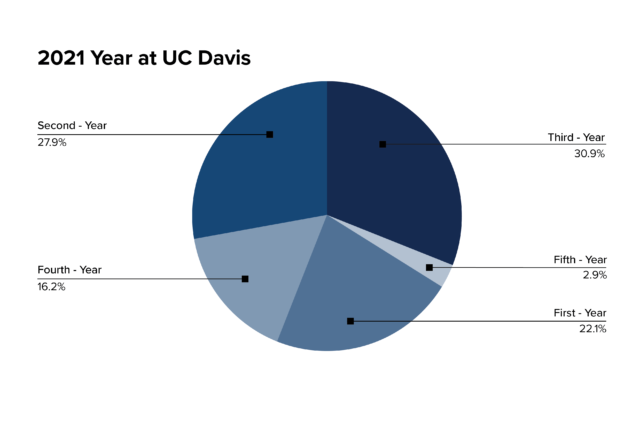
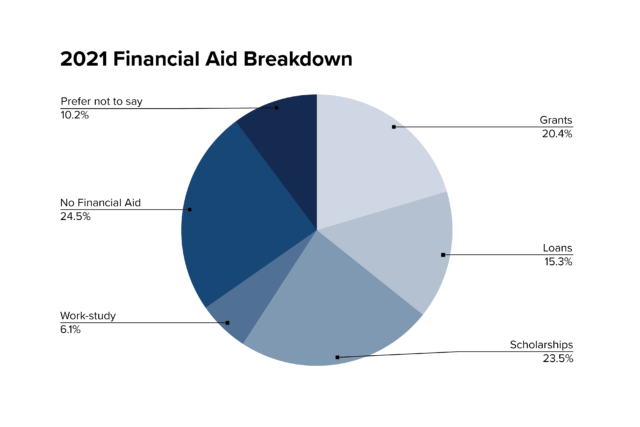
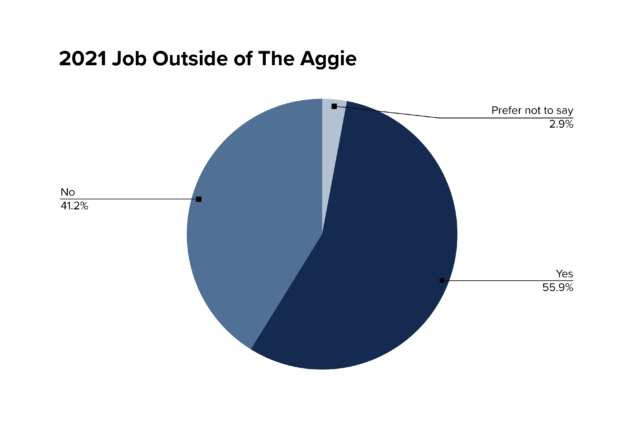
Methodology We collected this data by sending an anonymous survey to our staffers. We encouraged our staff to fill out the survey by sharing it multiple times in The Aggie’s Slack channel and in desk meetings. We chose these questions because we thought they were the most relevant measures of The Aggie’s total diversity. Out of the 88 staffers working for The Aggie when the survey was sent out, 68 responded. Staffers had the option to answer “Prefer not to say” to any question.


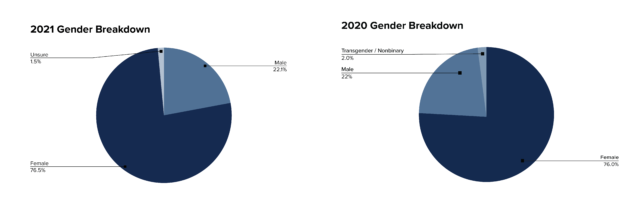
Staffers were asked to select the gender they identify with. The gender breakdown between 2020 and 2021 is almost identical.


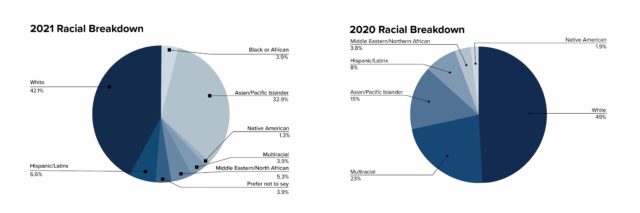
Staffers were asked to select what racial backgrounds they identified with. Some people are represented more than once if several answers apply to them. There appear to be fewer staffers who identify as white at The Aggie in 2021 compared to 2020, however, the question was asked differently in 2020 so this comparison is not comprehensive.


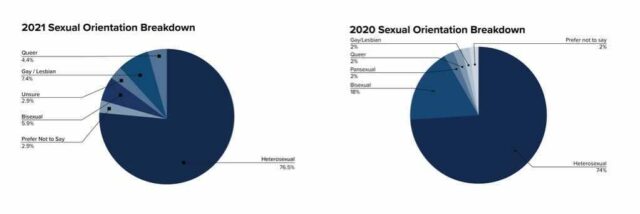
Staffers were asked to select which sexual orientation they identify with. There is a similar ratio of heterosexual to LGBTQIA-identifying staffers, but more of a range of LGBTQIA identities in 2021 compared to 2020. The question was asked in the same way in 2020.


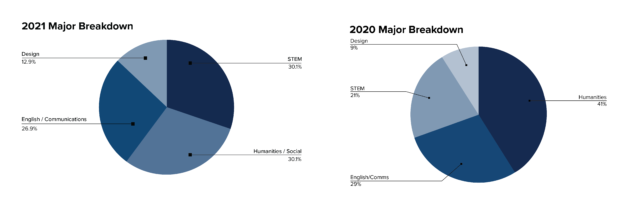
Staffers were asked to select which categories their major fall into. Some people are represented more than once if several answers apply to them. There seems to be a greater range of majors in 2021 compared to 2020, i.e. more design and STEM majors and fewer humanities and English majors. The question was asked in the same way in 2020.


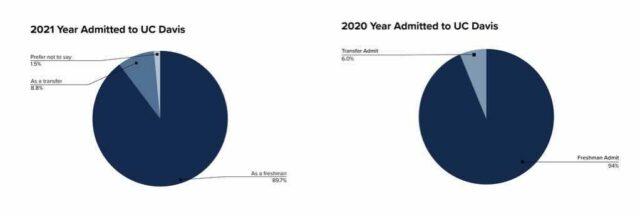
Staffers were asked to select when they were admitted to UC Davis. There was a slight increase in transfer staffers at The Aggie from 2020 to 2021.

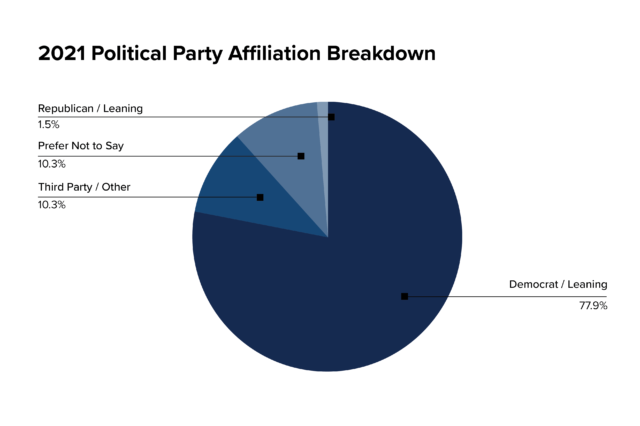
Staffers were asked to select their political party affiliation.

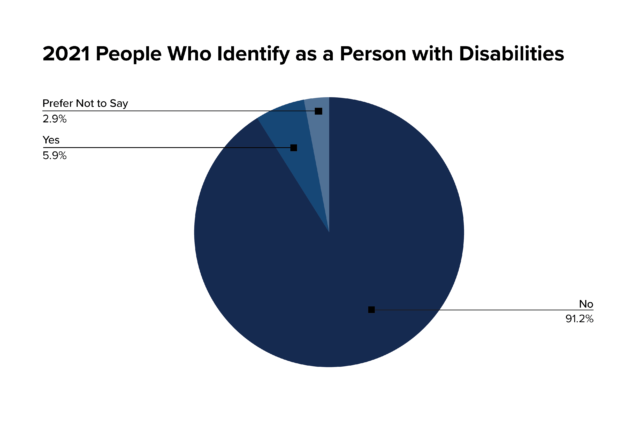
Staffers were asked to select whether they identify as a person with disabilities.

Staffers were asked to select what year they are in at UC Davis.

Staffers were asked to select which financial aid categories applied to them. Some people are represented more than once if several answers apply to them.

Staffers were asked to select whether they have a job outside of The Aggie.

Analysis

At least one staffer from each department of The Aggie, excluding distribution/business and advertisement, responded to the survey. Overall, we saw a 25.7% increase in participation from last year.

2 respondents were from the EIC/Managing Editor.

7 respondents were from the Campus News desk.

6 respondents were from the City News desk.

8 respondents were from the Opinion desk.

6 respondents were from the Features desk.

5 respondents were from the Arts & Culture desk.

2 respondents were from the Sports desk.

7 respondents were from the Science & Technology desk.

3 respondents were from the Photo desk.

2 respondents were from the New Media team.

11 respondents were from the Copy desk. 

4 respondents were from the Layout desk. 

5 respondents were from the Design desk.

At The Aggie, we understand the importance of collecting this demographic information about our staff and will continue to produce these reports annually. Through this work, we are committed to fostering a safe, inclusive work environment for all staff members. In our pursuit of a stronger newsroom, we will continue to reach out to students and community members to create news content showcasing the diversity of UC Davis. 

UC Davis former athletes, doctor took part in Tokyo Olympic Games

Student-athletes and a UC Davis Health physician represented three different countries at the summer games

By REBECCA GARDNER — campus@theaggie.org 

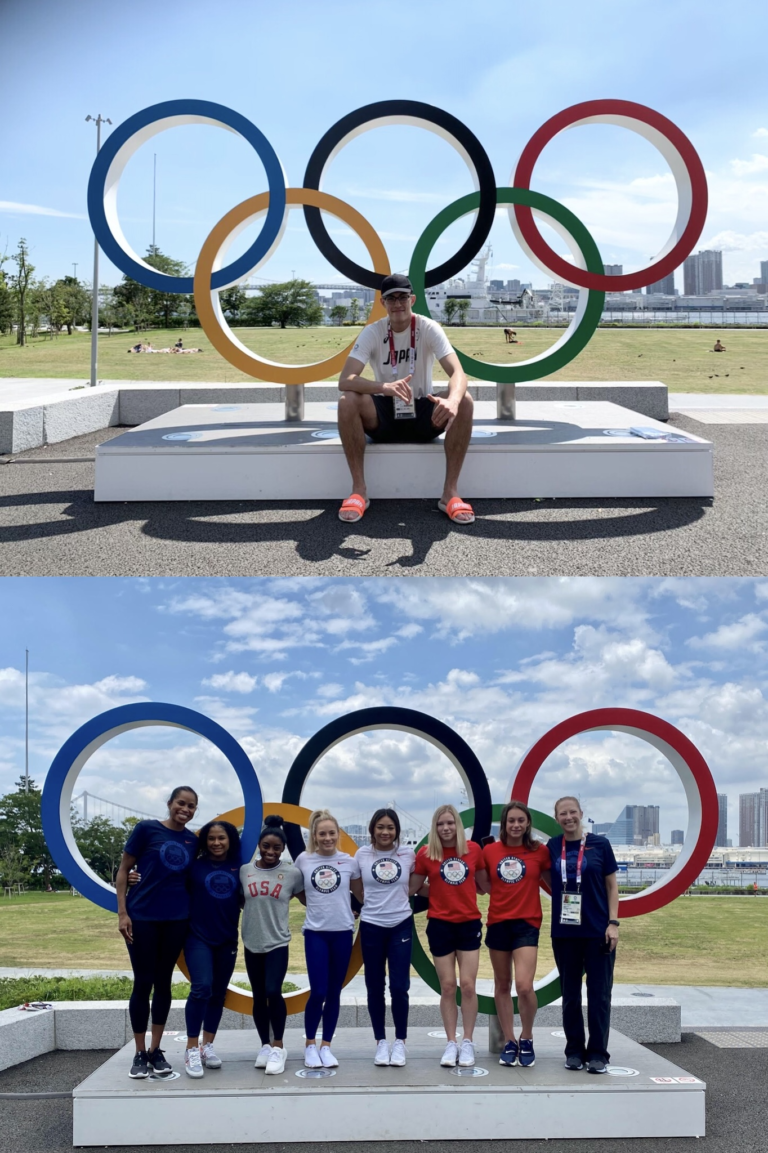
Two former student-athletes and a UC Davis Health sports medicine physician participated in the Tokyo Olympic games. 

Ty Kelly, a 2012 graduate with a degree in communication and a former UC Davis baseball player, represented Israel in the Olympics this year. Hugh Hogland-Watanabe, an MBA candidate who played on the UC Davis basketball team during the 2020-2021 school year, played basketball for Japan. Dr. Marcia (Marcy) Faustin, a family medicine and sports medicine physician, served as co-head physician to the USA women’s gymnastics team. Dr. Faustin works as an assistant clinical professor at UC Davis. 

Kelly, 33, is a free agent who has played baseball for the New York Mets and the Philadelphia Phillies. While earning his undergraduate degree, he played for UC Davis in 2008 and 2009. 

Kelly, an infielder, said many of his teammates in the Olympics were playing baseball for the last time in their careers. Although the Israeli baseball team did not make it to a medal round this year, it was the nation’s first time playing baseball in the Olympics. 

Kelly said that he and his teammates were devastated to lose their last game against the Dominican Republic.

“It felt surreal for everyone because going into the last inning of our last game, we had the lead and everyone would have expected to win,” Kelly said. “So it was just really sad and a difficult thing to swallow.”

During the games, athletes were confined to the Olympic Village and had limited social interaction. Despite these restrictions, Kelly said he enjoyed some normalcy and tradition in trading Olympic pins. 

“In those small instances when we were doing pin exchange with people from other countries, it was always really cool, especially with representing a country like Israel that is always in the news positively, negatively, all across the board, to be able to break down barriers of what your shirt says,” Kelly said.

Dr. Marcia (Marcy) Faustin, a former gymnast, Division 1 track and field athlete, sports fan and sports medicine physician, attended her first Olympic games as co-head physician of the USA gymnastics.  

Faustin volunteered for two years before becoming the co-head physician of the USA women’s gymnastics team. She works alongside Dr. Ellen Casey, the other co-head team physician, who is based in New York. The two care for gymnasts from junior and senior national teams and intermittently travel to training camps to provide additional care. 

At the Olympics, and at other competitions, Faustin treats muscle, tendon and bone injuries and also provides mental health care. 

Faustin said that watching the young women achieve their goals was the best part of the Olympics. 

“All of them came home with a medal, so that was really exciting to be a part of,” Faustin said.

Simone Biles, superstar American gymnast and four-time gold medalist, made the decision to withdraw from competition this year, sparking national conversations about mental health and toxic perfectionism among athletes. Faustin, who has supported Biles and teammates through their journeys, emphasized the interdependence of mental and physical health.

“I think that both physical and mental health are very important and not just in athletes but all patients,” Faustin said. “The pandemic has taught us how important it is to have relationships and how hard and difficult it can be on people when you don’t have your mental health well supported; […] it can affect your physical health.”

Hugh Hogland-Watanabe, 22, was a student in the Graduate School of Management at UC Davis and played on the basketball team last year. He paused his masters program to play professional basketball for the Ryukyu Golden Kings in Japan, where he holds dual citizenship.

“The [pro] contract was offered before he made the Olympic team,” said Matt Hogland, Hogland-Watanabe’s father. “He signed this contract, made the Olympic team and then he called Coach Les and said ‘Coach, I’m not going to make it back.’”

The UC Davis basketball team showed their support for Hogland-Watanabe via Zoom while he was in Tokyo.

“Our team did some Zooms with him when he was over there,” said Jim Les, the coach of the UC Davis basketball team. “He’s got a good fan base here on campus with his coaches and teammates who are wishing him well, and now we’ll be following his progress in the Japanese pro league.”

Japan was eliminated from the 12-team tournament prior to the medal rounds, and Hogland-Watanabe did not play. Hogland said it was frustrating that coaches chose to bench Hogland-Watanabe. 

“The craziest thing was that Hugh was an ameteur when he got there,” Hogland said. “Every other member of the Olympic basketball 12 teams that were there were pro. Hugh was the only amatuer, and he was the only guy that did not play a minute.”

Hogland watched the games from a bar in Hawaii, while Hogland-Watanabe’s brother traveled to Tokyo and quarantined for 14 days only to be turned away because of Covid-19 restrictions.

Les said an existing thumb injury prevented Hogland-Watanabe from frequently playing at UC Davis, but his former coach is supportive of Hogland-Watanabe’s future professional career.

“I do believe his best basketball is ahead of him because he continues to mature and I think building his skillset and the hard work he puts in is going to make him an awfully good pro in Japan,” Les said.

Written by: Rebecca Gardner — campus@theaggie.org 

UC Davis Health expands clinical approach to cancer with the fusion of diagnostics and therapy

Theranostics, a combination of therapy and diagnostics, offers new biologically engineered technology to image and attack tumors within patients

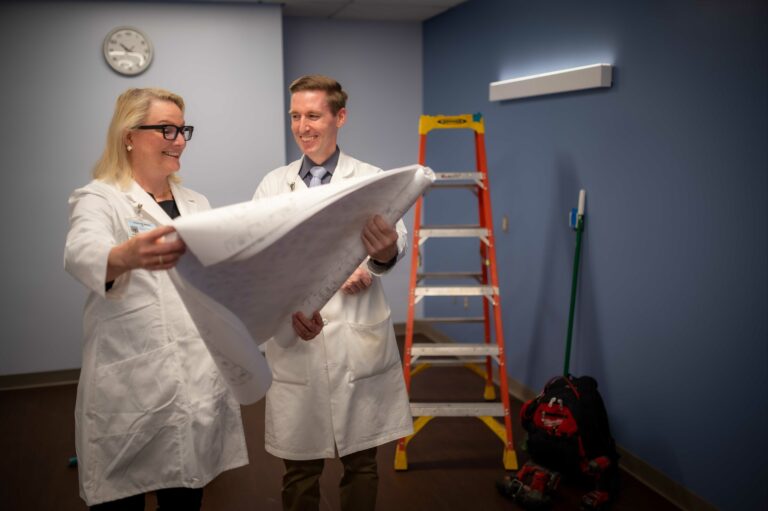
Next-generation cancer treatment is on the horizon, offering a transformative beacon of hope for many patients who may find conventional treatments like chemotherapy and surgery incompatible. UC Davis Health has incorporated this new state-of-the-art approach to the field of oncology called “theranostics.” Derived from the combination of therapy and diagnostics, injection into the bloodstream by target-specific therapeutic, radioactive agents can find a patient’s tumor to be imaged and attack the tumor site to prevent its expansion. 

    Dr. Elizabeth Morris, Professor and Chair of UC Davis Medical Center’s Department of Radiology, emphasized the efficiency of theranostics for the treatment of cancer.

“Theranostics is a two-in-one method to diagnosing and treating cancer,” Morris said. “This one-stop shop for our patients is a real game changer for medicine, and we’re proud to be at the forefront.” 

To further expand the field of theranostics, UC Davis Health has recently appointed Dr. Cameron Foster, director of the new UC Davis theranostics division and professor of clinical nuclear medicine, to oversee the development of a new, separate theranostics clinic.

    Nuclear medicine—under which theranostics operates—is similar but different from radiology. While they both involve imaging, as Foster emphasizes, theranostics is rooted in the physiological processes, which makes nuclear medicine a field full of potential for new therapies and solutions for cancer patients while still taking advantage of the imaging aspect of nuclear medicine. 

    “A good example of the difference between radiology and nuclear medicine is the difference between an X-ray of a foot and a bone scan of a foot,” Foster said. “You take a look at the images and you can say if it’s the right or the left foot. There’s potentially a fracture of the foot in a toe or something like that, but the one thing that you could always say on the bone scan which you might have a problem saying on the X-ray is whether the patient was alive when you took this image. Because for an X-ray, you can take an X-ray of a cadaver foot and it may look identical to someone who is alive. But for a bone scan you had to inject that tracer that had to go through blood flow and then get taken up into the bone matrix.”

    With recent boons regarding the development of new therapeutic agents for neuroendocrine tumors, the theranostics division is on the rise to both diagnosing and treating different types of cancers at the same time. Foster further explains how these agents operate inside a patient.

    “These new tracers which can identify these neuroendocrine tumors also have a conjugate where we can take off the radioactive particle bound to this much larger molecule that transports it to the targeted tumor to let us image the tumor and replace the particle with a different one which now does therapy,” Foster said. “This is bound to the same larger molecule which goes to the same location of the targeted tumor, but now we can attack it with radiotherapy.”

Currently, the Division of Nuclear Medicine is working to develop new tracers for imaging and therapy to be more catered to the medical center’s patient population as to “keep the department at the leading edge of imaging practices,” according to the department’s website

    The transformative power of this new biologically engineered technology offers alternatives to the traditional treatments for cancer, and Foster further reassures that this approach comes with limited side effects.

    “With these classes of therapeutics in the theranostics arena, they tend to have fewer side effects, and they tend to be very easy to administer,” Foster said. “Theranostic treatments are much, much milder. They might get a little bit of nausea during the procedure, and we combat that with anti-nausea medications. Largely, the biggest side effect during the therapy is boredom.”

    In the same vein as Foster, Morris describes the future of theranostics and the steps toward getting closer to the ideal treatment.

    “The goal is that we would be able to, for example, inject a tracer that was able to identify a really small cancer that has not metastasized and that is just local,” Morris said. “Then we will be able to treat it successfully with just the therapy itself by the injection, and the patient then would not need to have further surgery or any other kind of treatment. So that, to me, is the Holy Grail.”

Written by: Brandon Nguyenscience@theaggie.org

UC Davis researchers to reengineer peptide tarantula venom to create novel, non-addictive pain medication

Team of 20 receives funding from the National Institutes of Health’s Helping to End Addiction Initiative

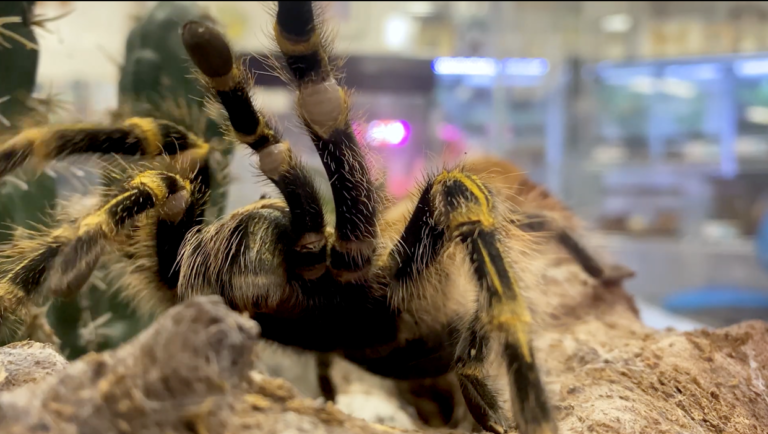
A team of 20 researchers are working tirelessly to transform protoxin-II, or ProTx-11—a peptide from the Peruvian green velvet tarantula’s venom—into a novel, non-addictive pain medication.   

According to the University of Queensland’s Institute for Molecular Bioscience, peptides are chains of two or more amino acids, which are one of the building blocks of life.

    This project is receiving $1,557,737 in funding from the National Institutes of Health’s Helping to End Addiction (NIH HEAL) Initiative. Not only is the NIH HEAL Initiative an effort to understand, manage and treat pain, but it is also a means to produce scientific solutions to improve treatment for opioid misuse and addiction, according to their website

    “The fact that opioids served as a primary medication for pain for many years and there was considerable fall out with understanding the risks associated with opioid therapy lends itself to search for safer and more effective medications, hence the push for medications that are unique, novel and have an improved risk profile,” said Chief of the Division of Pain Medicine at UC Davis Health Dr. David Copenhaver. 

    Copenhaver said that common side effects of opioid medications include but are not limited to constipation, nausea, vomiting, itching and perhaps the most grave of all: addiction. 

    According to the Centers for Disease Control and Prevention (CDC), as of 2016, 20.4% of U.S. adults have chronic pain. Additionally, it is estimated that in 2017, 1.7 million people in the U.S. suffered from substance-use disorders induced by prescribed opioid pain medications, according to the National Institute on Drug Abuse

    Both UC Davis School of Medicine Professor of Physiology and Membrane Biology Dr. Vladimir Yarov-Yarovoy and Professor of Pharmacology Dr. Heike Wulff are leading this project. 

    “I previously worked at the University of Washington in Seattle,” Yarov-Yarovoy said. “Which is where I got my initial passion to explore voltage-gated sodium channels that are important for pain signaling and also [using] computational, structural biology approaches […] for protein design, to be able to come up with alternatives to opioids.”  

    Voltage-gated sodium channels are responsible for making neurons fire, Wulff said via email. Neurons are defined to be “fundamental units of the brain and nervous systems,” according to the University of Queensland’s Brain Institute.   

    Researchers are focusing on Nav1.7, which genetic studies have identified as a specific type of voltage-gated sodium channel important in pain-signaling, Wulff said.  

    “People who have lost Nav1.7 function through spontaneous mutations feel no pain and can walk on hot coals or stick knives through their cheek,” Wulff said. “That is a very good reason to go after Nav1.7 for treating pain.” 

UC Davis Professor of Entomology and Nematology Dr. Bruce Hammock also described Nav1.7 to be a “single important driver of pain in man.”  

    “Ion channel researchers have […] traditionally looked at venoms to find potent and selective ion channel blockers,” Wulff said. 

    This is where protoxin-II comes into play. To bring this idea into fruition, researchers have turned to nature—particularly arthropods like cone snails, scorpions, snakes and spiders that produce “a cocktail of peptides” that target ion channels, proteins in neurons and muscles to paralyze prey for consumption.

    “We started our design optimization efforts with […] peptides which nature designed for us,” Yarov-Yarovoy said. “Nature optimizes through millions of years of evolution. Now, here we come with our computational protein development approaches which can take natural peptides and optimize it to make it more potent, selective and stable compared to what nature designed.”

    To engineer these peptides, scientists rely on computer and software technologies. 

    “So, what we can do is start with our best guess, which is the tarantula toxin,” Hammock said. “Then [we] have the computer design hundreds of thousands of peptides, and ask it [if those] peptides will bind and bind correctly. We make them. We run them against the sodium channel for humans in culture, and ask [if] they work to get better and more potent peptides. But, at the same time, we run them against other channels.”

    In particular, Rosetta Software has been integral to this effort. Rosetta Software was originally developed in the lab of Yarov-Yarovoy’s former mentor, Dr. David Baker, at the University of Washington. 

    “Rosetta is a protein design program that allows us to literally design millions of versions of the protoxin peptide on the computer and then select the ‘best’ ones for actual synthesis and testing,” Wulff said.   

    Rosetta makes it possible for this process to occur in a very short period of time, Copenhaver said. 

    “The computer, and specialized programming, [can be used] to evaluate the structure of the tarantula toxin, and re-engineer it, such that it is a better fit to that sodium-channel it’s going to block,” Copenhaver said. 

    The results of this project are promising, Wulff said, and it’s all thanks to an interdisciplinary team. 

    “UC Davis is at the forefront of what is amazing science,” Copenhaver said. “The interesting collaborative ecosystem at UC Davis is unique, where many of us researchers and clinicians talk to each other. The only way you can really get amazing science […] is really having a team approach, and this has been evident through this project—led by Vladimir.”  

Written by: Aarya Gupta — science@theaggie.org 

If there’s any kind of magic in this world

—it must be in an attempt to understand someone who is sharing something

By Liana Mae Atizado, Features Writer

“I know, it’s almost impossible to succeed, but… who cares, really? The answer must be in the attempt.”

So goes my favorite quote from the movie, “Before Sunrise.” Funnily enough, I first saw this movie, which is about exploring a foreign city with a stranger, at the beginning of the pandemic when cities were shutting down and strangers had to stay six feet away from each other. This movie was all about forming new connections through genuine conversation, something that seemed impossible to achieve during quarantine. At least that’s what I thought until I started writing for The California Aggie.

The Aggie gave me a chance to sit down and have conversations with members of the UC Davis community that I would have never encountered otherwise. One thing that made me absolutely fall in love with reporting was hearing the passion in my source’s voices when they talked about causes they cared about. Their capacity for kindness and selfless devotion to serving others, especially during a time of isolation and confusion, filled me with hope. It was an honor to hear their stories and to use this platform to share them.

I was also amazed by just how many opportunities there are for students to make a difference on and off campus. After three years of attending UC Davis, I thought I had a general idea of all that the university had to offer. When I stepped into the role of a reporter for the features desk during my fourth and final year, I got to take a closer look at the different organizations and individuals that make UC Davis so unique. There are so many people who are committed to doing what they can in order to make our corner of the world better, whether that be enhancing student diversity, working on the frontlines of healthcare, providing resources to those in need or uplifting the voices of those systematically silenced.

As my time at The Aggie comes to an end, it feels as though I have barely scratched the surface of all there is to know about Davis. Still, I’m forever grateful for the chance to listen to the stories of those who care so deeply about what they do. The Aggie has deepened my love and understanding of the Davis community, and I hope they continue to do the same for others. While it’s almost impossible for every community member to be understood and for every story to be shared, I hope that staff members at The California Aggie never give up in the attempt.

Liana Mae Atizado is a staff writer for the features desk. She joined The Aggie during her senior year, in fall 2020. She is graduating with a bachelor’s degree in human development.

A tribute to the place I call home and the people I’ve been unbelievably lucky to know

All I do is talk to or brag about the people in my life, so it should come as no surprise that my senior column is dedicated to them and the magical cowtown I’ve called home for these last four years

By Sabrina Habchi, Campus News Editor

Someone once told me I should look into getting a job as a filibusterer. Probably because anyone who has met me for a brief moment knows I could talk to a brick wall (not my own words, unfortunately). For once, I am speechless. I don’t know how to express my gratitude—any words I could offer don’t seem to be enough. 

I suppose I’ll start with thanking Davis for giving me my family. 

To my very best friend, Katie, I can’t believe I get to do my favorite things in life with my favorite person (you). I know for a fact we’ll be telling stories of living together at each other’s weddings, just as I know for a fact we’ll be part of each other’s weddings. Cheers to many more years of tossing, playing pickleball, skiing and snowboarding, late-night phone calls and weekend trips to see one another. I truly cannot wait until we get to travel together.

To Parker, I’m so glad we’re going to end up on the same (and correct) side of the best state. I once said I’d take a plane across the country for your next birthday—that’s still true, although fingers crossed I’ll be taking one across the world instead for your 24th. I love your stubbornness, your ability to laugh at yourself and how much you’ve grown since we were toddlers in the dorms, and I’m so excited for this next phase of our lives.

Cady, I know Greg said you’ll be lucky to keep in touch with four people from college, but I’m not too worried about it. I know we’ll see each other again and I know when we do, we’ll pick up right where we left off. Keep being your spicy, quick-witted, forgiving self that everyone around you loves so much. Sarah, Washington is lucky to have you—as am I, because I know you’ll do some cleaning up before I get there (literally, your soon-to-be spotless house and figuratively, our legislation.) 

To my Aggie family, you have become so much more than the people I work with. You have become the people I want to spend time with the most, the people I look up to and, yes, the people who have never failed to make me laugh uncontrollably four times a week (usually more). In fact, I’m smiling as I write this. 

I would say I’m going to miss Calvin’s sound effects (pew pew!), Eden’s snide comments (okay!), Margo’s ability to make me laugh with everything she says (well, you didn’t have anything else!), Omar’s wall-worthy quotes (Sabrina was pressing me yesterday), Allie’s athleticism (Calvin, get up!), late night walks with Sophie (I can’t while you’re filming me!), early morning pickleball with Anjini (the only other person willing to wake up early to play) and arguing with Maddie (a great driver). I would say I’m going to miss all of those things and more, but I know this won’t be the last time I experience any of them. In the meantime, carry on my pickleball legacy, say yes to everything because I won’t be there to convince you to have fun and don’t forget to PAY ATTENTION!

As if a family is not enough, UC Davis has given me the most inspiring people to look up to. 

To one of my first professors, Dr. Caitlin Patler, thank you for seeing something in me that I had not yet seen myself. It’s not always easy to find a woman mentor, but your accomplishments and compassion give me something to strive toward. I can’t wait to keep up with your groundbreaking research—I’m sure I’ll see future writers from The Aggie continue reporting on it. Also, go Bruins! 

To my thesis advisor and widely beloved UC Davis faculty member, Dr. Jim Adams, I have so much to thank you for, but I think I’ll start with your humor, because I’ve never laughed quite so much in any other course I’ve taken here. Beyond that, thank you for your constant guidance, incredibly kind words and willingness to help in virtually any situation. You have the rare ability of making learning so easy, I come away from class feeling like I put no effort in at all but can still recall the imperative function of the “iron cage of party discipline” in British politics a year later. I could not have produced a thesis I was truly proud of without you, and I’m certain I’ll be contacting you to produce some kind of publication in the future. 

I know I talk about being from San Diego so much that it has become a running joke in my friend groups, but Davis is and always will be one of my homes. I recently learned that senior columns are called “30s” because newspapers would send pieces through telegraphs and include “-30-“ at the bottom to signify the end of a story. Not to be cliché, but I’m not so sure this is the end of a story, but perhaps a chapter. I say that, because I am determined to be the 50-year-old woman still walking around in UC Davis gear, and I know I’ll keep so many of the connections I made here for years to come. 

I’m going to miss late nights spent at Shields, midnight runs to Dutch Bros, sunsets on top of the Hutchinson parking structure, sunrises on Picnic Day, Arboretum runs, day trips to Lake Tahoe, somehow always running into friends at the MU, playing lacrosse on Dairy Field, frequenting the iconic Farmers Market, studying at Philz, failing to connect to the Wi-Fi at Mishka’s and spending all my money at the Co-Op. 

To all my friends who have said they will be visiting me at UCLA, please know I will be holding you to it. Go ags forever.

Sabrina Habchi is The California Aggie’s 2020-2021 campus news editor. She joined The Aggie in fall 2017 as a campus news reporter. In fall 2019, she assumed the role of copy chief and served in that position for one year before becoming the campus news editor her fourth year. She is graduating with bachelor degrees in political science and psychology and with a sociology minor.

Writing will always be here

The Aggie has been here for me through thick and thin

By RebeccaBihn-Wallace, Campus News Writer

I like to think of my college experience as being bookended by two international disasters: a heartbreaking election season and a global pandemic. When I came to UC Davis in September 2017, I was deeply worried about the state of the world—and just as hopeful, as I am now, that I could do something to change it. On a more personal level, though, I was like any other college student: eager to make friends, uncertain in the bike circle and perhaps a little naive. Within two weeks of starting college, I had badly cut my knee in said bike circle—I have the scar to prove it—moved from one dorm to another and gotten used to the blistering heat of the California Delta. In spite of this rather rough landing at UC Davis, I powered through and decided to pursue my newfound fascination with politics and current events at The California Aggie in the spring of my freshman year. 

The Aggie became an outlet for my nervous and creative energies, a place where I could relax, listen to entertaining conversations and feel like a part of something important. The stories I covered have been by turns hilarious, challenging and baffling; the experience I have gained has been invaluable. When I found my heart broken and my strength being seriously tested in the middle of my second year, The Aggie was there. When the pandemic hit and life came to a standstill my third year, The Aggie was there. I missed the camaraderie of weekly in-person desk meetings and lamented the scarcity of non-COVID-19-related topics to write about; still, The Aggie was there. Working on the paper remotely this past year has strengthened my commitment to journalism, my affection for my fellow students and my sense of humor in spite of (and perhaps because of) incomprehensible global events. 

More than anything, though, I’d like to thank my amazing editors and colleagues for all of their hard work and dedication these past four years, and I’d like to remind my future self that while beginnings are hard, they often make us stronger in the long run. 

Rebecca Bihn-Wallace joined The Aggie in spring 2018 as a columnist on the opinion desk. In fall 2018, she joined the campus news desk, where she has written for the past three years. She is graduating with a bachelor of arts in studio art and a double minor in German and professional writing. 

I am a writer

Accepting the undeniable truth 

By Itzelth Gamboa, Arts and Culture Writer 

There is something about writing that is so painfully terrifying. Maybe it’s because we are taught with words written by grand people who actually had a story to tell. Or maybe it’s because words can be so easily misinterpreted. Or maybe, it’s because I’m so terrible at it. 

When I first joined The Aggie, I was severely underqualified. I was a second-year trying to find something to do that held significance. So I looked for an organization that involved the thing I loved most—writing. Before I was a student at Davis, I invested myself in everything I wrote; writing always had a way of comforting me. But to my surprise, my writing had failed me all of my undergraduate career up to that point. I was getting low B’s on every essay I turned in and it was killing me; my saving grace throughout my life was hurting my GPA.

So I joined The Aggie in hopes of meeting new people and bettering my writing. I didn’t realize that as I was working on my writing, I was piling up these great experiences along the way. 

There are two things that being a writer for the Arts Desk has shown me: one, that art, in all of its forms, consumes us, and two, that I am a writer. 

When we were stuck at home this past year, we watched movies to get us through the days. When we were dying of boredom, we read fiction books to escape. When we couldn’t sleep at night, we relied on music to slow down time. These past few months we’ve clung onto art like our sanity depended on it—because for the most part, it did. 

But I don’t think we take the time to appreciate all that art and artists have given us. At every period in my life, art has given me something. When I was younger, I stayed up reading until sunrise; I held onto books and characters until I unwillingly fell asleep. After I got into a car accident, the only thing that could keep me calm as I was driving was singing along to Taylor Swift’s “Lover” album. When I had a particularly rough day, I watched Disney movies for their unwavering commitment to happy endings. 

I’ve always loved art, but it wasn’t until recently that I noticed how much of my life revolved around it. Working at The Aggie, I read so many great articles from other writers on my desk. I met artists that blew me away with their work. I interviewed people that turned their art into a business. All of my interactions here really settled me in my belief that art is undervalued. We consume it in every form imaginable, but we never seem to appreciate its existence. The more I wrote, the more I realized the things I was eager to write about. I loved meeting new people who were passionate about what they were doing. I loved meeting people that took their hobby and ran with it. I loved meeting people who participated in art projects simply for the fun of it. But mostly, I loved writing about them. As horrible and difficult and exposing as writing is, I loved it. 

And yet, after all of these years writing an article week after week, I never considered myself a writer. People would ask me, “What do you do?” and I would respond with “I write.” But I never said “I’m a writer.” With that said, I’d like to take these last few lines of this article to finally call myself a writer. I unashamedly got better at writing in one of the most public settings, but hey, I got better. 

So here’s to The Aggie, the newspaper that never fired me despite my mistakes. But mostly, here’s to being a writer. 

Itzelth Gamboa is an arts writer for the arts and culture desk at The California Aggie. She joined the desk in October of 2018 and stayed in that position throughout her undergraduate career. She is graduating with bachelor degrees in sociology and communication. 

The perfect space

A place with a whole lotta hope, heart and heroes

By Calvin Coffee, Opinion Editor 

I came to UC Davis (almost) completely lost: no idea what I wanted to do or who I wanted to be, but I’m so lucky I found myself at The Aggie. I’ll never forget walking into the Lower Freeborn office for the first time. Once I completed the maze, the old couches and customizable walls of The Aggie (and all its people) became the most welcoming place on campus. 

Having the last year-plus on Zoom isn’t ideal, but the people I had the opportunity to work with every day made it more than worth it. More often than not, what anchored me through the day was knowing that I had my desk meeting to look forward to that night or that four times a week I would just hop on a Zoom call with some friends disguised as an Editorial Board meeting. I’ve enjoyed laughing at the fantastic humor pitches as they rolled in and marveling at the creative ideas my writers came up with every week. 

To everyone that’s been a humorist, columnist or cartoonist for the opinion desk this year, I cannot thank you enough for your dedication. Watching you grow as writers by tackling the issues and topics that matter to you has been a joy. Writing isn’t easy, it’s not for everyone, but those who are dedicated can produce stories for all to enjoy, and you all did that. 

Taryn and Nick, thank you for hiring and believing in me, letting me write about video games and all the “Game of Thrones” talk during its wild final season. Hanadi, thank you for believing in me as a writer and editor, making editing sessions a joy and allowing me to go on about the most trivial NFL details.

The wonderful editors on our editorial board inspire me every day—you are the best team I’ve ever been a part of. Anjini, Margo, Sabrina, Eden, Sophie, Allie, Omar and Maddie, I will always cherish how welcoming and enjoyable you made our Ed Board meetings on days when I really needed it. It has been an absolute pleasure working with you, but more than that it has been (and continues to be) a pleasure to call you all my friends. I can’t wait to see you all on the courts—let’s keep up that trash talk.

I am endlessly grateful for all The Aggie has helped me through, I would be lost without it. This is one of the hardest goodbyes I’ve ever had to make, my time spent with you all is one I will remember forever. So if for some reason you’re reading this and thinking about joining The Aggie, please do—you just might find the place for you. 

Written by: Calvin Coffee

Calvin Coffee was the 2020-2021 opinion editor. He joined The California Aggie in spring of 2019 and wrote as an opinion columnist before joining the Editorial Board. He is graduating with a bachelor’s degree in science and technology studies. 

Standing on the shoulders of giants

By Brandon Jetter, Arts and Culture Writer 

“There is no passion to be found in playing small—in settling for a life that is less than the one you are capable of living.”

That Nelson Mandela quote played in my head as I first applied to write for The California Aggie. Never in a million years did I think I would be writing for a campus newspaper. I was already handling countless commitments—double majoring, being on the track and field team, freelancing anywhere I got the chance—but something was still missing. l knew that I badly wanted to write for the school’s premier outlet. “Why should I settle?” I thought.

I still vividly remember my first desk meeting, waiting anxiously outside of the basement in Lower Freeborn. I was probably more nervous in those five or so minutes than I ever was in my entire collegiate athletic career. Emphasis on the probably.

Of course, as an opinion writer, you’re bound to piss some people off. My first article had just been posted, one that I thought was a safe, boringly centrist take that couldn’t possibly raise any issues. It definitely did. That was the day when I realized what it was like to have people actually read your work. 

I was lucky that when I first wrote for the Op-Ed desk, I was immediately surrounded by a phenomenal group of open-minded intellectuals. My first editors—head editor Taryn DeOilers and assistant editor Nick Irvin—were quick to show me the ropes, providing constructive criticism and objective feedback. My second-year editor, Hanadi Jordan, was a perfect successor to Taryn and Nick. She phenomenally managed the desk with an impressive breadth of knowledge as we navigated the initial virtual world of the COVID-19 pandemic. I’m thankful for how easy she made things. To my present editor, Allie Bailey, thank you for welcoming me for my brief, last quarter stay in the Arts and Culture section. I only wish we had more time. 

I am also forever indebted to Taryn, who spent countless hours with me editing my seemingly-endless spring 2019 feature piece on the Armenian Genocide. I’ve always been insecure as a writer, but it was after the piece’s eventual selection and publication in UC Davis’ Prized Writing collection that I thought, “Hey, maybe I can do this for real.” 

I’ve been in college a long time. I’ve met a lot of people. I’ve done a lot of unique things. I’ve accomplished a lot of goals—and failed at so many more. But one thing I will always cherish is my time at The Aggie. I’ll miss the thrills of seeing my latest article drop, obsessively reloading the Facebook page to see if anyone has commented yet. I’ll miss the angry responses from random students; I’ll miss the personal emails from curious and supportive readers even more.

In the end, The Aggie helped me determine who I really was. It showed me what I wanted to do with my life. With that came a wave of energy and enthusiasm I didn’t think I had. I hope I can find that same thrill in what comes next in life, whatever that may be. 

Brandon Jetter is an arts and culture writer for The California Aggie. He joined the Aggie in fall 2018 as an opinion writer and is presently writing for the arts and culture desk. He is graduating from UC Davis with bachelor degrees in political science and history and with a professional writing minor.

No man ever steps in the same river twice, for it’s not the same river and he’s not the same man

On to the next…

By Rebecca Gardner, Campus News Writer

As graduation approaches, I prepare to say goodbye to UC Davis as UC Davis prepares to welcome the next incoming class. 

I had planned to go to college at a UC near the beach, but I wound up seduced by Davis’ charm. When I first visited Davis and walked through the quad in the spring, I finally understood the glowing testimonials (that I didn’t believe) from alumni. 

I transferred to UC Davis pretty enthused to be at the next step, studying at a prestigious four-year university—not really understanding what being at an institution like UC really meant.

When I started attending UC Davis, we would ride our bikes to campus and freely roam without spitting in a tube. I went to giant psychology classes where we sat way too close to each other in cramped lecture halls. 

Then, school became sitting on my couch and watching lectures when I pleased. Or walking around my house compulsively doing chores listening to my professors as if they were podcast hosts.

It wasn’t until the pandemic’s peak when I took my first journalism class at UC Davis.

Journalism was refreshing and exciting. When my professor and mentor Stephen Magagnini encouraged me to apply to write for The Aggie, I only wished that I had done so sooner.

While I’ve only had the pleasure and privilege of being a reporter for two quarters, on Zoom, writing for The Aggie has certainly been a highlight of my quick time passing through UC Davis.

With little training and few credentials, I’ve been able to interview Chancellor Gary May about policing and calls for abolition on campus. I got to listen to students share how they somehow found themselves in a cult-like bible study group that preyed on their need for spiritual support at school. 

Once I exit Zoom, claim my symbolic diploma from a masked and cautiously optimistic Chancellor May and leave UC Davis, there will be new stories to tell. New task forces will be assembled to impress the next student body and re-enrage the worn out staff, but I have no doubt that the push and pull of conversation and passion of protest will continue on.  

My sweetest and hardest goodbye is to the members of Aggies for Recovery. Serving as the president of this organization, it has been my mission to build a community for students in recovery but thanks to a global pandemic and increased rates of substance use, the community, out of necessity, built itself.

I leave each meeting with a full heart and I am constantly in awe of your wisdom and compassion. My hope is that you will continue to welcome and support the next student who walks into UC Davis looking for recovery and friendship like I once did. 

Finally, thank you UC Davis for delivering to me the kindest and most brilliant pair of Alans: Alan Lawrence Buks and Allan Martinez. You are the best friends and roommates for someone who is bad with names. 

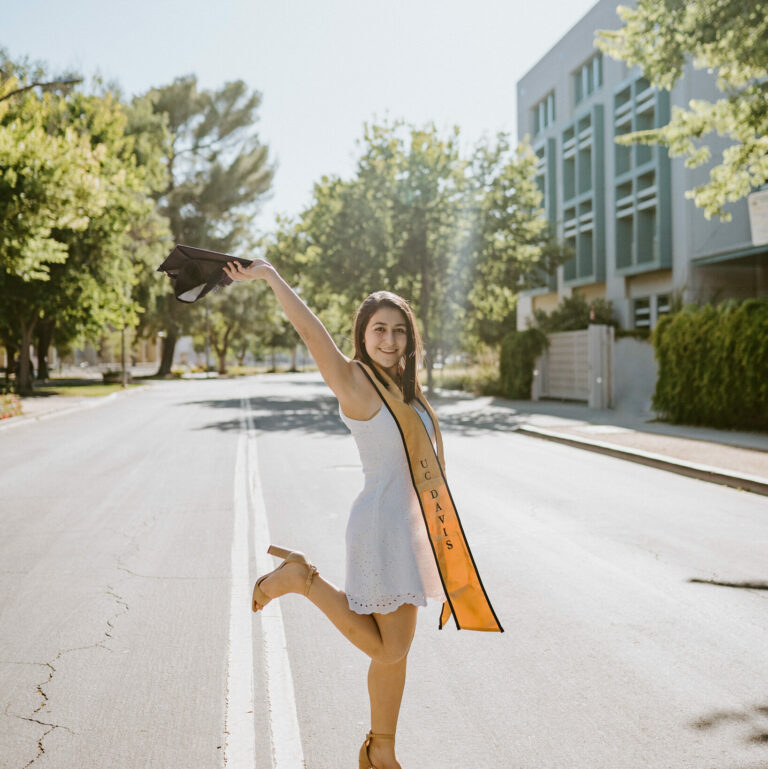
Rebecca Gardner joined The California Aggie in winter of 2020 as a campus news reporter. She is graduating with a bachelors in psychology and double minors in professional writing and human development.

Yolo County issues emergency proclamation due to drought conditions

The proclamation is one of many measures that are being taken throughout Yolo County to address drought conditions

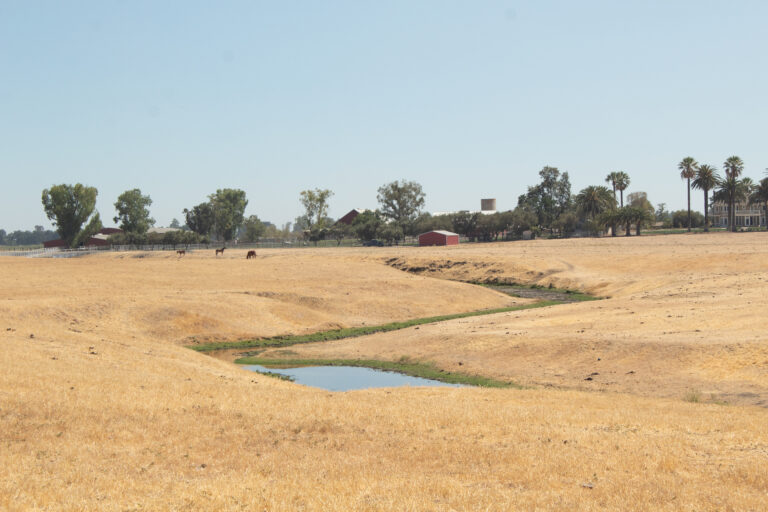
On July 30, due to exceptional drought conditions, Yolo County issued an emergency proclamation for unincorporated areas of the county. Due to little rainfall, historically dry conditions and exceptionally warm temperatures, the county is urging all residents and businesses to conserve water. 

Yolo County emergency services manager, Dana Carey, explained that in addition to there being an acknowledgement that a particular emergency exists, issuing an emergency proclamation for unincorporated areas allows the county to take more measures in response to drought conditions. 

“[A proclamation] gives the Board of Supervisors and County staff protections legally for their response,” Carey said via email. “It can always be expanded on so that if the water situation gets worse we can enact mandatory conservation measures or place a moratorium on actions that could lead to additional water usage.” 

Carey explained that Yolo County is currently taking several different measures to help Yolo County residents in this state of emergency. 

“Right now Yolo County is collecting dry well reports [to verify] that each well is in fact dry,” Carey said. “If a pump can be lowered or repaired we can provide technical assistance to get the homeowner connected to companies that may be able to help them.”
    If a well is dry, the county can either connect individuals to already existing programs or communicate the specific needs of a particular case if such a program does not exist, Carey said. 

“If it is dry we are trying to connect people to existing programs,” Carey said. “If there isn’t an existing program for their need we are feeding the information up to the Governor’s Office of Emergency Services, Assembly offices and Senators offices that a need exists for a new program to be built—especially when we see a repetitive need that is not being addressed.”  

Currently, it is not certain when this emergency will be lifted, according to Carey. 

“I would expect to stay in this emergency until we see a considerable improvement in the groundwater measurements throughout the County,” Carey said. “As of right now they are steadily decreasing each day with little recovery.” 

Sacramento also responded to drought conditions and water shortages, continuing their efforts that began in July. 

According to an article in the Sacramento City Express, the city is cutting back on irrigation in parks in an effort to reduce the city’s water usage. 

While the city will continue to irrigate gardens, trees, cemeteries, golf courses and sports fields, areas such as lawns and picnic locations will see a decrease in irrigation. 

    Department of Utilities Media and Communications Specialist Carlos Eliason explained that overall this change is welcome among city leadership and residents alike.

    “What’s interesting about our parks is that our city council and leadership, along with residents, are pretty favorable toward our water conservation efforts,” Eliason said. “Having brown areas of grass become unique signifiers that we are in a drought.” 

    Reducing the amount of water being used in public parks is not the only measure that the city is taking to address drought conditions, according to Eliason. 

    “The water shortage contingency plan outlines different ways we can make certain water use reductions—we are in stage one of that plan,” Eliason said. “Certain city departments do what they can to reduce water up to 5%, and parks are a big part of water usage.” 

In addition to the measures being taken by the city, Eliason urged residents to watch their everyday water consumption. 

    “The majority of water use is outside of the home—it is important for homeowners when watering lawns or landscapes to check their sprinklers and make sure that no water is being wasted,” Eliason said. “Fixing leaks in your irrigation system is also one of the biggest things homeowners can do to save water.” 

    City water consumers can also take advantage of the water conservation rebates, Eliason added. 

    “We have water conservation rebates available on our website as a way to save water and money,” Eliason said. “This includes things like irrigation upgrades, toilet upgrades or converting grass to drought-tolerant landscapes.” 

Written by: Yan Yan Hustis Hayes — city@theaggie.org