57.6 F
Davis

Davis, California

Tuesday, December 23, 2025
Home Blog Page 347

Humor: Trump: “How Vietnam and syphilis prepared me for coronavirus”

Testimony of a testy man being put to the test on testing

Fresh out of the fiery, flaming, burning, blazing pizza oven that is the White House’s daily coronavirus press briefing, President Donald Trump emerged red hot, bothered, salty, cheesy, crusty, slightly charred, covered in tomato sauce and without olives — not even an olive branch for journalists and healthcare workers. Luckily, The California Aggie’s very own reporter R.E. Porter and cameraman Cam Raman were lying in wait for our lyre (not fiddle) playing liar of a president with oven mitts, a heavy duty stainless steel pizza slicer and a professional-grade, 26-inch perforated anodized aluminum non-stick pizza peel with a varnished wooden heritage handle — everything needed for an exclusive interview with the commander-in-chief. 

Will these chic culinary contraptions help our team to carefully handle his spicy ego, cool him off, smack some sense into him and actually get some answers about his response to the pandemic? Or will the pressure make him heat up again and revert back to his same hyper-defensive responses from the press briefings? 

Mr. Trump: My God, it’s like a goddamn warzone out there! So many vicious, horrible questions. When you think about it, I should — are you listening? — should really be considered a wartime president for the attacks I have to deal with from you people in the media. It’s like, uh, not nice.

R.E. Porter: Well alright then sir, but we’re actually here to talk more about the coronavirus pandemic, which you — 

Mr. Trump: Oh Jesus here you go again…

R.E. Porter: You already said that this pandemic makes you a “wartime president.” We would just like to know more about how your approach has changed since March 18, a month ago, when you made those remar—

Mr. Trump: Yeah, I view it as, I’m a wartime president. It’s a war, and I have a lot of wartime experience that has prepared me for this. I basically was in Vietnam, okay?

R.E. Porter: I was under the impression that you got a medical deferment and were not in Vietnam. What are you refer—

Mr. Trump: When I was on Howard Stern in 1998, I said that dating and avoiding STDs was like Vietnam: “It’s my personal Vietnam. I feel like a great and very brave soldier…..”

R.E. Porter [nonverbally via eyebrows]: Did he just say that?

Cam Raman [barely audible]: F*****g s**t….

Cam Raman [fourth wall break]: Whoops, I’m gonna have to edit out my voice right there, aren’t I?

Mr. Trump: ….and since Howard asked me if I ever had sex with Anna Nicole Smith, I said, “If I had sex with a number of women that I’m supposed to have had sex with, I wouldn’t be talking to you right now. I’d be dead!”

R.E. Porter: Yeah okay sir, uh… do you really think it’s appropriate to feed into stigmatization around people with STDs like this, Mr. President? This is really not the most tasteful or appropriate way to talk about these iss—

Mr. Trump: Well maybe you should try to stop stigmatizing all these poor people that are sick with the coronavirus by social distancing from them. You know, convincing everyone that we have to do this is such — probably, and believe me, I have a hunch — such an overreaction, and now these sick folks will be stigmatized and blamed for destroying our economy when it’s really the dishonest people in the media like you. 

R.E. Porter: Mr. President, I think that’s a bit rash of you. And we’ve drifted very far astray from what this interview was supposed to be about. Healthcare workers are still very concerned about the severe lack of coronavirus testing. As Dr. Amy Cho recently said on CNN, without testing, we are “flying blind” and “have to continue to burn through extensive amounts of personal protective equipment” in order to prevent “increasing our risk of exposures to healthcare workers, as well as to the general public.” She added that “We need the testing. Most states across the country are limiting testing to healthcare workers and to hospitalized patients because we have to ration our supp—”

Mr. Trump: No, no, no, I’m not being rash, there’s no rash, there’s no rationing. You’re not a very good reporter, are you? You asked me what my approach is and I’m simply telling you how Vietnam and syphilis prepared me for coronavirus. Look, I never worry about personal protection, okay? And I’ve never gotten anything. But I know everything about it from what people are saying and that prepared me. Just like I told Howard, “It’s almost like I won the lottery thus far in life. I’m very lucky in that way.” That’s why I’m not worrying about corona testing now, even though I tested negative anyway. And that’s why I don’t think testing is a problem anymore. 

R.E. Porter: Why are you saying this when we know from your phone call with governors that Montana Governor Steve Bullock said they are struggling with contact tracing because they don’t have adequate testing? He said, “Literally we are one day away, if we don’t get test kits from the CDC, that we wouldn’t be able to do testing in Mont—” 

Mr. Trump: I’m gonna tell you what I told Steve, and that’s that I haven’t heard about testing in weeks. And as I already said during the briefing, “The models show hundreds of thousands of people are going to die. I want to come way under the models. The professionals did the models. I was never involved in a model. But — at least this kind of a model.” 

R.E. Porter: I know that you were already asked about this, but I’d like to repeat Kristin Fisher’s question: “The Inspector General for the Department of Health and Human Services recently released a report on over 300 hospitals across the country and the number one complaint from those hospitals were severe shortages of testing supplies and really long wait —”

Mr. Trump: It’s just wrong, it’s just wrong […] Give me the name of the inspector general, could politics be entered into this?

R.E. Porter:  But this is your own governme—

Mr. Trump: You should be thanking me, congratulating me, not asking such horrid questions. You see what you’re doing, this is what the media always do. Now you’re just stigmatizing me for being president. Guess what? I’m president. I’m making good decisions. If you’d actually read my book “Trump: Think Like a Billionaire,” maybe you’d be able to rest easy knowing that I “treat each decision like a lover.” That’s why I’m not worried about testing.

R.E. Porter: Mr. President, all of the information points to there being considerable reason to worry about your testing situation. Accurate information is essential in order to keep Americans healthy and safe. Fox News correspondent Geraldo Rivera recently said, “If you can hold your breath for 10 seconds then you don’t have this disease.” Do you have a response for people who have spread dangerous information and debunked claims like that?

Mr. Trump: Geraldo Rivera is a friend of mine, but he did something that I thought was absolutely terrible and he admits it was a mistake. He wrote a book naming many of the famous women that he slept with. I would never do that — I have too much respect for women in general, but if I did, the world would take serious notice. Beautiful, famous, successful, married — I’ve had them all, secretly, the world’s biggest names, but unlike Geraldo I don’t talk about it.

R.E. Porter: Sir, that doesn’t answer the ques—

Mr. Trump: Listen to me, I’ll decide what my response is, okay? As I also wrote in “Trump: Think Like a Billionaire,” “Sometimes you decide immediately — love at first sight. Sometimes you go slowly—the long engagement. […] Sometimes you’ll think with your head. Other times you’ll think with other parts of your body, and that’s good.”

Anonymous [offstage]: Goddamnit! This pizza is totally burnt to a crisp! And what did I overhear about a rash of rationing? What type of testing have you actually been talking about this whole time anyway?

Written by: Benjamin Porter— bbporter@ucdavis.edu 

(This article is humor and/or satire, and its content is purely fictional. The story and the names of “sources” are fictionalized.)
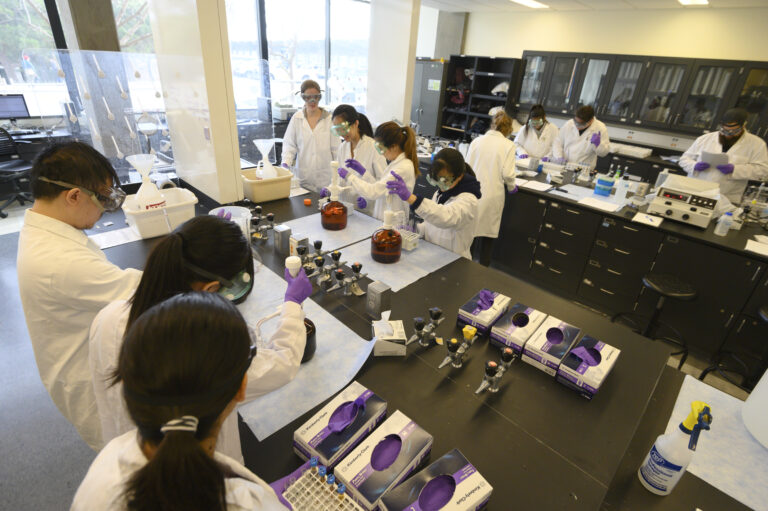
Science classes modify laboratories for online learning this spring

Departments record experiments, conduct laboratories over Zoom

Pipettes, beakers, syringes and microscopes will not be used by students this quarter. With UC Davis’ decision to move to online learning in an effort to slow the spread of COVID-19, classes will not offer the same “traditional” laboratory experience this spring. Professors, teaching assistants (TAs) and other faculty worked hard to design creative online alternatives for laboratory classes. 

Most courses are hosting online alternatives to in-person labs at the scheduled class times. By using online video platforms like Zoom, students watch their TAs and professors conduct experiments, instead of doing it on their own. 

For the introductory chemistry classes offered this quarter, CHE 2B and CHE 2C, faculty in the department recorded themselves conducting some of the experiments before the campus closed, said Brian Enderle, a lecturer in the Chemistry Department. These experiments typically would have been done by students in labs. Faculty edited the videos for students to watch during Zoom video calls with their TAs. Although students will not actually be completing the labs themselves, the TAs will talk them through the concepts and how to best analyze the data. 

In these videos, the Chemistry Department mimics the usual flow of the lab and focuses on teaching students concepts. The hope is for students to gain a similar understanding of laboratory concepts, but they will not get the same practice with scientific equipment, Enderle said. 

“This is the best of a difficult situation,” Enderle said. “We are doing our best but it will not be actually the same as using a pipette or [developing] glassware techniques that they would have in the lab. We can’t mimic and can’t send a bunch of glassware to your house.”

Classes in other departments, such as biological sciences, have implemented similar setups. In BIS 2B, an introductory biology class about evolution and ecology, labs have moved to online platforms, said Ivana Li, a staff research associate and the BIS 2B lab manager, via email. 

“Like everyone else, all of our content is online,” Li said. “This means a lot of the experimental and interactive parts of the lab cannot be done. We’ve opted to create laboratory videos as the substitute for our in-person labs.”

Since BIS 2B already has established course concepts outlined for each laboratory, Li worked closely with the course coordinator to make sure the concepts are met in the videos. Like with  chemistry labs, Li said she worries students may not develop the necessary skills they normally would by physically going to lab.

“What is lost is likely not knowledge, but experience,” Li said. “For instance, students will understand the concept of forming a hypothesis. However, since they are not able to do the lab experiments themselves, they will have less practice forming those hypotheses and fewer opportunities to discuss what makes a good hypothesis.”

Unlike chemistry, some BIS 2B lab sessions may include a do-it-yourself component for students to complete at home. Usually in biology labs, tools and specimens are provided to students, so Li and other faculty are trying to include hands-on components to labs as much as possible. Most experiments, however, will only be put into an observation context through video.

Similarly, in California Floristics and Angiosperms Systematics and Evolution, Dan Potter, a professor in the Department of Plant Sciences, is hoping to have students work with real flowers that they collect on their own, making it closer to the usual lab experience. 

“Normally, we have a lot of fresh plant material that we bring into the labs for the students to look at,” Potter said. “So it’s a very hands on lab in a normal year.”

Zoom video meetings will be held for the labs in these plant science classes. Images of flowers will be integrated into the videos instead of having students examine only plant material. Usually, the labs have been five hours, but this quarter they will be split into two groups that meet for two hours each. Due to the new format and shorter laboratory period, this course will cover less material.

“We usually in both of these courses cover a whole lot of different plant families and we just decided to scale back on that a little bit so there’s not quite as many different things that they have to be trying to learn without being able to see the fresh material,” Potter said. 

For the chemistry laboratory videos, piecing all of the clips together and adding a voiceover proved difficult, Enderle said. Also, if the faculty were unable to record a particular part of a laboratory, they have to now create or find an animation. 

“It was a big blitz and a bunch of unorganized clips so the editing is a long process,” Enderle said. “It’s a melee of trying to put everything together. The labs and exams are the most difficult parts.” 

Another difficult aspect of this transition was organizing materials for the TAs, since not everyone had all of the necessary equipment, Enderle said. Additionally, the department expects both students and TAs to face many technical difficulties and will be very understanding of those who have issues. 

“I like that post I saw from UC Davis: Keep calm and Aggie on,” Enderle said. “Basically to me that means, do your best to work out the technical difficulties you have. There will be internet going out, glitches and technical difficulties that both can and cannot be predicted.” 

Lab modifications have also made it hard to know what resources and access to technology each student has, Li said. Some experiments usually incorporated into laboratories were deemed too difficult to adapt to an online lesson, so the BIS 2B faculty had to adopt different methods for teaching those concepts.

“Do they have access to the outdoors so that they can measure plants outside?” Li said. “Are their laptops robust enough to run a modeling program? Everything has to be accessible, but it also has to fit the course concepts.”

For the chemistry classes, although the actual laboratory will be taught differently than previous quarters, pre-labs and post-labs completed before and after lab sessions will be the same, Enderle said.

“As far as the lab that they are getting graded on, they are having the same experience as any other student any other quarter,” Enderle said. 

For students to be successful in the online laboratory courses, they must be self-disciplined and good at managing their schedule on their own. Some students may find online learning more challenging than attending classes in person, Li said. 

“I think a student who is able to apply abstract concepts easily will do well in the class,” Li said. “Students who benefit more from hands-on learning may struggle.”

As the country faces challenges with preventing the spread of COVID-19, Potter said it is important for both students and professors to be flexible as laboratories undergo constant modifications.

“I think to some extent, we just have to accept that it’s not going to be the same, and [students] are not going to get the same kind of hands-on experience that they would otherwise get,” Potter said. 

Written by: Margo Rosenbaum — science@theaggie.org 

UC Davis to allow spring sport athletes extra year of eligibility

Decision follows NCAA adjustments of eligibility rules 

On March 30, the National Collegiate Athletic Association released a statement that it would allow schools to offer an extension of eligibility to spring sport athletes for an additional season of competition. The decision follows the historic cancellation of the spring sport season due to concerns about the spread of COVID-19. The decision especially devastated seniors playing these sports, who were only able to compete for a short portion of the season before it was cancelled, effectively ending their collegiate careers. 

Acknowledging this, the NCAA’s Division I Council voted to allow schools to bring spring athletes back for an additional season, but this does not require schools to offer athletes the same level of financial aid they received in previous years. Winter sport student athletes are not eligible for this extension, as those athletes would have competed in most, if not all, of their season, according to the council’s statement. 

The decision to not offer eligibility to winter sport athletes whose seasons may have been affected has been met with backlash. A statement put out by a group of 60 NCAA Student Athlete Advisory Committee members urged the NCAA to grant winter sport student athletes, who had not been able to complete for the entirety of their seasons, an extra year of eligibility. This was among other recommendations to mandate scholarship renewal and to provide immediate support for housing and food for all student-athletes. 

Following discussions between administrators, coaches and athletes, UC Davis athletics has decided to offer spring-sport student athletes the option of returning for another season. 

“The way that UC Davis is going to proceed is that the student athletes who wish to return may do so at the discretion of their coach,” said UC Davis Director of Athletics Kevin Blue. “They may return at the discretion of their coach and they may be put on scholarship as long as the scholarship that they will be receiving for their additional year of eligibility fits within existing scholarship budgets.” 

In an “Aggie Overtime” interview for the UC Davis Aggies YouTube channel, Blue mentioned that while UC Davis has decided to follow these guidelines, the Athletics Department is still working through the specifics of what that decision will entail. The department will likely continue to develop these policies through the next few weeks as students begin to make decisions about next year. 

In the meantime, the department must also decide how to make up for lost revenue that resulted from cutting the spring season short. In particular, the cancellation of the NCAA basketball tournament means a loss of a significant revenue source that UC Davis Athletics relies on each year.  

“We are continuing to fundraise through the end of the fiscal year as best we can,” Blue said. “But we’re also sensitive about the current realities going on right now and are modest in our expectations with regard to how much fundraising success we’re going to have compared to what we would have in a normal year. I think it’s important to note that everyone associated with UC Davis athletics has an appropriate perspective, [in] understanding that the circumstances going on in the world related to the pandemic are much more important than our challenges, as significant as our challenges might be for us.”

In addition to fundraising, ticket sales for the fall sports season — including season passes for the football games — are still ongoing, though the department is sensitive to the fact that the fall season may also be affected. Depending on how the virus progresses, the fall sports season may be affected or even cancelled, but the athletics department is preparing for all possible situations. 

“We’re thinking through various scenarios and modelling through various scenarios,” said Blue in the YouTube interview. “We are considering various permutations on the matter for how football may proceed this fall. It’s still too early to know anything for sure, but there is a reasonable likelihood that the football season may be affected in some way, and we are trying our best to be proactive and prepared for all those scenarios.”

Despite this, the department plans to keep the team budgets for scholarships next year the same. This means that senior student athletes who elect to return next year will only be given scholarships at levels that will fit within the current budgets — budgets that would also include the incoming freshmen. This decision is something that will ultimately be made at the discretion of the respective coaches.  

While many colleges across the country have decided to work within these new guidelines, one notable exception is colleges within the Ivy League. As of April 2, the Ivy League announced that it would not be offering spring sport athletes an extra year of eligibility and would instead follow its existing eligibility rules, which state that sports opportunities are only for undergraduates. 

Regardless of each college or conference’s individual decisions, the coming months will likely see athletic departments across the country working with athletes, public health officials and the NCAA to make the difficult decisions regarding bringing athletes back as well as moving forward with the fall season. 

Written by: Priya Reddy — sports@theaggie.org

If this is the end of Childish Gambino, it’s a beautiful tribute — a review of “3.15.20”

Glover’s most recent album is filled with honest, beautiful, self-assured self-doubt 

For years, Donald Glover, the singer, rapper, actor and altogether wildly gifted artistic creator, has hinted at plans to retire “Childish Gambino,” the musical stage name under which he performs. 

As a long-time fan, I can sympathize with Glover’s desire to separate from his Gambino persona. The transformations of both Glover and his Gambino persona are jarring — of Glover in his role as Troy Barnes on “Community” to his role as Earnest “Earn” Marks on “Atlanta,” and of Gambino from his early “I Am Just A Rapper” days, rapping over indie-pop favorites like Grizzly Bear’s “Two Weeks” and Sleigh Bells’ “Crown On The Ground” to his politically pointed and poignant “This is America.” Yet, the refinement and maturity of his artistic talent in these processes is blatant and undeniable.

This is perhaps why I wasn’t fully sold on his new album “3.15.20” upon first listen — I couldn’t quite find Childish Gambino in the album. It felt different — it was different — and I didn’t know what to make of it.

In early Childish Gambino work, there is an endearing, albeit juvenile, unsorted eccentricity. In the song “Lights On” from his 2011 album “EP,” he references (among other things) the clothing brand Gap, the Pokémon Raichu, the disinfectant brand Lysol, the 2010 film “The Social Network,” the SuperBowl, Vulture magazine, Cameron Diaz and Alex Rodriguez. It’s funny, but it’s also chaotic.

After I listened to “3.15.20” once, and then a dozen times, and then on an endless loop, I found Childish Gambino, still wildly anxious as ever, but now so composed. 

“Childish Gambino […] vividly conveys his anxieties regarding racism, aging, mass incarceration, climate change, parenthood and how people can’t walk down the street without tripping anymore because they’re always staring at their phones,” writes Los Angeles Times Music Critic Mikael Wood in his review of the album.

The album opens with “0.00,” seemingly meant as a preface to the rest of the album, rather than a stand-alone single. “3.15.20” is meant to be listened to in its carefully arranged progression, as the songs flow into one another. The more astute observer might notice that tracks four through 12 are titled with the minute and second mark, indicative of where they begin in the 57-minute album. (Apparently I am not an astute observer, because a friend of mine had to explain it to me after some confusion on my end.) 

The second and third songs, “Algorhythm” and “Time,” the only tracks titled with words, are two perfectly polar yet on-brand examples of Childish Gambino’s sound. “Algorhythm” is an ominous track about technology addiction and dependence, reminiscent in style and message to “II. Earth: The Oldest Computer” from his 2013 album (and my personal favorite) “Because The Internet.” “Time,” however, sets a completely different tone: It’s upbeat, pop-y and even features Ariana Grande. I’d be lying if I said I didn’t roll my eyes at some of the more banal lyrics in this track (“Maybe all the stars in the night are really dreams”).

Twelve minutes and 38 seconds into the album — at the track “12.38” — the album goes from forgettable to classic. As the kids say: This track slaps. It’s clever, addictive and classic Gambino. The sound change around the five-minute mark is flawlessly executed and reminds me of tracks like Frank Ocean’s “Nights” and Tyler, The Creator’s “GONE, GONE / THANK YOU,” which also incorporate seamless transitions toward the end of their run-times.

“12.38” is a musical narration of a sexual encounter enhanced or otherwise influenced by drugs. At one particularly memorable point, Childish Gambino asks: “Ayy, why your cat lookin’ at me sideways?” Then, playing the part of his female companion, he sing-croons “Sing to her.” “I said, ‘nah, I’ll put on the radio though.’” It’s a familiar integration of humor with music (Glover is also a comedian), but in a much more secure and relaxed way than before.

The end of “12.38” explodes into “19.10,” an energetic and easy-to-listen-to track. He recounts when, at age six, his father told him he was “gorgeous,” but “To be beautiful is to be hunted.” This is one of the first nods in the album to parental encouragement and advice, but it’s not the last. In “47.48,” Gambino/Glover seems to sing directly to his children: “Little boy, little girl / Are you scared of the world? / Is it hard to live? / Just take care of your soul.” 

The most touching moment in the album is the dialogue between Glover and his son, Legend, which closes “47.48.” Glover asks his son who he loves, and he says he loves himself. 

“Do you love yourself?,” Legend asks.

“I do love myself,” Glover answers.

“Does mommy love herself?” Legend asks.

“Absolutely,” Glover answers.

Appearing two songs prior to “47.48” is “39.28,” a song equally as beautiful, though tinged with sadness and loss. “Grief is a standing ocean / And I never swam unless you did / So I don’t know why I’m here without you / I miss you.” It’s one of my favorite songs on the album.

There are other greats: Listeners might recognize “42.26” as Gambino’s previously released “Feels Like Summer,” which appeared on the soundtrack to the 55-minute, gorgeously shot short-film “Guava Island.” The movie, starring Glover and Rihanna, is directed by Hiro Murai, who also directed Gambino’s “This Is America” music video, which has over 652 million views — and if a music video was ever to be considered a cinematic masterpiece, this is it.

Up until “3.15.20,” Gambino’s music has been largely defined by insecurity, self-deprecation and internalized anger. This album is none of that — it’s self-assured self-doubt. So I do understand why Glover wants to part ways with his musical persona, and it’s been suggested that “3.15.20” is the last Childish Gambino project. 

But if this is the end, it’s a beautiful tribute. These lines in “53.49,” the last track in the album, sum it up perfectly: “There is love in every moment / Under the sun, boy / I did what I wanted to, yeah, yeah / Now I just power forward.”

Written by: Hannah Holzer — arts@theaggie.org

A list of heartwarming things happening in the world right now

During this challenging time, here are a few pieces of good news to put a smile on your face 

With the constant bombardment of news related to the coronavirus, many people feel overwhelmed by pandemic-induced anxiety. Now, more than ever, people are making an effort to emphasize good things happening in the world. From John Krasinski’s “Some Good News” series on YouTube to shares on Twitter and Instagram, individuals have come together to appreciate the good amid the bad. Here are four pieces of news sure to brighten anyone’s day.

1. More animals fostered and adopted

Many have welcomed new furry friends into their homes through fostering and adoption during this period of social distancing. With more time spent in their homes, people are looking for something to occupy their free time and welcome a new source of happiness in their lives.

The Los Angeles Times addressed this trend, writing, “Amid the lockdown, a restless and hard-headed nation has discovered that what it really needs right now is a snuggle and a slurp.”

2.  Improved air quality 

Air quality around the world has improved as modes of transportation are used less frequently and emissions have decreased. In an article covering this change in air quality, The Washington Post shared details about Los Angeles from Yifang Zhu, a professor at UCLA’s Fielding School of Public Health. 

“Zhu says the average levels of PM 2.5 for the L.A. area dropped from about 16 micrograms per cubic meter to about 12 micrograms per cubic meter,” The Post article said, further mentioning that this improvement should not end with the pandemic, rather it is “something that society should strive for during normal times.”

3. Celebration for a girl’s last chemotherapy session on John Krasinki’s “Some Good News”

John Krasinski’s new series on YouTube, “Some Good News,” looks to the public to create a news platform solely consisting of good news. Krasinski shares many happy stories, one of which features a girl who is welcomed home by a socially-distant celebration from friends and family after her last chemotherapy session. The video showcases car after car filled with people cheering and holding up signs, revealing a community that has come together to show support even during these difficult times. 

4. Free membership, lectures and streaming available to the public 

Stay-at-home orders have left Americans with a lot of free time, and due to the crisis, many free options have presented themselves to solve this dilemma. From Broadway shows becoming available to stream online to gyms offering free online workout classes, there are myriad options now available for everyone. All Ivy League universities are even offering free online classes to the public — no perfect score on the SAT necessary. NPR detailed these opportunities and more here

Written by: Nora Farahdel — features@theaggie.org

Eighty-five percent of residence hall students cancel Spring Quarter contracts, remaining residents relocated

Student Housing and Dining Services adjust operations for Spring Quarter 

In an effort to reduce campus density following public health announcements for COVID-19, Student Housing and Dining Services encouraged students living on campus to return to their permanent residence if feasible and offered Spring Quarter housing refunds. 

According to Associate Vice Chancellor of Student Housing, Dining, and Divisional Operations Michael Sheehan, 85% of residence hall students chose to cancel their Spring Quarter contracts. 

In order to receive the full Spring Quarter refund, students had to terminate their contract online and move out of student housing by March 25. Any student who moved out after that date received a prorated refund based on a daily rate. Financial aid packages were not affected for those who chose to terminate their Spring Quarter contracts to receive housing refunds.

Student Housing residents received the announcement regarding the deadlines and options to move out before finals week.

“I know for some individuals it wasn’t that much time, just because decisions about what would happen next quarter and such were told to us around finals week,” Jonathan Kha, a first-year residence hall student, said. “That gave little time or created a hassle for them if they lived long-distance […] or had little time to say goodbye to friends and such.”

Kha said he initially planned to stay on-campus for Spring Quarter, given that living at home would be a hassle for his learning environment and his financial aid package covered most of his housing costs anyway. 

“However, when they provided information that certain services would be closed and that housing would be fully refunded if moved out by a certain date, I did feel an immense amount of pressure because of the amount of money that was going to be offered to me if I were to live off-campus, benefitting me a lot as a low-income student,” Kha said. 

Kha moved out of the residence halls on March 25. For the remaining students, Student Housing and Dining Services had to increase their safety measures to follow public health directives. 

After Yolo County issued a Shelter-in-Place Order on March 18, the university announced the move to “Suspended Operations” in which all non-critical functions, activities and facilities may be suspended. 

On March 19, the State of California issued a Stay at Home Order. On March 20, Student Housing and Dining released a message that residents who chose to stay in student housing for Spring Quarter may be required to move to another room “to consolidate students to one area for operational efficiency, to help support Social Distancing Requirements, or to provide a safe, isolated space for students that may fall ill.” 

“For the remaining residents, we have been very direct regarding the need to reduce density while also consolidating space,” Sheehan said. “The process of moving residents is just beginning. During the process, we are working with Student Health and Counseling Services to engage remaining students to assess their current health. If residents are presenting any symptoms, Student Health and Counseling Services will ask that the student be given special accommodation within an isolation space.” 

Sheehan explained that dining operations have implemented significant measures directed by Yolo County Health and the State of California to ensure resident and staff safety. 

Programmatic changes include an Elevated Sanitation Protocol using a diluted bleach solution to disinfect all non-food surfaces; disinfecting high traffic areas with the use of bleach on an hourly basis including door knobs, bathroom areas and railings; closing all campus coffee and restaurant services; omitting all seating options; moving to a full service to-go format with modified hours of operation in the Dining Commons and implementing social distancing point-of-sale and queuing lines with 6-foot indicated spacing. 

Sick tray service is also offered for students, which allows a fellow resident to visit the Dining Commons and request to pick up a meal for them. Meal plans were also adjusted to a “block plan” with 200 swipes and $200 worth of Aggie Cash for all remaining students. 

As for resident advisors, Sheehan said RAs were welcome to return to their position and their rooms or resign if they so chose to. 

“For those returning [RAs], we have adjusted their responsibilities to promote social distancing and RAs will not be conducting any rounds or providing any group social programs,” Sheehan said. “RAs will be an online resource to residents as needed and also assisting the department with various small projects as needed.”

All Residential Academic Centers, Residential Academic Center tutoring, RA programs, recreation rooms and residence hall IM sports have been cancelled. Staff on-call services, area service desks with limited check-out equipment and computer centers, however, are still available to students. 

Written by: Graschelle Fariñas Hipolito — campus@theaggie.org

The Pantry and Aggie Compass partner to create weekly grocery bag program for students during COVID-19 pandemic

Students in need receive weekly, customizable grocery bags

The Aggie Compass Basic Needs Center and The Pantry are teaming up to help provide students with basic needs despite constraints of the county and statewide shelter-in-place order and social distancing. Both spaces are currently closed in accordance with the county’s shelter-in-place order, but both teams remain dedicated to providing assistance and resources to students virtually and in new, innovative ways.

The evolving COVID-19 pandemic has simultaneously increased students’ need for basic needs and restricted the abilities of programs like Aggie Compass and The Pantry to meet these needs. 

Homelessness and food insecurity are prevalent issues among college students across the country. Around 250,000 students experienced homelessness in California in 2018, according to the U.S. Interagency Council on Homelessness. And more than 6.5 million Americans were forced to file for unemployment last week, according to The Guardian

At UC Davis, with nonessential services shutting down, many students have found themselves with reduced hours or out of work entirely. 

Before the COVID-19 pandemic, The Pantry provided around 800 UC Davis students with food products every day. To combat food insecurity during the pandemic, The Pantry and the Aggie Compass Basic Needs Center have partnered to create a weekly grocery bag program for students. While both The Pantry and Aggie Compass’ physical locations have closed, many services provided by both centers remain available online.

Every week, 150 students can sign up by Sunday night to receive a pre-filled grocery bag on Thursday between 12:00 p.m. and 2:00 p.m. Instead of receiving food products in the MU, students can pick up their groceries on the Quad where pre-filled bags are spaced six feet apart from one another.

On April 2, Aggie Compass and The Pantry provided 240 grocery bags filled with a week’s worth of groceries to students, nearly 100 more than they originally anticipated.

“Students will have the option to choose between a meat bag, a vegetarian bag or both,” said Ryan Choi, the director of The Pantry. 

In addition to providing access to food products, Choi spoke at length about The Pantry’s goal of providing for students’ needs that may differ based on cultural or religious belief. Providing vegetarian options for students is one way Choi hopes to respect the diversity of students’ backgrounds and needs.

After picking up their bag of groceries, students can check out with student volunteers from The Pantry and Aggie Compass, tabling nearby on the South Quad. 

In addition to groceries, students have the option to receive menstrual products in weekly grocery bags. 

PERIOD, a campus club, usually provides menstrual products in bathrooms across campus. The club is also adapting to the new constraints and demands created by COVID-19. 

Sabina Kabra, a fourth-year genetics and genomics major, is the operations and donations director for PERIOD. 

“During the coronavirus pandemic, more and more people are facing uncertainty surrounding health, shelter, employment, food and other necessities,” Kabra said. “PERIOD is trying to alleviate some of this uncertainty by providing free menstrual products. Menstrual products are a necessity and periods don’t stop during an epidemic.” 

PERIOD has donated over 3,000 menstrual products, according to Choi. 

Usually, The Pantry relies on both donations and their partnership with the Yolo County Food Bank to provide products for students. Due to the COVID-19 epidemic, the Yolo County Food Bank has become inundated with increased community demand for food. As a result, The Pantry is in need of community support and monetary donations now more than ever, according to Choi. 

The Pantry and Aggie Compass have also adopted strict procedures to help promote the health and safety of volunteers, staff and students. Groceries are pre-bagged in reusable bags to minimize the contact and possible contamination.

Because the service relies on the availability of reusable bags, The Pantry and Aggie Compass encourage students to donate reusable bags upon picking up their bag of groceries in order to minimize costs of the service. Bags donated are sanitized and isolated in a room separate from food products where they remain for four days prior to food distribution. 

In addition to weekly grocery bag services, Aggie Compass remains dedicated to helping students in crisis throughout the COVID-19 epidemic. 

“Our basic needs coordinator […] is meeting with students via Zoom and providing support in the form of swipes, grocery cards and emergency grants and rental assistance,” said Leslie Kemp, the director of Aggie Compass, via email.

Students in need of housing or emergency food resources have the ability to fill out an online basic needs request form and can get immediate support within two to three days.

Written by: Ally Russell — campus@theaggie.org

A Hero’s Odyssey: Jake Maier’s rise to Aggie football glory

How UC Davis’ all-time leading passer bet on himself to live out his college football dreams

Sometimes, we never know where a single choice may take us. 

Four years ago, after returning home to La Habra, California following a redshirt football season with Sacred Heart University in Connecticut, Jake Maier made a choice that would eventually lead him to become UC Davis football’s all-time leading passer. He just didn’t know it yet.

“There was a point in time where it […] might have been baseball, to be honest with you,” Maier said in a recent phone call. 

A two-sport varsity athlete at St. Paul High School in Santa Fe Springs, Maier made his mark on the diamond as well as the gridiron. The outfielder was selected as team MVP after hitting .360 his senior year. Despite his limited set of offers, Maier decided to take his chances with football and pursue his dream of playing the game at the collegiate level.

Having grown up a fan of USC football, he loved taking in the excitement of college football from a young age, and possessed a desire to compete on a similar stage. He just didn’t know how to get there.

It wasn’t until he was entering his junior year of high school that he decided to become a “serious” quarterback, Maier said. That’s when he came across Danny Hernandez, a Los Angeles-based quarterback guru whom Maier still works with today.

“[Hernandez] really elevated my game and made me fall in love with throwing footballs, working out and becoming a better quarterback,” Maier said. “Because prior to that, it was really just me, my dad and a family friend that I used to work out with when I was in middle school, and especially in high school. But Danny Hernandez had a huge impact on my development; [he] really made me start believing that I could be a college quarterback.”

The extra work with Hernandez helped Maier succeed throughout his junior and senior years of high school on the varsity squad. But once his high school football career ended, Maier said he didn’t initially receive any college offers. It wasn’t until later — in the middle of his baseball season that spring — that he eventually committed to Sacred Heart. 

After a season on the East Coast, Maier was back in California and once again faced the same dilemma: Where to go from there?   

“I remember coming home, and baseball kinda was in the back of my mind,” Maier said. “I always felt like I could kind of fall back on that just because it was my natural first sport that I grew up playing. I had a good senior year in high school, and some of those opportunities were still there — to go play college baseball.”

Perhaps taking the college baseball route would have been easier for Maier at that point in time — it was familiar, comfortable and less of a risk. But he wasn’t ready to put his football aspirations to bed just yet.

“After talking it over with family and other football coaches that had a big impact on me, they just kept trying to convince me to ride it out and try the junior college route,” Maier said. “And they believed that there was a future in college football for me. I wouldn’t be where I’m at without those people shining that light on me, just trying to inspire me to keep going.”

With the support and encouragement of his family and home network, Maier made a choice that became the seminal moment of his athletic legacy: He was going to play football.

Long Beach City College became the next stop on Maier’s journey. There were a lot of unknowns regarding the junior college process and his spot on the depth chart, according to Maier. But he was able to persevere through the summer workouts and fall camp with his new team, buoyed by the advice that his father, Jim, now a head softball coach at Cal State Dominguez Hills, and mother, Lori, a teacher at St. Paul High, gave him: Have fun and enjoy the opportunity to play the game.

At the outset of fall camp, Maier was LBCC’s third quarterback option. After an impressive performance in a scrimmage before the 2016 season was set to get underway, however, the coaches gave him the nod at the starting spot. 

“I just thought that was incredible,” Maier said. “I was like, ‘Man, I never thought I’d be able to start a college football game, even though it was junior college.’ I was super grateful for it.”

Although his role as QB1 was not guaranteed for the entire season, Maier showed up for his first collegiate start and never looked back. He threw five touchdown passes in the first half, and completed 23 passes for 322 yards en route to a 41-14 trouncing of Pasadena City College.

“From that [first] half on, the head coach said, ‘Okay, you can finish the game. I’m not just gonna pull you now,’” Maier said.

Maier started all 11 games that year, threw for 3,689 yards (an average of 335 a game), 38 touchdowns and just eight interceptions to lead the Vikings to a nine-win season that was capped by a bowl game victory over Bakersfield College.

“I always say — outside of obviously winning the championship at Davis — that was one of the funnest years I’ve ever had, just as an athlete,” Maier said.

Exactly nine days after the Jake Maier era ended at LBCC, a new era of UC Davis football began. On Nov. 28, 2016, Dan Hawkins was introduced as the Aggies’ newest head coach. That’s when the ball really started rolling, Maier said.

To effectively implement his new, up-tempo, pass-heavy offense, Hawkins knew he needed a quarterback who could take on that responsibility. He began hearing about a talented gunslinger from down south, whom his son and offensive assistant coach, Cody, then-defensive coordinator Robert Tucker and others had seen during their days at Los Angeles Valley College. Hawkins began recruiting Maier aggressively.

Although the new head coach was first drawn to Maier by the quarterback’s accuracy and quick release on film, Hawkins said that it was meeting Maier in-person and his intangibles that really sold him.

“I said, ‘Hey, let me kind of show you what we’re thinking about on offense,’” Hawkins said in a recent phone call. “And he [Maier] pulled up a chair and sat down there like a retriever, just waiting and was just locked in on everything. I mean, I could have talked for five hours and I don’t think he would have moved. He was just all about it, and locked in and very attentive — loved his vibe. You could tell it was kind of a quiet confidence, but a humble kid.”

After Hawkins made the initial push, the onus to seal the deal fell on former UC Davis quarterback and newly hired offensive coordinator and quarterbacks coach, Tim Plough. It was up to a former Aggie signal-caller to convince Maier to be the future at that position.

“Coach Hawkins basically was like, ‘Hey, your first job is to fly down to Long Beach and convince this kid to be an Aggie,’” Plough said in a recent phone call. “So within 24 hours of getting a job, I was on a flight down to Long Beach to see Jake and met his family. And over the next few weeks, we got to know each other. And luckily for us, he chose to be an Aggie.”

This time, Maier had a number of Division-I offers, including other Big Sky teams like Northern Colorado and Weber State, and Mountain West program Nevada. But none of those schools came close to the love and admiration that UC Davis showed for him, Maier said. Being recruited by UC Davis was “a dream come true.”

“They were always checking in on me and they made it known that they cared a lot about me, and they saw a real future for me,” Maier said. “I think, looking back as a recruit, that’s really all you want. All the extra stuff is really kind of nonsense in my opinion. And I tell this to people now that are in high school and getting recruited: It’s all about how much a university and a program and a coaching staff and the players […] want to invest in you and how much they believe in you, and if they have a real plan for you. I just think that that’s really where it’s at.”

With the prospect of new beginnings under Hawkins and his staff, Maier decided to join a UC Davis program that had just stumbled to a 3-8 finish in its final season of head coach Ron Gould’s four-year tenure with the team. In the run up to the 2017 season, the new quarterback on the block worked hard to prove he was worth UC Davis’ investment. Motivated by what he described as a healthy quarterback competition with junior C.J. Spencer and senior Brock Dale, who also came to the Aggies by way of LBCC and had started one game for UC Davis in 2016, Maier eventually earned the starting spot for the opener at San Diego State.  

“We could see very early on that he [Maier] was just different,” Plough said. “He has a different quality that the great ones have — the J.T. O’Sullivan’s, the Mark Grieb’s and the Khari Jones’, all those guys. They all have something special, and Jake had that. It was apparent, even the first day he showed up at camp, you could tell he was gonna be special.”

Not only did Maier’s abilities impress his new coaches, it was also his humility and dedication to the team that caught the attention of Hawkins. Even though Maier was the starter, Dale was still a team captain. 

“Jake was always super respectful of Brock,” Hawkins said. “And that showed me a lot, too.”

Although the Aggies were defeated in their first game of the Dan Hawkins era, Maier showed his worth as a tremendously efficient passer, completing 19 of his 24 throws (a near-80% clip) and tossing two touchdowns in a tough battle against a gritty FBS opponent. Maier’s first game under center was just a flash of what was to come.

The following week, Maier played in his first home game at UC Davis and collected his first win as an Aggie, shredding San Diego for 369 yards and three scores. On the same field three weeks later, he put together one of the finest performances of his collegiate career in a dismantling of North Dakota. Maier completed 33 of 38 passes for 415 yards and four TDs. This was his first 400-yard outing as an Aggie, and that 86.8% completion percentage stands as a career-best.

Number 15 would break his career-high for passing yards with a 459-yard, four-touchdown effort a few weeks after. The new-look offense was humming, but the Aggies weren’t yet quite up to par. UC Davis lost its final two games of 2017, including what was almost an incredible comeback at Sacramento State, to put a damper on what was otherwise a very promising 5-6 season.

Maier’s 3,669 passing yards (a program record for a single regular season), 26 touchdowns and nine games with over 300 yards passing (also a program single-season best) in 2017 put him on the national radar. Before the 2018 campaign began, he was named to the Walter Payton Award watch list alongside teammate and eventual finalist Keelan Doss. 

The Aggies had the proper pieces in place: a revitalized culture and a budding confidence as a program. But the pre-season media and coaches polls projected UC Davis to finish near the bottom of the conference. Maier, however, knew better.

“The second I got there and just saw what we had — talent-wise, belief-wise, strength coach, assistants — I mean, everything was lining up,” Maier said. “It was not a surprise to anybody within the program [of] how good we can be and how well we ended up doing.”

While 2018 was arguably the finest season of UC Davis football since the program made the jump up to Division-I — 10 wins, a share of the Big Sky title and the team’s first-ever FCS playoff appearance and victory, eventually culminating in a heartbreaking loss at Eastern Washington in the FCS quarterfinal — it was also Maier’s greatest season as an Aggie. 

On his way to being named Big Sky Offensive Player of the Year, Maier set single-game career-highs in passing yards (478 in the regular-season finale win over Sac State), completions (40 in a “Maieracle” comeback win over Idaho State) and touchdown passes (five in that same game and in the ensuing week’s contest at Cal Poly). He set new program single-season marks for pass attempts (557), pass completions (364) and passing yards (3,931). He also set a program regular-season record for passing touchdowns with 31.

“He just continued to grow, and he continued to develop and he continued to get better and continued to keep trying to reinvent himself,” Hawkins said. “I just think it’s rare in people when you find somebody [who is] that accomplished and that gifted and talented, that’s still willing to be able to be humble and keep learning.”

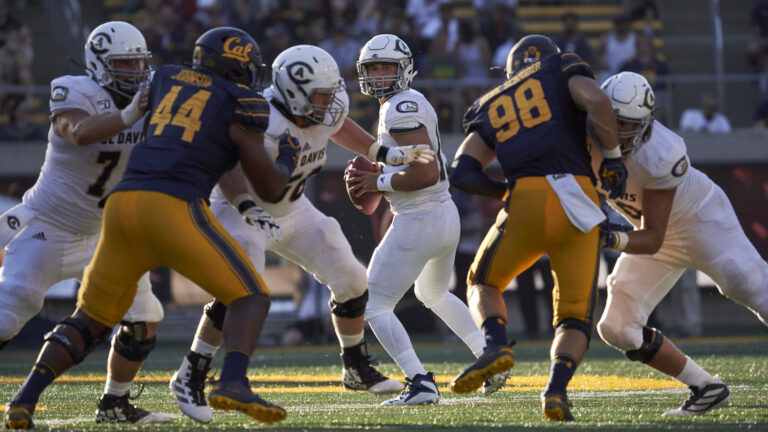
The 2019 season presented a new challenge for Maier. His favorite target and record-breaking wideout, Doss, had graduated and moved on to the NFL. The Aggies competed against formidable opponents week in and week out, and were decimated by injuries. They opened the season on the road against Pac-12 foe Cal, and then proceeded to play a schedule that featured seven eventual FCS playoff teams — including national champions North Dakota State and national semifinalists Montana State and Weber State. Of those teams, UC Davis was only able to top San Diego in week two. 

With a new target on their backs as defending co-champions of the Big Sky, the Aggies were repeatedly tested and, in several games, rose to the challenge. UC Davis was painfully close to upsetting the Bison at the Fargodome, lost on a late field goal on the road at North Dakota and had a late lead against both Montana State and Sac State. The opportunities were there, but the chips just didn’t fall the Aggies’ way.

“2019 was tough — emotionally, physically, anything that you can say about it, it was definitely difficult,” Maier said. “But you know, the thing that made it easier, for sure, was the people didn’t change, the culture didn’t change, the things that make you feel good about UC Davis were constant. So regardless if we were winning or losing, I went to practice every day and I got to play for Coach Hawkins and Coach Plough, and that never changed. And that was something that I always looked forward to every day.”

The quarterback’s positive attitude and unwavering commitment to getting better each day propelled him to greatness, even amid a season full of struggle. In his final home game as an Aggie, Maier broke O’Sullivan’s career passing yards record. Maier’s overall total of 11,163 passing yards and regular-season total of 10,619 are both program records. How’s that for a guy whose natural first sport is baseball?

It was a fitting end to what Maier deemed a “special” three years. A testament to his humility and understanding of the bigger picture, Maier is the first one to tell you that he was just part of the equation — one of the many contributors who worked to accomplish that goal. 

“For us to reach that milestone is something that everybody should be really proud of — the play caller, the receivers, the running back, the offensive line, the offense, the strength coach,” Maier said. “Everybody that’s involved within the program has something to do with it, whether it’s major or minor. If the program’s not running the way it’s run, then that’s not possible. So that’s something that everybody should be really proud of. If people want to put my name next to it and constantly put that number in the same sentence as my name, then so be it. But ultimately, it has less to do with me than you think.”

There’s no denying that, perhaps to a greater extent than most other team sports, success in the game of football requires a holistic effort from everyone involved. In football, an individual player’s greatness is limited by the very nature of the game: Each position requires a different, highly-specific skill set and depends on everyone else to do their job. The game’s biggest impact players are only able to play on one side of the ball — save for the rare exception of two-way players.

But if there’s one position in which a single player can have the greatest influence on the game of football, it’s the quarterback. And Maier is an exceptional one. In his 36 games as an Aggie, he recorded at least 300 yards, passing in 21 of them and posted a career completion percentage of 66.3 — not far from Chris Petersen’s program record of 69.7. He also set a new program career record for regular season touchdown passes with 85 — 13 more than the previous record of 72 set by O’Sullivan.

“We obviously have a storied history here in football,” Hawkins said. “And if you were to look at a few bylines that define Aggie football, certainly one of them would be the quarterback legacy. To live up to that and exceed, that says a lot about him [Maier] and about Tim Plough and about all the other quarterbacks that we’ve had come through here. People see that system, believe in that system. They look at those names and what they’ve done and there’s something to it. It’s not luck.”

If you talk to anyone who has ever been a part of Aggie football, you’ll quickly recognize that a deep appreciation for the program’s history is ingrained within them. That is especially true for Aggie quarterbacks, and Maier is no different. His reverence for the Aggies’ rich football tradition came naturally to him, according to Hawkins. And in Maier’s mind, UC Davis’ high standard of excellence at the quarterback position is “really second to none compared to a lot of other places that may be in the spotlight more than Davis is.”

The fraternity of UC Davis quarterbacks is a strong one: After he broke the all-time passing record, Maier said that “just about every single one of the great Aggie quarterbacks” sent him a congratulations video. He has a particularly strong relationship with former Aggie gunslinger and current radio analyst Scott Barry, and appreciates O’Sullivan’s support and perspective on the game. 

Now that his collegiate playing days are over, Maier has his sights set on a professional career in football. Needless to say, he has the support of many great Aggies behind him.

Maier got his first chance at an audition back in January, when he was invited to participate in the Hula Bowl, an all-star game for graduating seniors from all over the country and all levels of college football. 

Led by former NFL head coach Rex Ryan, Maier’s playing time was somewhat limited with three other quarterbacks on his team’s roster. He was only able to throw a few passes in the game, but said that the whole experience was bigger than football.

  “It was cool to have so many family members travel out there and enjoy Hawaii,” Maier said. “And [to] just take a step away from the reality of work and life and just enjoy a week where we can focus on football, but ultimately just focus on being with each other and just enjoying the things that are put in our lives because of football.”

The exposure at the Hula Bowl and his tape against strong opponents has earned Maier some well-deserved NFL draft buzz. For now, though, he’s back in Southern California, working out five or six days a week — often with old mentors like Hernandez. Although he’s no longer in Davis, he’s still very much connected to the Aggie football family.

“My advice to Jake was always just to trust himself,” Plough said. “And if he has a chance to get in front of NFL teams and throw for them — and they can watch him practice, they could watch how he learns, watch him interact in any capacity — I think that’s a positive thing.”

The climb to the pro’s isn’t easy for anyone, especially for quarterbacks like Maier, who don’t necessarily have the prototypical size or physical attributes that scouts are commonly looking for at the position — a fact that both Plough and Hawkins addressed when discussing Maier’s prospects moving forward. 

Plough, however, said Maier is “the smartest football player I’ve ever coached,” emphasizing his belief that he is well prepared for the next level because of his mastery of the Aggies’ pro-style offense. Hawkins shared similar sentiments, and summed it up by saying, “the guy’s an absolute winner.”

“I just keep telling teams, if you give him a chance, you’re not gonna regret it and you’re probably gonna want to figure out a way to keep him on your team, because Jake Maier will always make your team better,” Plough said. “I think he’s going to have a lot of opportunities, whether it’s NFL, CFL, XFL, Jake Maier’s the type of guy that will play until he exhausts all his playing ability. He’s going to play until they bar him out of the building. He loves it that much.”

Four years ago, Maier had to make a decision. With the help of those who believed in him, he chose to bet on himself and forge his own path to become an elite college quarterback. Now, he’s going all in again — this time on a chance to play as a pro.

“The only thing I can do is be the most complete player that I could possibly be,” Maier said. “Whatever my potential is, it’ll be that, and that’s something that I’ve always taken a lot of pride in. I’m going to be as accurate, as strong, as fast, as smart as I can possibly be. And anybody in my family, or anybody that knows me, knows that I’m not messing around when I say that. I really believe in myself, and I can do a lot for an organization. If my job description is a pro football player, then that’ll be my number one priority in life for that moment. And as other things add on to that, then I will do so accordingly. I want to be a father one day, a husband — I want to do a lot of other things that will get added onto the plate. But as for right now, my job is to put myself in the best situation to reach my goal and my dream.”

** Bonus: A note about the future of Aggie football… 

Plough: “We’re not gonna replace Jake Maier. There will never be another Jake Maier. But what I’m hoping for is that one of these guys ends up being the first Miles Hastings, or the first Hunter Rodrigues or the first Brock Johnson — or whoever. I really hope that they make their own mark. Jake left his mark. Like Jake said: 10 years from now, it’ll probably mean a little bit more to him than it does now when he comes back, but I’m excited about the guys we have. We looked ahead and knew that Jake was going to be leaving after the season, and so we over-recruited at quarterback just to be able to get a lot of guys in the room that could compete — [a] bunch of talent. So I expect whoever to climb out of that room will be well prepared. We’ve coached a lot of good quarterbacks over these several years. Coach Hawkins has had a bunch of great ones, too. So we feel confident in our ability to develop a quarterback, and so I’m excited to see who that’s gonna be. All those guys played really well in the winter. So we’ll be excited to see what happens in the fall.”

Hawkins: “I really, really, really thought we had a spectacular winter ball. Chemistry was good, execution was good. I thought it was great. The energy was great. I thought it was our best winter by far. The quarterback position, we do have a lot of competition there. The good news is, we got a lot of guys who can really play. We have not really made a determination where we are on that yet, we’re still letting that play out. So we’ll see. The good news is, we got a lot of options.”

Written by: Dominic Faria — sports@theaggie.org

UC Davis offers Visa gift cards as compensation to those affected by UCPath payroll problems

Students must contact Central Payroll to confirm addresses by April 17 and receive the money 

Students who lost pay during UC Davis’ implementation of UCPath this past Fall Quarter were informed via email on April 9 that they will receive either $50 or $100 Visa gift cards to recognize the “time and effort spent on resolving the issue” with the UC Davis administration.

UC Davis will send $50 Visa gift cards to students who lost around $100 from their checks during the UCPath implementation. The 296 students who missed $1,000 in payment during the UCPath rollout will receive $100 gift cards, according to Kelly Ratliff, the vice chancellor of UC Davis Finance, Operations and Administration.  

The initiative comes partially in response to a Jan. 23 ASUCD resolution demanding compensation for the financial problems UCPath created for students. Some students, for example, were unable to pay rent or make credit card payments due to lack of income from their on-campus jobs. The UCPath rollout caused similar issues on other campuses, including at UCLA.

Ratliff noted that they chose to use gift cards because it means that students won’t have to worry about tax withholding. It also simplifies the payment process for people working in the payroll office. She said the gift card distribution process has been slowed down by the unexpected circumstances of the pandemic. 

For example, the statewide shelter-in-place order, issued in March, came shortly after the chancellors had decided upon the gift card distribution as compensation. 

“At the time, we had no idea that everyone would be away from campus,” Ratliff said.

Ratliff also said they began analyzing the effects of the payroll issues in late January, shortly after many of the emergency checks had been cut. 

During this time, administrative figures discovered that a total of 963 students — evenly divided among undergraduates and graduates — received some form of emergency pay in response to the payroll problems. The emergency check amounts ranged from just a few dollars up to a couple thousand, she noted.

Now, students will have until Friday, April 17, to confirm their current addresses by emailing Central Payroll so that they can receive their gift cards in the mail. Ratliff said they “expect that everyone will have received payment within two weeks.” 

“It seemed important, once everyone had their head up and had the chance to get back to this, [to give everyone] an ounce of good news,” Ratliff added.

Written by: Rebecca Bihn-Wallace — campus@theaggie.org

Mars Wrigley launches new research program with UC Davis

Partnership expands on cacao crop research

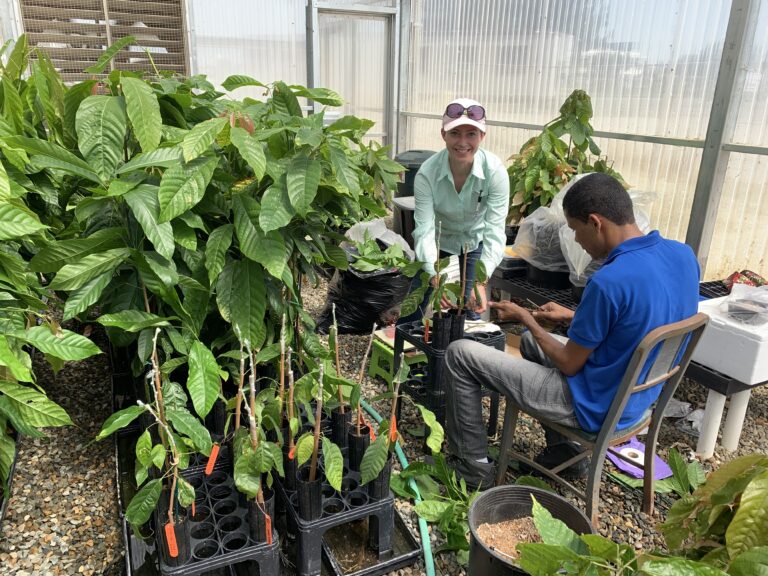
Mars Wrigley, the world-famous manufacturer of chocolates, candies and gums, recently launched a new research program with UC Davis focused on cacao. Construction of a new on-campus greenhouse supported by Mars for cacao plant research is nearly complete. 

Cacao is a relatively unexplored plant compared to other crops that are considered major sources of energy, according to David Mackill, the cacao genetics and breeding director at Mars Wrigley and an adjunct professor in the Department of Plant Sciences. Conducting fundamental studies to improve the basic understanding of cacao can have a great impact worldwide, Mackill said. 

      “More productive cacao trees that are resistant to pests and diseases means farmers can grow more high-quality cocoa on less land, improving their productivity and their lives with less risk of deforestation,” Mackill said via email. “This research partnership between UC Davis and Mars and these important new facilities will help achieve that.”

The partnership between Mars and UC Davis began in 1974. Since then, the company has worked with multiple departments and programs at UC Davis, conducting research on crops such as cocoa, peanut and mint. 

Research on sustainability and plant disease control are also areas of great focus. Alan Bennet, a distinguished professor in the Department of Plant Sciences, ran a research project with Mars focused on identifying corn varieties in Mexico that were able to fix their own nitrogen.  

“This research supports the development of more sustainable agriculture,” Bennet said. “It will have the biggest impact on undeveloped areas where nitrogen fertilizers aren’t even available. It can really enhance food security in important ways and in important parts of the world.” 

Because of the increasing world population, industry and academia are working together to find sustainable agricultural operations that can benefit future generations. 

“Mars can inform scientists, like myself and others, about how a company would look at the world and the kind of things they need,” Bennet said.

The collaboration between academia and industry will only increase in the future, Bennet said.

“It’s very important for our world to meet its food production demands by 2050,” Bennet said. “It’s going to need new technologies, creative ideas and disruptive approaches. This often comes from universities. In order for those disruptive ideas to be translated, there needs to be a strong collaboration with industry.” 

Ann Filmer, the communications director of the Department of Plant Sciences, also agrees that the partnership between industry and academia will continue to expand because of the emerging challenges in the production of healthy and affordable food worldwide. 

“With global population growth, a changing climate, and projected increases in drought, the partnerships can also address short- and long-term challenges — such as adequate global food needs, water supplies, and environmental sustainability — and how to solve them on a global scale,” Filmer said via email. 

UC Davis conducts numerous research projects with the goal of improving food production and sustainability both locally and internationally, Filmer mentioned. In addition to collaborating with industry, researchers in the department of plant sciences work with various agencies, governments and nonprofit organizations.   

Mackill noted that, because cocoa is under-researched, there are great opportunities for students and scientists to explore the plant. 

“Cocoa is a very exciting research topic and UC Davis students interested in pursuing a career in cocoa plant science and research should take advantage of having one of the foremost cocoa plant science and research programs in the world right here at UC Davis,” Mackill said. 

Written by: Yantong Ye — science@theaggie.org 

How to make money while sheltered-in-place

Remote work is all the rage

I’m sorry to bring it up again, but as I’m sure you know, the COVID-19 outbreak has done a number on the economy — and it’s a negative number. Many have been laid off, and the stimulus package doesn’t seem to be compensating adequately, if at all (but that’s for another article).

During this quaran-time, the prospect of getting a job or making any money seems unlikely, if not downright impossible. So, below is a list of some remote jobs suitable for college students that can get you some extra dough without having to leave the house (and please, don’t leave the house).

Tutoring

This is a common college or graduate student gig that transitions well to online meetings. Even if you haven’t tutored before, this is still a great option. Now that everyone is learning online, there’s going to be an increased demand for private learning services. Whether you’re a math whiz or an English major, there is probably at least a family or two out there that could use your services. And since even third-graders are going online, you might not need much skill at all to get the job done. You also never know what skills people want to learn, and with more spare time, people are picking up new hobbies. If you have a passion for something, even if it’s niche, consider offering a lesson online — you never know who might be interested. 

Investing 

I’m only partly joking. Although I would advise against putting any money into the stock market right now, I recommend learning about the process. Maybe you’ve always been interested in investing but never really had the time to learn about how it all works. With a little more free time on your hands, you can invest in your future and learn about ways to get started investing money later. Then, when things go back to normal, or as close as we can get to normal, you will have the necessary tools to start making some money to make up for what you aren’t making right now. Investopedia has a starter’s guide with useful links and there are lots of user-friendly apps to help get you started. 

Sell Your Stuff

Getting online platforms up and running to sell items can take some time. Whether it’s clothes or electronics, now might be a good time to set up shop. Apps like DePop and Poshmark are user-friendly clothing marketplaces that make shopping easy, so you might be able to start selling sooner than you think. Websites like Etsy are great for you crafters out there, so if you like being creative during your downtime, you can make your hobby a business, which is the goal, right? And of course, eBay or Facebook Marketplace is a classic option for selling all of the above and more. The key is online-only interaction, so no meeting up to sell!

Freelancing

Like the other jobs mentioned, this takes some time to curate, as well as some prior experience. You need to hone in on a specific skill and prove that you are worthy of joining another team and improving their business with your service. There are many different options here, including writing and proofreading, web design and development, programming, graphic design, marketing and social media and more. Getting your name out there is probably the hardest part. Most simply, you can try to get into direct contact with businesses that you think could use your help, through email or social media. You can also use websites that help you build a portfolio and post your work for start-ups, companies or entrepreneurs to see. These sites tend to be more professional, so it’s best if you have a portfolio or customer reviews to begin. Fiverr and Freelancer are two of many websites, some with fees and some without. 

Customer Service

This is a subset of the freelancing category, since this might be the service you best offer. But I want to highlight it because there will be a lot of opportunity for customer service work in the coming weeks and even months. Seeing that most retail stores have temporarily closed — for an indefinite period of time — there’s been a surge in online purchasing. There will likely be an influx of questions about online shopping and services, meaning more need for over-the-phone and online customer service. Although not as exciting as a web designer or freelance writer, this might be a good option if you don’t have a lot of time to curate a skill or find an employer who’s willing to accept your basic level of experience as a student. Also, this type of work can look great on a resume for its use of communication and interpersonal skills, and could land you a gig at the company after the pandemic is under control.

Online Testing and Surveys

The easiest option, although maybe the least stimulating, is using websites that pay you to test out services or take surveys. There’s not a lot of money in this if you only do it once or twice, but if you pencil in time for this as though it were a job, you can get some money flowing. UserTesting sends you ten bucks to complete a 20-minute video evaluation of a website or app, speaking your thoughts aloud as you navigate the platform. If you’re super productive, that gets you $30 per hour. Swagbucks awards you points for answering surveys, watching videos, web surfing and more, which you can redeem for cash or gift cards. FocusGroup.com is similar, but surveys can lead to phone interviews, online studies or product testing that pay up to $150. 

There are a variety of options for making money online. Depending on how much time you have, you can even build a full-on job for yourself. Hopefully one of these choices works for you, but if not, you can also create a LinkedIn profile or work on your resume to prepare for post-pandemic jobs. Or, just allow yourself to relax during this downtime. You don’t need to be hyper-productive during quarantine. School and maintaining your mental health are full-time jobs, so if that’s all you can manage, know that it’s enough. If you have any other money-making recommendations, please email them to us and we’d be happy to share them. Good luck job searching!

Written By: Allie Bailey — arts@theaggie.org

“This is why I’m choosing to be in this field” — COVID-19 through the eyes of pre-med students

Students express how inspiring watching healthcare professionals on front lines has been

The coronavirus pandemic has likely taken a toll on most global citizens’ lives — and for some med students, this has meant graduating early to join the fight. For others, like some of UC Davis’ own pre-med students, this crisis has heightened their motivations and reminded them why they wanted to go into medicine in the first place: to help as many people as they can.

Sakira Sethi, a first-year neurology, physiology and behavior major, said this trying time for the healthcare system and its workers has inspired her to stay on the pre-med track so that she, too, can be on the front lines one day.

“If you have the bug for medicine and that’s what your passion is, you’re going to be inclined to help instead of be scared at a time like this,” Sethi said.

She knew she dreamed of being a doctor from a young age, growing up with multiple family members with health problems. Sethi explained that seeing the amazing support the healthcare system gave her family inspired her.

“I grew up with my family having a lot of health problems, and my brother has a couple mental health issues, so I was just around medicine a lot growing up,” Sethi said. “I knew that was kind of what I wanted to do: to help the people around me and to help myself as well.”

Similarly, Sean Kumar, a third-year biochemistry and molecular biology double major, also drew inspiration from his family when deciding to pursue medicine. 

“My main motivation was originally my mom,” Kumar said. “She’s a nurse, and in high school she would always allow me to shadow her and see what the doctors do. I’ve kind of grown up with this group of doctors. They’ve inspired me to also work in the medical field, and having this environment where I can learn from these people made me more motivated to go into the med field.”

Seeing what the medical “front lines” look like first-hand inspired Kumar to pursue his current medical scribe position — and medical school in the future.

Kumar has seen the reality of coronavirus in hospitals like his mother’s amid the current pandemic, which he said has made him think about his intended career path. He said, however, that instead of feeling more hesitant to pursue medicine, seeing the response of healthcare workers has further motivated him.

“It motivates me a lot more knowing that there are people willing to risk their lives for a cause like this,” Kumar said. “I wouldn’t be opposed to working the front lines. I see the work that [my mom] does and it inspired me to replicate similar work ethics in the med field so if and when I go into the med field in the future, hopefully I can do the same.”

Kumar isn’t the only one who drew inspiration from family members. Alyssa Ghose, a third-year neurology, physiology and biology major, has also gotten to see, first-hand, the work that healthcare professionals are doing at this time, as her dad is a doctor. Through her dad, Ghose said she has seen the toll that this pandemic is taking on healthcare workers. 

“I definitely see my dad going to work and being exposed to all of these patients, and he’s nervous to come home because he doesn’t know if he’s going to get it from a patient,” Ghose said. “I feel like doctors are under a lot of stress right now. I think a situation like this would kind of take a toll on mental health and wellbeing.”

Though she recognizes that this reality is something to consider — or even anticipate — when going into a medical profession, Ghose said emergency situations like this don’t deter her, saying she becomes even more motivated to pursue medicine. 

“[It] makes me more excited to be in the field and help other doctors,” she said.

Second-year human development and Spanish double major Katie Thomas agreed that the current situation has been motivational for her. She said seeing the impact doctors and medical professionals are making right now reaffirms why she decided to pursue nursing in the first place. She admitted, however, that she has also become increasingly aware of the dangers that accompany the profession.

“Both of my parents are technically high risk, so it’s definitely something I’ve been very conscious about because I want to go out into the community and help my neighbors,” Thomas said.

Thomas shared that having immunocompromised loved ones adds even more pressure to medical professionals, who might have to worry about bringing coronavirus home to their families. She said, however, that despite the risk and the fear that accompanies both her and her loved ones’ safety, this situation has only made her more motivated to pursue nursing.

“I think if you’re going into healthcare, you know to a certain extent that there is always going to be that risk,” Thomas said. “I think you have to be willing to take that and be okay with that. It does make me nervous, but it’s hard because I want to help as many people as I can.”

Overwhelmingly, these students expressed how inspiring watching the healthcare professionals on the front lines of this pandemic has been for them. Despite the fear and stress that health professionals are being placed under amidst coronavirus, Kumar said, and they all seem to agree, that these professionals have acted as reminders of why they are pursuing medicine. 

“This is why I’m choosing to be in this field,” Kumar said. “To help people in need and be on the front lines.”

Written by: Katie DeBenedetti — features@theaggie.org

Shopping is a fleeting satisfaction

A break from consumerism can allow us to appreciate what we have 

I have three consistent coping mechanisms for bad days: dark chocolate, Gilmore Girls and buying new earrings. My obsession with earrings could make me the poster child for American consumerism. Most of the earrings I buy are meaningless. I spend two minutes deciding if I want to pick up a new, and often unnecessary, pair that holds my attention for no more than a day.

I’ve thought a lot about my shopping and spending habits since becoming a college student, but when I was younger, shopping was a very ordinary thing for my family. We made a trip to the mall at least once a month and came back home with multiple Forever 21 and H&M plastic bags. 

By the time I started college, I found myself with less time to spend for hours at the mall, and strangely enough, I didn’t miss the experience much. I realized just how big of a role consumerism played in my life, and as it turns out, I’m not the only person who feels this way. 

In the past few years, avid shoppers have been testing out a “shopping diet,” which requires them to abstain from purchasing new items, usually clothing, for a set amount of time. For some, this was an opportunity to practice Marie Kondo’s principles on tidiness and organization. Like many other dieters, the unintentional diet I underwent as a first-year made me realize my previous relationship with shopping didn’t make me any happier and might have even been unhealthy.

In 2017, Anne Patchett, author of “The Dutch House,” “Commonwealth” and other popular novels, wrote an op-ed about her own year-long shopping diet. She set strict rules about what items she could or could not buy. As an author and a co-owner of a bookstore, Patchett decided that books were okay to purchase. Items like shampoos and batteries were also okay to buy, but only when they ran out. Clothing and other non-essential electronic items, however, were off-limits. 

Patchett describes her craving to buy a Fitbit at one point, only to get over that craving within four days. For a year, she avoided the sale section in department stores and threw catalogs into the recycling instead of opening them in order to avoid temptation. The shopping diet left her with a new outlook on her use and value of time and money. She decided to continue her diet after a year.

Patchett is a good example of how shopping diets can be a self-imposed test of self-control in which there might be a meaningful conclusion about consumption habits. But for others, such as actress Jane Fonda, it’s a matter of being a conscious and considerate citizen. 

Last year, Fonda announced that she was no longer going to buy any new clothing for the sake of sustainability. Fashion has a hefty impact on the environment and carbon emissions. Fonda has been heavily involved in activism since the 1960s. Now, she is protesting for climate change and bringing attention to the dire state of the planet through civil disobedience and important lifestyle changes.

“When I talk to people about, ‘We don’t really need to keep shopping. We shouldn’t look to shopping for our identity. We don’t need more stuff,’ then I have to walk the walk too,” Fonda said in an interview with W magazine. “So I’m not buying any more clothes.”

This does not mean the proper shopping response is to purchase solely on the basis of basic needs rather than wants. Far be it for me to make that kind of a judgement about morality and responsibility. Almost everyone, myself included, enjoys consumer culture to some degree, whether that be time spent in malls and department stores or perusing online catalogs at home. As a teen, I took a lot of pride in being a price-conscious consumer, buying clothing based on dollar value before questioning if I even needed the new sweater in the first place. 

Incessant shopping was once a comforting and enjoyable exercise, but now I find more satisfaction in letting go of the clutter and noise that I accumulated in my closet. Surrounding myself with activities, clothing and items that actually hold some meaningful value to me allowed me to find a new kind of comfort in which I can appreciate all that I have. 

Written by: Simran Kalkat — skkalkat@ucdavis.edu

Disclaimer: The views and opinions expressed by individual columnists belong to the columnists alone and do not necessarily indicate the views and opinions held by The California Aggie

Police Logs

No beer pong on the golf course!

March 22

“White sedan occupied by 4 males, shooting Nerf darts at people.”

March 27

“Male seen running out of complex with drill in his hand.”

“Yellow quad and red motorcycle riding on the grass in the park.”

March 28

“11-year-old son got agitated by video game limits and threw items in the residence causing damage.”

March 29

“Large swarm of bees.”

“Males seen playing game of beer pong on golf course.”

March 30

“Receiving ongoing harassment by an area resident about social distancing.”

“Intoxicated subjects throwing fireworks down the stairs.”

April 1

“Property found: wallet. Reporting party did not want to pick up nor look inside of wallet in fear of COVID.”

“Selling individual masks for $10 plius, reporting party feels they are price gouging.”

UC Davis ranks first worldwide in veterinary science, second in agriculture and forestry, sixteenth in environmental science

As UC Davis yet again ranks as one of the best universities in the world, what qualities make it stand out?

The QS World University Rankings by Subject 2020, released on March 4, revealed that UC Davis had once again placed among the best universities in the world, at 31st nationally and 104th worldwide. 

Though UC Davis dropped by four places overall since the 2019 rankings were released, some scores of individual programs increased. This year, UC Davis reclaimed the #1 spot for veterinary science, jumped from the 101-150 bracket up to the 51-100 bracket for archaeology and reached #45 in life sciences and medicine. 

In order to determine where a university or program falls in relation to other institutions, QS uses six metrics: academic reputation, faculty-to-student ratio, citations per faculty, employer reputation, international faculty ratio and international student ratio. 

UC Davis scored extremely well in citations per faculty, academic reputation, international faculty and international students. Due to the almost 40,000 students currently enrolled, however, UC Davis scored low on faculty-to-student ratio. 

UC Davis also scored relatively low in reputation among employers. This may not, however, be UC Davis’ fault. Each of the six QS metrics are weighted differently. Twice as heavily weighted as any other metric, academic reputation has extreme pull in the final rank of any university, as it is worth 40% of the final ranking. 

Though academic reputation is based in a wide variety of qualities, QS is not alone in clumping academic reputation as a single metric. 

“[Higher education rankings are an] amalgam of a changing set of metrics [often] combined with a very large portion of reputation,” said UC Davis Provost Ralph Hexter. “Because of the metrics, the ranking looks like it’s very objective, but a large portion of it is just general reputation.”

The reasoning and specific methodology behind this decision leaves much up to the imagination.

“Based on our Academic Survey, it collates the expert opinions of over 94,000 individuals in the higher education space regarding teaching and research quality at the world’s universities,” the QS methodology states. “In doing so, it has grown to become the world’s largest survey of academic opinion, and, in terms of size and scope, is an unparalleled means of measuring sentiment in the academic community.”

Despite the weight placed on academic reputation, the balance between qualitative and quantitative metrics makes QS more equitable.

“When you measure something like the percentage of alumni who donate, or resources per faculty member, a small and elite private college is always going very much better than a large public institution,” Hexter said.

Though there are faults with all higher education ranking systems, they still have an influence on both the public at large and, in turn, the institutions themselves. This then quickly becomes a self-perpetuating cycle.

“You have the strength of the intellectual capacity of top-notch students and top-notch faculty,” said Helene Dillard, the dean of the College of Agricultural and Environmental Sciences. “That attracts top-notch graduate students, top-notch postdocs, so it just really feeds on itself. It’s just a really intellectually stimulating place to be.”

Similarly, since so much of the ranking is built upon reputation, once you are known as the very best in the field, it becomes hard to ruin that. This allows the UC Davis School of Veterinary Medicine the luxury of paying little attention to rankings in order to avoid clouding its goals and priorities.

“There are probably other schools that have to grapple much more with how to handle the rankings than we do,” said Tom Hinds, the director of strategic communications at the UC Davis School of Veterinary Medicine. “We’ve been doing the right things, all along, to be able to put us in this position.”

The true value in rankings is how much weight the public puts in them.

“Rankings matter to the extent that the general public pays attention to them,” Hexter said. “Pay attention to the ranking, but be aware of where the ranking is very closely aligned to your values — and, in some cases, where a ranking may have looked at one thing is that’s not something you really care about.”

Written by: Jessica Baggott — campus@theaggie.org