58.6 F
Davis

Davis, California

Monday, December 22, 2025
Home Blog Page 357

Mental wellness resources made more accessible on Canvas

Basic Needs Committee plans for mental health training, orientation videos 

When students sign in to Canvas, they are now able to access mental health resources as easily as their grades and assignments. ASUCD Vice President Shreya Deshpande, alongside Emilia George, the mental well-being health promotion specialist at Student Health and Counseling Services (SHCS), picked up and completed the project to change the language of the red resources box on the Canvas homepage and make mental health resources more accessible to students. 

Previously, the resources box stated, “Are you in distress?” accompanied by the phone number to the UC Davis Office of Student Support and Judicial Affairs (OSSJA) and 911 for emergencies. 

“The number on the box before was super outdated and didn’t even direct to the right number,” Deshpande said. “The slogan was also really awful and confusing, so students didn’t know if they could utilize the resource or if it was even meant for them.” 

Deshpande explained that the project idea was originally introduced by the Student Mental Health Coalition during the 2016-17 school year, but was not followed through. They revisited the project at the beginning of Fall Quarter 2019 and wanted to change the term “in distress” and the resources previously used in the Canvas resource box to a more comforting slogan to encompass general well-being. 

“The red box that was on Canvas prior to the changes that Shreya and I made had some language around supporting distress, but it was specific around distress,” George said. “We thought that the language could be better worded to resonate with the larger student community so that any student that needs support, may be in a crisis, or just needs to get help – whatever that means for them – can have really great resources at their fingertips.”

George and Deshpande drafted the new resource box to include the slogan, “It’s ok to not be ok.” Along with the original resource box’s original phone numbers to OSSJA and 911, the new resource box also includes resources for immediate crisis support with the Crisis Text Line and clickable links to the SHCS and Aggie Compass at the Basic Needs Center. 

“There are so many factors that go into mental health like food insecurity, housing insecurity, financial well-being and just basic needs overall,” Deshpande said. “We wanted to make the box clickable and have it link to the landing page for Aggie Compass which has all of those resources and is a good central site.” 

Deshpande mentioned that they are working to implement the new resource box to the Canvas mobile version as well. 

George, who is also part of UC Davis’ Basic Needs Advisory Committee along with Deshpande, outlined the committee’s future plans to increase awareness about student resources, such as a UC Davis mental health training to supplement the two other trainings regarding mental health offered on campus — Suicide Prevention/QPR (Question, Persuade and Refer) Training and Mental Health First Aid Training. 

“The hope is to create a UC Davis mental health training to talk about our counseling services, our [Community Advising Network] program, and all the great resources that are available on and off campus,” George said. 

Additionally, Deshpande addressed their plans to create a film series addressing mental health with the Basic Needs Advisory Committee’s Mental Wellness team to be shown at orientation. 

“We’re planning to make three short clips that follow a student’s journey and talk about three main aspects of mental health including dealing with stress and anxiety, coping with a lack of belonging and finding a sense of community on campus, then general well-being,” Deshpande said. 

Deshpande and the Basic Needs Advisory Committee plan to continue advocating for mental health awareness and overall wellness resources for students on campus. 

Written by: Graschelle Fariñas Hipolito — campus@theaggie.org
Animal Science Department welcomes new goat facility

Noel-Nordfelt Animal Science Goat Dairy and Creamery offers unique educational opportunities in cheese making

Located off of Old Davis Road and nestled between the Center for Equine Health and the California Raptor Center is the Goat Teaching and Research Facility. Home to a herd of 90 goats, with breeds ranging from alpines, saaens and lamanchas to transgenic goats, the facility serves to educate UC Davis undergraduates on goat management skills. Additionally, a variety of goat-oriented research, conducted by professors and graduate students, takes place at the facility. 

“The main role for this facility is a teaching role for undergraduates and the well over 1,000 students that come in contact with the goats each year,” said Benjamin Rupchis, the manager of the goat facility. 

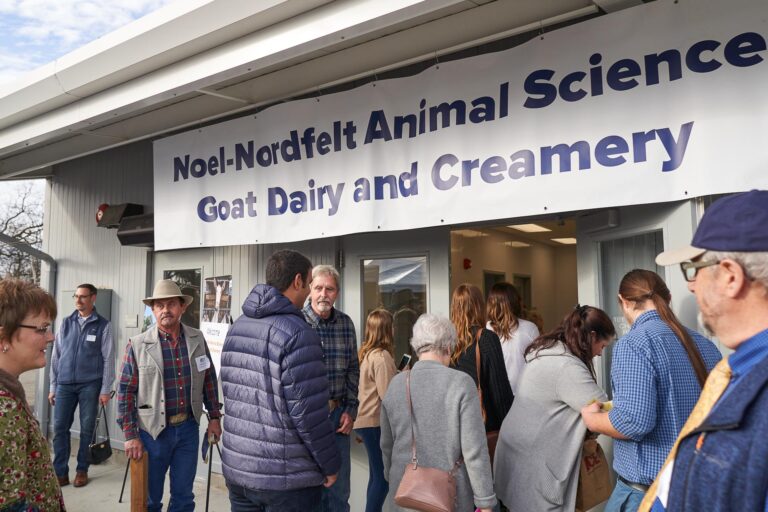
This January, the facility welcomed a brand new milking parlor and creamery, adding many new and exciting opportunities for students, researchers and the public. The Noel-Nordfelt Animal Science Goat Dairy and Creamery, approved and inspected by the California Department of Food and Agriculture (CFDA), provides the equipment necessary to milk, produce and sell Grade A goat cheese products. Although the facility is overseen by the Animal Sciences Department, educational opportunities will be available for animal science, food science and animal science and management majors.

When asked about the main goals for the new parlor, Dan Sehnert, the coordinator of all animal sciences facilities on campus, said, “Education, for sure.” 

“It’s an opportunity for UC Davis students to work in a modern and up-to-date milking parlor and also have the opportunity to process the milk and make cheese” Sehnert said.

The ANS 49 course, which Rupchis teaches, offers an overview of goat management — and it will now include a section dedicated to cheese-making. The new parlor and creamery can be incorporated into the existing course, expanding the breadth of goat management. 

Internships will be available to students who are eager to learn even more about the process of cheese-making. The department hopes to add quarterly internships focused on the cheese-making process. Students will be able to start in the milking parlor and follow the process to the cheese-making room where the aging and packaging process takes place. This internship will be in addition to the kidding internship offered in Spring Quarter, a chance for students to individually raise a goat.

For the general public, UC Extension seminars on cheese-making will be offered. The department hopes to offer these courses to anyone who wants to learn the full process of cheese-making.

 “One of the aspects of this facility will be outreach opportunities,” Sehnert said. “We are thinking, several times throughout the year, [of] having cheese-making workshops for the public and students and bringing in specialists to offer that chance to learn about cheese-making.”

With all this cheese being produced, we can expect to see the cheese being offered at the meat lab and on-campus dining services. The meat lab is where meat and eggs produced at animal science facilities are currently being sold. Due to certification from the CDFA, dairy products produced at the creamery can be sold and consumed.

“First thing we would really like to do is produce goat cheese,” Rupchis said. “Before now, any of the milk produced hasn’t been able to be used and now we can sell the cheese through the meat lab and campus dining services.”

Chevre will be the main cheese produced initially since it has the shortest aging period. The public will soon be able to purchase all the key necessities of an incredible breakfast at the meat lab, all locally produced by UC Davis. 

The facility is still in the early stages of functioning as more milking and processing licenses are required to produce certified cheese. The first batch of goats to be milked is set for spring as the goats will be birthing soon. Jim Murry, the chair of the animal sciences department, hopes to see the full facility in production mode and offering all these educational opportunities within a year. 

“We are thinking it will take a year to get up and running, but, by next fall, we hope to start making cheese,” Murry said.

It is an exciting time at the goat teaching and research facility. As a top-ranked university for animal science, the parlor and creamery will add to the excellent educational opportunities that exist for UC Davis students. The animal science department strives to offer as many hands-on learning experiences to their students as it can. 

“There are many educational opportunities at the new facility and that’s what we are all about,” Murry said.

Written by: Alma Meckler-Pacheco — science@theaggie.org

“High Fidelity” — Hulu’s original series sees Kravitz defeat heartbreak with music

A review of series’ ability to touch its audience 

The daughter of musician Lenny Kravitz and actor Lisa Bonet, Zöe Kravitz was born for her role in Hulu’s original series, “High Fidelity” — a remake of Nick Hornby’s 1995 novel. The ten-episode series, centered in a gentrified Brooklyn, is a play on the traditional heartbreak romantic comedy. The series first streamed on Feb. 14, as a little Valentine’s day revival for all the lonely hearts out there. 

Rob, the protagonist played by Kravitz, hunts down her heartbreakers on what she calls her top five heartbreak list — trying to figure out why she seems to be a ticking time bomb for love. Sound familiar? 

“High Fidelity” is a must-see for music junkies with an old soul. A musically-centered series, it emphasizes the late ‘80s, early ‘90s twang on modern pop-culture. The series takes millennials back to the time of obsolete delicacies: record players, mix tapes and an effort to quit smoking cigarettes.

After watching the series in a matter of two days (oops!), I gained a slight unhealthy obsession — which goes to show the effortless flow of the show itself. I got lost in Rob’s sob story of constant rejection and loneliness, yet she shows endurance as an independent woman. 

As someone who has endured a broken heart on more than one occasion, I can vouch that the series understands pain and speaks to the soul. I even began comparing myself to Rob’s character, mannerisms and experiences as I listened to classic oldies like Jimi Hendrix. 

Kravitz’s delivered as a relaxed, yet resilient woman who has a wound that keeps opening. Whether it be through heartbreak or in some other manner, everyone has pain they hold on to that seems to cling on like a shadow.

As for Rob, her shadow is her ex, Mac — No. 5 on her top five heartbreak list and her ex-fiancé. As to not spoil the series, Rob struggles with her former lover moving on with another woman, and another ring. Lilly, Mac’s new lover, tries to befriend Rob in an effort to lighten the already uncomfortable relationship of ex-lovers.

Everyone has a Lilly they cannot seem to shake — something (or someone) that brings piercing pain every time it crosses the mind. Rob endures that shadow every day, but learns how to live with that constant reminder of heartbreak alongside her two best friends and co-workers, Simon and Cherise.

Simon, Rob’s No. 3 on her top five heartbreak list, openly came out as gay while he and Rob were together. Simon’s sexuality is no secret, nor is Rob’s. She recalls her heartbreak No. 2 as Kat Monroe, a feisty social media influencer who left Rob for another woman.

As a quiet and a bit socially awkward character, Simon seems to only break out the comfortability of his shell when music is involved. As a musical genius, Simon is Rob’s right-hand-man when it comes to making her next playlist or needing a friend to lean on.

Simon gets his own spotlight, however, when he partakes in a stand-alone episode explaining his own top five heartbreak list. Here, the audience is able to understand Simon not only as Rob’s best friend, but as an individual.

Simon’s episode reveals that Rob is not the only person in the world who experiences pain, broadening the umbrella of experiences of heartbreak to a more diverse audience. As a gay character, Simon shares his own heartbreak — giving him autonomy as a supporting character.

As for Cherise, while she does not get the opportunity to explain her own top five heartbreak list through a stand-alone episode, it’s evident that her true love is her music. Constantly being rejected as an aspiring musical artist, Cherise’s goal is to be recognized as something more than a working black woman.

Everyone can relate to Cherise in terms of wanting to be seen as something more than what is outwardly presented. She embodies resilience, working up to her life’s goal despite being bogged down along the way. In the last episode, Cherise is heard as a musical artist for the first time in the series, as the sound of her new guitar and the soft of her voice echoes in the background.

Evident throughout the series, the producers of “High Fidelity” incorporate minorities as main foci in more ways than one. With Simon as an openly gay character and Rob as a queer, black, female owner of the record store (Championship Vinyl), the series embodies social activism.

Commending the producers for diversifying the series, I believe they did a decent job making these prevalent issues come naturally without playing the social justice card obnoxiously forward. Admittingly, it is hard to find that balance on such sensitive topics, the series gets a round of applause for its credibility and ability to address these matters. 

All in all, the show does a marvellous job of reaching a wide audience. Many of the pain that the characters endure can come in many forms that can relate to almost everyone. I certainly found peace in knowing that I am not the only one in a rut. And if Rob can get through it with music, I (and everyone else) can find my music too. 

Written by: Sierra Jimenez — arts@theaggie.org

Roger Casals earns 2020 Sloan Research Fellowship, NSF CAREER award

Geometry professor funded for further studies in Lagrangian fillings of Legendrian knots

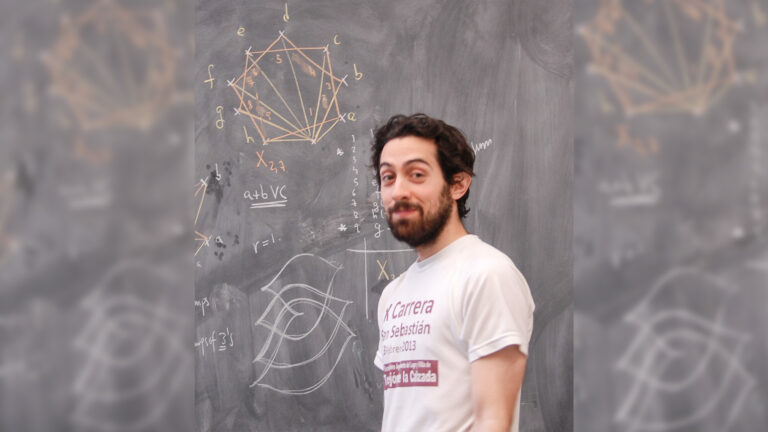
In the span of one month, Roger Casals Gutierrez, an assistant professor in the Department of Mathematics, won two prestigious awards: the 2020 Sloan Research Fellowship by the Alfred P. Sloan Foundation and a CAREER award from the National Science Foundation’s (NSF) Early Career Development Program. Out of the 20 Sloan Fellows named this year from UC campuses, Casals was the only professor from UC Davis.

Sloan Research Fellowships are awarded each year to 126 “outstanding young researchers in mathematics, chemistry, computer science, economics, computational and evolutionary molecular biology, neuroscience, ocean sciences or physics,” according to the UC Davis press release. Winners can spend their $75,000 earnings on any expense supportive of their research over a two-year period. The Sloan Research Fellowship website called these “early-career scholars” the “most promising scientific researchers working today” in the U.S. and Canada. 

CAREER awards support junior faculty who “perform outstanding research, are excellent educators and integrate outreach in their work,” according to the press release. Winners of CAREER awards earn $450,000 over the next five years as funding for themselves and also for undergraduate and graduate research, Casals said. 

Casals became a professor at UC Davis in July 2018. He earned his doctorate in geometry and topology, which is the study of geometric properties and spatial relations, from the Institute of Mathematical Sciences in Madrid, Spain. Prior to teaching at UC Davis, he worked at the Massachusetts Institute of Technology and the University College London. 

“[Davis] has been really great,” Casals said. “I really like it.”

Motohico Mulase, a professor in the department of mathematics, interviewed Casals when he was being considered for hire. Mulase said Casals’ achievements were impressive and he liked his positive demeanor. 

“[Casals’ hiring] is considered to be worthwhile and is far rewarded,” Mulase said. “He’s indeed changing the scope of UC Davis in the quality of research and happiness. As you see him, he is a happy person.”

Even at this early stage of Casals’ career, he has already been published in the top three mathematical journals: Journal of the American Mathematical Society, Inventiones Mathematicae and Princeton University’s Annals of Mathematics.

“[Casals’] publication record is kind of amazing, since he’s only a few years out of Ph.D.,” Mulase said. “Any professor would be happy to be published in one, but he’s in all three.”

Casals’ area of research is contact geometry, which involves the shapes created by rays of light as they bounce off objects, called caustics. Examples of caustics are the bright curved shape that appears in a coffee cup when light is reflected on it, the pattern of light bouncing off ocean waves or the path of a car reversing into a parking space. By connecting this work to other fields, Casals has made discoveries about caustics and developed new tools to describe them. 

As a professor, Casals teaches classes, researches and performs duties for the math department, but his recent awards will now give him the funding to focus more on the research component of his work, which is the goal of the fellowship. 

“The Sloan allows me to, for the next two years, tackle harder problems,” Casals said. “I’m going to be very ambitious and try these other projects because now I’ll have the time to invest.”

With this award, Casals can  travel to conferences, meet with collaborators and work with students on research. 

“Sometimes you’re trying to face a very hard problem, like a conjecture that’s been open for many years,” Casals said. “It’s required for you to work on it for like seven, eight hours a day for like a year, and if you have to teach a class, well that’s very important as well, but sometimes it does not really allow you to focus fully on that [research].”  

Abigail Thompson, a math professor and the chair of the Mathematics Department, said via email that this award will give Casals a lot of extra time for his major projects. 

“It’s a great boost at this early stage in his career,” Thompson said. “The Sloan award is an incredible honor — we’re very lucky to have been able to attract Roger to our department.” 

One of the projects Casals wants to work on is studying Lagrangian fillings of Legendrian knots. Like flying string in space, these knots are the boundaries of surfaces. This research is important for studying energy level sets of the earth, moon and sun and where probes or satellites could be sent. 

“[We] are going to learn the possible energy level sets and spaces in which these knots live and the surfaces [we] are trying to create are important in understanding the geometry,” Casals said.

Fifteen percent of Sloan Research Fellowship winners have been from UC campuses.  Casals said he “felt pretty good” to be chosen as a winner, but also thinks that winning involved being “in the right place at the right time” in his career. 

Despite his great achievements, Casals does not often talk about these accolades in class. Tonie Scroggins, a graduate student in the department of mathematics and student in Casals’ topology class, said Casals is very humble. Casals does, however, talk about his research and what he teaches in seminars. 

“[Casals] is almost always working,” Scroggins said.

Casals has a great passion for mathematics and teaching, which clearly shows in his lectures, said Sienna Mengjia Yang, a fourth-year mathematics major currently in Casals’ euclidean geometry class, via email. 

“Taking his class is like watching a great Shakespeare opera,” Yang said. “You get to watch a great performance and enjoy the beauty of math. It is always great to see how his mind works and approaches different problems.”

Casals makes himself very available to help students fully understand the material. Yang said he is caring, understanding and patient. Shanon Rubin, a graduate student in the department of mathematics and student in Casals’ topology class, said it is important that Casals makes himself so available for students since his classes are challenging and demanding. 

“[Casals] expected a lot from the whole class,” Rubin said. “But, the harder he makes his class, the more he has to be in his office with the door open waiting for people to ask questions.” 

Rubin also noted that while homework assignments can be time-consuming and hard, Casals accommodates.

“It’s not a complaint, it’s just a fact,” Rubin said. “He makes it work, though, and balances it. If we need more time on something or less problems on the next homework, he’ll give it to us. It’s really demanding but at least he’s surprisingly very available.”

Since Rubin is a TA for Casals’ euclidean geometry class, he spends a lot of one-on-one time with him. At their weekly meetings, Casals briefs Rubin on what he should teach in the section, but also likes to talk about the advanced classes Rubin takes. Casals likes to tie in topics from those classes to show how they all relate, Rubin said.

“[Casals] definitely brings in the big picture,” Rubin said. 

Scroggins said she appreciates Casals’ enthusiasm for teaching and the jokes he makes in class. He recently compared toruses, which are donut-like shapes in geometry, to ice cream cones and joked about how many knots he has drawn in his work. 

“He [teaches] with a smile,” Scroggins said. “He said that there hasn’t been a day in the last seven years that he hasn’t drawn a knot.”

Written by: Margo Rosenbaum — science@theaggie.org

How climate change will impact Sacramento

Yearly increases in average temperatures pose dangers to public health 

The effects of climate change can be seen around the world. But events, such as the fires raging in Australia and the Amazon rainforest and the loss of sea ice in the arctic, while impactful, do not directly affect individuals outside of the regions. This makes it difficult to contextualize how climate change will impact us. 

A comprehensive regional report on the Sacramento Valley clearly defines the changes we can expect to see while providing adaptation measures. The report is authored almost entirely by UC Davis researchers and professors as part of California’s fourth climate change assessment report. Information from various sectors is gathered to create a clear and concise review that addresses the most pressing climate impacts on Sacramento and the surrounding areas. 

Climate change is expected to increase the average temperatures in the region by 2.7 to 10.8 degrees Farenheit between the months of July and September. In addition to higher summer temperatures, heatwaves are expected to be more frequent and intense. Heatwaves are predicted to have both higher daytime and nighttime temperatures along with fewer cooling degree days, which are crucial during these periods of intense heat. 

In the water system, the greatest threat will be from droughts. As temperatures get hotter and weather extremes occur more often, the Sacramento Valley will be faced with the long term dangers of droughts. The water supply will be further weakened due to increases in population size. As Sacramento continues to grow and the water supply becomes unpredictable, the need for potable water will rise.  

“When you have population growth in any part of the state, that puts stress on water resources and is an underlying exacerbator,” said Hannah Safford, a researcher for the policy institute for energy, environment and the economy.

The impacts of these changes to the Sacramento Valley will be profound and felt across a wide range of sectors. When looking specifically at public health, many people are at risk. A higher number of extremely hot days will result in more frequent heat-related stress, illness and human mortality. 

Additionally, higher temperatures increase the rate of ground level ozone formation, a pollutant that poses many health risks when exposed to it. Once formed, ozone often stays in Sacramento due to the geography of the valley. 

 “The main air pollutant that causes harm to health is ozone and as temperature goes up the rate of ozone increases,” said Colin Murphy, a deputy director of the policy institute for energy, environment and the economy. “The central valley has the worst ozone and other types of air pollutants.”

The danger posed to public health will disproportionately affect already disadvantaged communities who lack access to crucial health care. The residential locations of lower-income communities often have higher rates of pollutants in the air, further putting these communities at a higher risk than those in affluent areas.

“Ozone tends to be a regional pollutant but the other pollutants such as particulates are at a much more local level and there is strong correlation between where the particulates are and disadvantaged communities,” Murphy said. 

Another major issue affecting disadvantaged urban areas are urban heat islands. These “islands” are areas with very few trees, little shade and buildings with surfaces that increase temperatures through absorbing heat and releasing it into the air. As temperatures increase in Sacramento due to climate change, temperatures in urban heat islands will rise even more. 

The threats to public health are also more significant in urban heat islands as the heat is inescapable. Urban heat islands can result in summer temperatures up to 7 degrees Fahrenheit warmer than the regional average, according to the regional report. Additionally, the islands retain these high temperatures into the night, which poses dangers to residents without air conditioning as there are no periods in the day with a cooling effect. 

Action is already underway to reduce urban heat islands through the Sacramento Tree Foundation. One of the foundations main programs, NeighborWood, works to address inequity through planting more trees and increasing green spaces in urban heat islands. 

“NeighborWoods goes into communities that have been historically not as well canopied as other neighborhoods,” said Jordan Cherry, the Sacramento Shade coordinator. “They don’t have the same old growth urban tree canopy that provides so much benefit.” 

Another branch of the foundation, the Sacramento Shade Program gives 10 free trees to any customers of the Sacramento Municipal Utility District. This program serves to bring more trees to Sacramento, which will not only reduce temperatures but also sequester carbon. 

In terms of drought prevention, Safford hopes to see a future where recycling and reusing water becomes the norm. As a more cost-effective way to obtain water than desalination, it can become an extremely beneficial technology for California to implement.

“If you can increase the amount of water you are recycling and reusing that would supply a lot more people with clean potable water,” Safford said. 

As groundwater reserves become spares and the amount of water from precipitation becomes highly variable, obtaining water through a dependable mechanism is crucial. With policy that promotes and advocates for recycling and reusing water, California can become more resistant to the threats posed to the water system. 

Climate change will also put stress on all sectors of society and the economy. Effective policies that work to reduce carbon emissions and make California greener are already underway, yet they will not stop the broader issue of climate change. Although it may seem like a never-ending problem, Safford reminds us that when the alternative is to do nothing, any action is extremely needed and beneficial. 

“You are left with two choices; you can try and do whatever you can or you can not,” said Safford. “But when the alternative is to just give up and not try at all, you must just try whatever possible.”

Written by: Alma Meckler-Pacheco — science@theaggie.org

UC Davis suspends remaining sports schedule

Athletics department makes decision in light of COVID-19

The UC Davis Department of Intercollegiate Athletics announced on Thursday that it would be suspending all remaining Winter Quarter and Spring Quarter competition, effective immediately, according to a press release. 

The decision “was made in the interest of the health and safety of our student-athletes, coaches and staff, administrators and fans,” per the release, and comes in the wake of the ongoing spread of the COVID-19 novel coronavirus.

Although the release states that the decision was made in conjunction with a similar announcement by the Big West Conference, the suspension applies to teams “of all conference affiliations, and includes out-of-season activity such as spring practice seasons for fall sports.” Sixteen of the 23 UC Davis athletics programs are members of the Big West Conference. 

The suspension was issued just hours after Big West officials announced that both the conference’s men’s and women’s basketball tournaments had been canceled. The two opening round games of the women’s tournament were played on Wednesday without spectators, and the men’s tournament was set to begin at noon on Thursday. 

The suspension also comes several days after the UC Davis administration elected to cancel all in-person final exams. As of Thursday, Yolo County is one of seven California counties to have a confirmed case of the novel coronavirus spread through community transmission, according to the California Department of Public Health. 

There was no indication in the release on when or if any or all athletic events would resume.

Written by: Dominic Faria — sports@theaggie.org


Center for Neuroscience cancels NeuroFest 2020 due to rising concerns of coronavirus

Free program rescheduled to March 13, 2021

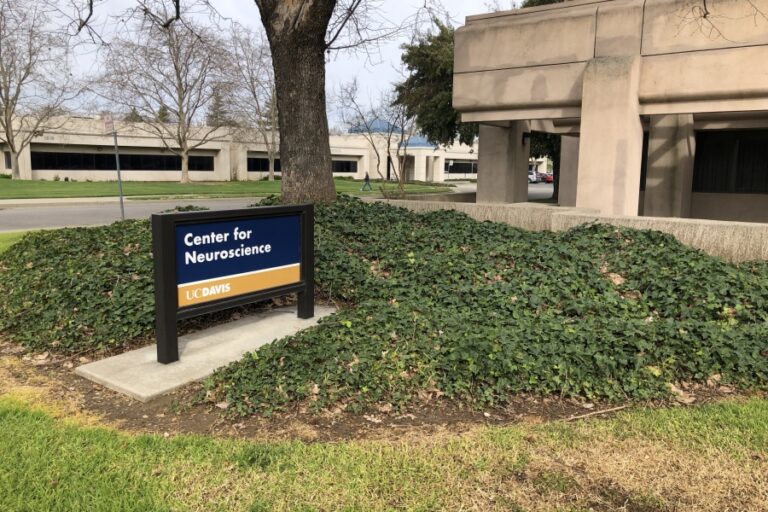
The Center for Neuroscience was set to hold their sixth annual NeuroFest on March 14 yet due to increasing concerns over the novel coronavirus (COVID-19), the center has decided to cancel the program.

“Due to the fluidity of the situation and in accordance with health guidance from the CDC, WHO and other health authorities, as well as input from UC Davis leadership, we have decided to cancel NeuroFest,” said Kimberley McAllister, director of the Center for Neuroscience, via email to those that RSVP’d to the event. 

In response to COVID-19, UC Davis administration advised “maximum flexibility” and has not mandated cancellation of in-person classes or any on-campus events. But the risk of further spreading the virus prompted the cancellation of NeuroFest.

The free program “Healthy Brain, Healthy Mind: Progress in Mental Health Research” was planned for families, students and local community members to learn about exciting mental health research and engage in brain stimulating activities.

“The whole goal of this event is to be accessible and have neuroscience research be accessible to the community,” said Carlos Carrasco, a graduate student in the neuroscience graduate group, when the event was still planned for Saturday. “We want them to be aware of the cool science happening at UC Davis and have them learn something new.”

Under the guidance of Diasynou Fioravante, the assistant professor for the Center of Neuroscience, the neuroscience graduate group was the real powerhouse behind planning the event. The graduate students had selected mental health as this year’s theme after considering what the public would benefit most from. This same theme will hold for next year’s Neurofest. 

“Mental health is always a great topic to discuss but for this year there was an increase in the number of undergraduate students and people in the community seeking out mental health advice, and I thought this is something we need to address,” Fioravante said. 

Four UC Davis faculty members and three graduate students, all from the neuroscience graduate group, planned to present their mental health research at this event. David Olson, an assistant professor in the department of chemistry, was set to speak on the innovative ways that psychedelic drugs can become a powerful cure for many mental illnesses. Randy O’Reilly, a professor in the department of psychology and computer science, planned on presenting his research on schizophrenia’s effect on decision-making skills.

Along with the planned presentations, more than a dozen interactive booths were going to be offered. The booths ranged from debunking common myths about the brain to being able to touch real brains from a variety of species. 

“All the booths are under the guise of mental health,” Carrasco said. “We will have information about keeping good mental health and will give insight into what we are learning and the treatments we have been finding.”

NeuroFest also planned on having a dark room with neuroscience-related activities that took advantage of the lack of light. For families with children, the kids room with booths would have catered to a younger crowd. 

 “We want to open the idea up to children that science is accessible and not so isolated from them,” Carrasco said. 

One of NeuroFest’s main goals is to open the communication between research occuring at UC Davis and the general public. As a majority of neuroscience research is funded by taxpayer money, NeuroFest wants to showcase the progress that those funds have helped create.

“At the end of the day, the funding is coming from the taxpayer and we want to give back to the community that supports us,” Carrasco said.

Additionally, NeuroFest gives researchers at UC Davis the ability to present their findings directly to the public, opening communication between the two communities. 

“Scientific communication is a critical line for scientific research and it benefits both the public and the scientific community,” said Sarah Warren Gooding, a doctoral candidate in the neuroscience program and member of the neuroscience graduate group.

Despite Neurofest’s cancellation for this year, the same research and presentations can be found at next year’s event. The Center for Neuroscience plans on holding the postponed NeuroFest on March 13, 2021. 

Written by: Alma Meckler-Pacheco — science@theaggie.org

The Editorial Board chooses women to celebrate

In honor of International Women’s Month, each member acknowledges the impactful women in their lives

Kaelyn Tuermer Lee, Editor-in-Chief

Emelia BensonMeyer has been my best friend since I first moved to Humboldt in seventh grade. We’ve been through a lot together, including a traumatic car crash, and she’s the first person I call when I have good or bad news. Through ups and downs, I know she’s always there for me.

Hannah Holzer, Managing Editor

My friendship with Maya Robnett precedes consciousness (our moms were friends while they were pregnant). Living across the street from one another, Maya and I were joined at the hip. So when she and her family moved, I was crushed. This past summer, seven years later, Maya and I lived just a Metro ride away from one another, and it was as if not a single day had gone by.

Kenton Goldsby, Campus News Editor

Professor Naomi Janowitz completely changed the course of my college career. I had heard great things about her, so I was excited to take her RST 1G class as a GE. Then, I never imagined that I would now be a religious studies major, all thanks to her encouragement. Thank you, Professor Janowitz, for always supporting me — especially through some of the hardest moments of my life.

Stella Tran, City News Editor

Christine Sin, one of my best friends, is a force to be reckoned with. She is by far the strongest woman I know, and she has a heart of gold. I would never say this to her face, as we always tease each other, but she has helped me so much during my toughest times — I will always be grateful for her.

Hanadi Jordan, Opinion Editor

In 2005, Febe Villarete moved into my home in Qatar and sacrificed her 20s to support her family while helping raise and take care of mine. She is my sister, my mother and the living embodiment of boundless kindness. She wasn’t born into my family, but she is forever part of it. 

Claire Dodd, Features Editor

I’ll never forget the day I met my best friend, Olivia Chandler — I was new to my elementary school and she asked if I wanted to color with her in the hallway after school, offering up her brand new pink colored pencils to me as an incentive. She’s always been my biggest supporter and no matter where we live, I know we’ll forever be a part of each others’ lives. 

Liz Jacobson, Arts & Culture Editor

There is one word to describe my friendship with the one and only Mathilda Silverstein — bashert (Yiddish for soulmate). Along with this word, Mathilda has taught me so much about life and about myself. I couldn’t imagine sharing a shoebox-sized apartment and a majestic, grumpy old cat with anyone else!

Dominic Faria, Sports Editor

Former Aggie Managing Editor Olivia Rockeman is one of the most inspiring people in my life and I am incredibly humbled to call her my friend. Not only is Olivia one of the most intelligent, motivated and badass people on this planet, she is also generous and selfless in everything she does. I can’t wait until she rules the world one day! 

Cecilia Morales, Science Editor

Out of all the incredibly strong and truly inspiring womxn in my life, Atalie Nguyen has been the most iridescent anchor in a chaotic sea lately. She radiates pure realness, humility (despite so much to celebrate) and a deep kindness (it’s almost #TOO #MUCH !). She makes me laugh to no end. Her ability to not only understand others but put them before herself is insanely remarkable. Atalie is a comforting home in a very ugly world.

Written by: The Editorial Board

The California Aggie first undergraduate UC newspaper to digitize entire collection

Digital archive, dating back to 1915, now available through California Digital Newspaper Collection

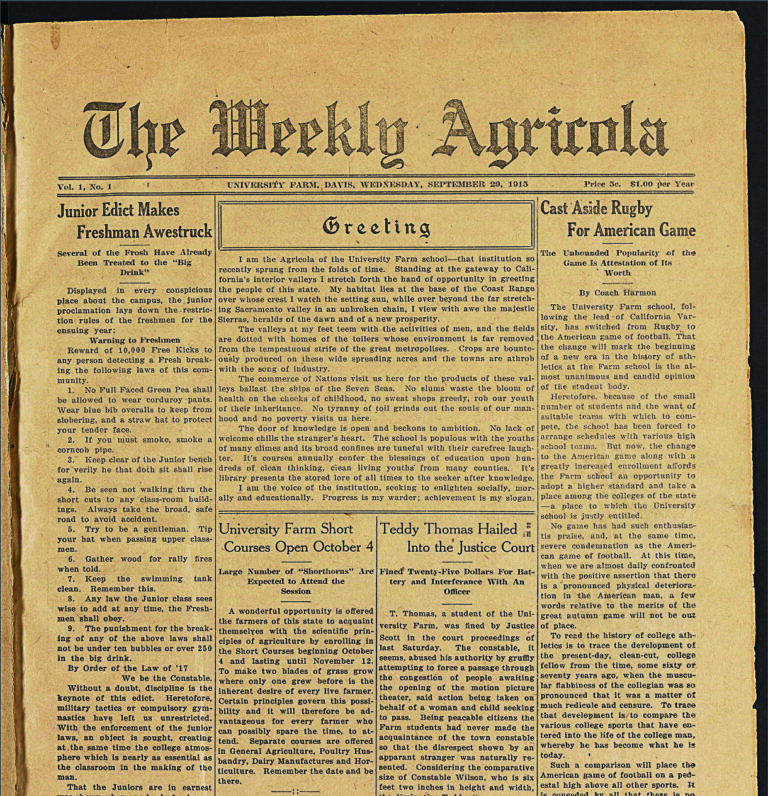
The California Aggie, formerly known as The Weekly Agricola, is the first undergraduate UC newspaper to digitize its entire historical collection. The California Digital Newspaper Collection (CDNC) — the online home of many historical editions of California-based periodicals — now showcases 5,410 issues of The Aggie. These issues date all the way back to the first issue of The Weekly Agricola on Sept. 29, 1915. The collection is broken down by year and month, has a keyword-search function and is available for download.

The idea of digitizing The Aggie was first brought up in October of 2016 by then Editor-in-Chief Scott Dresser, who worked at The Aggie from 2013–16 and served as the editor-in-chief for two years. Dresser met with Kevin Miller, the interim head of Special Collections and the university archivist for UC Davis at the Archives & Institutional Assets Program, to discuss digitizing the microfilm archives of The Aggie.

“I used to spend hours in the newsroom looking through our old bound archives, and I thought that these archives should be accessible to everyone,” Dresser said via email. “I think The Aggie is the most comprehensive piece of historical literature that exists for the university and the city of Davis.”

The Aggie and the UC Davis Library began outreach to former editors and UC Davis alumni for the digitization project, fundraising to support the effort. They attended UC Davis basketball games and other alumni events to gain support and raise funds. The project was fully funded by May of 2018, with the main funds coming from an anonymous, private donor who was a UC Davis alumni and a former reporter for The Aggie.

Brian Geiger, who worked on The Aggie’s digitization, is the director of the Center for Bibliographical Studies and Research at UC Riverside. He has been digitizing newspapers for over 10 years, partnering with a number of local projects throughout the state.

“[The Aggie is] digitizing the entire run for 1915 to 2014 — 79,000 pages,” Geiger said. “We’ve received about three-fourths of the pages from DVD. We had some hardware failures at the end of last year, and DVD couldn’t log in or work on their machines, so we sent all of your images to Laos, and they’ve been working on them there.”

One of the main differences in the digitization of The Aggie through the CDNC, however, was that the UC Davis Library handled the first part of the process, which included scanning the archived print newspapers.

“It’s been great working with the library, and it’s been a great project,” Geiger said. “There’s been talk about trying to do a UC-wide project like this, but in my experience, high school and college papers are not well preserved. It’s important to preserve them before they deteriorate.”

The digitization of The Aggie will enable UC Davis alumni, former members of The Aggie and other community members from the city of Davis and beyond to access old editions and see how the print newspaper has evolved over time.

“It kind of blows the paper wide open in terms of access,” Miller said. “It’s something the library has been really excited about. It’ll help us with our own reference questions. When somebody comes to us with a question about regional history, The California Aggie is the first place people will go.”

Jessica Nusbaum, the director of communications and marketing for the UC Davis Library, echoed this sentiment, reiterating the importance of The Aggie in terms of documenting the history of the university and the city.

“I think this has been a really lovely partnership between the library and The Aggie over the last couple of years,” Nusbaum said. “We sort of jointly hold the roles of being the storytellers of the university. As the student newspaper, The Aggie tells the stories of the university as it happens. It opens up the ability to see […] the stories of the former Aggie journalists.”

The UC Davis Library is trying to push engagement to undergraduate students, according to Miller.

“Most students won’t make the effort on a term paper to the library and figure out how to work the microfilm or request the print copy from 1982,” Miller said. “It really opens up The Aggie to historical research that it hadn’t before, so I think it’s going to make a huge difference.”

Dresser explained how the digitization of The Aggie will also enable former journalists and staff members to see their long-ago published work online, as well as see how Davis has changed over the past century.

“Having the history of Davis chronicled by the students who lived the events themselves is really interesting and insightful, and bringing these Aggie archives online allows researchers, students (both current and former) and anyone else interested to gain this unique insight into life in Davis across the last century,” Dresser said. “I also wanted former Aggie staffers to be able to find stories they wrote or photos they took 30 or 40 years ago and have the opportunity to show their families and friends what they had spent countless hours working on in college. I think this archive will be a great way to engage with alumni of both the school and The Aggie itself.”

Written by: Kaelyn Tuermer-Lee — campus@theaggie.org

Managing Editor Hannah Holzer also assisted with the reporting of this story.


Celebrating Pokemon’s 23rd Birthday

Over two decades, 807 Pokémon later, Pocket Monster franchise still holds a special place in hearts of millions across globe

Just home from preschool, alongside an overall-clad gang of toddlers, I took to digging a hole in my family’s backyard. With shovels in hand and determination in our hearts, we went to work — strewing weeds and tulips all over my mother’s manicured lawn. Were we headed to the center of the earth? No, we aspired to greater heights. This hole was to be our portal into the Kanto region — the land where our friends Pikachu, Squirtle and Charizard awaited us. To the delight of my toothless compatriots and to the dismay of my mother, we dug with the vigor of a herd of Dugtrios to escape the confines of our suburban neighborhood and discover our true calling as Pokemon Masters. 

This was only one of countless childhood memories linked to the world of Pocket Monsters. In fact, I owe my own literacy to Pokemon. While collecting countless booklets of the Trading Cards, I picked up Pokemon speak — replacing words like “medicine” and “sunlight” in casual conversation with “Hyper Potion” and “Solarbeam.” To this day, I still get immense pleasure from the satisfying click of capturing a legendary on the billionth Pokeball or watching Jesse, James and Meowth of Team Rocket blast into oblivion. 

  This past week, on Feb. 27, my beloved franchise celebrated “Pokemon Day” in honor of its 23rd anniversary. Pokemon trainers across the globe participated in “raids” through Pokemon GO, the iOS gaming app, to catch limited-release Pokemon legends like Mewtwo. Over two decades after the initial release of Nintendo’s classic video games Pokemon Red and Blue, Pokemon’s success has only continued to skyrocket. This can be attributed, in part, to the community aspect of Pokemon, which has attracted all sorts of people across the spectrum. From preschoolers to elderly to nerds to jocks, Pokemon does not discriminate. In honor of the series’ anniversary, I sat down with fellow Pokemon trainers to reflect on their relationship with the franchise. 

People come to Pokemon in odd and mysterious ways, and for Harris Terovic, a diehard Lucario fan and a third-year neurology, physiology and biology major, his love affair began in the hospital.

“My love started with the TV show,” Harris said. “When I was in kindergarten, my mom sterilized a lot of my stuff, so I wasn’t used to bacteria from the outside world. I had a pretty weak immune system and ended up in the children’s hospital for a cool weekend. I remember they had a vast collection of Pokemon cassettes, and I just sat in my hospital bed all day just watching Pokemon.”

On July 6, 2016, the date of Pokemon GO’s release, Terovic and his friends who shared a bond over the series reconvened in a mission to fill their Pokedex through the augmented reality gaming platform. By the end of the day, an additional 10 million people downloaded the app to live out their dream as Pokemon trainers. Now, four years later, the app has amassed a whopping billion downloads in the race to catch them all. Terovic reminisced on that fateful day when his childhood dream came true.

“I remember when [Pokemon GO] first came out, there was a Reddit post saying, the first few days of Pokemon GO was the closest we’ve been to world peace,” Terovic recalled. “My friends and I left at like 10 a.m. and didn’t come back until around 8 p.m.”

Gyassi Pigopt, a proud Charizard father and recent graduate of Alameda Community College, had the opportunity to visit Pokemon World in 2016, a gathering of over 9,000 Pokemon players — the largest at the time — in San Francisco, where he witnessed the full breadth of the Pokemon community.

“It was so amazing to see so many people from so many cultures gather together in one spot all over a game,” Pigopt said. “It really transcends all social boundaries. It doesn’t matter who you are, it doesn’t matter where you are from. Just the fact that you can get into Pokemon and love Pokemon and that community.” 

When it comes to Pokemon, love truly knows no boundaries. Pigopt also touched on the unique enduring power of the franchise that lasts well into adulthood.

“I play with full grown adults who have nine-to-five jobs and a family with kids who can still take these themes from Pokemon and apply them to their lives,” Pigopt said. “They still have that care about the series, and I don’t think you can really get it anywhere else.”

The community of Pokemon devotees is extensive, with fans covering the globe — from Japan to Australia. Through the video game platform discord, Terovic has found fellow Pokemon trainers right here in Davis who gather to participate in special raids and proudly don their personal collections.   

“I see the way they communicate with each other,” Terovic said. “They’re smiling, and it’s people of all ages, like our students and even staff just having a great time doing it. Some of them look like they could be professors.”

The deep attachment to the universe is cultivated through interactions with vastly different mediums of the Pokemon universe. For Melissa Thayer, a Celebi devotee and a third-year environmental science major, it was Pokemon Leafgreen for the Gameboy Advanced that originally piqued her interest. Although Thayer has grown out of the handheld video games, she can still find her own niche in the comprehensive reach of the Pokemon universe.

“I don’t think [Pokemon GO] could have taken off how it has if it hadn’t had those 15 years or so [to] build up merch, shows, movies, games,” Thayer said. “But I think it has an overarching reach for a lot of people. I don’t play the DS game so much anymore, but there is still a cornerstone that I can connect myself to.”

A transformative factor between Pokemon and other games is the autonomy to choose your own path within the game and develop lasting bonds between trainer and Pokemon. The TV show and videogames reinforce each other to add emotional complexity to what might initially seem to be just a handful of pixels. Pigopt discussed how this intimate relationship transcends time.

“You create these narratives in your head where you are going to take care of them for the next round,” Pigopt said. “In other games, you don’t necessarily have any of that companionship. Most of them are purely independent, where it’s you against the world. But with Pokemon, it’s you and your Pokemon against the world.”

Hardcore Pokemon fans have become so engrossed by series that they find themselves imagining ways to manifest their passion and harness the powers of Pokemon in everyday life. 

“I recently broke my lamp and sometimes my room gets dark, so I think to myself, ‘What if I had a Charmander just chilling here with me?,’” Terovic said. “As long as he doesnt light my room on fire, then we’re good!”

Pigopt also mentioned that Pokemon can be adopted for day-to-day use, whether it be riding a pidgeotto to work or working alongside them to remedy some of the man-made environmental mess.

“Pokemon is something I think about everyday,” Pigopt said. “Pokemon can be so convenient and enhance the quality of life. It’s kind of a stretch, but I’ve had the brief idea that Pokemon could help environmental issues as well, if you think about Pokemon like Grimer who get rid of trash, or Pokemon like Rayquaza who could help preserve the O-Zone.” 

The people at Nintendo have deftly crafted a world and outside community that grows with you. This rings true in my own experience — 22 years into my life, I still have not been able to shake my itch. Pokemon provided me with an escape in times of turmoil and a loyal hobby to build lasting friendships. As I’ve moved from dirt-laden-kid-on-the-blacktop to nostalgic adult, I’ve learned a Pokemon Master will always be able to confide in the comfort of their Pokemon. So on behalf of myself and hundreds of millions of others around the globe, all I can say is: Thank you, Pokemon.

Written by: Andrew Williams — arts@theaggie.org

Unpaid internships are a career barrier

Not everyone can afford to work for months without pay

I miss my childhood summers: playing in the front yard ‘til dusk, completing the exhausting “Just Dance 3” levels and staying up late during weekend-long sleepovers. These summers provided an escape from the trials and tribulations of pre-algebra and spelling tests. 

Summer in college is another story. Between going back home and seeing friends from high school, students’ summer plans are often tentative and depend on whether or not we get that coveted internship. 

Generally, these internships are valuable because they provide work experience in your desired career, which is hard to come by considering most fields only actually hire those who already have experience. It’s sort of an infinite loop of seeking experience through an internship while also needing experience to acquire it. It’s a trap that we often don’t realize we are in until we get to college. 

 Internships are synonymous with success for a young adult who hasn’t entered the workforce. Unpaid internships show that we’re noble enough to lend ourselves to our crafts without compensation. Once you’ve got one, you’re the talk of the town. Your mom is humble-bragging at the 4th of July barbecue about your passion and drive, and your LinkedIn profile gets a boost.

Did I mention that you aren’t getting paid at any point during this process?

I definitely sound like an entitled millennial or zoomer (who knows at this point), but I think it’s pretty ridiculous to expect notoriously broke college students to be okay with unpaid work. 

Unpaid internships are only viable for those who can afford not to work for two to three months out of the year. Due to the wealth gap, which continues to widen, the lack of paid internships makes it difficult to gain vital work experience and disproportionately impacts marginalized groups. 

 Expecting students to have the resources to support themselves without pay is ignorant of the socioeconomic barriers many students face. Many college students don’t have intergenerational wealth or the connections that are often needed to land an internship. 

Then there’s paid work. I’m talking about minimum wage jobs: Everything from filing papers to ice cream scooping. We often reserve these jobs for the school year and consider them a fallback for “failed” college students who didn’t get one of the sparkly internships.

Working has provided me with countless skills: customer service, time management and accountability, to name a few. The possibility of earning tips meant that I was constantly working with maximum effort.

Despite all these benefits, internships are the prevailing summertime interest among undergraduates. When I ask my friends about their summer plans, they always say how they’re seeking internships over employment. If the internship search doesn’t work out, then they’ll just have to work. 

 What’s even more frustrating is the way that summer jobs aren’t considered nearly as valuable as these internships in terms of the experience they provide. This is, in part, because of a belief that you would only be working somewhere and dedicating yourself solely for the paycheck. 

 If you want to be a doctor or a lawyer, it’s unlikely you’d want to brave the rigor of med or law school without the promise of a fat check at the end of the winding road. 

Sure, money is a definite benefit of working. I’d be lying if I said I didn’t do a happy dance every time I got a paycheck or an especially generous tip. Aside from braggadocious rap culture (see “Money Trees” by Kendrick Lamar), earning money has often been vilified and seen as a selfish practice. Hustle culture, however, is transforming this idea.

The argument of internships versus jobs is one that pits two versions of hustle culture against each other. Seeking internships is a long-form version of hustling — you’re hustling to secure a future for yourself. Paid jobs are a short-term hustle. Both are investments in the future, but the timelines are different. 

What if we equalized the two fields? We could get rid of unpaid internships altogether. I don’t see the reason why anyone should be deemed undeserving of compensation for their work merely because they lack prior experience.

Establishing an internship wage would also encourage those who previously couldn’t pursue internships to break into the field. It deepens the talent pool for companies, and who doesn’t want more young talent from which to choose? 

Bridging the wage gap is not a quick fix, but opening doors through internships would allow students to work toward a better future. 

Written by: Isabella Chuecos — ifchuecos@ucdavis.edu 

Disclaimer: The views and opinions expressed by individual columnists belong to the columnists alone and do not necessarily indicate the views and opinions held by The California Aggie

Police Logs

“Unknown electrocuting”

February 19

“2nd Street. Two subjects smoking marijuana on the steps.”

“Electric scooter laws.”

February 20

“Male heard groaning and touching furniture.”

February 21

“Carrying a bag drinking a open bottle of vodka.”

“Party complaint.”

February 22

“Subject refusing to get out of hot tub.” 

“Unknown electrocuting.”

“Male opened beer and drank it throughout the store.”

February 23

“Male subject was hit by vehicle after he chased after someone who stole beer from the residence.”

February 24

“Lost wallet while on bike ride.” 

February 25

“40 rounds of ammunition in vehicle to turn in.”

Cabins for youth aged 18-24 part of proposed plan to reduce homelessness in Sacramento

Five Point Homeless Plan includes safe parking program, motel conversion, sleeping cabins, tents

The Housing Authority of the City of Sacramento showcased a Five Point Homeless Plan on Oct. 22, 2019, as requested by the City Council of Sacramento on Sept. 24, 2019, according to a city council report released on Feb. 18, 2020. The Five Point Homeless Plan involved five different options designed to reduce homelessness in Sacramento: a safe parking program, scattered sites, motel conversion, permanent supportive housing and sleeping cabins or tents.

The sleeping cabins or tents will be implemented through the proposed Emergency Bridge Housing at Grove Program, which is intended to “provide emergency housing for unsheltered transitional age youth between the ages of 18-24 who may be referred through U.S. Department of Education’s Performance Partnership Pilots for Disconnected Youth (P3) Program.”

Tyrone Roderick Williams, the deputy executive director of the Sacramento Housing and Redevelopment Agency (SHRA), provided details about how the project was initiated. 

“This project came about as a result of responding to Governor Gavin Newsom’s 100-day challenge to make mayors across to come up with innovative solutions to deal with homeless [clashes],” Williams said.

There have been projects in the past that share the purpose of reducing homelessness in Sacramento, but the Emergency Bridge Housing at Grove Program is the first of its kind, according to Williams. 

As a result of the 100-day challenge, SHRA contacted a property owner in Sacramento who already had experience working with and helping individuals in the community. 

“The church, for over 30 years, has been reaching out to troubled youths and providing assistance for getting their lives back on track,” Williams said. “So, we thought, ‘Well, maybe if we reached out to Pastor Larry Joyner’ — who’s the Pastor of the St. Paul Church of God in Christ for Sacramento — ‘maybe we could come up with a project that we actually could launch within the 100 days.’”

After reaching out, Williams said Joyner was “very receptive.”

“He has […] vacant land adjacent to the church and even some space within the church that could be used for social services and other types of activities,” Williams said.

Stephen Watters, the executive director of First Step Communities, said this project “can make a real dent” on the number of homeless and unsheltered youth. 

The 24 cabins can house 48 people, according to the city council report. For further possible expansion in the future, there is enough land to create another 26 cabins, and, thus, an ability to house 80-100 youths with the goal of “transitioning them to permanent housing within six to 12 months,” according to the Sacramento city council report.

The process of building the cabins was gradual, Williams said. Before the project could be implemented fully, a request was put in to “establish a shelter crisis for the city,” which was done at the beginning of January. 

“We’ve been working night and day, literally — weekends and holidays — to establish what will be a […] community,” Williams said. 

Not only will the project provide housing for transitional aged youth, but it will also provide services for them. 

“The goal eventually is permanent housing,” Williams said. “But being able to offer a lot of different programs, like employment programs, educational programs, some life skills training — maybe some stress reduction type training — linkages to medical services and counseling and so on. I think we can make a real difference in some of the young lives.”

Additionally, through a partnership with a community college, some of the individuals staying in the cabins will be students who might not have stable housing, which is one of the unique parts of the project, according to Williams.

Such projects also can be adapted to different demographics in order to help reduce homelessness, Watters noted.

“It’s different than the idea of putting 100 or 200 people into a big dormitory,” Watters said. “It gives each person a community center and, yet, their own privacy and dignity at night.”

Although the project is not intended to be a permanent solution to reducing homelessness in Sacramento, it will still have a significant impact on the lives of unsheltered youth, according to Williams.

“We’re hopeful that over the next two years — because this is a two-year temporary shelter not envisioned at this time to be permanent — that we will be able to make a difference in the lives of community individuals who are 18-24,” Williams said. 

The Emergency Bridge Housing at Grove project will ultimately provide temporary housing in cabins for transitional aged youth in Sacramento, helping to provide them with stability and reduce homelessness. 

Written by: Shraddha Jhingan — city@theaggie.org

New honey bee research facility opens on campus

USDA-ARS research lab provides opportunities for improving pollination health

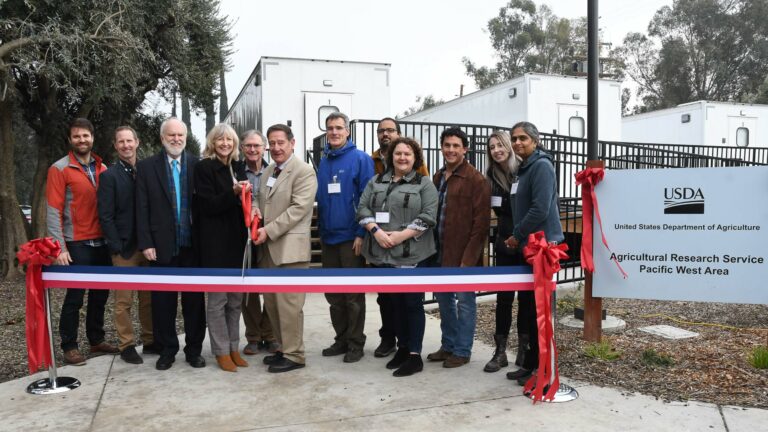
The newly established bee research facility of the U.S. Department of Agriculture’s Agricultural Research Service (USDA-ARS) opened its doors to the public on Jan. 7 at a ribbon-cutting ceremony. Speakers commemorating this progressive step ranged from the USDA’s Pacific West Area Director to a former president of the California State Beekeepers’ Association.

USDA-ARS and UC Davis have had a long-standing and mutually beneficial relationship, according to Anita Oberbauer, the associate dean of agricultural sciences. She said that having this lab on campus will allow students to become more involved in research and outreach activities.

“The lab presence allows a partnership between researchers of UC Davis and the USDA-ARS to enable more rapid progress on some of the pressing issues facing bees,” Oberbauer said.

Among the speakers was Julia Fine, one of the two recently hired research entomologists working for the Invasive Species and Pollinator Health Research Unit with the USDA-ARS.

“The purpose of the lab, broadly, is to study honey bees and to evaluate different stressors to honey bees and ways to ameliorate the stressors in an effort to help increase the longevity of honey bee colonies,” Fine said. “So, we will be investigating stressors to honey bee health as well as trying to identify tools, techniques and management practices that beekeepers and growers can use to help their operations.”

Arathi Seshadri, the other newly appointed research entomologist in the unit, said although there are USDA-ARS facilities working globally to alleviate the problems of honey bees and other pollinators, the essentiality of pollination within California posed the need for a facility within the state. 

“California […] is a place where pollination is extremely important,” Seshadri said. “We will be working with the local stakeholders, the beekeepers, the almond growers and all of these other communities to understand, ‘What is going on? What is the need? And how can we help meet these demands?’” 

Fine said she hopes to find solutions that support both growers and beekeepers in their work, as the two occupations work closely together. With an emphasis on studying the lethal effects of environmental stressors on honey bee health, she sees the need to identify ways to mitigate pesticide stress. Fine’s initial interest in honey bees stemmed from their distinctive qualities and social structure. Studying the field of toxicology allowed her to combine her interests and passions into her work. 

“Honey bees are incredibly potent as pollinators,” Fine said. “They pollinate so many of the different fruits, veggies and nuts that you consume and they’re very critical to ensuring that you have consistent access to nutritious food.” 

Similar to Fine, Seshadri found her work in pollinator health to be a natural progression from her past experiences. After discovering topics related to plant pollination and reproduction while studying evolutionary biology, Seshadri began to work on insect behavior and honey bees as part of her postdoctoral degree.

“Plants and bees have evolved together,” Seshadri said. “There have been a lot of instances of how they have modified themselves to fit the needs of the plants, and plants in turn have adaptations that benefit the bees. So, bringing these two together, looking at how they work together and how we can improve that connection, is kind of a natural fit for me.”

Although Seshadri said she believes that there has been an increasing understanding of the importance of pollinators, specifically honey bees, she would like to emphasize the need for expanded awareness of the growing human influence on natural habitats.

“We are taking away a lot of the resources that the natural animal populations need, and, so, one of the big challenges that honey bees and other pollinators are facing is lack of natural habitat,” Seshadri said.

Due to the increasing scarcity of natural habitats, honey bees lack diet diversity and nesting resources. As a result, Seshadri advocates for people to plant flowers or other plants that actually offer pollen and nectar — such as wild flowers — as some horticultural varieties do not offer these essential resources. She also stresses the importance of minimizing the use of agrochemicals and pesticides for both local people gardening in their backyards and farmers trying to maintain their crop.

Although the study mainly focuses on honey bees, Seshadri said she believes that these honey bees can work as a model to improve the health of other pollinators as well.

“Given that humans [belong to a single species] on this planet and yet are doing the most damage for the Earth, there may be ways in which we can actually do something to sustain the Earth the way it is by thinking a little broader, not just what humans like and what is beautiful in our eyes,” Seshadri said. “If we go beyond and look at the ecosystem and the other organisms that are in the ecosystem, that will really help.”

Written by: Michelle Wong — science@theaggie.org

In-person finals canceled at UC Davis

Finals to either be administered as alternative assignments, online examinations or eliminated altogether

UC Davis announced on Tuesday, March 10 that all in-person finals at UC Davis will be canceled due to concerns around the novel coronavirus and the disease it causes, COVID-19. Professors and instructors are being instructed to either create an alternative assignment or examination method, or they can cancel the final examination altogether and calculate a student’s grade based on already completed coursework.

“Alternatives that we described in our March 7 letter are all still viable options (e.g., substituting a take-home exam or other assignment for the announced final examination, or dropping the final exam altogether and grading students based on already completed work),” states the guidance published by UC Davis News and Media Relations. “For courses whose instructors decide not to avail themselves of one of these opportunities, the final examination must be conducted online.”

Also included in the university’s announcement that in-person final examinations will be canceled was other guidance surrounding the novel coronavirus. 

While UC Davis continues to allow instructors, at their discretion, to hold classes through the end of this week, other California higher-education institutions have canceled in-person instruction. At UC Berkeley, in-person classes are canceled for five weeks; at UC Santa Cruz, in-person classes are canceled effective March 11 and, at UC San Diego, all Spring Quarter 2020 courses will be online.

Under the new guidance, the UC Davis is “strongly encouraging faculty to go online with their teaching,” for the remainder of this quarter.

Additionally, the ASUCD Executive Office — in a joint statement from President Justin Hurst, Vice President Shreya Deshpande, External Affairs Vice President Adam Hatefi, President-elect Kyle Krueger and Vice President-elect Akhila Kandaswamy — urged the UC Davis administration to “transition all lectures and discussions to an online platform.” The officers also asked “that the university cancel all in-person finals and […] transition to take-home final projects, online examinations, or an equivalent assignment.”

Staff and faculty are now encouraged to use existing paid leave time if they are unable to work due to their own illness, a family member’s illness with the novel coronavirus or if their child’s school or daycare is closed because of the virus. Those without paid time available will be given up to 14-days worth of paid administrative time off. Those who are normally unable to accrue time off will still be eligible for the 14 days of paid administrative leave.

UC Davis had reaffirmed its commitment to letting staff and faculty work remotely, especially in the wake of COVID-19.

All nonessential travel — either domestic or international and either personal or on university business — is now strongly discouraged. Existing prohibitions on international travel to countries heavily affected by the novel coronavirus — China, Iran, Italy, Japan and South Korea — remain in effect. 

Finally, the university issued guidance on public gatherings, asking that all events with over 150 planned attendees, organized by either academic or administrative units and taking place between March 12 and 31 be canceled or postponed. Exemptions to this requirement include intercollegiate athletic events, which follow NCAA rules, and events at the Mondavi Center for the Performing Arts. Events at the Mondavi will go on as planned, and those who do not attend events due to the outbreak of the novel coronavirus will receive refunds.

Written by: Kenton Goldsby — campus@theaggie.org