55.4 F
Davis

Davis, California

Monday, December 22, 2025
Home Blog Page 358

UC San Diego announces all Spring Quarter classes will be online, UC Berkeley suspends in-person instruction citing coronavirus concerns

UC Davis’ operational status remains unchanged, university advises “maximum flexibility”

UC Davis officials announced on Saturday, March 7, that the university is advising “maximum flexibility” regarding instruction for the remainder of the quarter due to concerns regarding the coronavirus. The operational status of the university remains unchanged. In an online message explaining the decision, university officials said there are no confirmed cases of coronavirus disease 2019 (COVID-19) on the UC Davis campus, although they acknowledged that there is a confirmed case of the virus in Yolo County.

“Effective immediately, for the balance of Winter Quarter, instructors can move part or all of their remaining course content online,” reads the online message, signed by top UC Davis officials, including Chancellor Gary May. 

Other UC campuses, however, have recently made more drastic decisions to mitigate the spread of the coronavirus. UC San Diego officials announced on Monday that all of the university’s Spring Quarter classes will be held remotely via online access. At UC Berkeley, all in-person classes have been canceled until March 29. Neither UCSD nor UC Berkeley have reported any cases of the virus on their campus; however, the first case of COVID-19 in Berkeley was reported on March 3 and the first case of COVID-19 in San Diego County was reported on Monday. 

With over 100 countries reporting cases of the coronavirus and an estimated 110,000 people affected by the virus, the World Health Organization (WHO) is reportedly nearly ready to declare the coronavirus outbreak a “pandemic.” The word, however, strictly indicates the global spread of the disease, with the WHO’s director general reportedly saying, “We are not at the mercy of this virus.”

COVID-19 was first detected in Wuhan, China, and experts have classified it as zoonotic, meaning it is spread by contact between people and animals — this specific strain is thought to have been contracted through human contact with bats. Now spread from person-to-person contact, a complete understanding of COVID-19, a respiratory illness, is not fully known.

“Reported illnesses have ranged from very mild (including some with no reported symptoms) to severe, including illness resulting in death,” the Centers for Disease Control and Prevention reported. “While information so far suggests that most COVID-19 illness is mild, a report out of China suggests serious illness occurs in 16% of cases.”

Older individuals and individuals with health conditions such as heart disease, lung disease and diabetes are at a higher risk of developing a more serious form of the illness, according to the CDC.

As universities across the globe make internal decisions in an effort to mitigate the spread of the disease, UC Davis officials emphasize the importance of preventive care: Wash your hands frequently with soap and water for a minimum of 20 seconds; avoid touching your face; clean and disinfect frequently touched objects; stay home if you are sick and avoid close contact with people who are sick and cover all your coughs and sneezes with a tissue.
Written by: Hannah Holzer — campus@theaggie.org


UC Davis researchers publish comprehensive study on female millipede reproductive structures

3D modeling of millipedes reveals complex mating strategies

Scientists have finally uncovered the birds and the bees of millipedes. Millipede mating is a poorly understood topic in entomology, but a recent collaboration between UC Davis  entomologists and the Field Museum of Natural History in Chicago reveals the intricate anatomy of millipedes.

Millipedes are an incredibly ancient group of arthropods, potentially among the first terrestrial animals in the fossil record. There are more than 12,000 species described so far and likely double that number exists but has not yet been discovered. Despite the long history of millipedes on Earth, there is still much to uncover about millipede diversity. 

In current millepede research, most studies about mating and reproduction focus on the male side of the equation. Male millipedes begin life without any reproductive structures, but, as they molt, one pair of legs is absorbed into the body and later emerges as reproductive structures called gonopods. This incredibly complex procedure is fascinating to researchers because it is easy to observe, but this means not as much research has been conducted on female millipedes. 

“Genitalic structures tend to be species-specific,” said Jason Bond, a professor of entomology in the department of entomology and nematology. “There’s a broader evolutionary question about how those structures evolved, why some millipedes have really complex genitalic structures and how genitalic structures fit together.” 

To answer these questions, researchers used an imaging technology called micro-CT, similar to a CT scan of the brain. Micro-CT scanning is essentially a 3D X-ray. The millipede is rotated in a chamber while the scanner takes a series of 2D images. Then, a computer program compiles many cross-sectional images into a 3D model, all without harming the millipede. 

“The computer program looks like a coloring book,” said Xavier Zahnle, a graduate student in the department of entomology and nematology. “You go layer by layer and fill in the areas you’re interested in. That’s how the computer knows to use those areas in the 3D image.”

After scanning the millipede, researchers made models of the reproductive organs they were interested in. Inside a single scan of a female millipede, the program can detect and distinguish parts of the body segments, legs and even individual glands within its organs. This technology makes it much easier to conduct in-depth studies of extremely tiny bug bodies.

“Twenty-five or 30 years ago, the only way to get this detailed information would have been to embed the specimen in wax and take slices through it,” Bond said. “Micro-CT essentially does that without damaging the specimen.”

Using micro-CT scanning, researchers constructed models and animations of millipede mating. They show each individual muscle, organ and exoskeleton segment moving together to reveal the mechanics of mating. These models answered questions about how millipedes accomplish their life cycle and, specifically, how females use different parts of their bodies to store sperm and eggs.

Researchers are able to see the structure of each organ and muscle through 3D modeling and hypothesize their possible functions. They found that a female millipede will invert her reproductive structures and push them out of the body to mate. She can then store sperm in structures called spermathecae, which are chambers separate from her eggs. 

“Essentially, she checks off the requirement of ‘get sperm’ and saves it for later,” said Zahnle. “That allows her to wait it out until conditions are good. Then, she can lay her eggs and fertilize them externally.”

This strategy makes ecological sense according to a principle called differential investment. Egg cells are very large and require a lot of energy investment from the female, while sperm cells are small and are less energy-intensive to make. 

“There’s a saying about that: eggs are expensive and sperm is cheap, in terms of how much energy each sex invests in making them,” Bond said. 

Since females invest more energy into developing their eggs, they also tend to be choosier about their mates. The female is optimizing her offspring’s chance of survival by choosing the best male and waiting until the right time to lay eggs with the help of her unique reproductive structures.

One of the most exciting aspects of this research is that millipedes are not very well-studied, so there is a lot more to discover about them. In addition to new 3D data sets to better visualize their body shape and structure, researchers are diving into their genetics as well. 

“With a lot of the millipede groups, the only thing we have to organize them is the anatomy and morphology, but we’re working on classifying them using genetics,” Zahnle said.

Zanhle also explained that millipedes are key components of healthy ecosystems. They are classified as detritivores, which are animals that eat dead plant material and return nutrients to the soil. Studying their reproductive strategies and population health could help scientists understand the role millipedes play in the larger environment.

“Detritivores are the custodians of the environment,” said Brennen Dyer, a junior specialist at the Bohart Museum of Entomology. “They recycle nutrients back into the ecosystem for other animals to use. That allows old dead things like trees to be broken down and recycled back into the soil.”

The researchers agree that millipedes play an essential role in the ecosystem, especially backyard habitats.

“They’re completely harmless and super friendly and good for your garden,” Zahnle said.
Written by: Lauren Glevanik — science@theaggie.org

Modern Life and old fashioned rock: The Strokes in 2020

 The long-awaited return of Casablancas and co. 

The first time I touched down at JFK Airport, I remember the sounds that accompanied me more than anything. Carts whirled by, official announcements played on the speakers and planes roared for take off, all against the sonic backdrop of thousands of people coming and going.

Perhaps it is nature that comes to mind when one envisions exquisiteness, but in New York City, it’s quite the opposite. The urban expanse swallows you up almost immediately. Deep in the gullet of the city, you learn to embrace the concrete jungle. It does not spit you out — not until, of course, you are back at JFK. There is no band more adept at capturing these feelings than The Strokes, who recently came out with two new singles after a lengthy seven-year hiatus. Some things have changed, but much has stayed the same. 

The Strokes were the official symbol of New York Cool in the early 2000s. While musically talented, it was mainly their anti-establishment charisma that appealed to many young people at the time, especially those who looked up to the musicians of the ‘70s and ‘80s — the same ones that The Strokes idolized in both sound and image. The subject matter they chose to focus on, however, was very much their own. Whereas bands like The Velvet Underground, who they were compared to endlessly, chose to illustrate an outlandish and eccentric New York, The Strokes decided to embody the anxieties and minutiae of post-9/11 young adult life.

 Incredibly self-aware tracks like “Hard to Explain,” “New York City Cops” and “12:51” are all great examples to begin understanding this: Explaining a surreal night out, the blatant incompetence of the city’s finest and the moment right before you go home with somebody. These are all tales of the city, unedited and unchanged. The new singles bring the band back in full form, reminiscent of these times. 

The first single, “At The Door,” came out roughly two weeks ago. Produced by the venerable Rick Rubin, it begins with a loud, walloping synth line that takes you right back to the 1980s, a decade from which The Strokes drew endless inspiration. Julian Casablancas, the frontman and singer of the band, lets his voice caress the listener — it’s equal parts rough and silky, a defining feature of his. Background voices quickly merge into a Gregorian harmony as Casablancas hits the chorus.

The lyrics give a glimpse into the context of the song. The pre-chorus lines “I can’t escape it / I’m never gonna make it to the end, I guess” seem like a callback to something The Strokes have always struggled with: hype. When major music publications began to notice them in the early 2000s, the band was hailed as the sole act bringing back good ol’ rock ‘n’ roll in a time when electronic and hip-hop dominated the airwaves. Seen by critics as the next Rolling Stones, The Doors or, most popularly, The Velvet Underground, Casablancas and the rest of his crew felt the heat of the media. 

Naming their debut record “Is This It” was a middle finger to those same critics and publications that put them on the insane pedestal from the very beginning. “Is This It” was incredibly well received and rapidly fueled the hype train. Since then, with four albums and one EP released, nothing has received the same acclaim as their debut album. 

The second single, “Bad Decisions,” drops the synths for a clean, catchy guitar riff: Think less Depeche Mode and more New Order. This is classic Strokes, even more so than the first track. The satisfying guitarwork, the captivating chorus and the lyrical content all paint a portrait of the self-sabotage that comes with city life. This is a subject they’ve explored deeply, most notably on previous tracks like “Taken For A Fool,” “Last Nite” and “Meet Me in The Bathroom.” As the title suggests, the song is mainly about making poor choices and is theorized by some to be about Casablancas’ father, who was absent emotionally for much of his life. Yet, the song could also be about what The Strokes have always tried to capture: The absurdity of living in a city, being young and making bad decisions. The beauty of the band has always rested in their laissez-faire attitude, and the songs have always been as deep as the listener wants them to be. 

The Strokes were the coolest thing since fuzz pedals almost two decades ago, but what about now? 

“Like most people, I like their older stuff,” said Sarah Thornton, a third-year cinema and digital media and anthropology double major. “I love to run while listening to them.”

Thornton admitted to being a big fan of the band, but she was surprised to hear about the new singles — “I thought they kind of faded away into the void?” she said.

Not everyone shares this sentiment. 

Zoë Clevinger, a third-year viticulture and enology major, was excited about the new singles. 

“The Strokes have a unique ability to make their songs sound so familiar and nostalgic, even if I’m hearing these two new singles for the first time,” Clevinger said. “Each song retains classic Strokes elements, and I’m excited to hear the rest of the album.”

It appears that long-time fans, like Clevinger, have been eagerly awaiting new releases. And, according to her, it’s been worth the wait. 

When speaking of good art, it is usually a question of relevancy: How much did they succeed in capturing a moment in time? A feeling? When examining The Strokes, they invariably bottled up the early 2000s and the urban malaise that came with it. Fast forward nearly two decades, and the garage-rockers prove that they’re here to stay through strong musical offerings that cement their relevance. 

Written by: Ilya Shrayber — arts@theaggie.org

Playlists that embody “Coraline,” “Pan’s Labyrinth” and “The Giver”

Crafting three playlists for my three favorite movies

The following playlists are not the soundtracks to these films, but rather songs that evoke the tone and message of my favorite films: 

Movie #1: “Coraline” dir. Henry Selick `

When it premiered in 2004, “Coraline” was labeled as a fantasy/thriller, and for a good reason. The seemingly harmless children’s movie isn’t for children at all. When I watched it as a child, I was frozen with fear. But as an adult, I love it. It’s creepy and unsettling, but the visuals are beautiful and the storyline is brilliant. 

When Coraline Jones moves away from her sunny town to rainy Oregon, she discovers a secret door in her house that leads to a colorful life exactly like hers — only better. As the days go on, Coraline visits her alternate world every night, and it progressively gets more charming. But when she gets caught between the two worlds and her “Other Mother” asks her to stay, things get out of hand, and Coraline has to face her fears to save her family. 

Neil Gaiman, the creator of the eerie tale, admitted on Tumblr that the book was deemed too scary by his literary agent Merrilee Heifetz and was almost not published at all. It was only after convincing his agent to read the book to her children that it was purchased by Harper Children’s. Years later, when Gaiman attended the opening night of the “Coraline” musical, Gaiman was sitting next to Heifetz’s youngest daughter and he thanked her for her fearlessness. She replied, “I was terrified. But I needed to find out what happened next. So nobody knew.” The movie was always too scary for kids and it still might be, but it’s worth a lifetime of traumatizing thoughts. 

Playlist: 

Spirits” -The Strumbellas

“Something to Believe in” – Young the Giant 

“Nightmares” – Easy Life

“A Dream of you and me” – Future Islands 

“Meet Me In The Woods” – Lord Huron

“Bottom of the River” – Delta Rae 

“Toes” – Glass Animals

“It’s Called: Freefall” – Rainbow Kitten Surprise

At the surface level, “Coraline” is a kid’s story about appreciating the family you have and making the best out of a cloudy situation, a vibe that is felt in these songs. The songs have a nice, positive beat: They’re essentially feel-good dance songs. But after a closer listen to the lyrics, you’re laying down, plastered to the couch, awaiting the worst — exactly like “Coraline.”

Movie #2: “Pan’s Labyrinth” dir. by Guillermo Del Toro 

I first watched “Pan’s Labyrinth” with my mom when she forced me to sit down and watch it with her — as my mom frequently does. The movie follows Ofelia as she embarks on a journey to prove that she is the lost princess of a fairytale land. But what’s going on around her is what makes the story more interesting. Set in Spain in 1944, when the Allies invaded Nazi-Europe, a brutal group of soliders are led by Captain Vidal, who was sent to sqaush a group of rebel soldiers. Vidal brought along his pregnant wife, Carmen, and young stepdaughter, Ofelia, who witnesses the cruel comings of war and a sadistic leader. Although the movie follows a young Ofelia, it is rated R, so viewers be advised. 

Playlist:

Nightshade” – The Lumineers

“Dancing in the Moonlight” – 2001 Remix Toploader 

“House of Gold” – Twentyone Pilots 

“Dancing After Death” – Matt Maeson

“Dirty Paws” – Of Monsters and Men (Coincidentally, this song is rumored to be about World War II.) 

“Hopeless Wanderer” – Mumford and Sons 

“Monster” – Dodie

“Who Are You, Really?” – Mikky Ekko

Unlike “Coraline,” I’ve never felt as if “Pan’s Labyrinth” was nowhere near a children’s movie. It’s too dark, and focuses largely on World War II and their sociopath for a captain. But it still has an enchanting tone — there are fairies and a fawn, although not quite the fairytale version of them. There are a couple of supernatural-esque songs mixed in with the harsh truth. The movie is also in Spanish, but don’t let that stop you from watching it on Netflix. As Bong Joon Ho wisely said during his Golden Globe acceptance speech, “Once you overcome the one-inch-tall barrier of subtitles, you will be introduced to so many more amazing films.”

Movie #3: “The Giver” dir. By Phillip Noyce

Please don’t hate me. I know that the movie isn’t nearly as good as the book — I know, I get it. But there’s something about this movie that never fails to make me happy. Whether it’s the gradual transition from black and white to color, or the enamored scenes Jonas witnesses or even that Taylor Swift makes a small cameo, I will never know. But I always feel 10 times better when I watch the movie. It gives me a new appreciation for life, and I will never turn this movie down. 

Playlist: 

Power Hungry Animals” – The Apache Ray 

“Like Gold” – Vance Joy 

“Life in Color” – OneRepublic 

“Everything Now” – Arcade Fire 

“I Bet My Life” – Imagine Dragons

“Would That I” – Hozier 

“Two” – Sleeping at Last 

To twist things up, I added a happy playlist with just a hint of desperation. The songs reflect the casual contentedness that everyone felt in Lowry’s world with a mix of Jonas’ need to feel what others could not. 

Written By: Itzelth Gamboa — arts@theaggie.org

Does YouTube want you to move to the right?

Extremism is now easier to fall into than ever before

YouTube is consistently criticized as the platform where — usually –– young white men are radicalized by far-right figures who want nothing more than to spew conspiracies and hate. But how responsible is YouTube really?

Second only to Netflix, the Google-owned service is the second most-preferred platform on television among young people. With so many younger generations moving toward streaming platforms, the content on these platforms matters now more than ever. 

There are countless stories of young, lonely white men being drawn by the allure of right-wing influencers and creators online. And with 81% of young people using YouTube in the United States, the platform is more impactful than any other. Granted, not all of them become raging neo-Nazis but many end up rooted in the extremes.

Extremes on the internet can be enticing because, in the mix of all the desensitization we get from media, believing that the world might work in a different way or that insane conspiracies could be true is a tantalizing idea. For many who seek alternatives to traditional education, media and way of thought, YouTube is often the place for them.

Across social media, far right influencers create a type of alternate influencer network to envelope themselves in a web that connects to other right wing influences like an echo chamber. However, that can build dangerous rabbit holes when the average viewing session on mobile devices lasts more than 60 minutes. And with the rise of right-wing terrorism since 2016, these extreme places online are the breeding grounds for domestic terrorrists.

I know from my experience that if I watch even one Joe Rogan podcast or one Jordan Peterson lecture, I get bombarded with all kinds recommended videos from the right web. We should all challenge and test our beliefs by listening to and understanding different viewpoints. However, algorithms should not take our attempts to challenge our perspectives by feeding us videos that will dictate that perspective. These algorithms that control what videos YouTube recommends are responsible for more than 70% of all time spent on the site.

In June, YouTube announced it would ban channels that promoted supremacist ideologies from any group. And they largely followed up on that announcement, having removed more than 100,000 videos and 17,000 channels in the three months that followed — five times the usual amount in the fiscal quarter. But more than 500 hours of videos are uploaded to YouTube every minute, and with YouTube expected to take in more that 5.5 billion dollars this year, it is in its interest to keep users on the platform. Often, the content that keeps people watching is the most extreme. 

This problem is exacerbated when those in power who share supremacist and extremist points of view attempt to force tech companies to keep conservative extremists on their platforms. In August, the White House proposed for the FCC and FTC to act as speech police in an effort to protect Alex Jones and others like him. 

Radicalization may not be the intent of Youtube’s algorithms, but it nevertheless provides a platform for extreme views that are more accessible than ever. In contrast to mainstream media and education, YouTube has almost no barriers to entry, whereas an education costs thousands and cable charges add up. It’s an easy way to monetize thought and provides a video medium that is far more accessible than text. 

The audience for these views has always been there, but algorithms now make it easier to push people to one extreme or the other. It’s not that moderate people are being radicalized, it’s that malleable audience members who are often young, isolated and frustrated find it easier to fall in and drink the Kool-Aid. 

YouTube may not be directly angling users toward the extremes, but its platform has become the place where extremism begins for many. Confront your political and personal views, talk with people with whom you disagree and gain a new perspective on why your views are different. But don’t just question your beliefs, question the beliefs of others. Think critically about how you get the information that fuels your opinions — interrogate it. Challenge others and by doing so our perspectives will become collectively stronger.

Written by: Calvin Coffee –– cscoffee@ucdavis.edu 

Disclaimer: The views and opinions expressed by individual columnists belong to the columnists alone and do not necessarily indicate the views and opinions held by The California Aggie

Local reactions to California bill that would require stricter labeling of olive oil

Under Assembly Bill 2074, olive oil labeled “Californian” must primarily be derived from Californian olives

A new set of standards for California olive oil will separate natively-cultivated olive oils from mislabeled, imported ones. These standards are the result of a bill proposed by Assemblywoman Cecilia Aguiar-Curry on Feb. 5. 

Assembly Bill 2074 will tighten restrictions on whether olive oil companies can put the word “California” on their bottles, specifically requiring that bottles labeled “Californian” contain  100% California olives. These new restrictions include imprisonment, fines, or both if the requirements are not met. 

“This bill would make it unlawful and subject to imprisonment, fine, or both, as specified, to make any false representation in a brand name, label, advertising matter, packaging material, letterhead, invoice, tag, sign, business card, or other oral, written, or printed matter that an olive oil is produced entirely from olives grown within California, including using the terms ‘California olive oil,’ ‘California olives,’ or substantially similar representations,” AB 2074 read.

Furthermore, this bill applies to regional claims as well — if a particular region is included on a label, then that exact percentage of olives should come from that region. 

“This bill would apply a similar prohibition on representations that an olive oil was produced from olives from a specific region of California unless at least 85% of the olive oil, by weight, was produced from olives grown in that specific region,” AB 2074 read. 

This restriction ensures that the rights of consumers and producers alike are protected. It  also makes sure that local producers do not face false competition when entering the market, and that consumers do not buy misrepresented products.

A report published in 2011 of a study conducted by the UC Davis Olive Center initially found the quality of olive oil sold in Californian stores were inconsistent. 

“While there are many excellent imported and domestic extra virgin olive oils available in California, our findings indicate that the quality level of the largest imported brand names is inconsistent at best, and that most of the top-selling olive oil brands we examined regularly failed to meet international standards for extra virgin olive oil,” the report read.

Yet, while this report is regularly cited, Judge Christopher Cooper noted that the consistency of olive oil can further change from year to year, according to Olive Oil Times.  

For more precaution, Karen Bond, one of the co-founders of Bondolio Olive Oil, explained the commercialization of foreign oils. 

“If foreign oils are being purchased, they are usually being shipped by boat,” Bond said. “Olive oils need to be kept between 55 and 65 degrees in order to stay fresh, and if it goes in a boat — how do we know that it is being temperature controlled?”

Most consumers are unaware of olive oil’s bioactive nature, according to a 2013 study published in Food Research International. Bioactive substances include vitamins, enzymes and antibiotics that break down over time. 

Oils from the Bondolio Olive Oil Farm, located in Winters, Calif., have won “Best In Show” at the California State Fair’s Extra Virgin Olive Oil competition numerous times.

“California has the highest standard in the world for certified extra virgin olive oil (EVOO),” Bond said. “Because of the California Olive Oil Council […], our standard is the highest in the world, even better than the International Olive Council (IOC).”

Bond added that the extra precaution for labeling olive oils would be beneficial for consumers outside of California.

“I think [that] the new law is fabulous,” Bond said. “People from the east coast and other places — who aren’t as familiar with California olive oil — probably are confused about labeling.”

Although this measure will clearly separate imported oils from those locally produced, individuals looking for the highest quality of California olive oil should always look for the California Olive Oil Council (COOC) seal, according to its website.

“We tell people that if it is certified by COOC […] it has been tested chemically to meet their standards,” Bond said. “It also has to go through a sensory evaluation to test for defects. One defect, and it cannot be labeled as extra-virgin.”

AB 2074 does not place new restrictions on the production of olive oil. It establishes firm guidelines for the marketing and labeling of Californian olive oils. This bill aims to strengthen the integrity of olive oil labels and build consumer confidence. 

“I think it’s good for the state,” Bond said. “If it’s going to say California, it should be 100% Californian.”

Written by: Rachel Heleva — city@theaggie.org

Editor’s Note: An earlier version of this article stated that California produces 4% of the world’s olive oil. That is incorrect, as the overall U.S. production of olive oil is much less. The article has since been updated to further clarify the language of AB 2074 as well as take out misinformation about how much olive oil California produces. The Aggie regrets the error.

UC Davis prioritizes locally grown, raised food products for on-campus dining options

Uniting departments, research initiatives, agricultural initiatives to better serve students

UC Davis is shifting to prioritize locally-sourced fruits, vegetables and other food products to enhance students’ on-campus dining experiences. Student Housing and Dining Services, which oversees almost all on-campus dining options for students, is collaborating with Aggie Grown, a campaign focusing on integrating students’ needs and agricultural research departments at UC Davis.

“Aggie Grown” refers to foods grown in UC Davis soil, farmed on UC Davis land or raised on campus. Although local foods can be produced anywhere within 250 miles from UC Davis, Aggie Grown highlights the agriculture and livestock unique to UC Davis.

Kraig Brady, the director of Dining Services, commented on students’ growing interest in knowing where their food comes from.

“They are interested in actually the story behind the farmer, [rancher] or fisherman,” Brady said via email. “We have a campaign around ‘know your broccoli’ where we feature and highlight the broccoli grower and their story.”

This shift toward highlighting local foods follows a change in dining services management. Sodexo, a multinational corporation, formerly managed dining services at UC Davis. Starting in 2017, UC Davis took control of the then three on-campus dining commons and surrounding on-campus food options, such as the Silo. 

Under Sodexo’s management, 17% of all resident and retail dining program purchases were locally grown and/or sustainably produced. By the end of 2020, the university aims to source at least 20% of foods available at on-campus dining services from local or on-campus farms and facilities.

Aggie Grown boasts partnerships with numerous on-campus and campus-affiliated organizations, including Russell Ranch, the Student Farm, the campus research ranch, Pastured Poultry Program, Aquaponics, the Meat Lab, Goat Dairy, Olive Oil Center and the Honey and Pollination Center. In addition to providing students with healthier, more responsibly-sourced food options, Aggie Grown also helps fund existing research departments on campus.

When visiting any of the dining centers on campus, students can enjoy pasta with sauce made from fresh, Roma tomatoes grown right in Davis at Russell Ranch. Sites like Russell Ranch provide produce and vegetables for on-campus dining options and give students hands-on opportunities to learn more about agriculture and pruning. 

Though not currently providing eggs and poultry to UC Davis Dining Commons, this is something the Pastured Poultry Farm has done in the past.

“We have sold our birds/eggs to them in the past,” said Sarai Acosta, a staff member at the poultry farm and graduate student in global disease biology, via email. “In terms of providing meat, we have given the meat from the [egg laying chickens] to Dining Services once and they had a special barbecue sandwich at Scrubs and Gunrock Pub.”

Eating local has numerous economic and environmental benefits for businesses, farms and consumers. Locally-grown foods are more environmentally-sustainable because of reduced travel distances and reduced greenhouse emissions as a result, according to the Green Action Centre.

The global food system is responsible for about one-third of all anthropogenic greenhouse gas emissions, according to the Intergovernmental Panel on Climate Change. Eating local is one way to combat this. In addition, research suggests that local food systems are also more ecologically sustainable in terms of structure and culture.

Although not conclusively proven, there are also studies that suggest eating locally is more nutritious for consumers as well.

As the third most sustainable campus in the world, prioritizing locally-produced foods aligns with UC Davis’ larger commitment to advancing environmental sustainability.

In addition to existing partnerships, UC Davis Dining Services are engaged in numerous discussions aiming to expand Aggie Grown. Amina Harris, the director at the Honey and Pollination Center, commented on future partnership plans between the two entities.

“The Honey and Pollination Center is in discussion with Dining Services to get top quality UC Davis honey available for student use,” Amina said. “We can’t wait to see our honey used on yogurt, ice cream and in some of the terrific dishes Dining Services offer.” 

In partnership with Aggie Grown, Aggie Bloom helps source fresh, seasonal flowers from the Ecological Garden to be delivered weekly to all university catering events and the four dining commons on campus.

Written by: Ally Russell — campus@theaggie.org

Suspect armed with machete seen on campus

Machete recovered, suspect still at large

UC Davis police sent out a WarnMe alert to students, faculty and staff around noon on March 9 in response to a possibly armed suspect on campus. The suspect was armed with a machete. According to reports, the suspect was seen near the Activities and Recreation Center and Segundo Commons. UC Davis police released an updated report on the situation at 1:15 p.m.

“Police have recovered the machete,” the brief stated. “There is no threat at this time. The suspect remains at large.”

UC Davis police are investigating the area and are looking for a Hispanic male in his mid-30s with short or possibly shaved hair and a mustache. The suspect is also reportedly wearing a white t-shirt and jeans.

Earlier this morning, the suspect was reportedly seen in a South Davis neighborhood riding a BMX-style bike on Halsey Circle, north of the Safeway shopping center, according to an article from The Sacramento Bee.

While students at Montgomery Elementary School sheltered in place, the UC Davis WarnMe alert did not include information about whether the school was on lock down or what students in the Segundo area should do.

Classes are still taking place as planned. Surrounding offices, including the International Center and the anatomy room in Haring Hall, locked their office doors as a precautionary measure.

Written by: Ally Russell — campus@theaggie.org 


Late comeback downs men’s basketball on Senior Night

Hawaii’s 18-3 run in final minutes spoils Aggies’ final home game of the season

The UC Davis men’s basketball team led 62-49 with four minutes, 52 seconds remaining in the ballgame on Thursday night and looked as if it was going to cruise to its seventh win in nine games. But the Wahine responded with a furious 18-3 run over the final stretch of the contest to take back the lead and steal a win at the Pavilion — stunning the Aggies on senior night.

UC Davis opened the evening honoring the team’s four seniors — guards Joe Mooney, Stefan Gonzalez and Rogers Printup, and center Matt Neufeld — who were playing at the Pavilion for the final time in their collegiate careers. Both Mooney and Printup are four-year athletes who have been with the program since 2015, while Gonzalez and Neufeld transferred to UC Davis in 2017. Despite their different collegiate journeys, each of this year’s seniors has made impactful contributions to Aggie basketball over their time at UC Davis.

At the game’s opening tip, Printup was the only senior starting for the Aggies alongside freshman guards Ezra Manjon and Elijah Pepper, sophomore guard Damion Squire and junior forward Kennedy Koehler. Head coach Jim Les and his staff opted for a younger, more guard-heavy lineup to begin the contest, which likely contributed to UC Davis’ energetic opening.

The Aggie starters attacked the Hawaii defense with a fast-paced, high-intensity motion offense that allowed UC Davis to get some open looks early and jump out to a quick lead. Four of the first five UC Davis baskets were assisted, each by a different Aggie, showing the cohesiveness and fluidity of the team’s attack. 

But Hawaii abruptly shook the slow start and clamped down on the the Aggies, taking the lead and forcing a near five-minute UC Davis scoring drought that finally ended when sophomore guard Caleb Fuller knocked down a shot off a Mooney dish. But points were still hard to come by for the Aggies at this point, and it wasn’t until Fuller nailed a triple a few minutes later that UC Davis cut the Hawaii lead to one, 22-21, with just over four minutes left in the half.

Fortunately for the Aggies, their defense was operating well enough to keep things close while the offense struggled on the other end. With just under three minutes remaining in the half, UC Davis switched to a zone defense that immediately gave the Wahine trouble, forcing a shot-clock violation.

To salvage what was otherwise a largely forgetful half of basketball, the Aggies hit two threes in the final 30 seconds of the half to take a one-point lead at the break. The first was Mooney’s first and only made field goal of the game in the 11 minutes he played — a corner three to cut the Hawaii lead to two — and then Manjon hoisted up a prayer that banked home from beyond halfcourt at the buzzer to put UC Davis up 31-30.

Whatever halftime adjustments Les and the coaching staff made seemed to pay off right away for UC Davis in the second frame. The Aggies opened the half on a 13-5 run, and from there began to build a sizable lead, thanks in large part to the offensive talents of Manjon. The freshman weaved through the heart of the Hawaii defense and found enough airspace to sink five mid-range jump shots. He led the Aggies in scoring on Thursday with 18 points on 8-11 shooting to go along with five assists.

Everything was going right for UC Davis through the first half of the second period: shots were going down, the defense was in sync — they were even making the hustle plays. With eight minutes to play, Pepper made a diving effort for a loose ball in the Hawaii end of the floor, deflecting it to an open Printup, who dished it to Squire for the fast-break lay in.

That sequence put the Aggies up 11 and got the fans inside the Pavilion on their feet. After Pepper knocked down a pair of free throws with 4:42 remaining, UC Davis had amassed a 13-point, 62-49 lead and looked as if it would be in control of the final minutes of the contest.

But a Hawaii free throw and then back-to-back triples by Hawaii junior guard Samuta Avea signaled to all those involved that the Wahine were not going to just pack it in. The quick 7-0 run forced UC Davis to call a timeout to regroup, but it only prolonged the Hawaii surge. Avea nailed a third three-ball off an Aggie shot clock violation turnover, and then Pepper had the ball stolen from him to give way to a thundering Hawaii fast-break dunk. The 12-0 Wahine run turned a 13-point hole into a one-point deficit in just two and a half minutes of game time.

Following the dunk, the Aggies were able to stop the bleeding (at least temporarily) with a Pepper three from the top of the arc. But this turned out to be the last points that UC Davis was able to score. Despite the Aggies putting the ball in the hands of the best three-point shooter in the country for their final possession, Gonzalez was unable to make a contested triple. This left Hawaii 17.9 seconds to get a good look at a shot, trailing by just two points.

Unsurprisingly, Hawaii elected to feed the hot hand for a chance to deliver the knockout blow. With just three seconds to spare, Avea floated to the near corner on a Hawaii in-bound and sunk his fourth three of the game to complete the comeback and hand the Aggies their seventh conference loss. In the end, Avea connected on four of the Wahine’s seven made threes, with each of his makes coming in the final four minutes of the contest.

Les owed much of the Hawaii comeback to his team taking rushed shots and being careless with the ball late, saying that “we got to find ways to close out games.”

“We got up 12 [and] we almost got more in a hurry instead of being patient,” Les explained. “A couple long possessions, moving the ball and getting a great look — because when we did move the ball I thought we got really good shots. We just got rushed. And then our turnovers are leading right to layups where we can’t even get back and defend. So it’s something we gotta get cleaned up. And that’s on us and the coaching staff to work with these guys to get that cleaned up, because they’re certainly capable. Because they did it for 35 minutes and played a good game and probably deserved to win. But you gotta play 40 minutes.”

After taking the 13-point lead with 4:42 to go, the Aggies committed four turnovers in seven possessions before Avea hit his final three. And while Les believed that the majority of Avea’s shots down the stretch were fairly well contested, he reiterated that the Aggies “opened the door for them [Hawaii] with our rushed offense and our turnovers. [You need] to make plays and they [Hawaii] made plays when they needed to.”

The contributions that the Aggies have enjoyed from their two freshman phenoms — Pepper and Manjon — have been critical for their success this season. But if anything, Thursday night was a reminder of their youth. The duo combined for half of the 16 UC Davis turnovers, including a few critical miscues in crunch time.

Still, Pepper and Manjon led the team with 33 and 32 minutes played, respectively. They also were the only Aggie players besides Fuller (who tied Pepper with 11 points) to score in double figures, combining for 29. Pepper led the team in rebounds and Manjon in assists, all showing the duality of relying so heavily on young talent.

“It should hurt and we’ll let it hurt until tomorrow morning and then we’ll refocus,” Les said. “Not much we can do about this one, but we can get ready for the one on Saturday. And we’re still fighting for our positioning and we gotta stay focused on that.”

Even after being beaten in both games against Hawaii this season, the Aggies still had a chance to finish ahead of them in the Big West standings going into the team’s final game on Saturday at UC Riverside. 

But UC Davis couldn’t quite do what Hawaii did to them on Thursday — the Aggies’ second-half comeback in Riverside was snuffed out and they suffered a 66-61 loss to finish out the season with an 8-8 conference record. Mooney erupted for 24 points on 8-13 shooting in a much more expanded role, while Fuller added in 18 of his own. The rest of the Aggies combined for a mere six made field goals on 29 attempts — including Pepper and Manjon, who combined for just nine points on 2-13 shooting.

Losing three of their final four games was certainly not how UC Davis intended to end its regular season, but now the Aggies have their sights set on the Big West tournament where they’ll have a chance to make one last run at a spot in the NCAA tournament. The Aggies enter the conference tournament as a fifth seed and will open with a quarterfinals matchup on Thursday against who else but Hawaii. The late tip is set for 8:30 p.m. down at the Honda Center in Anaheim.

Written by: Dominic Faria — sports@theaggie.org


Sutter Hospital offers scholarship to college students with hopes of pursuing medical degree

Davis Sutter Hospital accepting applications for $1,000, $2,000 scholarship for high school, college students planning to enter medical field

The Davis branch of the Sutter Hospital Auxiliary released information about its scholarship for high school and full-time college students pursuing a degree in the medical field. 

Penny Anderson, the chair of the Auxiliary Scholarship Committee, described the requirements of the scholarship.

“We do get applications from students who are already in college, but they’re working on a health-related career,” Anderson said. “They have to have really good grades and show financial need.”

Anderson said although the exact amount of the scholarship varies each year, the auxiliary tries to give three scholarships of $2,000 and one of $1,000. The Auxiliary also changes award amounts depending on the needs of individual students.

In addition, the scholarship application requires applicants to reside locally and plan to enter a health-related field, preferably nursing.

“Scholarships will be awarded only to students who are interested in pursuing a career related to the human health sciences and their primary residence is in the Yolo County or Dixon area,” the application reads. “Emphasis will be on nursing careers.”

Laura Litauszki, a first-year human development major at UC Davis, described her aspirations to enter the medical field. 

“I’m planning on going to medical school for four years and then getting a three-year residency in order to become a pediatrician,” Litauszki said. “I decided I wanted to see patients from babies until they turned 18, and I wanted to live with them as they grew up.”

Jessica Lyon, a second-year neurobiology, physiology and behavior major at UC Davis, shares a similar commitment to her career goals in medicine.

“I plan to go to medical school, and then I want to specialize in neuroscience and hopefully become a surgeon,” Lyon said. “I’ve always wanted to help people, and I don’t think I could see myself doing something else.”

Due to the many classes expected of pre-med students, it can be difficult to maintain a job during the school year, according to Lyon. This lack of income makes the scholarship especially valuable.

“With all the schooling you have, if you have a job, it’s hard to balance both of those,” Lyon said. “I think a scholarship would help give you a little bit of a head start.”

Litauszki said the scholarship is especially beneficial to students on the pre-med track while they are undergraduates.

“Medical school itself is very expensive, but if you graduate undergrad with no debt, it’s a lot less than if you had medical school stacked on top of it,” Litauszki said. “Having this scholarship would definitely be a great burden relief, especially for those who are planning on doing ten or eleven years of college.”

Anderson stressed the scholarship’s requirement for students to demonstrate sufficient financial need.

“With the money we have, we want to help people that are struggling with their college cost,” Anderson said. “We’ve given scholarships to people who are going into pre-med. We expect an essay and we like to know their life story and why they have a financial issue with college. Our goal is to help these types of people out.”

Interested students can pick up an application form at the Sutter Davis reception desk from 10 a.m. to 2 p.m., or they can email Anderson directly at pennysander47@yahoo.com. Completed applications should be mailed to the Auxiliary or delivered to the reception desk.

To apply, students must provide their grade point averages, employment history, family income and anticipated expenses. In addition, students must write an essay and provide two letters of recommendation. The application is due March 31. 

Written by: Eden Winniford –– city@theaggie.org

Is self-sacrifice the key to success? Hustle culture explored in film

No pain, no gain, right?

Whenever I need a surge of motivation during the exhausting quarter system, I usually turn on “The Devil Wears Prada” so that I can at least procrastinate efficiently. Watching the protagonist, Andy, work herself to the bone, obtaining unpublished “Harry Potter” manuscripts and coffee, is admittedly satisfying to see. I suddenly want to take five shots of espresso and go into overdrive in the hopes of feeling an ounce of the same productivity.

Although Andy’s work ethic is undoubtedly admirable, the film does not try to hide the fact that her time working at Runway magazine is toxic. She loses her friends, sleep and herself in the process. Her coworker, Emily, is even more of a workaholic, constantly putting her life on the line to appease their tyrannical boss, Miranda Priestly.

Andy’s relationship with work is anything but ideal, and, in the end, she acknowledges this and promptly quits. Yet, as soon as the credits roll in, I am always inspired to pull an all-nighter and do everything I possibly can to get ahead, just like Andy.

Of course, not all “hustle” movies showcase this destructive side of work. Elle Woods in “Legally Blonde,” for example, never has a psychological breakdown or life-threatening experience. Although she does encounter challenges during her time at Harvard Law, in the end, she graduates after achieving a successful, healthy relationship with herself and her career. What makes “Legally Blonde” so influential is that it encourages viewers, specifically women, to chase their goals despite all obstacles.

On the other hand, films such as Darren Aronofsky’s “Black Swan,” transforms this pursuit of perfection into a cautionary tale. We witness Natalie Portman’s character, Nina, become overwhelmed by the competitive world of ballet and begin to obsess over her dancing, comparing herself to her alternate, Lily, played by Mila Kunis. 

At the end of her final performance (after experiencing unsettling hallucinations and psychosis), she proclaims “I was perfect,” while bleeding profusely. The scene is cinematically powerful and exemplifies the “no pain, no gain” mantra. It is unlikely that the director wants us to applaud her self-sacrificing dedication. Instead, by seeing her degradation progress, we can understand the dangerous limits of over-exertion. 

It’s also worth noting that it isn’t just the nature of her work that leads to Nina’s self-destruction. Watching the film, we see her controlling mother and inappropriately aggressive director tug at her repressed self. She struggles with many mental disorders too, including OCD, anorexia and bulimia. The film is commenting on the dangers of  “hustle culture” coupled with the ideals of perfectionism. The combination of Nina’s environmental factors and her fragile mental state ultimately leads to a break from reality. Still, the pursuit of greatness loudly resonates during the film’s final scene.

Another example of this is Damien Chazelle’s “Whiplash,” which further explores the danger of pursuing greatness. Throughout the film, jazz musician Andrew Neiman endures psychological abuse from his director, Terrence Fletcher, in hopes of becoming the next best drummer.

Like Nina, Andrew delivers his greatest performance and the film triumphantly ends with him and Fletcher sharing a smile. Whereas “Black Swan” overtly rejects this type of dedication by framing it as a horror film, the ending of “Whiplash” hints at the merit of Fletcher’s militaristic teaching and Andrew’s compliance.

“We’re supposed to leave our seats feeling just a little admiration for Fletcher and his alleged standards, because perversely, they really do tease out some greatness in Andrew,” said film critic Stephanie Zacharek.

Watching “Whiplash” made me want to dust off my flute and start practicing for hours on end. Even if Andrew Neimain’s story is far from heroic, it invokes a sense of hope that maybe if you do work hard (and sacrifice practically everything you have), you will be great.

Of course, this idea is problematic. Films like “Black Swan” and “Whiplash” intend to show audiences the dangers behind pursuing perfection. And even though we may realize and acknowledge that after seeing these movies, there’s a part of us that still feels disturbingly motivated to do our best too.

Written by: Julietta Bisharyan — jsbisharyan@ucdavis.edu

Assembly Bill 2176 would prohibit systems like Unitrans from collecting fees from students

Free public transportation for California college students introduced in Assembly Bill 2176

California State Assemblymember Chris Holden introduced Assembly Bill 2176 on Feb. 11 which would allocate free transit passes to students attending California Community Colleges, California State University (CSU) and UC schools through additions to the Education and Public Utilities Codes.

The bill prohibits California Community Colleges, CSU and UC administrations from charging students mandatory tuition or fees that would go toward any transit service required to allow students the free transit passes. 

The central idea of the bill, according to Holden, is to combat the greenhouse gas emissions made by the state’s largest source of global warming pollution — the transportation sector. It would also combat the high cost of attending college and the cost of commuting to and from campus each day.

“Providing free transit passes to students would curb greenhouse gas emissions, reduce the financial burden of attending school, and create healthier communities,” Holden said via email. “It’s a win-win-win.”

Prohibiting the use of student fees in paying for transportation systems, however, may be problematic, as the UC Davis bus system, Unitrans, and others like it, are largely reliant on student fees in paying for operations. Just last year, student voters approved an increased student fee to fund Unitrans — the revenue generated from that fee adds up to $3.5 million dollars annually

Under this bill, if transit agencies fail to provide free transit passes to students, the agencies would become ineligible for state funding provided under the Mills-Alquist-Deddeh Act, the State Transit Assistance Program or the Low Carbon Transit Operations Program. According to Jeff Flynn, the Unitrans general manager, the transit system receives $1 million in funding from the state per year. As of now, there are no alternative sources of funding provided in the bill. 

“I see two different pathways for us,” Flynn said. “One is that we give up the $1 million; we continue to levy the student fee that was voted on and approved by the undergraduates in lieu of the million dollar annual funding. [The other is that], we stop levying the fee on undergraduates and keep [the] million dollars [in state funding].” 

If Unitrans were to stop accepting undergraduate fees in order to cover the operation costs of the bus system “that would essentially make us have to cut service by 60%,” Flynn said.

The bill is young, and the true consequences on UC bus systems and student fees has yet to be seen. 

“If this bill were to be enacted, I’m not quite sure how we would change these fees as a result,” said UC Student Association President Varsha Sarveshwar via email. “But I’m not worrying about that just yet.”

Despite the uncertainty, many organizations including the UCSA, MoveLA, Transform and Environment California have come out in support of this bill.

“This bill would significantly impact students, who are increasingly spending more and more of their money — money they need for rent, food, books, etc. — on transit,” Sarveshwar said.

The first policy committee for this bill is expected at some point between March and April, but as Holden stressed, this issue is time sensitive.

“Young people have the most at stake, as the impacts of climate change will only worsen over time without bold action,” Holden said. “As a father of five, there is nothing more I think about than the future my generation is leaving for the next. That is why I am committed to making sure we do everything we can to stop the worst effects of climate change before it is too late.”

Written by: Jessica Baggott — campus@theaggie.org

Black Curl Magic: African American students embrace their culture, their identity through their hair

Thick, textured hair is a blessing, one that reflects beauty of a culture, community

Tiana Williams, a fourth-year cinema and digital media and African American Studies major, likes to wear her hair in a high puff, where her natural, coily curl pattern shines. Williams styles her hair daily and makes sure that it receives exactly the kind of attention Black hair was meant to receive.

“Our hair is a lot,” Williams said. “It’s fragile. It needs a lot of T.L.C.” 

Although she embraces her curls today, Williams said she didn’t always have a positive relationship with her hair. 

Growing up, Williams said getting her hair done was an intensive process. “Hair time” was comprised of her mother pulling and combing through the kinks and tight curls of her hair. Experiences like these made Williams unaware of her own natural curl pattern and more excited for relaxers at a young age.

“It was always a traumatic experience getting your hair done,” Williams said. “I was always looking forward to that relaxer.”

Relaxers are chemical hair straightening treatments, akin to blowouts, used by many people to keep hair sleek and straightened for months at a time. These treatments, however, can create damaged and brittle hair. 

Williams said her mother encouraged her to use relaxers to have long, straight hair. Williams feels a generational gap is responsible for her mother’s preferences toward straight hair and staying away from the scissors. 

“It depends on the generation,” Williams said. “In her generation, I mean, they went from the Black Power Movement with afros to the eighties, with jheri curls to the nineties, with weaves being in. I’m not sure how this was secured in her mentality that straight hair was better, like, ‘Long, straight hair is good.’ And so she was like, ‘You’re usually not allowed to cut your hair,’ that was not a thing. You just don’t cut your hair, ‘cause it’s so important to us and it’s so hard to get it to grow sometimes and to really learn your hair. I think my mom and I have very different experiences with our hair.”

Angelina Uzzle, a second-year Spanish major, said her mother, who was born in Georgia, also straightened her own hair when she was young.

“My mom’s mixed, and she used to get a lot of perms when she was younger,” Uzzle said. “The curl in her hair is really damaged. So now she can’t wear it natural, ever. Now, she gets it straightened every two weeks.” 

Like Williams, Chara Andrews, a fourth-year cinema and digital media major, said she felt frustrations about her hair growing up. 

Andrews described a similar experience of a painful combing routine. Growing up in a predominantly white community, Andrews straightened her hair to blend in with her white peers. 

“I got my hair relaxed, which was exciting at the time,” Andrews said. “Getting my hair relaxed made me feel like I was assimilating into my community. It’s interesting how hair is one of the big factors in that. I think getting my hair relaxed as a kid made me feel like, ‘Oh, I don’t stand out as much.’”

Her personal and ongoing relationship with her hair inspired her to produce a film which she is currently working on. The film will explore the perception of Black and mixed people’s hair with regards to American beauty standards.

“I want to examine how we’re treated in society when it comes to our hair and the definition of beauty,” Andrews said. “I really wanted to look at this inception of this whole perception of curly hair, nappy hair, kinky hair is not beautiful. I want to challenge that.”

For about 10 years, Andrews wore her hair in long dreadlocks. Today, her hair is styled into a short, curly afro. Andrews said her short style saves her time and gives her more hair autonomy.

Although some styles require less time and easier self-manipulation, for some Black students, styling their hair means buying a plane ticket home. 

Second-year cognitive science and theater and dance double major, Nadiyah Muhammad, said she leaves Davis to go home to Los Angeles for her hair appointments.

“Usually at home I wear my natural hair,” Muhammad said. “But I got a weave because I knew that nobody out here would be able to do my hair. I did get [my braids] done in L.A. because I couldn’t find anybody here.”

For many students like Muhammad, especially those rocking protective styles like box braids or twists, finding a capable hair stylist in city as small as Davis seems nearly impossible. 

“Nobody can do your hair out here, so I have to wait until I go back to San Diego to do anything to my hair,” said Carla Castro, a second-year neurobiology, physiology and behavior major. “If I did want to change it up, I’d have to wait ‘till I go home, and this year, because I’m a second-year now and my classes are harder and more time-consuming and they’re expecting a lot more from me, I feel like I don’t have the privilege to go home as much as I want to.”

Davis is home to almost 70,000 people, and according to the 2010 Census, fewer than 3% of those people identify as African American. This low percentage is reflected in the limited Black and African American institutions, such as hair-care and beauty supply stores in the city. 

As Williams put it, Black hair requires a lot of “T.L.C.” Daily moisturization and infrequent manipulation or protective styling require lots of products that can be costly and add up quickly. Individuals must pay stylists if they seek a more professional or complicated style they can’t do on their own. In addition, the frequent upkeep requires a lot of time, which can be burdensome for students.

Muhammad, who recently started wearing her hair in long, thin twists, said she started wearing her hair this way because of monetary reasons, as well as a desire to save time.

“I got braids recently because I just wanted to give my hair a break,” Muhammad said. “I was running out of time having to do my hair all the time before class and things like that. This is low maintenance.”

Eman Earlene Moore, a fifth-year theater and dance major, said styling her own hair and maintaining it would often interfere with her academics.

“The difficulty for me was finding the time,” Moore said. “Sometimes it takes a long time to do certain hairstyles, especially if you want them to last a long time. Sometimes it’ll bleed into my study time, and I’ll kinda fall behind.”

Moore had a lot more time on her hands to focus on her well-being and her academics once she decided to do a “big chop” and cut her hair very short. 

“My second year here at Davis, I cut my hair,” Moore said. “I knew I could do it. I wanted to, so I did. It was another thing just to see another dimension of myself and another side of myself that I hadn’t seen before. It was very liberating. My hair was cut and I was able to focus on myself and my studies at the same time. It was a very nice experience.”

 Before high school, Moore said she used texturizers and chemicals to straighten her hair. But she said the chemicals left her hair damaged and brittle. With her mother working a lot, these products were meant to make her hair more “tamable” and easier to manage. 

Since then, Moore has been doing her own hair, and she’s always changing up her styles, whether long or short, without chemicals or heat.

With the wide catalogue of styles, Castro said she wishes there were more resources for Black students to learn and share tips on hair care and styling.

“I feel like there also should be maybe a club on campus, or even just like an organization that teaches you how to do your hair,” Castro said. “I don’t know how to braid. There should be a little tutorial for girls that never got taught how to braid. I wish I could braid my hair, that would save me so much.”

For now, Castro said she relies on YouTube tutorials and videos for guidance on styling her natural hair and keeping it healthy.

A common concern for Black students is keeping their natural hair healthy. While costly, Black female students understand the risks when chemicals are involved, which is why many Black students choose to rock natural and/or protective styles, despite time and monetary sacrifice.

But what defines natural hair? Black UC Davis female students seem to agree that natural hair is hair that isn’t chemically treated. For others, natural hair is strictly the hair that grows out of one’s head — no box-braids that require synthetic hair, no extensions and no weaves. The debate of what is and isn’t natural hair will persist. But there is a consensus among UC Davis Black female students: All hair is good hair. 

What’s probably more prevalent and controversial than the natural hair debate is what defines “good hair” and what defines “bad hair.” 

In the Black community, “bad hair” has been described as hair that is “kinky,” “nappyorfrizzy.” Meanwhile, “good hair” either flows down into long, shiny waves or is thick, full and very long. Today, however, more young Black people are changing this narrative and arguing that all hair is good hair.

“Any hair is good hair,” Williams said. “If you are able to grow hair, that’s good.”

Andrews also said she embraces all hair textures and styles, and that it is one’s confidence in their look that matters most.

“However you feel about yourself and see yourself, people are gonna recognize that, [whether] your hair is in an afro or straight or whatever,” Andrews said.  

Black students like Williams and Muhammad said their hairstyles are at the root of their identities.

“I feel like how we choose to wear our hair is a large representation of where we are,” Williams said. “People may not realize this, [but] even how we choose to not take care of our hair in the morning because we’re running late indicates something about where we are as Afro women. We’re not going to be able to assimilate in the way that other races can into the European beauty standards.”

Muhammad agreed and, like other students, commented on how her hair has affected her perception of herself.

“I think all my confidence is stored in my hair,” she said. “If my hair’s not the way I want it, then it’s not right.”

For the Black UC Davis community, despite childhood experiences, misconceptions by their peers or times of hair-related frustration, their thick, textured hair is a blessing, one that reflects the beauty of their culture and their community. Students reiterated that Black hair is deserving of respect and care, and it is not a burden, but rather a source of character and pride.

“I prefer my own skin,” Williams said. “I prefer my own hair.”

UC Davis’ Black students continue to embrace their healthy hair in any and every style, both on- and off-campus. Black Aggies said the community they feel among each other continues to fuel more self-love and positivity toward their hair. 

“If you can see other people doing something that you want to do yourself, you’ll be inspired to do the same,” Moore said. “Seeing other Black women embrace their hair, embrace their curls, it’s an amazing thing. It’s a form of resistance. I really like the fact that a lot of Black women are embracing who they are, their existence, their hair follicles, […] things that people don’t find attractive. We say, ‘Hey this is me, I love me at the end of the day, at the end of every day.’” 

WRITTEN BY: ALANA WIKKELING — features@theaggie.org

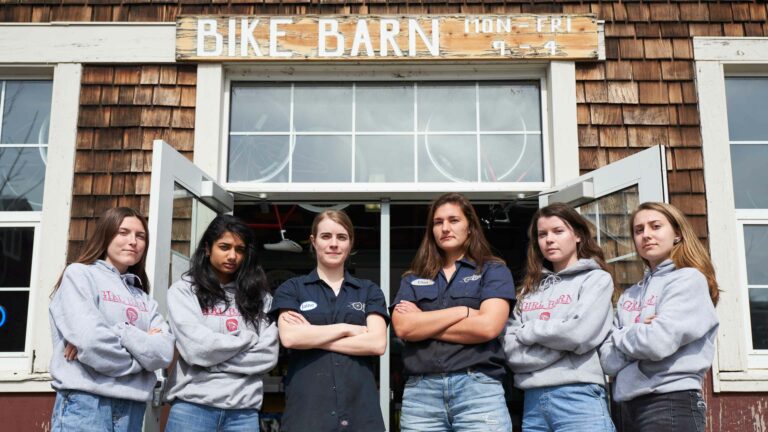
Girl Barn: Bike Barn promotes female empowerment

How UC Davis’ Bike Barn is changing the culture around women in mechanics

According to a UC Davis transit survey, 47% of the university’s student body bikes to campus daily. This not only entails lots of bikes, but also lots of bikes in need of repair. The Bike Barn, an ASUCD unit that serves as an on-campus bike repair shop, fixes over 10,000 bikes on campus each year. The unit would not have as big of an impact without the help of its female mechanics and managers. 

Today, women make up about half of the employees at the barn, but this was not always the case. The institution of Girl Barn — a movement by the Bike Barn aiming to change the culture surrounding women in the mechanic field — has helped women working in the Bike Barn feel more supported in the workplace and move up the ranks in positions of power.

Officially started in late 2018, “Girl Barn” was the nickname employees used for Friday morning opening shifts at the barn, at which time four of the five mechanics on duty were women. Though this happened organically, the manager at the time, Christa Hoffman, quickly noticed and took advantage of the opportunity it presented. 

Hoffman said she saw how many of the female mechanics on the shift were quick to tend to the managerial tasks that come with the job, like answering the phones and moving bikes, but they were missing out on opportunities to focus on mechanical tasks. Along with Molly Moritzburke, Hoffman decided to dedicate that Friday morning shift, dubbed “Girl Barn,” to more extensive learning for the women on duty while promoting female empowerment. 

Around the same time, Hoffman and the other female mechanics at the Barn began discussing injustices that they were facing at work, such as not being taken seriously or not being treated like ‘real’ mechanics. She said these experiences happen quite often, and they affected both her and her female co-workers’ confidence in their work. 

“It can be really disheartening as a female mechanic when somebody is subtly questioning [your abilities] or asking ‘Can I talk to a mechanic?’” Hoffman said. “Those small things make you question if you really have the knowledge you need.”

Through Girl Barn, female mechanics have been able to come together and share their experiences with customers and sometimes male coworkers, which has heightened the overall awareness of these issues and has led to a huge culture shift. Meg Davis, a third-year environmental engineering major and current Bike Barn mechanic, said the Girl Barn community has given her the courage to speak up when these issues arise.

“We are a lot more willing to speak up if we have a disrespectful interaction or something,” Davis said. “I’ve gotten a lot more comfortable saying and doing something about it.” 

Although there is no set shift for Girl Barn this quarter, women who work in the shop say that the culture of Girl Barn is only getting more prevalent. This change in culture is obvious through the sheer number of women who are employed as mechanics and in managerial positions at the Bike Barn. 

Clara Ginnell, a third-year biomedical engineering major and service manager at the Bike Barn, said that when she started, there was just one female manager. Today, three of the six managers are women. Additionally, at least half of the recent hires have been female. Ginnell and Davis were the first in their hiring class to become senior mechanics because of the extra learning experience that Girl Barn offered them through learning-focused shifts and workshops. 

The culture shift at the Bike Barn hasn’t been strictly quantitative in terms of female staff. Many of the female workers say the message has helped shift the culture among not only staff, but among customers as well. 

“When people come in, they continually see all or a lot of women up front — I’ve kind of stopped getting people asking, ‘Oh, can I talk to a mechanic’ comments,” Davis said. “It’s really anecdotally died down.” 

Not only has Girl Barn improved the culture around female mechanics, but it has also had an impact on the lives of the girls involved, in and out of the Barn. Ginnell explained how being a part of Girl Barn has impacted her work experience and her overall experience at Davis. 

“I have definitely built a lot of self confidence from working at the Bike Barn, I feel super supported in the workplace,” Ginnell said. “It’s just really cool to have a group of women who you have a shared experience with who you can always talk to about like school work that you’re struggling with, or Bike Barn stuff or personal stuff that you don’t usually talk about at a workplace when men are around.”

  The women all expressed a love for the early Friday morning shift, when they often sit around the break table before opening — playing the Girl Barn playlist on Spotify, with over 20 hours of exclusively female artists — and talk about what’s going on in their lives, both at work and outside of it. Hoffman said working at the Bike Barn is her favorite thing that she has done during her time at Davis and expressed that the culture Girl Barn has created has been instrumental in her personal growth. 

“Bike Barn has made me more confident as a person, a professional,” Hoffman said. “In everything, really.”

Written by: Katie DeBenedetti — features@theaggie.org

Contrasting generations in the 2020 NFL offseason

A look into past, potential moves of NFL quarterbacks this offseason 

The end of every NFL season always seems to bring about a surge of questions surrounding aging, veteran players and the decisions they make going into the following season. 

In this particular offseason, the league is witnessing more quarterback-oriented uncertainty than it has seen in a long time. A new core of young, immensely talented signal callers is emerging, while many older players at the position are at a crossroads. 

With several teams unsure who will be their quarterback in 2020, and with the free agent negotiation period set to open on March 18, it is important to examine past seasons and the potential futures for veteran quarterbacks while also examining the younger generation of quarterbacks we are now experiencing. 

One of the first decisions that was made was by former New York Giants quarterback Eli Manning, who announced he would be retiring at 39 years of age after spending 16 years with the team. 

Manning’s decision is an example of a veteran who decided to leave at the right time in his career. Although Manning boasts an overall impressive career with two Super Bowl wins, his underwhelming performance to start the 2019 season and the Giants’ decision to start rookie quarterback Daniel Jones midseason were clear indicators that Manning’s time with the Giants was coming to an end. 

In contrast with Manning’s retirement, Drew Brees, the quarterback for the New Orleans Saints, recently announced that he will continue playing in the 2020 season. Brees’ decision to continue through another season makes as much sense as Manning’s decision to retire, since Brees has not shown any major signs of slowing down — at least not to the same degree as Manning. 

Brees’ completion percentage has been the highest in the NFL for the last three seasons and he reached his own career-high completion rate of 74.4 just two years ago. Brees also threw only four interceptions in the 2019 season. These numbers are especially impressive considering his age — at 41, Brees is still an asset to his team and likely would be for any team in the NFL at this point. 

Among the quarterbacks whose careers still remain shrouded in uncertainty are former Los Angeles Chargers quarterback Philip Rivers and Tom Brady of the New England Patriots, both of whom have dedicated their entire careers to their respective teams. 

While the Chargers and Rivers have announced that they have mutually agreed to part ways, Rivers plans to continue playing and maintains impressive numbers following his 16-season run with the Chargers. Rivers, who is 38-years-old, has been a consistent passer throughout his time in the NFL and has thrown for over 4,000 yards each season since 2013.

When looking at Rivers’ 2019 season, it is easy to argue that his abilities have declined, as seen by his decreasing number of touchdowns and the fact that the Chargers finished last in the AFC West last season with just five wins. The fact that Rivers was sacked over 30 times last season, paired with the amount of injuries that plagued the team, however, indicate that a decline in numbers can be attributed more to a lack of reliability in Rivers’ offensive line and surrounding talent rather than his age. 

The quarterback who has received the most attention this offseason regarding his potential decision for 2020 is clearly Brady, who has spent his entire 20-year career with the Patriots. Dominating the league with six Super Bowl titles — the most by any one quarterback in history — Brady’s uncertainty for next season was never much of a question of whether or not he would keep playing but rather whether he would choose to stay in New England. 

Brady, now 42-years-old, has stated multiple times that he believes he can keep playing until he reaches at least 45 and that idea does not seem to be too far-fetched. He has carried the Patriots to the playoffs every season for the last decade and won his sixth Super Bowl just two years ago at the age of 41. 

Faced with some issues offensively last season — specifically the loss of key receiver Rob Gronkowski— was definitely a disappointment compared to what Patriots fans are used to seeing. If Brady decides to stay with New England next season and is placed behind an improved offensive line, it would not be too surprising to see him contend for yet another Super Bowl appearance. 

Brady’s ability to produce at such a consistent rate not only defies the notion that age is always a significant factor in a player’s abilities but also proves to the younger generation of quarterbacks that true dedication to your craft can allow you to be successful regardless of age. 

The most notable player within the “younger” group of quarterbacks is Kansas City Chiefs quarterback Patrick Mahomes. At just 24-years-old, Mahomes is already a Super Bowl champion and MVP. This year, he led the Chiefs to their first Super Bowl title since 1970, and, in 2018, he was named the NFL MVP. 

In just his second NFL season and first season as a starting quarterback, Mahomes threw for a whopping 50 touchdowns — a milestone that Brady didn’t reach until his seventh year with New England. The only quarterbacks in history to throw for 50+ TD’s in a season are Mahomes, Brady and future Hall of Famer Peyton Manning, who threw for 55 scores in 2013 with the Denver Broncos. 

Mahomes has more passing yards in his first two seasons as a starter than any of the other quarterbacks mentioned previously and has exhibited the same crunch time performance ability for which Brady has always been praised. 

Being named MVP at the age of 23 also places Mahomes in a list of the NFL’s youngest MVP award winners with icons like Walter Payton and Dan Marino. If he continues at a similar pace, it would not be surprising if Mahomes were to match and possibly even surpass Brady’s numbers. A situation like that would be similar to Brady’s ability to surpass records set by the older generation of his own time, such as Joe Montana.

Mahomes’ record of youngest NFL MVP, however, was recently broken by the 23-year-old Lamar Jackson, quarterback for the Baltimore Ravens. Jackson is only the second player to win the MVP award with a unanimous vote — the first was Brady in 2010. 

Jackson not only had an impressive 3,000 passing yard performance in 2019 but also rushed over 1,000 yards to become the first player in NFL history to do both in a single season. His rushing yards alone are more than double Mahomes’ career rush yards and are indicative of Jackson’s ability to improvise and carry a team through high-pressure situations. 

Jackson had an exceptional 2019 season overall, leading the league with 36 touchdowns and helping the Ravens to achieve the best record in the NFL. The performances by Mahomes and Jackson at such young ages demonstrate the talent that will continue to be showcased in the upcoming seasons. 

More talent among the younger group of quarterbacks can be seen in Dak Prescott from the Dallas Cowboys and Jameis Winston from the Tampa Bay Buccaneers. Prescott and Winston, both 26-years-old, finished the 2019 season with career high passing yards and touchdowns. 

Deshaun Watson of the Houston Texans is also just 24-years-old and helped the Texans, which was once one of the worst teams in the NFL, become a competitive team at the top of the AFC South in his first full season as starting quarterback. 

Both the Cowboys and Texans have already expressed their intentions to keep Prescott and Watson with their respective organizations for as long as possible. It is predicted that either Mahomes, Prescott or Watson could be offered a record-breaking deal going into the 2020 NFL season. 

This possibility of multiple young quarterbacks receiving record-breaking contracts indicates the value that the league places on young talent and demonstrates the enhanced sense of competition at the position that will likely be featured in this upcoming season. 

It is also worth noting that former LSU Quarterback Joe Burrow will most likely be entering the NFL in 2020. With 60 touchdowns, a completion percentage of 76.3 and over 5000 yards passing last season with the Tigers, Burrow is the overwhelming favorite to be the No. 1 pick in April’s NFL draft. 

Overall, the decisions being made by Brees, Rivers and Brady this offseason indicate that playing well into your late 30s or past the age of 40 is a plausible option for successful NFL quarterbacks. There is a level of respect and shared history that lies among veteran quarterbacks and their fans, but, as we can see with the departure of Manning and Rivers from their respective clubs, what is most important is what a team believes will benefit it most going forward. 

In essence, as players come and go through the league, teams will always be looking toward the future. The younger generations that enter the league may provide a new level of talent and stability within teams. 

Written by: Rain Yekikian — sports@theaggie.org