56 F
Davis

Davis, California

Friday, December 26, 2025
Home Blog Page 377

From spread to slices: CoHo avocados have a new look

CoHo switches from avocado spread to individually wrapped avocados, demonstrating trade-offs made for sustainability

In Fall Quarter 2019, the CoHo introduced an unlisted change to its menu: instead of using avocado spread on its deli sandwiches, it would now give customers individually wrapped, sliced avocados — switching to single-use, non-compostable plastic.

The switch came as a surprise to Environmental Policy & Planning Commission (EPPC) Chair Kyle Krueger. Before The California Aggie spoke to him, he said he had not noticed. 

“When I’m at the CoHo, I’m usually rushing and buying things, so sometimes I miss things like that,” Krueger said. 

EPPC, a part of ASUCD, works to improve sustainability across different campus units and educate the larger community about actions that can be taken to reduce effects on the environment. The commission recently deepened its involvement with the CoHo to implement the Fair Trade Initiative, an effort started by former EPPC chair Alice Beittel. 

Fair trade products are “conducive to the rights, equity and welfare of the people who made them,” Krueger said. The CoHo agreed to stock fair trade products with the condition that EPPC held tabling events to help increase awareness of the importance of fair trade.

This condition falls under the umbrella of the CoHo’s education portion of its sustainability efforts, which include labeling local and organic products. The CoHo also works to reduce its environmental impact in other ways. Every quarter, the CoHo conducts an internal waste audit and adjusts accordingly, and the single-use utensils in the CoHo are all compostable. It is the contrast between the CoHo’s demonstrated commitment to reducing environmental impacts and the use of single-use plastic-wrapped avocados that left Krueger surprised. 

According to Plastic Oceans, around 50% of plastics are used once and thrown away. Often, they end up making their way to the ocean, with more than 8 million tons of plastics dumped into oceans each year. 

Making the decision to switch from avocado spread to wrapped avocados, however, was a balancing act for Darin Schluep, food service director for AS Dining Services, which runs the CoHo. 

“When making [this change], we had to balance the savings in labor and reduction in food waste versus the possible addition of packaging waste,” Schluep said via email. “We are often faced with these tough decisions, but in this case, the quality improvement tipped the scales towards us making this change.”

He believes the wrapped product more closely resembles the avocado product customers receive when ordering sandwiches elsewhere. Previously, the CoHo made its avocado spread from scratch, but Schluep said the process was labor-intensive and costly. 

“Managing the ripening of fresh avocados led to a large amount of food waste, and the product wasn’t consistent in quality,” he said.

On college campuses, food waste accumulates quickly: according to Education Dive, 22 million pounds of food are wasted each year on college campuses. 

This food waste has large effects and contributes to climate change. If food waste was its own country, it would be the third-largest emitter of greenhouse gases, behind Canada and the U.S., according to The Guardian.

Consequently, the CoHo transitioned from house-made avocado spread to a pre-packaged avocado spread to reduce waste and labor. It then made its latest shift toward the new wrapped avocados, which “provided consistency of quality, labor cost savings and a reduction in waste,” according to Schluep. 

Still, UC Davis Food Science & Technology professor Dr. Alyson Mitchell said wrapping avocados does not necessarily influence freshness. 

“That will depend on when the avocado was picked,” she said. 

Schluep said the product received a positive student response and that the CoHo has not heard any negative comments about the switch thus far. 

“Last spring, prior to the change, we had between 8% to 10% of our sandwich customers adding avocado spread,” Schluep said. “Figures after the change were anywhere from 11% to a high of 13.5% of our sandwich customers adding sliced avocado.”

The entire CoHo management team — including student managers — were consulted before the switch was made, but Krueger said he wished the CoHo had consulted EPPC as well.

“Obviously, not all switches are bad, but it’s good to be informed and have that environmental perspective,” he said. 

Though he didn’t know at the time of the interview why the switch was made, Krueger said he understood how reducing food waste would ultimately be a win for sustainability. 

“We’ve had really good conversations with the CoHo,” he said. “They’re starting to work on more plant-based [food] options at the South CoHo — they’re working independently, but we look forward to working with them to maximize the sustainability of their efforts.”

Schluep emphasized the CoHo’s commitment to reducing environmental impacts. 

“We continue to have a strong waste diversion program,” he said. “Around 87% of the CoHo’s waste is diverted from the landfill to either recycling or composting streams as of our last waste audit, and we will continue to take our sustainable efforts into account with any menu adjustments that arise.”

Written by: Janelle Marie Salanga — campus@theaggie.org 
Discussion of ASUCD’s budget deficit and upcoming fee referendum at Dec. 5 Senate Meeting

Senate determines emergency legislation aimed at providing supplies for The Pantry is unconstitutional

Senator Shondreya Landrum called the Dec. 5 ASUCD Senate meeting to order at 6:15 p.m. with Vice President Shreya Deshpande and Senators Anna Estrada and Lylah Schmedel absent.

The meeting began with Senator Andre Spignolio unanimously elected to be interim pro tempore of the Senate.

Next, the Senate moved into elected officer reports, starting with Kyle Krueger, the chair of the Environmental Policy and Planning Commission (EPPC). Krueger explained that Camille Kirk, the director of sustainability, attended an EPPC meeting — each of the EPPC project teams had an opportunity to discuss their work with Kirk and allowed her to give them feedback. Krueger said it was a very productive meeting.

Gender and Sexuality Commision (GASC) Chairperson Elena DeNocochea said the commission’s last meeting of the quarter had already taken place and, therefore, many of the projects were ones that would be worked on over Winter Break and into Winter Quarter. 

DeNocochea said she is planning a meeting with the director of the health center to talk about the implementation of Senate Bill #24, which requires that all UC and CSU campuses offer medication abortions — commonly referred to as the abortion pill — on campus by 2023. 

External Affairs Commision (EAC) Chairperson Shelby Salyer explained that the commision is planning for next quarter.

Internal Affairs Commision (IAC) Chairperson Ashley Lo explained that, since there was no new legislation, there was no IAC meeting the week prior to the Senate meeting. Instead, the IAC focused on working with the Elections Committee. 

The Senate then moved into elected officer reports, starting with Senator Sahiba Kaur who sat in on interviews for the Sexual Assault Awareness and Advocaccy Committee (SAAAC) chair. In addition to other actions, Kaur highlighted the preparation she is doing for next quarter. 

Both Senators Khalil Malik and Camille Randolf had spoken with leadership at The Pantry and encouraged those on the Senate table to support the unit. Randolf also spoke specifically about expanding access to menstruation products and had met with John Gibson — who has been working on providing for students’ basic needs by spearheading the portable housing unit movement in Davis.

Malik met with the Executive Office to discuss the creation and implementation of an ASUCD-wide newsletter and discussed an ASUCD Senate feedback form that would allow campus community members to easily reach ASUCD senators. He is also working to reform a Sexual Assault and Sexual Harassment bill he worked on during Spring Quarter 2019.

The Presidential Report was next. ASUCD President Justin Hurst attended a counsel hearing about the constitutionality of elections, a meeting about Aggie Square, a meeting about the upcoming ASUCD fee referendum, a recording session for the Vanguard podcast series and engaged in interviews for chair positions and personal assistants.

Hurst also attended an Executive Council Meeting, a meeting about issues with UCPath, a meeting with the Unit Relocation and Space Allocation Committee and a meeting with staff at The Pantry to discuss the fee referendum. He specifically noted the time he spent on the emergency elections held at the end of Fall Quarter.

Landrum then pushed the Senate meeting back into elected officer reports, starting with her own report, saying she held interviews for Judicial Council members and attended an Executive Advisory meeting focused on a discussion of UCPath — including communication issues and plans for the future. Landrum has also been working on a gala which will take place on Feb. 15 from 6 to 9 p.m.

Spinoglio had a relatively slow week, but said he was excited to work with the new senators. 

Landrum amended the agenda to move forward with the confirmation of the Student Health and Wellness Chair. Alex Cohen, a first-year neurobiology, physiology & behavior major, said he applied for the position because of both his interest in medicine and aim to de-stigmatize mental health and substance abuse. 

After answering a round of questions from commision chairs and senators, Cohen was confirmed as the Student Health and Wellness Chair.

The Senate then moved into the Unitrans Quarterly Report, given by Unitrans’ General Manager Jeff Flynn. Flynn reported that ridership has expanded by 25% that can be attributed, in part, to the loss of ridership that occurred during the Camp Fire in November of 2018 when campus closed for seven days. Even with this factored into the equation, Unitrans ridership showed a 10% increase from last year: Fall Quarter saw a typical daily ridership of over 22,000 people. In late September, Unitrans saw its highest first school day ridership ever of over 25,000 people. 

“Put in perspective, that was what we used to see on the highest rainy day last year and years past,” Flynn said.

There have been zero major collisions this year; however, the greatest security incident in Unitrans’ history did occur.

“We had a driver who was assaulted this summer by a customer,” Flynn said.

Flynn explained that Unitrans has been working with UC Davis Police (UCDPD) to improve response times and said he was happy to report that UCDPD has agreed to respond to any incident within city limits, as opposed to just the university campus. Flynn said UCDPD usually have far greater resources than the Davis Police Department does.

On-time performance of Unitrans buses is generally declining as both ridership and traffic conditions have increased in the City of Davis. This is reflected in the numbers, as on time performance was at 93% this year, as compared to 95% at the same time last year.

Last year’s fee referendum is expected to provide an additional $850,000 for Unitrans’ budget. Flynn explained, however, that due to minimum wage increases, there will be approximately $700,000 in additional expenditures.

Flynn clarified that the fee referendum was intended to make Unitrans deficit-free in year two. Right now, Unitrans’ deficit is roughly $80,000 and is projected to be $270,000 by the end of the year. 

By early February, five new compressed natural gas buses will arrive, replacing buses bought in 2004 and 2005. These new buses “will hopefully be the last fossil fuel-based buses that we will buy ever,” Flynn said.

The Senate then moved onto the Picnic Day Quarterly Report. Picnic Day Chair Nicole Deacon explained that despite hiring complications, which set planning for the event back by two months, the board of directors has planning back on track.  

Afterwards, Salyer gave the quarterly report for the EAC. The commision is currently working on “bridging the gap” between students and student government, creating more transparency within student government and increasing student welfare. 

The Senate voted unanimously to confirm an undeclared first year as a new member of the Judicial Council and unanimously confirmed second-year managerial economics major Akhilla Kahdaswamy as the SAAAC chair. 

There was no new legislation, so the Senate moved into consideration of old legislation, starting with emergency legislation SB #17, introduced by The Pantry’s Unit Director Ryan Choi. The bill was introduced as emergency legislation because “of the priority in which we need to allocate spending from reserves to our operations,” Choi said. 

SB#17 allocates $6,192.36 for The Pantry for necessary funding for trips, advertisement and equipment, and was being introduced with the purpose of “increasing the impact of what The Pantry can provide through adding additional shelving [that] would enable us to use our space more efficiently until we can move into a larger space,” Choi said.  

In addition to shelving units, the emergency legislation also accounted for advertising expenses and other operational expenses. All those present, except for Senators Mahan Carduny and Spinoglio, voted to see the emergency legislation. 

Randolf spoke strongly in favor of the emergency legislation.

“I encourage the table to vote for this [legislation], as we have the reserves there for a reason — not just to sit on them, but to use them wisely, and I think this is a wise use,” Randolf said. 

Spinoglio, noting his previous position as the Business and Finance Commission chair, questioned why the bill was introduced as emergency legislation rather than going through the full legislative process. 

“For the sake of precedent, I am not comfortable passing a bill that allocates $6,000 from the Senate reserves to a unit without the Business and Finance Commision seeing it,” Spinoglio said.

Controller Kevin Rotenkolber noted that The Pantry holds the second-lowest operational expense budget at $1,070, while providing an immense amount of resources to the campus.

Naomi Reeley, Academic Affairs Commision chair, pointed out the importance of advertising, saying that with the number of students who suffer from food insecurity and homelessness, it’s hypocritical to deny The Pantry the extra budget when taking into account the budget for Picnic Day. 

”Picnic Day spends thousands of dollars [and, after volunteering] for two hours, volunteers get a free shirt,” Reely said. “These students [at The Pantry] are working for 30 hours. You can give them a darn t-shirt and they get to wear it at The Pantry and when they are walking around the campus.”

Hurst proposed that the emergency legislation be broken into two bills: items needed before Winter Break and items that could wait until after break. Choi agreed to these terms and, after considerable amendments, the bill was put to a vote. 

With five senators voting for and four voting against, SB #17 failed.

The Senate then moved onto SR #6, introduced by Krueger and written to support the phasing out of plastics on campus. Krueger said UC Davis was not at all on track for meeting the Zero Waste by 2020 Initiative and hoped that the resolution would have the effect of “calling on our administrators” and UC President Janet Napolitano “to put greater attention to this issue, since we are going to miss the zero waste deadline and need to ensure that we go zero waste as quickly as possible.”

The resolution passed unanimously. 

SB #15, which called for the creation of a Title IX Policy Task Force in order to combat federal policies which aim to limit Title IX of the Education Amendment Act. Under SB #15, the Title IX Policy Task Force would create “student-friendly” policies for the UC Board of Regents and the State of California to address the federal issues. The Bill passed unanimously. 

Constitutional Amendment #66 was unanimously voted not to be put back on the fall special ballot. 

SB #12, which regards a restructuring of the relationship between ASUCD commissions and committees and intends to increase responsibilities for commissions, was introduced. For committees, the bill was written with the hope of increasing access to the legislative process of ASUCD. SB #12 passed unanimously.

Hurst then led the Senate into the State of the Association, saying “ASUCD came into this quarter in a state of crisis — and we largely still find ourselves there.” He also spoke about the roughly $500,000 budget deficit accumulated by ASUCD, which threatens the many functions of the association.

“We have a long path ahead of us that leads to our hopeful passage of the fee referendum,” Hurst said. “Now we must fight to preserve and support those units that continue to define ASUCD and serve our students.”

Furthermore, Hurst discussed the ongoing issues related to UCPath. 

“Our ability to pay our own employees [and] our financial autonomy was effectively stripped from us,” Hurst said. “And these students, including many of us sitting here, have been caught in the crossfire. The timing of the UCPath rollout directly froze our hiring abilities, sending ripple effects throughout the Association.”

In regards to the Fall Quarter 2019 general elections, Hurst explained that ASUCD has “been posed with a complicated dilemma: adherence to the ASUCD Constitution while simultaneously lacking the infrastructure to do so.”

Hurst ended his address on a hopeful note: “Despite the setbacks that we have been plagued with this quarter, we have the potential to create lasting change for the association and all the people that we serve if [we] continue to work together,” Hurst said.

During public discussion, senators continued to speak about the budget deficit and fee referendum. 

The meeting was adjourned at 11:13 p.m.

Written by: Jessica Baggott — campus@theaggie.org

Higher education should not come at a higher price

UC should take advantage of increased state funding

The Editorial Board denounces the tuition hike proposed by the UC Board of Regents. The two different proposals that the Regents are considering are: an increase in tuition for new and continuing students to account for inflation each year, and a cohort-based model in which student tuition and fees would be raised once by a greater percentage for each incoming class, or cohort. The former would raise tuition and fees for students by a projected increase of 2.8% to $12,918 for fall of 2020, while the latter would increase tuition and fees by approximately 4.8% to $13,176 for the first cohort of in-state undergraduates in 2020–21. Additionally, the Nonresident Supplemental Tuition would increase tuition for nonresident undergraduates by $840 under the first plan and by $1,440 under the second plan.

The proposal claims that these tuition hikes “would generate additional funding for student financial aid that would reduce the net cost of attendance for more than one-half of UC California resident undergraduates, resulting in less need for students to borrow or work to finance their education,” according to the discussion item from the Regents meeting on Wednesday. The Regents also claimed that these tuition hikes would “avoid the erosion in the quality of a UC education that would otherwise result if the University were to rely solely on available funding from the state and other sources.”

Neither option should be adopted. The UC shouldn’t rely on tuition increases to finance student financial aid. Both plans would impose a greater stress on students, forcing them to take out additional loans and accrue more debt. A college education shouldn’t be something that families struggle to pay for — the state should be the one to fund the future scientists, teachers and entrepreneurs.

Around two weeks prior to the Regents meeting, Governor Gavin Newsom released his state budget proposal for the 2020–21 fiscal year, which included an increase in UC funding — but funded by the state, not the students. His proposal included permanent funding for: student services, expanding enrollment and operations for UC medical schools, agricultural resources, research, medical education grants and immigrant legal services. It would also provide one-time funding for online degree and certificate completion programs, K-12 computer science educators and a grant program for animal shelters here at UC Davis.

Even with keeping the cohort-based increases at a flat rate for six years, it is still a substantial increase that many students will struggle to afford. Consequently, prospective applicants or students may reconsider enrolling at a UC. According to the Regents, “Tuition is the single largest driver of the amount of need-based grant assistance available to California resident undergraduates at UC,” so why would the UC propose a tuition increase? In order to account for inflation and offset the fact that the UC’s in-state tuition “has remained flat for seven of the last eight years,” the state should be providing funding. The UC needs to be more proactive about supplementing tuition costs by taking more concrete efforts to come up with alternative sources of revenue.

Other than UC President Janet Napolitano — who recommended that either of the two plans proposed by the Regents be approved, according to the Los Angeles Times — many others, including Chair of the Board of Regents John Pérez, were against the proposed tuition hikes. Pérez noted at a Regents meeting last year that he is “predisposed against voting for any tuition increase that impacts current students,” according to the LA Times.

Students’ educations are on the line, and they must be taken seriously. It is not acceptable that the Regents meetings take place where students are unlikely to protest, such as the UCSF Mission Bay Conference Center — the only UC without an undergraduate program. The proposed hike seems even more unwarranted, given the major funds Newsom has already poured into public education in addition to his recommended plan for the next fiscal year. The UC needs to consider the consequences of its actions, like when the UCPath payroll system implementation continued, despite its failure at several UC campuses that resulted in students not being paid. The UC needs to hear students’ voices when they say they can’t be placed further in debt. Students deserve better.
It is important to note that these tuition hikes proposed by the Regents is entirely separate from the ASUCD fee referendum. The ASUCD fee referendum is a basic needs and services referendum that would go toward maintaining the student services and jobs ASUCD currently provides, such as the CoHo, Unitrans, The Aggie and over a thousand total employees. Funds raised by this fee referendum would stay at UC Davis and directly benefit UC Davis students.

Written By: The Editorial Board

Aggies edge out Long Beach, hold on to another conference win at home

0

Defending home court

The UC Davis women’s basketball team defended The Pavilion last Thursday night, holding on for a 57-55 win over Long Beach State. A game that seemed to be shaping up as an easy win for the Aggies turned into a nailbiter that took all 40 minutes to decide.

“These are games [that], earlier in the season, we weren’t finding a way to win,” said UC Davis head coach Jennifer Gross after the game. “It’s exciting that our players are finding a way to help us get the win. And that is how you build that confidence and that championship mentality.”

After winning the opening tip, Long Beach State scored the game’s opening points, followed by a quick response from the Aggies. The next several minutes of the game saw a lot of back and forth between both teams, along with a number of turnovers from a UC Davis side that could not find the answer to Long Beach State’s 2-3 zone. 

With about four minutes left in the opening quarter, the Aggies broke through and began an 8-0 run to close out the period up 17-11. Long Beach junior guard and Woodland, Calif. native Shanaijah Davison scored seven of her team’s 11 points in the quarter, which only shot 5-18 from the field and 1-6 from three as a whole. 

As the second quarter commenced, the ball movement on the UC Davis side led to plenty of open looks and a 5-0 start to the quarter. As was the case in the first quarter, the Beach got great looks themselves, but continued to miss them at the basket. The Aggies, seemingly in control for the time being, got sloppy with the basketball and turned it over three times during a 9-0 Long Beach run that closed the deficit to two. A three by the Beach’s freshman guard Kristyna Jeskeova tied the game up for the first time since the opening minutes. 

After a timeout, the Aggies regained their footing and closed out the half on an 8-2 run, and went into the locker room with a 33-27 lead. 

UC Davis’ leading scorer at the break was redshirt-sophomore forward Sage Stobbart, who had 10 points to go along with three rebounds. The Aggies shot an efficient 11-19 from the field in the first half, including 4-10 from three, and recorded 10 assists. Their one deficiency at the half was also a common theme for the rest of the game: turnovers. The Aggies committed 11 before halftime. On the Long Beach State side, Davison led the charge with 16, while only three other players on the Beach had points. The visitors as a whole shot 12-34 from the field.

“Tonight we got a little flustered with their pressure,” Stobbart explained. “We tried to prep for it during practice but nothing quite matches that athletic of a team” 

The third quarter saw minimal offense as only five points were scored in the first five minutes, all by UC Davis. The Beach only made three field goals in the period for a total of six points, but the UC Davis offense was stagnant as well. The Aggies continued their turnover woes by giving the ball away eight more times in quarter, which kept them from building a more sizeable lead. Regardless, the Aggies entered the final frame up 42-33. 

“A lot of us just thought we need to keep shooting,” Stobbart said about the rough offensive showing in the second half. “It definitely was difficult with all those turnovers to keep that attacking mindset.” 

Another mini-run by Long Beach State to start the final quarter pulled the visitors within four, and it took UC Davis about three minutes before freshman guard Evanne Turner answered back with a tough floater on the left elbow. A corner three from redshirt-junior guard Mackenzie Trpcic with about six minutes remaining gave the Aggies their nine-point lead back. It seemed as if, in a game where offense was at a premium, that would be too much for Beach to overcome. 

But with about five minutes remaining, Long Beach switched to a full-court press and instantly forced back-to-back Aggie turnovers. As the game approached 3:30 remaining, Long Beach hit a tough layup with the foul, knocked down the free throw and made it a 47-46 game. 

The Aggies could not get out of their own way, as they turned it over again, leading to a Beach fastbreak and an easy lay-in that gave them their first lead since the first quarter. 

With the Aggies reeling, Cierra Hall managed to make her first and only shot of the evening, a clutch three in the corner to give UC Davis the lead right back with two and a half minutes remaining. The Aggies were able to capitalize off of the Beach’s missed shots, and two made free throws by Trpcic made it a six-point game with 27 seconds left. 

After a loose ball foul gave Long Beach State two free throws, the Aggies missed one of their own at the other end and allowed Long Beach sophomore guard Justina King to nail a three with 13 seconds to play. 

The Beach were then able to force a jump-ball turnover and a chance to tie the game with 12 seconds left, down 57-55. The ball was in King’s hands once again, as she drove in the paint and put up a tough layup that ultimately fell short. Stobbart grabbed the rebound, and the Aggies survived. 

Turner was the Aggies’ leading scorer with 11 to go along with five rebounds and was key in holding on to the victory down the stretch. 

“Our mindset down the stretch was just attack them,” Turner said. “We know we have the ability to get out of those [situations]. We just kept pushing. We never had a doubt in our mind that we were going to win this game.”

Although Stobbart did not score in the second half, she was able to gather seven rebounds and notch a double-double. Three Aggies finished with five assists and collectively the team shot 47.5% from the field. But the Aggies’ 29 turnovers compared to Long Beach’s 10 allowed the visitors to stay in it all throughout. 

“That was a bit uncharacteristic of us to be honest,” Gross said about the 29 turnovers. “Something we’ve done really well all season is taking care of the ball. I think they sped us up a bit and to their credit, that’s what they do. So to turn the ball over like we did and still find a way to win definitely says a lot about our group and our defense.”

A win’s a win, and this one moves the Aggies to 7-9 overall and 2-1 in conference, extending their home win streak against Big West opponents to 24. Their next matchup will be against the Gauchos on Thursday in Santa Barbara, a place the Aggies have not lost since the 2015-2016 season.

Written by: Omar Navarro — sports@theaggie.org

Abigail Thompson: Diversity statements are not “political litmus tests”

Diversity statements reflect job applicants’s commitment to equal access to education

UC Students deserve professors, lecturers and other university professionals who understand who we are. We are a diverse student body, made up of people from myriad races, ethnicities, religions, nationalities, sexualities and genders. The people who are at this university, who teach us and guide us, should be vocally committed to advancing diversity at all levels.

Abigail Thompson, chair of the UC Davis Mathematics Department, sees things differently, as represented in two recent op-eds in American Mathematical Society Notices and the Wall Street Journal, in which she rallies against mandatory “Diversity Statements” in the UC’s hiring process. She amounted these diversity statements to nothing more than “a political test with teeth.”

The Editorial Board resoundingly objects to this argument.

There’s an issue here: Diversity should not be seen as political. The realities facing students because of their intersectional identities are only political because there has been a concerted effort for generations — conducted by politicians and other powerful individuals in this country and elsewhere — to systematically discriminate and subjugate us. 

As the UC Davis Principles of Community say, “We acknowledge that our society carries within it historical and deep-rooted injustices and biases.” The scourge of racism, gender-based violence, white nationalism and xenophobia are ever-present in our lives, especially in recent years. We have seen multiple incidents of overt racism and anti-Semitism on this campus, as white nationalist propoganda has been posted multiple times over the past two years.

In this environment, equal access to education is at risk. Mandatory statements that describe an applicant’s commitment to diversity help preserve and maintain access to a UC education for all.

The history of education in this country is replete with moments where a lack of understanding of diversity has prevented access to schooling. It was only in 1954 that the U.S. Supreme Court mandated public schools to desegregate, a process that continues to this day — such as in one town in Mississippi that was ordered to desegregate its schools in 2016.

To this end, we will admit that maybe diversity is political — but it is only political because the only way we can end discrimination is through our politicial systems. When we give equal weight to two different arguments — one saying that diversity is good and must be mandatorily advanced, and another one that says that it should be done passively — we are faced with a moral fallacy. 

A commitment to upholding diversity actively in the UC system is a moral good. “True commitment to diversity, equity and inclusion is active and not passive,” said Chancellor Gary May and Vice Chancellor Renetta Garrison Tull in a response to Thompson’s op-eds. We agree. Passive action won’t right the injustices that minorities and other marginalized populations have experienced throughout history, especially in the U.S. — a stance that Thompson advocated for by saying that “encouraging students from all backgrounds to enter the mathematics pipeline” would be enough to improve diversity in mathematics.

Thompson, hear it from students at your own university: Support diversity actively and brazenly. Contributing to diversity means that a candidate is intrinsically more qualified for a position at this university.

Technology Review: Headphones

Best headphones for college students

One casual walk around campus would likely prove headphones are a student staple. After all, how could one get across campus and through the various responsibilities of the day without a podcast, audiobook or music for company? 

Keeping in mind price, comfort and audio quality, the following lists recommendations for any student’s listening endeavors. Each selection was chosen objectively after surveying various headphone reviews and rankings from several websites — a literature review for headphones, if you will — like TechRadar and CNET. At least for earphones, there’s no need to go crazy, opening multiple tabs and windows on your laptop trying to look for the best option.

Balling on a Budget

Although some complain that the ear pads on these are prone to peeling, Sony’s MDR-ZX110 headphones boast 12,203 ratings on Amazon with an average of 4.2 stars out of 5. Many customers agree that, for the price, these headphones can’t be beat due to their comfortability and sound quality. 

Wireless

The ease of listening wire-free is nearly essential nowadays and especially for those on the go. JLab Audio’s JBuds Air True wireless earphones mimic the portability and size of AirPods, but for a fraction of the price. These earbuds also feature ear tips and optional JLab Cush Fins to sturdily stay in one’s ear. 

Noise Cancelling

Noise cancelling headphones can help make the background noise of a busy cafe or study area more muted. But often this in-demand feature makes headphones more expensive. Mpow’s H10 Active noise-cancelling headphones, at $50, offer a more cost effective option.

For the Gym Rat

If the grind never stops, try out Status’ BT Structure wireless earphones. This pair wraps around your ear to ensure a secure fit, is water resistant, has a battery life of 12 hours and, according to the Status website, users do not have to “compromise on sound quality.” 

For the Audiophile

Grado’s SR80e headphones are bare bones, and for those that value sound quality over everything else, these may be the best choice. While it might be better to use high fidelity equipment with these, they are still fine to plug into something simpler like a laptop, according to an Amazon reviewer. In another review, one Amazon customer noted that “if you’re a non-expert just looking to enjoy your favourite music then these will make you really happy.” 

For the Style Icon

If appearance is what matters most, Panasonic’s Retro Bluetooth Wireless headphones in the yellow color might be The One. Other colors are cheaper, but still just as retro looking. With 24 hours of playback, the battery life will last through multiple lengthy study sessions. 

Written by: Cecilia Morales — science@theaggie.org

Chanel Miller’s “Know My Name” opens discussion around sexual assault

Paving the way for other women

Before the #MeToo movement went viral in 2017, there was one account of sexual assault in 2015 that gripped the nation and flooded news outlets. Chanel Miller, known at the time as “Emily Doe,” was assaulted by Brock Turner during a fraternity party at Stanford University. 

During the trial, the media gave Turner a backstory and expressed sympathy for his circumstances. He was an Olympic swimmer, a strong student and a young man with a “future that was once bright,” according to an article from the Washington Post

Although Turner was convicted on three counts of felony sexual assault, he only served three months in a county jail. Judge Aaron Persky claimed that, “a prison sentence would have a severe impact on him.” It’s worth noting that Judge Aaron Persky was recalled from his judgeship in 2018.

Throughout the case, the identity of Emily Doe remained a secret. The media did not know her name, much less her story — that is, until the victim impact statement she gave after the ruling went viral in 2016. When the statement was published on Buzzfeed, over 18,000,000 people read it. Countless letters of support were sent to Miller. Other survivors of assault and harassment reached out to share their own stories and to let her know that they felt heard. Miller became the voice of survivors, even when her identity remained hidden.

“You don’t know me, but you’ve been inside me, and that is why we’re here,” Miller’s statement read.

After years of anonymity, the identity of Emily Doe was revealed when Miller published “Know My Name” on Sept. 24, 2019. This memoir follows what Miller remembers from the night of the assault as well as the struggles she continues to face years later. She described her psychological state during the trial and the emotional toll of recovery. 

The novel was hugely successful and has been lauded for its powerful language and important insight into the judicial processes and injustices regarding sexual assault cases. 

“‘Know My Name” is more than an indictment, though it is a successful and moving one,” reads an article in Elle magazine. “It is also an outstretched hand, inviting you to fight alongside her.” 

In her memoir, Miller discusses the power of the #MeToo movement and the way it affected her writing. Tarana Burke began the movement which gained prominence in 2017. Miller writes that it allowed survivors the “relief of finally being given a chance to set the story down, to see what it felt like to walk around, breathe.” 

The impact is still here. Laws and culture are changing — an article in Vox detailed the ripple effects of the movement, such as increased protection for workers and a ban of nondisclosure agreements that cover sexual harassment. The movement extended globally as well.

#MeToo has also changed the way we tell stories and allowed new voices to enter the mainstream. Miller’s memoir is a powerful example of what art and storytelling in particular can look like in a post-MeToo world. Suddenly topics viewed as taboo that had previously been relegated to niche media outlets are now seen on everyday platforms in a variety of different genres. 

“Every woman who spoke out did so because she hit a point where she could no longer live another day in the life she tried to build,” Miller writes. “Society thinks we live to come after him. When in fact, we live to live.” 

After 2017, the lives of survivors and their stories were something more and more people wanted to learn about. The film “Bombshell,” released on Dec. 20, 2019, depicted the Fox News scandal involving sexual harassment and the mysogonistic culture in the network perpetuated by Roger Ailes. The film earned $4.1 million in its opening weekend and starred award-winning actors Charlize Theron and Nicole Kidman. 

Series such as Netflix’s 2019 “Unbelievable” are shifting the way people tell true-crime stories. Rather than focusing on the perpetrator, his crimes or why he committed them, this series chose to delve into the stories of the survivors. 

From the “Handmaid’s Tale” being one of the most praised series in recent years to Peggy Oreinstein’s “Boys and Sex” becoming a New York Times bestseller, it is obvious that the world is ready for deeper conversations about consent and sexual politics. 

Miller paved the way for this. Even in 2015, the injustice and pain she experienced resonated with people. It was a sign to the public that something in society was deeply broken, and that change would be necessary to mend it. 

“If [a survivor] emerges, why don’t we ask her how it was possible she lived with that hurt for so long,” Miller writes. “Ask her who taught her to never uncover it.”

Written by: Alyssa Ilsley — arts@theaggie.org

Instagram doesn’t care who likes you

Instagram does next to nothing by removing public like counts 

Instagram said the removal of likes will reduce bullying on their platform and create a healthier environment for its users. But what the removal of tracking likes actually does is next to nothing to stop bullying or create a healthier environment. The actual consequences of this action are yet to be fully seen. 

Seeing the endless feed of highlights from our friends on Instagram may feed some with a feeling of pride or happiness, but in reality it is simply an inaccurate depiction of how life really is. Our lives are not perfect, so why should our feeds be?

In October 2010, Instagram started as a social app for photographers. It quickly transitioned into something else and allowed us all to be photographers. It seemed like the opposite of Twitter where users could endlessly argue — Instagram was a place for images without words. Since then, the platforms have moved closer and closer together. 

Removing likes from Instagram in an attempt to make the platform a safer place seems like a half-hearted move. With one billion monthly users and more than 500 million daily users, there are still classic metrics of bullying that will always prevail. Descrimination and antagonism based on how people present themselves will still remain. Removing a popularity meter that tracks how many people double tap on an image is a miniscule action to take in combating bullying. 

Instead, Instagram should be giving users the option to remove the like count from posts, similar to the ability of users to turn off commenting on specific posts. How is having the ability to remove likes any different? It most likely has something to do with Instagram’s mandatory timeline algorithm which determines what posts you see and when. No one really knows how it works. 

My experience with the removal of the like counter has been largely forgettable. The only thing that jumps out to me anymore is who Instagram decides to display right before “and others.” If the number of likes is no longer there, what replaces it still carries importance. 

Social media demetrication is the most likely phenomenon Instagram followed to get rid of a public like count. Popularized by Benjamin Grosser with demetricator tools, social media demetrication is the attempt to help us become less reliant on numbers that mean less than we actually think. Perhaps outside of all the numbers that come along with our social media accounts there is a happy medium where Instagram can find a safer and more authentic space, but I just don’t see it. Social media and social life are constructed on social standards that are inherently unhealthy and cruel. 

We can all be better people. The only way to create a healthier social media environment is to cultivate a healthier social circle for ourselves by using the tools available to us. Blocking and muting are wonderful tools when used to combat hate on the internet — hopefully Instagram can implement the capabilities necessary to do so. 

Written by: Calvin Coffee — cscoffee@ucdavis.edu

(This article is humor and/or satire, and its content is purely fictional. The story and the names of “sources” are fictionalized.)

Police Logs

Tables turning, police taking off handcuffs

January 2

“Open line sounded like child playing.”

January 3

“Reporting party babysitting six year old who put on and locked handcuffs; they are utilizing keys and unable to get off. Requested assistance.”

“Vehicle stuck in car wash and not authorized to be there.”

January 4

“Subjects in white BMW egged bicyclists.”

January 5

“Loud subjects in the hot tub after hours.”

January 6

“Reporting party advised that the vehicles car alarm is continuously going off and then stops.”

“Reporting party saw a subject riding a bike while carrying another bike.”

January 7

“Two buses headed northbound have been stuck at the light for approximately seven minutes.”

January 8

“Vehicle horn sounding, reporting party saw someone inside the vehicle and then saw a subject get out and start kicking the vehicle.”

January 9

“Resident playing with phone.”

$15 billion schools bond to come before California voters on March 3

$2 billion of bond would benefit UC schools

A $15 billion bond to support preschool, K-12 and higher education will be placed before California voters on March 3 during the state primary election. Known as Proposition 13 –– or the Public Preschool, K-12 and College Health and Safety Bond Act of 2020 — this piece of legislation allocates $9 billion for preschool and K-12, $2 billion for community colleges, $2 billion for the California State University (CSU) system and $2 billion for the UC. 

Authored by State Senator Steve Glazer and State Assemblymember Patrick O’Donnell, the bill focuses on improving seismic security, enhancing maintenance and expanding school buildings in order to better serve students. After passing both houses of the California state legislature with a two-thirds vote, the bill was signed by Gov. Gavin Newsom and went up for approval by a simple majority during the state primary. 

According to the UC Office of the President (UCOP), Prop. 13 will be the first bond that supports the UC since Prop. 1D in 2006, which allocated $345 million per year in 2006-08 for similar improvements. The bond is designed to provide additional funds to the UC system in an attempt to meet the demands of increased enrollment and limited housing availability, among other issues. The UC system plans to prioritize fire safety-related projects, as well as address “seismic deficiencies” and maintenance issues. 

“The university administration has identified more than $11.8 billion in unfunded capital needs across the 10 campuses, especially due to the fact that more than half of all UC space is more than 30 years old,” the UCOP press release read. The release states that this, as well as an enrollment increase of roughly 10,000 students during the last few years, has caused campuses to face significant physical constraints.

With many students struggling to find homes in the midst of the statewide housing crisis, the allocations for CSU and the UC are contingent upon systems conducting studies that examine housing affordability and availability both on and off-campus, according to Ed Source

If passed, Prop. 13 will mandate that the UC develop a five-year affordable housing plan, which could have a profound impact on UC students. The UC will be eligible to receive money from the 2020 University Capital Outlay Bay Fund — pursuant to Prop. 13 — if it complies with these requirements.

Sarah McBride, a media and communications strategist for UCOP, said in an email that the UC is “on track to exceed its goal of having 20,000 student housing beds by fall 2020.” Additionally, the UC hopes to add 15,000 more beds between 2021 and 2025. McBride added that all UC housing is “below market rate.”

She highlighted these accomplishments as evidence of the success of the Student Housing Initiative put forth by UC President Janet Napolitano in January 2016. The initiative outlined plans to “expand the pool of student housing over the next four years” and “to keep housing as affordable as possible for UC students,” goals which continue to be reflected as the UC seeks to house more students. 

Written by: Rebecca Bihn-Wallace — campus@theaggie.org

Guest: Yoseph Haddad provides important Arab Israeli perspective to Aggies for Israel

Haddad brings message of inclusivity and hope

Disclaimer: The views and opinions expressed by individual columnists belong to the columnists alone and do not necessarily indicate the views and opinions held by The California Aggie.

If someone were to ask me what I believe is one of the most common misconceptions about Israel, it would unequivocally be homogeneity. Anti-Israel advocates on college campuses push this narrative because they argue Israel is an ethnic state of white Jewish Europeans who suppress the rights of any other minority living in the country. 

Ignoring the fact that the Jews of Israel are the epitome of diversity, Israel’s citizenry has an invaluable population of Israeli Arabs. Under Israel’s basic law, Israeli Arabs are equal in status to Jewish Israelis. Israeli law protects their civil and political rights, such as the right to vote, free expression and security of person. Repeating facts we can find online, however, is an ineffective way to understand the Israeli Arab minority. Luckily, Aggies for Israel had the privilege of listening to Yoseph Haddad’s perspective as an Israeli Arab, and, most importantly, his critical message of hope and inclusivity. 

As the pro-Israel community in Davis gathered in Wellman Hall, many did not know what to expect. Most of our events have covered the same perspective. Often, we bring in a Jewish Israeli Defense Forces (IDF) soldier, a Holocaust survivor or an Israeli start-up entrepreneur. While these perspectives are important, this is only part of the picture. The Israeli Arab perspective is necessary to maintain a well-rounded understanding of our homeland. The onset of Yoseph’s story led to an overarching question each of us were thinking about: How does a non-Jew feel connected to Israel? 

Yoseph was born in Haifa and was mostly raised in Nazareth, a predominantly Arab city in Israel. He describes an upbringing without political division, contrary to what most would believe. As a child, he did not care if his friends were Christian, Muslim or Jewish — all he cared about was whether he won that day’s soccer game with his friends, not which religion prevailed. 

Eventually, Yoseph’s Jewish friends started to be drafted into the IDF. In Israel, Jews are required to serve in the armed forces; however, this decision is optional for Arab citizens like Yoseph. Nevertheless, Yoseph joined the Golani unit of the IDF not because he had to, but because he believed it was the right thing to do. Yoseph was no different from any Jew protecting their homeland because it is his home too.

“When I joined the IDF I wasn’t defending Jewish people, Christians or Muslims,” Yoseph said in an interview with Jewish Boston. “I was defending Israel.”

Unfortunately, the second Lebanon War started during his service. Yoseph was critically wounded in combat and lost his foot. Without hesitation, his Jewish brothers in arms picked him up and had him evacuated. Fortunately, his foot was salvaged, but the doctor said he would not walk the same again. Yoseph recovered to the point where he could joyfully walk into the doctor’s office with a soccer ball in one arm and a grin on his face. 

Yoseph put his persistence to use and founded the company Vouch for Each Other. His goal is to integrate Arabs into Israeli society to the point where they, like Yoseph, have a strong national identity — no matter how difficult the challenge. He argues the state of Israel is good for the Arabs. While not perfect, Israel provides the best opportunity for Arabs to live in peace — a rare luxury in the Middle East. 

Students who were able to hear Yoseph speak about his important work resonated with his message of bridging the gap. Pro-Israel students at Davis, like Israeli Arabs, can often feel disconnected from the greater community. They may not want to express a strong connection to Israel, feel unwelcome in areas on campus or be directly targeted by BDS legislation. But as Yoseph showed in his presentation, this is no reason to give up. His work showed all the Aggies for Israel at Davis why the work we do is important. 

Like Yoseph, it is our job to build that bridge between Pro-Israel students and the UC Davis community. We must be the catalyst for change in our community so that others can be integrated. Just like Israel will become stronger when Arabs are integrated into society, so too will the Davis community when Jewish students feel at home. 

Written by: Jacob Greenstein 

Jacob Greenstein is a fourth-year economics and international relations major, and is the vice president of Aggies for Israel. 

Shifting to public transit will help shape our society, culture and economy for the better

Transportation is significant for more than just movement

I am not a fan of cars or driving. With very few and notable exceptions, long drives are in no way a means of catharsis for me –– however, long train rides are. I enjoy sitting in an Amtrak cart and making my way back home from Davis instead of rolling down a highway with a long string of other cars. I’d much rather go from one place to another using some form of public transit than a car.

A part of me is very used to moving from one place to another with minimal car involvement. Growing up, there was always a local bus system to take me and my friends around to nearby destinations. If we needed to go a bit further, BART, the Bay Area Rapid Transit System, was an easy and convenient way to get around. In a country where almost everywhere we go seems to be oriented around a car, I really enjoy the ability to move around and reach my destination without one.

The way we move matters, whether that be using a bus, train or car or moving by foot. Transportation is more complicated than just the simple question of moving from one location to another. It’s also a matter of finding lucrative business opportunities as well as sustaining an important public utility. A decade and a half ago, ride-sharing and car-sharing was hardly a matter of discussion, however, today it is imperative to understanding how we move in both big cities or small towns. But this is also an ever-evolving story. The advent of microtransit — a dynamic transit-like service — shows that transportation is at the intersection of Silicon Valley business ideas but also in a string of solutions for increasing accessibility and improving public and mass transportation.

Transportation is also a story of change in American cities and the American landscape. A century ago, streetcars were a common sight in urban cities. These streetcars also inadvertently helped to shift the neighborhoods and cities which they operated in. Now the streetcar is practically obsolete. Modern technology and an evolving physical landscape made to better accommodate cars are among the driving forces for the change in transportation methods. When urban congestion became a problem too big to ignore, places such as the San Francisco Bay Area, Atlanta and Washington D.C. began to build rapid transit systems in the hopes of getting drivers off the road and onto trains. In the 1980s, commuter and light rails began to emerge as modern and affordable solutions for a transit-oriented development of a city.

But in the midst of all this, transportation is now being scrutinized and looked at through the lens of sustainability. Air quality is often poorest in urban areas that have higher levels of traffic congestion. Twenty-nine percent of greenhouse gas emissions in the U.S. results from transportation alone. Public transportation is helpful in reducing greenhouse gas emissions not just because it leads to a reduction in emissions per passenger mile, but because it allows for a more compact development by reducing the distance and time people spend in transit. Cars aren’t the only mode of transportation to be wary of when taking sustainability into account. Greta Thunberg, the 17-year-old climate activist from Sweden, is known for travelling throughout Europe using trains as opposed to airplanes and for using a sailboat to make her way from Europe to the United States emission free. Our use of transportation can’t merely be looked at as a matter of movement and migration alone, but as a factor in a larger interconnected web for societal development.

While I don’t care much for cars, that doesn’t mean I am entirely opposed to them. They’re convenient and useful, and driving is fun for some people. But I do believe that cars are given a primary focus when it comes to considering the different options for transportation. There is a great value in evaluating our use of mass and public transit when transportation is so critical to how our social, cultural and economic systems have been built. Our physical movements and destinations are what have allowed cities to grow and be designed in particular ways. This is powerful, exciting and yet another example of why it’s so important to place greater attention on transportation systems.

Written by: Simran Kalkat — skkalkat@ucdavis.edu 

Disclaimer: The views and opinions expressed by individual columnists belong to the columnists alone and do not necessarily indicate the views and opinions held by The California Aggie

Contracts between UC and Dignity Health restrict care that conflicts with religious doctrine

Religious doctrine dictates care for patients, what is taught to medical students and what care is allowed to be performed by UC doctors

Dignity Health, a Catholic hospital chain and the largest hospital provider in California, has agreements with five out of six UC medical centers. Contracts between the UC and Dignity Health explicitly restrict UC students and instructors from providing care that conflicts with religious doctrine issued by the United States Conference of Catholic Bishops (USCCB) including reproductive and gender affirming care. 

The UC Office of the President (UCOP) claims that the university’s “goal in establishing relationships with other health care organizations is to extend the reach of the University’s high-quality care,” as well as “ensure that UC is training the health care workforce to meet the needs of the people of California”

Dignity Health, as an organization affiliated with the Catholic church, must uphold the doctrine issued by the USCCB. This doctrine includes the denial of the existance of transgender people and strict witholding of reproductive health care including contraception, sterilization, abortion and treatment for miscarriage and ectopic pregnancy.  

The partnership between the UC and Dignity Health goes directly against the UC’s stated goals in many ways, according to Phyllida Burlingame, the reproductive justice & gender equity director for the ACLU of Northern California

“UC as a public university should not be engaging in activities that that constrain providers based on religion,” Burlingame said. “It undermines UC’s commitment to evidence based medicine and it stands in stark opposition to UC’s professed values of equity and inclusion.” 

According to a study done by UCLA Law, 60% of transgender people who have been denied health care based on their gender identity have attempted suicide. Nationally, only 4.6% of the population have reported at least one suicide attempt.

Evan Minton, a transgender man scheduled for a hysterectomy at a Dignity Health hospital in 2016, was denied the procedure solely on the basis of his gender identity. 

“You’re not expanding healthcare when you’re partnering with an entity that restricts it,” Minton said.  

Minton, an alumnus of UC Riverside, said that had he known about the UC’s partnerships with Dignity, he may have reevaluated his choice to attend a UC.

“I think that if I knew what the UC was doing then I would really be hesitant about wanting to be a student there, because [I would wonder] what is your commitment to LGBTQ+ students?” Minton said.

Furthermore, Burlingame argued that “If UC really wants to ensure better quality care for underserved patients, where those patients really are is in the public hospitals […however], these are not the institutions that UC is partnering with.”

Providing comprehensive care that aligns with the UC’s values should be the UC’s goal, according to Burlingame.

“UC seems to be placing a priority on market growth over its commitment to providing quality comprehensive care to its patients,” Burlingame said. “Expanding is fine and good as long as it’s done so with UC values. Unfortunately, that’s not what’s happening here.”

UCOP is trying to address concerns with the current agreements between UC Health Centers and Dignity by pursuing amendments to “certain existing contracts to revise language that may be inconsistent with UC values and expectations.” UCOP reports having several dozen agreements in the process of being updated. 

Furthermore, guidelines are in place in order to protect the freedom of UC employees and students working at faith-based facilities. Finally, UCOP has created a committee — the Working Group on Comprehensive Access (WGCA) — to “evaluate current practices and provide recommendations to ensure UC values are upheld in affiliations with other health care organizations.”

Current UC Davis medical student and Co-President for the UC Davis chapter of Medical Students For Choice Caitlin Jade Esparza explained that students can only learn medicine from those who supervise them. This can be a problem when studying under a doctor who must follow USCCB policy.

“Even if the restriction isn’t as obviously applying to me [as a medical student], if it’s affecting the person [who is] supervising me, who I’m supposed to be learning from, who’s supposed to be my teacher, then I’m going to receive a lower quality medical education,” Esparza said.

Written by: Jessica Baggott — campus@theaggie.org

Guest: Religious initiatives have no place in the UC health care system

UC partnerships with faith-based health systems such as Dignity Health, Catholic Health Initiatives undermines the quality of patient care in our hospitals. 

Disclaimer: The views and opinions expressed by individual columnists belong to the columnists alone and do not necessarily indicate the views and opinions held by The California Aggie.

It is not news to anyone that our current healthcare system struggles to meet the needs of millions of patients in California and across the country. This care gap is especially wide for brown, black, poor and queer communities that have been consistently excluded from accessing the same resources that others are given freely. 

It is because of these inequities that I find it especially alarming that the UC currently has existing contracts with Dignity Health, despite the massive outpouring of opposition to affiliations with Dignity by students, physicians and Californians across the state earlier this year. UC contracts with faith-based health systems represent a blatant disregard for the UC’s own stated mission of public service and undermines patient autonomy in healthcare decision making. 

UC affiliation with faith-based health systems such as Dignity and CHI will severely restrict the scope and quality of health care that providers can offer, even when a patient’s life is threatened. According to the Ethical and Religious Directives for Catholic Health Care Services (ERDs), physicians in Catholic hospitals are barred from providing basic reproductive health care services such as contraception, abortion and in vitro fertilization. It also prohibits the provision of gender-affirming services such as hormone therapy, hysterectomies and mastectomies. These types of sweeping and biased care restrictions are immoral in any scenario and unacceptable in the setting of a publicly-funded institution. 

In particular, limiting access to reproductive and gender-affirming health care can be life-threatening. Research consistently indicates that nearly every restriction on abortion access yields a corresponding rise in injury and death as a result of people attempting to self-abort. When folks are not allowed to access gender-affirming care, it undermines their right to self-determination, exacerbates mental health conditions and increases their risk of experiencing violence.

As a life-long resident of California and a future physician, I am ashamed that the UC system, an institution intended to represent the strength and future of our state, is taking a step back from its progressive vision by allowing religious institutions to restrict the quality of medical care that patients receive in our hospitals. As a student, I am outraged that the UC would detract from the quality of my medical training by agreeing to offer fewer services when it has the resources to provide more. 

Patients deserve nothing less than wholly inclusive, evidence-based care that addresses every aspect of their health. I urge UC leadership to reject the influence of religious institutions on our healthcare system and instead consider the many opportunities available to increase patient access to high-quality, comprehensive health care services.

Written by: Caitlin Esparza

Caitlin Esparza is a second-year medical student and co-president of Medical Students for Choice at UC Davis.

To submit a guest opinion, please email opinion@theaggie.org 


Davis Courtyard Healthcare Center workers picket for better wages, benefits

Staff members of Courtyard Healthcare Center picket to gain leverage on contract bargaining table

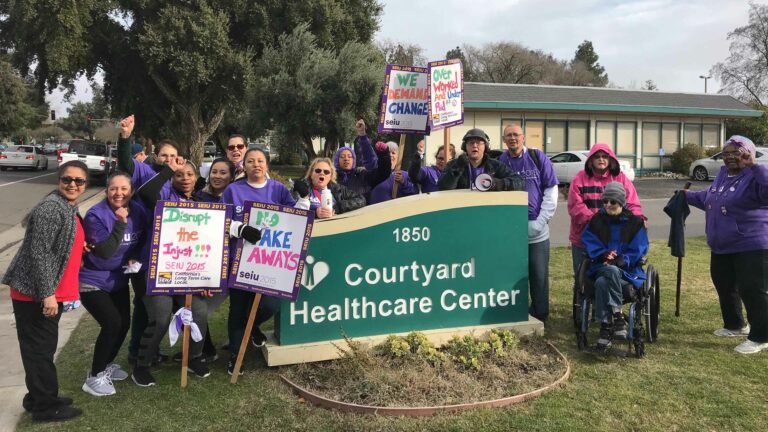
Staff members of the Courtyard Healthcare Center in Davis picketed on Friday, Jan. 17 to protest the proposed contract by their employer. The workers are represented by Service Employees International Union (SEIU) 2015, California’s union for Long Term Care Workers.

Ojo Akognon, a staff member of Courtyard Healthcare Center, explained what prompted the picket.

“We are on the table bargaining right now, and Courtyard is not moving,” Akognon said. “They’re not willing to give us livable wages, and they’re taking away part of the healthcare plan. We have to do this action so that we can move them on the table.”

This is the first picket carried out by the staff members. They’re returning to the bargaining table on Jan. 21, but if their demands are not met, they believe they would protest again.

According to staff member Alfa Cabiles, the majority of workers are protesting. This includes the certified nursing assistants, housekeeping and the dietary department. The nurses are not picketing, however, because they belong to a different union.

Cabiles went on to list that SEIU Local 2015 members picketed that day in five other locations as well. SEIU Local 2015 represents over 385,000 home care workers in California. Its website lists the organization’s vision statement.

“Through the work of our members, by building partnerships, and embracing innovation and education, SEIU Local 2015 long term care workers will have achieved quality jobs that deliver livable wages, retirement security, respect, and the right to a union for all,” its website reads.

  Organizer Eduardo Polanco said a much larger action will take place at the Board of Supervisors meeting in Woodland on Feb. 11 at 9 a.m. He described the importance of this meeting.

“Caregivers that work in Yolo County can get better wages and better benefits as the cost of living is continuing to rise,” Polanco said.

Administration from Courtyard Healthcare Center in Davis was unavailable for contact.

Written by: Eden Winniford –– city@theaggie.org