52.7 F
Davis

Davis, California

Friday, December 26, 2025
Home Blog Page 379

$9,000 raised after donations stolen from Woodland Salvation Army Service Center

Christmas break-in resulted in two doors being badly damaged, police still investigating

Thousands of dollars that had been raised through donations were stolen from the Salvation Army Service Center in Woodland over the holidays. The burglary occurred at 413 Main Street between late Tuesday, Dec. 24, 2019 and 12:30 on Thursday, Dec. 26, 2019, and resulted in damages to the service center of up to $1,000. 

Sam Jarosz, the public relations director for the Del Oro branch of the Salvation Army said employees who were returning to work after Christmas break “found two doors that were just pretty much destroyed.”

“Upon searching the buildings more, they found that $2,413 in kettle donations — which had been raised in the two days leading up to Christmas Eve — were stolen,” Jarosz said.

  According to Jarosz, the total losses added up to around $3,500, a blow to the holiday fundraising campaign and the efforts by the Woodland Salvation Army Service Center. 

“The last couple days in the red kettle campaign are usually some of our biggest days,” Jarosz said. “We really push to get those donations.”

The red kettle campaign, in which volunteers stand outside businesses with a red bucket for donations and a signature bell, generally operates between Thanksgiving and Christmas. The donations collected provide a large amount of funding for community programs offered throughout the year by the Salvation Army. 

This year, with Thanksgiving later in the month of November and fewer donations in general, the Salvation Army was already behind on its fundraising target before the break-in occurred. 

The Salvation Army mentioned the effects of the burglary in a KCRA article, stating “although no one was injured, this is far from a victimless crime” and that “these crimes push the service center further away from its fundraising target and could mean some people in need may not be able to receive services.”

In response to the burglary, the Salvation Army set up another donations page to recover the losses. According to Jarosz, the fundraiser raised almost $9,000 in the weeks since it was created. 

No suspects have been apprehended in the burglary, and the Woodland Police Department is currently investigating the incident. 

The Woodland Salvation Army Service Center provides a food pantry, Christmas rental and utility assistance and additional services in the Yolo County area. In Northern California, the nonprofit is known for supplying emergency shelters, transitional living centers, workforce development programs and adult rehabilitation programs for those in need. 

Jarosz described one of the most impactful Salvation Army programs for the Northern California and Nevada regions, Camp Del Oro.  

“It’s a wonderful experience to just be kids and learn about the outdoors and each other,” Jarosz said. “It’s been really helpful for children of Camp Fire survivors too.”

According to the Camp Del Oro website, donations to the Salvation Army help reduce the price of overnight camp by $32, and additional scholarships help children from low-income families afford the experience. 

Written by: Madeleine Payne – city@theaggie.org 
Chair of Math Department likens UC’s diversity statements to 1950 anti-Communist oaths in op-ed

Following publication of piece, discussion and debate ensues

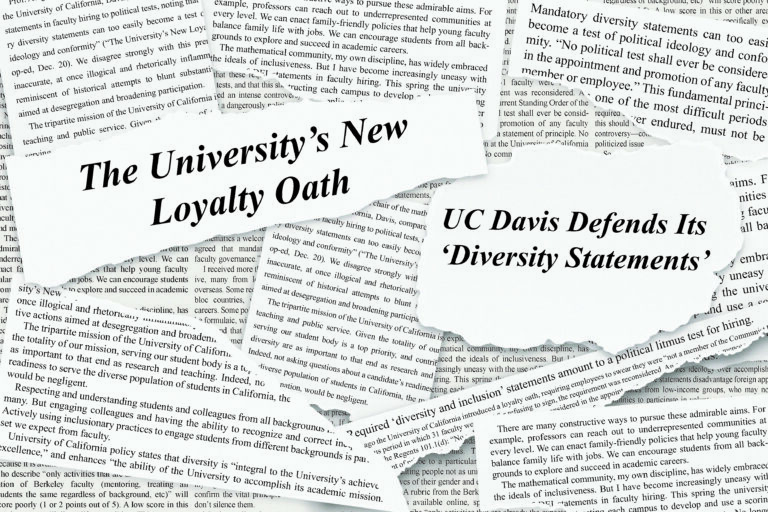
Diversity statements are political litmus tests, according to an editorial notice published in the December issue of the American Mathematical Society (AMS) Notices penned by Dr. Abigail Thompson, a professor in and chair of the UC Davis Mathematics Department. This notice was later expanded upon and appeared as an op-ed in the Wall Street Journal. Both articles have drawn varying reactions — including from the chancellor — and have garnered discussion on both a campus and national level.

When The California Aggie reached out to Thompson for comment, she said she was currently swamped with requests. The College Fix recently reported that Thompson would be writing a general response about her opinion piece and what followed from it, saying that she wanted to release the statement “hopefully in the next few weeks.” 

In October 2018, the UC Regents changed the Academic Personnel Manual, resulting in the consideration of “contributions to diversity” under “Criteria for Appointment, Promotion, and Appraisal.” According to Melissa Lutz-Blouin, director of UC Davis News and Media Relations, all tenure-track faculty at UC Davis must submit a “Contributions to Diversity, Equity, and Inclusion” statement. The statement is scored with a rubric and factored into the hiring committee’s evaluation of candidates. 

“Applications with ‘weak’ diversity statements may or may not proceed to the next step of hiring; this is left to the discretion of the recruitment committee,” Lutz-Blouin said. 

In the “Knowledge” section of the College of Engineering’s diversity statement rubric, a score of 1-2 — 1 being the worst and 5 being the best — is given to applicants with “little demonstrated understanding of diversity trends” and who are “unaware of personal challenges faced by under-represented groups.” The same score, in the “Track Record” section of the rubric, is given to applicants with “no participation in activities related to diversity and advancing inclusion.” The “Plans” section of the rubric states that a 1-2 score will be given to applicants who have “vague or no statements about what they would do if hired” and whose statements “describe only activities that are already the expectation of all faculty (e.g. mentoring, treating all students the same).” 

After seeing a similar rubric made public by UC Berkeley, Thompson, who is also a vice president of AMS, referred to these diversity statements as “a political test with teeth.” She said requiring faculty to submit such statements was political because it required faculty candidates to treat people differently according to their identity — a reflection of one’s belief about the way the world is organized.

“Faculty at universities across the country are facing an echo of the loyalty oath, a mandatory ‘Diversity Statement’ for job applicants,” Thompson wrote. 

Chancellor Gary May and Vice Chancellor Renetta Tull wrote a response to Thompson’s comparison of diversity statements to the loyalty oath.

“We disagree strongly with this premise,” the response said. “It is inaccurate, at once illogical and rhetorically inflammatory, and reminiscent of historical attempts to blunt substantive actions aimed at desegregation and broadening participation.”

The UC loyalty oath controversy happened between 1949 and 1950, during which time all UC faculty were mandated to sign a statement confirming they were not a member or supporter of the Communist Party. Thirty-one faculty members, including Edward Tolman, the leader of the non-signers and the namesake of UC Berkeley’s Tolman Hall, and David Saxon, a physicist who later became the UC’s president, were fired for refusing to sign. 

Dr. William Casey, a UC Davis chemistry professor, applauded Thompson “for her article about the reappearance of loyalty oaths at the University of California” in a statement published in the Wall Street Journal editorial section.

Casey recalled the Standing Order of the Regents 101.1d, which says that “no political test shall be required of applicants for jobs at the University of California,” as trying to eliminate viewpoint discrimination. 

“Why should your opinion on the right to life or gay marriage or electric cars — why should that have any bearing on your ability to discharge your abilities of teaching, service and research at the University of California?” Casey said.

Unlike the administration’s response, Casey said there was no position that would be the unified voice of the faculty. 

“In the first loyalty oath controversy, the faculty approved the oath by a factor of four to one,” Casey said. “So don’t look for unanimity in issues of free speech. It’s always controversial speech that needs protection.” 

The AMS opened up a response form to Thompson’s op-ed, which generated three letters. Two supported Thompson’s arguments and accumulated a total of 890 signatures. One that opposed Thompson’s arguments gathered 621 signatures. The letters were published online on Dec. 13, 2019, as part of the AMS Notices’ January 2020 edition. Additionally, the AMS Notices’ editor-in-chief posted a Twitter response acknowledging that Thompson’s piece was not representative of the views of AMS and apologized “to those who understood it as such.” 

One response in AMS Notices in support of Thompson directly addressed a response posted on the Institute for the Quantitative Study of Inclusion, Diversity, and Equity (QSIDE) site, calling it an attempt “to intimidate a voice within our mathematical community.” Authored by Chad Topaz, a Williams College mathematics professor, the response called for those who disagreed with AMS’s decision to publish the piece to contact UC Davis “to express […] concerns about diversity in the Department of Mathematics and about Thompson’s role as Chair.” It also encouraged faculty to direct students not to attend UC Davis.

Topaz, the director of QSIDE, submitted a preprint of a data science study that examines ethnicities, genders and other demographics of people who signed the three letters published in the AMS Notices. Using the platform Amazon Mechanical Turk, he and his fellow researchers crowdsourced the gathering of demographic and academic data of the signatories. 

They found that those who has signed on to what they termed Letter A — the letter opposing Thompson’s arguments — represented a broader range of institution types and levels of professional security and contained more women and members of minoritized ethnic groups. Those who signed both Letters B and C were “overwhelmingly inferred to be tenured white men at highly intensive research universities.”

Topaz said he hoped the research prompted people to reflect on mechanisms of power and added that he believed free speech, diversity, equity and inclusion were not in conflict.

“If someone doesn’t want to teach, they might not be appropriate for teaching positions,” Topaz said. “Just like if people don’t want to at least orient themselves toward diversity, equity and inclusion, for the relevant members of the university community, they might not be appropriate for certain jobs. It has nothing to do with speech. It’s a job qualification.”

Topaz identifies as a “social-justice-oriented professor” on his Twitter bio and said he started seeing how “discouraging” the mathematics landscape was after seeing the Society of Industrial and Applied Math’s announcement of their 31 fellows, 29 of which were men.

With regard to Thompson referring to diversity statements as political litmus tests, he said the way “political” has been used bothered him. 

“We could then say that insisting a candidate be good in a classroom is political,” Topaz said. “That doesn’t have anything to do with politics.”

UC Davis alumna Stephanie Chang, who signed Letter A, said her first reaction was one of shock. 

“I didn’t know what to say. I was extremely disappointed,” Chang said. “It was something I was shocked to see come from Davis itself. Diversity statements show people know we don’t live in a vacuum where we’re all born equal — it’s not just ‘if you work hard, you’re fine.’” 

Thompson has also received recent pushback when the Math Department, under her leadership, brought Yuval Peres, a math professor with a series of sexual misconduct allegations leveled against him, to speak at UC Davis. Peres’ lecture and Thompson’s op-ed made Chang feel that Thompson should be removed as chair of the department. 

“I’m not a huge fan, given her current opinion and her inviting him,” Chang said. “You’re saying that his work is more important than his character.” 

Chang, who now works as an engineer at GoDaddy, said she heard other opinions regarding the op-ed, where people agreed with Thompson’s sentiment but not her reasoning.

“I’ve heard that it can be hard for people who are struggling financially or mentally — who can’t do outreach because they don’t have time — to write a diversity statement that’s sufficient enough,” she said. “I can see that point, but Thompson’s point wasn’t that at all. It was a false equivalency.”

Chang said she agrees with the intentions behind diversity statements and affirmative action, but cannot speak about whether the execution is perfect. 

As a student, Chang was secretary of the Davis Computer Science Club for two years and vice president during her senior year. With the club, she held a yearly Gender Diversity in Tech conference supported by the department. 

“It was almost as if the onus for diversity, equity and inclusion was left to our club,” she said. “If I didn’t hold the event, there wouldn’t have been anything else going on. They weren’t against diversity, but they weren’t proactive about it, though they did try to hire more female professors.” 

With regard to hiring, Casey said search committees have done a “fine job” at making sure no one or their application is overlooked. 

“They don’t underrepresent minority and women candidates, they overrepresent them by a factor of about two relative to the applicant pool,” said Casey. “The problem isn’t with the search committees.” 

Casey believes that Thompson’s notice is not about anyone’s specific opinion about how to eliminate the achievement gap or achieve diversity. 

“The question is whether they’re even allowed to have an opinion that has not passed a narrow ideological filter that was determined by University of California administrators,” he said. “It’s not about my opinion. It’s about my right to have an opinion.” 

Written by: Janelle Marie Salanga — campus@theaggie.org

ASUCD needs you to vote to save student jobs and services

Basic Needs and Services Referendum is crucial to preserving association’s future

Our basic services and student jobs are in jeopardy. That’s why students must vote on the  Basic Needs and Services Referendum, which will be on the ballot in the 2020 ASUCD Winter Elections. The Editorial Board realizes that while students may be unaware of the full spectrum of amenities ASUCD encompasses, increased attention is necessary. If this referendum fails, students will suffer the consequences and lose services they may not realize fall under the jurisdiction of ASUCD.

Though the fine print of this referendum has yet to be released, its aim is clear: to raise the quarterly fee students pay to ASUCD by an estimated $26. While the concept of an increase may seem initially burdensome, it’s actually quite the opposite. Twenty-six dollars is a small price to pay for the continued ability to provide meals to food insecure students, keep coffee costs on campus low and maintain the supply of student jobs.

This fee, which currently rests at $8 per quarter, or $24 per year, has sat untouched since 1979, rendering it ineffective against harsh inflation rates. In fact, since the organization’s inception in 1915, the price has remained relatively steady — a stark contrast to California’s minimum wage, which has increased 31 times over the past 100 years.

While some ASUCD units generate revenue, others are programmatic or service-oriented. Some of the roughly 1,400 students who work for ASUCD work for the latter. Without this increase to the base fee, how can this non-profit organization continue to afford to pay those student employees and continue to put on events such as Picnic Day or the Whole Earth Festival? It can’t — and, without this increase, it won’t. These additional funds are an absolute necessity to sustain ASUCD, an organization that represents the livelihood of UC Davis, alive. Our elected officials have chosen this route because it’s the only feasible way to keep the organization afloat. 

Less than optimal alternatives include accepting assistance from the administration, which would force ASUCD to forfeit its financial autonomy, or privatizing the CoHo, which would result in price increases of up to 300% and an estimated 80% reduction in student jobs.

The numbers speak for themselves — ASUCD’s current base fee of $24 per year is notably the lowest ASUC fee. Students at UC Santa Barbara, for example, pay $630 per year. UC Berkeley’s yearly base fee is $112, and the remaining campuses’ fees average around $174.09. ASUCD is simply asking for is a base fee that is on par with that of its fellow UCs.

To say that ASUCD is just our campus student government would be a gross understatement. Yes, the organization contains the Senate, Executive Office and Judicial Council, but it also houses 16 units, seven commissions and 12 committees. ASUCD brings big-name artists to campus, ASUCD fixes students’ bikes, ASUCD advocates for mental health and so much more.

Though voter turnout in ASUCD elections is usually dismal, the past shows that students will often support for matters that greatly affect them — seen through the 2019 ASUCD Winter Elections, when 35.63% of the undergraduate population voted on the Unitrans Undergraduate Fee Referendum. A voter participation rate of at least 20%, with 60% of those voting yes, is needed to pass all fee referendums, and our hope is that students will recognize the same sense of urgency for this matter as they did with Unitrans.

We care deeply about this referendum, and we hope that our readers feel the same way. When voting on the Basic Needs and Services Referendum, students have the chance to support not only ASUCD, but also their fellow students’ basic needs, student organizations, news sources, transportation methods and more. This referendum is your chance to intervene to save structures fundamental to UC Davis’ identity and community.

Written by: The Editorial Board

Correction: A previous version of this editorial stated that the raise to the quarterly fee students pay to ASUCD would be an estimated $28. That is incorrect. It is actually $26. The Aggie regrets the error.

UC Davis men’s basketball drops tight conference opener

0

Aggies stumble in another close defeat

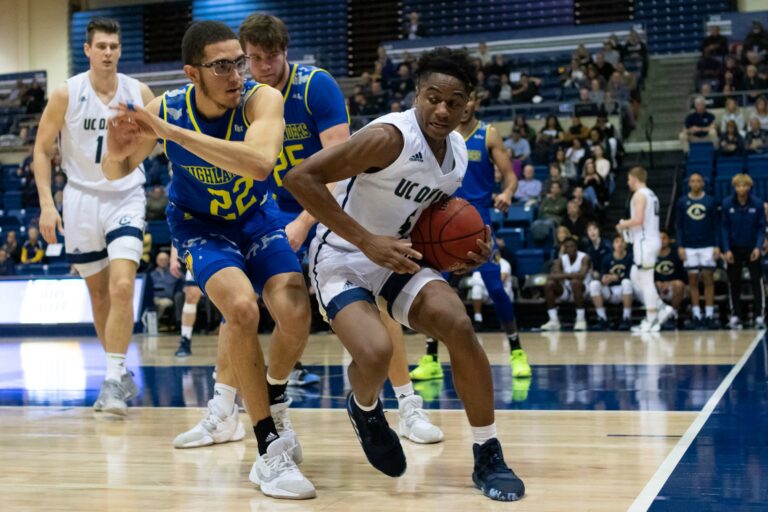
The UC Davis men’s basketball team suffered another painfully close loss in Thursday night’s Big West Conference opener, falling 65-59 to UC Riverside at The Pavilion. 

The tough defeat dropped the Aggies’ record to 6-11 on the season, with the last nine defeats all coming by 10 points or less. UC Davis is one of the youngest teams in the nation with a half dozen freshman and three sophomores on the 14-man squad, but the lack of experience has not held the team back. 

With the exception of a 82-48 season-opening loss at Loyola Chicago, the Aggies have given themselves a chance to win every game they have played in, often turning around large deficits with big second half comebacks. 

On Thursday night, UC Davis got off to a rocky start again, punishing itself with six sloppy turnovers in the opening four minutes of action. The team quickly fell behind and was forced to play catch-up for all but 43 seconds on the night, never once holding a lead.

“Unfortunately, we didn’t get enough contributions from everybody, from our starters to our bench,” said ninth-year Head Coach Jim Les. “I didn’t think our defensive intensity was what it needed to be. I thought we had too many unforced offensive errors and we’ve got to get that cleaned up if we’re going to be successful in this league.” 

The Aggies were able to weather the early storm thanks to consecutive three pointers by senior guards Joe Mooney and Stefan Gonzalez and sophomore guard Caleb Fuller. UC Davis relied on its sharp shooting from long range to stay competitive early in the game, nailing four of its first six attempts beyond the arc. 

Unfortunately, for the home team, UC Riverside simply would not slow down and instantly responded with eight points in a row to eliminate any momentum the Pavilion crowd hoped to create. The Highlanders shot 61.5% in the first half and were difficult to stop in the low post, scoring a total of 24 points in the paint. They also took advantage of nine UC Davis turnovers and cashed in on numerous points in transition. 

UCR took a 37-29 lead into the locker room at halftime, but it could have been a lot worse for the Aggies without sizable contributions from their bench. Gonzalez hit a trio of three pointers and Fuller was perfect from the field. 

The same problems continued to remerge for UC Davis in the second half when a flurry of six more turnovers in a four-minute stretch came at the most inopportune moment. The Aggies had began to build momentum with a 6-0 scoring run that cut the deficit to three points, but the team quickly got careless with the ball, which prompted a five-and-a-half minute scoring drought. 

“I’m not sure if it was nerves, but I thought a lot of those turnovers were from a lack of aggressiveness,” Les said. “If we make aggressive turnovers trying to make plays, you can live with those. But the ones tonight were unaggressive.”

The Aggies immediately suffered the consequences as UCR rattled off 10 straight points to regain a 13-point edge.  

As time started to run out, UC Davis kept chipping away at the deficit, largely due to the efforts of freshman guards Ezra Manjon and Elijah Pepper. The young duo — which had a combined total of 30 points that night — started to run loose on the fast break and suddenly the Aggies found themselves in a one-possession game with 42 ticks left on the clock. UC Riverside did not let it slip in the final minute though, calmly hitting seven free throws to ice the game. 

Besides Mooney, nobody else on the roster has played more minutes than Manjon and Pepper. Manjon, the only player to start all 17 games, ranks second behind Mooney in points scored and leads the team in assists. Pepper has especially made his presence felt on the defensive end of the court, leading the squad in rebounds and steals. Both players have made significant impacts in their short time on campus and undoubtedly have bright futures ahead of them at UC Davis.

UC Davis will enjoy a second consecutive weekend off before resuming conference play on Thursday at Long Beach State. Overall, the Aggies have hardly spent any time in Davis over the first two months of the season. The team’s 12 road games during the non-conference slate are the most in any season since Les took over in 2011. 

The Aggies have been highly competitive in all but one contest this season, but are continually finding themselves on the wrong side of close results. The young players have certainly experienced the high’s and low’s of a college basketball season and have had to learn some tough lessons the hard way.

“The mentality is that we have to just keep working and stop beating ourselves and shooting ourselves in the foot,” Les said. “We had a number of miscues tonight on both ends of the floor, so we’ve got to eliminate those. Teams are good enough, especially the way they play, where we can’t feed the fire and make mistakes on our own and I thought we did that tonight.”

During Thanksgiving week, UC Davis came excruciatingly close to knocking off a pair of Pac-12 opponents on the road. On a short road trip to Berkeley, the Aggies dug themselves an 18-point hole against Cal and were headed for an embarrassing blowout loss on national television until they furiously stormed back to grab the lead with nine minutes left in regulation, before eventually losing by six. Three days later in Salt Lake City, the team endured another sluggish start and fell behind by 13 at halftime, but another heroic comeback came up just short in the 77-73 loss to Utah. 

Other notable losses include a double overtime defeat against VMI at the Red Wolves Classic in Jonesboro, Ark. in November and a five-point loss against New Mexico in front of a raucous crowd of nearly 11,000 fans in late December. 

The Aggies hope their fortunes will turn around as the Big West slate progresses and maybe the ball will start rolling their way down the stretch. UC Davis won back-to-back conference titles from 2017-2018 before suffering a disappointing setback last season. 

With so much fresh, up-and-coming talent that will keep developing over the course of the season, there is no reason to believe the Aggies will not challenge for another championship in the near future. 

Written by: Brendan Ogburn — sports@theaggie.org

Women’s basketball team continues home court dominance

Aggies extend streak with overwhelming victory in Conference home-opener

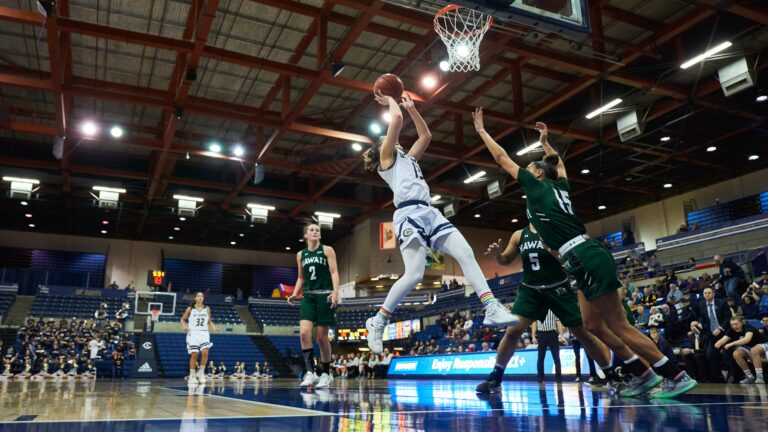
Coming off a historic 2018-2019 season in which the Aggies only lost a single game in conference play, head coach Jennifer Gross and co. are yearning to reciprocate last year’s success. Although the team lost numerous starters and seniors from last season, and is now battling through some injuries at the moment, the Aggies have displayed admirable resilience. Dating back to the end of 2017, the women’s basketball team is undefeated in home conference play, a streak that was extended with a come-from-behind win against Hawaii in the team’s inaugural 2020 conference matchup.

Saturday’s contest started off tumultuously for the Aggies, with Hawaii leading 13-7 at the conclusion of the first quarter. Gross placed an emphasis on defense and rebounding heading into the game, and it began to manifest in the second period, as the Aggies fought back to tie the game 15-15 behind smooth passing from redshirt junior point guard Mackenzie Trpcic.

Following the tie, Hawaii called a timeout to cool down the Aggies; albeit, to no avail. Out of the timeout, freshman guard Evanne Turner, sophomore guard Mikaila Sanders and then Trpcic nailed consecutive threes, sending the Pavilion into a frenzy. 

Not only did the Aggies explode for 20 points in the second frame, but they also held Hawaii to just four points — tied for second-fewest total in all of women’s college basketball since the NCAAW returned to quarter-play in 2015. That meant UC Davis led 27-17 entering the halftime break.

UC Davis burst out of the tunnel post-halftime still red hot, with lethal scorer and redshirt-senior guard Katie Toole burying a three and sinking a few other close range shots. It was Sanders, though, who stole the show in the third, splashing in three consecutive deep balls on her own and pushing her total to five on the afternoon. The third quarter ended with the Aggies sitting on a comfortable 49-28 lead. 

Although some substitutions led to some minor runs by the Rainbow Wahine, the Aggies shut down any hope of a miraculous comeback behind a clutch corner three from Toole, and lights-out free throw shooting courtesy of redshirt-sophomore forward Kayla Konrad. The scoreboard read 62-49 when the final buzzer sounded, solidifying the Aggies’ 23rd consecutive home court conference victory. 

Toole contributed a team-high 21 points — her fourth game this year with 20 or more. Also stuffing the statsheet was junior forward Cierra Hall, who recorded her fifth double-digit rebounding game of the season by grabbing 11 boards — including four on the offensive end.

Although the season has not been perfect, the now 6-9 Aggies are looking to kick things into gear with the heart of the season upcoming. Gross lauded her team’s mental fortitude.

“After the loss on Thursday, we really took a lot of accountability and the rebounding was an area where we were really unhappy with ourselves,” said Gross following Saturday’s game. “I think players, coaches, everybody. [We] turned it around today and had one of our best rebounding performances. I think we brought a lot of focus and urgency to the boards. I think we rebounded at about 90 percent which is very very good. So I’m really pleased at how we bounced back at something we struggled with the other day and turn that into a strength today.”

The Aggies outscored the Wahine 14-2 in second chance points, largely because of their aggressive rebounding on both ends of the floor. Being strong on the boards was also an important factor of limiting Hawaii’s scoring, especially in the middle quarters. Being able to lock-in defensively helped propel UC Davis into the lead and allowed them to stay ahead when the final buzzer sounded.

“That’s been a main point of ours, is consistent level of play and building habits everyday to perform the way that we want to,” Gross explained. “So I think the team gets it and why it’s so important because if you don’t have the strong habits to rely on, you never know what’s going to happen. So now it’s just about showing up everyday, committing to getting better, and working really hard to build those strong habits.” 

The scrappy UC Davis squad will return numerous players from injury before the season ends, including a crucial veteran piece in senior forward Nina Bessolo, who is week-to-week with a thumb injury, according to Gross. If the Aggies can manage to maintain a winning edge even without key starters in the rotation, it should instill confidence in a UC Davis team that’s still finding its stride.

“We could have easily gotten down on ourselves,” Gross said. “And I thought, ‘Its a new thing about this team that we’re staying positive and not focusing on the outcome and just focusing on our growth.’ And if we continue to do that I think we’re gonna be very dangerous in this next month or so.”

Gross is optimistic her team will catch fire at the end of the season with good reasoning, and Konrad backs up that sentiment. 

“We come out here everyday and we know it’s going to be a dogfight, so I’m just bringing everything I can,” Konrad said. “I think we’re going up from here and I’m really excited. Everyone’s really bought in […] We have a lot of really good young players, a lot of players stepping up with two of our best players out right now. So everyone’s just for the team and everyone’s going to step and do whatever they need to do.”

The Aggies will continue their dive into the Big West slate with a battle against Long Beach on Thursday night. UC Davis will hope to garner a 24th-straight conference home win before heading back on the road for a two-game stretch.

Written by: AJ Seymour — sports@theaggie.org

Environmental costs of the holiday season

Following “green holiday tips” won’t save the planet

In the 2018 movie “Leave No Trace,” an Iraq War veteran with PTSD lives with his daughter in the sprawling wilderness of the massive Forest Park in Portland, Ore. They live in isolation in the dense and murky forest, but as skilled survivalists, they live in balance with nature. And they’re happy.

But after being discovered by social services and arrested for illegally camping on public property, the two are relocated to live in and work on one of Oregon’s many industrial-scale Christmas tree farms. Raising and razing trees by the thousands so people can have something tall and green to stare at for a few weeks from the comfort of their living rooms does not sit well with the dad. The audience comes to realize how his pure and harmonious relationship with the natural world — the Pacific Northwest’s wondrous evergreen trees that previously gave him shelter — has now been tainted and compromised just for the sake of our Christmas tree tradition. Why do any of the trees have to be cut down? Why can’t we just keep planting them?

The enormous level of energy and effort that goes into planting and chopping down Christmas trees has always disgusted me on a gut level, as does the culture of mass consumption and waste that defines our holiday season. It’s definitely not news that our seemingly wholesome, family-centered traditions of begging for candy, trying to murder our crazy conservative uncle by over-stuffing him with food and buying hundreds of dollars worth of gifts to honor the hippy who died for our sins are not good for the environment.

This column could very well have been another so-called “think piece” that scolds Americans for doing things that are wasteful and not environmentally friendly. But as the Huffington Post recently learned before Thanksgiving, telling Americans that traveling millions of miles and eating millions of turkeys is increasing their carbon footprint will not do much beyond stirring the simmering stew of outrage over at Fox News, eventually prompting President Donald Trump to cite some supposed war that liberals are waging on Thanksgiving. 

First of all, Trump never exactly “cites” anything. Second, there is no “war on Thanksgiving.” And third, if there was, it certainly would not be about trying to “rename” the holiday as Trump claimed — it would be about the holiday’s environmental impact (same for the “war on Christmas”).

I could easily go on and on about holiday environmental consequences: the carbon cost of Christmas; how much higher greenhouse gas emissions are during the holiday season; how much uneaten food, wrapping paper, packaging and candy wrappers are thrown out; how much plastic is in Halloween costumes and decorations; how much energy and money is wasted on holiday lights; how many Christmas trees are killed. But my goal is not to scold Americans for participating in these traditions, no matter how wasteful and environmentally destructive they are.

I simply want people to outgrow the simplistic idea that everything about their holidays and traditions is good simply because they believe that the tradition itself is good or wholesome. And more importantly, I want people to get past the idea that people earn immunity from blame for that destruction just because they followed a few “green holiday tips.” This time of year, the internet and social media become densely populated with clickbait-y listicles that claim to give you all the answers for saving the planet — that is, if you can read whatever text is squeezed in between all the advertising banners. 

Of course, following those tips is better than not, but in reality, it’s just a drop in the bucket. These tips are often oversimplified and make people feel artificially good about themselves for doing the bare minimum, like buying a reusable plastic Christmas tree. 

As I explained before, it’s not hard to look at these colossal Christmas tree farms in the same way we see those enormous, cramped and inhumane poultry houses. “Close all these awful farms and I’ll be a vegetarian forever,” one might think.

But it’s a lot more complicated when it comes to the trees because plastic trees have their own environmental costs. And despite the ethical misgivings that people may have with the idea of tree farms, the trees on the farm actually provide valuable habitats and ecosystem services while they remain rooted in the ground for their short lives. In other words, we are at an ironic juncture where Christmas trees are so ingrained in our culture that the best way to mitigate the damages of our ecologically destructive tradition might be to continue our ecologically destructive tradition and milk any of the short term benefits that we can. 

Long story short, you won’t actually make a difference until the question you ask yourself (and that society as a whole asks itself) is not “How can I participate in these harmful traditions in the greenest way possible,” but rather, “Does preserving the values of these traditions really necessitate so many wasteful charades?” 

But the abundance of these convenient, lickety-split “solutions” to all of our environmental sins just goes to show that even the most environmentally conscious people will jump through hoops to feel good about themselves despite their only marginally less destructive behavior. They have convinced themselves that all the waste that’s become synonymous with these traditions is justified because they’re part of a tradition. Perhaps we should instead prioritize the “tradition” of being able to sustain a large population on the only planet in our solar system with water and breathable air.

American liberals and conservatives often seem to be more preoccupied with simply going through the “right” motions to demonstrate that they have the “right” values rather than pausing to consider whether their behavior actually reflects those values. As a result, I regretfully say that it’s doubtful our culture will allow us the collective self-awareness and mental bandwidth necessary to see how detached our contrived and overly-elaborate holiday celebrations are with the values these holidays are supposed to honor.

Written by: Benjamin Porter— bbporter@ucdavis.edu 

Disclaimer: The views and opinions expressed by individual columnists belong to the columnists alone and do not necessarily indicate the views and opinions held by The California Aggie

Police Logs

That’s a negative

December 23

“Male with head stuck inside washing machine in laundry room — reporting party thinks he’s high on something.”

“Male subject skateboarding and doing tricks in the middle of the street, reporting party honked at him and he cursed at her.”

“Smaller beige color dog with blue collar that growls and barks anytime someone comes close to it.”

December 27

“Breathing heard into phone — no response from caller — negative answer on call back.”

“Open line — music and singing heard. Negative sounds of distress.”

December 28

“Doors unlocked at building.”

“Five vehicles were egged on street this evening, per reporting party on going problem for the last month mainly on the weekends.”

December 29

“Porta-potty has been knocked over.”

“Subject across the street standing out in the rain in a santa hat pacing — subject is watching the people who had their vehicle broken into and has been smoking and then talking on a phone.”

January 1

“Subject walking slowly then stopping, seems suspicious.”

Review: “Let It Snow,” popular book and Netflix movie falls flat

Book or movie? A question as old as time

I am a total sucker when it comes to book-to-movie adaptations. So when I heard that “Let It Snow” was out, I watched it immediately and decided to read the book later. 

“Let it Snow” was adapted from the 2008 book of the same name by John Green, Lauren Myracle and Maureen Johnson. 

“Let it Snow” follows a group of teenagers each trying to solve their holiday problems. With actors such as Kiernan Shipka from “The Chilling Adventures of Sabrina” and “Mad Men,” Jacob Batalon from the “Spiderman” series and Odeya Rush from “Ladybird,” the cast was a hit. But the movie appears to have spent more money on actors than writing. The cast was there; it had the potential to be the beautiful Christmas rom-com that I wanted it to be, but there were simply too many loose strings that didn’t tie together in the end, and the characters fell flat. 

My main problem with movie adaptations of popular books is their inability to show any sort of personality in characters. They are bland and sanded down to the most evident flaws that become their single personality trait. 

Rush’s character Addie is the jealous girlfriend who is afraid that her boyfriend will cheat on her, all while dealing with her absent family. We never know her well enough to actually relate or feel sympathy for her character. The only thing I was able to muster for her character’s plight was a small, “oh man, that sucks.” But we move on. There’s not enough to Addie for viewers to sympathize with her. 

There is also Shameik Moore’s character Stuart Bale who is alone on Christmas Eve. But, again, we never find out much of why he spends his holiday nights alone in a hotel room. This is sad, but not sad enough to relate to the character. 

Not only do I love book-to-movie adaptations, but I love when movies string together the different stories that are playing out throughout the movie. Similar to “Love Actually” and “Crazy, Stupid, Love,” the movie “Let It Snow” focuses on four different love stories. 

The four different love stories consist of Julie (Isabela Moner) who meets a lonely celebrity who changes her day. Addie (Odeya Rush) is paralyzed with the idea that her boyfriend is cheating on her. Tobin (Mitchell Hope) is secretly in love with his best friend. 

But the main divergence from the book is the relationship between Dorie (Liv Hewson) and Kerrie (Anna Akana). Dorie is completely head over heels for Kerrie after a late night talking and sharing their lives with each other. But when Dorie and Kerrie see each other again, Kerrie acts as if she never met Dorie. 

The movie added Kerrie and Dorie’s love story, and it was a beautiful addition, but it was so rushed that I couldn’t see what was happening. Dorie mentions throughout the story that they had an unforgettable night, but we never see it happen. I would have been happy with small flashbacks of that night — a short snippet, a cookie crumble, something! But as always, the same-sex romance is left on the back burner, just there to appease the audience. 

It also would have been nice to know how Stuart Baule (Shameik Moore), the famous popstar who gets stuck in the snowy small town, rose to fame or why he has no family. But to my disappointment, none of the storylines worked as a movie. The movie ran for 92 minutes, so it should have been a TV show.

I read the book a month after I saw the movie and the book was even more of a disappointment. Each of the book’s three authors wrote a short story for the book, but each short story had its faults. Johnson wrote “The Jubilee Express,” which follows Jubilee as she is stranded in the middle of a snowstorm on her way to visit her grandparents. Jubilee meets Stuart, who gives her company on the snowy day. 

This short story made me feel like I was ten, staying up on Wattpad on a school night just to read — and not in a good way. A lot of young adult novels are flawed in their juvenile writing, but that is rarely a problem for me. Still, Johnson failed to meet my expectations, and her writing was subpar. Not only did her writing make me feel genuinely embarrassed to carry the book around with me, but her characters were unamusing.

Jubilee is the stereotypically smart but pretty girl in high school who hates cheerleaders because they’re dim. This overused personality makes me cringe. What’s worse about this short story is that it’s written by a woman. She created her protagonist as a devastating cliche.

John Green’s short story “A Cheertastic Christmas Miracle” was also lacking. Taking Johnson’s lead of using overwritten character types, Green brings in the Duke, who is the kind of girl who thinks a guy saying “you’re not like other girls” is a compliment. My problem with this character type is that it leads young girls to believe that they must hate pink and everything feminine in order to be intelligent. 

The lack of personality in the only female protagonist wasn’t the worst of Green’s story. “A Cheertastic Christmas Miracle” was boring, to put it simply. The story follows Tobin, whose parents are stuck outside of town because of the snowstorm, the Duke and JP. The group of friends are watching movies when Tobin gets a call that a group of cheerleaders are at the Waffle House and he needs to go over to play Twister. The trio drive through the snowstorm for the boys to play Twister with the cheerleaders and for the Duke to get hashbrowns. I wanted nothing more than to finish this short story. It dragged on, and I found myself counting how many pages I had left to finish.

Lauren Myracle wrote “The Patron Saint of Pigs” as the third story. Out of the three, this would be my favorite. This story follows Addie, who is devastated after a recent breakup with her boyfriend. In order to feel better about herself, she promises her friend Tegan that she will pick her up a pig. But Addie forgets to pick up the pig and someone else does, leading her to realize that she may be just as selfish as her friends tell her. But of course, like any cliched Christmas tale, Addie learns the valuable lesson of putting others before herself. This story is my favorite solely because Addie’s character flaws are so evident that it’s a refreshing change from the previous two stories. I also love how all the characters intertwine with each other. 

Choosing between the book and the movie, I would choose the movie. The stories are drastically different, but I didn’t enjoy reading the book. For those who like cheesy, mindless movies, this film just might be for you. Maybe. 

Written by: Itzelth Gamboa — arts@theaggie.org

Food Truck Feature: Shah’s Halal

0

Owner of Shah’s Halal Food Truck, fans of the food discuss its success 

Outside the Mondavi Center, on the Quad and clustered at the Silo, food trucks are a staple of the UC Davis campus, but the very first food truck to open on campus was Shah’s Halal in October of 2009. 

“I had moved to New York for a bit where I worked in food trucks and learned the way of the business before coming back home to California,” said owner Tory Mashriqi via email. “With the help of my family, we had our first food truck made in Florida and driven from there. Then we started applying to places to park and sell our food. UC Davis had agreed to sign a contract with us, and we haven’t looked back since!”

In a post on the UC Davis subreddit from a year ago that asks “Favorite food truck in campus? And what should we order?” the response “Shah’s Halal food. Chicken over rice, spicy” had the most points. And, according to Mashriqi, chicken over rice is the most common order.

Second-year computer science and engineering major Deeptanshu Sethi’s favorite thing to order is spicy chicken over rice. Sethi said that “the Shah’s experience is warranted at least once a week,” but he goes more often during week zero and finals week.

“Shah’s is more than an eatery,” Sethi said via email. “It’s a journey, a lifestyle. After I’ve eaten Shah’s, I feel as if I have been inoculated with a sensation in which my whole life flashes before my eyes.”

The food truck has many fans and followers — thanks to both its cuisine and reliability. Many food trucks come and go on the UC Davis campus, but Shah’s is dependable. Second-year biochemistry and molecular biology major Aparna Manoj feels the same way about Shah’s as many others, and her go-to order is also the chicken over rice.

“It’s literally the best food I’ve ever tasted and I could never imagine not loving that meal,” Manoj said via email.

The food truck serves about 700 customers a day, according to Mashriqi. He attributes its popularity to the fact that it was the first food truck on campus and that the line always moves quickly. There is another location at University Mall, but Mashriqi said to keep an eye out for another truck or two coming soon.

Manoj finds Shah’s comforting and said the food makes her feel “full, satisfied and happy,” and she always enjoys the experience.

“The food they serve is always warm and very flavorful, and it’s definitely a treat I reserve for when I need a pick-me-up or just want to be in a really good mood,” Manoj said. “Coming from a South-Asian household, their food reminds me of home-cooking, and so Shah’s always makes me feel very comforted, especially if I am feeling a little homesick. More than anything though, the spices and ingredients they use just taste so amazing, and it’s hands-down one of my favorite parts about Davis.”

When Manoj lived in the dorms, she would get Shah’s at least once every two weeks, but she doesn’t go as often now that she is living off-campus.

“The feeling of the hot and spicy food in my mouth when I go to their food-truck with my friends on a cold and windy day is irreplaceable,” Manoj said. “I’ve never had a cafe or restaurant I consistently run back to every time to not only eat or hang out, but to just put a smile on my face, and Shah’s is definitely that place for me now.” 

Sethi described the first time he had Shah’s on the first day of school after he had heard that a lot of students were losing “their minds over this food.” 

“I thought, ‘It’s just a food truck, how good could it be?’” Seth said. “The rest is history.” 

Since he is not a picky eater, Sethi said he can get good-tasting food at decent prices, but his love for Shah’s has given him “the flavor of spirituality.” Sethi added that, given the fact that Shah’s sometimes gives extra chicken and rice for free later in the day, they “understand us students” like no one else. Mashriqi said there are multiple reasons why Shah’s stands out among the other on-campus food trucks.

“We are a local, family-run business,” Mashriqi said. “Our food is made fresh daily. We’ve been serving for over a decade now, and we feel that campus faculty and students are most familiar with us.”

Written by: Anjini Venugopal — features@theaggie.org

Humor: Desperate student cites himself in MLA formatting

“Me, Myself and I. Personal Interview. 2019.”  

Fourth-year economics major Jonah Johnson was at the end of his rope last night. He had a 10-page paper due for his A History of the Paperclip class that he had put off until 9 p.m. the night before it was due.

Armed with a dangerous cocktail of Bang energy and double-shot espresso, Jonah locked himself into his room with only his hallucinations to keep him company. He read the prompt for the first time and swiftly experienced disillusionment. A string of unquotable expletives escaped his mouth. 

Sources. Oh god, the sources. The paper required five different secondary sources along with the primary text, which he didn’t even own. He had only taken this class because the professor was extraordinarily hot. 

He sat back and took an exhausted sip of his deadly cocktail, feeling his soul break up with its earthly container, leaving a depressed husk in its wake.

It was at this point that Jonah realized he would require access to the library’s database. Unfortunately for him, in order to access it, he needed the VPN login — that, or figure out how to somehow haul ass to Shields. 

He looked out the window. It was raining. Not happening. 

Jonah stood up from his chair. Now, what he reported next cannot be proven, but it also cannot be disproven. A flash of lightning struck outside his window, illuminating his body and bathing him in its bright, powerful light.

Perhaps it was the Bang coffee or a Come to Jesus moment — or maybe both — but he realized that he had three wonderful sources inside him all along. He returned to his seat and began aggressively typing. 

Who cares what 20th century paper clip experts have to say about whether the Norwegian inventor, Johan Vaaler, was the true inventor of the paper clip? 

Jonah f*****g Johnson thinks that Noreweigan dude sounded pretty legit, and it truly seemed like his expertise was overshadowed by that other guy… whatever his name was. The Guy that Doesn’t Really Matter All That Much Since We Learned About Him All the Way Back in Week One — yes, that was his name.

The sources were piling in, and they were high quality. He cited one source as “Me,” the other as “Myself” and the last as “I.” 

Me, Myself and I never contradicted his claims, and he did not have to puzzle over the date accessed and date published times in EasyBib since that information had been inside of him all along.

He felt a bit like a god and also a bit like a philosopher. He couldn’t help but judge his peers, who were hypothetically scouring archives for disjointed information that they would probably misinterpret, given their underdeveloped minds. No, this was the correct path.

Of course, in his reverie, he had forgotten the necessity of two other sources. But, you know what they say: Ignorance is bliss. And so is Bang energy and coffee mixed together in a 21-year-old digestive system.

Written by: Kelsey Stewart – kcstewart@ucdavis.edu

(This article is humor and/or satire, and its content is purely fictional. The story and the names of “sources” are fictionalized.)

Interior design: the what and why

What can set interior designs apart from the rest

When one thinks of interior design, a few things might come to mind. One of these things might be a curious head scratching that may occur if you speak to someone from the STEM field. Perhaps it is a girl with a wildflower tattoo telling you how much she appreciates the Urban Outfitters home decor section. Another could be the absolute mania of going to IKEA with your housemates for the first time. But what exactly is interior design? 

Interiors are a relatively new discipline in the professional creative world, but the history of the medium extends far beyond what one might have thought. Going all the way back to ancient times, Egyptians would decorate their mud huts with animal furs to add a pop of color and some visual appeal in a time before the living room was just a place for people to fight over what movie to stream. In 17th-century India, architects hired to create grandiose displays of wealth and stature were subsequently tapped to craft fitting interiors. In the Western world, with the rise of the bourgeoisie and their thirst for opulence in the 18th and 19th centuries, the role of an interior designer became more and more prominent. 

The actual craft of interior designing, however, is something that often confuses people. Is it really just arranging things in a certain way? Well, yes and no. Victor Reyes, a fourth-year biological sciences major, said interior design is the personality of a home — it’s like an art that is essential but often forgotten. 

It can simply be arranging things in a space, sure, but will it look like a place that inspires a reaction in you? Probably not. Many students at UC Davis who aren’t in a design field have nicely decorated homes. 

“I think interior design is really important for personalizing your space and making it as useful as possible for your specific needs,” said Kevin Pack, a third-year computer science major.

Indeed, as design is a solution to a problem, interior design tackles how to meet needs within a space.

This is to say you don’t need to be an interior designer to create attractive spaces to spend your time in, but the indispensable knowledge of color, space, object, material and atmosphere are the things that set apart spaces from just simply being to being simply great. This knowledge is the edge that interior designers have, a set of principles and disciplines guiding them to create efficiency and emotion within a space. 

The art of good interior design, then, like any other school of design, comes down to two universal elements: talent and taste. These are what separate designers from specifiers: those who can create a space versus those who simply like to look at catalogs. 

Talent is the secret sauce to being confident in your work, no matter what discipline it is. Ironically, in the world of design, it is something that emerges only from throwing yourself fully into your work. It is not as inherent as many people would lead you to believe. Taste is something much more subjective, however, so the only real definition one can give it is the commitment to an aesthetic, or a school of aesthetics. Pairing a mid-century modern Eames chair in an office with a Scandinavian glass table might seem like a good idea, but an interior designer knows better. Mid-century modern furniture emphasizes warm, inviting colors with an organic styling to them. A cold, harsh glass table would invariably clash with something like that. Now, perhaps at very high levels an interior designer would know how to tweak this room so that both could fit harmoniously, but that would be a challenging puzzle. 

The beauty of interior design is that anyone can try their hand at it, and many of us probably already have. Decorating a freshman dorm, a first apartment or a house for a party are all examples of this. Remember that time you put twinkly lights over your Polaroids in the living room? That’s interior design. What about that time you put that succulent on your table? Yup, interior design. When you fought with your housemate about the placement of the rug? Notch one up for interior design, baby. Although they’re all very micro forms of it, you are still designing and crafting a space for yourself. And that is the very essence of the discipline, from its inception. Elevating a space is a beautiful thing.

Written by: Ilya Shrayber — arts@theaggie.org

Humor: Girl who wears farmers market hat every day confesses she’s only been once

The truth comes out

Waking up in a cold sweat, Katie Helmer realized she couldn’t take it any longer. With graduation just around the corner, the last thing she wanted to do was leave Davis as a fraud. 

Four years of lies and cover-ups have haunted her during her time as an Aggie, and after much self-reflection and soul-searching, she is finally ready to tell us the truth.

Helmer is hesitant at first, hiding her face underneath her vividly pink Farmers Market hat. She takes several sips out of her Hydro Flask, which is also decked out with a Farmers Market sticker, among other stickers from various TV shows she claims she hasn’t seen.

“I’ve only been to the Davis Farmers Market once,” Helmer finally says, her voice shaking. “And that one time was just to buy the hat during my freshman year.”

To say we were shocked would be an understatement.  

Helmer has avoided the topic of going to the Farmers Market for as long as she can remember. While wearing the hat on campus, she’d often be bombarded with compliments from her peers, praising her for supporting local farmers. 

“Everyone applauds me for being unique, saying I’m not like other girls they’ve met. They all think I buy fresh celery and apple juice every weekend.” 

Helmer removed her cap and looked down in remorse. A single tear fell down her face. “I just can’t keep being someone I’m not.”

With her busy schedule of 12 units and countless service hours for her sorority, Helmer said she is frankly unable to find time to attend the weekly event.

“If only the grind stopped for just a moment, then maybe, just maybe, I’d be able to actually go,” Helmer said. “It’s just so hard.”

As our interview came to a close, Helmer unzipped her jacket, revealing a striking Ariana Grande tour shirt. When asked about her favorite song from the popular artist, Helmer began to slur her words incomprehensibly before suddenly running away. We assume she ran to attend the Farmers Market one last time before she finally crosses the stage. Her honesty today is truly commendable.

Written by: Julietta Bisharyan — jsbisharyan@ucdavis.edu

(This article is humor and/or satire, and its content is purely fictional. The story and the names of “sources” are fictionalized.)

Spring commencement speakers include CA Surgeon General, College District Chancellor, NASA Astronaut

Distinguished alumni announced as speakers

Among the many distinguished UC Davis alumni, three were announced as speakers for the campus’ undergraduate commencements in June. Nadine Burke Harris, California’s first surgeon general; Francisco Rodriguez, chancellor of the Los Angeles Community College District and Tracy Caldwell Dyson, a NASA astronaut, will speak to the thousands of graduates and guests at the UC Davis Health Stadium on June 12, 13 and 14 respectively. 

Traditionally, seven commencement ceremonies were held each year at UC Davis: three for the College of Letters and Science, two for the College of Agricultural and Environmental Sciences, one each for the College of Biological Sciences and for the College of Engineering. The seven commencements have been condensed into three – with the distinguished speakers each speaking at one – and majors from each of the four colleges will be represented at each of the ceremonies. 

The selection and invitation of these prominent speakers are among the university’s changes to spring undergraduate commencement announced in April to celebrate UC Davis as a whole as a leading public university.

“A committee of students, faculty and staff made recommendations to the chancellor based on the suggestions that came from a variety of sources,” said Julia Ann Easley, a news and media relations specialist for UC Davis. “The chancellor then made a final decision based on the top recommendations.” 

The selected speakers have made strides in the fields of public health, education and engineering. 

Burke Harris earned her medical degree from UC Davis in 2001 and was appointed Surgeon General of California in Jan. 2019 by Governor Gavin Newsom. As a clinician, researcher and author, Burke Harris advocates for educating people on how Adverse Childhood Experiences, or ACEs, negatively impact patients’ health. In 2018, she released her first book The Deepest Well: Healing the Long-Term Effects of Childhood Adversity. 

She has helped to pioneer the treatment of toxic stress through projects such as the Center for Youth Wellness, which focuses on risk screening, care coordination and multidisciplinary treatment. As surgeon general, she has worked to implement a California law in partnership with the state Department of Health Care Services that offers reimbursement to MediCal providers for ACE screening, including abuse and neglect, to promote further research on toxic stress. 

While in medical school, Burke Harris also served as co-director for UC Davis’ student-run Imani Clinic. 

Rodriguez earned a bachelor’s degree in Chicano studies in 1985 and a master’s degree in community development in 1997 from UC Davis. He currently serves as a chancellor of the Los Angeles Community College District, the largest community college district in the nation. In his 30 years of experience as an educator, faculty member and administrator within the California public higher education system, Rodriguez has dedicated his career to championing diversity, outreach and equitable education policies for underserved groups such as undocumented students and student-veterans. He has also been involved with many boards and committees such as director of the Board of Higher Education; Workforce of the National Academies of Sciences, Engineering and Medicine and the California Association of Latino Community College Trustees and Administrators Association (CALCCTA), to name a few. 

Additionally, he served as a past president of the Cal Aggie Alumni Association and director of the UC Davis Foundation Board. Rodriguez said he was honored for the opportunity to return to UC Davis to share his words to graduating students on his experiences.

“I am deeply appreciative of Chancellor May and the university for extending this invitation [and] I am looking forward to returning to campus to connect with students,” Rodriguez said. 

As far as the content of the commencement speech, Rodriguez said he plans to incorporate general themes that are both practical and inspirational, drawing from his perspective as a first-generation college student from an immigrant family with no history of higher education. 

“I also initially struggled to find and embrace my calling, my profession – that is, how I could understand and use this powerful tool called higher education to do good work and to make an impact in this world,” Rodriguez said. “I believe that one of the most important leadership traits that one can achieve is resilience, so I will give some reflections on this purposeful act and necessary determination to overcome obstacles and to always move forward.”

The final commencement speaker is Dyson, who earned her doctorate in chemistry from UC Davis and recognized by the university as the outstanding doctoral student in chemistry in 1997. She was selected as an astronaut for NASA in 1998. She was part of two spaceflights – serving as a mission specialist in 2007 and flight engineer in 2010, with three spacewalks the latter expedition. Her work included designing, constructing and implementing electronics and hardware in the study of atmospheric gas phase chemistry and presenting papers on chemical ionization. She was awarded the NASA Go the Extra Mile (GEM) Award in 2001 and the Distinguished Service Medal in 2010. 

Easley expressed excitement on having these speakers to introduce the university’s new commencement structure. 

“They are very accomplished alumni who are making an impact in our world – and beyond!” Easley said. “They will help launch these new ceremonies in a wonderful way as new UC Davis traditions begin.”

Written by: Graschelle Fariñas Hipolito — campus@theaggie.org

New era of football is phasing out coaches who cannot adapt

Antiquated schemes and playstyles proving inferior to new, innovative playbooks 

In Jeff Fisher’s final two years as head coach of the Los Angeles Rams, his team posted a 11-21 record, an underwhelming performance for a team with an abundance of talent. After parting ways with Fisher following the 2016-17 season, the Rams took a leap of faith by hiring 30-year-old Sean McVay, to the dismay of many disgruntled long-time colleagues of Fisher. But those who mocked the unprecedented move across sports news stations, talk shows and social media were silenced quickly after McVay and the Rams amassed 11 wins in his first season at the helm. 

McVay built a fast-paced, scheme-heavy offense that limited the amount of reads for his young quarterback, Jared Goff, while adding more for the team’s receivers and skill position players. This allowed Goff to have better control of the offense as a whole while also speeding up the Rams’ play-calling — similar to a college offense, only with more advanced and complex reads. The 2017-2018 season marked the first time the Rams had a winning record since ‘03. 

The prior year with Fisher as the head coach, the Rams offense was the laughing stock of the league, finishing last in points per game (14.9), yards per game (286.2), yards per play (4.7), and first downs per game (16.2) and Total QBR (38.9). A wild but true fact to illustrate how abysmal that QBR stat is: throwing the ball at the ground every offensive snap of the game will earn a quarterback a QBR of 39.6. It was the second straight season the Rams ranked last in offensive efficiency. 

McVay stepped into the spotlight in Los Angeles and immediately changed the focus of the entire NFL with his intuitive and innovative offense — boasting one of the league’s best attacks and leading the NFL in scoring at 31 points per game. In just his second year, any criticism of McVay and the Rams’ move was laid to rest, as he led his team to the Super Bowl. Although the Rams fell short to the New England Patriots, McVay became the youngest head coach to ever take a team to the Super Bowl at just 32 years old. 

If the importance of offensive innovation was not already evident, the Baltimore Ravens and quarterback Lamar Jackson made that clear as day this season. Jackson, a former Heisman Trophy winner at Louisville, appears only weeks away from receiving this year’s NFL MVP award in only his second season. 

Since Ravens head coach John Harbaugh was a bright-eyed kid, he has believed in the mantra: “You’re either getting better or you’re getting worse.” Harbaugh won a Super Bowl title with Baltimore fairly recently in 2013, but in this age of the NFL, that’s practically an eon. 

In that Super Bowl run, Harbaugh led the Ravens with Joe Flacco as his gunslinger. Flacco embodied the previous gold-standard quarterback: tall (standing six foot six), strong-armed and full of veteran experience — almost the polar opposite of Jackson. 

Jackson stands at roughly six feet two inches, has a low throwing release point, relies on his speed instead of technique frequently and just turned 23-years-old. At the college level, Jackson displayed some technical weaknesses that in the past, would have been considered red flags in the eyes of many NFL scouts. Namely, underthrowing some deep balls, missing badly while throwing on the run and hesitating to throw down the seams were factors that pushed the electrifying quarterback down the draft board in 2018 to number 32, where the Ravens moved up to snag their future star. While other coaches saw these flaws as imperfections or possibly major red flags, Harbaugh saw the genius in Jackson and understood how to scheme around the enigma perfectly. 

Although Jackson did show some flaws in his games, he also possessed unteachable abilities that very few other quarterbacks have ever had, which is what Harbaugh went after. Mainly because of Sean McVay’s offense in L.A., it became commonplace in the NFL for a quarterback to no longer have four to six reads and checkdowns to progress through, allowing an imperfect quarterback like Lamar to still succeed. 

For Jackson, Harbaugh and the Ravens this season, success is an understatement. In his first year in the league, Jackson began behind Flacco and played sparingly in Harbaugh’s traditional offense with a few integrated formations and plays. With a full offseason of film and playbook study, and an offensive system built entirely around him, Jackson not only shined this season, but shattered tons of NFL records. 

On the way to a first team All-Pro selection, Jackson broke the single-season quarterback rushing record with 1,206 yards — the most since Michael Vick of the Atlanta Falcons gained 1,039 yards on the ground in ‘06. Jackson even amassed more rushing yards alone than the Miami Dolphins did as an entire team (1,156) this season.

In addition, his 3,127 passing yards created the 3,000-1,000 club, which he is the sole member of, and also made him the first quarterback to ever throw for 30 touchdowns while running for 1,000 yards in the same season. Jackson led the league in passing touchdowns with 36, a new Ravens franchise record. Not to mention, Jackson’s 43 touchdowns accounted for this year surpassed the team touchdown totals of 17 NFL franchises. The NFL record for games with a perfect passing rating (158.3) is two, held solely by Ben Roethlisberger. Jackson had two this year alone. 

As of late, it seems as if all the emerging young quarterbacks have one thing in common: an ability to run. Although that not every player might have breakaway speed like Lamar Jackson or Kyler Murray, it’s undeniable that mobility has now become an essential characteristic of quarterbacks. The era of immobile pocket passers — like Phillip Rivers, Drew Brees and Tom Brady — may be on the decline, as young quarterbacks, from Jared Goff, to Patrick Mahomes, to Baker Mayfield, have shown the ability to make plays with their feet. The more weapons on the field, the harder it is to defend, so why wouldn’t coaches and general managers go after dual-threat quarterbacks? 

The only caveat to this formula is correctly matching the appropriate head coach with the right quarterback and team. Despite some teams, like the Houston Texans, having found perfect harmony in a new head coach-quarterback combo, other teams like the Cincinnati Bengals failed miserably. After going 2-14, it was quite obvious that Zac Taylor and the Bengals, or at least Andy Dalton, are far from a match made in heaven. 

Former Cleveland Browns head coach Freddie Kitchens was quickly relieved of his duties after just one season at the position. Perhaps this puzzling statement before a week four game was an indication of how the season would end up.

“We don’t draw up plays to beat the other team,” Kitchens said. “We play football. That’s what we want to be. I can’t get more clear than that. I think you know that about me. We want to be a football team. We don’t want to be the designer of plays.” 

Kitchens’ one season in Cleveland was a complete disappointment. The Browns finished with a 6-10 record, while Kitchens appeared to frustrate and alienate team leaders Odell Beckham Jr. and Jarvis Landry. 

To the joy of much of America, and dismay of the NFC East, Dallas Cowboys Owner Jerry Jones finally came to accept that his Dallas Cowboys will never be an elite team with Jason Garrett calling the shots, firing him shortly after the new year passed, in hopes of salvaging the careers of Ezekiel Elliot and Dak Prescott. 

Granted that Lamar Jackson’s story seems to be an anomaly at the moment, it is undeniable that teams will search to replicate the quarterback-friendly offense that has overtaken the league. 

Written by: AJ Seymour — sports@theaggie.org

Davis City Council approves plan, funding for daytime respite center

City council is working jointly with Yolo County Board of Supervisors to fund six months of operation

The Davis City Council voted to move forward with plans for constructing a daytime respite center on Fifth Street during a meeting on Tuesday, Dec. 17, 2019. The respite center would be open during the day to provide shower and restroom services, storage facilities and connection to social services. 

After receiving a status update from city staff and hearing a number of public comments, the Davis City Council approved initial implementation steps and allocated up to $300,000 for building and operation costs through June 30, 2020. The council also approved agreements with the Yolo County Health and Human Services Agency and CommuniCare Health Centers to provide staffing for the respite center.

Many of those who spoke during public comments supported building the daytime respite center at the corporate yard on Fifth Street, including volunteers from the Interfaith Rotating Winter Shelter and residents of the nearby Davis Manor neighborhood.

Yet several Davis residents expressed concerns about the location of the pilot project, bringing up issues ranging from the safety of children in the neighborhood to decreasing property values. 

Before the Fifth Street corporate yard was selected, the Davis City Council had been considering five potential sites for building the respite center. Councilmembers originally favored the city-owned land under the Dave Pelz bicycle overpass on Second Street for the proposed location but ended up switching the project to the Fifth Street location in early November. 

During the City Council meeting on Dec. 17, councilmember Will Arnold stressed that this switch occurred because of the advantages to the Fifth Street location and not due to complaints made by citizens.   

“The Dave Pell’s Overcrossing — if it had the infrastructure and location assets that this location had — that’s where we would be doing it, in my opinion,” Arnold said. “It’s not about one neighborhood versus another, it is about existing infrastructure and location — proximity to services, proximity to transport.”

Gloria Partida, the mayor pro tempore, emphasized the urgency of the situation and discussed how building a respite center could mitigate some of the concerns expressed by neighbors. 

“We got to the point where now it’s rainy, now it’s cold and we really want to help these people get out of this situation and this is the place where we can do that the fastest,” Partida said. “The number one complaint we have from people is human waste, and we are hoping that a lot of issues that people struggle with from our homeless population will be mitigated by this site being opened.”

Earlier in the day, the Yolo County Board of Supervisors approved additional funding to help with start-up costs and hiring two full-time employees for the respite center. Supervisor Don Saylor spoke during the Davis City Council meeting to reiterate the support for the pilot center from the Yolo County Board of Supervisors. 

“I want to thank this council for your hard work and your dedication to addressing this issue,” Saylor said. “It’s clearly a community priority to address the issue wisely, with compassion, and we are at the point in our history where we have some capacity and resources to direct to this cause.”

The Davis City Council is also working with the Yolo County Board of Supervisors in purchasing a duplex on H Street to provide permanent services for the homeless population. The building is intended to be used as an interim shelter during the construction of Paul’s Place, a new project that would replace the Davis Community Meals and Housing homeless shelter located right next to the duplex.

As many changes are being made in an effort to support the homeless population of Davis, Councilmember Lucas Frerichs encouraged increased community outreach, especially in the Davis Manor neighborhood. 

“There’s going to be, of course, a real need for neighborhood community engagement,” Frerichs said. “I’ve been in the neighborhood a lot, both before the community meeting, during the community meeting and since the community meeting — talking with neighbors about this particular issue — both those in support and opposition.”

Councilmember Dan Carson enumerated the reasons for building the interim shelter, including the oncoming winter weather. 

“This has not been a perfect process, but we’re eight days from wind, cold and rain and more of that is coming,” Carson said. “I feel morally bound to support an action that seems well planned out that will help keep folks alive, but there are strong analytical and good policy reasons for doing this.”

Written by: Madeleine Payne – city@theaggie.org