55.7 F
Davis

Davis, California

Monday, December 22, 2025
Home Blog Page 444

Guest: UC Davis, don’t hide behind the First Amendment

A police officer and licensed attorney argues that Professor Clover’s words aren’t as protected as the university has made them out to be

UC Davis Professor Joshua Clover, who specializes in Marxism, recently came under fire for his comments advocating for violence against police officers. As someone who has spent over a decade-and-a half wearing a uniform, these comments don’t surprise me. While they are disgusting and inappropriate, especially coming from a “respected academic,” they are in fact Constitutionally-protected speech. Just because speech is protected, however, doesn’t mean it is without ramifications.

Predictably, the UC Davis administration has condemned the professor’s remarks. And also predictability, the administration has said that “public statements [such as these]… are accorded a high level of protection under the First Amendment.” With the explosion of social media, it seems as though every week a college administration is issuing statements about a professor’s First Amendment rights. It might make good sense, then, that college administrators be provided with a brief Constitutional law lesson. As I am a street cop and not a law professor, I’ll try to do my best here.

The First Amendment restricts the ability of Congress to make a law abridging the freedom of speech. By way of the 14th Amendment, the First Amendment applies to state governments.

Generally, private employees are not protected from discipline from their employers for their speech. Public employees, such as public university professors, are placed into a special category and do receive some First Amendment protection with respect to their employers. However, according to a 2006 Supreme Court decision, to receive this protection, the employee must satisfy a three-prong test to determine if the speech is in fact protected.

First, government employees must be speaking as private citizens. Second, the government employee must be speaking on a matter of public concern. And third, one must weigh whether the government employer’s interest in efficiently fulfilling its public services is greater than the employee’s interest in speaking freely.

The first two prongs of the Supreme Court decision seem to have been met here. Number one, Professor Clover’s remarks were on his private Twitter account (even if he is identified as a UC Davis professor); and secondly, no one would argue that any matter with the police is not a matter of public concern. However, it is the third prong where this test seems to fail.

As a state university, UC Davis has an interest in providing education to all citizens of California, which includes the family of 1,646 California peace officers who died in the line of duty while protecting the citizens of California. Professor Clover’s interest in making comments advocating for violence against police officers could not possibly outweigh UC Davis’ mission to fairly and impartially provide higher education. In fact, other than passing on his hate message, I can’t really fathom what interest Professor Clover has in making those comments.

Earlier last year, a City University of New York professor, Michael Isaacson, had his employment terminated after he made similar comments about the police. If the UC Davis administration does not want to take action against Professor Clover, that is their prerogative and right. But to claim that they can’t by hiding behind the skirts of the First Amendment is a slap in the face of the men and women in uniform at home and abroad, who have sworn to uphold the Constitution, often times with their lives.

Written by: Ari L. Maas

The writer is a police officer with 16 years of experience who currently resides in Nanuet, New York. He holds a B.S. in Civil Engineering from Rutgers University, a J.D. from New York Law School and a Master of Public Policy from Princeton University’s Woodrow Wilson School. He is a licensed attorney in both New York and New Jersey.

To submit a letter to the editor, please email opinion@theaggie.org.
Guest: Why the Israeli-Palestinian debate belongs at UC Davis

An outgoing ASUCD Senator argues that the Israeli-Palestinian debate has a place in student government

Imagine the moment you found out you’d be continuing your education at UC Davis. That moment defined the beginning of a new era for each of us, one that meant an opening to learning and expanding our knowledge, allowing us to become better at what it is we are passionate about.

Now, imagine after committing to UC Davis, you were told you could not voice your opinion on an issue you are passionate about, or simply seek to learn more about. This would outrage any rational, education-loving human being.

Luckily, our campus does not place such “official” regulations on us. Unfortunately, that does not mean every student is truly free to express themselves without repercussion. This is especially true for the wide pro-Palestinian community here at UC Davis. Aside from the fact that watch-lists like Canary Mission exist to track our every move in a fixed effort to slander us as “anti-Semites,” the simple fact is that debate is stifled on this issue, particularly by your own Associated Students.

As a current interim Senator, former City and Community Affairs Director, Unit Director and Chief of Staff, I have witnessed our student government attempt to silence the pro-Palestinian community for well over a year. The most common method used is framing the issue as one “that has no place in ASUCD.” Of course, this does not apply when the Senate is passing resolutions making “criticism of the State of Israel” anti-Semitic; this standard only applies when pro-Palestinian students begin to voice legitimate concerns. While there is an argument to be made for why this issue should be independent of ASUCD, I chose to write this article to explain why it is impossible for ASUCD not to get involved in this issue.

First and foremost, as members of ASUCD, we are here to represent students, so if an issue affects any student, it affects us, too. In our case, the debate surrounding Israel/Palestine certainly effects students both directly and indirectly. It directly affects students, when innocent people voicing their opinions are blacklisted by a group like Canary Mission, slandering them and making their lives difficult — all for practicing their constitutionally-protected rights. Another case in which it affects our students is when anti-Semitic flyers are posted around campus. Moreover, it indirectly affects us all because it is the great foreign policy challenge of our time, and the United States federal government plays a big role in this. As students who seek to make a change in the world, regardless of what field we go into, this issue will come up at some point.

Second, if our university is partnering with corporations that contribute to the State of Israel, a country that time and time again has demolished homes inhumanely, killed innocent children and displaced thousands of innocent people, how can we students remain quiet?

The answer is simple: We don’t remain quiet. We have seen it every year at UC Davis — students rising up, as a collective whole, seeking justice for Palestinians and making sure their voices are heard. If our students are coming out in such force, then why should the Associated Students remain quiet? What logic and rationale exists for that? Furthermore, it is unjust of us to sit back from a privileged position and recuse ourselves of necessary debate that not only affects our fellow students but our fellow human beings, at home and abroad.

Lastly, we (the student body of UC Davis) are not only the future of this country, we are the present. What we do here, what we say here, what we learn here matters. Never let anyone tell you it is not your place to debate. Never let anyone silence you, especially when you’re passionate and you have something to say. The fact is that every decision the U.S. Government makes, even in foreign policy, can have an effect on us. Therefore, since the Israeli/Palestinian conflict is a big part of American foreign policy, we as students not only have a role to play in fixing America’s policy, but a moral obligation to do so.

As I finish my term, I encourage all continuing senators, newly elected senators and members of ASUCD to not shy away from voicing their opinions, even if those around you say “it has no role in this association.”

Written by: Mohammad Qayum

The writer is a fourth-year political science major at UC Davis and an outgoing ASUCD Senator whose term ends on Thursday, March 14.
To submit a letter to the editor, please email opinion@theaggie.org.

Humor: Little Caesar’s celebrates Ides of March with collectible knives stabbed into every pizza

Caesar wasn’t HOT-N-READY for impalement, but this pizza is!

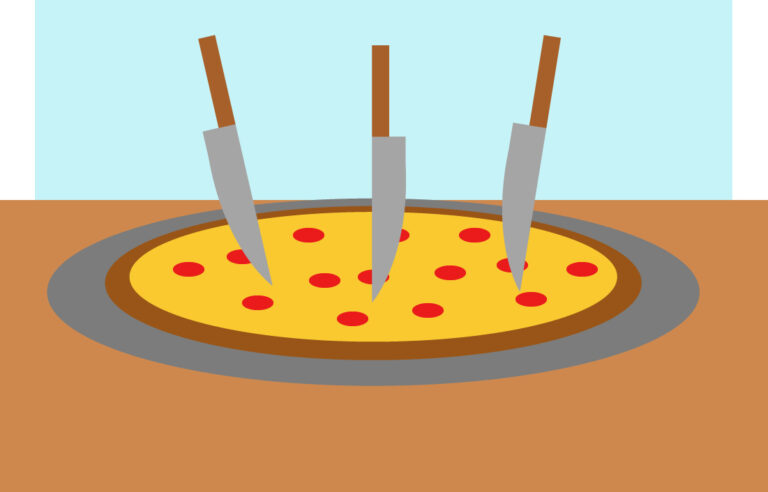
What’s better than getting a large pepperoni pizza to celebrate the brutal murder of history’s favorite dictator? Getting a free knife as well! That’s right, the brains behind your favorite I’m-drunk-and-it’s-2-a.m. pizzeria chain are giving away collectible knives with the purchase of every pie on Mar. 15.

Everyone knows that all Little Caesars employees are big history buffs, so chefs are painstakingly recreating the day Julius Caesar should have called in sick for work. When you first open the box, you’ll realize that the employees didn’t put any of the toppings you wanted on the pizza. You’ll feel betrayed, and then you’ll realize you could never feel more betrayed than Caesar when he saw Brutus pull out a dagger. Et tu, pepperoni?

If you’re intolerant of the ol’ lactose, that’s even better. This pizza is extra cheesy, and you’ll feel like the mozzarella is skewering you right in the gut, Caesar style. Marinara is haphazardly sprayed onto the pie to recreate that spurt-of-blood-from-being-stabbed-by-an-entire-Senate look. This flavor profile is so tasty, it’s to die for.

Don’t get it twisted: this pizza was not made with love, like the normal Little Caesars fodder. It was crafted with a seething hatred for totalitarian, un-democratic methods of governance. Seething hatred, and a blend of Italian herbs and spices. There are 60 different variants of collectible knives, one knife for every co-conspirator! Now, employees only stab one of these knives into the heart of each pizza, so be sure to spend your rent money on collecting as many as possible.

The California Aggie recommends that you order this sweet deal to fuel a late night of completing, by yourself, what was supposed to be a group project. As you sob into the thick crust, you can think about how your group members abandoned you to go to a rave in Sacramento. Now that’s what I call backstabbing!

Written by: Madeline Kumagai — mskumagai@ucdavis.edu

(This article is humor and/or satire, and its content is purely fictional. The story and the names of “sources” are fictionalized.)

Blue Gatorade or Davis water?

City of Davis receives accusations of dyeing water blue, results show otherwise

Throughout January and February, the city of Davis received multiple complaints about the water tint being more blue than usual, especially when observed in large basins such as bathtubs. The city responded almost immediately to these calls and took water samples, both within residential homes and the distribution system in South Davis.

Although it is not required to take more than one sample, the city felt inclined to get to the bottom of this to ensure citizens that the distribution system was not contributing to the issue at hand. Typically, homeowners are responsible for anything having to do with their water, including samples and tests done on private property.

The results from the tests performed exhibited that the city delivers colorless water, and the constituents tested for met all state and federal drinking water standards. The city now has taken even further action to comprehend why this might be, consulting other agencies and firms on potential factors that may cause blue-tinted water.

“The city of Davis does receive discolored water calls on occasion,” said Heather Brown, the water quality coordinator for the City of Davis Public Works Department. “The city received and responded to a call regarding blue-tinted water in the fall of 2018. After taking water samples and investigating the call, it was determined that the water entering the residence met all drinking water standards, and that the blue tint was most likely due to the physical properties of water and not due to its quality.”

Brown believes that water may come up as bluer when viewed in large quantities or white bathtubs due to the fact that when light shines on water, some colors are absorbed and others are reflected. She also stated that light bulbs used in homes produce different types of light, as different individuals also do see several shades or hues of blue in varying tones.

“It would be very difficult to dye the water any color due to the large volume of water delivered in the potable water system,” Brown said. “Localized discoloration does occur, primarily due to legacy deposits of manganese on the interior of the water mains from when the city was supplied by groundwater. This is a short term issue that [is] usually resolved by simply flushing your home plumbing to a lawn or through a faucet.”

Since water quality tests came back normal, South Davis residents can now be freed of the notion that their water was being dyed blue.

Written by: Lauren Tropio — city@theaggie.org

Japanese internment demonstration honors 77th anniversary of executive decision

ECAC, YDSA involved in demonstration to inform students of Japanese-American internment during WWII

The Ethnic and Cultural Affairs Commission (ECAC) and the Young Democratic Socialists of America (YSDA) chapter at UC Davis held a demonstration in front of the Memorial Union on Feb. 19 in honor of the 77th anniversary of the U.S. executive decision to inter Japanese-Americans during World War II.

Rina Singh, a fourth-year political science, international relations and Italian triple major and chair of ECAC, emphasized that the event at the MU was intended as a gesture of solidarity for individuals impacted by the internment of Japanese-Americans.

“I think it’s really important for us as a commission that aims to stand in solidarity with different communities of color to be out here,” Singh said.

Yalda Saii, a second-year sociology major and commissioner of ECAC, also stressed the importance of reflecting on the event of Japanese-American internment in the U.S. when considering daily life and rhetoric in the nation today.

“I think it’s also important for us to recognize in our political climate today just the parallels, because obviously we don’t want something like this to happen again,” Saii said. “We have to be attentive of current political rhetoric and work towards a future where we don’t have to be concerned about the possibility of this happening again.”

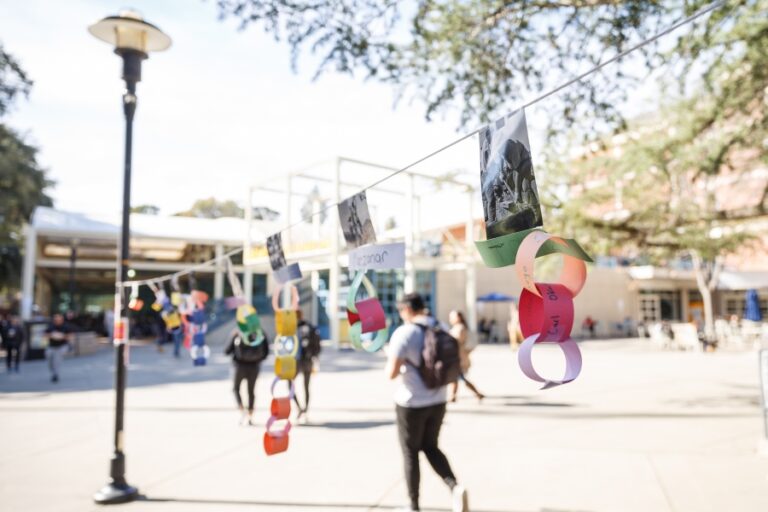
The demonstration included a clothesline with pieces of paper listing each of the 10 internment camps created by the U.S. during WWII. Students participating in the demonstration looked up a name of an individual interned in one of the 10 camps and placed a link made of a colored piece of paper that included the interned individual’s name under the location where they were interned.

“For example, Manzanar is the one that people here know about, so now we have three names in Manzanar,” said Morganne Blais-McPherson, a graduate student in the anthropology department and co-chair of YDSA. “We had a couple of people who didn’t even have to use a search engine, because actually their grandparents had been put into internment camps. They put the names and they knew where their grandparents had been placed.”

Of the students whose grandparents were interned is Mark Shimabukuro, a fourth-year cinema digital media major and member of YDSA. Shimabukuro stressed the importance of learning from history to avoid making the same historical mistakes in modern times.

“I think one of the most important tools we have as a society is collective memory,” Shimabukuro said. “We can look back at the mistakes of the past and not only honor those that had to go through these things, but learn from these experiences and make changes to ensure that nothing like this will ever happen again.”

Shimabukuro said that he feels he’s continuing his grandmother’s legacy by raising awareness and reminding others about this period in American history, just as his grandmother, who was interned, did throughout her life.

“Especially since this is a particularly overlooked event in American history, I want to make sure that people are able to connect the names and faces of these people to this point in our history, so we don’t forget the humanity of these people interned,” Shimabukuro said.

Blais-McPherson said that students responded well to the demonstration and were interested in it.

“I was putting up fliers on the tables and just having conversations and people were really thanking us, because I think that people do think this is an important part of American history that we need to remember,” Blais-McPherson said.

When asked why the YDSA organization was partnering with ECAC for this demonstration, Blais-McPherson responded that it was because both organizations “are very anti-racist.”

“In terms of why we’re doing it now, it is the 77th anniversary,”  Blais-McPherson said. “And we just want to also remind people that it’s not that racism isn’t here anymore.”

Written By: Sabrina Habchi — campus@theaggie.org

True Detective Season Three: Redeeming the Franchise

HBO’s crime drama wraps up in an unconventional yet satisfying way

Time is a flat circle. This is a reference to the most important story aspect from the first season of HBO’s crime drama anthology “True Detective,” where the main character Rustin Cohle, played by Matthew McConaughey, is obsessed with the cyclical, never-ending nature of time; however, Cohle never experiences the flat circle of time.  It’s Mahershala Ali’s Wayne Hays in the third season who is forced to venture into the endless and revolving depths of his mind as it fades from existence after a long life of war and policing.

The writer of “True Detective,” Nic Pizzolatto, is known for writing complicated characters, which he faithfully delivers in the third season. Yet the biggest controversy of the season, splitting fans down the middle of disappointment and delight, is when Pizzolatto refused another trope of the series he’s well known for — the final shootout, the grand finale.

In both the first and second season, the series finale resulted in tears as the fans plead for their favorite characters to survive their violent confrontation with the masked killer they were hunting. Because the entirety of the third season was presented as one large memory inside Hays’ mind — another reference to Cohle’s first season philosophy — the finale episode was from the perspective of Hays as a seventy-year-old man, which brought fans to their knees as they hoped they weren’t going to see him gutted with a knife or executed by a government militia. But, no. Pizzolatto went the optimistic route.

All eight episodes of the season were spent on the pursuit of Julie Purcell, a girl who was supposedly kidnapped at a young age, which resulted in her brother’s murder when he tried to stop the incident. The final episode was a reunion, of sorts, between the lost and found. Once again, the audience expected the worst with the missing girl since both prior seasons dealt with a pedifilic ring of kidnappers that were tied in with local government forces. In fact, those clues were even laid out for the audience. As a true-crime documentarian, Elisa Montgomery, played by Sarah Gadon, presented similar evidence between the Purcell case in Arkansas and other missing children cases in Louisiana — which ended up being a direct reference to season one as Montgomery showed newspaper clippings of hero detectives, Cohle and Martin Hart, played by Woody Harrelson.

Instead of a bloody end, this season concluded with Hays having a flashback to a piece of evidence he wholly overlooked, which then lead to him finding Purcell alive, happy and with a daughter of her own. The Arkansas community expected her dead, and so did the audience, but she was actually sold by her drug addict mother to another woman of large fortune to be her own daughter since she had lost her own. Although nothing goes over smoothly; as the sale results in Purcell’s brother’s unfortunate death and her own drugging to forget the incident.

Surprisingly, Purcell lived a happy life, albeit on copious amount of Lithium, until she escapes the “pink castle” and builds a life of her own. And while the detectives are searching for kidnappers and gunning down suspects while on the hunt, Purcell is living happily in a convent, thus steering the two roads of seekers and hiders to never merge with one another until the finale. In that final meeting, Hays finds the address to Purcell’s new family and pays them a visit. But he forgets what he’s doing and where he’s at upon walking up the driveway, resulting in a nice conversation between an elderly man and middle-aged mother who do not recognize each other despite their long history within the flat circle.

This season may refuse its audience a few aspects they’ve come to expect from Pizzolatto: the monsters in the dark and the finale shootout that reveals those monsters, but it replaces those tropes with more pertinent themes. Probably the most lovable aspect of this season is the unbreakable bond between Hays and his partner Roland West, played by Stephen Dorff, who spend over 35 years together on the Purcell case alone. Despite their unyielding partnership, external racial tensions put them at odds more often than not.

As West consistently received praise for Hays’ hard work, West is determined to the pull strings that will allow his partner shine in the light of the racially prejudice foundations the Arkansas Government is built upon, however, that’s not how Hays works. As he puts it, “I don’t play games.” His decisions to overcome the racist dispositions of his employers and working on the case on his own time leads him to find the Purcell girl while the rest of police force fades from the picture.

The bond between these two partners is what keeps a smile on the viewer’s face. Much like in every other season of True Detective, the audience is brought into the front seat of a vehicle with two partners on the hunt. But what’s different this time around is that these partners actually enjoy each others company from the start and their friendship only grows.

Season three deals less with the darkness of humanity and more with the horror of  the mind. The audience spends more time being viciously flailed around from dark corner to dark corner inside Hays’ fading memory.

That is where the brilliance of this season stays: while each scene represents a memory that Hays is experiencing, the reliability of that memory is sketchy. There might be a scene of an elderly Hays traversing the dark cellars of the pink castle, but pay attention to the mirrors on the wall and you will see a reflection of thirty-year-old Hays — is that how he sees himself, even in old age, or is that memory ever really taking place? For the first time ever in “True Detective” history, the audience must bear the weight of an unreliable narrator as they explore his most intimate memories and hazy recollections. It goes without saying, Mahershala Ali is a brilliant actor, meant to play only the most important roles on-screen. Paired with a writer like Nic Pizzolatto, the combination results in an unforgettable television performance that stands side-by-side with the greatness of the most favored first season of “True Detective.”

Written by: Clay Allen Rogers — arts@theaggie.org

Police Logs

Stranger danger

February 27

“Mediation with granddaughter who is currently moving out of resident and yelling/causing a scene reporting party has AirBnB tenant staying at location and doesn’t want to expose them to granddaughter’s behavior.”

“Open line with faint conversation then x faintly saying she called by mistake.”

“On the bike path behind above location — two car batteries in close proximity to a transient camp. Reporting party concerned the batteries could shock a child. Request they be picked up.”

February 28

“Transient sleeping in the elevator. Request subject be moved along.”

March 2

“Second floor near elevator, male transient playing loud music from boombox.”

“Request advice for legality of what constitutes stalking.”

March 3

“Female subject told employee to ‘keep an eye out for her because she doesn’t know the person’ keeping her company.”

March 4

“Open line with talking heard, no obvious distress.”


If Trees Could Talk

A whimsical, interactive art piece brings focus to environmental issues

Third-year studio art and psychology major Maxine Aiello turns campus trees into pieces of art through a project titled “If Trees Could Talk.” Aiello placed mirrors in tree hollows around campus, as well as dog-tags directly underneath to demonstrate personal responsibility in environmental degradation. Aiello transformed 14 trees last year for her sculpture class, Art 150 2A: Studio Projects. The project took a total of five weeks to complete. To alter each tree it took four hours.

Inspiration struck when she was working on a different project for Art 150 2A, which consisted of three smaller projects and one larger final. They weren’t necessarily meant to build on each other, but Aiello took them in that direction.

“My philosophy in the class is to have them dig deeply and find something that they care about,” said Robin Hill, an art studio professor in the UC Davis Department of Art and Art History. “And that they put their work into context that acknowledges not only contemporary art history, but the world around them.”

As Aiello worked on her smaller projects, she was inspired by “Alice In Wonderland.” Aiello saw a tree with a small opening at its base where the grass touches and thought it resembled the rabbit hole that Alice fell into. As a response, Aiello created small polyester clay woodland creatures and placed them at the bottom of a tree on campus.

“[It was] kind of my way of dealing with life’s anxieties,” Aiello said. “To shrink down and just go into this world that I made up that was basically the opposite of how it is now where everything is fantastic, and everyone respects the planet. Everyone respects each other, and we’re just sustainable and thriving.”

With this idea in mind, Aiello realized what she wanted to do for her next smaller project: put a mirror in a tree.

“I really just wanted to see people’s reaction to it,” Aiello said. “I was itching to watch people see it. I wanted to just post up 30 feet away and see who walked by. I was just excited. I think I knew once I put the first [mirror] in that it wasn’t going to be the end of it.”

While her final smaller project included placing a mirror in a tree, the first tree also had an impact on what would later become her larger project of fourteen trees. The first tree was Aiello’s take on a mini magical mirror, the dog tag containing the phrase “mirror mirror in the tree who can stop the third degree.”

“There’s this article [that argues that] by 2030 if we’re going along this path, we’re going to increase [the earth’s temperature by] three degrees which is detrimental to us and animals and basically everything,” Aiello said. “That was kind of the source of me really wanting to say something in my gigantic project. I thought it was just a really good opportunity for me to say what I want to say and make everybody hear me.”

With the idea of placing mirrors inside trees, Aiello developed the concept for her final project in the class. She combined her whimsical mindset with an environmental one.

“At this point, a lot of information had come out about how bad our climate is doing and  how scary it is that our planet is going down this path,” Aiello said. “I was just overwhelmed with the idea that we were kind of on this unstoppable path, and people weren’t really paying attention to it. So the messages I was adding to the trees ended up being my way to get people to think about the planet and think about what they’re doing, how they’re affecting it, what they can do and kind of finally take some personal responsibility for their role in our future. So each mirror has a different message engraved on a dog tag that’s just lightly nailed into the tree below the mirror.”

While the idea of bringing attention to the environment was Aiello’s motivation, others perceived it as a different type of artwork entirely. There exists a spectrum of reactions and interpretations to Aiello’s work.

“I feel [the art piece] tries to show that there’s so many people here,” said Kate Heller, a third-year economics and statistics double major. “If you look in the mirror, there’s so many different people that come to Davis. There’s going to be so many people passing by this tree and seeing themselves in the mirror. Davis is a very diverse place, and we all don’t look the same.”

In order to get the mirrors to fit inside the hollows, Aiello used butcher paper to estimate what shape the mirror would take. The butcher paper would then be used to outline cardboard. If the cardboard fit well inside the hole, Aiello cut out plexiglass using the cardboard as a guide. This created a problem for Aiello, and it was one of the most frustrating aspects of the process.

“The art building is in a weird corner of campus and some of these trees were far away from it,” Aiello said. “And it was starting to rain. Some days I was just out in the rain because that’s when I had the time to do it. I mean, I can’t not do it just because it’s raining outside, and there was just some points that just seemed like ‘I’m never going to get this mirror to fit, should I scrap this tree all together,’ ‘should I try and find another one?’”

But once the trees were finished, Aiello felt satisfied.

“I kind of get taken over by this person that just won’t stop until I’m satisfied and can be proud of whatever I made,” Aiello said. “So it’s hard, and there was times where I’m in the Art Building until like 4 a.m. engraving something, and I really want to leave, but there’s something else in me that won’t let me leave.”

This quarter, Aiello’s upcoming project falls in line with her environmental concerns. She will be using recycled milk cartons, a type of plastic that is nondegradable and stays on the planet years after it is produced, to produce her art.

Written By: Itzelth Gamboa — arts@theaggie.org

Art Building intruder released from jail, students told to report suspicious activity

Nicholas Chavez ordered to stay away from campus for three years following arrest

Nicholas Chavez, the transient individual who had been living in the Art Building and occupying the office of a professor on sabbatical without permission, was released from jail yesterday after his arrest on Feb. 21. Chavez has been issued a three-year order to stay away from the campus, according to Kate Shasky, the accreditation manager for the UC Davis Police Department (UCDPD).

“He will be on probation for three years and as a condition of his probation he has a stay away order prohibiting him from being on the UC Davis Campus,” Shasky said. “If Mr. [Chavez] is contacted on campus he is subject to arrest for violating his probation.

Chavez is allegedly responsible for committing a string of crimes that took place this year in the Art Building. He allegedly sexually assaulted fourth-year art studio major Stephanie Lee while she was in the building last Fall Quarter, sexually harassed a second student, damaged and vandalized university property and stole students’ art supplies.

After a student reported damage to an office door in the Art Building at 4 a.m. on Feb. 21, police found Chavez asleep inside. He was subsequently arrested and transported to the Yolo County jail.

Chavez was released from jail yesterday. Students from the Art and Art History and Design Departments were made aware of his release in an email sent by Karen Ostergard, the chief administrative officer for the Department of Art and Art History.

In the email, which was obtained by The California Aggie, Ostergard informed students of the three-year stay away order issued to Chavez.

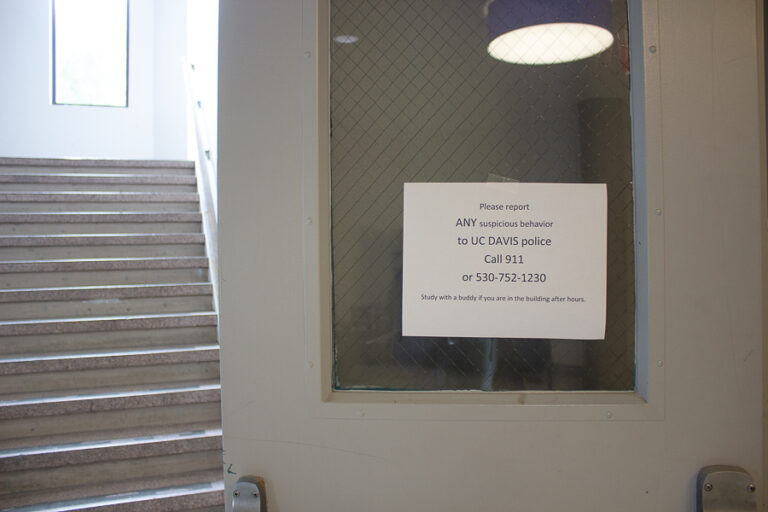
“It is our hope that he will abide by that order, but if anyone sees him (or anything suspicious), please call the campus police […] 752-1727 in a non-emergency and 911 in an emergency,” Ostergard wrote, reminding students not to prop open exterior doors at night and lock up spaces when exiting the Art Building.

Both Ostergard and Shasky told The Aggie that UCDPD has been proactive in getting information out and implementing additional security measures, including repairing broken windows, doors and door locks. UCDPD has been conducting extra patrols after dark and there are plans to install audible alarms in the building.

At a town hall that took place on Feb. 13 to address concerns regarding Chavez’s presence in the building before his arrest, students expressed concerns and frustration over the lack of information being shared with them. Following his release from jail yesterday, Ostergard said there will be “increased communication on the topic,” including additional postings in and around the Art Building, “so everyone can be more informed.”

Written by: Hannah Holzer — campus@theaggie.org

Guest: The double standard with Aggie Pride and sports

Students must support the men’s and women’s basketball teams in equal measure

Aggie students and fans tend to have this belief and notion that we take pride in and support all of our sport teams, both men and women. Though this is mostly true for Aggie sports, this has certainly not been the case for Aggie Basketball this season. Being a devout fan and follower of both the men’s and women’s basketball teams, I have witnessed firsthand the double standard and hypocrisy when it comes to Aggie Pride.

This season, I have attended and watched four games for the men’s team and five for the women’s team, but what’s a shame to see throughout this season is the lack of attendance for one team versus the daily full-house attendance for the other. Men’s basketball has gotten off to a rough start with the team playing below standards, but have turned their season since Big West play has begun. All the while, they still have a packed house for every home game, regardless of their position in the Big West standings. The men’s team, whose record went to 5-4 in the Big West standings after their triumphant victory over CSU Northridge, had a full house on Feb. 13. This is Aggie pride and greatness — to still come and support our men’s team, which is giving its all for every game.

However, it is disappointing and discouraging to see the Aggie faithful do not come out and attain the same attendance for the women’s team. Having attended a fair number of the women’s games myself at the Pavilion, there is a lack of Aggie students who come out and watch the women play. This is so disheartening and upsetting, considering how brilliant and lights-out this team is playing. As of Mar. 10, our women’s basketball is #1 in the Big West with a 15-1 conference record and a 14 game win streak. We have witnessed some of the greatest basketball in Aggie history this season, yet there is no wide-range support from the Aggie students, who will go all out for the men’s team, but won’t for this successful and triumphant women’s team.

To be absolutely clear here, I am not advocating one team over the other. I am a fan of both the men and women’s teams, but I sincerely believe that Aggie Pride and students needs to show up for our ladies, just as much as they do for the men. The seasons have ended, but I implore all students who love Aggie Basketball — who come and cheer at the roaring Pavilion — to do the same for both teams in the future. It is truly Aggie Pride at its best when the Pavilion is packed and roaring for both our teams. But it’s such a mortification when one team gets more attention and more of a packed crowd over the other.

Both of our teams will be in the Big West tournament starting this weekend with a chance to make it to March Madness and it is the task of the students who are fans of Aggie basketball to come forth, show up and cheer for the men’s as well as the women’s team. Come out and show Aggie pride and support for Aggie Basketball, especially for our ladies!

Written by: Vikram Singh

The writer is a fourth-year history major at UC Davis.
To submit a letter to the editor, please email opinion@theaggie.org.
Letter to the Editor: Faculty thank UC Chancellors for condemning boycott of Israeli academics

To the Editor:

Re “All 10 UC Chancellors condemn boycott of Israeli academics” (news story, Jan. 17):

We write to thank and support Chancellor Gary May and the other nine UC Chancellors for their letter opposing an academic boycott of Israeli academic institutions and/or individual scholars.

We share Chancellor May’s belief in the value of unfettered exchange of ideas and perspectives on our campuses, and appreciate his defense of these important principles.

Joel Hass, Department of Mathematics

Raul Aranovich, Department of Linguistics

Boaz Arzi, School of Veterinary Medicine

Galia Franco, Department of Middle East/South Asia Studies

Ralph Green, Department of Pathology and Laboratory Medicine

Barry M. Klein, Department of Physics

Deanne Meyer, Department of Animal Science

Matthew Shugart, Department of Political Science

David Siegel, Department of Internal Medicine

Al Sokolow, Department of Human and Community Development, Emeritus

Abigail Thompson, Department of Mathematics

Stephen White, School of Veterinary Medicine

Simone Monnier Clay, Department of French and Italian, Emirata

Richard L Kravitz, General Internal Medicine, Director, UC Center Sacramento

Rivkah Isseroff, School of Medicine

Diego Yankelevich, Department of Electrical and Computer Engineering

Fern Tablin, School of Veterinary Medicine, Emerita

Niels Grønbech-Jensen, Departments of Mechanical and Aerospace Engineering, Mathematics

Amina Harris, Honey and Pollination Center

Burl R. Don, Department of Medicine

Prof. Tonya Kuhl, Chemical Engineering

Jay Rosenheim, Department of Entomology and Nematology

Marvin Goldman, Surg. and Radiological Sciences, Emeritus

Michael J. Singer, Department of Land, Air and Water Resources, Emeritus

Norma Landau, Department of History, Emerita

Marc Pollack, Microbiology Graduate Group

A. Hari Reddi, School of Medicine

Amir Kol, School of Veterinary Medicine

Maynard Skinner, Retired Assistant Vice Chancellor and former Mayor of Davis

Mitchell Singer, Department of Microbiology and Molecular Genetics

Jerry Suran, Graduate School of Management, Emeritus

Anne-Maarit Bagman, Department of Plant Biology and Genome Center

Alex Groth, Department of Political Science, Emeritus

To submit a letter to the editor, please email opinion@theaggie.org.
Letters to the Editor

Community members react to Professor Joshua Clover’s statement that cops “need to be killed”

For over 30 years of my life, I’ve been known as “Officer Smith,” “Sgt. Smith” and “Detective Smith” with the by-line of “Davis Police Department.” For the past eight years, I’ve also proudly carried the title of “retired Detective Sgt. Smith.”

For 30 years, I worked in and around UC Davis students. I was the officer who helped a graduating senior who was leaving town after graduation change the tire on his car at the ampm because, while he had a degree in chemical engineering, he had never learned to change a tire. I am the officer who spent 7 hours with the victim of the NorCal Rapist after she was kidnapped at knifepoint from her apartment on Alvarado and sexually assaulted in the back of her car. I was also the officer who each night at 10 p.m. would go the Lil Caesars Pizza on Covell Blvd and buy (out of my own pocket) all their leftover $5 pizzas and deliver the aromatic stack of cardboard boxes to the homeless encampment behind the train station.

30-plus years, and I could fill a novel with all the interactions, both positive and negative, that I had with the students, professors and staff of UCD. If you research David Thornton, the UCD student who died of an alcohol overdose on his 21st birthday in a downtown bar during an ill-fated night of “21 drinks on the 21st birthday” celebration, it was me who had to notify his parents and break the news that their 21-year-old son was dead. Look at the white bicycle at the corner of Covell and Pole Line Road. It is a makeshift memorial to a female UCD student who was riding her bike home and was “clipped” and run over by a semi-truck loaded with tomatoes headed to the old tomato plant just down the road. And yes, it was me who had to attend the autopsy and attempt to remain emotionless as the coroner dissected her badly mangled body.

My point is not one of self-glorification. It is simply to point out that Officer Natalie Corona and many, many before her have spent the majority of their lives “doing the right thing,” and now stand by as anarchists like Professor Clover spew hatred and dissention towards us as professionals and as human beings — all the while being protected by the First Amendment.

Just know that if you took Professor Clover’s quotes and inserted the words “college professors” instead of “police officers” and attributed it to any police officer in the country, they would immediately be fired. Yet, in the enlightened world of academia, such vitriol is both accepted and appreciated for providing a different viewpoint.

SCOTT SMITH, SACRAMENTO, CA.

To the Editor:

I just applied to UC Davis and am hoping to be admitted.

I can honestly say, with a brother who’s an officer and a mother who has worked as an office civilian worker for the LA Police Department, I am genuinely hurt by the professor’s words and the university’s lack of action. This is making me second guess my choice of university. It has been a very grueling decision to pick a university, but when I decided on UC Davis it felt right and like a perfect fit, given my major of biological anthropology and UC Davis’s great program. Now I am saddened that the university houses such a close-minded person.

Does he not think that officers are humans just as he is, or you are or I am? They have brothers, sisters, mothers and fathers who are scared everyday they will receive that phone call or home visit that their loved one was just killed. Yet, here is a man who is supposed to be an example for community and progression of education, supporting what’s essentially murder.

I do have one question to pose to the university: How would the university respond if a student was to tweet, post or shout the exact same words as the professors’, but replaced “cops” with “professors” or, more specifically, “UC Davis professors”? Would that student still be in good standing? Would they be given the same lenacy as the professor?

It saddens me how the university does not think about the message it is sending to future students with its lack of action. Personally speaking, it does feel that everything the university said about supporting officers is just a lie when it then decides to do nothing. It does feel as if UC Davis doesn’t truly support officers. Sort of a handshake and a smile while stabbing you in the back.

I would like to say that my choice of UC Davis is still cemented, but the lack of action has definitely shaken my choice. I have fallen in love with the campus and the opportunities available by attending UC Davis, but when the university essentially is saying that a man who would like to see my family killed did nothing wrong, how am I supposed to be okay with that?

JONATHAN SALAS, EAST LOS ANGELES, CA.

The writer is currently a student at East Los Angeles Community College.

To the Editor:

The teachings of professors at world-class research universities such as UC Davis very much affect students’ thoughts and views of society. There are too many instances in which students with mental health issues have snapped under the pressure put on them to excel at the university and have taken their lives or other lives. Irresponsible writings of individuals such as Joshua Clover may encourage some with mental health issues to act out what he espouses.

The university and its employees should be encouraging students to think for themselves.  While killing police officers may seem like a viable option to Mr. Clover, he should be strongly advising against such violence to his students and anyone else who reads his writings.  It is sad that in his arrogance he expresses no remorse for advocating the death of those who would be first in line to protect him from violent harm.

BEN CHIN, DIXON, CA.

The writer’s career with the University of California began in 1990 as a UC Davis Internal Auditor. He retired from the UC Office of the President, as the Director of Financial Services for Agriculture and Natural Resources, in 2016.

To the Editor:

You support your negative opinion of Professor Clover’s anti-police statements by citing the senseless murder of ONE female officer, and by citing the ACCIDENTAL killing (with a gun stolen from a member of the law enforcement community) of a woman by an illegal immigrant.  The former incident is much hyped on the news in order to glean sympathy for police; the latter is much hyped in order to support President Trump’s demagogic hatred of Latinos. However, on the other side of the balance sheet, there is a long, long history of police abuses against minorities and political dissidents. I personally have experience, and much first-hand knowledge, of the absolutely heinous abuses committed by UC (and other) police officers against pro-civil-rights and anti-war protesters in the 60s and 70s. Probably the Occupy demonstrators were treated in much the same manner. Then there are the Black Lives Matter protests. These “incidents” totally justify Professor Clover’s hatred for “duly constituted” authorities. He should be applauded for his honesty and his courage — not castigated.  

JOHN MELLENDER, SAN FRANCISCO, CA.

The writer graduated from UC Berkeley in 1984 with a degree in English.

To the Editor:

As a UC Davis alum, it is very disappointing to see the political direction the campus has taken over the 15 years since I graduated. It was never a bastion of moderate thought (much less conservatism), but UC Davis was the less pretentious, more practical and more friendly alternative to places like UC Berkeley, which was what I loved about it. It keep constructing bigger, more lavish buildings and teaching ridiculous things in the liberal arts colleges.

I am the head of a small Christian school just north of Davis, and while I have my diploma framed near my desk, I am having a harder time recommending UCD to high school students and their families. I hope that will change.  

On a personal note, we have three students who are related to Officer Natalie Corona. I am not sure what it would take for someone like Clover or the people protecting him to realize how radical and dangerous their thinking is. Hopefully they never need a law enforcement agent to save their lives or protect someone they love.

JUSTIN SMITH, WOODLAND, CA.

The writer graduated from UC Davis in 2004 with a degree in communications and political science.

To submit a letter to the editor, please email opinion@theaggie.org.

The search for good tea in Davis

Though hard to find, good tea exists in Davis

Finding good tea in Davis can be challenging. While there are boba shops around every corner and more seeming to open every day, finding unsweetened tea is difficult. Many tea drinkers have been disappointed after ordering hot tea at a café or restaurant, only to watch a flavorless tea bag float in a mug.

Why drink tea? With less caffeine, it’s a healthier alternative to coffee. Some tea may even lower the risk of cancer, heart disease and diabetes.

All tea comes from the Camellia sinensis plant, native to China and India. Different ways of processing the plant result in different types of teas, and the main types of tea are black, green, white, oolong and pu-erh. Anything else is technically not considered tea but herbal infusions or tisanes, such as beverages prepared with chamomile, lemongrass, osmanthus, mint, rooibos or other plants.

Andy Leung, a second-year biological systems engineer, buys all of his tea from Hong Kong and prefers tea over coffee.

“[Tea is] less tannic, less bitter, more refreshing,” Leung said. “Coffee feels like it slaps me in the face and wakes me up. Tea is like a nudge, like ‘hey, wake up.’”

Loose leaf tea refers to tea leaves that are not separated into paper or mesh bags and is often higher in quality than tea that comes packaged in bags. Typically, loose leaf tea is put into a strainer that is removed from the cup once the tea has reached the desired steeping time. Quality tea that is prepared correctly should not be bitter and therefore does not need milk, sugar or any other additions.

“I’m not against the idea of milk tea, but regular loose leaf teas don’t need [milk and sugar],” Leung said. “Milk and sugar is to cover up any offensive notes from the tea, and my tea has no offensive notes.”

Leung recommends purchasing tea from China. Those unable to make the trek still have options, however. Leung recommends walking around Chinatown in San Francisco to find quality teas.

Jake Cheng, a second-year statistics major, considers tea drinking to be an integral part of his culture back home in Beijing.

“[Tea drinking is] about [being] social, business,” Cheng said. “If you invite someone to a tea place, it’s kind of like respect, it’s good manners. You rather take a friend to and talk about business at the tea place than like coffee shops right now in China, or other restaurants. When you take them to the tea house, you respect them more. Of course, it’s really expensive. A pot is like three to four hundred bucks [USD].”

Similarly, undeclared second-year Chad Lee drinks tea to connect with his parents, grandparents and cultural roots.

“I’m Asian American and my grandparents drink a lot of tea,” Chad Lee said. “Usually when we go out to eat at Asian restaurants, they obviously have tea so I drink tea with my grandparents. I don’t really drink it with my parents a lot, but mainly with my grandparents, because they’re a little more traditional.”

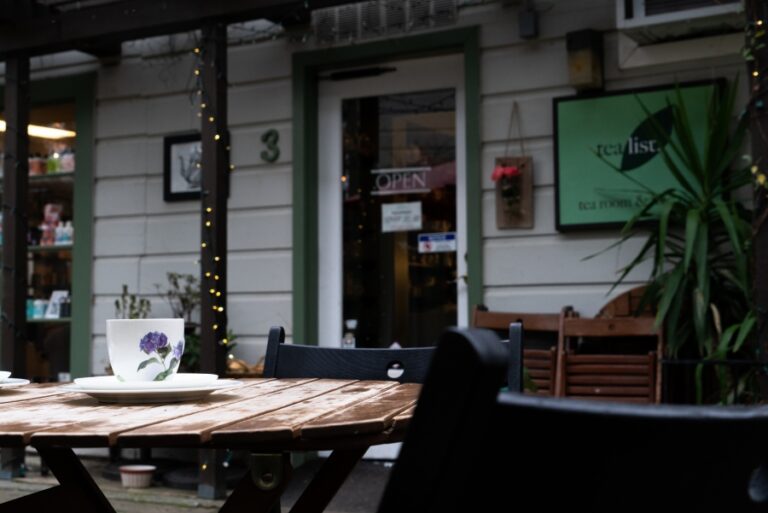
While there are no Chinese tea shops in Davis, there are still several places to enjoy a good cup or pot of tea. In downtown Davis, Tea List offers afternoon and high tea, as well as food options. Unlike many English tea rooms, Tea List does not enforce a minimum price per person. Customers can enjoy a singular cup or pot of tea, and prices depend on the type of tea. Tea List currently offers over fifty types of tea, such as black, green, white, oolong, pu-erh and herbal infusions, in addition to yerba maté, matcha and blooming teas. Tea List also offers tea lattes and other specialty drinks.

While known for its coffee, Temple Coffee Roasters has an impressive list of loose leaf teas. Temple Coffee Roasters serves black, green, oolong and white teas, as well as tisanes and iced teas. Like Tea List, Temple Coffee serves hot tea in aesthetically pleasing teapots.

Peet’s Coffee and Tea has a separate list of loose leaf teas that can be found near the registers. They also sell tins of tea to buy and make at home. Unfortunately, the Peet’s Coffee and Tea cafés on campus do not offer this separate list of teas.

While Cloud Forest Café only offers tea bags, the café has several unique tea drinks on its menu that are nice alternatives to coffee drinks, such as a matcha latte and iced tea topped with cream foam.

Several restaurants serve loose leaf tea. For example, Crepeville, known for its breakfast food, has a list posted near the register of various tea varieties. The tea is served in a teapot with a strainer.

Students can also make tea at home. Lee buys his tea bags from Trader Joe’s.

“I like the decaffeinated green tea,” Lee said. “Late at night, I like to drink it so I can feel relaxed when I go to bed.”

Loose leaf tea is available in decent selections at other stores, such as Nugget Markets, Davis Food Co-Op and Cost Plus World Market. Kim’s Mart, a Korean grocery store, carries tea as well. Safeway, Target, Save Mart and other bargain stores tend to carry bagged tea more often than loose leaf varieties.

Options for good tea in Davis are limited compared to the Bay Area or abroad. Good tea does exist in Davis, one just has to be willing to look for it.

Written By: Cheyenne Wiseman arts@theaggie.org

Social media’s affect on students

How students can change the way they use social media, how they are currently affected by it

Decades ago, the move to college came with tears and uncertainty when parents left their children in a dorm, not knowing when they’d next see their face or hear their voice. Today’s technology, through FaceTime, phone calls and text messaging, have made this separation seem far less severe with parents and high school students only being a tap of a screen away.

Despite increasing communication, social media can also have negative consequences when it comes to time management and students’ self esteem. Liking posts, scrolling through endless feeds and becoming distracted from the outside world are all burdens that come with the glowing rectangle most students (and people in general) carry. Getting sucked into the digital world at students’ fingertips can slowly start to become a heavier burden than originally anticipated.

Fifth-year computer science major Kush Patel only recently picked up on some of the more popular social media apps like Instagram, though he previously used other platforms like Facebook.

“I generally use social media for texting friends,” Patel said. “The other side of it would be searching Reddit or Instagram for content and different material.”

While Patel has noticed the common habit of students to immediately check their phones and social feeds for new updates right after a lecture period, he feels that the effects of that habit depend on the ability of the person’s self-restraint.

“If you’re in class and you’re going to text, you might as well not show up to class,” Patel said. “After class, you open up your phone, it’s your personal time, why not? I think it’s their own choice.”

In Patel’s case, his focus has been largely placed on his academics and trying to graduate as soon as possible. He finds that social media, as a result, takes a backseat most of the time, but he indulges whenever free time allows it.

“There’s no universal rule that says, ‘Oh, social media is bad,’” Patel said. “I think it comes down to the mindset of the person using it, whether they are easily distracted or they’re not stable in the sense that, if someone says something crazy in a group chat, they might lose it.”

Patel, however, has encountered students who, like himself, do not frequent apps or social media.

“Some people barely use it,” Patel said. “My first roommate, he didn’t use social media at all. I know other people who use social media a lot, and they’re still just as successful and social.”

Patel recognizes the potential that social media has, as he also commented on the ways it can encourage people to express creative interests and find outlets to share information. His reliance on social media has dwindled over the years, which has been a positive change for him overall since he now has more time to focus on what he feels to be important in his own life.

Patel tries not to compare himself to what he sees his peers doing, instead choosing to support and congratulate their accomplishments and using that motivation to carry out his own goals.

Hugo Hernandez, a UC Davis alumnus currently working with the Early Academic Outreach Program in Undergraduate Admissions, discussed his use of social media in his academic career and how he has since shifted his focus after being away from school.

“I used social media a lot more when I was younger,” Hernandez said. “My friends and I mainly used it to promote events going on around campus or to connect with one another about classes. It was also great to let my family from far away see everything that I was involved in and doing over here while they were over there.”

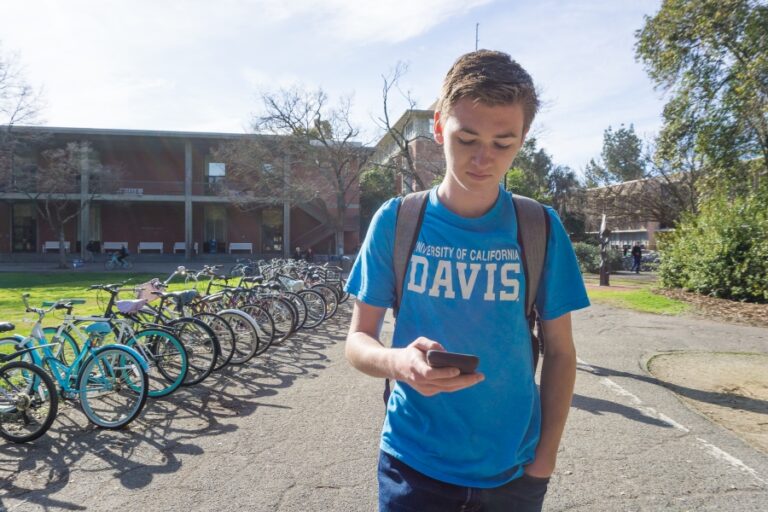
Since Hernandez has started working frequently with students, he has noticed their reliance on their phones and social media. Even as a student, seeing students reach for the phones after lecture was something he felt should change.

“That was actually a pet peeve of mine, seeing students pull out their phones just looking at a screen,” Hernandez said. “I tell the students I work with all the time to get off the phone for a few minutes and go outside, enjoy nature. That was how we used to play and socialize as kids. Now, people would rather look at a screen for hours instead of having actual conversations.”

Hernandez has seen considerable improvements in his life since limiting his social media usage and implores students to do the same. He stressed the value of reaching out to friends to meet for coffee or lunch for personal interaction, something he feels is becoming too scarce in our current society.

“I have learned to not be so reliant with my phone and technology,” Hernandez said. “Sometimes it’s nice to relax and use the phone for music or to find information. I think we need to get back to appreciating time spent with friends and family in real life.”

While social media may not be going anywhere in the near future, it may be time to reevaluate its usefulness. Students should consider alternative ways to spend time and connect with those they care about by engaging in activities that allow for quality time to be shared. Although photos and videos may last forever, a crucial conversation or much needed gathering can make a profound impact far greater than any social media utility can create.

Written by: Vincent Sanchez – features@theaggie.org

Humor: A definitive take on the best water fountains at UC Davis

Bringing a new meaning to ‘wet’ campus

As a Davis student, countless factors of student life breach the veil of background noise into coherent, active thought on a daily basis. So, when I say that on-campus water is important to me, you should understand how serious I am.

I have spent countless hours with my lips wrapped around water spigots, streams and fountains for my own personal enjoyment, and my authority on this subject is, as humbly as I can say, unchallenged. Today, I’m bringing this vast knowledge of the public water fountain trade at UC Davis to the layman water-goer.

I evaluate fountains based on their stream arc, water temperature, mouth-feel and general atmosphere on an index of one to ten. Then, I give each fountain a rating of one-to-three Good Year Stars: one star meaning you should travel from another building to get there; two stars, that you should travel across campus to get there; and three stars that a trip across the city of Davis would be appropriate. With that, let me take you on a journey into the water fountain scene at UC Davis.

Storer Hall, first floor

Arc: 8

Temp: 9

Feel: 7

Atmosphere: 6

Tucked away in between two offices in a hallway of Storer Hall is a gem of a fountain with some of the most delectable water to grace my tongue. I stumbled upon this fountain based on a friend’s recommendation, and I must say, it lives up to the hype. What they do with the temperature here is simply stunning. After I left for the first time, my lips would keep sending me wisps of cold that had me craving more. I assure you, I have returned. Stars: 2

Science Lecture Hall

Arc: 6

Temp: 6

Feel: 10

Atmosphere: 7

Although a well-known spot already, the fountain at Sci Lec produces perhaps the smoothest water I have encountered at UC Davis. When the water enters your mouth, try swirling it twice before swallowing and let it wash over your taste buds. Truly, a delight. Stars: 1

Haring Hall, first floor

Arc: 9

Temp: 6

Feel: 8

Atmosphere: 7

Another hidden fountain, down in the corner of the western end of Haring Hall. I stumbled upon this spot after being disappointed with the other prospective fountains in Haring. I was immediately startled by the amount of water that could come from a single fountain, giving the stream a lovely arc and unique mouth-feel that I can only describe with a single word: exquisite. Stars: 2

The Grove

Arc: 8

Temp: 7

Feel: 6

Atmosphere: 7

There’s a reason why The Grove is named separately from the other Surge facilities, and it’s not the ground traffic. I walked into The Grove expecting just another overblown operation, and although the mouth-feel fails to reach the bars others set, I was pleasantly surprised. Easy to find, pleasing to watch and overall a wonderful place to enjoy your water. Stars: 1

Sprocket Hall, second floor

Arc: 8

Temp: 10

Feel: 8

Atmosphere: 9

This one was an exception amongst the other sub-par spots along the bike path to The ARC. When I discovered this fountain, I felt as though my mouth had transcended into Poseidon’s realm, with chilled mermaid kisses and waves of crashing water upon my throat. Any time I’m passing by campus, I take the opportunity to relive my enlightenment. Yes, it’s just that good. Stars: 3

Music Building, second floor

Arc: 9

Temp: 10

Feel: 9

Atmosphere: 10

We all remember our firsts. First love, first job, first kill. My first water fountain at Davis just happened to be the best fountain on campus. Nothing can compare to that first sip, which I have yet to replicate at any other fountain. Along with the sounds of struggling musicians practicing in the background lulling you into a trance of continuous drinking, this is far and away the best fountain on campus (so nice I had to say it twice). Stars: 3

Written by: Conner Shaw — cjshaw@ucdavis.edu

(This article is humor and/or satire, and its content is purely fictional. The story and the names of “sources” are fictionalized.)