55.7 F
Davis

Davis, California

Tuesday, December 23, 2025
Home Blog Page 473

2,500 more students will enroll in UC system next year, with no tuition hike

UC Regents approve $9.3 billion budget

The UC Board of Regents recently approved a budget of $9.3 billion for the 2019-20 school year. According to an email by Julia Ann Easley, a news and media relations specialist for UC Davis, the budget will account for an additional 2,500 more California undergraduates to UC enrollment systemwide.

It’s unclear how this increase in budget allocated for more students will affect UC Davis.

“It’s too early to know how that will affect enrollment at individual campuses, including UC Davis,” said Steven Weisler, the interim associate vice chancellor of enrollment management in a statement sent to The California Aggie via Easley.

According to an article from the LA Times, the budget approved by the Regents will “increase support for struggling students without raising tuition.” Easley said enrolled students also help fund financial aid through part of their tuition.

“A portion of the revenue from the tuition students pay is set aside for financial aid,” Easley said. “So, since financial aid is determined and funded depending on the size of the class, more money would become available if more students enroll.”

A briefing from the University Office of the President said that UC’s goals include producing “over 200,000 more UC degrees by 2030,” eliminating graduation gaps and “investing in the next generation of faculty and research.”

Projections from the Public Police Institute of California show that there will be an increasing demand for workers who have bachelorette degrees, according to the brief.

While UC Berkeley and UCLA are “nearing their on-campus capacity,” UC Santa Barbara, UC Riverside and UC Merced have about half or less of the enrollments of these campuses, with room for population growth.

Written By: Sabrina Habchi — theaggie@campus.org
Unprecedented campus closure: how administrative, health, financial aid decisions were made

UC Davis loses seven days of instruction due to poor air quality

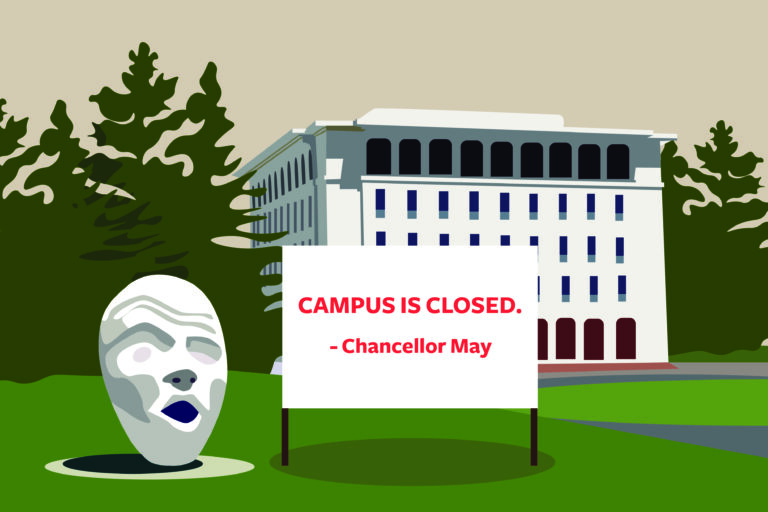
UC Davis’ decision to cancel classes during seven days of previously scheduled instruction, from Nov. 13 to 26, was an unprecedented event resulting from unhealthy air quality from the now fully contained Camp Fire. School officials were marshalled into emergency responses that required close collaboration between campus administration, faculty and students as they came together and created a campus closure plan that was based on day-to-day information.

Emily Galindo, the interim vice chancellor of student affairs, spoke about the extreme difficulty of closing down the largest campus in the UC system.

“We’re dealing with a campus population [including students and staff] of over 60,000 people in a region that was impacted by a major event,” Galindo said. “Within that context, no decisions are made in isolation. The chancellor is great about consulting, and from the very beginning, there was consultation ongoing throughout.”

Chancellor Gary May had determined that if the air quality index was under 150, the campus would be opened, but if the AQI was at 200 or above, the campus needed to be closed.

“Most folks were in agreement: if above 200, then that was a definite close,” Galindo said. “But if the area was under 150, it was fine. If it got between 151 and 200, [it] was really a judgment call. As we looked from one day to the next, the reading showed that it was going to remain in that area when in fact it didn’t […] In many instances, we were just doing our best [and] listening to the feedback.”

Galindo discussed the tenuous nature of the crisis that required an hands-on strategy to manage the problem.

“We were taking a day-by-day approach,” Galindo said, referring to a number of people, including the chairperson of the Academic Senate, the student assistants to the chancellor, ASUCD leadership, the Graduate Student Association (GSA), college deans and staff who were present at the “many, many” meetings that were held.

Carolyn Thomas, the vice provost and dean of undergraduate education and a professor of American Studies, became involved on the third day of the closure. Thomas discussed her role in the decision-making process.

“My sense was the chancellor’s team was waiting to look at all of the information everyday,” Thomas said. “But […] by the third day, the leadership reached out to me and asked my opinion about what should happen and how we might make decisions for the [upcoming] days.”

Thomas went to work on setting up guidance and FAQs for the faculty.

“What we were trying to do was to help faculty be focused on making sure that the learning objectives for the course were what they were focused on,” Thomas said. “We had to lose class days, but we wanted faculty to know that they didn’t need to think about […making] up all of that material, but instead what they need to do was to try to stay focused on being empathetic to the students and really focusing on the bigger picture in the remaining days.”

On the student side of things, Galindo said she was concerned about the 6,000 students living in on-campus housing because they needed special care.

“We had to ensure that meals were prepared and can happen,” she said. “They are also living in facilities where we had to be sure that trash was removed on a regular basis. We needed custodians to come in and make sure that happened, because you could end up with a serious health issue.”

Galindo explained that the Unitrans bus drivers were outfitted with N95 masks early on, but bus service had to be halted if the AQI reached 200 or more. She also mentioned that Aggie Compass, which is located in the Memorial Union and provides food and housing information, stayed open throughout the campus closure.

The CoHo was closed on the second day of campus closure, Galindo said, and some 300 ASUCD student workers who receive paper paychecks were not able to pick them up at the ASUCD office.

“The decisions cannot be made lightly, and we need to be thoughtful,” Galindo said. “If you make an announcement that we’re closed and those students need those funds, that creates a hardship — that is an example of why everything needed to be thought through.”

ASUCD President Michael Gofman worked alongside the GSA president and other association leaders as well as the Academic Senate to develop FAQs and guidance as to the university’s response if such an event were to occur again.

“In hindsight, […] it would have been obvious that we would have never have had school over that two week stretch, but as things were happening, we were unsure as to what was going to happen with the fire, we were unsure as to what was going to happen with the smoke and the air quality, and we were unsure if we were going to be put on probation with our accrediting agency because of the amount of days that we have missed,” Gofman said.  

UC Davis needs approval from the UC Office of President if the number of instructional days in Fall Quarter falls below 48 days.

“We just got that approval,” Galindo said. “By policy, you have to have 48 of the 50 instructional days each quarter in order to get credit. That is required. If you drop below that 48 days, then you have to request an exception.”

On the health side of operations, Charles Casey, the senior public information officer at UC Davis Health, spoke via email about the work the hospital did during the crisis.

“Despite the extraordinary air quality issues in our region, there was never any question about remaining open for patient care,” Casey said. “We are a 24/7/365 hospital, with all the related clinical care activities that we must be able to provide at all times, regardless of conditions.”

And, Casey added, UC Davis Health’s regional burn unit was caring for victims of the fire. Casey also said that throughout the crisis, the emergency department did not report any cases of people affected by the smoke.

“We presume people made common sense decisions to avoid outdoor exercise and avoided spending extended time outside while the air quality was hazardous,” Casey said.

Casey spoke about UC Davis Health’s preparedness for providing medical services in the event of emergencies such as the Camp Fire.

“UC Davis Medical Center has an Emergency Preparedness Program that is designed for all types of emergencies and disasters (natural and man-made),” he said. “We have full-time staff members who oversee and coordinate the health system’s disaster preparedness, which includes regular trainings for staff and an entire manual devoted to the roles, responsibilities and logistics for keeping health services available during a crisis.”

Deborah Agee, the director of financial aid and scholarships, discussed how her office managed the closure and worked to continue service for students.

“We learned [about the closure] at about 7:20 a.m. on Tuesday, the 13th,” Agee said. “My senior staff and I quickly conferred via phone and email, and we determined […] that we should move forward with the implementation of our business continuity protocol.”

She said the protocol involved supervisors notifying all staff by text message of the closure, and that because the closure notice came out at 7:20 a.m., some workers were already in the office but later had to be sent home. Agee also said workers who could work from home on their laptops were encouraged to do so.

On the pending financial aid applications and cases, Agee worked with her staff to come up with a plan. She also stated that there were hard deadlines that the financial aid office had to meet.

“In financial aid, we have a number of deadlines that we have to meet with the United States Department of Education — you have x amount of days to return for Title IV aid, and you have x amount of days to complete certain activities,” she said. “And we realized that we were going to be in danger of missing some of those deadlines. Those compliance requirements were prioritized and we brought in a team of 10 processing folks.”

  For all financial aid concerns that have resulted from the campus closure, Agee suggested sending an email to her office or using the Contact an Expert portal on my.ucdavis.edu. Students also have the option to call the financial aid office at (530) 752-1011.

Mccall Fellows, a third-year economics major, was asked about her thoughts on the campus closure.

“I think that really the school was doing what they had to do,” Fellows said. “There was no other options. Once they cancelled the first day and all the other days after that were worse — they had no options but to cancel class.”

Fellows expressed concern for the people of Paradise at the center of the wildfire.  

“My aunt and uncle live in Paradise — they are all safe, but their house has burned down,” she said “I know there is lots of students who have family up there. The university also had to be mindful of those families.”

Galindo offered her thoughts on the lessons that were learned from the crisis.

“We do plan to debrief as a leadership team to talk about lessons learned, talk about if these circumstances presented again what kind of processes would we put in place,” Galindo said. “We will work on ensuring that we do that.”

In looking at the bigger picture, Galindo said, “This was a tragedy. A whole community gone. Lives have been lost, and within that context, it is pretty sobering, and we need to think about that as well.”   

Galindo asked the UC Davis community to refer to her open letter to the campus on the closure for any additional information.

Written by: George Liao — campus@theaggie.org

Feds’ proposed Title IX changes would strengthen rights of accused, critics say, now public has 60 days to respond

UC, student leaders comment on Department of Education’s proposed Title IX policy changes

The Trump Administration plans to implement changes to Title IX policies that would effectively roll back Obama-era guidelines — which, critics say, would increase the amount of proof required in order to punish offenders, among other policy changes. A 60-day period for the public to voice their opinions on these proposals opened on Nov. 29 and will close in late January.

The UC’s interim systemwide Title IX coordinator Suzanne Taylor took a firm stance against the Department of Education’s proposed changes in a press release sent on Nov. 16.

“The […] proposed changes will reverse decades of well-established, hard-won progress toward equity in our nation’s schools, unravel critical protections for individuals who experience sexual harassment, and undermine the very procedures designed to ensure fairness and justice,” Taylor said in the release. “This is yet another attack on students’ right to an educational environment free of sexual harassment.”

The federal government, by way of Secretary of Education Betsy DeVos’ proposed changes to Title IX policy, would codify the steps federally-funded educational institutions are required to take regarding to sexual harassment.

As stated by The Chronicle of Higher Education, “College officials have been in limbo for the past year, since the secretary of education, Betsy DeVos, rescinded the Obama administration’s Title IX guidance, which for six years had framed colleges’ approach to handling sexual assault and harassment.”

On Aug. 29, The New York Times obtained a drafted version of the new proposed Title IX rules. These rules were reported to have been written in such a way that they strengthened the rights of accusers and reduced the liability and financial costs for colleges.

The Times reported that these proposed rules “narrow the definition of sexual harassment, holding schools accountable only for formal complaints filed through proper authorities and for conduct said to have occurred on their campuses.” The rules would also require schools to approach all cases “under the presumption that the accused is innocent until proven guilty” and hold institutions to a higher legal standard.

A comment period for the public to voice their opinions regarding the proposed changes was opened Nov. 29 and will allow for the submission of feedback to the Department of Education for just 60 days. The period, which coincides with holiday breaks, will close around the end of January.

Title IX pertains to students as it bans sex discrimination in any federally-funded education program — if a student experiences a form of sex discrimination, they are protected and entitled to specific rights and may seek legal remedies if they choose to do so.

“Discrimination on the basis of sex can include sexual harassment or sexual violence, such as rape, sexual assault, sexual battery, and sexual coercion,” according to the US Department of Education.

Taylor, the UC’s interim systemwide Title IX coordinator, said the proposed changes would “require universities to hold live hearings rather than implementing an investigative model,” allowing for the accused to cross-examine complainants who have come forward, according to her press release.

“[The Department of Education] proposes these rules under the guise of protecting respondents, yet UC’s procedures (and those of many other universities) already ensure due process, including the respondent’s right to question complainants and witnesses in a manner that does not cause further trauma,” Taylor stated.

UC Davis’ Chief Compliance Officer and Title IX Officer Wendi Delmendo said it is not necessary to have hearings with live cross-examinations.

“Given the thorough investigation process used by the university, these hearings will not result in more robust fact-finding or credibility determinations,” Delmendo said. “Instead, hearings will make the process take longer and expose all who participate in the process to further distress.”
Delmendo is responsible for overseeing efforts to ensure the university responds efficiently and effectively to reports of sexual harassment and sexual violence, in addition to educating folks in the UC Davis community about these topics.

“In my view, the proposed regulations are a big step backward,” Delmendo said. “While it is important to ensure our procedures are fair to both those who report sexual misconduct and those who are accused, the UC system has incorporated significant due process protections into our current procedures.”

Claire Chevallier, a fourth-year psychology major, vocalized her concerns through her platform as a member of the Sexual Assault Awareness Advocacy Committee, which aims to raise awareness about sexual violence and advocate for survivor rights. She is also one of two undergraduate representatives from UC Davis for the UC’s Sexual Violence Prevention and Response Board, which engages with students and provides feedback to the UC administration.

Chevallier was part of a group of students who traveled to Washington D.C. in early October to lobby at Capitol Hill. The group, mainly comprised of Associated Students of the University of California officials, visited congressional offices to voice student concerns.

“We expressed concern about […] minimizing the amount of reports that would go through, how they are not survivor-centric and how they would dissuade reporting and ultimately leave many people feel like their situations were not valid,” Chevallier said. “We also met with the Office of Civil Rights within the Department of Education — the folks who wrote this policy — and we got to present to them directly. I believe some change came from that, because their initial alleged policy change that only events that occurred on campus would be investigated was not included in the most recent press release.”

Chevallier believes the proposed policy changes are solely based on the department’s fear of reprimanding someone who has been falsely accused.

“While these do occur, the rate is only two to seven percent, which is not any different from other crimes,” Chevallier said. “While I understand the importance of due process and the right to a fair trial, […] I think these policy changes do more harm than good.”

The most upsetting aspect of the new Title IX guidelines, Chevallier said, is the new definition of sexual harassment.

According to The Times, the new proposal narrows the definition, defining it as “unwelcome conduct on the basis of sex that is so severe, pervasive and objectively offensive that it denies a person access to the school’s education program or activity.”

Chevallier said this new definition effectively de-legitimizes forms of sexual misconduct which are not deemed “severe,” such as “creepy sexual comments” — ultimately, leaving these forms of misconduct unaddressed and leaving “people feeling invalidated.”

“I have no doubt that these policy changes, if they [are] implemented, would severely minimize the already low number of reports made to Title IX, thus letting more perpetrators of sexual violence and sexual harassment off the hook,” Chevallier said.

Delmendo echoed this statement, adding that the proposed regulations would limit the university’s ability to respond to acts of sexual violence.
“This will seriously constrain the university’s ability to address sexual harassment that falls short of violating federal law,” she said. “While the proposed regulations do not have as significant an impact on the definition of sexual violence — sexual assault, dating violence, domestic violence and stalking — they would limit the university’s ability to respond to such conduct that occurs outside university property or programs. Most sexual violence occurs in other contexts, but has a continuing impact on university property or in university programs.”

The Department of Education released a press release on Nov. 16 which states: “every survivor of sexual violence must be taken seriously, and every student accused of sexual misconduct must know that guilt is not predetermined.”

“It’s like they placed these provisions at the beginning of their list in an attempt to create an illusive frame that their policies are survivor-centered, […] when in fact they are just strengthening the rights of the accused, and we shouldn’t be fooled by that,” Chevallier said.

Members of the ASUCD Senate did not immediately respond to an email seeking comment.

If students have feedback about the way UC Davis handles and prevents sexual violence and sexual harassment, the UC Title IX Student Advisory Board is accepting responses via the following link: goo.gl/ueD6de

Resources on campus pertaining to sexual violence and sexual harassment can be accessed through sexualviolence.ucdavis.edu and hdapp.ucdavis.edu.

Written by: Priyanka Shreedar — campus@theaggie.org

Freeborn Hall to be demolished

After closure in 2014, renovation to reopen building deemed too expensive

UC Davis administrative officials have decided to demolish Freeborn Hall, contrary to previous plans to pursue renovation options to reopen the building to the public after its closure four years ago. The demolition is planned to happen within the next two years, and administrative officials hope to assess space needs and create a plan of action by this summer.

Freeborn Hall was built in 1961 and named after Stanley Freeborn, UC Davis’ first chancellor. Around 2010, Freeborn Hall received a very poor seismic rating, and the building was closed to the public in 2014.

Vice Chancellor for Student Affairs Emily Galindo said Freeborn Hall is built with tilt-up concrete, meaning that the building would “pancake” if a major geological event were to occur.

Although university officials and student leaders had engaged in lengthy talks to preserve Freeborn Hall through renovations, seismic retrofitting for the building would cost $8.5 million alone. Modernizing the building with accessibility upgrades and new electrical systems would cost an estimated $36 million, according to an op-ed written by Galindo and given to The California Aggie.

Since its closure in 2014, administrators had discussed renovating the building to add classroom space, but, according to Galindo, because the building has been used mostly for student affairs purposes, the university is not willing or able to spend the money required for renovation.

“When the campus has to decide if they’re going to build classrooms or labs for research, unfortunately the priority is just not at the top,” Galindo said. “Student affairs had to say, ‘Well, what can we do?’ And we don’t have a big pot of money sitting anywhere. We do have the money to do the demolition.”

The demolition, which will cost $5 million, will be paid for using a specific safety fee every student pays. After demolition, there are hopes to build in the space Freeborn Hall currently occupies, situated between the Memorial Union and the MU bus terminal, but there are no solid plans to build at this time.

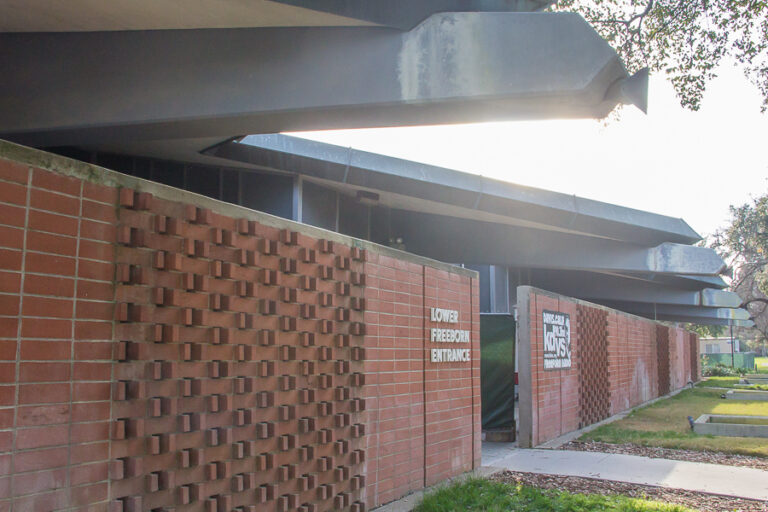
Though seismically unsafe, the basement of Freeborn Hall, Lower Freeborn, was deemed fit for use. ASUCD units including KDVS, The California Aggie, the Entertainment Council, The Pantry and Aggie Studios have occupied that space for years if not decades, in some cases.

An email was sent out on Thursday informing the unit directors and occupants of Lower Freeborn Hall about the demolition plans.

KDVS’ General Manager Jacob Engel, a fourth-year political science and American studies double major, said he was under the impression that the university was still pursuing renovation plans when he received the email. Half terrified and half excited, Engel said he sees the demolition as a new opportunity for KDVS.

“I look at this as a liberating opportunity for us to really be able to build an organization as the ground up,” he said. “This is the 50th year of being FCC licensed as KDVS and so seeing the third iteration of the station will be really fun.”

The walls of KDVS, with posters dating to the 50s, and The California Aggie’s century worth of archives physically historicize Freeborn Hall in all its glory.

A poster of the Count Basie Orchestra performing at Freeborn Hall hangs in KDVS, and The Aggie’s 1973 archives review performances by Fleetwood Mac, with tickets selling for $3.50, Arlo Guthrie and Boz Scaggs. Notable speakers who have visited the Hall include “Fahrenheit 451” author Ray Bradbury, who spoke in 1977; Carl Bernstein, who helped break the Watergate Scandal and spoke in 1974; and Ronald Reagan, while governor of California, was “greeted by loud boos” in Freeborn Hall when he spoke there in 1974.

In addition to ASUCD units which occupy space in Lower Freeborn, the Student Affairs Marketing and Communications Department staff and Campus Recreation and Unions IT staff work there as well. The university is looking for space to accommodate these groups.

KDVS, which has been in Lower Freeborn since 1967, has over 80,000 physical media units — consisting of records, CDs and cassettes — in addition to an impressive array of posters and artwork. Engel foresees challenges moving KDVS’ collection of music and artwork, and he also worries that a move would force KDVS, a radio station which broadcasts 24/7/365, to temporarily go off air while in transition.

At the moment, Engel said KDVS does not have a new location to move to yet.

“The last possibility that was thrown out was the temporary buildings over by the Domes but then the last I heard was those have been already promised to somebody else, so right now we’re kind of in the dark,” he said. “And that’s something that we’re increasingly working on and that ups the urgency of it.”

This summer, the third floor of the MU, occupied by the ASUCD student government, will be renovated. The staff and faculty members who work there will need to be moved first, before the groups in Lower Freeborn are moved.

“Even if we identify space […] we need to use that for the displaced people from the third floor while that project gets done,” Galindo explained. “We really need to engage the students. I know location is critical, so that’s going to be the primary thing.”

Galindo, who recently spoke with Stanley Freeborn’s grandson about the demolition plans, said she wants people to know this decision was made thoughtfully.

“We didn’t just make this decision without taking into consideration the historical feelings about the building,” she said. “But sometimes you just end up with a decision that you don’t want to spend good money on a building that’s really past its life.”

Engel credits his love of UC Davis to his early memories of Freeborn Hall. With his dad serving as president of the alumni association, Engel remembers attending the pancake breakfast in Freeborn Hall at age seven and, later, sneaking away from high school field trips to visit KDVS.

“This space and the ambience will be lost,” he said. “I know that most college stations that we go to are very sterile, they’re very clean, and the ethos of KDVS will be diluted through the move. But it’s also a good start to a new aesthetic — bringing some more retro type of stuff into a new place can be cool. We’ll see.”

Written by: Hannah Holzer — campus@theaggie.org

Heartbreak in Cheney

UC Davis football loses FCS quarterfinals, 34-29

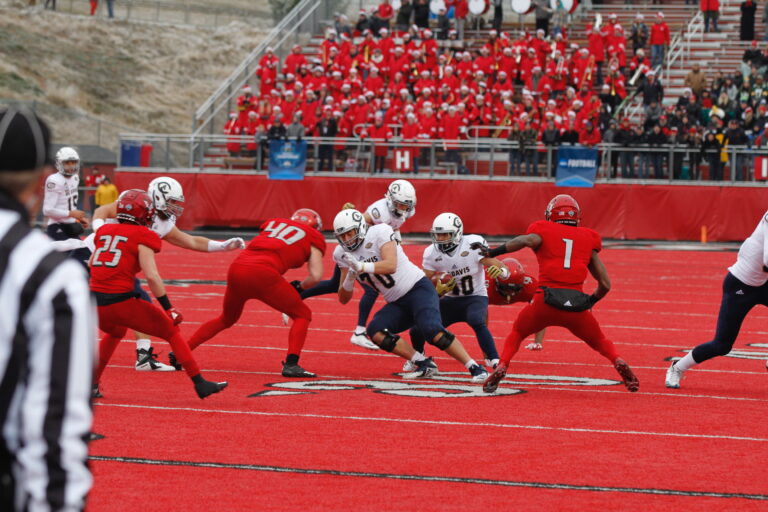
It only took 47 seconds for the Eastern Washington Eagles to spoil the Aggies’ hopes of advancing and hosting their second Division I postseason game. Trailing by one with just over a minute remaining, the Eagles put together a four-play, 75-yard scoring drive in the closing moments of Saturday’s contest to break the hearts of the UC Davis faithful and move on to the FCS semifinals.

The second battle between the two Big Sky foes proved to be the more thrilling one, with several lead-changes, incredible plays and wire-to-wire drama. But like the first installment, the sequel ended with the team from up north walking away with the win.

The temperature at kickoff — and throughout the night — was several degrees below freezing, but the weather did not seem to bother either team. After a quick six-play drive resulted in a UC Davis punt, Eastern Washington scored on its first offensive possession of the afternoon to go up 7-0. Just three plays later, the Eagles took the ball right back, intercepting junior quarterback Jake Maier’s errant pass that sailed right over his intended receiver.

The Aggie turnover set up Eastern Washington well inside UC Davis territory. With an opportunity to take an early two-score lead, the Eagles elected not to kick a field goal on fourth-and-one from the 11 yardline and instead their attempt to convert on downs was stonewalled by the Aggie defense.

It wasn’t until the second quarter that the UC Davis offense found its stride. Finding themselves in a fourth-and-short situations of their own, the Aggies decided the take a risk that ended up paying off. On fourth down in plus territory, UC Davis called on the services of redshirt freshman running back Ulonzo Gilliam, who dashed through the heart of the Eagle defense and scored from 29-yards out to even the contest at seven.

Gilliam was not nearly done. The Aggies’ next possession was sparked by a trick play — a 44-yard pass from redshirt freshman wideout Carson Crawford to junior wide receiver Jared Harrell, which put the Aggies in range. It was then Gilliam’s turn again to finish the drive, scoring from 24-yards out to give UC Davis its first lead of the game, 14-7.

A 91-yard touchdown drive by the Eagles on the ensuing possession evened things up for the second time. Now with time running out in the half, the Aggies drove the ball all the way down to the Eastern Washington three yardline. The aggressive style of head coach Dan Hawkins again took over, as the Aggies opted to try to score six instead of three points before the halftime whistle blew. But unlike the first fourth down attempt, this one was not so successful. The teams headed into the break all tied up.

The third quarter couldn’t have started better for the Aggies. Senior defensive back Isiah Olave intercepted a pass by Eastern Washington’s redshirt sophomore quarterback Eric Barriere, setting up a third UC Davis touchdown six plays later. The score came from freshman receiver Lance Babb II, who made a toe-tapping catch at the edge of the endzone for his first-ever reception and touchdown as an Aggie.

With the score now 21-14 in the Aggies’ favor, both defenses began to settle in. Each of the game’s next six drives resulted in a punt, but one of these UC Davis possessions was stalled after a long pass from Maier to Crawford appeared to be completed on third down along the Eastern Washington sideline. It was ruled incomplete on the field, so the Aggies were forced to punt, but ESPN’s video replay of the catch showed Crawford securing the ball with at least one foot in bounds.

Nevertheless, the Aggies failed to add it their lead in the third quarter, and eventually gave up two consecutive Eastern Washington touchdowns to start the final frame, including one on a two-play, 62-yard drive by the Eagles sparked by a 55-yard reception.

Trailing by seven once again, the Aggies pieced together a seven-play, 42-yard drive in which they converted on two third downs to find the endzone with 1:13 remaining. Gilliam was responsible for this clutch score, scampering in on a shovel pass from Maier for his third touchdown of the afternoon. Gilliam finished the game with 167 all-purpose yards.

“The offensive line, they did their thing today,” Gilliam said. “They opened those holes up for me and I just did my job and hit them.”

Just an extra-point point away from tying the game and a two-point conversion away from taking back the lead, Hawkins did not hesitate to put it all on the line. Unbothered by the boisterous Roos Field crowd, UC Davis executed its two-point play to perfection. Maier took the shotgun snap and quickly flipped the ball to senior running back Namane Modise, who streaked his way to the left pylon and scored to put the Aggies on top 29-28.

The magic that had defined this season for UC Davis looked as if it had not run out. Now the Aggies stood just 73 seconds away from the program’s first-ever FCS semifinals birth. All they had to do was hold the Eagles one last time.

With three timeouts and starting from its own 25 yardline, the Eagle offense saved its best for last. On the first play of the drive, Barriere appeared to be caught in the backfield multiple times by Aggie defenders, but somehow slipped away to scramble 29 yards downfield.

If that wasn’t an indicator for how the game would finally end for the Aggies, Eastern Washington’s senior running back Sam McPherson scored just three plays later to put the nail in the coffin on UC Davis’ season.

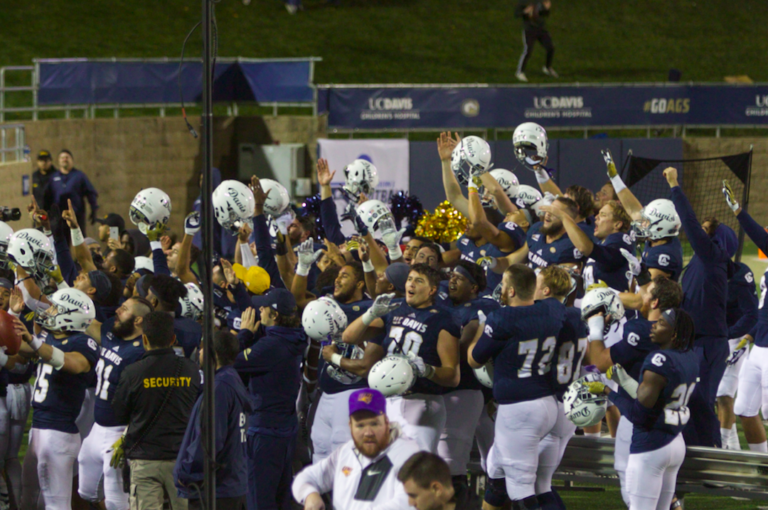
The last-minute loss was obviously not the result the Aggies had hoped for. But looking back on the run that the UC Davis football team put together this season, coming up short on Saturday did not prevent the Aggies from appreciating what they were able to accomplish.

“I couldn’t be more proud of my team,” Doss said. “This team was able to accomplish something that Davis has never done. It’s awesome to be a part of and I’m glad I got to experience it with these guys. I know the future is bright.”

In his final game as an Aggie, Doss hauled in nine catches for 143 yards against what he said was a “great” Eastern Washington defense. He recorded a UC Davis single-season record 118 receptions this season for 1,334 yards. Doss’ career 4,069 receiving yards and 321 receptions are both the most in program history. It has yet to be confirmed, but Aggie fans can expect to see number three on an NFL roster come August 2019.

Hawkins, in his highly-unique and philosophical style, likened the UC Davis football program to bamboo. He’s never grown bamboo himself, but people have told him that it sits dormant for some time and all of the sudden bursts forth and “grows 40 feet in one year.”

“[This season] was magnificent in a lot of ways,” Hawkins said. “To get a share of the championship, to get in the playoffs, to win in the playoffs, really sets a whole new standard for UC Davis football.”

For many college football analysts, the sudden and intense success that the Aggies experienced this season was unexpected. According to this year’s preseason poll, UC Davis was picked to finish ninth in the Big Sky. It’s safe to say that this team exceeded everyone’s expectations but its own.

“We’re really, really proud,” Maier said. “When you experience failures like this, it just motivates you to work even harder.”

Maier has one more year of college eligibility left and he would like to make it count. He and the rest of the team’s returners will take their well-deserved time to reflect on the incredible 2018 campaign, but sooner rather than later they will all be back to build upon the new gold standard that was forged this season — one that will be remembered for years to come.

Written by: Dominic Faria — sports@theaggie.org


Inside the Waterparks “Entertainment Tour”

Waterparks & Company visit Ace of Spades  

Enthusiastic cheers echoed the hall, hands were held high and a real sense of community could be felt in the air at Ace of Spades on Sunday, Nov. 25th. This was one of the final shows of Waterparks’ “Entertainment Tour,” which featured performers such as De’Wayne Jackson feat. Dominic Stepanian, Nick Gray, I Don’t Know How But They Found Me, Super Whatevr and, of course, Waterparks.

From Nov. 2 to Dec. 1, the “Entertainment Tour” rocked its way through 22 states, met thousands of dedicated fans and performed many nights in the spotlight. From Florida all the way to California, the performers stayed busy in their one-month timeline.

The line-up of these performers — being an amalgam of genres that span from hip-hop, rap, pop, punk, new wave to indie — put on a phenomenal show and found a way to make each performance unique as well as engaging. From start to finish, the concert was loud and live; it was a rollercoaster ride through a genre wonderland. Some performers vibing to deep 808 basslines and others bringing the audience into a head banging rock show, which kept the night electric and the music alive.

All of the performers on the “Entertainment Tour” had been travelling together as an entourage, but catch their sets apart from the rest of the touring musicians and one would be perplexed as to how these differing genres work so well together on a tour.

Waterparks, hailing from Houston, Tex. is a next-gen pop-punk trio that can quickly get any crowd on their feet, as they did at Ace of Spades. Watching and listening from afar, they play as if they were a direct product of Blink-182 and Fall Out Boy in the early 2000’s — a memento from that one emo phase everyone considered going through. When they came on stage, the crowd went wild. It was a punk show but a safe space — everyone rocked out while loving and hugging each other between songs.

Superwhatvr, is an indie-band out of Orange County, Calif. According to its website, its songs “don’t seek to push away the darkness. Instead, they invite it in.” They are gritty, ultra-indie and have hints of gothic inspiration by way of their lyrics. It’s hard to tell whether they were listening to Grizzly Bear or Joy Division when they found their original inspiration, but their music could probably satisfy both styles. The lights went low and red when they came on stage, and the reverb/chorus/delay mix on their guitar and vocals brought the crowd into a moody realm, sometimes hanging their heads and sometimes doing the goth hop.

I Don’t Know How But They Found Me, often shortened to IDKHow, comes from Salt Lake City, Utah and is a band that considers themselves “out of time [and] one who faded away into obscurity” according to their website. With strong influences from the 1980’s new wave culture, their two-man band plays musical chairs between dumsets, guitars, microphones and keyboards. If a 80’s new wave fan were in the audience, they would have wondered whether they were watching an IDKHow show or a Depeche Mode reunion. Their music has a sense of longing and self-reflection, and against their electro-bass musical backdrop, the crowd danced like it was ‘88 and they were all wearing sunglass (at night).

Nick Gray, a rapper from Boston, Mass., sounds much like a perpetually autotuned Mac Miller. With his mic out of the stand and his crew dancing on-stage, Gray’s performance focused heavily on the choruses of his songs, which were always catchy enough to have the bulk of the crowd singing it for him. The 808’s slapped hard and, beyond the crowds control, they vibed to it.

De’Wayne Jackson, from Spring, Tex. and his featured guitarist, Dominic Stepanian of Grass Valley, CA are a duo that performed a blend of alt-rock, soulful R&B with a touch of hardcore-rap. One moment Jackson could be hitting a trap-worthy freestyle and the next he could be serenading the audience with angelic vocals against some bluesy guitar, or he might just hit go on a fast-paced, rap-punk song and start a mosh pit. The vivaciousness that Jackson puts into the spotlight is something similar to that of a modern-day Freddie Mercury, and Stepanian, with his ‘77 Gibson Les Paul in-hand, would surely leave Joe Bonamassa enthralled as he shredded a number of solos and made it look easy.

After the show, Stepanian took some time to answer questions about the tour, the performance and his experience being featured as De’Wayne Jackson’s guitarist on the tour.

“It’s so special to be on tour with such an amazing friends,” Stepanian said. “Especially getting to create and play music every night. Everyone we’ve travelled with puts on an amazing performance, especially De’Wayne, so my ultimate goal is to add any subtle nuances to his already unique sound, while also ensuring that I bring a bluesy, funky style that I love so much to table.”

Sacramento stood out from the rest of the shows on the tour.

“Although it is somewhat biased for me, since I’m from the Sacramento area, this was by far the best show on the tour,” Stepanian said. “Not only was I able to look out from the stage and see a wave of familiar faces, but the energy from everyone was electric that night. We had just left the Midwest and I believe everyone was already in high spirits to be in sunny California, but after the show, every performer had commented on how my ‘home-crowd’ was truly amazing.”

The tour was 23 shows in 28 days and flew by quickly.

“By the time we got to Sacramento, we all had grown very close on the tour,” Stepanian said. “So, when show time came, it was good vibes all around. Plus, since I was so close to home, it didn’t hurt to sleep in my own bed for a couple nights.”

The “Entertainment Tour,” focused heavily on blending a number of genres together to create a unique, one of a kind tour for its fans.

“I personally think that it is because of the trying times we live in why so many different art forms are being meshed together,” Stepanian continued. “Especially because music can be the means for ones’ self-expression and identification. Trying times calls for innovation [and] that is this tour. Something new and great for the world. I’m so happy to have been a part of this wonderful tour to help spread peace and positivity in a country that needs a lot more of it.”

Stepanian is not wrong. Change is essential, especially in music. This tour demonstrated the grand possibilities for music production and touring in the 21st century. The “Entertainment Tour” may have wound down, but the memories will live on for a lifetime. For the endless crowds of fans and the musicians alike.

Each artist from the “Entertainment Tour” can be found on Spotify, Soundcloud and their social media accounts.

Written by: Clay Allen Rogers — arts@theaggie.org

Immersing oneself in a world of artistic possibilities

0

Why students choose careers in the arts

Art takes many forms and can be interpreted in many different ways, whether it be through painting or drawing, music, film, dance, theatre or other creative mediums. Students who aspire to pursue a career in the arts must channel their inner expressive capabilities to master their craft.

Claire Youngerman, a fourth-year cinema and digital media and economics double major, found her love for filmography by indulging in her everyday interests and giving herself room to explore wide-ranging topics that excited her.

“Sure, I like to binge-watch TV as much as the next lazy college student, but I started seeing film and television differently when I decided to study it,” Youngerman said. “I was excited by the possibility of film and its ability to transcend people into different realities and trick them into feeling real emotions for characters they know in their heart to be made up and acted out. I am excited by the possibility that film offers a way to interpret and explore life.”

According to Youngerman, her period of exploration gave way to the discovery of a very tangible career goal, one of which she is wholly passionate about.

“I would like to eventually become a producer,” Youngerman said. “There is so much talent and detail that goes into a production — writers, storyboard artists, costume designers, production designers, actors and every person that uses their skills to create something out of nothing […] It is more than entertainment, it’s kind of like magic.”

Youngerman was not always certain about pursuing a career in the arts. In fact, she originally enrolled at UC Davis as a physics major.

This experience is not one that is unique to Youngerman. Many students begin their collegiate careers as different majors, majors that one might say are on the more practical side of the spectrum, before eventually deciding to pursue a major in the artistic realm.

“I was an animal biology major my freshman year because I wanted to be a veterinarian, but I was a year into my studies, and [although] I was doing alright, I just wasn’t happy — I was doing it but it felt like I was just going through the motions,” said Daniela Ponce, a fourth-year theatre and dance major. “I did theater in high school, and at the time I thought ‘this is something I really love and enjoy, but it’s not going to be a career’ because [I] got discouraged to not pursue those wants. It took me a really long time to realize that I kept coming back to acting and theater and the arts.”

Although equally challenging and fulfilling as other career paths, careers in the arts are not as commonly pursued by college students as are other, more pragmatic professions. Vanessa Mendoza, a third-year design and music double-major, attributed this phenomenon to society’s tendency to gravitate toward one-dimensional standards of conventionality and normalcy.

“A lot of people have the notion that if you’re not a STEM major you’re not as intelligent,” Mendoza said. “I see people that have so much potential in other fields, and they don’t go towards [those fields] because they’re so fixated on these various stigmas. But there’s art everywhere, and you need all different majors for society to function. Everybody’s important, and you never know how you can contribute [to society].”

Tiffany Nwogu, a third-year theatre and dance major, argued that the arts are all-encompassing — they gives direction to nuanced ways of interpretation that require individuals to tap into more imaginative ways of thinking.

“A lot of the people who look at the arts have a very closed mind about, which is why [the arts] and theater are essentially forgotten,” Nwogu said. “But the thing that makes theater so precious is that people come there to escape logic and actually learn how to feel. Theater is not just limited to our closed-minded view, and it can catch you off guard. When you go to a performance, you expect to be entertained, but you’ll never [expect] to actually be educated in the process. The arts is more flexible because you think creatively about what could be. There are so many possibilities because there is freedom.”

Ponce advised any and all individuals who want to pursue the arts to dive into them with vulnerability and courage and to really allow themselves the opportunity to discover their craft, whether or not it may be deemed acceptable by others.

“If this is something that you truly want, something that you want to give your everything to, then do it,” Ponce said. “People have their own ideas of what’s an acceptable career path, and you’re going to find a lot of judgemental people that tell you you’re stupid for wasting your time. But you shouldn’t care about what other people think. It’s your life, and you have to live it however makes you feel happy.”


Written by: Emily Nguyen — features@theaggie.org

Humor: This Article is Not Offensive

I am pleased to announce that my articles are no longer extremely offensive, and I’m no longer a horrible person

I am reformed. After recently writing an extremely offensive article, getting fired by The Aggie, writing an extensive apology and getting provisionally rehired, I am beyond proud to announce that from this point forward, nothing I write (or even think for that matter) will be too offensive, too controversial, too relevant, too topical, too stimulating, too soon, too much, too little, too late, too close to home, too smart, too stupid, too right, too wrong, too short, too long, too small, too big to fail, too-faced, too fast, too furious, too far, too fiery, too feisty, too fussy, too funky, too funny and, as a result of all this, especially not too f***ing good.

In short, my articles will no longer contain any ideas that anybody doesn’t like or agree with, in style or substance. In fact, perhaps it would be best if my articles didn’t contain any ideas at all. Yes, I think that should work. No ideas, no thinking, no problem. I don’t want to expect too much from my readers, and I fully realize that thinking is just not something that most people want to do, especially when they sit down to read.

My idyllic, idealized non-idea would be something that you already believe but enjoy being told by others is true so you feel better and more vindicated for believing it, too. When I don’t think of a non-idea that I know won’t make you think or reevaluate your preconceived notions, I’ll know that it’s a non-idea worth not exploring or explaining in my future articles. I like to refer to this amazing natural feedback loop as “confirmation, pious.”

Through these tumultuous last few weeks, I’ve learned that comedy is only funny if everyone thinks it’s funny. The legendary comedian Steven Wright once asked, “If you tell a joke in the forest and nobody laughs, is it a joke?”

Well, I’d like to answer that question and go a step further. No, it’s not a joke because humor and comedy have to be funny, and telling a joke in a forest, especially if it’s a joke about a tree that fell in the forest when nobody was there to hear it make a sound, is bullying a dead tree, and that’s just not funny or okay under any circumstances. If you think that making fun of dead trees is funny, then your sense of humor is not the correct one, and you, like me, need to change it right now.

I learned this the hard way because I recently told some jokes that some people didn’t laugh at, not because they weren’t funny, but because they weren’t the right kind of funny. Since I’ve learned this lesson, I’m extremely grateful going forward that I will be spared the painful burden of consoling you after deeply offending you or not making you laugh.

Going forward, please avert your eyes from potentially offensive, unfunny humor and proceed to the emergency eyewash and shower station. I sincerely hope that you are able to redevelop the fallow land within your brain that makes you think that things that aren’t funny are funny. I did, so you can, too. This was a Notice of Proposed Land Use Action.

Author’s Note: This article includes the word “fiery” and discusses “dead trees” at length. This is merely coincidental and in no way related to the fires that burned throughout California and is not intended to be funny in any way, so do not laugh.

Written by: Benjamin Porter — bbporter@ucdavis.edu

(This article is humor and/or satire, and its content is purely fictional. The story and the names of “sources” are fictionalized.)

You’re more important than your grades

Take care of your physical, mental health during finals

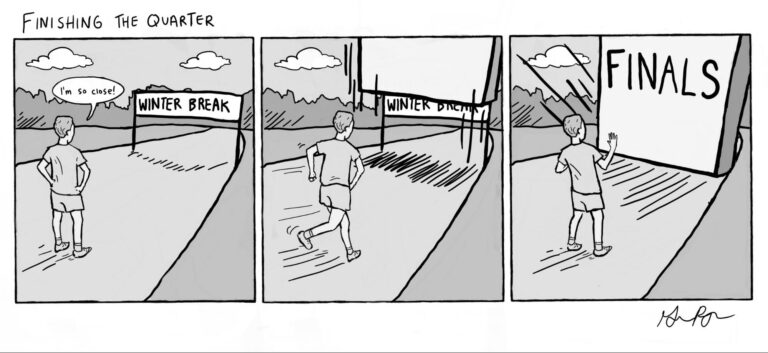
The realization that finals week is approaching is typically followed by unanimous groans in the classroom, a spike in one’s blood pressure and a sudden and blatant disregard for one’s sleep schedule. In the student community, taking care of one’s mental and physical health, which should always be a priority, often falls secondary to ensuring success on finals.

It’s not breaking news that students sacrifice a good night’s rest in order to have a few extra hours to cram copious amounts of material, carefully calculating the trade-off of suffering decreased cognitive functioning due to the lack of sleep. Instead of ditching the prospect of sleep altogether, which usually does more harm than good, try taking small naps whenever possible to boost energy levels as well as productivity.  

Consecutive all-nighters, as unhealthy as they are, don’t exist in isolation. A reduction in sleep is usually accompanied by a binge diet of energy drinks and fatty foods. While this may sound seductive to a student laboring through finals, limiting these drinks and foods and consuming a “brain-healthy diet” of unsaturated fats (fish, olive oil), vitamin E and antioxidants (citrus, dark-skinned fruits and vegetables) has shown to increase the ability to focus as well as have memory benefits.

Another notorious player in a highly-competitive academic environment is a prescription stimulant called Adderall, also referred to as “addy.” Though it is prescribed to help individuals manage their ADHD and ADD, Adderall is also commonly found circulating illegally on college campuses, exploited by students for its performance-enhancing properties, such as improved concentration and alertness. While using Adderall may seem like a good idea during the days before a brutal final, it is important to note that, as an amphetamine, Adderall often causes symptoms such as loss of appetite, increased paranoia and increased risk for seizures and stroke at high doses, and can also have immense addictive potential with repeated administration. Instead of turning to study drugs, going for a quick run can produce a natural high and elevate one’s mood, as well as alleviate stress and improve focus.

Elevated levels of stress during finals week also exacerbate the symptoms of imposter syndrome, a serious condition that plagues many members of the student community. Pressure to achieve drives afflicted students to relate their worth with their competency and they tend to attribute their successes to luck, fearing that they will soon be revealed as a “fraud” at any given moment. Every student has a vision of optimal performance and failure—or the mere thought of failure—to meet the demands of that vision can induce feelings of inadequacy, anxiety and depression. While students suffering from the syndrome often credit these negative feelings as a mental and emotional tax that they must pay to be on the agonizing path to success, it is important to be cognizant of these thoughts and actively reject them. Instead, practicing healthy behaviors, such as being gentle with oneself, realizing that no one can attain perfection and learning to celebrate small moments of triumph can go a long way in staving off negative thoughts. Talking to someone can also help, so turn to a trusted friend or family member or consider stopping by Student Health and Counseling Services for a session.

Though students may loathe the menacing approach of finals week, a torrent of exams will inevitably arrive every quarter with an annoying punctuality. The Editorial Board feels that it is therefore crucial to remind students that they are human firsts and students second. You owe it your body to eat and sleep as regularly as possible, abstain from “study drugs” and take care of your mental health. Let’s say “hello” to finals without saying “goodbye” to our health.

Written by: The Editorial Board

Aggies look north for FCS quarterfinals challenge

0

UC Davis set for rematch with Eastern Washington

For the UC Davis football team, last Saturday’s postseason victory over the University of Northern Iowa accomplished two things. For one, it served as the program’s first ever Division-I playoff win — a feat that, on its own, deserves to be celebrated. But in addition, the result guaranteed the Aggies a chance at redemption.

As the dust has settled on the historic win and the temperature continues to drop up and down the west coast, the Aggies trotted back out to the practice field this week just as they have in each of the past weeks since August. The only difference: they are preparing for a FCS quarterfinals showdown with Big Sky rivals Eastern Washington, a team that handed the Aggies their worst loss of the season on Nov. 10.

“It’s an opportunity that doesn’t happen a lot, to play a team [twice] within a month is kind of crazy,” said junior quarterback and offensive standout Jake Maier. “What’s funny, after the game, a lot of talk of the players on the field when we were shaking hands was, you know, we’ll probably see you guys again. And we were right. We’re motivated to go back up there and try to even the score.”

For a team that averaged over 43 and allowed just 26 points per game entering that first matchup in Cheney, it seemed preposterous that UC Davis would manage to collect only 20 points while allowing a season-high 59 against the Eagles — especially given that the halftime score had the Aggies trailing just 21-17.

The second half of that game proved disastrous for UC Davis and stands as arguably the team’s worst 30 minutes of football this season. Three interceptions (including one returned for a touchdown to open the third quarter), two fumbles, a missed field goal and a turnover on downs by the Aggies resulted in a 38-point second half from Eastern Washington. It’s no wonder why Maier, senior wide receiver Keelan Doss and head coach Dan Hawkins all praised the aggressiveness of the Eagles’ defense while stressing the importance of executing and taking care of the ball on offense.

Make no mistake, Eastern Washington’s defense is legitimate. The Eagles hold opponents to under 22 points per game and possess one of the best scoring defenses in the country. Maier had one of his worst games of the season against them — he threw two interceptions and was held to under 200 yards passing for only the second time this year. In their game last Saturday against Nicholls, the Eagles held the Colonels to 21 points and recorded a 95-yard interception return for a touchdown. The Aggies will need to crack this tough defensive unit on Saturday if they want to inch closer to a national championship.

For how talented Eastern Washington is on that side of the ball, the Aggies also have a defense that has proved itself formidable throughout the season. With 23 forced turnovers, UC Davis ranks in the top 20 in turnover margin and has held opponents to 21 points or less in seven of its 12 games. The Aggies needed all of that defensive power and more to defeat Northern Iowa last Saturday.

“Playing a respectable opponent like UNI made the stage even bigger for us to showcase our abilities and our talent,” said junior Linebacker Nas Anesi. “Like I said before, we finally discovered our true potential and we’re barely scratching the surface.”

UC Davis held the Panthers to 16 points, under 50 percent on third down conversions and forced two interceptions — all of which was crucial in allowing the Aggies to slip by 23-16. After that postseason performance, Anesi is understandably confident in the defense’s ability to show up in big games, even when the offense isn’t exactly rolling. Even Maier praised his teammates on the other side of the ball, saying that the defense “did not flinch” against UNI, a team with more size and strength than the Aggies had been accustomed to playing.

The Aggies will be facing a much different type of opponent this Saturday, though. Eastern Washington ranks second in the nation in total offense and fourth in scoring, averaging 543 yards and just a tick under 45 points per game. For as well as the Aggie defense played last Saturday, it very well might have to play an even better game this weekend.

There is no one on the UC Davis defensive unit that doubts the team’s ability to better itself. Similarly, the offense is excited to get another opportunity to right the wrongs it committed in the regular season battle.

“It doesn’t matter where we play, it’s how we play,” Doss said.

This seemed to be the mindset echoed by every member of the UC Davis football team throughout the entire season. It is a mentality that certainly stems from that of Hawkins, who preaches consistency and discipline. No one in the program is thinking of Saturday’s clash as a revenge game, according to Doss, but Anesi admitted that knowing what Eastern Washington did to the Aggies in early November has put somewhat of a chip on UC Davis’ shoulder.

“[This Saturday’s game is] really a shot at ourselves,” explained Hawkins, downplaying the narrative of Aggie vengeance.

Regardless of how this UC Davis team feels when it makes the trip up to Cheney on Saturday, the results of the regular season — and even last week’s victory — won’t matter. The high temperature on Dec. 8 in Cheney, Wash. is also projected to be a mere 31 degrees. It will be very cold, but as Hawkins puts it, both teams will have to deal with the weather.

Perhaps there is a secret weapon that UC Davis will have under its belt in Washington this time around, and that’s the Aggie Band-uh. The UC Davis marching band announced Wednesday that it has raised enough money to make the trip up to the Pacific Northwest. A little slice of Aggie pride will be present at UC Davis football’s most important contest in decades, and Hawkins was fired up to hear the news.

“When I was at Willamette, the band came up — the Ags were playing at Portland State,” Hawkins said, recalling his days coaching at Willamette University in Salem, Ore. in the 1990’s.

He explained that, when he heard the band was making the trip up for UC Davis’ game in Portland (about 50 miles away from Salem), he invited its members to stay in the Willamette gym on the condition that they would play at Willamette’s game that weekend as well. And play they did.

“I still remember the game, and our Willamette guys remember, because the band’s out there playing, I got tears running out of my eyes, I’m like on fire! I love those kids. It’s great for college football, it’s great for us and they bring a lot of juice.”

Band or no band, it will ultimately come down to how the Aggies compete once the ball is kicked off at 1 p.m. on Saturday, and they’re not quite ready to have this magical season come to an end.

Written by: Dominic Faria — sports@theaggie.org

Testing the brain to make the grade

Instead of cramming for exams, taking advantage of the brain’s own memory and attention networks could be the grade changer.

Exams challenge students to find creative ways to remember every detail from the first day of classes to the last.

       Each strategy impacts the brain’s memory and attention networks. Memory is a collection of abilities, such as remembering events, learning skills and building fact-based knowledge and interactions. Attention involves the brain implementing relevant goals such as being able to focus on material that relates to exams.

“Passive listening and passive reading are time-consuming and less likely to improve attention,” said Joy Geng, associate professor in the Department of Psychology. “You can improve your attention by linking new information to another existing body of knowledge that you have.”

       The brain is always taking in information and environments shape the way that people process it.

       “One of the myths out there is that people can turn memory encoding on or off,” said Charan Ranganath, professor in the UC Davis Department of Psychology. “It’s always on, but we can focus our attention on different things.”

       For students who get easily distracted, crowded and noisy environments may receive more of their attention than their studies. They may leave these environments remembering conversations happening around them or the atmosphere more than their study materials. Distractible students should seek quieter studying environments to help improve focus.

       “Attention boosts signals and makes others less noticeable,” said Ron Mangun, distinguished professor of psychology and neurology. “You become more aware of the things you attend to, and when you ignore something, you become less aware of it.”

       It is possible to become aware of too many things. Rapidly switching one’s attention from subject to subject, which occurs in multi-tasking, can result in lapses in retaining information.

       “Multi-tasking reduces your performance because there’s a switching cost,” Mangun said. “We have a limited capacity of cognitive resources to allocate to tasks. There are only so many things you can hold in your head, if there’s a distraction, you might miss something.”

       While trying to focus on everything at the same time, important details and concepts may get left out.

“Our lab, and many other labs, has shown that the best way to retain information over time is to test yourself,” Ranganath said. “Go over what you are trying to learn and test yourself on them. For equations, foreign languages or vocabulary words, use flashcards or an online testing site. For more complex readings, like history, read and then write summaries of what you read. Explain what you are studying to a classmate. Test yourself, go back to your study materials and fill in the right answer. Rinse and repeat for successful retention. Studies show you can get a 50 percent increase in retention if you test yourself than if you repeatedly study the same materials.”

Written by: Foxy Robinson⸺science@theaggie.org

UC Davis announces plans to build new student-athlete performance center

0

New facilities include areas for training, sports medicine, Aggie EVO and more

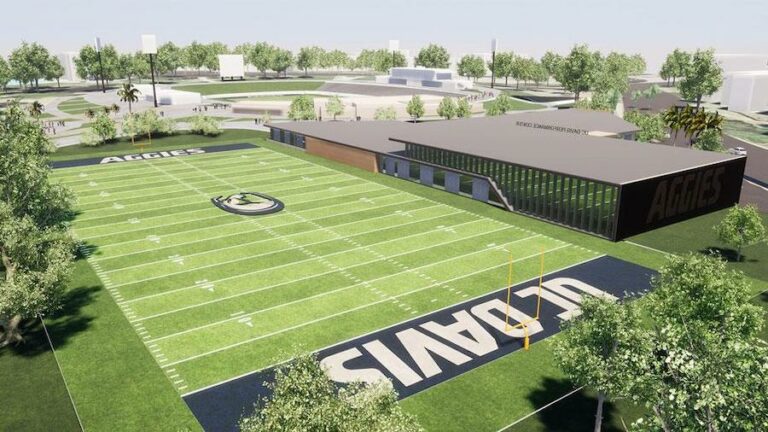
On Nov. 15, UC Davis announced its plans to continue campus and student resource expansion by teaming up with UC Davis Health to begin construction on a new student-athlete performance center. The new center will provide more spaces and services for the university’s intercollegiate athletics teams as well as other sports-related programs on campus.

On the day of the announcement, UC Davis Director of Athletics Kevin Blue discussed the program’s feelings toward UC Davis Health and the new project in a press conference.

“UC Davis Health is the top ranked health system in our region and is an extraordinary partner for our athletic programs in many ways. The health care provided to our student-athletes is world class,” Blue said. “We’re excited at UC Davis Athletics about this advanced partnership and thankful for the support of UC Davis Health.”

Estimated to be about 38,000 square feet, the new building will make its home right next to Aggie Stadium, on the corner of Hutchinson Drive and La Rue Road. An additional 16,000 square feet will go toward a renovation of the Bob Foster Team Center to the north of the stadium and a new practice field situated close by.

The new building and practice facility will be built upon what is now used as the designated tailgate area before UC Davis football games. For the time being, “several new options” for future tailgating are currently “being evaluated,” according to the university.

It was also announced that, going along with the athletics programs’ partnership with UC Davis Health, Aggie Stadium will be renamed “UC Davis Health Stadium” on Aug. 1. The name will stick for a set period of 20 years. Within the new performance center, UC Davis Health will also become the student athletes’ “exclusive provider of healthcare services.”

Around 90 percent of the funds for the $40 million project came from several sizeable donations from members of the UC Davis community and its alumni network, with the largest coming from Bruce and Diane Edwards.

Kevin Blue gave shoutouts to several specific donors, including the Edwards, and mentioned the gratitude the two programs felt toward the generous gifts.

“We’re deeply grateful for the contribution to this project by UC Davis Health and very importantly from our generous donors [… for] making this project a reality,” Blue said.

Dr. David Lubarsky, who was appointed vice chancellor of human health sciences and chief executive officer at UC Davis Health in May 2018 by Chancellor Gary May, commented on his excitement for the project and what it means to UC Davis Health.

“It is a great thing to be apart of something this exciting so early in my tenure. I’ve only been here a few months, [but] naming the stadium is just a small example […] of UC Davis Health’s commitment to serve this community,” Dr. Lubarsky said. “Every single person on this campus, and, really, every single person in Davis is a part of our family […] I think it’s really critically important that the health system do its best to serve all the people who want to access the best physicians around.”

The project is set to break ground in the early months of 2019.

Written by: AJ Seymour & Kennedy Walker — sports@theaggie.org

Gift ideas for parents

Exploring the options for holiday gift giving

It’s the time of the year when stores advertise endlessly for the upcoming holidays. Students who choose to participate in gift exchanging culture may find themselves at a loss of ideas when it comes to gifts for their parents. After all, they’ve given their children life itself along with undying love and support (usually), so finding a decent gift can be challenging.

Second-year undeclared life sciences major Kaylena Principe has had success in previous years with gifts that her parents can wear, such as jewelry for her mom and shoes for her dad.

“I haven’t really thought about [this year] but probably [I will be] gifting them the same sort of gifts,” Principe said. “My parents are very trendy, so [their gifts will come from] all of the same stores I shop at: Urban Outfitters, Forever 21, Anthropologie, etc.”

First-year biological sciences major Cherrica Igot has given her parents slippers, gift cards, homemade coupons and baked goods in past years.

“When I was younger I used to make them little ornaments or decorations, and now that I’m older I make them baked goods, or as I said, the homemade coupons,” Igot said. “Like for cleaning the car, or taking out the trash, or giving them 30 minute massages or something like that.”

Homemade gifts can be a less costly option. Even for the less artistically inclined, any parent would be overjoyed at the care and effort that goes into making a gift. Some simple DIY ideas include painting a picture frame for a family photo, mixing a sugar lip scrub, putting baked goods into decorated jars and personalizing mugs with Sharpies.

“When I was younger I made scrapbooks, cards and paintings, little things for around the house,” Principe said.

Websites such as Pinterest, Etsy and Good Housekeeping are full of DIY inspiration.

Some students prefer shopping for gifts. Angelina Hernandez, a second-year communication major, typically shops at Nordstrom for her mom and Bass Pro Shop for her dad.

“I’ve given my parents gifts for the holidays and they always say they like them,” Hernandez said. “I’m also just a good gift giver.”

Hernandez expects her gifts to be well-received this year as well.

“I will probably get my mom something trendy that she wouldn’t get herself,” Hernandez said. “I could potentially get her a new makeup palette, something practical for her.”

Bigger stores offer reliable quality and a wide selection of gifts.

“I like Bath and Body Works or Best Buy, or Home Depot for my dad,” Principe said “Or like clothing stores like Marshalls.”

Malls and department stores can be hectic during the holiday season, so some opt to shop locally for unique gifts. Parent-friendly shops in Davis include Creme De La Creme, The Avid Reader and Cookery & Company.

University gear is another viable option. Parents will proudly wear a UC Davis T-shirt or drink from an Aggie themed mug. Check out the Campus Store for gifts on Dec. 7, the last Aggie Pride Friday of the year. UC Davis branded clothing and gifts will be 25 percent off.

Some students find gift ideas for their parents online.

“I definitely just surf the web for inspiration, like Pinterest or Instagram,” Principe said. “Usually it’s easy to find things from there.”

Hernandez has a similar approach.

“I watch YouTube videos and I go on Pinterest, Instagram, ‘Best of’ lists,” Hernandez said.

The New York Times recently published its 2018 Holiday Gift Guide, an extensive list of gifts sure to satisfy anyone. The list is divided into different interests, such as food, home, books, self-care, technology and even a category for the hard-to-please. The list can be filtered by price ranges so there are options for any budget. The gifts are artsy and on-trend, ranging from luxury kitchen tools and cozy loungewear to stocking stuffers such as silent squeak toys for dogs, fancy pens and eco-friendly straws.

Instead of buying mom another candle she’ll never use or dad another jacket he’ll return, consider browsing the holiday gift guides online. If your parents are picky or otherwise hard to shop for, one solution is to encourage them to create an Amazon Wishlist, then all you have to do is buy from that list and watch the mail. Bottom line is, parents will probably appreciate any thoughtful gift if it comes from their child, whether store bought or homemade.

Written by: Cheyenne Wiseman — arts@theaggie.org

Davis Joint Unified School District board to discuss raising teacher salaries

JEREMY DANG / AGGIE

Newly-elected school board will consider parcel tax in December to address teacher compensation gaps

During the Nov. 15 board meeting, the Davis Joint Unified School District’s Board of Education voted to hold a discussion on Dec. 20 about putting a parcel tax measure on the 2020 ballot. Parcel taxes are a specific property tax in which taxes are allocated from owners of parcels of real estate. In Davis, the parcel tax would allocate funding for teacher salaries in the district.

Earlier this year, Davis’s Board of Education Trustee Alan Fernandes pushed for the parcel tax to be placed on the Nov. 6 general election ballot. This initiative was postponed to center focus on passing Measure M, a $150 million school facilities bond.

Following the passage of Measure M, Fernandes requested that the school board schedule a discussion for the parcel tax on the Dec. 20 Board agenda.

“I, for one, have become pretty resolute in believing that in order to meaningfully close the compensation gap,” Fernandes said at the Nov. 15 school board meeting. “We need a local source of revenue.”

California school districts are subject to the Local Control Funding Formula legislation, which determines how state funding is allocated to schools.

“When you talk about relying on the state and increases in state-to-local education, that’s never going to allow us as a district to catch up because of the way that LCFF is constructed,” Fernandes said.

The requested discussion will be administered by the new board trustees, who were elected in November. They will discuss the possibility of drafting the bill for the next ballot with public input.

“It’s important to have it out publicly available for people to review and provide input on,” Fernandes said at the meeting.

During the Nov. 15 board meeting, Frank Thomsen, the president of the Davis Teachers Association, noted that the DTA did not have an official position on the board-approved parcel tax initiative, as it is too early.

“[DTA’s] representative council voted to endorse the concept of a citizens’ initiative parcel tax for the same purpose, so DTA in no way opposes this,” Thomsen said in the meeting.

Local schools in Davis pay lower salaries than those in surrounding districts. During the 2020-2021 school year, Woodland Joint Unified District is expected to receive $10,778 per student in LCFF funding. In comparison, DJUSD is expected to only receive $9,252 per student. LCFF funding affects salary compensation for teachers and creates a compensation gap between neighboring districts.

“Increase in teacher salaries means there would be more stability, more relationships, more cohesion at all levels,” Thomsen said via email. “There will be a staff that knows the district values them and prioritizes them, as they are entrusted most directly with our students and their academic, social, and emotional growth.”

With Fernandes’ comments at the initial board meeting, the district acknowledged the compensation gap for teachers in the district.

“If not the parcel tax, other new revenues would have to be generated or some fundamental changes (priorities) would have to change in managing the general fund,” Thomsen said.

Tom Adams, the board president, explained that the board is in need of the community’s support.

“With the current way public education is funded, there are relatively few ways to raise the revenues to make this happen,” Adams said. “This is precisely why we are entertaining this as an idea, and if we decide to move forward by putting a measure on the 2020 ballot, we will be asking our community to support us in this important effort.”

Newly elected trustees Cindy Pickett and Joe DiNunzio will discuss whether or not to move forward with the parcel tax alongside current trustees Alan Fernandes, Tom Adams and Bob Poppenga.

“Closing the regional compensation gap is one of the highest priorities of our board,” Adams said. “Quality schools are defined by quality professionals.”

During the Dec. 20 board meeting, the board will hold a discussion and a possible vote for placing the a parcel tax initiative on the 2020 ballot to raise revenue for teacher salaries.

Written by: Brooke Hill — city@theaggie.org