53.5 F
Davis

Davis, California

Tuesday, December 23, 2025
Home Blog Page 503

Students who held Mrak Hall sit-in in January placed on disciplinary probation

DIANA LI / AGGIE

Protests over proposed tuition hike leads to disciplinary action

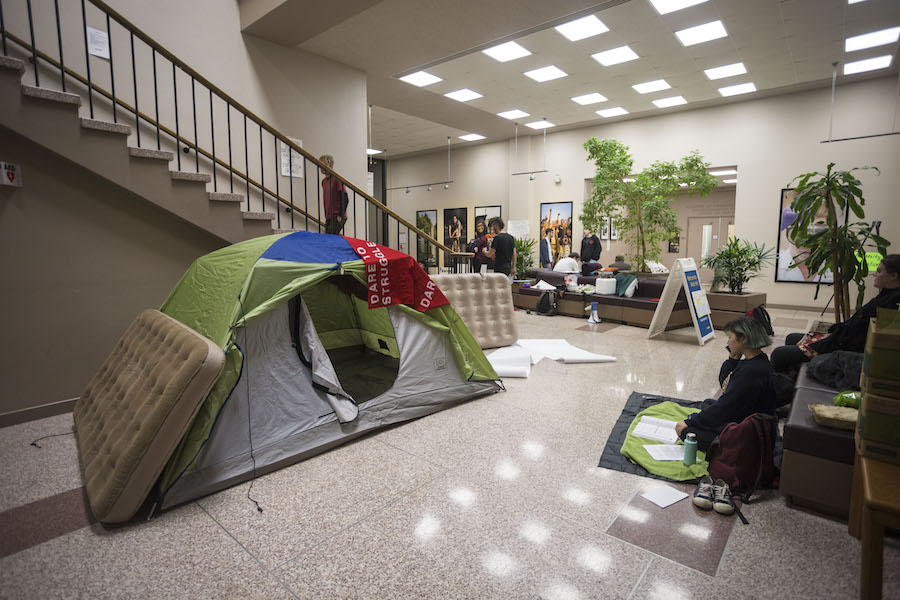
Six students and members of Students for a Democratic Society (SDS) who participated in a sit-in at Mrak Hall over potential tuition hikes which began on Jan. 23 and continued both that night and the night of the 24 were found guilty of violating university policy and have been placed on disciplinary probation.

Students faced multiple charges including being on university property after the Mrak Hall had closed for the night. Students were originally protesting the proposed UC-wide tuition hikes. The tuition hike for nonresidents was approved in March and consideration over the proposed tuition hike has been postponed until the 2018-19 school year.

Mrak Hall has historically been used as a site for student protests and sit-ins. In 2016, students occupied Mrak Hall for five weeks to protest then-Chancellor Linda Katehi. Students who participated in the 2016 sit-in were not disciplined.

Students who participated in the January sit-in tried to appeal having their “names on file,” which permanently records their violation of university policy. The appeal was rejected. Although having their names on their permanent records does little more than state that they did to violate university policy, if any of the six students violate university policy in the future, they will face suspension or expulsion.

Donald Dudley, the director of the Office of Student Support and Judicial Affairs commented on the hearing, but declined to share the official outcome.

“While release of outcomes is permitted under policy for public hearings, the University’s practice is not to release these outcomes and is not doing so,” said Dudley.

Dudley also stated that OSSJA is not responsible for placing students on academic probation, but the result of the trial works to establish a precedent for more serious actions going forward if students are found to be in violation of campus policy in the future.

AJ Ballesteros, a first-year sociology major, is one of the six students found to be in violation of university policy. According to Ballesteros, students received support from the Graduate Student Association as well as from ASUCD, which passed Senate Resolution #16 urging the university to drop the official charges against the protestors.

“By ignoring legislation passed in these organizations, both of which are meant to be avenues of power for the students of UC Davis, the administration admits that these groups have no meaningful authority in the power-structure of the UC system,” Ballesteros said. “This is especially important when we consider that the January protest was primarily about the increasing inaccessibility of the UC system to students from historically marginalized communities.”

Ballesteros stated that the overall process speaks to the culture of exploitation perpetuated by the UC administration.

“Rather than repressing student activism and discouraging students from participating in collective organizing, the UC administration should actively work towards promoting structural changes that dismantle, rather than reproduce oppressive/exploitative social and economic systems/processes,” Ballesteros said.

Written by: Ally Russell — campus@theaggie.org

Last Week in Senate

HANNAH LEE / AGGIE

Turmoil in Senate as Senator Halawi makes allegations of ASUCD “corruption,” other senator resigns

Vice President Shaniah Branson called the ASUCD meeting to order on Thursday, May 24 at 6:11 p.m. Senator Danny Halawi and Senator Brandon Clemons were late and Senator Daniella Aloni was absent.

The meeting began with a public announcement made by Senator Ko Ser Lu Htoo about gender-neutral language, which was then followed with the consideration of new legislation.

Senate Resolution #21, authored by Senator Alisha Hacker, was passed as amended. SR #21 intends to show support for a bill in the California legislature that, if passed, would tackle food insecurity by allotting enough money to cover at least 10 meal swipes per week.

Andy Wu, a fourth-year computer science major and chairperson of the Disability Rights and Advocacy Committee, gave a quarterly report. Wu said that DRAC is working on establishing ASL courses at UC Davis and working with the Student Disability Center (SDC) to establish a new satellite location in the Memorial Union, so that students with disabilities don’t have to go out of their way to get the help they need. The current Student Disability Center is located next to the International House.

After announcing his resignation from Senate on May 3, this was Senator Halawi’s last Senate meeting in his official position. During a public announcement, Halawi cited his reasoning for leaving the Senate, saying he was not happy with ASUCD and the Unite! slate. He also argued against a bill in Senate that would not allow resigning senators to have a say in their replacement.

“Even if I wasn’t leaving, I would not be a part of ASUCD because I’m really not happy with the executive team and the Unite slate in general,” Halawi said. “From a holistic point of view, if you take a specific senator out, you’re taking out the representation of other communities.”

Halawi then made accusations that Senator Atanas Spasov and President Michael Gofman are attempting to force out Senator pro tempore Jake Sedgley. He referenced an attempt by Sedgley to “hold the executive team accountable for not doing their job properly.”

“Atanas said I will revoke my bill if you vote Jake out,” Halawi said.

He ended his speech by saying that he has evidence of collusion, corruption, racism and transphobia demonstrated by the executive branch.

“As an insider on the Unite slate, I have a packet full of evidence, and I will be taking it to the Aggie for everyone to see and you both will lose your jobs,” Halawi said, referring to Branson and Gofman.

After Halawi walked out, Senator Jesse Kullar also announced his resignation, calling ASUCD “toxic” and saying that the job has taken a toll on his mental health.

“We resort to going to Facebook, make comments on chats instead of working together constructively,” Kullar said.

Since this announcement, Kullar has since decided to stay in Senate and not resign.

After these events, the senators took a short break and reconvened to confirm the Experimental Community Gardens Unit director. Helen Vanbeck, a third-year environmental policy major, was confirmed with no objections as the new unit director and said she plans to make the gardens more accessible to undergraduates and work on better communication between her unit and ASUCD.

Senate Resolution #22 was then voted on and passed as amended. The resolution intends to address frustration with the recent misallocation of funds for the hiring of additional counseling psychologists. This resolution is meant to force the university to give ASUCD and the student body an annual copy of an internal audit.

The general manager of KDVS gave the unit’s quarterly report. KDVS hit all of its financial marks and there are plans to split the general manager position into multiple positions with different foci.

The last confirmation was Angela Ruan, a second-year managerial economics major, as the Aggie Reuse unit director. Ruan said that she hopes to foster the community and continue educating people on Zero-Waste policies.

Senate Bill #72, which makes the Elections Committee a part of the Judicial Council, was passed.

There was then lengthy discussion and public comments on Senate Resolution #19, a resolution intended to support student activist groups on campus. SR #19 also denounced Canary Mission which, according to the resolution, “is a campus watch-list with a history of relying on student-given footage and material to target pro-Palestinian student activists: causing direct personal repercussions, including limiting their movement and employment opportunities.” The resolution passed as amended.

Emergency legislation was also introduced to provide the Mental Health Initiative Committee with the funds it needs.

Discussion on Senate Resolution #23 took place. SR #23 is an emergency legislation to help the Mental Health Initiative find additional sources of funding. The MHI was allocated $100 during budget hearings, though $15,000 were requested. The resolution states that the “ASUCD Senate shall continue to offer its support and to stand with MHIC staff and volunteers in what may be a long and hard fight with the UC Davis administration.” SR #23 was passed as amended.

No new legislation was introduced.

Public discussion occurred, during which time Branson made note of the drama in ASUCD and encouraged senators to try to be more socially cohesive.


Written by: Sabrina Habchi — campus@theaggie.org


Yanny or laurel?

SANTIAGO BARREDA / COURTESY

Find out what makes this clip so ambiguous and why some hear one, the other, or both

Yanny vs. Laurel is the dress debate 2.0. A couple weeks ago, the internet nearly broke (again) with the controversial Laurel/Yanny debate.

The audio clip was discovered by a confounded high school student upon searching “laurel” on Vocabulary.com for a school assignment, according to Wired. The word means a “wreath worn on the head, usually as a symbol of victory.” However, when the student listened to the audio clip for the word, she heard something very different.

After hearing Yanny over and over, the bewildered student shared the clip on social media, which was later shared on Reddit and went viral. Thus the Laurel/Yanny squabble was born.

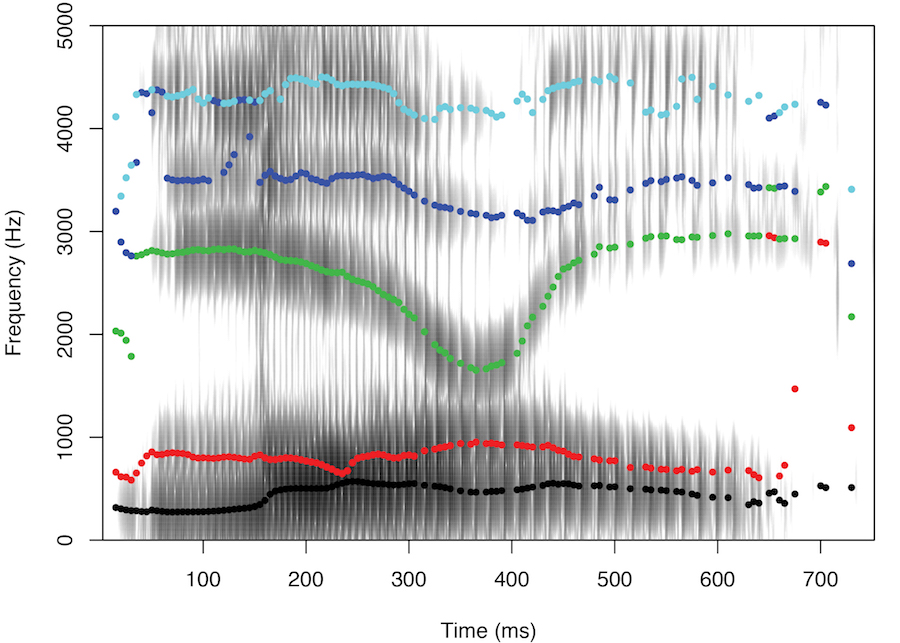
“It’s like one of those visual illusions, is it two faces or is it a vase?” said Santiago Barreda, an assistant professor in the Linguistics Department. “It’s like that, it’s just an ambiguous sound that you have to make a guess.”

Barereda’s research focuses on the roles of the listener and how language is perceived. Given the relevance of the Laurel/Yanny phenomenon, Barreda has made this a discussion topic in his phonetics class (LIN 112).

  “It’s from a dictionary website, from a hired voice actor’s pronunciation. Whoever made the website considered this to be the canonical, perfect English,” Barreda said. “So obviously they thought it wasn’t ambiguous, the reproduction is ambiguous because of poor recording, basically.”

One of the predominant reasons for the controversy is the quality of the audio clip and the quality of the computer or phone speakers people are tuning in on, Barreda explained. When the clip was re-posted on various sites, the original clip was distorted, causing alterations in the sound frequencies.

“It’s like if you took a picture of somebody, and then if you took a picture of a picture, and then a picture of a picture of a picture,” Barreda said. “It’s a messed up recording. If you hear the original, there is no ambiguity. It’s from a dictionary website, the original is not remotely ambiguous.”

Another theory floating around the internet for this auditory paradox regards the hearing ability of the listener. Our hearing ability naturally deteriorates with age, and over time, we struggle to hear higher frequency sounds. However, our hearing can also be damaged by exposure to enduring, loud noises. Examples of this include planes, playing music through headphones at an elevated level and concerts.

“It’s just a normal process of aging that we lose higher frequency resolution as we get older, so we can describe it as a physiological property of the cochlea,” said Georgia Zellou, an assistant professor in the Linguistics Department. “The cochlea is the membrane in our inner ear and due to the way it is anatomically, the part of the cochlea that has really high frequency, resolution above 6,000 or 7,000 or 8,000 hertz, naturally loses its ability to function as well as we get older.”

The contested idea is that the level hearing damage one has endured could determine whether they hear Laurel or Yanny. But this is not true according to Barreda. Although frequency is a factor in whether one hears Laurel or Yanny, high frequency hearing loss or damage will not affect the listener’s interpretation of this internet sensation.

“High frequency hearing loss is real, but it’s above the 10,000-plus hertz region, which is a very high frequency,” Barreda said. “I’ve never heard of anyone having significant hearing loss or high frequency damage below 5,000 hertz, and this audio clip is below 1,000 hertz. High frequency hearing loss can’t explain this at all.”

The role that frequency plays in this paradox is not the cochlea’s ability to detect it, but whether the individual listener pays attention to higher or lower frequency sound. The New York Times published an interactive tool which amplifies both the higher and lower frequencies from the original audio clip.

“Here is what’s really interesting about it, if we look at all the sounds sequentially, starting with ‘L(uh)’ and ‘Y(uh)’, in English those are really distinct, discrete sounds,” Zellou said. “Even acoustically, if we look at the phonetic signature of the two sounds, they are very distinct.”

By dragging the scale back and forth on the interactive tool, the alteration of the frequency makes certain sounds more prominent.

“[Luh and Yuh] are still similar, for both our mouths are somewhat open. They are sonorant sounds where we are creating louder sounds than other types of sounds we might make,” Zellou said. “So ‘L(uh)’ and ‘Y(uh)’ have certain similar properties articulatorily and thus acoustically.”

However, the act of hearing is not just a physical process. To ascribe meaning to language, we must use cognition.

“We use speech to communicate language, but speech is ambiguous,” Zellou said. “Everytime I produce a word, you don’t know if that was the exact message I intended in my head. This process of trying to translate this acoustic message is always going to be probabilistic. It’s always going to be a guess to some extent.”

This introduces a cognitive dimension. In play is not only the physical frequencies of the sound and the physical nature of our ears but the way our brain draws connections between sound and meaning.

“But language exists as these discrete categories in our mind, categories of sounds, a ‘Y(uh)’ versus a ‘L(uh)’, categories of words that exist because we have heard them,” Zellou said. “One thing that could be biasing people towards Laurel in certain situations is maybe the fact that Laurel is an actual, true word that exists in American English. Whereas Yanny is not, it’s what we call a nonword, it’s not a word that we use in American English at this point.”

The evidence that this is not purely a physical phenomenon, such as hearing ability and speaker quality, is that some individuals can hear both Laurel and Yanny from the same recording.

“It can’t be purely about the anatomy and or the properties of someone’s hearing resolution, I think there is also a really strong cognitive factor involved,” Zellou siad. “I have heard of these anecdotes of people who are listening to it on repeat and getting the different precepts within a single sitting. So for me that is evidence that it can’t be purely physical.”

Wafaa Yazdani, a third-year economics major, and Sonia Aamer, a second-year biochemistry major, had similar experiences.

“First I hear Yanny and then I heard Laurel, and then I heard Yanny again,” Yazdani said.

Most who heard the clip were polarized, hearing one or the other and creating an uproar on social media, much like the dress debate in 2015. But the fact that some individuals can hear both is evidence that it is a combination of several physical and cognitive factors.

“I heard Laurel first and then later on in the day I told my friends about it and I played it again, and I heard Yanny,” Aamer said. “It really tripped me out, I felt like something was wrong with me.”

The ambiguous nature of this audio clip and the many factors at play caused this sensation, possibly resurfacing unresolved feelings from team black and blue or white and gold.

“I don’t think it would’ve been as big of a deal if people were only hearing one, since you hear both at different times, I think that is what got more hype,” Yazdani said. “I still can’t tell which one it is, it’s different every time for me.”

So, which one did you hear?

Written by: Grace Simmons — features@theaggie.org

ASUCD Senators, Judicial Council Chair, President criticized for missing meetings

MEENA RUGH / AGGIE FILE

Lack of attendance raises questions about accountability

At recent ASUCD government meetings, elected officials have been criticized for missing meetings.

Only four out of the 12 ASUCD senators attended the recent budget hearing summit, where ASUCD officials discussed plans for the budget hearings which took place recently. Unit directors and staffers were said to have outnumbered senators at the summit. Senate Pro Tempore Jake Sedgley vocalized frustration on the absences at the May 10 Senate meeting.

“[It’s] really hard to keep going when people don’t take the initiative to do their job,” Sedgley said at the meeting. “You were elected to represent people on campus.”

Sedgley also accused senators of not taking bills or the association’s bylaws seriously and leaving meetings early to go to parties. As pro tempore, part of Sedgley’s job is to hold senators accountable.

“The problem is probably not as bad as it may seem based on my comments,” Sedgley later said in an email to The California Aggie. “But my position requires me to hold everyone to a higher standard.”

Sedgley also said that attendance at commission meetings has significantly improved since Winter Quarter.

Another issue ASUCD has faced this year is the resignations of both elected and appointed officials. From Senate, both Andreas Godderis and Danny Halawi, elected to senatorial positions during the Fall Elections, have resigned. Senator Jesse Kullar also recently announced his plans to resign, but has since decided against doing so.

“We’ve had almost half of our fall class of senators resign,” Gofman said via email. “The reason, in my opinion, is because they never had to invest time and sweat into campaigning, and as such have a different perspective on the privilege of being a senator.”

Appointed officials from the Elections Committee, the Gender and Sexuality Commission and the Business and Finance Commission have also resigned this year.

Issues with attendance, however, are also prevalent in other governing bodies of ASUCD.

At the May 10 Senate meeting, Kullar called out Judicial Council Chair Ryan Gardiner for not showing up to the last few Judicial Council meetings. Kullar made a motion to close-session Gardiner that was not seconded. ASUCD President Michael Gofman responded by saying that moving to close-session someone, even as a joke, is a “serious thing,” and advised senators against close-sessioning Gardiner without him present.

Both Gofman and Gardiner later clarified that Kullar’s statement was meant in a joking manner.

“This was more of a joke than anything,” Gardiner said in an email to the California Aggie. “The particular meetings in question, I had various personal and professional obligations that drew me away from Davis for a few consecutive weekends. These were prearranged, and my Vice-Chair was given notice and prepared to preside in my place.”

Gofman explained the severity of closed-sessioning an official.

“I explained that this isn’t just a way to chastise an official,” Gofman said via email. “No one had spoken to him about this before.  A closed session is the last resort measure, not a ‘Plan A.’ Furthermore, previous closed sessions have been held over MUCH graver issues than missing a couple meetings, but otherwise being on top of responsibilities.”

Other concerns have been raised over Gofman’s own attendance at committee and commission meetings.

At the May 17 Senate meeting, a member of the community called out Gofman for not attending important student committee meetings. This topic also came up at the recent ASUCD Town Hall on May 31 when Gofman was asked about his absence at two meetings with the Chancellor’s Undergraduate Advisory Board.

“There are multiple overlapping meetings I have to go to,” Gofman said at the Town Hall. “I was never really explained the [importance] of that committee. I missed the two meetings because there were other things going on that I assumed were more pressing. I’ve heard how important it is and I apologize for not knowing how important this board is. I’m in contact with their Chair and the board and rest assured it won’t happen again.”

To this, Senator Ko Ser Lu Htoo said ASUCD officials are “elected to serve the students” and “using that as an excuse shouldn’t be allowed.”

“Everything I do in this office is for the students,” Gofman said in response. “No one is
doing this for the money. I didn’t know what it was. I knew from conversations I had with the admin and with the former President that the following X amount of things were unmissable. If you’re sitting in this role and see how many things you have to go to per week it’s impossible. As soon as I found out I reached out to everyone involved and apologized and committed going to in the future.”

Earlier this quarter, former Gender and Sexuality Commission Chair Becca Nelson alleged that Gofman had never attended a GASC meeting

In regards to GASC, the reason was always due to other conflicts,” Gofman said via email. “Unfortunately, I was unable to attend them.”

Attention has also been brought to Gofman’s absence from meetings of the Council on Student Affairs and Fees. As a voting member of COSAF, Gofman is one of the eight members who act as a link between the student body and the administration for the management of student fees.

“As a result of budget hearings and a few meetings early on this quarter […] I did have to miss a few of them,” Gofman said via email. “This was very unfortunate.  I’ve served in an ex-officio role most of my term as a senator and am intimately aware of its inner workings, and as such its importance. While I did miss a couple meetings, I read up on what happened in them prior to those meetings, and made sure that my concerns were addressed in meeting, and had notes given back to me.”

At the May 17 Senate meeting, Gofman said that, as ASUCD’s main representative, he sits on 25 committees. He later added over email communication with The California Aggie that he is “not too prideful to admit” mistakes were made and he is “looking to and [has] been in the process of rectifying mistakes and making sure not to make them again.”

“When assuming the role of Presidency you’re thrown off the boat and forced to swim,” Gofman said during the May 17 Senate meeting. “This is something I have to be [better] at going forward.”


Written by: Taylor LaPoint — campus@theaggie.org


Last week in Senate

HANNAH LEE / AGGIE

Academic Affairs Commission chair announces lengthened transfer, freshmen orientations

ASUCD Vice President Shaniah Branson called the weekly Senate meeting to order on Thursday, May 13 at 8:42 p.m. in the Mee Room on the third floor of the Memorial Union. The meeting followed the ASUCD Town Hall, which was also held in the Mee Room.

The Senate meeting began with the Committee on Committees delivering its quarterly report.

ASUCD President Michael Gofman introduced Mohammed Qayum, a third-year political science major, as his recommendation for the new unit director of Refrigerator Services. Though he was not elected, Qayum ran for Senate during the Winter Elections on the Unite! Slate alongside Gofman. Qayum served as Senator Alisha Hacker’s chief of staff and is president of the UC Davis Model United Nations. Qayum was confirmed by the table.

In consideration of old legislation, Senate Resolution #20 was passed. The resolution states “that the Associated Students of UC Davis enter a formal partnership with Rise California.”

Rise advocates for free college tuition across the state of California. Its goal is for statewide free tuition to become a model for nationwide free tuition.

Sexual Assault Awareness Committee chair Claire Chevallier delivered the committee’s quarterly report. Attendance was varied for events during Sexual Assault Awareness Month in April. The committee intends to pursue a bylaw which would require all risk management chairs in sororities and fraternities to be equipped to handle sexual harassment cases.

During introduction of new legislation, Senate Bill #75 was discussed. The bill would “require all appointed vacancy positions to take an ASUCD Oath of Office.” SB #73 would “reduce ASUCD Elections candidates’ flyer copies from five hundred (500) to two hundred (200).” SB #74 formally defines the role of the executive’s cabinet.

Academic Affairs Commission chair Abby Edwards announced the support of Dean of Undergraduate Education Carolyn Thomas in having professors voluntarily submit their syllabus before instruction. Edwards also said, after a letter of recommendations sent to administration, three and half extra hours would be added to transfer students’ orientation as well as increased one-on-one time with counselors for freshmen student orientation.

Edwards believes American Sign Language classes will soon be offered at UC Davis, as a petition in circulation has accumulated significant numbers.

External Affairs Commission Chair Amanda Bernal commented on the format of the Senate Town Hall. Similar to Senate meetings, the public faces the Senate table and questions are encouraged and answered. Bernal expressed a desire to change the format to encourage public participation and commented on the lack thereof during the event. Senate Pro Tempore Jake Sedgley responded and said he is working on a bill to create a committee to plan prospective Town Halls.

In public announcements, Justin Yap on the Library Committee for Academic Senate announced that 330 more seats would be made available in the library and the 24-hour room would be open permanently rather than only during finals week. By 2020, the library is expected to be expanded and renovated.

Elected officer reports were delivered followed by ex-officio reports.

The meeting adjourned at 10:59 p.m.

Written by: Elizabeth Mercado — campus@theaggie.org

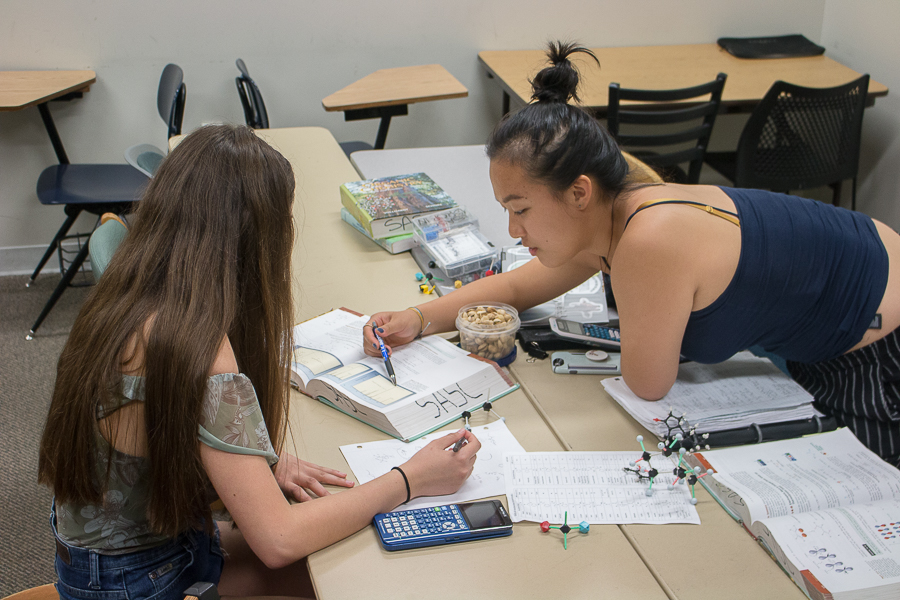
Tutoring, the way toward academic success

DANIELLE MOFFAT / AGGIE

Students discuss experiences as tutors

Joanne Newens was eating lunch at Blaze Pizza one day when an employee approached her and asked if she was a tutor at UC Davis. Newens was touched at the person’s comments, as they mentioned that Newens was recognizable as the person who helped them get through one of their tough finals. It’s moments like these where Newens truly feels like becoming a tutor for the Academic Assistance and Tutoring Center (AATC) was the perfect fit for her.

“The comment that always warms my heart when tutoring is when they ask what times I tutor, so they can come visit me to ask me questions,” Newens, a second-year neurobiology, physiology and behavior major said in an email. “This comment shows me that I am doing something right in my job. I am considering changing my future plans because of my year as a tutor. I love teaching, and I love being kept on my toes by answering new questions. I am considering graduate school because I now hope to become a professor!”

Newens tutors MAT17 (calculus for biology students), but the AATC offers tutoring services across the board including other classes, such as math, chemistry, econ, physics, statistics and even writing. The AATC was formerly known as the Student Academic Success Center, or SASC, which is what many upperclassmen might recognize it as today.

According to Inez Anders, the director of tutoring services in the AATC, the number of tutors remains around 250 students at any time of the school year. The AATC also employs a handful of student assistants as well as a tutor specialist.

“The tutors support all of the drop-in tutoring and all of the things that we do,” Anders said. “Then the people who help support the tutoring program [are] our student assistants. They do lots of the scheduling things that happen, they do lots of the reschedules, they respond to a lot of the emails, so they essentially do a lot of the admin work that helps the tutoring program run.”

Although they don’t do the tutoring, the student assistants are integral in the functioning of the AATC. Ilona Salim, a second-year food science major, is one of four student assistants at the AATC, and she is responsible for rescheduling when people miss their appointments. Other student assistants help with scheduling individual tutoring, the hiring process and promotional outreach.

Nick Cumpian, the tutor specialist at AATC, is in charge of managing the hiring and recruitment of tutors at the center, as well as managing training and working closely with the lead tutor.

“I usually keep tutors in the loop with the big interactive strategies that we use here to improve tutoring and maintain a high level of tutoring,” said Cumpion, who graduated in 2017. “I’m also in charge of actually scheduling all the tutors that work in the drop in rooms, scheduling finals tutoring, reaching out to different organizations who then speak to Inez and then Inez lets me know [what] we need to offer this upcoming quarter. Then I’ll collect all the individual schedules from each one of our tutors, and from each of these I go and I schedule their drop-in and things like that.”

It’s no wonder Cumpian needs some help from the student assistants when it comes to scheduling the tutors’ work schedules and individual tutoring, as Cumpian notes that, on average, 300 students receive individual tutoring from the available tutors a quarter.

Sometimes a student comes to the AATC requesting tutoring for an obscure class, in which case the AATC has to seek out a student who fulfills the qualifications of becoming a tutor and is willing to take on the job.

“Like ARE 155, we had a hard time, for example, trying to fill that order specifically because it’s hard to find upper div students that […] have taken the course and are still going to UC Davis to work as an undergrad tutor,” Cumpian said. “Typically we send those emails out because we’re looking for somebody who has the grade in that class, has the GPA, all that stuff, hoping somebody will apply and then we can interview them and move on.”

This was how Kimberly Tanaka, a fifth-year biomedical engineering and computer science double major, joined the AATC. She received an email asking if she wanted to tutor, and since spring 2016, has been tutoring thermodynamics and the physics 9 series.

“Of course you need to know the subject a little bit, but sometimes we don’t know the answers so sometimes it’s this fun journey of like, ‘hey, let’s figure out the answer together’ and getting to pass along some of the skills that’s helped you along the way,” Tanaka said. “Often the students know more than they think they do, and sometimes tutoring is giving them that extra boost of confidence of like, ‘hey, you’re on the right track, let’s correct it a little bit, but you’re on the right track’.”

Another aspect of AATC is providing tutors for programs that pay for special student services. For example, the athletics department pays to have tutors from the AATC hold special tutoring sessions to support the academic success of athletes on campus.

One of these programs is the Biology Undergraduate Scholars Program (BUSP), which serves students with a strong interest in undergraduate research in biology. After witnessing the passion and knowledge of a BUSP tutor in his freshman year — someone he saw more definitively as a mentor — Matthew Culberson was inspired to become a tutor himself.

“Seeing him [teach], that was something where I was like ‘wow’ and I did well in the class, in chemistry,” said Culberson, who just graduated last quarter with a degree in biochemistry and molecular biology. “He said, ‘I want you to be a tutor’ and I already wanted to be a tutor, so it matched up, so ever since the end of freshman year, I’ve been tutoring. I was hired to be a BUSP chemistry tutor, and then from there, I was able to apply to the [general] AATC tutoring program.”

Culberson tutors for general chemistry and organic chemistry. Since he’s not a student anymore, he finds his weeks filled with tutoring work. He doesn’t mind though and in fact loves the feeling of purpose he gets from the job and the relationships he’s built in his past four years as a tutor.

“The little joke I have all the time is, ‘I’m leaving this quarter, so you have to be the next tutor and replace me,’” Culberson said. “I’ve found people [like my tutor did with me], but some people don’t feel like they’re good enough, or they say, ‘I get this, but I don’t know how to explain it.’ But I always encourage people. It’s an excellent experience to be able to stand up there in front of people and get a random question asked at you. It’s a good skill to learn how to think on your feet and analyze questions.”

Another student who absolutely loves tutoring is Anika Agrawal, a third-year environmental toxicology major. After having found that her job at the library was not quite for her, she was ecstatic when she received an email at the end of her freshman year asking if she wanted to be a tutor.

“I love it, it’s great,” Agrawal said. “Recently somebody asked me, ‘what is, aside from doing school, one thing that gives you joy?’ And I love tutoring. After awhile the same people come in at the same times. They learn your quirks or you learn theirs. It’s just like a ten-weeks lived relationship with these people.”

As seems to be a common interest amongst all these tutors, Agrawal loves teaching others and witnessing progress. She has developed a unique teaching style of using positive reinforcement and lots of analogies. Instead of talking about hydrogen and oxygen, Agrawal will paint a picture using everyday concepts like flour and sugar that goes into baking a cake.

“I would love to be the Enderle of whatever the new age of chemistry is at my university, that would be really fun just to get more people excited about it,” Agrawal said. “I’m a very excitable person, and [love] making everybody really excited. Even if I could get like five more people excited about science, I’ve done something right.”


Written by: Marlys Jeane — features@theaggie.org


Humor: The surprising true story of how I found love with a traffic cone

DIANA LI / AGGIE

Why do they let me write this stuff?

The traffic cone. We pass them every day without a second thought. Maybe it’s time for a change.

It was a Sunday in February. The sun was shining, the birds were in the sky (where they belong) and I was wearing my spring hat and my best shoes. People asked me, “Why are you naked except for that straw hat and those galoshes?” But I had other mysteries of the universe on my mind: charcoal, Three’s Company, and FedEx. Naked, I got in my black and white Crown Victoria. I told the driver to take me around the block, but he was only interested in taking me to jail for “indecent” exposure. As the sirens blared down the road to jail, I realized how inconsiderate I had been my whole life. Every day I pass traffic cones, but never, not even once, had I thought, “Do traffic cones desire?” I was ready to explore — partially because of my revelation but mostly because I was trapped in the back of a paddy wagon.

Three days later, as I left the jail cell and stretched my legs, I came across it. A sign. It read: “Slow for Construction.” However, construction zones are commonplace, so I continued about my business.

A day and a half later I came across a traffic cone. It was a sign. It indicated to me that there was a pothole up ahead and that I should be careful where I walked.

A week later I remembered my question, “Do traffic cones desire?” So I bought one online, and after some romancing we consummated our love. It was sticky and plasticy and very unpleasant, even painful at times. However, after I had crushed it with the entirety of my body weight, something about the way it uncrumpled told me, “Well done.” It was the kind of thing that goes unsaid, that hangs in the air, like a subtle smile or a light caress. Yet those things were impossible as a traffic cone doesn’t have a mouth to smile or fingers to caress. What a traffic cone does have, however, is a clitoris.


Written by: Parker Nevin — phnevin@ucdavis.edu

(This article is humor and/or satire, and its content is purely fictional. The story and the names of “sources” are fictionalized.)


Student Disability Center looks to technology to help students

NICHOLAS CHAN / AGGIE FILE

Adaptive technologies assist disabled students

The Student Disability Center uses technology-driven tools and services to provide assistance to students with disabilities in order to meet their academic challenges.

Jennifer Billeci, the director of the Student Disability Center, described the center’s mission.

“University of California, Davis is committed to ensuring equal educational opportunities for students with disabilities,” Billeci said. “Officially, that is our purpose and is why we are on campus, but seriously our scope is much more than that.”

Belleci also said that the goal is to “support students […] to be comfortable and thrive here, and we want them to know UCD is their home.”

Most of the time, students’ first experience with the SDC is when they go the the office located in the Cowell building at 425 California Avenue.

“The students helping out at the front desk are typically first contact for students, faculty and staff who want information about the office,” Billeci said. “The student workers disseminate basic information, will collect forms if somebody wants to turn them in and then forward them on with the professional administrative assistants to get people into the system.”

Maddy Hart, a third-year psychology student at UC Davis and a student assistant at the SDC, described her work. Hart said “being able to help people” is why she “loves this job.”

“This is an opportunity that I get to help people even if it is just connecting them to a specialist that can help them with school,” Hart said.

Billeci said the “personalized [and] individualized” services that they provide to students are meant to “mitigate barriers, and it is all about access.”

One of the areas where the SDC works to overcome barriers for students is with the use of technology. Belleci spoke about the work that Joshua Hori, the Accessible Technology Analyst, and his team put into place.

It comes down to the barriers that are created by the students’ disabilities,” Billeci said. “A student who has low vision might require assistance, probably from Hori’s team, to make the materials accessible. They might use assistive tech, using a screen reader [or] there might be enlargements individualized to the student.”

In evaluating students to find the technology they need, Hori first assesses their familiarity with technology.

“When I first come in to see a student, I kind of try to gauge their technical knowledge and willingness to work with technology,” Hori said. “I kind of ask them if they are willing to embrace technology or they kind of fight it and depending on their answer, I guide my presentations on the different types of technology. [For instance, with] STEM, you have to do a lot of writing, so something like that we will recommend something like a LiveScribe Smartpen where it records your handwriting.”

Hori said that the device also records lectures as the student takes notes, “so everytime you are taking down notes, you are making a bookmark inside the audio that you can come back to and play from that writing.”

Hori also described a tool that records lectures using an iPhone or an iPad that allows students to annotate the lecture.

“We have Sonocent, which has highlighting capabilities to your audio lecture recordings, which you can then put on your computer,” Hori said. “Now a lot of people question — ‘Wait, how do I get it to my computer?’ In that case, we introduce cloud services on your mobile device as well as on your computer.”

According to Hori, Sonocent has noise cancellation and timecode annotations that synchronize with the recording.

For students that need reading assistance, there are electronic text readers offered by the SDC.

“We have e-readers that can read your textbooks out loud and allow you to read your textbooks directly on your mobile phone, iPad or even on your computer,” Hori said. “A lot of students tend to like it on the iPad because they can zoom in and make it big.”

Hori spoke about an e-reader called BeeLine Reader and said that it “adds visual reference and visual alterations to your text but makes it easier for people like me with Attention Deficit Hyperactivity Disorder to keep track of where you are reading.”

“There has been times where I have read whole chapters, and I get to the end for some reason, I was thinking about something else instead of actually reading, I [think], ‘Wow, I have to read that chapter all over again,” Hori said. “[The BeeLine Reader keeps me] involved in the text and following the colors while also reading. I am able to absorb more that I usually would.”

The SDC also has research projects under development. One of these is a tactile electronic map embedded with braille. When a person uses a pen to tap on a specific location on the map, a recording gives details on the location. Another project is a virtual reality headset paired with smartphones to help vision-impaired students.

The tactile map is a collaborative project involving different UC Davis departments.

“This is a project that is a collaboration between the SDC, the Design Department and Disability Issues Administrative Awareness Committee,” Hori said. “They have come together to do this project, so it is really very nice because it is student involvement, instructor involvement and our involvement.”

Hori spoke about how the map will function.

“This is a tactile map where you can feel the roads, you can feel the walkways, you can feel the buildings,” Hori said. He added that the innovation behind the tactile maps is how it handles the indexing of building, roads and landmarks.

“If you are blind, there is usually a two-character braille code that you can associate with the building and with the index — as you know, a lot of the building on campus are just labeled with an [abbreviation],” Hori said. “What we are doing is we are taking the index and making it into an audio file where we are taking this LiveScribe smartpen, and we are embedding all this information into this LiveScribe smartpen. If you tap on these buildings, it actually reads out what the building is.”

The pen will read the name of the building and the functions and services provided by the building.

“We are having multiple versions for UC Davis,” Hori said. “We are going to house it in different areas, for example at the Welcome Center, at the MU, here [at the SDC], at the ARC and the Student Community Center.”

Hori finally brought out a virtual reality headset and a smartphone that attaches to it. He said that the device gives people the ability to see things currently unavailable to people with low vision and that the device allows them to have a “walking [closed circuit television] no matter where you go.”

“We can use bluetooth controllers in order to zoom in on areas or burst the contrast so that way light becomes dark and dark becomes light to make things a little bit easier to see,” Hori said.


Written by: George Liao — campus@theaggie.org


Album Review: “Tranquility Base Hotel & Casino”

CAITLYN SAMPLEY / AGGIE

Arctic Monkeys return with new style, fail to sustain it.

On May 11, Arctic Monkeys returned to the music world with their sixth album: “Tranquility Base Hotel & Casino.” The album is the British rock group’s first in five years. It comes after their wildly successful album “AM,” which featured internationally renowned tracks such as “Do I Wanna Know?” and “Why’d You Only Call Me When You’re High?” The album, while commercially popular, was a remarkable jump into the realm of pop rock for a band that has made its name emulating punk rock lyrics and sounds. “Tranquility Base Hotel & Casino” is yet again an extreme departure from the punk of the past. The band’s lead singer and lyricist, Alex Turner, trades in both pop and punk for captivatingly strange lyrics and a never-before-heard piano emphasis.

The album’s first track, “Star Treatment,” serves as the calm before the storm. Turner’s opening line, “I just wanted to be one of The Strokes / now look at the mess you made me make,” is the first and last moment of introspection by the Arctic Monkeys’ frontman. The brief honesty is followed by a winding, and at times, disjointed story concerning lunar landings and taquerias on the moon. That being said, hearing Turner’s admission of The Strokes’ influence on his career is endearing to Arctic Monkey fans.

On “American Sports,” Turner makes first mention of the album’s lunar theme: “So when you gaze at planet Earth from outer space / Does it wipe that stupid look off your face?” The line serves to perfectly transition the album into its eponymous song “Tranquility Base Hotel & Casino,” where we listen to Turner describe the so-named casino and its presence on the moon.

The album reaches its climax at the halfway mark with the song “Four Out of Five.” The popular track describes Turner’s opening of a taqueria on the moon with crazed lunar theme lyrics like “I put a taqueria on the roof, it was well reviewed / Four stars out of five.” Turner’s crooning voice and a classic Arctic Monkeys’ rock sound culminate in what turns out to be the album’s best song.

Unfortunately, the album proceeds to drop off with the remaining five songs. The band struggles to maintain a singular focus and in turn, produces numerous songs such as “Batphone” and “Ultracheese” of similar sound and structure.

The stripped down instrumentals of the Arctic Monkeys’ “Tranquility Base Hotel & Casino” necessitate a reliance upon Turner’s lyrical abilities. It’s an avante garde attempt that excels initially but ultimately falls short of expectations. Listeners can hear the artistic intentions of Turner and the Arctic Monkeys, but the album’s ambitions reach a crescendo far too early, falling flat with similarity and simplicity.


Written by: Rowan O’Connell-Gates — arts@theaggie.org


How NCAA is becoming more academically focused

JEREMY DANG / AGGIE

NCAA guaranteed student-athletes more time away from sports in 2017-18 season

Last year, time demands from student-athletes had the NCAA concerned about the student-athlete experience and prompted the NCAA Student-Athlete Advisory Committee to advance legislation to restrict athletically related activities for a set amount of days, adding to the time-off requirements already in place in the form of time management plans.

These new time management regulations were adopted at the 2017 NCAA Convention, and were put into effect for the 2017-18 academic year — UC Davis Athletics Compliance oversaw the implementation.

The Aggie spoke with the assistant directors of compliance services, Lydian Sandlin and Ryan Qualls, who were prepared with the NCAA bylaws, to discuss how this will affect Division I programs at UC Davis.

Qualls and Sandlin explained that student-athletes are already required to take one day off out of every week while their sport is in season, and two days off every week while their sport is out of season. The new requirement added a mandatory week off after a final competition and another 14 days free from any athletics related activity, which includes things like practice, conditioning or team promotional activities and media events.

“I personally call them holy days off because the only thing you can do is something health related — physical therapy or a doctor’s appointment.” Sandlin said. “Or academically related, so you can go see an academic advisor.”

As for the additional 14 required days off, Qualls added they could be used at the student-athlete’s discretion.

“Those can be sprinkled in throughout [the] in season or off-season,” Qualls said.

The legislation is a response to previous NCAA discussions about the time demands of Division I athletics. Around 50,000 people involved with Division I athletics were surveyed and committees built legislation designed to give student-athletes a break when they need it.

“It’s designed to benefit the student-athlete and to give them more time to be able to have a more successful and flexible schedule with college and balancing college and athletics,” Qualls said. “So it’s an extra day to get student-athletes rest and recovery ample study time for tests and quizzes, ample time to do their homework.”

Sandlin noted that athletically related activities have become more defined under the new requirements.

“Now it’s more strict on [days off] being completely off.”

Because, as Sandlin added, before the new rules UC Davis Athletics could ask student-athletes to do things like a media interview, despite it being their day off.

It hardly needs saying that UC Davis holds its students to a high academic standard, being ranked 29th in the nation and 42nd internationally by the Center for World University Rankings, including student-athletes. Seven of UC Davis’ sport programs received a Public Recognition Award from the NCAA for being in the top 10 percent of their respective sports academically. In light of UC Davis’ academic achievements, adopting these new rules seems hardly useful.

Although the NCAA only required the Power Five conferences to opt in, the Big West Conference voluntarily opted in, forcing UC Davis to comply with the legislation.

Sandlin brought up UC Davis’ unique academic culture and that coaches and student-athletes are sensitive to the academic rigor.

 “I think a lot of our coaches and our students are very aware that this is a high-level academic institution,” Sandlin said. “So our coaches will say ’hey you know what, it’s midterms we’re going to take two days off, it’s finals week we’re going to take three days off’.”

Sandlin has noticed a mixed student-athlete response to the new time requirements.

“It’s a little bit more mixed in my opinion because some soon athletes are like ‘hey I don’t really like it,’” Sandlin said.

According to Sandlin, this is because it sometimes causes some teams to pack their schedule to accommodate the new requirements, so that practices aren’t sacrificed.

“So it’s a two-sided coin,” Sandlin said.

It’s too early to tell how it has impacted student-athlete GPAs, says Sandlin, and only time will tell how it affects athletic and academic performance, if it does at all.


Written by: Bobby John — sports@theaggie.org


Humor: People keep telling me I have “it,” and by “it,” they mean HPV.

VENOOS MOSHAYEDI / AGGIE

And by people I mean doctors.

It all started when I walked into the room. Everyone in it was blown away — I could see it on their faces. These shocked expressions and dropped jaws have become standard reactions to my presence. I turn and talk to a woman in the room. She looks me in the eyes, slightly shaken; she seems a bit shocked by my calmness.

“You have warts on your arm,” she says.

“Tell me something I don’t know,” I reply.

“No, really, you have an infection,” she states. “Have you been sexually active lately?”

“Maybe, why do you ask?” I answer with a wink.

“Because I’m your doctor and I need a straightforward answer.” Dr. Karonelli wasn’t playing any games. I proceeded to tell her my sexual history, all of the dirty details she wanted.

“You need to put on this cream twice a day,” she prescribes.

“Will you do it for me?” I plead.

“Get out,” she demands frustratingly.

I leave without a phone number, though she did note her email on this prescription pad. I read it outside while smoking a cigarette.

“What are you doing?” It’s her again — Dr K. I knew she couldn’t resist.

“Funny seeing you here, outside the hospital, doctor.” I say smoothly.

“You need to quit smoking immediately,” Dr. K. said. “I told you that was one of the ways to inflame the disease. Put that out now.”

“What, so I can live longer so you can flirt with me some more? I don’t think so, Doc. I’m riding on my own wave and there’s no shark that’s worth diving for.” I reply.

“God, I hope nobody is dumb enough to have sex with you,” she says.

“I don’t know doctor, are you?” I respond hopefully.

I am no longer allowed to visit the Balboa Hospital, but I know one thing for sure: I’m absolutely positive — HPV-positive.


Written by: Beck Nava — rnavamcclellan@ucdavis.edu

(This article is humor and/or satire, and its content is purely fictional. The story and the names of “sources” are fictionalized.)


Fish keep friends close, anemones closer

PUBLIC DOMAIN

Where and when animals eat food is dependent on those around them

Animals are socially influenced by each other, which affects everything from how much individuals eat to the likelihood that certain species will go extinct. For example, a study shows that algae-eating fish in coral reefs will eat food in more dangerous areas if there are other algae-feeding fish already there.

“Social information, while it’s a simple process, as simple as fish copying each other, or whatever it is, a bird copying another bird, a bird copying a squirrel […] If an animal that shares your needs, your resources, or shares your predators, reacts in a way that seems good or bad, then animals often then follow suit,” said Michael Gil, a coauthor of the study.

A more recent study shows that all types of animals rely on social cues to determine their behaviors, such as picking a sleeping site or avoiding predators. Supporting this theory is the study done on coral reef fish, which found that fish reinforce each other’s feeding behaviors.

In a calm lagoon off French Polynesia, a fixed station with video cameras monitored flat, open areas with lots of algae. Even though there was a lot of food for algae eaters like parrotfish and surgeonfish, the areas not did provide cover from potential predators, like sharks. In these more dangerous areas, the fish still gathered to feed if other algae-eating fish were present.

“Animal use of social information is something that we’ve known about for a very long time, and now more and more ecosystems are showing these same patterns,” Gil said. “Animals copy one another within and across species.”

Andrew Hein co-authored both studies with Gil, and he explained different methods by which the footage of fish was examined. At first, students went through the hours of film looking for fish and how they reacted. Later, a computer program was designed to recognize fish, which reduced the time needed to look at the videos.

According to Hein and Gil, these studies have far-ranging applications. Understanding that different mechanisms drive ecosystems is important for conservationists to know so that they can push for policies to protect the environment.

“When we remove fish from these ecosystems, we’re not just removing these valuable workers […] when you remove the fish, you’re not just removing the important individual and it’s feeding ability, you’re also removing its social influence on the rest of the fish in the ecosystem,”  Gil said.

By removing a few fish, the rest of the fish will not have the reinforcing behavior to eat, and may become weaker. Not only would this decrease the fish population, but other species might suffer. The coral reefs that parrotfish and surgeonfish live in can be killed off from excessive algae growth.

“The reason that one would care about this is that the fish I’m talking [parrot fish and surgeonfish] about are responsible for consuming algae,” said Gil. “And these particular algal species that these fish eat, if left unchecked, they can kill coral. And we know that, in some cases, degrade entire coral reef ecosystems, making them far less valuable for humans.”

The study about fish behavior is important to coral reef conservation. However, if the same social behaviors occur in other contexts and species, the impacts would be even greater. Gil thinks that their theory could predict how species will be affected by climate change and which species will be able to avoid extinction. However, it is possible that fish copying each other’s behaviors can have negative effects.

There might be a social component to making bad decisions as well, like eating plastic,” said Lea Pollack, a Ph.D. student. “If one fish eats plastic, maybe another one will try it too. Sort of like the proverbial, if your friend jumped off a bridge, would you jump too? We tend to think of this social information use as beneficial to these animals, since it tells them more about their environment and more information often means a more informed decision […] this social information might actually be harmful in certain situations.”


Written by: Rachel Paul — science@theaggie.org


For millions of covered women, the hijab isn’t a tool for oppression

JEREMY DANG / AGGIE

While some women are forced to cover, there are millions who choose to do so, and it’s important to know why

In an era that saw the Free the Nipple Movement rise alongside a broader fight for male and female equality, it’s disheartening to witness continued attacks against Muslim women for what they choose to wear.

A lot of people have opinions on hijabs. Whether these opinions are positive or negative ones, they’re arguably irrelevant. The most important opinion is that of Muslim women — after all, they’re the ones actually wearing the hijabs.  

Before I continue, it’s important to distinguish the various forms in which Muslim women cover themselves. The burka and niqab are separate from the hijab; the burka covers the entirety of the face, whereas the niqab covers most of the face but leaves slits for the eyes. The hijab only covers the hair, sometimes fully, sometimes not, depending how the wearer chooses to style it. I must confess that I find the niqab and burka oppressive as they take away from an individual’s identity. For me, however, the same cannot be said of the hijab.

It’s no secret that there are Muslim women who are forced to wear the hijab. In Saudi Arabia and Iran, for example, it’s compulsory that women wear the hijab in public. Aside from government-led imposition of the hijab, there are also members of the Muslim community who force the hijab upon their daughters, wives and sisters. In these cases, the hijab is a tool utilized for the oppression of women; forcing the hijab (“forcing” includes any form of coercion, undue encouragement or guilting) infringes upon a woman’s freedom to make choices, and therefore, is oppressive. That being said, there are many — indeed, millions — of Muslim women who choose to wear the hijab. It’s important to understand not only the fact that some women freely choose to wear it but also why they choose to do so. Establishing these understandings can serve to invalidate generalizations and stereotypes.

For some women, the hijab affords recognition for who they are, not what they look like. This isn’t about a safeguard against the lusts of men — it’s about the right to assert one’s body and spirituality as a woman sees fit. In defense of her own hijab, Ayesha Nusrat put it best when she wrote: “I control what you see, how is that not empowering?” A lot of covered women believe that the media, marketers and a number of others have worked to sexualize and objectify women’s bodies. By choosing to wear the hijab, they feel they are actively combatting this by asserting their own will over what others get to see. Modesty has a beauty of its own, and there’s nothing wrong with that.

Some people regard covered women as lacking the intellect and bravery to advocate for their rights. In light of this, many Muslim women wearing the hijab have felt inspired to contest these stereotypes. Wanting to be who you are without having to choose between your religion and your rights is undeniably reasonable. The ability to be who you are without reservation, in all facets of life, is empowering. Some women feel most empowered when expressing their faith or exerting control over their own bodies — if the hijab allows for this empowerment, why doubt its validity?

The hijab, for many women who choose to wear it, expresses spirituality along with a personal bond with God. For many covered women, faith is an integral part of their identity that they choose to openly declare through their wardrobe, much like nuns, many Orthodox Jewish women and Greek Orthodox women. Many Muslim women face obstacles when deciding to wear the hijab — specifically, judgment. If it was a tool for oppression, then women wouldn’t choose to wear it or subject themselves to the scrutiny, and sometimes violent reactions, from those who would assume those women are oppressed. For the sake of logical consistency, if you don’t have a problem with the attire of other religious women who chose to cover, then you shouldn’t have a problem with hijab-clad Muslims either.

Muslim women aren’t collectively being forced to wear the hijab. My mother considers herself a religious woman, yet my mother and the majority of her family do not choose to cover. That being said, the word “choice” is the paramount term when discussing hijabs. Oppression occurs when an individual’s rights and freedom to make choices are taken away. If a woman chooses to wear the hijab for the reasons that covered women are arguing (expressing faith and control over one’s own body), you cannot argue that the hijab is oppressing them. That’s just illogical. Making the assumption that all covered women are oppressed disparages the women who choose to wear it by belittling the fact that it was a choice, which perpetuates an unjust stereotype regarding Muslim women. If the concern about covered women is oppression, then they should be brought into the conversation when discussing hijabs — their voices should be heard louder than any other voices on this topic.

Muslim women are left vulnerable to oppression by both Muslims and non-Muslims. If the concern is the oppression of Muslim women, non-Muslims shouldn’t express this by ridiculing the hijab or ripping it off Muslim women’s heads (this happens frequently), as this behavior does exactly what was trying to be combated. If you’re going to fight for the right of any woman to reveal as much as she wants, then you should also fight for their right to cover as they see fit. As writer Hanna Yusuf has stated, “There’s nothing inherently liberating in covering up, just as there’s nothing inherently liberating in wearing next to nothing. But the liberation lies in the choice.”


Written by: Hanadi Jordan — hajordan@ucdavis.edu

Disclaimer: The views and opinions expressed by individual columnists belong to the columnists alone and do not necessarily indicate the views and opinions held by The California Aggie.

School board urged to build swimming pool at Davis High School

DAVIS WHALEN / AGGIE

Supporters of aquatics program want pool for practice, safety, learning, exercise

In a recent public comment held at the Community Chambers in Davis City Hall, supporters of the aquatics program in Davis spoke up. They urged the Davis School Board to include a swimming pool — to be built specifically at Davis High School — among the top tier of priorities in the school district’s facilities master plan for the next 10-15 years. Davis is one of the largest aquatic communities in Northern California, with nearly 5,000 local households involved in some way with local aquatics.

Peter Motekaitis, the associate head coach of the UC Davis women’s swim team, talked about the importance of aquatic skills.

“According to the CDC, more than 10 Americans drown every day, and 88 percent of those deaths are preventable,” Motekaitis said. “Yolo County’s obesity rate is around 35 percent for 10th graders. Skill-based aerobic swimming can reach that population for moderate to vigorous aerobic exercise.”

Doug Wright, the water polo coach at Davis High School, also commented on the need for a swimming pool at Davis High.

“Students graduate every year that would drown if they fell in a pool,” Wright said. “Seems ridiculous that one of the primal skills to live on this planet is swimming, yet students get through 12 years of formal education without it being taught.”

According to The Davis Enterprise, a pool at Davis High would cost “somewhere between $8 million and $9 million” dollars.

“Pools are expensive, so ever since I have been involved with aquatics from 1984, no serious discussion took place,” Motekaitis said. “This is the right time to put a pool in. Davis High School is a very large school, and a pool could be used by a large enough segment of the district to fill it.”

Davis High School, which opened in 1961, has never had a swimming pool for swim teams, water polo and other aquatic sports.

“A swimming pool has been on the master facilities plan for 15 years,” Wright said. “It is overdue. Tax payers, voters, parents, athletes, staff members want the pool. We have always needed a pool, but other projects seemed to take priority. It will allow for adaptive PE classes to be taught. Athletes can cross train and rehab and specifically, our aquatics athletes can have a proper place to train.”

“Swimming is a part of the California State Physical Education Curriculum,” said Koren Motekaitis, the co-director of Davis Aquamonsters. “By not having a pool, this hurts the students who cannot afford to join youth swim teams or pay for expensive swim lessons to learn a critical life skill of learning to swim. This skill set can be taught in our public education with our current curriculum if we had a pool.”

Koren also mentioned additional benefits of a swimming pool at Davis High School.

“High school aquatic athletes could run a low-cost swim lesson program as part of their real community service,” Motekaitis said. “These fees could help fundraise money for the high school aquatic teams. Since this program could be low-cost, the athletes could volunteer their time and give back to the community that supports [or] funds their facility.”

According to Peter Motekaitis, unequal access to swimming pools is morally unacceptable.

“[Swimming is a] lifelong skill that will not be replaced by tech. There is no app to teach you to swim, or no app that will save you from drowning.”


Written by: Rabiya Oberoi — city@theaggie.org


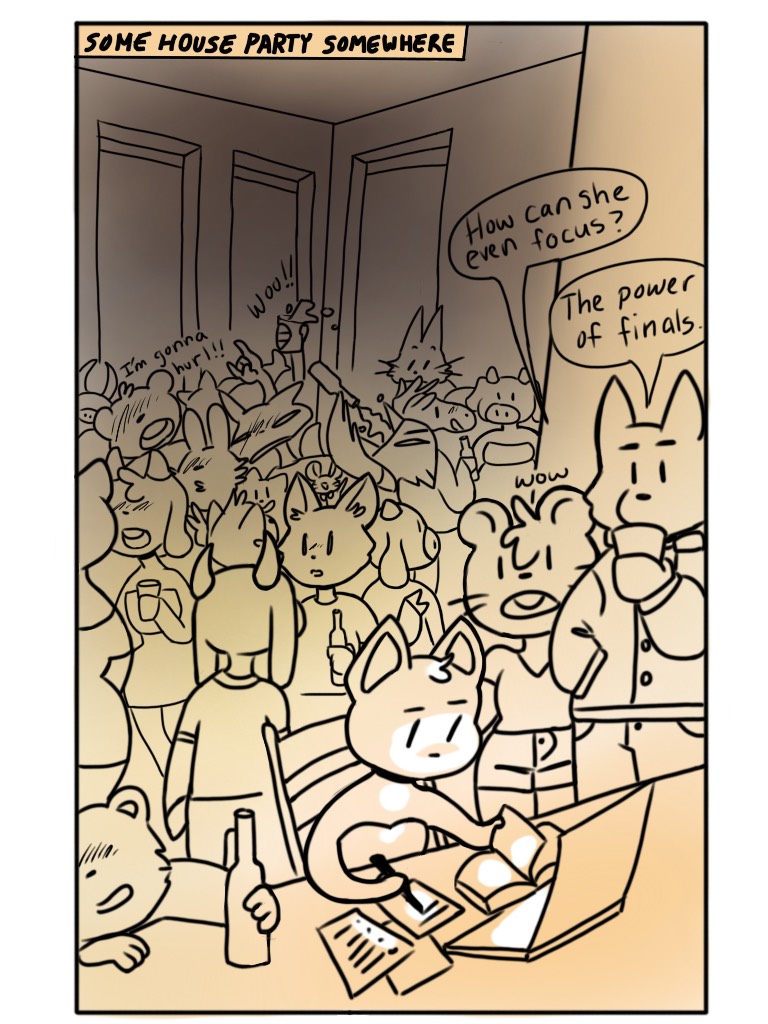
Cartoon: Studying for Finals

By: Diana Olivares — deolivares@ucdavis.edu

Disclaimer: The views and opinions expressed by individual cartoonists belong to the cartoonists alone and do not necessarily indicate the views and opinions held by The California Aggie.