53.8 F
Davis

Davis, California

Friday, December 19, 2025
Home Blog Page 511

Humor: Gunrock reunited with estranged parents: member of Blue Man Group and this horse

ALLYSON KO / AGGIE

Gunrock might have cried happy tears, if his unblinking eyes could

It was a joyous day yesterday. Gunrock was reunited with his family for the first time since moving to Davis in 2003. Happy tears flowed from the eyes of Mr. Blue Man as the family hugged and kissed one another. I had the chance to ask Gunrock about the emotional reunion, and he responded to my questions with an Etch-A-Sketch, drawing answers faster than you can say, “Go Ags!” Actually, it took him a little longer. Couple minutes or so.

“I just couldn’t believe the look on Pa’s face,” Gunrock wrote. “‘Is that you, Gunny Boy?’ he asked me with tears glistening on his cornflower face. Well, he didn’t really say it, because he can’t talk. But he blinked it to me using Morse code. That’s how we communicate. He blinks, and I stomp the ground. It sure brings back good memories of when Dad and I used to play catch in the front yard with marshmallows using only our mouths!”

“Wait,” I said. “Your father, of the Blue Man Group, can’t hear or talk, so he communicates with blinks. You can neither talk nor blink, so you communicate with stomps. And you mother, this horse, can’t understand either of you, because — well, she’s a horse. Is this right?”

“Yes, Ma doesn’t pick up much of what we say,” wrote Gunrock, shaking the Etch-A-Sketch vehemently to clear space. “Which might explain why the three of us haven’t talked in 15 years. It was just a big misunderstanding,” he continued, nodding his ginormous head in what I can only hope was a silent laugh. “Isn’t that right, Ma?” he wrote, looking deeply into the horse’s face for the first time.

“Crap,” he wrote, twisting the knobs of the Etch-A-Sketch with nervously speedy fingers. “This is the wrong horse.”


Written by: Jess Driver — jmdriver@ucdavis.edu

(This article is humor and/or satire, and its content is purely fictional. The story and the names of “sources” are fictionalized.)


She thought her Facebook feed was normal. Then she found out about clickbait

JULI PEREZ / AGGIE

Although mostly harmless, clickbait can have negative political and social repercussions

Clickbait is one of the most pervasive and hard-to-ignore features of the Internet in the 21st century. It undoubtedly plays an important role in how people perceive the world: politically, economically, socially, racially and religiously. The early days of Internet grappled with spam — Viagra advertisements, miracle beauty cures, fake lottery wins — but today such ads encompass only a small portion of the material that Internet users are exposed to on a daily basis.

For example, when I first began using Facebook as a 15-year-old in 2014, I was puzzled by the near-constant flow of Tampax commercials, American Apparel ads, psychological horror stories, crisis hotline numbers and unsolicited beauty advice columns that were constantly appearing on my feed. Then I understood: Just as a middle-aged woman using Facebook might be exposed to ads advertising dating sites for “hot single men over 50,” my Facebook page was feeding me commercials and information that they thought I would find interesting. Aside from finding this utterly depressing — teenage girls, believe it or not, have more to think about than feminine hygiene and whether or not their summer body is bikini-ready — I also found it irritating and insulting. I was going through a particularly self-conscious phase of my life, so I’m certain that the impact of such clickbait registered much more sharply than it would now. I remember realizing that I would never really be free: someone, somewhere, would always be trying to tell me what to do, how to look, how to act. Even the Internet had it in for me.

I also noticed that my Facebook feed was providing me with a particularly apocalyptic world view. If I had decided not to use the “manage my ads” feature, I may have been inclined to fall into the negative vortex of “information” that claimed that, as a teenage girl in the 14-to-18 age group, I would likely experience unprecedented anxiety, love problems, beauty worries and reproductive crises on a near-daily basis. Evidently, womanhood was even more fraught with danger than I had anticipated. Nevertheless, I believed that in managing my ads, I would be immune to the clickbait that tailed me on social media and in my Internet searches. This, of course, is not so.

As a college student, I engage in brainless Internet surfing fairly often. It’s a way to relax, I tell myself, a way to escape the daily drudgery of the trending news cycle that haunts my iPhone day in and day out. I will even confess that, in addition to reading The New York Times and The Washington Post to assure myself that I’m still an informed, upright citizen with a balanced view of the world, I have religiously followed the details of the upcoming royal wedding. I have fallen prey to articles citing “Ten Times Meghan Markle was a Total Boss,” “Ten Times Meghan Markle and Prince Harry were Totally Cute” and “What Meghan Markle Looked Like Before She was Famous.” I can’t help it. Markle may finally be able to redeem the whole abdication-Wallis-Simpson-fiasco that shook the English monarchy to its core in the 1930s. A divorced, biracial, Catholic-school-educated American actress is marrying into the notoriously stuffy House of Windsor. Can you blame me for enjoying it? Nevertheless, I’ve begun to notice that the Markle thread is following me. Her much-sought-after Everlane bag, rumored to have “broken the Internet,” has appeared on my feed, as have endless “top ten” lists featuring beauty and fashion candids. It’s beginning to feel a little strange. It appears that I’m still, after all, a victim of clickbait.

Naturally, such articles are harmless enough. I’m old enough to distinguish between reality and fantasy, truth and nonsense — or so I tell myself. However, clickbait can still have negative repercussions. As I wrote about in my previous column, clickbait and “trending” features are not limited just to product histories. They can be political, contributing to a narrow and isolationist worldview that is becoming increasingly hard to fight in this era of social, economic and ideological polarization. They can be psychological, convincing you that you’re on the verge of a nervous breakdown, that you may benefit from Adderall. And they can be social. Here you are, sitting in your dorm room, while everyone else is out having a good time. Everyone else is more fashionable, more politically aware, than you are. Have you seen these new sneakers? Have you watched Childish Gambino’s “This is America” video? Moreover, have you finally copped on to the fact that Childish Gambino and Donald Glover are the same person?  Have you registered to vote? Get with it, Rebecca.


Written by: Rebecca Bihn-Wallace — rlbihnwallace@ucdavis.edu

Disclaimer: The views and opinions expressed by individual columnists belong to the columnists alone and do not necessarily indicate the views and opinions held by The California Aggie.

Affordable alcohol options

MELINDA CHEN / AGGIE

Try these spirits in the last month of Spring Quarter

For the majority of undergraduate students, college is a coming-of-age experience, and one seminal moment is turning 21. At that point, the world of legal liquor opens up, and students begin exploring their alcoholic options. But like most college endeavors, these explorations are often hindered by a limited budget. But fortunately, there are many available options for affordable — and not all that bad — alcohol.  

Cherry Blossom Pinot Noir

Price: $3.99

Found at Trader Joe’s, this surprisingly delicious red wine is one of the best wines for the price. Perfect for budgeted dinner parties or a simple weeknight meal, Cherry Blossom pinot noir allows the possibility of multiple bottle purchases given its cheap price.

Boatswain Double IPA

Price: $4.99

In the spirit of Davis grocery stores, we have another Trader Joe’s speciality. Boatswain Double IPA is renowned for having both an exceedingly small price tag and a 6.7 percent ABV content. With caramel notes and a strong hoppy taste, this beer is a perfect beginning to a night out.

Kirkland Signature American Vodka

Price: $16.99

Beloved by college students for its cheap price tag and smooth taste, Kirkland Signature American Vodka is a perfect choice for affordable cocktails. It has gained notoriety for its connection with the luxury vodka brand Grey Goose. And at $16.99 a handle, it’s a steal for those drinking on a budget.

Sierra Nevada Torpedo Extra IPA

Price: $7.99

For fans of IPAs, Sierra Nevada Torpedo Extra IPA is the perfect summer beer. Sold at under $8 for a six-pack, this beer is one of Sierra Nevada’s lesser known products. However, don’t let its status fool you; this beer is packed with flavor and hoppy character.

Beringer Main and Vine Pinot Grigio

Price: $6.99

This white wine is the answer to Cherry Blossom pinot noir. A fruity wine with a dry flavor, Beringer Main and Vine pinot grigio is the perfect dinner pairing for fish or pasta. Its crisp flavor is sure to add to any upcoming summer dinner party.


Written by: Rowan O’Connell-Gates — arts@theaggie.org


“Sense8”: Series finale

DAVIS WHALEN / AGGIE

Controversy over cancellation Netflix original; predictions

Content warning: This article contains spoilers for the Netflix original series “Sense8.”


The Netflix original show “Sense8” is scheduled to release a second two-hour special on June 8, but it’s unconfirmed if the special will actually be the show’s finale. A statement released on the official “Sense8” Instagram page said only time will tell what happens next. Season 2 left several things unanswered — enough for an entire season. But the question remains: why did Netflix cancel such a cinematically spectacular show?

In fairness, most shows don’t have eight protagonists that live in eight, very spaced-out corners of the globe. The cost of transporting cast and crew to different locations was very costly. According to Variety, the show had cost upward of $9 million per episode. The first two seasons had at least 11 episodes each, so you do the math.

The show has a small audience in relation to its top-tier budget. The show is a dramatic, suspenseful overload of chaos and dialogue. It isn’t a light watch, but that’s what makes it so interesting.

The entire cast has returned, so there are no odd or sudden write-outs. Again, eight protagonists leave little room to go further in depth with the characters and their backstories. It makes connecting to the characters a bit challenging. However, the intimacy that the characters share with one another manages to span across several distinct cultures, regardless of their differences.

The degree of diversity and inclusion that the show promotes is a model for other shows to follow. The relationship between Lito (played by Miguel Angel Silvestre) and Hernando (played by Alfonso Herrera) represents a realistic gay couple that doesn’t have a heteronormative face value. Nomi, a transgender woman (played by Jamie Clayton), is a spectacular stride in the right direction in inclusion of the transgender community on the small screen.

Season 2 left off with the eight protagonists throwing Whispers (played by Terrence Mann), the unconscious leader of a villainous organization, into the back of van. What are they going to do with him, especially when he wakes up? Lastly, where’s Wolfgang? I have a feeling there will be some bargaining involved in the series finale.

The first two seasons of “Sense8” along with the Christmas special are available to stream on Netflix now.


Written by: Josh Madrid — arts@theaggie.org

Pancakes with a side of life-saving

CHRISTIE NEO / AGGIE

Local firefighters host pancake breakfast to raise money for burn institute

On May 5, Davis firefighters put together their annual pancake breakfast for students, families and residents to raise money. All proceeds, collected through $5 tickets sold around campus, are directly donated to the the Firefighters Burn Institute. This burn institute was founded by Fire Captain Cliff Haskell and local Sacramento firefighters as a nonprofit organization. Since 1973, this operation has worked in many other ways than just treating victims; it has also publicly educated those unaware of how important these outreach efforts are to communities nationally. This specialized burn unit has helped many of those who have experienced fire-related trauma from the Sacramento to the Davis area.

Altogether, the student firefighters raised approximately $1,500 with major assistance from nearby stores to put together the whole fundraiser. Nugget and Safeway offered employees to cook for the morning, using gift cards to purchase necessary supplies.

“The event was definitely a success and we were super grateful and happy with the turnout throughout the day,” said Ari Wargon, a fifth-year mechanical engineering major, via email. “Personally I love this event because I get to see a lot of friends and family and show them where I live and where I work. Being able to donate to the burn institute is something very important to us, too, because burn injuries are so common in the fire service. We understand and sympathize the pain and devastation that comes with burn injuries. We are extremely appreciative there are people out there to aid victims in their journey.”

This on-campus program invites everyone to look into the opportunity of becoming a firefighter and to make a major difference in the Davis community. The station covers campus territory and major freeways in the area to assist in much more than just structural fire incidents. The program itself is much more than just something one could sign up for — it involves a written test, physical test, interviews and a six-week academy course for training. Student firefighters must complete four 14-hour shifts and one 24-hour shift per month alongside classes.

“The experience I have gained from this program has really made me grow up,” said Brock Gordon, a fourth-year managerial economics major. “You have to sacrifice a lot of things college students wouldn’t be willing to sacrifice, from missing holidays with family to not being able to go out or participate in many common college-related things. I’m not complaining at all, but it is a sacrifice that I wouldn’t change for anything. The program has given back to me in more ways than I could even state — I mean, it helped me realize what I wanted to do with my life.”

After receiving their degree at UC Davis, these graduating student firefighters will come out with their EMT, their Firefighter 1 and skills that will last them a lifetime when it comes to saving lives.

“Something many people also do not know is that 70 percent of the job is actually medical,” Gordon stated.

From the Thomas fire to daily calls to events like the pancake breakfast to raise money to better assist organizations around them, firefighters are providing necessary services around Davis.

As student firefighters, we go through hours and hours of training on fire suppression, vehicle extrication and medical aid,” said Benjamin Fenison, a fourth-year managerial economics major. “All the time we put in goes directly to help our fellow students, peers and community. Being able to impact the Davis community as a student is very rewarding. Although most students in the program are pursuing full-time careers as firefighters, this program is meant for all different backgrounds, majors and career paths. Personally, I am not pursuing the fire service, but this program has impacted me and taught me skills that will help me in my career path and the rest of my life.”


Written by: Lauren Tropio — city@theaggie.org

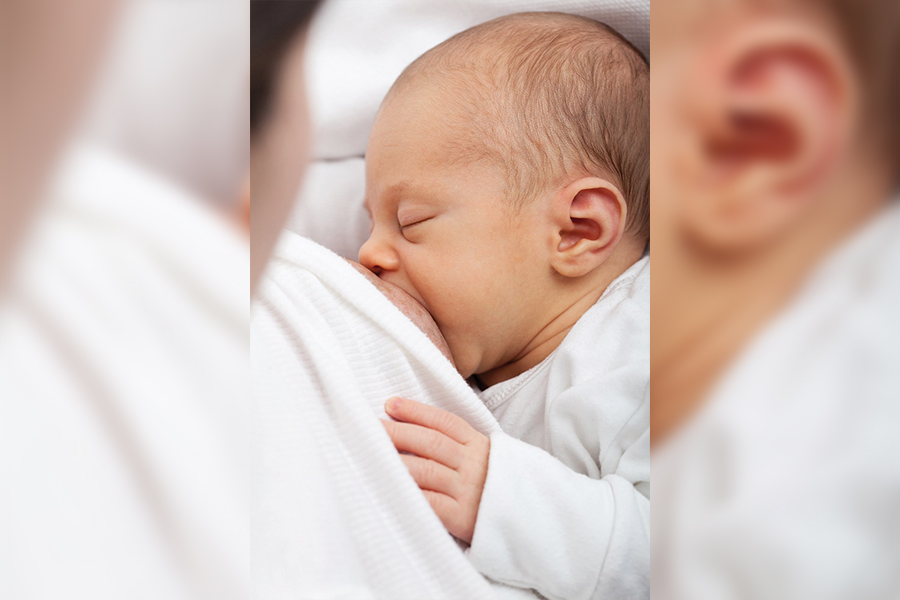
Probiotic boosts beneficial bacteria in bellies of breastfed babies

PUBLIC DOMAIN

Bacteria that break down breast milk colonize newborns better with Evivo probiotic

Pediatricians and microbiologists have shown that a short dose of a probiotic product given to breastfed newborns can have enduring impacts on their gut microbiomes. The probiotic Evivo boosts the presence of Bifidobacterium longum infantis, a beneficial bacteria that specializes in breaking down complex sugars found in human breast milk.

“The cool part of this story is here is one particular kind of bacteria that is really good at consuming human milk oligosaccharides — better than anybody else,” said Dr. Mark Underwood, who serves as chief of pediatric neonatology at UC Davis Medical Center. “And here’s the mom who is making these sugar molecules and putting them into her milk at great cost to herself. The bottom line is that the mom seems to be shaping the microbiota — or the composition of the bacteria in the gut — by putting these sugars into her milk to try to selectively feed healthy bacteria.”

Human breast milk is largely composed of lactose and fat, but substantial amounts of protein and human milk oligosaccharides are present. HMOs are complex chains of sugar that humans cannot digest. B. infantis is the only known bacteria that is equipped with the enzymes to break down all known HMOs found in human breast milk. These tools give it an advantage in colonizing space in the intestines of breastfed human infants and clearing out pathogenic bacteria, which can produce inflammatory enterotoxins.

Although young infants born in nations such as Gambia and Bangladesh have high levels of B. infantis in their guts, babies born in nations such as the United States have much lower levels of the beneficial bacteria, with the gulf widening over the last century. More pathogenic bacteria have taken the place of B. infantis in American babies’ guts.

“It’s most likely that a combination of interventions resulted in this effect,” said Steve Frese, the associate director of research and development at Evolve Biosystems. “Formula feeding reduces the abundance of human milk oligosaccharides that B. infantis depends on, caesarean sections reduce the ability of B. infantis to be transferred, and on top of that, this is an organism sensitive to penicillin antibiotics — which most kids get early in life at least a few times — and mothers are often given around birth to prevent Group B Streptococcus infection of infants or as antibiotics for C Section.”

After giving Evivo to breastfed babies between days seven and 28, B. infantis levels spiked from around 30 percent to 80 percent of all bacteria measured in stool. At day 60, after 32 days of not taking the supplement, the levels of B. infantis remained remarkably stable, a departure from typical probiotic responses.

“What we saw was dramatically different from any other probiotic study I’ve ever seen,” Underwood said. “Most of the time, when you give somebody a probiotic, you can measure small amounts of the probiotic in the stool. As soon as you stop giving it, it goes back to the way it was.”

Part of the unique response to B. infantis supplementation likely lies in its ancient adaptations to live in the human gut and break down milk sugars as a food source.

“Our hypothesis was that we didn’t need to keep them on a probiotic for weeks or months,” Underwood said. “We could just give a short course, and then as long as they were still getting human milk — as long as they were breastfed — those bacteria we gave as the probiotic should be able to outcompete the other bacteria and be the dominant strain. That’s what we saw.”

Besides consuming HMOs, which would normally be passed through the infant digestive tract, B. infantis creates short chain fatty acids as a byproduct. These acids help to lower the pH in the intestines, energizing intestinal cells to tighten junctions with neighboring cells and creating an uncomfortable environment for pathogenic bacteria.

Infant formula contains mostly lactose and other simple sugars that feed many types of bacteria, some of which are linked to poor gut health. Breastfeeding a baby helps B. infantis outcompete bacteria which can create inflammatory compounds in the belly.

“We see in the literature that when babies have higher levels of these pathogens early in life, they’re at higher risk for allergic diseases,” said Jennifer Smilowitz, the associate director of the Human Studies Research Program at the Foods for Health Institute. “We see higher rates of asthma, allergies, a type of eczema and type I diabetes. These are all immune-related diseases which are higher in people, adults and children, when they have higher levels of pathogens in their guts in infancy or early life.”

Infants are quickly colonized by bacteria during birth and being exposed to the world outside of the womb. Babies delivered vaginally are first colonized by microbes in the birth canal, while babies born via Caesarean section are first colonized by bacteria from medical equipment and mother’s skin. Since B. infantis is anaerobic, it’s unlikely to survive well on skin.

“We think mom has a constitutive amount in her colon, and during labor and normal delivery, it is passed into the baby,” Smilowitz said.

After analyzing commercial probiotics advertised as containing B. infantis, researchers found all but one product contained different types of Bifidobacterium than what the packaging suggested. Such products would not help a breastfeeding baby colonize their gut with beneficial B. infantis or improve gut health.

“They are so functionally different, but they look so similar when you do DNA sequencing,” Smilowitz said. “David Mills’ lab was one of the first to develop methods to differentiate the two. You’ve got all these products on the market claiming to have B. infantis, but they actually have B. longum.” B. infantis is being packaged into a product called Evivo by Davis startup company Evolve Biosystems, founded by UC Davis faculty members to translate academic research into tangible impacts for the community. Future experiments will look into how long the increases in Bifidobacterium concentration last, how older infants respond to Evivo treatments and how changes in the infant microbiome can affect health in adolescence and adulthood.


Written by: George Ugartemendia — science@theaggie.org


Does the impossible burger promise an impossible future?

PUBLIC DOMAIN

Plant-based meat product may have better environmental, health impacts

In 2011, Patrick Brown founded Impossible Foods Inc., which is based in Silicon Valley. The company is dedicated to creating alternative forms of animal produce and released its first product four years ago. Composed of wheat protein, potato protein and soy, this alternative meat has been the subject of intense debate over the last few years.

In many developed countries, new food items must attain a government seal of approval before they go on sale. However, U.S. policy dictates that a company must simply self-certify as “generally recognized as safe,” and then they have permission to sell. Impossible Foods got its GRAS certification in 2014 and has been selling its flagship product ever since.

This food item is the Impossible Burger, a plant-based meat replacement.

“We’ve done all these tests and, as of 2014, we’re generally recognized as safe,” said Rebekah Moses, the sustainability and agriculture director of Impossible Foods. “We wanted to introduce more transparency to the process so we pursued a ‘letter of no questions asked’ that entails rigorous testing on animals which was a tough thing for us because we do not want to engage with animal testing, but we did so in order to meet this additional step. That is still under review right now.”

Despite the product still undergoing review, it is available for purchase.

Ermias Kebreab, a professor of animal science and the deputy director of the Agricultural Sustainability Institute, took issue with the product’s availability.

“In animal agriculture, you never would’ve been able to get away with that,” Kebreab said. “All the tests that the FDA asks from industry have to be done. There are a number of cases where the technology is good but because there wasn’t really a champion or an organization behind it, that idea died because of the requirements from the FDA. We only have [AquaAdvantage salmon] officially FDA-approved after 20 years, to be sold in the market, and it’s only found in Canada right now. If the FDA required that something be verified and have data on it that then that should be completed before it is available to consumers.”

A UC Davis club, Peace for the Elimination of Animal Cruelty through Education, still sees great potential for this burger.

“There [are] definitely environmental benefits for consuming a product that is similar tasting and with a similar nutritional profile as meat,” said McKenna Maxwell, the co-vice president of PEACE and an environmental studies and management major at UC Davis. “But the environmental impacts — the land use, the water use, the carbon dioxide equivalent — is much less when you’re consuming a plant-based burger versus a traditional animal-based burger. There are also health benefits. There’s no cholesterol, there’s no saturated fat, there is unsaturated fat found in plant foods that’s easier for the body to digest.”

Although the Impossible Burger might have the same number of grams of protein and have fewer calories than a beef burger, Kebreab argued that there is more to nutrition than these values.

“It’s not just having livestock products,” Kebreab said. “It’s looking at amino acid profiles. Animal proteins have the amino acids that we need as humans. Eggs for example have a nearly perfect profile of essential amino acids, which you will not get from plants. I am not saying you should eat animal sourced food all the time. You need to balance vegetables, fruits and animal proteins. For some groups this is more important than others, like children or pregnant women — you have to have some type of animal sourced food in order to have good development.”

Environmental factors are another issue at play when it comes to creating the Impossible Burger. Impossible Foods wanted to reduce the amount of land needed to create a meat-product, thereby improving the sustainability of their item.

“We do need to find alternative means of producing animal-based products,” Moses said. “The demand for those is going to increase by 60 to 70 percent. One-seventh of human based greenhouse gases are the results of animal farming. 30 percent of our water goes to it globally, 50 percent of the ice free surface of the planet is devoted to [livestock].”

Environmental concerns is also a hot debate in the livestock industry. But depending on where you are, those numbers change. In the US, where resources are carefully controlled and research is constantly ongoing to mitigate livestock’s impact on the environment, there is a different picture.

“It really depends where you are,” Kebreab said. “Here, in the United States, it’s going to 4 percent, but if you go to New Zealand, it’s going to be 50 percent because they have a lot of sheep. For greenhouse gases, it varies where you are. Globally, the number is about 14.5 percent from animals. That number comes from the FAO. In terms of water use, yes, 30 percent sounds correct, but this includes the water used for crops grown as feed for livestock animals. In terms of space, 50 percent of the ice free land doesn’t really make any sense. You have to think if this area good for agriculture or not. If it’s not, like a lot of the rangeland isn’t in California, most rangeland would be barren. The grass will not grow because you need to have the cycle where animals graze and deposit their manure. This adds value to the land.”

With the global population expected to reach over 10 billion people by 2050, precise and responsible stewardship of limited resources is becoming more essential than ever before. According to the Center for Food Integrity, the world will need twice the amount of food produced today by 2050.

“I see the Impossible Burger playing a key role as a transition into making better products with better technology that will decrease the environmental footprint of our individual consumption habits,” Maxwell said.

Technology will definitely be on the forefront of how food will be produced in the future. Humanity needs to learn produce more with less and, depending on who you ask, livestock can either be part of the solution or be part of the problem.

“I don’t think it’s feasible to feed 10 billion people on the system we have now,” Moses said. “There are improvements in yield across plant-based foods and increases in efficiency for livestock. Those are good things but we need, in order to feed that many people, a transformative technology in addition to yield improvements if we do not want to hugely compromise natural resources. There are many ways we can initiate food system sustainability, for the 2050 population I just don’t see how we do that with the existing system.”

Many individuals within the UC Davis Animal Science department argue that livestock is an essential part of that future transformative system Moses is referring to.

“A lot of beef cattle are grazing on grassland where you can’t do anything else. A lot of the crops being grown for human food are being fertilized by manure,” Kebreab said. “If you’re going to get rid of animal agriculture, this would increase the amount of inorganic fertilizers you would have to produce, which takes quite a lot of energy and would result in a lot of associated emissions and the whole system would collapse.”

Moses said this product will help bring optionality to our food production system in order to meet growing demands.

But does the Impossible Burger stand up to the challenge? Moses said that blind taste tests have found the Impossible Burger comparable to a beef burger. Other consumers are not convinced.

“To actually call the Impossible Burger a burger doesn’t seem right because nutritionally it is not comparable,” Kebreab said. “It’s not just calories and proteins. You need to look at the trace elements that we get, like iron, which are essential for human beings. This comparison will give you a better picture as to why we need animal sourced protein.”


Written by: Alice Rocha — science@aggie.org

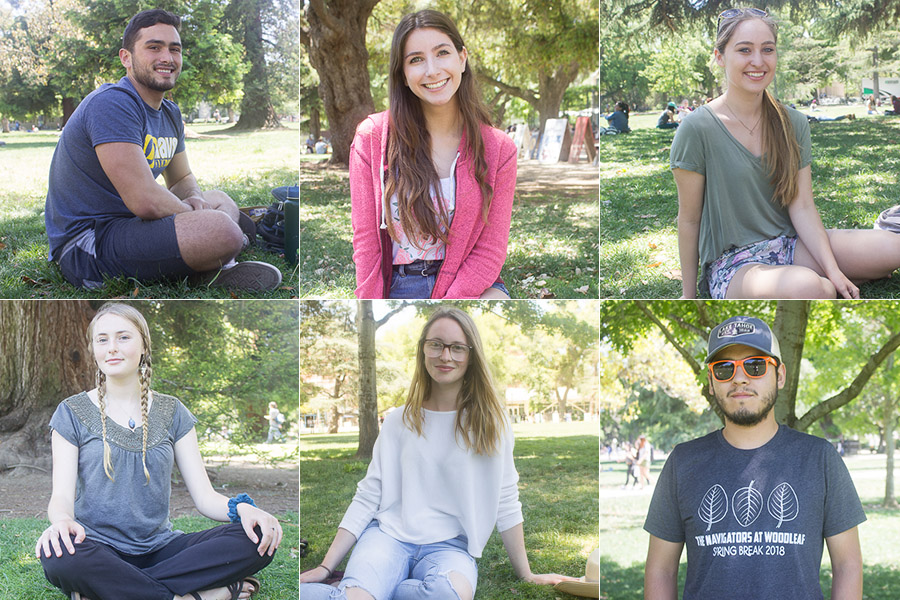
What are you doing this summer?

(from top left to bottom left) CHRISTOPHER LOPEZ, EMILY COWAN, KATIE RICKLETON, CHRISTIAN MARTINEZ, ALEXIS ROBERTS, VICTORIA ROBERTS (MACLEAN HARTFORD / AGGIE)

Roving reporter uncovers student plans

The summer months can be an ambitious period of self-realization for students. Taking many forms, it’s an opportunity to travel to new places, explore professional realms, complete research and fulfill major requirements. Taking a walk down the quad will reveal the diverse paths students follow and the opportunities that pop up, and slip away.

Taylor Schuman, a second-year communication major, is taking an academic approach to summer 2018.

“This summer I plan on taking summer classes, during summer session one,” Schuman said. “I’m taking a philosophy class and a linguistics class.”

The simplicity of Schuman’s plan evades some students, though they find excitement in taking advantage of the fleeting summer days. Balancing familial obligations and intimacy with internship opportunities can be essential.

Katie Rickleton, a second-year biological sciences major, looks forward to a fast-paced, domestically diverse summer.

“Over the summer I am going to Southern California with my cousin, going to Disneyland for a few days,” Rickleton said. “Then I’m going to New Mexico and Colorado for some family reunion-type events, and then I’m going to the east coast to Boston area for about a month to work in a genetics lab, so I’m going to be doing that for about a month and then I’ll be heading to Seattle to do some more family stuff. It’s honestly just a really crazy summer, it’s usually not like this, I don’t really have a lot of time at home so I’ve just kind of made time for as much as I could because I already knew I had to do a lot of the family things but then I also knew that I really wanted to do these internships and get the experience for school, obviously.”

For science and humanities majors alike, academic internship experience can be a foremost priority. Given the difficulty of balancing academic coursework and a lab or research assistant position, there’s no time like the summer. For some students, like Rickleton, this means planning ahead and respecting family events. For Christopher Lopez, a third-year biochemistry and microbiology double-major, his internship enabled him to stay close to family.

“I’m spending a 10-week program at the Amgen Scholars at UCLA, for research,” Lopez said. “I’ll be researching in muscular cell disease. I live 25 minutes from UCLA so I’ll actually be living on the campus but I’ll be going back and forth every weekend to say hi to my family, spend time with them. It’s the main reason why I chose going there. So potentially being [there], [is] setting me up for the future.”

The serendipity of future opportunity close to family is appealing to some, but the lure of travel certainly calls to many. With numerous study abroad opportunities overseas, some including academic coursework, others packing in internship experiences, dreams can come true.

Alexis Roberts, a third-year international relations major, will get a taste of her future career goals in Switzerland.

“I’m studying abroad in Geneva, Switzerland to do the United Nations program so I’ll just be taking classes with WHO, UNICEF, the WTO and several other organizations, IO’s, NGO’s and so it’s going to be a really fantastic opportunity, just to learn about the UN,” Roberts said. “I’ve been doing model UN for quite a while now, so it’s literally like my dream, dream job. [The program is ] about a month, so it’s a shorter study abroad program but I think it’s a perfect amount of time and it’s over the summer, too. I’ll be traveling around Europe for about two and a half weeks afterwards in Italy and Spain. And then right afterwards I’m not entirely sure, hopefully an internship, but we’ll see. I’d really like to work in Sacramento, hopefully working with some government entity there, I’m not entirely sure which one though yet. At the capital there are so many opportunities.”

Her sister Victoria Roberts, an incoming freshman in Fall 2018, happened to be visiting the campus and was a day away from a trip to Southern Spain.

“Starting tomorrow, I’m leaving for Spain,” Roberts said. “I’ll be visiting Southern Spain. I’m also going to Italy, but she and I are missing each other. And then I’m going to come back and I’m working for the city of Arcata […] for their Parks and Rec. Department. I’m a camp counselor, so I’ll be working with kids in the redwood forest. When I come back I’ll be an incoming freshman in the nutrition science program here.”

Emily Cowan, a second-year biological sciences major, looks forward to a study abroad experience that may not speak as directly to career goals, but will get her ahead in her coursework.

“This summer I’m actually doing one of the study abroad trips,” Cowan said. “Through UCEAP I’m going to the University of Sussex in Brighton, England and I’m getting my whole physics seven series done, in that summer. It starts in June and then it’s going to go all the way to mid-August and then after that I’m going to stay in Europe, because might as well while I’m there, and go to Greece. They offer three different study abroads […] I really liked the England one because I liked that, it’s easy to fly out of […] London area to go to other places so I thought that was nice, it’s […] more central to other things. I knew I wanted to travel around while I’m doing the study abroad program, so I was like, ‘this is the way to get the cheapest flights and like easiest to fly out of and take a train.’ I’m going to be home for probably like ten days before my trip, because I live in Southern California. So, I mean, I’m already kind of used to not being home for like weeks at a time. Then this is going to be so exciting, I mean, I’ve been out of the country twice before […] but this is like totally on my own and like studying somewhere else, I’m so excited.”

Christian Martinez, a fourth-year communication major, doesn’t have the plane tickets between his fingers yet, but has plans in the works, and the hopes that they will give direction to his future career path.

“I’m still trying to figure out what I’m going to do this summer, there’s a possibility of me going to the Ukraine with a friend of mine to work at a summer school program teaching English,” Martinez said. “And possibly also just working or getting an internship here or near Davis. Part of that is to kind of figure out what I’ll be doing this next year after I graduate. It’s dependent upon when I decide but hopefully before, hopefully soon-ish, probably before the end of this month.”

While the summer is only a few months, for Martinez it could be a pivotal moment in his life path. Wherever the summer takes Aggies and no matter how unclear the next three months appear now, it’s clear they take advantage of every minute.


Written by: Stella Sappington — features@theaggie.org

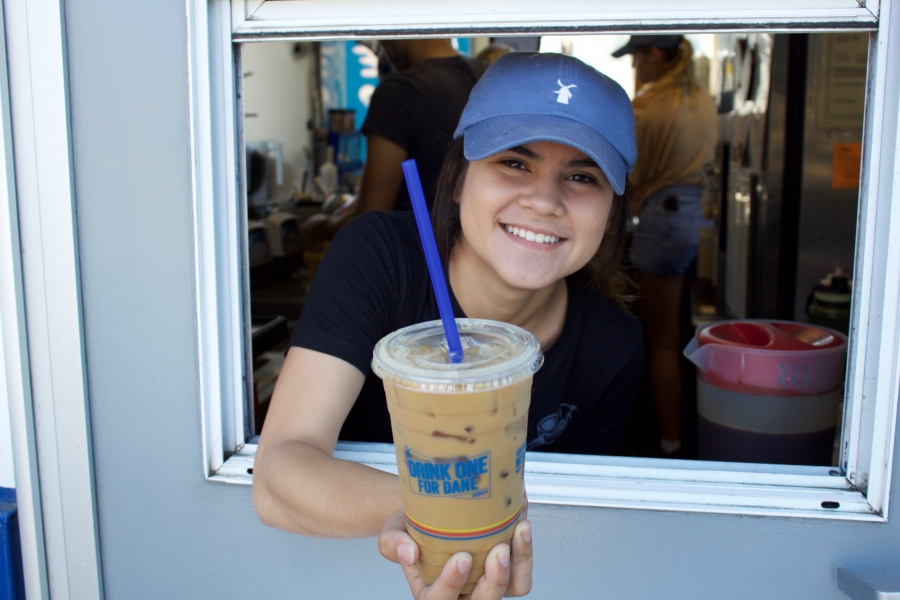
Dutch Bros hosts 12th annual Drink One for Dane fundraiser

REBECCA CAMPBELL / AGGIE

Dutch Bros brings community together to support finding cure for ALS

Friday, May 11 marked Dutch Bros’ 12th annual Drink One for Dane fundraiser for the Muscular Dystrophy Association. Each of the over 300 stands joined forces to support finding a cure for ALS, with a fundraising goal of $1 million. The fundraiser, which began in 2007, is dedicated to Dutch Bros co-founder Dane Boersma, who was diagnosed with ALS and passed away in 2009.

All proceeds from the entire day are dedicated to the MDA’s work in providing for ALS research and family support services. The MDA is the nonprofit health agency dedicated to funding research towards curing muscular dystrophy, ALS and other related diseases. Amyotrophic lateral sclerosis, often known as Lou Gehrig’s disease, is a disease with an unknown cure which affects parts of the nervous system that control muscle movement.

Every year, each Dutch Bros location gets excited to play its part in the fundraiser, including the local Davis Dutch Bros. Ryan Martinez, the manager of the Davis branch, explained how involved each location gets in the fundraiser, as officials from the MDA come to the store to educate employees on where the money actually goes.

“Every May 11, all of the Dutch Bros donate the proceeds from that day to the MDA,” Martinez said. “I think this year we raised around $1.3 million, which passed the fundraising goal of $1 million. From an employee perspective going into Drink One for Dane, we watched videos, we have a Dutch Bros Facebook page where they’ll show us posts about what happened with those affected by ALS and how ALS has affected them, and we get the crew hyped for the fundraising event.”

The disease causes victims to become increasingly unable to control speaking, breathing and moving. Those diagnosed with the disease typically die from respiratory failure within three to five years.  

Employees anticipate huge support of the event due to the grave nature of the disease and the deep impact that ALS had on the franchise as a whole.

“We expect it to be one of the busiest days of the year because this entire community is giving back without even trying to,” Martinez said. “It’s an event where all you have to do is come get a cup of coffee and that’s already helping. We also have a big donation bucket; the biggest donation I’ve ever seen was up in Rocklin for $10,000. It’s pretty cool to see the whole community come together for such an important cause.”

Austin Coyle, the manager of the Dixon Dutch Bros, speaks about how excited the staff get every year to contribute to the cause.

“It’s really cool because everyone gets into it, everyone’s excited to wears their Drink one for Dane gear and wear our shirts that say ‘End ALS’ on the front,” Coyle said. “We usually staff up more because we know it’s going to be busy and we want to have good vibes where no one’s going to be stressed out by the rush of customers. We had 8 or 9 people which is double the amount of people we usually staff and it’s cool because everyone wants to work since it’s such an important cause.”

With each year that passes, more and more customers learn about the event and the turnout and excitement increases as well.

“The vibe is unreal because we get all the customers into it and they’re all happy because they’re donating,” Coyle said. “It’s my favorite promo of the year. I’ve done it twice now and it’s really cool. It’s mainly the same tradition year to year but it just gets better every year because the more people that know about it, the more people donate. We hype it up once it starts to get closer to the date. On the day of the event we serve the Wiseman Mocha, which is just a standard mocha, but we dedicate it to Dane Boersma because that’s what he used to get when he was here.”

Dutch Bros donates over $2 million every year to nonprofit organizations, with hopes to “make a difference, one cup at a time.” Dutch Bros’ Love Abounds Foundation engages its community and supports programs connected with health, music, youth and origins.

“We absolutely love our customers, and they have amazed us with their growing generosity each year for this campaign,” said Travis Boersma, the co-founder of Dutch Bros Coffee. “This event encapsulates [my brother’s] spirit, which remains a guiding force for Dutch Bros. We are truly moved by how our communities continue to embrace his legacy and all those impacted by ALS.”


Written by: Alyssa Hada — features@theaggie.org

Davis garden tour fundraiser for Yolo Hospice

DIANA LI / AGGIE

Huei Young’s garden tour

Huei Young, a longtime Davis resident, has used her Asian-inspired garden as a site for many fundraisers over the years. On May 20, Young held tours of her garden with all of the proceeds going toward Yolo Hospice. This fundraiser was very personal and meaningful to Young, whose late husband, Frank Young, was cared for by Yolo Hospice.

“They treat you like a family and it feels like you have a relative and not a stranger helping you,” Young said about Yolo Hospice. “You don’t feel alone. I think they are very caring, and I want everybody in Davis to know and to never worry about getting old because Davis is a very good community.”

Young’s garden stands out among the houses within her Davis neighborhood. She spent 45 years changing the entire landscape of her yard and her house for it to become the artistic masterpiece that it is now. Gardening has always been an interest of Young’s, whose inspiration comes from her father.

“I compile all my father’s artwork […] and I put all the art he has done into my garden,” Young said.

Many may see Young’s house as they walk along the greenbelt next to her vibrant home. The amount of color, artistic detail and the sound of her three ponds can make one feel at ease. Young’s garden has been the site of many fundraisers for organizations, such as Shriners Hospital. Young is invested in helping others. Besides gardening, Young’s other hobby is volunteering as a cook for homeless shelters, an activity she used to do alongside her husband.

Huei’s garden holds not only the sentimental value of her father, but of her late husband as well. A bright bench sits surrounded by flowers in her front yard in memory of Frank.

“Other people go to cemeteries, but I go there,” Young said. “I change the color around the bench depending on the season for him.”

Having the ability to give back to an organization that offered her so much help provides Young with solace.

“Hospice makes you feel good […] people don’t always understand it,” Young said. “They helped me. I had a caregiver stay with me for one year.”

Yolo Hospice is incredibly grateful for what Young is doing.

“There have not been any other fundraisers like this,” said Louise Joyce, the community relations manager at Yolo Hospice.

People can be misinformed or unaware of all that Yolo Hospice provides. Joyce expressed that it is more than just helping a patient.  

“Part of the service of Hospice is to not only support the patient, but the family, and remain with them until that loved one passes,” Joyce said. “And then afterwards, we provide bereavement services to get the family through the first year.”

Ashley Flemming, a second-year sociology major at UC Davis, was originally unaware of the services that Yolo Hospice offered. Flemming, after learning about Yolo Hospice, spoke in support of Huei Young’s fundraiser.

“I think it’s a really great thing that she’s doing,” Flemming said. “Not a lot of people nowadays will do something so genuine out of their heart and give back to a cause that not a lot of people think about donating to.

All the money fundraised for Yolo Hospice will go toward patient outcare and uninsured patients.

Huei Young’s garden is a hidden Davis gem. Young wants people to take in the beauty of her garden and to see the potential within it.

“You can make nothing into something — anybody can do it,” Young said. “I did it beginning with one plant to all of this.”


Written by: Cassidy Kays — city@theaggie.org

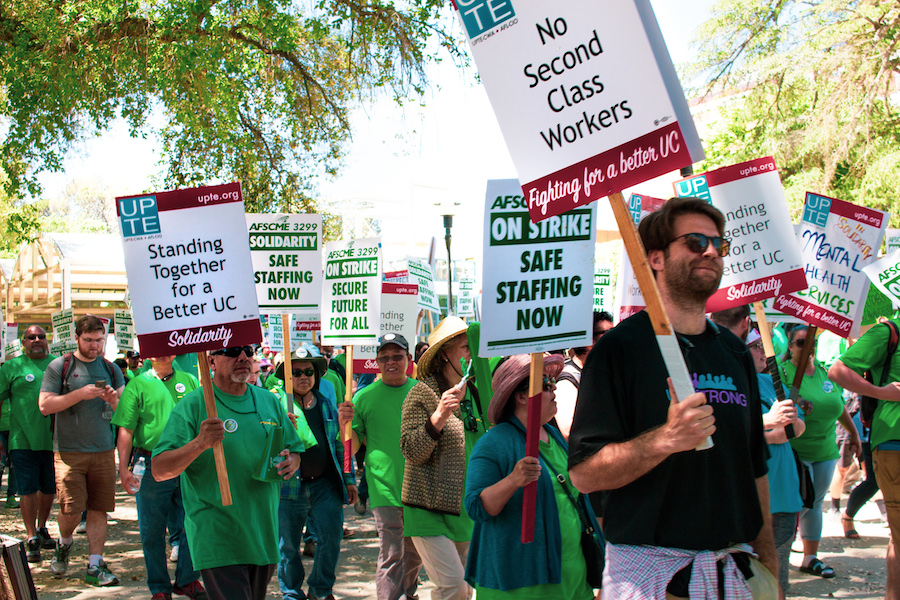
UPTE in contract negotiations with UCOP

DANIELLE MOFFAT / AGGIE

UPTE members show frustrations over lack of cooperation from the university

The University Professional and Technical Employees union has been in the process of negotiations for several contracts with the University of California for the last year. Members of the union have expressed concerns about the way UC Office of the President’s behavior and lack of cooperation at bargaining sessions has led to little progress over the last 12 months. Recently, UPTE workers went on a sympathy strike in solidarity with AFSCME workers who were also striking.

Alexis Roberts, a clinical laboratory specialist and UPTE member, gave information about the UPTE contract and described some of the issues encountered with UCOP during negotiations.

“Our contract expired back in October of last year,” Roberts said. “Typically, they are three-year contracts and we’ve been in negotiations for over a year. It’s a statewide contract with all 10 UC campuses, and we represent 15,000 employees up and down the state of California. We feel that the UC is not presenting us with any options; they’re not really negotiating in good faith. We have attempted to meet with them every month for 12 months now, and they just never seem to come to the table with anything useful.”

Roberts also mentioned some of the proposals UCOP was offering for future UPTE contracts.

“[The UC] continues to try and enforce a 2 percent raise, they want to take the cap off the parking fee, which means they could raise the parking fees to any level they want and they want to take the cap off the healthcare fee,” Roberts said. “With all that they’re taking away, they never want to give us anything. Basically, cost of living keeps going up and our employers keep only offering us a 2 percent increase each year and we’re slipping farther and farther behind.”

UCOP has maintained that it is bargaining in good faith. UC Spokesperson Stephanie Beechem said in an email that the proposals the UC has offered UPTE workers have been fair.

“UC continues to bargain in good faith on a wide range of issues, including wages, benefits and other employment terms and conditions, with the goal of reaching a new, long-term contract for UPTE employees,” Beechem said. “To that end, UC has offered multiple proposals that would provide UPTE-represented employees with fair wages, continued quality health care, and excellent retirement benefits that few other employers offer.”

Beechem also commented on the sympathy strike that UPTE workers participated in.

“We were disappointed by UPTE leaders’ decision to call a sympathy strike against UC earlier this month,” Beechem said. “In UC’s view, strikes unfairly impact patients and students and should not be used as a negotiating tactic.”

An email to UPTE members from Greg Wine, the vice president of Davis UPTE, however, disagreed. The email stated that workers “cannot afford NOT to strike” and that patients would be taken care of.

“All outpatients areas are closed,” Wine said. “Patients will be protected for the one day we take off just like they are protected on Sundays.”

In comparing UC healthcare workers to those outside of the UC system, Roberts said

that the UC vastly underpays its workers.

“In many of the healthcare professions, the UC wages are 10 to 20 percent lower than market value, market value meaning all of the other healthcare institutions in the region — Kaiser, Sutter and Dignity — are offering more money for those professions,” Roberts said.

Sonia Ghandi, a technical employee at UC Davis and UPTE member, said the the four bargaining priorities of UPTE are “wages, pension, job security and union accountability.” Elaborating on the priority of union accountability, Ghandi said that “new employees don’t get any advantage of knowing about their union representation and [UPTE is] trying to add that into contracts for new employees so they know their rights.”

Roberts commented on the issues with what the university is proposing with regard to pension and other union priorities.

“They want to compromise the pension by offering newer employees a 401k option, which then just compromises the UCRP pension that they offer all the other employees,” Roberts said. “When it comes to all the things we want that are non-wage issues, the UC is trying to block everything that we’re asking for. We want sick leave. Sometimes people ask for vacations from their boss and they don’t get an answer. The UC is not being a good employer — people working full-time shouldn’t be making less than $15 an hour for some of these jobs.”

According to Roberts, the university has not been cooperating nearly as well as UPTE members had hoped, and its consistent offer of a 2 percent wage increase per year is inadequate for a number of reasons.

“We don’t feel that the university is dealing in good faith because we’ve been trying to deal with them for over a year,” Roberts said. “Two percent per year doesn’t even keep up with inflation. It does not offer our employees a decent wage when they’re just jacking all the other costs and fees up. They just don’t come to the table with anything useful. They have an offer that is a really low amount and then they put an expiration date on the offer and they just make it very difficult to try to have any actual negotiations because they won’t agree to our terms — it’s just incredibly frustrating.”

Roberts said the she believes the university is stalling contract negotiations until the AFSCME v. Janus Supreme Court decision comes through — a decision that, if ruled in favor of Janus, would severely hinder the funds of unions across the country.

“As an UPTE member, I feel that they are trying to knock the knees out of the union,” Roberts said. “This is their strategy: they are delaying and dragging their feet, hoping that when that Janus decision comes down, we will no longer be able to collect fair share dues — we may not have a union if we don’t have 50 percent of people actually signing up who want to have collective bargaining, and [the UC is] counting on that.”

According to Ghandi, one reason that the negotiations have taken so long is that the UC has been uncooperative with regards to the issue of compensation.

“One of the main reasons that the negotiations have taken so long for us is that management has not made any reasonable wage offers,” Ghandi said. “UC hasn’t responded back to our recent proposals and they rejected most of our proposals.”

Roberts said that UPTE is really just looking for one thing: “We just want fairness and equity for our employees.”


Written by: Sabrina Habchi — campus@theaggie.org

Bottlerock Napa Valley 2018

BRIAN LANDRY / AGGIE

Wine, music and more wine

For a relatively new festival, Bottlerock Napa Valley has managed to enlist some big name performers — most notably this year’s headliners of Bruno Mars, Muse, Snoop Dogg and the Killers. As the festival’s name implies, Bottlerock is located in the heart of Napa Valley, and festival goers are made more than aware of this fact. With over twenty wineries in attendance, that $12 glass of wine was never far from reach.

With your attention being pulled in many different directions — and dehydrated, wine-drunk attendees often reaching a low point — the food options were fortunately abundant. From food trucks to individual vendors, gourmet meals were, quite literally, only steps away.

The festival also provided entertainment on many fronts (in case the four stages of lives music weren’t enough), and the festival grounds also boasted a silent disco arena, spa booth and of course, a barrel backdrop for your Instagram story.

And, like the wine, the music was constantly flowing. From Muse’s guitar-smashing rock show to Allen Stone’s soulful sunset performance, there were no shortage of sounds coming from the Napa Valley Expo Center this Memorial Day weekend.


Friday

The festival kicked off with a number of noteworthy performances, including that of Trombone Shorty and Orleans Avenue. The group played a primarily instrumental set, with a funky sound that primed the audience for the following band to take the stage: Earth, Wind & Fire. And although Earth, Wind & Fire played a full set of entertaining and danceable music, the highlight unsurprisingly remained “Boogie Wonderland.”

Afternoon shows included last year’s NPR Tiny Desk winner, Tank and the Bangas, and Alabama locals St. Paul and the Broken Bones. Both shows impressed but didn’t make particularly lasting impressions. The Austin, Texas performer Shakey Graves also made an appearance, but his relatively quiet set didn’t quite suit the loud atmosphere of a daytime festival slot.

The evening ended with two main performers, and it was unsurprising that the audiences at each were starkly different in both age and energy. British rock band Muse took the Jam Cellars stage while electronic duo The Chainsmokers performed at the opposing Midway stage.

With legendary hit songs like “Madness” and “Uprising,” Muse put on show that matched their fame. Lead singer Matt Bellamy smashed a guitar (one whose price would probably make me sick to my stomach) and gave a cringe-worthy “Are you ready, San Francisco?” to an awkward and silent Napa Valley crowd. At one point, Bellamy put on a pair of sunglasses with lenses that flashed the lyrics to “Madness” in tune with his singing.

But behind the flashy show and excessive, streamer-throwing finale, Muse played their music — and they played it well. The Chainsmokers, on the other hand, received opposite reviews. Although I opted out of The Chainsmokers’ performance, the only feedback I received from others was, “bad,” “very bad,” “really really bad” and “I left early.”


Saturday

Following a cold and cloudy Friday, the Saturday performers similarly looked brighter. The adorable British duo Oh Wonder played a wholesome set of melodic pop songs — but were similarly trapped by a case of “too quiet music in a too loud outdoor setting.”

It was fitting that Seattle’s The Head and the Heart played during Saturday’s sunset; Charity Rose supported the band vocally more than in previous shows and played violin for many of their early songs like “Rivers and Roads.” The folksy sound that turned the band into international folk-pop stars has slowly dwindled — and the quaintness of their early shows has surely long passed — but they have yet to disappoint in a live setting.

Jacob Banks gave an afternoon performance in the shaded Miner stage, and he took full advantage of the opportunity to wow listeners with his incredible vocals. He crooned his way through his discography, eventually landing with hit song “Chainsmoking.”

But while the day was full of noteworthy musicians, many Bottlerock attendees made it clear that the Killers was their primary reason for attending the festival. The band did not disappoint, and they gave an energetic and surprising opening by playing “Mr. Brightside” first and foremost. They ended the show with lead singer, Brandon Flowers, seemingly disappearing from the stage — only to reappear in a shiny gold suit, sequined boots and all.


Sunday

The third and final day of the festival reached 85 degrees, and the scent of pinot noir was now slightly tinged with sunscreen. But more shocking than the turnaround of weather was the carpool promotion Bottlerock gave us. Upon our arrival, parking attendees asked to pull aside and provided our car of four people with VIP passes for the day — a deed apparently attributed to our decision to carpool. But beyond the free iced coffee and cleaner bathrooms of VIP Village, the accessibility to the main stages was almost identical to that of general admission. Nevertheless, we accepted the upgrade.

After some technical difficulties that put her set 17 minutes behind schedule, Alice Merton wowed the crowd with her energy, down-to-earth audience interactions and of course, her rendition of the song that made her huge: “Roots.” She also introduced the audience to her friend Allison, a professional lemon shaker whose lemon shaking was completely inaudible to the audience — and no, I’m not kidding.

Merton’s performance was apparently difficult to follow; New York pop star Halsey took the stage, only to express her annoyance at the Bottlerock crowd. Though an admittedly lackadaisical crowd, Halsey’s bland performance and, in all honesty, her rude remarks, made it an easily forgettable performance. She later tweeted that she had an asthma attack on stage and was treated by medics after her set.

Fortunately, soul singer Allen Stone provided the festival with a positive turn-around, making two appearances that day: one at the VIP acoustic stage and another at a main stage. After listening to Allen Stone’s brief, acoustic performance, the stranger behind me put it best — “If he’s this good, imagine his show with a full band.” And at 6:45 pm, Stone did just that; he brought an incredible energy with him, infecting the audience with new and old songs — notably the classic “Contact High” as well as his recently released track, “Brown Eyed Lover.”

A notably mysterious performer with few, if any, published interviews, Allan Rayman gave a strange and eerie performance that shocked even his well-established fan base. Laughing maniacally into the microphone, Rayman was backed only by a producer and a guitarist. His contorted dance moves were interspersed by apologies: “Just a few more songs and we’ll get out of your hair.”

If you didn’t know that Bruno Mars was attending the festival — today you certainly did. He quite famously called Bottlerock “the fancy Coachella,” which received mixed reviews by the audience, among them laughter and scoffs. Frankly, he could not have better summed up the festival; to all sides of me were white moms drinking pinot grigio — but at least they knew how to boogie with Bruno.


Written by: Ally Overbay — arts@theaggie.org

Using light to see the brain

WENJUN ZHOU / COURTESY

New research improves noninvasive brain imaging

What might a stroke patient, a drowning person, and someone with severe traumatic brain injury have in common? If the stroke results from a blood clot in the brain, then all three might experience changes in their cerebral circulation. Blood flow in the brain is an important indicator of its health; proper blood pressure and circulation means enough oxygen and glucose are reaching the cells, and they require a lot of circulation to stay healthy.

Traditional methods for measuring cerebral blood flow and pressure include MRI and probes. However, they come with their own caveats. Metal and electronic items should not be taken inside MRI machines, including implants, prostheses, and pacemakers. This procedure is thus limited to people who don’t have those items, and is also relatively expensive, making conditions where multiple scans are necessary costly. Probes are invasive, as they must be inserted into the head to sense pressure.

One alternative is diffuse correlation spectroscopy, where certain wavelengths of light are able to penetrate into the brain and create an image. This procedure is noninvasive and can be used at the bedside, allowing for continuous monitoring. However, the spatial resolution isn’t very good compared to an MRI, and the materials needed to make it so are very expensive. Currently, DCS is not commonly used in medical practice.

New research from a biomedical engineering lab at UC Davis may help change that. Wenjun Zhou, a postdoctoral fellow working in Vivek Srinivasan’s biophotonics lab, and his colleagues have developed an improved light-based method for measuring cerebral blood flow they call interferometric diffusing wave spectroscopy, or iDWS.

“The previous methods required very expensive detectors,” said Srinivasan, an associate professor of biomedical engineering and ophthalmology at UC Davis. “We looked at that method, and while it worked, the problem was that you couldn’t have many detectors detect the light, because it would be too expensive; the technology is somewhat difficult to use; and it’s sensitive to ambient light, or environmental light, which makes it difficult to use if you want to monitor blood flow in a hospital environment where the lights are very bright. So we tried to improve the detector, and we came up with this idea, which is really an combination of two ideas. The first idea is that if you think of what the cheapest, most widely used light detection device out there, it’s got to be the CMOS camera.”
The CMOS camera is the type of camera found in smartphones, which uses a sensor chip to record images. It is easily integrated into other technology, but its resolution isn’t as fine, so it wouldn’t be able to pick up the weak light used for DCS. To resolve this problem, the researchers changed the strength of the light field without strengthening the source.  

“Measuring blood flow centimeters below the surface has required expensive approaches to count the small numbers of light particles, or photons, that make it back,” Zhou said in an email interview. ”Boosting the light power on the scalp is not possible due to concerns about heating. Instead we use an interferometric approach to boost the weak sample light field with a strong reference field, creating intensity fluctuations that are strong enough to be measured by a inexpensive CMOS camera.”

The combination of multimode fiber interferometry and CMOS cameras is a promising one; not only does it cut much of the cost, but it also has highly sensitive and parallel detection capabilities for faster and deeper imaging. It also has the potential to become better as CMOS camera quality continues to improve at a fast rate. The lab is currently collaborating with doctors at the UC Davis Medical Center to further develop this technology, including Lara Zimmerman, an assistant professor in the department of neurological surgery and neurology at UC Davis and co-director of the Neurocritical Care Service.

“When the brain is injured, it undergoes a period of swelling and the pressure inside the skull (intracranial pressure) increases,” Zimmerman said in an email interview. “This is a very dangerous problem which can lead to additional brain injury due to lack of blood flow and oxygen delivery to the brain. Currently we are able to monitor intracranial pressure with invasive probes, but ideally want to develop a technique to monitor cerebral blood flow non-invasively, which is the goal of this collaboration.”


Written by: Kira Burnett — science@theaggie.org


Jahz: Rooted in the Bay

NIGEL MCINTOSH / COURTESY

Student clothing company to spread cultural appreciation

Third-year communication and music double major Sammy Seaver was stopped by a random person while in Germany during his study abroad last year. Wearing a sweatshirt made by third-year design major Nigel McIntosh, Seaver was asked about the sweatshirt’s brand.

“It started to spin the wheels for me,” Seaver said. “I had some experience in marketing and helping people build their projects, but this is something substantial — the product, the message. This is not a get-rich-quick type of scheme, this is something that needs to be out there.”

With such passion dedicated to the core of the company, Seaver soon became a member of the Jahz team, the new UC Davis-born clothing line dedicated to promoting cultural celebration.

Jahz, coming from the Rastafarian word for “god,” consists of McIntosh as its founder and designer; second-year history and political science major Andrew Williams as its marketing coordinator; third-year managerial economics major Laili Attai as the operations manager and 2017 alumnus Marc Toney as its finance operator. Seaver acts as president.

“Nigel and I have been friends since freshman year, and when I started seeing these drawings something really clicked; these are amazing,” Attai said. “Initially I was drawn to the artwork, and when I found out the meaning behind them I was completely sold on the company and I wanted to be a part of it.”

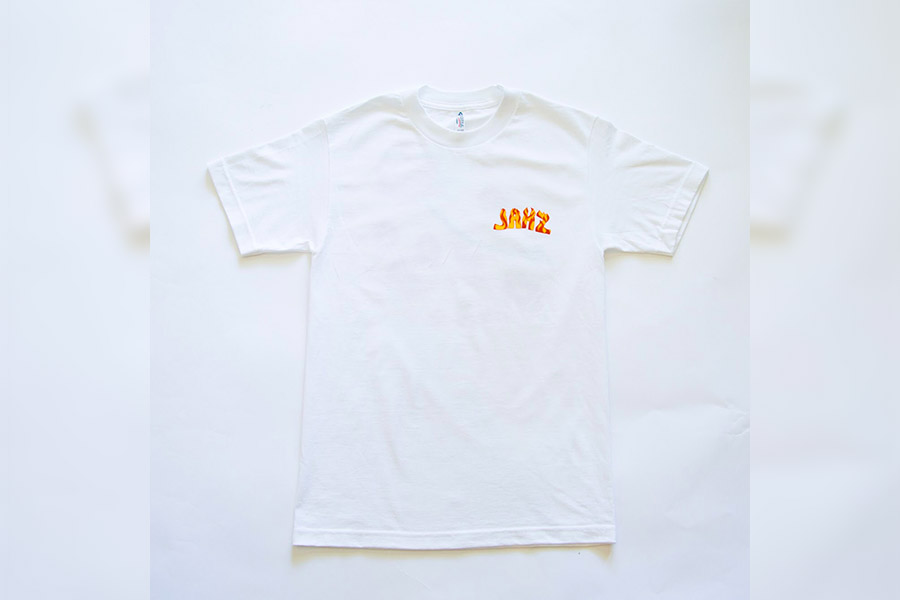
Seaver’s sweatshirt may not be the only recognizable design of the company; the most recent “La Flor de Jalisco” flame tee has made its way on the backs of various students. That’s the point of the clothing company: finding the commonality between all humans, transcending cultural boundaries.

“I wanted to hit a theme that everyone could connect with,” McIntosh said. “Even though it is illustrating the beauty in every culture, I feel like everyone can in some way relate to another culture. Culture is just fulfilling needs that everyone has as humans. Jahz is just finding what makes us human to our core.”

Rather than relying on stereotypical or mass-produced images, each hand-drawn design takes inspiration from a specific culture in order to present the essence of the culture.

“Everyone has culture so we can come together in the shared experience of culture,” McIntosh said. “For example, I have a design that celebrates Indian Hindu culture, and there is a god that I find very beautiful […] I found a picture that I liked and made my own version of that picture. It’s something that people can see and think of Hinduism, but it’s not screaming it. It is simply giving you something to think about when you think of India.”

Moreover, the celebration of diversity and culture ties into Jahz’s emphasis on the Bay Area — as a target area as well as a place of inspiration in itself.

“It has a lot of people in different ethnicities in the same place,” McIntosh said. “But they all understand each other without trying to be each other. Since we all understand each other, we can be each other. I want to show the human part of us so we can get along and be normal together.”

Nested in a college campus, Jahz is careful to and adamant about avoiding cultural appropriation with its designs.

“Obviously we’re not in it for approporting cultures; we want to see the beauty in them,” Attai said. “It has been a fine line between how we present these designs and being very genuine about the intention behind each design. We realize we are on a very politically active campus.”

For Seaver, the uniqueness about the company is that the original designs are truly about appreciation, the abstract center of culture and “quintessential appreciation.”

“We don’t want to be ignorant to the specific images that we are using, so when we do use something from a culture, we want to know what it means, what it means to people — we are not using the image for image’s sake. We want to know the specifics behind it.”

Such a message places itself easily on a T-shirt or sweatshirt, an item of clothing and medium accessible to everyone.

“It’s a medium that everyone can see it; it’s not in an art gallery,” Williams said. You can just be walking down the street and be moved by it. When you wear it you can be proud of it.”

Each shirt also gives back to the community. Since the most recent shirt drop, a percentage of the sales will be donated to a local charity or nonprofit to help where the image was taken inspiration from or the surrounding community.

“The recent one had the flames and the rose, so we gave back to burn victims and the Santa Rosa Fires,” Toney said.

As for the future of the company, Jahz has plans for expansion.

“Right now our big focus is establishing a strong online presence, establishing our social media and making our website fully functional, so that not only people from Davis but people all around the Bay Area can order our stuff,” Williams said. “We want to get into retailers as well. I was thinking as a summer project going down to little boutiques in Berkeley, Oakland and San Francisco to try to get our message out and be able to present them a look book. We want to expand ourselves, yet staying true to who we are.”

Jahz will be dropping a new shirt design to be on sale in June. To buy their products and learn more, check out their website.


Written by: Caroline Rutten — arts@theaggie.org

Eric Gudz running for City Council while sleeping in car

Awareness campaign brings Davis’s housing situation into perspective

Rather than get a good night’s rest on the campaign trail, Davis city council candidate Eric Gudz slept in their car for a week.

“There’s definitely a lot of things that I picked up on right away,” Gudz said. “The sheer amount of energy that that process took was noticeable. It took a lot of energy to figure where you want to sleep and getting the environment right. That was a big realization for me.”

Eric Gudz is running for city council on a campaign based around affordable housing, transportation and community building.

“Issues around the homeless and rental crisis wasn’t really getting the attention it deserved,” Gudz said. “If I am on the council making policy in the interests of students and other renters, I have to understand that [situation] the best as possible.”

Gudz questioned how to best maintain the population in Davis by ensuring that the new generation has a place.

“We need to be able to keep folks here, otherwise they won’t be investing in the community and we’ll be losing a part of our community because we cannot accommodate everybody,” Gudz said.

Shahrukh Hameed, a fourth-year sociology major and global disease biology minor, however, does not see much help coming to UC Davis students. To the contrary, Hameed’s friend’s friend received help from Sacramento State’s emergency housing program, which offers students with nowhere else to stay up to 30 days in the residence halls. Acceptance is on a case by case basis, but once approved, it would also come with two free meals a day at the dining commons.

“Sacramento State does a much better [job being] more open about the aid that they provide for their students,” Hameed said. “I think that that’s something Davis should adopt for its students in need.”

On the policy side, the city of Davis has tried some programs to address the housing crisis. For homelessness, Cesar Chavez Plaza offers 53 units worth of temporary housing for homeless people. A job training program also moves the homeless into permanent jobs, according to Mayor Robb Davis. A homeless outreach coordinator connects people with services. To assist renters, Yolo County has received a grant from Sutter Health to provide bridge vouchers. These temporary vouchers aim to assist renters while they wait to enter the federal housing voucher program, which helps low-income people cover housing costs. The biggest obstacle to programs like these are due to funding.

“It is not inexpensive to either construct affordable housing units in Davis or to work with individuals experiencing homelessness,” said Kelly Stachowicz, the assistant city manager for the city of Davis. “We do not have dedicated sources of funding, so funding is a challenge.”

According to Stachowicz, rental housing developments need to set aside 15 percent of rental units for people designated as low-income. The Yolo County area median income in 2016 was $57,663. The city council planned to set aside 35 percent of new rental units to low-income residents, but has decided to keep it at 15 percent for the rest of the year. To qualify for lower rents, low-income is defined as having 80 percent of the area median income and below.

The city also sets aside 10 to 25 percent of housing development for home ownership, depending on the type of home. Within home ownership, 120 percent and below the area median income is considered low-income.

“If it is a single family home type of development, a developer may propose certain units that are reserved,” Stachowicz said. “The prices of those houses would be capped at a certain income level.”

Davis sees major challenges when it comes to tackling the housing crisis. He also noted that, despite counting the amount of people sleeping on the streets or in shelters every two years, it’s hard to assess the varying needs that people have.

“We’re not really clear what the magnitude of the problem is,” Davis said. “Providing services, it’s hard to get a handle of the need.”


Written by: Justin Chau — city@theaggie.org