53.8 F
Davis

Davis, California

Friday, December 19, 2025
Home Blog Page 510

Eric Pape’s life remembered

TAYLOR LAPOINT / AGGIE

Mental health, criminal justice system discussed at rally

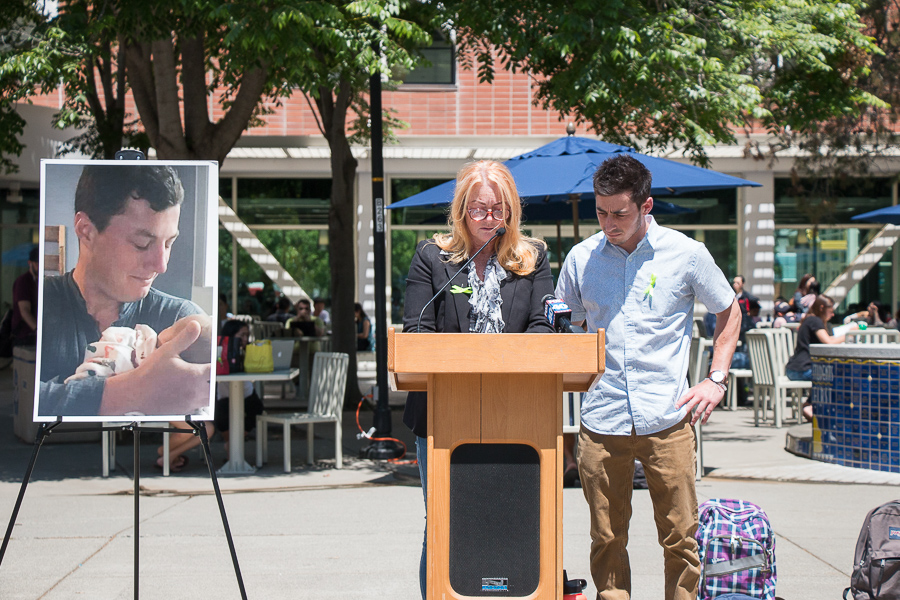
Students, family members, residents, community leaders and activists all gathered in front of the Memorial Union patio on Thursday, May 17, to remember Eric Pape, a former UC Davis student. They also continued the conversation his death generated about mental health and injustice in the criminal justice system.

“He was incredibly kind,” said Dave Griffin, a friend of Pape’s. “Sensitive. Smart. Smart as hell. Generous. We — all our friends — met him at the Kava Bar […] We talked long and hard about philosophy, life, struggles with mental illness. My favorite memories of Eric were just talking into the midnight, standing in the parking lot […] And again, just that kindness and warmth. Simple stuff.”

Eric Pape committed suicide on May 4 of last year. Pape had been struggling with mental health issues throughout the year, feeling depressed, isolated and anxious after leaving his family and girlfriend to move to Davis. Eric checked himself into the Sutter Davis Hospital on Jan. 13 of last year. According to the hospital staff, he was hyperventilating and pacing around the room, growing agitated as he awaited treatment. His anxiety increased and, according to a nurse, Pape grabbed at him as he entered the room. The altercation grew violent, and Pape dislocated the nurse’s shoulder. Police arrived and, because of a mental health block, made only a report on the incident. Three months later, as Pape’s mental health was showing improvement from treatment at an outpatient facility, Pape was arrested on a felony battery charge. He was accused of inflicting serious bodily injury during the altercation. Pape struggled with he stress and anxiety of the long court case and the potential felony charges, and on May 4, 2018, he took his own life.

The rally was organized by the Mental Health Initiative with help from William Kelly, a graduate student and local activist. As part of the rally, the Mental Health Initiative put together a visual of 24 backpacks arranged in columns. The 24 backpacks served to represent each of the 24 UC Davis students who, according to the Student Health and Counseling Services, have taken their own lives since 2012. Members of the Mental Health Initiative were especially excited by the prospect of meeting and hearing from Pape’s mother, Patti Pape, who had flown in from Southern California to speak.

“Eric was a giant redwood,” Pape said during the rally. “He was solid, he was dependable, he was ever-present and what we thought was resilient, but […] it is apparent to me that my son was not treated properly in a medical setting with the dignity and respect that other sick patients get. Consequently, he was not treated with dignity and respect by the criminal justice system […] Eric was not a criminal. His self-worth, his future were being held hostage by the courts.”

According to his mother, Eric was “never a violent person.” Many of the speakers, including Patti Pape, called out the the District Attorney’s office — who prosecuted Eric — Sutter Davis Hospital and the University of California, Davis itself for failing Eric and failing the 24 other students who have committed suicide since 2012.

“May is mental health awareness month,” said Tracie Olson, the Yolo County public defender who fought to exonerate Pape of the felony charges pressed against him. “It’s been celebrated since 1949, yet in the last years you would think we would have made more progress […] When it comes to our criminal justice system, we need to advance our understanding of mental illness so mental illness is not punished […] In the case of Eric Pape, he was in a hospital emergency room because he was suffering acute mental distress. He should have been diverted into treatment, not into a prisonhouse.”

Among the many community leaders who attended the rally were Dean Johansson, David Greenwald and Mayor Robb Davis. Davis spoke to the crowd at the end of the ceremony, calling the criminal justice system “broken,” and accusing the state and the system of “criminalizing mental health.”

“How a case like this gets charged a felony — that’s a broken system,” Davis said.

“If our administration and our criminal justice system did not disproportionately target people of color and people with mental illness — which Eric falls into the latter category — he might still be here today,” said Samantha Chiang, a fourth-year English and psychology double-major and president of the Mental Health Initiative. “Our law enforcement and administration must take accountability.”


Written by: Ahash Francis — city@theaggie.org
 

Aggies Vote Rally Held in Quad

DANIELLE MOFFAT / AGGIE

Event encouraged students to vote in upcoming California primaries, other community issues

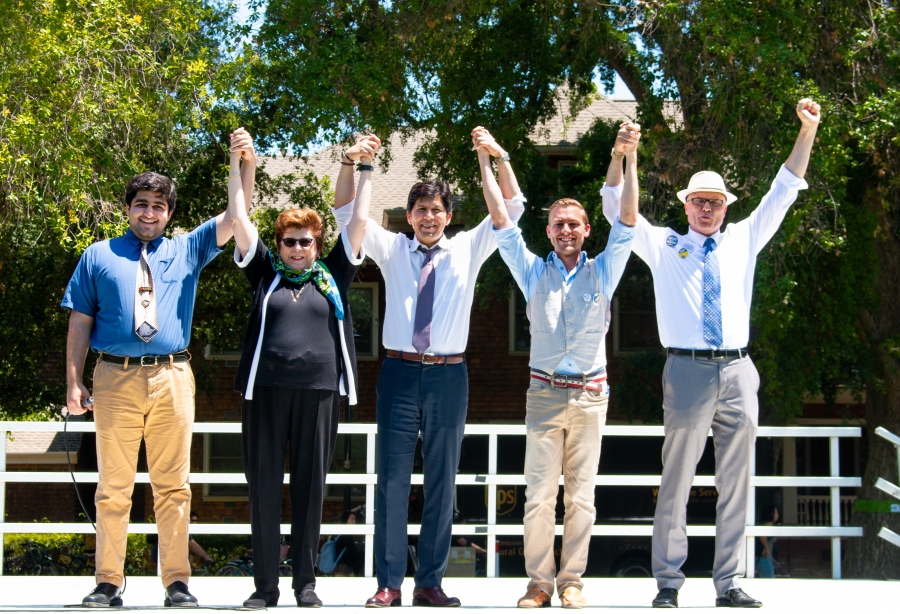
On May 21, several student organizations including ASUCD, Davis College Democrats and RISE came together to hold the Aggies Vote Rally in the Quad.

The rally featured several notable speakers, including Delaine Eastin for California Governor, Kevin de León for U.S. Senate, Dean Johansson for Yolo County District Attorney and Eric Gudz for Davis City Council.

According to Adam Hatefi, a second-year political science major and event coordinator at the rally, the goal of the event was to have “a place where [students] could come together, get candidates to come and speak and get students registered to vote.”

At the forefront of the rally was an effort to encourage students to register to vote in the upcoming California primaries, since it was the last day to register.

“In California, primaries are important because we have [a] top two primary system, so the two candidates that receive the most votes go on to general election regardless what party they’re from,” said Lauren Low, a second-year community and regional development major and a staff member to ASUCD Senator Alisha Hacker.

However, the primaries were not the only issue of focus of the event.

The speakers spoke about a variety of issues and problems with the current political system, including racial profiling conducted by police officers, inadequate support for individuals suffering from mental health issues and increasingly unaffordable rent that has forced many students to sleep in their cars.

“One major issue with the housing developments […] is that even though most of Davis’ population are students, they are not actually registered to vote in Davis,” Low said. “A lot of housing developments that could be really beneficial to the student population are voted down because a lot of the long-term residents in Davis don’t want them.”

The speakers emphasized the importance of the vote in dealing with these issues and facilitating change.

“The reality is that college voices are not being represented in the U.S. Senate, and when it comes to debt free college education, immigration reform, universal health care, clean energy and climate change, millennials have to have their voices heard,” De León said. “If they don’t get involved in politics, politics will get involved with them whether they like it or not.”


Written by: Clara Zhao — campus@theaggie.org


NFL favors false patriotism

CAITLYN SAMPLEY / AGGIE

Leaders put an “end” to kneeling with unconstitutional requirement

The National Football League announced on May 23 that all players and league personnel must “stand and show respect for the flag” during the national anthem. Teams whose players fail to comply will be fined, and individuals who do not wish to stand may stay in the locker room and wait for the anthem to end.  

The new policy comes after months of controversial and divisive debate sparked when then-San Francisco 49ers quarterback Colin Kaepernick took a knee to call attention to police brutality and other forms of injustice that black individuals face in America. Kaepernick and all those who eventually joined him were met with contempt from many fans, who stated that the players were disrespecting the flag, nation and military through their protests. The NFL’s top officials agreed: “It was unfortunate that on-field protests created a false perception among many that thousands of NFL players were unpatriotic.”

Yet taking away someone’s ability to protest is, ironically, far more unpatriotic than the anthem protests themselves. The flag and “The Star-Spangled Banner” are evidently symbols of the country’s commitment to freedom, justice and equality. But, as the kneeling NFL players pointed out, America fails to fulfill such principles when unarmed black men are killed by the police and mass incarceration of people of color plagues our justice system. And when the rights supposedly secured by our Constitution are not truly upheld, individuals must use their voices and platforms to speak out against these injustices. This is not unpatriotic. Rather, it is the epitome of patriotism: kneeling in reverence to these ideals and pledging allegiance and commitment to a better America that actually lives up to its promises.

The players attempt to shake Americans from their complacency through their protests — to disrupt their entertainment and force them to reflect on the grim realities of racial disparities. The league’s leaders, a group of all-white men, initially promised to reach a compromise with the Players Association, which represents the players, about 70 percent of whom are black. Instead, NFL leaders banned kneeling outright, ultimately sending the message that issues affecting black communities are worth turning a blind eye to — that watching football is more important than the lives of the players themselves.

Unsurprisingly, President Donald Trump — who previously referred to the kneeling players as “sons of bitches” — supports the new policy, even stating that those who decide to take a knee shouldn’t be in the country. It’s concerning, to say the least, that the leader of our country supports a move that stifles the First Amendment in exchange for the fetishization of the flag and a watered-down, intellectually lazy version of patriotism, in which citizens must have absolute, unquestioning respect for their country’s policies. This blind devotion to America is not patriotic, and Trump’s encouragement of silencing dissent that takes a critical eye to the country and doesn’t adhere to his ideology is startling and dangerous. Trump doesn’t understand — or worse, doesn’t care — that protests should be uncomfortable, disruptive and convicting.

The Editorial Board finds the NFL’s decision a cowardly, complacent attempt to muzzle free speech, a spit in the face of constitutional rights and a step backward from achieving equality for all Americans.


Written by: The Editorial Board 

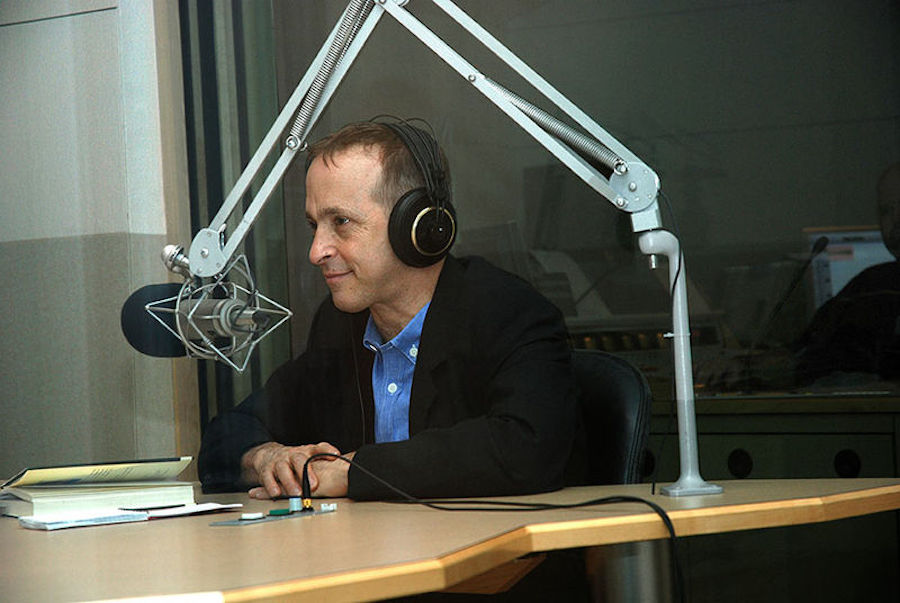
Review: An Evening with David Sedaris

WBUR [(CC BY-SA 2.0)] / COMMONS
A sophisticated comedy show

My expectation of David Sedaris, the contemporary American humorist and writer, was different than my experience at his lecture at the Mondavi Center on May 9. His legacy and writing exudes sophistication, clever wit and a seasoned wisdom — he writes for The New Yorker and has ten books under his belt, after all. His social commentary combines serious intellect with a relatability that’s accessible to the layman. Even his headshot reminds me of a Manhattan socialite, always knowing the right thing to say at every moment. While the last comment remains true, the seriousness I was anticipating was flipped on its head.

My first instance seeing the writer in person was outside the Mondavi Center before the show. His driver parked his car perpendicular to the sidewalk (parking spots don’t seem to exist to a man like Sedaris). Out he stepped, adorned in a long linen shirt and MC Hammer-style pants, walking confidently to the side entrance. What an entrance; what a badass.

My first time hearing him speak that night also dismissed my preconceived notions of the man. The stage mentally prepared me for a well-structured lecture: a podium was centered in the middle of the stage, a stool with his water placed on top. His low-hanging pants soon made their debut, and he welcomed the crowd. The surprise came from how high his voice is, which again dismissed the deep, serious voice I was expecting to hear. He told the crowd he wasn’t nervous to speak in front of us; he was already winning since we paid to see him. Laughter ruptured from the audience. I was expecting commentary, his views on our political and social commentary. He gave us a better one: humor.

He began his evening reading an excerpt from a recent essay about a piece of gravel that got caught in one of his molars and the chaotic road to getting a root canal. As he told of his travels to different cities — and different dentists —  he weaved in the hard truths of growing older: the physical and emotional pain you become accustomed to, but the miraculous way we overcome it.

He later presented the commencement speech he will be giving at Oberlin College — ironic, considering the limited number of college students in attendance. In the speech, he gave some advice: only buy high-end scented candles, and send handwritten thank-you cards for any and every occasion. Each time his talk hit a hard, serious tone, the audience drew silent. But always he found the wit, the humor and the positivity to embed in those moments.

What was surprising, and an aspect of him that I both forgot and possibly failed to notice, was how raunchy and un-politically-correct he was. Don’t get me wrong, he did not cross a line, but sex jokes frequently made their way into his lecture. He mentioned there are few things in this world that he genuinely cares about, but of those things, you should fight for them, stand up for them.

Sedaris is real; he doesn’t make himself bigger than he is. His humble being and presentation was captivating and enthusiastic. What I — and the audience — got from the night was a conversation with David Sedaris.

This was indeed not a formal lecture, but rather, a comedy show. I found myself continuously laughing throughout the two hours, and so was the crowd. Nevertheless, I was intellectually stimulated throughout the evening. His beauty lies in his ability to combine the most serious of topics within the context of creativity and smart humor. Sedaris gave us a gentle reminder of what we really need: a conscious, deliberate thought — an ever-so present humorous perspective.


Written by: Caroline Rutten — arts@theaggie.org

UCLA, UC Davis, UC Irvine, Stanford researchers find evidence of Majorana particle

DAVIS WHALEN / AGGIE

New research may have implications for supercomputing

Researchers at UCLA, with the help of researchers from UC Davis, UC Irvine and Stanford, have found evidence of the Majorana particle. This particle acts as its own antiparticle and belongs to a class of fundamental particles: fermions.

The experiment was conducted by first constructing a “layer cake” of quantum materials from a superconductor and a magnetic topological insulator. A superconductor was used because it has zero electrical resistance and a topological insulator has the characteristic only along its surface and edges but not through its middle.

A magnetic field applied to the ‘layer cake’ induces pairs of Majorana fermions, which travel along the edges of the topological insulator,” said Kai Liu, a co-author of the study and a professor of physics at UC Davis. “Under certain conditions, the hybrid structure splits each pair, allowing one member to go through and deflecting the other, leading to conductance half as high as that for electrons. These half-steps were the signal confirming the presence of mobile Majorana fermions, predicted by Professor Shoucheng Zhang’s group at Stanford.”

Ettore Majorana, an Italian physicist, first proposed this particle in 1937, but it remained undiscovered until now. This particle’s connection to quantum computing directly linked this discovery to cybersecurity.

Quantum computers based on Majorana particles can be powerful and fault tolerant,” said Zhijie Chen, a third-year graduate student at UC Davis. “Because quantum computers are way more powerful than computers we have nowadays, encryption used by quantum computer is impossible for normal computers to break.”

Information in normal computers are stored in terms of bits, but in quantum computers, information is stored in terms of complex superpositions of quantum states called Qubits. There are two types of particles that make good candidates for Qubits: trapped quantum particles and topological structures like Majorana fermions.

“The advantage of the latter is that Majorana particles have zero charge and are thus less easy to influence than particles that do have charge like electrons,” said Edward Burks, a researcher and UC Davis alumnus. “Additionally, small perturbations and outside effects can degrade a trapped quantum particle state [and cause data loss], but it’s much more difficult to change a topology. So, if data could be stored in this form it could be more robust to external influence, creating a fault tolerant and safe data storage method.”


Written by: Kriti Varghese — science@theaggie.org

By focusing on the past, Muslims continue to live in it

JEREMY DANG / AGGIE

It may benefit Muslims to put to rest a 7th-century division

I would never argue that people should not know their own history, nor that of others. I would argue, however, that too much remembrance can be problematic in certain cases, especially if those historical moments occurred in the 7th century.

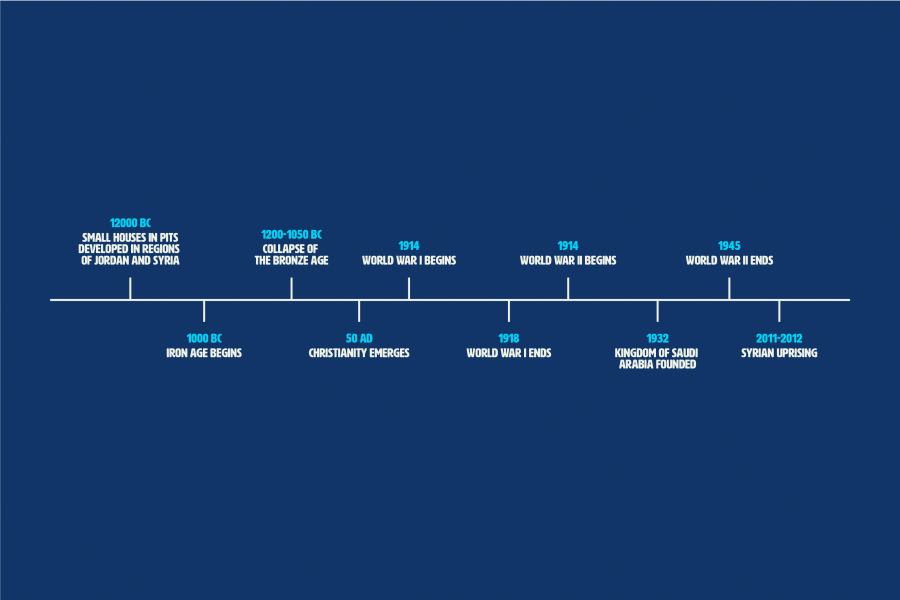
As a Muslim, I know the story of the Shia-Sunni split well. The division can be traced to the year 632 A.D., continuing all the way to present day. The split occurred with the debate over succession after the prophet Mohammad’s death. Sunnis wanted the community to determine who would become the next caliph while Shias argued that a member of the prophet’s family should lead. While Shias didn’t immediately receive gratification, Mohammad’s son-in-law, Ali, would later become the fourth caliph. An onslaught of violence and war brought Ali’s rule to an end after his death. The war continued with Ali’s son, Hussein, who fought against the new caliphate, resulting in the death of 72 of his companions, as well as Hussein’s decapitation — whose body was then carried as a tribute to the Sunni caliph.

While an interesting history lesson, the historical meaning behind these labels doesn’t necessarily hold any relevance in today’s world. Despite tense political differences in 632 A.D., both factions still follow the same book, worship the same God and recognize the same prophets. The unique characteristic about a division this strong is that you don’t need to understand why the split occurred originally, because it doesn’t contribute much to the present conflict. The labels mean something, but it’s not about the history or source of the divisions; they’ve become arbitrary titles used to, either knowingly or unknowingly, ensure division. In this case, remembering history is serving no one.

This unrelenting fixation on the Shia-Sunni division shifts focus from present issues while also giving rise to new ones. Rather than deal with the issues that directly affect citizens, such as combating poverty and unemployment, Middle Eastern nations instead allocate time and lots of money to fighting sectarian proxy wars in the region. This results in what feels like a never-ending war with a weak chance of resolution, as evidenced by the 14 centuries that have passed since the split. The Shia and Sunni labels have not only withstood the test of time but have also remained a source of contention. Even if problems like poverty were not ignored in favor of conflict, the presence of these labels indicate that many Muslims have failed to recognize the absurdity of a centuries-old, now-irrelevant political dispute that still manages to dictate politics and religion today. This division has also given rise to problematic traditions like Ashura.

Ashura, for the majority of Shias, is a day of remembrance for the death of Hussein. Muslims are expected to, as the eighth Shia Imam Ali al-Rida once dictated, observe Ashura as a day of rest, sorrow and disregard of other issues or worldly matters. Shia Muslims participate by mourning and listening to recollections and sermons on the death of Hussein and his family. Along with this Ashura custom comes the practice of self-harm, in which Muslims whip, cut and slash themselves in commemoration. While largely performed by men, children have also taken part in such activities. A chilling image of a young girl being restrained by two men as a third prepares to slice into her forehead always comes to mind; what is the incentive to mourn and beat oneself in honor of a 7th century historical figure? Why is this taught to children to ensure continued practice?

Unquestioning compliance to traditions is not uncommon in the Middle East; restrictive laws and other governmental functions go largely unquestioned, creating a society of people willing to beat themselves without a logical justification for doing so. Perhaps mourning the past is a result of dissatisfaction with the present; Arabs once led civilization and now their region is characterized by proxy wars.

Why do Muslims continue to identify themselves with a political dispute that occurred well beyond the realm of present relevancy? The subject of the dispute now means nothing and the label now means everything — despite the fact that everything that defines the label (support, or lack thereof, for the prophet’s family to lead the caliphate) is no longer relevant nor of immediate concern to anyone, and that includes Sunnis and Shias. Converts don’t pick a title because the label is entirely separate from Islam itself. It is not mentioned in the Quran and it’s the consequence of political rivalry in the 7th century. So why continue to adhere to a label whose sole basis is division, rather than unity? Even if addressing present day issues is not a motivating goal to loosen the grip on the past, the fallacy of the titles themselves should be motivating enough to do away with them.

It’s difficult not to get lost in the nostalgia of one’s past, but how does an entire religious group continue to feel nostalgia for an event so far removed from present day? Muslims constrain themselves through this remembrance; by mourning the past, Muslims continue to live in it and lead their country and their children as such. Rather than look to the past as a means to feel sorrow over the present, Muslims should look to the present to establish a better future.


Written by: Hanadi Jordan — hajordan@ucdavis.edu

Disclaimer: The views and opinions expressed by individual columnists belong to the columnists alone and do not necessarily indicate the views and opinions held by The California Aggie.

Humor: Dog in discussion section clearly has better life than you

PETE MARKHAM [(CC BY-SA 2.0)] / FLICKR
Who does he think he is?

You walk in to Statistics 13 a disheveled mess. Your hair is in a frumpy knot, you’re wearing the same clothes as yesterday and you barely remembered to bring something to write with. You sit down, and there it is — supreme comfort staring you straight in the face: an adorable, white poodle sleeping under the desk next to you.

As you put your things away, one thing is clear — this dog’s life is waaaay better than yours. Its tiny, plush bed taunts you. What’s that? Suede? When you pull out your bag of old, semi-white carrots to snack on, the dog’s owner opens a container of freshly cooked steak, cut into tiny bits. The smell permeates your nostrils, and your crunching becomes louder, more frustrated. The dog starts to wake up to the smell of food, but yawns and stretches gloriously, as if to say the entire world is built to fulfill its desires.

You struggle to pay attention to class lecture, as this poodle promptly devours a meal you would murder your mother for.

Thoughts start to flood your mind: “How dare he. How dare he think he’s better than me.”

Near the end of class, the anger begins to simmer down. You’ve found the right angle in your seat where none of your limbs will fall asleep and those carrots satisfy your physiological desire to bite the dog owner’s fingers off. Finally, you’re comfortable. The professor dismisses class for the day, and you see the person next to you reach for something. No way. This poodle gets to ride around bjorned, strapped to this guy’s chest. Like a baby kangaroo in a pouch filled with eucalyptus leaves, this dog’s got it all. You try to contain your jealousy, but all you can think of is dressing up in white wool and switching yourself out with this dog. To trade lives, even for a day. One can only dream.


Written by: Beck Nava — rnavamcclellan@ucdavis.edu

(This article is humor and/or satire, and its content is purely fictional. The story and the names of “sources” are fictionalized.)

Summer reading returns to Yolo County Library

SHEREEN LEE / AGGIE

Annual summer reading commenced on May 20

The Yolo County Library’s annual summer reading program this summer will be held from May 20 to August 18. This year’s theme, “Reading takes you everywhere,” will host a variety of programs and activities to motivate people of all ages to savor the simple pleasures that lie in reading.

“The summer reading program at Yolo County Library is designed with the whole community in mind,” said Margaret Pelrine, a librarian at the Clarksburg Branch Library. “We have programs for babies, toddlers, school age kids, teens and adults all summer long. One of Yolo County Library’s strategic goals is to promote reading as a beneficial activity, and SRP is a great opportunity to invite the community to come together over books.”

Various prizes are awarded to those who finish the program. According to Katrina Laws-Eswald, a youth services librarian at the Yolo County Library, there are certificates and coupons available for favorite food venues.

This year, instead of having the final prize as a book, we are giving each person a free book at signup,” Laws-Eswald said via email. “It’s a way to get them started and also excited about the program. Children 0-12 will get a Chipotle coupon, a Round Table coupon, and a discounted ticket to LEGOland when they finish the program.”

Kids and teenagers have been actively participating in the past years.

“Parents love the Summer Reading Program,” said Laura Benn, the early learning coordinator at the Yolo County Library. “Each year, we hear from parents and caregivers that they appreciate the incentive to keep the kids reading over the summer, as well as the creative activities we suggest and the free events we host.”

Each year, the theme is decided upon by the California Library Association Advisory Council, whose members include children’s, teens and adult services librarians throughout the state.

“This year, the theme is about reading as a vehicle to different places (the past, the future, a different state or country, outer space, underwater, a different dimension, or a make believe place),” Laws-Eswald said. “Not only that, we are also showing that reading can take you to different perspectives (a different race, culture, religion, orientation, disability, or even a different species). The library has been a strong advocate for diversity in our community’s reading in order to develop empathy for the minority.”

Benn encouraged community members to head over to the library this summer, pick up a book and start reading.

“Based on community feedback, we’ve made participation in this year’s program flexible so that it fits everyone’s unique needs and schedules,” Benn said. “Whether you want to finish that challenging classic novel or develop a habit of reading every day, we’ve got the program — and the prizes — to help you reach your goal. Signups start May 20 and the program runs through August 18. We hope to see you at the library.”


Written by: Rabiya Oberoi — city@theaggie.org

Bringing city, community together

CAITLYN SAMPLEY / AGGIE

Diane Parro named director of business and community engagement

Diane Parro is now the director of business and community engagement for the City of Davis. She was previously the City’s chief innovation officer and will now serve as a liaison between the community and the City.

Mike Webb, the Davis city manager, elaborated on Parro’s role for the city.

“Her position is a bit more focused now on strategic communications, really heading up the City’s efforts, and our staff team that are involved in helping communicate back and forth with the community at large,” Webb said.

Parro jumped into her role right away and is currently filling her new position.

“The changes were effective immediately,” Webb said. “She’s already diving in headfirst with these things. Formally her title with the City was chief innovation officer, and I felt that we really needed to focus more on our strategic communications. We needed to bolster things even more. She has a background in marketing and she’s a member of our executive team, so she has good access to department heads to quickly cut to the chase and get things done.”

Parro will also work directly with businesses to bridge them with the City as well as involving the community.

“Whenever a business has questions about where to start with a process to get a remodel done or expansion or business licences, Diane is a starting point for them,” Webb said.  “With respect to communications, her role also expands to include community engagement on a broader scope and scale. She’s in charge of helping with organizing and helping to get word out about things that are happening with the City — helping us develop our approach to how each City department engages with the community and creating clear expectations about when we engage with the community.”

In order to get the word out and connect the City and the community, she’s working to use social media platforms such as Facebook.

“Largely, she’s building upon some good things that the City’s done in the last couple of years like utilizing social media platforms, [such as] using our website and more traditional means of press releases and local media to help get word out,” Webb said. “Putting signage out in the community, like our roadway construction project [for example], and working with our team to help explain what is happening, like what’s the end product going to look like and what the community can expect in terms of completion and how it’s funded.”

Rachel Hartsough, the arts and culture manager, will be working with Parro, and noted how the arts are connected to the city’s government and community.

“I am looking forward to working more closely with Diane in this way,” Hartsough said via email. “Taking a more holistic overview of how the Arts fit in with — and bolster — economic development and other community engagement efforts helps support our ongoing vision of the City’s Arts & Cultural Affairs Program to support community-based arts projects, cultural opportunities, and education initiatives that foster excellence, diversity, and vitality in the arts.”

Parro’s role largely influences how the City can connect to the community better through communication, which includes the arts, among other projects.

“She also has a very good and direct communication style, and she’s also what I call proactive,” Webb said. “She doesn’t wait for someone to come and say to do x, y or z. Part of the expectation with Diane is […] that we should already be now thinking about to communicate to the community.”

This relationship between the City and the community will allow more projects and practices such as art management.

“The newly formalized relationship within the City’s organizational structure will further strengthen our goals to build community partnerships, explores best practices, and manage the public art collection through an enhanced network of partners in the community,” Hartsough said.

Hartsough stated that the arts and culture program is seeing improvement with overall city satisfaction.

“The Arts & Culture program has seen incredible growth and momentum in Davis during the past few years, and this will really continue to help us have a positive impact on the quality of life for all Davis residents and visitors,” Hartsough said.

According to The Davis Enterprise, Mayor Robb Davis indicated that open communication will only add to the City’s momentum to engage with the community.

“Transparency is of critical importance and I am supportive of efforts to deliver more information using traditional and emerging modes of communication,” Davis said. “I am pleased that the city manager’s office has reorganized around existing staff to place greater emphasis on providing information to the public and engaging the community in myriad ways.”

Webb added that he believes that there is more potential for communication between the City and the community.

“I think we’re very fortunate to have the engaged community that we have, and I think this is a good time for us to be doubling down on our communication with the community on what’s happening,” Webb said. “Day in and day out, there’s good things that the City is doing out there in the community, whether it’s posting a forum or meeting or working on a capital improvement project and a myriad of other things. I think there’s a lot of good things that are happening, and we need to be in communication with the Davis community about those things. I’m pleased to see that we’re going to be able to move that forward.”


Written by: Stella Tran — city@theaggie.org


Police Logs

NICKI PADAR / AGGIE

Are there any Girl Scout cookies in there?

May 10

“Several vehicles facing wrong way on street.”

“Three duffle bags with Girl Scout property left in front of residence. Request items be picked up.”

“Tenant in office refusing to leave — upset over her vehicle being towed today from fire lane — request officer mediate.”

“Male subject playing a trumpet in the open field by the barn.”


May 11

“Bar closed prior to reporting party getting his ID back — request officer assist.”


May 13

“Reporting party’s girlfriend broke his computer.”

“Female party who is restrained person has barricaded herself inside residence.”

“Boyfriend entered residence and vandalized the reporting party’s property. Subject grabbed a knife and refused to leave the residence. Boyfriend is still in the apartment. Reporting party is on the patio.”


May 14

“Neighbor throwing sandals at the screen door.”


May 16

“Ongoing issue with known male calling reporting party excessively.”

Teaching computers to see

YONG JAE LEE / COURTESY

UC Davis computer science professor researches computer vision

Yong Jae Lee, an associate professor in the UC Davis Department of Computer Science, recently won the National Science Foundation CAREER Award, a grant that provides $501,000 over a period of five years to early-career faculty who have demonstrated potential to make significant advances in their fields.

Lee’s specialty is to teach computers how to “see.” The niche of computer science that seeks to emulate the human visual system is known as “computer vision.”

Computer vision involves developing algorithms that process large numbers of digital images and videos and detect patterns associated with various objects. In a very simple example, a computer program trying to learn what a dog looks like would first be fed millions of images containing a dog and millions of images containing no dogs.

First, it attempts to learn the differences between images that have a dog in them and images that do not. Then, it tries to find patterns and similarities among the images with dogs in them: for example, it may detect two ears, two light shapes (eyes), and a dark spot (the nose) among all images containing dogs and conclude that this pattern is what determines a dog.

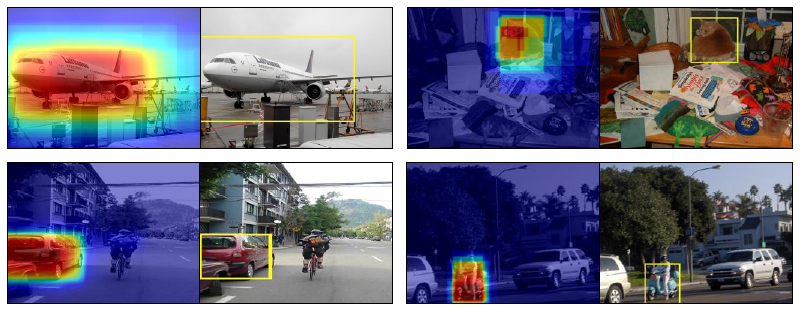
Current image-recognition techniques rely on images that have been painstakingly annotated by humans. Consider, for example, a photo of an airplane. A human annotator would have to go in, draw a box around the category they’re interested in (this is known as a “bounding box”), and label it as an airplane. Easy enough, right?

Not so easy, it turns out.

“What happens when we have have thousands of categories? Human annotation can get very expensive,” Lee said.

Lee’s research seeks to eliminate the need for expensive, time-consuming and cumbersome human annotation by developing “weakly-supervised” algorithms. Weakly-supervised algorithms require very little human annotation and labeling. Instead of having a bounding box and label around item in a photo, the photo would have no bounding boxes. It would also have minimal labeling: for example, just “plane” or “dog in grass.”

Lee noted that people have been working on weakly-supervised computer vision algorithms for a while.

“Typically, weakly-supervised learning has been done using only images. We’re adding video,” Lee said. “In video, things are changing, objects are moving. This motion information can be useful for any algorithm trying to learn about the world.”

Lee noted that his research relies on a combination of photo and video. While photos can provide a diverse breadth of information about an object category, videos can teach an algorithm more deeply about a category.

For example, consider an algorithm trying to learn what a dog looks like. Photos can expose an algorithm to thousands of different kinds of dogs. But videos can show the algorithm a more complete picture of the dog, such as how it looks like at a variety of angles.

Lee also teaches ECS 174, an undergraduate course on computer vision. According to his TA, Yash Bhartia, Lee makes an effort to ensure that class projects reflect the most recent and relevant computer vision techniques.

Students in ECS 174 also have the opportunity to build a Video Search Tool application. The application allows a user to search video footage. For the purposes of this project, students are asked to build an application that allows users to search through footage from the TV show “Friends.” For example, if a user searches for “Joey in a red shirt”, the application returns footage frames containing the “Friends character Joey in a red shirt.

“The reason I like this project is because people who are not familiar with computer science can still recognize and appreciate the complexity of the task,” Bhartia said.

The potential applications of Lee’s research and similar efforts are many and varied. One such application is building robots to navigate our world. They would need to be equipped with sophisticated object detection and recognition systems in order to learn quickly about their surroundings.

Harshita Kaushal, a second-year studying computer engineering at UC Davis, worked on precisely such a system during her internship at Intel last summer. She implemented an algorithm for Intel’s Autonomous Driving Platform that would allow a computer to accurately detect depths of various objects.

“This is important for self-driving cars, so that they can accurately navigate the road,” Kaushal said. “After working on this project, I truly understood the far-reaching applications of it, beyond just identifying faces in your photos.”

There are also ethical dilemmas posed by a computer system that is able to perfectly recognize all objects — including human faces. But as with all technologies, Lee says that there will be “good” and “bad” uses of computer vision technology.

A positive use of human facial recognition would be an intelligent home assistant for elderly people or children. Such a system would need to be able to accurately recognize the faces of the people it is monitoring.

“It is still definitely something to be cautious about,” Lee said. “We need to be aware of security and privacy concerns and think ahead about potential negative consequences.”


Written by: Nausheen Sujela — science@theaggie.org

From the California Chronicles

CHRISTIE NEO / AGGIE

The conversation flowed naturally…

I couldn’t get my mind off of him over the next few days. There really was no reason for it. I mean, he wasn’t even the guy I went on a terrible coffee date with, but the thoughts were still there. I am by no means a romantic — because who would want to be classified an “endangered species?” About a week had gone by when he sent me a text. It read, “Hey, how’ve you been?” I put my phone down, planned to strategically reply 30 minutes later, but completely failed. I immediately responded and said, “Doing well. Been busy. And yourself?” He said he had two midterms the previous week and thus he was exhausted.

Much to my amazement, he asked me out on a real date in Sacramento. I said that I needed to check my schedule because I was so busy (I really wasn’t). The evening came and he picked me up from my dorm around 7 p.m. He didn’t probe me with questions about myself, which was great, but instead he asked me what I thought about different topics.

We’re both intellectuals; small talk would be a waste of our intelligence. The conversation flowed naturally, and we both were naturally unapologetic about calling out each other’s bullshit. To most, that would be too much to handle. To me, all I could think was “Finally.” We arrived at the restaurant and parked. He didn’t open my door for me because I was perfectly capable of doing it myself. However, I compromised by letting him open the front door for me. The hostess sat us at the bar — and so it began.


Next week: Chance


Written by: Terry Hudson — arts@theaggie.org

2018 Davis Music Fest

ZOË REINHARDT / AGGIE

Davis Live Music Collective showcases local talent in annual festival

Returning for its eighth consecutive year, the Davis Music Festival embodies the spirit of the Davis music scene, with live performances day and night throughout the small but vibrant town. Familiar faces from all over flock to the streets of downtown to enjoy performances from 40 bands including returners such as Alec Lytle & Them Rounders, West Nile Ramblers and Element Brass Band.

“We say that we’re a ‘no headliner, South by Southwest’ type of festival and we really mean that,” said the executive director of the Davis Live Music Collective, Kyle Monhollen. “You are as likely to hear your favorite band at 3 p.m. in the afternoon as you are at 10 at night.”

Monhollen first got his start with DMF after working for the Davis School Arts Foundation for many years. And while DMF is a music festival, it is first and foremost a fundraiser for the Davis School Arts Foundation, an organization dedicated to raising money for art education in local public schools.

“We’re doing an arts-related music event and Davis public schools have been really good about providing positive art — and especially music — education to students in town,” Monhollen said. “Anything we can do to help secure [that education], we’re gonna do.”

Put on by the Davis Live Music Collective, the weekend kicks off on Friday, June 17 for attendees to enjoy music, food and beer as four acts perform at the Sudwerk Brewing Co. Dock Store from 5 to 10 p.m. On Saturday, the festivities continue at various venues all over town, including Armadillo Music, Delta of Venus, Sophia’s Thai Kitchen, Davis Odd Fellows Lodge and the courtyard at Pence Gallery. Lastly, on Sunday, the festival wraps up with performances from 12 to 7 p.m. at Three Mile Brewing Co. and Woodstock’s Pizza.

But with the Davis Live Music Collective being a nonprofit organization, how is all of this even possible in the first place? Two words: local sponsors. Restaurants, brewing companies and shops all over town offer their support in the form of event sponsorship in order to bring this highly anticipated festival to fruition.

“Most of our sponsorships are overwhelmingly from family-owned, small businesses in town that get what we’re doing,” said Monhollen. “For me, one of the most positive things is that we have sponsors who return year after year, so clearly they feel like it’s a worthwhile thing to be involved in.”

As the premier local record store in Davis, Armadillo Music serves as one of the main sponsors of DMF since the festival’s inception eight years ago. Armadillo helps the Live Music Collective with event promotion, ticket sales and even offers their stage as a venue for the weekend.

“For what we do everyday, putting music out into the world, it’s great to see people coming into town to enjoy a festival atmosphere, and kind of bounce around from venue to venue,” said the owner of Armadillo Music, Josh Chapman. “It’s just a great atmosphere.”

Among the performers of DMF include Davis native Alec Lytle. Born and raised in Yolo County, Lytle is returning for his second year at DMF with his acoustic group Alec Lytle & Them Rounders. While he typically spends his time performing all over the western states, Lytle is still based in California, now residing in the Santa Cruz mountains. However, he still holds Davis near and dear to his heart, especially for events like DMF.

“A lot of my music really comes from a place of real personal stories, and, of course. a lot of personal stories emanate from where you were born and raised,” Lytle said. “So, there’s a lot of Davis in my music, for sure.”

Alec Lytle & Them Rounders will be performing at DMF in a style of what the performer claims to be a little different for them. With a trio of a drummer, an upright bass player and Lytle himself, singing and playing guitar, the Rounders will be bringing a non-traditional, fully acoustic sound to the festival.

“You’ll hear music that’s got a lot of storytelling in it, a lot of personal stories,” Lytle said. “I’m always trying to relate it back to other people. My whole reason for doing music and performing music is because it’s the best way that I have to communicate with people.”

For more information leading up to DMF, visit davismusicfest.com. Tickets are just $15 per venue, with festival admission on sale online or at Armadillo Music for $35 in advance and $40 day of.


Written by: Sydney Odman — arts@theaggie.org

Student group launches pilot program to provide free menstrual products

KAILA MATTERA / AGGIE

PERIOD to address menstrual product accessibility on campus

Campus groups are working to tackle the topic of menstruation with menstrual product drives and pilot initiatives. PERIOD: The Menstrual Movement is a new club on campus working to increase the accessibility of menstrual products for UC Davis students. Graduate researchers, club members and the student group IGNITE have collaborated to create a pilot program which will provide free menstrual products in several high-traffic bathrooms across campus.


From May 7 to 10, members of HerCampus tabled at the Memorial Union to hold their annual menstrual product donation drive. The team hoped to beat last year’s totals of 1,900 pads and 600 tampons. All items collected will be donated to local women’s shelters.


“The menstrual product drive was hosted by HerCampus. We are partnering with them to distribute the products,” said Annie Wang, a second-year material science and engineering major.
Wang is also a member and one of the founders of PERIOD at UC Davis.


This week, PERIOD launched its pilot program to begin providing free menstrual products in specific bathrooms around campus for students. PERIOD claims that free access to menstrual products is a right, not a luxury.


Hung Doan, a graduate student researcher, discussed the movement’s platform and what they hope to accomplish.


“We believe that menstruation is an underserved, and unduly tabooed topic,” Doan said. “We believe that menstrual products, like pads and tampons, are a basic hygiene necessity, equivalent to toilet paper, soap and hand towels.”


Free menstrual products can now be found for a short time around campus. The initiative plans to provide 140 pads and 140 tampons in multi-stall bathrooms and 70 pads and 70 tampons in single-stall bathrooms each week. Over the course of the entire quarter, this translates to providing 6,720 tampons and 6,720 pads for students.


Newly-provided pads and tampons can be found in Kemper Hall, Sciences Lecture Hall, the Peter J. Shields Library, the Student Community Center and Wellman Hall.


Student volunteers will be tasked with restocking products on a weekly basis for the duration of the initiative. In addition to restocking supplies, volunteers can help gauge how frequently students are utilizing the products. Anusha Klinder, a second-year global disease biology major, is one of the founders of PERIOD on campus. Klinder spoke about current observations during restocking.


“The initiative is going really well,” Klinder said. “Each time we check the bathrooms most if not all the pads are gone, and most of the tampons too.”


The initiative received support from Custodial Services, Shields Library and the Women’s Resources and Research Center. Student Health and Counseling Services and the Dr. Michelle Famula Fund provided funding for the initiative, which will cost $2,585 in total.


While the pilot program is focusing on short-term provisions for students, PERIOD plans to implement long-term provisions of menstrual products in all campus buildings.


Written by: Ally Russell — campus@theaggie.org

Humor: UC Davis ranked No. 1 in list of “Best School Colors” among UCs

CAITLYN SAMPLEY / AGGIE

U.S News & World Report now ranks colleges based on their school colors to give potential students more to consider

This week, U.S. News & World Report confirmed what Davis students have known for a long time — that UC Davis is superior at more than just veterinary and viticulture programs.

After conducting research for a period spanning 12 months that included 500 universities internationally, the popular site that somehow still convinces prospective college students every year that their happiness is determined by arbitrary number ranking systems has released its list of “Best Colleges by School Color.” Out of all the schools in the UC system, Davis’ infamous Aggie Blue and Gold secured the number one spot and placed third internationally — below only University of Michigan’s maize yellow and blue and Notre Dame’s classic blue and gold.

School colors can affect a lot about the college experience, such as what a e s t h e t i c students are limited to, how often they participate in school spirit and how many college sweatshirts students will see athletes wearing around campus every day. U.S. News & World Report considers these and other metrics in their careful deliberation.

“We want to make sure that every student hoping to pursue a college education has all of the resources they need in order to make a decision,” a U.S News representative told The Aggie. “By nature, high school students are complete idiots, and we feel it’s our job to prevent them from thinking for themselves and definitively tell them how to gauge their self-worth.”

“I just got accepted into Davis and I’m so happy!” said George Lawrence, a high school senior. “Davis’ school colors are so much better than UC Berkeley’s. I mean, who would want to wear Berkeley Blue over Aggie Blue? I do wish I could have gotten into Notre Dame, though. They have the best blue and gold in the nation.”

Others are not so happy. “This ranking seems completely arbitrary,” an administrator from UC Berkeley said. “How can you rank schools based on school colors? Everyone knows that Berkeley has the best blue and gold, I mean our gold is called California Gold. We practically invented the color gold. I just don’t see how this makes any sense.”


Written by: Conner Shaw — cjshaw@ucdavis.edu

(This article is humor and/or satire, and its content is purely fictional. The story and the names of “sources” are fictionalized.)