55.8 F
Davis

Davis, California

Saturday, December 20, 2025
Home Blog Page 551

Mental Health Town Hall erupts in protest

FARAH FARJOOD / AGGIE

Students demand promised counselors, question allocation of mental health fee

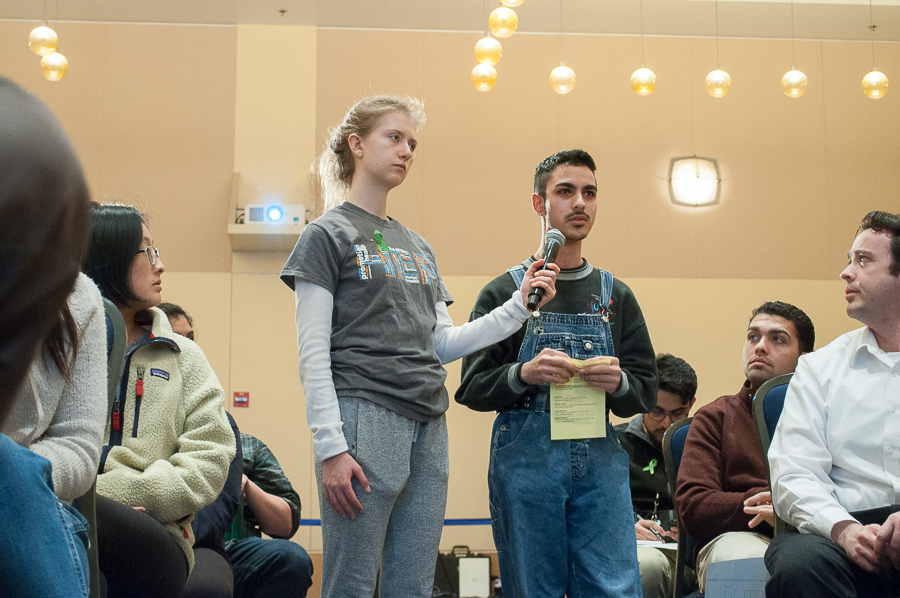
On Feb. 12, at the Mental Health Town Hall organized by Student Health and Counseling Services, three UC Davis administrators faced student questions regarding SHCS’ funding allocation and potentially deliberate setbacks to staff growth. The three administrators — Executive Director of Health and Wellness Margaret Walter, Assistant Vice Chancellor for Divisional Resources of Student Affairs Cory Vu and Director of Multicultural Services for SHCS Paul Kim — delivered opening statements to a room full of about 200 students, faculty and community members.

The administrators discussed the findings of the recent internal CS audit from December of 2017, which was published in its entirety several hours before the town hall took place after portions were made public by The California Aggie. Walter, Vu and Kim answered both in-person and online questions — often met by intense audience frustration. The event was live-streamed and uploaded in its entirety.

In 2016, the UC Office of the President announced an $18 million UC-wide initiative for the hiring of 85 mental health clinicians including an additional 12 counseling psychologists at UC Davis. The audit found the usage of $250,000 of mental health funds at UC Davis to have been spent in a manner which “may not be consistent with the rationale for the fee increase.”

In her opening statement, Walter praised a “vibrant” conversation revolving around UC Davis mental health. She joked that “she was a little disappointed” because she thought that she would see signs from student activists at the event, saying “maybe you’ll pull [the signs] out later […] that would be fun.” Later in the evening, students pulled out pre-made signs and began protesting inadequate responses from the administrative panel, demanding the hiring of the 12 counselors. The panelists and moderator asked students to speak one at a time and submit their feedback through set-up posters and online messaging.

Walter called students the administration’s “bosses” because the SHCS operates primarily from Student Services and Mental Health fees. Walter said that when the $18 million UCOP initiative was first announced in 2016, “it was very exciting to hear that we were getting these new people.”

According to Walter, the plan did not pan out as expected and SHCS had to use Student Services and Mental Health fees funds to “stabilize” and “shore up” current positions rather than bring in the promised new positions. Walter said five more positions have been stabilized.

Panel members and students unpacked the audit findings and confronted administrators about a lack of transparency after original plans to increase clinicians had changed. Students echoed the audit’s questioning of the $250,000, spent on two positions in Student Services and Judicial Affairs and the UC Davis Student Disability Center, and demanded the promised 12 additional counselors.

Walter came to a different conclusion, admitting that SHCS at one time had a “commitment to the 11 positions” based on “assumptions that did not come true.” Walter, Vu and Kim sought to justify the spending of that money on the Student Services and Judicial Affairs and Student Disability Center positions. The audit stated that “guidance published by UCOP in 2015 indicates that the funds should be used in support of the CS department” and concluded that the allocation to external departments resulted “fewer funds […] available for recruitment of CS counselor [full time equivalents].”

The students demanded answers for budget management. The UCOP recommended the mental health funds go to the counseling services, but these were non-binding guidelines. Other findings of the audit included inadequate numbers of staff, low productivity of counselors, problems with student appointment scheduling policies and access and staff salary and retention.

Donald Dudley, the director of the Office of Student Support and Judicial Affairs, was present to justify the allocation of the $250,000 to departments outside the SHCS stating that the funds were used for a non-clinical case manager position who works with students and academic advisors, the student retention center and housing providers. Jennifer Belleci, the director of the Student Disability Center, spoke about the number of students who need disability treatment, explaining why one of their staff members is a psychologist who determines student eligibility for services and is paid with the funds.

The audit also found that administration had been unclear in that SHCS “leadership has not articulated a strategic plan for Counseling Services.”

A pie chart was provided via projector showing the different allocations of SHCS funds, from crisis support and case management to consultation and clinical counseling.

Walter talked about a growing student need for crisis treatment stating that each time student needs evolve and each time “something is added, other parts of the pie have to shrink a little bit.”

Aj Ballesteros, a first-year sociology major and a member of Students for a Democratic Society, responded to Walter’s statement of shrinking parts of the pie chart. Ballesteros told the panel that they should increase funds for SHCS and “increase the size of the pie.” Ballesteros rejected Walter’s statement that students were the bosses of administration.

“Firstly, it shouldn’t be students’ job to advocate for our own mental health — y’all should be advocating for us in the highest level, all the way up to the chancellors and even UC Regents,” Ballesteros said. “Y’all said that students are the boss of y’all, but I completely disagree. I don’t think we have any meaningful democratic engagement in allocating where our tuition fees go. We certainly are not the boss of administration.”

Shradha Shah, a second-year psychology major and the policy advocacy officer for the Student Mental Health Coalition, said “this health care is ours” and that students “have already paid for it.”

“A survey in 2015 revealed that 40 percent of undergraduates at UC Davis felt so depressed that they could not function on a daily basis,” Shah said. “12 percent said they seriously contemplated suicide.”

Shah then read the Coalition’s petition that 1,100 students and faculty had signed. She asked students who signed the petition to stand, and at that time around 30 students stood up.

“In 2015, UC Davis student affairs committed to a net increase of 12 counselors by the end of the fiscal year 2017,” Shah said. “Today, we are in 2018 and a recent audit has shown that this recent commitment has yet to be fulfilled. And despite rising tuition cost, we have yet to see additional mental health support. This is about us students, and not only what is rightfully ours, but what is needed for our wellbeing — and at this point — our survival.”

The petition demanded the SHCS add 10 more counselors to complete the 12 counselors they had previously committed to, as well as increase the salary of counselors and increase the prioritization of hiring queer and trans counselors. The coalition asked for heightened transparency of budget allocations and project updates, increased student participation in decision-making and mandated mental health training for professors and TA’s.

The petition’s co-author Samantha Chiang, a fourth-year English major and the director of the Mental Health Initiative, advocated for students she said have been failed by SHCS. Chiang said “increased services” are “integral to our survival.”

“It’s for the students who can’t get appointments,” Chiang said. “The students who muster up the courage to walk into North Hall, only to be told the next appointment is three weeks out. So they call in for day-of appointment at 8:05 a.m., but they are told the appointments were all booked a minute ago. So they give up. It’s for the students who have to schedule their panic attacks, because they can only get seen five times a quarter, if they’re lucky. So they try to assess which mental health breakdowns merit an appointment. It’s for the students of color, who say they can only work with CAN counselors, because the rest invalidate our issues.”

Chiang said her SHCS counselor left because “UC Davis couldn’t pay him a competitive salary.” Chiang asked the panel what they plan to do to help the community and if they are  “going to give us the 12 counselors” that they “promised” or if they will “sit in silence as we struggle to survive.”

Walter replied to this comment by saying that administration and students “want the same thing” and “of course we agree with you.” She also said the university plans to hire one counselor every year for the next three years.

“I’m so sorry if promises made haven’t come through,” Walter said. ”I can only speak for myself and the staff, and we do have a commitment to those positions. I don’t believe the commitment to the 11 positions at the time was made on assumptions that did come true — that was banking on having enrollment increase, and that did not happen. We do have that commitment from UCOP to have those three increases that we’ve earmarked for positions. When we fill these positions, we can show you. I’m sorry if we’ve let you down. I can assure you I’m working on not doing that now, and we will keep the transparency going so you can see that that’s true.”

Students in the audience rejected this apology, saying they found it to be empty and not satisfying their concerns. Administrative panelists said it is important not to get fixated on the number of counselors. Students audibly disagreed.

One student in the audience spoke about how anxiety and mental illness compromise the ability to get help when it is needed most, stating it can become a negative feedback loop of needing help but facing personal obstacles in getting that help. The student said they were told by UC Davis counselors that their post traumatic stress disorder was invalid.

Students were also concerned with the recent intended firing of the director of Counseling and Psychological Services, Sarah Hahn, one day after she filed a Whistleblower Retaliation Report. Students at the town hall said Hahn’s requests for financial allocation information put a target on her back.

Katrina Manrique, a fourth-year English major, told the panel and audience that on Feb. 8, Hahn filed a Whistleblower Retaliation Report and “on Feb. 9, she was escorted out of counselor services, by you, Margaret Walter.” Hahn said she was threatened and intimidated after raising concerns about the allocation of the mental health fund.

Manrique said Hahn was a consistent advocate for the 12 missing counselors, and since the release of the audit and since filing for whistleblower protection, she has been fired. Students and a recent article published in the Davis Vanguard claim foul play in her termination.

“We can’t comment on any confidential personnel issues, but we all want to be contacts for you and advocates for you,” Walter said. “I’m sorry that you felt you only had one person.”

Chiang fired back at Walter, saying that Hahn was the “only one who didn’t lie to our faces about the counselors being fired.” Walter did not reply.

Aaron Latta, a third-year political science — public service major, read an official statement from the Davis College Democrats Mental Health Caucus, stating that budget misallocation “can’t be swept under the rug.”

“The administration has to understand there are many different groups on campus working with this issue, and when the university lies to us and ends up doing the exact opposite of what they told us they were going to do, it makes us all look bad,” Latta said. “Even if you can’t comment on specific personnel issues, at least assure us that those who step out and prove wrongdoing are protected by the institution that is a public utility of education, not a private corporation.”

To this point, the administration replied that they will better the department based on the audit’s suggestions as well as the future findings from the Mental Health Taskforce led by Dr. Cam Carter.

First-year gender, sexuality and women’s studies major Francesca Iacono spoke about how SHCS at UC Davis failed her. She had her psychiatry appointments canceled on her during finals week, and with her family out of state, UC Davis was her sole support system within proximity. Iacono said that when students call Mental Health Services, staff often don’t pick up.

Kim replied to this, saying that administration “certainly prioritize access to service.” He talked about how the same-day access model in counseling has been done away with at UC Davis, and that appointments have to be scheduled in advance now.

According to Kim, the SHCS sometimes refers students to community partners. Yet to this point, an online question rebuked that off-campus professionals are rarely available, rarely accept insurance and charge enormous fees. Chiang previously mentioned a barrier due to types of insurance.

To this, Vu admitted that there was “an issue of access to community providers” with not accepting new patients and insurance. Walter said that SHCS wants to hear feedback regarding appointments accessibility, and claimed that it is developing a “button to click” online to make mental health appointments.

In terms of specific actions, Walter said she’s starting a “student advisory group” for keeping the conversation going between service providers and students. Applications for these positions will be released soon. Vu talked about creating tangible change through investment in student success grant, utilizing a crisis text line being developed and teaching bystander advocacy and peer-on-peer help.

When the moderator announced the town hall was concluded, students were unsatisfied with the answers SHCS administration provided. Fourth-year psychology major Dylan Newman held a sign reading “Yet another UC Davis corruption story” and rejected what he saw that night.

“It was a crock,” Newman said. “A thinly-veiled attempt by administration to manipulate the perceptions of a student body that they do not take seriously or respect.”

Newman said administration skirted from responsibility by focusing on claimed benefits to students.  

“They accepted no negative feedback from students, despite the fact that there was plenty of it,” Newman said. “[They talked] about various programs that they run, which is laughable, because the entire reason that so many people are upset is that all of these million little cheap bureaucratic initiatives they run do not meet the basic need of having a good core of psychological and psychiatric healthcare for their student population. Students wept while they told us about waiting weeks for help — they struggled to survive mental health nightmares without any local support. Kim and Vu and Walter replied that their hearts hurt, but accepted no responsibility and promised no action on their part.”

Chiang stood up and approached the panel at the front of the room, pleading for them to deliver on past promises. Chiang told the panel that she “wanted to work with” them and “wanted to believe” in them, but that students “need our 12 counselors that were promised to us.” Chiang said SHCS did not confirm a follow-up meeting time.

“I’ll be here all night,” Chiang said. “You all are paid to be here and we are not. Clearly, so many more students have things to say. As for our follow-up, we were operating under the assumption that you all were ok with those twelve counselors. We paid for those 12. We ask you to care about student health, not admin wealth.”

At this point, students applauded Chiang and chanted “Student health, not admin wealth.”

The moderator and panelists tried to quiet students, telling attendees the town hall was over and that questions could be continued via online submissions. The moderator told students that they “will get a response” and that “the meetings will be set and a followup will be made.”

“How about right now with all of us?” a student responded.

“What’s the purpose of a town hall if we don’t get a response?” another student yelled.


Written by: Aaron Liss — campus@theaggie.org
 

ASUCD Senate candidates debate to largely inattentive crowd

TAYLOR LAPOINT / AGGIE

Candidates promoted platforms, few students stopped to listen

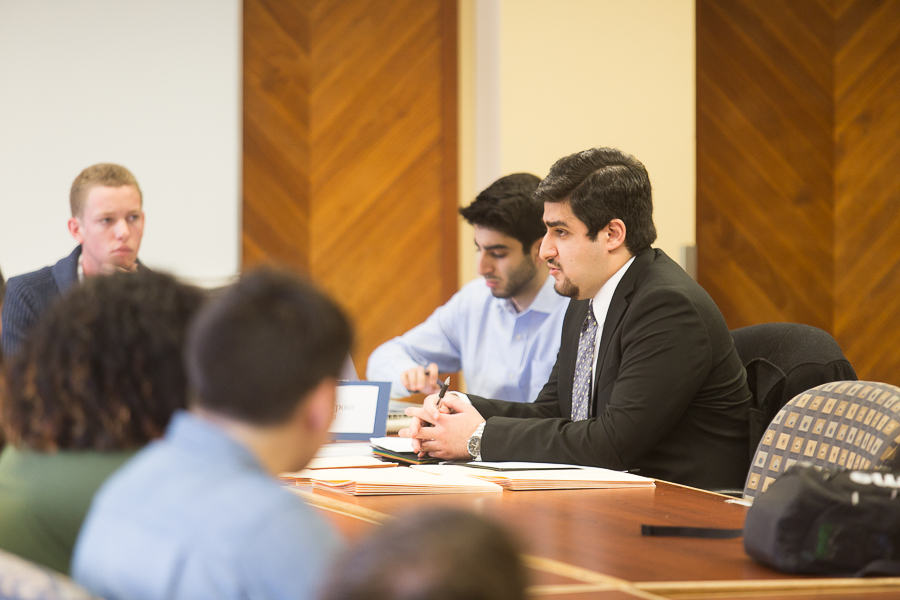
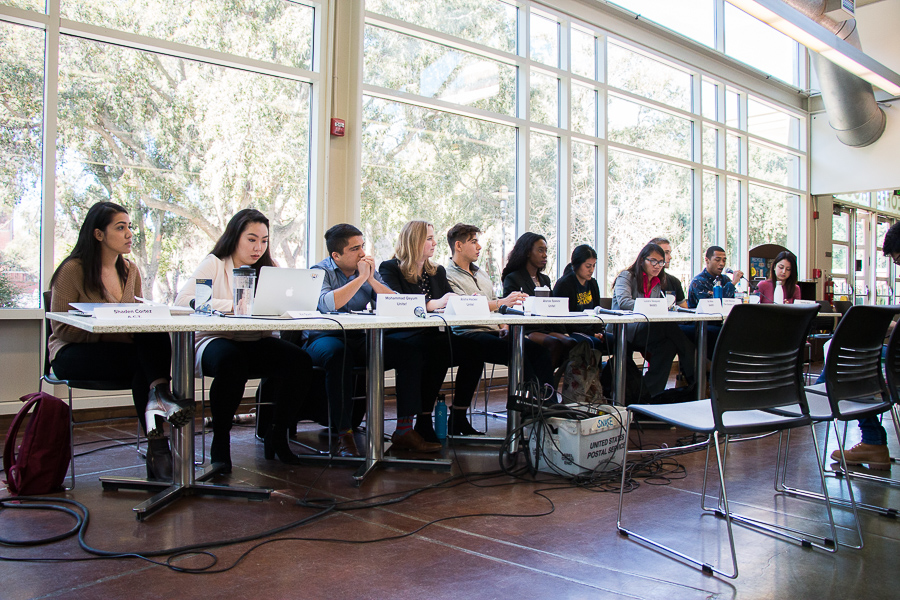
11 out of 22 ASUCD Senate candidates sat beside each other on Tuesday, Feb. 20 at the CoHo to debate their platforms and encourage students to vote in the ASUCD elections. The group sat at a lined group of tables, passing microphones between themselves and trying to grab the attention of CoHo patrons.

Five members of the Unite! slate were in attendance, accompanied by two members of the Aggie Community Transfers (ACT) slate, three members of the BASED slate and one representative from The Golden Slate. They conversed about pressing issues for UC Davis students, including the housing crisis, the “forgotten” population of transfer and veteran students, food stability, balancing ASUCD’s budget and how to get students to care about student government.

According to Alisha Hacker, a first-year political science major and Senate candidate running under the Unite! slate, ASUCD has one of the largest budgets of any associate student union in the country. In order to balance the budget, Hacker said ASUCD must focus more of their time on the units with more potential for return — primarily the Bike Barn and the CoHo. Daniella Aloni, a third-year transfer student also running on the Unite! slate, agreed that more time needs to be spent on marketing in general, not only for those units but for ASUCD as a whole.

Kim Helen Quach of the ACT slate, a third-year English major, spoke about providing support for the media units that would help promote such marketing. She said, “I realize that none of them really have any name recognition or, to be quite honest, any kind of funding.”

Luke Stocker, a second-year English major and the only representative of The Golden Slate in attendance, steered most of his comments toward Davis’ housing crisis. He mentioned how members of The Golden Slate and other activists packed Davis City Hall in hopes of showing how serious students and the Davis community take the housing crisis.

The debate lasted for three hours, with all but one student — Lucero Vasquez, a second-year undeclared major running with the BASED slate — staying for the entire duration. The debate was originally supposed to be split into two separate rounds to allow all 22 of the candidates their time.

“I think [the debate] went as best as it could under the circumstances,” Aloni said. “Some people just didn’t do their job of being here.”

Atanas Spasov, a third-year economics and mathematics double major running under the Unite! slate, was also frustrated by the lack of candidate presence. He believes that debates should be mandatory for all running candidates.

“Make it more of a spectacle,” Spasov said in reference to how to get more people involved and aware of the debates. “Making that information readily available, making it known that there’s going to be a debate in the first place, and sort of reinforcing how much ASUCD really matters in the students’ daily lives I feel like would bring out more students to watch the debate.”

During the course of the debate, students flitered in and out of the CoHo, with a few people stopping by to listen before going about their day. Mai Xiong, a fourth-year sociology and Asian American Studies double major, said she was listening in every now and then.

As a member of the Hmong Student Union, Xiong said that the topic of community representation is something that is extremely important to her, and during her time listening, she resonated with third-year sociology major and BASED candidate Jumoke Maraiyesa’s words about community identity. Maraiyesa said they feel it is important to represent marginalized groups while not giving them precedent over other groups.

“Checking in with new clubs is really needed,” Xiong noted, referring to the Hmong Student Union, which struggles with funding. She feels that it is important to have conversations about allocating funds to clubs because of the importance of representation.

Madison Farricker, a fifth-year environmental policy analysis and planning major, watched a good portion of the debate. Having already familiarized herself with many of the candidates’ profiles, Farricker said it was interesting to see how similar the goals are of the different slates, but also how there are distinct ideologies within them that prevent the conversation from feeling stale.

“This is a group who has the opportunity to improve engagement,” Farricker said. She believes that it is important for students to engage in local elections, especially those outside of the university system.


Written by: Taylor LaPoint — campus@theaggie.org

Adam Hatefi and Shreya Deshpande disqualified after missing mandatory Candidate Workshop

BRIAN LANDRY / AGGIE FILE

Executive ticket challenges alleged bias within Elections Committee, decides not to pursue $100,000 lawsuit

Adam Hatefi, a third-year political science major, and Shreya Deshpande, a third-year cognitive science major, were running mates on The Golden Slate’s executive ticket for the positions of ASUCD president and vice president ticket. Deshpande and Hatefi have been disqualified from the Winter Elections.

On Feb. 9, the pair was notified by the Elections Committee that they had been disqualified from running in the Winter Elections due to Deshpande’s absence from a mandatory Candidate Workshop held by the committee on Saturday, Feb. 3. Absence from the mandatory workshop is not considered a violation point but an immediate disqualification from the race.

“We weren’t notified that there was an investigation or that the Elections Committee was even discussing it — which, by the Bylaws, we were required to be discussing it and we weren’t before the decision was made,” Hatefi said. “We were supposed to be interviewed before the decision was made, none of those things happened.”

Hatefi and Deshpande appealed their disqualification to the Judicial Council, providing a doctor’s note from Deshpande explaining her absence from the workshop. The Elections Committee, however, believes Deshpande to be at a dance competition at the time of her doctor’s note.

Adam and Shreya were disqualified for violating ASUCD Bylaws Section 403(A)(a)(iv), attendance at the mandatory candidate workshop,” said Elections Committee Chair Naeema Kaleem said via email. “Only Adam was in attendance, and due to Shreya’s absence, their ticket was automatically disqualified as a whole. Shreya attended a dance competition in Atlanta, Georgia, when her medical note to the Elections Committee stated she would be returning home (Fremont, CA) for a reevaluation. There was no investigation needed, as this case was an automatic disqualification as specified in the Bylaws.”

Hatefi, however, disagreed.

“There is no evidence that Shreya was not at the doctor as she was supposed to be at time of the workshop,” Hatefi said. “There is no link between the dance competition at night and a workshop in the morning.”

Hatefi emailed Elections Committee Chair Naeema Kaleem a day before the appeals hearing, notifying her that he would be filing a lawsuit against her for $100,000. The grounds of the lawsuit were relating to an an alleged failure by Kaleem and the committee to follow ASUCD Bylaws during the process of the executive ticket’s disqualification.

The appeals hearing was scheduled for Tuesday, Feb 13. It was announced as a closed hearing and, in response, several students — including ASUCD Senate candidate Ben McDougall, a second-year undeclared major, and ASUCD Senator Andreas Godderis — organized outside of the hearing’s proceedings in the Moss Room of the MU calling for transparency.

“They shouldn’t have put [Hatefi] on the brink,” McDougall said.

McDougall referred to perceived biases from the Elections Committee toward other candidates — particularly candidates of the Unite! slate who have relationships with students already working within ASUCD. McDougall said the committee is trying to keep Hatefi out because he is an “outsider.”

The organized group of students outside of the appeals hearing began as a sit-in but escalated to chanting when Kaleem exited the Moss Room for a 10-minute break. A group of around 10 students demanded transparency from the Judicial Council. Current ASUCD Vice President Adilla Jamaludin approached the protestors, reprimanding them for their presence and instructed them to cease chanting and file any complaints they had.

The hearing concluded as it began, privately. A final decision to affirm their decision of disqualification was decided later that same day, citing Deshpande’s doctor’s note as an insufficient excuse of absence. Deshpande was placed in Atlanta, Ga. at the time of the meeting on Feb. 3 by the Judicial Council in their rejection of the appeal and upholding of the disqualification.  

“A doctor’s note was submitted to the Elections Committee; however, none of the dates that the Petitioners claimed Deshpande to have seen her doctor aligned with the date of the mandatory candidate workshop, and testimony given by the Petitioners affirms that Deshpande was in Atlanta, GA during the workshop,” the ruling states.

Hatefi later notified Kaleem via email that he would be dropping the $100,000 lawsuit, even though, he said, “what you did during the last couple of months was enough for us to win in court without much effort.”

Hatefi will be appealing further to the Judicial Council Oversight Committee.

In response to allegations of bias toward Unite! slate candidates, Elections Committee chair Kaleem said via email, “The Elections Committee has acted in accordance with all ASUCD governing documents. Any speculation of conflicting interests can only result from slates and their penalizations for violating the ASUCD Bylaws, which is a more accurate depiction of the slate as a whole, rather than the Elections Committee. Questions of personal bias from the Elections Committee Chair are untrue and irrelevant rumors, as no personal relationships nor friendships have affected any decisions made by the Chair or Committee.”

Judicial Council Chair Ryan Gardiner defended the council’s impartiality in their decisions, pointing out how no frustrations about alleged biases have been brought forward as an official complaint.

“Complaining about bias after a decision has been made, and never seeking to utilize the mechanisms in place to deal with alleged bias, seems to me like someone is grasping at excuses because they didn’t like a particular ruling,” Gardiner said via email.

Unite! slate executive candidates Gofman and Branson responded to claims which allege they have received biased support from the Elections Committee and Judicial Council during their campaign. In their response, they addressed the disqualification of Unite! senatorial candidate Colin Heurlin and violation points distributed to other Unite! candidates as a rebuttal of said insinuations. Heurlin was disqualified because he was not physically able to attend the mandatory workshop, as he is currently partaking in the UCDC program.

This is all to say that there cannot be any conflict of interest between the Elections Committee, the Judicial Council, and our slate,” the joint statement from Branson and Gofman said via email. “Any claim that states otherwise, we believe is being done so for personal and/or political advantage and it is extremely disheartening that these allegations are being put forth let alone that they exist at all.”


Written by: Elizabeth Mercado — campus@theaggie.org

America needs gun reform, now

CAITLYN SAMPLEY / AGGIE

Addressing the bigger issue of gun accessibility

A 19-year-old former student at Marjory Stoneman Douglas High School in Parkland, Fla., opened fire there on Feb. 14 with an AR-15-style semi-automatic rifle, killing 17 students and faculty. Just six months prior to the horrific incident, the gunman commented on YouTube, “I’m going to be a professional school shooter.”

On the afternoon of the shooting, the gunman took an Uber to school and began the massacre of his classmates an hour before being taken into custody. Aaron Feis, an assistant coach and security guard, sacrificed his own life to save those of students, dying a hero. Another student, Anthony Borges, is currently in the hospital after being shot five times through a door as he closed it to block the shooter from harming the rest of his peers.

A concerned parent of one of the student survivors explained that her daughter’s biggest fear was a school shooting and had therefore wanted to be home-schooled.

Students shouldn’t feel afraid to attend school and receive an education. It’s appalling that school shootings — and shootings in general — have become so frequent that they’re viewed as “normal.”

The attack was said to be premeditated, with the gunman’s former classmates describing him as reckless and stating that his actions were unsurprising. He was abusive to his now ex-girlfriend, threatening to kill her, and had been expelled from Douglas High for fighting with his ex-girlfriend’s new boyfriend. There were several clear warning signs that should have been more attentively addressed. In many cases, these warning signs of potential violence aren’t taken seriously until it’s too late.

Often, shootings result from multiple oversights and failures in communication. This shooter was volatile and unstable. But mental instability is not the primary driver of shootings — guns are.

The U.S. has 224 million more guns and had 72 more mass shooters than any other country from 1966 to 2012. This shocking number is undoubtedly linked to the immense number of guns that the U.S. makes readily available to its citizens. According to the same study, 31 percent of gunmen involved in shootings worldwide have been American. Guns and access to them are the cause of these shootings, which cannot be attributed to racial conflict or mental health.

The AR-15 is a military assault rifle and has been used in several other mass shootings. It has no business being in civilian hands. In order to purchase the gun, the gunman had to complete a background check and fill out paperwork that indicated he did not suffer from a mental illness. However, he had a history of disciplinary action, which was obviously not indicated in his paperwork. As a result of the recent shooting, the gun shop that sold this particular gun has been closed indefinitely.

Australia, a country with a similar culture surrounding guns, shows that nationwide gun reform works. Australia hasn’t seen a fatal mass shooting since 1996.

The Editorial Board demands that these issues not be taken lightly and that legislators start making real change by reforming laws surrounding gun control. Too many innocent lives have been taken. This could have been prevented if people had decided to take action — before it was once again too late.


Written by: The Editorial Board

Department of Theater and Dance relocates Pippin after injuries

AUTUMN WARD / COURTESY

New showing will take place at Pitzer Center on Feb. 25 only

The Department of Theater and Dance sent out an email Tuesday morning announcing that “Pippin,” expected to show in late February, would experience drastic changes to its performance after students were injured during rehearsal. The play will now only show on February 25 for 1 p.m. and 5 p.m. performances at the Ann E. Pitzer Center.

Three students were injured during rehearsal on Saturday, Feb. 10 after a trap door opened unexpectedly. Students were injured from the subsequent fall; their injuries were described in an email by music professor Alex Stalarow as “non-life threatening.” The main stage — where the show was originally to take place — was also damaged.

Those who have already purchased tickets for the show will hear from the box office. Ticket holders will either be refunded the full amount or paid the difference for their new tickets, as the show has reduced its price to $10 student price and $15 general admission. Tickets are available to the general public for this revised version of Pippin either by phone or the UC Davis Ticket Office.


Written by: Ally Overbay — arts@theaggie.org

Coyotes: A dangerous but necessary evil

REY PEREZOSO [(CC BY-SA 2.0)] / FLICKR
How human smugglers operate as portal for migrants coming to the U.S.

President Donald Trump has repeatedly stated that illegal immigrants will face more challenges coming into the United States — not just crossing the border, but also staying within its bounds. Trump’s agenda to build a massive wall and increase border patrol agents and his alteration of current immigration laws have caused migrants to rethink whether it’s even worth it to live in the U.S.

However, our President fails to realize that increased border patrol and the proposed building of the wall will not stop people from illegally crossing over to the U.S. For over 100 years, people from all over Mexico and South America have illegally crossed the border. The issue of immigration reform is a complicated one. How do you stop someone who will continuously keep trying to cross the border no matter the cost?

In short, you can’t. When someone is determined to go back to their family after deportation, better their life or escape the violence of their home country, they will stop at nothing to reach the U.S. In particular, people either try to cross the border on their own, or use a “coyote” — a human smuggler.

The distinction between smugglers and human traffickers is that the latter transport and sell people with the intent to force them into sex slavery or prostitution or other labor. A coyote is like a product for which people pay exorbitant prices to use their services. Prices vary from coyote to coyote and depend on the various clever modes of travel the migrant wishes to use, ranging from $4,000 all the way up to $15,000.

The use of a coyote is almost required because migrants making the trek on their own will certainly face many hardships, not to mention the risk of getting caught — or death.

Nevertheless, it’s inherently dangerous to use a coyote. There’s always the chance that migrants will get caught while crossing. In addition, there have been reported cases of people being abandoned or sold off to the cartels after paying off a coyote. For this reason, if someone does not know the coyote, that person runs the risk of not only losing their money, but also facing capture or an even worse fate.

Coyotes are a necessary evil; they’re an essential premium because without them migrants have little chance of completing their trek.

Coyotes do not see themselves as criminals because they’re simply helping people achieve their dreams of a better life. They merely act as a portal through which they help others get back to their families.

Legacy and reputation create a snowball effect that keeps attracting customers. When people use coyotes and are successful in crossing over, they pass that information along to their family and friends. For the most part, this is how most people hear about coyotes; they’re referred by others.

Coyotes are expensive because only they know how to navigate the various routes and secret passages used to cross the border. Yet it’s important to note that no smuggler owns a specific route. Instead, the cartels in Mexico control certain areas and charge smugglers a fee to cross into their territory.

Trump wants to build a wall in order to stop people from illegally coming into the U.S. Yet such action will not stop people from crossing over. Instead, all of Trump’s statements on immigration have increased the prices that smugglers charge.

The increased border protection doesn’t stop the issue at hand — which is people coming over. It just makes it so that smugglers have to get more ingenious with their routes and forces them to develop a relationship with the cartel to further ensure safety for their travels and customers. So, in a way, the building of the wall will only further line the pockets of cartels. There’s a positive relationship between U.S. spending on border protection and the prices that coyotes charge.

Our president should focus his attention on further fleshing out better immigration processes for people who wish to come to the U.S. Building the wall is not only a childish idea, it is also costly — roughly $18 billion. That money could be used for education and a wide variety of other social programs that lack necessary funding.

The way I see it, coyotes will continue to help people cross over the U.S. as long as physical borders exist. People will continue to illegally cross the border because a wall will not stop a person from achieving their dreams of a better life — it’s only a matter of time when they will cross and finally make that their reality.


Written by: Alejandro Lara — amlara@ucdavis.edu

Disclaimer: The views and opinions expressed by individual columnists belong to the columnists alone and do not necessarily indicate the views and opinions held by The California Aggie.

Humor: Student can’t connect with most people, had WiFi off

MICHELLE GORE / AGGIE

Evolution in progress

“Millennials can’t communicate with anyone. They’re hard to talk to,” said some person over the age of 30, probably 40. “Although with what they’ve got between their personality and their Messiah complex, I’m not sure there’s much there, anyway.”

“Older generations are so dumb. Of course we can communicate, that’s what phones are for,” a Millennial texted to the interviewer sitting right across from them.

With the proliferation of cell phones, it’s no wonder that many Millennials can’t communicate with adults who prefer face-to-face interpersonal communication.

“I was having sex with my girlfriend, and being the gentleman I am, I texted her asking for consent right before insertion,” said Sam Cuckingham, who wears sandals in the winter. “She sat there for a minute, and I realized that my WiFi was off. I turned it on and saw her face light up — when she got my message. There was a slight delay because the campus has awful Wi-Fi, especially in lower Olson.”

“I really prefer face-to-face interaction,” said Aggie “writer” Drew Hanson, whose attire is often interpreted as intimidating. “I’ll try talking to a girl while wearing a Slayer shirt and black jeans, and she’ll have this look on her face like I’m going to attack her right there in the middle of the CoHo. It’s a Slayer shirt, not Patagonia.”

Psychiatrists are often working from home now, with many young clients preferring to talk about their problems over Snapchat.

“I just take a picture of my face — see, a frowny face — and then send it to her,” a sad, depressed student said. “She replied. She said that maybe I wouldn’t feel so hollow and vacuous if I had more interests. Does vacuous mean like a vacuum? That sounds like it enforces gender roles, so I’m going to have to file a report.”

“We’re beginning to see evolution happen before our very eyes,” human rights expert and world leader in eugenics Holden A. Pare said. “Many of these Millennials are losing the ability to speak rationally and can only use their vocal cords for buzzwords or outcries of victimization. They’re quite prepared for the real world, although this could be more along the lines of natural selection.”

“I’m just glad that you only have to be at least half-competent to be miles ahead of most Millennials,” said rapper Sc00by Dr00. “I huffed so much Elmer’s Glue you’d think I’d be in a coma, but here I am, a goddamn Millennial genius. If you turn off your WiFi, you’ll be forced to interact face-to-face, where people are real, have feelings and deserve respect. That’s just too much for most people to handle.”


Written by: Drew Hanson — andhanson@ucdavis.edu

(This article is humor and/or satire, and its content is purely fictional. The story and the names of “sources” are fictionalized.)

Krustaceans for Kids Crab Feed held on March 24

0
SHEREEN LEE / AGGIE

Yolo Crisis Nursery holds annual fundraiser to benefit families in need

The Yolo Crisis Nursery is holding its annual “Krustaceans for Kids” Crab Feed on March 24 at 6 p.m. at the Woodland Community and Senior Center. The annual crab feed is the largest fundraiser the nursery holds, and members of the Friends of the Yolo Crisis Nursery, the Nursery’s volunteer group, have been working to make this year’s crab feed successful and entertaining for all who choose to attend.

“The money will go towards helping families in need, during times of crisis,” said Heather Sleuter, the executive director of the Yolo Crisis Nursery. “That’s what we do here, we focus on preserving families, providing a safe, nurturing environment for kids to grow and parents to succeed. All our services are for families and childcare — for the children and the parents.”

The Yolo Crisis Nursery is a nonprofit organization that offers aid and services to children up to the age of five and families going through a crisis. The main goal of the Nursery is to provide a safe environment for children in need and help support parents during times of crisis while they work to preserve their families.

“The Crab Feed started because […] we needed to create a fundraiser to earn some money to keep the nursery going, even to just keep the lights on,” said Nancy Storm, a board member for the Yolo Crisis Nursery. “Now this is our sixth year […] It is really an incredibly fun event with great energy and enthusiasm, and not only for the cause but for the social aspect, the festivities.”

The Crab Feed’s menu features all-you-can-eat crab with butter and cocktail sauce; pasta with red sauce, salad and bread as well as a no-host bar serving beer and wine to guests. A dessert auction will follow, and after their meal guests will be able to bid on sweets and confections. There will also be a silent auction and a raffle with various prizes to bid on and win, all to raise money for the nursery.

“Fresh crab is just part of the deal here,” said John Denton, a board member for the Yolo Crisis Nursery. “In addition to good food and drink, it’s a great place to see old friends and make new ones, while at the same time supporting the work of Yolo Crisis Nursery. My wife and I wouldn’t miss it for anything.”

Tickets for the Crab Feed are being sold on the Nursery’s website for $50, but additional donations are welcome and encouraged. The event is typically attended by approximately 520 donors and benefactors, with tickets selling out every year. Storm also stated that the Crisis Nursery was reaching out to student organizations for volunteers to set up, serve and clean for the event. Students interested in volunteering can contact Storm for more information.


Written by: Ahash Francis — city@theaggie.org

Police Logs

0
NICKI PADAR / AGGIE

Congregating dog owners

Jan. 29

“Reporting party woke up from sleeping and called 911 on her cell phone — reporting party asked for an officer to investigate everywhere after hearing strange noises.”

“Children were playing in the puzzle section in library and found various medication which they mistook for candy and ingested it. Children and parents currently in ER. ER requested officer for report.”


Jan. 31

“Group of 5 dog owners usually congregate daily around 1600 hours in the park and let their dogs off leash.”


Feb. 1

“2 dogs off leash attacked reporting party’s bunny, reporting party yelled at the dog owner and the dog owner yelled at reporting party. Reporting party upset that the dog owner yelled at her and got in her face.”

“Male subject was in backyard, reporting party’s dog was barking, and when they went outside they heard a male voice say ‘Oh hello,’ requested area check.”


Feb. 2

“Reporting party requesting to speak with traffic officer regarding bicycle helmet laws.”

“Unitrans into a parked vehicle, non injury — accident notification note left on their vehicle.”

“Unknown male subject on reporting party’s porch — appears to be dancing.”

Last Week In Senate

HANNAH LEE / AGGIE

Vice President Adilla Jamaludin criticizes state of Senate

On Thursday, Feb. 1, 2018 at 6:12 p.m., the ASUCD Senate meeting was called to order by Vice President Adilla Jamaludin. Senator Jesse Kullar was absent.

Guest speaker Sofia Molodanof, a fourth-year English major, gave a presentation on about a proposed Non-Instructional Days Policy, which would provide a day without class instruction or campus events before the start of finals to give students time to focus on well-being and practice self-care. This would entail two non-instructional days per quarter between the end of instruction and the start of final exams. It would not include weekends.

Molodanof stated that between the fall of 2012 and the fall of 2016 UC Davis had one non-instructional day each for Fall and Spring Quarters. However, beginning in the fall of 2016, changes were made due to student advocacy to end Saturday exams. This shortened Winter and Spring Quarters from 50 days to 48 days and rescheduled the required 146 days of instructions during the regular school year to avoid finals on Saturday to having finals on Friday.

Findings of these changes presented by Molodanof showed 83.6 percent of UC Davis students favored two non-instructional days per quarter prior to the beginning of finals. 44 percent reported academic performance was affected by stress in the past 12 months, which was 10.2 percent higher than the national average. 62.5 percent reported academics was traumatic/very difficult to manage during the past 12 months, which was 13 percent higher than the national average.

A proposal was made to set mental health services at UC Davis as a high priority. The Senate offered support for non-instructional days and encouraged the promotion of non-instructional days through petition signatures.

The Administrative Advisory Committee confirmed Gabriel Guerin, a fourth-year political science major, as AAC commissioner. Additionally, Manasa Gogineni, a first-year international relations major, was confirmed as Internal Affairs Commission commissioner.

Next, discussion over Senate Bill #26, an ASUCD bill to create a monetary reserve for the ASUCD Technology Reserve, commenced. The IAC and Business and Finance Commission approved this proposal unanimously. SB #26 passed the Senate without objection.

Next on the agenda was Senate Bill #31, an ASUCD bill to correct the structure and formatting of the Legislative Process section of the bylaws and to create transparency for ASUCD legislation that mentions members of the UC Davis community. After a lengthy discussion on the language and process of the bill ensued, the bill passed the Senate with amendments.

This was followed by work on Senate Bill #32, which is emergency legislation due to the lack of a BNF chairperson. SB #32 proposed the allocation of $980 from Senate Reserves to ASUCD Elections Committee to issue platform flyers during the 2018 Winter Quarter Elections. Items discussed included the number of flyers to print. The discussion also included the amount of current election reserves and if there was a sufficient amount to cover the election. After discussion, SB #32 was passed with amendments.

The Senate had a break at 8:12 p.m. Roll call was taken for new legislation and the status of previously passed legislation was signed.

Public discussion followed. Controller Jin Zhang spoke about the effectiveness of collaboration within the Senate.

“This is a privilege,” Zhang said. “It’s amazing what we can do in a week. If you’re not exhausted at the end of the week because of this position you’re not doing your job right. There needs to be more of this.”

During public discussion, commission chairs discussed senator attendance at commission meetings. IAC Chair Jacob Ganz said five out of 12 senators have not attended commission meetings this quarter. Jamaludin criticized the state of the Senate.

“It makes my blood boil to see this state of the table right now,” Jamaludin said. “I’m disappointed and upset. I’m leaving this table and I don’t know if you’re up for the job. I don’t want to yell but I feel like I have to. If the bills that come in every week are from the exec team that’s disappointing because that’s not an association that should be run by just the exec team. It’s run the by the senators and all the other units involved. Can you blame people when they say we don’t do anything? That’s the state of this table right now. Do me a favor and prove me wrong right now in six weeks.”


Written by: George Liao — campus@theaggie.org


Creating the perfect peck of peppers

UC DAVIS / COURTESY

UC Davis students use plant breeding methods to improve characteristics of vegetables

Imagine a pepper that has the heat of a jalapeño, but the depth and size of a bell pepper. That combination would make a perfect pepper for poppers, chile relleno and other tasty fillings. While this type of cultivar, a variety produced by selective breeding, already exists, some UC Davis students are focused on creating a jalapeño/bell pepper variety that is more sustainable, as well as teaching students how to take on leadership roles.

Jorge Berny, a postdoctoral researcher in the plant sciences department, has been researching peppers since he was an undergraduate. Upon coming to Davis for his Ph.D. in 2012, Berny was introduced to the Student Farm, which is known for its effective sustainability practices. Originally, it was just Berny and a handful of students using space at the Student Farm for K-12 education and the peppers project.

“There were some [jalapeños] that they advertised were big jalapeños, and they were not [actually] big or productive,” Berny said. “We thought, maybe we could do better.”

Saarah Kuzay, now a second-year Ph.D. student, is one of the first people who worked with Berny. She is currently one of the “mentor” figures of the peppers project and likes how the model of recruiting and teaching students is also sustainable.

“A student would join the project, they would get taught by the senior, the mentee would become the mentor and recruit their own student,” Kuzay said. “It was this neat process of teaching a craft and passing it onto the next person. They liked that model enough that when Charlie Brummer, the current leader of the Plant Breeding Center, joined, he said we should really do this with more crops. So he wrote this grant proposal to the USDA, and we got a $1 million grant, as opposed to a $10,000 or less a year.”

Berny said that plant breeding is similar to a permit test. The rules could be learned in a book, but that couldn’t replace hands-on learning. Working with undergraduates also gave him room to not just teach, but grow from their observations.

“Sometimes, you just do stuff because that’s how you’ve been doing that for some time,” Berny said. “There’s always room for improvement.”

The team originally had little space for planting and was lucky to have up to 50 plants for the first few years. However, with the backing of the Plant Breeding Center and the grant, the project was able to support paying more students and provide space to put out more plant trials.

Charlie Brummer, along with then-Student Farm director Mark Van Horn, thought the project had a unique way of letting undergraduates experience hands-on learning with plant breeding and genetics as well as how to become leaders. They felt the precedent of the peppers project could be applied to other vegetables, which became the tomatoes project and the lima beans project.

“I thought there was a possibility that we could develop some breeding programs on the small scale that would give students actual in-field experience,” Brummer said. “Students could run the project, maybe get some idea on how things work that would then be useful for them later in the job market.”

The main focus of the peppers project is to make a jalapeño with a larger cavity to fit more ingredients like cheese, meat and other vegetables. Kuzay and others on the project produced a short video in 2016 on what plant breeding is, how their research was going and highlights of those who contributed to the peppers project. Kuzay believes the project should be completed within 2 to 3 years, barring any major disasters.

However, with each generation, other plant trials are also tested, allowing research to effectively “restart” a possible failure or even start new projects, like working with orange jalapeños or improving the resistance of bell peppers. Brumer said that, at minimum, it takes 7 to 8 years for a variety to be marketable, since it needs to be durable in the long-term and account for various environmental factors.

“As you get closer to getting something good, you want to trial that around,” Brummer said. “Make sure it isn’t, for some reason, just pretty well adapted to the student farm in Davis, but doesn’t do particularly well when you put it on different soil types or in different farms that have different managements.”

A concern that Kuzay, Brummer and Berny share is the public’s opinion on genetics. Plants genetics, and genetics in general, has been a difficult topic for scientists to talk about to the public. It often gets linked to biotechnology, which some of the public does not see in a positive light. Kuzay believes that for some people, the problem lies in the abstractness of a project and how detached the research seems from a person’s daily life.

“I’ve maintained for a long time that [this type of project] starts with an idea and ends with a product, just like how we do inventing,” Kuzay said. “We invent new cars, we invent new things, and we also invent new plants. That’s kind of what we’re doing. It’s a creative process that people can benefit from. They can taste it, eat it, see it.”

She thinks a good way to start re-introducing people to plant genetics is to make it appear non-threatening, accessible and personal.

“It’s not something abstract that’s high and lofty,” Kuzay said. “It’s something that anybody could do.”


Written by: Jack Carrillo Concordia — science@theaggie.org


UC Davis’ unique method to treat humans, pets

ZOË REINHARDT / AGGIE

Veterinary Institute for Regenerative Cures, School of Medicine collaborate to find treatments

By using what they learn from treating companion animals like cats and dogs, the  Veterinary Institute for Regenerative Cures can help the School of Medicine find treatments for diseases like cancer and diabetes that affect humans and animals alike.

The science/medicine industry relies primarily on lab-based studies and then on studies in [mice, rats and rabbits] to test therapies prior to starting human clinical trials,” said Dr. Dori Borjesson, the director of the VIRC. “The problem with these models is they don’t replicate [diseases] that are influenced by genetics, environment, et cetera. The goal of using real diseases in companion animals first is that it can help sort through the drugs with the most promise as dogs, cats, and horses are outbred, like people, and get natural diseases, like people. So, you can run a small trial in naturally-occurring diabetes in dogs, test your candidate therapy and then go into your human trial with more confidence and an increased likelihood of success.”

The VIRC conducts clinical trials in a way that is similar to how clinical trials are conducted with humans. Rather than inducing the disease, the doctors try to treat an animal that already has the disease. This is fundamentally different from conducting a clinical trial on experimental animals where the animals are induced with the disease and then hopefully cured.

Dr. Boaz Arzi is currently conducting a clinical trial for a potential treatment for feline chronic gingivostomatitis and is applying what he has learned to a potential treatment for oral lichen planus in humans. He makes it very clear that while there are potential benefits for humans, the main goal is to find a treatment for the pets.

“When we start the clinical trial, we don’t do it because it’s good for humans,” said Arzi. We do it because it’s good for pets. And [if we’re successful…] we start looking for treatments in humans.”

Humans and companion animals share the same cells and similar genetics, so the cause of the disease and the response toward the disease are often alike. One of the main areas of research is a treatment for cancer.

Regarding cancer, much has been learned from rodent models. Recent breakthroughs in the field of cancer immunotherapy have further generated interest in pet cats and dogs as models because they have competent immune systems,” said Dr. Robert Rebhun, an associate professor and associate researcher in Surgical & Radiological Science at the Center for Companion Animal Health. “What is really exciting is that these studies have the potential to benefit not only humans, but also our beloved pets.”


Written by: Kriti Varghese — science@theaggie.org

Dance for a Cause takes center stage for Camp Kesem

0
RAUL MORALES / AGGIE

Released Contemporary Dance Company hosts fourth annual showcase in support of nationwide organization

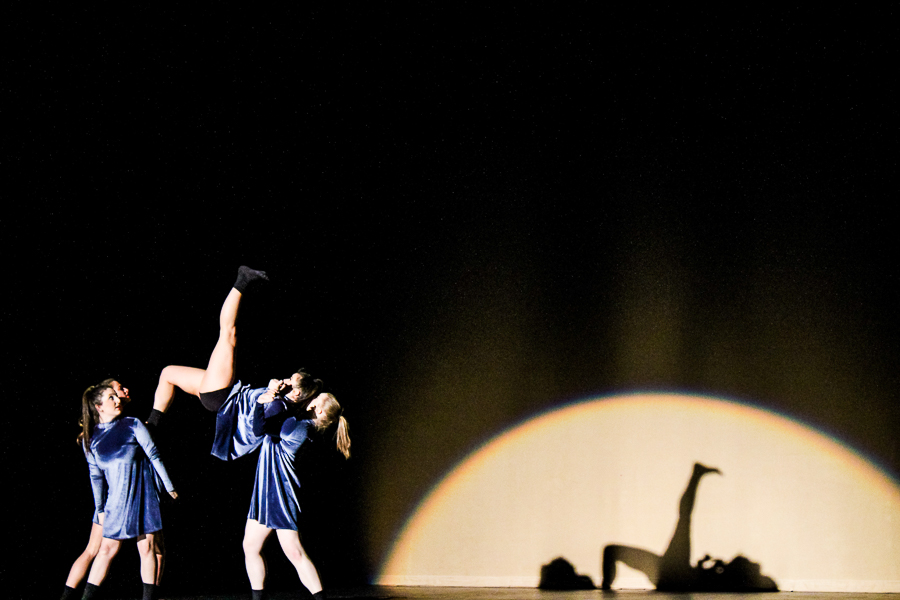
On Saturday, Feb. 10, the fourth annual Dance for a Cause showcase stole the spotlight at the Richard Brunelle Performance Hall, just north of UC Davis’ campus. The yearly fundraiser, put on by UC Davis’s Released Contemporary Dance Company, features 10 of the university’s dance groups as well as two special guest performances. The first and second-place winners, chosen by a panel of four judges, get $200 and $100 toward a charity of their choice.

Dance for a Cause supports and raises money for Camp Kesem, an organization that utilizes college students as counselors to put on free summer camps for children whose parents have or have had cancer. Camp Kesem not only allows these children to participate in a unique experience without the stress of financial costs, but it also enables them to have the opportunity to be a part of a community of thousands of kids going through the same situations in their own families. Founded at Stanford University in 2000, Camp Kesem has grown to reach over 100 different universities in 40 states across the United States, and over 100 UC Davis students are involved in the program as camp counselors.

This year, Dance for a Cause was judged by two Camp Kesem campers, a counselor and a former member of RCDC.

Junior director of RCDC Hannah Contois expressed why supporting Camp Kesem is so special to her.

“Dance for a Cause gives collegiate dancers the opportunity to perform for a cause greater than just themselves,” Contois said. “We are helping deserving children attend a life-changing summer camp for free, all while doing an activity that we are passionate about. There is nothing more rewarding than looking out into an audience of our friends and peers and knowing that we are making a difference in the lives of so many children and families.”

On top of supporting an organization that’s very active in UC Davis’ community, Dance for a Cause allows many of the university’s dance organizations to showcase the routines they have been diligently working on all year. The performances feature a diverse range of styles of dance, spanning from hip hop to ballet to hula.

In addition to performing in support of Camp Kesem, the participating dance teams put on their own shows throughout the course of the year. Fourth-year biological sciences major Brooke Neville shared warm remarks about her group, Na Keiki ‘O Hawai’i — UC Davis’ Polynesian club that specializes in hula and Tahitian dance.

“My favorite thing about this organization are the people involved and the sense of family — ohana — we have,” Neville said. “I always look forward to seeing everyone at practices and socials.”

Na Keiki ‘O Hawai’i’s dance chair, Misa Vasquez, a fourth-year human development major, also expressed her fondness for the program.

“For me, hula is therapeutic and a creative outlet, so I appreciate having a break from school, studying and internships,” Vasquez said. “I also love the people in the club. Everyone is unique and offers something different to the club, but one thing we all have in common is our love for dance. Giving back to the community is important to me, and it’s awesome that I can do what I love for a great cause.”

The event’s host group, RCDC, focuses mainly on perfecting the technical elements of contemporary dance and features dancers of many different stylistic backgrounds, including jazz and ballet. The group strives to bring the culture and beauty of contemporary dance to the Davis community. Fourth-year neurobiology, physiology, and behavior major and the company’s director Marisa Pedroso reflected on her favorite element of RCDC.

“I love the bond each and every team member has with one another,” Pedroso said. “I truly feel like we are all there for each other through different highs and lows, and it is such a cool thing to be a part of. We all share such a deep passion for dance, and I love that we all get to move together, laugh together, and just be together.”

Contois also shared her fond sentiments about RCDC.

“Without a doubt, my favorite thing about being in the company is having the opportunity to be around such a strong group of women,” Contois said. “All of our members are not only dedicated to the art of dancing, but also their academics, jobs, volunteer work, and other clubs […] they are a part of. Seeing how determined the women in our organization are encourages me to take on responsibility and work harder in all areas of my life.”

This year, Dance for a Cause raised over $3,000 for Camp Kesem, and Davis Ballet Company was given the first-place nod at the end of the night. Pedroso shared some final remarks about performing for a deserving cause.

“I just really love getting to combine my passion for dance with my passion for helping others, and I think that all of the amazing girls on my company feel the same,” Pedroso said. “We get to do our favorite thing in the world while raising money for a good cause; there really is no other feeling like it.”


Written by: Kennedy Walker — sports@theaggie.org


Davis Faculty Association, others create public space for higher education

0
DIANA LI / AGGIE

Tackling issues affecting California

On Feb. 2, the Davis Faculty Association hosted a public forum on the future of higher education in California. The program was also sponsored by the departments of Religious Studies, Sociology and Cinema and Digital Media among other groups. Cinema and Digital Media professor Jesse Drew, a member of the faculty association, hosted the event. A closer look at the goals of the faculty association reveal the stakes in the future of higher education, other than the obvious ones. The Davis Faculty Association is tied to faculty associations within the UCs and independently fights for issues that affect faculty, students and staff.

“It’s independent because what we’re looking after is not necessarily the same as the administration,” Drew said. “We supposedly have shared governance through the academic senate but a lot of people feel like that governance has been eroded.”

The association exercises its independence by lobbying at the state capital and creating a UC-wide coalitional structure.

“We jointly lobby with students,” Drew said. “We will typically go in with anyone who’s interested in higher education whether it’s public, students, staff.”

One of those inter-UC connections is professor Michael Burawoy of UC Berkeley. Burawoy is a professor of sociology and the chair of the faculty association at Berkeley. His connection with the goals of reforming higher education are inextricably connected with his research in sociology.

“I could never have given this talk had I not been a sociologist,” Burawoy said.

His initial sociological inquiries give way to reconsidering the workings of the University.

“Why is it that people comply?” Burawoy said. “It’s an interesting question to ask to the university. How is it we all consent to problematic features of the university?”

One of these problematic features, according to Burawoy, is not just diverse access to the public university system in California, but the issue of inclusion on arrival.

“The UC does extremely well in terms of access, but what we don’t talk enough about is inclusion,” Burawoy said. “What does it mean to bring people from very different backgrounds together into the same classroom. What does it mean to actually have people who are sometimes almost barely literate alongside people with enormous cultural capital. What does it mean to have students that are supporting their families, are working 30, 40 hours a week sometimes alongside those whose parents can afford to fund their education and their existence.”

The questions posed by Burawoy complement the financial issues facing California’s public education system. He said that the share of the state budget received by the higher education system in California has fallen from 8 percent to 2.5 percent. The financial crisis facing the system, one of four crises he identifies including governmental, identity and legitimation, has lead the UC system to involve itself in private investment. This investment does not give way to a more accessible or higher quality education, but rather transforms it from Burawoy’s conception of a public university in a capitalist system to a capitalist university.

The capitalist university in California may soon find itself producing a shortage of citizens with bachelor’s degrees to join the economy. The solution to this problem may be one proposed by Amy Hines-Shaikh, higher education director of the University Professional and Technical Employees and executive director of Reclaim CA Higher Education Coalition. Reclaim CA Higher Education has developed the $48 Fix, a return to the principles set forth by the 1960 Master Plan for higher education in California.

The Master Plan, which hasn’t been revised since 1960 despite a vastly different California population of students, champions accessibility, affordability and quality. According to the Master Plan, the top 12.5 percent of California high schoolers would have a sure place at a UC, the top 33 percent at a CSU and all would have access to a community college. The cost of tuition would be free and the quality of education would be equivalent among the segments. In order to return to this, Hines-Shaikh proposes a 12.7 percent income tax surcharge — on average of $48 per family to make higher education free.

We believe that if you can gain access to the three higher educational systems, then that should be free for your personal enrichment and for the enrichment of all of society because we all benefit when folks have the means and the ability to move forward,” Hines-Shaikh said.

Hines-Shaikh is shocked by the reticence of the state to fund education. Reclaim CA Higher Education holds multiple lobby days each year at the state capital. The next large event is scheduled for Mar. 14.

“People have understood that education is a fundamental human right and that right does not stop at 12th grade,” Hines-Shaikh said. “That fundamental human right does not have an age [or] have an income, we’ve known that for a bit now.”

Delaine Eastin, the former superintendent of California Public Instruction and current candidate for Governor of California, supports the $48 Fix. She believes in free, quality education from kindergarten through higher education and the reinvestment in these resources which have since been poured into incarceration.

“Budgets are statements of values,” Eastin said. “I’m horrified to tell you that this afternoon we are 41st in per people spending and number one in prisoner expenditures. If budgets are statements of values, what does that tell you? I have not met a single person in California that thinks that’s their values.”

She invokes the need for new higher education campuses that are accessible to rural Californians, not new prisons, 23 of which she said have been built since 1985.

“The best crime prevention program in the state is education,” Eastin said.

As an alumna of UC Davis, Eastin can speak to the issues directly facing Aggies, but as the former superintendent of public instruction she has insight on public education at every level.

“We have to reinvest in higher education in this state, K12 and preschool, all of it,” Eastin said. “Since 2000 we’ve taken almost 39 percent out of higher education.”

Eastin, Hines-Shaikh, Burawoy and Drew, while approaching the issue from disparate professional locations, locate the issues facing higher education in the absence of state funding and call for action.


Written by: Stella Sappington — features@theaggie.org


Formerly incarcerated students publish zine to spread stories

TAYLOR LAPOINT / AGGIE

Beyond the Statistics joins formerly incarcerated, system-impacted individuals

Members of the student group Beyond the Statistics as well as friends and allies joined in Hart Hall on Thursday, Jan. 31 to hear from contributors to the club’s newly-released zine. Attendees also met members and discussed ways to help systematically combat stigmas that surround formerly-incarcerated individuals.

Beyond the Statistics is a student organization on campus for formerly-incarcerated and system-impacted students who have found solidarity in one another and a platform to tell their stories. Organized by group leaders, speakers from across the region joined to release the club’s second zine and perform spoken word to break down social barriers dividing students.

Zines — short for “magazine” — have largely served as a platform for counterculture and social justice organizations to spread self-published work, including art, poems, personal narratives and news.

The organization is just over a year old and was acknowledged as an official campus organization this year.

Co-founders Daniel Mendoza, a fourth-year sociology major and Tina Curiel-Allen, a fourth-year Chicano/a studies major, met after being paired together for a project in class and discovered that they both are formerly-incarcerated students. From there, Beyond the Statistics was born.

Mendoza discussed his time at UC Davis compared to his experience being incarcerated.

“I went from one institution that was meant to keep me in to one that’s meant to keep me out,” Mendoza said. “Transferring was very hard, trying to navigate this big system. I found myself in tough situations my first year, at risk of dropping out and doing dumb stuff.”

Along with building a sense of community and understanding among members, Beyond the Statistics has collaborated with individuals and organizations across the state faced with similar systematic oppression and exclusion from institutions like universities.

Along with contributors to the zine from fellow students at UC Davis, individuals from across the region made the commute to stand with fellow formerly-incarcerated individuals.

Andrew Winn, the director of Project Rebound at Sacramento State University, spoke about Project Rebound’s mission before sharing a personal narrative of his time behind bars. As a formerly-incarcerated individual, Winn is uniquely qualified to act as a counselor and guide for students working to overcome their experiences in an educational setting.

“Part of what we do is provide round-the-clock services to students on campus and students that were formerly incarcerated,” Winn said. “I myself am formerly-incarcerated as of two prison terms, and I have been to every county jail in this region.”

Mendoza spoke about his initial attempts to try to find people he could confide in and relate to when he began his academic career at UC Davis.

“There are good people out here with good intentions,” Mendoza said. “But every time I tried to talk to someone, I felt like I had to lie about who I was and change my story so they would feel comfortable.”

Beyond representing formerly-incarcerated students, Beyond the Statistics also works to acknowledge those who are system-impacted and have been marginalized in society.

Mendoza spoke about how difficult it is for students without a base of support to navigate life at university.

“This system is not built to keep us on this path,” said Mendoza. “It’s easy to fall.”

Members said they hope to reach a broader audience with their recently-published zine.  Beyond the Statistics’ zine is filled with poems, personal statements and interviews from members and allies of the movement.

Curiel-Allen, who first and foremost identifies herself as a poet, spoke more about what she hoped to deliver with the organization’s second zine.

“This is what the zine was for us, to strategically get out our narratives,” Curiel-Allen said. “Some of our goals are obviously advocacy for formerly incarcerated students on campus and system-impacted and visibility [and] eventually to find resources. Also, to have a say in the narrative.”

At the zine release party, Curiel-Allen told attendees about a seminar that Beyond the Statistics will be facilitating in the spring about education as a freedom to further combat stigmas and break down divisions among students.

Mendoza discussed being in classes at UC Davis and hearing professors speak about criminology and crime rates from an imperial and detached perspective and realizing they were discussing individuals like himself.

“I was never given the opportunity to show what those numbers really look like,” Mendoza said.

In Spring Quarter, members of Beyond the Statistics will have the opportunity to expand their reach with a seminar class about education as a freedom.


Written by: Ally Russell — campus@theaggie.org