59.5 F
Davis

Davis, California

Sunday, December 21, 2025
Home Blog Page 557

Biggest snubs throughout Oscar history

ALLYSON KO / AGGIE

Noteworthy and relevant films cheated of Oscar nominations

Content Warning: The links in this article contain profanity and graphic violence which some readers may find disturbing.


Each year produces too many films to be properly recognized by the various award ceremonies. After 89 Oscar ceremonies, such unfortunate discredit has only built, leaving some incredible films absent in the Dolby Theatre. Here are two critically acclaimed films — with notable longevity — that were left without even a nomination in previous Oscar ceremonies.


Best Original Screenplay (1992):


Snubbed film: “Reservoir Dogs”

Winner: “The Crying Game”


Today, Tarantino’s writing is often marked for its quality, earning an Oscar for Best Original Screenplay for both “Pulp Fiction” and “Django Unchained,” yet in 1992 the name Tarantino wasn’t as common. “Reservoir Dogs,” Tarantino’s break-out film, doesn’t lack his signature wit or long-tongued conversations when compared to his newer films. The largest notable difference is the pacing: action is much quicker to the draw in “Reservoir Dogs” when compared to newer films like “Inglorious Basterds.” Yet that isn’t necessarily a bad thing.

What Tarantino does well in “Reservoir Dogs,” and what deserved him at least a nomination, is characterization. Mr. Orange, played by Tim Roth, is a pivotal character in the overarching plot of the film, yet takes up a noticeable portion of runtime, a few minutes, telling his fabricated commode story. The story itself isn’t complicated. Following Orange’s almost explosive encounter with police in a bathroom, the story isn’t added to influence the plot as most aspects of a script are, but instead highlights a key aspect of Orange’s character: his patience.

How Orange keeps a steady head for so long in an unfortunate situation foreshadows his ability to bide time until the desired moment is ripe. The foreshadowed patience truly pays off at the end of the film, when Orange’s true goal is revealed, showing the value in a seemingly usual previous scene. Orange’s story is reflective of Tarantino’s masterful characterization, the ability to highlight unique sides to multifaceted characters. Such characterization provides greater resonance with the audience at the film’s climax; it is exactly what Tarantino does well and is exactly why he should have been nominated.


Best Actor in a Leading Role (1980):


Snubbed actor: Jack Nicholson, “The Shining”

Winner: Robert De Niro, “Raging Bull”


Horror films have a snubbed history at the Oscars, and Stanley Kubrick’s “The Shining” unfortunately finds itself in that bin. “The Shining” is considered one of the finest horror movies to date, following the main character Jack Torrance’s corruption of sanity and the ensuing mayhem in an isolated, snowed-in hotel. While, to Stephen King’s dismay, the film differs a lot from the book, Nicholson’s performance is nothing short of outstanding.

Every character needs to have a “want,” something they will pursue and either fail or achieve to acquire. Torrance’s “want” in “The Shining” is to remove his family from The Overlook Hotel through means of axe murder. How he attempts to achieve such a “want” is where Nicholson shines. A particular scene to watch, exhibiting Nicholson’s skill, is toward the ending of the film — what could be called the “light of my life” scene. In this scene, Nicholson hopes to deceive Shelley Duvall’s character, Wendy Torrance. He starts out as speculative, then throws a smile on his face until the scene climaxes with his anger, followed by him slipping down a staircase, and ultimately into sadness. The notable side to the scene is Nicholson’s ability to seamlessly switch between emotions, a testimony to his acting chops and a display impressive enough to warrant an Oscar nomination.


Written by: Nicolas Rago — arts@theaggie.org

New affordable housing and emergency service center proposed

ALLYSON KO / AGGIE

Paul’s Place to accommodate displaced individuals in place of H Street transitional housing

A $5 million project was proposed at a forum addressing homelessness on Jan. 21. Held at the Unitarian Universalist Church of Davis, the forum was centered around providing affordable care and shelter to self-identifying homeless individuals across Yolo County.

The city of Davis has anywhere from 120 to over 150 homeless living in shelters and on streets each night. Organizations such as Davis Community Meals and Housing provide transitional residence up to a week for each individual, while the Interfaith Rotating Winter Shelter provides emergency housing seasonally. Though many programs address the need for shelter, around 39 percent of homeless individuals sleep outside.

Paul’s Place would be a three-story development on H Street, replacing the established 12-bed shelter. It would offer services such as showers, first aid, laundry, emergency and longer-term residence. Martha Teeter, a professor at the UC Davis Medical Center and the president of Davis Opportunity Village, emphasized that small details, such as an orange “H” archway that would symbolize home at the entrance to the proposed building, make all the difference.

“A sense of home gives a sense of safety and well-being,” Teeter said.

Construction has been set tentitavely for early 2019, but Maria Ogrydziak, the architect behind Paul’s Place, commented that this was an ambitious estimate. With construction costs at $4.5 to $5 million, DOV has enlisted several organizations around Davis to help fundraise.

“We need people with a heart and the resources,” Teeter said.

For Bill Pride, the executive director of Davis Community Meals and Housing, the struggle lies in getting everyone into safe beds at night.

“The lack of affordable housing is a huge impediment everywhere in this field,” Pride said. “Most people become homeless because of job loss or their rent went up, and those people utilize these programs and temporary housing.”

The city’s efforts to accommodate lower-income residents include maintaining 1,200 units of permanently affordable housing as well as recently approving Creekside Court, a 73-unit building with single-room apartments. Affordable housing is available to individuals who make 30 percent or less of the median income.

“We want to make sure we have the resources going forward,” said Lucas Frerichs, a Davis city councilmember.

In the meantime, social services have been boosted, according to Mayor Robb Davis, who recently endorsed Police Service Specialist Supervisor Ryan Collins. Police have been receiving training in conflict resolution and community outreach.

“It’s a long engagement process with these folks,” Pride said. “Get them to trust you, and maybe then you can get them some help.”


Written by: Genevieve Murphy-Skilling — city@theaggie.org

City of Davis hosts cannabis workshop

JEREMY DANG / AGGIE

Cannabis workshop at Senior Center to inform public about policy, health

The Senior Citizens Commision of the city of Davis requested an educational workshop on cannabis, which is to be held on Thursday, Feb. 8 at the Davis Senior Center. The workshop aims to spread knowledge about both the policy logistics and the health benefits of the newly legalized drug.

“One of the commissioners brought up at a meeting that it would be important to share information about cannabis to the general public and, specifically, to help seniors learn more about it from the policy perspective and the health care perspective,” said Maria Lucchesi, the community services supervisor at the Davis Senior Center. “We want people to know the dos and don’ts, and we wanted to have a physician on-hand share information so that folks can then talk to their doctor.”

The workshop will include two speakers from different fields in order to address a variety of issues or concerns regarding cannabis. Ron Trn, a Davis police officer, is covering city policies and regulations that are being implemented while Dr. Karen Mo, a physician from UC Davis, is discussing medicinal aspects and benefits.

“We’re just trying to get information out to people that may have questions regarding cannabis laws in city regulation and be upfront and answer as many questions as we can,” Trn said. “The city council has allowed up to four cannabis dispensaries in the city, along with manufacturers and delivery services. They also have rules and regulations for places in the city where people can grow.”

Trn also suggested that most of Davis is currently ill-informed of these rules and regulations and said he hopes that an increased dialogue will promote safety and prevent mishaps.

“I think this will at least build a dialogue with as many groups as we can so if they do have any questions, concerns or issues they can feel comfortable calling us and reporting that stuff and we can work together in taking care of any issues that come up,” Trn said. “Obviously this is a new thing for everyone in the state, so it’s hard to say what’s going to come of it. We’re hoping for positive interactions and positive outcomes, but I’m sure there’s going to be a few glitches as it goes on.”

Many UC Davis students, including Rikky Patel, a third-year managerial economics major, also share this sentiment of wanting to increase dialogue in order to encourage safety and proper usage.

“I know a lot of people who don’t know much about the exact details of the law regarding cannabis,” Patel said. “So hopefully people will actually use these attempts of informing the public to learn more and know how to be safe and legal. I think it’s great that both a police officer and a physician are going to be there — also to make sure they cover everything.”

The public is encouraged to do research and ask questions at the workshop so that all issues and concerns can be addressed and clarified.


Written by: Hadya Amin — city@theaggie.org


Breaking the political ice

CAITLYN SAMPLEY / AGGIE

Put political differences aside for sake of sport

Every four years, outstanding athletes from all over the world pride themselves on competing in the Olympic Games. The time leading up to the games is filled with extreme patriotism from participating countries, and while the Olympics strive to be independent from the political climate, the two are not mutually exclusive.

This year, in parallel to the 2014 Sochi Winter Olympic Games, the attention is diverted from sports. The big controversy surrounds the pairing of North and South Korea to play under a unified flag. Not only will the two countries march onto the Olympic stage together, but they will also, for the first time, compete in the Women’s Ice Hockey category as a joint team. The South Korean team has clearly expressed its discontent with the decision, but nonetheless the teams will remain as one.

Sarah Murray, the head coach for the Korean women’s ice hockey team, said she agreed with players who don’t want to be made into “a political statement and that they just want to play the game.”

While it appears that diplomats take advantage of the Olympics to either advance their political agenda or establish relationships with other countries, the Olympic Charter states, “The Olympic Games are competitions between athletes in individual or team events and not between countries.”

The Editorial Board agrees that the individuals should not be obligated to represent the political stance of their respective countries and recognizes each individual as a competitor who has earned their right to be an Olympian, regardless of political discourse. By the same token, however, we cannot say that the Olympic Games are exempt from the political arena.

In examining the history of the Olympics, it’s clear that politics influence their status. The 1936 Summer Olympics in Berlin were heavily tainted with the extremist politics of the Nazi regime and were the reason for potential boycotting. After winning the 200-meter dash in 1968, Tommie Smith and John Carlos shocked the world with the Black Power salute during the United States national anthem. In the 2014 Winter Olympics hosted by Russia, the games were deemed homophobic due to the hosting country’s law on “gay propaganda” that raised an issue for some competing athletes.

Whatever the political atmosphere, the Olympics are a core part of shedding light on the hosting and competing countries’ stances. Politics are supposed to be put aside for the sake of sport during the Olympics, yet the relationship the worldwide games provides makes the distinction difficult.

Although we cannot put aside growing political tensions during this 2018 Pyeongchang Winter Olympics, the Editorial Board urges that viewers pay respect to each Olympian’s talents and achievements. Watch the Olympic events justly, without heading each athlete’s countries’ political climates.


Written by: The Editorial Board

Recap of UC Board of Regents January meeting

Screenshot from live stream.

Regents vote to defer vote on tuition hike

From Jan. 24 to 25, the UC Board of Regents met for its bi-monthly meeting at UC San Francisco. Among the most anticipated topics discussed was the proposed undergraduate tuition increase.

The meeting began with an open forum. Most of the speakers present urged the regents to vote against tuition hikes.

Varsha Sarveshwar, the Fund the UC campaign manager at the Associated Students of the University of California, was one of the speakers. Sarveshwar criticized regents for holding this meeting on a Wednesday morning as well as on the second week of Winter Quarter for UC Davis, UC San Francisco and UC Berkeley, where, in many classes, if students are absent in the first two weeks, they are dropped from courses.

“Holding this vote today puts students last,” Sarveshwar said at the meeting. “It shows you are not willing to work with students as equal partners and making sure that the state gives us the money that we need.”

On Jan. 24, the following committees were heard from: public engagement and development, compliance and audit, governance and compensation, academic and student affairs, national laboratories subcommittee, finance and capital strategies, finance and capital strategies and special meeting of the board.

President Janet Napolitano welcomed regents to the first meeting of 2018. Napolitano said that regents need to work with the state to attain necessary funds to keep tuition costs the same.

“I would like to begin by saying how important it is to maintain direct communication with the leaders of the State Assembly and the Senate as well as with the Governor’s office,” Napolitano said at the meeting. “As we strive to secure the funding needed to maintain access and quality and to ensure students’ success we must also strengthen our working relationship with state leaders.”

Interim Associate Vice President Chris Harrington updated regents on federal issues including the budget of fiscal year 2018, legislative efforts to protect DACA recipients and changes to tax laws.

The Governance and Compensation Committee met next. Chair George Kieffer spoke about proposed policy and bylaw changes. The proposed changes are in response to a recent University of California audit. Kieffer went through each policy and bylaw amendment. The first would require that university employees do not obstruct or interfere with the protected disclosures of any audit.

“During a state audit of the Office of the President, the Chief Compliance and Audit Officer is going to report directly to the board through the chair of the Compliance and Audit committee,” Kieffer said.

Finally, the Special Meeting of the Board convened to discuss the proposed tuition increase tuition.

“I think the board would be better advised to defer voting on this item until its May meeting, with the proviso that the portion of the item related to out-of-state tuition may be brought [up] at the March meeting,” Napolitano said.

Napolitano and other regents said they hope the State of California allots more funding for the UC.

“The Office of the Presidents will work with campuses to identify and possibly mitigate any specific needs they may have due to the delay,” Napolitano said. “But I think we need to show that we have done everything possible here. We should accept the invitations of the students with us here this morning to fight together for funding for the University of California.”

The regents voted to defer the vote until May.

The board reconvened on Jan. 25. The meeting began with the 25 speakers that had signed to address the regents and voice their concerns. Concerns included low average salaries for faculty at UC Santa Cruz, the need for labor unions within the UC system, graduate student housing, protection for DACA students and better working accommodations for nurses across the UCs.

First, Judith Gutierrez, a fourth-year political science major at UC Santa Cruz and the President of the UC Student Association, spoke out against tuition increases and lack of transparency.

The Board then moved on to committee reports.

Before giving the National Laboratories Subcommittee report, Regent William De La Peña made an announcement about Regent Norman Pattiz’s contribution to the Board of Regents.

Regent Norman Pattiz will retire effective Feb. 2018 following a year of pressure from student organizations over sexual assault allegations.

“I had the privilege of working with Norm as the vice-chair of this committee for 11 years so I got to know him quite well,” De La Peña said. “We were very, very fortunate to have [Pattiz] as a chair.”

De La Peña made no reference to the sexual assault allegations.

Napolitano recognized awards, achievements and research advancements made by the UC affiliates in the last year.

The meeting closed with the resolution to accept the resignations of Regent William De La Peña, Regent Norman Pattiz and Regent Bruce Varner. Pattiz was not present at his last meeting as a regent.


Written by: Ally Russell — campus@theaggie.org


Editor’s Note: A previous version of this article misspelled Sarveshwar’s name. The article has been updated to reflect this change. 

AFSCME workers picket at ARC

TAYLOR LAPOINT / AGGIE

Picketers protest UC treatment of workers

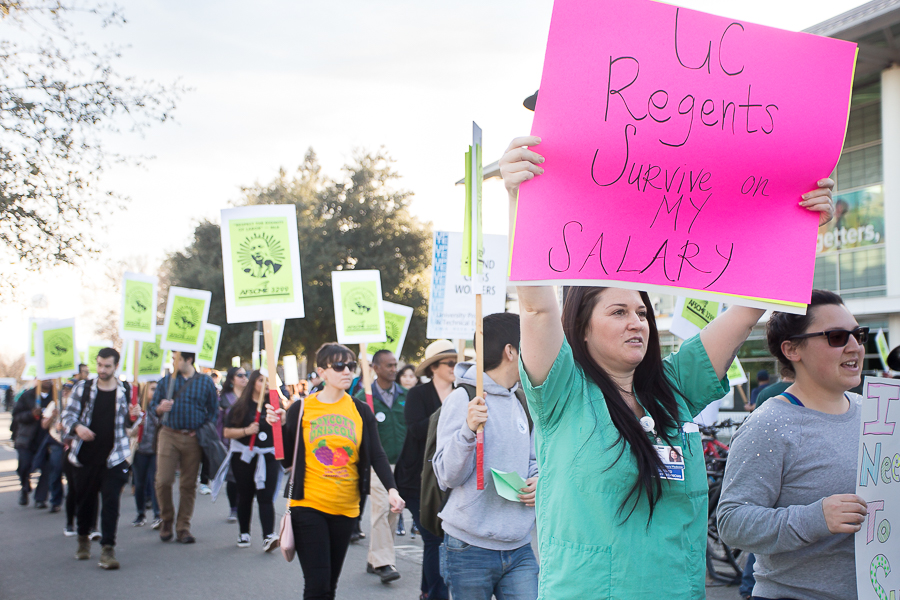
On Feb. 1, workers in the American Federation of State, County and Municipal Employees trade union picketed at the ARC in protest of the treatment they receive in their positions from the UC. AFSCME represents over 24,000 employees across all 10 UC campuses. Others outside of the union came out to support, including both undergraduate and graduate students and community members. Eric Gudz, a former UC Davis graduate student who was pursuing a masters degree in Transportation, Technology, and Policy, elaborated on the reasons he came out to support AFSCME workers.

“A lot of the workers, both student workers and non-student workers, have presented a series of demands and certain needs that have been unfulfilled and unmet within our administration system,” Gudz said. “They have a list on their website and Facebook group for all the demands they have, but where it boils down to is pay, benefits and making sure that we do everything we can within the university to protect employees’ right to unionize and to prevent any sort of attack or reduction in unionizing power. It’s very important that we’re here supporting unions and everyone’s right to unionize and organize effectively.”

Blanca Centeno, a UC Davis worker with the custodial department, discussed a few of the reasons why she was picketing.

“We’re here right now because we’re fighting for justice, equality, respect and dignity,” Centeno said. “It doesn’t matter how many years pass by, we always have to keep fighting for our future.”

UC Davis employee Kristina Torres also discussed her reasons for picketing.

“We are here today because the service workers and the patient care workers under AFSCME do not have a contract,” Torres said. “The University of California has not been bargaining faithfully with us and so service workers have been out of a contract since June 30 of 2017 and patient care workers since Dec. 31 of 2017.”

Torres talked about what her hopes were for the outcome of the picket.

“We’re hoping that the university hears us, sees us in solidarity, and that we’re going to fight for everything that we deserve because they’re coming to the table with giving us zero across the board for any kind of salary wages,” Torres said. “They’re saying that all of us make too much, they want to cut our pensions, they want us to pay more for our health benefits and raise the age of retirement from 60 to 65. This is the second protest that we have had. Obviously, the university still came to the table with no negotiating.”

Caroline McKusick, a graduate student pursuing a Ph.D. in anthropology, also came out to support AFSCME workers.

“I am out here today because I am also a part of a union on campus and I am here to support AFSCME workers,” McKusick said. “We have to stand together right now when labor is under attack across the country and at the UCs. I believe that AFSCME workers have every right to be making the contract demands that they are making and UC’s reaction has been insulting.”

McKusick also explained the correlation between what the union she is a part of is fighting for and what AFSCME workers are currently fighting for.

“I’m a part of the UAW and we have a lot of shared ground and demands with AFSCME workers such as getting sanctuary campus status for the UC and these are things that we can win if we all work together as students and workers on campus,” McKusick said. “It’s my hope that during these bargaining processes we can win some concrete victories for students and workers on campus.”

As a worker at the UC Davis Medical Center, Carla Alston schedules specialty appointments. Alston gave insight into why the picket happened to be on this particular day.

“Today is the 50th anniversary since the passing of our brothers at Memphis, Tenn.,” Alston said. “They were out here 50 years ago trying to fight for dignity and equality and fairness in the workplace here, and here we are 50 years later and we’re still fighting for that here.”

According to the Facebook event page for the picket, Feb. 1 is “the 50th anniversary of the two men whose deaths moved Memphis’s 1,300 sanitation workers to join AFSCME in 1968, stand with Dr. Martin Luther King, and strike for over 10 weeks against the same issues we’re dealing with at UC today.”

According to Alston, the UC is offering a contract that will yield only negative effects for workers like her.

“We’re hoping that UC regents will take into consideration what we’re trying to propose here at the bargaining table because what they’re proposing is not fair or equal,” Alston said. “The UC is offering zero percent pay raise for the next five years, raising in our health care benefits so we’re going to be paying more in healthcare costs with no increase in pay. They want us to have to pay more in our pensions and they don’t want to give us more staffing.”

Alston also believes that the staffing levels for workers at the UC Davis Medical Center is worrisome for both the workers and for those receiving care.

“Staffing levels are unsafe in the workplace here, so we’re trying to get that at safe levels,” Alston said. “It doesn’t only affect us, it affects anybody that walks into any UC campus. Many departments are so understaffed and overworked. There are a lot of departments with double-time shifts and overtime pay all the time because there is no staffing there and they’re tired and being taken away from their families and that is not safe.”

Chants and signs at the protest included sayings such as “Zero percent won’t pay the rent” — in reference to the zero percent increase in wages for the next five years that the UC has offered to service and patient care workers.

During the picket, a few of the organizers called together those in attendance to make an announcement that an AFSCME picketer at a recent rally at UC Berkeley had been arrested. The footage of the arrest can be seen on the AFSCME Facebook page.


Written by: Sabrina Habchi — campus@theaggie.org

Ram exploits King legacy for financial gain

CAITLYN SAMPLEY / AGGIE

Car company runs commercial using Dr. King sermon

The answer to the question on everyone’s mind this past Sunday — “Did Ram really just try to profit off a Dr. Martin Luther King, Jr. speech?” — is, unfortunately, “Yes.”

Dodge Ram ran a “Built to Serve” commercial on one of the most high-profile advertising days of the year: Super Bowl Sunday. This year’s Ad Bowl featured a commercial overlayed with an excerpt from Dr. King’s “The Drum Major Instinct” sermon, delivered exactly 50 years prior to the 2018 Super Bowl, over a series of clips featuring people laboring in various tasks including training, fishing, herding cattle, relocating a church and rescuing animals.

The ad was not approved by Dr. King’s family, but rather by the manager of the Estate of Dr. Martin Luther King, Jr., Eric D. Tidwell, who said in a statement, “We found that the overall message of the ad embodied Dr. King’s philosophy that true greatness is achieved by serving others. Thus we decided to be a part of Ram’s ‘Built To Serve’ Super Bowl program.”

The attention paid to the historical game between the Philadelphia Eagles and New England Patriots was quickly diverted as many viewers took great offense to Ram’s commercial. The Editorial Board could not agree more with the disapproval of the sermon being used for the company’s monetary gain.

The selection from the sermon featured a quote from Jesus instead of the more ironic lines where Dr. King blatantly criticizes car advertisements. Clearly, Ram counted on an ignorant audience unfamiliar with the contents of the sermon and chose to appeal to American beliefs about patriotism and Dr. King’s lasting influence in the current political climate surrounding racial equality.

This year, the cost for a 30-second commercial averaged upwards of $5 million. The Chicago Tribune ranked the Ram commercial as the lowest grade — a D — and, although it gathered approximately 11.5 thousand mentions, Fox News reports that most of them were negative looks. Ram wasted $5 million.

While the words of Dr. King were used with permission from the Estate, the decision to use them in a time of political tension — when African Americans are still widely discriminated against — was a poor one. It’s vital that the drive for profit not deafen companies to the tone of the country.

Featuring a leader of the civil rights movement for financial gain is appalling. Using the sermon out of context is insulting; airing it during the event where professional sports players have been previously attacked for peacefully protesting in support of the Black Lives Matter movement is repulsive.

Advertisers and big-name companies should be more culturally sensitive when creating a 60-second bit of money-making propaganda. Important topics of the political climate do not exist to be financially banked on.

This ad can join the Kendall Jenner Pepsi commercial disaster.


Written by: The Editorial Board

Vice Chancellor named new president of San Diego State University

CAITLYN SAMPLEY / AGGIE

De la Torre will be first Latina president of SDSU

On Jan. 30, Vice Chancellor of Student Affairs and Campus Diversity Adela de la Torre was appointed as the next president of San Diego State University by the California State University Board of Trustees. De la Torre will be stepping into her role as president this coming June.

De la Torre is the first Latina woman to be appointed as president of SDSU. De la Torre is a researcher in and chair of the Department of Chicana/Chicano Studies at UC Davis.

ASUCD President Josh Dalavai spoke about de la Torre’s relationship with students.

“We are sorry to see Vice Chancellor de la Torre leave the UC Davis community but are excited for her future endeavors at SDSU and wish her the best,” Dalavai said. “It was a pleasure working with her on behalf of students.”

At UC Davis, as Vice Chancellor of Student Affairs, de La Torre has worked to secure $19 million in order to support programs like educational outreach, recruitment and health education.

May recently announced that in light of de la Torre’s departure, he will be looking to fill two open positions: vice chancellor of student affairs and vice chancellor for diversity, equity and inclusion.

“One thing we must do is further increase the diversity of our students, faculty and staff in the years ahead,” May said in a press release published by the university. “This new position for diversity, equity and inclusion will allow us to engage more effectively with recruitment and retention of the best and brightest students, faculty, and staff in the state and nation.”

In an official statement, May congratulated de la Torre on her new position.

“Please join me in congratulating Adela,” May said. “She has been a dynamic leader and scholar during her time with UC Davis and has demonstrated a commitment to diversity and inclusion in a wealth of programs and services for students.”


Written by: Ally Russell — campus@theaggie.org

Yes Means Yes: How the understanding of rape culture in Hollywood is influencing our daily lives

TIMOTHY KRAUSE [CC BY 2.0] / FLICKR
We should not pin blame solely on powerful men but also on the society that made them.

Content Warning: This story contains references to sexual harassment and assault. 


“It was 30 minutes of me getting up and moving and him following and sticking his fingers down my throat again. It was really repetitive. It felt like a […] game.” An anonymous woman openly spoke about her alleged negative sexual experiences with Aziz Ansari, the man who just won a Golden Globe for Best TV Actor. Ansari’s show “Master of None” ironically features an episode dedicated to condemning a character for sexually harassing women in the workplace. In the past few months, Hollywood has experienced a disturbingly massive awakening dedicated to opening the eyes of the public through the stories of women who have faced horrific, demeaning and sometimes violent encounters with specific men in the industry.

It started with Harvey Weinstein. Matt Lauer, Louis C.K., Kevin Spacey and countless other influential men have since fallen from their positions of power as men and women have steadily stepped into the open about their traumatizing experiences.

As I was following this movement, I have come upon several realizations. Many people around me seemed absolutely shocked that something like this could happen, when the reality is that incidents like these have been happening for decades without any acknowledgement. Simply because women are speaking up now does not mean that today’s society is significantly worse than it was 50 years ago — more women just feel empowered enough to fight against it. I’ve also noticed the tendency of our society to blame women for deciding to accuse the perpetrators of sexual harassment at this moment instead of years ago, at the time of the event.

In several circumstances, if many of these women had decided to speak up years ago against the behavior of a certain male director, producer, actor or any other man in a position of power for that matter, she would have been booted out of the industry and her career would have been over. This era of transparency reveals the disgusting behavior exhibited by innumerable men in their spheres of influence, and finally women have enough support to openly speak about what they’ve been through. The momentum of this movement is vital to sustaining it.

Now, let’s return to the issue of Aziz Ansari. I adored this man, and he’s someone who still deserves to be recognized for his efforts in starting conversations about difficult topics on his show and standing up for women to voice their experiences. However, he allegedly made a major mistake — one that essentially could have been recurring with several women in his life, and one that would boil down to society letting Aziz Ansari down just as much as it has let countless women down. It’s our responsibility as members of our community to contribute to a discourse that supports “yes means yes” over “no means no.” Enough with the victim-blaming and the questioning of validity. Enough with claiming that women are too sensitive and weak when it comes to harassment. Every woman who has had a painful, traumatic experience with sexual assault in her life must be incredibly strong and powerful to have dealt with that situation and worked to fight against it.

The demeaning misconduct and harassment in the industry doesn’t always come from deliberately malicious men — it comes from a carefully constructed system in which women have constantly been placed into roles they did not necessarily choose. A powerful article calls upon 25 female celebrities to speak about issues they’ve noticed, such as the lack of variation in female identities in movies, the heavy focus on a woman’s weight on screen, the wage gap and the lack of female directors.

The situation with Aziz Ansari highlights an important point for me. Rape culture does not have to depend solely on rapists jumping out of the bushes to assault women in the middle of the night. Rape culture is the discourse that we all feed into when we decide to comment on a girl’s appearance by calling her a slut, whore or just irresponsible for staying out late or dressing the way she chooses to. Rape culture is blaming the woman for not saying “no” to Ansari when she allegedly made it quite clear she was not interested in intercourse. It’s a common occurrence for many women — constantly fighting against the offenses of persistent men — and this is something that needs to change. (Of course, there are also situations in which this applies to non-female groups — take Kevin Spacey’s actions, for example. It’s a poison that needs to be eradicated absolutely everywhere.) Rape culture is insisting that aggressive sexual behavior is justified by the belief that the man thought it was consensual. The solution is simple — ask, and don’t assume. Hollywood has been ripped open from the inside out, and the toxicity of the industry is finally being exposed to the public.

But this still isn’t hitting home for many people.

In a recent survey, registered voters across the nation stated that 59 percent of people believed sexual harassment and misconduct was a significant issue in Hollywood, 43 percent believed it was a large problem in the federal government, but only 16 percent believed it was an issue in their workplaces. This belief displays the unwillingness of people to accept that these negative dynamics can be prevalent in their own lives and that something needs to be done against it locally. It’s essential that women speak out in this moment. This movement is vital in beginning to uproot the widespread toxic structures in our society today. It’s 2018, and we are finally working to make the world a better place for women, simply by hearing them out and treating them like the human beings with basic rights that they are.  


Written by: Akshita Gandra — agandra@ucdavis.edu

Disclaimer: The views and opinions expressed by individual columnists belong to the columnists alone and do not necessarily indicate the views and opinions held by The California Aggie.

Humor: Oily scalp? Watch out for the U.S. military

JAMIE CHEN / AGGIE

U.S. implements new system of skullfracking

The U.S. military’s time-tested approach of invading non-white countries and labeling areas as terrorist hotspots in order to extract all their oil is as unethical and effective as ever. Unfortunately, America’s oil consumption has increased so rapidly that we’re failing to meet the demands of Escalade-driving gasmongers and jacked-up V8 hicks. The military has taken up a new approach to getting oil: skullfracking, in which they drill into the skulls of those with oily scalps in order to extract the only thing that makes them valuable — crude oil.

“I knew that when my Billy-Joe was popping off left and right with swear words that he had become crude,” said a stereotypical mother from Woodland. “That’s when I called the local recruiting branch, and they came right for him.”

I personally watched the entire event unfold. They took the Naruto headband off and rubbed their hands over the scalp. The moment I saw all that dandruff and grease was the same moment one of those government goons whipped out a titanium step drill bit and bored right into his head. Blood was spraying all over the place, and the mother said, “I pray to the Lord that my poor boy won’t die.”

“It’s a much cheaper form of fracking,” said a businessman who was pretending to be ethical. “We pump nationalist jargon and buzzwords into the mind and extract the oil that makes them so crude.”

After the procedure, the government goons stuck some crumpled up toilet paper, probably The New York Times, into the kid’s head hole, and then covered it all up with a MAGA hat.

When asked how he felt after the procedure, Billy-Joe exclaimed, “All lives matter!”

“This is a pretty efficient way to instill propaganda in our fanbase while treating them as human capital,” said Drill Sergeant A. Nellsechs, the worker who performed the procedure. “But they also could’ve gotten that through a career in the military.”

UC Davis students appear to be exempt from the procedure, as their minds have already been indoctrinated by the university. Nonetheless, the Anime Club and computer science majors seem to be the next targets. So if you see someone with an oily scalp, please call 866-740-4531.


Written by: Drew Hanson — andhanson@ucdavis.edu

(This article is humor and/or satire, and its content is purely fictional. The story and the names of “sources” are fictionalized.)

Owls Collateral Damage on Illegal Marijuana Farms

JAMIE CHEN / AGGIE

Increased rat poison in forest areas harms spotted owls and barred owls

The impact of anticoagulant rodenticide, commonly known as chronic rat poison, on unintended wildlife has mainly been studied in agricultural and urban settings. However, recent data has shown that the use of rat poison in remote forests has increased and is killing wildlife. A study led by UC Davis and the California Academy of Sciences has shown that illegal marijuana farms are the most likely source.

Mourad W. Gabriel, the lead author of the paper, is the executive director of the Integral Ecology Research Center and part of the Research Associate Faculty at the Karen C. Drayer Wildlife Health Center at UC Davis.

Previous research has demonstrated that rodenticides were extensively at trespass grow sites on public lands,” Gabriel said. “We wanted to investigate if avian species, that would be clear sentinels of secondary poisoning, were exposed to [rat poison]. Also, if these individuals sampled from private lands that were not associated with trespass growths were exposed, then what are the potential source points.”

The results show the environmental impact of illegal marijuana farms.

Illegal marijuana grow sites are unregulated and the use of large quantities of pesticides is likely having a very negative effect on wildlife populations,” said Robert Poppenga, a veterinary toxicologist at the CAHFS Toxicology Laboratory in the School of Veterinary Medicine at UC Davis. “The sites are often contaminated with a variety of pesticides and the costs associated with clean-up are substantial.”

One species heavily impacted is the northern spotted owl. This owl is listed under the Federal Endangered Species Act and was recently listed under the California Endangered Species Act. Barred owls have entered the critical habitat designed for the spotted owl and now compete for the same resources.

Rodenticide is just part of the problem, but one of the more readily measurable impacts,” said Jack Dumbacher, a curator of ornithology and mammalogy in the Institute of Biodiversity Science and Sustainability at the California Academy of Sciences. “Finding these toxins in barred owls suggests that it is an ecosystem-wide uptake, or, that the toxins are not just in rodents, but they are poisoning the entire food chain, right up [to Barred and Spotted owls]. Spotted owls are a very sensitive endangered species and this is a serious threat to a species that is already plummeting toward extinction.”


Written by: Kriti Varghese — science@theaggie.org

Davis City Council election gearing up

JEREMY DANG / AGGIE

Mark West announces candidacy for City Council

Mark West, a lifelong Davis resident, former local business owner and Davis High School alumnus, has announced his candidacy for the Davis City Council Election. He has previously served the public as a Site Council member at the Valley Oaks Elementary School in Davis. In addition, West is a local activist and commentator, writing articles for the Davis Vanguard and appealing decisions made by the City Council and the city’s Planning Commission.

“His priorities are going to be fiscal sustainability,” said Michael Bisch, the owner of Davis Commercial Properties and a friend of West’s. “A big problem the city government is facing is how to fund our services going forward. He’s also looking to improve our economic development effort so we have jobs and opportunities for our residents. Another issue that he’s spoken a lot about is alleviating the housing crisis, and he’s written quite a bit about social and economic equity and how critical it is that the community does far, far more in that regard.”

West has a B.A. from Berkeley and a Ph.D. in neuroscience from Johns Hopkins University. He has two daughters and four foster children that have all worked or are working their way through Davis’s public school system. West worked at the university before co-founding the Rominger West Winery in 2004 and operating it for eight years until its closing in 2012. West is joined in the race for the council by eight other candidates.

“I like this field — I think it is very strong in a lot of ways,” wrote David Greenwald, the founder and a writer of the Davis Vanguard. “They are an indication that the political lines that divided this community for years are really gone […] There is also a solid contingent of fiscally-conscious candidates […] Mark West [is] clearly going to push for fiscal responsibility.”

The election for the Davis City Council will be held in June 2018, with the seats of Councilwoman Rochelle Swanson and Mayor Robb Davis to be decided. To learn more about the General Municipal Election process, visit the city website, and to register to vote, visit the Yolo County elections website.

“I think we have a really good city, and we have to move in the right direction if we want to stay a good city,” West said. “I’m not beholden to anyone […] but it’s for the people to decide. As for me, this is who I am, this is what I believe and this is how I’ll operate if I’m elected.”


Written by: Ahash Francis — city@theaggie.org

Not looking like a “real” Mexican

ALLYSON KO / AGGIE

How racial identity is based on cultural upbringing, not physical appearance

What does it mean to be Latino? Are there certain requirements that need to be met for someone to be considered a “real” Latino? Does one need to speak Spanish fluently or be native born to be considered Hispanic? Are children with Hispanic origins born in the U.S. considered Latino or American? The issue of racial authenticity is confusing, especially when so many different people have different ways of defining cultural groups.

Let me start by saying that race is not based on physical characteristics. Race is based on your family’s upbringing and origins. How people identify culturally or racially is their own choice, and people should be more sensitive when it comes to affixing labels on others.

I am Mexican. Both my parents were born in Mexico; I was born in the U.S. Culturally I identify as Mexican. Racially, I’m Mexican-American, if you want to be technical about it.

I take no offense to being called Latino or Hispanic because I know they’re mainly Census words — umbrella terms used to calculate the Latin American population in the U.S.

What I do take offense to is when people call Latinos “Chicano.” The Chicano Civil Rights Movement in the 1960s focused on Mexican-American rights because Mexicans comprised the overwhelming majority of the immigrant population at the time. The term “Chicano” was used to try to re-signify what it means to be Mexican. It’s a term of empowerment, not a racial identity.

In the United States, identifying people’s race is almost commonplace. As a Mexican-American, I have been questioned about my racial background a lot. It might have to do with the fact that I don’t look like a stereotypical person of Mexican ancestry. Once I say that I am Mexican, people look at me and say, “Are you sure?” I’ve been told by friends and strangers that I look mestizo, or Spanish. People can’t fathom the idea of someone not adhering to their cultural stereotypes because their views of race are too rigid and appearance-based.

Whenever the topic of race comes up people hurry to ask about your origins. Although “Where are you from?” seems like a normal question, it can be framed to mean “What is your race?” It’s a common question that I’m sure a lot of people have been asked. For instance, when I get asked that question, I respond with “Oakland, California.” In some cases, I’ve even been told “Sorry, no, where is your family from?”

Growing up, I always felt like I had to traverse different worlds. As a Mexican-American, I grew up speaking Spanish at home while being socialized in Western culture outside of my home. Life at home included Spanish music, Spanish television and Mexican food. Meanwhile, school would be different: English everything.

I felt out of place. At school, I was this Mexican kid who looked kind of white, yet wasn’t really Mexican. I was in a weird limbo. Back at home, my parents would tease me about not being able to roll my double Rs because, they said, only real Mexicans could roll their double Rs naturally and smoothly. I felt like I never fit the definition for Mexican.

I thought it was curious how my white friends would call me Mexican, while my Mexican friends would call me white. I hated it. I hated not feeling like I belonged.

I felt that way growing up. However, after taking classes here at Davis, I have come to realize that race is merely a social construct. It’s not a real thing. Genetically, there’s no difference between my DNA and the DNA of someone from China, the only difference being physical characteristics. People need to make the distinction that physical characteristics are not clues to someone’s racial identity.

My racial identity is something that I’m proud of. Whenever someone asks for my name at a restaurant I make sure to pronounce it in my best Spanish accent. I used to be embarrassed to answer my parents’ phone calls because I was always cautious of speaking Spanish in public. Now, I’m all for it. I love to let people know that I’m Mexican. I will not let other people affix their labels to me. I’m honored to be Mexican and proudly assert it.


Written by: Alejandro Lara — amlara@ucdavis.edu

Disclaimer: The views and opinions expressed by individual columnists belong to the columnists alone and do not necessarily indicate the views and opinions held by The California Aggie.

Last week in Senate

HANNAH LEE / AGGIE

Discussion over OASR unit director position leads to disagreement

On Jan. 18, at 6:12 p.m., Vice President Adilla Jamaludin called the ASUCD Senate meeting to order in the Mee Room of the Memorial Union.

The evening’s first presentation was given by the Office of Student Support and Judicial Affairs. Don Dudley and Jennifer Chow presented on the office’s status after rebranding two years ago from the former Office of Judicial Affairs. The office laid out its mission to help maintain conduct standards and provide due process when called upon.

The Office of Student Support and Judicial Affairs intends to “coordinate between students and the resources they need for counseling.”

Sarah Risher and Lois Kim, the chair and vice chair of the Environmental Policy and Planning Commission, presented on The Green Initiative Fund. The fund sponsors students’ projects for sustainability.

The Spring Grant Cycles have raised enough money to fund student-run projects based in UC Davis or the Davis community ranging from $2,000 to $200,000. Applications to submit a sustainable project are due on April 9.

The Elections Committee then updated the table on the Winter Elections cycle. Petitions for prospective candidates went out on Monday, Jan. 22. Committee Chair Naeema Kaleem and  Vice Chair Rodney Tompkins presented the committee’s ideas to promote the election cycle. Raffles and increased tabling will be implemented to incentivise greater voter turnout. Voting, endorsements and petition signatures will all be digital.

ASUCD President Josh Dalavai presented third-year design major Amber Kumara as a prospective unit director for OASR to the table. Kumara was questioned before her confirmation on her history with advocacy and her goals as a representative for undergraduate students. She spoke about her passions for representing students. She was a returning student from time off from the university and did not have much advocacy experience. While she admitted to not being knowledgeable about every community on campus, she said her desire was to learn more.

A 10-minute break was called at 7:28 p.m. The meeting reconvened at 7:40 p.m.

Upon return, Dalavai rescinded his nomination of Kumara.

Becca Nelson, the Gender and Sexuality Commission chair, delivered an LGBTQ allyship training course to the table to accommodate senators who had not yet proactively done so.

SB 22 passed as amended during introduction of new legislation.

SB 23 redefines the office hours of ASUCD senators. They are currently required to reserve four hours for the public. The bill proposes that one hour may be substituted with a visit to a club or a classroom to make a public announcement on ASUCD’s behalf. The table spoke about whether making a short visit to a class or club should be equated to making oneself available for one hour to the public.

The meeting moved out of public discussion on SB 23 and into consideration of ASUCD Constitutional Amendment 1 regarding the position of the OASR unit director. The unit director is appointed by the president and confirmed by the Senate. The amendment would change the position of OASR unit director to an executive one, thereby creating a new elected position.

Senator Michael Gofman spoke about the intentions of the amendment, to make the role of primary student advocacy a democratic decision. The new seat is said to increase voter turnout in the upcoming elections.

Representatives from OASR and senators voiced their dissatisfaction with the amendment, commenting on Gofman’s lack of communication with OASR about the proposed changes and the amendment’s hastily-written contents.  

OASR members shook their heads in disagreement over the amendment’s defense and expressed their disapproval over not being consulted in the process. Senators rolled their eyes at other senators’ words and Gofman’s frustration at opposition led to his usage of profanity.

A motion was passed to divide the house for a litmus test vote over whether the Senate wanted to put the amendment on a ballot for students to vote on its approval. There was one yes, seven nos and three abstentions. The official vote ended in one yes, nine nos and three abstentions, keeping it off the ballot.

Public discussion moved back to SB 23. The bill will continue to be edited and discussed in the future to address recent complaints about the ineffectiveness of Senate office hours.

Ex officio reports were given followed by elected official reports.

The meeting adjourned at 10:26 p.m.  


Written by: Elizabeth Mercado — campus@theaggie.org

Liberty In North Korea club hosts North Korean refugee at event

Charles Ryu speaks to crowd about escaping North Korea and about his life in America. (DIANA LI / AGGIE)

Club hopes to raise enough money to rescue North Korean refugee

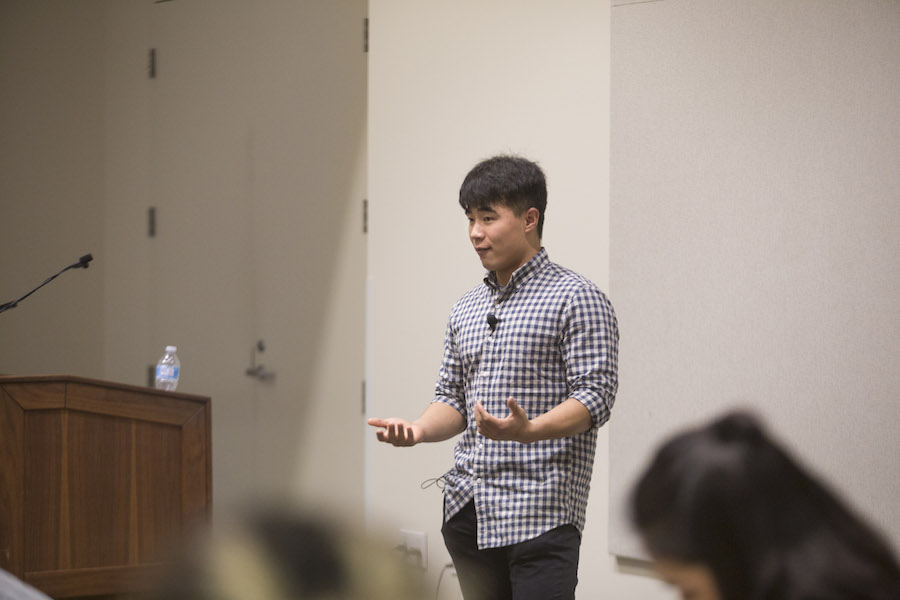
On Jan. 18, Liberty in North Korea hosted Charles Ryu, a 24-year-old North Korean defector, in the Student Community Center.

Soo Kyeom Lee, a UC Davis alumna and the original founder of LINK, hosted the event and discussed the club’s goals for the year.

“Our mission is to educate and raise awareness about the human rights crisis in North Korea,” Kyeom said. “This year our goal is simple, to rescue one refugee. To do so we need to raise $3,000.”

LINK began at Yale University in 2004 and has been at UC Davis for three years. Kyeom thanked those in attendance and their contribution to LINK’s cause, stating that attendees were “part of the rescue mission.”

Kyeom then introduced the event’s speaker, Charles Ryu. Ryu told attendees his story of growing up in North Korea and escaping twice before eventually ending up in America.

Ryu was born in 1994 to a North Korean mother and a Chinese father. When Ryu was 5, in the midst of the famine going on in North Korea, Ryu’s father abandoned him and his mother and sought refuge in China.

Six years later, Ryu’s mother died from starvation. Ryu spent the next few years of his life homeless and begging for food. At 14, Ryu escaped North Korea for the first time with the help of his Chinese half-brother. After bribing the guards, Ryu was able to swim across the river and meet his estranged father who cared for him for the next year.

Ryu was eventually discovered by the Chinese police and was deported back to North Korea, as China does not currently recognize North Korean refugees.

“I was convinced I would be shot the moment I crossed the border,” Ryu said. “But I realized killing me would have been too nice for the regime. They wanted me to confess to trying to defect.”

Because Ryu had not been trying to defect and instead was only seeking his father and better living conditions, he was transported to a labor camp. At the age of 15, Ryu spent eight months in a labor camp until he was too weak to support his own body weight. He was then released. For the next year, Ryu regained his strength and worked in a mine. After seeing countless friends lose limbs and die due to working conditions, Ryu decided to try to escape again.

After stealing flashlights and selling them in the black market, stowing away on a train and running to a border town, Ryu was able to cross the river again and escape into China. From there, Ryu’s life beyond the North Korean border began.

In America, Ryu graduated high school and currently works with LINK. Ryu has given talks about his experiences and hopes to eventually go to a university to study computer science.

When fielding questions from the audience, Ryu discussed the role foreign movies played in his disillusionment with the North Korean regime.

“That really changed my perspective, watching foreign media,” Ryu said. “It was really easy for me to get my hands on foreign media.”

Ryu’s Chinese half-brother was able to smuggle him CDs and movies. “007” and “Bad Boys” were among the notable movies Ryu grew up watching. From there, Ryu would burn copies and sell them on the black market. Ryu insisted that the majority of the North Korean economy revolves around the black market.

“They found their way to survive,” Ryu said. “[The black market] got really big. It was too big to fail. The government can’t control it.”

Ryu claimed that 99.9 percent of the North Korean economy depends on the black market. He also said that most of what is sold is manufactured in China.

Ryu spoke about the culture of bribery within North Korea.

“It is very easy to bribe guards in North Korea because everyone seeks opportunity to feed their family,” Ryu said. “It’s not that we want to bribe them, they want bribes from us.”

After Ryu’s presentation, Kyeom thanked those who attended the event and encouraged individuals to seek out more information about North Korea and to get involved.

Caitlin Perkey, a third-year international relations major and a public relations officer at LINK, spoke about Ryu’s positive attitude.

“He’s a very humorous and chill person to be around,” Perkey said. “Charles has overcome numerous instances of hardship where the world was very unforgiving.”

Ryu engaged with audience members throughout the event, making jokes and stayed well after the event to meet those in attendance.


Written by: Ally Russell — campus@theaggie.org