53.3 F
Davis

Davis, California

Thursday, December 25, 2025
Home Blog Page 568

Humor: Bitcoin price inflation directly correlated with lack of parking spaces at UC Davis

Get ready to be so rich that you can buy a car and then have nowhere to park it

Ever wonder what makes bitcoin tick? Well, you’re in luck, because The Aggie has made a groundbreaking discovery about what has caused its recent price fluctuations.

You might be asking yourself right now, “What is a bitcoin?” This is a very good question that we figure we should define for our less sophisticated readers.

To put it simply, bitcoin is a very small coin. Some might even call it a baby coin. This baby coin is comprised of blockchain technology, which is a very long chain of blocks. Logically, your next question is probably, “Why would anyone want a baby coin made of blocks?” The answer is because babycoin has recently spiked in value after many years of existing as a niche, questionable form of currency similar to Monopoly dollars, but still somehow less valuable.

Many people question what exactly has caused its price surge, but after completing some deeply significant research, The Aggie has concluded that the rise and fall of bitcoin’s price is inversely correlated with how many parking spaces are available at UC Davis.

As you can imagine, because the number of parking spaces has been getting smaller and smaller, the price of bitcoin has gone through the roof. With evidence like this, we only expect the price to get higher and higher in the future, so you should probably invest all of your money right now, quickly, before it’s too late.

At this point, it’s natural that you may have your doubts. After all, as young scholars we have all been informed that correlation does not imply causation. However, we do know that the university name “UC Davis” does imply a lack of parking spaces. We also know that the name “bitcoin” implies a very small amount of coin. You could even say a lack of coin. Therefore, the evidence is truly undeniable: UC Davis’ lack of parking spaces causes bitcoin’s price to increase, and the reverse is also true in that bitcoin’s price increase has caused a lack of parking available at UC Davis. Any other conclusion just doesn’t make sense.

Still, if you are questioning what a teeny coin and UC Davis’ parking spaces have in common, look no further than their stackable features. Teenycoin is made of blocks, which are most likely stackable. As for the parking spaces, UC Davis believes that it is possible to stack many cars on top of one another in a single space, so theoretically they are stackable, too. Also, both smallcoin and UC Davis parking spaces don’t exist in nature.

So, citizens of Davis, if you’re even considering investing in babycoin, now is the perfect opportunity to blow all of your real-people dollars.


Written by: Lara Loptman — lrloptman@ucdavis.edu

(This article is humor and/or satire, and its content is purely fictional. The story and the names of “sources” are fictionalized.)


The scariest provision in the tax bill: Oil drilling in the Arctic National Wildlife Refuge

U.S. FISH AND WILDLIFE SERVICE HEADQUARTERS [CC BY 2.0] / FLICKR
A 40-year debate comes to a close, but there’s still hope drilling will be stopped

I wish I had a funny anecdote to make talking about oil drilling in the Arctic National Wildlife Refuge less depressing. I don’t.

The tax bill has been approved, along with one of the saddest provisions to affect the environment in recent years: authorization to lease sales of oil and and gas in the ANWR.

The ANWR is part of 19 million acres of federally protected wilderness — which happens to contain an estimated 11.8 billion barrels of oil.

It’s known as “America’s Serengeti” for its diversity of wildlife. It’s called the “Sacred Place Where Life Begins” by the native Gwich’in people.

It contains the largest designated wilderness within the National Wildlife Refuge System that remains “untrammeled by man.”

It’s one of two national refuges where polar bears, grizzly bears and black bears coexist.

It’s “the only national conservation area where polar bears regularly den and the most consistently used polar bear land denning area in Alaska,” according to the U.S. Fish and Wildlife Service.

It’s also home to nearly 200,000 Porcupine caribou, over 200 species of migratory birds, 42 fish species and 37 land mammal species.

Oil drilling would invade the home of native animals and people and wreck the refuge’s pristine wilderness.

But those in favor of the provision are excited about the so-called benefits of oil drilling — $1 billion over the next 10 years — and claim that the drilling will be done responsibly.

“If we are allowed to move forward with development, we will do it right,” said Alaska Senator Lisa Murkowski. “We will take care of our lands. We will take care of our wildlife. We will take care of our people.”

I appreciate Murkowski’s statement — and I wish she could deliver on that promise. But there’s no way to “do it right.” The right thing to do is to stop development before it’s too late.

“Oil related activities such as seismic testing, aircraft and vehicle noise, or even the mere presence of humans nearby can drive mother polar bears away from their den and cubs,” Defenders of Wildlife said. “Drilling the Arctic Refuge could alter the annual path of the Porcupine caribou herd, one of the longest land mammal migrations in the world. The critical breeding grounds for migratory birds would be severely impacted, and could cause population-scale impacts for many species.”

The provision tacked to the tax bill ended a 40-year debate between politicians, oil companies, environmentalists and Alaska residents.

Environmentalists reasoned with the American people before. Republicans and Democrats came together to protect and conserve one of the last truly wild places in our country.

“The crush of news out of the Trump White House and the focus on other elements of the tax bill has deflected attention from the fact that the measure would open up the refuge,” said Carl Hulse, The New York Times’ Washington correspondent.

Hulse’s statement reflects a recurring issue in American politics: Environmental issues aren’t given enough attention.

It’s important to know the risks that oil drilling poses to the ANWR. Knowing the risks means that we can discuss ways to prevent harmful degradation to American wilderness and unnecessary harm to already-threatened wildlife, like polar bears. We can speak to our representatives in office or find other ways to push back.

“It’s still an open question about whether drilling will ever happen there,” said Matt Lee-Ashley, a senior fellow at the Center for American Progress. “It’s hard to image that drilling will occur in the next 10 years — or ever.”


Written by: Jessica Driver — jmdriver@ucdavis.edu

Disclaimer: The views and opinions expressed by individual columnists belong to the columnists alone and do not necessarily indicate the views and opinions held by The California Aggie.

2018 Grammy Awards Predictions

HANNAH LEE / AGGIE

From Childish Gambino to Lorde, the greatest artists of the year are up for nomination

With the beginning of a new year comes the review of all that has transpired in 2017. And for those involved in the entertainment industry, that means awarding the industry’s stars for their greatest works and achievements. From the Academy Awards to the Golden Globes, awards season is a crucial time for the careers of many, in which they have the chance to be recognized on a global stage. In the world of music, the Grammy Awards honor the most accomplished musical artists and performers of the time. Set to be hosted by James Corden on Jan. 28, here are my predictions for how the night at Madison Square Garden will play out.

Album of the Year: “DAMN.” by Kendrick Lamar

2017 was a extraordinary year for music, with many artists often transcending the mainstream sounds. New stars and veteran performers alike stunned audiences with fresh material that rose through the charts. Personally, I believe that Album of the Year should be awarded to Lorde for her second album, “Melodrama.” However, despite my admiration for the 21-year-old singer-songwriter, I also believe that Kendrick Lamar’s “DAMN.” stands as a strong contender to take home the prize. The reality of the matter is that the nominations pool this year is extremely competitive with Bruno Mars’ “24K Magic,” JAY-Z’s “4:44” and Donald Glover’s unique “Awaken, My Love!” also being recognized. But at the end of the day, “DAMN.” is some of Lamar’s best work, with many of the album’s tracks holding a deeper meaning not only in his personal life but also in the lives of his listeners.

Song of the Year: “1-800-273-8255” by Logic, Khalid, Alessia Cara

It’s always hard to wrap my head around the idea of there being one single greatest song throughout an entire year — there’s always so many great choices. In this year’s pool of contenders, the nominees include “1-800-273-8255” by Logic, Khalid and Alessia Cara; “Issues” by Julia Michaels; “That’s What I Like” by Bruno Mars; “Despacito (Remix)” by Justin Bieber, Luis Fonsi and Daddy Yankee and “4:44” by JAY-Z. While Logic’s suicide prevention awareness track strikes a deep chord lyrically and emotionally — thus seeming like the obvious choice — it’s hard to say who will win. Although a rap song has never won Song of the Year, we can’t count out Jay-Z just yet, as the rapper has earned a total of 21 Grammy Awards throughout his career. Additionally, “Despacito (Remix)” topped the charts in the U.S. for several weeks, in addition to breaking multiple records in music video views and more. With all these factors in mind, my pick would still have to be “1-800-273-8255,” despite “Despacito” and its far-reaching popularity.

Best New Artist: Khalid

Throughout the past year, so many new artists emerged. From pop singers Alessia Cara and Julia Michaels to rapper Lil Uzi Vert, the category for Best New Artist holds a variety of different musicians. I believe that the front-runners this year are sure to be Khalid and Alessia Cara. Despite the fact that SZA may be a fan favorite for the win, I don’t believe her presence on the music scene was as well established as it could have been over the course of the year. As for my pick, I think Khalid deserves the award. With a completely unique sound that flows seamlessly from pop to soul to R&B, Khalid’s debut album “American Teen” held some of the greatest tracks of the year, especially coming from such a young artist. Khalid will be performing at UC Davis in early May.

Record of the Year: “24K Magic” by Bruno Mars

This category contains some of the year’s top tracks, many of which have maintained their presence on Billboard’s Top 100 for weeks on end. The nominees include “Humble” by Kendrick Lamar; “Redbone” by Childish Gambino; “24K Magic” by Bruno Mars; “The Story of O.J.” by JAY-Z and “Despacito (Remix)” by Justin Bieber, Luis Fonsi and Daddy Yankee. While I’m torn between “Redbone” and “24K Magic,” I feel as if Childish Gambino should be honored for his exemplary talents as a recording artist but simply won’t be due to the historical nature of the Grammy Awards. As a previous winner in this category (“Uptown Funk” in 2016), Bruno Mars has the upper hand, which I think could potentially carry him to another victory.


Written by: Sydney Odman — arts@theaggie.org

Incorporate art into your 2018

BECCA RIDGE / AGGIE FILE

Ways every student can benefit from art

Among family members, friends, peers and strangers alike, the onset of a new year sparks a rejuvenated spirit and a fresh hope in clean slates. Of course, the decision to make better or different personal life choices can be made at any point in the year with enough motivation. Nevertheless, one can successfully achieve a better version of themselves or simply a goal by the end of the year. This, at least, is something to appreciate — whether you support the concept of New Year’s resolutions or not.

And why not let art tag along on your new journey this year? Below are suggestions for how to tap into your artistic side (it’s in there somewhere) in 2018.


1. Visit local museums and art galleries

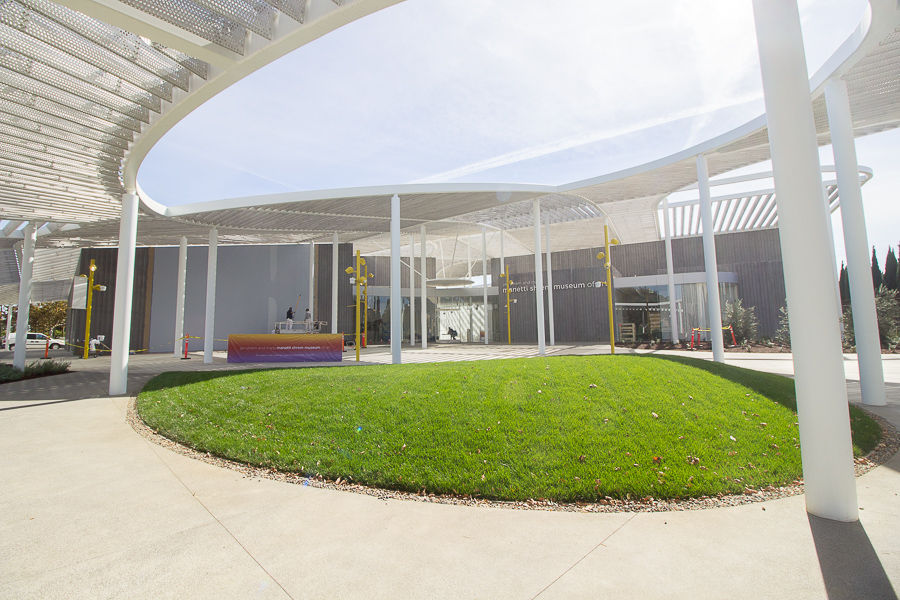
Students can experience art through museums and galleries on campus, in Davis and in the Bay Area. To start off, there is the Jan Shrem and Maria Manetti Shrem Museum of Art, which is located right next to the UC Davis Welcome Center. On Jan. 16, there will be two new exhibitions to check out. There is also the C.N. Gorman Museum located in Hart Hall, the Design Museum in Cruess Hall and the Basement Gallery in the Art Building which features student work and is run by undergraduates.

Off campus and in the city of Davis, there’s the John Natsoulas Gallery (easily identifiable by the large cat sculpture in front of it) and the Pence Gallery downtown. In the office of the Davis Cemetery there is Gallery 1855, which features a different exhibition monthly.

In Sacramento, you can visit the Crocker Art Museum, the Sojourner Truth African American Museum and the Verge Center for the Arts. Two popular San Francisco destinations are the de Young museum and the San Francisco Museum of Modern Art.

Julie McGilvray, an academic advisor for the Arts Group Advising Center, explained how museums help display the world as it’s seen through different lenses.

“Visiting art museums, attending theatrical productions or music productions is a great way to learn how art intersects with everyday life from the artist’s perspective and to learn about the influences of cultures, politics, societies, ethnic groups, race and gender and social movements,” McGilvray said.

Adam Cochran, a first-year graduate student in the art studio program, appreciates the power of museums to connect people.

“Museums offer an inspiring, quiet place for reflection and to connect with other people from the past,” Cochran said. “Humans began making art thousands of years ago not just to decorate a wall, but because it also enriches and informs our lives. It is a means of expression and thus a record of culture and a visual way in which we can connect to it across time and distance.”

Keep in mind this is a short rundown of options, but there is much more to discover. All you need is a Google search to unveil a world of art. Frequently visiting sites like thedavisdirt.com or local venue websites (or even joining email lists) can help you keep up with nearby events and prevent you from missing out.


2. Take up a new art

Starting an art practice might seem obvious or daunting as there are many options to experiment with, but you never know what artistic skill you may gain. Cochran has some advice on where to begin.

“Each art form has its inherent qualities that others don’t, and this might help direct someone […],” Cochran said. “My biggest recommendation would be to try a little of everything you can. What a person is interested in will become very obvious very quickly, even within just one or two projects.”

Patience is key for many things in life, including art. Keep that in mind if this endeavor proves more difficult than you had imagined

“There is absolutely nothing wrong with trying something, not liking it and then trying something else,” Cochran said. “Remember there is a difference between trying something and stopping because it is unenjoyable and quitting because it’s frustrating at first.”

Another important note is to let loose and not worry so much about proper technique.

“A lot of students avoid art because they feel like they aren’t doing it ‘right’ as opposed to allowing themselves to relax and discover the joy that the medium can bring,” Cochran said.

Specifically for painting, Cochran suggests starting with a couple brushes, cheaper materials such as acrylic paints and less expensive canvases or a pad of canvas paper.

“Painting can be an expensive practice, so don’t buy the most expensive tools before you are ready,” Cochran said. “By using the cheaper tools and gradually moving into the better ones, the student will appreciate why things are priced the way they are and will develop their skills without feeling as though they are wasting money. Wasting materials is an unavoidable part of the process of learning.”


3. Classes

Classes at the Craft Center are an on-campus opportunity to get hands-on experience and special attention, with many to choose from every quarter. As described online, these classes provide “a comfortable, encouraging atmosphere in which you can explore and develop creative skills.” Pamela Pretell, an undergraduate advisor for the Arts Group Advising Center, suggests other classes as well.

“Students may also consider taking a course like ART 10, Fine Art Appreciation, which exposes students to a wide range of artists, or they could take a beginning studio in Art Studio,” Pretell said. “Art Studio provides multiple lower-division studios every year in drawing, ceramic sculpture, painting, printmaking, photography, sculpture and video.”


4. Keep a sketchbook

A notebook of paper provides a blank canvas to fill with anything that comes to mind. Carrying it with you wherever you go may motivate you to eliminate its empty pages. Plus, it keeps all spontaneous thoughts, ideas, poems or drawings in one place for inspiration. Often the best writing stems from streams of consciousness. As Cochran explains it, drawing can also serve as a stepping stone in the process of trying out other art platforms.

“I would recommend drawing as the springboard for all other art forms,” Cochran said. “Painting, sculpture, ceramics — their common ancestor, for lack of a better word, is drawing. From there, most people begin by just trying out what interests them.”


5. Attend live performances

Live performances include events like concerts, underground shows and theater and dance productions. On the surface, these examples may seem more like opportunities for entertainment and not as outwardly artistic. If appreciated the right way though, music as art becomes very apparent and just as breathtaking as looking at a painting.

For music on campus, the Ann E. Pitzer Center holds free Shinkoskey Noon Concerts every Thursday for an hour. The Mondavi Center also hosts plenty of artists yearly, spanning many genres of music. Students can redeem one free ticket during their academic career at UC Davis.

Underground shows taking place in Davis and the surrounding area are listed on undietacos.org. Along this line, Sofar Sounds can help you find “intimate gigs all around the world,” including San Francisco and Sacramento if you don’t want to travel very far.

The UC Davis Department of Theatre and Dance holds free productions every quarter. All students are welcome to audition for the shows.

There are many local, accessible ways to engage with art, in one form or another. Art “[…] offer[s] diverse perspectives in the human experience,” as Pretell puts it. Victoria Lee, a third-year art studio peer advisor, agrees.

“Art has a strong impact to reveal and revitalize the thought processes of those who seek to find out something new,” Lee said. “It can also be an opportunity for students to learn about history and the society we all live in, since one could say art is a reflection and the outcomes of our lives.”

Students can also benefit from art for other reasons. According to McGilvray, it is a way to enrich daily life.

“I feel the process of engaging in a creative activity or attending an event related to the arts can be a meditative, learning and social experience that can enhance the routine of everyday life,” McGilvray said.

Cochran expanded on the meditative quality of art.

“I find that intensely concentrating on creating artwork can have the same effect as meditating, in that by focusing intently on one activity, all of the worries and random thoughts that pop into our heads throughout the day stop for a while as we are working on the art,” Cochran said.


Written by: Cecilia Morales — arts@theaggie.org

Difficulties with Counseling Services

DIANA LI / AGGIE

Valuable resources hampered by issues with scheduling and continuing care

College can be a stressful environment, and young adulthood is often accompanied by the surfacing of various mental health issues. Many students might look to their school for help, and UC Davis prominently advertises the free mental health services provided by the Student Health and Counseling Center (SHCS). But despite their importance and prominence, these services remain difficult to access and unsatisfactory to some.

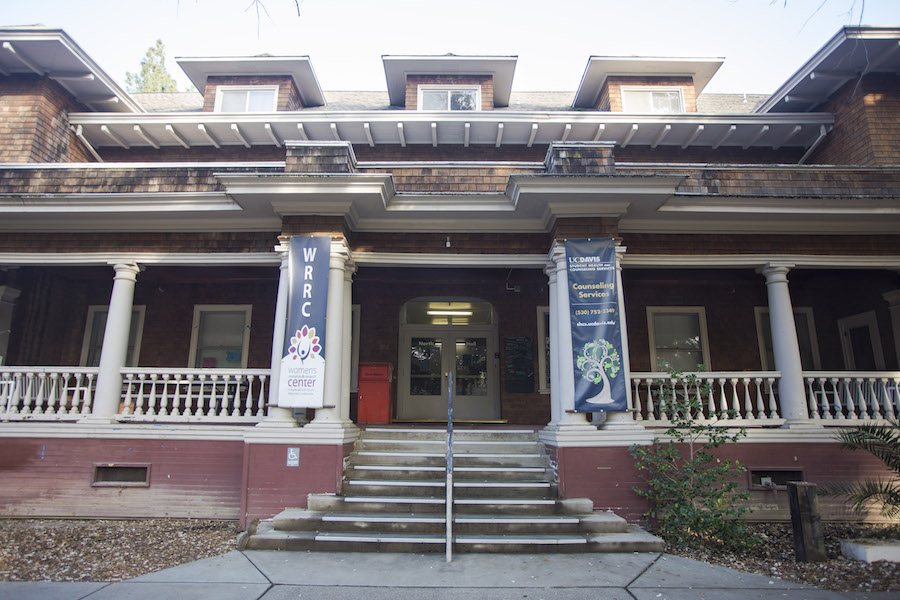
Students wishing to make a individual counseling appointments can either visit the Counseling Center at North Hall or call the Appointment Desk, which is open from 8 a.m. to 5 p.m. on weekdays, except on Wednesdays when it opens at 9 a.m. Generally, appointments are scheduled for the same day, and the counseling center is usually busy, meaning students who call later in the day might not be able to make an appointment at all. There is a relatively narrow window in which to make appointments, and even this window doesn’t guarantee success.

Sedona Patterson, a second-year art history major, was met with frustration when she tried to make an appointment for counseling during her first quarter at UC Davis. She emailed SHCS to voice her displeasure.

“Unfortunately, it is now the end of the third week and after several attempts to make an appointment with somebody or anybody really I have only felt as though I have been turned away,” Patterson said. “I’ve called a couple of times and I tried to make an appointment online and each time there was something that kept me from being able to see somebody and has discouraged me […] I am disappointed because I can only think of the other students here at UC Davis whose case may be worse than mine and are facing the same situation as I am.”

After this experience, Patterson was offered a counseling appointment, but she was left with a bad impression of the system.

“It was the beginning of the quarter, it was just too difficult, too many hoops to jump through,” Patterson said. “After I submitted this complaint I got an appointment close to instantly. I didn’t understand why it couldn’t have been like that the first time around. Like I said, I understood how the system worked but it still didn’t feel right […] making a same day appointment just isn’t very practical.”

It’s hard to determine the cause of problems with campus counseling services, or how they can be addressed. Patterson isn’t confident that the system has done everything it can to make mental health services more accessible and helpful.

“My twin sister goes to Duke University and I would call her complaining about it and she would tell me that she’s having the opposite experience at her school,” Patterson said. “I just kind of feel like the counseling center exists because it has to. But is there are money being put into it? Is the student’s health actually the priority?”

Immediate crisis assistance is always available from SHCS, but for people who don’t feel that they are in crisis, the available counseling can be difficult to schedule and is only available short-term. After a few sessions, those who want to continue counseling are usually referred to off-campus mental health services. Acacia Counseling and Wellness, located in downtown Davis, is one such service.

Acacia Counseling and Wellness is primarily here for the Student Health and Counseling services to be able to refer students with the school insurance (UC SHIP) to us,” said Jonathan Truong, Acacia’s office manager.

Referrals to Acacia or other counseling practices don’t always guarantee access to counseling. Complications presented by insurance and a large population of people looking for counseling mean that finding counseling in or near Davis can be very difficult.

“It definitely can be difficult to accommodate the high volume of referrals,” Truong said. “Not many places accept insurance and that is why it can be so hard to find a provider in the area. We have done our best to hire accordingly to accommodate the volume of referrals, but it’s still hard because some people’s insurance don’t have out of network benefits all the time.”

The large amount of referrals and turnover from SHCS has affected practices even outside of Davis.

“I do work regularly with UC Davis students,” said Laura Gidney, a therapist in Woodland. “I am a part time therapist and because I am a part time practitioner and because there are so few therapists who accept insurance, my practice is almost always full.”

Individual counseling may be difficult for many at UC Davis, but SHCS has other mental health services which may be more accessible; it offers group counseling, the Community Advising Network (CAN), and other resources and forms of counseling.


Written by: Gabriel Mulcaire — features@theaggie.org

Union Pacific considering shutdown of popular I-80 shortcut

JEREMY DANG / AGGIE

Concern over transportation consequences

Union Pacific, the U.S.’s largest freight-hauling railroad, is bidding to shut down or alter County Road 32A, which runs parallel to Interstate 80 across the Yolo Causeway.

Union Pacific points to a series of sharp turns on each side of the railroad tracks at the Road 105 intersection, which make the road dangerous for motorists.

The road is used as a shortcut for commuters from Davis, Sacramento and the Bay Area. A shut down of the road would create one less avenue for drivers traveling across the causeway.

“I use [Road 32A] everyday to bypass the traffic,” said Patrick Maolini, a Sacramento resident who commutes by car across the causeway to get to work in the Bay Area. “Causeway traffic in Davis and Sacramento is only going to become more congested if we shut down the road with any additional alternative transportation investments.”

Protests against Union Pacific’s bid have been filed by the Sacramento Area Council of Governments, the city of Davis and the California Farm Bureau Federation. Each group is concerned about increased congestion on I-80 and a shift in vehicular traffic toward already densely traveled roads such as Mace Boulevard.

Road 32A is not only used for car commuters, but bike commuters as well.

“Although it gets a little unsafe at times, Road 32A is my only way to commute from Davis to Sacramento by bicycle conveniently,” said Leon Kelley, a bike commuter from Davis. “It’d be a shame if I had to find a different form of transportation because of one unsafe stretch of road.”

Recently, local biking advocacy group Bike Davis joined the debate over the potential closure of Road 32A.

“In the spirit of compromise, Bike Davis has developed a proposal to close the westbound lane of County Road 32A to all but cyclists and farm equipment,” reads a legal motion signed by Bike Davis Executive Board President Dan Fuchs.

The possible closure of Road 32A was discussed at a Davis city council meeting on Dec. 5.

“The Road 32A crossing needs to be closed,” said Davis resident Alan Miller at the city council meeting. “It’s very dangerous. The thing is, to close that crossing and not have an alternative is unconscionable. The garbage trucks, ag vehicles and bicycles all trying to go through Mace Boulevard and use alternate routes? It’s insane.”

All five members of city council panel, Mayor Robb Davis, Mayor Pro Tempore Brett Lee, Will Arnold, Lucas Frerichs and Rochelle Swanson, expressed support for a new bicycle structure along the causeway.

Caltrans Deputy Director for Planning Marlon Flournoy stressed that a new bike route will be added before any changes are made to Road 32A.

In November, Yolo County and Caltrans announced they were seeking federal funding for a pedestrian or bike structure for causeway commuters, along with additional carpool and bus lanes on I-80.

A decision on the fate of Road 32A is expected soon, according to Beth Gabor, a county spokeswoman.


Written by: Dylan Svoboda — city@theaggie.org

New ownership for Historic City Hall

JEREMY DANG / AGGIE

Engstrom Properties’ bid accepted for City Hall

The search for a steward to buy the Historic City Hall building in downtown Davis has ended, as Engstrom Properties’ bid was accepted on Nov. 21. The bid was $3.5 million and will be split between the city and public entities, such as school districts.

Before the bid was accepted, the city was contracted with Turton Commercial Real Estate to sell the building. Scott Kingston, the vice president of the company, commented on Engstrom Properties taking ownership of  City Hall.

“We are very fortunate to have received offers from many qualified buyers, and we couldn’t be more excited than to have Engstrom Properties in escrow to buy the building,” Kingston said. “They have a tremendous amount of local retail development and leasing experience.”

Engstrom Properties currently owns, leases and manages several other commercial properties in Davis, including the Covell Shopping Center and El Macero Center in South Davis.

As the City Hall building is now a restaurant, Kingston further elaborated on how Engstrom Properties has the experience necessary to own the building.

“The company also owns, operates and renovated the historic Hotel Woodland in downtown Woodland,” Kingston said. “They have the perfect combination of local presence, retail and restaurant experience and attention to stewardship of the property.”

Kingston noted that the city wanted to maintain the building’s historical presence.

“The City was very focused on finding the right buyer for the property — not just any buyer that could close escrow and collect rent — but finding a buyer that had a resume of owning and maintaining buildings with a similar sense of historic importance,” Kingston said.

As City Hall is in the heart of downtown Davis, Kingston noticed that buyers liked the location of the building and its historical significance.

“Local buyers love the history, timelessness and long-term legacy of the building, while regional and out-of-town buyers were intrigued by its proximity to the UC Davis campus, its unparalleled presence in downtown Davis and the popularity of Bistro 33,” Kingston said.  

Since the building is still in its early stages of having new ownership, Kingston does not believe that there will be any instantaneous effects.

“I don’t believe the new ownership have any immediate plans for the building, as Bistro 33’s lease has a couple years remaining on its existing lease, with an option to extend for five additional years,” Kingston said. “I do imagine that little items will be cleaned up, restored or improved, but nothing significant if Bistro ever vacates the property.”

Brett Lee, the mayor pro tempore of Davis, commented on Engstrom Properties’ ability to maintain the property.

“They also have the resources and staff to hopefully find good tenants and maintain the property and make sure that it’s well run and managed into the future,” Lee said.

Though the city hall building no longer serves its original purpose, the building remains a historical artifact that the city of Davis wants to uphold, according to Lee.

“The city wants to maintain the historic design and look of it,” Lee said. “It’s nice to have something unique around downtown. We were able to make sure that it was decently maintained, and we feel confident that the same thing will occur.”

Lee further stated that choosing Engstrom Properties was a rather easy decision.

“For the city, it wasn’t very difficult all,” Lee said. “We had several different offers to choose from, and we thought that Engstrom’s offer was the best fit. In the long run, they have plans to refurbish and upgrade it.”

Engstrom Properties was then chosen as part of a policy decision based on the city council.

“The selection of Engstrom was done at the city council level because it was a policy decision in terms of who we thought would best operate that property and maintain it as a historical sighting in the town,” Lee said.

A city news release stated that Engstrom Properties was chosen based on its competitive offer price, proven track record of owning and operating high-quality commercial and historic properties, extensive commercial leasing and property management staff, vision for the property, dedication to maintaining the historic integrity of the building and understanding of Davis community values.

According to the city’s statement, Mayor Robb Davis also believes that Engstrom Properties was the right choice.

“We feel Engstrom Properties will be an excellent steward for our Historic City Hall building and are confident they will exceed our expectations,” Davis said.


Written by: Stella Tran — city@theaggie.org


“To Boldly Go” campaign takes aim at UC Davis’ future

TAYLOR LAPOINT / AGGIE

10-year strategic plan started by Chancellor May currently being drafted

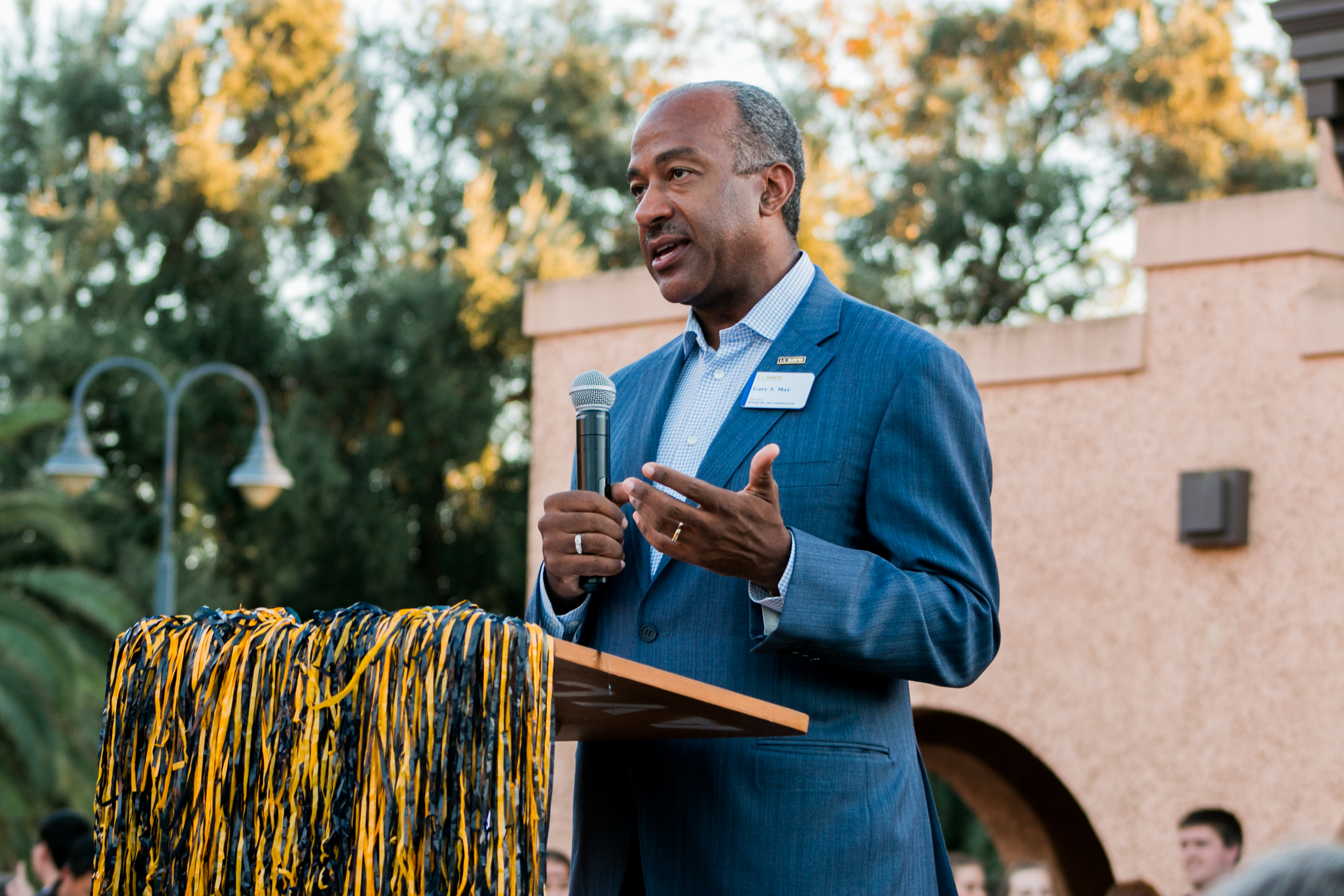
UC Davis Chancellor Gary May recently announced the creation of his “To Boldly Go” campaign, a 10-year strategic plan for the university. The specific details included in the plan are currently being drafted and discussed.

“The strategic planning initiative started in October with the retreat of about 90 or so faculty, staff, students and alums,” May said. “It is now at the stage where we defined the steering committee to gather input of the community and to distill it into some actionable tasks for the plan, and will be drafted and ready for review sometime in April or so.”

The namesake for the strategic plan has its roots in one of May’s most noted passions.

“We thought the title, ‘To Boldly Go,’ [would] be appropriate, because number one, I am a Star Trek aficionado,” May said. “Davis has historically been a place that has been very good in many areas, great at some areas but overall a pretty humble place.”

In regard to the drafting of the plan, May said “a lot of it still has to be determined.”

“The general objective is to raise the profile of the university,” May said. “Some of the early things that I am sure will be part of the plan […include] stronger engagement [with] the city of Sacramento around innovation.”

A stronger partnership between UC Davis and Sacramento is at the forefront of the concept of Aggie Square.

“This idea of Aggie Square will certainly have some appearance in the plan in some form,” May said. “The idea there is for the university to partner with the City [of Sacramento] to engage with the business community and do a better job of taking the many wonderful ideas that come out of the laboratory and get it to the marketplace. One of the main motivations for doing [this] is economic development and job creation. I always thought that innovation [was] one of the most important and sustainable ways to create new industries, new jobs and new opportunities for not only our students but the region and the community.”

Professor Ken Burtis, a faculty advisor to the chancellor and provost and a co-chair of the campaign discussed the purpose and aims of the “To Boldly Go” campaign.

“What this process is about is, ‘Where does the university need to be in 10 years?’” Burtis asked. “We are seeking input to develop a plan. What goal do you have in mind for the university that is a 10-year goal? Having named that goal, what strategies do you think the university should be engaging in in order to achieve that goal? At the level of the whole university, what should we be thinking about? What is out there? What is changing?”

Regarding the timeframe of the campaign, May said there are short-term plans in process at the moment.

“The short-term object is more or less to align all of the stakeholders in the UC Davis environment and get them rolling in the right direction,” May said. “We will probably come up with a small handful — five or six — broad objectives which all aspects of the campus can and should buy into and help them to steer in that direction.”  

May also discussed the diversity of students and faculty members which comprise the steering committee.

“The steering committee has faculty and staff from across the university, and there are also […] graduate and undergraduate student representatives as well,” May said. “We expect everyone [to have] an opportunity to be heard — [that] is the real goal. In addition to the committee, there is the website and the email address where people can send in their ideas.”

Roy Taggueg, a Ph.D. candidate in sociology, the president of the Graduate Student Association and a member of the steering committee, offered a particular appreciation for the inclusiveness of the campaign.

“One thing that I particularly like as a student is that it is pretty comprehensive,” Taggueg said. “[Chancellor May] has somebody in every corner of UC Davis and beyond to basically do all the survey to get all of the information.”

Anthony Bulaclac, an MBA student in the Graduate School of Management and another member of the steering committee, expressed his excitement to be able to contribute to the campaign.

“It is great to be able to play my part in making sure that the leaders [who work] with the chancellor […] make the right decision that will have a positive impact in allowing UC Davis to reach [its] potential for the next 10 years,” Bulaclac said.

Burtis discussed the activities of the steering committee in the upcoming months.

“We figure we are going to collect input over a couple of months, then the committees are going to work for a month to assimilate that input and see if we find some themes,” Burtis said. “And then we will produce a kind of a summary that summarizes what we have come up with […] and [we will] be sending that around for feedback. By April or May, we begin to have […] a finished document that the chancellor will have received.”

May also emphasized the impact strategic planning can have on a university.

“I [have] been involved in strategic planning at various levels for long time, and I always thought it was a good mechanism for not only setting a direction for whatever the organization is, in this case, the University of California, Davis, but also as a way for building the community,” May said. “Bringing people together and helping them drive the same direction. And in many cases, you find that the process of doing that is as valuable and sometimes more valuable than the final product.”


Written by: George Liao — campus@theaggie.org

Counseling psychologists demand market-level salaries during negotiations with UC

JAMIE CHEN / AGGIE

UC Office of the President’s most recent salary proposal effective wage reduction

This article is the first in a three-part series examining issues that counseling psychologists in the UC system are currently facing, including under-market wages, understaffing and high demand leading to systemwide recruitment and retention issues.


Bargaining negotiations are currently taking place between the UC Office of the President (UCOP) and University Professional and Technical Employees (UPTE) over terms relating to employment under the job titles Counseling Psychologist 2 and 3 in the UC system, including and perhaps most notably relating to the under-market pay scale these employees receive at the UC.

When asked why several, if not all, UC campuses are severely understaffed in terms of counseling psychologists, Aron Katz, a psychologist at UC Davis’ Student Health and Counseling Services said “it comes down to money.”

“I love my work, I love being here, but you can go ten miles down the road in either direction and make 20 to 50 percent more,” Katz said. “It’s a tough sell.”

According to Jamie McDole, the vice president of UPTE, the below-market salaries counseling psychologists currently receive, in addition to heavy workloads, are the main factor behind the retention and recruitment issues UC campuses struggle with. McDole said counselors are “stressed, overworked and overburdened.”

“The only way to achieve adequate staffing is to have adequate salary to recruit competent therapists and then retain them,” McDole said.

_______________________________________________

In January, UPTE successfully petitioned the Public Employment Relations Board, a state agency, to add the job titles Counseling Psychologist (CP) 2 and 3 into union membership. Previously, counseling psychologists were not unionized. According to Katz, the distinction between CP2s and CP3s is not “meaningful” — currently, the title of CP3 is used to denote “semi-management positions.”

Two separate processes between UPTE and UCOP are now occurring. Accretion is the process of adding counseling psychologists to the pre-existing healthcare contract (Hx). Since accretion negotiations began, the pre-existing Hx contract counseling psychologists are being added to expired on Oct. 31.

“Accretion negotiation began in January,” said Katz, who is also the UC Davis counseling psychologist representative for bargaining in the accretion process. “In the time it’s taken to negotiate this, the Hx contract has expired, so that also needs to be negotiated. We are fighting to keep those two negotiations separate, because if they were combined, counseling psychologist staff would have next to no influence on our terms because we would make up such a small proportion of Hx members.”

According to Katz, salary negotiations are the “major sticking point to resolving accretion.” The current pay range for CP2s is $66,214 to $119,186 — “but no one is at either end” of the scale, Katz said, “so it’s terribly misleading.” Using the list of counselors posted on the SHCS website, The Sacramento Bee’s 2016 state worker salary database shows most of these full-time counselors received salaries in a range between $86,000 to $98,000.

At a local healthcare provider such as Kaiser, the job title “psychologist” has a pay range of $119,955 to $155,764. UPTE has presented UCOP with a step scale structure of pay ranges for counseling psychologists reflective of local markets. Each UC campus has a different salary structure it is presenting.

“The current step that has been presented to represent UCR is pretty much indicative of other community colleges [and] it also […] takes all those different local pieces into consideration,” said a source from UC Riverside who wished to remain anonymous. “I think the biggest issue that UCOP has with the step salary is that it requires them to pay us more, basically comparable to what people are leaving the UC system for — people are leaving the UC system for higher paying jobs. The only argument is that they have no money or that there’s no funding for it, that it would require too much stretching of the budget to give us comparable pay.”

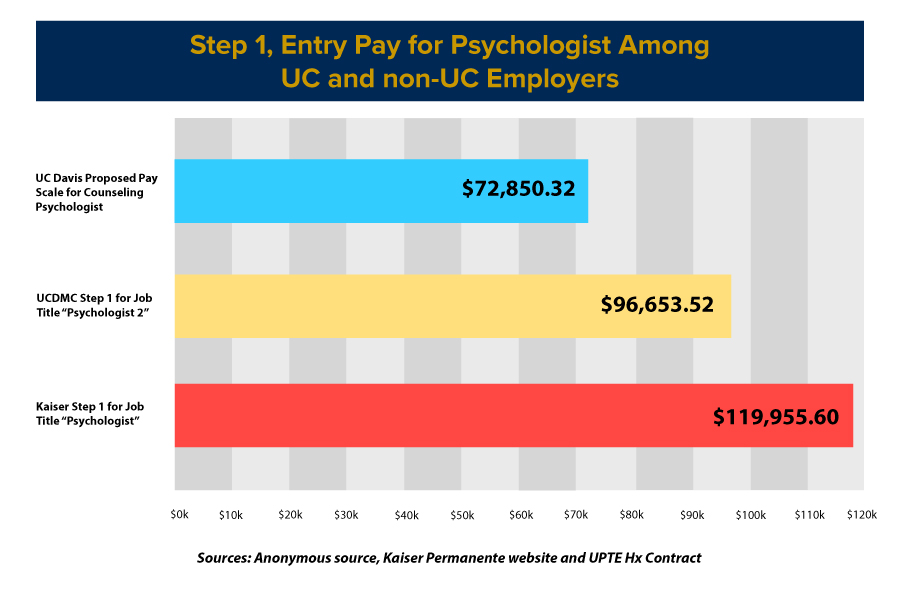
During negotiations, UCOP presented UPTE with three offers. UCOP has proposed a step 1 entry pay of $72,850.32, according to a source who wished to remain anonymous; for comparison, the UC Davis Medical Center’s entry pay for the job title “Psychologist 2” is $96,653.52 and the entry pay at Kaiser for the job title “Psychologist” is $119,955.60. Both UPTE and UCOP are proposing a step scale for salaries — UCOP’s salary proposition would place existing counseling psychologists on a salary step corresponding with the salary range they currently receive.

According to Katz, UCOP’s salary proposals are effective wage reductions. Although counseling psychologists could potentially receive a small raise, when union dues and an increased contribution to the UC Retirement Plan are taken into account, there is “a reduction in the take home pay.”

According to UC spokesperson Stephanie Beechem in an email interview, the UC has, since March, “offered multiple fair and reasonable proposals on wages, benefits and other employment matters in order to reach a settlement.”

In 2016, the UC Office of the President publicized and promoted a mandate which stated that, by 2018-19, an additional $18 million would be allocated to the mental health budget to “support hiring 85 mental health clinicians” UC-wide. Counseling psychologists in the UC system are funded by student fees. The additional $18 million allocated to the UC’s student mental health budget is comprised of “an increase in the annual student services fees,” according to the UCOP website.

UC states that salary funding is limited to student fees (which students recently voted to increase for additional availability of services),” McDole said via email. “That limit is set by the university and there is no reason, other than an arbitrary university decision, that mandates the limited funding source. We have brought this up many times in bargaining, but the University continues to limit funding.”

Beechem did not respond specifically to the question: “If there is an additional $18 million in the mental health budget, why is UCOP’s most recent salary proposal for counseling psychologists unreflective of local markets?” Beechem did say that the UCcontinues to negotiate in good faith.”

McDole and Rodolfo Victoria, a senior staff psychologist and the bargaining representative from UC Irvine, however, both allege that UCOP has engaged in bad faith bargaining.

We thought, coming into this, that we would be negotiating in good faith and that has not been the case,” Victoria said. “There seems to be a very strong reluctance to negotiate with us in any kind of meaningful way. They initially had offered to lower our salary and then now they’re at a place where they’re trying to present themselves as very generous and offering to give us a raise that we would have been entitled to under the […] system that we were under. They’re trying to say that we are a valuable resource on campus, but yet, when we ask them to […] at least give us fair and competitive market wages, they have been incredibly reluctant to do so.”

In a memo from June 1, composed and sent by Dwaine Duckett, the vice president of human resources for UCOP, he claimed “UPTE has presented a wage demand UC believes is unrealistic that would almost double costs for our Counseling and Psychology Services and Student Health Centers.”

“That is false,” McDole said about Duckett’s claim. “I think if we did all the full calculations of what we are proposing, [it] is overall approximately a 30 percent increase in total costs. We did the math, they didn’t.”

Duckett was unavailable for comment.

An online petition titled “Petition for Good Faith Bargaining With Campus Counseling Psychologists” states that the “UC has lost staff due to the lack of competitive campus wages, which has substantially decreased the availability of mental health staff for students. The intensity of student needs is increasing to the point that we, the staff, fear for our safety and that of the students and campus community.”

A counseling psychologist from UCLA, who wished to remain anonymous, said they signed the online petition, which has over 200 signatures, because, after working “at a number of different counseling centers, […] there’s something about the fear and dispirited, disjunctive culture that is palpable here.”

Several counselors at multiple UC campuses said both they and their colleagues feel that the UCOP sees counseling psychologists as replaceable. Victoria said, at UC Irvine, “there’s already a huge morale burnout issue on our campus.”

According to Katz, a UC employee asked UCOP’s Chief Negotiator Patty Donnelly at a meeting during negotiations “if recruitment and retention of counseling psychologists is a bargaining interest of UCOP” and Donnelly said “no.”

Donnelly was not available for comment. Beechem did not respond to the specific question: “Is the recruitment and retention of counseling psychologists a bargaining interest of UCOP?”

“We get the message that we should be grateful to work for UC and that if we’re not happy here for any reason, that we should just consider leaving,” said a counseling psychologist from UC San Diego who wished to remain anonymous.

The same UCSD counseling psychologist said, as negotiations drag, there is the risk of losing more staff — “I’ve already heard murmurings about people looking elsewhere and feeling frustrated.”

Another meeting for accretion negotiations is pending scheduling for Jan. 12. Asked how hopeful he was that negotiations would be completed within the next month or two, Victoria said “not very.” McDole said, most recently, “the university has proposed scant increases that in no way moves therapists toward market wages.”

At this point, there has been informal discussion of a strike among several individual campuses.

“I can say that […] we are quite frustrated with how things are going and the lack of progress on UCOP’s end,” Victoria said. “There has been talk about [striking]. We obviously would like to avoid that at all costs — we don’t want the students and the campus community to be impacted by this. But at some point, if this continues like it has been, that’s obviously an option we’ll have to consider.”


Written by: Hannah Holzer — campus@theaggie.org

Humor: The festival of no lights: Celebrating the holidays in maybe the world’s darkest city

PEBBLEPICJAY [CC BY 2.0] / FLICKR
Davis’ very own holiday traditions

Because the majority of the Davis student population took their finals and immediately escaped as quickly as possible in hopes of forgetting all their negative associations with a quarter of terror, the holidays in Davis exist as kind of a mystical and untouched topic that nobody knows anything about.

As a result, a question that many people might be curious about is: What do the holidays look like in Davis? And as someone who also wasn’t in Davis for any of the holidays, I’m writing this article based simply on the pattern of oddities and peculiarities that Davis seems to add to everything normal.

When Davis decided that it wanted to be a “Dark City” with minimal light pollution while also being the world’s biggest Bike City (excellent combination — what a quirky and cute town!), its relationship with lights took a weird turn. In regards to this, I strongly believe that the communal aspect of Davis comes solely from the bond that students hold in knowing what it’s like to bike in the pitch dark with a malfunctioning bike light that was given to them by a kind and lovable police officer following the $100 fine they received for not knowing that bike lights were required during sunset hour. It’s a bond that everyone shares. “How does this relate to the holidays?” you ask. It doesn’t, but I think it’s something that had to be addressed.

Anyways, the holidays in Davis are probably strictly monitored, and the citizens are only allowed to use recycled light energy (I don’t think that exists, but it might) and bike lights to decorate their houses. For those who celebrate other holidays that feature candlelight, Davis probably requires permits and permission from the neighborhood association, just to make sure that you’re not taking away from the natural “darkness” of the city that everyone loves. While these things may seem excessive, Davis will put a cute spin on it that shows how its efforts in stifling the holiday season are progressive and necessary to fostering an environment that welcomes all expressions of minimal light.

There are ways to go around these strict rules of course, but they require a mix of contraband and commercial holiday products. Since you probably live next to a professor who is already living in their own zero-waste, zero-light-pollution ecosystem, you probably don’t want to risk the embarrassment and judgment of celebrating the holidays in a conventional way.

My advice is that, while Davis probably offers its own charming and unique version of typical holiday traditions, it’s probably better that it’s left as an unknown conjecture rather than another one of those scarring Davis experiences we’ve all come to know and love.


Written by: Rosie Schwarz — rschwarz@ucdavis.edu

(This article is humor and/or satire, and its content is purely fictional. The story and the names of “sources” are fictionalized.)

The case against travel visas: –– and why they impede cultural exchange

SHEREEN LEE / AGGIE

Stringent visa policies harm the average citizen more than we realize

Let it be known that travel visas are a nuisance. Sure, they mark passports in exotic hues of purple, green and red like trophies in your own personal case. To some, indeed, a chalked-up passport is the ultimate beacon of globetrotting success. Yet visas remind travelers how even the momentary thrill of traversing international boundaries can be marred by bureaucracy. They can also be agonizingly painful to get.

Documents allowing safe passage through foreign lands are nothing new. The book of Nehemiah in the Hebrew Bible tells of an official who requests “letters” for his journey to Jerusalem, most likely in the 5th century B.C. Henry V of England issued a document of “safe conduct” in 1414. Following the First World War, what we call passports today became much more ubiquitous and standardized, deemed necessary by Western governments for managing the flow of immigrants and refugees fleeing destruction in Europe. It’s this little booklet that determines who can go where in the global theater.

Buried within passports are the visa pages, where a sticker or stamp allows the traveler to cross national boundaries according to local rules (sometimes an electronic visa accomplishes this instead). There are short-term visas for things like tourism, business trips and medical visits as well as long-term visas that are issued for studying and working.

Visas, in their current form, allow immigration officials to siphon through and keep track of foreign visitors. There can be good reasons for doing this. Visas are often imposed on citizens from countries mired in unrest, violence and terrorism — an added layer of security that may prevent such hostile elements from spilling over.

On the other hand, diplomatic quid pro quo gives governments leverage over the actions of travelers when global politics takes center stage. If country X imposes strict entry requirements on citizens of country Y for its territorial aggression, for example, country Y can reciprocate by issuing more stringent visa policies in retaliation. Government egos may leave unscathed, but cooperation — and all its benefits — takes a hit.

Tourism also suffers. Bearers of an Israeli passport are barred from entering a host of Middle Eastern countries, and even presenting an Israeli entry stamp in a non-Israeli passport will prevent access to Iran, Kuwait and Lebanon, among others. Exploration and friendly overtures between cultures is more difficult with harsher visa and passport laws.

Many visa requirements are quite stringent, which can discourage potential visitors. To acquire a visa for Russia — which I’m in the middle of doing for my semester studying abroad — applicants must navigate a complex system of questions and bureaucratic backlogs. Visa applicants must obtain an invitation letter from a Russian organization or host resident. (Mine took eight weeks to arrive, and I was helped by a third party.) The online questionnaire can take hours and includes personal questions about prior military service, work experience and whether the applicant has ever been involved in charitable or “civil” organizations. Those staying longer than 90 days are required to supply a blood test proving they don’t have HIV. To many travelers, this can seem daunting.

Though visas are required for many wanderlust-worthy journeys, there are some exceptions where diplomatic alliance-making has eased international travel. The Schengen Agreement — stemming from the resurgent friendliness of France and Germany in the decades following the Second World War — allows holders of the singular Schengen Visa to travel throughout its 26 European member states essentially visa-free. The United States has a visa waiver program that allows nationals of 38 countries to visit with only an Electronic System for Travel Authorization form instead, which bypasses the entrenched slowdowns of the visa application.

Other such agreements exist, and they usually benefit everyone involved. Governments find an easy way to publicize their cooperation with one another. Citizens can forego the red tape and reap the rewards of simple travel. Businesses are allowed to expand into zones that once inhibited their growth potential (which is why the coming Brexit negotiations on trade are so consequential).

In the age of explosive border-wall talk and rocket men, the doors are closing on an era of openness and globalism. Visas are a case in point. They enhance the barriers between nations and do nothing to help the little guys — ordinary people looking for pleasure, knowledge or survival on the other side.


Written by: Nick Irvin –– ntirvin@ucdavis.edu

Disclaimer: The views and opinions expressed by individual columnists belong to the columnists alone and do not necessarily indicate the views and opinions held by The California Aggie.

The ways we’re raised: Free-range and helicopter parenting

YAN SONG [(CC BY-SA 2.0)] / FLICKR
How parenting styles affect us as students — and why we don’t need to be subjected to them

Many of us have read Amy Chua’s provocative Wall Street Journal article “Why Chinese Mothers Are Superior.” Chua was the original Tiger Mom — fearlessly describing what was a hidden reality for many students. On this campus, Aggies come from a variety of backgrounds: Some had helicopter households, and others — for want of a better word — free-range ones. Yet, despite the diversity in upbringings, most Aggies are very ambitious and successful in their academic pursuits. So does the way we’re raised factor in how successful we are and how well we run the rat race?

Growing up a stone’s throw away from the Apple Campus in Cupertino, I was in what is the heart of tiger parent territory. And despite the prolific studies since 2011 on how helicopter parenting can cause more strife in families than good for children, nothing really changed post-Chua’s cathartic article. Some of my friends came from households that mirrored Chua’s — no playdates, sleepovers, computer games. And at that stage, it made a difference. When children are given clear and rigid expectations, they don’t have much of a choice — they meet them or face the consequences their parents lay out.

But jading children so early, making them feel there is only one option and a singular path to success is undoubtedly detrimental. I grew up in a household where my parents didn’t helicopter — more of “satellite-d.” Meanwhile, the children who had free-range parents did just as well; their drive was completely internal, and their perspective was remarkably mature. This isn’t an anomaly: Studies continue to show that “troubled teens” come as much from authoritarian households as permissive ones.

“When children are caught in between their parents’ old way of parenting and being and culture and the new in the U.S., then that can be very, very tough […] in a variety of ways,” said Desiree Baolin Qin, a professor at Michigan State University who has done extensive research on tiger parenting. And she’s right. It’s mostly the immigrant households that helicopter — the fears parents have for the success of their children in a new land with a system so different from what is familiar and indubitably scary are well founded. When I graduated from high school, 90 percent of my graduating class were students of color, 85 percent of Asian descent. Most of us were immigrants and first-generation Americans.

What bothers me is that the insecurities of our role models shouldn’t be forced upon us. As students, we are encouraged to introspect and address personal issues — for many high schools, with at least one counselor or therapist. Yet once students leave for home at the end of the school day, they must carry the burden of their parent’s unfamiliarity. And then there are the parents who are just competitive, pushing their dreams on their children’s tender shoulders. Not only does this create students who are cold and hard to the world, but they also get an unbalanced idea of what success means and how to achieve it.

The approach to education and overall attitude and demeanor of my peers was the largest change upon starting college. And while many of us who grew up where cutthroat competition was the norm breathed a little easier, some of my peers found the transition harder. Most students don’t have their parents by their side at this stage in their college career, so it isn’t tiger parents who push their children — it’s grit and self-drive. Whether we hit the ground running or not, by graduation, most of us find our groove. The advantages of growing up in a high-stakes household diminish as the playing field evens ever so slightly.

My plea to students is to maintain perspective — what was the norm in youth is no longer. And the definition of success and failure is fluid. Only for so long is the influence of parents significant for the habits of an Aggie. It’s up to us to choose what drives us and gives us the push to become the best versions of ourselves.


Written by: Sam Sridharan — smsridharan@ucdavis.edu

Disclaimer: The views and opinions expressed by individual columnists belong to the columnists alone and do not necessarily indicate the views and opinions held by The California Aggie.

New Food Group For Chickens: Larvae?

DAVID MADEY / COURTESY

UC Davis Poultry Farm supplements chickens’ diets with black soldier fly larvae to boost nutrition, make farm more sustainable

Since the world population is expected to reach 9.7 billion by 2050, food production will be a major challenge in the upcoming decades. Ongoing research at UC Davis is examining whether larvae can replace corn and soy in chicken feed, shifting those resources away from livestock and into human food production.

In 2015, the USDA allowed farmers to use synthetic protein in chicken feed to ensure that hens are obtaining the essential amino acids for their diets. Dr. Maurice Pitesky and his team of researchers are testing whether black soldier fly larvae can be used as an equivalent protein supplement.  

Organic poultry diets tend to lack methionine, an essential amino acid required for egg production.

“So what we’re trying to do is find an organic supplement,” Pitesky said.

And that’s where the black soldier fly larvae came into play. The question is one of taste — whether fly larvae will affect the taste of eggs.

“We want to see if feeding the chickens black soldier fly larvae impact the productivity and welfare of the chickens and the taste and quality of the eggs,” said Pitesky, whose focus is on poultry health and food safety epidemiology.  “A lot of that we can do in the lab, but the taste test we have to do in the field. The best way to measure any changes in the taste is via taste tests.”

The taste tests were performed at the Memorial Union about a month ago, hoping to unravel the mystery of this question. It was a double-blind test, which meant that the distributors and participants were unaware which eggs came from hens with and without the larvae supplement.  

Each participant was given three pairs of sliced hard-boiled eggs on a paper plate, and asked if there was a difference in taste between each egg.  Anny Huang, a recent UC Davis animal science graduate, and Nicole Fernandez, a fourth-year animal science undergraduate, tabled at the Memorial Union and shared their research scope with fellow Aggies.  

“We’re trying to ensure there are no weird flavors in the eggs,” Fernandez said.  

This sentiment is not surprising, as there have been effects on taste in the past.  

The organic industry have used other forms of synthetic protein, like fish-meal, “and that’s actually affected the taste of the egg,” Huang said. “So we just want to make sure that isn’t happening with black soldier fly larvae.”

The next focus of the research will be on the taste of the chicken meat.  The egg data is ready for analysis and the meat taste tests will soon follow.  

Cost is a another relevant question.  Naturally, egg producers want to know if using black soldier fly larvae as a supplement would increase or decrease costs.

“We are in the ‘proof of concept phase,’” Pitesky said. “Once we have determined that the diet is effective, then we will address issues of scale.”  

The hope is that the insect supplement will provide as many essential amino acids as traditional feed, and not affect the eggs and meat in the process. In a larger market, larvae could potentially replace traditional corn and soy in animal feed, shifting those resources away from livestock and into human grocery products.

“We’re trying to find a viable option,” Huang said.  

One-third of all produced food goes to waste, while nearly 13 percent of the world population is undernourished.

“If we are able to displace 5,10, 15 or even 20 percent of a chickens ration, which is normally made up of corn and soy, with something that humans don’t consume, like black soldier fly larvae, then we can produce eggs in a more sustainable fashion,” Pitesky said.  

The UC Davis Poultry Farm, located off of Old Davis Road, houses 170 chickens, and each one lays about an egg per day.

“The goal is to make this farm as sustainable as possible economically […] and make the farm pay for itself. That’s the real challenge,” Pitesky said.  

The poultry farm is also a local food provider, selling some of the meat and the eggs to Campus Dining Services as well as the Yolo County Food Bank. The eggs studied for research are not sold commercially. However, should the larvae not impact the taste of the egg or meat, the FDA could allow black soldier fly larvae in chicken feed.

In the spring, Huang and her colleagues, along with Pitesky, will be presenting some of the results at the Western Poultry Disease Conference .


Written by: David Madey — science@theaggie.org

Women’s basketball leaves Hawaii out at sea

0

Bertsch, Anderson prove too much for Hawaii lineup

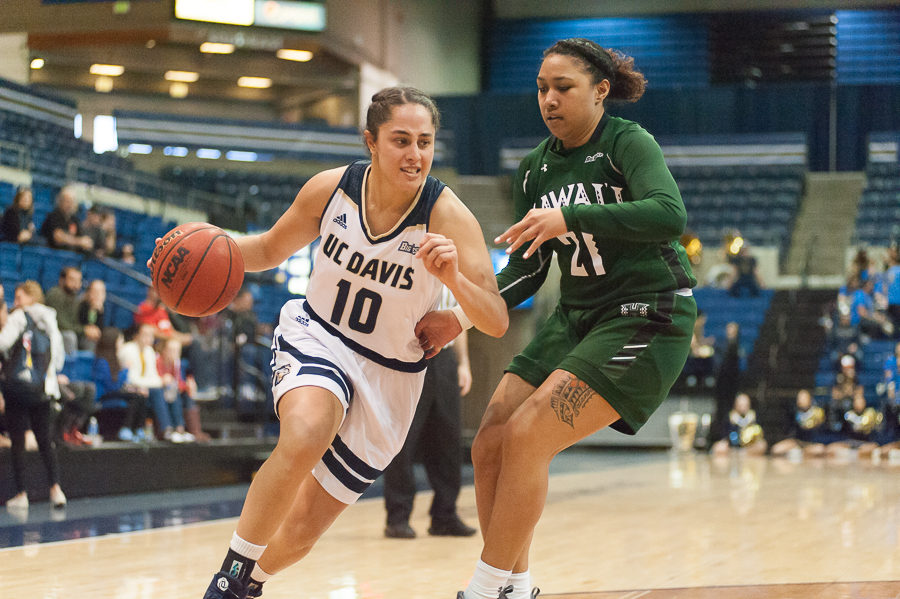
After beginning conference play with valuable a win against Irvine, the UC Davis women’s basketball team headed into its second conference game hoping to build off of the much-needed victory. With Hawai’i coming in having lost four of its last six games, the Aggies needed to take advantage of their opponent’s weaknesses as they fought to correct some of their own. The team responded well to the challenge, and the result was a 76-52 win that extended the Aggies’ conference record to 2-0.


While conference play is what matters most in terms of winning championships, losing three of the previous four games heading into the heart of the season was not the ideal way to wrap up the preseason. But according to junior forward Morgan Bertsch, it was up to the team to put the losses behind it and learn from every hiccup along the way keeping the end goal in mind.


“I think we’ve come to realize that conference is a whole different ballgame,” Bertsch said. “A lot of times during the preseason, people don’t know who you are. […] And when you come to conference, everyone knows who you are and everyone knows all your plays.”


The game began without much urgency. After trading baskets with Hawai’i for much of the first quarter, the Aggies took a 17-16 lead on a three-pointer from sophomore forward Nina Bessolo and didn’t look back. Keeping it close for much of the first half, the Aggies broke apart from Hawaii and added another win to their conference record by 76-52.


“I thought we came out just a touch sluggish in the first half,” said head coach Jennifer Gross. “We talked at halftime about really needing to have great urgency and energy in the second half and I thought our team really responded.”


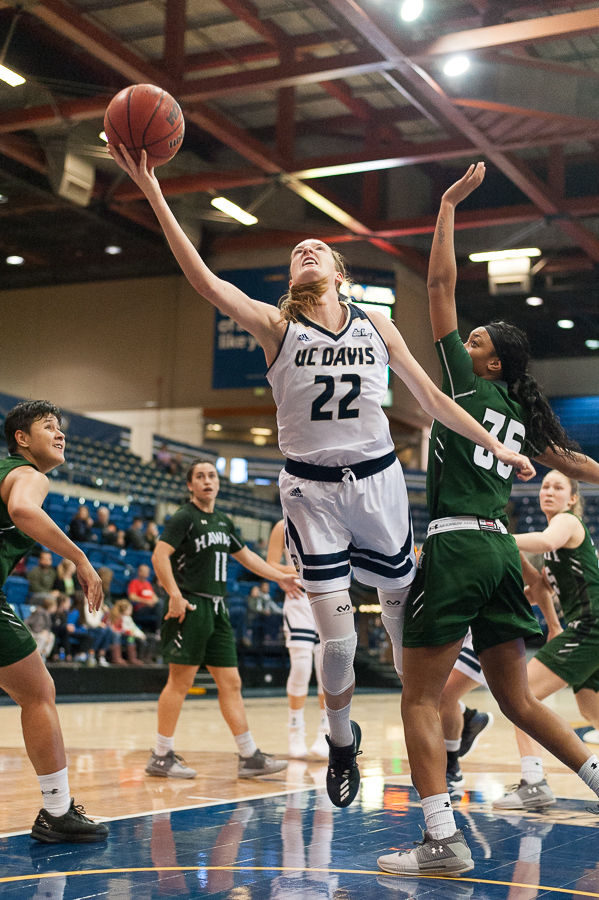
It was a balanced effort from the Aggie players, with valuable production coming from a variety of different places. Bertsch found her offensive groove early and kept on rolling, leading the Aggies with 26 points and six rebounds. It was Bertsch’s time on the court with redshirt senior center Marly Anderson that helped the Aggies break out in front of Hawai’i when the game was still close. Anderson finished the game with 13 points on a 6-6 from the field to go with nine rebounds and two blocks.


“We’ve been kind of trying to find more and more opportunities to use that combination,” Gross said. “With Hawai’i’s size, it worked for us today, and today it put the opponents in a tough spot, because we have two big scorers inside and we can kind of look for the right matchups, so we’d like to try to find more time for them to get to play together.”


Anderson echoed Gross’s analysis of the duo, acknowledging that it helps not only the team, but she and Bertsch as well and opens the floor up for each of them to play to their strengths.


“It makes it hard for the other team,” Anderson said. “They have to play two posts against us, and that’s not the usual lineup, so I think it messes up their lineup a little bit.”


It was not, however, a two-person game. Bertsch and Anderson got lots of help from their teammates, as the rest of the roster chipped in where they were needed. Senior forward Pele Gianotti and first year forward Cierra Hall each chipped in 10 points. The rest of the team added to the scoreboard at critical moments and kept the crowd in the game. Notably, a late game trey by junior guard Karley Eaton to give the team its 76th point sent the crowd into a frenzy as the promise of free pizza was announced over the speakers.


The Aggies will next take the court at UC Riverside at 7 p.m. on Thursday, Jan. 18.


Written by: Bradley Geiser — sports@theaggie.org

Review: D Street Steakhouse

NICHOLAS CHAN / AGGIE

New downtown steakhouse provides variety, struggles to excite

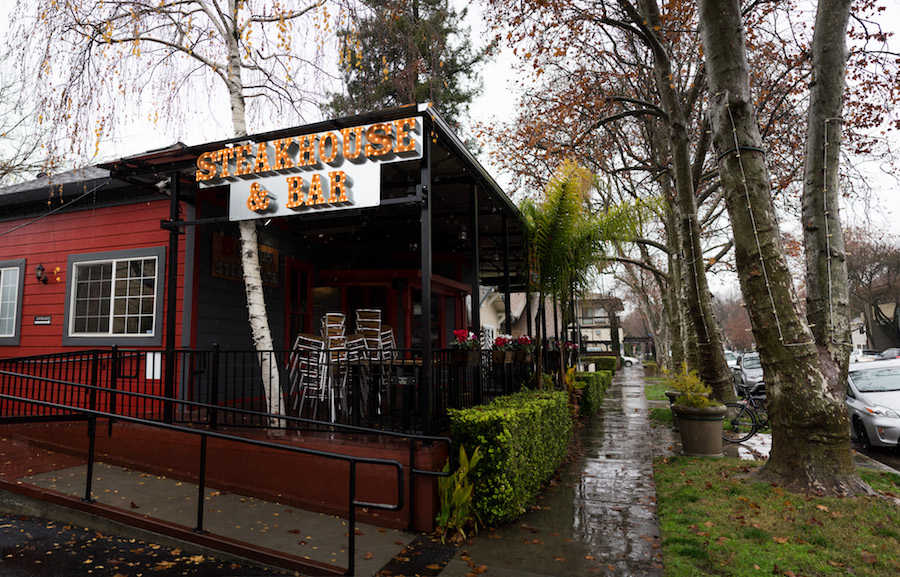
Davis welcomed its first steakhouse to the downtown area this fall. As many would guess, D Street Steakhouse is located at the junction of D and 1st street. You’ll know you’ve found the spot when you turn the corner and spy the outdoor patio adorned with a large, beaming “Steakhouse & Bar” sign. The Aggie stopped by to see what D Street Steakhouse offers.

The moment you enter the steakhouse, you’re struck by the sweeping bar to the right and the intimate environment of the dimly lit tables just down the hall. At times, D Street Steakhouse has had live music, and upon my arrival, there was a small jazz band playing in the corner of the bar area. Even after being seated in the back of the restaurant I could still hear the music throughout my meal. With live music in restaurants becoming an increasingly rare phenomenon, it was a lovely addition to the dining environment.

That being said, it quickly became apparent that D Street Steakhouse is understaffed. There were seemingly two employees with the responsibility of hosting, waiting and running the bar. It simply wasn’t enough. The wait for a table was long even with a reservation, service was slow and the employees were clearly (and understandably) stressed. While this is an easily fixable trait of the restaurant, it will negatively impact the entire D Street Steakhouse experience until addressed.

Given the nature of the restaurant, I ordered the “D Street Sirloin” steak. However, there are many options on the menu including several other steak options, seafood, burgers, poultry, salad and more. The steaks come with a side of fries and a house salad. The fries were delicious and the salad, while small, was fine. The steak was quite good, slightly overcooked for the rare that I ordered, but nevertheless I could tell that the quality of meat was top notch, and I enjoyed the main course.

To round out the meal, I tried the tres leches cake. The slice of cake arrived on its side in a bowl full of sweet milk. I was skeptical and rightfully so. While the taste was fine, the texture left much to be desired. I felt as though I was eating a bowl of cereal. To put it simply, the dish needs work.

Ultimately, my time at the D Street Steakhouse was positive. While my meal was not perfect, the steak was good and the atmosphere was nice. As a restaurant in its infancy, I see potential in the D Street Steakhouse. The space achieves elegance in a simple way that Davis residents will appreciate, and the restaurant’s cuisine and staff have plenty of time to grow. If you’re looking for a slightly upscale night in the downtown area, this can be your destination. However, be sure to temper your expectations, as this restaurant is a serious work in progress.


Written by: Rowan O’Connell-Gates — arts@theaggie.org