55.4 F
Davis

Davis, California

Monday, December 22, 2025
Home Blog Page 569

New contract allows UC Davis to continue cache slough study

0
SOLANO COUNTY WATER AGENCY / COURTESY

Solano County Water Agency taking over state contract to fund research

In early December of 2017, it was announced that the Solano County Water Agency agreed to a $1.2 million three-year contract with UC Davis to study the Cache Slough Complex, a network of sloughs and creeks in the North San Joaquin River Delta. This replaces the previous state contract with UC Davis that began in 2012.

“SCWA has been keeping millions of dollars in reserves for many years,” said SCWA Board Chair and Mayor of Suisun City Pete Sanchez. “SCWA must invest some of those reserve monies in ventures like this UC Davis study. The bigger chunk must be devoted to levee management, flood control projects, habitat conservation and whatever other projects that will ultimately result in fulfilling SCWA’s declared goals.”

Since the Cache Slough Complex is crucial to the urban and agricultural water supply of Solano County, gaining a stronger understanding of the hydrodynamics and biodiversity of the Complex is an important goal. However, it is difficult to draw more meaningful conclusions if the research cannot be continuously conducted over longer periods of time.

“It is important to continue funding this research so we can have a longer time series,” said Dr. John Durand, a researcher for UC Davis’s Center for Watershed Sciences and the principal investigator of the study. “We want to continue monitoring this area because of the high level of primary productivity from zooplankton and phytoplankton [and because] it was surprising to discover that there was such a high proportion of native fishes here.”

The Cache Slough Complex’s high productivity has helped it to be identified as an ideal location for conserving and restoring habitats.

“There is great interest in this region because these waterways [in the North Delta] are remnants of historic slough networks that have largely been leveed and bypassed,” Durand said. “Compared to areas of the South Delta, the Cache Slough Complex is very productive [and] alien fishes have become naturalized and are able to coexist with native fishes.”

Roland Sanford, a general manager at the SCWA, also noted the historic significance of the Complex and explained other factors that make it unique to other areas of the Delta.

“The Cache Slough Complex is evidently one of the last large areas with significant ecological and physical remnants of the historic delta,” Sanford said. “Furthermore, much of the topography is gently sloping, which better accommodates sea level rise vis-à-vis creation of tidal wetlands.”

This is in contrast with areas of the southern portion of the Delta that are complicated by more extreme land subsidence. Fish in the South Delta also face the challenge of getting pulled into the pumps that bring water from the Delta into the California Aqueduct. According to Durand, much of the South Delta is considered to be “lost,” but both he and Sanford are optimistic about the potential opportunities in the north.

“From our perspective, the fact that the results of the state sponsored study and others indicate that the Cache Slough Complex has significant ecological value and potential for restoration/enhancement is important, simply because so much of Solano County’s water is in some way connected to the Cache Slough Complex — either the water comes directly from the Cache Slough Complex or flows through it,” Sanford said. “Through the continuing work of Dr. Durand and others, I am hopeful that we will identify actions that can be taken to preserve if not enhance the ecological value of the Cache Slough Complex while meeting critical water supply needs.”

The North Bay Aqueduct is responsible for transporting water from the Complex to urban and agricultural water users in Solano County. Unfortunately, this water is high in organics and has poor quality, and therefore must be treated more heavily than the cleaner water of the Sacramento River, but Sanford said that the study will do more water quality and biological sampling near the NBA’s intake at Barker Slough.

“At the moment it remains unclear what can be done to improve the NBA’s source water quality and more specifically, the degree to which ongoing and future habitat restoration efforts may or may not impact NBA source water quality,” Sanford said. “Hopefully Dr. Durand’s work will provide some insight to those questions.”

With the threat of climate change, there is more uncertainty about water levels in the Delta as well as water availability because of different patterns of severe wet and dry years. The researchers and stakeholders like Dr. Durand and water users served by the SCWA hope that this study will help reveal the best ways for agricultural operations and cities to sustainably coexist with healthy, productive ecosystems in the future.


Written by: Benjamin Porter — features@theaggie.org

Planning for Picnic Day on track for 2018

AARON KEOKHAM / AGGIE FILE

Picnic Day organizers announce theme, grand marshals

This year’s completely student-run Picnic Day will take place on April 21, 2018. The theme will be “Where the Sun Shines.” Aaron Garcia, a second-year biological science major and the publicity director for Picnic Day, commented on how the theme was chosen and the reasoning behind it.

“This year’s Picnic Day theme is a collective idea that the 16 directors of the Picnic Day board came up with,” Garcia said. “When we were brainstorming ideas, we tried to think of words that describe UC Davis and Picnic Day. Because Picnic Day is really a student-led event in terms of planning Picnic Day and the people that are participating in Picnic Day, we believe Picnic Day is a day where students can shine like the sun.”

Picnic Day is being advertised on a number of social media platforms, including Instagram, Facebook, Twitter and Snapchat. Instagram and Facebook have been used to share recent news about Picnic Day, and any one of these platforms may be used to contact those in charge of Picnic Day with questions.

Along with the theme, this year’s parade grand marshals have been announced as recently-retired Professor Thomas Famula and Director of Student Health Services Dr. Michelle Famula.

“We have chosen [Professor and Dr. Famula] as our parade marshals because of the long-lasting impact they have had on UC Davis and on our community,” Garcia said. “Professor Famula has taught the introductory animal science course in the past and many, many students have loved him. Dr. Famula has been trying to protect the health and safety of UC Davis students over her career at UC Davis. We also chose them because of their warm and welcoming personalities.”

Professor and Dr. Famula have been a part of UC Davis for over 30 years and have participated in countless past Picnic Days.

“We marched with the student health program and the peer health educators that would be represented in the parade dressed up as vegetables for healthy eating,” Dr. Famula said.

Professor Famula has helped with the animals used during the day and both he and Dr. Famula have participated and marched in the parade in the past.

“Whether it’s doing displays or participating in the parade, anything we’ve done in [the Department of Animal Science] has been because the students have asked us,” said Professor Famula.

The two said they are both very excited to be a part of this year’s Picnic Day.

“When I first saw the email, I thought it was a hoax,” Professor Famula said. “We were stunned and so thankful to have this opportunity. It means so much, because it is really the students who do everything for Picnic Day, including picking the grand marshals.”

The parade grand marshals are tasked with certain duties, which Dr. Famula elaborated upon.

“We have to judge the floats and give a little speech at the opening ceremonies, and we get to sit in a car and wave as marshals,” Dr. Famula said.

Those in charge of Picnic Day are attempting to incorporate improvements and new ideas into the event this year — a few of which Garcia mentioned.

“We had food trucks last year, but […] 17 of them with very long lines,” Garcia said. “We are trying to have more food trucks come in so that we can avoid those long lines and have more of a variety of food. We’re also looking into the possibility of mobility vehicles to drive around the elderly and those with disabilities so that they could go to any events or activities they would like to more easily.”

Applications to assist with the planning and running of Picnic Day can be found on the UC Davis Picnic Day website and are due on Feb. 1.


Written by: Sabrina Habchi — campus@theaggie.org


Terms In Review: Four ASUCD senators conclude their fall 2016-17 terms

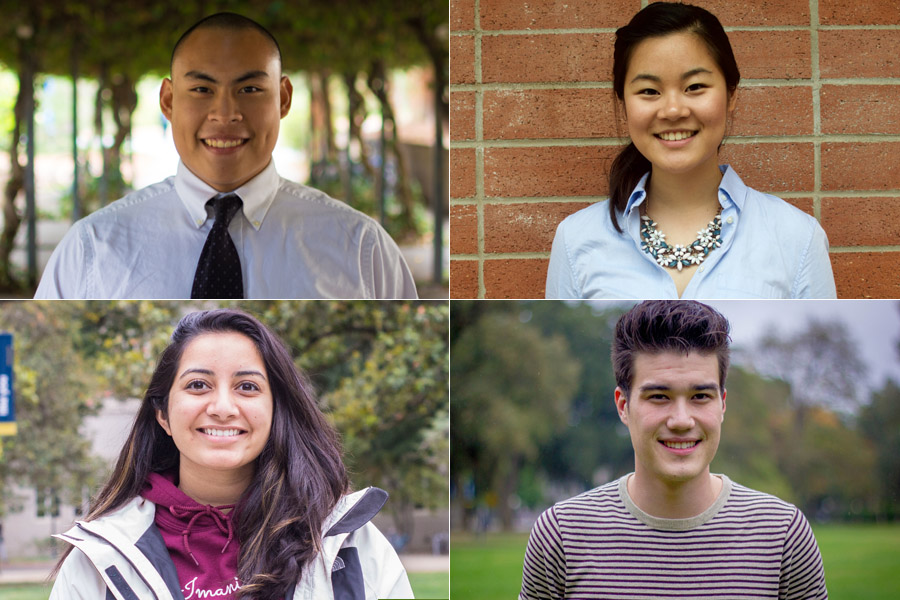
Jose Antonio V. Meneses, Julie Jung, Matthew Yamaguchi, Simran Grewal (DANIEL TAK, CAT TAYLOR, KELSEY GREGGE, AMY HOANG / AGGIE)

Reflecting on Julie Jung, Jose Meneses, Simran Grewal, Matthew Yamaguchi’s individual platforms, accomplishments, shortcomings

The California Aggie reflects on four ASUCD senators who completed their 2016-17 terms in office. After each student’s respective victory in the 2016 Fall Elections, each of the four had a year in the Senate to address their platforms and efficiently represent their constituencies.


Julie Jung

Julie Jung joined the ASUCD Senate table in October of 2016 as an interim senator for Georgia Savage. She ran, and won, the Fall Election of that year and began her one-year Senate term with platforms on basic needs, security and advocacy for unit representation.

“The reason I applied for the interim seat was mainly because I had worked in former president Alex Lee’s staff, who was the president before Josh,” Jung said. “He had us focus a lot on units.”

As a full-time senator, Jung adopted 10 units — she worked primarily with Creative Media, Unitrans, The CoHo, Entertainment Council, The Pantry, Picnic Day, Aggie Reuse, Refrigerator Services and the Experimental College.

When asked if attention to units has become more prevalent in ASUCD, Jung said yes, citing the realigned focus onto units at the Senate table as a proud accomplishment of her term.

“It’s very rewarding when someone comes up to me and says, ‘I really appreciate how you focus [on] X Unit, it’s not seen very much on the table,’” Jung said.

Annie Wang, a second-year materials science engineering major, described her interaction with former Senator Jung. Wang served on Jung’s staff and as an intern for Aggie Reuse.

“She really tried to mentor the people who were working for her,” Wang said.

Wang also said that Jung would host socials and mock Senate tables for staffers to get accustomed to how the ASUCD Senate works.

Former Pantry Director Maria Chang, a fifth-year pharmaceutical chemistry major, called Jung a support-oriented senator.

“She helped us navigate ASUCD and understand how things work and she put us in touch with people that had the resources to help us with what we need at the time,” Chang said.  

Jung’s appointment to Senate pro tempore took time away from what would have gone to projects based on her platforms to prioritizing her new role.

“Pro tempore is so focused on making sure all the other senators are doing their jobs, so it was very hard to focus on my projects after Spring Quarter,” Jung said.


Jose Meneses

Jose Meneses was elected during his second year at UC Davis on the platforms of sexual assault awareness, domestic violence awareness and legal representation on campus.

Meneses addressed access to legal counsel for students by corresponding with other UC campuses.

“With months of researching and meeting with admin and different groups across UCs, primarily UC Berkeley [and] their student legal clinic, we found that we already have a lot of legal resources on campus,” Meneses said.

The former senator’s platform focused on increasing the accessibility of UC Davis’ legal counsel on the ASUCD website. The project is up for approval by the campus’ office of legal counsel for initiation in Winter Quarter.

“It’s essentially looking for legal resources on campus we already have and just sort of making it easier for students to navigate and access,” Meneses said.

Meneses worked primarily with the Whole Earth Festival (WEF) and the Experimental Community Gardens units as an adopted senator.

“He, in general, was very proactive about reaching out to us in terms of knowing what’s going on with us and being informed with what’s going on at the WEF,” said Monica Dwight, a fourth-year Spanish and political science public service double major and the WEF unit director.

When asked where he fell short in his term, Meneses said he overlooked opportunities to work with the Asian American/Pacific Islander (AAPI) community on campus.

“I think AAPI students […] get bunched up into this umbrella of ‘Asian’ and whatever stereotype that encompasses,” Meneses said. “I think the model minority myth is so prevalent on campus that a lot of the issues we’re facing — academic, mental health and […] other issues that plague our communities — get overlooked because of those stereotypes.”

Meneses does not have any plans to continue with ASUCD now that his term has ended.

“In terms of being involved in school and students’ lives, I definitely look forward to that,” Meneses said. “I hope ASUCD keeps fighting for progressive issues. I hope that people don’t see [ASUCD] as political, [but] that people see it as human rights.”


Simran Grewal

Simran Grewal, a third-year neurobiology, physiology and behavior major began her term as a second-year. Her goals with a newly-acquired seat in Senate were to academically diversify the table.

“Something I really wanted to do was bridge the gap between ASUCD and many of the STEM majors, because there’s a really clear misconception that ASUCD is only meant for pre-law or political science students, but that’s definitely not the case,” Grewal said. “When you have a student government that serves the entire UC Davis undergraduate population, you should have a Senate table that thoroughly reflects that.”

Grewal marks her successful implementation of 24-hour library periods during finals week as a proud accomplishment of her term. As the only remaining UC at the time to not have had a 24-hour library period for students, Grewal took on the project at the beginning of her Senate term.

“I was really glad to see [this project] accomplished within one term,” Grewal said. “Oftentimes you see a lot of Senate platforms completed after terms, but to have it completed actually within the last week of my Senate term was something I was really proud about.”

Grewal focused on STS/Taxi, HAUS, the CoHo and The California Aggie for her adopted units.

Areas for improvement, according to Grewal, included time management for larger projects and greater collaboration between senators.

“Two is more than one,” Grewal said. “When you have the time of two senators and their staff, two teams working together can accomplish a lot more than one.”

Grewal sees herself continuing her involvement in student government. She is considering advocating for the continuation of Punjabi language classes at UC Davis, which Grewal said she has been involved in since her freshman year.

Grewal also said she hopes to see greater numbers of STEM majors on the Senate table and further communication between senators and commissions.


Matthew Yamaguchi

Matthew Yamaguchi is a fourth-year managerial economics major. On his Senate profile page, Yamaguchi describes himself “as a business and finance enthusiast.”

“Matthew had a strong understanding of business and economics,”  said Alex Mirov, the former chair of the Business and Finance Commission, via email. “This allowed him to provide relevant and constructive insight to our discussions. Matthew also participated in the interviewing process to hire new B&F members. Matt’s opinions on applicants were also very helpful in deciding who to hire from our new member applicant pool.”

After multiple requests for comment, Yamaguchi was unavailable to provide a statement.


Written by: Elizabeth Mercado — campus@theaggie.org

Removing the lifelong challenges women face in entering STEM fields

LUCY KNOWLES / AGGIE FILE

In male-dominated professions, women confront a culture where they’re devalued and discouraged

When I was a 7-year-old girl, I unwillingly held tightly to the impractical Barbies that oblivious family friends bestowed upon me, while I watched in envy as the 7-year-old boys were given building sets and scientific experiment sets. When I was a 15-year-old young woman, I was forced to slip on heavy Indian ghaghras and told to give second priority to studying for tests, while the 15-year-old young men were at home studying for the same classes I was taking. Their mothers bragged about how their sons had more important things to value than the festival we were celebrating — but of course, it was a daughter’s responsibility to spend time with her family.

As an 18-year-old woman, I recently watched in horror as some of my closest male friends mocked the deficit of women in STEM fields on Snapchat, deeming it an “annoying” complaint of women at my high school that was apparently talked about too much.

In universities around the nation, I have friends who recall being the only girl on their robotics team or the only female student in their mechanical engineering course. In India, some of my older female relatives are disturbed by the fact that they were expected to attend less expensive schools closer to home while their male counterparts were sent away to expensive boarding schools. Everywhere we look, there are stark reminders that women have been valued less in education over and over again.

In the United States, conditions have been rapidly improving, and as of 2015, there are more women with a college degree than men. At UC Davis the female-to-male ratio is 59 percent to 41 percent — a staggering difference between the sexes that trends throughout the U.S. This could be attributed to the diminishing discrimination against women and less pressure on women to get married instead of pursuing higher education. Although women dominate undergraduate education, only 17.9 percent of computer science degrees and 19.3 percent of engineering degrees are held by women, according to studies conducted in 2015 and 2016 by the National Science Foundation. Women are still falling behind in STEM-related fields, which has long been dominated by men, both in undergraduate education as well as in the workforce.

Race also plays a significant role in the percentages of STEM-related jobs, with Asians comprising 17 percent of science and engineering occupations even though they only make up 5 percent of the working-age population. Meanwhile, only 11 percent of these occupations are held by Hispanics, blacks and American Indians/Alaska Natives, who make up 27 percent of the U.S. working-age population.

It’s not surprising that the combination of identifying as a woman as well as part of a racial minority means that only 10 percent of employed scientists and engineers are minority women. Imagine being one of the very few women of color in a workplace dominated by predominantly white men and white women and facing discrimination at every turn on the way there.

There are two important aspects in overcoming the challenge of equalizing the playing field for women and men. First, people need to be aware of the challenges faced by women in entering certain fields, and they need to recognize that there’s a major deficit in how we encourage women to enter these fields. Women are not paid as much as men; they’re not provided with ample maternity leave nor is their partner provided with paternity leave; they face sexual harassment in the workplace or a number of other issues — issues that must be understood by all in order to be confronted.

Secondly, parents and our community must raise a generation of children who grow up in an environment that induces women to enter fields of their interests. Parents and other adults should encourage young women to play with cars, LEGOs, dinosaurs, helicopters or other toys that have been deemed appropriate mostly for young men. Perhaps these women will grow up to become involved in mechanical engineering, construction, paleontology or technology. The sooner we stop forcing stereotypes on young women, the sooner we will be able to flourish in the innovations they achieve through the fields of their own interests. We need to mend our society to foster a community that positively reinforces both girls and boys in pursuing their passions over fitting into a role that had been predetermined for them.


Written by: Akshita Gandra — agandra@ucdavis.edu

Disclaimer: The views and opinions expressed by individual columnists belong to the columnists alone and do not necessarily indicate the views and opinions held by The California Aggie.

Humor: How winter break drives you to insanity in 48 hours: a memoir

MACLEAN HARTFORD / AGGIE

Relaxation and rest come at the cost of craziness and overeating

Winter break, at a surface level, appears to be the height of luxury for the college experience. It’s long enough to recuperate after finals season roundhouse kicks you right in the gallbladder but not long enough to where you’re expected to get an internship, job or 401k. Spending the holidays at home seems lovely… but at what cost?

I left Davis on Wednesday of finals week, as all of my finals were giant essays about books I would forget the plots of by Saturday. One parent came to pick me up, and thus the shame party began. You can’t let your parents see your room during finals week. That’s like letting someone see your 7th grade yearbook picture on the first date. It’s too much and it’s gross.

My mom walked in to see what can only be described as “tornado chic.” My pillow was on fire and a goat was eating my backpack. I had begun to scratch tallies into the wall to count down the hours until the week was over. I was wearing a potato sack and a head full of dry shampoo mixed with some stress sweat. It was the sexiest I’d ever looked. My mom couldn’t look me in the eyes. Sure, it was because they were closed because I fell asleep mid-introduction, but she was ashamed. I could smell it… or was that still me?

Once I got home, I assumed the madness would cease. Au contraire… au contraire.  

You know how you eat the diet of a mouse watching its carb intake when you’re at school because you don’t have that one ingredient called “money”? Well, adults have that ingredient and a Costco membership. Immediately, I averaged like two to 10 bags of popcorn a day and throwing back packs of fruit snacks like they’re candy. (Author’s note: Fully aware that they are, in fact, candy.) I can’t be tamed or satisfied. It’s like a renaissance king just looking to have six wives and no male successors. That was a Henry VIII roast. He was plump. I am now plump. It’s due to the popcorn. I digress.

Additionally, you realize that none of your friends from your life before the War for Adulthood began, AKA high school, are home yet because they’re all on the semester system. You’ve got about one week to just sit on the couch at home, refresh Canvas and look out a window dramatically while shedding a single tear as “The Sound of Silence” plays in the background. Days go by and you see nothing, only to find out that your professors are some of those jokers who go right to Oasis with the final grade submission. Bastards. I wasted days refreshing when my fate had already been decided. I’m a mere fool.

Did I mention that it’s Christmas time? I have a family of four and a budget of $4. Everyone got a bottle of Dasani water. I got glares.

Most likely, the first two days of break are you at home and alone sitting in front of an episode of “Judge Judy” while praying to Gary May for a decent GPA. Solitary confinement? Indeed. A straitjacket? On its way from Amazon Prime.

And, yes, you can buy straitjackets on Amazon.


Written by: Olivia Luchini — ocluchini@ucdavis.edu

(This article is humor and/or satire, and its content is purely fictional. The story and the names of “sources” are fictionalized.)

Aggies down Anteaters

0
DIANA LI / AGGIE

Men’s basketball wins first conference battle of season, keeps home win streak alive

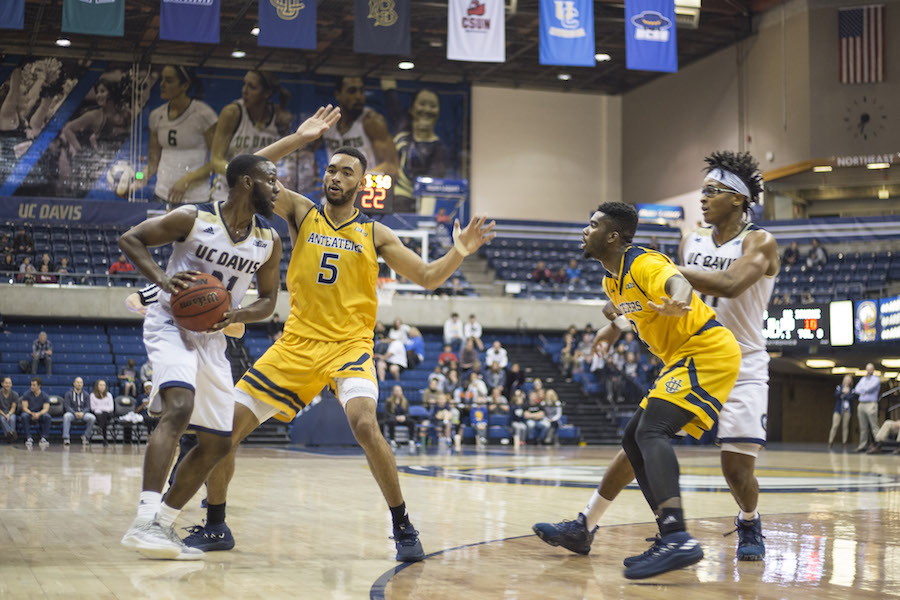
After two months of battling it out with non-conference opponents, the UC Davis men’s basketball team opened Big West conference play last Thursday night with a 64-53 win over the UC Irvine Anteaters. This victory, in a contest that featured a rematch of last season’s conference championship game, marked the program’s 16th straight home win.

The game’s first half was a tightly contested one, as the teams began the evening trading scores. Usually a sharpshooter from behind the three-point line, junior guard Siler Schneider instead found his shots falling from inside the paint. Schneider’s six first half points all came within the game’s opening 10 minutes, as he slashed his way inside the Irvine defense for three tough baskets.

In an effort to tighten their interior defense, the Anteaters briefly switched from a man-to-man scheme to a zone. This change freed up the Aggie backcourt, where junior guard TJ Shorts took advantage. Shorts knocked down UC Davis’ first three of the game, putting the Aggies in front for the first time of the contest.

The Aggies benefitted from inside scoring, but outside of Shorts they uncharacteristically struggled from beyond the arc and fell behind early. The team missed seven of its nine first half three-point shots, with Schneider failing to connect on all three of his attempts. This lack of outside firepower, however, did not seem to bother head coach Jim Les.

“We know both teams are going to defend,” Les said. “I thought early, and especially in the first half, we had some really good looks. Good shots for us, the right guys taking them, they just didn’t go down. What I liked about our team was just staying with it. The defense didn’t suffer because shots weren’t going in.”

UC Davis proceeded to clamp down on the Anteaters, forcing 11 first half turnovers, off of which the Aggies scored ten points. Both its swarming defense and ability to get to the foul line helped UC Davis build on its lead. A flurry of points from Shorts, who led the Aggies with 15 in the first half, pushed the UC Davis lead to nine.

UC Irvine, however, closed out the period with a strong showing. The Anteaters intensified their defense and responded with a 12-4 run. As a result, the Aggies saw their lead shrink back to just one point, leading 31-30 at the break.

UC Irvine opened the second half with the same energy as it had closing out the first. The Anteaters made it a priority to get the ball in the hands of its very capable sophomore guard Eyassu Worku, who scored eight of his team’s first 10 points of the half. UC Irvine reclaimed the lead, and went ahead by as much as four before the Aggies came storming back.

Already in foul trouble and behind by four, UC Davis needed to get things going again offensively. The team found its scoring spark in Shorts, whose craftiness around the hoop and ability to finish ignited an ensuing Aggie run with a gliding, and-one layup in traffic. Shorts would finish the night with a team high 22 points –– just the third game of his career with 20 or more.

“Can’t say enough about [Shorts],” Les remarked. “His ability to get the basket, get to the paint and make plays; finish at the rim, drop-offs for layups –- he’s playing at a high level.”

After a relatively quiet first half, senior forward Chima Moneke took his turn providing some offensive fuel. Moneke scored seven of the Aggies’ next eight points, including scores on back-to-back possessions; his smooth up-and-under layup was immediately followed by his only three-point field goal of the evening. Despite Moneke’s six second-half turnovers, Les was still impressed with Moneke’s patience throughout the game, pleased with his ability to “pick and choose his opportunities” and find open teammates when he was doubled.

Sophomore guard Joe Mooney –– who recorded a game-high and career-high four steals in 19 minutes off the bench –– added another three to extend the Aggie run that eventually climaxed at 15 to 1. Mooney’s extended minutes and productivity on the defensive side was something that did not surprise his head coach.

“Some of the rotations we had worked extensively on the last couple days, we talked about those guards,” Les explained. “They were going to be in the hole guarding those bigs when we doubled […] [Mooney’s] ability to be in the right place and make a play on the ball, I thought that was huge.”

With seven minutes remaining, UC Davis had a 51-41 lead, which was more than enough for the Aggies to cruise to yet another home victory. The 11-point win did not come easily, however, as UC Davis had to adjust its offense to focus on getting good looks closer to the basket. UC Davis is generally a steady three-point shooting team, making around 39 percent of its shots from deep. Against UC Irvine, however, the Aggies shot just 23.5 percent from three, but outscored the Anteaters 34-20 inside the paint.

While the offense had its ups and downs, the Aggie defense rarely broke down in this matchup. UC Davis was plus eight in points off turnovers, as they forced UC Irvine to lose the ball 22 times while recording 12 steals. The Aggies did not allow UC Irvine to record an offensive rebound in the first half and held the Anteaters to just 23 percent shooting the second half.

“I think that was the first time we brought it to [UC Irvine],” said Moneke. “We were ready for it, we anticipated it […] the rebounding thing has been a big issue for us, so for us to hold them to [no offensive rebounds] in the first half is huge.”

Outside of Shorts’ 22 points, two other Aggies recorded double digit scoring figures. Moneke finished with 20 points (13 in the second half) and 13 rebounds en route to his ninth double-double of the season in just his 14th game. Schneider added in 10 points and a game-high four assists –– and no turnovers.

After another sharp performance at home, UC Davis is now 10-5 overall and will be on the road for the next two games. Both of these away contests will be aired on ESPN 3, meaning that UC Davis fans will be able to watch the Aggies battle with UC Riverside and Cal State Fullerton via national broadcast. The Aggies will not be returning to the Pavilion again until Jan. 17 to host Long Beach State.


Written by: Dominic Faria — sports@theaggie.org

This Week in Sports

0
CHRISTIE NEO / AGGIE

Thursday, January 11

Women’s Basketball vs. UC Riverside at 7 p.m.


Wednesday, January 17

Men’s Basketball vs. Long Beach State at 7 p.m.


Written by: Kennedy Walker — sports@theaggie.org

Films of 2017

ALLYSON KO / AGGIE

Aggie writer takes his pick of 2017’s top 3 films

2017 produced a diverse list of first-rate films, evident in both the ironic yet hellish world of “Get Out” and the explosive seas and beaches of “Dunkirk.” Finding it hard to choose a definitive best movie of 2017, I’ve split my recommendation into three categories: Best Performance, Best Script and Best Design.


Best Performance: Gary Oldman, “Darkest Hour”

Gary Oldman adds to the near surplus of WWII films with a stunning performance as Britain’s Winston Churchill. Oldman displays a side to Churchill that is rarely touched upon: his doubt. Churchill is typically seen as a decisive prime minister during a time of incredible need, yet Churchill’s famous “we shall fight on the beaches,” among his other exceptional speeches, wasn’t something that came easy. Oldman does not leave such a pursuit unsung, but instead paints Churchill’s approach to Dunkirk as countless meticulous decisions, each one displayed through precise and careful actions. Oldman masterfully exhibits Churchill’s struggle to serve the British people under the gun of an encroaching Germany.


Best Script: “Lady Bird”

“Lady Bird” displays the awkward transition between high school and college in an effective way through the focus on Lady Bird and her mother. “Lady Bird” is a successful coming-of-age story, dodging the typical reliance on youthful relationships. “Lady Bird” fits much of the mold for a typical coming-of-age story (think “Superbad” and “Dazed and Confused”), yet stands alone in which relationship to follow. In “Superbad,” the story follows a small group of tight-knit friends; it focuses on their relationship. By contrast, “Lady Bird” examines the nuclear family — specifically, the mother-daughter relationship and how it changes with a daughter leaving the nest, showing the clashing dynamic between a rising child and a ruling matriarch. This honest depiction of surpassing family life and budding into adulthood awards “Lady Bird” with the best script of the year.


Best Design: “Bladerunner 2049”

A futuristic Earth containing the dying throes of a failing civilization isn’t an uncommon premise, yet the execution of “Bladerunner 2049” is original. The slightly dystopian world is crafted through the normalization of current oddities — for example, their food. According to the movie, the world, in order to provide nutrients for everyone, resorted to the consumption of worms. When these worms are consumed, they are alive and squirming: an uncomfortable sight, yet any character who eats them is unfazed. Subtle design choices, like the worms, create a genuine apocalyptic world. If Ryan Gosling sits down to salad and steak, nothing is strange. But once he sits down to a plate of worms, the world has truly moved on. This strategy of altering something as primary as food distinguishes the film’s setting, showing how something as familiar as home life is changed. The off-kilter world created in this film can be accredited to nothing but the stellar design, the focus on tweaking norms and what we are comfortable with today.


Written by: Nicolas Rago — arts@theaggie.org


8 Ways to Actually Keep A New Year’s Resolution

0
ALLYSON KO / AGGIE

Tips to stay on track with New Year’s goals

New Year’s resolutions are a time-old tradition we create for ourselves the second the clock strikes midnight on December 31. Many people ring in the new year with goals and desires in mind, but research shows that about 80 percent of people give up on their New Year’s resolutions by the time February rolls around. There are, however, a couple of tips and tricks to help those resolutions stick.


1. Get excited

Oftentimes New Year’s resolutions are events or fun things people want to happen that year. Some, though, are about resolving something about oneself, and those who stick to their personal resolutions establish the ‘why’ before the ‘how.’ The motivation to accomplish a resolution comes from true excitement and passion behind the goal-setting. When a resolution has more purpose, people are generally more motivated to complete it when there is a reason behind wanting to accomplish the goal.


2. Write it down

It sounds old-school, but writing down a New Year’s resolution is a powerful strategy to accomplish it. Writing out a plan makes the end result less intimidating, and checking off what has already happened feels satisfying and motivating. Those who can make lists, plan a strategy and review it everyday develop a sense of focus on the goals set before them and simultaneously bring order to the ideas in their head.


3. Keep it simple

Although it’s understandable that the new year is a fitting opportunity to completely flip one’s life around, goals that are too grand are the ones hardest to achieve. Self-improvement is a typical route to take when creating resolutions, but focusing on simple changes rather than big life-alterations is a good approach in order to follow through with a goal.


4. Set realistic goals

It’s important to consider one’s previous experiences with resolutions. If resolutions have failed in the past, the possible reasons behind that failure can help direct the person to create a more realistic goal. Setting goals that are aimed too high opens the door for giving up, which can lead to disappointment and guilt, yet these are the kinds of feelings New Year’s resolutions are designed to avoid.


5. Team up

Some of those resolutions that involve activities like exercising more or eating a healthy diet can be intimidating to do alone. Not only can a friend give advice and tips, but it’s more fun to do the activities with another person as well as compare progress. A friend can be a motivating force behind achieving the goal, because you are going to try to avoid disappointing them and they can support you when times get tough.


6. Couple it with existing habits

Some resolutions can be made more achievable when coupled with a person’s contemporary lifestyle. If it’s a small daily goal, completing that goal with a regular activity that already exists is a surefire way to fit that resolution into a daily routine. When there is an existing foundation, it’s easier for people to grow and build upon that in order to accomplish their goals.


7. Stay true to yourself

The quickest way to drop a resolution is if it doesn’t align with one’s values. Therefore, it’s important to pick a goal that fits existing values in order to sustain a resolution over a long period of time. Once this happens, it takes less effort and energy to think about the resolution, and it becomes less of a challenge and more of an enjoyable part of life.


8. Don’t give up

Slip-ups happen, but that shouldn’t be an excuse to give up. It’s important to remember achievements and avoid becoming critical of oneself. Allowances for slip-ups are a helpful way to achieve the end result because perfect goals are too tough for even the most disciplined people to reach. Ultimately, confidence and high self-esteem are the keys to sticking with a New Year’s resolution.


Written by: Marlys Jeane — features@theaggie.org
A helping hand for those in need

JAMIE CHEN / AGGIE

Unitrans teams with Nugget to stuff double-decker bus full of food

On Dec. 9, a Unitrans double-decker bus sat parked in the square outside of Nugget Market. Unitrans employees passed out free tote bags and customers spun a prize wheel. Boxes of donated food were piled high inside bench seats, waiting to be delivered to Davis residents in need. Unitrans and Nugget Market partnered this holiday season to literally “stuff a bus” with food, an event organized by Unitrans General Manager Jeff Flynn. The publicity helps both Unitrans and Nugget provide holiday meals and promote an environmentally friendly way to travel while addressing the growing need for food donations.

“It’s spreading good word for Unitrans,” said Inna Nytochka, a volunteer organizer and the route supervisor for Unitrans. According to Nytochka, half of the donated goods go to Yolo County Food Bank, the other half to the Davis Pantry. “It’s a win-win everywhere.”

Leah Guerrero, a volunteer at the drive and a Unitrans employee, commented on working for Unitrans.

“It’s like being part of Greek life without the fees — it’s a nice environment, most of my friends are Unitrans people,” Guerrero said.

The Davis Food Pantry is a self-defining support system for UC Davis students. In 2010, 50 percent of students said they had skipped meals occasionally. Since its opening, the Pantry has served as a resource for students in need. Donations go directly toward students, who need only show a student ID to get three free food items or toiletries per day. It was created in part as a response to the growing costs of college tuition, which can make balancing meals difficult for students.

“The mission of The Pantry is to aid UC Davis students in their pursuit of higher education by ensuring that no student ever has to miss a meal or go without basic necessities due to financial reasons,” according to The Pantry’s website. According to the Yolo Food Bank’s website, over 31,000 people in Yolo County are food insecure, meaning that they cannot regularly procure quality food. This can be influenced by a variety of factors, including low income and student loans. A study in 2014 led by UC San Diego found that 35 percent of students had skipped meals in order to make ends meet. This prompted many universities to open food pantries and promote local food banks.

The Yolo Food Bank helps residents across the county with regular deliveries of both fresh and canned produce. Their rural food delivery program ships over 500 food boxes to nine different locations each month. These shipments help supply necessary goods to individuals in harder to reach areas, even those outside of Yolo County, via a combination of donors who support their operations. In addition to the deliveries, the food drive was available from 9 a.m. to 3 p.m.

The bus drive was stationed directly outside of Nugget and provided incentives, such as reusable water bottles for anyone giving a donation. The bulk of donations were received early in the day and filled the lower cabin of the double decker.

“It’s been pretty successful,” Guerrero said. “I’m surprised at how generous everyone has been.”


Written by: Genevieve Murphy-Skilling — city@theaggie.org

Cut it out: stop partisan gerrymandering

CAITLYN SAMPLEY / AGGIE

Federal court rules against North Carolina congressional map

In a political landmark, a panel of federal judges ruled North Carolina’s 2016 congressional map void due to its heavy GOP partisanship. This took place on Jan. 9, just in time to cause chaos before a pivotal midterm election, which North Carolina Republicans are desperate to secure.  

The heavy Republican favoritism on the map is due to the political tactic of redrawing congressional districts to favor a particular political party.

This process of redistricting, called gerrymandering, has been adopted by both Republicans and Democrats alike. In North Carolina, the GOP has taken it too far once more and is now facing consequences.

The federal judges did not only rule this map void, but also deemed it as unconstitutional due to how skewed it was to one party’s political advantage. This is the first time a federal court has voided a congressional map using this reasoning, and North Carolina legislators are now left with only about two weeks to redraw all 13 congressional districts to be less partisan. Currently, Republicans hold 10 of these districts with Democrats in the remaining three.

With improved map-drawing software and detailed data collection, lawmakers have become increasingly more savvy when redrawing their districts. Republicans have taken advantage of this sneaky tactic and contorted districts so much that gerrymandering has become destructive to the very foundation of our country’s democracy.

But how does gerrymandering affect us? In the way American democracy was intended to operate, voters would elect their representatives and elected officials would represent the ideals of voters. When representatives create their own districts instead, they are choosing which party gets represented and consequently can overrepresent a group within the state. Thus, voters in the opposing party are marginalized.

The Editorial Board is heartened by this action taken against unconstitutional partisan gerrymandering. We are proud that this issue is becoming unacceptable after so many years of shrewd lawmakers slipping by unscathed. Looking toward the future, we look forward to a more democratic process as our founders intended.  


Written by: The Editorial Board

Tracking Predator and Prey

Olive Baboon in camera trap (LYNNE ISBELL / COURTESY)

UC Davis primatologists study primates and predator interactions in a new way

It is often very difficult for researchers to study animals without influencing their behavior. Lynne Isbell, a professor in the UC Davis anthropology department and Laura Bidner, a postdoctorate working with Isbell, came up with a simple solution to study predator and prey interaction: remove themselves from the field. That was the idea behind their paper published in Behavior in 2016 on the latest research on primates in Laikipia, Kenya.

At the 49107 sq. acres Mpala Research Centre, two species of primates were studied: olive baboons and vervet monkeys. The study also examined the activity of a common predator of both species: leopards.

“We know leopards avoid people and they’re shy,” Isbell said. “We follow primates around to study them and don’t see any leopard predation.”

Bidner and Isbell initially came up with the research idea in 2009, and in 2012 they received preliminary funding from the National Science Foundation. Bidner then spent five months in the study area to find out how many groups of primates lived, where they slept, and to estimate how many leopards hunted there.

“This data turned out to be critical for the bigger grant,” Bidner said.

To study how predator and prey interacted with each other, the team of researchers fit baboons, vervets and leopards with GPS radio collars. Two audio recorders were also placed near their sleeping sites for a year. Additionally, three camera traps were set up to monitor human activity near the animals’ sleeping sites.

Studying the predator and primate interactions in this way will provide important insights into how and if primates alter their behavior when a predator is around,” said Dena Clink, a recent UC Davis Ph.D. graduate researching primate ecology and primate conservation.

While leopards tend to be solitary, female primates rarely separate from their groups. Therefore, only 12 radio collars were needed to follow the five different groups of vervets, as adult females were captured in box traps, collared, and then let go. Aside from using bigger cage traps, the same process occurred for the baboons. However, the team could only get six out of the eight planned collars on the female baboons.

“Olive baboon males and juveniles were crazy over the maize in the cages ,” Isbell said. “The females were a lot more hesitant.”

The collars still went to good use. The team was able to convert the leftover baboon collars to fit leopards, and replaced two of the collars that had died early on. However, looking through images in the camera traps, more uncollared leopards were found to frequent the study area.

“There were at least seven leopards in the area,” Isbell said, “They’re supposed to be territorial!”

While seven uncollared leopards were found on the camera traps, it is believed that even more resided in the area.

In two instances, collared leopards killed collared primates. One of those times, Bidner heard a vervet alarm call near the research center, and later realized what it meant.

“A few days later we figured out what happened after we uploaded the [GPS] data,” Bidner said.

Recordings at the vervets’ sleeping site revealed that they gave ‘leopard’ alarm calls most frequently near dusk and dawn. When those calls were made, the leopard’s GPS collars showed them leaving the area. The data shows leopards hunt vervets during the day, when less alarm calls were made to ward off the predators.

Baboons are hunted at night by leopards. This is naturally thought to be due to baboons not being able to fight off an attack while sleeping.  

Olive baboons are larger and more aggressive than vervets. This suggests baboons may be less vulnerable to predation, but the study proves otherwise. Despite the differences between the two primates, they were both similarly targeted by the leopard.

“The predation rate for baboons and vervets was around 5 percent,” Isbell said.

In past studies, researchers have to look at several factors to estimate the rate of predation on a species. This includes counting the number of animals every day and searching for carcasses. Often, these traditional methods can be unreliable due to individuals moving or predators dragging their meal far away. In this study, the researchers were able to determine predation rate and observe predator and prey interaction more accurately.

“This is not necessarily groundbreaking,” Bidner said. “It’s more of a cautionary tale against assumptions made of predator and prey interactions.”


Written by: Rachel Paul — science@theaggie.org


Cross Cultural Center 2017-18 budget cut by 7 percent

MARTÌN GIRON / COURTESY

CCC programs such as REACH Retreat, International Retreat cancelled

In the 2017-18 school year, the UC Davis Cross Cultural Center experienced a significant cut to its budget.

According to the CCC’s website, the center “provides a community space promoting values such as advocacy, cultural competency and community.”

The CCC’s budget cut was part of a larger budget cut to the Division of Student Affairs, which affected the CCC as well as several other departments.

The CCC leadership team was given permission to internally decide what to cut. According to a post on the CCC’s Facebook page, the team was mainly concerned with “the possibility of losing a staff member that supported the International and ME/SA communities.”

As a result, the cut was applied to several programs and services the CCC usually holds, including the REACH Retreat, the International Community Retreat, the Asian American & Pacific Islander Leadership Retreat, Students of Diverse Affiliations and the Student Grant Program.

Programs such as the Asian Pacific Culture Night Market, Black Family Day, La Gran Tardeada, Powwow, P.E.A.C.E., Danzantes del Alma and the Graduate Students of Color Program were retained.

“Losing a staffing position is much more difficult to regain and we also felt that a staff member provides broader and more ongoing support for communities than a one-time program,” the CCC explained in the Facebook post.

The CCC advocated for keeping the program coordinator position and making it permanent, and was granted the request. Additionally, this year the CCC was able to secure a permanent position to serve the international and Asian Pacific Islander communities.  

The total cut from the budget was $76,794 – approximately 7 percent of the budget. However, CCC Director Bruce Smail expressed some optimism in light of the situation.

While this is a loss for the 2017-18 fiscal year, we enhanced our programming to support the communities we serve,” Smail said via email. “We created a new programming model to enhance our reach to the various communities we serve.”

The new programming model includes three key components: Themed Series Programming, which includes two major events and six smaller events in Fall and Winter Quarters, Community Specific Programming, which provides an opportunity for the community coordinators to address issues and events targeted to the various communities served by the CCC and Spring Cultural Days Pre-Events.

Since the budget cut decision was announced after the CCC’s student hiring season, the CCC will honor current employment agreements with the 28 student staff members hired for 2017-18 fiscal year.

“Although we experienced a budget reduction this year we have received a 214 percent programming budget increase over the last five years which demonstrates divisional support,” Smail said.


Written by: Clara Zhao — campus@theaggie.org

UC Davis professor stripped of titles after sexual assault allegations surface

UC DAVIS DEPARTMENT OF MUSIC / COURTESY

#MeToo movement inspired administrator to come forward

In December, The Sacramento Bee reported that former UC Davis professor D. Kern Holoman “was stripped of his distinguished professor and emeritus titles […] after allegations surfaced that he assaulted a college freshman 30 years ago.” Holoman was the former director of the UC Davis Symphony and chair of the Department of Music. He retired in 2013.  

On Dec. 12, the former UC Davis student who came forward with these accusations — UC administrator Danny Gray — published a blog post titled “#MeToo Arrives at the University of California” detailing the allegations against Holoman. Gray alleged that Holoman had sexually assaulted him in a hot tub, later raped him and continued making unwelcome advances from 1987 through 1991. Gray claimed that he had reported the incidents to university officials but had no information as to whether any action against Holoman had been taken at the time.

Gray sent a copy of the post to university officials before it was published online. The university agreed to launch an investigation into Holoman’s actions. Holoman denied the allegations and, in lieu of an investigation into the allegations, agreed to have his titles removed.

According to The Bee, in a statement to Gray given by Holoman’s lawyer, Holoman wrote, “I am distressed and deeply apologetic for my role in any event that has harmed Danny Gray in any way, and heartsick at the thought of harm that has festered for 30 years. Our memories of that time differ markedly, but the remorse is very real. I continue to treasure memories of our long friendship and its focus on the beauties of art, literature and history.”

UC Davis Chancellor Gary S. May issued a statement on Dec. 11 acknowledging the abusers and survivors on the UC Davis campus as well as including resources available to students, staff and faculty.

“Many of the reports of abuse emerge after years and sometimes decades of silence and shame,” May wrote. “In the past, few if any institutions had adequate reporting and investigative processes, UC Davis included. Our protocols and processes have improved greatly over the years.”

Though the statement did not mention Gray or Holoman by name, UC Davis spokeswoman Dana Topousis confirmed to The Bee that May’s message was a response to Gray’s allegations and that the university expects more people to come forward with allegations.

In his statement, May wrote that he supports “those in our community who have come forward or who are thinking about doing so” and that “the safety and security of our community remains [a] priority for those who study, work and live here.”

Most recently, on Dec. 28, The Bee reported that Holoman’s predecessor, Christian Baldini, the conductor of the UC Davis Symphony Orchestra was put “on unpaid administrative leave after a university investigation found he engaged in unwanted sexual conduct toward an undergraduate student.”

Baldini has reportedly also denied the claims and labeled the allegations a misunderstanding.


Written by: Jayashri Padmanabhan — campus@theaggie.org

Second student-run Mental Health Conference will offer accessible mental health information, resources

JAY GELVEZON / STUDENT AFFAIRS MARKETING AND COMMUNICATIONS

Conference to be held Jan. 20 to 21 will include professionally-led workshops, keynotes, resource fair

Content warning: This piece contains references to mental illness and suicide.


From Jan. 20 to 21, the UC Davis Conference Center will host UC Davis’ second Mental Health Conference. The conference — bolstered by experts offering keynotes and workshops — is run by an “entirely student-led initiative that aims to engage students in destigmatization and education efforts, prompt attendees to organize around mental health issues and offer them the opportunity for self-reflection and healing through mental health discourse,” according to the event page.

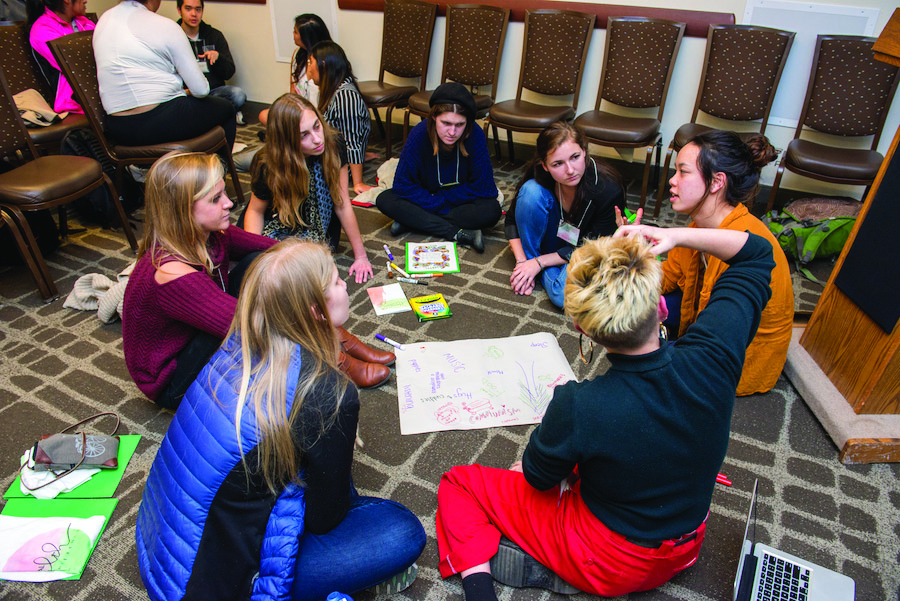
A Mental Health Initiative that started as a ASUCD Senate project has grown into a platform for a two-day conference and other events such as performances, panels and a resource fair. Attendees will be given access to diverse therapeutic techniques such as coloring activities and digitally-guided meditation in a “healing space.” All activities are administered by volunteers who have received the national certification for mental health first aid.

This year, the event’s closing keynote will be given by Sacramento Mayor Darrell Steinberg, who was a driving force behind Prop. 63 — which was created to fund mental health services — and who also founded the Steinberg Institute. The Institute, according to its website, “was created to upend the status quo and dramatically raise the profile and increase the effectiveness of mental health policy-making in California.”

To Samantha Chiang, a fourth-year English major and the director of the initiative, the initiative and conference may not be groundbreaking, but she saw exceeding necessity within underrepresented communities where approaching mental health can be stigmatized, silenced or forgotten. Chiang said she understands the complexity — and individuality — of unpacking mental health concerns in regards to both the cause and the cure. She said she views this conference as a specific way to provide immediate mental health assistance and resources to those who cannot afford or access individual professional mental health care.

“Is this revolutionary?” Chiang asked. “Not by any means. I don’t think it can tackle the root of the problem. Yet, there are material needs of underrepresented communities that need more immediate assistance and the mental health community has historically been silenced and discriminated against.”

The Mental Health Initiative comprises 15 board members who coordinated and programmed the conference with the help of over 55 volunteers. Chiang said that exploring mental health concerns is a passion for these members, all of whom have been affected by mental health issues. Following the first conference’s popularity, the initiative received an overwhelming amount of board applicants in 2018 — only a quarter of interested applicants were able to be accepted.

Chiang explained how an ASUCD Senate project of a mental health initiative became a programmatic committee, responsible for coordinating campus outreach and events that culminated in an annual conference.

“The board members applied through vacancy.ucdavis.edu and went through interviews, in which ASUCD leadership was courteous enough to give us relative autonomy in this process,” Chiang said.

The popularity of the 2017 Mental Health Conference prompted Chiang and other team members to expand this year’s event.

“Last year, we didn’t know how to use the venue to its fullest capacity, but this year, we’ve worked with Conference and Event Services to create a setup best suited to our need,” Chiang said. “As such, we are now proud to offer a full healing space, as opposed to one stuck in a back room. Additionally, we hope that our art display and photo booth will truly cement the nurturing, compassionate atmosphere that we strive to create in our conference and overall initiative.”

Since last year, the conference has tripled in size due to increased funding by UC Davis — registration increased from 150 to 420. But some students who want to attend will not be able to. Tickets have already sold out online, and Chiang says the event’s physical capacity does not allow for any admission exceptions. She sees this unfortunate situation as a meeting point of extraordinary demand for mental healthcare with UC Davis’ lack of support for such student services on campus.

“With 125 people already on the waitlist, it is simply impractical and irresponsible of us to accept more attendees,” Chiang said. “I hope that the initiative can eventually come to a point where we can accept anyone who wants to attend; there’s such a high demand for educational mental health events and healing spaces. Yet due to inadequate funding for both counseling services, psychiatric services and student-led programming, our capacity to help students and community members simply cannot keep up with the university demand.”

According to Chiang, feedback from last year’s conference resulted in an increase in activities and programs led by non-student professionals and experts.

“We have mental health professionals coming to UC Davis from all over the state,” Chiang said. “We are incredibly excited to offer suicide prevention training and certifications, […] community-based programming regarding masculinity [and] the prison justice system as well as ethnicity and culture. In addition to modules centered on education, we also have ones touching on personal healing and growth, with topics such as yoga, anxiety management and compassionate communication.”

The conferences’ panel coordinator Katrina Manrique, a fourth-year English major, discussed how the conference harnesses cost-free and destigmatized resources for students.  

“The Mental Health Conference is important because it gives students with mental illness space and freedom,” Manrique said via email. ”Attendees with mental illness are able to freely and safely engage in workshops and resources which can benefit them. It is important for folx to realize that there are many different constraints which prevent a person with mental illness from understanding or confronting their illness within their day-to-day life. There are cultural, professional, social, and socioeconomic barriers which make it nearly impossible for someone with mental illness to express or confront their illness. This conference, for many, is one of the few spaces they can safely face their mental illness.”

Chiang talked about the conference’s need-based roots — prior to the creation of the Initiative and Conference, UC Davis students were disappointed in the campus’ lack of mental health conferences and support that other campuses have.

“Twelve [UC Davis] undergraduates attended the UC Irvine Mental Health Conference and realized the need for similar programming catered to the UC Davis community,” Chiang said. “They decided to go about working with an ASUCD Senate staff and from there, the UC Davis Mental Health Conference was born.”

For Chiang, championing the initiative and the conference intersected with her own mental health and identity. She said she seeks to unite the UC Davis community, composed of a diverse range of identities, especially those underrepresented, and strives for every individual to be recognized and validated as deserving mental health care.

“I am involved with the initiative due to my positionality in society as a Taiwanese American womxn with a complicated relationship to immigration that intersects with my bipolar disorder, PTSD, anxiety, panic disorder and substance abuse disorder,” Chiang said. “At the same time, I try to bear in mind that my mental health is not adversely affected by my sexual orientation, gender, physical ability, or socioeconomic status. No one person can fully understand all the intersections of mental health — our initiative tries to suture that divide in the mental health community by creating one space where people interested in mental health can convene on our campus.”


Written by: Aaron Liss — campus@theaggie.org