55.5 F
Davis

Davis, California

Tuesday, December 23, 2025
Home Blog Page 698

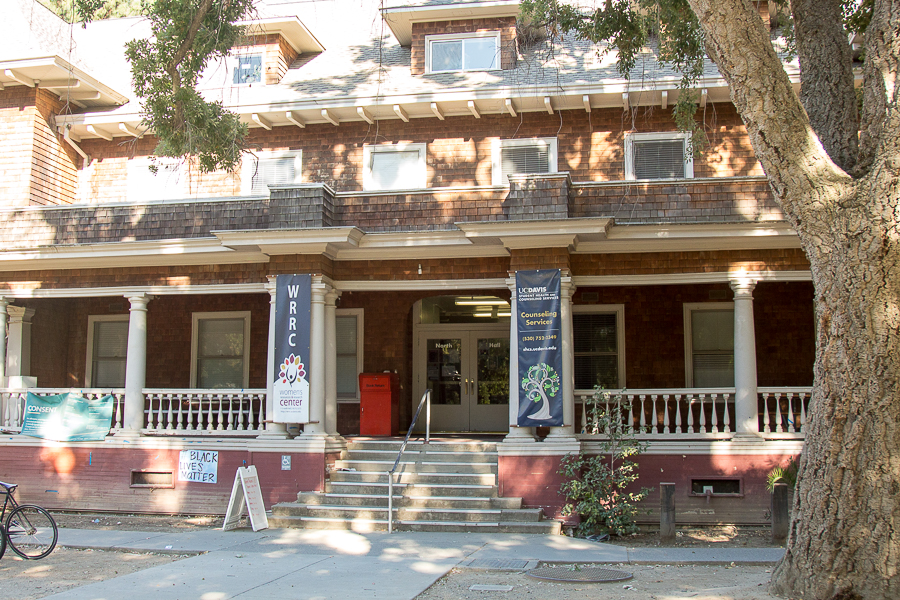
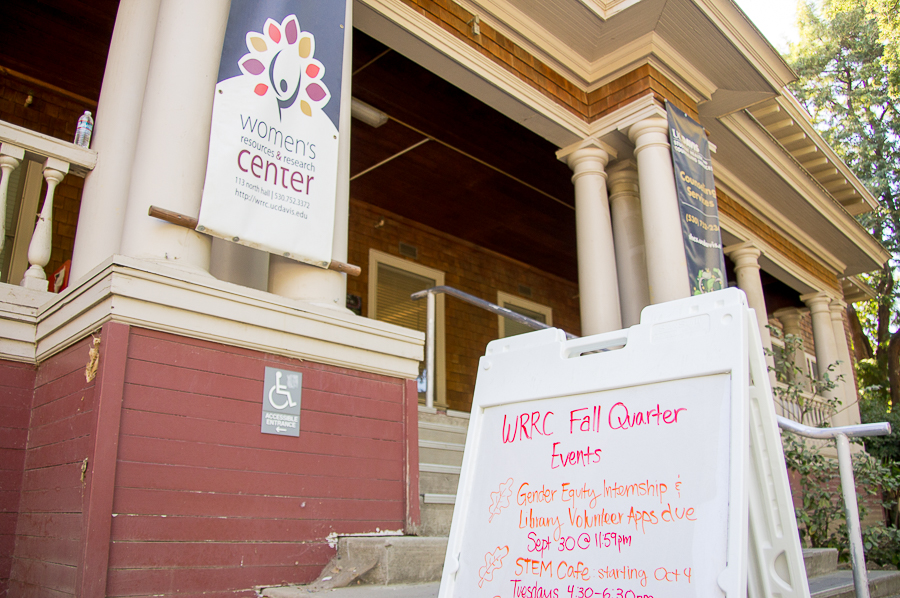
Women’s Resources and Research Center to be moved from North Hall

BRIANA NGO / AGGIE
BRIANA NGO / AGGIE

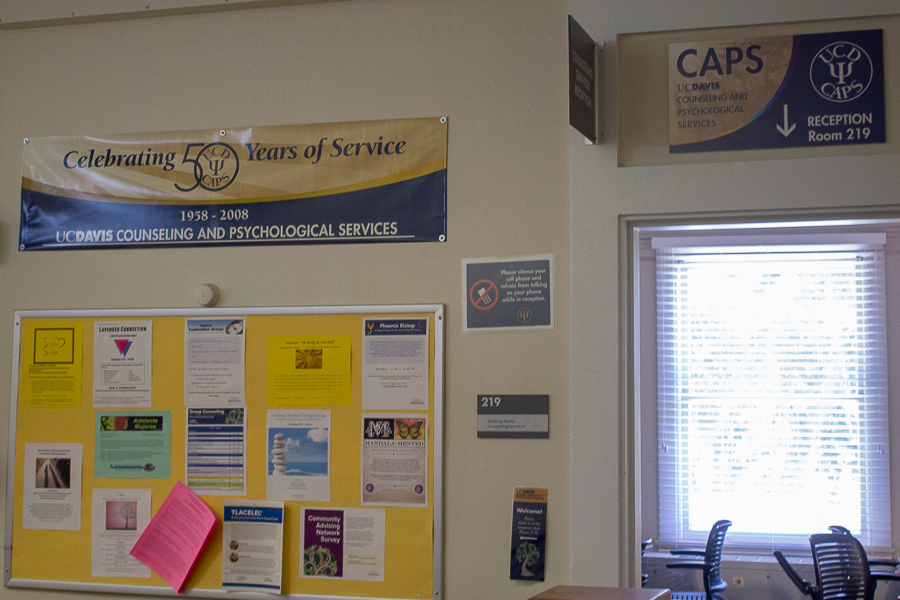
With new location not yet determined, Counseling Services to make use of former WRRC space

The Women’s Resources and Research Center (WRRC) announced through a public Facebook post on Sept. 23 that it will move from North Hall to another location on campus. With no timetable set or new location determined, few details are available regarding moving plans.

The WRRC, which has a 40-year history at UC Davis, has long used North Hall as a central location on campus.

“I don’t know exactly how long the resource center has been held in North Hall, but it has been a good long time,” said Ashley Teodorson, business and finance coordinator for the WRRC. “The women’s center has been on campus for 40 years, and it was originally housed in Lower Freeborn, but primarily for its existence it has been housed in North Hall.”

Counseling Services (CS), which has been located in North Hall for 58 years, is in the process of hiring additional counselors to meet student demand. This expected increase in CS staff prompted discussions about moving the WRRC.

“We have heard from students that they would like more access in North Hall which can only be achieved by having more counselors in North Hall,” Hahn said. “Conversations were frequent about a year and half ago in terms of us getting more counselors, however from my understanding, talk of expanding [Counseling Service’s space] has been going on for years, even preceding my arrival three years ago.”

Both students and the University of California Office of the President (UCOP) have been especially active in asking for additional counselors to meet student demand, according to Associate Vice Chancellor Milton Lang.

“It is a combination of our students who really feel as though there are not enough counselors within the system, UCOP hearing that and supporting that and asking the different campuses to move forward in that regard,” Lang said. “So I would say it is twofold: one, coming from our students, and two, UCOP embracing that and asking us to move forward.”

Lang said that, although students were consulted about the proposition of moving the WRRC, they were not directly involved in the decision process.

“I wouldn’t say that students made the decision,” Lang said. “Students were involved in a process that allowed us to get a perspective; staff was involved in that. We felt that it would be extremely important to have an opportunity to hear from all sides about what we are doing and why we are doing it.”

Lang believes that the WRRC is going to remain a resource for students on campus regardless of its new location.

“I can assure you that the WRRC is going nowhere,” Lang said. “This is an asset to our campus that provides a great service to our students. There is a strong commitment to this program within student affairs and we are going to do all that we can to sustain the level of service and really explore ways to enhance this service as we move forward. We are not going to allow this transition to push us in [a] place where we are backing away from our commitment.”

Even though the final location of the WRRC has not been decided upon, other centers on campus have been named as possible facilities.

“I would say that we have had conversations about moving forward with the location at the Student Community Center, so we are having conversations with the students about heading in that direction,” Lang said.

Although the WRRC is going to remain on campus, Teodorson realizes that this change has been hard for students.

“This has been a difficult process for the students that we serve,” Teodorson said. “I think the best and most we can do is try to understand the needs of the students that the WRRC serves and that Counseling Services serves and try our best to work together to kind of come to a solution that centers the experiences of our students. I think we are all trying to do that and I think we will continue trying to do that.”


Written by: Kenton Goldsby – campus@theaggie.org
The key to a healthy transition

BECCA RIDGE / AGGIE
BECCA RIDGE / AGGIE

A look into the academic, wellness resources UC Davis has to offer

First-years looking for smaller, more personal classes to complement a lecture-heavy workload can look into the one and two unit freshmen seminars offered by the Center for Excellence in Teaching and Learning. These seminars are limited to 19 spots per class, allowing students to develop better relationships with their peers and professors. In the past, popular seminar topics have ranged from zombies to climate change and even documentary film.

“Freshman seminars are not like regular courses — [professors] don’t have the same expectations,” said Cristina Gonzalez, professor of spanish and education. “[Freshman seminars] are a way to actually meet faculty members and to talk to your classmates [in] a more informal setting. I want them not only to learn about the history but also to realize that it’s a very important university. I am trying to make them connect with the institution.”

Gonzalez teaches her own freshman seminar, FRS 001: Introduction to the University of California. For students eager to know more about the history of the campus and the different resources UC Davis has to offer, this class is the one to take. Gonzalez teaches from excerpts of the memoir of Clark Kerr, the twelfth president of the University of California and instructs on how to write an effective resume.

She also introduces her class to different administrative officials from on campus including Shields Library, the Undergraduate Research Center, Student Affairs, The Internship and Career Center and Study Abroad. Students also get the opportunity to interview five people within different levels of education, including lower and upper division undergraduate students, masters students, doctorate students and postdoctoral scholars.

“I want [students] to understand that [going from undergraduate education to graduate education] is progressive, gradual and not that difficult,” Gonzalez said. “At the end of the seminar I have a sense that [the students] are much more grounded and aware of the campus and their options, and the [people they meet] actually have an impact on them.”

The service centers in Tercero, Segundo and Cuarto are all home to the Residence Hall Advising Team (RHAT). RHAT is made up of approximately 60 peer advisors who put on seven workshops throughout the school year. For Fall Quarter, the workshops focus on how to be successful with time management, stress, grading options and student development.

“We want to give [students] a smooth transition from their previous institution’s experiences to our college experience,” said Wilburn Wang, third-year communication and economics double major and First-Year Experience (FYE) peer coordinator.

Students are also encouraged to drop-in for advising with the RHAT FYE peer advisers and from the different colleges’ Deans Offices.

“[It’s very important to ] have [students] come in when they are transitioning to UC Davis and take advantage of these resources […] it’s always very helpful,” said Montserrat Garcia Juarez, a third-year political science and chicano studies double major and FYE peer advisor. “We are also peers, so I think that helps a bit so that [students] can be more open to talking to us about what they want. We are the door to the more advising that we have here on campus.”

Students can find many other resources for adjusting to campus other than in classes and in the residence halls. The Student Academic Success Center (SASC) offers free tutoring in certain subjects for all registered UC Davis students as well as free workshops in math, science and writing throughout the quarter.

Additionally, Student Health and Counseling Services provides free individual and group counseling for students. Located in North Hall, students can meet with a counselor to talk about various mental health issues, family problems, academic problems, concerns about drug and alcohol use, relationship concerns and much more.  

“We want to meet the demands of students,” Wang said. “We want to accommodate.”


Written by: Fatima Siddiqui — features@theaggie.org

The Minority Report: How the model minority myth contributes to mental health problems among Asian Americans

0
CHARLES MIIN / AGGIE

Stereotypes place undue pressure on minority groups

Suicidal thoughts are higher among Asian American college students than Caucasian students, said a report from the American Psychological Association. According to findings by the University of Washington, Asian American women born in the U.S. are more likely to contemplate and attempt suicide than any other ethnic group.

These numbers don’t make headlines. Instead, Asian Americans are consistently featured as the “model minority” in media and popular culture. This doesn’t seem overtly harmful, but that’s only if you don’t consider the implications of this stereotype on Asian Americans and their mental health.

When Asian Americans are stereotyped this way, they are held to extremely high standards: to be intelligent, excel in school and persevere without failure. This isn’t a stereotype reserved for the film and television industry. It is an actual belief people hold about Asian Americans.

This paints them as hard-wired, emotionless individuals who don’t have concerns outside of academic and financial success. What others don’t understand is that the pressure these stereotypes place on people can increase depression and anxiety.

Perhaps even more troubling, this model minority stereotype prevents Asian Americans from getting help for mental illnesses because they are automatically assumed not to have any problems. By promoting silence, we are dismissing a reality that many Asian Americans are living. Stereotypes dehumanize Asian Americans and strip them of their capacity to feel and express emotions.

For most Asian Americans, academic success is a priority; that isn’t false. The Pew Research Center reported that 49 percent of Asian Americans ages 25 and up have at least a bachelor’s degree, compared to 28 percent of the U.S. population. While this supports the “model minority” stereotype, it certainly doesn’t paint a full picture of why the stereotype persists.

Contrary to popular belief, Asians are not innately more intelligent. Rather, work ethic and the importance placed on education stem from cultural values that reflect a long, arduous history of lower and working-class Asians who immigrated to America for a better education and life.

These values are imbedded so deeply within Asian American culture that it affects not only the pressure individuals feel, but also how they respond to mental health issues.

Unfortunately, Asian American culture, which values privacy, doesn’t encourage individuals to speak up about mental illness. Often, when an individual has a mental illness, it isn’t even brought up even in the family. Instead it’s kept private, partly because of the shame associated with mental illness.

Because most Asian Americans don’t consider mental health problems valid illnesses, when an individual does have one, it isn’t seen as legitimate, and it isn’t held to the same level of seriousness as physical sickness.

To some extent, even physical well-being comes second to education in Asian culture.

This goes back to the fact that most Asian Americans and Americans don’t have a good understanding of mental illness. To most people, depression, despite being a disorder, seems no different from sadness.

Depression isn’t a temporary mood to “get over.” It’s persistent and impairs an individual from going about their normal routines. It is a legitimate illness, and it shouldn’t be dismissed.

When nearly an entire community refuses to acknowledge or discuss depression, this only contributes to the shame and ignorance surrounding mental health. Furthermore, doctors and counselors can’t treat and reach out to to a group if they don’t recognize what prevents them from seeking help in the first place.

Ignoring this issue and allowing the model minority stereotype to persist is detrimental to all groups, especially other minorities.

Other minority groups who don’t achieve the same level of academic or financial success are being held up to unrealistic standards. Culturally, not all groups have the same values, and it’s ridiculous to use one group’s supposed success as a standard without understanding the cultural and social factors and the detrimental consequences of that success.


Written by: Jeanette Yue –– jyyue@ucdavis.edu

Aggie doubles teams dominate tournament play

0
JAY GELVEZON / AGGIE

UC Davis men’s tennis hosts annual Aggie Invitational tournament during start of fall season play

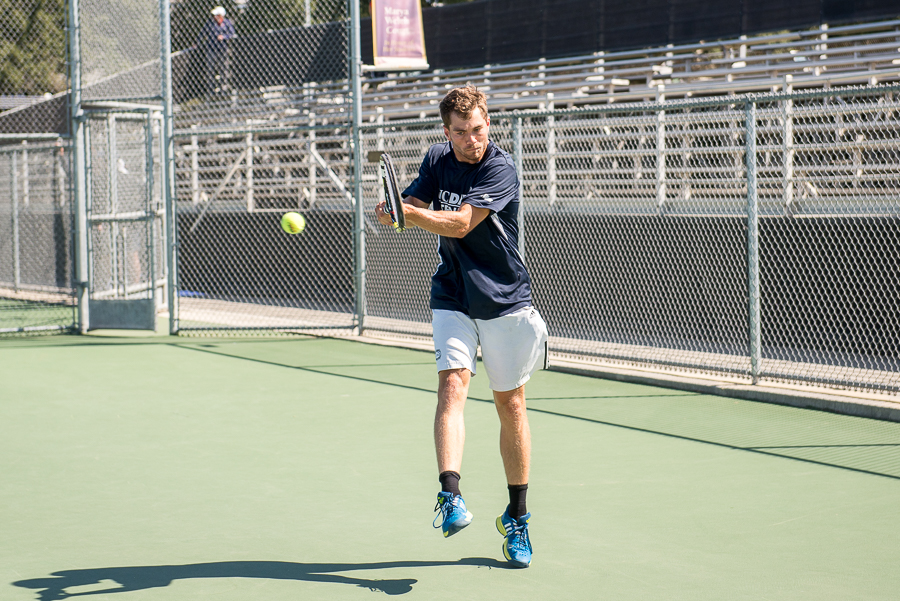
Players from around the West Coast competed at the Marya Welch Tennis Center from Sept. 30 to Oct. 2 as the UC Davis men’s tennis team hosted the 2016 Aggie Invitational for early fall match-ups. Student athletes came out to the three-day event, which featured three singles and three doubles brackets.

Each player of the UC Davis men’s team competed in the tournament except for senior Alec Adamson, who traveled to Tulsa, Oklahoma to compete in the ITA All-American Championships.

JAY GELVEZON / AGGIE

On opening day, the Aggies looked good, featuring senior Eli Whittle, junior Everett Maltby and freshman Max Pham — one of the newest additions to the team. All posted straight-set singles victories in their brackets to advance to the quarterfinal round. The Aggies’ four doubles teams also rolled easily into Saturday competition. Freshman David Goulak and junior Tommy Lam, seniors Bryce McKelvie and James Wade, and Maltby and senior Jesse Ross all defeated their opponents 8-3, while Pham and Whittle skirted by with an 8-7 win.

All of UC Davis’ doubles teams advanced to Sunday’s championship round, with Goulak and Lam taking down Sac State, 8-5. McKelvie and Wade rolled over Portland, 8-1, in the Flight ‘A’ Bracket, but were edged out 8-7 in the semifinal. In the Flight ‘B’ Bracket, Pham and Whittle beat their Portland opponents, 8-5, and Maltby and Ross sent Santa Clara home with their 8-3 victory.

In singles play, Maltby fell to Portland in the quarterfinal round. McKelvie and Ross both won their individual matches in the quarterfinal, but when they met in the semifinal round, McKelvie knocked Ross out with a 6-2, 6-4 win.

Pham won his quarterfinal singles match in the Flight ‘B’ Bracket, 7-5, 6-4, but he lost in his semifinal match. Whittle made his way into the championship round after a 7-6, 6-4 upset in the quarterfinal and a straight-set 6-1, 6-4 victory in his semifinal match.

During the final day of play, UC Davis had four representatives in the eight final matches. Doubles team Maltby and Ross claimed their Flight ‘B’ Bracket doubles crown with an 8-7 victory over their teammates Pham and Whittle in the championship match. Goulak and Lam lost their Flight ‘A’

JAY GELVEZON / AGGIE

Bracket championship doubles match, 8-7.

McKelvie lost his Flight ‘A’ singles championship match, 4-6, 6-3, 1-0, while Whittle came back from his doubles defeat and was crowned singles

champion with his victory.

The Aggies have five more events on their fall schedule before finally opening spring season play in January against Pacific and Fresno State. UC Davis will be on the road for 10 games straight, including its match-ups against top-seeded University of Southern California and University of San Diego.

With a tough schedule ahead, head coach Eric Steidlmayer said that, this early in the season, the team is just trying to figure out where they stand in competition.

“What we’re trying to do in the next three weeks is see where we’re at,” Steidlmayer said. “We have a chance to evaluate where we are — what we do well, what we don’t do well, and how we fix it.”

The Aggies will travel to UC Santa Barbara to compete in the UCSB Classic from Oct. 7 to Oct. 9.


Written by: Nicolette Sarmiento – sports@theaggie.org

UC Davis hosts India Art Festival at Mondavi Center

COLLEGE OF LETTERS AND SCIENCES, HUMANITIES ARTS AND CULTURAL STUDIES / COURTESY

Yearlong celebration of Indian arts explores Indian arts from different aspects

The UC Davis Department of Religious Studies is collaborating with the Mondavi Center to host a yearlong celebration of Indian arts, titled “India in the Artist’s Eye,” from Sept. 30 to April 13. This celebration includes a series of photography exhibitions, concerts, lectures and workshops.

As part of UC Davis’ Religion of India Initiative, “India in the Artist’s Eye” explores Indian arts and cultures from a wide range of perspectives, from kolam — a form of chalk drawing — to classical Indian music and a discussion of India’s rising film industry.

“We are interested in bringing a range of [Indian] artistic practice to Davis, be it women’s domestic art like the kolam or the vibrant independent cinema that is produced in India,” said Archana Venkatesan, UC Davis professor and chair of the Department of Religious Studies. “We hope that such a festival is a first step in starting meaningful conversations about India through the arts and with artists, particularly at this moment, when the country has emerged as a major player on the global stage.”

The idea of hosting an Indian arts celebration originated with Venkatesan, an enthusiastic researcher and educator of Indian culture and religions. Through this project, she hopes to bring the artistic aspect of India to the audience not only in Davis, but also to the greater Sacramento area.

She has invited a brilliant selection of nationally-acclaimed Indian artists in order to showcase the beauty of her motherland.

“Through her research, family ties and personal background in India, Archana’s knowledge of the arts in India is extraordinary, and far exceeds our ‘in-house’ understanding, particularly of cultural and regional differences and nuances,” said Jeremy Ganter, associate executive director and director of programming at the Mondavi Center. “From my point of view that’s one of the major strengths of a university-based performing arts center.”

Shraddha Agrawal, a second-year chemical engineering major and an international student from India, is excited about this celebration and believes that this initiative will be a unique opportunity for the world to learn about the beautiful culture of India.

“The yearlong celebration is going to explore the hidden intricacies of India’s dance, art and music,” Agrawal said. “Some of the very celebrated artists from India are coming to perform. I am pretty excited about it.”

For more information about “India in the Artist’s Eye,” please visit the College of Letters and Science website. For information about the schedule of events in this series, please visit the Mondavi Center website.


Written By: Betty Wu – arts@theaggie.org

Hopeful Hyatt House hotel denied approval by planning commission

THE HR GROUP ARCHITECTS (HRGA) / COURTESY

Plans to develop a new hotel in South Davis faces final vote in City Council

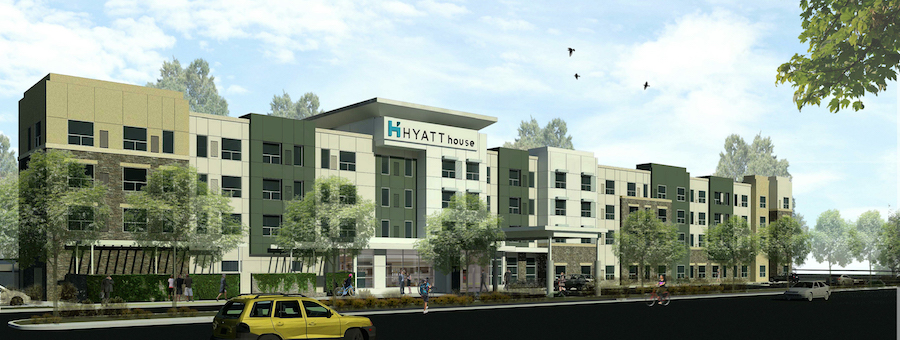
The Davis Planning Commission voted down a proposal on Sept. 14 to approve the development of a new extended stay hotel in South Davis. The project, which will be built in South Davis on Cowell Boulevard, has faced significant opposition from community members in Rose Creek, many of whom are concerned about the disruption the development will have on the area.

Guneet Bajwa, managing principal of Presidio Companies, who is seeking to build the Hyatt House development, recognized the community concerns. However, he emphasized that the project will provide an economic boost to the city, which currently has a shortage of high-end hotels. He hopes a hotel will introduce new shops, cafés and restaurants for Rose Creek residents.

“There’s a very big demand in the city for an extended stay [hotel] and the UC which is the biggest driver of business in Davis, they want an upscale brand,” Bajwa said. “Hyatt is globally known as one of the most upscale brands, so that’s why we chose [it] as the brand. [It will have] 120 guest rooms and it will be the first extended stay [hotel] in Davis, which the city really needs.”

Many residents in the neighborhood object to the proposal, arguing that the project is incompatible with current zoning regulations in the area, which prohibit buildings of more than three stories from being constructed. In a change.org petition, residents of the area argue that the developers want the area to be ‘rezoned’ by the city to allow the construction of the Hyatt House hotel.

In a statement to The California Aggie, Alan Pryor, a resident of Rose Creek who was involved in the creation of the petition and opposes the project, highlighted that residents strongly feel that the development will significantly change their neighborhood.

We are opposed to the zoning change of 2750 Cowell […] and are convinced it will negatively impact our neighborhood. The proposed zoning change would, at minimum, impact neighbor’s privacy, traffic and allow a development that isn’t compatible with a neighborhood of single and multi-family homes. We applaud the planning commission for voting NO on the proposal based on the city council’s criteria for evaluating hotels,” Pryor wrote in an emailed statement. 

While Bajwa accepted the privacy concerns, he said that the development has already proposed a plan to implement screened windows on the highest floors of the hotel to prevent guests from seeing into neighbors’ homes, which was a concern of residents.

The hotel developer also emphasized that the project has significant support from the Davis Chamber of Commerce, Davis Downtown, UC Davis Campus Events and many local businesses. He dismissed the notion that the majority of Davis’ 60,000 residents oppose the project, and said he is confident that the City Council will override the Planning Commission’s recommendation and approve its development.

Both proponents and opponents of Hyatt House will have to wait until Oct. 25 for the City Council to give a final say in whether the project will be allowed to continue.

Councilmember Lucas Frerichs, who supports the proposal, agreed with Bajwa that the city is in need of more hotels to accommodate visitors, and was also keen to highlight that projects like the Hyatt House are extremely beneficial to the city’s finances.

“The city has a shortage of hotel rooms currently, and many cities rely upon what’s known as Transient Occupancy Tax (TOT) to help fund city services,” Frerichs said. “There is both a shortage of hotel rooms and also not a very large amount of TOT dollars that are gained from having hotel rooms right now in Davis. So we’re looking at all our options in the city for potential new hotels and new locations.”

Frerichs, unlike Bajwa, was not so sure about whether the project will be approved by the council and conceded that, as with all cities, new developments are always a contentious issue amongst community members.

“I’m not sure that it will be approved by the city council. People seem to be very torn over the project. I think any site is going to present unique challenges […] You have a site like that nearby a neighborhood, and often [residents] have concerns about any change or development in their neighborhood,” Frerichs said. “It’s not a unique situation for that site and it’s also not unique to Davis.”


Written By: JUNO BHARDWAJ-SHAH – city@theaggie.org

Going Greek

NADIA DORIS / AGGIE
NADIA DORIS / AGGIE

Panhellenic students discuss sorority, fraternity recruitment

Before even coming to university, many students already know whether or not they are going to participate in Greek life. However, prior to joining up, students set on sorority and fraternity life have to endure the infamous “rush week.”

The Panhellenic council is an organization that governs all social interest sororities on campus. It oversees a total of ten sororities on this campus, including two associate organizations that do not participate in formal recruitment.

“We have Formal Recruitment at the beginning of Fall Quarter every year where are all eight chapters participate in open house activities,” said Panhellenic Council President Suzi Jacobs, a fourth-year communication and psychology double major. “All of [the sororities’] active members speak with members who are going through the recruitment process. This year we had about 560 […] people go through recruitment.”

Each day of recruitment has a theme and gives potential new members a chance to get to know each chapter on campus. Jacobs stressed the importance of potential members finding a chapter that will help them grow, and for current members to find recruits who can help the chapter grow. This process is called “values-based recruitment.”

“By the end of rush week, [potential new members] get more comfortable and find women who they are bonding with,” Jacobs said. “By the end of the week they find where they feel like they belong.”

Special-interest sororities have different motivations behind their recruitment guidelines. For the latina-based sorority Lambda Theta Nu, the recruitment process is much longer.

“We’re always recruiting — we have socials for people to come and get to know us [and] study jams where people can get study help,” said Lambda Theta Nu treasurer Quetzalli Haro, a fourth-year political science and chicano studies double major. “That way the girls can start getting to know us — we want to build that home away from home. After that they can decide whether they want to start the process [of becoming a member] or not.”

Lambda Theta Nu is based on the three pillars: academic excellence, community service and sisterhood. Their motivation is to help Latinas thrive on a college campus.

“A lot of Latinas don’t make it to higher education, and we are here on campus to make sure [Latinas] get where we have to go,” Haro said. “[Our chapter has] the highest GPA in our council, and we are in the top ten amongst all the sororities and fraternities on campus.”

For Haro, the recruitment process is vital in helping potential members understand the goals of the sorority and how they fit in with those goals. Their sisterhood is about inner growth through support that their sisterhood provides.

In addition to social and multicultural options available on campus, professional co-ed fraternities based on major or career choices are just as sought-after. Melissa Leong, third-year neurobiology, physiology and behavior major rushed a pre-medical fraternity during the Fall Quarter of her first year, but did not get initiated. She found that rushing too early in her college career was not for her.

“In high school I knew everyone in my classes because we would all take the same classes together,” Leong said. “Going to college, [rushing] and meeting people for only five minutes [at a time] was a really big change for me, and I didn’t like that.”

She chose a fraternity with special interest in pre-med in order to focus more on the academic support that Greek life offers. Recruitment activities for the fraternity lasted one week, and included events during which Leong got to know both members and potential members.

“If you want to rush then go ahead!” Leong said. “But, if it doesn’t feel right, it doesn’t hurt to wait until later on. There will be more chances for you to do it.”

Leong is currently planning on rushing a service-oriented fraternity focused on philanthropy and the community this fall. She feels more confident this time round because of the time she took to experience meeting and interacting with new people outside of the Panhellenic spectrum.

“[Rushing] is not a spur of the moment decision,” Haro said. “Do [your fellow members] hold your ideals? Do you fit in? Are they your home away from home? Does [the chapter] do things you would be proud of? [Joining a sorority or fraternity] is a lifetime commitment, and you need to look for what you want.”

Written by: Amanda Cruz — features@theaggie.org

New International Center now open

DANIEL TAK / AGGIE
DANIEL TAK / AGGIE

Center to offer international student resources in centralized location

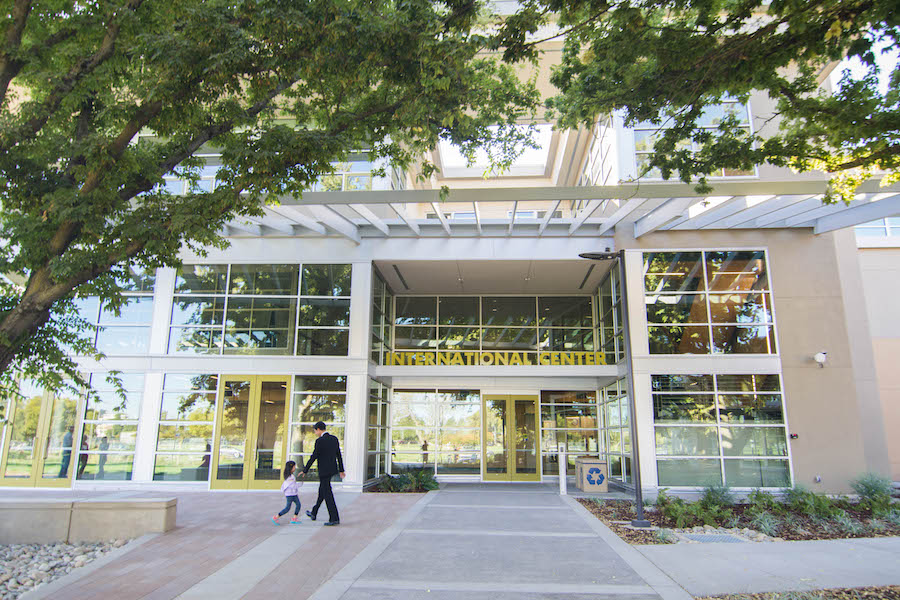
The new International Center, located on California Avenue and Beckett Hall Drive, opened its doors to students this August. The center provides services to international students and scholars, as well as students who are interested in studying abroad.

Previously, the various international resources were not in a centralized location, with the study abroad office located off-campus and the extension center positioned by the student farm. Three Global Affairs departments comprise the new center: the Services for International Students and Scholars (SISS), Study Abroad and the UC Davis Extension Center. A space is also currently being built for the Office of the Vice Provost within the center.

“All our international centers were dispersed, so at some point someone said that we need to address this and get all these services in one building,” Vanda Rovis, project manager, said. “If somebody is coming and needs to find support, it’s all here. The campus wanted to provide a one stop shop for international students.”

The projected budget for the center was $29,901,000. The 61,700 square foot building offers students academic amenities including modern classrooms, computer labs, a large multipurpose room and a common gathering space.

“The building commons space was originally not funded [and] it was not part of the building,” Rovis said. “Campus provided funding for a space to congregate, something like the Student Community Center. They thought this would be a great place to be a beacon for mingling between the international students and the campus at large.”

Additionally, the International Center features an outdoor BBQ area and a kitchen for catering events. A coffee cart is also in the plans to be added by the end of the year.

The initiative to build a centralized building for all on campus international ordeals began in 2012. UC Davis made the project a design build, with different companies submitting their designs for the building. Ultimately, Flint Builders were given the project. Once the plans were finalized in 2014, the process took under a year and a half to complete, with sections of the building opening at various intervals starting in mid-August.

The UC Davis Extension portion of the center offers classes to international students staying with host families while abroad. Part of this program requires the students spend time learning English, and to accommodate this need, the International Learning Center (ILC) will offer a state of the art facility stocked with books, magazines and online resources. According to ILC director Abram Jones, the center provides a space that reflects the most modern language centers across the country.

“The fact that we’ve set it up with this modern layout that is sensitive to the community of language centers that are in operation across the country, I think students will really appreciate it,” Jones said.

Students are excited to use the International Center and take advantage of the resources it offers.

“I think it’s really great that UC Davis has taken the initiative to make the international students feel welcomed here,” said Kevin Tang, a second-year chemical engineering major.


Written by: Lindsay Floyd – campus@theaggie.org

Photo of the Week: 10/5/2016

When life gives you bananas...dance! (CHARLES MIIN)
When life gives you bananas…dance! (CHARLES MIIN)

Enervating Enrollment: Recontextualizing the California resident vs nonresident debate

0
ANH-TRAM BUI / AGGIE

Numbers show Davis is a model for equitable enrollment practices

A fresh school year has brought a new wave of discussion on the University of California’s enrollment figures. This year’s class is the most diverse in UC history. But it’s time for me to be the bad guy and bring the conversation back to a hot button issue of recent years: the controversy surrounding increasing nonresident enrollment. It’s important to avoid demonizing nonresidents in this discussion. Recognizing universities which have the best system for both residents and nonresidents is imperative.

Let’s look at some data from my home state of Arizona and compare its public university system to California’s. California has 32 public universities available to undergraduates and Arizona has three. For every 1.2 million California residents there is a public university, whereas in Arizona the number bends upwards to one public university for every 2 million residents.

Based on these numbers, it appears as if Californians have less of a “squeeze” for public university placement than Arizona does.

But there’s a caveat with these statistics — they don’t account for differences in the demand for public education, and therefore the numbers don’t tell the whole story. To account for this, we must examine general enrollment trends for Californians in concert with statewide population statistics for college age individuals.

There was a 16 percent increase in the number of Californians aged 20 to 24 from 2000 to 2010. Over the same time period, there was a 21 percent increase in enrollment of Californians at UC Davis; there was actually a greater number of Californians enrolled at Davis than statewide demographic trends would indicate.

Let’s examine more recent years. From 2010 to 2014, there was an estimated four percent increase in the number of Californians aged 20 to 24. During the same time period UC Davis saw a five percent increase in Californian enrollment. UC Davis has not been shorting Californians at all; on the contrary, Davis has been a model for equitable enrollment practices.

The UC system as a whole experienced more pronounced enrollment figures for Californians compared to the statewide 20 to 24 age-range statistics from 2000 to 2010. During these years the UC system saw a 27 percent increase in Californian enrollment as a whole. But enrollment fell flat between 2010 and 2014. During that time period, enrollment figures for California residents at UCs overall remained stagnant, despite the four percent increase in Californians aged 20- to 24 in the same window.

The only campuses which saw a comparable increase in Californian enrollment from 2010 to 2014 were Davis and Merced. Berkeley and San Diego saw a substantial decrease in Californian enrollment, while the rest remained more or less stagnant.

Criticism may be warranted, but it should be focused in the right direction. The blame for stagnating enrollment should not be cast on nonresidents. Instead, certain schools should be charged with failing to work hard enough to ensure enrollment figures reflect demographic changes.

Nonresident enrollment has increased substantially in the UC system. This in and of itself should not be a problem: more nonresidents enable diversity of thought and enrich college campuses with cultural awareness somewhat akin to studying abroad. (In a perfect world this practice would exist because of its potential social benefits and not for monetary reasons, but that’s a whole different ballgame.)

The million-dollar question is whether nonresident student growth spells doom for California residents. The answer is nuanced. Data from California reveals a gap between general population trends and enrollment for residents. However, some schools like Davis can move the numbers higher in both camps at the expense of none.

This is the ideal paradigm. Understanding what works at the university level is paramount to fixing any perceived injustice in enrollment. As for the student perspective, I implore the following: consider the experiences of nonresidents before jumping on the anti-nonresident bandwagon.

Ask whether you would feel comfortable facing ever-increasing backlash against your origin. Reflect on the power of acceptance and the impacts of diversity. Nonresidents are people too.


Written by: Nick Irvin — ntirvin@ucdavis.edu

The 2050 Challenge: How are we going to feed over nine billion people?

0

ADRIAN HU [CC BY-NC-ND 2.0] / FLICKR
An ever-increasing population underscores importance of more responsible food systems

Did you know in France it’s illegal to throw away food past its “best by” date? Unsold products from grocery stores are sent to food banks, and the repurposed food generates over 10 million meals for those suffering from food instability.

In America, expired food goes to the dumpster. The United States produces the highest amount of food waste in the world. This wasted food includes food that is expired, overstocked or considered too “ugly” to sell. Today, we produce enough food to feed the entire population, yet millions do not receive enough food to lead a healthy lifestyle. In the U.S. alone, one in eight people are going hungry.

The world population grows by more than 200,000 people per day. Most of this growth comes from developing regions like Asia and Africa. Whereas the United States underwent its industrial revolution around 1760 to 1840, many underprivileged regions have only in the last few decades started to achieve the same level of manufacturing and production.

With increasing industrialization, countries also experience population booms, leading to improved diets and a higher demand for food. This includes meat-based products, which are considered luxuries.

In order to keep up with the burgeoning world population, we will need to produce twice as much food as we do today to feed the expected 9 billion that will populate the Earth by 2050. We will need to generate twice the amount of calories on the same amount of land in order to preserve our ecosystems.

Which such a large population on the horizon, we need to take a long, hard look at the way we grow food today. As it stands, we do not have the means or resources to grow enough food to feed that many people if we keep using our current systems.

Think of it this way: about 25 percent of Earth is land, and only half of that land is available for us to live on. And we only use about nine percent of land for cities, neighborhoods and factories. This leaves us with only a little over three percent of the entire planet to grow food and only on the top three feet of soil.

With our resources so severely limited, how can we expect to feed ourselves and future generations without completely destroying our planet? Consider this: between now and the end of the century, we’ll have to produce more food than we’ve ever grown in the last 10,000 years combined.

Sustainable agriculture and livestock agriculture, as two of the fastest-growing research fields today, have been trying to keep up with increasing food demands. Scientists and professors all over the globe, including at UC Davis, are working to discover more sustainable methods of growing food.

For example, Dr. Ermias Kebreab, of the animal science department, works to measure the greenhouse gas emissions from livestock to build mathematical models to search for potential solutions in animal husbandry and manure and soil management practices. His models have been used in New Zealand, the United States, Europe and Australia in order to predict the emission output in those countries.

Another professor at UC Davis, Dr. Frank M. Mitloehner, specializes in designing “environmentally benign livestock systems” –– or the effects of animal husbandry on the environment and vice versa.

He also focuses on air quality and the impacts of livestock emissions on the environment and on animal welfare and health. By reducing the impact these emissions have on animals, their overall production performance will improve, meaning more food for consumers at a lower environmental cost, Dr. Mitloehner has found.

The possibilities are endless and the research is ongoing. Now it’s up to consumers to make a change. It’s time to start reading and educating ourselves about where our food comes from and how it’s grown.

The work done by researchers like Dr. Kebreab and Dr. Mitloehner will help create a greener food production system critical for facing the 2050 challenge in a responsible way.

When we start taking charge of how we eat food, we waste less, we use our resources better and fewer people go hungry.

Written by: Alice Rocha –– asrocha@ucdavis.edu

Aggie Style Watch: Back to School Edition

BRIANA NGO / AGGIE
BRIANA NGO / AGGIE

Making basics unique

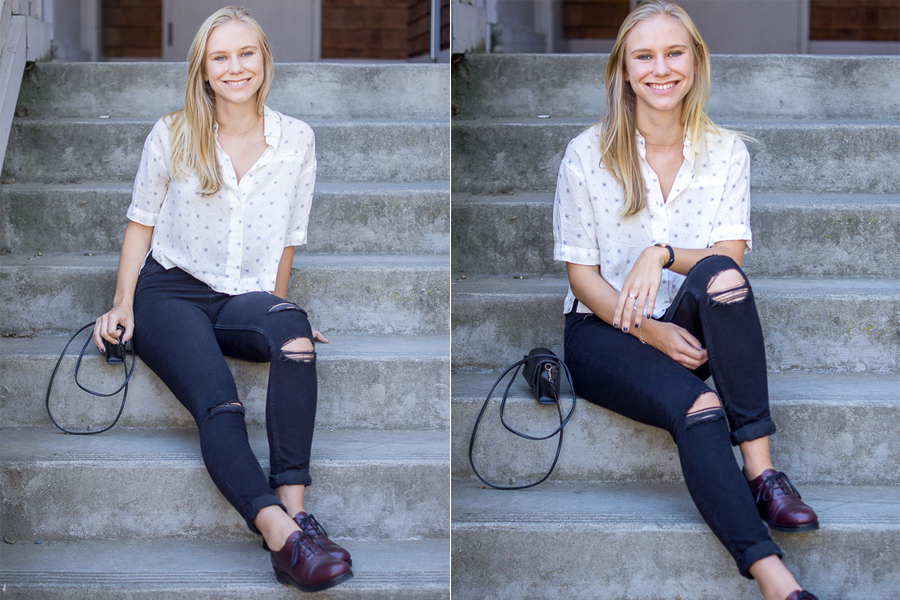
Emma Gary is a third-year art history and history double major with a passion for fashion. According to Gary, who takes a “back to basics” approach to clothing, wearing “classic pieces” can often be the perfect way to make a good first impression.

[hr]

ASW: How would you describe your style?

Gary: I would describe my style as very tomboy. I definitely like menswear pieces more than dresses a lot of the time. I go for pretty classic silhouettes and colors.

ASW: What is your go-to outfit?

Gary: My go-to outfit is a pair of boots, jeans and just a great fitting white t-shirt.

ASW: Do you have any style inspiration?

Gary: No icon comes to mind, but when I go out to events and I see someone with an outfit that looks great I take parts that I think I can apply to myself and what will look good on me.

ASW: What’s your favorite store?

Gary: I shop a lot at TopShop because you can get a lot of great basics that are pretty well made. I also worked at Urban Outfitters in the past and I do like a lot of their stuff but some of it is a little too trendy for me.

ASW: Do you have any advice for someone who wants to be more fashionable?

Gary: Stick to a lot of basics in most of what you wear and if you find one item that you really love just go for that, rather than making it too complicated.

ASW: Where did you buy these clothes?

Gary: My top is from Urban Outfitters, the jeans I actually got in Amsterdam and the shoes I got in Germany but are Italian-made.

BRIANA NGO / AGGIE
BRIANA NGO / AGGIE
BRIANA NGO / AGGIE
BRIANA NGO / AGGIE


Written by: CaraJoy Kleinrock – arts@theaggie.org

Living in the dorms: a how-to guide

LUCY KNOWLES / AGGIE

Resident advisors discuss residence hall resources

Ice cream socials and movie nights at the rec pool are only a couple of the activities that UC Davis residence halls provide for first-year residents. But while social events are widely publicized on social media, there are many invaluable resources that students do not take advantage of which could set them ahead in their college career.

“There are a lot of resources here at UC Davis — I think it is challenging for students sometimes to find all the resources and to put themselves out there and ask questions,” said Richard Ronquillo, assistant director of communications and student outreach for Student Housing. “I really encourage students to take the time to get to know what is available to them and to take advantage of them [their] first year.”

In Ronquillo’s opinion, living on campus is beneficial for students in their first year to transition into living a college lifestyle. It allows students to build new relationships and gives them access to helpful programs.

One resource that Student Housing provides for residents living in the residence halls are the Living Learning Communities (LLCs). These are shared interest communities for residents to participate in, including interests in culture, music and major. Programs and classes are offered through these communities in which any resident can participate, even if they do not live in that community. Residents also have the option to transfer into one.

“We do additional programs and events based on that particular theme,” Ronquillo said. “Some of the LLCs have class components to [them] that take place in the residence halls. It is a really good opportunity for students that have a shared interest to live together and experience college life together.”

Rachel Le, a third-year evolution, ecology and biodiversity major, is taking on her second year as a resident advisor (RA) for the Segundo Residence Hall area, and she said her job is to help incoming students easily transition from living at home to being on their own.

“In the beginning, I would hear [residents] really struggle on how to study for certain classes or pass exams,” Le said. “They were surprised when the way they studied in high school did not transition the same coming into college. However, as time passed they would figure out ways to change that through forming study groups and going to tutoring offered in the services center.”

The academic center in each housing area offers tutoring and advising that residents can access. Another resource is the Residence Hall Advising Team, which visits the dorms to offer advice about academic and professional topics ranging from resume building to class scheduling.

Tanvi Chitre, a third-year neurobiology, physiology and behavior major and Tercero resident advisor, emphasized the importance of utilizing these resources and the convenience of having them near the dorms.

“When I first came here chemistry was really hard for me, but going [to the Academic Advising Center] really helped […and] improved my grade by a lot,” Chitre said. “The tutors who are there are really great! Make sure to take advantage of the resources that are there for you as a resident.”

Although first years are not limited to hanging out with fellow residents, the social events in each resident area serve as a way to bring students together in a “casual and relaxed atmosphere,” according to Le.

“We always want residents to feel comfortable with where they are living since it is not the same as living at home,” Le said. “We want to help them find where they fit in on campus.”

Chitre said that the best part about being an RA is getting to meet so many great people within Student Housing and the residence halls.

“Another part of being an RA is doing rounds at night, making sure no one is in trouble […] and just being there for residents,” Chitre said. “Everyone is busy with classes, friends or other things, so even if we do not talk to residents often we want to make sure we see them once in awhile to make sure that everything is fine.”

Other benefits of living on campus include easy access to various areas at UC Davis. While the Tercero residence hall area is closest to the Arboretum and Cuarto has direct access to the bus lines, Segundo’s centrality is often cited as beneficial for residents, located only a few minutes bike ride away from the ARC, Rite Aid and many main lecture halls.

“When people leave the dorms they tend to miss the easy access to cooked food and tutoring — so really take advantage of it,” Le said. “Take a look at what your RA has prepared for you — it might be really fun! If you ever need help, our door is usually open, or you can always knock!”
Written by: Amanda Cruz — features@theaggie.org

Police Logs

DEVIN McHUGH / AGGIE

A compilation of the City of Davis’ most bizarre recent police reports

Sun, Aug. 28

“Tomato trucks driving in excess of 50 mph all day long”


Thurs, Sept. 1

Noise complaint for “Loud trumpet.”


Fri, Sept. 2

“RP believes transient X currently OS, was throwing her feces and toilet paper @ LOC’s fence and plot”


Tue, Sept. 6

“Abandoned unoccupied minivan in the intersection”.


Fri, Sept. 9

“RP trying to set up a new smartphone.”


Fri, Sept. 9

“Turkey acting aggressive and chasing people”


Tue, Sept. 13

“Open line with child saying ‘Ooh’”


Tue, Sept 13

“Go Kart in the area” holding up traffic.


Fri, Sept. 16

“Voice either stated ‘Hello’ or ‘Spanish’” a few times, then disconnected


Sun, Sept. 17

“Family refusing to leave drive thru window” at a fast food restaurant.


Mon, Sept. 18

“Female visitor to hospital is currently attempting to sleep in the bushes of ambulance bay, refusing to leave.”


Thurs, Sept. 22

“East Covell at F St, sofa in the lane closest to median”


Thurs, Sept. 22

“Aggressive turkey.”

Wildcats stun Aggies in final seconds of Big Sky Conference opener

0
JAY GELVEZON / AGGIE

UC Davis football falls 38-35 to Weber State

The UC Davis football team fell in the final seconds to the Weber State Wildcats in the Big Sky Conference opener last Saturday night, after rallying back from a 22-point deficit. Heading into the game, UC Davis was 1-2 in non-conference play and had hoped to snap their 0-4 record of Big Sky openers.

Fans, students and families came out in full force to participate in new game day festivities including the Kickoff Street Party, featuring new concessions menus, food trucks, music and family fun. The buzzing atmosphere in the stands added to the excitement of the Aggies’ first football game since the official start of school.

Wildcats won the coin toss and opted to defer the ball until the second half, which gave UC Davis the first possession of the game. After a quick three-and-out, Weber State capitalized on the Aggies’ struggling defense with a touchdown and two-point conversion, giving the Wildcats an 8-0 lead.

JAY GELVEZON / AGGIE

The Aggies responded with a completion from senior quarterback Ben Scott to senior tight end Nehemiah Winston for 52 yards into Wildcats territory, and got on the board with a touchdown pass from Scott to sophomore wide receiver Keelan Doss.

UC Davis got their only lead of the game, 10-8, after senior safety Keleen Culberson intercepted the ball, setting up a field goal by freshman kicker Matt Blair.

After a missed field goal and an interception from senior defensive back Zach Jones, Weber State pounded on the Aggie defense, which allowed the Wildcats a 35-yard gain off a fake punt as well as allowed 17 more points before halftime.

The Wildcats kept the momentum and extended their lead to 32-10 on their opening drive of the second half. The Ags did a quarterback change at the half, putting in junior Brock Dale to replace Scott.

JAY GELVEZON / AGGIE

The Aggies finally picked it up and rallied back from a 22-point deficit with big offensive plays from Doss, senior wide receiver Chris Martin and a 92-yard kickoff return for a touchdown from sophomore running back Joshua Kelley. The Aggie defense turned it around and held Weber State to just six points in the fourth quarter, with a forced fumble by redshirt freshman linebacker Quincy Bennett.

However, in the final 16 seconds of the game, sophomore cornerback Isiah Olave fumbled the punt return that was recovered by Weber State at the Aggie 23-yard line. With four seconds left on the clock, the Wildcats put the finishing touches on the game with a chip-in field goal to lift them to a 38-35 victory over the Aggies.

UC Davis is on the road for the next two weeks to face the Eastern Washington Eagles on Oct. 1 and the Southern Utah Thunderbirds on Oct. 8. The football team returns to Aggie Stadium on Oct. 15 to face Northern Colorado at 4 p.m.

Written by: Nicole Sarmiento – sports@theaggie.org