55.5 F
Davis

Davis, California

Tuesday, December 23, 2025
Home Blog Page 699

UC Davis takes new measures against drought

DANIEL TAK / AGGIE
DANIEL TAK / AGGIE

Water Action Committee sets 22 percent water conservation goal

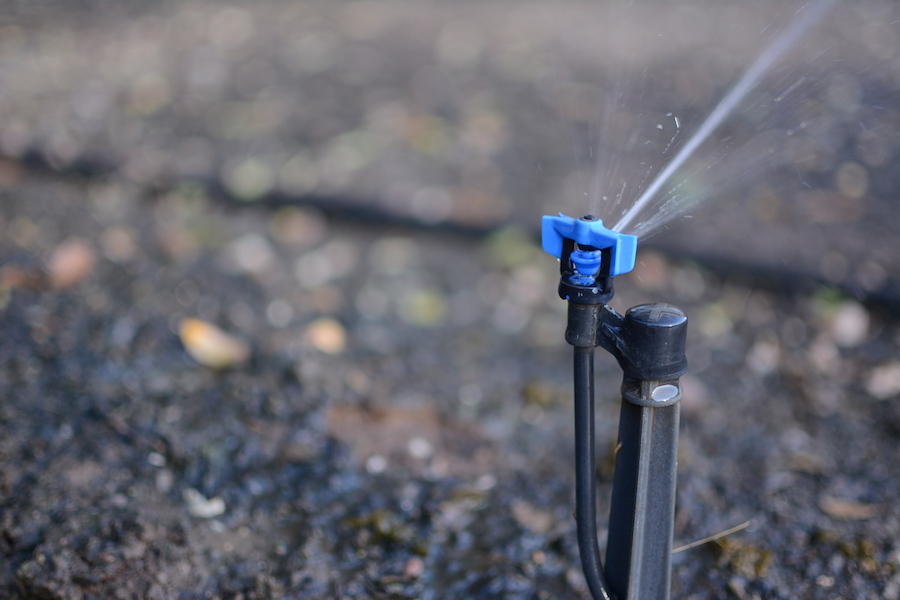
Last year, the UC Davis campus saved 471.5 millions gallons of water, according to the UC Davis Water Dashboard. To improve this number even further, the UC Davis Water Action Committee (WAC) set a goal to reduce water usage 22 percent from March 2015 to October 2016.

According to the Drought Response Action Plan, written by WAC in 2014, below-average snowfall and precipitation caused loss of water at a rate that an average amount of precipitation could not combat.

“While [it] has eased a bit in California compared to last year, we are still in a drought,” said Camille Kirk, assistant director of sustainability and WAC chair. “We still need everyone to be mindful about their water use.”

Before the state’s call for emergency regulation of water usage in 2015, there were already efforts to save water underway at UC Davis. In order to regulate water use on campus, Kirk and the committee collaborated with many teams from different facilities to discuss smarter ways each facility can conserve water.

“A couple of years before I came to campus, all the resident halls were replaced with low flow and flush fixtures,” said Jenni Porter, the Student Housing sustainability coordinator.

Porter also listed UC Davis’ dining services’ best practices before 2015, like trayless dining and water-efficient dishwashers, as proof of the campus’ conservation efforts.

Other facilities on campus also carried out techniques to conserve water. Facilities Management had retrofitted about one-third of the campus’ fixtures with the low-flow version as early as April 2014, according to the Drought Response Action Plan.

In 2015, by the state’s official issue, all small water suppliers including the UC Davis campus were required to reduce their water usage by 25 percent from the 2013 numbers.

“We achieve[d] a 25.7 percent reduction. We exceeded the goal,” Kirk said. “This year, the governor and the Water Board said we’re still in a drought. People did take conservation seriously, so the targets are adjusted a little bit they’re adjusted down.”

Regardless of the regulation adjustments, the committee still wanted to set a conservation goal for the campus.

“We need[ed] to set a conservation goal for the campus because we cannot let up on our progress,” Kirk said.

The cooling tower project  which uses treated water from the campus’ sewage treatment plant instead of well water was a factor used towards achieving this goal, along with fixing old water fixtures like toilets, urinals and sink faucets for more efficient water conservation. The campus landscape is also gradually adapting to better handle a drought.

“The Arboretum itself was already in good shape and served as a model of water conservation for the campus,” said Andrew Fulks, assistant director of Arboretum and Public Garden.

Fulks’ team worked alongside Grounds and Landscape Services to carefully select which areas of the arboretum would receive the most water.

“We looked at where turf areas were most used, so places like the Quads, or the Intramural fields, and […] areas around buildings and some smaller courtyards where you don’t have as much [foot traffic],” Fulks said. “Those areas might get a more dramatic water reduction.”

One of the facilities on the forefront of water conservation at UC Davis is Student Housing, according to Porter. For Porter and her sustainability team, drought outreach and education starts with the residents. There are also programs geared toward promoting individual efforts to conserve water.

“We found out that [the programs] have worked out pretty well and we’ve seen a reduction in water use,” Porter said. “It’s an ongoing effort to make the residents aware that California is in a severe drought and we need their help in conserving water.”

The team, with help from the Energy Conservation Office, created a competition among all Residence Halls called “The Energy and Water Challenge” last year, which will start again this Fall.

“They developed a leaderboard online that residents can go to during the challenge,” Porter said. “They can go and they can look and see their energy saved and their water saved.”

According to Porter, outreach programs to develop behavior efforts such as educational tablings, movie events and arts and crafts programs, will continue to take place in the coming years.

“For example, last year they [had] a program where they make plant terrarium,” Porter said. “We get them to come to the programs to make a terrarium, but the message is overall water saving.”

Around campus, especially in restrooms, there are notification signs that explain how to report broken fixtures and water leaks. These signs not only promote, but also depend on individual efforts.

“It’s important for people to take action when they can,” Kirk said. “‘Am I using water the best way? Are there better ways for me to achieve what I want to achieve?’ Those are the kinds of questions that we want people asking themselves.”
Written by: Temperance Tran – science@theaggie.org
Cheers to the start of a hella good year

VENOOS MOSHAYEDI / AGGIE

Differences between southern, northern California exhibited at UC Davis

Due to its location in the Sacramento Valley, Davis shares many characteristics of northern Californian scenery, slang and weather. While this environment may be familiar to students from nearby regions, other aspects of the small college town often come as a shock to others.

“There [was] still a culture shock of a new environment, especially one with no beach, even though I wasn’t too far from home,” said Michael Hamming, a second-year international relations major and southern California native. “The unfamiliarity was scary at first […but] if you end up feeling the same, get out and meet as many people as possible because it’s a good way to get comfortable in a new environment.”

After living somewhere for a long time, it’s easy to take the little things for granted. Josh Januska, a second-year life sciences major and native of Ventura, CA, experienced this firsthand.

“I definitely miss Mexican food from down south the most, which I think is better because I’ve grown up on it,” Januska said.

As with many regions in America, sports rivalries between northern California and southern California can be very intense.

“I have noticed that the people up here are split between being 49er fans and Raider Fans for football,” Januska said. “I also noticed that the Giants and Angels rivalry is pretty big in Davis as well, but not quite as intense as the one between the Los Angeles Dodgers and the Angels.”

Many people can still find pieces of home in Davis, such as authentic cuisine and sports rivalries. For anyone from southern California having burrito withdrawals, Januska recommends Taqueria Davis on L Street for the most authentic Mexican food in town.

Another adjustment for non-northern Californian students is the weather, which often seems a bit extreme at first. The weather patterns and seasons that Davis experience are characteristic of the Sacramento Valley.

“We have a Mediterranean climate, which is the technical term for dry summers and wet winters,” said Travis O’Brien, assistant adjunct professor from the Department of Land, Air and Water Resources.

During summer and the beginning of fall quarter, days of over 100 degrees are not uncommon, while persistent rain, cold, crisp days and heavy fog prevail during winter months. O’Brien suggests that students prepare for all types of weather by not only bringing weather appropriate clothing, but also by keeping the California drought in mind.  

“Unusually low amounts of winter rain and snow in mountains over a couple of years have been a main cause of this record drought,” O’Brien said. “The second cause is extraordinarily warm summers over the past few years which dry out the soil and lakes.”

Since not all out-of-state students are used to living in such conditions, it is important for them to learn how to stay hydrated in sustainable ways. For example, O’Brien suggests investing in a reusable water bottle to refill at hydration stations around campus.

There are also a few linguistic nuances which differentiate Davis from central and Southern California. In northern California, the word “hella” is used as an alternative for “really” or “very,” or also for “a large amount of something” — native southerners often find themselves boycotting the usage of this word. In general, Californians exhibit various vowel shift which differentiate their speech from those of out-of-staters when saying words such as “dude.”

“Californians believe that they don’t have a distinct accent — however, there are differences in the way we pronounce vowels, which is referred to as vowel shift,” said Robert Bayley, UC Davis professor of linguistics. “The one we experience the most is ‘U fronting’ which we can hear when we say ‘dude’ or ‘goose’ by pronouncing it ‘dewde’ or ‘gewse,’ which is associated with valley girl speech. Just think of Saturday Night Live’s ‘The Californians.’”

While these linguistic nuances are small, they are characteristic of the different regions of California. Bayley recommends respecting other people’s customs as a rule of thumb — whether those customs have to do with language, food or other variances.

“I taught in Texas for a long time and I never adopted “y’all” […] because it just seemed totally phony when I tried,” Bayley said. “However, I believe linguistic diversity is a good thing because how you talk is very much who you are. People associate language with family, the place that they grow up in and things that are close to them.”

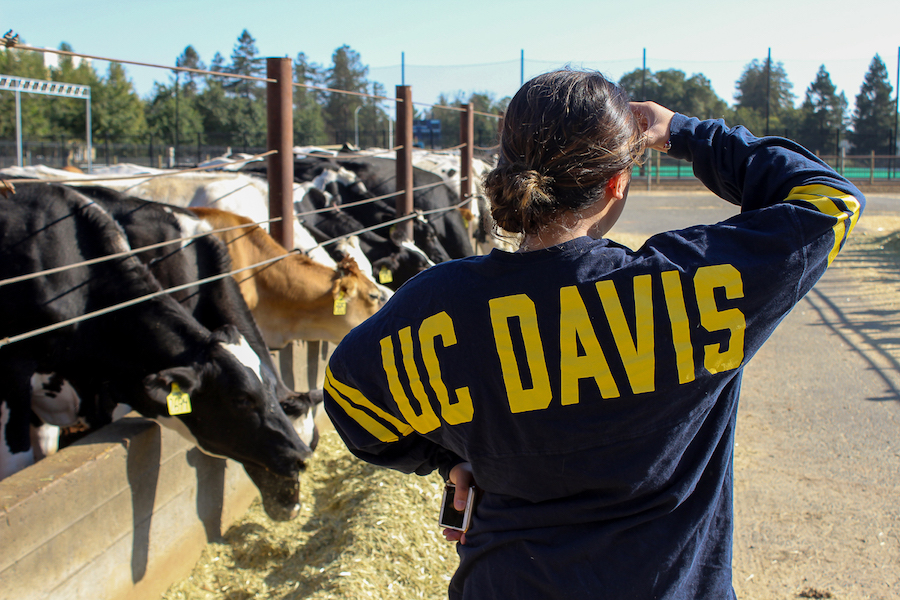
Despite the unique farmland-feel, cow smells and linguistic diversity, UC Davis students agree that the people are what make the town and the university so unique.

“The people in Davis are so much more friendly and less judgemental, at least compared to what I’m used to in Orange County,” Hamming said. “In Davis I noticed that people tend to be much more genuine and accepting of things — it’s just a more open environment.”
Written by: Gillian Allen — features@theaggie.org

HUMOR: Linda Katehi caught pickpocketing students on Quad

1

ALEXA FONTANILLA / AGGIE

Former chancellor gets a little “out of control” in what appears to be revenge act

It’s not easy to lose your job, especially when it means leaving a powerful and high-paying career at a prestigious institution for a different powerful and high-paying career at the exact same institution. Former Chancellor Linda Katehi found this out the hard way. Katehi is under fire once again at UC Davis, this time for stealing money directly out of the pockets of UC Davis students. The incident occurred during the first week of Fall Quarter 2016.

Katehi is said to have accumulated a little over $400,000 from almost 27,000 students before someone realized what she was doing and called campus police. Upon the arrival of the police, Chancellor Katehi told them that she was, in fact, not under arrest, despite their claims. They left shortly after.

One of the victims of Katehi’s actions was Samantha Reynolds, a third-year economics major, who caught Katehi in the act.

“I thought it was just some guy getting grabby, but it was actually Chancellor Katehi trying to steal my wallet! I couldn’t believe my eyes,” Reynolds said. “It brings up some serious concerns about who used to be in charge of this institution. At least the person in charge now was only pressured to resign from his former position at another college because of embezzlement accusations. At least some administrators still have morals!”

Katehi sent out a lengthy email regarding the scandal after seeing how many students were Yik Yak-ing and chalking the campus about her.

Here is part of the response crafted by her PR team:

“It hurts me greatly that I have been caught stealing money from you, the beloved students of this university. I can assure you that I will do everything in my power to make sure it looks like I have learned my lesson from this experience.”

Not satisfied with this response from the chancellor, a group of brave student activists began an occupation of Katehi’s house. Many are actually living in the chancellor’s home full-time, having food delivered and camping out overnight.

“We don’t plan to leave until she resigns and gives me my wallet back,” said Ryan Paul, occupier and hoverboard owner.

Katehi said she plans to keep the money, but she will use part of it to set up a $30 scholarship fund for five lucky undergraduates to split.

The former chancellor is expected to keep her job at UC Davis despite the incident, and might even get a raise.


Written by: Brian Landry –– bjlandry@ucdavis.edu

Food for thought

0
HANNAH LEE / AGGIE
HANNAH LEE / AGGIE

Solving UC Davis’ food insecurity problem

After having to strip a first-grader of his lunch this week, a cafeteria employee in the Canon McMillan School District has quit her job in protest of the district’s new ‘lunch shaming’ system.

The district, located just outside of Pittsburgh, Pennsylvania, has implemented new policies revoking students’ meals if they are over $25 in meal debt. As required by state law, indebted students from kindergarten to sixth grade are given a supplemental meal a cheese sandwich while older students receive nothing.

These actions by the Canon McMillan School District have left many young students teary-eyed and humiliated and have opened up a space for a greater dialogue on the matter of food insecurity, which should prompt UC Davis to take further measures to combat the issue..

The United States Department of Agriculture defines food insecurity as “a state in which consistent access to adequate food is limited by a lack of money and other resources at times during the year.”

Results of a survey completed in 2015 showed that of the 9,000 students across the UC system who participated, 19 percent of them suffered from “very low” food security, while another 23 percent reported feeling “low” food security. UC Davis in particular has put great efforts into combating these numbers with initiatives that make food more accessible for its students and alleviate food insecurity.

The University of California Global Food Initiative, launched in 2014 to “sustainably and nutritiously” feed an ever-growing world population, utilizes the research-powerhouse capabilities of UC schools to “help individuals and communities access safe, affordable and nutritious food.”

UC Davis has received $375,000 in grants thus far through the initiative out of the total $3.3 million that UC President Janet Napolitano has pledged to the issue through 2018.

The initiative will deviate to pre-existing food access resources on campus like the ASUCD Pantry, located in Lower Freeborn, which offers all students free meals and grocery items on weekdays, and Fruit and Veggie Up!, a program that through the Pantry and at the Student Health and Wellness Center provides free produce to UC Davis students.

Budget allotment also allows for the revamping and wider publicizing of Aggie Food Connection (AFC), an “online access point for UC Davis information, resources and services pertaining to food security and nutrition.”

The Editorial Board would like to commend UC Davis for prioritizing and pushing for initiatives that combat food insecurity and promote food access for all its students.

While UC Davis does its part in alleviating this problem, students can also take action by donating to the Pantry and participating in the ASUCD Pay It Forward campaign spearheaded by ASUCD senator Adilla Jamaludin.

We hope UC Davis will continue to add to the nutrition resources on campus and  diminish the number of students that experience any level of food insecurity. Students should not have to compromise their academic performance because they’re worried about where their next meal is going to come from.

ASUCD senators make progress on their platforms

BECCA RIDGE / AGGIE
BECCA RIDGE / AGGIE

Fall Quarter to bring Student Health and Wellness fair, CoHo nutritional facts and more

Fall Quarter is coming to UC Davis, bringing with it revamped efforts by ASUCD senators to implement policies left unfinished at the end of last year.

ASUCD Senator Sofia Molodanof, a third-year English and communications double major, ran on a platform that included creating a 24-hour non-urgent wellness hotline, hosting a student mental health fair, getting nutritional facts displayed in the Coffee House (CoHo) and increasing campus amenities.

“I’m happy to say I have made progress on all of [my platforms’ objectives],” Molodanof said.

On Oct. 6, students will have the opportunity to attend a Student Mental Health and Wellness Fair on the east quad, organized by Molodanof with help from the Psychology Department and Student Health and Counseling Services. Various UC Davis clubs and organizations will be in attendance, such as Active Minds, Out of the Darkness and Best Buddies.

“My main focus last quarter was planning the Student Mental Health and Wellness Fair,” Molodanof said in an email interview. “I hope that my work toward mental health and wellness on campus makes a difference on campus and students can take advantage of all the positives that occur when improving your mental and physical health.”

Molodanof has also made progress toward her goal of making nutritional facts available in the CoHo. She has worked in collaboration with the CoHo’s food services director to create a website that will allow students to access nutritional information for food and drink offerings at the CoHo.

As part of her effort to increase amenities around campus, Molodanof was able to secure the placement of an additional microwave in the CoHo and a water hydration station on the first floor of Wellman Hall during Fall Quarter.

Irveen Grewal, a third-year political science and psychology double major and ASUCD senator, also made strides in accomplishing her platform objectives of accommodating students’ mental health needs, creating new napping spots in the library for students, implementing Punjabi as a language class, hosting a cultural fair and installing additional parking in the Tercero parking lots.

To accomplish these initiatives, Grewal joined the library committee and designed new napping spaces within Shields Library, which will be included in the library’s ongoing reconstruction. Parts of her designs are modeled after the stress and mental wellness research of Jing Mai, a fourth-year neurology, physiology and behavior major.

Additionally, Grewal has secured over 300 signatures on a petition to make Punjabi a language class offered at UC Davis.

“We are currently working on getting funds, as it costs up to millions in dollars to have a new class implemented,” Grewal said in an email interview. “I am following the same timeline of how Persian was implemented this year, [as it] takes a couple of years to have it implemented [since] it has to go through many checkpoints. But we are doing our best to spread the word and we have been contacting local colleges for professors, and have been in contact with the local temple that offers Punjabi classes as a part of Sunday school.”

This Fall Quarter, students can attend a cultural fair in the quad organized by Grewal as part of her campaign platform. The fair, which will include several campus cultural clubs, will promote participation in the clubs as well as provide a safe place to recognize featured cultures.

“We are planning an event to have many cultural clubs come together and be able to display and provide information about their individual clubs […] We felt this was important because many cultural clubs end up retaining very few members and don’t get enough publicity,” Grewal said.

Grewal is also collaborating with the UC Davis Police Department to install additional lighting in parking lots by Tercero and Olson Hall. She hopes to have this completed by the end of her term.

 
Written by: Lindsay Floyd – campus@theaggie.org

An Eggcellent Debate: Cage-free eggs might cause more problems than they solve

0

MARK BONICA [CC BY 2.0] / FLICKR
Consumers must consider food producers when voting to change animal husbandry practices

Eight years ago, California voters were asked to vote in Proposition 2. It asked if consumers would like their egg-laying hens to be able to “stand up, lie down, turn around, and fully extend their wings.” Consumers agreed with the proposition outline and the full effects of the law became apparent by 2015. Since then, various large producers like Foster Farms and Hickson Family Farms have changed to cage-free systems.

Chicken production has frequently been berated with negative images, especially for poultry raised in conventional cages. Pictures of birds missing large chunks of feathers and stuck in small cages have been spread over social media through groups like People for the Ethical Treatment of Animals (PETA), advocating that no animals should ever be used by humans for consumption or otherwise. Those who see these photos might cast the blame on the cages, but the ragged appearance of the birds cannot be blamed on husbandry alone, but on the animals themselves. Chickens are hierarchical and establish a “pecking order” in their cages, where they fight with other birds to gain dominance. These constant attacks cause the bald spots and injuries the hens suffer in their cages.

Besides the conventional system of raising chickens, there are several different methods of poultry husbandry. The system previously used by such big producers is called conventional cages (CC). Known to be very efficient, CC ensures manure is taken away from the cages and the eggs are removed before they can be exposed to disease from the feces. A second, more expensive method is called enriched cages (EC), in which chickens are housed in larger cages with nesting boxes and scratching area. Cage-free systems allow birds to roam freely in an enclosure where eggs are laid in manure. This was the system elected to be adopted in 2008 and is still used today.

Despite the overwhelming positive response from the public during this election, cage-free systems are not all positive. According to a study by Dr. Frank M. Mitloehner, UC Davis professor of animal science, the new egg-laying system could pose environmental, food safety, worker safety, animal welfare and affordability consequences.

Environmentally speaking, cage-free causes a higher daily concentration of ammonia and an increased concentration of particulate matter in the air than CC and EC methods. While ammonia is a naturally occurring chemical, it can still be detrimental in high concentrations, with the potential to erode the ozone layer that protects humans from harmful UV rays. Cage-free eggs also have higher risk of pathogen ingestion. All hens shed salmonella in manure and when eggs come in contact with the feces, this increases the rates of salmonella and decreases the food’s safety.

Prop 2 also had serious consequences for animal welfare. Hens in these systems have lower weekly egg counts, the highest death rates, cannibalism and high rates of pecking between the birds. When hens lose track of the birds they’ve established dominance over, the chickens constantly fight with one another because of the lack of separated flocks. And with single flocks that can range up to 200,000 chickens, this can cause a lot of damage. Cage-free birds were also seen to have prominent keel bone fractures (the large bone in their chests) due to the chicken’s unsuccessful flight abilities.

Imagine having another person thrown at you — that’s what these birds experience every time they’re landed on. Moreover, workers in these facilities are also exposed to health threats due to the high concentration of inhalable dust, which puts them at greater risk for lung disease.

While conventional cages might provide better food safety and worker safety, they do create a worse environment for the birds. When having to decide between cage-free and CC or EC, there will always be trade-offs. It’s important to be fully educated before voting on a proposition that could make as much of a difference as Prop 2. It’s also important to keep in mind that farmers raising these birds only receive seven cents for every twelve eggs sold, while retailers keep the rest of the average $2.94/dozen. And this cheap price applies only to conventional cage systems. By forcing producers to redesign their entire production systems, we are generating more expenses for them and creating a more expensive product most consumers are still reluctant to buy. Prices for cage-free eggs range from 5 to 9 dollars but few people willingly hash out the extra cash to pay for the eggs.

This is not to say cage-free is a terrible system. Everything has its pros and cons, and consumers must remain vigilant and educate themselves in order to make important decisions about the food they put on their tables. They must consider not only the impact of a law on the general population, but on the people who grow the food as well.

So what has Prop 2 actually done other than increase egg prices, increase health concerns for workers and decrease food safety in eggs? Only the future can tell.

Written by: Alice Rocha — asrocha@ucdavis.edu

Davis wouldn’t be Davis without a strong focus on agriculture. Alice Rocha, a third-year animal science major, will bring that focus to the Aggie with a column on sustainable animal agriculture and how it impacts the food system today. This paper ran a column last year on ethical consumption, which was partly concerned with the potential downsides of our eating habits. Rocha will expand upon those concerns, using her own experience working in a lab to inform her takes on some of the most pressing issues we need to start working through today, including how to feed nine billion people by 2050.

UC Davis men’s soccer falls short, excited for conference play

0
JAY GELVEZON / AGGIE

Aggies take the 1-0 loss to Utah Valley in final preseason game

Last season, the UC Davis men’s soccer team produced an overall record of 8-10-3, with a home record of 5-2-2.

Now, it is a new season for the Aggies and with Big West Conference play beginning this week, the team is already succeeding in their preseason games and hold a 4-3-2 going into the start of conference.

JAY GELVEZON / AGGIE

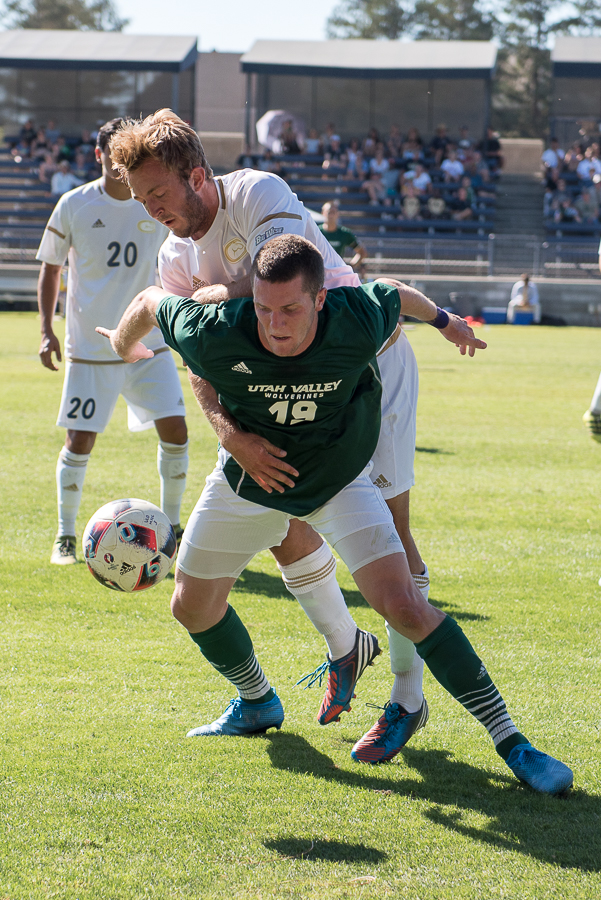
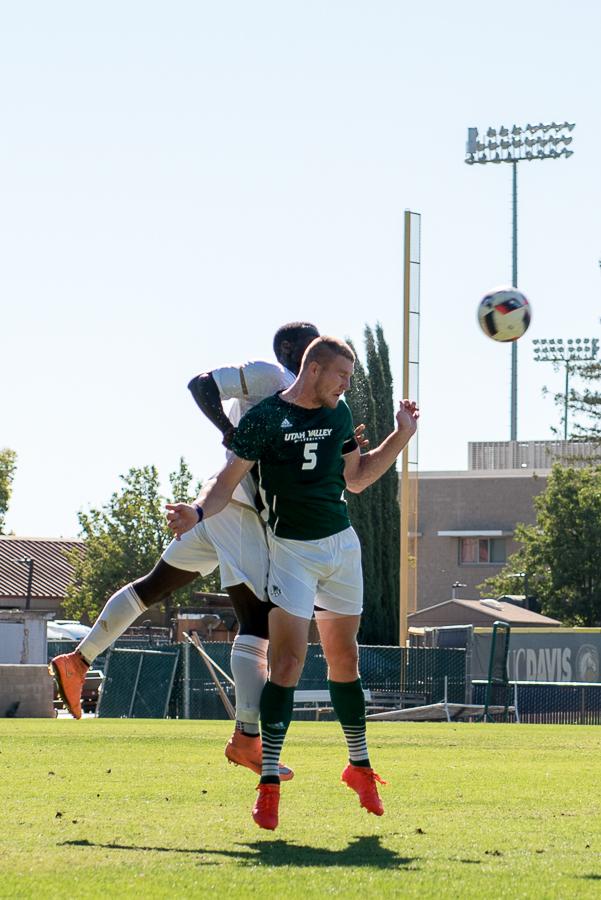
The team finished its preseason play last Saturday, Sept. 24 against Utah Valley, but fell short, taking the 1-0 loss in an exciting game at Toomey Field and ending a three game winning streak.

“I’m not very excited about our performance — in order to win, you are expected to score a goal at home and unfortunately it just didn’t work for us,” head coach Dwayne Shaffer said. “It doesn’t matter what we do, how well we look or how pretty it is, the bottom line is that you have to score a goal at home to win a game. Next [game] we are going to have to have way more energy and effort than what we displayed today.”

Even with the tough loss Saturday, the men’s soccer team is looking forward to conference play this Thursday, Sept. 29 at Cal State Northridge at 7 p.m..

“I’m excited about my team, I like my group,” Shaffer said. “It is wide open in the Big West, with everybody beating

JAY GELVEZON / AGGIE

everybody right now. Anything can happen. Playing at CSU Northridge on a Thursday under the lights is always a great thing.”

Looking into the future of the team and what fans can expect this season, Shaffer commented on what he thinks the team will produce moving

forward.

“We need to get our health, minds and spirits back to a high level and compete for a Big West Championship,” Shaffer said. “This year we have a much better record and a very good team. We will give it our best shot and I am excited for our team. There are no secrets in soccer — you have to score goals and that’s the bottom line. We have got to keep getting better and better and hope we start scoring goals.”

With the confidence of the team and the coaching staff and the way the team has been playing, the UC Davis men’s soccer team is well positioned to produce a Big West Championship this season.


Written by Ryan Bugsch – sports@theaggie.org

Memoirs of a mellophonist

JAY GELVEZON / UC DAVIS CAMPUS RECREATION AND UNIONS

Being apart of the Band-uh! family

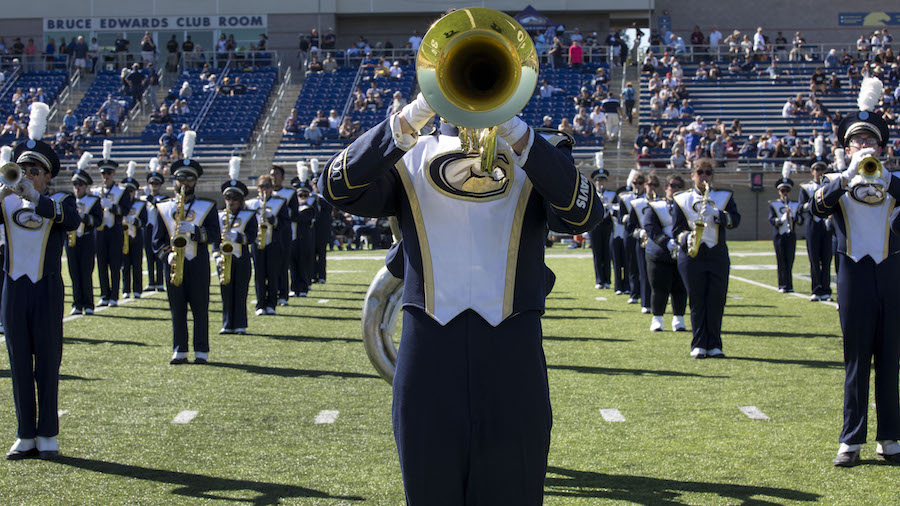
UC Davis alumnus Reece Mathiesen still remembers the first time he watched the UC Davis Cal Aggie Marching Band-uh!, clad in blue and gold uniforms, march through campus on the first day of retreat five years ago. As an experienced musician, he instantly felt the welcoming atmosphere brought about by the band’s unique energy.

Being a newcomer to a large university is a daunting prospect. It’s often the first time that students are away from home for an extended period of time. Luckily, Mathiesen found his home away from home in the Band-uh!, a group which fostered his passion for music and helped him form valuable bonds with his fellow students.

Mathiesen graduated from UC Davis in the spring of 2016, with degrees in chemistry and Japanese. He had been a member of the Cal Aggie Marching Band-uh! since his freshman year. Mathiesen played the mellophone — “the marching version of a French horn, [which] is a little bit bigger than a trumpet,” he explained. Mellophones are mainly used to play the countermelody and can also be used for rhythmic backup. According to Mathiesen, mellophones are also suitable for playing solos.

“The fun part about mellophone specifically in Band-uh! is that we get a lot of the solos as well,” Mathiesen said.

The mellophone section is a medium-sized group in the band that usually consists of eight or nine players. Mathiesen was the section leader in his junior year. He described the job as being the “parent” of the section: “making sure gigs are covered, all the food for the mellos gets out for football games, and planning events within the section as well as with other sections.”

Despite the intense practice and performance schedule, playing with the Band-uh! was an indispensable part of Mathiesen’s college experience.

“Every Monday, I would really look forward to rehearsals because I knew we were all going to the [dining commons] afterward to socialize, tell funny stories and bond,” Mathiesen said. “The support from people in Band-uh! really helped me as a shy freshman who was slightly homesick and didn’t know too many people.”

Looking back, Mathiesen is confident that Band-uh! changed his college life for the better. He is now looking forward to his next great adventure as he takes part in the Cal Aggie Alumni Band-uh!

 
Written by: Betty Wu – arts@theaggie.org

Reconstructing our campus

ALEXA FONTANILLA / AGGIE

An update on the construction in the Tercero residence hall area

In July 2015, demolition of Leach Hall in Tercero led to “Tercero Phase Four” (TP4), an ongoing effort to create new buildings in Tercero. Phase four will feature three new four-story buildings, one large community space building, a music room, a recreational room, a community kitchen, office spaces and a meeting room for future seminars.

“We broke it up into three phases — first [was] the demolition of the existing buildings, second [was] installing all the underground utilities, so everything you don’t see when the project is completed [that] is in the ground [and third was when] they broke ground and started putting for the buildings themselves [in September 2015],” said Michael Head, project manager of design and construction management.

Head coordinates with his team, the architects and the contractor each week in order to make sure that the project remains on schedule. The construction of the buildings has been relatively smooth, Head said, so the team has dealt with few challenges along the way. In one area of construction, Head and his team faced the challenge of digging up pea gravel, which is small gravel that runs off the sides like sand.

“That was a challenge,” Head said. “When [problems] arise it is [about] how everyone works together to get them resolved. Communication is key in a project like this.”

The new residence halls are estimated to house around 500 new students, compared to the 175 students Leach Hall previously housed.

“The campus growth plan is continuing to move forward based on the enrollment numbers we’re getting from the Office of the President,” said Brendan Pettit, director of the office of student development. “So, with the additional freshmen and transfer students coming to our campus, it will be important that we provide housing [for them and] make sure we’re meeting the demand.”

TP4 is scheduled to be completed and open for incoming freshmen in Fall of 2017.

 “It shouldn’t affect [incoming freshmen] too much [since] most of the exterior work is already complete,” Petitt said. “The workers are working during the day when the students are up or at class. This fall, most of the work will be done on the interior of the buildings, so most of the noise will be mitigated.”

The new residence hall buildings of TP4 will be similar to the existing Tercero dorms and the Alder, Thompson and Miller buildings in Segundo. These buildings all feature cluster-style housing, where a couple of rooms in a hallway form a cluster and share one restroom space. These clusters then become small communities all connected to each other.

Like existing residence halls in Tercero, Segundo and Cuarto, the new residence halls will also feature Living Learning Communities (LLC). The specific LLCs will not be determined until later this school year.

“The collaboration with all our campus partners will determine what will go in those buildings,” Petitt said. “[LLCs] could be based on major, gender, cultural identity [and] special [interests] like music arts and performance. There’s a big variety.”

TP4 is also a LEED registered project under the LEED green building certification program. The program promotes a sustainable approach and recognizes performance is five areas: sustainable site development, water savings, energy efficiency, materials selection and indoor environmental quality. A LEED registered project could receive one of four LEED rating levels: certified, silver, gold and platinum.

“We’re going for gold,” Head said.

In addition to TP4, the dining commons (DC) in Tercero are also under renovation and should be ready to open this fall. The Tercero DC renovation had been planned for almost two years, but early construction took place in March 2016. Among the renovations was the upgrade in the mechanical system in a separate building immediately to the left of the dining commons. These systems, originally installed in the 1960’s, provide domestic hot water, heating hot water, domestic cold water and steam. The air handling units in the main buildings were also replaced.

Additionally, the student lounge on the first floor of the DC has been converted into new dining seating for the increased amount of students in Tercero. Likewise, a new elevator was installed in the building to make it easier to transport dishes from the first to second floor.

“[The renovations] will provide a newer environment in the dining area to provide more capacity for folks to come and get their meals,” said Morgan Meier, project manager of design and construction management. “Hopefully it just serves more students — that was really the intent.”

The new buildings are estimated to be completed by Fall Quarter 2017.


Written by: Fatima Siddiqui — features@theaggie.org

New director, new focus for athletics department

0
DANIEL TAK / AGGIE
DANIEL TAK / AGGIE

As the academic year kicks off, UC Davis moves to improve competitiveness and student involvement

With the induction of new athletic director Kevin Blue, UC Davis Athletics can expect big changes to the department’s overall involvement in student life. The Athletics Department hopes to increase the degree to which UC Davis is competitive in Division I, while maintaining its traditional core values as a sports program.

For the 2015-2016 academic year, UC Davis spent over $26.8 million and made back $28.1 million in revenues, according to the latest Equity in Athletics (EADA) report. This gave UC Davis the opportunity to capitalize on building the school’s brand.

“We have an opportunity to professionalize what we’ve been doing and I think one of the aspects of our athletic program is that there’s an opportunity to modernize the business side of it — and that’s revenue generation,” Blue said.

Blue’s primary vision has to do with cultivating relationships with students and alumni in order for the program to take a more active part in the community. With that in mind, Blue hopes to emphasize the program’s commitment to a “positive culture of togetherness,” to scholar athletics and to an ethical conscience that is both proactive and active when it comes to complying with NCAA policies and rules.

Although it is too early to have any “specific, granular goals,” Blue said the department is very much focused on increasing the competitive nature of the athletics program.

Blue named Rocko DeLuca as deputy athletics director over the summer. DeLuca has 14 years of experience, having previously worked as athletics administrator for the University of Colorado and the Denver Broncos. He most recently served as senior associate athletic director and executive director of development at University of Massachusetts.

As the deputy athletic director, DeLuca will head external affairs by overseeing program development and sponsorships, making him one of the key players in building the UC Davis name, and implementing Blue’s platforms for the coming year.

As far as scholar athleticism goes, 61 of UC Davis’ student-athletes received Big West Conference Academic All-Conference honors last academic year. In order to be considered for the award, student-athletes must maintain a GPA of 3.0 or higher, compete in 50 percent or more of their respective team’s competitions, as well as have completed a full academic year at their school.

One of the premier changes in UC Davis sporting events has manifested itself through this year’s football season’s promotional purposes. For instance, the annual Hall of Fame Ceremony that is usually held in the spring is scheduled to be part of the Homecoming Day game in order to give the ceremony more visibility.

Mike Robles, assistant athletic director and communications coordinator, emphasizes the importance of the partnership between athletics and the university.

“Athletics is a part of the university,” Robles said. “[Blue] has been trying to build that partnership up and ASUCD is obviously a big part of that, but even beyond that. We want to be part of the experiences — part of the university.”

Written by: Nicolette Sarmiento — sports@theaggie.org

Freshman 15? Don’t Sweat It.

JAY GELVEZON / UC DAVIS CAMPUS RECREATION AND UNIONS

The ARC provides a variety of fitness tools, activities

With the variety of physical activities offered at UC Davis, it’s not difficult to avoid the notorious “freshman 15.” From club volleyball, to intramural quidditch teams, to establishing a fitness plan with one of the many qualified trainers on campus, there are fitness opportunities for anyone looking to keep in shape.

Campus Recreations and Unions (CRU) is connected to several programs that UC Davis students can take part in, including the Craft Center, Outdoor Adventures, the Rec Pool and the Activities and Recreation Center (ARC).

There are many services available throughout the department of Campus Recreation and Unions. The ARC is only one of the buildings that will house such activities,” said Tyler Scudero, CRU’s senior recreation coordinator.

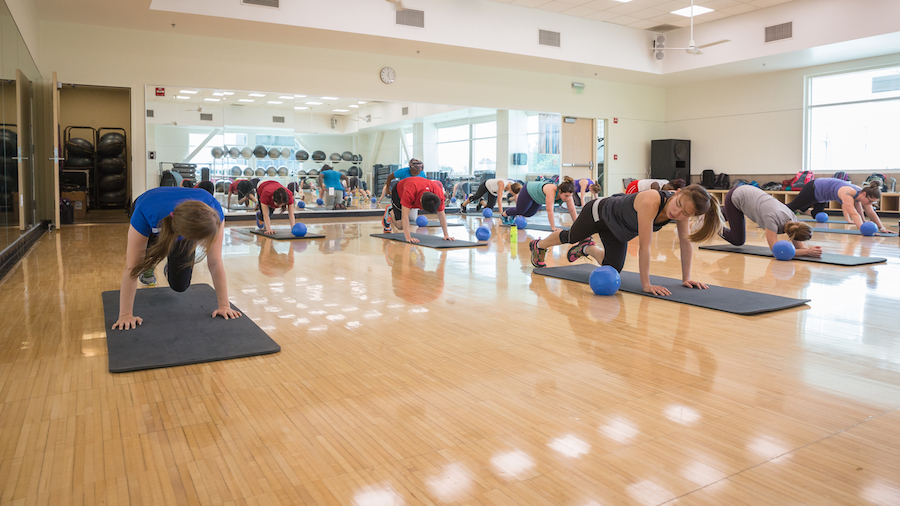
The ARC is the best place for any incoming student to take advantage of CRU opportunities, especially during the first week of school, during which students can participate in “try before you buy” — a week of free group exercise and instructional classes. This way, students can try out all the different classes before buying the pass for the quarter — a great way to get comfortable with using the ARC facilities as well as meet others.

“Group exercise [classes like] zumba, cycle and etcetera [are] all found on a schedule that is available on the ARC website,” said Brian Luu, assistant director of the Fitness & Wellness Center. “Instructional classes are a little bit different from group exercise in that they are not drop-in after the first week, but rather aim to be more progressive. Instructional [classes] include martial arts, small group training and mind [and] body classes like pilates or yoga.”

Students can also seek out a personal trainer with the help of the “initial training package.” This package includes an initial consultation, where students can discuss their fitness goals, as well as a nutrition consultation with an on-campus nutrition intern. Information about all trainers can be found on the ARC website, where students can get in contact to start an initial fitness plan for $75.

If team sports are more your style, UC Davis offers a collection of 39 club sports, in addition to a variety of intramural leagues. You can sign up for these sports at campus events such as The Buzz, through contacting the president of clubs listed on the ARC website or by going directly to the club sports office located upstairs at the ARC.

In many club sports programs, there are “A” and “B” teams to ensure newcomers feel welcome. For those looking to play at a competitive level, there are certain programs — such as volleyball and lacrosse — that require tryouts for the team.

“For club sports, some of our highest numbers in terms of participating members is [for] our boxing club – we get about 200 members a year,” said Michael Dominguez, Sport Clubs coordinator.  “A majority of them go just because they enjoy the workout, want to hit something and learn how  to punch and defend, and a small number compete at the collegiate level. We [also] get a lot of people in our Alpine Ski Club, and our tennis program gets high numbers as well.”

The ARC itself offers a wide variety of ways students can exercise. Racquetball courts are available on reservation, and the rock climbing wall can be accessed for a fee. The basic fitness center, including weights, machines and a state-of-the-art indoor track, are always accessible during ARC hours.

Also connected to CRU is the Recreation Pool, free for students until its seasonal closing date of Sept. 30.

Whether students want to make it up to Tahoe for ski season, discover a newfound love for cycling or simply get in a good workout, the ARC is a great place to break a sweat. The amenities offered by the ARC create a community of active, diverse students and serve as a break from the stress of school.

Written by: Austin Carroll — features@theaggie.org

West Village, UC Davis begin project to build 50 homes for faculty, staff

VENOOS MOSHAYEDI / AGGIE

Project designed to provide housing for employees currently living outside of Davis, produce energy-saving homes close to campus

UC Davis announced over summer an upcoming project to build 50 single-family homes for faculty and staff at West Village by 2018.

The homes, which are all walking or biking distance from campus, will be sold at about 80 percent of the cost of comparable Davis homes. These homes will meet West Village’s ambitious efficiency and sustainability goals.

Jillian Ramsey, the assistant project manager, believes that this plan helps ease the issue of the expensive cost of living in Davis while continuing the pursuit for zero net energy housing.

“It is solving one of our biggest recruitment challenges,” Ramsey said. “Everyone has a challenge finding affordable homes here in Davis, so we hope this will encourage new faculty and staff to live close to campus. It will also model our sustainable growth progress, and that is really important to us.”

The problem is not unique to Davis; schools across the nation are struggling to hire and retain faculty members in cities where the cost of living is high.

Currently, the only university housing designed for faculty and staff is at Aggie Village, where there is an approximately 200-person waiting list for a complex that only sees a new vacancy every one or two years, on average.

Andy Fell, associate director of news and media relations at UC Davis, believes that this new project will attract potential professors and faculty employees to the university.

“What’s important is there is a need for housing in our area for faculty and staff,” Fell said. “Housing in Davis can be really expensive, so there is a kind of need for affordable housing that is biking or walking distance from campus that can be attractive and help lure in new staff.”

The project has been in the works since 1999, when the contractor who designed and constructed student housing at West Village also planned to incorporate single homes that could potentially be for faculty and staff. However, the project stalled due to various complications, including the housing market crash of 2009.

Last fall, the original contractor left before beginning work on the housing project, and the university terminated its master ground lease with West Village Community Partnership LLC, putting about 60 acres back under the university’s control.

Regenerating the project under its existing Long-Range Development Plan (LRDP), the university now can build up to 475 homes. The original project conceived under the LRDP included not only the 475 single-family homes, but capacity for 3,000 students, approximately 42,000 square feet of commercial space and a community college center with about 60,000 square feet of space. The Sacramento City College Davis Center has already been completed and running since 2011, making UC Davis the first UC campus to host a community college on its property.

Siegel & Strain Architects, an Emeryville-based firm which also worked on the Jess Jackson Sustainable Winery Building at UC Davis, has been selected to design the single-family homes. They are now working with the university, faculty and staff to develop initial design concepts. Once design and construction are completed, potential new residents will be chosen by a lottery process.

In order to receive input, the university is asking faculty and staff to fill out a survey addressing topics such as household composition, home design, energy efficiency and transportation and commute patterns.

BreAnda Northcutt, communications director at the Office of the Vice Chancellor and chief financial officer, says that both the faculty and staff have contributed to the housing design.  

Northcutt believes this is the start of a project that will draw in new faculty and staff, and provide them with a welcoming community.

“This is an important project for us to really show our faculty and staff that we are understanding of the challenges within the housing market and we want to reach out to them,” Northcutt said. “There is so much yet to come. This is only the beginning.”

Written by: Demi Caceres — campus@theaggie.org

Letter from the Science Editor

BRIAN LANDRY / AGGIE

After a two year hiatus, The California Aggie’s science and technology desk is back.

As the many of the world’s most powerful volcanoes lay dormant, so too did The California Aggie’s science and technology desk — until now.

My name is Ariel Robbins and I’m the science and technology desk editor helping to rise the science and tech desk up and out of the ashes.

Our university, a forerunning research institution, has had a newspaper devoid of a section that would cater to and publicize all of the scientific and technological feats UC Davis students, faculty and alumni have been accomplishing since March 2014.

Two years without a science and technology desk is two years too long.

As the mitochondria is the powerhouse of the cell, the science and technology desk will be the powerhouse of the newspaper this year, and for many years to come.

Last week, you got a teaser of the content the science and tech desk will be churning out on a weekly basis. My team is coming at you laptop keyboards ablazing, and will keep you informed with the most honest, diverse and fair STEM-related news UC Davis has to offer.

I speak for myself and the reporters at my desk when I say that it is a pleasure to be back and providing UC Davis with the science and technological news it had been missing for so long. It’s an honor to write for and about such a dedicated, talented and unique student body.

If you are interested in writing for the science and technology desk we’re hiring! Fill out an application at vacancy.ucdavis.edu before Oct. 11.


Written by: Ariel Robbins — science@theaggie.com


Pitzer Center to benefit students, Davis community

NICKI PADAR / AGGIE
NICKI PADAR / AGGIE

New recital venue provides music students with enhanced musical experience

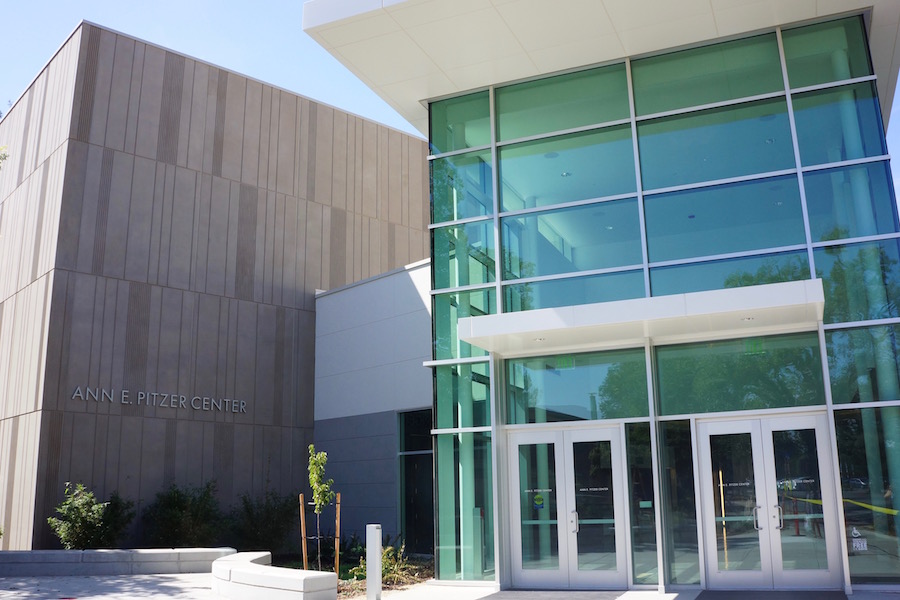
The opening of the Ann E. Pitzer Center concert hall, a new performance and teaching space, has been much-anticipated by the UC Davis Music Department. The Pitzer Center will celebrate its grand opening from Sep. 23 to 25 with a variety of performances by the UC Davis Jazz Combos, the UC Davis Symphony, the Anderson-Roe Piano Duo, and a film screening of Koyaanisqatsi with world-renowned composer Philip Glass. 

The center is named after Davis alumna Ann E. Pitzer, who generously bequeathed $5 million toward the facility’s construction, and was a long-time supporter of UC Davis. The plans for the building have been in progress for years, and it has proved rewarding for the faculty and planning committee to see the completed outcome.

Carol Hess, a professor of music and the chair of the music department at UC Davis, noted that the process has been “a good exercise in persistence, and not letting things go.” She was present for the acoustical tests over the past weekend and raved about the center.

“It was wonderful to see so many people in the music department show up on a Sunday to make sure that this was all going smoothly, and the sound is just amazing!” Hess said. “We knew it would be good, but we didn’t know it would be that good. [The students] can walk out on the stage of a state-of-the-art concert hall where the acoustics can be perfectly calibrated to best compliment whatever instrument they are performing on. And if you’re a singer, the acoustics can be justified to have a optimal positions for [whatever] you’re performing.”

The center hosts 17,000 square feet of classroom space and a 399-seat recital hall.

“In addition to all of the professional benefits, it’s a real show of commitment in the music department, and the fact that we all really care about what we’re doing,” Hess said. “And if you’re a musician, you don’t say ‘Oh, I’m going to be a musician so that I can be rich’ — you do it because you love music, and I think that that has manifested itself in so many ways as we have gone through the years of planning, fundraising and preparation.”

Angela Yam, a fourth-year music major, was also present and participated in testing the Pitzer Center’s acoustics. 

“Rehearsing in the recital hall was an absolute dream; the audience felt simultaneously close and far away, which is perfect for performers just starting their careers to feel comfortable enough to emote while minimizing stage fright,” Yam said.

Groups such the Brazilian drumming ensemble, Cuban drumming ensemble, East Indian ensemble, jazz band and wind ensemble will be able to utilize the music hall. There will also be additional practice rooms that are, according to Hess, “a much better environment.”

“Right now, we’re all crammed into the music building,” Hess said. “If you are a brass player and you have to be practicing right door to the percussions studio, and you won’t hear what you’re doing. And that problem will be solved with the new concert hall.”

The space will not only be available for students of the Music Department, but also for a variety of majors and departments. The entire community of Davis is set to benefit from the enhanced musical experience of the Pitzer Center, as the space will continue to host concerts in a now larger and more professional environment. The popular Shinkoskey Noon Concerts, which have been hosted in older classrooms or in the lobby of the Mondavi Center, will now take place in the state-of-the-art Pitzer Center.

Philip Daley, the events and publicity manager for the Music Department and an alumnus of the music program, believes that the opening of the center will greatly benefit students.

“It’s thrilling to see this building finally happening, because I had performed my senior recital in a one-hundred-person classroom,” Daley said. “I will be looking forward to seeing how this will change for our current students. The center has been in the works for a long time, and we’re elated that it’s going to open!”

Hess also noted the impact that the center will have on the faculty and other performers.

“When the faculty perform, it’s so much nicer when you can really take pride in the surroundings,” Hess said. “It’s a professional environment, and we were feeling very celebratory after this weekend when we heard the detail, and the level of attention that has gone into the acoustics, and the things that are possible. It’s truly, really spectacular.”

All are welcome to the opening of the Pitzer Center, located at Old Davis Road and Hutchinson Drive, on Sep. 23. The Jazz Courtyard will provide an informal gathering space outside, and a jazz combo will be playing there on 3 p.m. on Friday. Admission to this event is free.

Visit the UC Davis Department of Music’s website for more information about ticketing for other Pitzer Center events.


Written by: Pari Sagafi — arts@theaggie.org

Why it matters that Republicans at elite universities are rejecting Trump

0

MICHELLE LEE [CC BY 2.0] / FLICKR
GOP organizations at Harvard, Yale and Cornell are putting country over party

While younger voters tend to be reliably liberal, millennials identify more now with traditional Republican values than baby boomers and Gen X-ers did when they were at their age, according to a new study published this month in the Personality and Social Psychology Bulletin.

But it’s not clear that the growing number of students espousing conservatism (up eight percent since 1976) are necessarily doing so in support of Donald Trump, underscoring an ever-widening gap that threatens to tear the GOP apart for years to come.

Interviews with Republican leaders on three prominent and politically active campuses — Harvard, Yale and Cornell — show that some young conservatives have more than just reservations about their party’s nominee.

For the first time in its 128-year history, the Harvard Republican Club (HRC) announced August that it would refuse to endorse the GOP nominee in a statement that blasted Trump as racist, misogynistic and antithetical to the club’s values.

“There was no Trump as the first choice,” said Declan Garvey, a fourth-year student currently serving as president of the HRC. “And as the primary went on, it became clear that Trump was not anybody’s second, third, fourth, fifth — down to sixteenth choice.”

In the weeks following the GOP convention in Cleveland, a poll sent out to HRC members yielded only about 10 percent support for Trump, according to Garvey, prompting him and his executive board to come out with the announcement before school started. Their decision was met with national media coverage and general praise, putting pressure on other schools, including Yale and Cornell, to take a position on the Republican nominee.

Neither of these campuses enjoyed a similar harmony in coming out with their own endorsements.

Longtime members of the Yale College Republicans (YCR) broke from the organization after its co-chairs (who declined to comment for this article) decided to back Trump on party grounds. Leaders of the new group that formed in the shake-up, the Yale New Republicans, say that they’re going to focus on reelecting Republican candidates down-ballot, like Kelly Ayotte of New Hampshire and Pat Toomey of Pennsylvania.

“Today, in general, people are so tied up on party label — Republican, Democrat — that they fail to look deeper into the candidates and really question: Do they really reaffirm my values?” said Ben Rasmussen, co-chair of the Yale New Republicans and the former Vice President of YCR.

And the Cornell Republicans were officially unrecognized by their overseeing body, the New York Federation of College Republicans, for endorsing Gary Johnson, the Libertarian candidate and former Republican governor of New Mexico.

“We’re really trying to show people that what’s really important in this election is fiscal conservatism,” said Olivia Corn, chairwoman of the of the Cornell Republicans. “And Gary Johnson is the candidate for fiscal conservatism.”

Cornell Republican’s endorsement points to a free-market and free-love direction that many young conservatives seem to be heading, and one that could have significant impact on the future of the Republican Party. The New York Federation failed to recognize this when it voted to revoke the Cornell organization’s credentials. Corn, who said she was blindsided by these actions, has consulted a lawyer and plans legal recourse.

That’s the strong and proper response required in an election where putting party over country could wind up fatally damaging both.

By affirmatively supporting Johnson — Cornell Republicans plan on helping him attain the 15 percent polling threshold required to make the debate stages — the organization is effectively saying that issues like same-sex marriage and marijuana legalization (Johnson supports both) are not as central to its conservative beliefs as his free-trade and supply-side economic agenda.

This has probably been the inner belief of Republicans in Congress for decades, but it’s not one on which they’ve staked their political fortunes. Republican constituencies constantly vote against their own economic interest because their leaders overstate the importance of social issues and exploit base fears about the moral decline of society. We see the consequence now in Trump.

That is why he must be defeated this November.

His loss could further signal to young Republicans that rooting a campaign in identity politics rather than ideology and policy actually doesn’t increase your odds of winning an election (or at least a national one with increasingly diverse demographics).

Harvard should be commended for helping starting the conversation on colleges on whether their Republican organizations should endorse Trump. The actions of the Yale College Republicans and the New York Federation showed an alarming short-sightedness when they chose to stay the course with a businessman with no relevant political experience.

But if the response from the majority of Republicans at these elite universities is any indication of the GOP’s future, disaster may be stalled out and a better, more tolerant party might emerge.

Of course, the word ‘elite’ should tip you off that these aren’t exactly the voters that have been propelling Trump to the nomination in the first place. The real-estate billionaire from New York is a champion of the common man — particularly the white common man without a college education.

But that doesn’t mean the actions of these young Republicans doesn’t count for nothing — clearly it does when they receive pushback from those supporting a demagogue.

Written by: Eli Flesh — ekflesch@ucdavis.edu