53.3 F
Davis

Davis, California

Thursday, December 25, 2025
Home Blog Page 710

Aggie Style Watch

BRIAN LANDRY / AGGIE

Student Fashion Association members talk style and inspiration

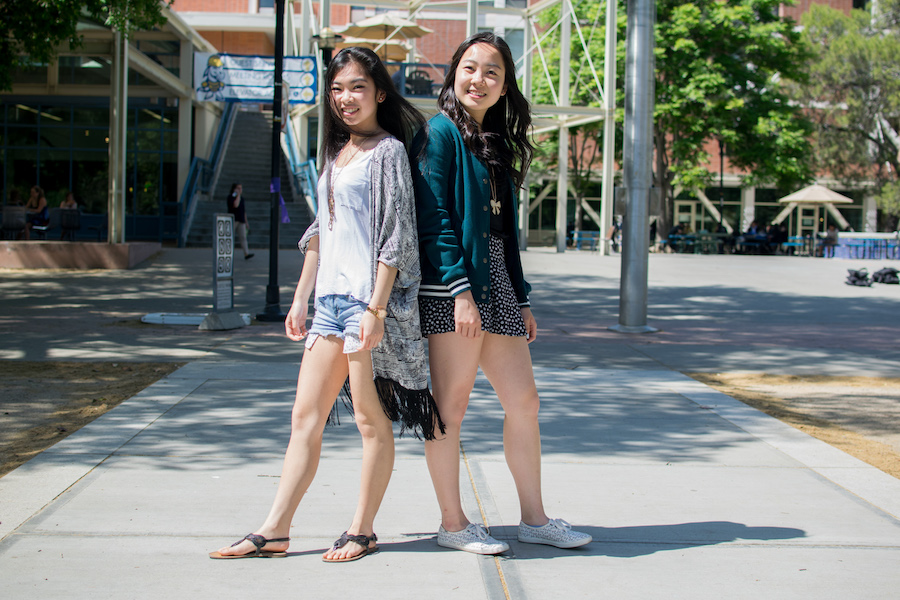
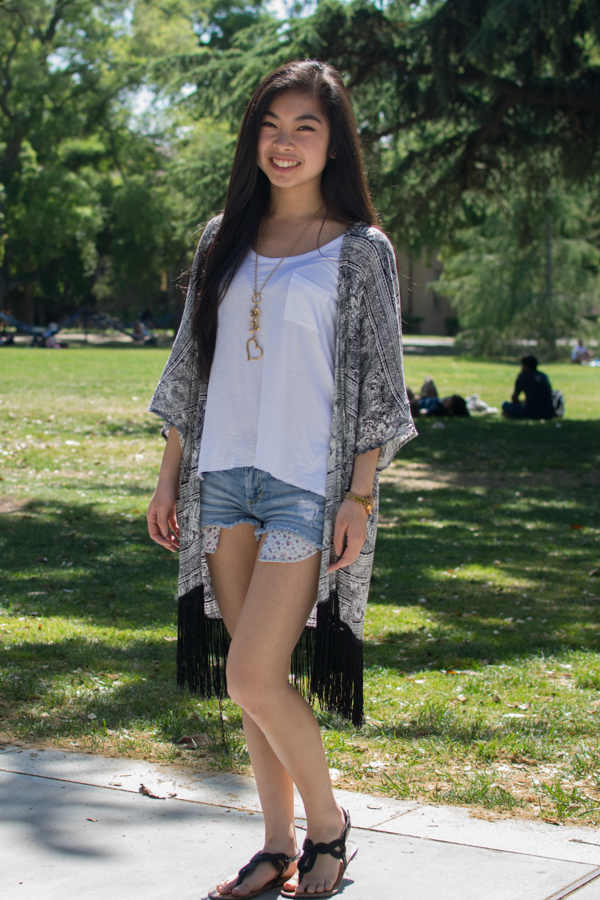
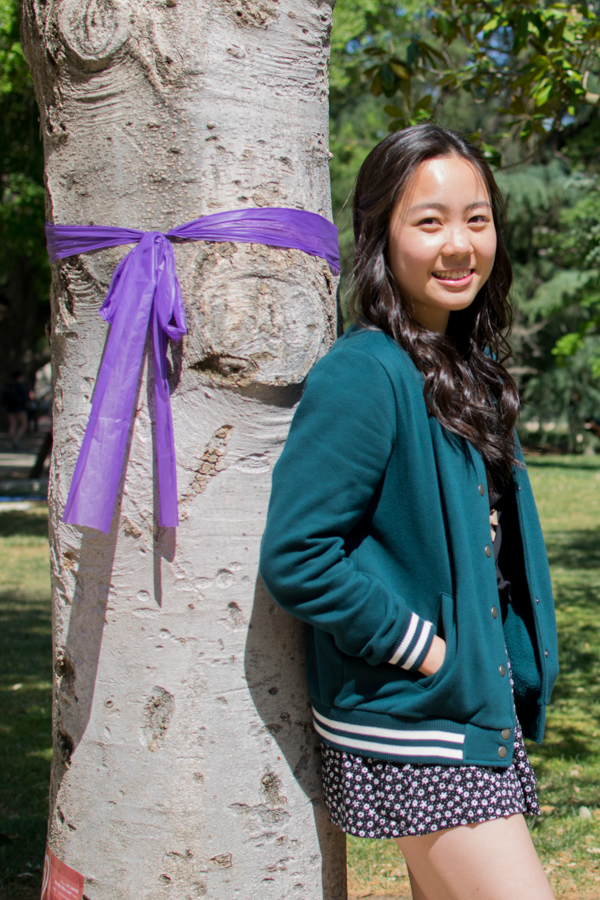
Beijo Lee, a second-year cinema and digital media major, and Jane Zhang, a first-year managerial economics and textiles and clothing double major, are both part of the UC Davis Student Fashion Association (SFA), which had its annual fashion show on April 30. Both were excited to contribute to the event, with Jane modeling in the fashion show and Beijo working as a photographer and a member of the decoration committee. We caught up and talked about their different styles and their various influences. 

ASW: How would you describe your style?

Zhang: Classy and chic — or at least, I hope to be.

Lee: I jump around a lot in styles. I’ve been very girly lately, and sometimes bohemian, but it just depends. 

ASW: What is your favorite outfit?

Zhang: I’d pick out something that I can look good in, but that’s also comfortable. So nothing super form fitting, but something that has a sleek cut to it that will flatter my body.

Lee: I think it just depends on how I feel like dressing, and the weather.
BRIAN LANDRY / AGGIE

ASW: Are there any recent trends that you like, or dislike?

Zhang: I recently got into off-the-shoulder tops, because the neckline is really pretty, and I’ve been trying to find tops that I can invest in, but the search is still in progress.

Lee: I’ve noticed that halter and high neck tops are in, and I’ve never liked that style before, but when a trend comes back again, they re-do it somehow, and it’s like ‘Oh, that doesn’t look half as bad as I thought before!’

ASW: Who is your style inspiration?

Zhang: I don’t have a specific inspiration, but I tend to observe what people wear daily, and if I see someone who’s’ wearing a really cool outfit, I make a mental note and try to find similar items in my closet to recreate the outfit for myself.

Lee: I feel the same way; there’s isn’t a specific person that I look for, because I feel that my style is very unique. I like how other people put together things, but their style isn’t specifically for me. 

ASW: How has being in the SFA influenced your style?

Zhang: For me, I just noticed a lot more different styles and got more exposed, especially by Cindy [Suzuki] and Miguel [Bagsit] (SFA president and vice president) because they’re both prominent on social media. 

Lee: Being in the [SFA] exposes you to different fashions. We see them a lot in their own styles, and that influences me to explore what kind of style I would like to do.
BRIAN LANDRY / AGGIE

ASW: Do you think that your style has changed over the years?

Zhang: I switched more from layering to summer clothing because I’m from San Francisco, where it’s always windy and cold. 

Lee: I think that I’ve become more girly. I didn’t realize that until my middle sister said ‘You’ve grown to like pink a lot,’ and I found that pink is a good color that matches me. It looks good on me, so that’s the thing — it’s not my favorite color, but it looks good.

ASW: Do you have any last fashion advice?

Zhang: Fake it till you make it. If you’re confident enough, you’ll look good.

Lee: Exactly! if you say you can work it, then you can work it. That’s the mentality that you should have. 

Written by: Pari Sagafi – arts@theaggie.org

BRIAN LANDRY / AGGIE

Lacrosse lands eight recruits

BRIAN LANDRY / AGGIE

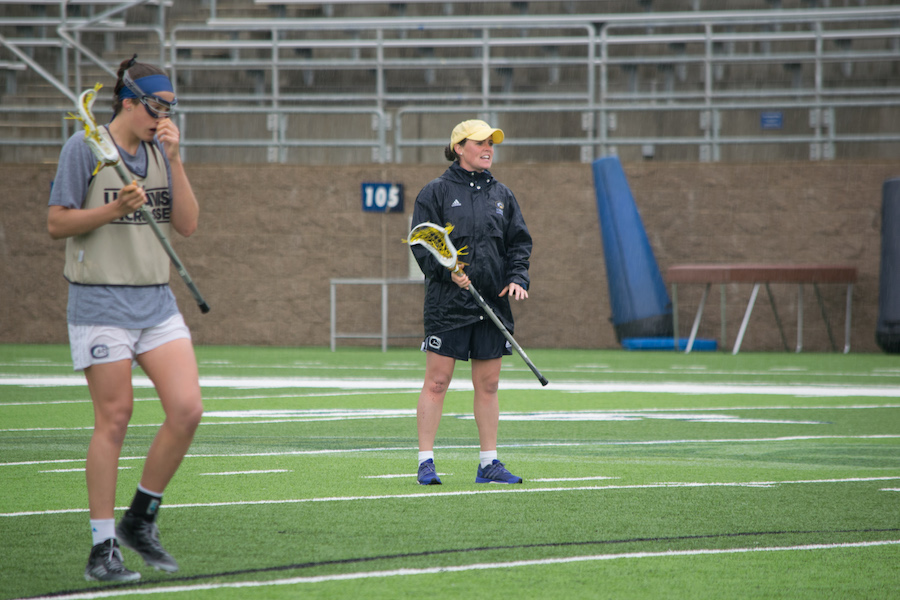
Less than two weeks after the end of the 2016 campaign, the UC Davis women’s lacrosse program is already gearing up for next year. After a very successful inaugural season, head coach Tee Ladouceur recruited eight incoming freshman student-athletes from across the country to join the squad this upcoming fall.

The incoming prospect class is middy heavy, consisting of Anna Belenis of Davis; Rowan Chamberlain of Redding; Addie Dearden of Napa; Kate Graham of Belvedere; Jacqueline Kelly of Western Springs, Ill.; Sorana Larson of Ellicott City, Md.; Maddie Myers of Walnut Creek and Amanda Outcalt of Alamo.

The Aggies finished this past season with a 7-8 overall record and 5-4 in conference play, which was enough to earn a berth in the Mountain Pacific Sports Federation (MPSF) tournament. After a 4-13 record a season ago, Ladouceur has brought a much needed change to the UC Davis lacrosse program and hopes to build on the progress of this past season with a solid recruiting class.

“It was a phenomenal first year for me. I had a lot of support from the administration, my fellow coaches and especially my players who are  just really good kids,” Ladouceur said. “They were patient, willing to learn and willing to accept change in the most positive way.”

In the world of collegiate lacrosse, recruiting begins early. Most prospective student-athletes commit as soon as their sophomore year of high school and some commit even before that. However, with Davis in the midst of the coaching change this past offseason (and in fact without any coach at all for a four month period of time), half of the 2016 recruiting class de-committed. Ladouceur, a former standout lacrosse player herself at Syracuse, was able to use her east coast connections to add two “late recruits” to balance out the 2016 class.

Unlike other sports at UC Davis, the lacrosse program competes in a league that is also home to some of the biggest schools on the west coast. This presents inherent challenges in recruiting with the enormous disparities in resources from team to team within the league. The coaching staff goes head-to-head in order to compete for prospective athletes with conference rivals the likes of Stanford, USC, Cal, Oregon and Colorado.

Despite being a smaller school without the resources of the traditional big name universities, UC Davis remains relevant in the league by offering a unique college experience that other schools cannot match.

“I love the Davis atmosphere: from all of the biking, to the top-notch academics, to how friendly everybody is, it’s a great place to go to school,” Ladouceur said.

The current athletes in the program are also a large part of the recruiting process throughout the year.

“When recruits come on campus as a player you’re really involved you go on tours with them, you go to lunch with them all the time at the DC and then they spend the night in the dorms,” said fourth-year design major and senior midfielder Mary Doyle. “It’s really fun to meet them, but can also be a lot of work sometimes.”

Ladouceur and the Ags look forward to building on this past season with the addition of eight strong recruits and with the lofty goal of returning to the MPSF championship next season.

Written by: George McConnell – sports@theaggie.org

Something new, something Blue

HANNAH LEE / AGGIE
HANNAH LEE / AGGIE

New UC Davis athletics director appointed by acting chancellor

Earlier this week, Acting Chancellor Ralph J. Hexter appointed Dr. Kevin Blue as the new UC Davis director of athletics. Blue graduated from Stanford after playing on the men’s golf team, then traveled to Michigan State to earn his Ph.D. in sports psychology. He then returned to Stanford, where he worked for seven years in the athletics department and was appointed to the position of senior associate athletics director for external relations in 2013.

This decision by Hexter was made with the full authority of the Office of the Chancellor. Hexter, appointed by University of California President Napolitano following the placement of Chancellor Linda P.B. Katehi on investigative leave, told the media in his first press conference that he planned on filling the position of athletics director. Though Katehi has many legitimate complaints levied against her, she has only been placed on leave for 90 days. If cleared of her allegations, she will presumably return to work as the head of UC Davis. If this is the case, should a temporary chancellor make a decision that could significantly affect the athletics department for many years to come?

It is reasonable to assume that Hexter, already part of UC Davis leadership, had at least a baseline understanding of the search process and what the committee was looking for. In the past few weeks, Hexter has undoubtedly familiarized himself with any gaps in his knowledge on the search for athletic director. Regardless, given Hexter’s temporary and recent appointment, The Editorial Board hopes that this was not a hastily made decision.

Though it is too early to tell how the athletic administration will look under Blue’s leadership, one thing is for certain: he is a highly educated and qualified selection. He has personal experience from being an athlete at an academically rigorous institution and has a proven track record as an effective administrator. We hope that he will continue to stress academic excellence as a key component of the student-athlete experience and works to increase student engagement in athletics.

Blue looks to revitalize UC Davis athletics during his time at this university, and has said that he would like the Athletic Department to be more involved in the Davis community. He has also indicated a willingness to sit down with The Editorial Board, where we hope to learn more about his particular vision for athletics. Blue officially enters his position on June 21.

Go Ags!

ASUCD Pay It Forward campaign to provide Aggies in need with free pizza

ASHLEY LUGO / AGGIE
ASHLEY LUGO / AGGIE

Program to offer students the opportunity to pay for another student’s slice of pizza at the CoHo

Beginning on Friday, May 20, ASUCD’s Pay It Forward campaign will give Aggies the chance to pay for another student’s slice of pizza at Ciao in the ASUCD Coffee House (CoHo).

Started by second-year environmental policy analysis and planning major and ASUCD Senator Noor Adilla Jamaludin, Pay It Forward unites the forces of the CoHo and ASUCD’s The Pantry in providing a hot meal for hungry students in need.

Jamaludin was inspired to create the program after an experience with a friend who decided to skip a meal to avoid having to pay for his lunch.

“With the rising cost of living, I can see how difficult it must be for some students to pay for food on a daily basis,” Jamaludin said. “It adds up. According to the [University of California], one out of every four students is food insecure, so they will either skip meals to save money for later or they skip meals because the food is too expensive. I think this is a great way for students to start the conversation […] So now when the cashier asks you if you’d like to buy another slice of pizza, you start to wonder ‘who is this slice going to?’ and ‘maybe there are a lot of students facing this challenge on a daily basis.’”

Cashiers from Ciao will ask students if they want to purchase another slice of pizza for a student after they buy their own slice. At the end of every week the CoHo will collect the Pay It Forward receipts and give them to The Pantry to act as vouchers for students who want to get a free slice of pizza.

Located in Lower Freeborn, The Pantry offers non-perishable foods to hungry students. With the Pay It Forward program, Aggies can request pizza at The Pantry, where they are given the receipt vouchers to use at Ciao.

“We provide non-perishable food at The Pantry, such as canned foods, but it’s nothing that Aggies can really make for themselves in the moment,” said fourth-year managerial economics major and director of external affairs at The Pantry Shannen Nguyen. “Now with the pizza voucher, they can go and get a hot meal right away instead of having to go back home and make themselves something to eat.”

Lauren Woods, the front of house manager at the CoHo, praised the campaign for creating a sense of philanthropy at UC Davis.

“The program is creating more opportunities and more outreach to people who might not have the resources to eat a meal every day or three times a day,” Woods said. “It’s also creating awareness for people to realize how prevalent this problem is on campus.”

Jamaludin’s goal is to expand the program to healthier food items in the CoHo, including foods from Swirlz, in hopes that less students will skip meals.

“I want people to ask themselves why we have a program like this,” Jamaludin said. “Once you ask yourself that, you’ll start to realize that we don’t live in this perfect bubble […] What I’m trying to do is provide other students with a platform to help those students in need.”

More information about the program can be found on the Pay It Forward Facebook page.

Written by: Emma Sadlowski – campus@theaggie.org

UC Davis Confucius Institute hosts inaugural cooking competition

AMY HOANG / AGGIE
AMY HOANG / AGGIE

Entrants tasked with incorporating Lee Kum Kee sauces into their own unique Chinese cuisine-inspired dishes

A live cooking demonstration, featuring both amateur and professional chefs, will be hosted at the Davis Veterans Memorial Center on June 18. The event will serve as the second round of the Innovative Cooking Competition organized by the Confucius Institute at UC Davis.

The competition, open to anyone age 18 and above, invites amateur chefs of any level to submit original recipes that in some way incorporate innovative elements, such as a fusion of cultural styles or unique ingredients, into their dishes. The competition also requires the use of any Lee Kum Kee sauce, a brand of Chinese sauces based out of Hong Kong that is sponsoring the contest.

Submissions for the competition will be accepted until May 21. The submitted recipes will be judged by a committee. Selected entrants will be invited to make their dishes on-site at the Veterans Memorial Center and compete among other participants before a panel of judges.

The competition is a continuation of an ongoing effort by the Confucius Institute at UC Davis to promote more widespread knowledge of Chinese cooking and cooking customs for both the university and the surrounding Sacramento area.

“We want to provide opportunities to people who may be interested in learning about Chinese culture. Everyone loves food, so our focus on Chinese food culture doesn’t require any explanation,” said Dr. Michelle Yeh, a professor within the East Asian Language and Culture department as well as director of the Confucius Institute at UC Davis. “Those who attend get to actually taste and make Chinese food and [it] serves as sort of a fun way to promote a cultural exchange.”

The competition encourages participants to creatively explore Chinese cuisine in their own ways.

“The name of the competition is Innovative Cooking. If you copied some recipe without enhancing it in your own way, you aren’t innovating,” said Sally Wu, an instructor in the food department. “It must be original in some way, like a combination of cultural styles or special flavors. For the second round, the dishes will be cooked on site, and we will have judges taste them there for cash prizes.”

Winners will be awarded $1,000 for first place, $500 for second place, $100 for two third-place finishers and gift cards to honorable mentions. According to Dr. Yeh, the Confucius Institute plans to host future competitions as well as offer larger prizes. She continued that the Institute hopes to broaden the scope of the programs offered in the near future to include a variety of Chinese-based food cultures.

Sophie Xu, an alumna of UC Davis and a language instructor at the Davis Chinese School, was motivated to enter the competition to promote vegan Chinese cooking, which she believes has become a difficult task for those facing the dietary restriction.

“I am very interested in cooking Chinese food. However, after I started to practice a vegan diet, I started to notice how hard it was to order at local restaurants because very few Chinese restaurants offer many vegan or vegetarian options,” Xu said.  “I thought the options they had tasted boring so I wanted to try to, in my own home, start to create my own recipes that featured the Chinese cuisine but were vegan and vegetarian friendly.”

Confucius Institutes, non-profit entities established in over 100 American universities and nearly 500 educational institutions worldwide, are organized by Hanban, a branch of the Chinese Ministry of Education. Nearly all are established to promote the education of the Chinese language and culture. However, in 2013, UC Davis, in partnership with the Jiangnan University in China, opened the first and so far only Confucius Institute that focuses solely on Chinese culinary study.

“The great majority of Confucius Institutes around the world focus on Chinese language teaching. However from the very beginning at UC Davis, we felt we had a more important opportunity to take advantage of the strength of its food science and technology departments,” Dr. Yeh said. “Our partner university at Jiangnan in Eastern China is also consistently ranked highly in those departments. That is why between the two universities there were a lot of areas for collaboration. It made a lot of sense that we would build a Confucius Institute benefiting off of the strength of both universities.”

Dr. Yeh added that she hopes the competition will encourage participation in the Institute’s programs and serve as an introductory point for individuals who may be interested in learning more about China and its customs.

“Those who attend get to actually taste and make the Chinese food and it serves as sort of a fun way to promote a cultural exchange. It’s a satisfying way to learn something about the lives of other people and cultures,” said Dr. Yeh. “At the very least, they can enjoy the food and hopefully they can learn how to cook some food and take that skill with them home. It can enrich their life even at a basic level. Enlarge the range of their culinary tastes.”

She continued that the significance of Chinese food and culture extends beyond traditional mainland Chinese cuisine.

“This can go beyond just China though, this idea of a broadened food culture can be extended to the entire Chinese speaking world, which includes Hong Kong, Taiwan, Singapore or Chinese communities in other parts of the world,” said Dr. Yeh. “Each of these communities outside China has been developing its own styles of Chinese food. Every Chinese community develops its own type of cuisine, and eventually we want to offer a whole range of different cultures.”

The Confucius Institute at UC Davis features three unique departments, each focusing respectively on Chinese food, wine and tea cultures. In turn, each of the departments hosts workshops, demonstrations from Chinese culinary experts as well as lectures describing the history or significance behind Chinese food and beverage culture. Wu believes the subject of food is a good way to stimulate a better understanding of a society’s culture.

“Food is just a good way to connect people and facilitate an appreciation of one another’s culture,” Wu said. “Food is a universal concept and yet each country has their own unique food and beverage culture. Our mission is to help people understand Chinese culture. To achieve this mission we have to try to choose a sort of cultural mixing point. Since nobody can live without eating and drinking, in that sense choosing food and beverage culture serves as that crossing point.”

Written by: Jack Raineri – campus@theaggie.org

Painted utility box project celebrates Davis Farmers Market

NADIA DORIS / AGGIE
NADIA DORIS / AGGIE

Public art project underway for 40th anniversary celebration of Farmers Market

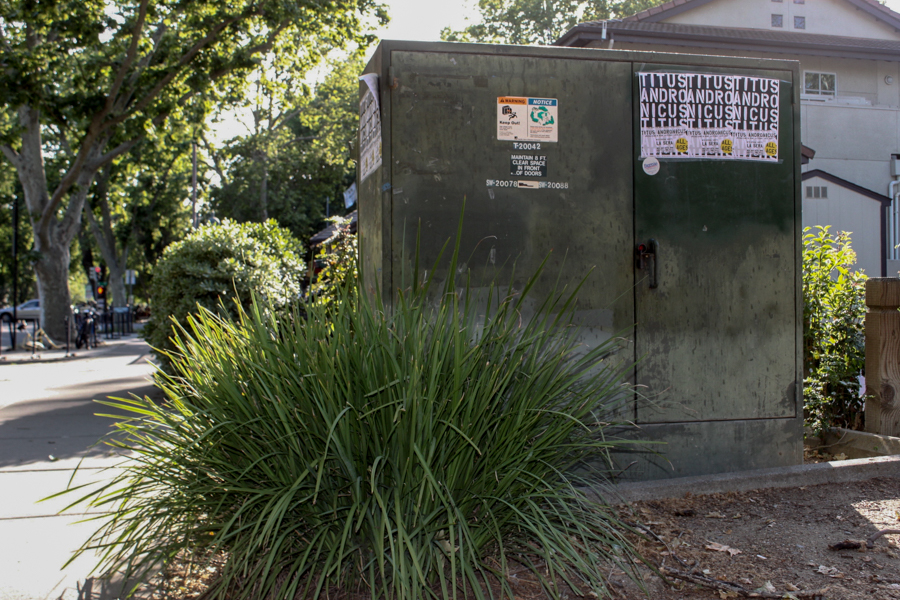
Downtown Davis is known as the heart and spirit of the Davis community, and a new public art opportunity will ensure it stays that way. The City of Davis Arts Commission and Davis City Council are asking artists to decorate five utility boxes in Davis with art that celebrates the 40th anniversary of the Davis Farmers Market.

The specific boxes commissioned to the Davis Farmers Market celebration are located on the south end of Central Park on Third Street, between B and C streets. Selected utility box proposals will celebrate the Davis Farmers Market, Davis agricultural heritage, locally grown food, healthy eating and healthy communities.

“The things that are important about the farmers market and what it means in our community is what we will be looking for in those artist submissions,” said Rachel Hartsough, arts and culture manager of Davis.

The market operates every Wednesday from 4:30 to 8:30 p.m. and every Saturday from 8 a.m to 1 p.m in Davis Central Park, located between Third and Fourth streets. Everything in the market from fruits, vegetables, honey, eggs, wine and meats are grown by the local sellers. The market also hosts a 33-week concert series, featuring live bands, local food purveyors, bounce houses, pony rides and face painting for kids.

The Davis Farmers Market began in 1975 and, according to Davis Farmers Market manager Randii MacNear, it has grown in popularity ever since. MacNear adds that there are many farmers markets, but the one in Davis has received international attention.

“[Davis Farmers Market] is a community asset that shapes the flavor and culture of Davis. […] We try to be an inspiration for people to understand how important it is to eat healthy foods and develop community,” MacNear said.

Painted utility boxes are a common public art project across various cities and Davis is planning for more in the near future. So far, there are five painted utility boxes around downtown. Artists like Danielle Fodor, a local artist who specializes in murals and scientific illustrations,  have participated in past projects. Her painted utility box can be seen at its location on First and D streets.  

Fodor is interested in local and unknown history of places and said she seeks to bring out hidden beauty in her artwork for the public. She explains that she likes the surface of the utility box because it is plain and unnoticeable until an artist transforms it. She believes the role of public art is manifested in its visibility and the public’s inevitable encounters with it.

“It’s important to me that visual artists work in the public space to redefine the places and focus on the things that matter to us as a community,” Fodor said.

Each artist or group of artists will receive a $1,000 stipend to cover costs of the project upon selection. Artists must submit their proposals by May 25 per the instructions found on the City of Davis website. The entire project will be unveiled at the 40th anniversary celebration of the Davis Farmers Market on Aug. 13.

Written by: Mashal Ayobi – city@theaggie.org

Unapologetically Black

BLACK FAMILY DAY / COURTESY

Black Family Day to celebrate black culture and community

The 45th annual Black Family Day (BFD), a free family event celebrating black family, culture and students on campus, is coming up on Saturday, May 21 from noon to 5 p.m. There will be over 30 vendors selling food and merchandise and sharing information about their organizations and clubs. There will also be music, performances, games and photo booths. The Cross Cultural Center (CCC), the organizer of this special day, is excited for everyone to come out and socialize. The CCC expects a turnout of over 1,000 people and believes that it is important for UC Davis to have events like this to recognize the accomplishments of the black community.

Christian Nesbitt, fourth-year political science public service and sociology double major, and co-coordinator of BFD, believes that Black Family Day is a significant campus event.

“This day is about encouragement, affirmation and acknowledgement of our existence, and what we may have gone through in terms of being black,” Nesbitt said. “It’s a way to bring visibility to who we are and feel like we aren’t alone and there’s a community.” She also stressed that it is an important and fun way to network and build community between the alumni, faculty and students.

The event is open to all students, and student staff at the CCC believe it is important for non-black students to attend to support the black community.

“As a non-black person of color I think it’s important to show solidarity and support to our fellow black students. Coming out to BFD affirms and supports the black students here on campus,” said Val Sierra, a third-year Native American studies major and the Native American Cultural Days Coordinator at the CCC.

The theme of the event this year is “Unapologetically Black” to encourage pride in one’s identity and self.

“We chose this theme because recently we’ve had a lot of anti-black crimes, and we wanted our theme to reflect student experiences and encourage students to accept and love who they are,” said Brina Sylve, BFD co-coordinator and third-year sociology and African-American studies double major. “We’re spreading the message that we are proud of who we are, what we look like. We are being unapologetic.”

For more information about the event, please visit the Facebook event page.

Written by: Sami Bass – arts@theaggie.org

Humor: Leftover budget to be spent on iPod shuffles for every student

STRETCHDOG / FLICKR
STRETCHDOG / FLICKR

So 2000s. What’s next? Lizzie McGuire and Pablo getting back together?

Remember the thrill of your first iPod? You had HitClips, but 45 seconds of your favorite song wasn’t enough! You wanted the shiny, new iPod shuffle. S/o to mom for getting you the magic white stick that inspired you to download Limewire, probably infecting the family PC with many a virus (and, if you were unfortunate, a call from the FBI), but ultimately led to your love for music. But what if you could experience this joy again?

You’re in luck, buckaroo! UC Davis has soooo much extra cash lying around from this year that they’ve decided to gift every student with an iPod shuffle! Yippee! But some students think the cash could be better spent on updating campus buildings or hiring a functional, non-corrupt chancellor.

“What the actual hell? iPod shuffles? Are you f***ing kidding me? And what do you mean extra cash? Then shouldn’t I be paying less tuition?” said Tina Wexler, a third-year international relations major.

Oh Tina. For tax reasons or something, that’s just not possible. It’s iPod shuffles or they’ll have to hire a team of infernologists to burn all the extra cash. HELLO, TINA, WE’RE NOT TRYING TO POLLUTE THE AIR???

Besides Tina, everyone else seems to have gotten with the program.

“Of course I want an iPod shuffle. It’s like, do I need to be able to see a screen to tell me what song comes on next? Absolutely not. I love when it goes from a soothing melody to heavy metal without any warning — it makes for some interesting naps. And the design is just so sleek! It’s a fantastic invention,” said Steve Jobs (don’t ask).

I know as soon as I get my shuffle it’s going straight into the drawer where I keep all my broken headphones. Yes, technically it’s called a ‘junk drawer,’ but I don’t want to insult my broken Apple products like that.

Lizzie McGuire would be happy to have an iPod Shuffle, and you should be too! Just be grateful the extra budget isn’t going towards paying professors and TAs a liveable wage (ew!).

ALEX GUZMÁN wrote this article by releasing a single ant onto her keyboard and letting him type. So if you hate it, blame him. You can reach her at almguzman@ucdavis.edu and on Twitter @cactasss.

Leadership is not locking your friend in the bathroom

WIKIMEDIA COMMONS
WIKIMEDIA COMMONS

The bathroom in my house locks from the outside — if you close the door as you’re leaving, whoever’s inside is trapped. I can think of several fates worse than death, and one of them involves being locked in a fraternity house bathroom.

My friend was using the bathroom one time as I was brushing my teeth. As I was leaving, I jokingly told him that I’d lock him in (I was still pissed that he beat me in basketball earlier that day). He replied that if I did lock him in, it’d be a “power move.”

But I don’t see the power in using my temporary moment of dominance, where by chance I was by the door and he was occupied doing something else, to lord over my friend and have him at my mercy. That’s not power. I could have locked him in, and the next day, he could make a similar “power move” by replacing my shampoo with toothpaste, by stealing my phone and writing something unsettling on my Facebook or by doing whatever other weird thing he’d do.

A power move is actually a move that brings other people up, that gives someone else the opportunity to do something they wouldn’t have been able to do.

It takes a lot of security in your own “power,” so to speak, to “relinquish” that power for a moment and give someone else the chance to do something great and feel good about themselves. It’s as if you’re so comfortable with your level of influence and capability that you don’t think that giving someone else a platform would threaten yours in any way, shape or form.

Leadership is something I think about all the time. I’ve been involved in many organizations, from youth groups to tech start-ups to marketing agencies to research labs. I’ve been at the bottom of the totem pole as an intern, I’ve served as a colleague and peer and I’ve managed teams. I’ve worked with some stellar leaders, managers and bosses, people who I still look up to and actively keep in touch with because I’m confident that they’ll change the world. I’ve also worked with nightmarish leaders who frankly need to read this article.

I’ve noticed a key commonality in my favorite bosses, something that the worse leaders didn’t pick up on. The good leaders focused their energy on building up their team. It went beyond just a generally supportive and encouraging attitude — they did dramatic things, like deferring all credit to the people they managed (even if it wasn’t 100 percent deserved); and they did subtler things, like taking an interest in how employees days were going (even when they’re slammed with things to do). They would understand failure, and were gentle yet honest in their feedback, and they would pump you up when you succeeded, letting everyone else know how awesome you are.

They were different in that they didn’t derive their meaning and success from them doing great work. They didn’t want to be seen as the best writer or the best salesman or the best engineer in the room — they wanted their people to be seen as the best collective around. They were so confident in the fact that they could do a great job at whatever field they were in that they didn’t need personal validation. Instead, they were committed to the results of the team that they were in charge of, finding that validation from the finished product.

I have a hard time with this because I’m too driven to be seen as the best. In high school, I had to work to stop my “lone wolf” tendencies. I felt like I had to prove myself all the time. When I interned at a start-up last summer, I was always the dumbest person in the room; the people around me were brilliant. Yet they went out of their ways to boost each other up, even the 18 year-old intern. That’s why I’m convinced that this company will thrive — the leaders are committed to a culture of empowerment.

To use a basketball analogy, people often think the best kind of leaders are the Kobe Bryant types — the individual talents that shine so bright that nothing else matters — the types that are so good at what they do that they can will their teams to victory. The good leaders are more like Draymond Green — those that can hold their own in individual elements of the game, but whose true value comes from their ability to set their teammates up for success with world-class passes and rebounds. To use a different analogy: Kanye West has put out seven impactful, polarizing and best-selling albums, and not because he’s in the studio doing everything. He gets the best producers, vocalists and sound engineers he can find. And he guides them with his vision, letting people better than him accomplish his ideas via whatever skill they bring to the table. You’d think otherwise because of his massive ego. But his massive ego comes from his objectively amazing body of work, and he’s so focused on producing the best albums that he can that he’ll put that ego aside in order to totally devote himself to the creative process.

My friend has lived on to tell his tale – he didn’t have to die an undignified death in the bathroom stalls of AEPi. No “power” moves were executed on my part. I was powerful enough to leave the door open and bring him some Febreeze.

I’ve written 1000 words about leadership, but I could write 10,000 more because I don’t think there’s anything more important in the world. Anyone who follows politics, regardless of ideology, can agree that our leaders in government have the potential to be much more competent and effective. And with humanity-defining issues including climate change and world hunger looming, we sure as hell need the best leaders we can get. At UC Davis, we need great leaders in our clubs and organizations: in ASUCD and in Mrak Hall. Great leaders leading great teams will take on anything life throws at them. They, and by they I mean you, will save our school, our country and our planet.

You can reach YINON RAVIV at ravivyinon@gmail.com, or tweet at him @YR195.

Immersed in a virtual world

DANIEL TAK / AGGIE
DANIEL TAK / AGGIE

The KeckCAVES at UC Davis develop virtual reality system for scientific research.

From the Samsung Gear VR to the Oculus Rift, virtual reality (VR) has become a trending topic in the technological world. Here at UC Davis, researchers of KeckCAVES bring a unique twist to the VR experience.

The KeckCAVES is a collaborative project between Davis computer scientists and earth scientists who work to develop interactive 3D visualization for scientific data. The KeckCAVES faculty began working together in 2003, but the project did not officially start until 2004 when the group received funding from an organization called the Keck Foundation.

DANIEL TAK / AGGIE
DANIEL TAK / AGGIE

“It is an interdisciplinary project,” said Oliver Kreylos, computer scientist and software developer for KeckCAVES. “We have faculty from Computer Science and Earth and Physical Sciences. There’s roughly a dozen or so faculty involved in it.”

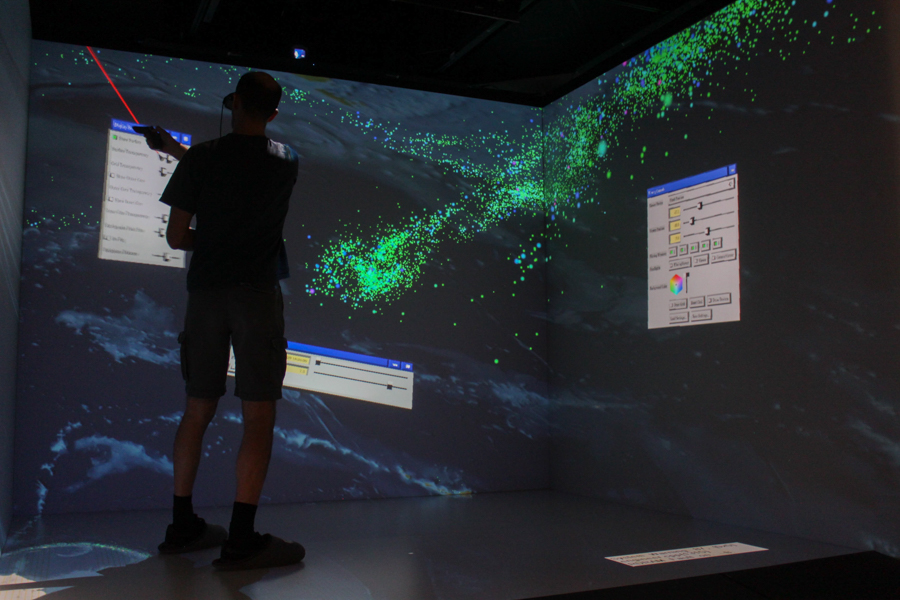
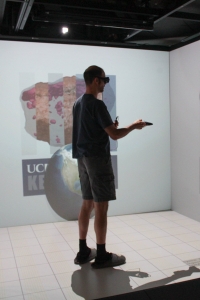
The primary feature of KeckCAVES is a cave automatic virtual environment (CAVE) located on campus in the Earth and Physical Sciences building. The CAVE consists of four large 10 by 8 feet screens — three walls and one floor — creating a boxlike space that provides users with a virtual reality environment for conducting scientific research. Having been built in 2005, the CAVE has been operating for eleven years.

The CAVE has been used for research in fields such as geology, astrophysics, oceanography and biology. Researchers bring collected data to the KeckCAVES faculty, who then use the data to either develop new programs or access previous programs that generate virtual CAVE settings for further research.

“[The purpose of KeckCAVES] is to enhance our ability to analyze large 3D data sets,” said Michael Oskin, a UC Davis geology professor and KeckCAVES research group member. “We can measure them, we can remeasure them, we can get statistics on them — we can do things people can’t do because they’re preserved in 3D and we can work with them in 3D.”

KeckCAVES has a YouTube channel titled “UC Davis KeckCAVES,” where demonstration videos of the CAVE and the KeckCAVES software are posted.

Since KeckCAVES’ software is mainly developed and used for research in science, it is distinctive from other virtual reality projects.

“There is nothing like this in another geology department in the country,” Oskin said. “There are other CAVEs around the country, this technology is not new, but [they’re] primarily a presentation tool as opposed to a research tool. That’s what makes [KeckCAVES] unique.”

Behind the screens of the CAVE is an elaborate system of electrical equipment, including six computers and four projectors. Images of objects and geographical settings are projected onto the screens, and when viewed with a pair of StereoGraphics CrystalEyes shutter glasses, the projections appear as 3D, hologram-like models that can be analyzed and manipulated through the use of a wireless controller.

DANIEL TAK / AGGIE
DANIEL TAK / AGGIE

“I like to call the CAVE itself a ‘holodeck for scientists.’ [It] allows a scientist [to] treat [data] almost like a physical object — except that you can do things with the virtual data that you can’t do with a real object,” said Dawn Sumner, UC Davis geology professor and chair of the Department of Earth and Planetary Sciences, in an email interview. “For example, you can make a rock transparent. Or you can look at the distribution of all the earthquakes recorded on Earth all at once. Or you can explore the structure of chaotic mathematical equations.”

In 2007, KeckCAVES collaborated with Sideshow Physical Theatre of the UC Davis Department of Theatre and Dance to produce the modern dance performance COLLAPSE (suddenly falling down). Through computer projections, KeckCAVES provided live, 3D scenery that dancers were able to interact with onstage. The production won an Isadora Duncan Dance Award.

The future of KeckCAVES will not lie in the CAVE itself, but rather the software, according to Kreylos. He predicts that CAVEs will become obsolete very soon, and therefore has been working to ensure that the KeckCAVES software can properly run on other pieces of hardware, mainly virtual reality headsets.

“Right now, the hardware is changing rapidly — very rapidly,” Kreylos said. “What wins out in technology is what most people embrace. Currently, what is being embraced is headsets.”

Written by Jennie Chang — features@theaggie.org

Film Festival promotes feminist dialogue and intersectionality

DAVIS FEMINIST FILM FESTIVAL / COURTESY

11th annual Davis Feminist Film Festival presents films dealing with issues of gender, race, sexuality

The 11th annual Davis Feminist Film Festival (DFFF) will take place from May 19 to May 20 at the Davis Veterans Memorial Theatre. The festival presents independent international films that deal with issues of gender, race, class, sexuality and systemic inequality, among other themes. DFFF is a grassroots event sponsored and coordinated by the Women’s Resources and Research Center (WRRC), which relies heavily on undergraduate student involvement in curating films and the festival.

Leilani Kupo, director of the WRRC, has seen DFFF grow in its international scope and its impact on the community. The WRRC’s goal in partnering with DFFF is to use films as a platform for engaging with topics such as gender and other social issues, and to use this engagement to further the WRRC’s mission of establishing and supporting gender equity at UC Davis.

“We can engage in conversations about feminism from international contexts and then use it as a platform to talk about issues that are happening in the U.S. and/or locally — Davis, Sacramento, or Northern California,” Kupo said. “DFFF allows folks to be able to connect with things they may be learning in classrooms, like theory or current events. Film is a platform that allows us to engage deeply, and to be a part of these enriching conversations about gender equity and gender disparities, the ways in which we have to continue to question what gender and the gender binary.”

Maya Sadler, a third-year economics and gender, sexuality and women’s studies double major, is one of the students involved with DFFF. Sadler helped organize the festival’s panel of experts who will be discussing Black American Womxn filmmakers — the first event of its kind to be included in DFFF.

“The panel came from the fact that we had over 400 submissions and only 8 of them were from black women. So we [wondered] why there aren’t more black women making films, but the thing is, they are — we just aren’t seeing them,” Sadler said.  “As a black woman, you grow up thinking that there is nothing you can say that is going to matter because A, it has already been said by a white person or B, you think nobody is going to care except other black women. So we want to discuss the process of deciding that your voice is worth being heard.”

Emelie Mahdavian, the director of DFFF, explained that the festival aims to be intersectional and varied in its themes. The range of perspectives that the films provide allow audience members to interpret them differently and to engage in dialogue about the nuances and messages of the films.

“I see the role of the festival in regard to the audience as one of conversation-starting. This means that we aren’t trying to put a singular feminist message across to the audience, but rather trying to select films that may spurn interesting dialogue after people leave,” Mahdavian said. “I want the audience to enjoy the films (some are funny or fun) and leave mulling questions of gender, power, politics, social action, etc. I expect people think that a feminist festival is going to “preach” — but actually, I think this year’s lineup provides such a diverse set of perspectives on feminist issues, that audiences will leave with very different experiences.”

Thursday’s portion of films includes animation, documentary, narrative and experimental films. Friday’s selection explores familial and intergenerational relationships. Doors open at 6 p.m. both evenings and films will begin at 6:30 p.m. The Black American Womxn filmmakers panel will take place at 3:45 p.m. on Friday. Tickets for the event can be purchased at the WRRC or at the door of the event for a suggested donation of $5 to $10 for students and $10 to $15 for non-students. For more information, please visit the Facebook event page or http://femfilmfest.ucdavis.edu/.


Written by: Sara Williams – arts@theaggie.org

Turn of the Page

HIERONYMUS FRANCKEN I

How courtiers can help us succeed

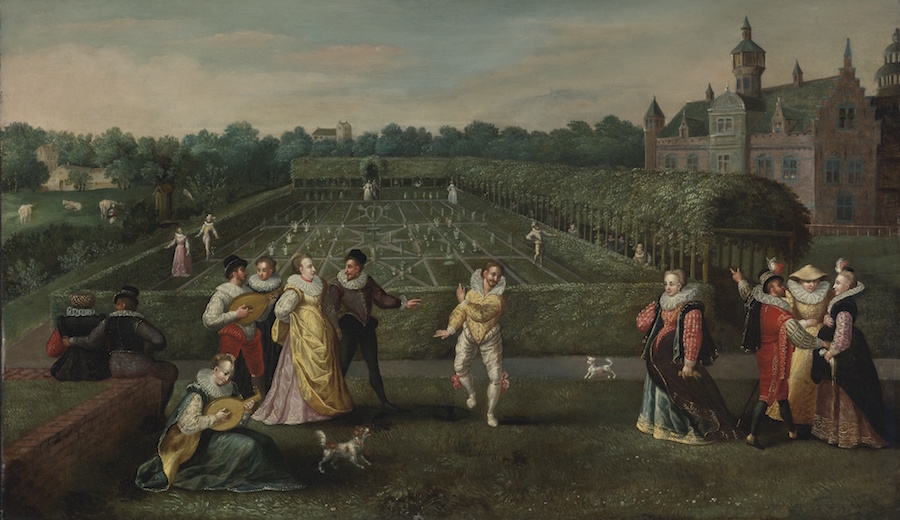
Perhaps one of the most inaccessible areas of study in American universities is the High Renaissance. From the contemplation of nude paintings to rich and dynamic texts admired by aesthetes and tourists alike, students often feel disconnected from the greater context of these works. For instance, Machiavelli’s The Prince is terribly underwhelming to those assaulted by the complex 24-hour news cycle that is now all too familiar. For us Millennials, it’s not at all shocking to believe, as Machiavelli once broke precedent by proposing, that statesman simply will not keep promises like normal people do. But of all the esoteric institutions within the period, it would seem that the most unrelatable is that of the court, which was once so integral to Renaissance life. But anyone who takes the time to read Robert Greene’s The 48 Laws of Power will become intimate with it’s history and elegant machinations. However, Greene’s attempt to illustrate the opulence of courtly lives and how they weaved their calculated gestures and actions into an art form for the purpose of overtaking their fellow courtier’s opponents — and to gain favor from those above them — fails to interest anyone but the most ambitious of historians and networkers.

Even more remote in time period and prose, though, is Baldassare Castiglione’s The Book of the Courtier. Just hearing the very first sentence of the work — “The book written at the instance of Alfonso Ariosto and in dialogue form, in order to record certain discussions held at the court of Urbino” is enough to make the eyes of readers our age glaze over. But there is more value in this book, both in terms of aesthetics and practical utility, than may first appear.

The work apparently claims to recall four successive discussions in the evening among some courtiers who are beholden to Guidobaldo da Montefeltre, the lord and master of 16th century Urbino. The book discusses cerebral challenges faced in Italy that are difficult to relate to, which include proper ways to speak Italian and why various forms of art are better than others. There’s even a maudlin and somewhat absurd assertion made about the power of love, which is so over-the-top that one can hardly imagine anyone saying it other than some overly-clingy high school romantic partner.

Despite all of these seemingly banal and arcane discussions, the text is actually not at all about simply being a dandyish man or understanding the particular merits of sculpture. (This, at least to me, is incredibly refreshing, as the surface topics discussed are incredibly boring). It would seem that the true goal of the book is to educate Renaissance nobles in perfecting their roles within the European courts. Castiligone even goes so far as to use his characters as a mouthpiece of what sports one should play, naming ‘…running, leaping, swimming and wrestling…an accomplished [horse]’ and that one must ‘…be a good dancer.’ He names everything from the sort of literature one should know to why oratory is an important skill to have.

Not only must these noblemen learn a staggeringly large list of skills and sports, but they must work so hard at them as to make it seem casual and easy. Or, as Castiligone puts it, “…[the courtier] must put every effort…into outstripping others…so that he may be…recognized as [above the rest].” But most important of all is how the courtier should conduct themselves in their performance. Through “sprezzatura” (literally translated from Italian as “effortless grace”), they must hide all their hard work and dedication so that it seems as easy as breathing.

The reason for all of this obsessive and severe professional preening and skill-building is so that he may “properly” advise his ruler and gain their favor. Supposedly, the courtier is ‘the sharpening stone’ and the prince ‘the blade’ — and it’s the former’s job to keep the latter sharp and righteous.

But there is a much darker, colder aspect to the work than simply how to love well and how to be moral. The author says, using one of his characters as a mouthpiece, “There is an adage which says that when our enemy is in the water up to his waist, we must offer him our hand and rescue him from peril; but when he is up to his chin, we must put our foot on his head and drown him forthwith.” That is an incredibly alarming piece of advice, and certainly does not sound “moral” in any sense of the word. But it may be difficult to see why all of this is pertinent to any of us. We are not princes, princesses, kings or queens; we are regular students, who hopefully will get a good job after graduation. So why worry about any of this at all?

It’s because it takes great pains to discuss the primary force within politics, and the professional world, which is power. The virtue of how to properly acquire power and how to maintain it essential in any office, classroom or home gives the practitioner an edge in any social environment one can imagine. And despite the lofty subjects discussed by the various characters in The Book of the Courtier, the banter and intimate conversations could, with updated vernacular, easily be discussed by any of us. While we should never, ever “put our foot on [someone’s head],” it is useful to remember that not everyone is what their appearance may suggest, and by reading this book, one adds that much more knowledge needed to succeed in the world, regardless of the pursuit.

You can reach RYAN DOWNER at rmdowner@ucdavis.edu.

Unitrans holds Safe Space campaign to encourage student safety

CHELBERT DAI / AGGIE

Campaign promoted in response to recent hate speech incident on Unitrans

On May 10 and 11, Unitrans conducted a Safe Space Initiative, a new campaign to raise awareness in creating a safe experience for passengers using Unitrans buses.

The initiative was created after a May 3 incident in which an African American UC Davis graduate was the victim of hate speech while riding a Unitrans bus.

Breanna Pasqua, a fourth-year communication major and human resources manager for Unitrans, said that finding ways to make university space more welcoming for people is an important aspect of using the transit system.

“We had an incident on one of our buses that prompted us to take a closer look at our policies and training and everything that goes into the way our drivers handle situations where our passengers might feel uncomfortable,” Pasqua said. “The safety of everybody that I serve in transit is really important and I think that the psychological safety is just as important, and so I know that I want everybody to feel welcome when coming onto my bus and I want them to feel equally valued.”

ASUCD Senator and third-year political science and philosophy double major Ricardo Martinez, who adopted the Unitrans unit for his term, said that advocating for student safety is always an important issue.

“Student safety should always come first,” Martinez said. “I think it’s a good thing [Unitrans is] putting student safety first and allowing students to have that safe space when they go home or when they come back to school.”

The campaign began as a project for a communication course that Pasqua and her co-workers are taking this quarter. They hope to demonstrate the steps that Unitrans is taking to promote its safe spaces, including training for employees and increased student awareness of safety procedures.

“We chose to do [the project] for Unitrans,” Pasqua said. “We chose to do kind of like a PR campaign that helped really bring awareness to all of the things that we, as a company, really wanted to promote with everybody riding our buses and participating in the Unitrans service so that we could all be active participants in making the buses a really safe spot.”

Devon O’Shea, a fourth-year English and communication double major who worked on the project and campaign, said that although the initiative was for their class, she hopes that it extends into Unitrans’ future.

“I think we definitely want to continue it,” O’Shea said. “It’s something we want to make more knowledgeable to the public. I think what we did was a really good start to it, but I think Unitrans as a whole definitely wants to continue that knowledge that we want our passengers to feel safe.”

Martinez said that he hopes that other parts of the university can emulate what the campaign is trying to do for students at UC Davis.

“I think that this is a great initiative and other departments or organizations should take the lead on making students feel safe on campus,” Martinez said. “I don’t think that this is going to be the only initiative that’s going to happen. Maybe there will be more because as long as we keep making students safe on campus, I think that’s the best that can happen.”

When talking about what the initiative means to Unitrans and the community, Pasqua said that each person can have a place to make a difference.

“I personally feel like the buses are an extension of the campus and the student body,” Pasqua said. “Especially because it’s student run and I think that our principles of community say that we accept the role that we play in being really respectful to other people; I think that’s really important.”


Written by: Ivan Valenzuela –campus@theaggie.org

UC Davis student organization raises $2,000 to donate 80 supply-filled duffel bags to local foster youth

DIANA LI / AGGIE
DIANA LI / AGGIE

Fundraiser coincides with Foster Care Awareness Month in May

Student organizations Guardian Scholars and the Davis chapter of California Youth Connection raised $2,000 in a little over two months to purchase and fill 80 duffel bags from the foster organization Together We Rise to give to foster youth in Yolo County.

According to the organizations, when foster youth are either initially put into foster care or have to move between facilities, they are often given trash bags to put their belongings in. To help comfort the youth during this transition, third-year community and regional development major Ariella Grozbord organized the fundraiser with Together We Rise to purchase duffel bags, called Sweet Cases, to give to the kids.

“By giving children entering foster care Sweet Cases, we are impacting them in what could be the most traumatic time of the their life. When entering foster care, most children receive a trash bag to put their belongings in or arrive at their new placement with nothing at all. These children are already going through a stressful time and then have to suffer the added indignity of living out of a trash bag,” said Gianna Dahlia, administrative officer of Together We Rise via email. “The Sweet Cases ensure kids that they are more than just a number in the system and that they too matter.”

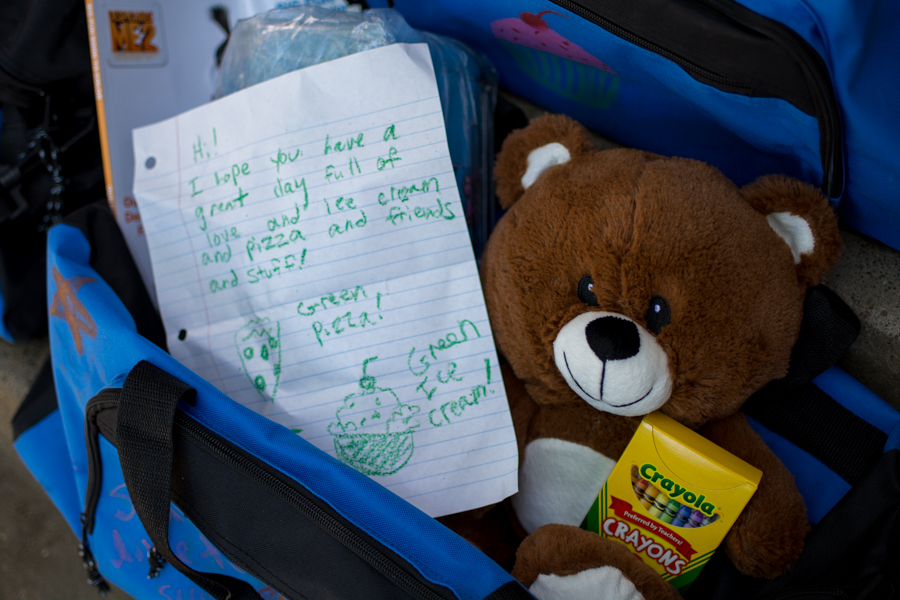
The fundraiser reached out to Greek organizations and the Davis community to ask for contributions. Donations were made online, and the $2,000 raised went entirely to purchasing the Sweet Cases. Each bag was additionally filled with a soft blanket, a teddy bear, a hygiene kit, a coloring book and a handwritten note.

“The club California Youth Connection put some of its own money into [the fundraiser], but the community [contributed] as well,” Grozbord said. “It was really just a team effort with all the volunteers from Guardian Scholars program, [California Youth Connection] and ASUCD […] It really shows how nice the Davis community is.”

On May 10, the Guardian Scholars ambassadors set up the duffel bags on the Quad, and let students decorate the exteriors and write encouraging notes to place inside.

“Having a duffel bag that is decorated or has inspirational messages makes it a little bit easier,” said Guardian Scholars program coordinator Valeri Garcia.

All members of the Guardian Scholar group have experienced foster care in their childhood. The organization reaches out to help youth going through similar experiences. Garcia explained that the program, along with California Youth Connection, allows members to give back to the foster community.

“There [are] a lot of [students] that want to give back. They’re in a position where they feel they can inspire, they can help, they can make changes. They participate in California Youth Connection to do all of that,” Garcia said. “Many students are involved because they came from foster care and it’s their way to give back and do something positive for current foster children.”

The upcoming distribution of the duffel bags coincides with May, which is Foster Care Awareness Month. The bags will be sent to foster youth in Yolo County, Solano County and Sacramento County.

In addition to the Sweet Cases, Together We Rise also fundraises for scholarships, bikes, holiday gifts and opportunities for foster youth to reunite with siblings at Disneyland. The organization distributed 31,000 Sweet Cases in 2015 and has already distributed 18,564 in 2016 with a goal to reach over 60,000 children.


Written by: Lindsay Floyd – campus@theaggie.com

The most underrated UC Davis resources

HANNAH WODRICH / AGGIE

Five assets that will help you achieve success in college.

  1. The Teaching Kitchen

The Teaching Kitchen, located at the Student Health and Wellness Center, offers various cooking classes throughout spring that students can sign up for online. These classes are free for UC Davis students, and are especially designed to cater to busy college lives.

“There are some classes that are hands-on when they actually teach you how to cook the food and also about the nutritious value of the food, and some have a guest chef,” said Sonja Chesnutt, a first-year human development major. “You watch the chefs cook the food as they teach you how to use zero waste. For example, they show you how to use all parts of foods or reuse water for boiling.”

The goal of the kitchen is to prepare students for life without the dining commons, and to prove that cooking is not truly as hard or time consuming as it seems if you follow short recipes.


2. National Alliance on Mental Illness (NAMI) club

NAMI is not an academic resource, but it is a very active and influential club on campus. This mental health club strives to destigmatize mental illness and promote mental health.

“On a day-to-day basis, we are just trying to get the word out, [providing an] open space so that people can have a more comfortable area to talk about what’s bothering them,” said  Jackie Leonardo, third-year neurobiology, physiology and behavior major and NAMI publicity director. “We offer a lot of things to create a safe space to talk about mental health, such as communication workshops in which faculty, staff and students all come together to learn how to communicate, and overpass that student-teacher barrier.”

Another resource offered by NAMI is a mental health first-aid training, from which students can receive a two-year certification. Instead of physically saving someone’s life as the words “first-aid training” may suggest, students learn how to deescalate a person in distress. Additionally, the organization puts on events that are announced on their Facebook page, such as an annual mental health fair on the Quad.


3. Math and science workshops

The Student Academic Success Center (SASC) offers various math and science workshops for students who need extra attention on topics they may be struggling with. These workshops are free and take place throughout each quarter; a schedule with locations and times can be found on the SASC website.

“The workshops have been beneficial, especially when we were going over difficult topics in class, because workshop leaders would recap and explain key concepts and procedures,” said Ella Queen, a first-year cognitive science major. “They definitely helped me succeed and understand what I was learning, and I would definitely recommend the workshops for students to go to regularly if they are struggling.”

The workshops are led by specialists in chemistry, mathematics and physics, and provide students with worksheets that contain extensive practice problems. In addition, students can benefit from the workshops’ small setting since they can easily ask questions and maximize their learning time.


4. Internship and Career Center (ICC)

The ICC is arguably one of UC Davis’ most beneficial assets for students planning their lives after college. While major advisors help students to plan course schedules, the ICC provides extensive services for students and recent alumni to achieve success beyond their university years.

“We offer [hour-long] workshops that anyone can attend in which we cover topics from Linkedin, cover letters and resume basics, finding internships and much more,” said Tiffany Lin, fourth-year managerial economics major and ICC peer advisor. “We also have drop-in advising with student advisers […] where we can help you with interview preparedness, finding internships or anything of that sort. You could also make a 30-minute appointment with a coordinator which is a more in-depth session of trying to figure out what you want to do with your career.”

An extensive description of all of the ICC’s resources can be found on their website. Drop-in advising hours are Monday through Friday from 10 a.m. to 4 p.m in their office in South Hall.


5. The Women’s Resources and Research Center (WRRC)

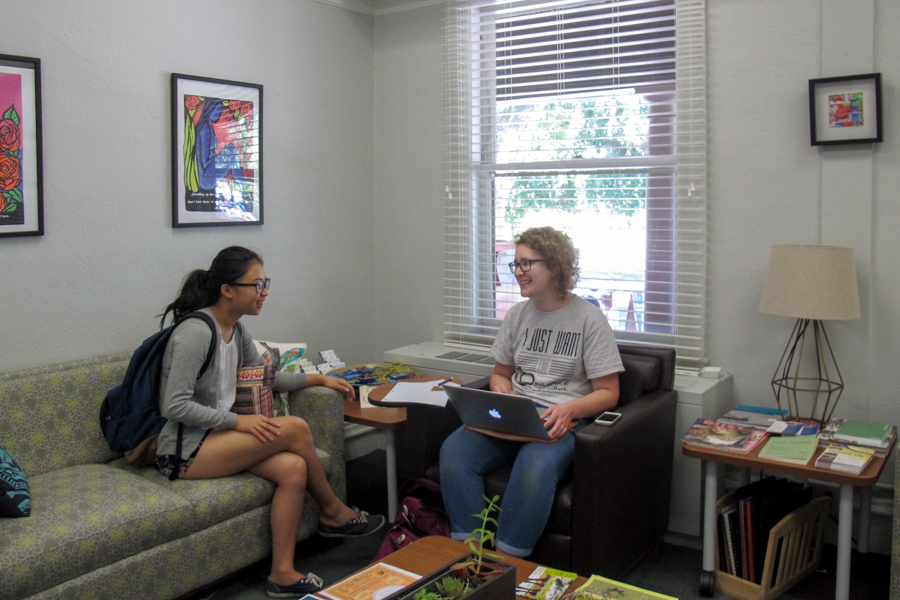
The WRRC, located on the first floor of North Hall, is dedicated to promoting gender equity in the UC Davis community. This is a place for students of all genders to talk, study and read while learning about the importance of gender equity.

Open from Monday to Thursday from 9 a.m. to 5 p.m. and Fridays from 9 a.m. to 4 p.m., the WRRC also serves as a confidential support unit for individuals who have experienced sexual trauma or gender-based violence.

“Our goal is to expand the ways in which we understand gender and sexism and to address misogyny,” said Leilani Kupo, director of WRRC. “We’ve got all of these really great resources, both on-campus and off-campus, to help students overcome some of the barriers and obstacles that make college and university even harder.”

The WRRC is a unique and free asset that UC Davis students can benefit from. Students looking for a safe space to study, access resources, learn or find support can access all of that and more in the WRRC.


Written by: Gillian Allen — features@theaggie.org